Magnetism trends in doped Ce-Cu intermetallics in the vicinity of quantum criticality: realistic Kondo lattice models based on dynamical mean-field theory
Munehisa Matsumoto

TL;DR
This study uses realistic electronic structure calculations and dynamical mean-field theory to analyze magnetism trends near quantum criticality in doped Ce-Cu intermetallics, revealing a crossover in magnetic behavior relevant for permanent magnet design.
Contribution
It presents a realistic Kondo lattice model based on DMFT to describe quantum criticality and magnetism in doped Ce-Cu intermetallics, connecting theory with experimental magnetic trends.
Findings
CeCu$_6$ doped with Au crosses a magnetic QCP at 0.2<x<0.4.
The magnetic behavior in Au-doped CeCu$_6$ is similar to that in Co-doped CeCu$_5$.
The study discusses implications for coercivity in rare-earth permanent magnets.
Abstract
The quantum critical point (QCP) in the archetypical heavy-fermion compound CeCu doped by Au is described, accounting for the localized -electron of Ce, using realistic electronic structure calculations combined with dynamical mean-field theory (DMFT). Magnetism trends in Ce(CuAu) are compared with those in Co-doped CeCu, which resides on the non-ferromagnetic side of the composition space of one of the earliest rare-earth permanent magnet compounds, Ce(Co,Cu). The construction of a realistic Doniach phase diagram shows that the system crosses over a magnetic quantum critical point in the Kondo lattice in of Ce(CuCo). Comparison between Au-doped CeCu and Co-doped CeCu reveals that the swept region in the vicinity of QCP for the latter thoroughly covers that of the former. The implications of these trends…
Click any figure to enlarge with its caption.
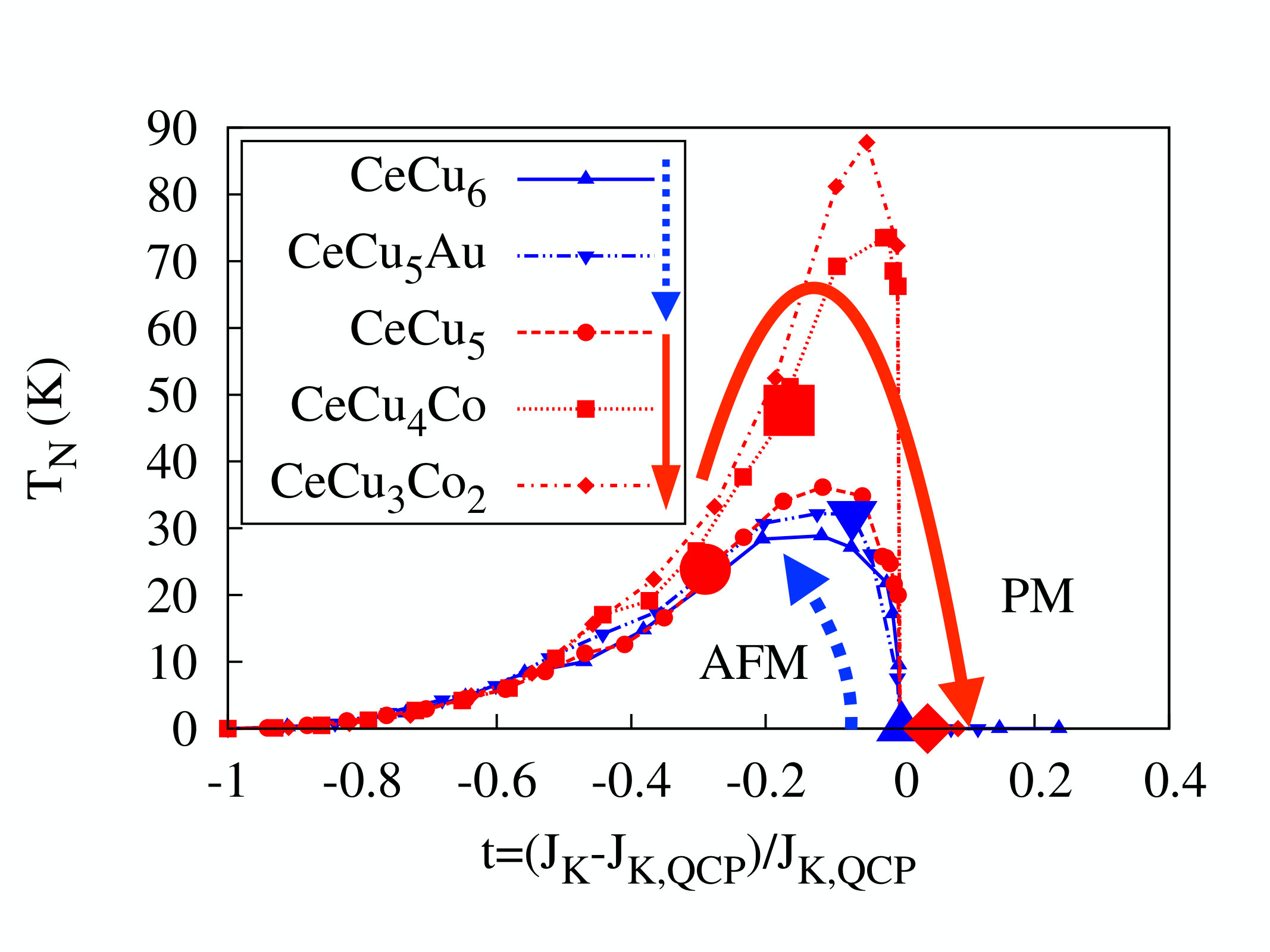 Figure 1
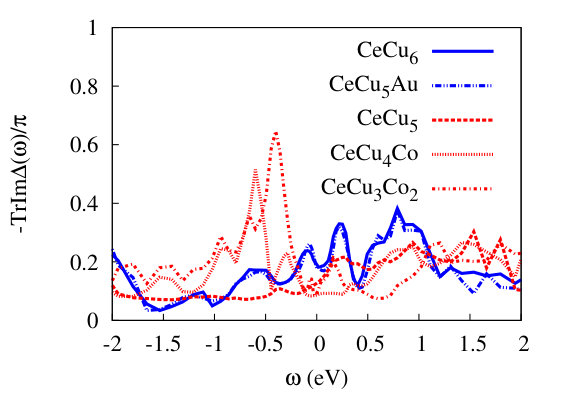 Figure 2
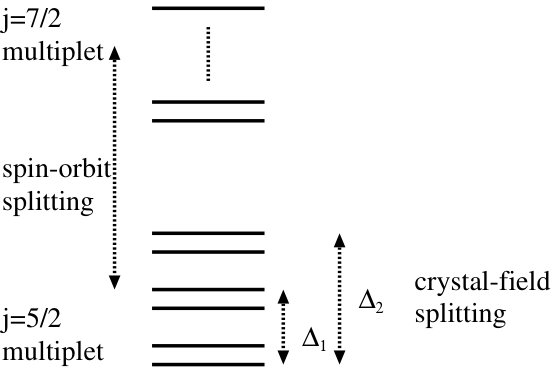 Figure 3
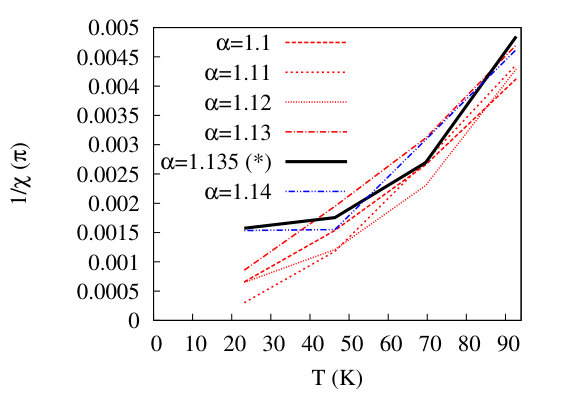 Figure 4
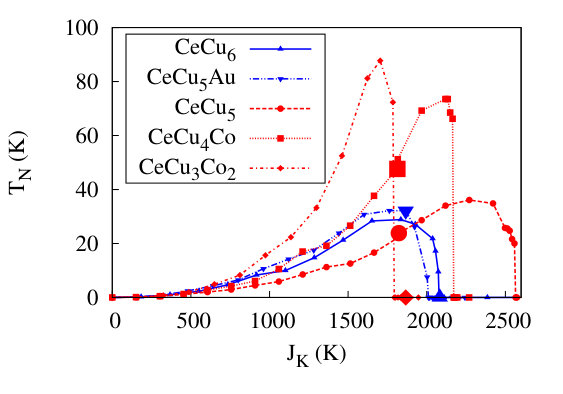 Figure 5
| compound | ,, | |
|---|---|---|
| CeCu6 | , , | Ref. act_cryst_1960, |
| CeCu5Au | , , | Ref. act_cryst_b_1993, |
| CeCu5 | , , | Ref. girodin_1985, |
| CeCu4Co | (fixed to be the same as CeCu5) | |
| CeCu3Co2 | (fixed to be the same as CeCu5) |
| (a) | |||||||||||||||||||||
|
|||||||||||||||||||||
| (b) | |||||||||||||||||||||
|
|
|||||||||||||||||||||
|---|---|---|---|---|---|---|---|---|---|---|---|---|---|---|---|---|---|---|---|---|---|
| aCu for CeCu5 and CeCu4Co / Co for CeCu3Co2 | |||||||||||||||||||||
| bCu for CeCu5 / Co for CeCu4Co and CeCu3Co2 |
| compound | ||
|---|---|---|
| CeCu6 | ||
| CeCu5Au | ||
| CeCu5 | ||
| CeCu4Co | ||
| CeCu3Co2 |
| compound | crystal-field splittings | |
|---|---|---|
| CeCu6 | , | Ref. cecu6_2007, |
| CeCu5 | Ref. jmmm_1990, |
Peer Reviews
No public reviews on file for this paper yet. If you reviewed it on a platform where reviews are public (OpenReview, ICLR, NeurIPS, ICML), you can paste yours below so the community can read it here.
Videos
No videos yet. Explain this paper in a talk, walkthrough, or lecture? Add one.
Magnetism trends in
doped Ce-Cu intermetallics in the vicinity of quantum criticality:
realistic Kondo lattice models based on dynamical mean-field theory
Munehisa Matsumoto1,2
1Institute for Solid State Physics, University of Tokyo, Kashiwa 277-8581, JAPAN
2Institute of Materials Structure Science, High Energy Accelerator Research Organization, 1-1 Oho, Tsukuba, Ibaraki 305-0801, Japan
Abstract
The quantum critical point (QCP) in the archetypical heavy-fermion compound CeCu6 doped by Au is described, accounting for the localized -electron of Ce, using realistic electronic structure calculations combined with dynamical mean-field theory (DMFT). Magnetism trends in Ce(Cu1-ϵAuϵ)6 () are compared with those in Co-doped CeCu5, which resides on the non-ferromagnetic side of the composition space of one of the earliest rare-earth permanent magnet compounds, Ce(Co,Cu)5. The construction of a realistic Doniach phase diagram shows that the system crosses over a magnetic quantum critical point in the Kondo lattice in of Ce(Cu1-xCox)5. Comparison between Au-doped CeCu6 and Co-doped CeCu5 reveals that the swept region in the vicinity of QCP for the latter thoroughly covers that of the former. The implications of these trends on the coercivity of the bulk rare-earth permanent magnets are discussed.
pacs:
71.27.+a, 75.50.Ww, 75.10.Lp
I Motivation
While heavy-fermion (HF) materials and rare earth permanent magnets (REPM’s) have gone through contemporary developments since the 1960s kondo ; strnat ; nesbitt ; tawara ; ott ; doniach ; steglich ; sagawa ; croat , apparently little overlap has been identified between the two classes of materials. One of the obvious reasons for the absence of mutual interest lies in the difference in the scope of the working temperatures: HF materials typically concern low-temperature physics of the order of 10K or even lower while REPM concerns room temperature at 300K or higher. The other reason is that the interesting regions in the magnetic phase diagram sit on the opposite sides, where HF behavior appears around a region where magnetism disappears doniach while with REPM the obvious interest lies in the middle of a ferromagnetic phase. In retrospect, several common threads in the developments for HF compounds and REPM’s can be seen: one of the earliest REPM’s was Ce(Co,Cu)5 tawara where Cu was added to CeCo5 to implement coercivity, and CeCu5 was eventually to be identified as an antiferromagnetic Kondo lattice bauer_1987 ; bauer_1991 .
One of the representative HF compounds is CeCu6 onuki ; stewart that was discovered almost at the same time as the champion magnet compound Nd2Fe14B sagawa ; croat ; rmp_1991 . While REPM’s make a significant part in the most important materials in the upcoming decades for a sustainable solution of the energy problem with their utility in traction motors of (hybrid) electric vehicles and power generators, HF materials might remain to be mostly of academic interests. But we note that a good permanent magnet is made of a ferromagnetic main-phase and less ferromagnetic sub-phases. For the latter compounds in REPM’s, we discuss possible common physics with HF materials, namely, magnetic quantum criticality where magnetism disappears and associated scales in space-time fluctuations diverge, and propose one of the possible solutions for a practical problem on how to implement coercivity, which measures robustness of the metastable state with magnetization against externally applied magnetic fields.
Even though the mechanism of bulk coercivity on the macroscopic scale in REPM’s is not entirely understood, the overall multiple-scale structure has been clear in that the intrinsic properties of materials on the microscopic scale of the scale of nm is carried over to the macroscopic scale via mesoscopic scale. Namely, possible scenarios in coercivity of Nd-Fe-B magnets hono_2012 ; hono_2018 and Sm-Co magnets ohashi_2012 have been so far discussed as follows.
Nd-Fe-B magnets
Propagating domain walls around a nucleation center of reversed magnetization are blocked before going too far. Infiltrated elemental Nd in the grain-boundary region that is paramagnetic in the typical operation temperature range of K neutralizes inter-granular magnetic couplings among Nd2Fe14B grains murakami_2014 . Single-phase Nd2Fe14B does not show coercivity at room temperature and fabrication of an optimal microstructure on the mesoscopic scale, with the infiltrated Nd metals between Nd2Fe14B grains, seems to be crucial to observe bulk coercivity.
Sm-Co magnets and Ce analogues
Pinning centers of domain walls are distributed over cell-boundary phases made of Sm(Co,Cu)5 which separate hexagonally-shaped cells of Sm2(Co,Fe)17. The uniformity of the cell boundary phase ohashi_2012 ; navid_2017 suggests that the pinning intrinsically happens on the microscopic scale in Sm(Co,Cu)5 which freezes out the magnetization reversal dynamics. Also for CeCo5, addition of Cu has been found to help the development of bulk coercivity tawara without much particular feature in the microstructure, suggesting here again an intrinsic origin contributing to the bulk coercivity.
Solution of the overall coercivity problem takes out-of-equilibrium statistical physics, multi-scale simulations involving the morphology of the microstructure in the intermetallic materials, electronic correlation in -electrons, finite-temperature magnetism of Fe-based ferromagnets, and magnetic anisotropy, each of which by itself makes a subfield for intensive studies. Faced with such a seemingly intractable problem, it is important to build up fundamental understanding step by step. Therefore, we clarify the magnetism trends around quantum criticality in Ce-Cu intermetallics, as a part of - intermetallics that belong to a common thread between HF materials and REPM, in order to pin-point a possible intrinsic contribution to the coercivity, specifically via exponentially growing length scales in spatial correlation and characteristic time in the dynamics.
The magnetization in REPM’s derives from -electron ferromagnetism coming from Fe-group elements and -electrons in rare-earth elements provide the uni-axial magnetic anisotropy for the intrinsic origin of coercivity. Sub-phases are preferably free from ferromagnetism to help coercivity e.g. by stopping the propagation of domain walls. In the practical fabrication of REPM, both of the main-phase compound and other compounds for sub-phases should come out of a pool of the given set of ingredient elements. Investigations on non-ferromagnetic materials that appear in the same composition space as the ferromagnetic material are of crucial importance for contributing the intrinsic information into the solution of the coercivity problem.
Thus we investigate the Cu-rich side of the composition space in Ce(Co,Cu)5 and inspect the magnetism trends around the HF compound, CeCu5. It is found that Co doping into CeCu5 drives the material toward a magnetic quantum critical point (QCP), to the extent that -electron ferromagnetism coming from Co does not dominate, which seems to be the case experimentally girodin_1985 when the concentration of Co is below 40%. It has also been known that Au-doped CeCu6 goes into quantum criticality 1994_cecu5.9au0.1 ; 2000_cecu5au , a trend which is reproduced in the same simulation framework. With CeCu6 as one of the most representative HF materials, experimental measurements and theoretical developments si_2001 ; coleman_2001 ; rmp_2020 have been extensively done. Our finding basically reproduces what has already been agreed on the location of magnetic QCP, but the spirit of our microscopic description may not entirely be the same as some of the past theoretical works si_2001 ; coleman_2001 ; rmp_2020 . Our description should be more consistent with even older works anderson_1961 in the fundamental spirit with the proper incorporation of realistic energy scales based on electronic structure calculations. We may fail in catching some subtlety specific to Au-doped CeCu6, but our approach should be suited rather for general purposes in providing an overview over intrinsic magnetism of - intermetallics to extract the common physics therein.
We set up a realistic Kondo lattice model mm_2009 ; mm_2010 for these cases and see the followings: 1) CeCu6 sits very close to the QCP, 2) Au-induced QCP can also be described on the basis of a conventional Kondo lattice model as downfolded from realistic electronic structure data featuring localized -electrons, at least concerning the relative location of QCP, without invoking valence fluctuations 2018 or the specialized Kondo-Heisenberg model to describe local quantum criticality si_2001 ; coleman_2001 ; rmp_2020 , in contrast to some of those previous developments si_2001 ; coleman_2001 ; 2018 for Au-doped CeCu6, and 3) Co-doping in CeCu5 drives the material toward the QCP in the opposite direction as Au-doping does in CeCu6. The main results are summarized in Fig. 1 where the Au-doped CeCu6 and Co-doped CeCu5 are located around a magnetic QCP following a rescaled realistic Doniach phase diagram doniach ; mm_2009 ; mm_2010 .
The rest of the paper is organized as follows. In the next section we describe our methods mm_2009 ; mm_2010 as specifically applied to the target materials: pristine CeCu6, CeCu5, and doped cases. In Sec. III magnetism trends in the target materials are clarified. In Sec. IV several issues remaining in the present descriptions and possible implications from HF physics on the intrinsic part of the solution of the coercivity problem of REPM are discussed. The final section is devoted to the conclusions and outlook.
II Methods and target materials
We combine ab initio electronic structure calculations on the basis of the full-potential linear muffin-tin orbital method andersen_1975 ; sergey_1996 and dynamical mean-field theory (DMFT) for a Kondo lattice model with well-localized -electrons otsuki_2007 ; otsuki_2009 ; otsuki_2009_II , to construct a Doniach phase diagram doniach adapted for a given target material to identify an effective distance of the material to a magnetic quantum critical point. Electronic structure calculations follow density functional theory (DFT) hohenberg_1964 ; kohn_1965 within the local density approximation (LDA) kohn_1965 ; vosko_1980 . Our realistic simulation framework can be regarded as a simplified approach inspired by LDA+DMFT anisimov_1997 ; gabi_2006 , where electronic structure calculations describing the relatively high-energy scales and a solution of the embedded impurity problem in the lowermost energy scales are bridged: here a realistic Kondo lattice model is downfolded imada_2010 from the electronic structure calculations for Ce-based compounds with well localized -electrons mm_2009 ; mm_2010 .
More specifically, our computational framework is made of the following two steps:
For a given target material, LDA+Hubbard-I hubbard_1963-1964 ; gabi_2006 is done to extract hybridization between localized -electrons and conduction electrons, as a function of energy around the Fermi level. Position of the local -electron level below the Fermi level is determined as well. 2. 2.
A realistic Kondo lattice model (KLM) with the Kondo coupling is defined following the relations mm_2009 :
[TABLE]
which is a realistic adaptation of Schrieffer-Wolff transformation schrieffer_1966 to map the Anderson model anderson_1961 to Kondo model. Here and are the Coulomb repulsion energy and an effective Hund coupling between electrons, respectively, in configuration and is an energy cutoff mm_2009 ; imada_2010 that defines the working energy window for the realistic Schrieffer-Wolff transformation. The trace in Eq. (2) is taken over all -orbitals and dividing the traced hybridization by gives the strength of hybridization per each orbital. Experimental information on the local level splittings is incorporated for the -electron part. The thus defined KLM is solved within DMFT using the continuous-time quantum Monte Carlo impurity solver otsuki_2007 . A Doniach phase diagram doniach separating the magnetic phase and paramagnetic phase is constructed for each of the target materials and the magnetic QCP is located.
The realistic model parameters that appear in Eqs. (1) and (2) are taken on an empirical basis referring to past works gabi_2006 ; cowan , among which the origin of the on-site Coulomb repulsion energy eV between -electrons can be traced partly back to past electronic structure calculations herbst_1978 and analyses of photoemission spectroscopy data baer_1979 . Even though one can argue for material-specific data of , here we are more concerned with relative trends among the target materials within a realistic model with fixed parameters to get an overview over a group of Ce-based compounds with well localized -electrons, rather than pursuing preciseness of each material-specific data point.
Below we describe the details of the overall procedure one by one, taking CeCu6 as a representative case, partly introducing the results.
II.1 LDA+Hubbard-I
The overall initial input here is the experimental lattice structure. This is taken from the past experimental literature for pristine CeCu6 in Ref. act_cryst_1960, and CeCu5 in Ref. girodin_1985, , and also for CeCu5Au in Ref. act_cryst_b_1993, together with the particular site preference of the dopant atom, Au. Our input lattice constants are summarized in Table 1. We note that CeCu6 undergoes a structural phase transition between a high-temperature orthorhombic phase act_cryst_1960 and a low-temperature monoclinic phase JPSJ_1986 , while CeCu5Au does not PRB_1999 . In order to compare CeCu6 and CeCu5Au on an equal footing and inspect the relative trends between them and observing that the lattice distortion introduced by the structure transition seems to be minor PRB_1999 , we fix the working lattice structure of CeCu6 to be the orthorhombic phase and proceed to the downfolding to the realistic Kondo-lattice model. The internal coordinates of atoms in CeCu6 and CeCu5Au are shown in Table 2.
For Co-doped CeCu5, various things happen in real experiments starting with the introduction of a ferromagnetic conduction band coming from Co and lattice shrinkage even before reaching the valence transition on the Co-rich side. Here in order to simplify the problem and to focus on the magnetism trends concerning the -electron QCP, we fix the working lattice to be that of pristine CeCu5 and inspect the effects of replacements of Cu by Co. Following the site preference of Co for Cu() site as suggested in Ref. uebayashi_2002, for Cu-substituted YCo5, which we also confirm in separate calculations mm_2018 , we replace Cu by Co in the sublattice one by one as shown in Table. 3 for CeCu4Co and CeCu3Co2. With this particular set-up, the effects of Co-doping on CeCu5 has been effectively softened in our calculations. However we will see that Co-doping on CeCu5 drives the material across the QCP more effectively than Au-doping does for CeCu6.
LDA+Hubbard-I calculations give the hybridization and position of the local -level, . The results for and as defined in Eq. (2) are summarized in Table 4. Raw data for as traced over all of the -orbitals is shown in Fig. 2.
II.2 DMFT for the realistic Kondo lattice model
Following Ref. mm_2009, , the hybridization function between the localized -orbital in Ce and conduction electron band defines the material-specific KLM. Here we describe the details of the Kondo impurity problem embedded in the KLM within DMFT georges_1996 where we use the continuous-time quantum Monte Carlo solver werner_2006 for the Kondo impurity problem otsuki_2007 .
In the impurity problem embedded in DMFT we incorporate the realistic crystal-field and spin-orbit level splittings in the local -orbital of Ce. The local -electron level scheme is shown in Fig. 3. For CeCu6 and hexagonal CeCu5, it is known that the crystal structure splits the multiplets into three doublets, separated by (meV) between the lowest doublet and the second-lowest doublet, and (meV) between the lowest doublet and the third-lowest doublet. Crystal-field splittings have been taken from the past neutron scattering experiments as summarized in Table 5. We set the level splitting between and multiplets due to spin-orbit interaction to be (eV) referring to the standard situation in Ce-based HF compounds settai_2007 .
The input obtained with LDA+Hubbard-I to our Kondo problem is shown in Fig. 2. The Kondo coupling via a realistic variant mm_2009 of the Schrieffer-Wolff transformation schrieffer_1966 is defined as in Eqs. (1) and (2). There was the band cutoff that is set to be equal to the Coulomb repulsion (eV), and is the effective Hund coupling in the multiplet to which the second term of Eq. (1) describes the virtual excitation from the ground state.
We sweep to locate the QCP on a Doniach phase diagram and also to pick up the realistic data point at (eV). This particular choice of the Hund coupling in the virtually excited state has been motivated muehlschlegel_1968 ; cowan by the typical intra-shell direct exchange coupling of eV and an overall magnetism trend in CeM2Si2 (M=Au, Ag, Pd, Rh, Cu, and Ru), CeTIn5 (T=Co, Rh, and Ir) and pressure-induced quantum critical point in CeRhIn5 as studied in our previous works, Ref. mm_2009, , mm_2010, , and mm_2019, , respectively. Thus the working computational setup has been applied to elucidate the magnetism trends around QCP as precisely as have been done for other representative HF compounds. In practice, we define at as and then sweep a multiplicative factor , calculating the temperature dependence of staggered magnetic susceptibility for each . In this way we can see where in the neighborhood of the QCP our target material with corresponding to the realistic number, eV, resides on the Doniach phase diagram.
We calculate the staggered magnetic susceptibility with the two-particle Green’s function following the formalism developed in Ref. otsuki_2009_II, and using a random-dispersion approximation to decouple it into single-particle Green’s functions gebhard_1997 which would enhance the transition temperature, in addition to the single-site mean-field nature in DMFT.
The calculated data for is shown in Fig. 4 for the case of CeCu6. The temperature dependence of the reciprocal of the staggered magnetic susceptibility is observed for each and we extrapolate it linearly to the low temperature region to see if there is a finite Néel temperature. We identify that the Néel temperature vanishes in the parameter range , where is the Kondo coupling at . The realistic data point is obtained by plugging in (eV) mm_2009 and (eV) (as can be found in Table 4) to Eq. (1) to be . Thus the data in Fig. 4 shows that CeCu6 is almost right on the magnetic QCP where the Néel temperature disappears.
The same procedures are applied to all other target materials.
III Results
Plotting calculated Néel temperatures with respect to , the Doniach phase diagram is constructed for each target material as shown in Fig. 5.
By rescaling the horizontal axis of the Doniach phase diagram as follows, to inspect the dimensionless distance to the QCP independently of the materials mm_2009 ; mm_2010 , we end up with the main results as shown in Fig. 1.
III.1 CeCu6 vs CeCu5
Remarkably, CeCu6 falls almost right on top of magnetic QCP in Fig. 5. Also it is seen that the energy scales for antiferromagnetic order are on the same scale for CeCu6 and CeCu5 as seen in the vertical-axis scales for the calculated Néel temperatures. This may be reasonable considering the similar chemical composition between CeCu6 and CeCu5.
Here we note that overestimates of the calculated Néel temperature are unavoidable due to the single-site nature of DMFT and approximations involved in the estimation of two-particle Green’s function mm_2009 . Thus the calculated Néel temperature for CeCu5 falling in the range of 20K should be compared to the experimental value of 4K bauer_1987 ; bauer_1991 only semi-quantitatively. Nevertheless, expecting that the same degree of systematic deviations are present in all of the data for the target compounds, we can safely inspect the relative trends between CeCu6 and CeCu5.
III.2 Magnetic QCP in Au-doped CeCu6
In Fig. 5 it is seen that doping Au into CeCu6 only slightly shifts the energy scales competing between magnetic ordering and Kondo screening. Most importantly, Au-doping drives the material towards the antiferromagnetic phase and the magnetic QCP is identified in the region Ce(Cu1-ϵAuϵ)6 with , which is consistent with the experimental trends of magnetism 1994_cecu5.9au0.1 ; 2000_cecu5au . This has been achieved with the control of an effective degeneracy of orbitals incorporating the realistic width of level splittings in the localized -orbital, putting the characteristic energy scales in magnetism under good numerical control in the present modeling.
While quantitative success for Ce(Cu1-ϵAuϵ)6 () concerning the location of the magnetic QCP is seen, some qualitative issues may be considered to be on the way to address magnetic quantum criticality, since this particular materials family represents the local quantum criticality scenario si_2001 ; coleman_2001 ; rmp_2020 where a sudden breakdown of the Kondo effect is discussed to occur on the basis of a Kondo-Heisenberg model. In our realistic model, the exchange interaction between localized -electrons naturally come in as a second-order perturbation process with respect to the Kondo coupling yosida_1957 , which is the RKKY interaction rk_1956 ; kasuya_1956 ; yosida_1957 .
Even though no special place for another Heisenberg term is identified in our realistic Kondo lattice model, there should indeed be other terms that are not explicitly considered: for example, with very well localized -electrons, there is another indirect exchange coupling campbell_1972 that work via the following two-steps: (a) intra-atomic exchange coupling between -spin and -spin and (b) inter-atomic hybridization between -band and other conduction band. Notably, in this channel the coupling between and is ferromagnetic, which is in principle in competition against the antiferromagnetic Kondo coupling that we mainly consider here.
For REPM compounds such as Nd-Fe intermetallics, the latter indirect exchange coupling, which we denote for the convenience of reference as the effective coupling between rare-earth elements and transition metals, is dominant because -electrons are even more well localized than in Ce3+-based compounds. There the Kondo couplings are not in operation practically, since - hybridization is weak and Kondo couplings are at too small energy scales as compared to other exchange couplings. Now that we bring HF materials and REPM compounds on the same playground, the - indirect exchange couplings should also have been given more attention even though there is at the moment only some restricted prescriptions mm_2016 ; toga_2016 to downfold a realistic number into .
This indirect exchange coupling can motivate the Heisenberg term on top of the realistic Kondo lattice model, even though it is to be noted that the sign of such extra Heisenberg terms is ferromagnetic. This may pave the way to define a realistic version of the Kondo-Heisenberg model si_2001 ; coleman_2001 ; rmp_2020 . Since ’s can compete against RKKY at most only on the same order, the presence of the terms would not significantly alter the position of magnetic QCP, which is brought about by the Kondo coupling that competes against RKKY as a function of exponential of the reciprocal of the coupling constants. This way, it is hoped that there might be a way to reconcile the local QCP scenario for Au-doped CeCu6 and the present realistic modeling for the magnetic QCP focusing on the characteristic energy scales involving the Kondo effect.
Recent time-resolved measurements and theoretical analyses based on DMFT NatPhys2018 ; PRL2019 for Ce(Cu,Au)6 also provides a way to reconcile the local QCP scenario and experimentally detected signals from the possible Kondo quasiparticles on the real-time axis within the non-crossing approximation (NCA) kuramoto_1983 ; bickers_1987 as the impurity solver in DMFT. Since our DMFT results are based on quantum Monte Carlo (QMC) formulated on the imaginary-time axis, migrating to the real-time data via analytic continuation poses a challenging problem jarrel_gubernatis_1996 ; otsuki_2017 , while the solution of the quantum many-body problem is numerically exact with QMC. Thus the location of QCP derived from static observables would be better addressed with the present framework.
Still our numerically exact solution is limited to the imaginary-time direction and effects of the real-space fluctuations are not incorporated in the single-site DMFT. Recently, theoretical comparison between an exact solution of the lattice problem and DMFT has been done PRL20190606 and an artifact of DMFT to overestimate the region of antiferromagnetic phase has been demonstrated. In this respect, the present location of magnetic QCP right below CeCu6 should also reflect the same artifact: if the spatial fluctuations are properly accounted for, the magnetic phase would shrink and the position of CeCu6 would shift slightly toward the paramagnetic side.
III.3 QCP to which CeCu5 is driven by Co-doping
Co-doping in CeCu5 shifts the energy scales more strongly than seen in Au-doped CeCu6. It is seen in Fig. 5 that the QCP is driven toward the smaller side, reflecting the underlying physics that Kondo-screening energy scale is enhanced as Co replaces Cu. The origin of the enhanced Kondo screening is seen in Fig. 2 where anomalous peaks below the Fermi level are coming in which should come from the almost ferromagnetic conduction band which grows into the ferromagnetism in the Co-rich side of the composition space in Ce(Cu,Co)5. With 40% of Co, the -electron QCP is already passed and CeCu3Co2 resides in the Kondo-screened phase. Thus it is found that the magnetic QCP of Ce(Cu1-xCox)5 is located in . We note that the crystal structure and crystal-field splitting have been fixed to be that of the host material CeCu5. In reality, the QCP may be encountered with smaller Co concentration.
In the present simulations, we have neglected the possible ferromagnetism in the ground state contributed by the -electrons in Co. Referring to the past experiments for Ce(Cu,Co)5 described in Ref. girodin_1985, , the absence of the observed Curie temperatures for the Cu-rich side with the concentration of Cu beyond 60% in the low-temperature region seems to be consistent with our computational setup in the present simulations. Even though other past work lectard_1994 for an analogous materials family Sm(Co,Cu)5 does show residual Curie temperature in the Cu-rich region, it should be noted that there is a qualitative difference in the nature of the conduction band of Cu-rich materials for the Sm and Ce-based families.
III.4 Universal and contrasting trends
Co-doped CeCu5 and Au-doped CeCu6 represent the different mechanisms where Co enhances - hybridization with the -electron magnetic fluctuations in the conduction electrons, while Au rather weakens - hybridization, being without -electron magnetic fluctuations.
The trend in magnetism comes from the relative strength of exchange coupling between localized -electron and delocalized conduction electrons. Among Ce-based intermetallic compounds, a general trend in the hybridization is seen to be like the following
[TABLE]
as is partly seen in Ref. mydosh_1993, for other materials family CeSi2 (=transition metals) - somewhere in the sequence of the trend written schematically in Eq. (3), a magnetic quantum critical point between antiferromagnetism located on the relatively left-hand side and paramagnetism located on the relatively right-hand side is encountered within the range where -electron ferromagnetism from Co does not dominate. The overall one-way trend from antiferromagnetism on the left-most-hand side to paramagnetism on the right-most-hand side in Eq. (3) is universal around the magnetic quantum criticality, while the contrasting trend between Au-doped case and Co-doped case in Ce-Cu intermetallics is seen from the position of the Ce-Cu intermetallics concerning the directions toward which the dopant elements drive.
The opposing trends coming from -metal dopant and -metal dopant might help in implementing a fine-tuning of the material in a desired proximity to QCP in a possible materials design for REPM’s as discussed below in Sec. IV.2.
IV Discussions
IV.1 Validity range of the Kondo lattice model
While we have defined the Kondo lattice model referring to the electronic structure of the target materials, the limitations on the validity range of such downfolding approach mm_2009 ; imada_2010 should be kept in mind in assessing the implications of the present results. In Sec. III.2, we have already discussed the possible relation of our model to the Kondo-Heisenberg model that has been extensively used in the local QCP scenario si_2001 ; coleman_2001 ; rmp_2020 for Ce(Cu1-ϵAuϵ)6. In a wider context, the spirit of the so-called - exchange model that was originally introduced by Vonsovskii vonsovskii_1946 and Zener zener_1951 in the early days of the theory of ferromagnetism is still alive in the indirect exchange coupling . This has been dropped in the present modeling for Ce-based compounds. Here we have assumed that the localization of the -electron in our Ce3+-based compounds is good enough to assure the applicability of the Kondo lattice model: at the same time, it is presumed that our -electrons in Ce3+-based - intermetallics are not so well localized as are the case in Pr3+ or Nd3+-based - intermetallics. This means that the Kondo coupling coming from - hybridization would dominate over the ’s coming from the indirect exchange coupling campbell_1972 . Such subtle interplay between different exchange mechanisms can depend on the material. Since we did not address in the present studies, the outcome of the possibly competing exchange interactions is not included in the present scope. Possible subtle aspects coming from the local QCP scenario might reside in this particular leftover region. If one would further opt for an alternative scenario sluchanko_2015 , it may be useful to further investigate the effect of these dropped terms, and include them through improved algorithms based on better intuition. Although a completely ab initio description is desirable, to make the problem tractable we are forced into making some approximations. Here it is at least postulated that the validity of the relative location of magnetic QCP can be assured in the present description because we have put the most sensitive coupling channel, Kondo physics, under good numerical control.
A few more discussions on the validity range of the Kondo lattice model and possible extensions are in order:
IV.1.1 Toward more unbiased downfolding
The terms in our low-energy effective models have been defined targeting at the particular physics, namely, the RKKY interaction and Kondo physics. While this strategy has been good enough to address the relative trends among the target materials around the magnetic QCP, it may well have happened that other relevant terms have been dropped that do not significantly affect the location of QCP. In this regard it may be preferred either a) to downfold from the realistic electronic structure to the low-energy effective models in a more unbiased way, at least proposing all possible candidate terms and eliminating some of them only in the final stage according to a transparent criterion e.g. referring to the relevant energy window or b) to work on the observables directly from first principles without downfolding. While b) does not look very feasible, a) might pose a feasibly challenging problem with a possible help from machine learning rmp_2019 in systematically classifying the candidate terms even for such materials with multiple sublattices, multiple orbitals and relatively large number of orbital degeneracy as imposed from -electrons and -electrons.
IV.1.2 Effects of valence fluctuations
Valence fluctuations have not been entirely incorporated in the present description of Ce compounds. Other scenario for Au-doped CeCu6 that emphasizes the relevance of valence fluctuations are recently discussed 2018 . We have described at least the magnetism trends around the QCP in CeCu6 and CeCu5Au only with localized -electrons. Apparently valence fluctuations may not be dominant at least for magnetism. We can restore the charge degrees of freedom for -electrons and run an analogous set of simulations for a realistic Anderson lattice model in order to see any qualitative difference comes up on top of the localized -electron physics. Often the typical valence states for Ce, Ce4+ or Ce3+, are not so clearly distinguished: even in the present Kondo lattice description, state with Ce4+ are virtually involved in the Kondo coupling and localized -electrons even contribute to the Fermi surface otsuki_2009_FS . To pick up a few more cases, for actinides or -Ce, one can either discuss on the basis of localized -electrons and define the Kondo screening energy scale spanning up to 1000K, or convincing arguments can be done also on the basis of delocalized -electrons emphasizing the major roles played by valence fluctuations. Given that it does not seem quite clear how precisely the relevance or irrelevance of valence fluctuations should be formulated for the description of magnetism trends, here we would claim only the relative simplicity of our description for magnetic QCP in Ce(Cu1-ϵAuϵ)6 (). This simplification may well come with the restricted validity range.
IV.2 Implications on the coercivity of REPM
Observing that the magnetic QCP can be encountered in the chemical composition space of Ce(Cu,Co)5, we note that slowing down of spin dynamics when the system crosses over to QCP can be exploited in intrinsically blocking the magnetization reversal processes in REPM to help the coercivity. Since coercivity is a macroscopic and off-equilibrium notion, it is still much under development to formulate a theoretical bridge over the gap between the microscopic equilibrium properties and macroscopic coercivity. At least with QCP, diverging length scales of fluctuations and diverging relaxation times can in principle reach the macroscopically relevant spatial and time scales to help coercivity. Range of the critical region on the temperature axis and on the composition space would depend on each specific case.
In Sm-Co magnets, even though it is clear that the cell boundary phase intrinsically carries the coercivity nesbitt ; ohashi_2012 ; navid_2017 , precise characterization of the inter-relation among the intrinsic properties, microstructure, and coercivity has been still under investigation ohashi_2012 ; navid_2017 ; chris_2018 . Since Sm(Cu,Co)5 can be considered as a hole analogue of Ce(Cu,Co)5 in the lowest multiplet of Ce3+, with a quest for QCP both for magnetism and possibly also for valence fluctuations, it may help to consider the possible role of QCP in Sm(Cu,Co)5 for the intrinsic part of the coercivity mechanism. Considering the electron-hole analogy, possible effect from QCP for Sm(CuCo)5 can be expected in the concentration range (here is defined in Sec. III.3) which fall in . This may be compared favorably with the experimentally discussed nesbitt concentration of Cu in Sm-Co magnets, where up to around 35% of Cu in the cell-boundary phase made of Sm(Co,Cu)5, especially in the triple-junction area zhang_2000 ; xiong_2004 , has been correlated with the emergence of good coercivity.
V Conclusions and outlook
Realistic modeling for Au-doped CeCu6 and Co-doped CeCu5 successfully describes the trends in magnetism involving QCP on the basis of the localized -electrons. One of the archetypical HF materials family, CeCu6, and its Au-doping-induced QCP can be described within a magnetic mechanism with the terms that can be naturally downfolded from the realistic electronic structure in the spirit of the Anderson model anderson_1961 , without explicitly invoking valence fluctuations or introducing additional Heisenberg terms. We believe we have just put the characteristic energy scales of the target materials around QCP under good numerical control in having succeeded in addressing the relative trends in magnetism around QCP. We do not rule out other subtlety around QCP that may come from other terms si_2001 ; coleman_2001 ; rmp_2020 that are not included in the present simulation framework. As long as the dominating energy scales are concerned, those other terms would not significantly alter the magnetism trend around QCP.
Co-doping in CeCu5 drives the material on a wider scale on the chemical composition axis as compared to Au-doped CeCu6. This is caused by magnetic fluctuations in the paramagnetic conduction band that is on the verge of ferromagnetism. For the - intermetallic paramagnets in REPM in general, small changes in the -metal concentration can drive the material around in the proximity of quantum criticality on the chemical composition space, rendering it easy to encounter critical regions in a microstructure with an appropriate spatial variance in the microchemistry.
Ce(Co,Cu)5 represents one of the earliest and most typical materials family in REPM rmp_1991 ; li_and_coey_1991 . The lattice structure of the materials family RT5 including Ce(Co,Cu)5 can be transformed into R2T17 and RT12 li_and_coey_1991 (R=rare earth and T=Fe group elements), and a local structure around the rare-earth sites in the champion magnet compound R2Fe14B (R=rare earth) resembles RT5 as described in Sec. III A of Ref. rmp_1991, . With our results for Ce(Cu,Co)5 in relation to Ce(Cu,Au)6 concerning QCP, it has been suggested that potentially various properties of derived compounds from the RT5 archetypical series chris_2019 residing in REPM, especially physics in the crossover to QCP, can be exploited for the possible intrinsic contribution to coercivity.
Acknowledgements.
MM’s work in Institute for Solid State Physics (ISSP), University of Tokyo and High Energy Accelerator Research Organization (KEK) is supported by Toyota Motor Corporation. The author thanks C. E. Patrick for his careful reading of the manuscript. The author benefited from comments given by J. Otsuki and H. Sepehri-Amin. The author gratefully acknowledges helpful discussions with H. Shishido, T. Ueno, K. Saito in related projects, crucial suggestions given by T. Akiya pointing to the particular materials family R(Cu,Co)5 (R=rare earth), and an informative lecture given by K. Hono in the early stage of this project. The present work was partly supported by JSPS KAKENHI Grant No. 15K13525. Numerical computations were executed on ISSP Supercomputer Center, University of Tokyo and Numerical Materials Simulator in National Institute for Materials Science.
The reference list from the paper itself. Each links out to its DOI / PubMed record.
- 1(1) J. Kondo, Resistance Minimum in Dilute Magnetic Alloys, Prog. Theor. Phys. 32 , 37 (1964).
- 2(2) G. Hoffer and K. J. Strnat, Magnetocrystalline Anisotropy of Y Co 5 and Y 2 Co 17 , IEEE Trans. Mag. MAG-2 , 487 (1966).
- 3(3) E. A. Nesbitt, R. H. Willens, R. C. Sherwood, E. Buehler, and J. H. Wernick, New Permanent Magnet Materials, Appl. Phys. Lett. 12 , 361 (1968).
- 4(4) Y. Tawara and H. Senno, Cerium, Cobalt, and Copper Alloy as a Permanent Magnet Material, Japan. J. Appl. Phys. 7 , 966 (1968).
- 5(5) K. Andres, J. E. Graebner, and H. R. Ott, 4 f 4 𝑓 4f -Virtual-Bound-State Formation in Ce Al 3 at Low Temperatures, Phys. Rev. Lett. 35 , 1779 (1975).
- 6(6) S. Doniach, The Kondo lattice and Weak Antiferromagnetism, Physica 91B , 231 (1977).
- 7(7) F. Steglich, J. Aarts, C. D. Bredl, W. Lieke, D. Meschede, W. Franz, and H. Schäfer, Superconductivity in the Presence of Strong Pauli Paramagnetism: Ce Cu 2 Si 2 Phys. Rev. Lett. 43 , 1892 (1979).
- 8(8) M. Sagawa, S. Fujimura, N. Togawa, H. Yamamoto, and Y. Matsuura, New material for permanent magnets on a base of Nd and Fe, J. Appl. Phys. 55 , 2083 (1984).