Chemical composition induced quantum phase transition in Cs$_{1-x}$Rb$_{x}$FeCl$_{3}$
S. Hayashida, L. Stoppel, Z. Yan, S. Gvasaliya, A. Podlesnyak, and A., Zheludev

TL;DR
This study explores how changing chemical composition in Cs$_{1-x}$Rb$_{x}$FeCl$_{3}$ induces a quantum phase transition from a gapped state to magnetic order, with disorder effects prominent at intermediate Rb levels.
Contribution
It provides experimental evidence of a composition-driven quantum phase transition in an $S=1$ quantum magnet using thermodynamic and neutron scattering techniques.
Findings
Quantum phase transition at x~0.35
Magnetic excitations broaden at intermediate x
Disorder influences magnetic excitations
Abstract
The isostructural series of quantum magnets CsRbFeCl is investigated, using both thermodynamic measurements and inelastic neutron scattering experiments. It is found that increasing Rb content the system evolves from the gapped state at , through a quantum phase transition at , and to the magnetically ordered state at larger . Inelastic neutron experiments for , , and demonstrate that the magnetic anisotropy and spin interactions are continuously tuned by the chemical composition. For the intermediate concentration all magnetic excitations are substantial broadened suggesting that disorder plays a key role in this species. For the two end-compounds, excitations remain sharp.
Click any figure to enlarge with its caption.
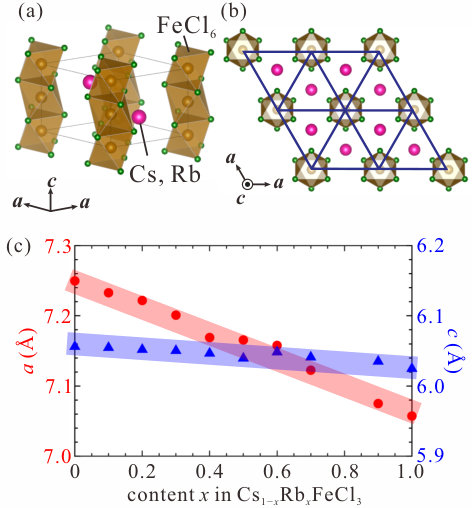 Figure 1
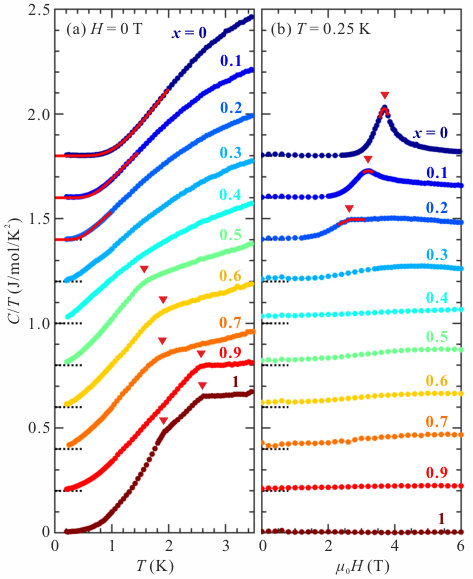 Figure 2
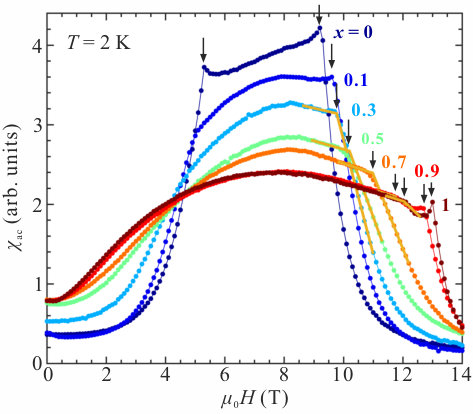 Figure 3
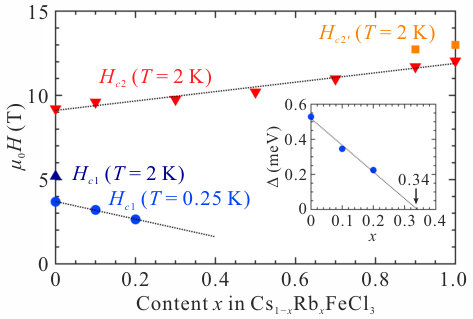 Figure 4
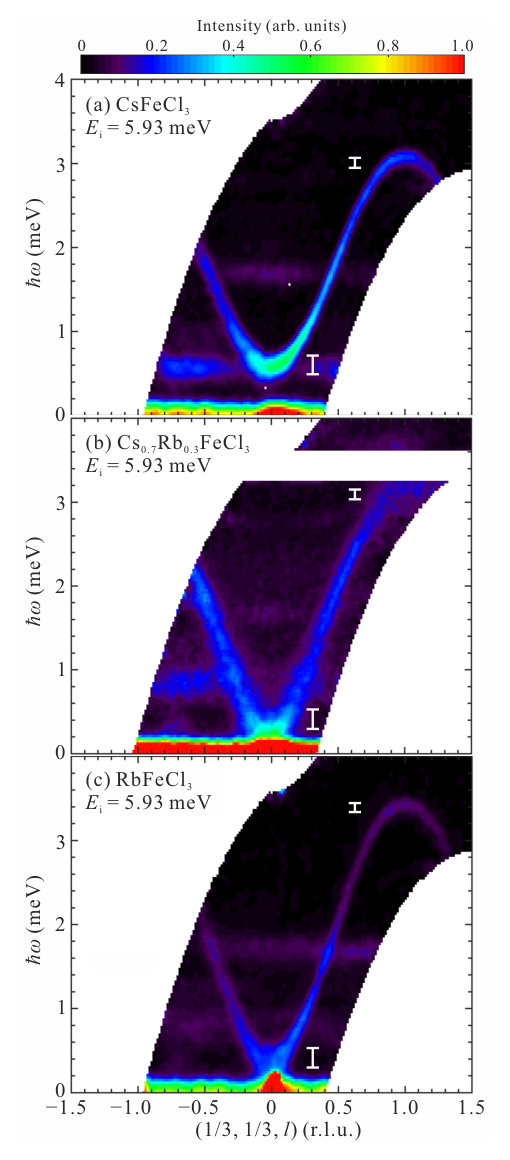 Figure 5
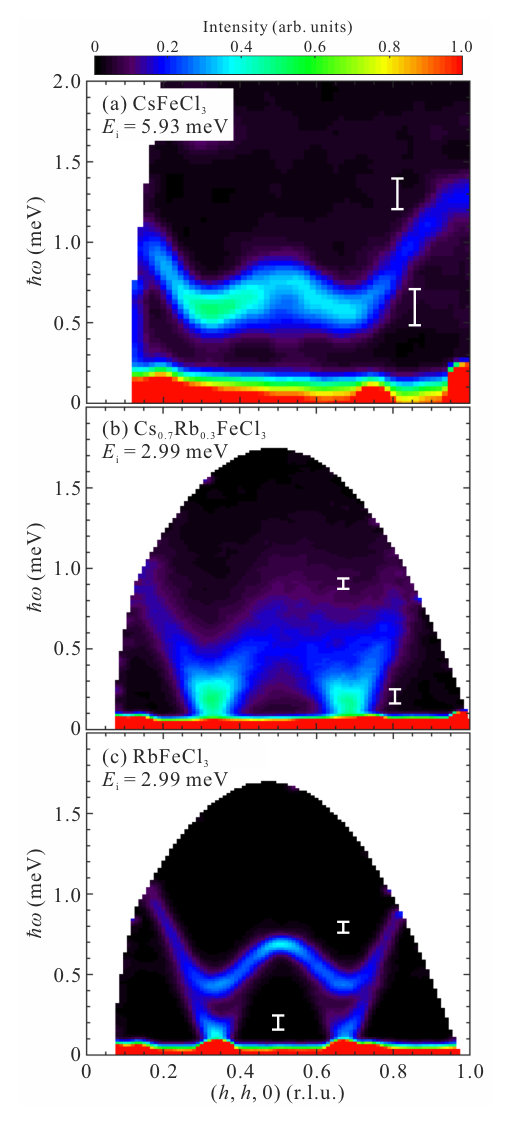 Figure 6
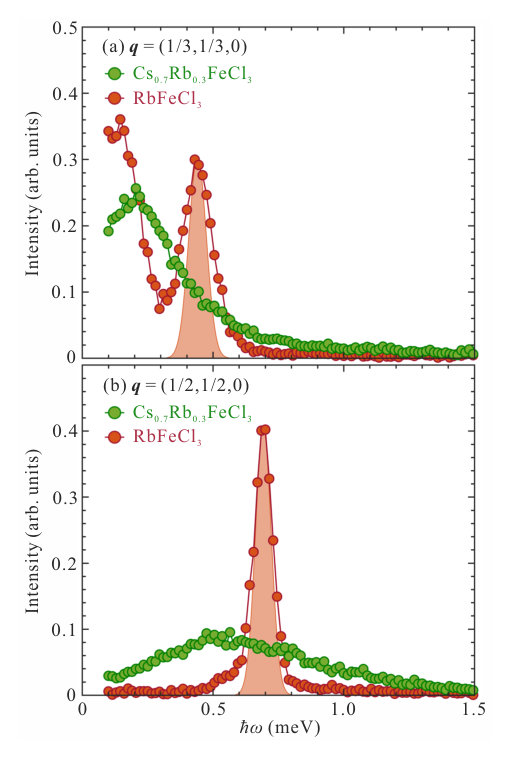 Figure 7
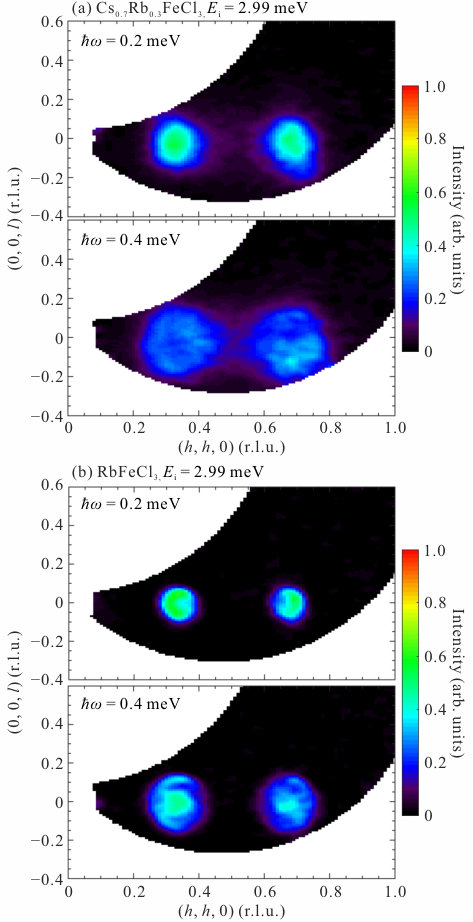 Figure 8
Peer Reviews
No public reviews on file for this paper yet. If you reviewed it on a platform where reviews are public (OpenReview, ICLR, NeurIPS, ICML), you can paste yours below so the community can read it here.
Videos
No videos yet. Explain this paper in a talk, walkthrough, or lecture? Add one.
Chemical composition induced quantum phase transition in
Cs1-xRbxFeCl3
S. Hayashida,1 L. Stoppel,1 Z. Yan,1 S. Gvasaliya,1 A. Podlesnyak,2 and A. Zheludev1
1Laboratory for Solid State Physics, ETH Zürich, 8093 Zürich, Switzerland
2Neutron Scattering Division, Oak Ridge National Laboratory, Oak Ridge, Tennessee 37831, USA
Abstract
The isostructural series of quantum magnets Cs1-xRbxFeCl3 is investigated, using both thermodynamic measurements and inelastic neutron scattering experiments. It is found that increasing with Rb content the system evolves from the gapped state at , through a quantum phase transition at , and to the magnetically ordered state at larger . Inelastic neutron experiments for , , and demonstrate that the magnetic anisotropy and spin interactions are continuously tuned by the chemical composition. For the intermediate concentration all magnetic excitations are substantially broadened suggesting that disorder plays a key role in this species. For the two end compounds, excitations remain sharp.
I Introduction
Gapped quantum paramagnets are an excellent platform for studying quantum phase transitions (QPTs). In these systems QPTs leading to a magnetically ordered state can be induced by magnetic field, pressure, or chemical modification Sachdev (2000, 2007, 2008). Field-induced QPTs of this type have been extensively studied in numerous compounds, a review of which can be found in Ref. Zapf et al. (2014). Pressure-induced QPTs have been also reported in several systems including TlCuCl3 Tanaka et al. (2003); Rüegg et al. (2004, 2008), piperazinium-Cu2Cl6 Thede et al. (2014); Perren et al. (2015); Mannig et al. (2016), and CsFeCl3 Kurita and Tanaka (2016); Hayashida et al. (2018). Recent attention has been drawn to the less common chemical composition induced QPTs in quantum magnets Vojta (2013); Zheludev and Roscilde (2013). Unlike the field- and pressure-induced QPTs, in composition-driven QPTs disorder effects are endemic because of a local structural-distortion by the chemical modification. The presence of such disorder can change the nature of the quantum critical point (QCP) Zheludev and Roscilde (2013), or even destroy it entirely Vojta (2013). QPTs in the presence of disorder are complex phenomena, understanding which can benefit from further experimental input.
The effect of the chemical substitution has actually already been studied in most known quantum magnets, including Tl1-xKxCuCl3 Oosawa and Tanaka (2002); Shindo and Tanaka (2004), (CH3)2CHNH3Cu(Cl1-xBrx)3 Náfrádi et al. (2013); Perren et al. (2018), piperazinium-Cu2(Cl1-xBrx)6 Hüvonen et al. (2012, 2012, 2013); Glazkov et al. (2014), H8C4SOCu2(Cl1-xBrx)4 Wulf et al. (2011), and Cu(quinoxaline)(Cl1-xBrx)2 Keith et al. (2011); Povarov et al. (2014). Unfortunately, all these systems are pushed away from criticality by such modification. To date, the only known composition-induced QPT is in a gapped quantum magnet Ni(Cl1-xBrx)4SC(NH2)2 (DTNX), where disorder effects do not seem to play a huge role Yu et al. (2012); Wulf et al. (2013); Povarov et al. (2015, 2017); Mannig et al. (2018). In the present work we present another example, where disorder effects are much more prominent.
Our target compound is an easy-plane type antiferromagnet Cs1-xRbxFeCl3. Species of this isostructural series crystallize in a hexagonal structure with space group as displayed in Figs. 1(a) and 1(b). Straightforward powder x-ray diffraction measurements yield lattice constants Å and Å for CsFeCl3 and Å and Å for RbFeCl3, in agreement with previous studies Seifert and Klatyk (1966). For intermediate Rb content the lattice parameters change continuously as shown in Fig. 1(c).
The magnetic properties of Cs1-xRbxFeCl3 are due to Fe2+ ion (, , ). The FeCl6 octahedra form one-dimensional chains along the crystallographic axis [Fig. 1(a)], and a triangular structure in the plane [Fig. 1(b)]. The low-energy excitation of the Fe2+ ion is described by a pseudo-spin due to the cubic crystal field and spin-orbit coupling Inomata and Oguchi (1967); Eibschütz et al. (1975). The spin system has been identified as ferromagnetic chains. These chains are weakly coupled by antiferromagnetic interaction in the triangular plane Montano et al. (1973); Yoshizawa et al. (1980); Steiner et al. (1981). Since they have strong easy-plane type anisotropy, the system is regarded as easy-plane type antiferromagnet Matsumoto and Koga (2007). The easy-plane anisotropy splits the triplet spin into the singlet and the doublet , favoring a gapped non-magnetic ground state which is a quantum disordered (QD) phase. In contrast, the spin interaction favors a magnetic long-range ordered (LRO) state. Controlling the competition between the anisotropy and the spin interaction by an external parameter brings about the QPT.
CsFeCl3 exhibits a gapped non-magnetic ground state with on each site Yoshizawa et al. (1980), and a pressure-induced QPT Kurita and Tanaka (2016); Hayashida et al. (2018). In contrast, RbFeCl3 undergoes a three magnetic transitions at K, K, and K Haseda et al. (1981); Wada et al. (1982). The ground state below K is a 120*∘* structure having the propagation vector Wada et al. (1982). In this paper we show that, similarly to what is seen in DTNX Povarov et al. (2015, 2017); Mannig et al. (2018), the spin gap in Cs1-xRbxFeCl3 closes at some critically value , driving a QPT and eventually restoring magnetic long-range order.
II Experimental details
Single-crystal samples were grown by the vertical Bridgman method Kurita and Tanaka (2016). The crystals were aligned using the Bruker APEX-II single crystal x-ray diffractometer. Bulk measurements were carried out using the Quantum Design Physical Property Measurement System (PPMS). Heat capacity was measured on a standard Quantum Design relaxation calorimetry option and the 3He-4He dilution refrigerator insert for PPMS. We measured temperature scans at zero magnetic field and field scans at 0.25 K for each sample. Field dependence of alternating current (ac) magnetic susceptibility was measured at 2 K. In both measurements of the heat capacity and ac magnetic susceptibility, magnetic field was applied along the axis.
Inelastic neutron scattering (INS) experiments were performed at the Cold Neutron Chopper Spectrometer (CNCS) Ehlers et al. (2011, 2016) at the Spallation Neutron Source (SNS) of the Oak Ridge National Laboratory in USA. Three samples were investigated: the parent compounds CsFeCl3 and RbFeCl3, as well as the material Cs0.7Rb0.3FeCl3. In each case the samples were aligned such that corresponding - planes were horizontal. All measurements were performed at 0.1 K maintained by a 3He-4He dilution cryostat. Data were taken with incident neutron beam energies or 2.99 meV. The energy resolution at elastic position was and 0.09 meV, respectively. For each incident energy, the samples were rotated stepwise to fully cover the spectra in the scattering plane. In the following, all spectra shown represent data integrated in momentum transfer perpendicular to the horizontal plane in the range Å*-1*.
III Results and discussion
III.1 Thermodynamics
The measured temperature dependencies of heat capacity in zero magnetic field are shown in Fig. 2(a). For the parent compound CsFeCl3, the specific heat below 2 K has a pronounced activated form , as indicated by the red solid curve. The activation energy is determined to be 0.529(1) meV. The low temperature heat capacities for and are also reasonably well described by activation laws with activation energies are 0.346(2) and 0.225(3) meV, respectively. We conclude that the spin gap decreases with increasing for small .
On the Rb side, two kinks are observed at , and 1.9 K for the parent compound RbFeCl3 as indicated by the triangles in Fig. 2(a). These correspond to the transitions at and , as reported in Refs. Haseda et al. (1981); Wada et al. (1982). At around K there is a weak indication of an additional feature in the temperature dependence for the material. However, repeated measurements on several samples were unable to unambiguously clarify its significance. For , only the second kink at higher temperature is visible. Single kinks indicative of long-range ordering are also observed at , and , but not at . The position of the kink decreases with decreasing the Rb content, indicating that the transition temperature reduces upon approaching the critical point. We conclude that is close to being at the critical concentration.
The field scans of the heat capacity at 0.25 K are shown in Fig. 2(b). A sharp peak is observed at 3.7 T for , which corresponds to a phase transition from the gapped state to the antiferromagnetically ordered one. The transition field is consistent with the previous reports Kurita and Tanaka (2016). A peak and kink are also observed for and 0.2. Their positions are shown in Fig. 2(b) by red triangles and visibly shift towards lower field with increasing . This is also consistent with a decrease of the spin gap. The peak in specific heat becomes progressively broader and disappears at . Overall, the observed broadening of the heat capacity peak is much more pronounced than in the similar system DTNX Povarov et al. (2017). This suggests that in Cs1-xRbxFeCl3 the magnetic state is strongly affected by disorder caused by the chemical substitution.
As shown in Fig. 3, the magnetic susceptibility of Cs1-xRbxFeCl3 systematically evolves as a function of Rb concentration . For , sharp anomalies are observed at the field of gap closure T and at saturation T. For the saturation field is T. The anomaly at lower fields is rapidly broadened with increasing Rb content, but pronounced kinks near saturation persist at all concentrations. This implies that disorder affects the low-energy gap excitations more than the high-energy zone-boundary states. For and 0.9, there are two separate features near . The kinks at about 12 T continue the trend found in lower Rb content materials, and another sharp feature appears at about 13 T.
The measured critical fields and are plotted as a function of the Rb content in Fig. 4. The resulting phase diagram indicates that the concentration systematically tunes the spin Hamiltonian. The concentration evolution of the gap energies estimated from the heat capacity is shown in the inset of Fig. 4. From a linear extrapolation, the critical concentration can be estimated as .
III.2 Inelastic neutron scattering
The measured INS spectra for CsFeCl3, Cs0.7Rb0.3FeCl3 and RbFeCl3 are visualized in Figs. 5 and 6 as cuts along the and directions, respectively. They are presented as false color plots of the neutron intensity, and are plotted without any background subtraction. The flat intensity bands at and 1.8 meV in Figs. 5(a)-5(c) are spurious and have been observed to shift their position when the incident energy is changed. They are likely due to multiple scattering in the sample environment. Note that different panels show measurements with two different incident energies and thus different energy resolution, as indicated by the white vertical bars in the figures.
Highly dispersive magnetic excitations are clearly observed below meV along the direction and below 1.5 meV along the direction in all samples. As borne out in Figs. 5(a) and 6(a), in CsFeCl3 there is a single excitation branch with a gap of 0.59 meV in full agreement with previous neutron studies Yoshizawa et al. (1980) and with the activation energy of the heat capacity. In RbFeCl3 our experiments show magnetic Bragg peaks appearing at low temperatures. The magnetic propagation vector is consistent with previous neutron diffraction study Wada et al. (1982). However, unlike the previously reported lower-resolution inelastic experiments Yoshizawa et al. (1980), two distinct spin-wave branches are observed in the inelastic channel. One of these has a gap of 0.5 meV at , while the other is gapless (see Fig. 6(c)).
The most interesting results pertain to Cs0.7Rb0.3FeCl3. Only a single mode is visible. However, compared to the parent compound, the bandwidth is increased and the spin gap is almost closed, as shown in Fig. 5(b). No elastic (Bragg) scattering was observed at the wave vector of the dispersion minimum, suggesting that the system is still in the quantum paramagnetic phase. Figures 7 show constant- cuts at and . Whether or not there is a true gap at the former reciprocal space position is not clear cut, although the observed broad peak is centered at a finite energy of 0.2 meV. We conclude that the concentration of is close to critical. Constant energy slices below 0.4 meV are shown in Fig. 8(a). These are contained in a well-defined and almost isotropic “relativistic” cone, suggesting that the proximate QCP is a three-dimensional one with a dynamical exponent , similarly to DTNX Povarov et al. (2015, 2017); Mannig et al. (2018). Compared to the parent compound in Fig. 8(b), the spectrum in the compound broadens in the space and loses its distinct concentric structure.
A key finding of this work is that the magnetic excitations in Cs0.7Rb0.3FeCl3 are obviously broadened compared to those in the parent compounds. Note that the data shown in Figs. 7 were taken with the high resolution setup meV. The intrinsic width of the measured inelastic features is also apparent in the scans plotted in Figs. 7. We attribute the broadening effect to disorder, as in DTNX Povarov et al. (2017); Mannig et al. (2018). Note, however, that the relative broadening appears to be considerably more pronounced in Cs0.7Rb0.3FeCl3. Unfortunately, this extreme broadening in Cs0.7Rb0.3FeCl3, as well as the presence of multiple and often poorly resolved branches in RbFeCl3, prevents us from carrying out a consistent quantitatively spin-wave theoretical analysis of the excitation spectra, as it was done for DTNX Mannig et al. (2018).
IV Conclusion
The qualitative conclusions of this study are rather unambiguous. For Cs1-xRbxFeCl3 undergoes a composition-driven transition from a gapped paramagnetic to a gapless and eventually magnetically ordered state. The transition itself, as well as the spin dynamics in its vicinity are strongly affected by disorder effects.
Acknowledgments
This work was supported by Swiss National Science Foundation under Division 2. We thank Dr. K. Yu. Povarov (ETH Zürich) for assistance with the thermodynamics measurements and for fruitful discussion. The neutron scattering experiment at the CNCS used resources at the Spallation Neutron Source, a DOE Office of Science User Facility operated by the Oak Ridge National Laboratory (IPTS-21713.1).
The reference list from the paper itself. Each links out to its DOI / PubMed record.
- 1Sachdev (2000) S. Sachdev, Science 288 , 475 (2000) . · doi ↗
- 2Sachdev (2007) S. Sachdev, Quantum Phase Transitions (Cambridge University Press, 2007). · doi ↗
- 3Sachdev (2008) S. Sachdev, Nature Physics 4 , 173 EP (2008) . · doi ↗
- 4Zapf et al. (2014) V. Zapf, M. Jaime, and C. D. Batista, Rev. Mod. Phys. 86 , 563 (2014) . · doi ↗
- 5Tanaka et al. (2003) H. Tanaka, K. Goto, M. Fujisawa, T. Ono, and Y. Uwatoko, Physica B 329-333 , 697 (2003) . · doi ↗
- 6Rüegg et al. (2004) C. Rüegg, A. Furrer, D. Sheptyakov, T. Strässle, K. W. Krämer, H.-U. Güdel, and L. Mélési, Phys. Rev. Lett. 93 , 257201 (2004) . · doi ↗
- 7Rüegg et al. (2008) C. Rüegg, B. Normand, M. Matsumoto, A. Furrer, D. F. Mc Morrow, K. W. Krämer, H. U. Güdel, S. N. Gvasaliya, H. Mutka, and M. Boehm, Phys. Rev. Lett. 100 , 205701 (2008) . · doi ↗
- 8Thede et al. (2014) M. Thede, A. Mannig, M. Månsson, D. Hüvonen, R. Khasanov, E. Morenzoni, and A. Zheludev, Phys. Rev. Lett. 112 , 087204 (2014) . · doi ↗