Search for muon-philic new light gauge boson at Belle II
Yongsoo Jho, Youngjoon Kwon, Seong Chan Park, Po-Yan Tseng

TL;DR
This paper explores Belle II's potential to detect a light, muon-specific gauge boson that could explain the muon g-2 anomaly, focusing on the process e+ e- → μ+ μ- + X with missing energy.
Contribution
It demonstrates that Belle II can probe the parameter space of a muon-philic light gauge boson relevant to the muon g-2 discrepancy with planned high luminosity.
Findings
Belle II can test the muon g-2 favored parameter space.
The light gauge boson can be detected down to coupling constants of 1.5×10⁻⁴.
The signal involves muon pairs plus missing energy, serving as a clear signature.
Abstract
Motivated by the long-lasting discrepancy in the anomalous magnetic moment of muon, we consider a new muon-specific force mediated by a light gauge boson, , with mass and the coupling constant . We show that the Belle~II experiment has a robust chance to probe such a light boson in channel and cover the most interesting parameter space explaining the discrepancy with the planned target luminosity, . The clean signal of muon-pair plus missing energy at Belle II can be a smoking gun for the new gauge boson. We expect that the (invisibly decaying) muon-philic light () gauge boson can be probed down to for 50 (1, 10) ab search.
Click any figure to enlarge with its caption.
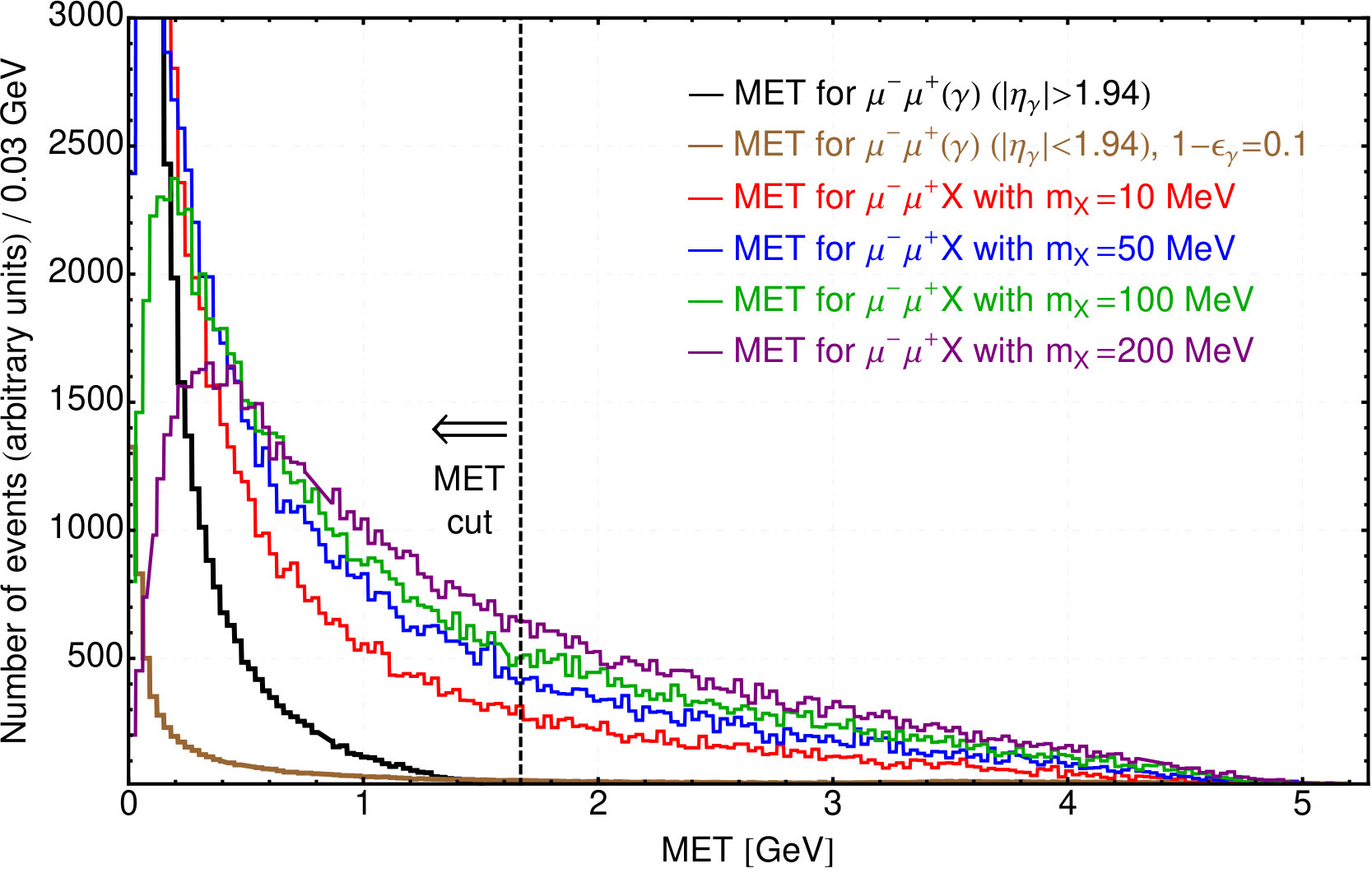 Figure 1
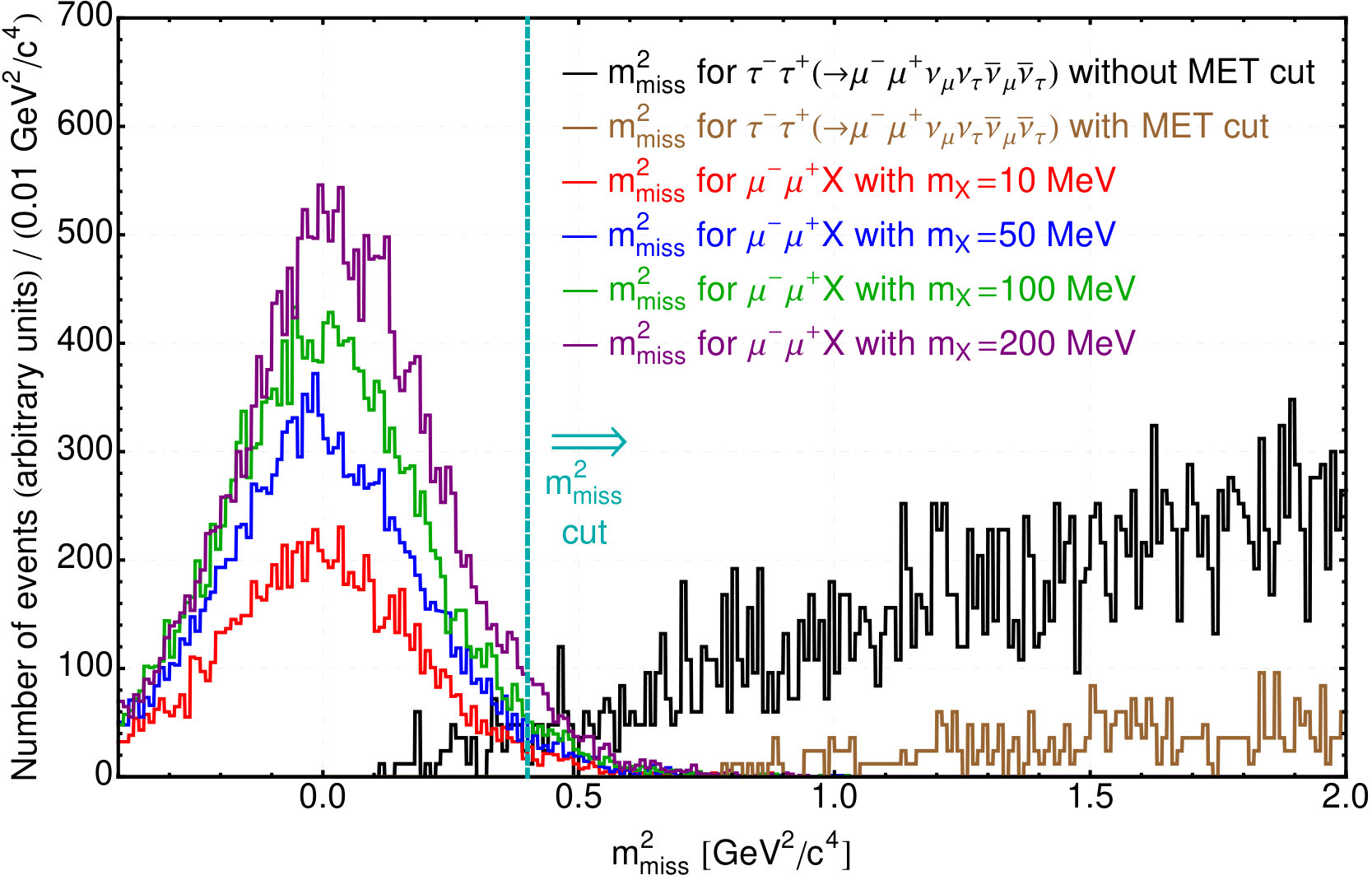 Figure 1
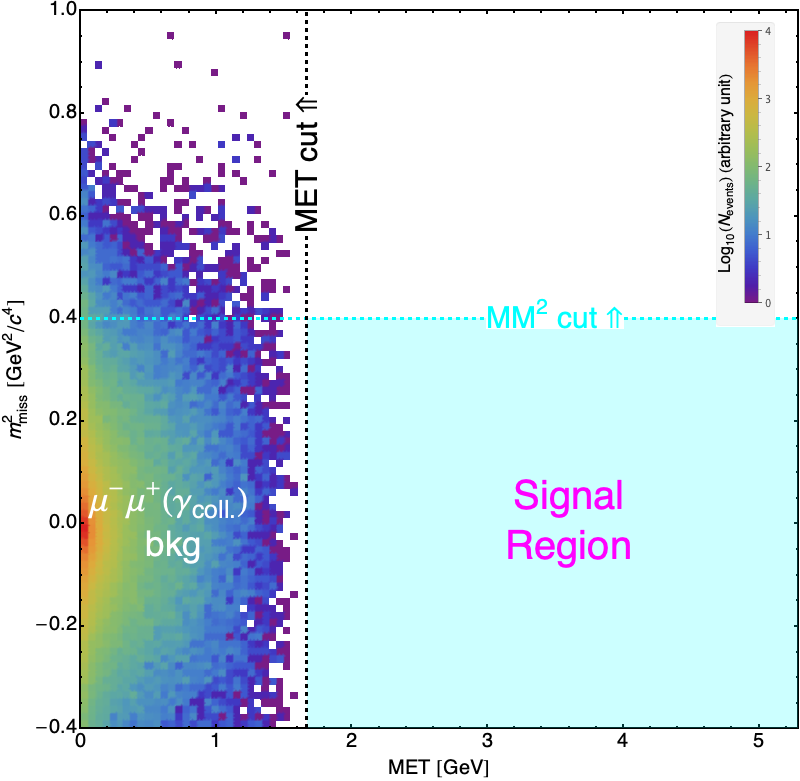 Figure 2
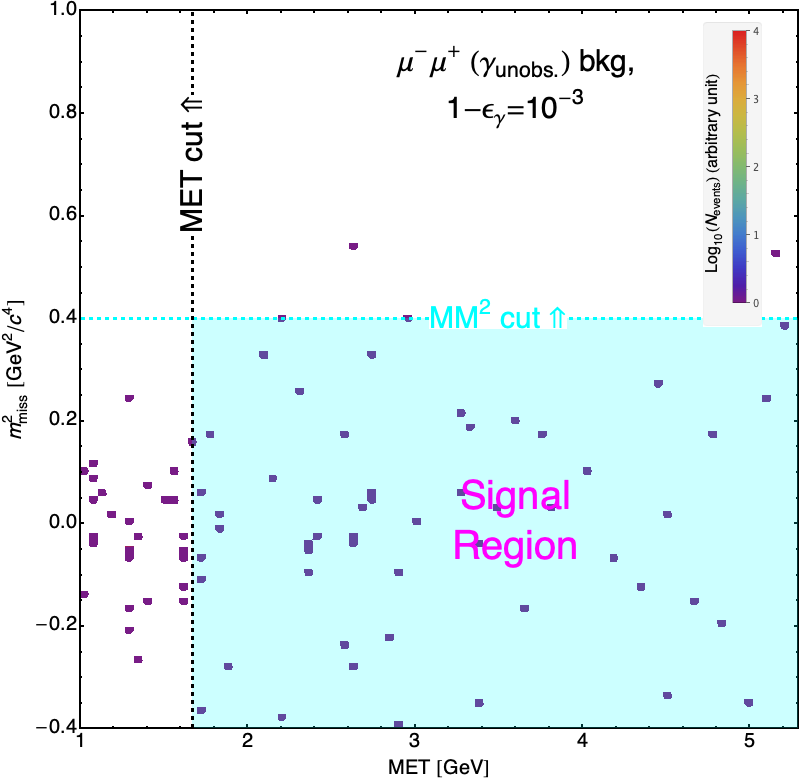 Figure 2
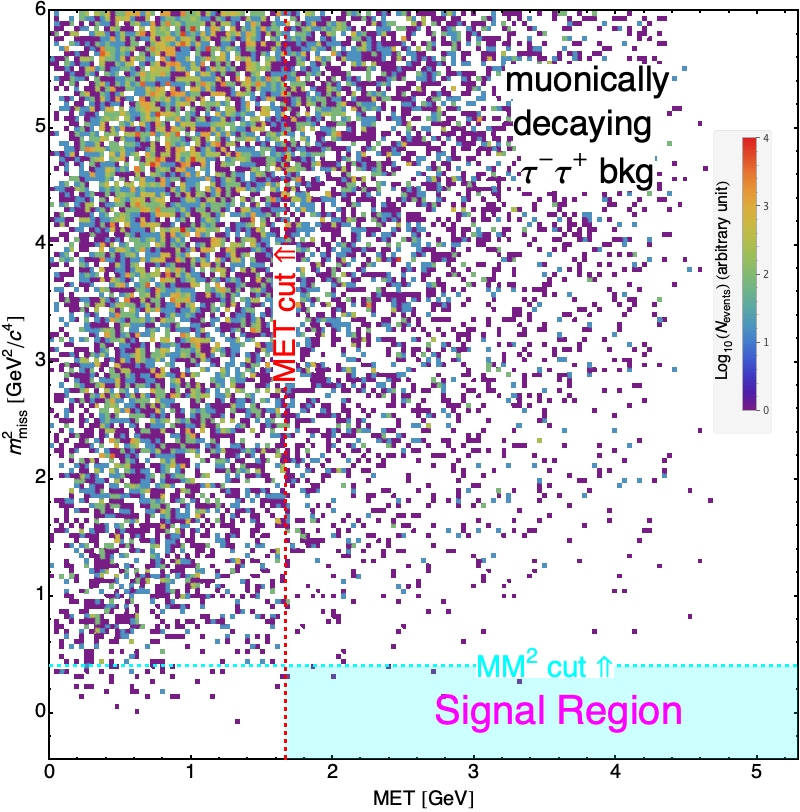 Figure 2
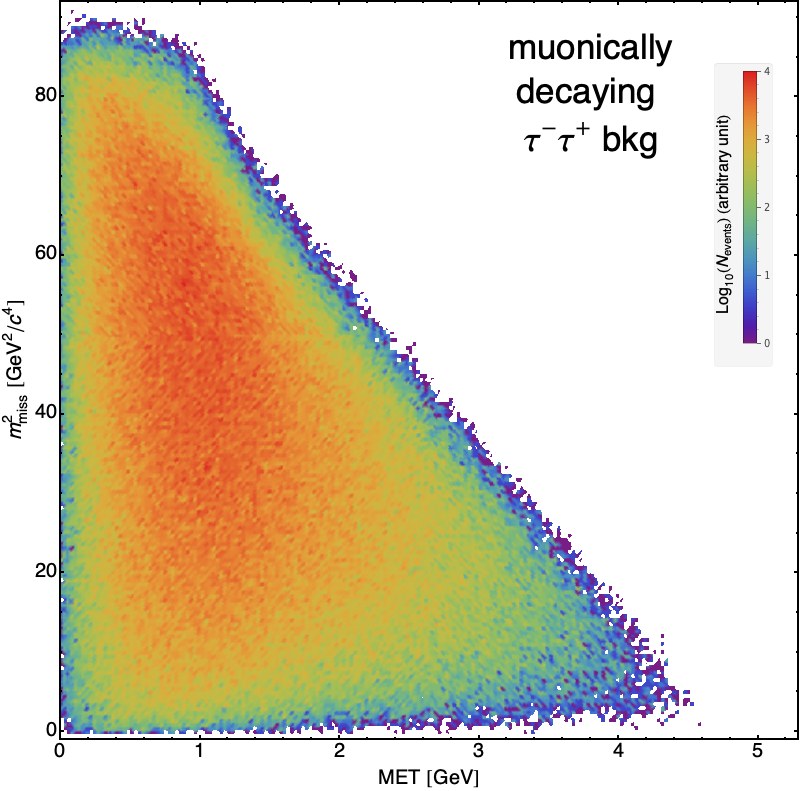 Figure 2
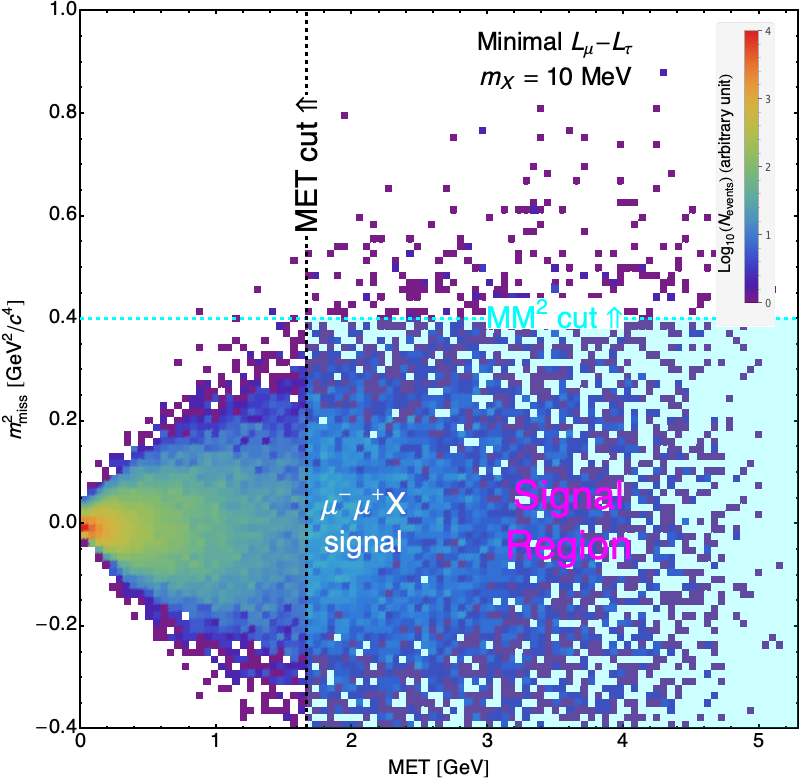 Figure 2
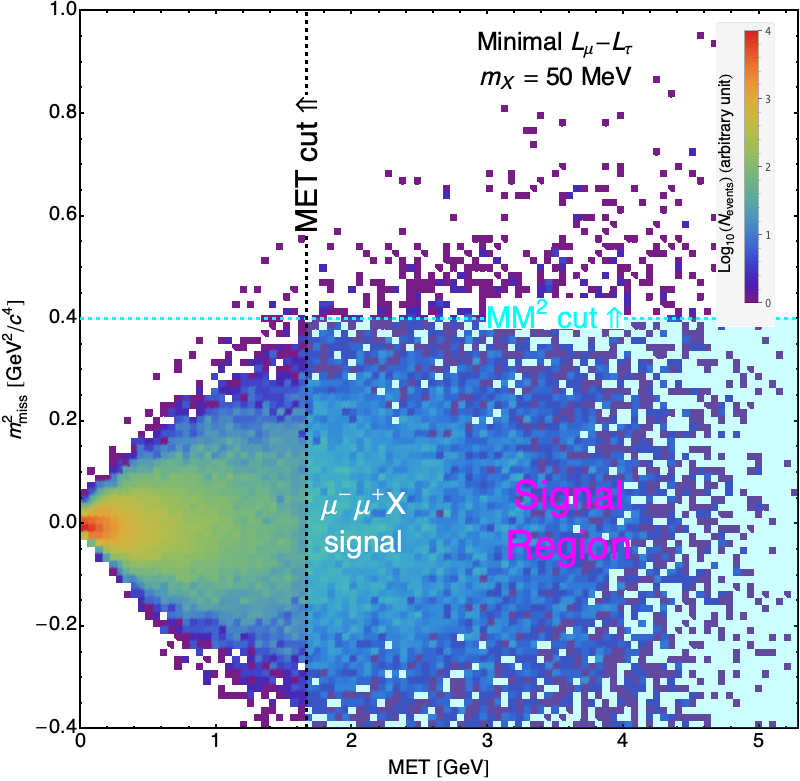 Figure 2
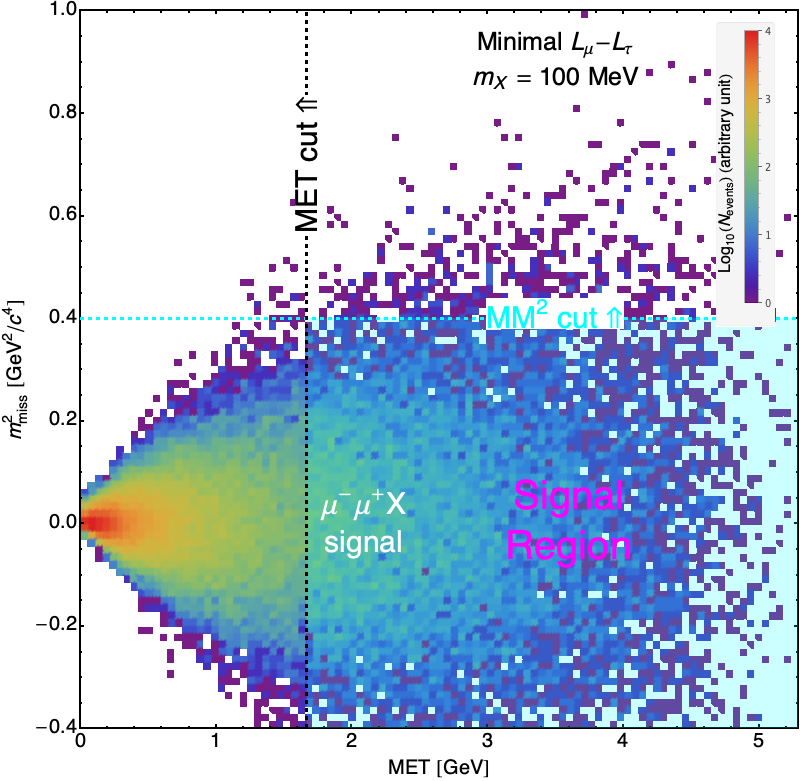 Figure 2
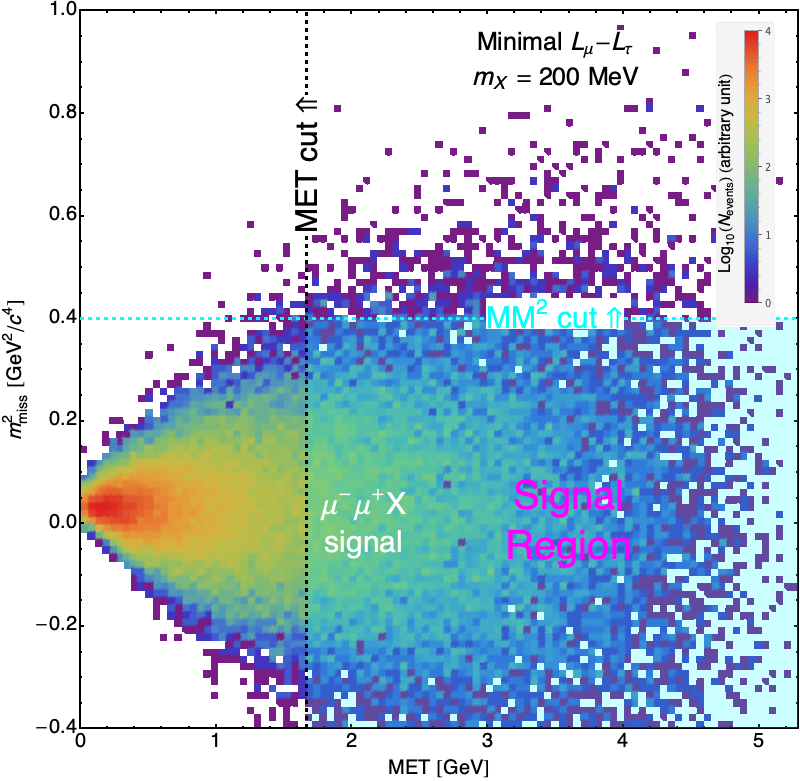 Figure 2
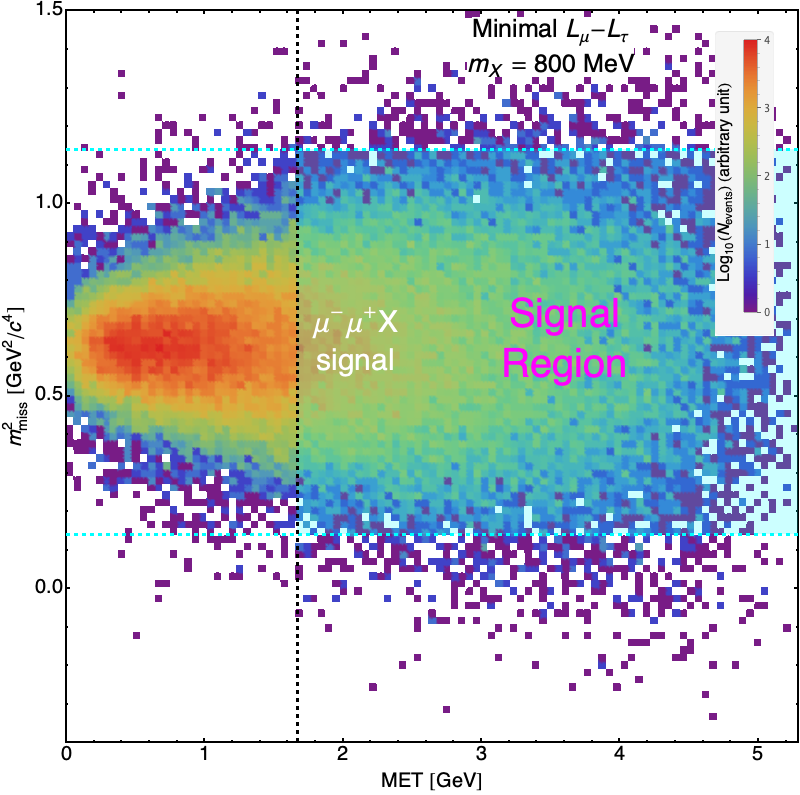 Figure 2
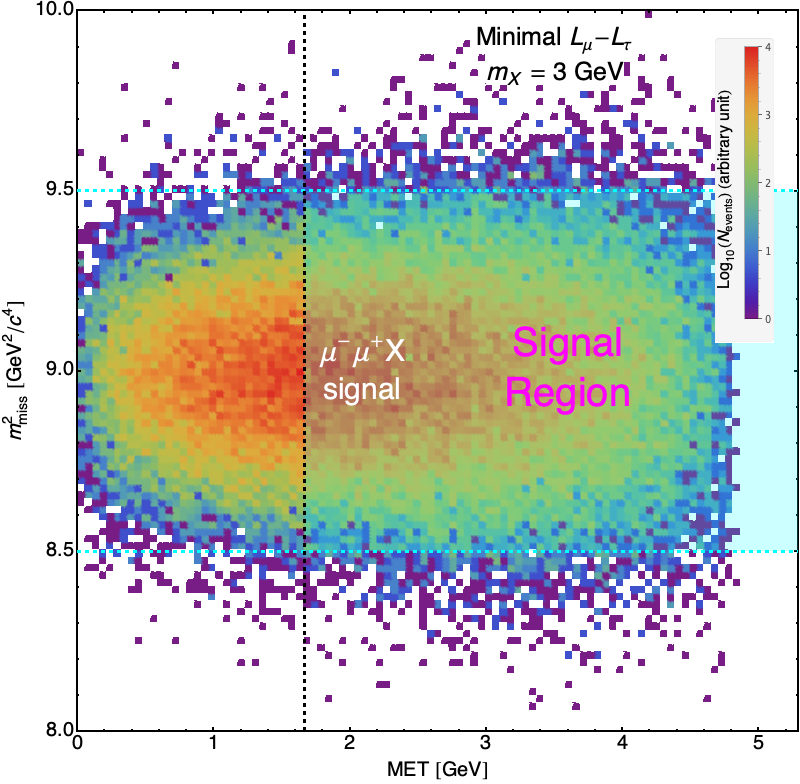 Figure 2
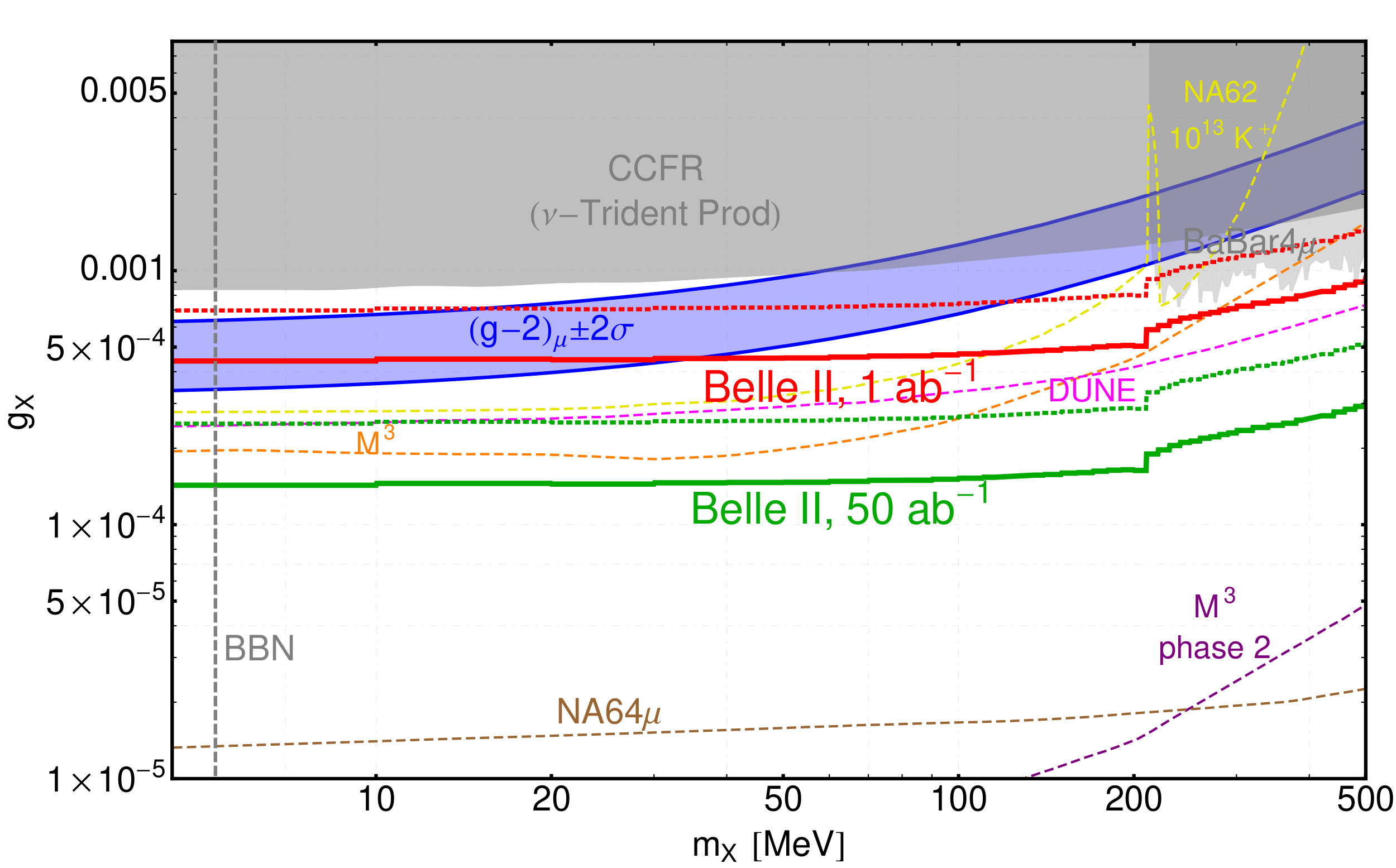 Figure 13
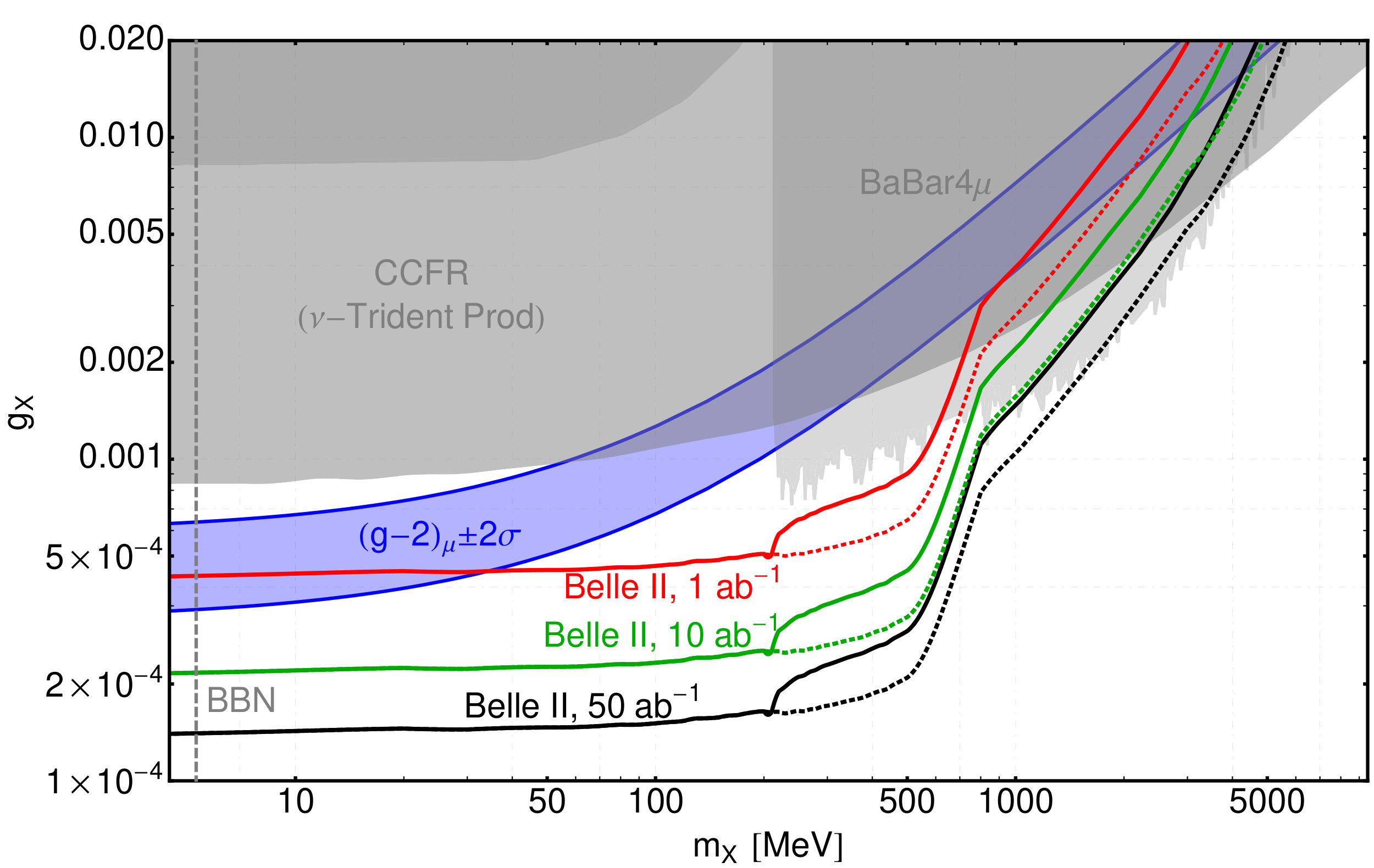 Figure 14
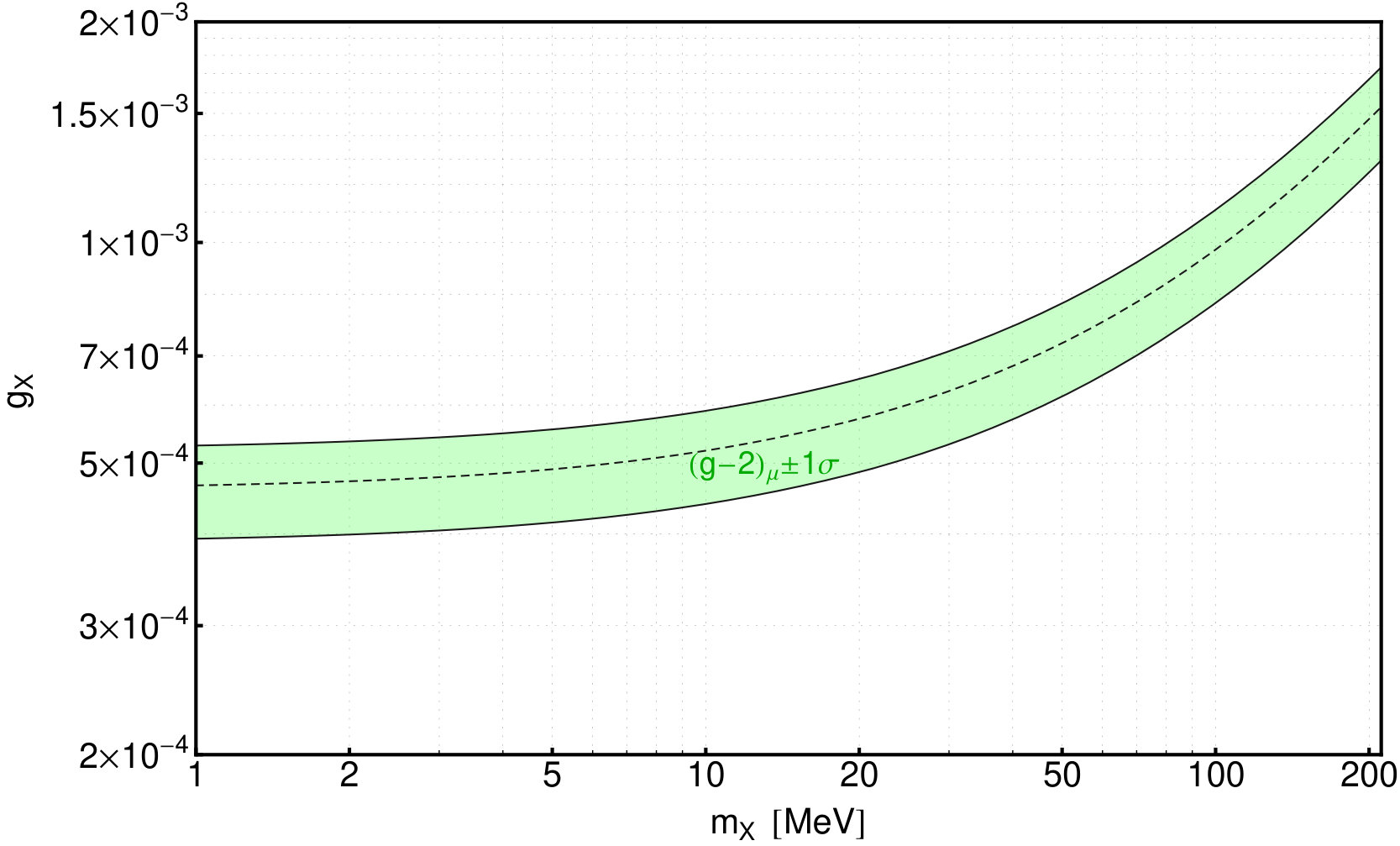 Figure 15
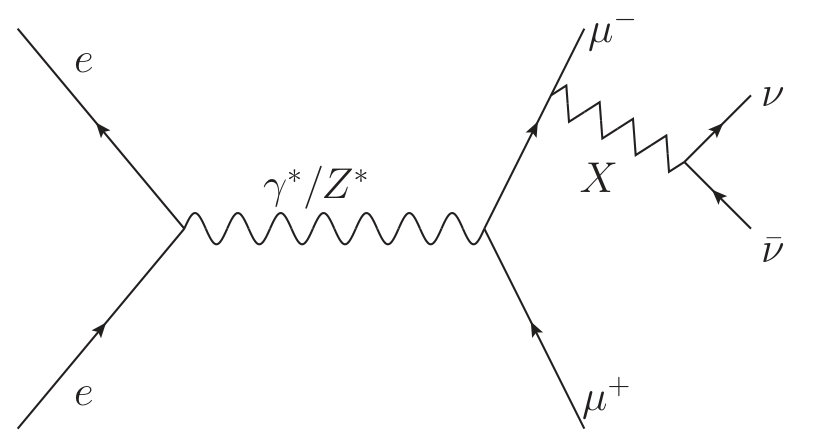 Figure 16
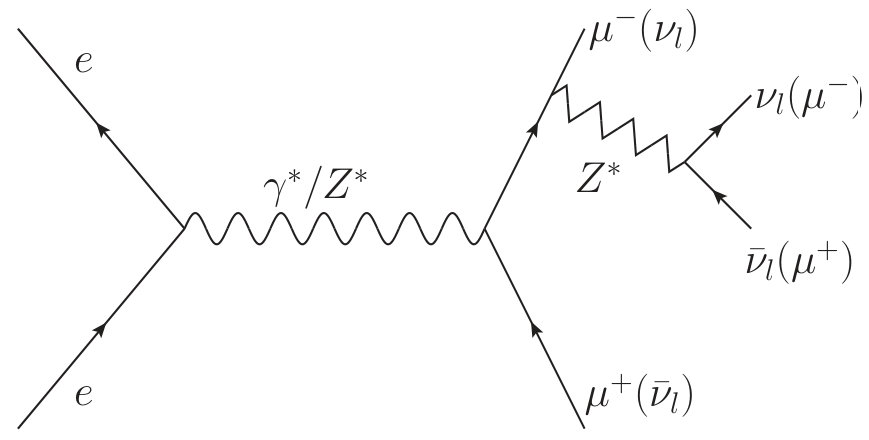 Figure 17
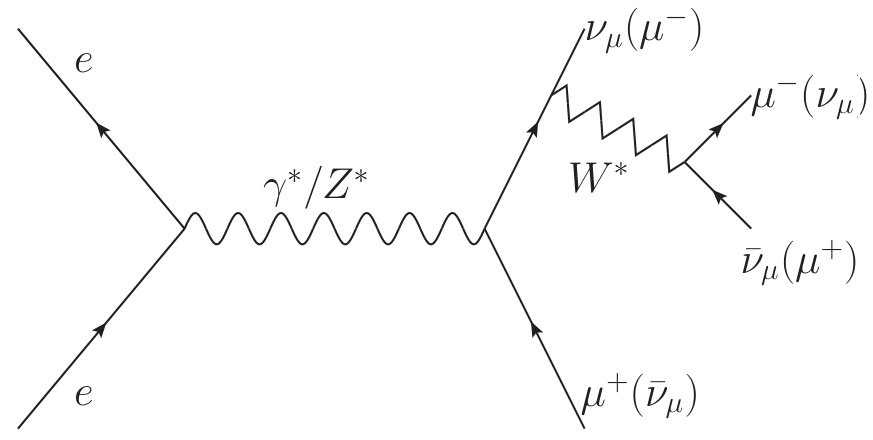 Figure 18
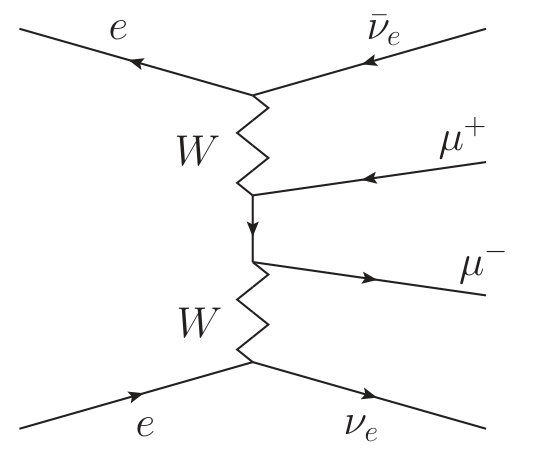 Figure 19
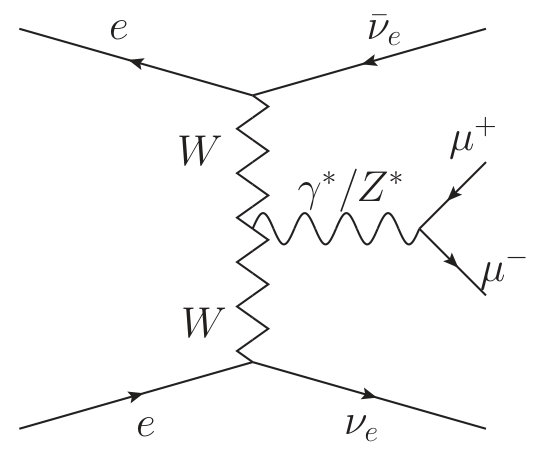 Figure 20
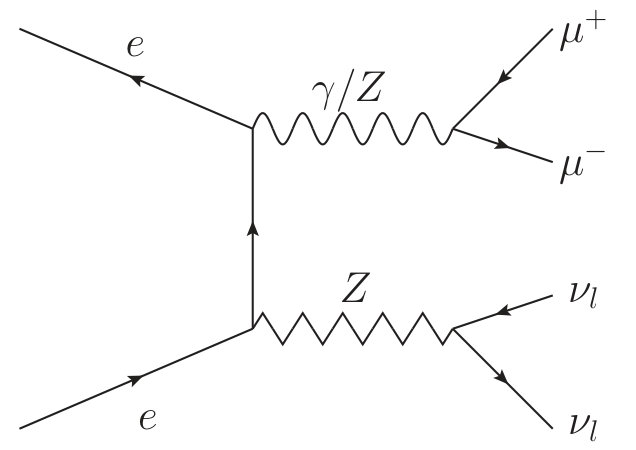 Figure 21
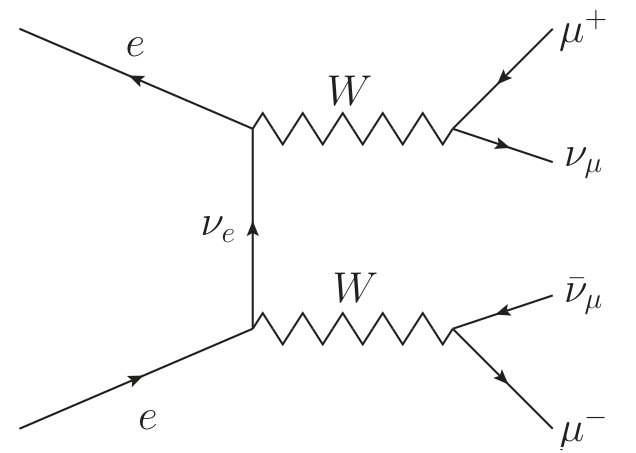 Figure 22
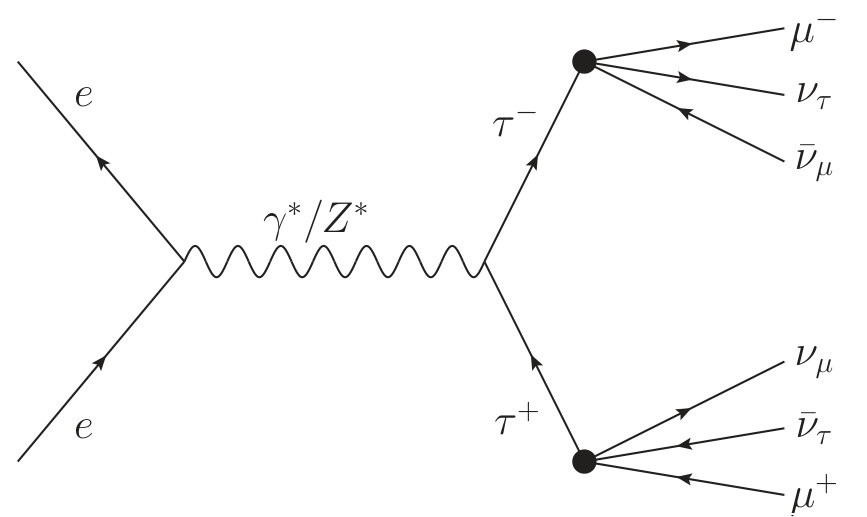 Figure 23
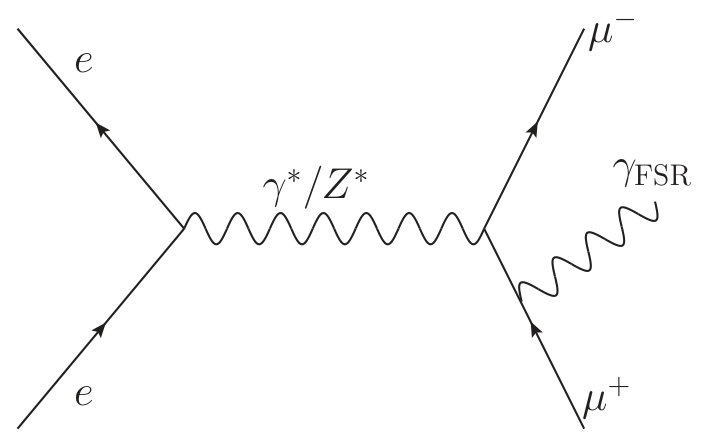 Figure 24
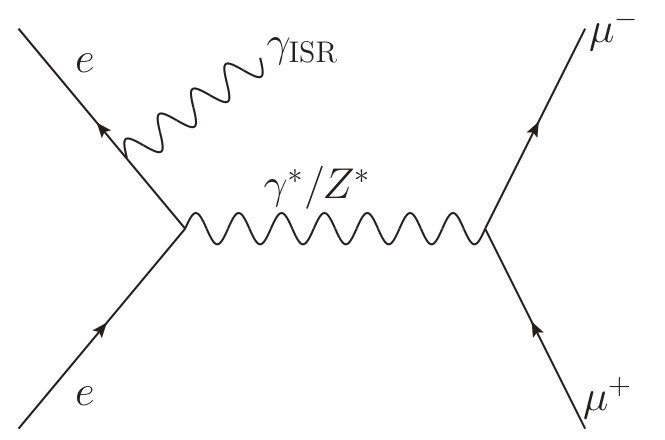 Figure 25
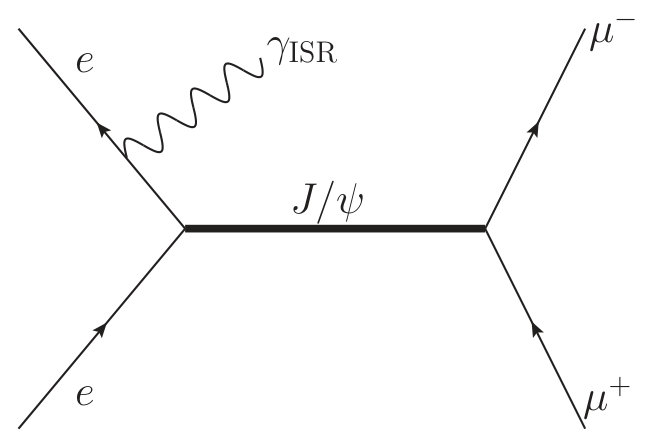 Figure 26
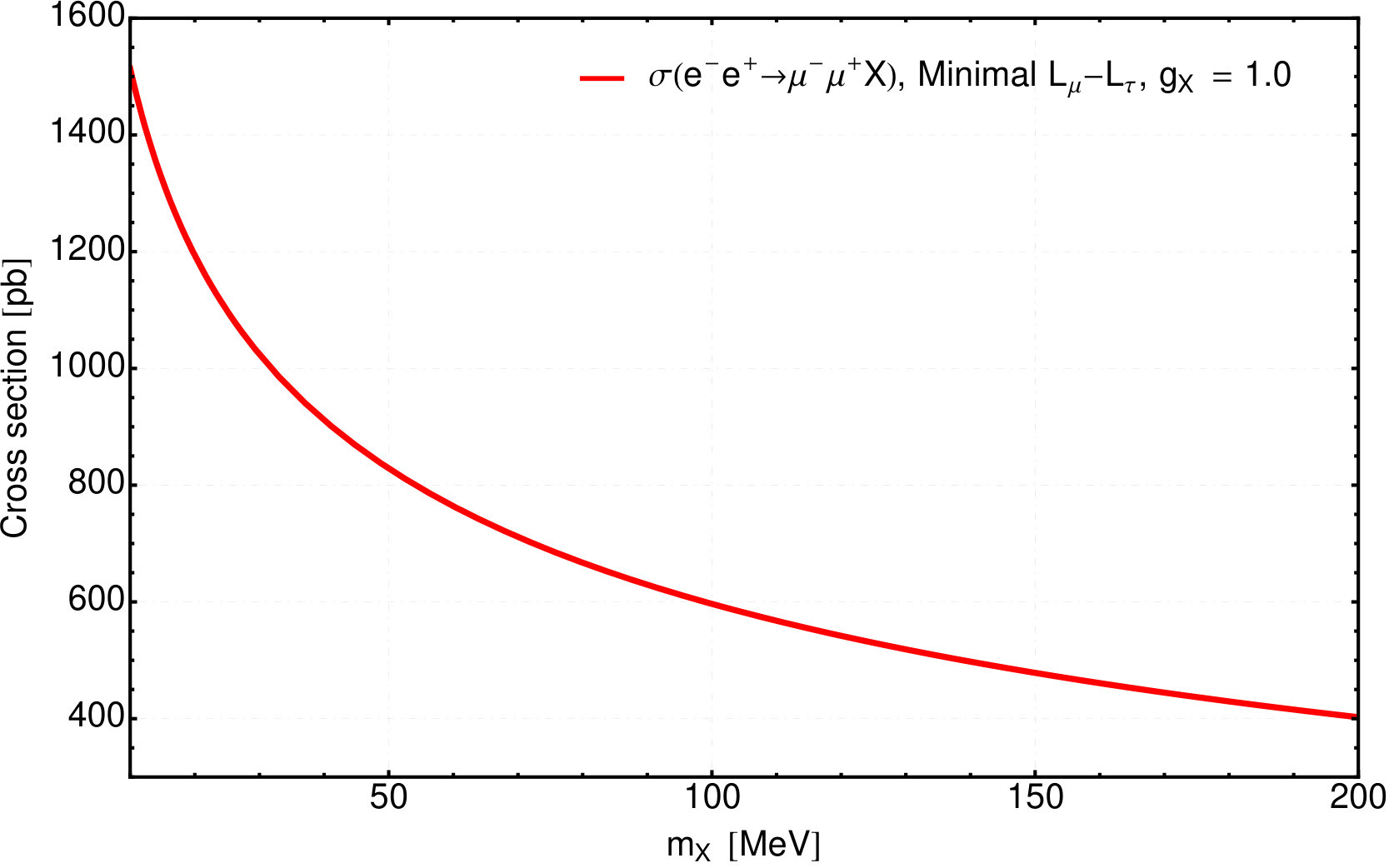 Figure 27
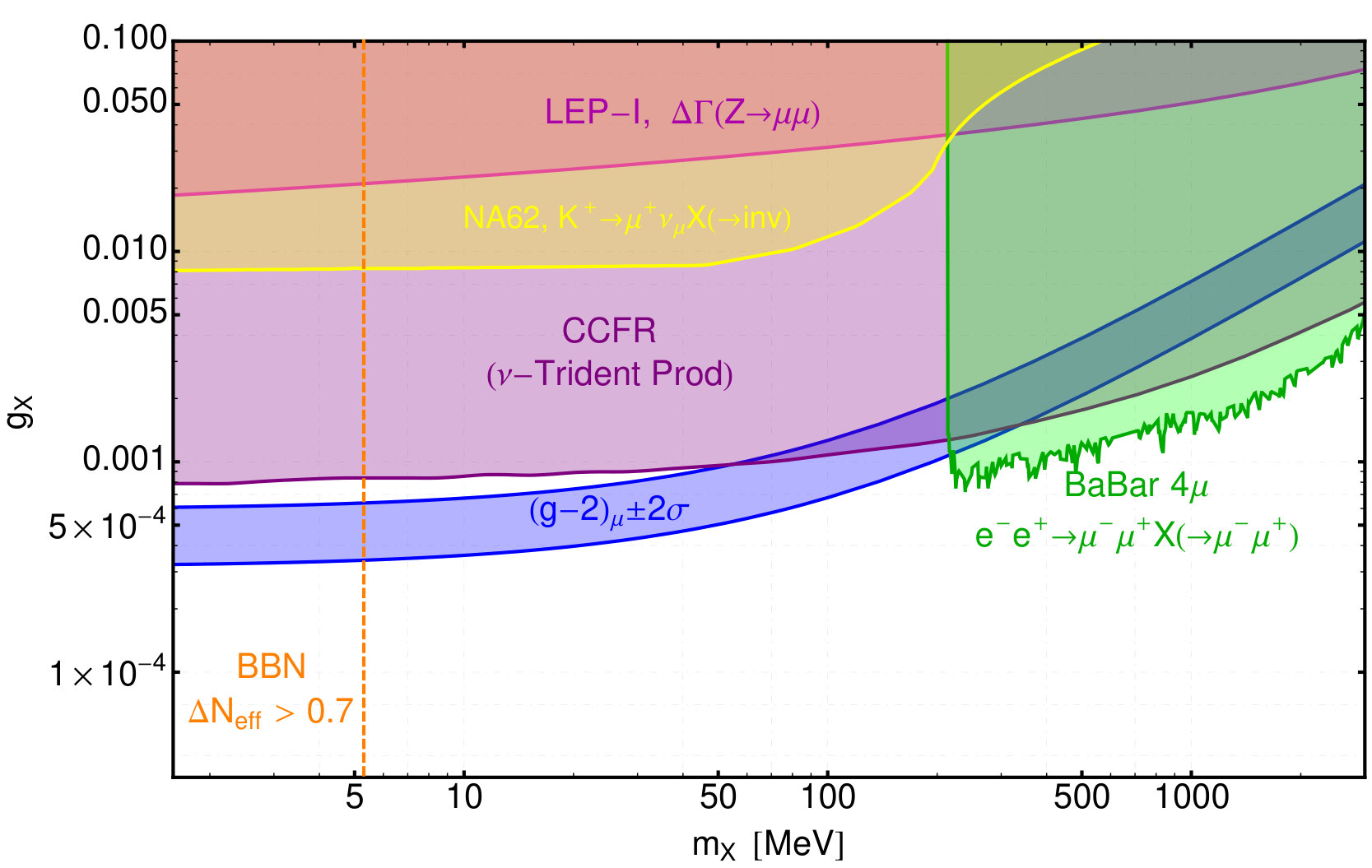 Figure 28
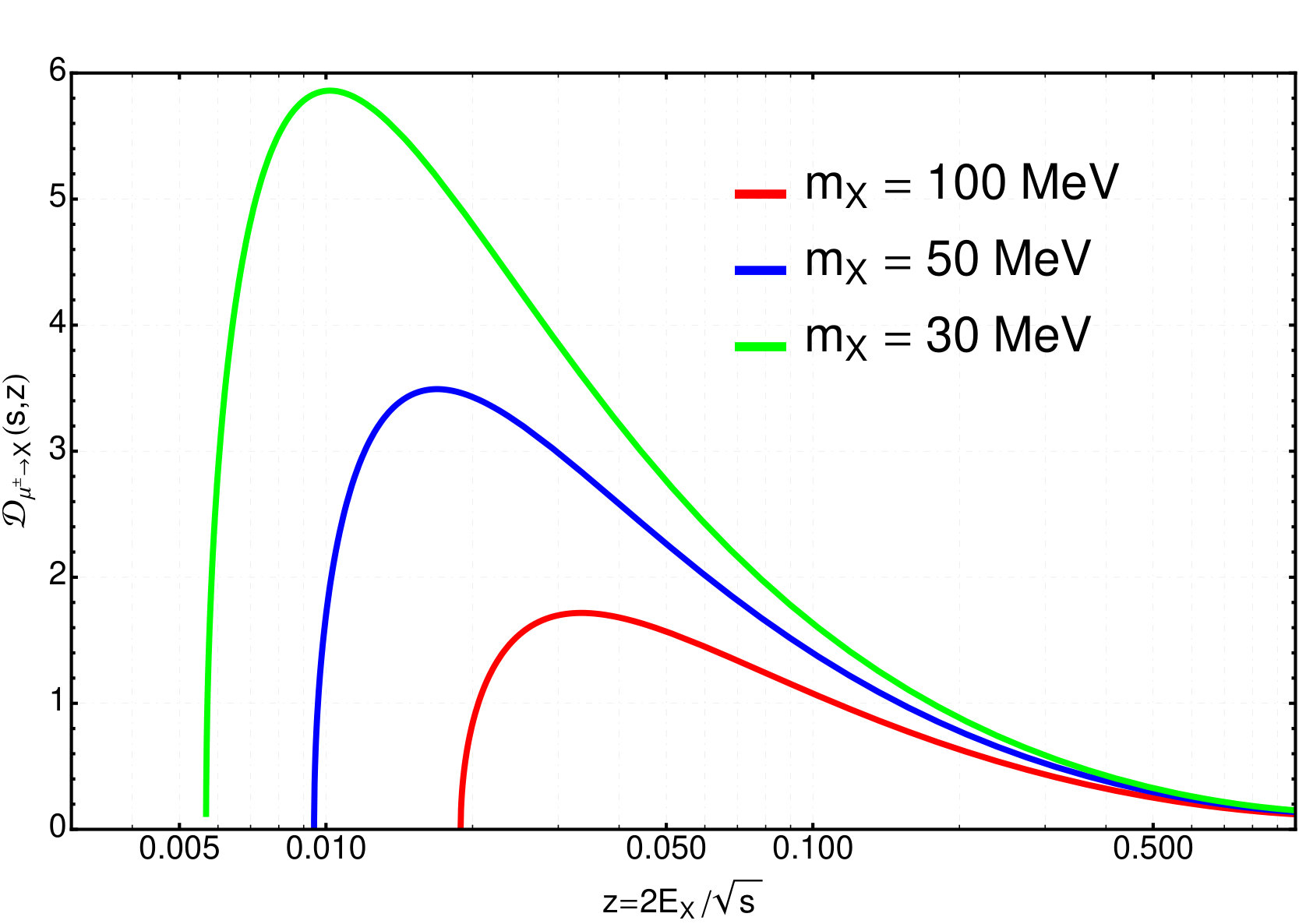 Figure 29
Peer Reviews
No public reviews on file for this paper yet. If you reviewed it on a platform where reviews are public (OpenReview, ICLR, NeurIPS, ICML), you can paste yours below so the community can read it here.
Videos
No videos yet. Explain this paper in a talk, walkthrough, or lecture? Add one.
††institutetext: Department of Physics and IPAP, Yonsei University,
Seoul 03722, Republic of Korea⋆⋆institutetext: Kavli IPMU (WPI), UTIAS, The University of Tokyo,
Kashiwa, Chiba 277-8583, Japan
Search for muon-philic new light gauge boson
at Belle II
Yongsoo Jho †
Youngjoon Kwon †
Seong Chan Park ⋆
and Po-Yan Tseng
Abstract
Motivated by the long-lasting discrepancy in the anomalous magnetic moment of muon, we consider a new muon-specific force mediated by a light gauge boson, , with mass and the coupling constant . We show that the Belle II experiment has a robust chance to probe such a light boson in channel and cover the most interesting parameter space explaining the discrepancy with the planned target luminosity, . The clean signal of muon-pair plus missing energy at Belle II can be a smoking gun for the new gauge boson. We expect that the (invisibly decaying) muon-philic light (m_{X}\mathrel{\hbox to0.0pt{\lower 4.0pt\hbox{\hskip 1.0pt\sim}\hss}\raise 1.0pt\hbox{<}}2m_{\mu}) gauge boson can be probed down to g_{X}\mathrel{\hbox to0.0pt{\lower 4.0pt\hbox{\hskip 1.0pt\sim}\hss}\raise 1.0pt\hbox{>}}1.5\times 10^{-4}\ (4.6\times 10^{-4},\ 2.3\times 10^{-4}) for 50 (1, 10) ab*-1* search.
1 Introduction
After the Higgs discovery in 2012, we are now entering the new era of particle physics. The main goal now is to uncover physics beyond the standard model (SM) even though there are still more rooms to improve the precision of the measurements especially in the Higgs quartic and cubic couplings as well as the top quark (pole) mass, which are crucial to determine the stability of our universe Degrassi:2012ry ; Buttazzo:2013uya .111Also see Hamada:2014iga ; Hamada:2014wna in the context of cosmological Higgs inflation.
Even without any theoretical prejudice, we are actually facing the observational problems, which enforce us to modify or enlarge the standard model. In particular, the significant discrepancy in the anomalous magnetic moment of the muon remains one of the largest anomalies in particle physics Blum:2018mom ; Tanabashi:2018oca ; Brown:2001mga ; Bennett:2004pv :
[TABLE]
where the errors are from experiment and theory prediction, respectively. Many well motivated theoretical solutions to fit the data have been proposed Moroi:1995yh ; Pospelov:2008zw ; Czarnecki:2001pv ; Park:2003sq ; Park:2001uc but no one has been experimentally confirmed so far Jegerlehner:2009ry .
It is well-known that light, weakly coupled particles can bring theoretical predictions into agreement with observations Pospelov:2008zw . With a simplified interaction with muon, , the light (m_{X}\mathrel{\hbox to0.0pt{\lower 4.0pt\hbox{\hskip 1.0pt\sim}\hss}\raise 1.0pt\hbox{<}}2m_{\mu}) gauge boson () contribution to the anomalous magnetic moment of muon at one-loop level is
[TABLE]
The integration is easily done numerically and found to be positive and close to unity when m_{X}/m_{\mu}\mathrel{\hbox to0.0pt{\lower 4.0pt\hbox{\hskip 1.0pt\sim}\hss}\raise 1.0pt\hbox{<}}1 so that . Hence is desired. This sets up the ball-park range of parameters for our study. (see Fig. 1) 222A light ( GeV) dark photon with kinetic mixing and flavor-universal couplings, has been ruled out for either cases where it decays to visible final-states only, or to invisible final states only Battaglieri:2017aum . However, the partially visible and partially invisible decays of dark photon scenario is currently still allowed. Therefore, future sensitivities from Belle II monophoton search and BABAR displaced track re-analysis will probe this region Mohlabeng:2019vrz .
When we target to the new light gauge boson, , we don’t really need a huge center-of-mass frame energy of the LHC or other future experiments but rather a precise measurement at a relatively low energy experiment. In this letter, we would focus on the Belle II experiment Abe:2010gxa , which has been just started and will get scientific data in coming years Shwartz:2015kja . Indeed, as we will show in detail, the Belle II experiment would be an ideal place for our purpose.
Most dark photon searches at low-energy colliders have considered the mono-photon process which depends on the kinetic mixing between the Standard Model photon and the dark photon Lees:2014xha ; Lees:2017lec . For the muonic force such as gauged He:1991qd , the similar mono-photon channel has been considered for ‘minimal’ gauged whose kinetic mixing is induced by only SM and loops Kaneta:2016uyt ; Araki:2017wyg . To be specific for muonic force, we have considered the -bremsstrahlung process , (invisible) in the muon pair production, which is independent on the kinetic mixing .
This paper is organized as follows. In the next section (Sec. 2) we first set up our theoretical model, a minimal model of muon-philic gauge boson, where the necessary interactions and the most relevant parameters are introduced. We are taking the anomaly-free condition into account for consistency while requiring the model to remain minimal. In Sec. 3, we study the signature at Belle II experiment in channel then optimize the signal/background taking the spectral shape and the missing transverse energy and the missing mass cuts of muons into account. We show the potential coverage of the Belle II experiment in comparison with other relevant experiments. We finally conclude in Sec. 4.
2 Model
To incorporate the muonic new force for muon-philic new gauge boson, we extend the SM by including a new gauge symmetry. The Lagrangian now contains the kinetic term, mass term and the gauge interaction term for the gauge boson, , of the new gauge symmetry:
[TABLE]
where denotes the field strength tensor of the new gauge interaction and is the gauge coupling constant. The current is given by the charge assignment of the SM fields (and extra fields too, in principle). The kinetic mixing between and SM gauge bosons induce the small electromagnetic current contribution but we do not focus on it since they are much more suppressed by both and .
As a simple but consistent example, we may take the leptonic symmetry, , which is anomaly free. In this case, the new gauge boson couples with the muonic and tauonic currents with their corresponding (left-chiral) neutrinos He:1991qd ; Kahn:2018cqs :
[TABLE]
It is important to notice that as long as the new boson is light below the muonic threshold, m_{X}\mathrel{\hbox to0.0pt{\lower 4.0pt\hbox{\hskip 1.0pt\sim}\hss}\raise 1.0pt\hbox{<}}2m_{\mu}\approx 2\times 105.7 MeV, the boson would decay mainly to neutrinos (i.e. , ) because all other channels are kinematically forbidden.
It may be worth considering other potentially interesting options free from anomaly. The first, seemingly minimal, option is the solely muonic symmetry , which couples to only muon and muon-neutrino at low-energies. This option looks indeed good enough for phenomenological studies of muonic force. However, as pointed out in Dror:2017ehi ; Dror:2017nsg , regardless of the UV structure (content of anomaly-cancelling fermion), they would be strongly constrained by Wess-Zumino counterterm contributions to exotic decays Acciarri:1997im from the 4-dimension operator and FCNC processes such as , Grygier:2017tzo ; Artamonov:2008qb from the other operator . Another potentially interesting option for UV completion free from anomaly is , which would open not only leptonic but also hadronic interactions. This case is also highly constrained by e.g. proton beam-dump experiment Bergsma:1985qz .333The proton beam-dump experiment usually use the proton bremsstrahlung Blumlein:2013cua and the meson decay process, such as Blumlein:2011mv and Gninenko:2012eq , to constrain (the baryon number for the first generation) mainly. and (i.e. the baryon number for second and third generation, respectively.) still can be free from this kind of low energy constraints unless we consider the large kinetic mixing with gauge boson. Thus, to avoid unnecessary complication in our analysis, we will focus on the case below.
In addition, one can naturally extend the list of interactions mediated by muon-philic gauge boson, including dark sector particles. It provides possible scenarios of light dark matter at sub-GeV scale Foldenauer:2018zrz . If one considers additional interactions between and the dark sector particles, (vector-like) fermions for example, as
[TABLE]
the width of boson can be enhanced as where
[TABLE]
and is the total width of minimal gauged case. is the number of fermion species in the dark sector.
Before studying the future perspectives of finding the muon-philic new gauge boson at Belle II experiment, we first consider the existing constraints in the kinematic range of our interest from various experiments as follows:
- •
-pole precision measurement. The boson can contribute to the vertex correction at one-loop level thus modifying the muonic decay width of boson by
[TABLE]
where the loop-function is
[TABLE]
with the polylogarithmic function of order being Carone:1994aa . We set the bound for this correction taking the precision measurement at -pole as
[TABLE]
where we used the values Tanabashi:2018oca
[TABLE]
The bound is depicted in Fig. 2 on the top left as a slowly growing line (in magenta). Even after removing phase space suppression due to the lepton masses, still has some tension from the averaged value of leptonic decay width. If we specify our case as , it gives slightly stronger bound. However, in any case, the bounds from virtual corrections are much weaker than -trident production bound.
- •
Neutrino trident production. (). The neutrino-nucleon scattering experiments effectively provide the stringent constraint to the light gauge boson parameters which couple to the muon and the neutrino(s). The total cross section of -trident production with boson, in the light boson limit (), is given by Altmannshofer:2014pba
[TABLE]
The CCFR experiment using a -beam with GeV has obtained the result Mishra:1991bv . The bound is depicted in Fig. 2 by the purple line slightly above the band of .
- •
Rare kaon decay at Beam-dump experiments. Rare kaon decay at NA62 beam-dump experiment provides upper bound for muon-philic light bosons by rare kaon decay for , and for with a significant feature of some kinematic variables. Current bound comes from the charged kaons and it gives the upper bound as g_{X}\mathrel{\hbox to0.0pt{\lower 4.0pt\hbox{\hskip 1.0pt\sim}\hss}\raise 1.0pt\hbox{<}}10^{-2} Krnjaic:2019rsv in the parameter range of our interests (also shown in Fig. 2 by yellow line), although it is above the bound from neutrino trident experiment.444Recently, the future expected sensitivity from charged kaon and its rare decay such as at NA62 experiment is explored in Ref. Krnjaic:2019rsv . We show this result in Fig. 10 (by yellow dashed line.) 555If one considers the kinetic mixing between boson and SM photon, it is also constrained by the channel Chiang:2016cyf down to ).
- •
BaBar channel search. The BaBar experiment have explored TheBABAR:2016rlg the muon-philic gauge boson by using the channel (), although the result is valid for the case . This is depicted in Fig 2 by the green colored (wiggly) region above .
- •
Constraints from Big Bang Nucleosynthesis (BBN). A light boson coupled to neutrinos can directly enhance the number of relativistic degree of freedom in the BBN era for m_{X}\mathrel{\hbox to0.0pt{\lower 4.0pt\hbox{\hskip 1.0pt\sim}\hss}\raise 1.0pt\hbox{<}}\mathcal{O}(1) MeV. Even in the heavier case MeV, the presence of muon-philic boson can affect the effective number of the light neutrino species by providing additional energies to (and also in case) from the decay process after all SM neutrinos are decoupled from SM thermal bath at MeV Kamada:2015era ; Kamada:2018zxi ; Escudero:2019gzq . The deviation of the effective neutrino number comes from the difference between the tempreature of the thermal bath of () and the temperature of the thermal bath of (). This process is an analogy to the photon heating by the annihilation. Requiring , it disfavors the case m_{X}\mathrel{\hbox to0.0pt{\lower 4.0pt\hbox{\hskip 1.0pt\sim}\hss}\raise 1.0pt\hbox{<}}5.3\ (10) MeV Kamada:2015era 666If one considers a non-negligible kinetic mixing between gauge boson and SM hypercharge gauge boson, the interaction between and also can affect Kamada:2018zxi ; Escudero:2019gzq . In this case, the BBN bound can be slightly more stringent.. The lower bound for corresponding to is shown in Fig. 2 as the orange dotted line. Because gauge boson can be in thermal equilibrium with other SM particles at early times as long as the coupling between and are g_{X}\mathrel{\hbox to0.0pt{\lower 4.0pt\hbox{\hskip 1.0pt\sim}\hss}\raise 1.0pt\hbox{>}}4\times 10^{-9} Escudero:2019gzq , this lower bounds on is valid in the range of our interest.
At low mass region (), is the main channel of the minimal dark photon search Lees:2017lec . The discovery potentials in the same channel at Belle II experiment also have been explored Kaneta:2016uyt ; Araki:2017wyg .
However, the kinetic mixing between boson and SM is not determined, unless we assume that - and -lepton loops only contribute to the kinetic mixing which is the minimal mixing case. For instance, other heavy particle loops (from the particles with mass splitting ) also can contribute to the mixing as and the total kinetic mixing depends on UV structure. For instance, one can modify the kinetic mixing with extra heavy vector-like leptons Chen:2017cic or charged scalars Banerjee:2018mnw . If one does not impose the kinetic mixing values between and SM hypercharge gauge boson as ), the bound for purely light muon-philic force is not completely determined by low-energy -collider experiments up to now.
Similarly, other indirect bounds of muonic force for , which comes from the electron-neutrino scattering process Bauer:2018onh such as Borexino experiment Kaneta:2016uyt and the white dwarf cooling Dreiner:2013tja , also depend on the kinetic mixing between gauge boson and SM gauge boson, since these bounds assume - scattering via -channel with the mixing .
Another advantage of considering the parameter region is to avoid stringent constraint from cosmic microwave background (CMB). In general, any symmetric population of dark matter (DM) particles which annihilate to particles in -wave which inject electromagnetic energy can modify the CMB spectrum, so there is a stringent bound on this scenario. That would be the case, if boson becomes a portal to the dark sector. The upper bound for the annihilation cross section from CMB can be estimated by \langle\sigma v\rangle/m_{\rm DM}\mathrel{\hbox to0.0pt{\lower 4.0pt\hbox{\hskip 1.0pt\sim}\hss}\raise 1.0pt\hbox{<}}4.1\times 10^{-28}\ {\rm cm^{3}\ s^{-1}\ GeV^{-1}} Slatyer:2015jla , which rules out the thermally produced DM lighter than 100 GeV. However, the CMB stringent constraint can be avoided, if decays only into invisible channels. In addition, since the kinetic mixing from and loops is small enough, the process could not give significant modification to CMB spectrum. Eventually, the bound from CMB can be satisfied in the parameter region .
3 Expected sensitivity at Belle II
The muon-philic gauge bosons are exclusively produced in muon-associated channels thus is less constrained compared with the model with universal couplings to fermions. In the Belle II experiment, muons are pair-produced and boson can be radiated away from muon as in Fig. 3. Finally, and do not leave a detectable signal so that we regard it as an invisible particle (INV) and exploit appropriate kinematical variables such as missing transverse energy () and missing-mass-squared (). Since the cross section of is proportional to so that we can almost directly check whether the boson would be responsible for the anomalous magnetic moment of muon from the measurement at Belle II experiment. We provide some details about the expected sensitivity of muon-philic boson search in the INV channel at the Belle II experiment.
3.1 Signal:
The signal process is a muon-pair production with the real emission of a light boson as a final state radiation. Thus, most of bosons are very soft and collinear (along with muons’ momenta). The signal cross section is Carone:1994aa
[TABLE]
where
[TABLE]
where is the cross section of muon pair production in the Born approximation with . The cross section blows up as due to the infrared divergence as in usual final state radiation emission cases. (See Fig. 4)
Including and muon masses, we utilize the splitting function of the emission in the process for massive partons () Ciafaloni:2001mu ; Ciafaloni:2005fm ; Ciafaloni:2010ti as follows:
[TABLE]
where
[TABLE]
in the small mass limit (See Fig. 4). Note that factor of 2 comes from boson emission by both and . Here, is the energy fraction carried by the emitted boson, within kinematically allowed range
[TABLE]
and the total cross section is consistently given by integrating the spectral splitting function as
[TABLE]
In principle, the signal ( INV) has a peak in the missing-mass-squared
[TABLE]
around . The decay width of boson is given by
[TABLE]
and this width is very small in the region of our interests (g_{X}\mathrel{\hbox to0.0pt{\lower 4.0pt\hbox{\hskip 1.0pt\sim}\hss}\raise 1.0pt\hbox{<}}10^{-3}) and the narrow width approximation (NWA) is valid in our event analysis. In this case, we are sure that the produced bosons are on-shell, and spectral shape of will be very clear.777If the coupling of to dark sector is large as and a number of species of light (2m_{\chi_{i}}\mathrel{\hbox to0.0pt{\lower 4.0pt\hbox{\hskip 1.0pt\sim}\hss}\raise 1.0pt\hbox{<}}m_{X}) dark sector particles are coupled to boson (), then the width
\displaystyle\sum_{i}\frac{g_{D}^{2}}{12\pi}m_{X}\Bigl{(}1+\frac{m_{\chi_{i}}^{2}}{m_{X}^{2}}\Bigr{)}\sqrt{1-4\frac{m_{\chi_{i}}^{2}}{m_{X}^{2}}}\ \mathrel{\hbox to0.0pt{\lower 4.0pt\hbox{\hskip 1.0pt\sim}\hss}\raise 1.0pt\hbox{>}}\ \mathcal{O}(m_{X})
(21)
for additional Dirac fermions in the dark sector coupled to gauge boson, for example. Thus, the finite width effect becomes significant in this case. However, for relatively small value of width \Gamma_{X,\text{total}}\mathrel{\hbox to0.0pt{\lower 4.0pt\hbox{\hskip 1.0pt\sim}\hss}\raise 1.0pt\hbox{<}}m_{X}, the production cross section is almost constant (even after the and cuts) because the narrow width approximation (NWA) is valid. Thus, our conclusion about the sensitivity of is indeed independent to the detail of the dark sector in most cases.
However, once the detector resolution is involved, the peak of missing mass becomes much broad with Gaussian smearing deFavereau:2013fsa . The tracking resolution of muon momenta in the central drift chamber (CDC) detector is given as
[TABLE]
at Belle II experiment, where is momentum of the muon track Adachi:2018qme . We use in our event analysis at the detector level. For typical momentum of muons GeV, the momentum resolution is about MeV. Thus, at the low boson mass region (m_{X}\mathrel{\hbox to0.0pt{\lower 4.0pt\hbox{\hskip 1.0pt\sim}\hss}\raise 1.0pt\hbox{<}}50 MeV), it is hard to expect that the signal peak is distinguished from the backgrounds without additional kinematic cuts to remove relatively huge SM backgrounds.
3.2 SM backgrounds and kinematic cuts
The main backgrounds are as follows:
- •
- •
- •
by off-shell and
and the diagrams for each background process are shown in Fig. 5.
Most dominant background process is , which has typically pb of the production cross section, although all of them actually can be removed using kinematic cuts. To remove and backgrounds, we reject all events with GeV or with the photon energy in the center-of-mass frame GeV where the electromagnetic calorimeter (ECL) has high efficiency Adachi:2018qme . This kinematic cut removes most of the backgrounds. One notices that, at the center-of-mass energy GeV, the resonant production of and mesons are not negligible. Indeed, meson can be produced with a photon and decay into (or ), and its contribution to total production cross section is % Aubert:2003sv ; Banerjee:2007is . However, due to its small , most of the background events are removed by requiring GeV.
For muonically decaying tau-pairs , the cross section is
[TABLE]
with the collision energy GeV Banerjee:2007is , and they contribute as a significant background. Although the final state (INV) is the same as the signal mode, its energy spectrum is completely different. The muons come from the decay of taus, and the muon energies at the muon pair center-of-mass frame have broad continuum distributions. In the center-of-mass frame of the electron-positron collision, the differential cross section of the (muonically decaying) tau pair production Scheck:1977yg ; Ackerstaff:1998yk is given by
[TABLE]
where and . The distribution is given by
[TABLE]
where . Here, and is the vector and axial-vector couplings to the charged leptons. We use the Mitchel parameters , , as the prediction in the Standard Model Ackerstaff:1998yk . The anisotropic contribution is negligible because off-shell photon (not ) is dominant channel for and initial electron and positron beams are not polarized. We use TauDecay Hagiwara:2012vz library to make FeynRules Alloul:2013bka model file which allows to perform decays with polarization. Most events in this background are in the region m_{\rm miss}^{2}\mathrel{\hbox to0.0pt{\lower 4.0pt\hbox{\hskip 1.0pt\sim}\hss}\raise 1.0pt\hbox{>}}(0.6~{}{\rm GeV})^{2}, which is beyond the region of our interest ( GeV). If one imposes the condition GeV, the remaining values become even larger. Thus, we can safely ignore tau-pair background after cuts.
There are also off-shell and involved process (). The cross section is fb. However, it is 4-body production channel and highly off-shell, so after and cuts, no background events remain, even at the integrated luminosity of 50 ab*-1*.
3.3 Event Analysis
We use MadGraph5_aMC@NLO Alwall:2011uj for background and signal event generation. We use our own FeynRules Alloul:2013bka model file for gauge boson coupled to muon (and neutrino), to generate signal events. Event analyses have been performed for the following sets of Monte Carlo events ( events for each set):
- •
background with 888In this case, photons are highly collinear with beam axis, and just go through the beam pipe and only muon pair with some small in the final state.
- •
background with
- •
background
- •
off-shell involved background
- •
signal
where is the photon rapidity in the center-of-mass frame and the muon rapidity in the center-of-mass frame is given in the range for all events. All rapidity cuts are considered in the center-of-mass frame so that all muons are within both CDC () and and muon detector (KLM) () angle coverages and all photons are within ECL () angle coverage Adachi:2018qme after Lorentz boost with is performed, where GeV and GeV.
The most dominant background source is the process in which the photon is not detected. Typically, for Belle II, the inefficiency is . It is mainly due to the small gaps between barrel and endcap regions ( and ), a gap at owing to the mechanical structure of the Belle II ECL, and gaps between the crystals in the ECL endcap region.
Most of this inefficiencies are removed by requiring the direction of missing 3-momentum (in this case, the 3-momentum of the unobserved photon) to be within the ECL barrel region. The inefficiency is then reduced to Kou:2018nap which comes from intrinsic probability of missing the photon detection inside the ECL crystals.
For Belle II, the KLM detector can also be used to detect photons. By combining the ECL and KLM together for photon detection, the inefficiency is suppressed down to . In fact, it can provide an improved sensitivity limit on the “single-photon” search at Belle II () down to Kou:2018nap . Therefore, in this paper, we set the conservative (aggressive) nominal value of photon inefficiency . In addition, imposing and cuts and muon detection efficiency for these background events, the expected event number is . In this study, the uncertainty in becomes the dominant source of the systematic uncertainties. The other sources such as in the selection of two muons and other kinematic requirements, in comparison, contribute much less to the total systematic uncertainty.
As we mentioned in the previous section, , and cuts are used to remove all background events. Comparison for signals and backgrounds under these kinematic variables are shown in Fig. 6 for and Fig. 7 for . Also, we show correlations between and in Fig. 8 and Fig. 9 for backgrounds and signals, respectively.
3.4 Sensitivity limit
After imposing the kinematic cuts
[TABLE]
almost SM backgrounds are removed and the remaining signal gives the sensitivity limit from the criterion
[TABLE]
where the signal and the background rates , are given by
[TABLE]
respectively and GeV, GeV as we mentioned. We also reject all events including muons with momentum below 0.6 GeV in the lab frame and assume that the detection efficiency at the and muon (KLM) detector is for Kou:2018nap . We focus on cases of integrated luminosity ab*-1*. Expected sensitivity limits at Belle II are shown in Fig. 10. We assume the photon detention inefficiency and show other detection inefficiency cases.
For , the branching fraction for invisible decays becomes less than the unity, hence reducing the signal rate. For larger values of boson mass (m_{X}\mathrel{\hbox to0.0pt{\lower 4.0pt\hbox{\hskip 1.0pt\sim}\hss}\raise 1.0pt\hbox{>}}1 GeV), the most important background is muonically decaying tau pair () which have large and . We show the distributions of background and signal events for larger masses of boson in Fig. 11. We use the kinematic cuts
[TABLE]
to obtain the sensitivity limit of the channel for . The sensitivity limit including this larger mass region is shown in Fig. 12. The sensitivity limit for larger boson masses do not depend on the photon detection inefficiency, because is no longer dominant background for m_{X}\mathrel{\hbox to0.0pt{\lower 4.0pt\hbox{\hskip 1.0pt\sim}\hss}\raise 1.0pt\hbox{>}}1 GeV. In this mass region, the best channel is 4-muon mode ( as in Ref. TheBABAR:2016rlg ) due to the huge background for invisibly decaying case.
Belle II together with NA62 and DUNE are the currently operating or recently approved experiments that will probe the entire parameter region from model with light boson in the near future. Compared to the kaon decays at NA62 and neutrino-trident process at DUNE, both of which include hadronic amplitude uncertainties, exploiting the signal at Belle II has the merit of less theoretical uncertainties being involved.
4 Conclusion
The large amount of integrated luminosity is expected in the Belle II experiment. We expect that the (invisibly decaying) muon-philic light (m_{X}\mathrel{\hbox to0.0pt{\lower 4.0pt\hbox{\hskip 1.0pt\sim}\hss}\raise 1.0pt\hbox{<}}2m_{\mu}) gauge boson can be probed down to g_{X}\mathrel{\hbox to0.0pt{\lower 4.0pt\hbox{\hskip 1.0pt\sim}\hss}\raise 1.0pt\hbox{>}}1.5\times 10^{-4}\ (4.6\times 10^{-4},\ 2.3\times 10^{-4}) for 50 (1, 10) ab*-1* search, rejecting almost SM background events (, , involved) by imposing and simultaneously. This sensitivity limit is largely model-independent. This direct search of muon-philic gauge boson also can be combined with other channel search, for instance , to determine the kinetic mixing and the fate of explanation scenario by muon-philic light gauge boson.
Acknowledgements.
This work was supported by the National Research Foundation of Korea (NRF) grant funded by the Korean government (MSIP) (NRF- 2018R1A4A1025334). PYT was supported by World Premier International Research Center Initiative (WPI), MEXT, Japan.
The reference list from the paper itself. Each links out to its DOI / PubMed record.
- 1(1) G. Degrassi, S. Di Vita, J. Elias-Miro, J. R. Espinosa, G. F. Giudice, G. Isidori et al., Higgs mass and vacuum stability in the Standard Model at NNLO , JHEP 08 (2012) 098 , [ 1205.6497 ]. · doi ↗
- 2(2) D. Buttazzo, G. Degrassi, P. P. Giardino, G. F. Giudice, F. Sala, A. Salvio et al., Investigating the near-criticality of the Higgs boson , JHEP 12 (2013) 089 , [ 1307.3536 ]. · doi ↗
- 3(3) Y. Hamada, H. Kawai, K.-y. Oda and S. C. Park, Higgs Inflation is Still Alive after the Results from BICEP 2 , Phys. Rev. Lett. 112 (2014) 241301 , [ 1403.5043 ]. · doi ↗
- 4(4) Y. Hamada, H. Kawai, K.-y. Oda and S. C. Park, Higgs inflation from Standard Model criticality , Phys. Rev. D 91 (2015) 053008 , [ 1408.4864 ]. · doi ↗
- 5(5) RBC, UKQCD collaboration, T. Blum, P. A. Boyle, V. Gülpers, T. Izubuchi, L. Jin, C. Jung et al., Calculation of the hadronic vacuum polarization contribution to the muon anomalous magnetic moment , Phys. Rev. Lett. 121 (2018) 022003 , [ 1801.07224 ]. · doi ↗
- 6(6) Particle Data Group collaboration, M. Tanabashi et al., Review of Particle Physics , Phys. Rev. D 98 (2018) 030001 . · doi ↗
- 7(7) Muon g-2 collaboration, H. N. Brown et al., Precise measurement of the positive muon anomalous magnetic moment , Phys. Rev. Lett. 86 (2001) 2227–2231 , [ hep-ex/0102017 ]. · doi ↗
- 8(8) Muon g-2 collaboration, G. W. Bennett et al., Measurement of the negative muon anomalous magnetic moment to 0.7 ppm , Phys. Rev. Lett. 92 (2004) 161802 , [ hep-ex/0401008 ]. · doi ↗