A new example of robustly transitive diffeomorphism
Pablo D. Carrasco, Davi Obata

TL;DR
This paper introduces a novel example of a $ ext{C}^1$-robustly transitive skew-product system that is conservative, ergodic, and non-uniformly hyperbolic, with unique non-hyperbolic homological action.
Contribution
It provides the first known example of a robustly transitive skew-product with non-hyperbolic homology action and complex fiber dynamics.
Findings
The system is $ ext{C}^1$-robustly transitive.
The system is conservative and ergodic.
Fiber directions lack dominated splitting.
Abstract
We present an example of a -robustly transitive skew-product with non-trivial, non-hyperbolic action on homology. The example is conservative, ergodic, non-uniformly hyperbolic and its fiber directions cannot be decomposed into two dominated expanded/contracted bundles.
Click any figure to enlarge with its caption.
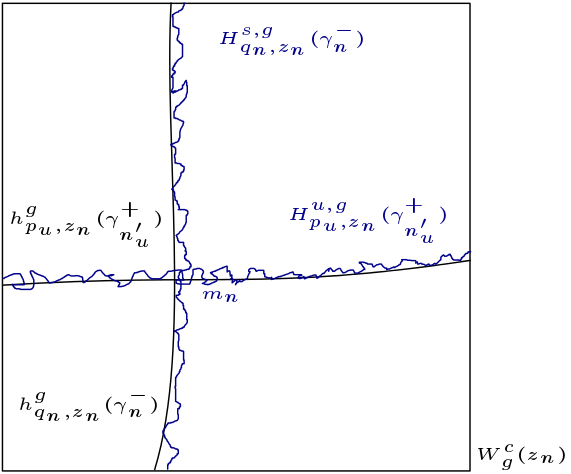 Figure 1
Peer Reviews
No public reviews on file for this paper yet. If you reviewed it on a platform where reviews are public (OpenReview, ICLR, NeurIPS, ICML), you can paste yours below so the community can read it here.
Videos
No videos yet. Explain this paper in a talk, walkthrough, or lecture? Add one.
Taxonomy
TopicsMathematical Dynamics and Fractals · Geometric and Algebraic Topology · Homotopy and Cohomology in Algebraic Topology
A new example of robustly transitive diffeomorphism
Pablo D. Carrasco
Davi Obata111D.O. was supported by the ERC project 692925 NUHGD.
Abstract
We present an example of a -robustly transitive skew-product with non-trivial, non-hyperbolic action on homology. The example is conservative, ergodic, non-uniformly hyperbolic and its fiber directions cannot be decomposed into two dominated expanded/contracted bundles.
1 Introduction and Main Theorem
Let be a closed Riemannian manifold and denote by the space of diffeomorphisms in , equipped with the topology. In trying to understand , properties that are stable under perturbations play a central role in the study. This is true not only from a theoretical point of view (i.e. understanding open sets in ), but also from an applied one, as it is desirable to maintain the same qualitative conclusions even in presence of small errors. Following common use, we will say that has the property robustly if is also valid in an open set containing .
Among the robust properties that have been studied, transitivity has been one of the most extensively researched. Recall that a diffeomorphism is transitive if for any two non-empty open sets and , there is an integer such that . The first known examples of robustly transitive diffeomorphisms are given by Anosov maps [1, 15]: if is transitive and uniformly hyperbolic, then it is robustly transitive. It turns out that certain degree of hyperbolicity is required in order to have robust transitivity. Indeed, if is robustly transitive and then is hyperbolic/partially hyperbolic [9, 7]; in general, admits -invariant bundles such that for some uniform [4]. It is worth to point out that the bundles above are not necessarily uniformly expanding [5].
As for non-hyperbolic examples, there are several known. The list below gives a rough (and necessarily, incomplete) picture of the arguments used to establish robust transitivity for non hyperbolic systems.
Deformations from Anosov systems. The first concrete example of non-uniformly hyperbolic robustly transitive map was given by M. Shub in [14]; later in [9] R. Mañe gave a similar type of construction on . They are both partially hyperbolic (see next section) and homotopic to an Anosov system, in particular with hyperbolic action on homology. The example given in [5] is also a deformation of an Anosov diffeomorphism, and although it is not partially hyperbolic, it does admit a dominated splitting222An invariant closed set admits an dominated splitting if is an -invariant decomposition satisfying for some uniform . coherent with its Anosov part (as the previous two examples). More recently, R. Potrie ([11] page 152) gave an example of this type, but with the difference that it admits a dominated splitting which is not coherent with its hyperbolic part. In these cases, the proof of robust transitivity is founded in that they have hyperbolic-type behavior in a large part of the space.
- -
Blenders. This powerful mechanism was introduced in [3] by C. Bonatti and L. Díaz. With it the authors were able to prove that some perturbations of time- maps of mixing hyperbolic flows, and of the product of an Anosov map times the identity (say, on ), are robustly transitive. Note that in the first case the examples are homotopic to the identity, while in the second the action on homology on the fiber direction is trivial. The same tool was used by C. Cheng, S. Gan and Y. Shi in [6] to present a robustly transitive skew-product, but where the fiber action in homology is given by minus the identity. We also point out that the example in [6] has some interesting ergodic properties.
- -
Minimality of the stable/unstable foliation. It is easy to see that if admits an invariant expanding minimal foliation, then is transitive. Conditions that guarantee the persistence of these types of foliations are thus relevant for robust transitivity. Among this, the property SH introduced by E. Pujals and M. Sambarino [13] is particularly simple to check, and can be applied to establish robust transitivity of transitive partially hyperbolic systems where one has some control on the behavior of the stable/unstable foliations. Shub and Mañe’s examples cited before fall into this category.
- -
Non-uniform expansion along the center. In a recent work [16], J. Yang considers partially hyperbolic systems with non-uniformly expanding center behavior, and shows that any conservative ergodic of such systems with one-dimensional center is robustly transitive. The author uses the non-uniform expanding character of the center as a replacement for hyperbolicity, employing methods of smooth ergodic theory. These techniques however seem to be applicable only for systems with one-dimensional center.
In this note we add a different type of example to the previous list. We present a diffeomorphism that is again a partially hyperbolic skew-product on , but with non-hyperbolic action on homology. More importantly, the tangent bundle of the fiber neither admit any one-dimensional invariant direction, nor does it have a non-uniform expanding/contracting behavior.
Let and for each we consider the standard map given by . Fix a hyperbolic matrix. On we use coordinates , and for each we consider the skew product given by333Here denotes the integer part of .
[TABLE]
This diffeomorphism was introduced in [2] where it is proven that for large it is non-uniformly hyperbolic (i.e. all its Lyapunov exponents are Lebesgue almost everywhere different from zero), and remains so by conservative perturbations: these maps are in fact ergodic with respect to the Lebesgue measure [10]. It is direct to verify that the action on homology of is not hyperbolic, and that its fiber direction does not admit a dominated splitting (since ). We remark that for a system to have the SH property, the behavior along the center has to be somehow “homogeneous”, meaning, one has to find many points where the action on the center is expanding (or contracting) for some uniform time. The mixed behavior along the center for implies that it does not satisfy the SH property, and the question whether its stable/unstable foliations are (robustly) minimal seems to be outside the reach of current technology.
Here we establish the following.
Main Theorem**.**
There exists such that for any the diffeomorphism is robustly transitive (in fact, robustly topologically mixing).
Remark 1.1**.**
Topologically mixing is a stronger property than transitivity: is topologically mixing if for any two open sets and , there exists such that for any we have .
The proofs of robust transitivity for the diffeomorphisms which are deformations of Anosov systems, mentioned above, use information about some type of minimality (or -minimality) of stable/unstable manifolds. Observe that, our example has a hyperbolic-type behavior in a large part of the manifold, as in the examples which are deformations of Anosov systems. However, an important difference in our proof is that we do not use any information on the minimality (or -minimality) of stable/unstable foliations. Finally, we remark that in our example (and for sufficiently small volume preserving perturbations) the manifold is the homoclinic class of an hyperbolic point, due to ergodicity and Katok’s theorem [12]. However, it remains unknown whether this is true also for small perturbations, and we pose the question for future research.
Acknowledgements
The authors thank Sylvain Crovisier for useful comments, and to the referee for her/his suggestions and pointing out several typos.
2 Preliminaries
In this section we present the tools we will use. We first state some general facts about partially hyperbolic diffeormorphisms and then some facts about the example we are studying.
2.1 Partial hyperbolicity and foliations
A diffeomorphism is partially hyperbolic if there exist a -invariant decomposition and a Riemannian metric on such that for any
[TABLE]
The set of partially hyperbolic diffeomorphisms is an open subset of . It is well known that the distributions and are uniquely integrable [8], that is, there are two unique foliations and , with -leaves, that are tangent to and respectively. For a point we will denote by a leaf of the foliation , we will call such leaf the strong stable manifold of . Similarly, we define the strong unstable manifold of and denote it by . We denote and .
Definition 2.1**.**
A partially hyperbolic diffeomorphism is dynamically coherent if there are two invariant foliations and , with -leaves, tangent to and respectively. From those two foliations one obtains another invariant foliation with leaves that is tangent to . We call these foliations the center-stable, center-unstable and center foliation.
For we denote by the disc of size centered on , measured by the intrinsic metric in , for .
Definition 2.2**.**
Let dynamically coherent. We say that and are leaf conjugated if there is a homeomorphism (called a leaf conjugacy) that sends leaves of to leaves of and such that for any it is verified
[TABLE]
One may study the stability of partially hyperbolic systems up to leaf conjugacies. The next theorem is a good representative of this situation.
Theorem 2.3** ([8], Theorem ).**
Consider having a differentiable444More generally, the differentiability condition can be replaced by plaque expansivity. See Chapter 7 of [8] center foliation. Then there exists an open neighborhood of such that any is partially hyperbolic, dynamically coherent, and leaf conjugate to . The corresponding leaf conjugacy between and depends continuously on .
Let and be compact manifolds. We define a partially hyperbolic skew-product as a diffeomorphism of the form
[TABLE]
where is a hyperbolic diffeomorphism, for each , the map is a -diffeomorphism and depends continuously with the choice of the point , and
[TABLE]
In this case is dynamically coherent with center foliation . The example that we are considering is of this type.
Remark 2.4**.**
Using theorem 2.3 one checks that if is a partially hyperbolic skew-product, then any diffeomorphism sufficiently close to is also partially hyperbolic, and has a center foliation given by a trivial fibration with leaves diffeomorphic to . These leaves approach (in the Hausdorff metric) the horizontal foliation as .
This Remark applies in particular to for sufficiently large . See Proposition 2.9 below.
2.2 Some estimates for the example
Recall that for each and we defined the diffeomorphism
[TABLE]
Its derivative can be computed in block form
[TABLE]
where
[TABLE]
For a point we will write . Observe that
[TABLE]
Denote by the eigenvalues of , and let be unit eigenvectors of for and , respectively. Consider the involution for . An important feature of the map is given by the following lemma.
Lemma 2.5** ([2], Lemma ).**
The map is conjugated to the map
[TABLE]
by the involution .
This lemma allows us to prove certain properties for and only by considering the map , since the involution tell us that and behave in the same way up to exchanging the and coordinates.
Lemma 2.6** ([2], Corollary ).**
For sufficiently large, there exists a -neighborhood of such that for any , for any point and for any unit vector in , we have
[TABLE]
By lemma 2.5, similar statement holds for the strong stable direction, but projecting on the direction.
For , we identify ; since the center bundle of is tangent to the horizontal fibers, by an abuse of notation we write (the first two coordinates). We define to be the corresponding projections. Similarly, since the hyperbolic directions and of on are constant, by the same abuse of notation we will write for the directions that determine on . If we write using the decomposition
[TABLE]
For we define the stable cone of size over by
[TABLE]
Note that is a continuous cone field over . Analogously, we define the unstable cone field of size .
Lemma 2.7**.**
Fix . If is sufficiently large there exists an open neighborhood of in such that for every , the strong stable direction of is contained in . Similarly, the strong unstable direction of is contained in .
Proof.
By (1) we deduce
[TABLE]
On the other hand, the strength of the expansion (or contraction) of is (respectively ), which is exponentially bigger than the estimates above. Therefore, a simple calculation for sufficiently large concludes the proof of the lemma for the case . Noting that all bounds are stable by perturbations we finish the proof. ∎
Lemma 2.7 states that for large enough, the strong stable direction is close to the stable direction of the linear Anosov . Similarly, the strong unstable direction is close to the unstable direction of the linear Anosov .
Define and write . Consider the regions
[TABLE]
We define the good regions as the sets , for . For each , we define the horizontal cone of size along the center, as
[TABLE]
We define similarly the vertical cone, but exchanging the roles of and in the definition, and we denote it by . Fix .
Lemma 2.8**.**
For every sufficiently large there exists an open neighborhood of with the following property: if then
[TABLE]
Furthermore, if is a -curve contained in a center leaf satisfying
- •
, and
- •
it has length greater than ,
then the curve has length greater than and its horizontal projection is tangent to .
Proof.
The proof follows from the proof of lemma and in [10] ∎
As an easy consequence of Remark 2.4, we have the following proposition:
Proposition 2.9**.**
Fix small, for large enough there is a -neighborhood of , such that if then is dynamically coherent, its center leaves are -submanifolds, is leaf conjugated to and for every the -distance between and is smaller than .
3 Topologically mixing: proof of the Main Theorem
Lemma 3.1**.**
For every large enough, there exists a -neighborhood of such that any verifies the following properties:
If is non trivial curve then there exist a point and a number such that for every . 2. 2.
If is non trivial curve then there exist a point and a number such that for every .
Proof.
Suppose that is large enough and is the -open set given by lemma 2.6. Let and be a non trivial curve contained in a strong unstable manifold of . Take to be the smallest integer such that has length greater than .
By lemma 2.6, we have that . This implies that we may take a compact connected curve contained in with length greater than .
It is easy to see that for large enough, for any curve contained in a strong unstable manifold with length greater than , has length greater than . Therefore, the length of is greater than .
Repeating this argument, we find a decreasing sequence of compact sets
[TABLE]
with the property that , for . Take
[TABLE]
By construction, the point verifies the conclusion of our lemma. The argument for the stable curves is the same, working with backward iterates.
∎
Using the skew product structure of , we can prove the following lemma:
Lemma 3.2**.**
There exists a constant with the following property: for sufficiently large, there exists a -neighborhood of such that for any and any two points we have that for any there exists such that .
Proof.
First let us prove that if is sufficiently large, we have the conclusion of the lemma for . The robustness of this property will then follow by a transversality argument.
We consider the projection on the last two coordinates, and start by noticing that (due to minimality of the foliations in ) there is a number with the property that for any the disc intersects transversely . By lemma 2.7, there exists a constant such that for any point we have .
For any we consider the -submanifolds
[TABLE]
By our choice of , for any the sets and intersect transversely; indeed their intersection is a center leaf, which shows that the conclusion of the lemma holds for . Since the manifolds depend continuously on ([8] chapter 5), the lemma folows. ∎
We fix as in lemma above and recall that
Proposition 3.3**.**
If is sufficiently large there exists neighborhood of such that for any and any open set , there exists a number with the following property: for every there exists a curve satisfying:
- •
* is contained in a center leaf.*
- •
* is tangent to .*
- •
* has length greater than .*
- •
**
Similarly, there exists such that for any , there exists a curve satisfying
- •
* is contained in a center leaf.*
- •
* is tangent to .*
- •
* has length greater than *
- •
**
Proof.
Choose and so that the conclusions of lemmas 3.1 and 3.2 hold. Fix and also fix two open sets . Take a small unstable curve and consider given in lemma 3.1 (i.e. ). Set .
Since and the set is open, we may take a curve
[TABLE]
centered in , such that is a horizontal segment on the torus . By lemma 2.8, the image projects to a curve tangent to and verifies . The same argument as in the proof of lemmas and in [10] implies that there exists such that for any , there is a curve with length greater than and is tangent to .
Take so that
[TABLE]
Fix such that for any and , we have that . Finally, take . It follows directly that for any we have
[TABLE]
which finishes the proof of the first part. A similar argument for completes the proof of the proposition. ∎
Consider the vertical foliation . Observe that if is sufficiently large and sufficiently -close to , we have that intersects each vertical torus in exactly one point, for any . Hence, for any two points , the map from to defined by is well defined. Note that is just the identity map, independently of the points .
We recall also the notion of holonomy. For with define , the stable holonomy between and , by
[TABLE]
It is easy to see that this is a well defined map. Analogously we define for close to . Similarly, we define the unstable holonomy map using instead of .
Let be the constant given by lemma 3.2.
Lemma 3.4**.**
For every , there exists with the following property: for there exists a -neighborhood of such that if and then . Analogous result holds for the unstable holonomy.
Proof.
Fix . Let us first prove that the conclusion holds for , for large. Using the coordinate system we defined in (3), we consider the constant vector field , where is the unitary vector that generates the stable direction for the linear Anosov chosen at the beginning. Let be the flow generated by . As mentioned, since the system is a skew product, any stable manifold of projects to a stable manifold of . In particular, for and there exists an unique number such that is a diffeomorphism between and . It is easy to see that for .
By lemma 2.7, after fixing , for large enough belongs to the cone of size around the direction . This implies that for any point , the Hausdorff distance between the strong stable manifold and the piece of -orbit is less than . By the definition of , we conclude that .
Since the center leaves and compact parts of strong stable leaves vary -continuously with the choice of a diffeomorphism in a neighborhood of , we conclude that for any sufficiently -close to , and we have . ∎
Proof of the Main Theorem. Fix small and let be large enough with corresponding neighborhood small enough such that the conclusions of proposition 3.3 and lemmas 3.2 and 3.4 hold. Fix and let be any two open sets.
By proposition 3.3 applied to for the future and for the past, we obtain two numbers that verify the conclusion of the proposition. For consider the curve that is almost vertical, and be the almost horizontal curve given by the proposition.
Applying lemma 3.2 we deduce the existence of a point such that . Observe that the image of is a curve -close to a vertical curve of length . By lemma 3.4, the curve is also -close to a vertical curve of length . Similarly, is a curve -close to a horizontal curve of length . Therefore, the curves and must intersect at some point (see figure 1).
By proposition 3.3, the point belongs to . In particular, . Hence, for any we have that and is topologically mixing. This concludes the proof of the Main Theorem.
The reference list from the paper itself. Each links out to its DOI / PubMed record.
- 1Anosov [1967] Anosov, D. (1967). Geodesic flows on closed Riemannian manifolds of negative curvature. Trudy Mat. Inst. Steklov. , 90.
- 2Berger and Carrasco [2014] Berger, P. and Carrasco, P. (2014). Non-uniformly hyperbolic diffeomorphisms derived from the standard map. Comm. Math. Phys. , 329:239–262.
- 3Bonatti and Diaz [1996] Bonatti, C. and Díaz, L. (1996). Persistent nonhyperbolic transitive diffeomorphisms. Annals of Mathematics , 143(2):357.
- 4Bonatti et al. [2003] Bonatti, C., Díaz, L. and Pujals, E. (2003). A 𝒞 1 superscript 𝒞 1 \mathcal{C}^{1} -generic dichotomy for diffeomorphisms: Weak forms of hyperbolicity or infinitely many sinks or sources. Annals of Mathematics , 158(2):355–418.
- 5Bonatti and Viana [2000] Bonatti, C. and Viana, M. (2000). SRB measures for partially hyperbolic systems whose central direction is mostly contracting. Israel Journal of Mathematics , 115(1):157–193.
- 6Cheng and Gan and Shi [2018] Cheng, C., Gan, S. and Shi, Y. (2018). A robustly transitive diffeomorphism of Kan’s type. Disc. and Cont. Dyn. Sys. , 38(2):867-888.
- 7Díaz et al. [1999] Díaz, L., Pujals, E. and Ures, R. (1999). Partial hyperbolicity and robust transitivity. Acta Mathematica , 183(1):1–43.
- 8Hirsch et al. [1977] Hirsch, M., Pugh, C. and Shub, M. (1977). Invariant manifolds. Lecture Notes in Mathematics , Vol. 583. Springer-Verlag, Berlin-New York.