Spin, orbital and topological order in models of strongly correlated electrons
Wojciech Brzezicki

TL;DR
This paper explores various complex orders, including spin, orbital, and topological, in strongly correlated electron systems, revealing exotic magnetic patterns, topological states, and novel phases in transition metal oxides with potential for advanced quantum phenomena.
Contribution
It introduces new models and findings of exotic magnetic and topological orders in strongly correlated electron systems, including a topological magnetic order and a Kitaev-like model with hidden symmetries.
Findings
Discovery of exotic non-colinear spin patterns due to spin-orbit coupling and entanglement.
Identification of a topological magnetic order in a gapless phase of a 1D spin-orbital model.
Realization of a Kitaev-like topological phase in a disordered hybrid system.
Abstract
Different types of order are discussed in the context of strongly correlated transition metal oxides, involving pure compounds and and hybrids. Apart from standard, long-range spin and orbital orders we observe also exotic non-colinear spin patterns. Such patters can arise in presence of atomic spin-orbit coupling, which is a typical case, or due to spin-orbital entanglement at the bonds in its absence, being much less trivial. Within a special interacting one-dimensional spin-orbital model it is also possible to find a rigorous topological magnetic order in a gapless phase that goes beyond any classification tables of topological states of matter. This is an exotic example of a strongly correlated topological state. Finally, in the less correlated limit of oxides, when orbital selective Mott localization can occur it is possible to stabilize by…
Click any figure to enlarge with its caption.
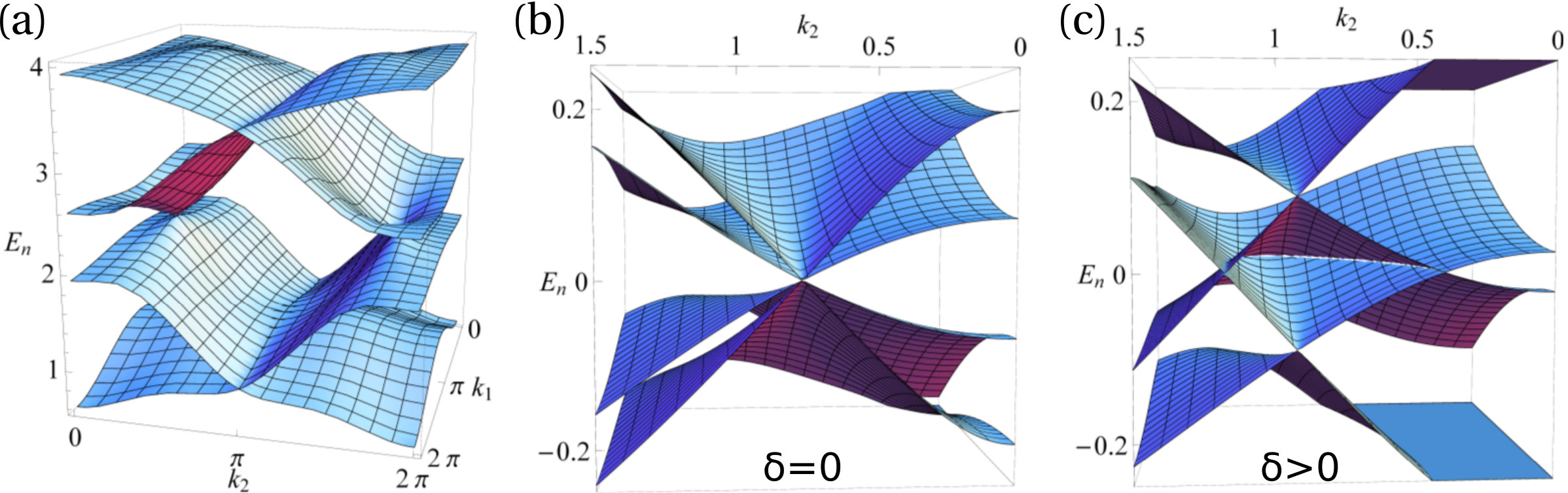 Figure 10
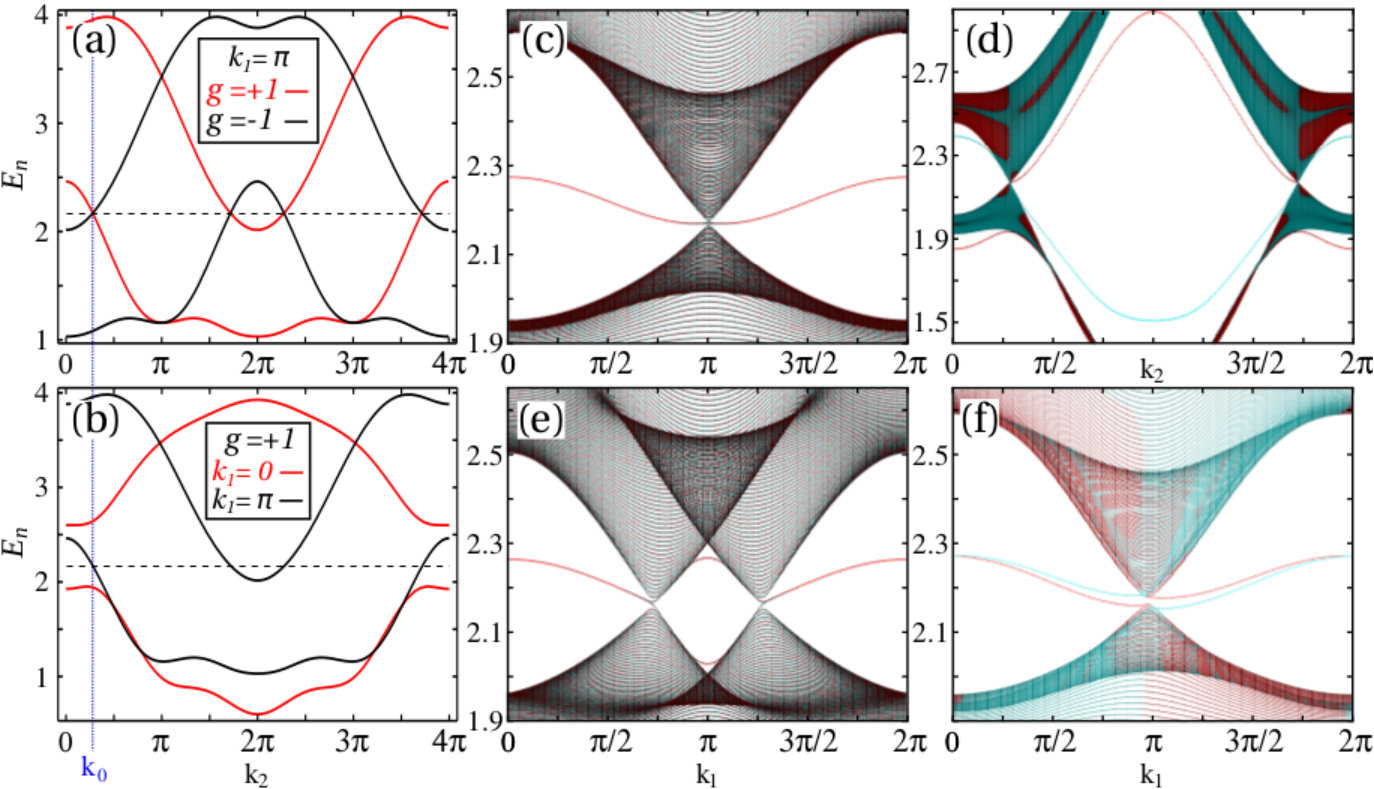 Figure 10
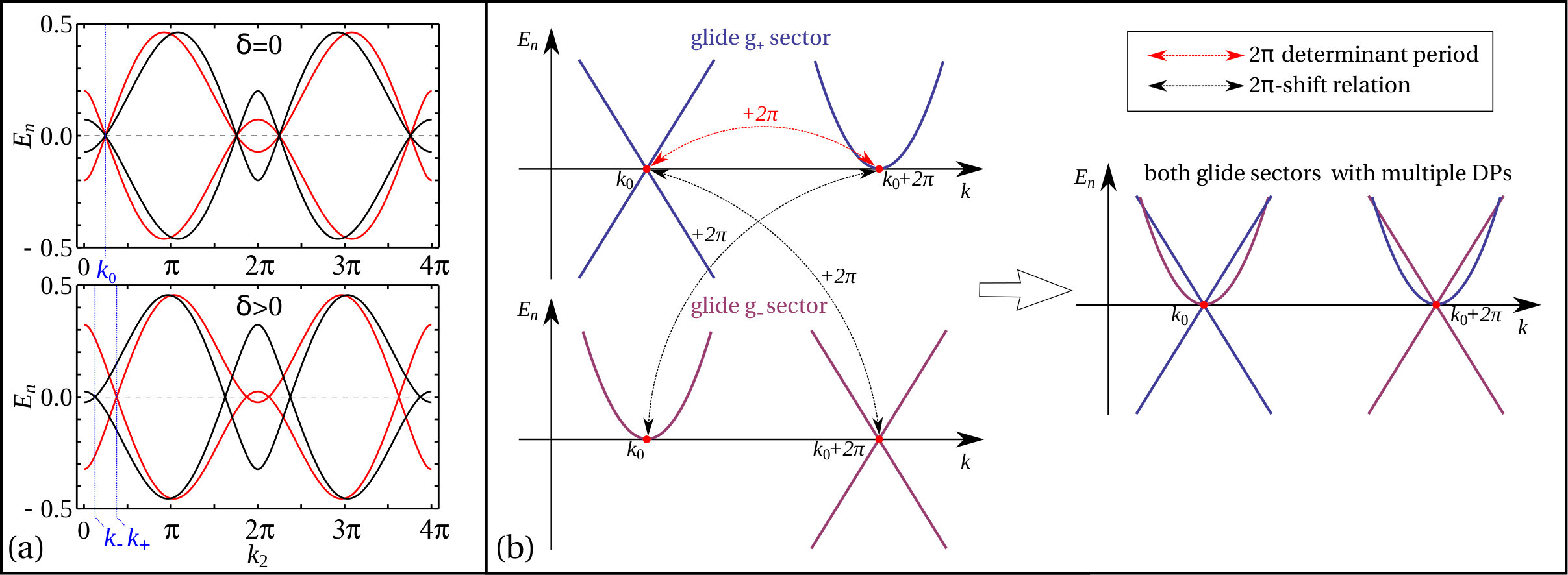 Figure 10
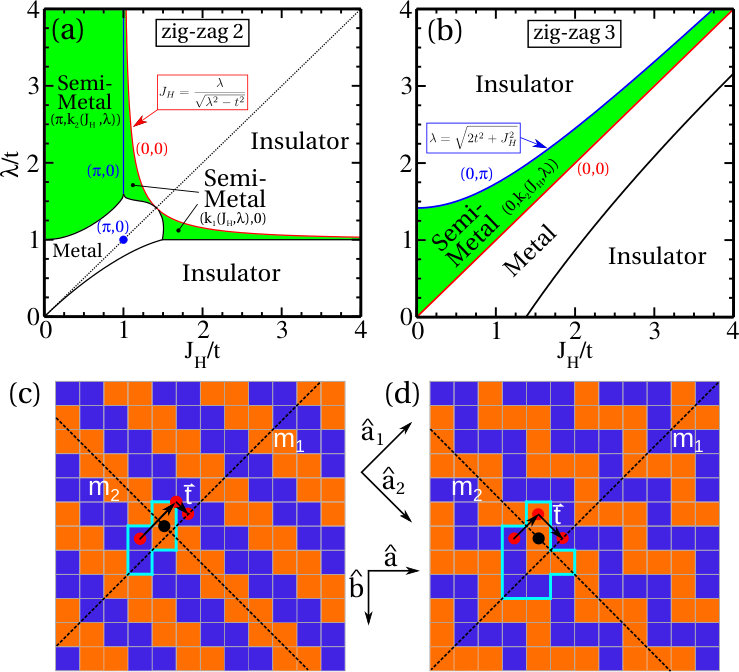 Figure 11
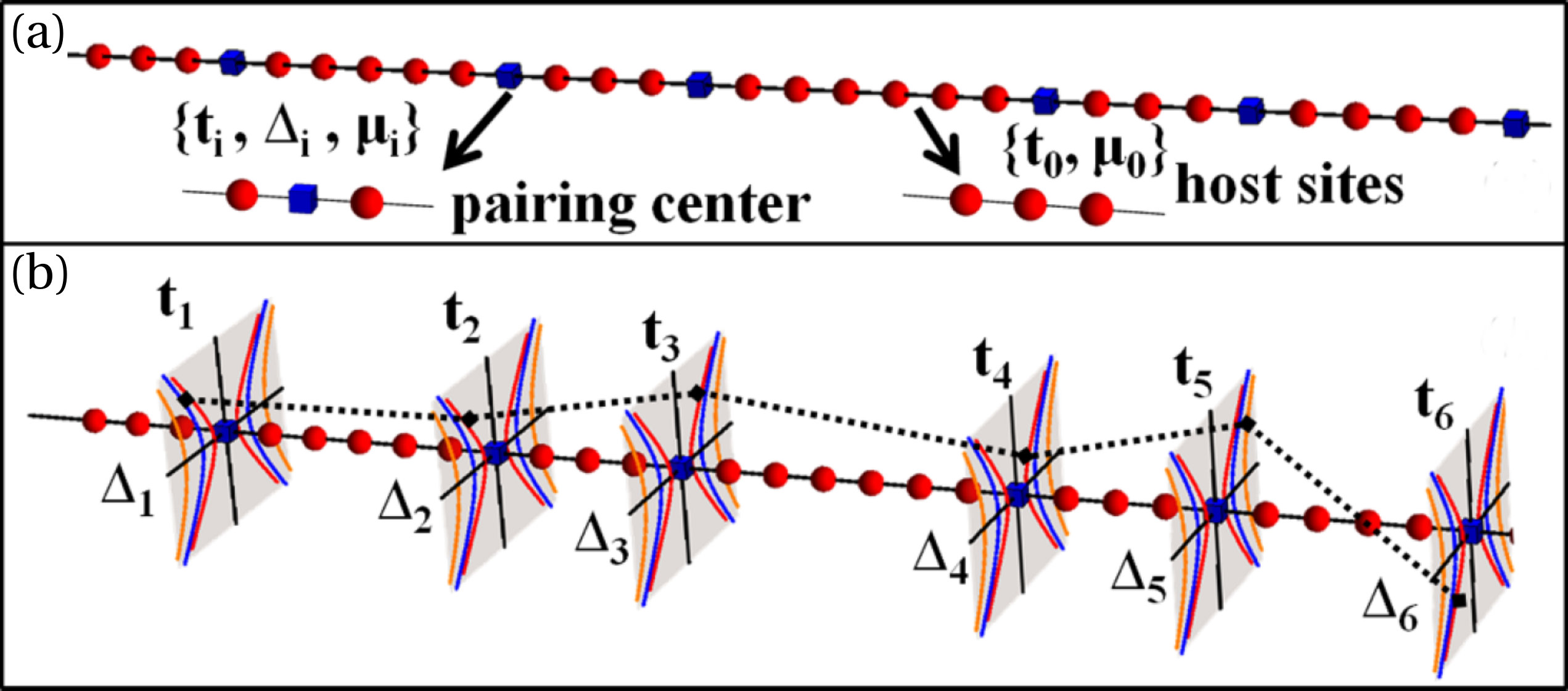 Figure 12
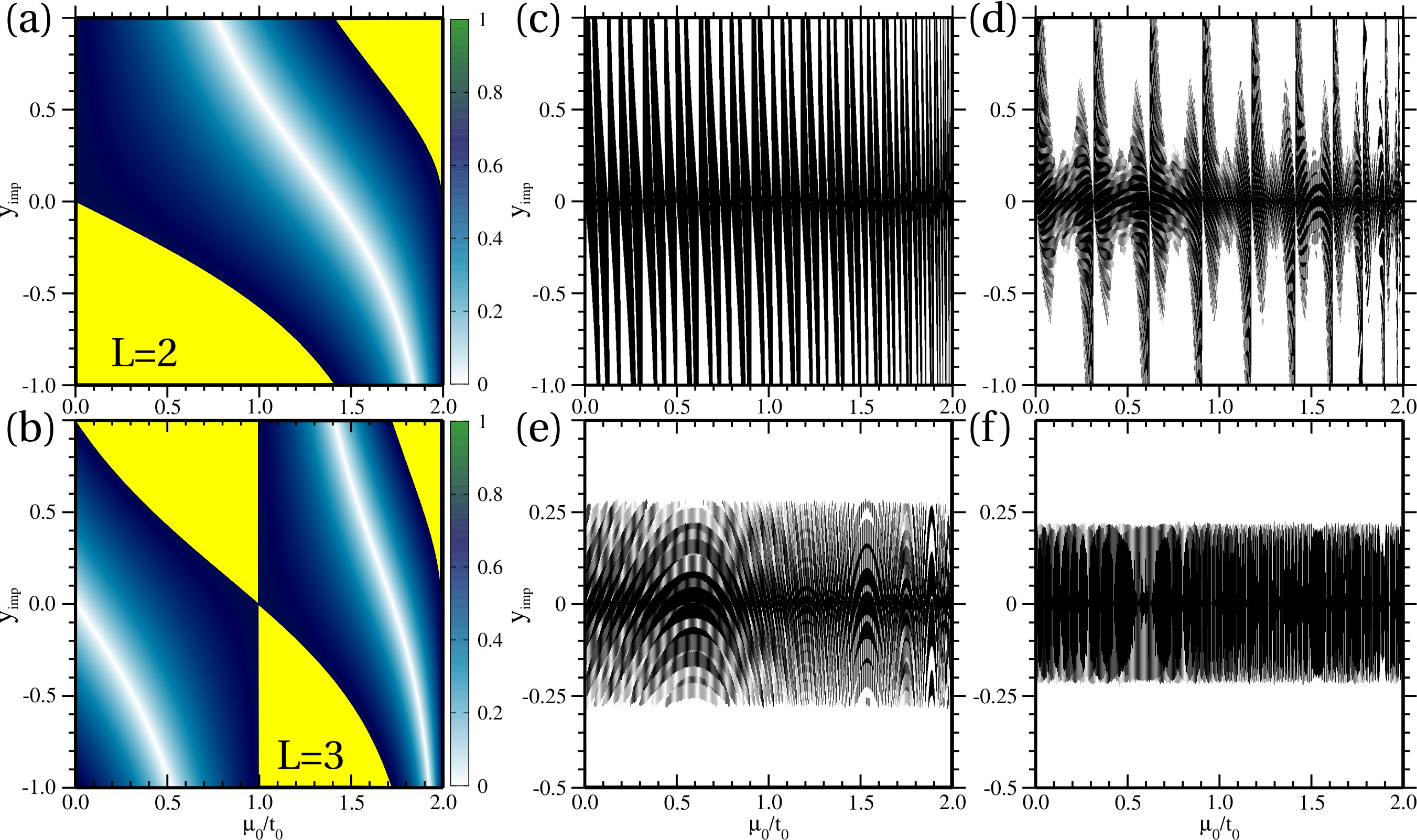 Figure 12
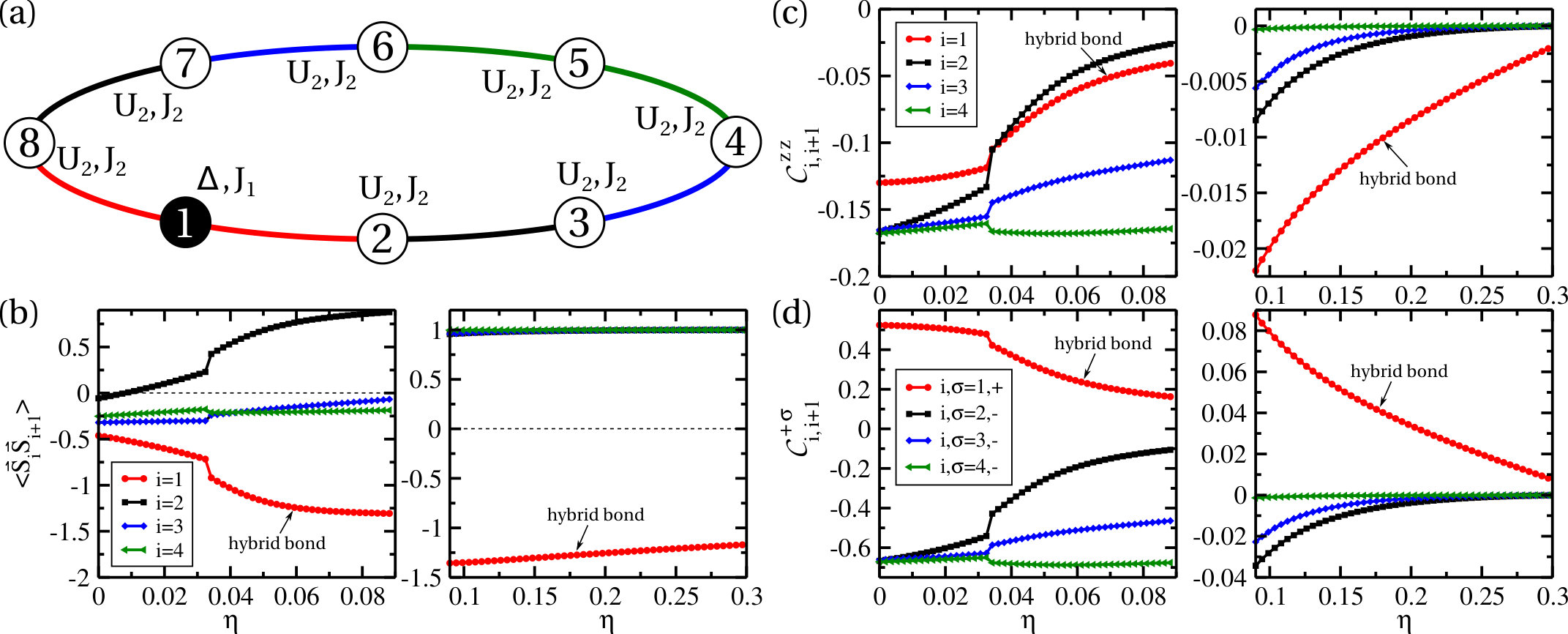 Figure 13
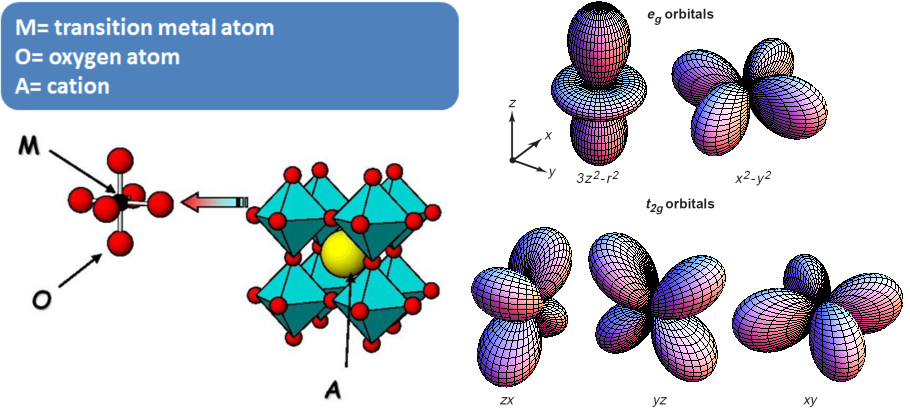 Figure 1
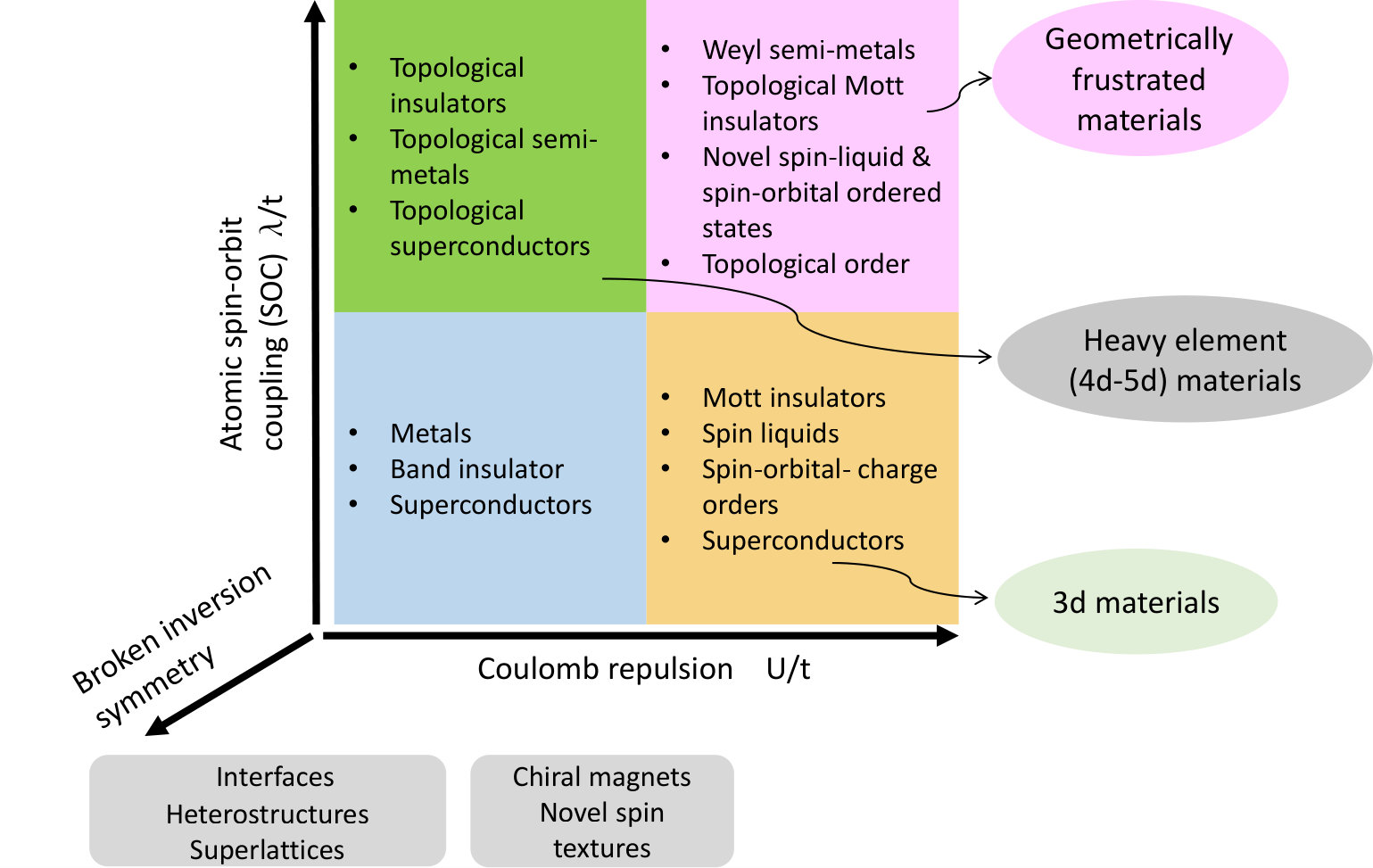 Figure 2
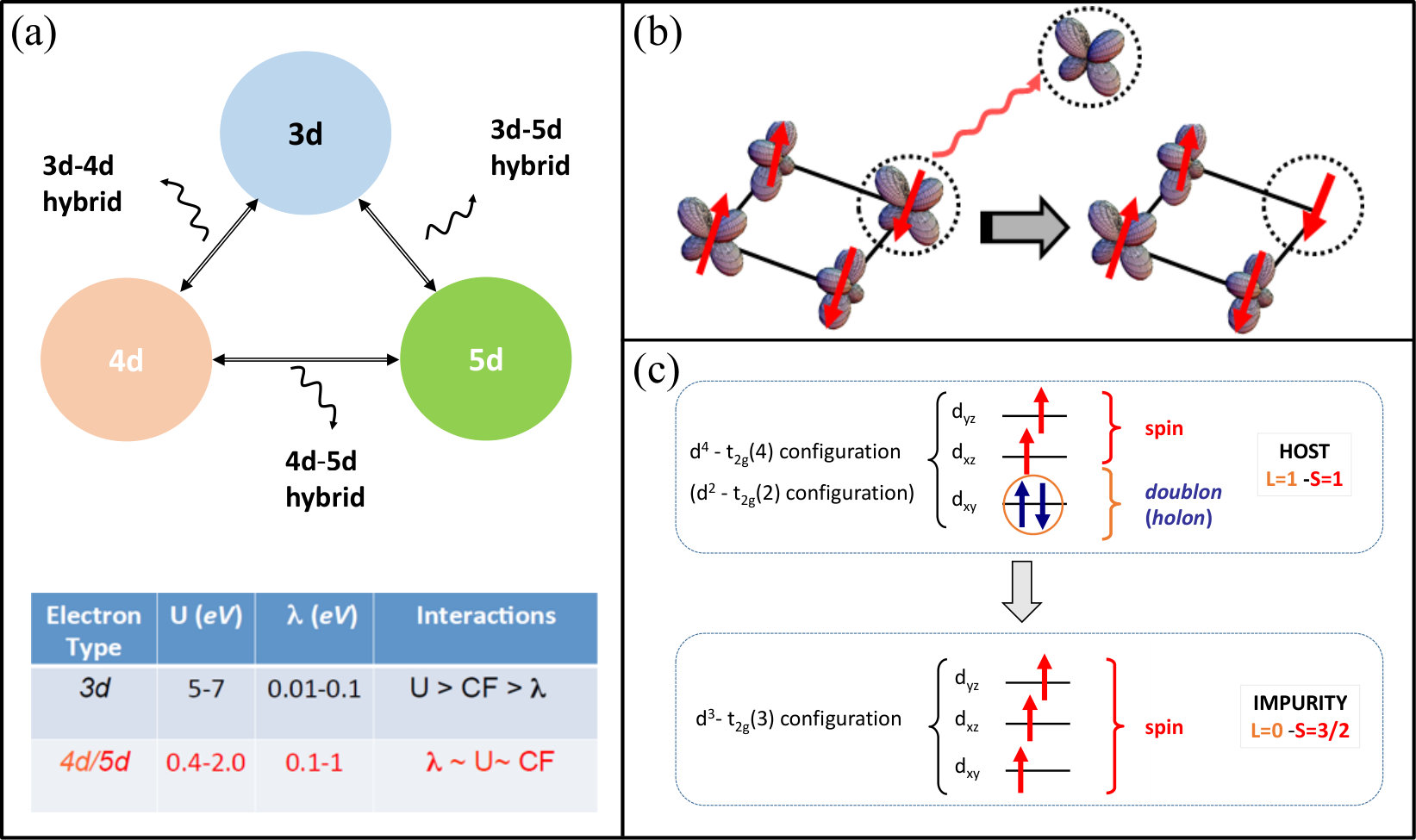 Figure 3
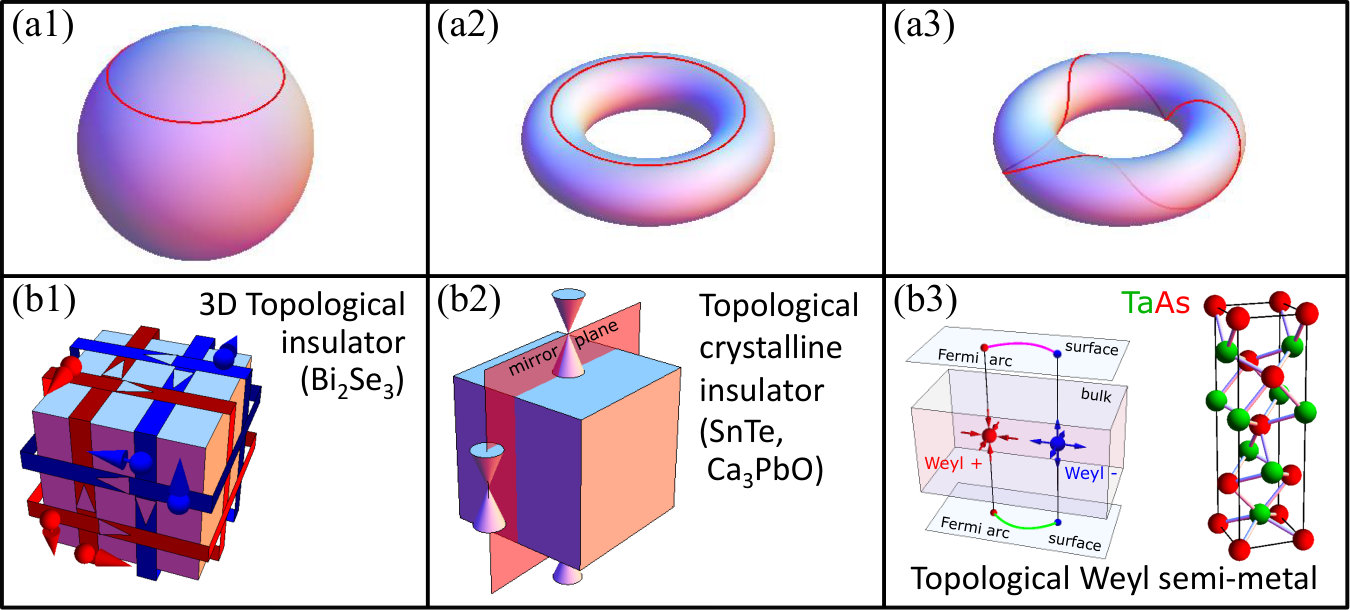 Figure 4
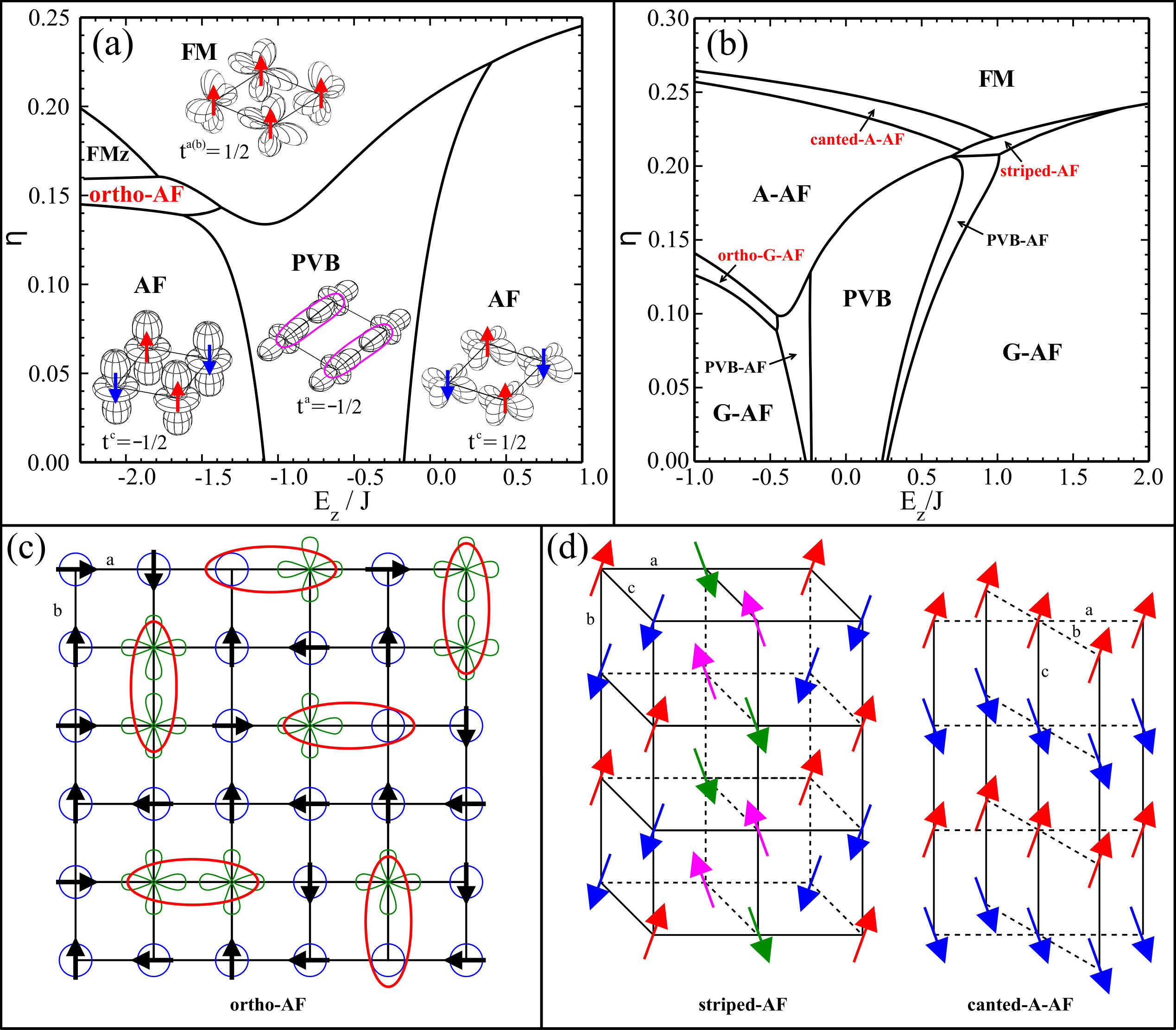 Figure 5
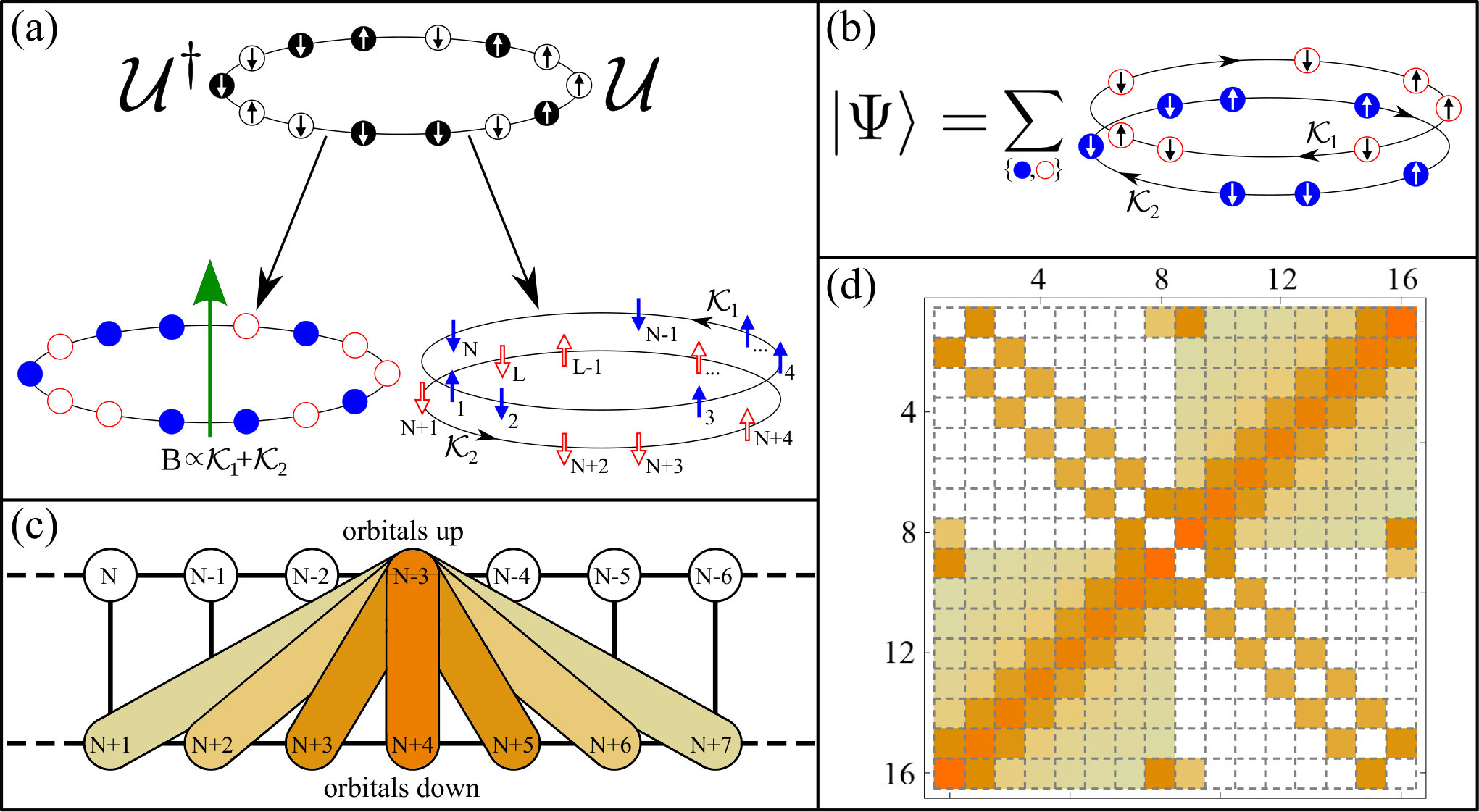 Figure 6
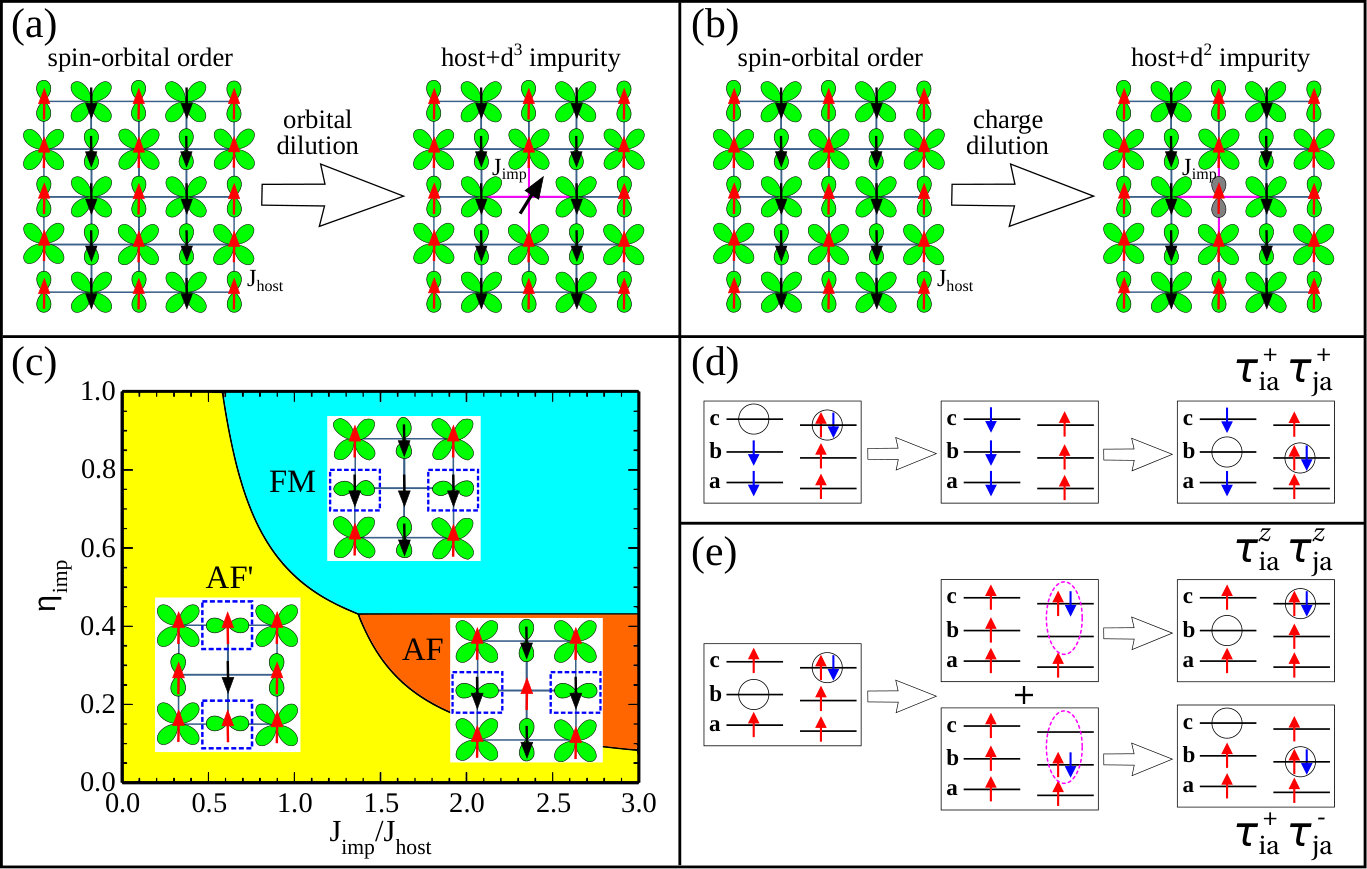 Figure 7
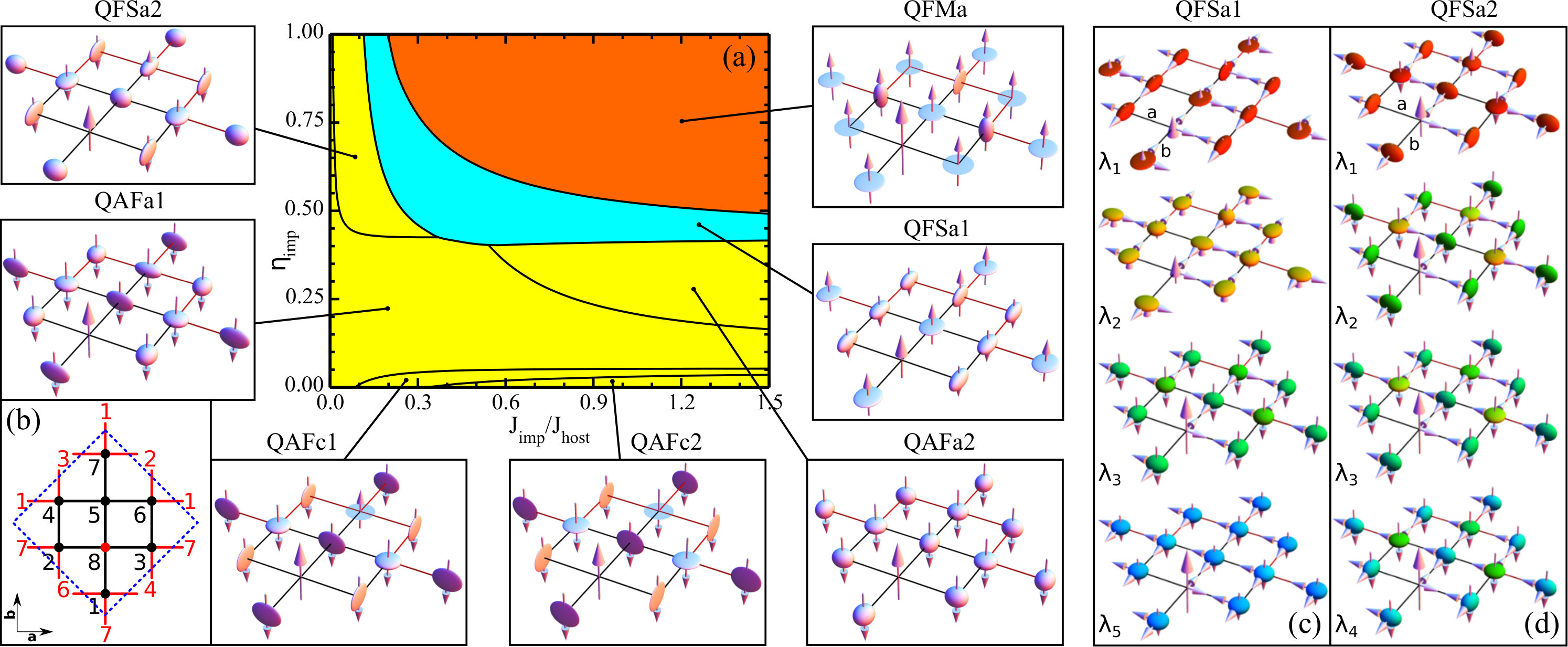 Figure 8
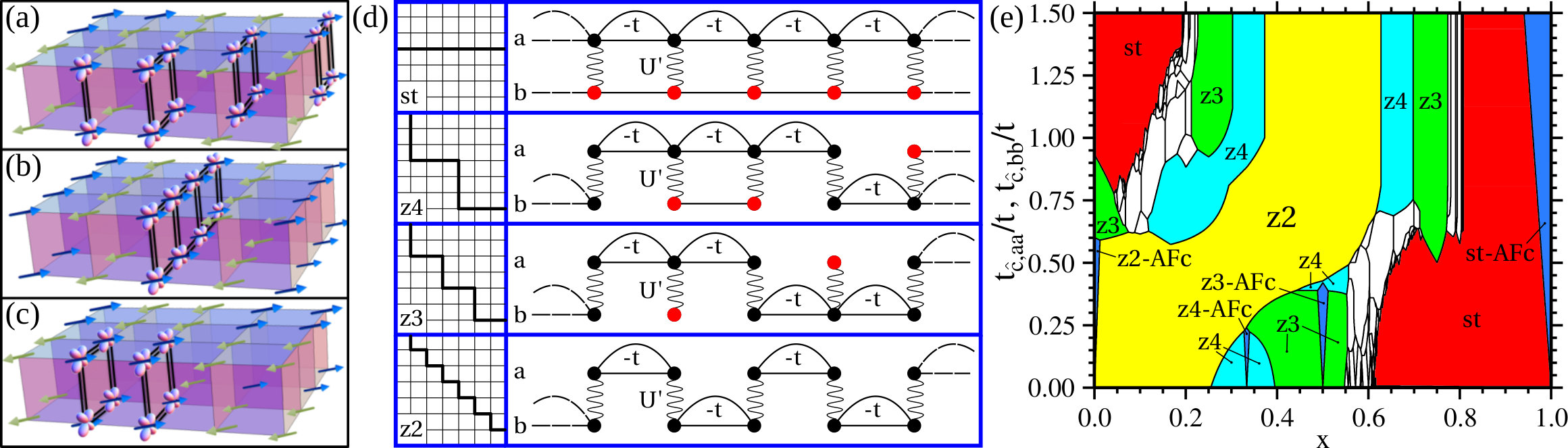 Figure 9
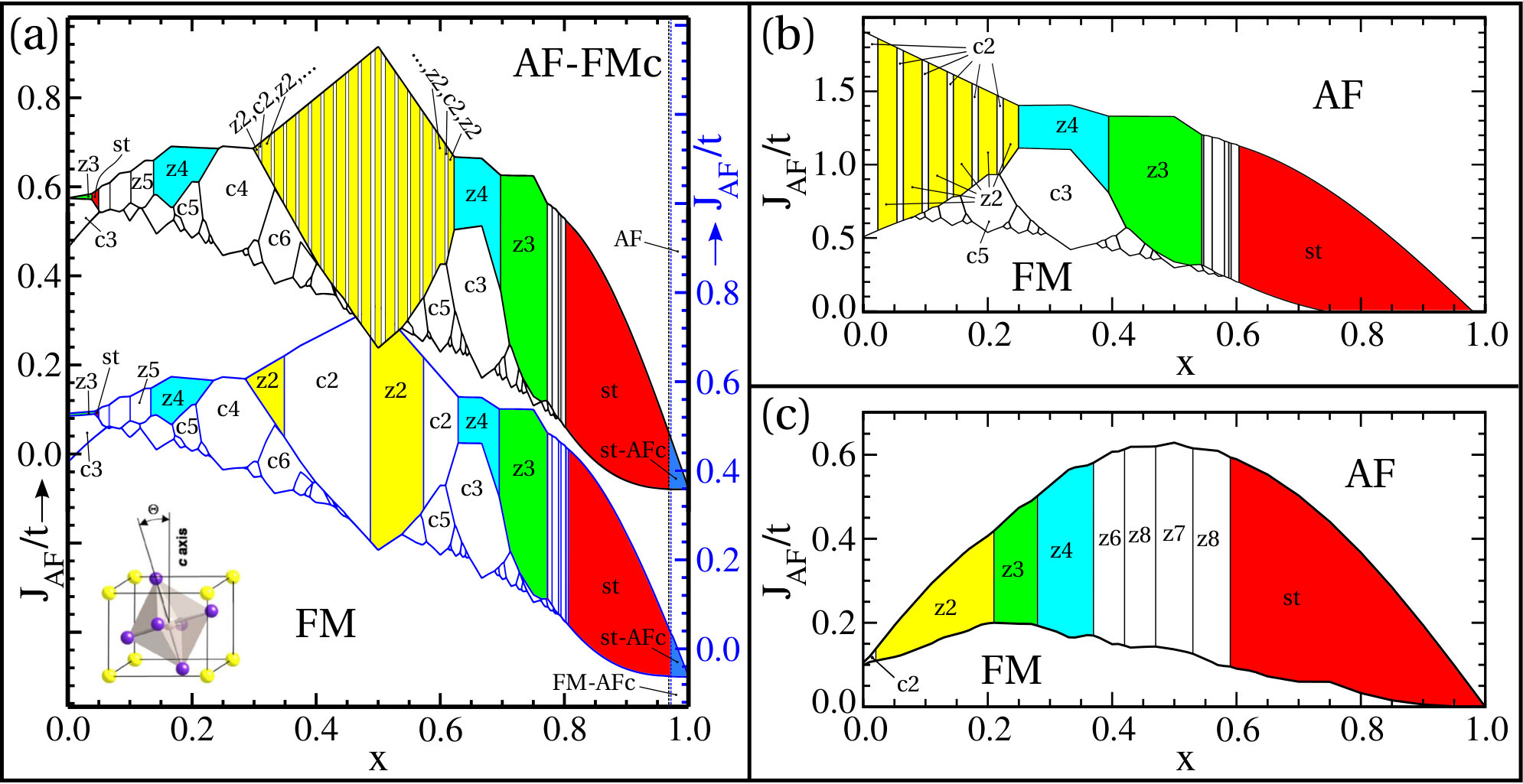 Figure 9
Peer Reviews
No public reviews on file for this paper yet. If you reviewed it on a platform where reviews are public (OpenReview, ICLR, NeurIPS, ICML), you can paste yours below so the community can read it here.
Videos
No videos yet. Explain this paper in a talk, walkthrough, or lecture? Add one.
Spin, orbital and topological order in models of strongly correlated
electrons
Wojciech Brzezicki
International Research Centre MagTop at Institute of Physics, Polish Academy of Sciences, Aleja Lotników 32/46, PL-02668 Warsaw, Poland
Abstract
Different types of order are discussed in the context of strongly correlated transition metal oxides, involving pure compounds and and hybrids. Apart from standard, long-range spin and orbital orders we observe also exotic non-colinear spin patterns. Such patters can arise in presence of atomic spin-orbit coupling, which is a typical case, or due to spin-orbital entanglement at the bonds in its absence, being much less trivial. Within a special interacting one-dimensional spin-orbital model it is also possible to find a rigorous topological magnetic order in a gapless phase that goes beyond any classification tables of topological states of matter. This is an exotic example of a strongly correlated topological state. Finally, in the less correlated limit of oxides, when orbital selective Mott localization can occur it is possible to stabilize by a doping one-dimensional zigzag antiferromagnetic phases. Such phases have exhibit nonsymmorphic spatial symmetries that can lead to various topological phenomena, like single and mutliple Dirac points that can turn into nodal rings or multiple topological charges protecting single Dirac points. Finally, by creating a one-dimensional hybrid system that involves orbital pairing terms, it is possible to obtain an insulating spin-orbital model where the orbital part after fermionization maps to a non-uniform Kitaev model. Such model is proved to have topological phases in a wide parameter range even in the case of completely disordered impurities. What more, it exhibits hidden Lorentz-like symmetries of the topological phase, that live in the parameters space of the model.
1 Introduction
The effects of strong correlations are typically observed in transition metal oxides (TMOs) of perovskite structure, see Fig. 1, where transition metal ions are enclosed in oxygen octahedra and form a cubic lattice [1]. Transition metal ions are characterized by not fully filled shell what determines their chemical properties. Orbitals have orbital quantum number and thus five possible states with magnetic quantum number . These five states in case of isolated atom are degenerate but in case of an atom in cubic environment they get split into three states having lower energy and two states with higher energy, see Fig. 1. Hence, there is still orbital degeneracy left in a cubic crystal. states are typically labeled as; , and , while states are denoted as; and . A commonly used convention for orbitals is; , and – its meaning will become clear later.
Electrons in TMOs can move mainly by hopping from metal to oxygen ions and vice versa what follows from the overlap of their atomic wave functions. These electrons are subject to Coulomb repulsion which is assumed to be purely local due to screening, i.e., electrons interact only when they are at the same atom. In many cases, that depend on the band structure [2], interactions at the oxygen ions are not relevant for the ground state and the system can be described only by a lattice of transition metal ions. The hopping between them is possible due to hybridization with oxygen atoms. Electrons that are at the same atom or lattice site can interact being in the same orbital state and different spin states, then we talk about Hubbard interaction , or can interact being in different orbital states and then the Coulomb interaction depends on spin configuration of electrons via Hund’s exchange and is lowered by for parallel spins [3]. A generic interaction Hamiltonian for transition metal ions has a form of,
[TABLE]
where fermion operator creates an electron with spin in orbital and is a spin operator defined as . Values of i differ for different transition metals, but coupling always favors state with maximal spin , which is the Hund’s rule. The kinetic Hamiltonian can be written as,
[TABLE]
where the sum is over the nearest neighbors (NNs) and hopping amplitudes depends on the bond’s direction and a pair of orbitals between which the hopping takes place. This follows from the fact that orbitals live in real space (unlike spins) and their overlap depend on . For example, in case of orbitals for a bond in direction the only non-vanishing hopping amplitudes are and, in general, for any direction there is no hopping between two orbitals . This is a consequence of their symmetry and symmetry of a cubic lattice, which can be changed for instance by a lattice distortions, and also of participation of oxygen orbitals in hopping processes .
In case when interaction between electrons are strong and there is no doping changing the number of electrons at the lattice sites, a Mott localization can occur [4] being a metal-insulator transition only due to electron-electron correlations, with crucial role played by antiferromagnetic spin exchange [5]. Such an insulator can be described by an effective model where charge degrees of freedom are absent [6, 7]. The charge motion is possible only within virtual superexchange processes, when an electron hops from on metal ion to another one (via oxygen) and hops back. An effective superexchange Hamiltonian can be derived by a perturbative expansion where a perturbation is the kinetic Hamiltonian and unperturbed states are the spin and orbital degenerate eigenstates of . As a result we obtain a model of interacting spin and orbitals known as spin-orbital superexchange model, with the simplest realization being a Kugel-Khomskii model [3] of the generic form of,
[TABLE]
where spin stands for total spin at the transition metal ion following from the Hund’s rule, are pseudospin operators describing orbital degrees of freedom and , are some bilinear functions of these operators depending on the bond’s direction. For metals with high main quantum number, i.e., or ones, one should also include a finite spin-orbit coupling (SOC) . Such a coupling can be added to the superexchange Hamiltonian (3) as a , where is an angular momentum operator that can be expressed in terms of components of [8], provided that – otherwise the high spin description following from is not correct and one has to start from local spin-orbital entangled eigenstates determined by [9].
Equation (3) defines a highly non-trivial quantum many-body problem whose complexity grows exponentially with the system size. Another difficulty is that the spin-orbital interactions are generically frustrated – in the classical picture it’s impossible to find such a configuration that all the bonds have minimal energy, and spins are entangled with orbitals, which means that the wave function cannot be factorized into spin and orbital part [10]. This means that an exact solution is not available (apart from very special cases) and approximate solutions are limited by frustration and entanglement. Nevertheless, in some parameters range, it’s possible to find approximate properties of the model (3), such as spin and orbital ordering or elementary excitations. There are Goodenough-Kanamori rules saying that ferro/antiferromagnetic order in a given direction is accompanied by antiferro/ferro order of orbitals (i.e., for orbitals a pair of spins on a given bond is accompanied by a pair of orbitals and a pair of spins with a pair of orbitals ). However, these are approximate rules that can be modified in presence of strong quantum entanglement [11] or can be formulated in a more general way [12].
Transition metal oxides are intensively studied because of broad variety of possible non-trivial phenomena and possible states of matter that can be realized in TMOs. This follows from the competition between kinetic energy of the electrons and various types of ordering stabilized in the regime of large Coulomb repulsion . Fig. 2 schematically depicts some of there states of matter as functions of and spin-orbit coupling with respect to . Low values of are typical for metals [13, 14], for such compound as cuprates or iron pnicitides [15] known for high-temperature superconductivity or manganites where colossal magnetoresistance is observed. Depending on the interactions strength, for small we can obtain weakly correlated states like metals or band insulators or superconductor and for larger one gets correlated insulators described by spin-orbital models (3), leading to various types of orders, like in vanadates [16, 17, 18], manganites [19, 20, 21] and copper fluorides [22, 23, 24, 25, 26], or to exotic spin-orbital liquid or valence-bond phases on frustrated lattices [27, 28, 29]. Apart from these orders strong correlations in oxides can also lead to supercoducting states [30, 31] which can happen as well in heavy fermion systems [32]. In the limit of larger SOC, relevant for the and oxides [33, 34, 35, 36, 37], one observes the so called topological states in the limit of small interactions [38] and topological order [39] in the opposite limit – the large typically requires some frustration to reduce the hopping amplitude which is typically larger than for the oxides due to larger atomic shells. For the ruthenates this can be achieved by octahedral distortions reducing the bandwidth and lead to different spin and orbital patterns [40, 41] that can be modified by a non-vanishing SOC [42]. Another relevant degree of freedom in ruthenates is dimensionality, controled by the layered structure of these compounds, that decides about electronic properties of these systems [43, 44] and can yield magnetic states with interlayer spin anisotropy [45]. Another factor leading to exotic magnetic states can be breaking of the inversion symmetry that can result in spin interaction terms of the Dzyaloshinskii–Moriya type and chiral spin orders [46]. Such an effect can be achieved by creating interfaces or heterostructures, as a monolayer-bilayer ruthenate superlattice [47] or ruthenium-iridium oxide bilayer hosting topological Hall effect [48, 49]. It is however debated whether the source of this effect are so called magnetic skyrmions triggered by the Dzyaloshinskii–Moriya interactions [48] or non-trivial topology of the underlying band structure related to the spin-orbital fluctuations [49].
A new platform to obtain even more interesting phenomena and spin-orbital orders could by hybrid oxides, i.e., such oxides where on random lattice sites some metal ions are replace by other transition metals. In this way one can create hybrids where energy scales of the Coulomb interaction, spin-orbit coupling and crystal field splitting are not spatially homogeneous, see Fig. 3(a). An example of hybrids are manganese doped layered ruthenium oxides from the family Srn+1RunO3n+1 ( defines number of layers), where physical properties strongly depend on . For , i.e., cubic compound, doping with manganese drives the system from a metallic ferromagnet to antiferromagnetic (AF) insulator [50], whereas for the same doping gives an insulator with a zigzag magnetic order – spins order ferromagnetically along zigzag lines in the planes [51, 52]. For a similar hybrid, single-layer Ca2RuO4 oxide, doping with chromium leads to noncollinear spin order with a tendency to ferromagnetism and exotic negative volume thermal expansion in the parameter range where the system exhibts spin and orbital order [53, 54]. Doping of ruthenium oxides with manganese has a particularly simple interpretation in the limit of strong correlations where the effective spin-orbital description (3) is valid. It is an effective dilution of the orbital degrees of freedom, as shown in Fig. 3(b)-(c), being a subject of papers [8] and [55]. Ruthenium atoms (being the host’s atoms) are in configuration so their atomic state has spin , according to Hund’s rule, and orbital angular momentum , where orbital degree of freedom is the double occupation (doublon) of one of the orbitals. On the other hand the doped ions (i.e., the impurities) have electronic configuration so their atomic state is the one with maximal spin . Since all the orbitals are occupied by one electron each, effectively these ions have no orbital degrees of freedom. In this context doping with chromium is completely different case because similarly to the host’s atoms the dopants have spin and orbital angular momentum realized by empty occupation (holon) of one of the orbitals – see Fig. 3(c). Hence, there is no orbital dilution in this case but the charge dilution [56].
A completely different type of ordering, comparing to conventional spin and orbital orders, is topological order. It refers to periodic systems and can be observed when go around the system. For example, running around the surface of a sphere, as shown in Fig. 4(a1), we do not observe anything particular because any loop on its surface can squeezed to a point. On the other hand, doing the same on the surface a torus, see Figs. 4(a2-a3), we can notice that loops can be non-trivially different; we can do laps along the large circle and laps along the small one and we cannot go smoothly between the loops with different . This means that, in contrary to a sphere, a torus has a non-trivial first homotopy group. This follows of course from the fact that sphere and torus indeed have different topology [57]. This has consequences in the physics of solids – for a non-interacting fermion system the role of loop is played by the quasimomentum space whereas the space of eigenstates of a Hamiltonian plays the role of the surface on which we trace the loop. Rigorously, such a link was established by the Atiyah-Bott-Shapiro construction [58], being rather advanced mathematical concept. The main idea is that thanks to the global phase invariance of the quantum states the eigenstates of Hamiltonians of different symmetries can be regarded as isomorphic to the homogeneous spaces of orthogonal, unitary and symplectic groups. Thus a given Hamiltonian sets a maps from the Brillouin zone (BZ) to such a homogeneous space, also called a classifying space. In contrary to multi-dimensional spheres, for which complexity of higher homotopy groups is uncontrolable [57], the homotopy structure of classifying spaces is strictly limited by the so-called Bott periodicity [59],saying that the homotopy groups are periodic in spatial dimension of the BZ with period for unitary and for orthogonal and symplectic cases. This allows to fully classify all possible topological states of physical systems which is typically done by means of the so-called algebraic K-theory, being a method of generalized cohomology groups [60], a systematic but approximate approach that assumes that the number of bands is infinite . Another important mathematical property of the homogeneous spaces is that their topological properties are independent of their dimension. This guarantees that the topology of the bands does not depend on the choice of the unit cell, which can be chosen as multiplicity of the elementary cell.
Topological phases of matter can be characterized by topological invariants that take integer values, in analogy to surfaces shown in Figs. 4(a1-a3) that can be characterized by integrals of the Gauss curvature giving the number of holes in the surface ([math] for sphere and for torus). This is some kind of a quantization that has physical consequences – for example, in quantum Hall effect where it gives the number of edge states and consequently quantization of the Hall conductance. Depending on the basic (non-spatial) symmetries of the Hamiltonians, which are time reversal symmetry , particle-hole symmetry and chirality (product of and ), and spatial dimension of the system we can classify its topological states as always trivial, non-trivial with a topological index (any integer including [math] being a trivial state) or non-trivial with a index (only [math] or ) [61, 62]. Symmetries () are antiunitary so they can be either absent or present such that () or . On the other hand chirality (or sublattice symmetry) is unitary so either the system has it or not. All together, this gives ten canonical symmetry classes called Altland-Zirnbauer classes, for which there exist six universal prescriptions for calculating topological indices; chiral and non-chiral index and two types of index, both in chiral and non-chiral versions. These apply to all Hamiltonians of non-interacting fermions, both with energy gap (insulators, fully gapped superconductors) [38, 63] and without (semimetals, metals and nodal superconductors) [64, 65]. In case of an energy gap we say that it is topologically protected if the system has non-vanishing topological index – it is defined in fully energy-momentum space. On the other hand for -dimensional systems without energy gap we say that a Fermi surface of dimension is topologically protected if it has a non-vanishing topological charge – it is a topological index defined on a -dimensional sphere enclosing Fermi surface in energy-momentum space, where .
From the existence of topological indices and charges one can derive a very important property: the bulk-boundary correspondence. One can show by a rigorous calculation that if a system have an edge (a boundary with vacuum or other system) and it is topologically non-trivial (as a periodic system without edge) then on this edge there will appear states closing the energy gap or connecting the Fermi points in the momentum space. In this way one can show that any change of the topological index of a system must be related with closing the gap, if the system has it, or opening it, if the system is gapless [66, 67]. Since the topological index is given by an integer, a small perturbation cannot change it, unless it changes the symmetries of a system, so it cannot close or open the gap. This is meant by a topological protection of a gap or a Fermi surface. These symmetries can be both non-spatial ( , and ) or spatial, related with crystal symmetries like mirror symmetry, inversion with respect to inversion center or rotation with respect to an axis, which additional complicates classification of topological states [62, 68]. Examples of topological systems are shown in Fig. 4(b1-3). These are; (b1) – three-dimensional topological insulator (TI) Bi2Se3 with metallic, so called helical edge states [69], (b2) – topological crystalline insulator (TCI), e.g., SnTe or Ca3PbO protected by mirror reflection, with Dirac fermions as the edge states [70, 71, 72] and (b3) – topological Weyl semimetal (SM) TaAs with Fermi arcs on the surfaces [73, 74]. Following the bulk-boundary correspondence the topological properties of the bulk are manifested by the metallic egde states; in case of TI they experience spin-momentum locling, i.e., the direction of motion determines direction of spin, in case of TCI they form surface Dirac cones and in Weyl SM Fermi arcs. Other example of topological semimetal is graphene [75, 76, 77] hosting bulk Dirac fermions protected by mirror symmetry. Apart from effective Dirac and Weyl particles low-dimensional topological systems can also host so-called Majorana fermions, as in 1D SbIn superconducting nanowires [78, 79, 80] or other SC systems with vortices or defetcs [81, 82], including even ultracold atom systems [83]. Due to potential application in quantum computers [84], for their non-Abelian braiding properties [85, 86], Majorana states are intensively searched in other than SC system, like quantum Hall ferromagnets [87, 88] and surfaces with atomic steps [89]. It is however not completely clear whether the zero-energy modes observed at the surface steps of TCI [90] are related to the Majorana quasiparticles or rather to the magnetic domain walls crossing the steps [91].
General classifications of topological systems exist only for fermion systems without interactions. Nevertheless, prescriptions for topological invariants are applicable also in presence of interactions because they are formulated in terms of single-particle Green’s function. Symmetries , and can be also generalized for interacting systems. Hence, in principle one can show topological non-triviality of a generic fermionic system but still this may not lead to any edge states because interacting Green’s function may have not only poles but also zeros [66, 67]. In this sense interaction can drive a topological system trivial, at least concerning the single particle spectrum. In practice a good approximation of Green’s function in strongly correlated systems can be obtained by means of various numerical implementations of Dynamical Mean Field Theory (DMFT) [92, 93, 94] or variational wave-function approaches [95]. A slightly different case is a Hamiltonian of the type (3) with no fermionic degrees of freedom, only interacting spins and orbitals. In such case we can have a topological order which is a kind of a non-local order protected by symmetries, i.e., symmetry-protected topological phases [96], with topologically robust ground-state degeneracy . It may be not obvious whether a system have it. It is known that in one dimension a system with topological order has degenerate entanglement spectrum [97]. Another way to look for it is by imposing twisted boundary conditions, parametrized by an angle, and calculating Berry phase of the ground state acquired when changing periodically this angle [98, 99]. A more involved approach is by extracting so-called modular transformation matrices from the degenerate ground-state wave functions obtained either by exact diagonalization [100] or more involved tensor network type of approaches [101], including standard Density Matrix Reronalization Group (DMRG) method [102]. These matrires encode self- and mutual-braiding statistics of the elementary excitations [103, 104] and are closely related with entanglement spectra of a two dimensional systems partitioned into halves along two different cuts. Such approach to topological order can for instance help to identify topological spin-liquid phases and fractional excitations of frustrated magnets [102, 100].
In this paper we will addres the issue of spin, orbital and topological order in the strongly correlated electron systems. In Sec. 2 we focus on exotic cases of non-collinear magnetic order in a class of the Mott insulating transition metal oxides which arises in absence of the atomic SOC, in Sec. 3 we show exotic case of an exact topological order in a one-dimensional spin-orbital model that arises from orbitally degenerate Mott unsulators and we link it with spontaneous dimerization due to orbital quatnum fluctuations., in Sec. 4 we discuss the impact on spin and orbital order of orbital and charge dilution in inhomogeneous (hybrid) and transition metal oxides and the quantum aspect of orbital dilution are discussed in Sec. 5. Sec. 6 addresses the question of stability of zigzag antiferromagnetic phases in a bilayer and monolayer hybrid oxide and in Sec. 7 the topological properties of such phases are discussed with special focus on the role of the nonsymmorphic symmetries. Finally, Sec. 8 describes topological properties of a non-uniform Kitaev model in one dimension which originates from spin-orbital model of a hybrid oxide, see Sec.9. The summary is given in Sec. 10.
2 Noncollinear magnetic order stabilized by orbital fluctuations
A very interesting feature of the Kugel-Khomskii model (3) for strongly correlated TMOs with the electron configuration of the metal ions are exotic spin orders found in two and three dimensions [25, 26]. The configuration effectively means a single hole in the multiplet of orbitals, so spin and orbital degrees of freedom realized by a hole occupying one of orbitals yielding orbital pseudospin . Considered models are for two-dimensional (2D) [25] and three-dimensional (3D) [26] cubic lattices relevant for description of copper compounds, namely K2CuF4 and KCuF3 (with analogical structure as TMOs). Study of these compounds is qualitatively simplified, and can be limited to spin-orbital superexchange, because SOC is absent. Nevertheless it revealed peculiar types of spin ordering, namely noncollinear magnetic patterns depicted in Figs. 5(c-d). The mechanism that can stabilize such ordering in absence of SOC are entangled spin-orbital fluctuations on lattice bonds, also dicussed in Refs. [105, 106, 107].
Noncollinear phases were observed in spin-orbital phase diagrams, obtained via cluster mean-field method (Bethe-Peierls-Weiss method, also used in analogical bilayer case [24]), shown in Figs. 5(a-b). The parameters are; crystal field splitting with respect to superexchange constant (where is a hopping amplitude for a pair of orbitals along axis), where positive value of means that orbital states have lower energy than and negative vice versa, and value of being the ratio of Hund’s exchange with respect to Hubbard . Main magnetic phases are those with AF order in all directions (labeled as AF in 2D and G-AF in 3D systems), phases with ferromagnetic (FM) order in all direction (labeled as FM) and in 3D case a phase being FM in planes and AF in direction (labeled as A-AF). In all these phases the Goodenough-Kanamori rules are satisfied meaning that orbital order in AF bond directions is ferro-orbital and vice versa – see Fig. 5(a). An exception is the FMz phase in 2D system where orbitals do not alternate despite FM spin order. One can also notice that the increasing value of decides about the tendency towards ferromagnetism whereas determines orbital polarization. These relatively simple phases, whose existence can be predicted in the classical limit, are not the only ones. In case when energy scales compete and the system cannot decide about any simple type of order, phases with strong quantum fluctuations occur, such as plaquette valence bond (PVB) phase or finally phases with noncollinear spin order, labeled in red in diagrams 5(a-b). These are phases; ortho-AF in a 2D system and ortho-G-AF, canted-A-AF and striped-AF in three dimensions schematically depicted in Figs. (c-d).
It was demonstrated that the ground state in the ortho-AF phase in the classical limit, see Fig. 5(c), consists of mutually perpendicular NN spins and all orbitals in states [25]. This state is dressed with quantum fluctuations having a form of singlets accompanied with a pair of orbitals or with a single orbital. Noncollinear spin configuration in this case is related with entanglement of spin and orbital degrees of freedom on the bonds, which can be proven by a perturbative expansion. Taking the crystal field term , a purely orbital Hamiltonian, as a center of the expansion and the rest of the Hamiltonian (including spins) as a perturbation, one can get in the first order effective spin interactions between second neighbors on the square lattice. Thus the two sublattice are decoupled and order antiferromagnetically, one independently of the other. The orbital states remains unchanged. In the second order the orbital fluctuations occur, as shown in Fig. 5(c), and effective four-spin interactions which couple the two sublattices in the way that, after neglecting quantum fluctuations, the neighboring spins orient themselves perpendicularly.
This mechanism, described in work [25], is a new way to obtain a noncollinear magnetic order without involving strong relativistic effects, present in heavy transition metals. The key ingredient are strong orbital fluctuations, which in this case follow from the proximity of an orbital phase transition from ferro-orbital order in AF phase to alternating orbitals in the FM one. A similar effect can be also observed in a 3D system, where the ortho-G-AF phase is realized, being a 3D analogue of ortho-AF [26], together with canted-A-AF and striped-AF phases, depicted in Fig. 5(d). They all appear as noncollinear intermediate phases between phases with conventional spin order. For example, being in the phase diagram 5(b) in phase G-AF on the left, spin correlations are AF in all directions and orbitals are polarized as . Increasing we change spin correlations in the planes to FM ones and orbitals to partially alternating by passing to the ortho-G-AF phase. By further increasing we change all the spin correlations in FM ones, so the bonds in direction must reorient themselves by degrees. This reorientation takes place in the canted-A-AF phase, see Fig. 5(d), where the angle between spins along axis changes continuously from to [math] degrees by increasing . This process can be described by a similar perturbative expansion as in the ortho-AF phase with a difference that the center of the expansion in the part of the Hamiltonian that favors alternating orbitals [26]. On the other hand, the striped-AF phase, also shown in Fig. 5(d), can be obtained by the same expansion as ortho-AF one but with positive crystal field , meaning a state with polarized orbitals. The result is then completely different, the spin correlations are AF in all directions but there is a deviation from the degree angle between neighboring spins along one lattice direction and this gives a four sublattice magnetic order. Therefore, it was demonstrated that complex spin and orbital orders can arise even in TMOs with negligible SOC.
3 Spin-orbital model with topological order and spontaneous dimerization
Even more exotic order is present in one-dimensional (1D) spin-orbital model introduced by Kumar [108] in the context of spin-orbital separation found in 1D TMO [109]. Such models are challenging in low dimension as they often exhibit strong spin-orbital entanglement [110] and quantum critical points [111]. The model has a generic form of equation (3) with spins and orbital pseudospins , so we will use notions spins up and down but also orbitals ’up’ and ’down’. To some extent it resembles exatly solvable orbital compass models [112, 113, 114, 115, 116, 117] in one dimension [118, 119] and on a ladder [120, 121] that originate from interacting orbital models. Their generalization are so-called compass plaquette models [122], that in one dimension can be also solved exactly, at least in certain limits [123, 124], making use of specific local symmetries. These models however contained only orbital pseudospins and no real spins. The case of the model is different; Kumar has demonstrated thar for an open chain one can define a unitary transformation that splits spin and orbital degrees of freedom in the rigorous way. The effect of this transformation is that spins become an effective gauge field attached to orbitals and after the transformation they disappear completely from the Hamiltonian. However, in Ref. [108] there is no answer to the question what happens in the system has periodic boundary conditions (PBCs). This turns out to be particularly interesting – in work [125] it was shown that transformation still leads to almost complete spin-orbital separation but the spins absorbed as a gauge field by orbitals reappear on the last bonds connecting first and the last site of the chain. They appear as a very special non-local operator leading to topological order and topological excitations in the system. This is an intriguing example of a topological order in a strongly correlated system that is exactly solvable.
The action of the non-local boundary term on the spin subsystem is generating cyclic transpositions, i.e., every spin at site with orbital ’up’ (’down’) is shifted right to the nearest site with orbital ’up’ (’down’), and thereby the total number of orbitals ’up’ (’down’) is a good quantum number. On the other hand the orbital subsystem feels these cyclic transpositions as effective magnetic field crossing the closed chain – ring. A schematic view of such a special spin-orbital splitting caused by transformation is shown in Fig. 6(a) and of the ground state with topological order in Fig. 6(b). The position of orbitals ’up’ and ’down’ in such a state fluctuates in the orbital Fermi sea in such a way that on average every ’up’ orbital is neighboring with ’down’ one. At the same time in every component of this superposition there are spin currents with quasimomenta i flowing through subsystems of orbitals ’up’ and ’down’. Thus, the spin order in state is completely non-local and relies on closed topology of the periodic chain – hence it is a topological order [125].
The minimal energy of state is obtained for and the lowest excitations are for , with excitation energy being quadratic in and energy gap between excited states scales as , where is the system size. Such excitation can be called topological, unlike orbital excitation whose gap scales as . In the case of an open chain the states split by finite collapse on each other to a single multiplet with degeneracy . One can see then that in the model topology determines the degeneracy of the ground state, which for large system is for closed chain and for open one. In case of topological insulators such a change of degeneracy follows from the presence of edge states with zero energy. However, the model is not a free fermion model and does not have single-particle states so it is hard to talk about edge states in this context. Nevertheless the topologically protected degeneracy and non-local spin order define the topological order in this case.
The model has a rather special form without any direct interaction between spins, only interaction between spin-orbital pairs on the neighboring sites are present. It is then natural to ask what will happen with the ground state if we add as a small perturbation Heisenberg interactions between spins and what kind of order it will produce [126]. The key question is to express the pure spin Hamiltonian of the perturbation in the basis defined by transformation that causes spin-orbital splitting, as shown in Fig. 6(a), and deriving its effective form by perturbation expansion in the spirit of works [25, 26]. As an effect of this approach we obtain a ground state with dimerized spin order – NN correlation alternate between low and high values [126]. This is a non-trivial result because in the initial Hamiltonian all the bonds have the same strength. The exotic spin order follows here from the orbital fluctuations, similarly as it was in the Kugel-Khomskii model [25, 26]. These fluctuation lead to an effect known in the context of electron-phonon interactions as Peierls dimerization [126] but here it happens at zero temperature, in contranst to spin-orbital models studied before where it was activated thermally [127].
The mechanism of dimerization in the -Heisenberg model is related with the special action of transformation on spin degrees of freedom. Under its action spins become so to say attached to orbitals, so delocalization of orbitals entails delocalization of spins. Spins are no longer associated to the lattice sites but to the position of the first, second, third etc. ’down’ orbital. In this way we obtain an effective spin Hamiltonian of the form , where due to delocalization of orbitals couplings do not refer only to NNs but they are diffuse as shown in Figs. 6(c) and 6(d). Then, we have in Fig. 6(c) a subsystem of spins attached to orbitals ’up’ (where ) and a subsystem of spins attached to orbitals ’down’ depicted as two legs of a ladder. Dominating couplings are those on the rungs of the ladder – if the orbital state was a classical Néel state then it would be the only non-vanishing . Due to orbital fluctuations we also have couplings to the further neighbors on different leg of the ladder and couplings along the legs for NNs, not shown in Fig. 6(c) – all values of for a system of the size are shown in Fig. 6(d) (presence of finite follows from PBCs). Dominating couplings are on antidiagonal of matrix and for the ground state it is not a bad approximation to take only these terms in the effective Hamiltonian . The spin order that we get then in the physical basis, after inverse transformation, is a dimerized state where on every odd bond we have and on every even one .
These perturbative considerations have limited application in the thermodynamic limit because the energy gap in the (open) system vanishes as . Thus, for large system a numerical approach was required, going beyond the limitations of perturbation theory. The most suitable method for a 1D system is the density matrix renormalization group (DMRG) [128], which allows in this case to solve the systems up to sites. These calculations showed that, quite contrary to perturbative intuition, there is a continuous quantum phase transition between a system with zero and positive (AF) Heisenberg coupling between the spins. What is interesting is that a closed system realizes a resonating state, being a superposition of two equivalent dimerized states, which does not break a translational invariance and which is subject to spontaneous symmetry breaking in the limit of . On the other hand a perturbative effect, but of higher order than , is dimerization of the orbital state, being a consequence of spin dimerization, observed in the DMRG calculations. All these exotic quantum effects are observed only in case of AF Heisenberg exchange, whereas for FM coupling the spin ground state is trivial and purely classical. Thus, for the dimerization effect one needs entanglement of spin and orbital degrees of freedom.
4 Inhomogeneous spin-orbital models; orbital and charge dilution
Up to now the models that were considered concerned only homogeneous systems and without SOC. Despite this apparent simplicity it was still possible to obtain interesting spin and orbital orders including topological order in one dimension. Thus, even more interesting and richer perspective would be due to hybrid systems like layered ruthenium oxides doped with manganese . Such a doping, as pointed out in the introduction, is a dilution of orbital degrees of freedom, depicted in Figs. 3(b) and 7(a).
In the limit of strong correlations an effective spin-orbital model of the type (3) for bonds connecting the atoms of the host is known. It contains interacting spins and orbital pseudospins , describing a doublon in one of the three orbitals, as in Fig. 3(c). On the other hand, for hybrid bonds between host sites and impurities, the superexchange Hamiltonian describing interactions between a pair spin-pseudospin and a single spin was not known before. Its derivation is given in Ref. [8] as one of the main results. The main issued addressed there is the change of spin and orbital order due to doping of the host with quite typical spin-orbital C-AF order, shown in Fig. 7(a). These studies concerned both a single impurity and finite doping case with periodic distribution of impurities. For both these cases phase diagrams, as the one shown in Fig. 7(c), were determined containing different spin and orbital orders around the dopants as function of microscopic parameters of the model. An extension of this work for different configurations and concentrations of impurities was presented in Ref. [55]. The interesting point about both these works is that they show how by a purely magnetic dopant one can affect both spin and orbital order.
Hybrid bonds around the impurities are significantly different than the ones of the host. In case of the host bonds virtual processes that lead to spin-orbital interactions engage charge excitations related to interaction , i.e., the lowest excited states of a pair of ions have energy gap of the order of . In case of hybrid bonds of pair of ions the energy gap to the lowest excited states is not given by but by ionization energy , being a bare energy difference between the levels of manganese and ruthenium ions, following for instance from differing main quantum numbers. As shown in Ref. [8] this bare difference in the excited states is additionally dressed by differences in Hubbard and Hund’s interactions between and ions. Thus, we obtain the energy scale of the charge excitations as , where and are Hubbard and Hund’s interactions for () ions. The superexchange constant for host bonds is then given by a standard , where is the hopping amplitude between ions (in fact this is a product of two hopping amplitudes, from ruthenium to oxygen and from oxygen to ruthenium). On the other hand, for hybrid bonds the superexchange constant is given by , where is the hopping amplitude between and ions. For host bonds the parameter that decides about tendency to ferro/antiferromagnetism is, as in the case of Kugel-Khomskii model for ions [25, 26], the ratio . For hybrid bonds analogical role is played by .
Figure 7(c) shows a phase diagram, obtained by neglecting quantum fluctuations, as a function of and (with fixed ). Single impurity placed at the lattice site where, before doping, there was a doublon of the host in orbital couples with its spin either ferro or antiferromagnetically with surrounding spins of the host (phases FM, AF or AF’) and at the same time either polarizes the host’s orbitals ’towards itself’ (phases FM and AF) or it is ignored by them (phase AF’). Such defects resemble spin-orbital polarons considered in vanadates where a doped hole is strongly localized at the charge Ca defect and forms a spin-orbital polaron around it [129, 130, 131]. This is a different case than a hole doped in spin-orbital systems [132, 133, 134, 135] that can delocalize due to spin quantum fluctuations. Polarization of host’s orbitals is possible when is sufficiently large with respect to , which also depends on . It follows from the fact that host’s orbitals pointing towards the impurity increase kinetic exchange between and ions. In Ref. [8] it was shown that in case of finite doping there is a generic intermediate phase between FM and AF phases where the impurity spin is frustrated, i.e., half of the hybrid bonds if FM and half is AF. Such a phase is denoted as FS – frustrated spin.
Other type of doping of the system with C-AF order is doping with ions, as shown in Fig. 7(b). In this case both host and impurity are described by local spins and orbital pseudospins but the charge related to the orbital degrees of freedom is different. In case of host’s ions we have doublons, i.e., double occupations of orbitals , or , and in case of impurity we have holons being empty occupations. Thus we call such a doping a charge dilution, in contrast to orbital dilution described earlier. Hybrid bonds between host and impurity in the superexchange limit require deriving, like in the case of doping, and it is done in Ref. [56]. The most interesting effect of charge dilution is appearance of the orbital pairing terms of the form in the spin-orbital Hamiltonian around the impurity. These terms are absent in the pure host system and do not appear in case of orbital dilution. Operators are represented by the three Pauli matrices on site , which for a bond in the direction , act in the space of orbitals states and as if they were states of spin , and analogically in other directions . A consequence of presence of orbital pairing terms is that ’orbital magnetization’, being a total number of doublons/holons in orbitals , and in the system, is not a good quantum number, similarly as in a superconducting Hamiltonian total number of electrons is not a good quantum number. Quantum fluctuations in the orbital sector are thus locally enhanced by the doping which depending on the initial order of the host may affect or not the global orbital order [56]. Other consequence of orbital pairing is that in 1D case for the orbital sector we get a model equivalent to the -type superconducting Hamiltonian or Kitaev model [84]. Such a model is known for its topologically non-trivial ground state which suggests that the orbital state of a 1D model can also be topological – this problem is considered in Ref. [136], which will be discussed later. This is a quite unexpected and interesting aspect of charge dilution.
Exemplary virtual processes leading to orbital pairing terms are shown in Fig. 7(d); we assume bond in direction, so the only allowed hopping processes are from orbital to and from to . In initial configuration the total spins on and ions are opposite and both doublon and holon are in orbitals . This an AF and ferro-orbital configuration. In virtual excited state one of the electrons forming the doublon recombine with holon so there is neither doublon nor holon in this state. Coming back to the ground state one can now either reverse the previous process or shift an electron from orbital of the impurity back to the orbital of the host. In the latter case we come back to the ground state where both holon and doublon were simultaneously shifted from orbitals to . In the language of orbital pseudospins this means that an operator acted on initial ground state. Of course, for a hybrid bond there are other processes possible, shown in Fig. 7(e), that lead to ’orbital hopping’ terms or diagonal ones, both also present on the host bonds.
5 Orbital dilution in the quantum limit
Orbital dilution is even more interesting if we consider it in the presence of quantum fluctuation [8]. The full quantum phase diagram for doping can be obtained by exact diagonalization of an - site cluster with one impurity and PBCs, see Fig. 8(a-b) and evolution of different phases in presence of SOC at host sites, shown in Fig. 8(c). In case of a diagram 8(a) this coupling is absent so the total magnetization is a good quantum number. Other good quantum number is total number of doublons in orbitals , i of the host. Different phases of the diagram 8(a) have thus well defined and and boundaries between the phases are determined as level crossings of the lowest energy levels. The representative spin-orbital configurations in the phases of the diagram are shown in Fig. 8(a); arrows stand for local magnetization and ellipsoids average occupation of orbitals and by a doublon, so the arrow without an ellipsoid stands for impurity. The length of the semiaxes of the ellipsoids in directions and encodes the occupation of orbitals , and in such a way that if a semiaxis in direction is zero then the orbital is occupied. For example, if an ellipsoid looks like a disk in the plane of the cluster then a doublon is almost exclusively in orbital . On the other hand a nearly spherical ellipsoid means that doublon does not favor any orbital. There is some similarity of configurations shown in Fig. 8(a) to the phases of classical phase diagram 7(c), e.g., arrangement of orbitals around the impurity in phases QAFc1 and QAFc2 is similar to the one found in the AF’ phase. A general conclusion that can be drawn from the diagram 8(a) is that it is qualitatively similar to the diagram that can be obtain in classical limit for small but finite concentration of impurities [8], and quantum fluctuations are most significant in FS phases where in absence of quantum fluctuations remove frustration and are responsible for polarization of the impurity spin.
The evolution of representative configurations of the phase diagram 8(a) can be also traced for increasing values of spin-orbit coupling on host atoms. Such an evolution for two FS phases is shown in Fig. 8(c-d). The color of the ellipsoids means local value of the SOC term , where a shift from red to violet means increase of this value. For both phases such values of (increasing with ) were chosen for which there is a significant change of spin or orbital configurations. Due to the presence of SOC quantum numbers and are no longer conserved so distinction between different phases of diagram 8(a) becomes collusive. The universal behavior for large are spin-orbital singlets on every host site and residual magnetic moment at the impurity. An interesting observation is that local for intermediate has a non-trivial spatial distribution, e.g., in phase QFSa2 sites and have much smaller than other sites. Another interesting effect, visible e.g. in phase QFSa2 for , is that for some bonds spin correlations along axis (vertical arrows) have a different sign than along the axes and (arrows in the cluster plane). This means that in an analogical system but with spontaneous symmetry breaking the spin order would be noncollinear, similarly as it happened for the Kugel-Khomskii model for metals [25, 26]. However, here the mechanism is more conventional – SU symmetry for spins is explicitly broken by the SOC terms in the Hamiltonian.
6 Magnetic zigzag phases in the double-exchange model
The problem of possible spin-orbital orders in the hybrid TMOs is non-trivial not only in the limit of correlated insulator, where effectively the charge degrees of freedom are absent, but also in the context of a so-called double-exchange mechanism [137, 19]. Double-exchange Hamiltonian we get by assuming that some of the charges get localized giving rise to a magnetic order and by the Hund’s exchange it affects the energy of delocalized electrons described by kinetic Hamiltonian (2). Such situation can arise due to so called orbital selective Mott transition [138, 139] when electrons localize due to interactions only on some orbitals. A model of this type was studied in Ref. [140] in the context of bilayer ruthenium oxides doped with manganese impurities. This is exactly the case which was called orbital dilution in the limit of an insulator. The aim of this study was, inter alia, explanation of experimentally observed magnetic phase with zigzag order [52], where in the plane spins order parallel along zigzag lines and this pattern repeats in the next plane below, as shown in Fig. 9(a). The stability of various zigzag phases was shown in the parameter range where FM and AF correlations compete with each other [140]. What more, these phases remain stable in presence of octahedral distortions and finite interorbital Coulomb interactions . Very interesting feature of these phases is that the mechanism of their stability is purely kinetic and follows from the directionality of orbitals – thanks to zigzag kinks electrons can enclose themselves in ’orbital molecules’ and lower their kinetic energy with respect to propagation along straight lines.
The double-exchange model considered in Ref. [140] involves three orbitals at every lattice site, where all host atoms have four electrons while impurities have only three, as shown in Fig. 3(c). We assume that orbitals (or the ones) are always singly occupied and electrons that occupy them localize and order magnetically, whereas the electrons occupying orbitals i (or and ) can move freely according to Hamiltonian (2). We assume that the ordering of the localized spins , where labels lattice sites, is collinear and purely classical, so that the Hund’s interaction between localized and itinerant electrons has a form of; , where is the spins of these electrons. The choice of the quatization axis as does not lower the generality of the model if the order of spins is collinear they do not experience quantum fluctuations, the feature we assume here. The interaction between localized spins is then reduced to; , where are neighboring lattice site (and is positive). The operator is a bilinear form of the creation and annihilation operators of the itinerant electrons in orbitals and with spin . Its form is given by; . Thus, for electrons we get a quadratic Hamiltonian parametrized by classical variables living on every lattice site. Our task is to find such a configuration of spins that for a given doping ratio (or electrons ) and the value of the coupling between spins gives minimal energy.
A similar optimization problem was solved by Dagotto and coauthors for manganese oxides in Ref. [19]. The most general method to solve it is to employ a classical Monte-Carlo simulation in variables . However, due to strong tendency of the system towards phase separation a method of variational wave functions was used, i.e., only some chosen ordered configurations of spins were considered and tested for the lowest energy for a given value of and [140]. These configurations are either simple AF and FM phases or intermediate phases between these two having a form of either AF zigzags with a segment length , labeled by , or straight stripes , or checkerboard phases , with square magnetic domains. Phases , and are shown in Figs. 9(a-c). It is not difficult to predict that the FM phase will be stable for , when the system is dominated by kinetics, and the AF phase for , when exchange interaction between localized spins is more important. A non-trivial question is which phase is realized between these two extreme cases.
An important factor affecting the stability of phase with 1D character is directionality of orbitals; hopping of an electron in direction () is possible only through orbitals (). For large with respect to (and this is a case of interest here) electrons with a fixed spin are almost exclusively in the domains with the same spin , because hopping to the opposite domain costs energy . Thus, in the limit of we can treat zigzag phases a set of independent 1D subsystems and a single zigzag or a stripe map on a ladder, depicted in Fig. 9(d). The legs of this ladder are orbitals and in such a way that every rung is a single site of a 2D lattice. For a phase with stripes in direction hopping on a ladder are possible only along leg . Bending the stripes and forming zigzags we change orbitals through which we can hop, as shown in Fig. 9(d). In case of the shortest zigzag for every magnetic domain we effectively get a set of independent two-site molecules formed at neighboring lattice sites with well defined orbital polarization – hence this is a phase with orbital order. Fig. 9(e) shows a phase diagram for such 1D phases where the parameters are doping and interplane hopping amplitude . The diagram shows that phase is stable in quite wide range of doping around in case when amplitude is equal to inplane hopping amplitude . This interval shifts towards if we decrease and for (independent planes) the phase starts from zero doping, meaning high electron density. This is related with a competition between inplane and interplane orbital molecules. A consequence of having second plane is also presence of phases with AF magnetic correlations in direction, such as -AFc phase, which however occur only in narrow windows of doping.
The above considerations concern only 1D phases, i.e., zigzags and stripes. A generic 2D case is richer because it involves hopping processes between magnetic domains, always present for finite , and phases with a 2D character, like AF, FM and ones. Additionally, it is possible to describe a system with octahedral distortions that allow for hybridization of orbitals on the bonds. In Ref. [140] two types of distortions were considered; cooperative rotation of the oxygen octahedra and tilting of the octahedra with respect to axis perpendicular to the plane. The first case turns out to be trivial – the system with rotation distortion in this case is equivalent to the system with no distortion. On the other hand, the tilting distortion is non-trivial and affects phase diagrams of the system, which is shown in Fig. 10(a) with phase diagrams for tilting angle and obtained for and relatively large . In these diagrams we see a window bewteen FM and AF phases where zigzag and stripe phases are formed. However, these phases have to compete with checkerboard phases which grow from below as a extension of the FM phase. Because of similar band structures the competition (almost degeneracy) between and phases is particularly strong in the doping region around but only for and the effect vanishes in presence of distortions.
In case of a single plane, i.e., , the diagram without distortions is shown in Fig. 10(b). Zigzag phase shifts towards zero doping, as in the 1D diagram 9(e), but as it was before still strongly compete with checkerboard . In this case however there it was possible to find another mechanism increasing the stability of the phase – interorbital Coulomb interaction (according to the general Hamiltonian (1), ), such as schematically depicted in Fig. 9(d). Diagram for a single plane with interactions is shown in Fig. 10(c). In presence of interaction between electrons the model becomes a many-body problem which is unsolvable, so the results were obtained via exact diagonalization of finite systems assuming , meaning that the electrons do not leave their magnetic domains.Under such assumption it is correct to include only interorbital interactions due to the absence of electrons with opposite spins. As one can see from diagram 10(c), checkerboard phases do not appear almost at all and the order of the zigzag phases in the window between FM and AF regions is similar to the one found in the former case without interactions. An interesting feature is that, apart from quite obvious magnetic and orbital orders realized by the zigzag configurations, in the phase a non-trivial charge order was found, i.e., the optimal charge distribution is alternating between and electrons in every odd/even segments of the zigzag. This means that phase can have a non-vanishing electric polarization or ferroelectric order. Another effect, common for all diagrams 10(a-c) is exotic metal-insulator transition between phase , being metallic, and phase where electrons are fully localized. It takes place by a cascade of zigzag phases whose segment length diverges when we approach the phase. This is quite peculiar transition from a molecular insulator to a 1D metal by the growth of the molecules, or zigzag segments.
Summarizing, in was shown in Ref. [140] how interestingly a spin-orbital-charge order of the host can change in presence of doping in the limit of partially localized electrons, i.e., localized but only for one orbital flavor. In this case the spin-charge density modulations is due to the purely kinetic mechanism of the electrons but a similar type of order can arise from spin-orbital superexchanges in models of insulating electrons [141, 142]. Such exotic spin orders provoke a natural question of propagation of charge in such systems, a property that can be seen by a photoemission experiment, which is especially challenging in fully insulating regiome [132, 142, 143, 144]. On the other hand, in the double exchange limit zig-zag orderings open a route towards exotic topological semi-metal [145] or nodal superconductor [146] phases, extablishing a connection between magnetism and topological matter.
7 Topological semi-metal phases in systems with zigzag magnetic order
The topological issues of itinerant electrons in the presence of the zigzag magnetic order were exensively studied in Ref. [145] for and orders, whose stability in doped oxides was addressed earlier [140]. These configurations were found to have topological semi-metal phases with Dirac points (DPs) as functions of Hund’s exchange and SOC. In case of zigzag these points have coexisting topological charges of different types and this follows from simultaneous presence of many symmetries in the system, including a nonsymmorphic symmetry – in this case a mirror reflection with a shift of half lattice translation. In case of zigzag this symmetry leads, together with another mechanism described in Ref. [140], to double DPs, i.e., a linear band touching with degeneracy . This is local dispersion of a relativistic particle with spin . Every time the presence of topological charges manifests itself by a presence of topologically protected edge states. Thus we see that the coexistence of magnetic order and nonsymmorphic symmetries can lead to exotic topological properties.
The main focus of study in Ref. [145] is determining the symmetries behind the topological protection of DPs and the behavior of DPs if one breaks them. The mechanism of the mirror symmetry protection is known and there exist tables with the classification of topological invariants that one can have depending on the Altland-Zirnbauer class of the Hamiltonian, spatial dimension and commutation relation between reflection operator and time-reversal and particle-hole symmetries [68]. Similar classification tables exist for topological states protected by nonsymmorphic symmetries in gapped systems [147] but not in the gapless cases, so the question of topological properties of nonsymmorphic gapless systems is still valid [148, 145].
In the zigzag model considered in Ref. [145] it is assumed that electrons in a 2D system hop through orbitals and and experience Hund’s interaction with localized spins at orbitals . Additionally, they are subject to anisotropic spin-orbit interaction , where , being projection of the full interactions term on the subspace of orbitals () and (). Both interaction conserve spin of itinerant electrons , which is a good quantum number. Effectively, the problem is reduced to a Hamiltonian of free and spinless fermions where Hund’s interaction enters as a chemical potential spatially modulated by and spin-orbit coupling as an on-site hopping between orbitals and with its amplitude modulated by .
For zigzag systems and electronic phase diagrams were determined as functions of and , shown in Figs. 11(a) and 11(b). It turned out that topological states (green areas in the diagrams) can be observed for the system with filling and one for half-filling and they appear in a semi-metal phase, where energy gap closes at isolated points in the momentum space – Dirac points. These points are placed at high-symmetry lines of the BZ; their positions are marked in diagrams as . In case of zigzag this is either line (main part of the topological phase for ) or one (smaller parts adjacent to insulator phase). On the other hand, for zigzag DPs are always in the line . Values of the remaining components of are functions or parameters i . For example, in the system being in the main semi-metal phase and increasing we shift DPs along the line until they merge at high-symmetry point for and, further increasing , they split again but now in the line. Further increase of makes the point merge in another high-symmetry point and then energy gap occurs and the system undergoes transition to an insulating state. Similarly, in the system, being in the diagonal of phase diagram () and moving perpendicularly to it through semi-metal phase we change from [math] to keeping constant . This means that DPs move from high symmetry point to along the line .
Schematic views of the and systems are presented in Figs. 11(c) and 11(d), which also shows elementary cells, related lattice directions and (corresponding quasimomenta are and ) and spatial symmetries. These symmetries are; mirror reflection with respect to , mirror reflection with translation and spatial inversion symmetry. Reflection with translation is called a glide and it is a nonsymmorphic symmetry, i.e., such that is composed of point group symmetry and translation by vector which is a fraction of a lattice vector. In our case for both systems and this is a parallel direction to reflection line . Action of this symmetry on a single lattice site is demonstrated in Fig. 11(c) and 11(d). These figures do not show however orbital degrees of freedom – since hopping in direction () is possible only through orbitals (), and mirror reflections interchange and , it is necessary to interchange orbitals and within reflection operator as well. Another type of symmetry is a sublattice symmetry or chirality being an interchange of magnetic domains within a unit cell. This can be achieved by a translation by a vector . Since this is a fraction of a lattice translation, chirality is also a nonsymmorphic symmetry.
In the momentum space Hamiltonians for and systems are represented by matrices of sizes and , respectively. The symmetry operators are represented in a similar way; reflection (with respect to ) and glide (with respect to ), where the latter one involves intrinsic dependence on due to translation . Action of these operators on Hamiltonian is to reverse the sign of quasimomentum perpendicular to the line of reflection, i.e., and . Lines of high symmetry correspond to the reflection lines and in these parts of BZ operators () commute with Hamiltonian , meaning that energy bands can be labeled by quantum numbers being the eigenvalues of (). On the other hand, chiral symmetry for half-filled systems satisfies , so it anticommutes with Hamiltonian for any and analogically to contains intrinsic dependence on due to translation . Intrinsic dependence on quasimomentum implies that one cannot define such a unit cell that would map onto itself under the action of operators or [145].
The plots of the energy bands with DPs for and systems are shown in Figs. 12(a) and 12(b). A very interesting feature for system is that its DPs have fourfold degeneracy and energy bands around these points have form of four Dirac cones touching with their tips. These cones can be split without breaking any symmetry of the system by adding to the Hamiltonian extra hopping terms [145], and then one obtains Fermi surfaces of the form of doubly degenerate circles or nodal lines, as shown in Fig. 12(c). On the other hand, DPs of the zigzag have more conventional form and resemble DPs found in graphene [77, 149].
In case do DPs lying in the glide line one can expect that this is the symmetry that protects them from hybridization and opening a gap. In Fig. 13(a) one can see that this is indeed true in case of zigzag; it shows energy bands for whose color correspond to two eigenvalues of . It is worth to notice that such colored bands have period of , not , which follow from the nonsymmorphic character of symmetry [145]. DPs in Fig. 13(a) appear as crossing points of bands with different eigenvalues of , which indicates that they are protected by the glide. As it follows from a general theory [68], DPs in such case have topological charge , which manifests itsefl by the edge states in a system with open edge. Such states can be seen as colored bands in Fig. 13(c), where the system is open in direction but keeps translation symmetry in direction. These bands have double degeneracy arising from the fact that one is located on the right and one on the left edge of the system. They connect two DPs (in Fig. 13(c) they overlap) with opposite topological charges and in this case they have an energy gap and finite dispersion. The lack of flat band, observed for instance in graphene, results from the fact that the edge of system is not invariant with respect to – it is easy to check that in two dimensions there is no such edge.
Fig. 13(d) shows spectrum for the system open in direction, so a case complementary to that depicted in 13(d). Now we can see both DPs connected directly with two non-degenerate edge states and with one through the boundary of the BZ. This third edge state indicates additional topological charge of the DPs. Its existence can be proven by looking at the bands in 1D subsystems with fixed , perpendicular to the glide line, shown in Fig. 13(b). For each such subsystem is an inversion symmetry operator and each one of them, except those crossing DPs at , has energy gap. As it was proven in Ref. [150] they can have a non-trivial topological index related to the inversion symmetry, which can be expressed as a difference in number of occupied states with fixed inversion eigenvalue between high-symmetry points and . Fig. 13(c) shows such states as functions of , where different colors of bands correspond to points and . One can see that for the value of index is non-vanishing because the number of red and black lines below the Fermi level is different. For there is a topological phase transition to a trivial phase where vanishes. DPs are thus boundaries between topologically trivial and non-trivial phases for 1D subsystems perpendicular to the glide line. This is consistent with appearance of an extra edge state in Fig. 13(d) for and .
The last topological charge, which can be assigned to DPs of the system is the index related to simultaneous presence of inversion and time-reversal symmetries [151]. Its existence can be determined by breaking both reflection and glide symmetries but keeping their product which is inversion. It turns out that this does not open a gap but only moves DPs outside the glide line . A spectrum for a half-open system with edge states is presented in Fig. 13(e). They could not exist without a third, topological charge at the DPs, which can survive breaking of the symmetry. Another example of symmetry breaking is breaking of the time-reversal. Fig. 13(f) shows the spectrum of a half-open system where it happened without breaking other symmetries. As one can see an infinitesimal gap opens in the bulk and it is closed by non-degenerate edge states connecting bottom bands with the upper ones. The spectrum resembles a classical case of a 2D topological insulator with a non-vanishing Chern number or a quantum Hall system.
These considerations concerned only magnetic phase . State of a topological semi-metal for the configuration is different because of a chiral symmetry present at half-filling, that affects possible topological charges of the Fermi surface. It turns out that double DPs place in the glide line can be continuously and without breaking any symmetry of the system transformed into Fermi circles crossing the line at four ordinary DPs, as one can see in Fig. 14(a). Such circles have topological charge arising from simultaneous presence of inversion and particle-hole symmetries [151]. The effect of transformation of multiple DPs into Fermi circles or nodal lines was not described in any earlier work concerning topological systems. We remark that it was possible to describe a hidden non-unitary symmetry which allows for existence of multiple DPs at .
Characteristic feature of a nonsymmorphic symmetry such as is that at the symmetry line, here , bands with fixed eigenvalue of have a period not of but of . On the other hand, since the full Hamiltonian has a period of , these bands cannot be independent – they must differ at most by a shift of . This indeed happens in Fig. 14(a). Additionally, in case of the zigzag at , it turns out that despite bands having period of the determinant of the Hamiltonian in each eigenspace of has still a period of , so the bands are -periodic but their product is already -periodic. This indicates that we have some symmetry of the Hamiltonian at which however refers not to the operator itself but to its determinant. For this reason it is non-unitary, as it was shown in Ref, [145]. Having the knowledge about the determinant it is easy to explain the mechanism of forming multiple DPs, or more generally, multiple bands touching points at the Fermi level. This mechanism is depicted in Fig. 14(b). In a subspace of fixed value of glide (or other order two nonsymmorphic symmetry) we have a Fermi point at , where its origin and degeneracy can be any. Due to the property of determinant it must repeat at in the same subspace although its degeneracy and dispersion can be different. In the other subspace the bands differ only by a shift of so and are still Fermi points, but interchanged. Now, taking both subspaces together we immediately see that at and we get multiple Fermi points.
The mechanism described above is an interesting peculiarity of a nonsymmorphic symmetry. It is responsible not only for degeneracy DPs in zigzag at but also for DPs with for ’magical’ value of chemical potential . Such a triple Dirac point is also found in the glide line and it consists of an ordinary DP crossed by a weakly dispersive parabolic band that contributes to the Fermi surface at . This case resembles Dirac points crossed by flat bands found in the Lieb lattice models [152], which can be relavant for TMOs, however here the lattice structure is simpler and the effect is caused by a nonsymmorphic magnetic pattern.
8 Topological phases in non-uniform Kitaev model
As shown in Sec. 4 doping of a host with a metal can lead in the superexchange limit to a Hamiltonian with orbital terms around the dopants, where are orbital pseudospins and are lowering/raising operators of . Apart from this, on every bond, both of host and around impurities, there are also terms and . For a 1D system, for instance along , we have effectively an Heisenberg model on host bonds and on bonds around impurities.
In one dimension pseudospin operators can be easily mapped onto spinless fermions using Jordan-Wigner transformation. In this way terms become hopping between nearest neighbors and become paring terms, as the ones in the -type Kitaev superconductor [84]. Furthermore, if we substitute the diagonal terms by the mean-field terms (from the point of view of fermions this is Hartree decoupling) then we obtain local chemical potential different for host and impurity sites. Thus, we obtain a non-uniform superconducting Kitaev model schematically depicted in Fig. 15(a), where host sites have one, uniform hopping amplitude and chemical potential and impurity sites, being pairing centers, have different hopping and paring amplitudes and chemical potentials , where labels impurities. Such a model is slightly more general than the one that can be obtained from the spin-orbital model describing host with impurities, because all the impurities are equivalent, but one has to remember that orbital sector is coupled with physical spins . Hence if we are interested in a purely orbital problem then, after averaging over non-uniform spin configuration (if this is justified by weak entanglement of spins and orbitals), the impurities can effectively differ from each other.
The Hamiltonian of a 1D non-uniform superconductor, schematically shown in Fig. 15(a), was studied for possible topological states [153]. This was motivated by the fact that a homogeneous Kitaev model [84] is topologically non-trivial as long as . This non-triviality leads, in a system with open edges, to so-called Majorana states localized at both edge of the system. These states have zero energy so in a superconducting system it is impossible to distinguish which one is an electron an which one a hole state. They are interesting because they are topologically protected and could be potentially used for creating qubits that are robust against decoherence and thus for quantum computing. Signatures of Majorana modes in real physical system were first reported in Ref. [79], where InSb nonowires contacted with -wave superconductors were experimentally studied. Therefore the question of possible topological states in inhomogeneous Kitaev model is relevant since, firstly, physical systems are often non-uniform, secondly, the spin-orbital system from which this model originates could be a novel platform for obtaining Majorana states realized by orbital degrees of freedom. From this point of view finding analytical expressions to determine whether a system of length with impurities is topologically non-trivial is a relevant result of Ref. [153]. Additionally, an important simplification is by introducing variables that allow for strong reduction of number of relevant parameters of the model and exhibiting hidden Lorentz symmetry of topological phases, depicted in Fig. 15(b). It was thus possible to demonstrate that even a system with complete disorder of impurities distribution has a non-vanishing area in parameter space where a topological state is realized, what happens even for small impurities concentration of the order of . Consequently, when such a system is opened the Majorana end-modes were observed [153].
Non-uniform Kitaev model belongs to the same symmetry class as a uniform one, i.e., it has a time-reversal and particle-hole symmetry and thus also a chiral symmetry . From the general classification of topological states one gets that such a model can have a non-trivial topological index, in one dimension given by so called winding number. It can be defined in a following way; in the eigenbasis of operator Hamiltonian of the model in momentum space (assuming translational invariance with any unit cell) has a block-antidiagonal form with two blocks given by matrices and . A determinant of matrix is a complex number and sets a map from BZ, being a 1D sphere, to the complex plane. Such a map can be non-trivial in the sense of homotopy groups, i.e., vector given by real and imaginary part of determinant of can rotate by a angle after one turn around the BZ, where is an integer. It is not hard to guess that is equivalent with the topological index . In case of the considered model the determinant is given by a formula, , where , and are real constants and is an imaginary unit. Thus, by changing from [math] to we have three options; either vector does not make any rotation or it rotates once clockwise or anticlockwise. These two last cases give a topological state and occur if only and . What is interesting, expressions for coefficients , and as functions of the parameters for the host and for the impurities at positions in the unit cell of the length can be obatained in an exact and closed form [153].
Expressions for , and are simple enough to present them in full glory. The biggest simplification is achieved by a hyperbolic parametrization for impurities, i.e., for any impurity we put and , where by an analytic continuation this parametrization covers the whole planes excluding the diagonal , being analogical to the light cones. With such parametrization we get coefficients and as dependent only on the sum of angles , whereas coefficient depends on radii , positions of impurities and host’s parameters. These dependencies however can be reduced to a dimensionless parameter , related with every impurity , whose form is and to one dimensionless parameter determining the host, , . Coefficient can be now written, using triangular matrices and and a diagonal matrix , as , where non-vanishing matrix entries are; and for and . Matrices encode spatial distribution of impurities by distances between impurity and , so they contain some interference of single-particle states localized between two impurities and can be treated as en effective Fermi length of the host.
As one can directly see from the form of coefficients , and , a system that is in a topological state can be modified in infinitely many ways and it will remain topological. Especially, and depend only on the sum of angles , so one can freely modify angles provided that one compensates these changes by the last angle. Therefore, we have symmetries of the Lorentz type in every plane related with impurity , which is depicted in Fig. 15(b). Discovery of such symmetries of topological phase is rather an unexpected and non-trivial result for a system with disorder. Another non-trivial symmetry is scaling of and at every impurity by an arbitrary constant , which neither affects values of parameters nor obviously angles .
Question about the topological state of the system comes down to question about the values of , and , which still depend on many variables. Analysis of this problem can be simplified if we notice that we always have . In such a case if and angles do not sum up to zero, then the system is always topological. The area in the parameter space where we will call a topologically stable domain. Having a general formula for we can now study such domains for different impurity configurations. Note that from the form of coefficient it follows that for we always have independently on all other variables. Figures 16(a-b) show topological domains for a single impurity with a parameter for and , so a high concentration of impurities. We see that with increasing of the unit cell a topological domain gets fragmented and these fragments always evolve around lines where . Impassable boundary of any topological domain is always point , being at the same time a boundary of topological phase for a uniform Kitaev model.
Figures 16(c-f) show the evolution of a topological domain for concentration of impurities with increasing disorder of their positions but with the same parameters on each impurity, with exception of 16(f), where the sign of is random variable. Fig. 16(c) concerns an ordered system where the distances between neighboring impurities alternate between two values and , so it is a dimerized system with two impurities in the unit cell. Topological domain is strongly cut vertically into narrow legs stretching in wide range of . In Fig. 16(d) we introduce a binary Poisson disorder where distances between neighboring impurities take random and equiprobable values or , in such a way that the total number of short and long distances is the same. Coefficient is then averaged over many realizations of the disorder and based on we determine the topological domain. One can notice some similarities of this domain to an ordered case with a difference that some of the legs are cut in vertical axis and there appears a subtle interference pattern, which makes some parts of this area full of holes, resembling Sierpiński carpet, Cantor set, or other fractal structures. Increasing further the disorder we obtain a domain shown in Fig. 16(e), where impurities are placed completely randomly, with a restriction that they are never neighboring. As one can see, there are no vertical legs and the vertical boundaries of the domain seem to be independent on . Interference patterns is clear and resembles many overlapping parabolas whose tips seem to accumulate at few distinct values of , which probably is related with forming of charge density waves between the impurities for chosen values of host’s chemical potential. One can also notice an asymmetry of the domain with respect to positive and negative , where this effect disappears when apart from position disorder we randomize the sign of at each impurity. This case is shown in Fig. 16(f) where topological domain shrinks in vertical direction and interference pattern has a form of long and thin fingers of a trivial phase entering the domain. What is interesting, the subtle character of topological domains 16(e-f) does not depend strongly on impurities concentration; only the width of the domain grows with the decrease of their concentration as the number of impurities is at the same time the maximal power of in the expression for coefficient .
Summarizing, the non-uniform Kitaev model showed interesting analytical properties including hidden symmetries of the topological phase and robustness against disorder. What more, it turned out that for any disorder one can have topological states and consequently Majorana states in open system if only the parameters of impurities are sufficiently close to zero. This is a condition of some kind of resonance between impurities and the host that occurs when and allows the system to igore the disorder inflicted by the impurities.
9 Relationship of non-uniform Kitaev model with charge dilution
The model described above originates from a spin-orbital system with charge dilution, i.e., system doped with metal. The spin-orbital model is however richer than the Kitaev one because orbitals can be entangled with spins. Therefore, one has verify if this entanglement can be neglected and if the pure orbital model, with such parameters as follow from the superexchange, can become topological. To address this issue the full spin-orbital model was studied for a single impurity and seven host atoms [136]. Schematic view of such a setup is presented in Fig. 17(a), where and are the Hubbard and Hund’s interactions of the host, is a Hund’s interaction at the impurity and is characteristic excitation energy for hybrid bonds between impurity and host, analogical to the one which was introduced for orbital dilution [56]. Main result here is demonstrating that if is sufficiently large then spin order of the host becomes FM and entanglement between spin and orbitals is small. Thus, in this parameter range the spin interaction can be substituted by their averages in the FM state and then using the results of [153] one can tell whether the pure orbital model is topological.
In Fig. 17(b) the ground state NN spin correlation obtained by exact diagonalization were shown. As one can see already for the host becomes FM although hybrid bonds remain AF. One should then check if such a bond does not generate high spin-orbital entanglement in the system. In order to do it spin-orbital covariances on the bonds and were calculated. Their form is given by: and , where , which follows from the form of spin-orbital terms in the Hamiltonian. Zero value of these covariances means basically that the wave function of the system can be factorized into spin and orbital part. The behavior of these quantities as functions of was shown in Figs. 17(c) and 17(d). It turns out that non-vanishing off-diagonal covariances for host bonds are only ones with , whereas for hybrid bonds the ones with , so only such covariances were presented in Fig. 17(d). As one can see the AF region for low is characterized by relatively high covariances, so one cannot decouple spin and orbitals. On the other hand, in the FM regime, the covariances are order of magnitude smaller and, especially for host sites, they vanish quickly with growing . A slightly higher entanglement remains on hybrid bonds but one can expect that this effect will be weakened for smaller concentrations of impurities because FM state of the host will be effectively suppress spin fluctuations.
After averaging over spin the pure orbital model was solved by a Hartree-Fock approximation for terms written with Jordan-Wigner fermions. In this way the system was mapped onto inhomogeneous Kitaev model and then its topological non-triviality was confirmed using the results from Sec. 8. Hence, [136] shows that the spin-orbital model with charge dilution can have a topological state in some cases and consequently orbital Majorana states at the edges.
10 Summary
We discussed non-trivial cases of spin, orbital and topological orders in models describing complex and strongly correlated transition metal oxides. Within a spin-orbital model for transition metals in the configuration, i.e., the Kugel-Khomskii model, the noncollinear magnetic phases were found, whose stability does not rely on SOC but only on strong orbital fluctuations and spin-orbital entanglement [25, 26]. On the other hand, a rigorous topological order was uncoveded in one-dimensional spin-orbital model, which follows from a non-trivial separation of spin and orbitals in a periodic system [125]. Studies of the same system with additional Heisenberg spin coupling showed the presence of quantum phase transition involving spontaneous dimerization of the system [126]. This dimerization occurs mainly in the spin sector due to orbital fluctuations. Therefore, this is a mechanism related to the one that gives noncollinear phases in the Kugel-Khomskii model.
Another interesting case are models of transition metal oxides doped with or metals. First of these cases we call orbital dilution [8, 55], because the dopant is effectively deprived of orbital degrees of freedom, and the second one is the charge dilution [56], because the dopant has orbital degrees of freedom but realized by empty, not double occupancy of one of the orbitals. Orbital dilution was found to lead to strong modification of the spin-orbital order of a host in different ranges of microscopic parameters both in classical and quantum limit, including spin-orbit coupling at host sites. This leads again to phases with noncollinear magnetic order around the dopants and host’s spin-orbital order is modified even for small doping ratios. On the other hand, in the case of charge dilution, it was shown that dopants are the source of orbital pairing terms. It turned that they increase orbital fluctuations and can drastically change the order of the host, similarly as it happens for the orbital dilution case. Works [8, 55, 56] are one of few theoretical contributions to this very interesting direction of research which are hybrid transition metal oxides. What more, they are inspiration for further experimental studies of the systems with orbital or charge dilution. We argue that short-range order around impurities could be investigated by the excitation spectra at the resonant edges of the substituting atoms. We expect that the spin-orbital correlations could emerge in the integrated RIXS spectra providing information of the impurity-host coupling and of the short-range order around the impurity.
Another aspect of hybrid oxides and charge dilution is that in one dimensions a system with a doping can be connected with non-uniform Kitaev model having topologically non-trivial phases [153], even in the case of complete disorder of the dopants [136]. The mapping of one model onto the other is possible only under condition that spin-orbital entanglement is small, which happens in the ferromagnetic regime of the host. On the other hand, results obtained for the Kitaev model are more general and show hidden symmetries of the topological phase involving, inter alia, Lorentz transformations in local space of impurities parameters. Therefore, works [153, 136] not only contribute to fundamental understanding of properties of topological phases but also postulate existence of orbital Majorana states in an insulating, strogly correlated spin-orbital systems. An experimental realization and detection of such Majorana modes remains an open question, although analogical realization of Majorana bound-states in a spin model was suggested recently [154]. The detection of such states could by through spin transmission through the magnetic region of a characteristic resonant length. Therefore, the orbital Majorana states could be detected in a similar manner.
A different connection of physics of topological states with transition metal oxides and spin-orbital order can be made in the limit of itinerant magnetism described by double-exchange models. The stability of zigzag magnetic order in a bilayer system doped with ions, so a case of orbital dilution, can be attributed to direction hopping forced by the symmetries of the orbitals [140]. The system was studied using a double exchange model, where electrons with one orbital flavor are subject to localization and interact, via Hund’s interaction, with electrons on the other orbitals which remain itinerant [140]. It was shown that different types of zigzag phases are stable due to the process of formation of orbital molecules which for some electron densities allow to reduce the kinetic energy in the system. This happens in the region of the parameter space where the uniform ferromagnetic phase competes with the antiferromagnetic one, so the kinetic energy of itinerant electrons is comparable with magnetic exchange of localized spins. On the other hand, one can focus on the topological aspect of the itinerant electrons that moving among localized spins ordered in a zigzag fashion interact with them via Hund’s exchange and spin-orbit coupling [145]. It turns out that by tuning these two parameters we can obtain wide regions of metallic, insulating an semi-metallic phases, where these last ones are topologically non-trivial. Their non-triviality follows from the presence of topologically protected Dirac points. These can be points with higher than a double degeneracy and the topological protection can arise from more than one topological charge present at the Dirac point. The source of exotic features of topological semi-metallic phases is the nonsymmorphic character of the zigzag magnetic order – it has a symmetry of a mirror reflection with a shift of half of a lattice vector. What more, this symmetry has a tendency to glue Dirac points together and form multiple degenerate point which engage another symmetry, being however non-unitary (nor antiunitary), acting on the level of determinant of the Hamiltonian. Therefore, some new fundamental understanding of topological phases with nonsymmorphic symmetries was developed in Ref. [145]. It can be an inspiration for experimental groups searching for materials which are both topological and magnetic, for instance antiferromagnetic topological insulator whose discovery was reported recently [155]. Another interesting option is interfacing such a planar magnetic system with a superconductor to induce superconductivity in presence of nonsymmorphic symmetries, as discussed in Ref. [146]. This can lead to an exotic nodal-loop superconductivity even in proximity of a simple -wave superconductor. This shows that interfacing magnetic or superconducting order with topology can lead to unexpected and interesting phases of matter.
I thank Andrzej M. Oleś, Mario Cuoco and Jacek Dziarmaga for friendly and fruitful collaboration. This work is supported by the Foundation for Polish Science through the IRA Programme co-financed by EU within SG OP Programme. I acknowledge support by Narodowe Centrum Nauki (NCN, National Science Centre, Poland) Project No. 2016/23/B/ST3/00839 and by the European Union’s Horizon 2020 research and innovation program under the Marie Sklodowska-Curie Grant Agreement No. 655515, project UFOX: Unveiling complexity in Functional hybrid Oxides.
The reference list from the paper itself. Each links out to its DOI / PubMed record.
- 1[1] Oleś A M, Khaliullin G, Horsch P and Feiner L F 2005 Phys. Rev. B 72 214431
- 2[2] Zaanen J, Sawatzky G A and Allen J W 1985 Phys. Rev. Lett. 55 418–421
- 3[3] Kugel’ K I and Khomskii D I 1972 JETP Lett. 15 446
- 4[4] Mott N F 1968 Rev. Mod. Phys. 40 677–683
- 5[5] Wysokiński M M and Fabrizio M 2017 Phys. Rev. B 95 161106
- 6[6] Oleś A M 1983 Phys. Rev. B 28 327–339
- 7[7] Khaliullin G 2005 Prog. Theor. Phys. Suppl. 160 155
- 8[8] Brzezicki W, Oleś A M and Cuoco M 2015 Phys. Rev. X 5 011037