Induction of chaotic fluctuations in particle dynamics in a uniformly accelerated frame
Surojit Dalui, Bibhas Ranjan Majhi, Pankaj Mishra

TL;DR
This study demonstrates that a horizon in a uniformly accelerated frame can induce chaotic behavior in a particle trapped in a harmonic oscillator, independent of intrinsic curvature or gravity effects.
Contribution
It provides a model showing that horizons alone can cause chaos in particle dynamics, supporting the conjecture that horizons induce chaos without gravitational curvature.
Findings
Horizon presence can induce chaos in particle motion.
Chaotic behavior depends on parameters like acceleration and energy.
System transitions from periodic to chaotic states.
Abstract
The ongoing conjecture that the presence of horizon may induce chaos in an integrable system, is further investigated from the perspective of a uniformly accelerated frame. Particularly, we build up a model which consists of a particle (massless and chargeless) trapped in harmonic oscillator in a uniformly accelerated frame (namely Rindler observer). Here the Rindler frame provides a Killing horizon without any intrinsic curvature to the system. This makes the present observations different from previous studies. We observe that for some particular values of parameters of the system (like acceleration, energy of the particle), the motion of the particle trapped in harmonic potential systematically goes from periodic state to the chaotic. This indicates that the existence of horizon alone, not the intrinsic curvature (i.e. the gravitational effect) in the background, is sufficient to…
Click any figure to enlarge with its caption.
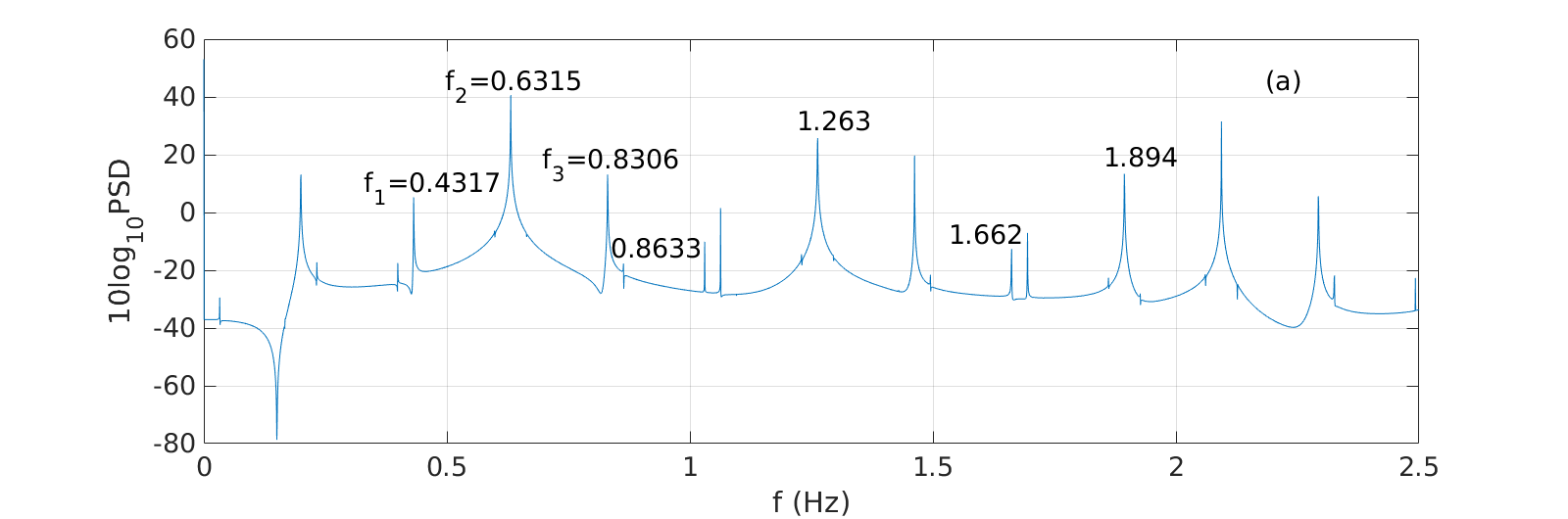 Figure 1
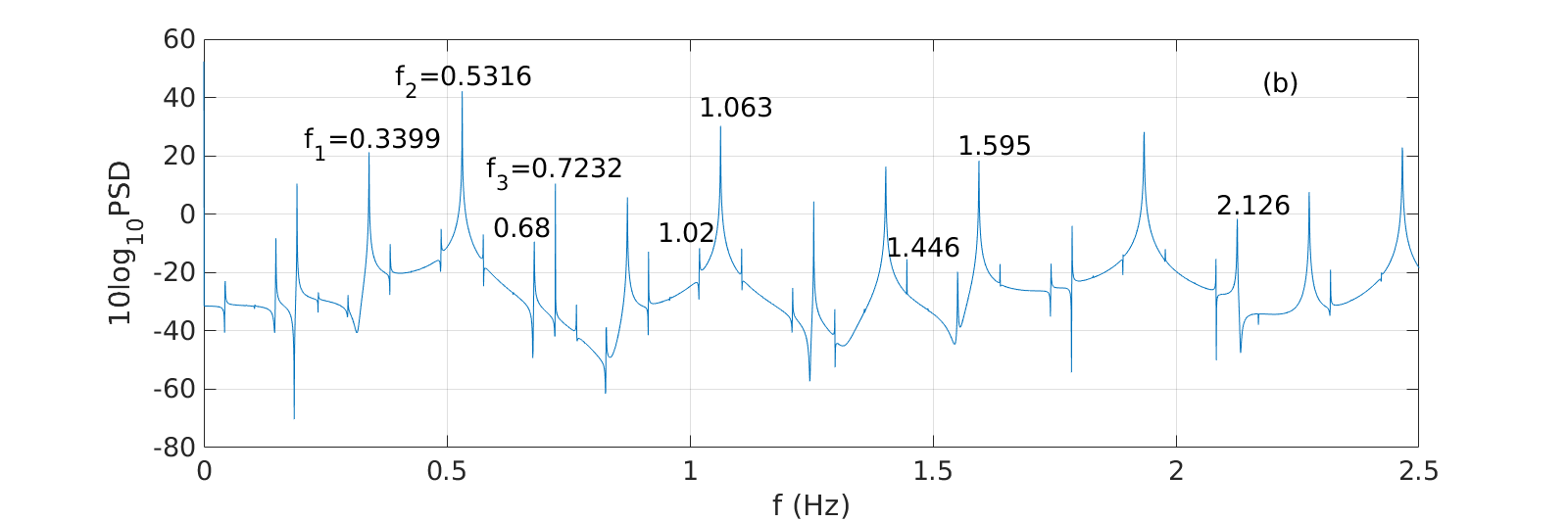 Figure 2
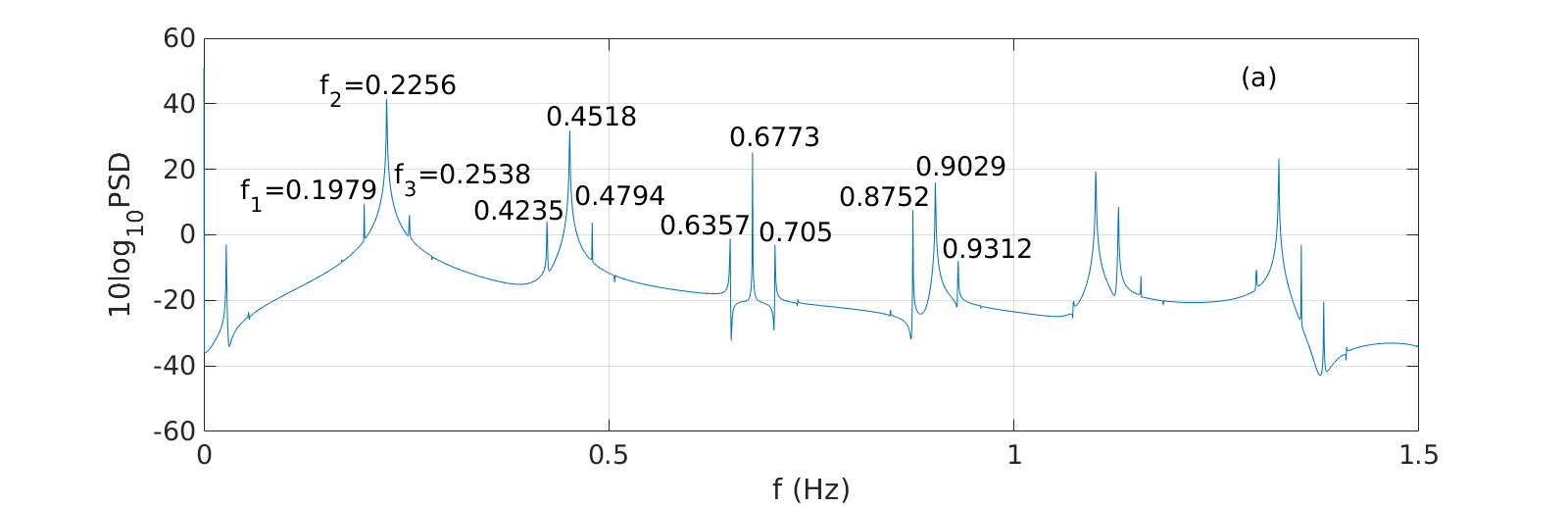 Figure 3
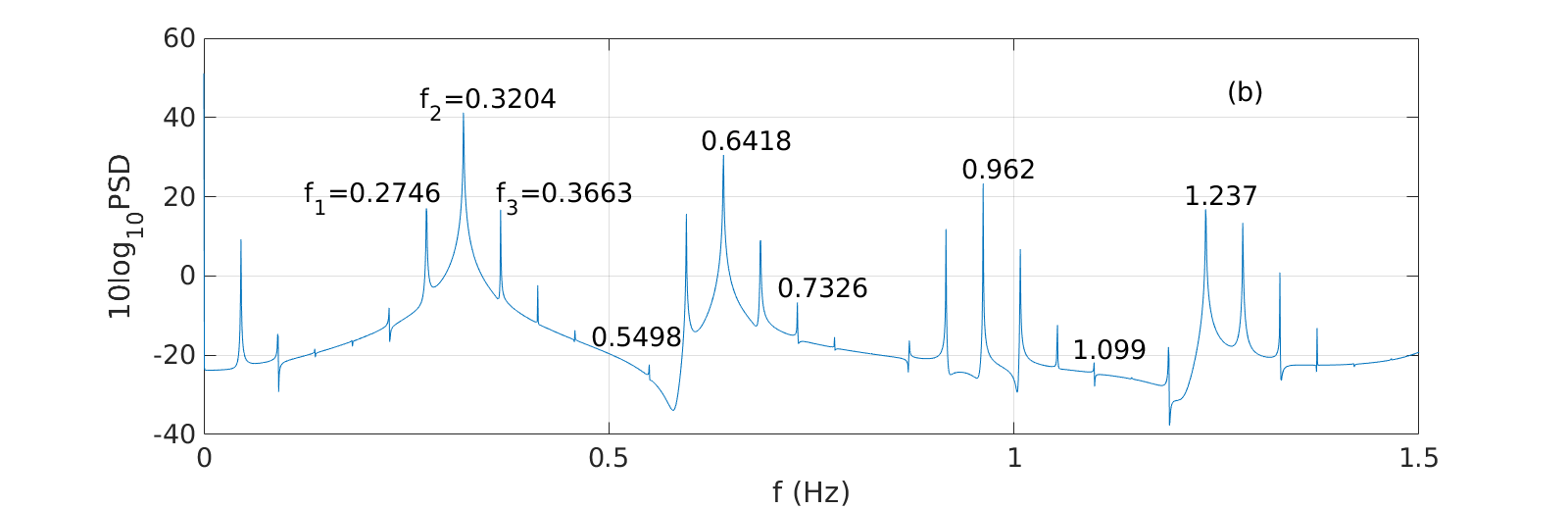 Figure 4
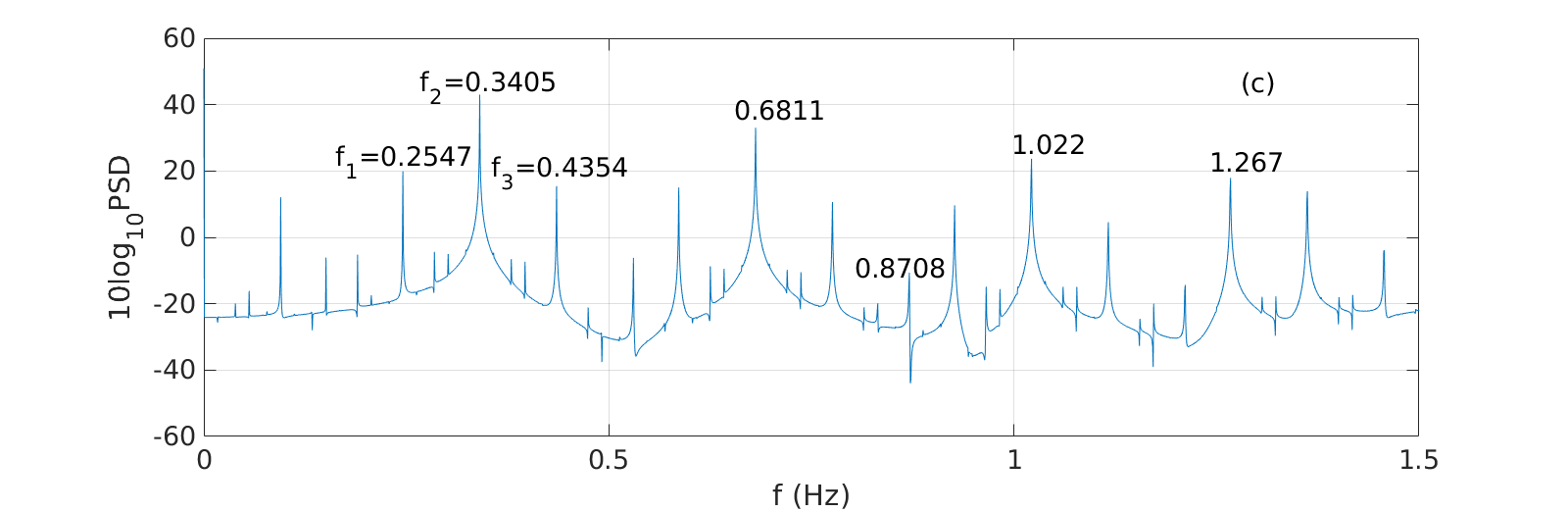 Figure 5
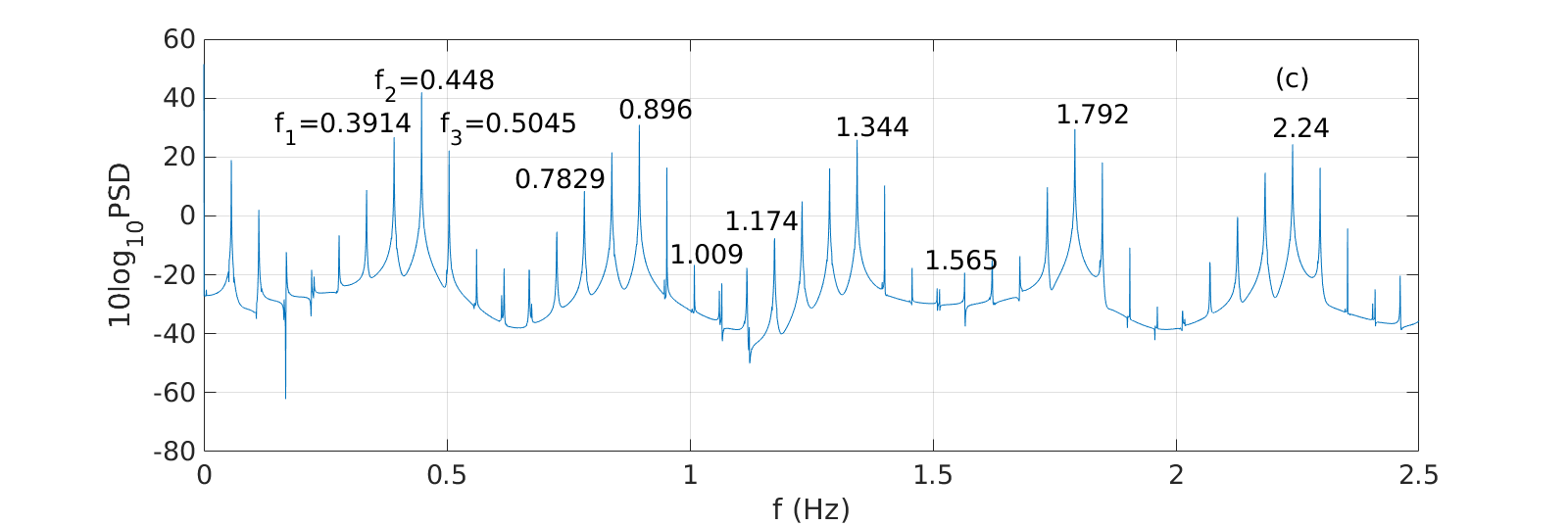 Figure 6
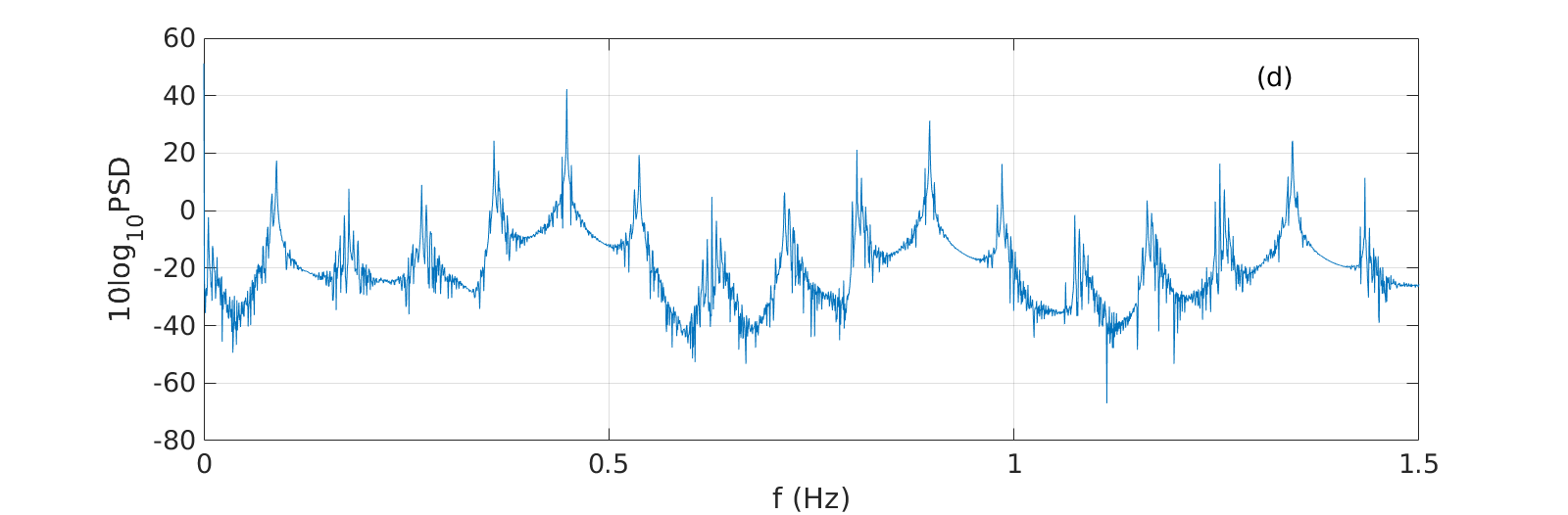 Figure 7
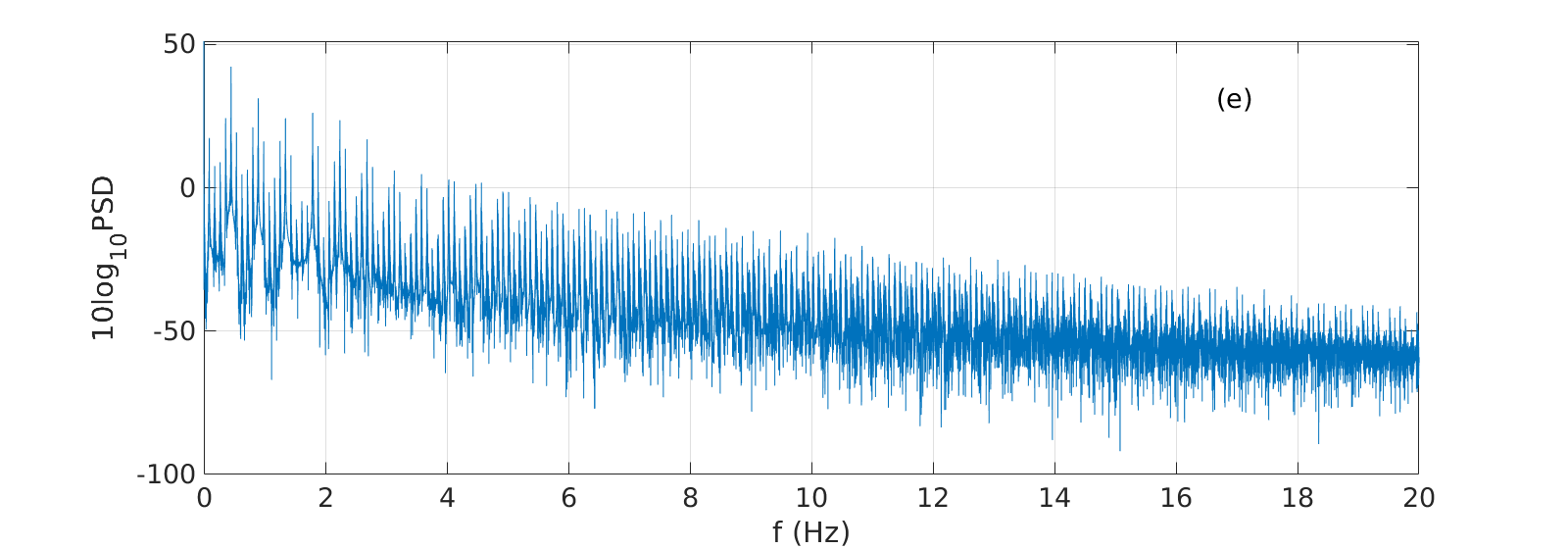 Figure 8
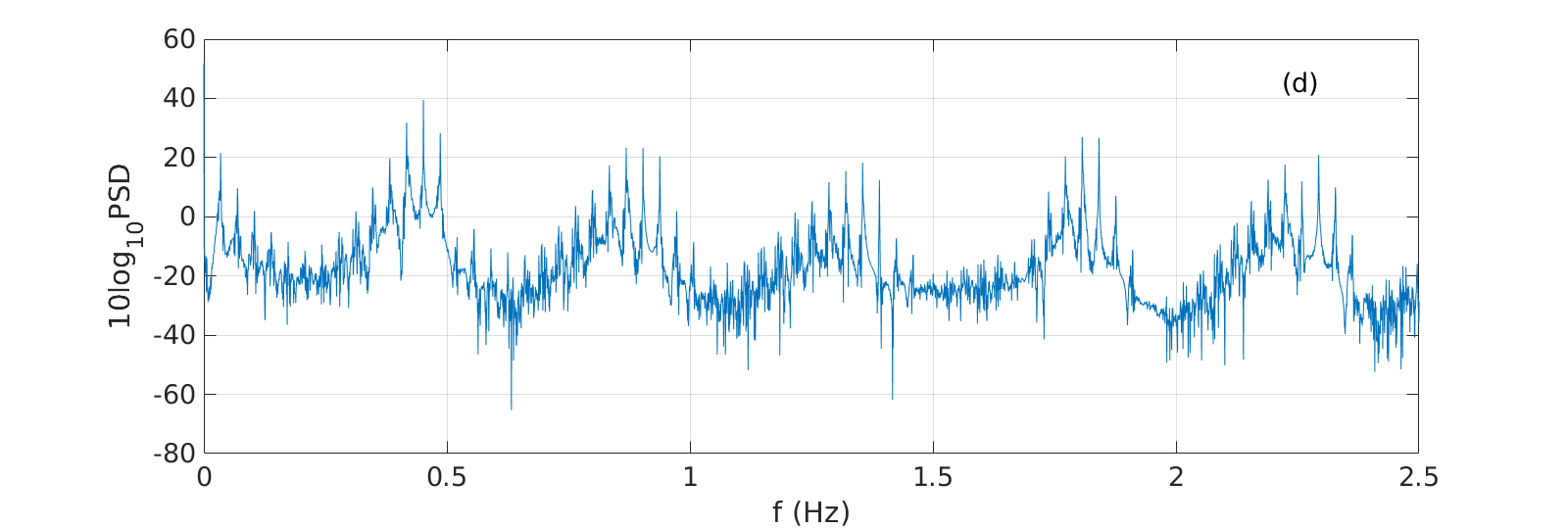 Figure 9
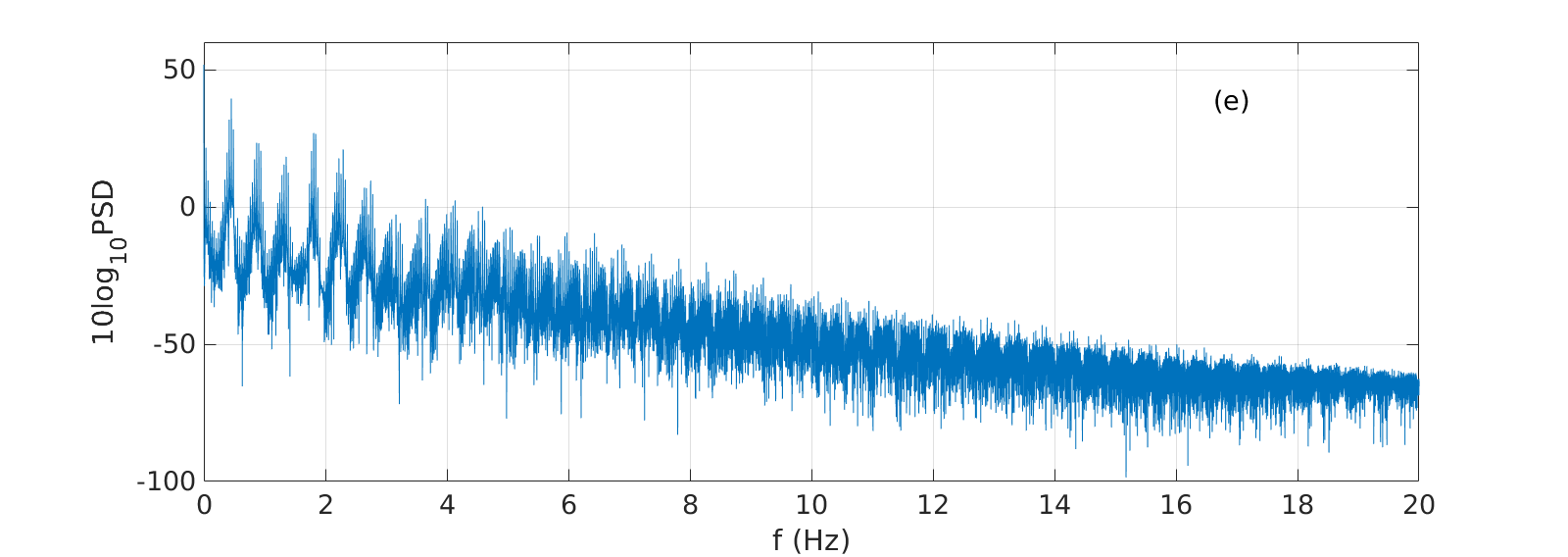 Figure 10
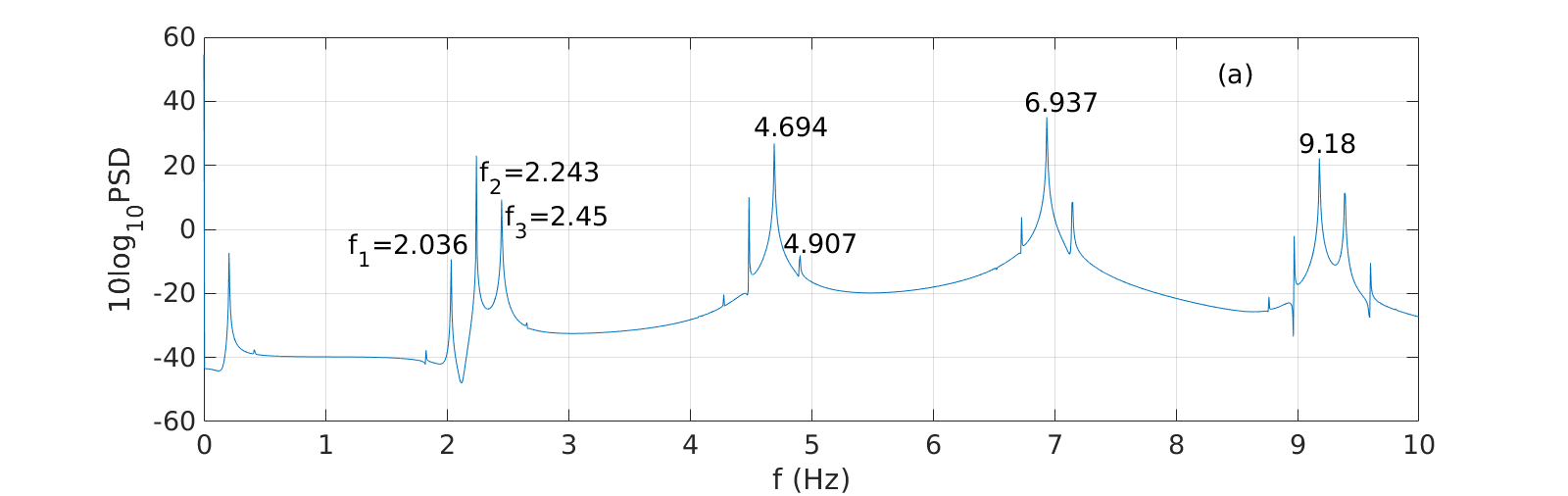 Figure 11
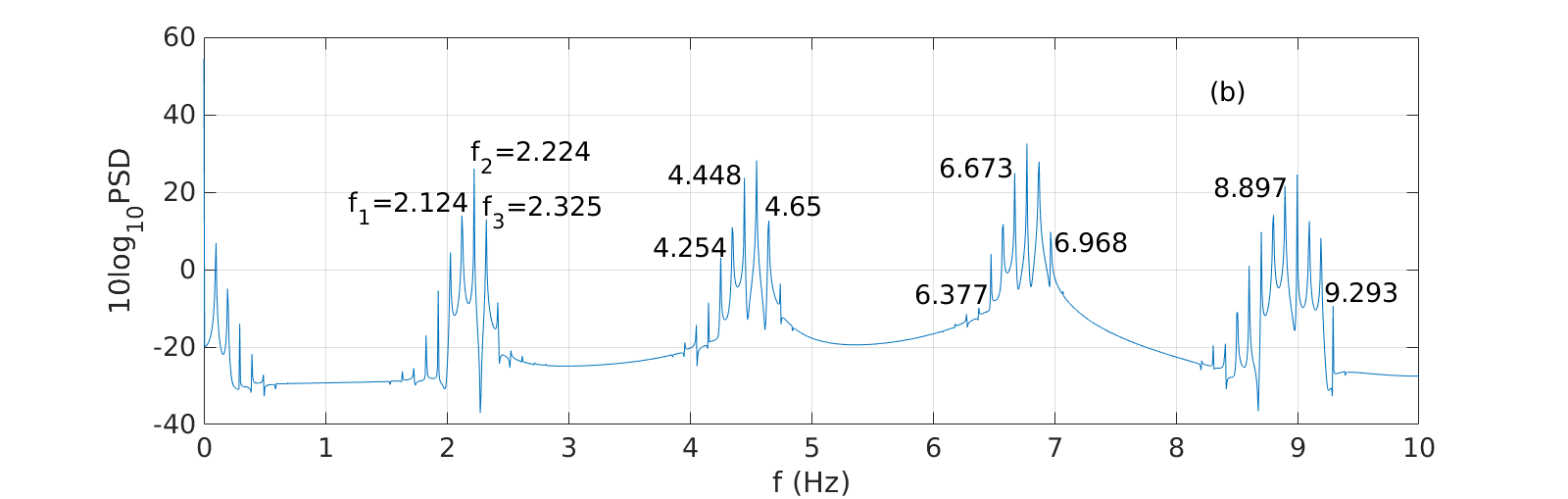 Figure 12
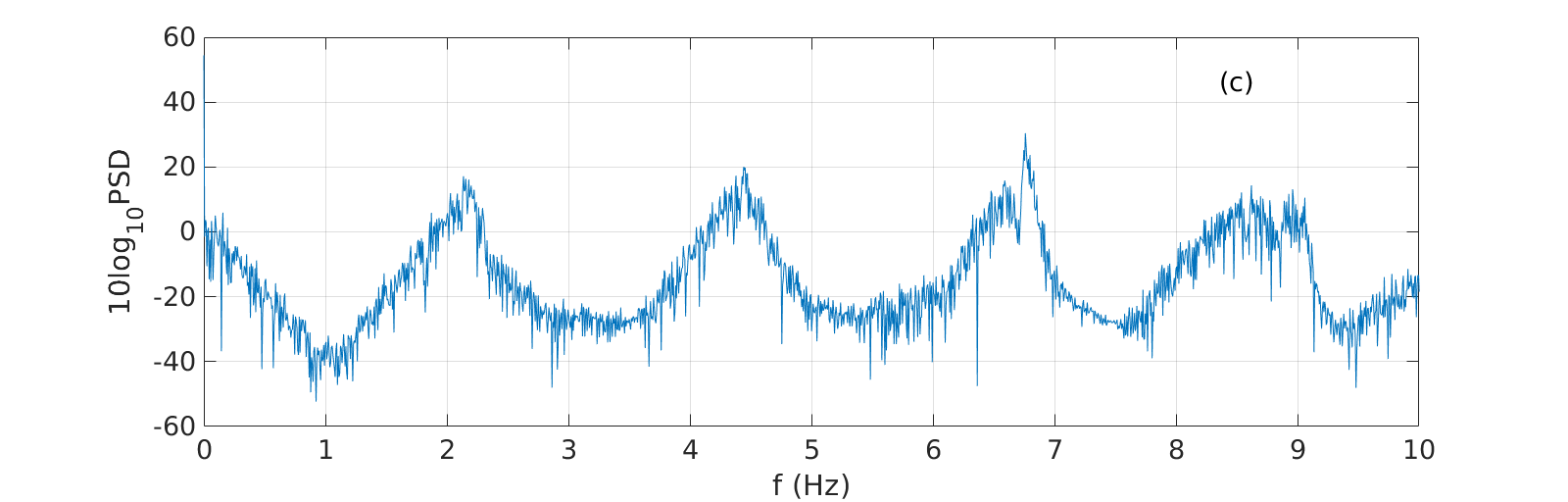 Figure 13
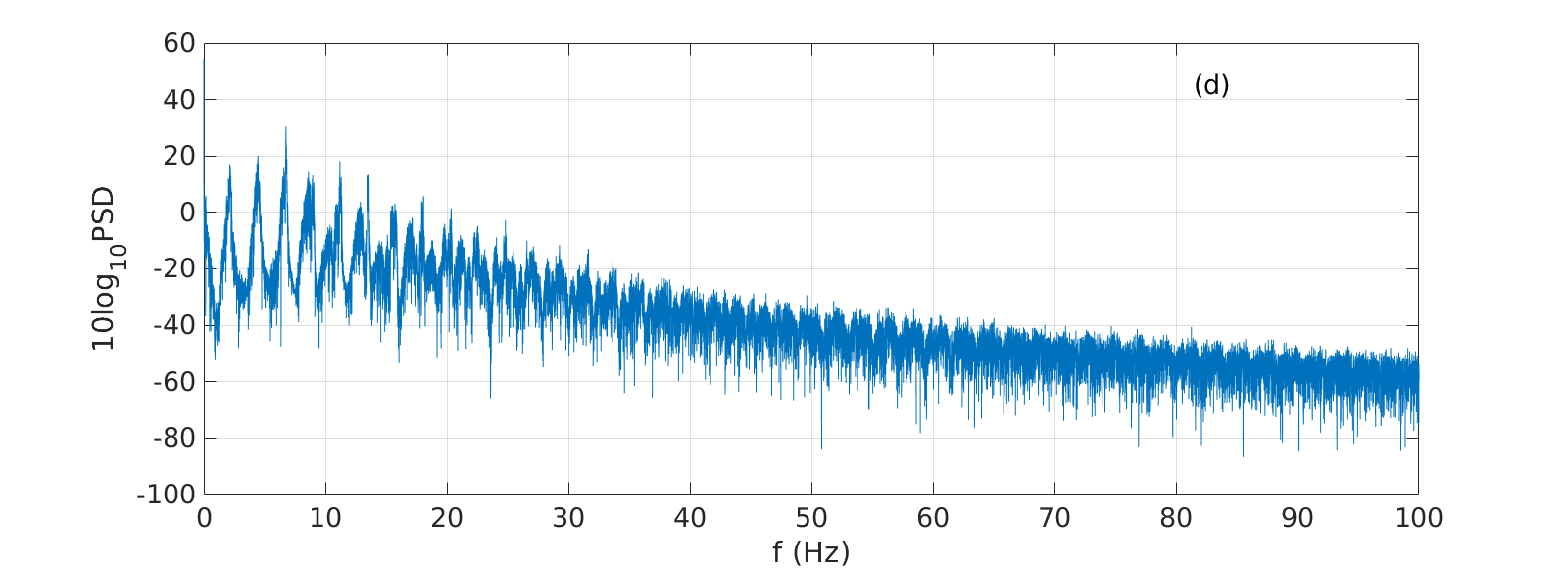 Figure 14
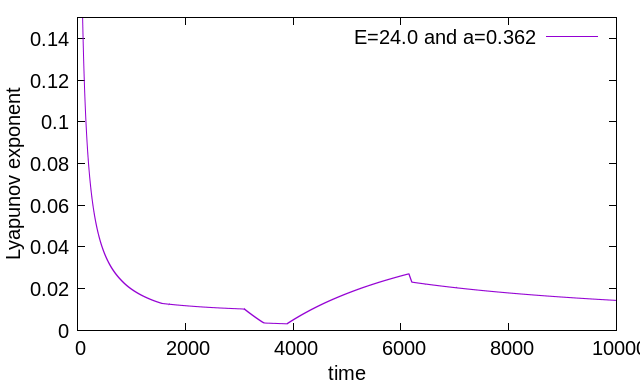 Figure 15
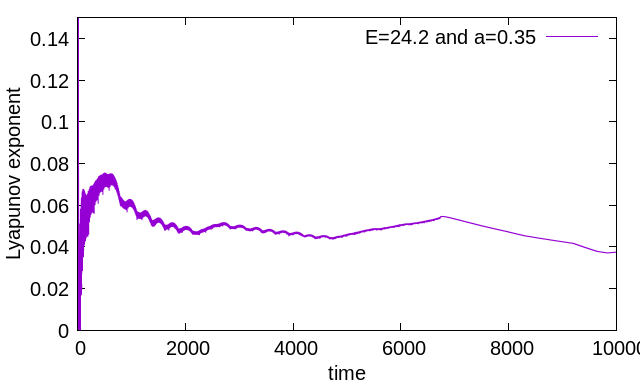 Figure 16
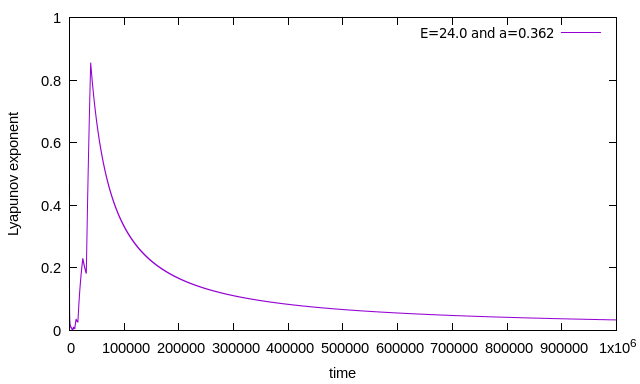 Figure 17
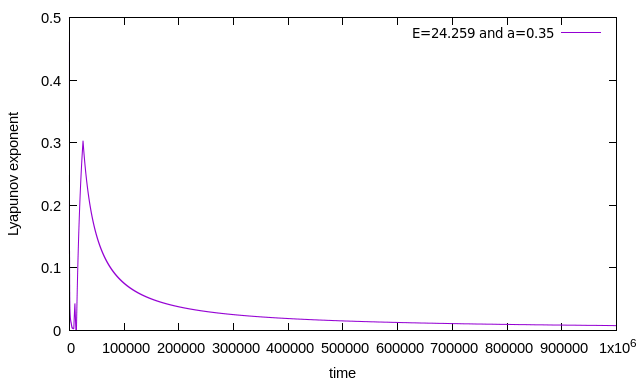 Figure 18
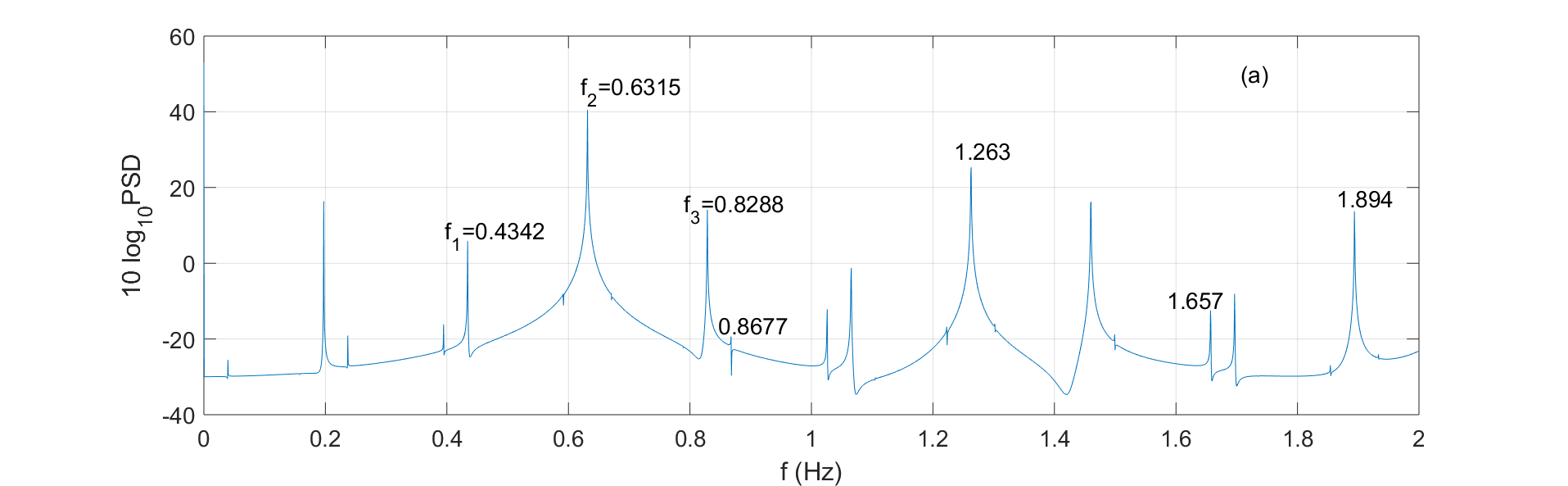 Figure 19
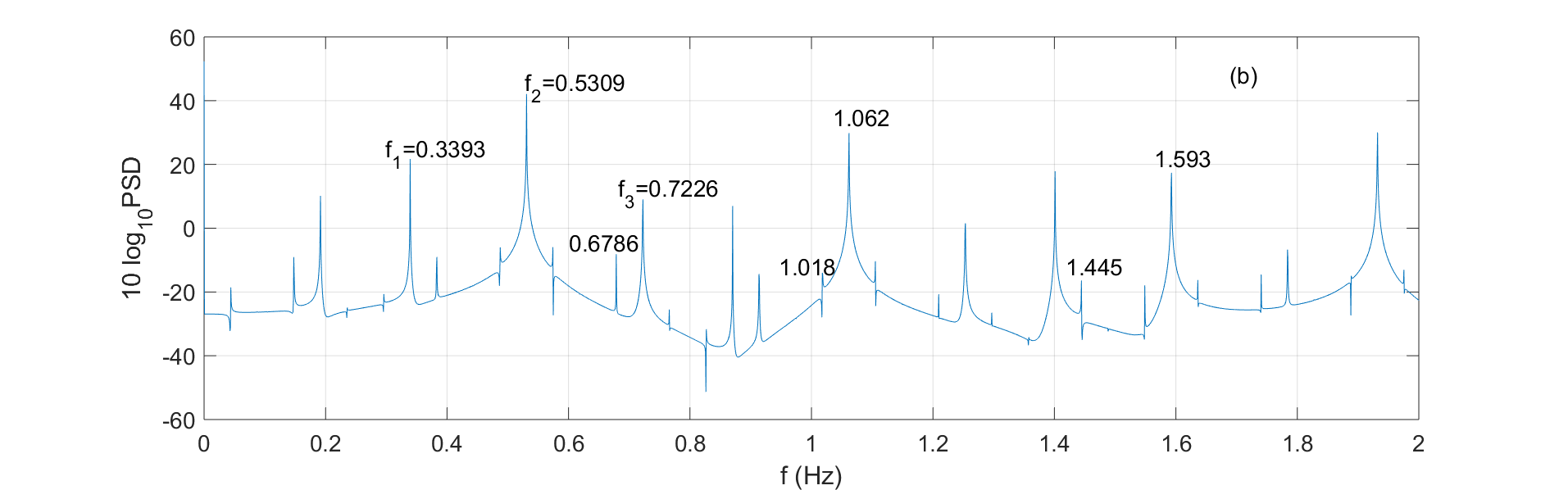 Figure 20
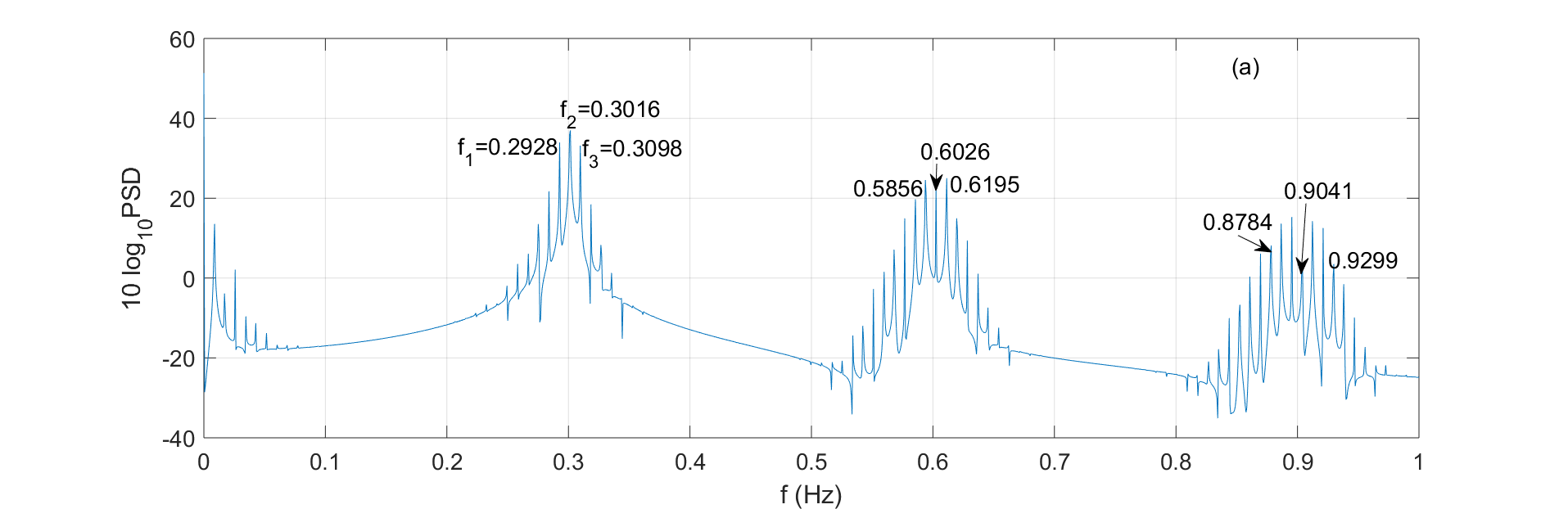 Figure 21
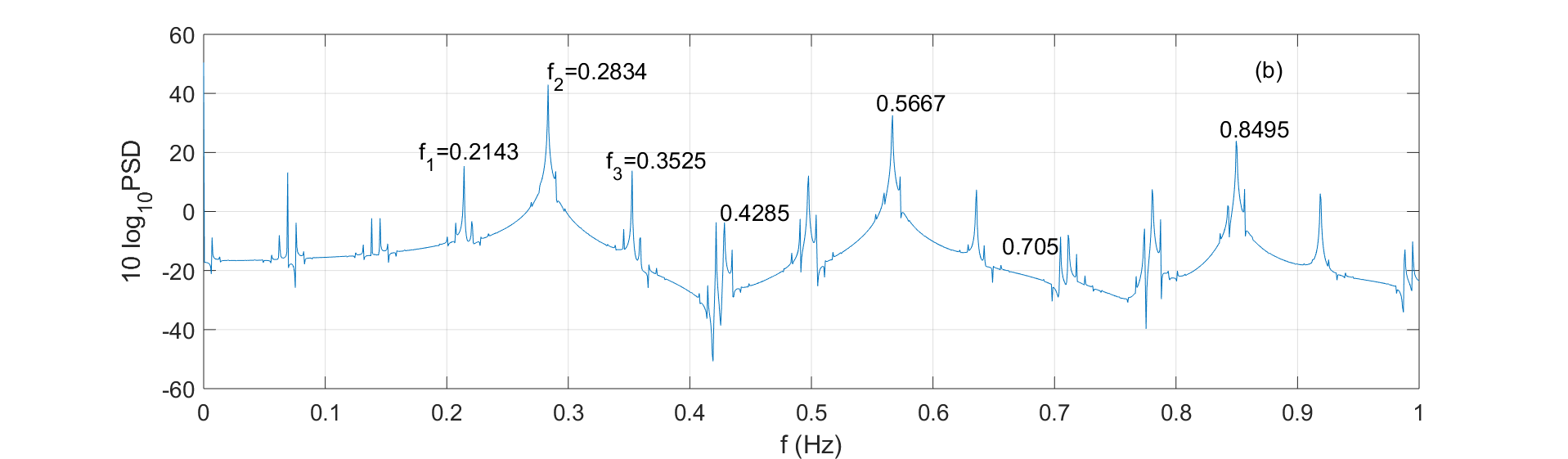 Figure 22
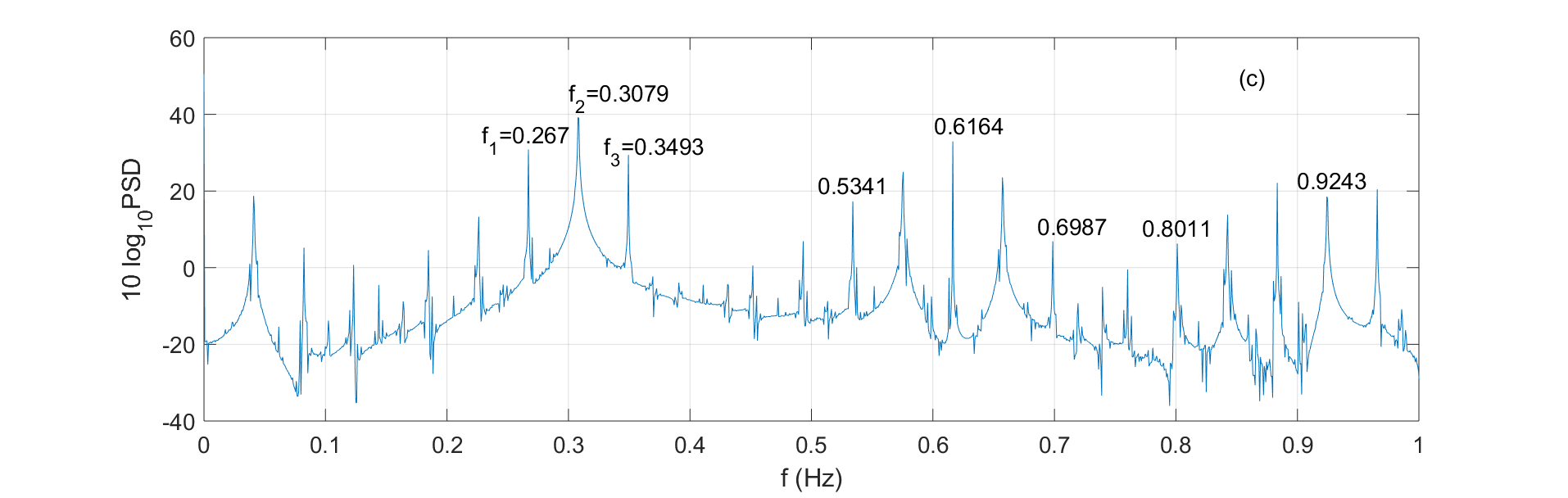 Figure 23
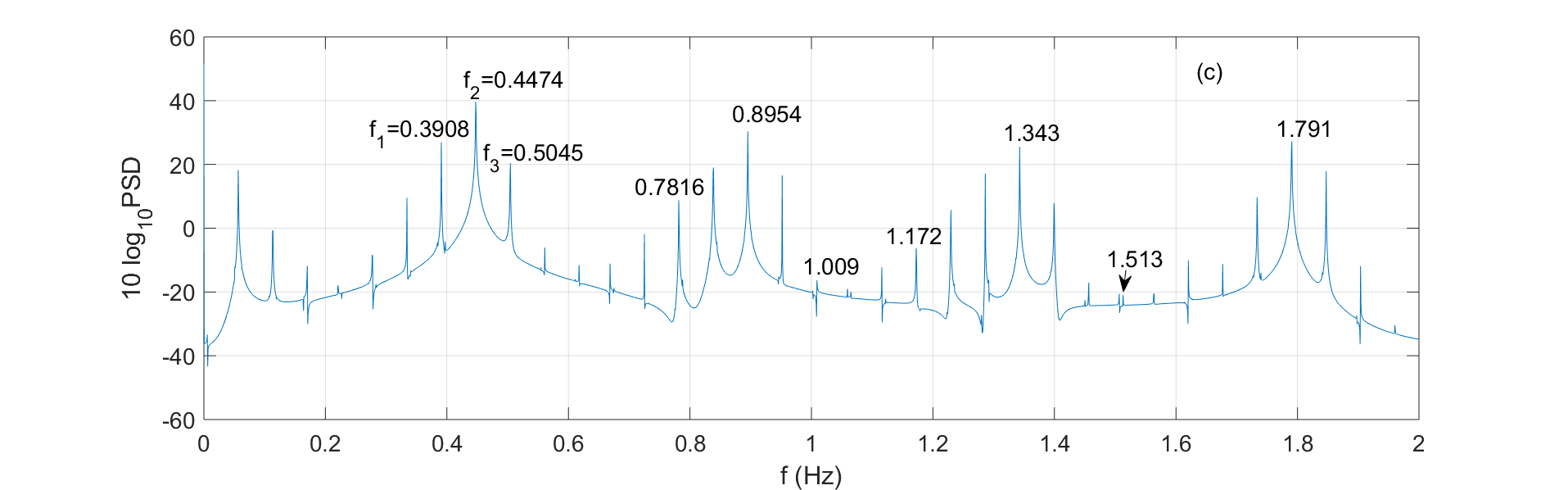 Figure 24
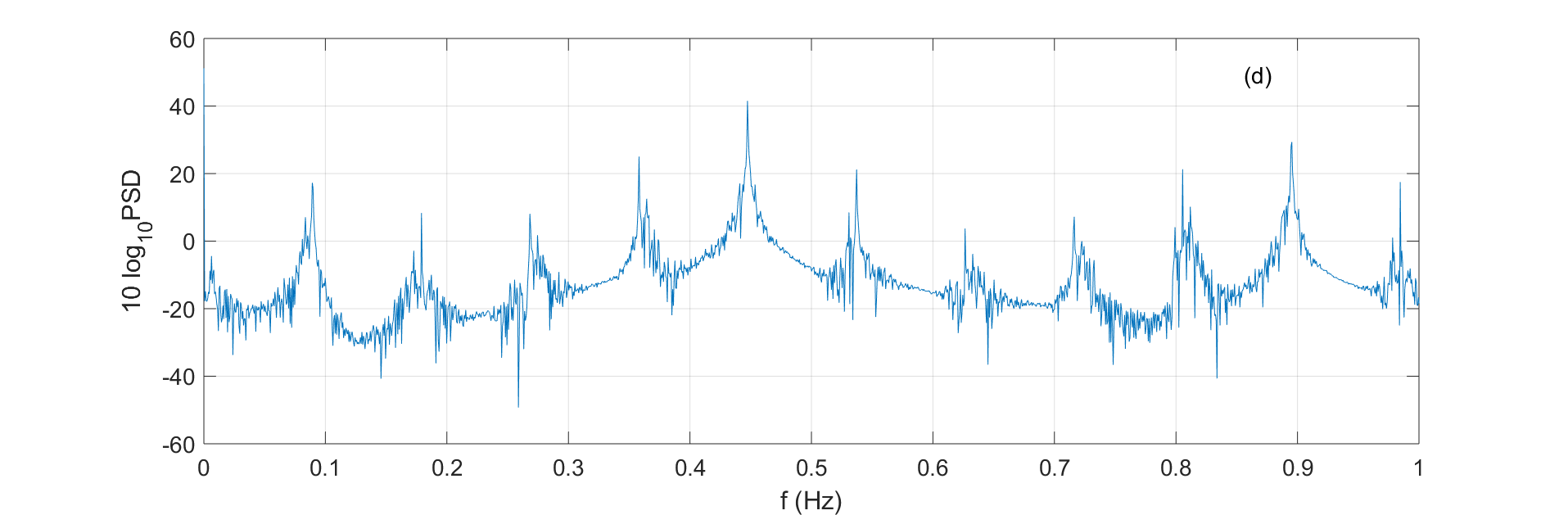 Figure 25
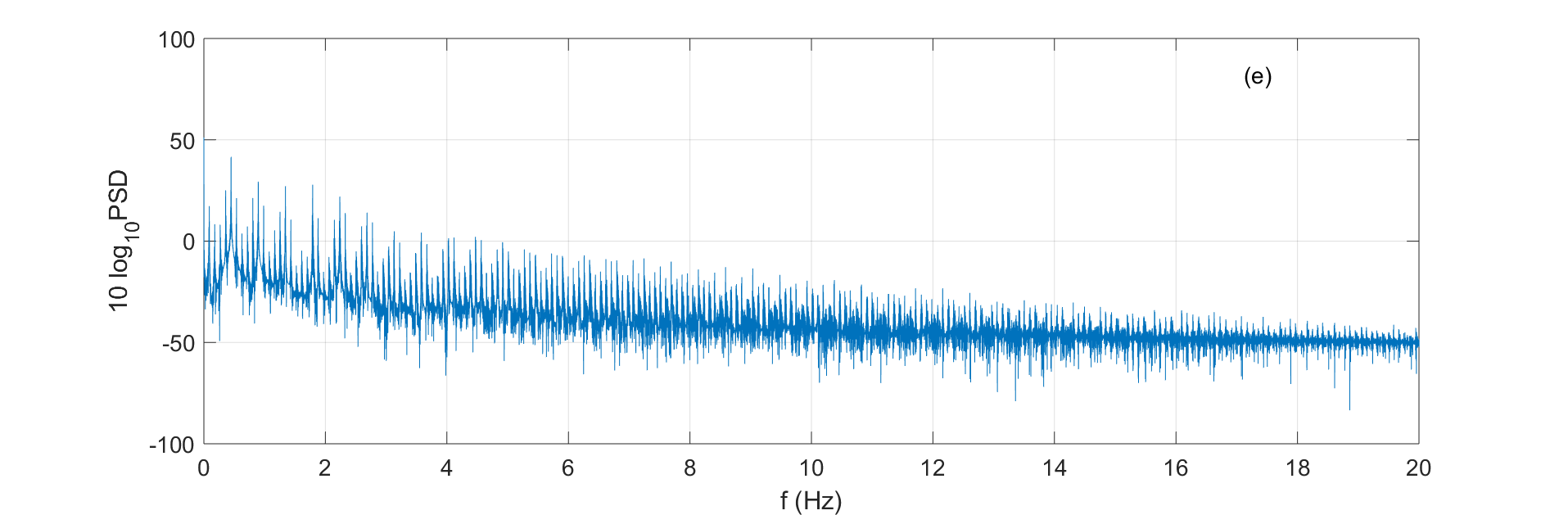 Figure 26
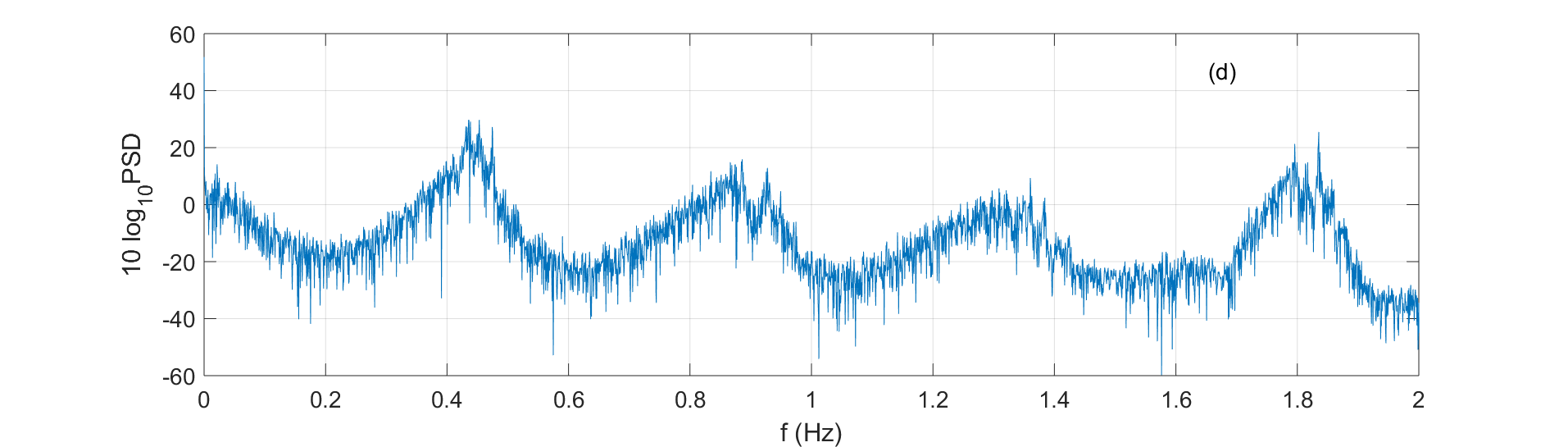 Figure 27
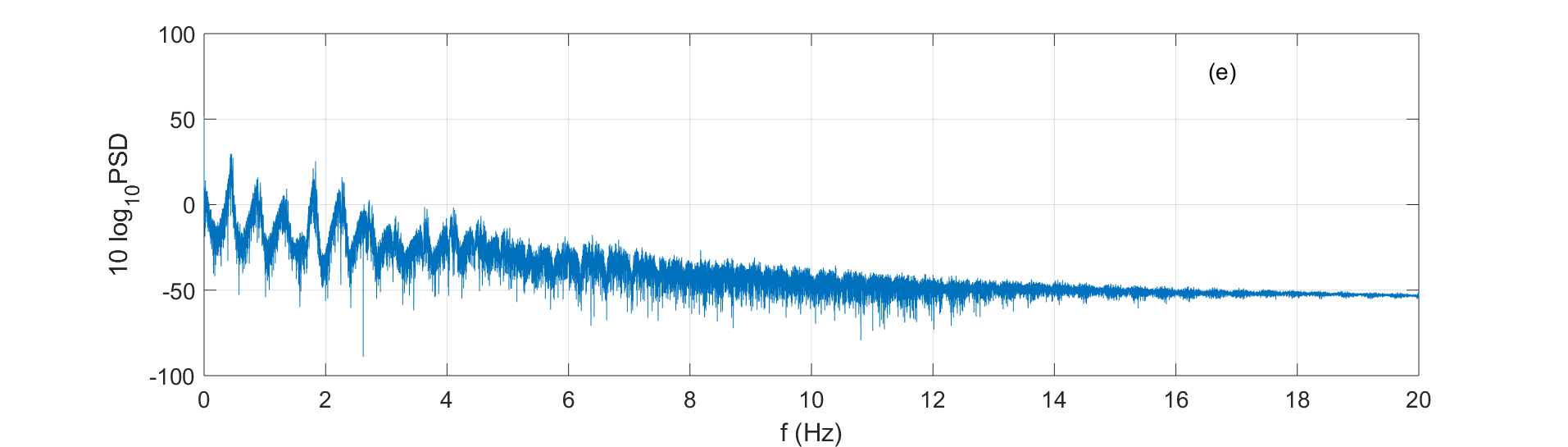 Figure 28
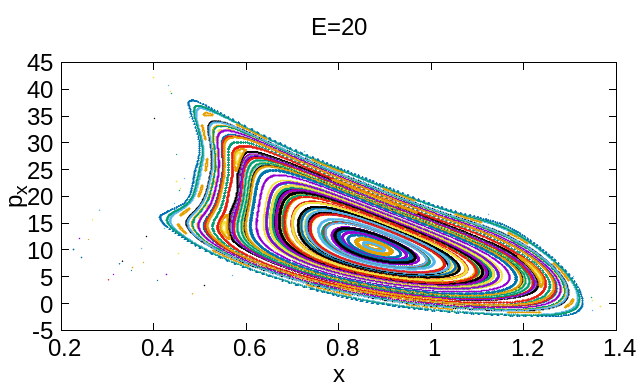 Figure 29
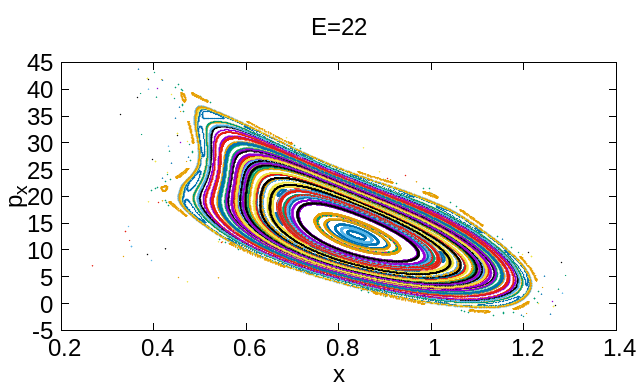 Figure 30
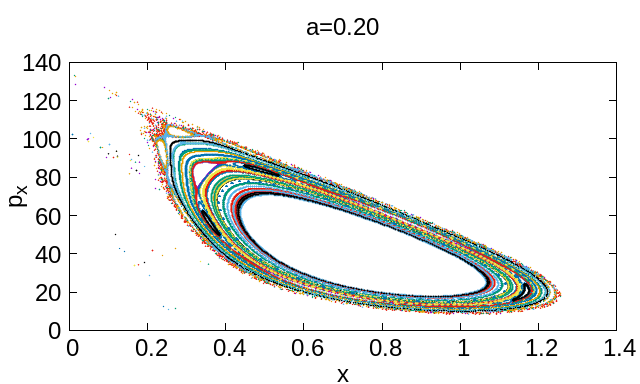 Figure 31
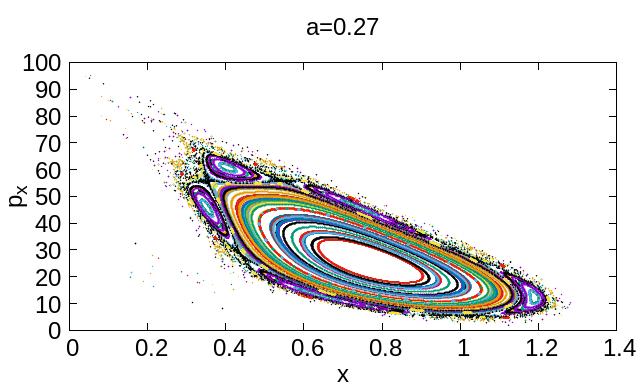 Figure 32
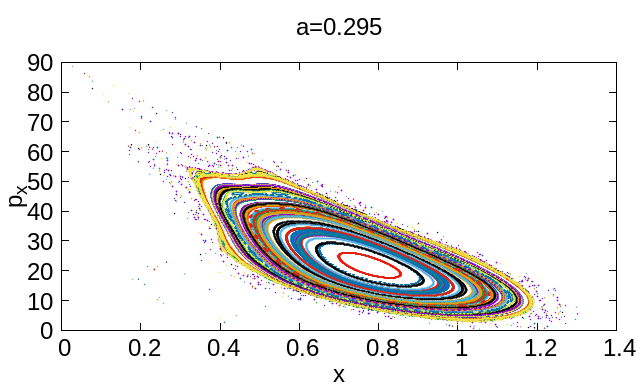 Figure 33
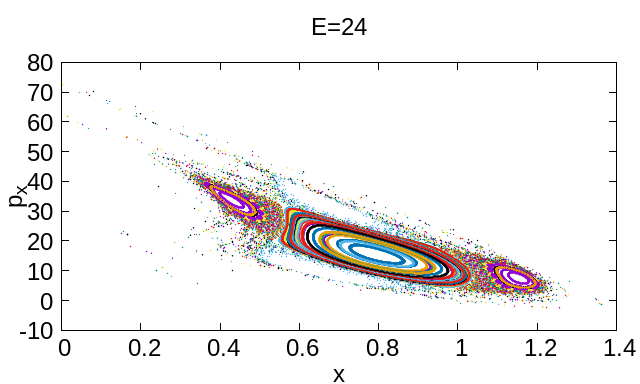 Figure 34
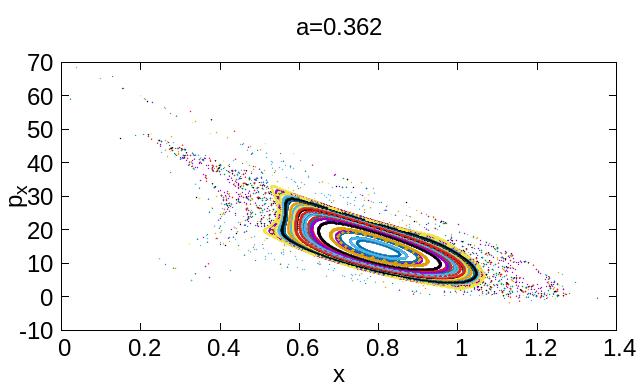 Figure 35
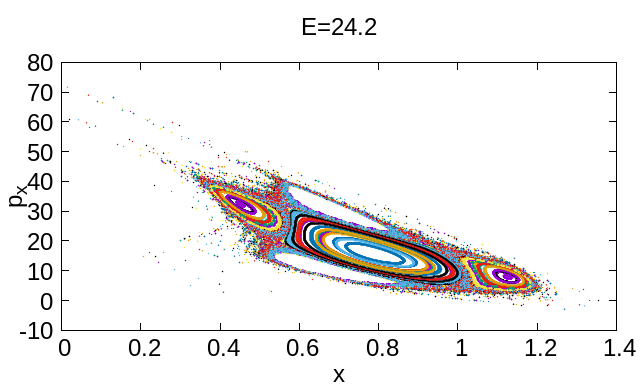 Figure 36
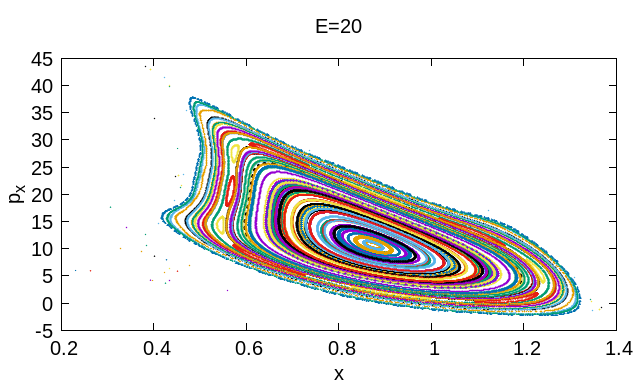 Figure 37
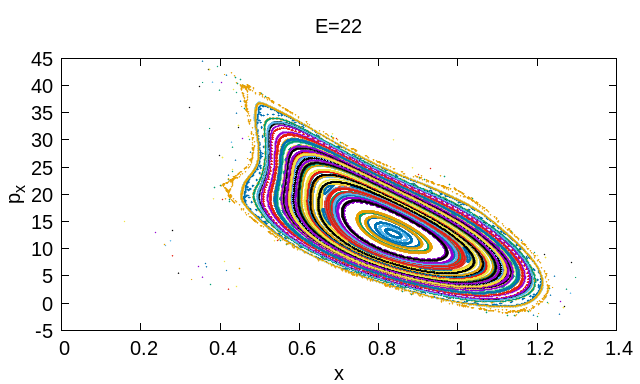 Figure 38
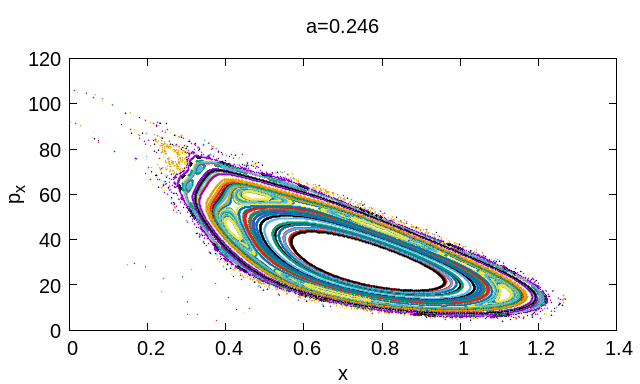 Figure 39
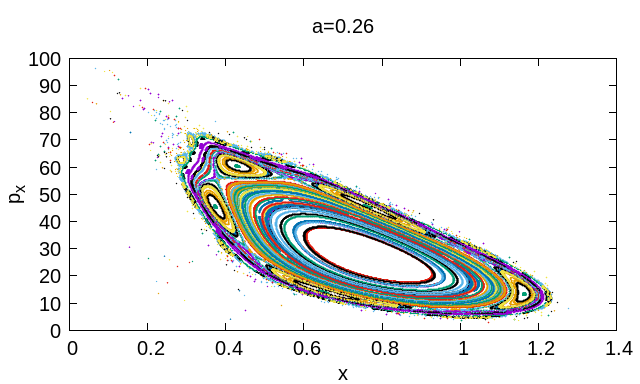 Figure 40
Peer Reviews
No public reviews on file for this paper yet. If you reviewed it on a platform where reviews are public (OpenReview, ICLR, NeurIPS, ICML), you can paste yours below so the community can read it here.
Videos
No videos yet. Explain this paper in a talk, walkthrough, or lecture? Add one.
Induction of chaotic fluctuations in particle dynamics in a uniformly accelerated frame
Surojit Dalui111 [email protected]
Bibhas Ranjan Majhi222 [email protected]
Pankaj Mishra333 [email protected]
Department of Physics, Indian Institute of Technology Guwahati, Guwahati 781039, Assam, India
Abstract
The ongoing conjecture that the presence of horizon may induce chaos in an integrable system, is further investigated from the perspective of a uniformly accelerated frame. Particularly, we build up a model which consists of a particle (massless and chargeless) trapped in harmonic oscillator in a uniformly accelerated frame (namely Rindler observer). Here the Rindler frame provides a Killing horizon without any intrinsic curvature to the system. This makes the present observations different from previous studies. We observe that for some particular values of parameters of the system (like acceleration, energy of the particle), the motion of the particle trapped in harmonic potential systematically goes from periodic state to the chaotic. This indicates that the existence of horizon alone, not the intrinsic curvature (i.e. the gravitational effect) in the background, is sufficient to induce the chaotic motion in the particle. We believe the present study further enlighten and balustrade the conjecture.
pacs:
04.70.Bw, 04.70.Dy, 11.25.Hf
I Introduction and Motivation
The intimate relationship between the geometrical properties of spacetime horizons and the dynamics of particle motion near it has always been an interest to many researchers. The horizon, which acts as one way membrane, is one of the most fascinating boundaries gravity. These arise as the solutions of gravitational equations of motion Paddy book . The typical examples are: Schwarzschild black hole which has event horizon, the de-Sitter horizon which emerge when the spacetime has a finite boundary at the asymptotic region, etc. These arise in the purely curved background. Interestingly, even in Minkowski spcetime, we have the Rindler horizon which is an observer (uniformly accelerated) dependent non-compact horizon.
In last few decades, near horizon physics, at classical as well as quantum level, has been the active area of research Bombelli:1991eg ; Sota:1995ms ; Vieira:1996zf ; Suzuki:1996gm ; Cornish:1996ri ; deMoura:1999wf ; Hartl:2002ig ; Han:2008zzf ; Takahashi:2008zh ; Hashimoto:2016dfz ; Li:2018wtz ; Hashimoto:2018fkb . In recent time there have been many attempts to study the particle dynamics in presence of event horizon for different kind of black hole systems where the black hole is either static spherically symmetric Sota:1995ms ; Suzuki:1996gm or rotating Hartl:2002ig or magnetized Li:2018wtz . The test particles considered in those cases are either massive, charged, and spinning Han:2008zzf ; Takahashi:2008zh or the massless ones Dalui:2018qqv . All the analysis done in those cases are performed at the classical level Bombelli:1991eg ; Suzuki:1996gm ; Cornish:1996ri ; deMoura:1999wf ; Takahashi:2008zh and the observed results show that the motion of the test particles become chaotic in nature. There has also been an attempt to understand the behaviour of Lyapunov exponent for the case of null trajectories of a particle Cardoso:2008bp . Another interesting observation has been made in Cornish:1996de , where the authors studied the motion of a test particle in the field of two fixed centres described by a family of Einstein-Maxwell-Dilaton theories and showed that the transition between regular to chaotic motion is possible as the dilation coupling is varied. In the quantum regime also the influence of horizon on the particle dynamics has been studied. It has been observed that the particle’s motion, detected in the Minkowski vacuum by Rindler detector, is Brownian type Adhikari:2017gyb . A recent analysis in de-Sitter spacetime, from the perspective of quantum field theory, also demonstrated that the produced particle seen from the comoving observer in conformal vacuum exhibits Brownian type of motion Das:2019aii .
Moreover, at the classical level it was explored the fact that the regular motion of a system can be chaotic when it experiences the presence of horizon. This has been tested so far for a massive as well as massless particle in the backgrounds of static spherically symmetric (SSS) as well as Kerr spacetime Hashimoto:2016dfz ; Dalui:2018qqv . In particular, our previous analysis Dalui:2018qqv has been done for the system in which a particle is trapped in two-dimensional harmonic potential for the SSS and Kerr spacetimes. We observed that the harmonic motion can get affected and that may lead to chaos in certain range of parameters of the composite system. In this regard, it must be noted that all the previous analyses are done for an intrinsically curved background, except in Hashimoto:2016dfz where the Rindler case has been investigated for a massive particle. So in these cases, the motion of the particle got affected not only by horizon, but also by the curvature of the space-time as well as its own mass.
On the basis of these works mentioned above, a further spontaneous and interesting question in this context that arises is: what would be the role of only horizon on the overall behavior of the particle motion which lacks the presence of any intrinsic curvature in the spacetime. So far we observed in different analysis that presence of only horizon captures important features in the system. One of the well known facts is at the quantum level the Rindler horizon is associated with temperature and entropy Unruh:1976db , which is similar to the Hawking effect Hawking:1974rv in black hole case. Although, the later one contains intrinsic curvature, the former does not. Therefore by taking one step further in this paper we are interested to address the unique role of horizon into the particle motion at the classical level. Other than going into the complexities of curved spacetime, one can think much more simplified geometry, where a horizon appears naturally and analyze the particle trajectories in order to get the role of horizon. So here we exploit that liberty and consider the well known Rindler spacetime which is merely a flat spacetime (as it is an uniformly accelerated frame in the Minkowski spacetime and the metric is constructed by using the suitable coordinate transformations). Our objective is to focus on the unique implications of the horizon and to see how its presence leaves an imprint into the particle motion. In this regard, we would like to mention that the Rindler spacetime is an interesting choice as these scenarios can be built up experimentally. Moreover, if chaos emerges into the particle dynamics again then the previous claim – the presence of horizon is enough to make the particle motion chaotic – will be further balustraded.
Motivated by such interesting possibilities, here we consider a chargeless and massless particle is trapped under the influence of two-dimensional harmonic potential in the Rindler frame. Here the harmonic trap direction is one along the Rindler -direction (when the accelerated frame is moving parallel to Minkowski axis) and the other one along one of the transverse directions. The particle confined into the harmonic potential in the uniform accelerated frame, with respect to this accelerated observer, will also feel the effect of Rindler horizon. This type of model clearly fulfil our purpose of the present investigation as the Rindler frame does not have real curvature effect.
In this regard, it must be mentioned that the analytical calculations only for the motion of an outgoing particle along the x-direction show that position along this particular direction grows exponentially with time when it is situated very near to the horizon. This is certainly the signature that the system can experience chaos. Performing the numerical analysis for the above mentioned model and analyzing the Poincar sections of the particle trajectories we confirm that chaos is inevitable for certain range of parameters. Another interesting result which is found is that the upper bound of the Lyapunov exponent is the acceleration of the particle which is consistent with the conjectured bound predicted by the SYK model Maldacena:2015waa .
The paper is organized as follows. In section II, we obtain the equations of motion of our composite system. In subsection III A, these equations of motions are analyzed throughly by solving numerically and then the Poincar sections are investigated systematically. Next in subsection III B, we present different routes to chaos arising in the presence of different strength of interaction with the horizon and the harmonic potential due to the tuning of different parameters of the system. Subsection III C contains the evaluation of the Lyapunov exponent numerically. In final section we conclude our work. Two appendices are also included at the end of the paper. In appendix A, we highlight that massive particle under harmonic trap have route to chaos same as obtained for the massless particles. Appendix B shows that the route to chaos for static spherically symmetric black hole is similar to our present Rindler case.
II Rindler frame and equations of motion
The frame of a uniformly accelerated observer is given by the Rindler metric. In () dimensions it is of the form:
[TABLE]
The location of the Rindler horizon is and is the value of the acceleration. To remove the coordinate singularity at , we apply the Painleve coordinate transformation Painleve:1921 ; Parikh:1999mf
[TABLE]
which transforms the metric as
[TABLE]
The energy of a particle with respect to this frame can be determined by the inherent timelike Killing vector of this spacetime. It is identified as , where is the four momentum of the particle.
Below, we want to mention the reasons for applying Painleve coordinate transformation.
- •
In our manuscript, the motive is to study the dynamics of a massless and chargeless particle in a uniformly accelerated frame and the effect of the Killing horizon on its motion. In order to do so, we confined the particle very near to the horizon so that the effect of horizon is maximum. Accordingly all the calculation will be done in the near horizon approximation. In this scenario, the form of the metric (1) which has a coordinate singularity at is not a good choice. So one needs to choose a different coordinate system where such coordinate singularity does not appear. Also one must be careful that the non-singular coordinates should be such that the corresponding observer can see the horizon as one way membrane. This is because in our case the motion of the test particle should be affected by it. Therefore, although Kruskal coordinates system does not have the singularity problem, the corresponding observer can not feel the horizon. So such system is ruled out. On the other hand Painleve coordinate system has no such problem. It is free of coordinate singularity as well as the observer can see the horizon as one way membrane. This is also the reason for using the Painleve coordinates in discussing Hawking effect by tunneling mechanism in the null geodesic approach (see Ref. Parikh:1999mf ).
- •
Another important feature of Painleve coordinate transformation is that the component form of the timelike Killing vector which defines the horizon as well as energy of the particle, remains identical to that in original Schwarzschild like coordinates. Initially, the metric (1) has the timelike Killing vector and the component form of this remains same in Painleve also: . This can be checked by using the tonsorial transformation of a vector under coordinate transformations. This helps us to define energy in terms of only time component of four-momentum in both the coordinate systems. For instance in Schwarzschild like coordinates it is given by where is Schwarzschild time coordinate; while this is again given by only time component of momentum: where is the Painleve time. Therefore calculations do not get complecated.
To find the expression for energy in terms of the space components of momentum, we shall use the standard dispersion relation where is the mass of the particle. Under the background metric (3), it is expanded as
[TABLE]
where, we have considered only the motion of the particle along and directions. This particular choice is taken for simplicity by keeping in mind the minimum dimensions required to demonstrate our particular goal. The solution of the above equation will lead to the expression for energy, which turns out to be
[TABLE]
In the above, positive sign refers to the outgoing trajectories, while negative sign signifies ingoing trajectories. Since ingoing particles are trapped inside the horizon and on the other hand we are interested to investigate the system when it is very near, but outside the horizon, we shall concentrate only on the outgoing ones (positive sign of the above equation).
Before proceeding to the main goal, we want to investigate the behaviour of particle trajectories qualitatively when it is under influence of only the Rindler horizon. For simplicity, we consider the particle to be massless; i.e. . If one concentrates only on the motion along direction (i.e. for constant values of and ), then the rate of variation is given by
[TABLE]
Now if the particle is very near to the horizon such that , then the above Eq.(6) reduces to
[TABLE]
In the above Eqs. (6-7), the parameter with respect to which the derivative has been defined is some affine parameter, say . It should be such that the four momentum of the massless particle is defined by which satisfies . This is the usual prescription to define the parameter in the case of a null-like path . Remember that is similar to proper time for a timelike geodesic. The solution of the above equation is
[TABLE]
This solution implies the exponential growth of position coordinate along the direction which signifies possible induction of chaos in an integrable system when it comes under the influence of Rindler horizon. We shall show explicitly in the later part of the paper that if this massless particle is kept in a harmonic potential in the accelerated frame, the motion of the particle in the composite system becomes chaotic for certain values of the parameters, like total energy of the system and the acceleration of the frame.
In order to fulfil our claim now let us concentrate on the equations of motion and see what happens when the influence of horizon comes into play. For that we consider two dimensional harmonic potential in accelerated frame which have the nature and along Rindler and directions, respectively. Here and are the spring constants while and are the equilibrium positions of these two harmonic potentials. Our goal is to discover the fact about the collective impact of horizon on this integrable system. In particular we want to inspect thoroughly in order to determine how the nature of the particle trajectory gets changed or influenced by the presence of Rindler horizon.
We begin our calculation by obtaining the total energy of the composite system when our massless test particle moves in the background Eq. (3) under the influence of these two harmonic potentials. So the total energy of the system turns out to be (considering only the outgoing paths)
[TABLE]
and correspondingly, the equations of motion will be
[TABLE]
In the next section of the paper we will examine these equations with the help of numerical analysis in order to study the motion of the particle. Here we would like to mention that the interaction between the horizon and the harmonic potentials are taken to be so small that one can ignore that term compared to the other terms. Hence the total energy of the composite system, in the above, has been taken as the sum of the gravitational and harmonic potentials parts.
III Numerical analysis
To illustrate that the presence of horizon is the origin of chaos, this section will be dedicated to analyze the particle motion numerically. In the previous section we analytically showed that the particle’s position along the direction grows exponentially as the particle approaches near to the horizon. This particular feature, we invoked, as the possible induction of chaos in an integrable system. In order to confirm our claim we will analyze the Poincar sections and the power spectral densities of our model (harmonic oscillator in an uniformly accelerated frame), obtained by solving the dynamical equations of motion (Eqs. (10)-(13)). This will give us the glimpse about the change in the dynamics of the particle trajectory. First we will present the Poincar sections of our composite system. In the upcoming subsections we will present power spectral density and Lyapunov exponent and show how our dynamical system becomes chaotic for some particular values of parameters, like acceleration and energy .
III.1 Poincare sections
The results for the Poincar sections of the particle trajectory are shown in Fig. 1 and Fig. 2. In Fig. 1 the Poincar sections are projected over the () plane for different values of accelerations but for a particular value of energy . Whereas, in Fig. 2 the Poincar sections are plotted for different values of energies while the acceleration of the system remains constant.
The dynamical equations are solved (Eqs. (10)-(13)) numerically using the fourth order Runge-Kutta method with fixed . The other parameters we have chosen are , , and . The variables , and are initialized with the random numbers and is obtained from Eq. (9) for a fixed values of and . The sections are the slice defined by and . In Fig. 1, the Poincare sections are plotted for different values of and while the energy is fixed at as indicated in the plots. In Fig. 2, we have considered the energies and while the value of is fixed at . For different initial conditions the different trajectories of the particle are indicated by different colors in the figures.
Now let us investigate these two sets of figures in more careful way. First we explore the effect of acceleration on the particle dynamics. For low value of acceleration the display of regular KAM (Kolmogorov-Arnold-Moser) tori nonlinear:02 (see Fig. 1) reveals the fact that the particle trajectory is yet to come under the influence of the horizon. As we increase the value of the trajectories start getting deformed and breaking into small tori. Note that the effect is more pronounced for the orbits which are closer to the horizon. There always have been some regions of regular tori in the figures instead of the fully chaotic region where all the points should be scattered. However, in the present study we could not get the fully developed chaos as we find that the orbits are quite sensitive to the parameters i.e and . On further change in those parameters lead to the unbounded situations.
It is noted here that as we increase , more and more regular tori are broken and correspondingly the chaotic nature of the system appears. This can be attributed to the effects of horizon on the orbit of the particle. The reason can be described in a qualitative way. The relation between the Minkowski coordinates and Rindler coordinates , for the uniformly accelerated observer on the right wedge, are
[TABLE]
So the trajectory of the accelerated observer is
[TABLE]
which is hyperbolic in nature for a constant . Now since is the proper acceleration (as measured by the Rindler frame), the path of the Rindler observer in terms of its own coordinate is ; i.e. constant. So different value of corresponds to different accelerated observer. It shows that if we increase the value of , the frame will be more close to the horizon and the particle will get more effect of the horizon. Hence the instability in the motion of the particle along will increase according to (8). This causes breaking of the orbit when it approaches towards the horizon. That’s why we here obtained more breaking of tori as we increase the acceleration.
We obtain from Fig. 2 that for low energy the Poincar section exhibits the regular KAM tori nonlinear:02 . As the total energy of the system gets increased the volume of the phase space increases and the trajectory of the particle approaches nearer to the Rindler horizon. As soon as the particle moves nearer to the horizon the trajectories start getting distorted into their structure which can be clearly seen from the Fig. 2. The appearance of the scattered points in the outer most regions as we increase the total energy of the system indicates the presence of chaos into the system. The value of energy is chosen in such a way that the particle come close enough to the horizon but not fall into it. Finally we mention that if the particle is massive, the situation does not change. This has been confirmed numerically in Appendix A.
III.2 Power Spectral Density
In order to have an instinctual idea about the dynamical behavior of our composite system in an accelerated frame and to understand the collective impact of horizon in the particle trajectories, we systematically investigate the evolution of the position coordinate, with respect to the affine parameter (which plays the role of time for the massless particle). To get an extensive idea of the trajectory of the system and the deeper understanding of the onset chaotic behavior of the system, the power spectral density (PSD) is analyzed which is defined as Stoica ,
[TABLE]
where is the discrete Fourier transform of evaluated at and is the length of the discrete affine parameter series).
Let us see what happens when the total energy of the system is changed. In Fig. 3 we show PSD for the case when the acceleration is fixed and is varied . As we found from the previous section that for lower value of energy the Poincar sections are periodic in nature, that means the effect of horizon has not appeared into system yet. This feature is seen from Fig. 3 where the PSD diagram is plotted for energy but only a few number of peaks appear into the plot. The appearance of PSD peak at is the fundamental frequency and other frequencies at are the harmonics of that fundamental frequency. The appearance of other frequencies i.e etc, indicates the involvement of other frequencies of oscillations in the time evolution of , which is a signature of the quasi-periodic nature of the system. With further increase in the value of , we find that more frequencies near start getting populated (see Fig. 3(b) and Fig. 3). Finally for high value of energy, i.e., , PSD shows fully populated pattern over the frequency range (see Fig. 3). That is the distinguishing character of the onset of chaos. Interestingly this has an exponential decaying character. The similar trend of PSD was also obtained in the case of the chaotic region of fluid motion Pankaj1 . In this case also, like ours, the chaos is temporal one. It may possible that such exponential decay of PSD (which is completely a phenomenological feature) is a very general nature for a system when it is in chaotic regime. But it needs further investigation which is beyond the scope this present paper. Thus for , the observed a periodic time evolution of displays chaotic behaviour for the particle dynamics in presence of horizon.
Next we plot the PSD diagrams for different values of the acceleration of the system for a fixed value of energy (see Fig. 4). For lower value of the particle acceleration i.e at the PSD (Fig. 4()) shows the presence of only three frequencies, which are and their harmonics. While for larger values of that is at (Fig. 4()) and at (Fig. 4()) the frequencies start getting shifted and other frequencies near start getting populated like the previous case. Finally, for very large value of (Fig. 4()) where the interaction between the harmonic potential and the horizon is very large, we found that the PSD diagrams are fully populated with again an exponential decay over the entire frequency region which basically shows the distinguishing feature of the onset of chaos. Hence we obtain a series of transitions in the dynamics of our composite system, namely, from periodic to quasi-periodic and finally to chaotic dynamics as the total energy of the system or the acceleration of the particle is increased. Thus both the cases result in * quasi-periodic route to chaos*.
III.3 Lyapunov exponent
In literature the Lyapunov exponent of a dynamical system is defined as the quantity that characterizes the rate of separation of infinitesimally close trajectories sandri:96 . In phase space if we consider two trajectories with initial separation , the rate of divergence within the linearized approximation is given by
[TABLE]
where is the Lyapunov exponent. In this situation, it may be worth to point out that the value of the Lyapunov exponent has an upper bound which was first mentioned in Maldacena:2015waa for the SYK model. For our system the Lyapunov exponent is bounded by
[TABLE]
where is the acceleration of the Rindler frame. This is apparent from the near horizon solution (8) for . Now at the quantum level, the accelerated frame will feel the Unruh temperature (see Unruh:1976db ) and hence the above inequality can be expressed as , which is exactly identical to what was obtained for SYK model Maldacena:2015waa . In this regard we here mention some recent studies on the bound on Lyapunov exponents in the context of black holes. In Lu:2018mpr authors have studied the minimal length effects on the chaotic motion of a massive particle near the black hole horizon where they have shown that the corresponding Lyapunov exponent is greater than that in the usual case with the absence of the minimal length using the Hamilton-Jacobi method. People have also shown that the bound on the Lyapunov exponent can be violated by a large number of black holes including the RN-dS black holes or black holes in Einstein-Maxwell-Dilaton, Einstein-Born-Infeld and Einstein-Gauss-Bonnet-Maxwell gravities Zhao:2018wkl . Another interesting work Cubrovic:2019qee where the author performed a systematic study of the maximum Lyapunov exponent values for the motion of classical closed strings in Anti-de Sitter black hole geometries with spherical, planar and hyperbolic horizons. The analytical estimation from the linearized variational equations predict the Lyapunov exponent value modified as , where is the winding number of the string.
Now below we present our numerical analysis on Lyapunov exponents for different cases in order to show our proposition is reasonable. We have plotted the largest Lyapunov exponent for two cases. First, we consider the energy and (see Fig. 5) and secondly, we have plotted for and (see Fig. 6). For both the cases we obtained the chaotic behaviour in the particle dynamics. In both the figures (Fig. 5 and Fig. 6) it is observed that the Lyapunov exponent settle to positive values ( and respectively) which suggests the chaotic motion of the particle. Since we observed that the obtained values of the Lyapunov exponents for both the cases are lower than the bounds (0.35 and 0.362 respectively), it is consistent with our claim.
IV Discussions and conclusions
In this paper we have studied the motion of a massless and chargeless particle in an accelerated frame in the flat spacetime background. First we derived the equations of motion of the outgoing particle trajectories and found that the position coordinate along a particular direction increases exponentially with the time parameter which gives us the indication that may be the horizon is influencing the chaotic fluctuation in the particle’s motion. Next our aim was to trap the particle near the horizon and study its dynamical behaviour. For this purpose we introduced an external harmonic potential in the accelerated frame and derived the equations of motion from the Hamiltonian of the whole composite system. The whole phenomena are seen by a comoving observer. After solving these equations numerically and analyzing the Poincar sections and the PSD diagrams we ascertain our claim that chaos can be indeed induced in the particle dynamics by just influence of a horizon.
So it appears that a harmonic oscillator in the Rindler frame lost its periodicity with respect to the comoving observer as it approaches nearer to the horizon. This is consistent with the well known KAM theory. According of which, if an integrable system having the number of degrees of freedom (say ) greater than three, it loses its stability with the application of a small perturbation into the system Kaloshin . Now our system has degrees of freedom (namely, ) and that means a general small perturbation can lead our system to instability which is happening for our case. Here if we think the interaction with the horizon as a perturbation then as the perturbation gets increased (due to increase in and ) the periodic motion of the harmonic oscillator initially decomposes into a number of tori. Further increase in the parameters and leads to the instability in some of the regular tori that results them breaking into several small tori. It signifies that our harmonic oscillator initially started with a fundamental frequency but later due to the increment in the perturbation the fundamental frequency decomposes and a number of other frequencies show up into the system which is the characteristics of the onset of chaos. Now from the expression of the Hamiltonian of the system we can say that the first term of Eq. (9) will act as the perturbation in the system and the other two terms in Eq. (9) will form the integrable system of harmonic oscillator in two dimensions. The only source of this perturbation term is the acceleration of the system itself. That means if an harmonic oscillator is moving in two dimensions in a constant accelerated frame, for a comoving observer it would appear that the acceleration itself perturbed the system rigorously and as a result the harmonic oscillator loses its fundamental frequency and for large perturbation it shows chaotic behavior.
Chaos in the coupled harmonic oscillators (as for an example, double pendulum) system in the flat space time for inertial observer is generally observed due to the presence of the nonlinear coupling Nbook . The coupling is independent of the state of the inertial observer. So chaos appears in the system even the velocity of the inertial observer is set to zero. Here, as a precautionary note for the readers, we would like to mention that in our system the coupling between the oscillators appears owing to the presence of the accelerated observer only which in turn provides a Killing horizon. The coupling among the oscillators are happening through their interaction with this horizon. In absence of the acceleration, the coupling between the oscillator vanishes and that will lead to the disappearance of the chaos from the system. So one needs to be careful while comparing the chaos that appears in our model to those appear in the system of coupled harmonic oscillators for inertial observer.
We also found that the chaos of the particle probing the Rindler horizon has a universal upper bound on the Lyapunov exponent. In this regard, it may be mentioned that the upper bound is given by the acceleration of the particle and it is independent of the external potentials which prevents the particles falling into the horizon (for details on the potential independent nature, see Hashimoto:2016dfz ). This upper bound conjecture of the Lyapunov exponent coincides with the prediction of the SYK model, argumented by Maldacena, Shenkar and Stanford Maldacena:2015waa .
From this analysis it is apparent that an integrable system when comes under the influence of horizon, it’s dynamics can be chaotic. Since in the present case, the horizon is part of the flat background (vanishing Riemann curvature), the conjecture – horizon makes system chaotic – is further balustrade as the curvature does not play much role. This has been further elaborated by studying the route to chaos for our present model and the model with harmonic oscillator in static spherically symmetric (SSS) black hole. We observed that they are similar in nature (see Appendix B for the PSD of SSS case).
The present analysis is well consistent with the equivalence principle as only horizon is responsible for similar chaotic dynamics in both the setups: accelerated frame and black hole spacetime. In this regard we further want to point out a possible parallel description between the thermality in an accelerated frame (known as Unruh effect Unruh:1976db ) and that for a static observer in black hole spacetime (familiar as Hawking effect Hawking:1974rv ). It is well known that both the temperature expressions are identical with the identification of the acceleration parameter as the surface gravity for black hole. Similar situation again arises here also. It is noticeable that the maximum value of Lyapunov exponent is given by proper acceleration of the frame (see Eq. (18)). Whereas, it was already mentioned in Dalui:2018qqv that the same for black hole case is given by the surface gravity. So the existing map between acceleration and surface gravity at the quantum level also appears here, but at the classical level.
Furthermore, we hope that as our model composed of simple accelerated frame and harmonic oscillator, an experimental setup may be designed to test this possibility. In addition we point out that in the present context the Rindler spacetime was investigated in Hashimoto:2016dfz for a massive particle in original Rindler coordinates. The bound was obtained same as ours (18). Here we worked out for a chargeless and massless particle and the Rindler background has been taken in Painleave coordinates. Interestingly, in both analysis the bound on is identical and independent of the mass of the particle. This certainly provides an universal feature of horizon as mass of the particle does not play any role on this bound. In this sense, the current analysis is different from the earlier discussions Bombelli:1991eg ; Sota:1995ms ; Vieira:1996zf ; Suzuki:1996gm ; Cornish:1996ri ; deMoura:1999wf ; Hartl:2002ig ; Han:2008zzf ; Takahashi:2008zh ; Hashimoto:2016dfz ; Li:2018wtz (as they either used curved background or massive particle or both simultaneously in their analysis). In this paper we used massless particle and also investigated the nature of power spectrum density which gives the information on the nature of route to chaos when one changes the system parameters. This has not been attempted in earlier analysis. In appendix A we also give the PSD for the massive particle in Rindler frame. We found that route to chaos for both massless and massive is similar in nature – frequency spectrum gets populated as one increases energy or acceleration. This again shows that the horizon actually can make system chaotic while the mass of the particle is not so important.
Let us now summarize what are the information we can have from the study of PSD of our system.
- •
Study of PSD helps to understand the actual appearance of chaos in a system by analyzing the population of the spectrum with the change of macroscopic parameters of the system.
- •
Here we studied the motion of massless as well as massive particle in a Rindler frame. In both cases, after analyzing PSDs, we observed that the nature of onset of chaos into the system is similar. Interestingly, the system with massive and massless particle exhibit same route to chaos which in the present case we identified as quasi-periodic route to chaos. Increase of same parameters (e.g. energy and acceleration) for both the situations, frequency spectra get populated. So we infer that the horizon actually induces chaos to the system, while mass of the particle is not so important.
- •
At the stage of maximum chaos, the PSDs show an exponential decay in all cases. Although as of now this is completely a phenomenological feature, but it may be possible that such nature is a very general one for any temporal chaos in a system. This statement is just a prediction rather than a concrete one.
Finally, in this scenario where researchers are trying to prove the equivalence principle experimentally, we hope our work can shed some light in that direction. A significant amount of efforts have been put to uncover the universal behaviour of the Lyapunov exponent and relate it with the temperature of the chaotic system. With the progress of these present investigations we think that the mystery of horizon may be revealed and further exploration on the behaviour of the universal chaos will benefit the physics of black holes and quantum information.
Appendix A Presence of chaos in an accelerated frame for a massive particle
The expression of the total energy of the composite system for a massive test particle moving in the background (3) under the influence of the two harmonic oscillators is
[TABLE]
and the corresponding equations of motion are
[TABLE]
A.1 Poincar sections for constant total energy of the system
Here we present the Poincar sections for a massive particle moving with an acceleration in flat spcaetime for a fixed energy value of the system . The dynamical equations (Eqs. (20)-(23)) are solved numerically using the fourth order Runge-Kutta method with fixed . The mass of the particle is chosen . The other parameters are kept same as mentioned in the section III. The analysis confirms that in presence of horizon with the increase in the particle acceleration the motion of the massive particle becomes chaotic (see Fig. 7) just like the earlier case i.e for the massless particle.
A.2 Poincar sections for constant acceleration of the system
In this part we present the Poincar sections for the massive particle confined in a two dimensional harmonic potential moving with a fixed acceleration in flat spcaetime but for different values of energy of the system. The numerical simulations are done in the similar process as earlier keeping all the values of the parameters same. The analysis shows us that in presence of horizon with the increase in the total energy of the composite system the motion of the massive particle becomes chaotic which is quite evident from the following figures (see Fig. 8).
A.3 PSD for a massive particle for constant total energy of the system
In this part we present the PSD diagrams for the massive particle confined in a two dimensional harmonic potential moving with a constant total energy of the system in flat spcaetime but for different values of accelerations. The numerical simulations are done in the similar process as described earlier (see III.2) keeping all the values of the parameters same. The analysis shows us that in presence of horizon with the increase in the acceleration of the system, the motion of the massive particle becomes chaotic which is clearly observed as the frequencies start populating the spectrum. From the following figures (see Fig. 9) it can be seen for high values of accelerations the frequencies are highly populated which indicates the beginning of the chaotic fluctuations into the system.
A.4 PSD for a massive particle for constant acceleration of the system
Here we present the PSD diagrams for the massive particle confined in a two dimensional harmonic potential which is moving with a constant acceleration in flat spacetime but for different values of the total energy of the system. The numerical simulations are done in the similar process as earlier keeping all the values of the other parameters same. This analysis shows us that in presence of horizon with the increase in the total energy of the system, the motion of the massive particle becomes chaotic and it is observed as the frequencies start populating the spectrum as the value of the total energy goes higher. From the following figures (see Fig. 10) it can be seen for high value of the energy (Fig. 10) the frequencies are highly populated which indicates the beginning of the chaotic fluctuations into the system.
A.5 Lyapunov exponent for massive particle
In this section we present our numerical analysis on Lyapunov exponents just like the earlier one (see III.3) but for the massive particle with mass . We have plotted the largest Lyapunov exponent for two cases. First, we consider the energy and (see Fig. 11) and secondly, we have plotted for and (see Fig. 12). For both the cases we obtained the chaotic behaviour in the particle dynamics. In both the figures (Fig. 11 and Fig. 12) it is observed that the Lyapunov exponent settle to positive values ( and respectively) which suggests the chaotic motion of the particle. Since we observed that the obtained values of the Lyapunov exponents for both the cases are lower than the upper bounds (0.35 and 0.362 respectively), it is consistent with our claim for the massive case also.
Appendix B Power Spectral Density analysis for a system of simple harmonic motions of a particle in a static spherically symmetric (SSS) spacetime
In our previous analysis Dalui:2018qqv we studied a system of simple harmonic motions in two dimensions of a massless and chargeless particle in the static spherically symmetric (SSS) background. After solving the equations of motion numerically and analyzing the Poincar sections we confirmed that the composite system shows chaotic trajectories when it comes under the influence of the event horizon of a SSS blackhole. Here we discuss about the PSD diagrams for this system to get an intuitive idea about the route to chaos.
Now the total energy of the composite system under the background of static spherically symmetric spacetimes is Dalui:2018qqv
[TABLE]
and correspondingly, the equations of motion will have the form as
[TABLE]
where is taken to be near horizon form with and are surface gravity and location of horizon, respectively. In the above is chosen to be . Since here and are not Cartesian coordinates, the system can be called as a harmonic potential distorted to align it along a constant circle.
After solving these equations (25-28) numerically we plot the PSD diagrams using (16) for different values of the total energy of the system. The values of the other parameters are set as Dalui:2018qqv . Now in Fig. 13 we see for low energy value of the total energy of the system () the system contains only three frequencies and their harmonics (see Fig. 13). As the total energy of the system gets increased the appearance of more frequencies are noticed (Fig.13) and at high value of (Fig. 13()) the highly population of frequency spectrum indicates that the system is in the chaotic regime.
In case of the accelerated frame we observed that for lower values of energy the PSD diagrams contain only three frequencies and their harmonics (see Fig. 3) which is similar to the present case (Fig. 13) where the particle is moving near the event horizon of a SSS black hole. So this observation implies that the route to chaos for both the cases are similar.
The reference list from the paper itself. Each links out to its DOI / PubMed record.
- 1(1) T. Padmanabhan, “Gravitation: Foundations and Frontiers,” Cambridge University Press, Cambridge, UK (2010)
- 2(2) L. Bombelli and E. Calzetta, “Chaos around a black hole,” Class. Quant. Grav. 9 , 2573 (1992).
- 3(3) Y. Sota, S. Suzuki and K. i. Maeda, “Chaos in static axisymmetric space-times. 1: Vacuum case,” Class. Quant. Grav. 13 , 1241 (1996) [gr-qc/9505036].
- 4(4) W. M. Vieira and P. S. Letelier, “Chaos around a Henon-Heiles inspired exact perturbation of a black hole,” Phys. Rev. Lett. 76 , 1409 (1996) [gr-qc/9604037].
- 5(5) S. Suzuki and K. i. Maeda, “Chaos in Schwarzschild space-time: The motion of a spinning particle,” Phys. Rev. D 55 , 4848 (1997) [gr-qc/9604020].
- 6(6) N. J. Cornish and N. E. Frankel, “The Black hole and the pea,” Phys. Rev. D 56 , 1903 (1997).
- 7(7) A. P. S. de Moura and P. S. Letelier, “Chaos and fractals in geodesic motions around a nonrotating black hole with an external halo,” Phys. Rev. E 61 (2000) 6506 [chao-dyn/9910035].
- 8(8) M. D. Hartl, “Dynamics of spinning test particles in Kerr space-time,” Phys. Rev. D 67 , 024005 (2003) [gr-qc/0210042].