Emulating optical cycling centers in polyatomic molecules
Ming Li, Jacek K{\l}os, Alexander Petrov, Svetlana Kotochigova

TL;DR
This paper provides a detailed quantum mechanical analysis of the electronic, vibrational, and rotational properties of the polyatomic molecule SrOH, focusing on its potential as an optical cycling center for laser cooling applications.
Contribution
It offers a comprehensive computational study of the potential energy surfaces and Franck-Condon factors in SrOH, advancing understanding of polyatomic molecules for optical cycling.
Findings
Identified vibrational trends affecting Franck-Condon factors
Quantified the diagonal nature of Franck-Condon factors in SrOH
Provided electronic structure data for multi-dimensional potential energy surfaces
Abstract
An optical cycling center (OCC) is a recently coined term to indicate two electronic states within a complex quantum object that can repeatedly experience optical laser excitation and spontaneous decay, while being well isolated from its environment. Here we present a quantitative understanding of electronic, vibrational, and rotational excitations of the polyatomic SrOH molecule, which possesses a localized OCC near its Sr atom. In particular, we describe the vibrationally-dependent trends in the Franck-Condon factors of the bending and stretching modes of the molecular electronic states coupled in the optical transition. These simulations required us to perform electronic structure calculations of the multi-dimensional potential energy surfaces of both ground and excited states, the determination of vibrational and bending modes, and corresponding Franck-Condon factors. We also…
Click any figure to enlarge with its caption.
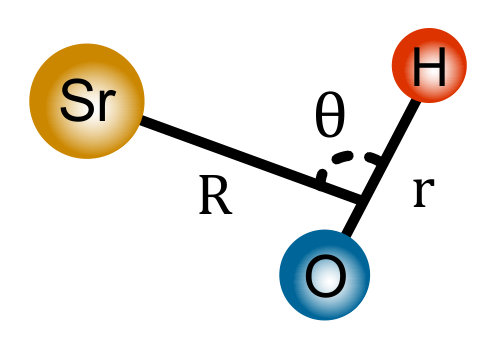 Figure 1
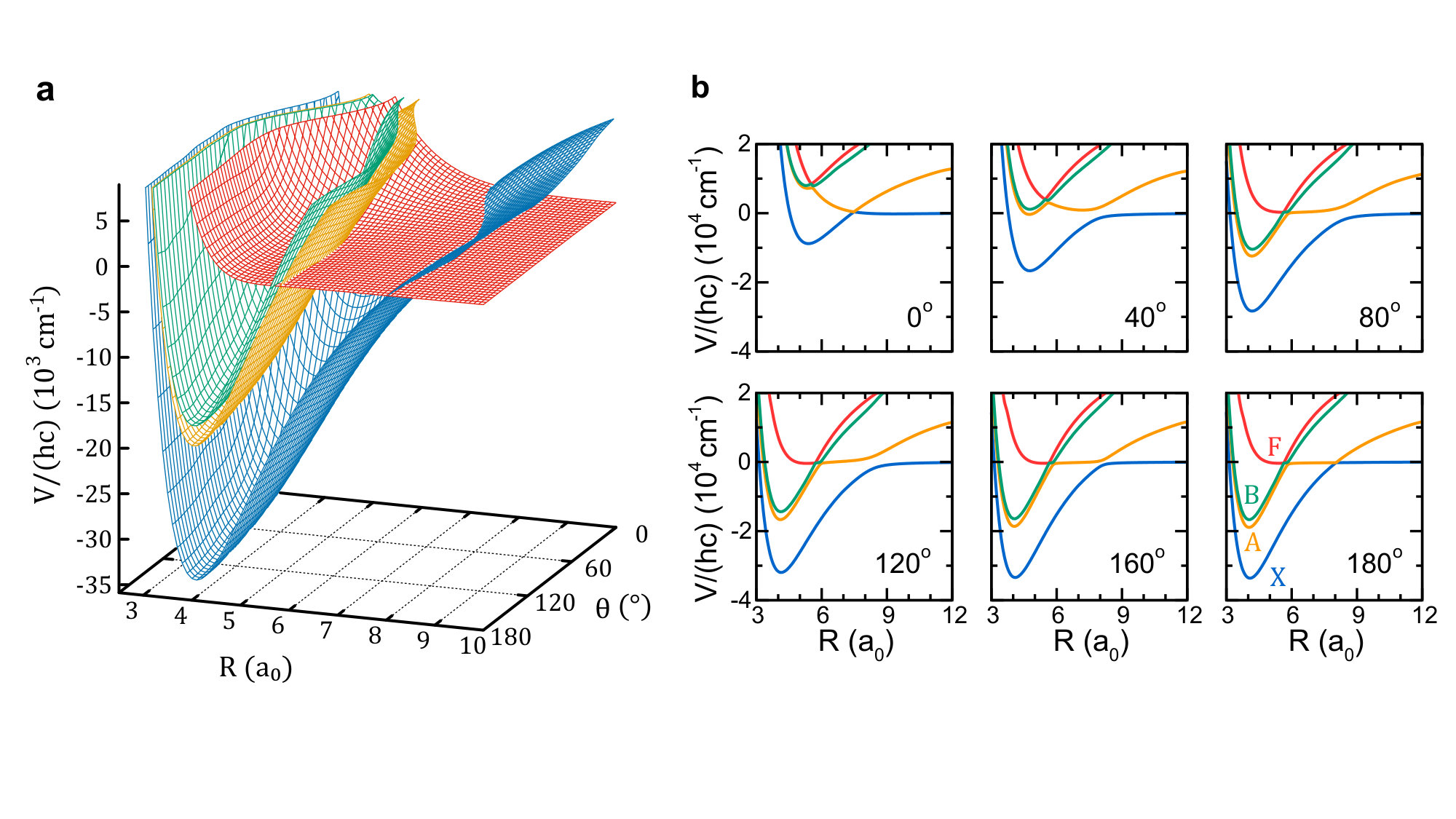 Figure 2
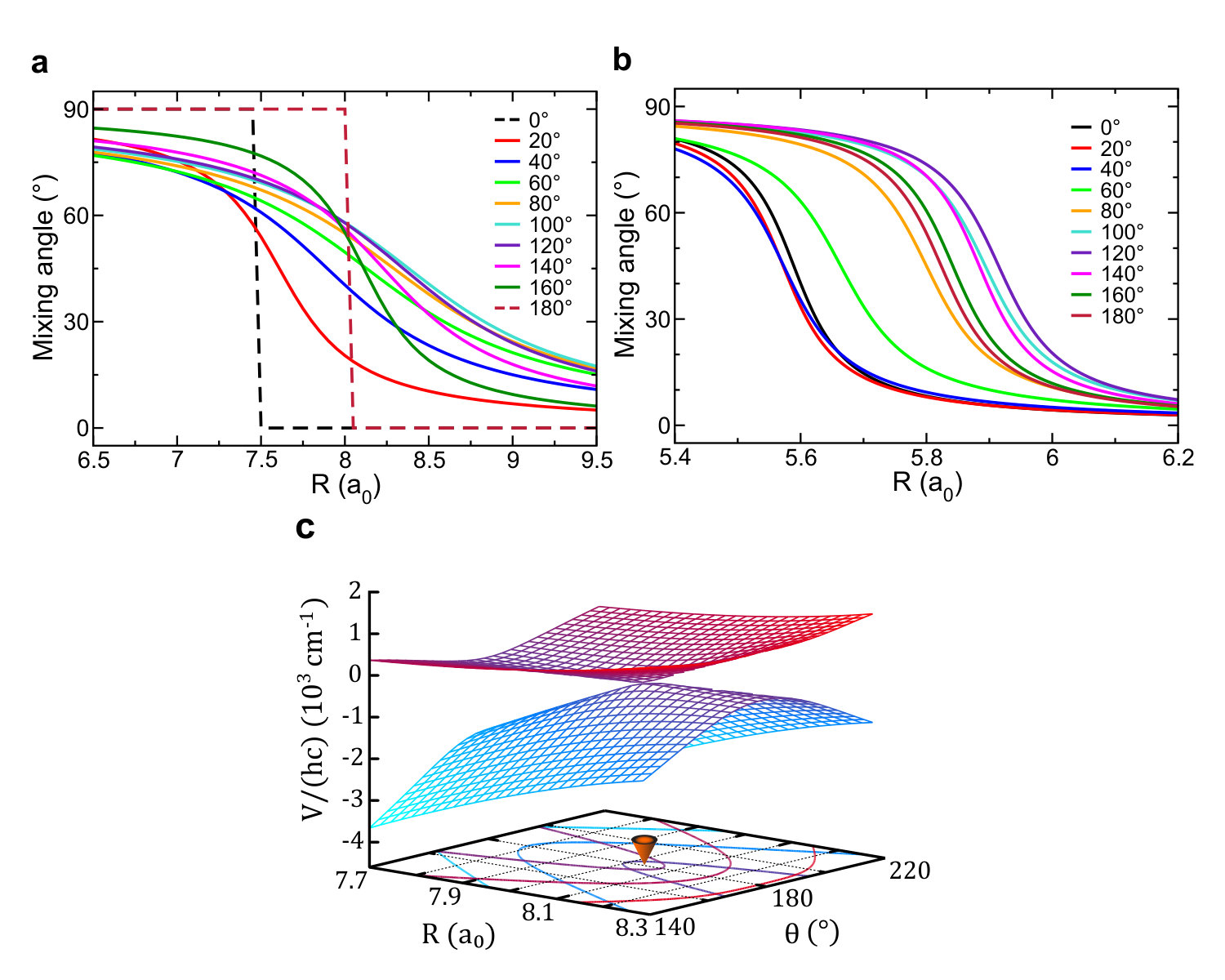 Figure 3
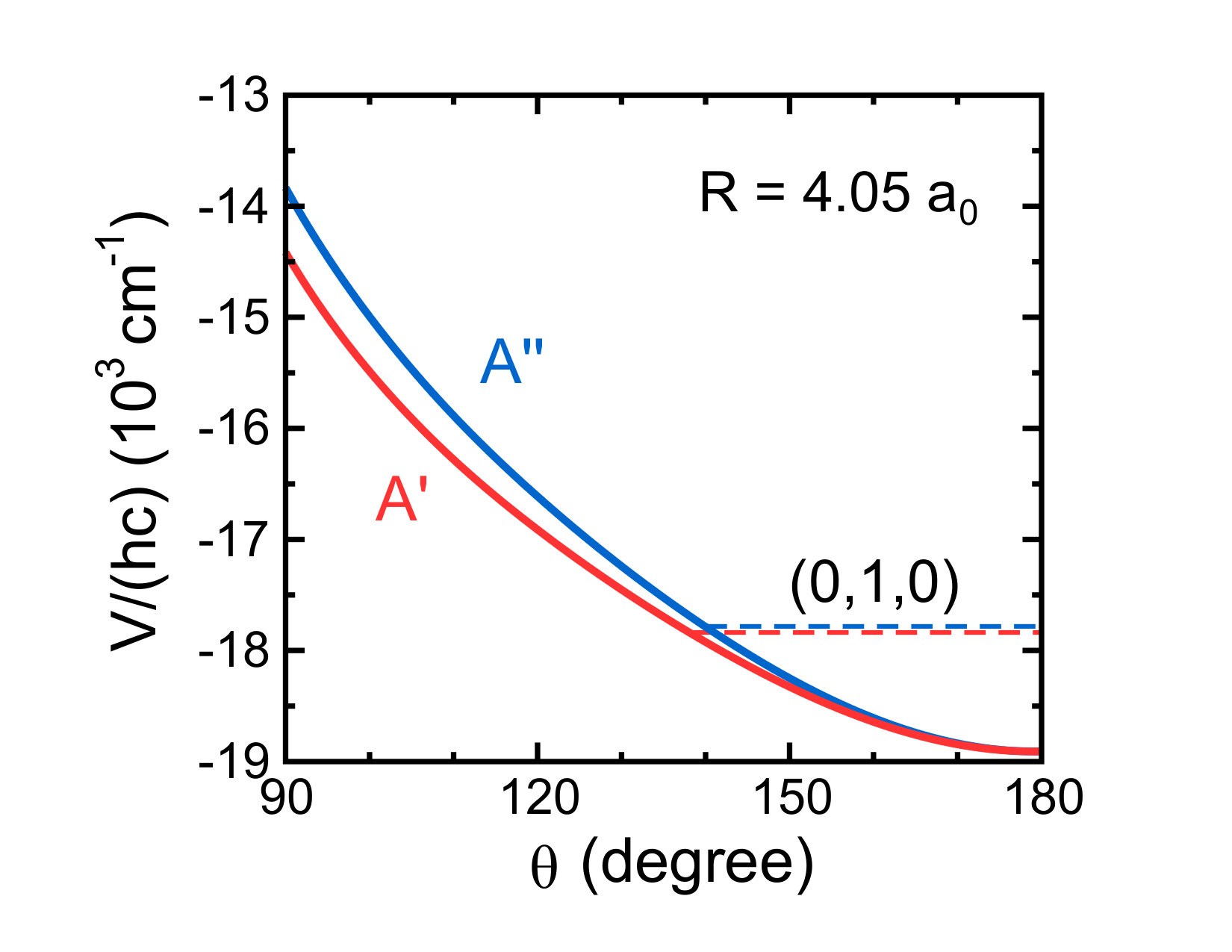 Figure 4
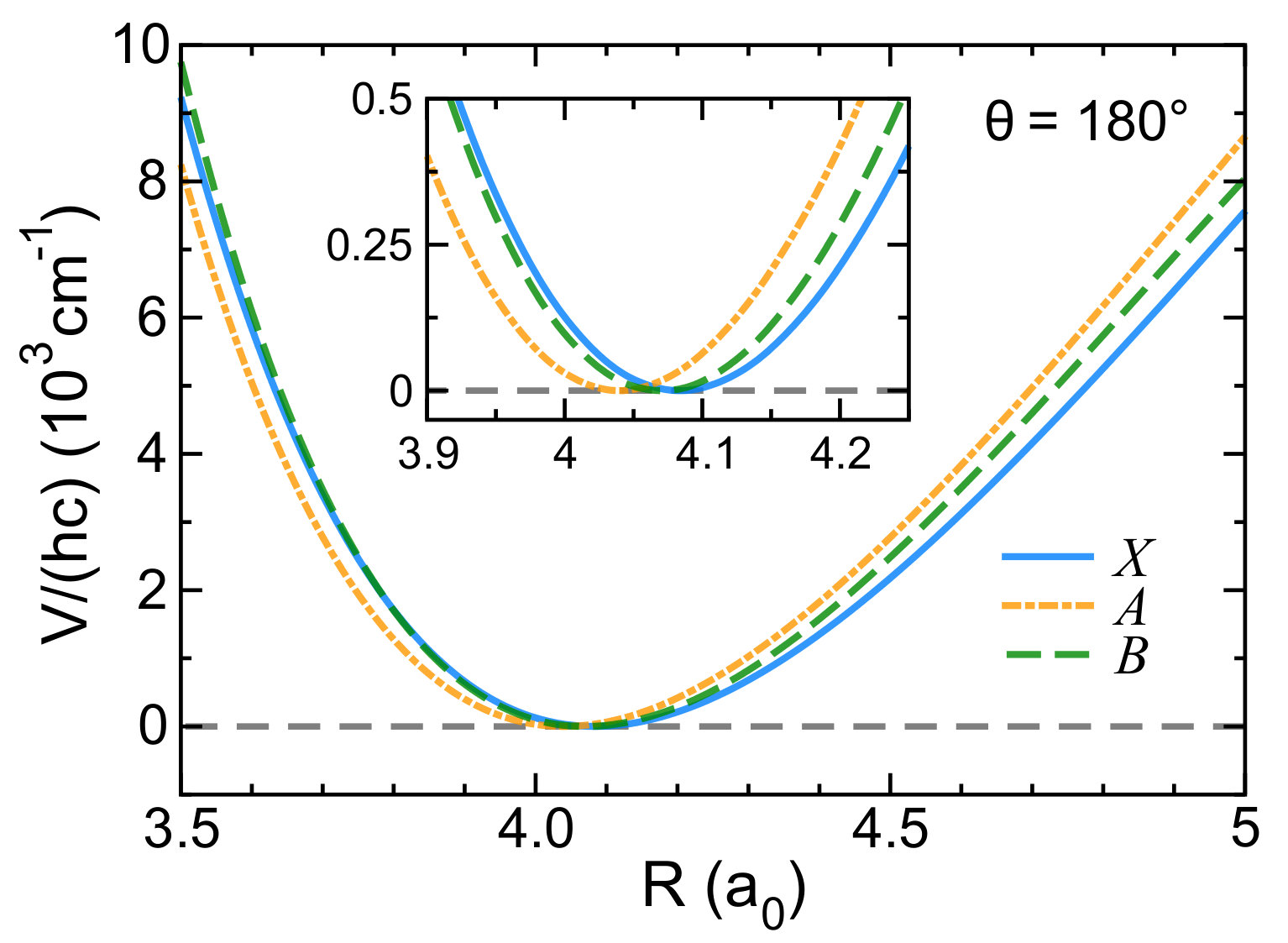 Figure 5
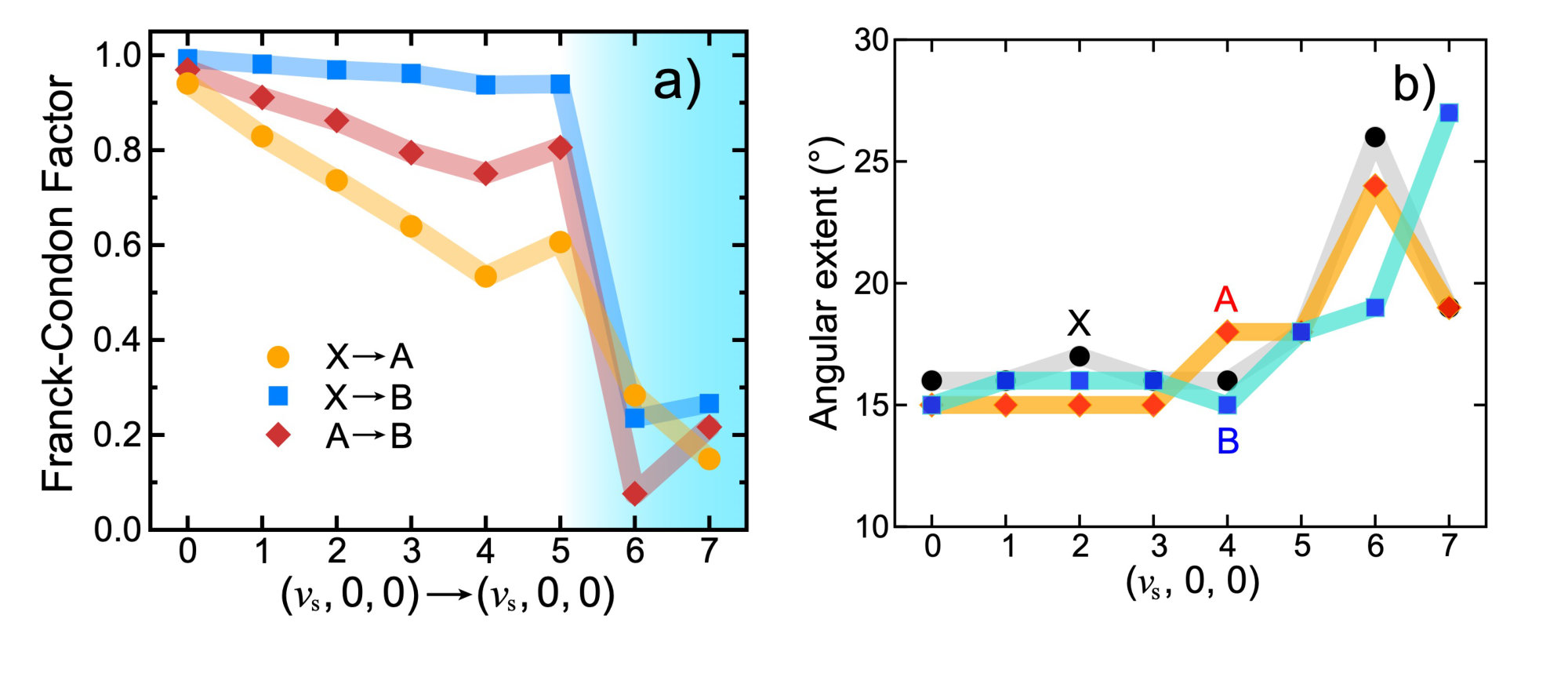 Figure 6
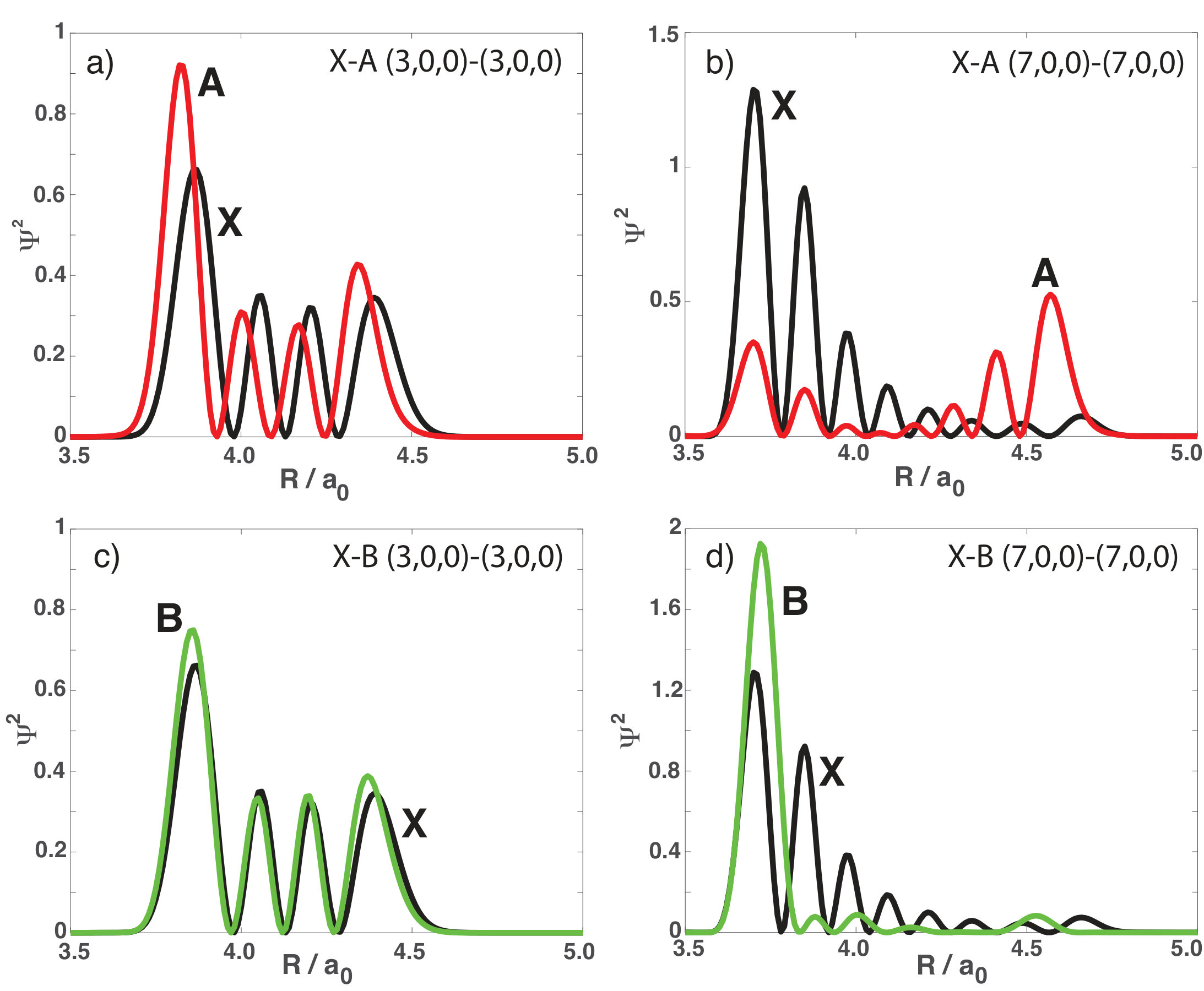 Figure 7
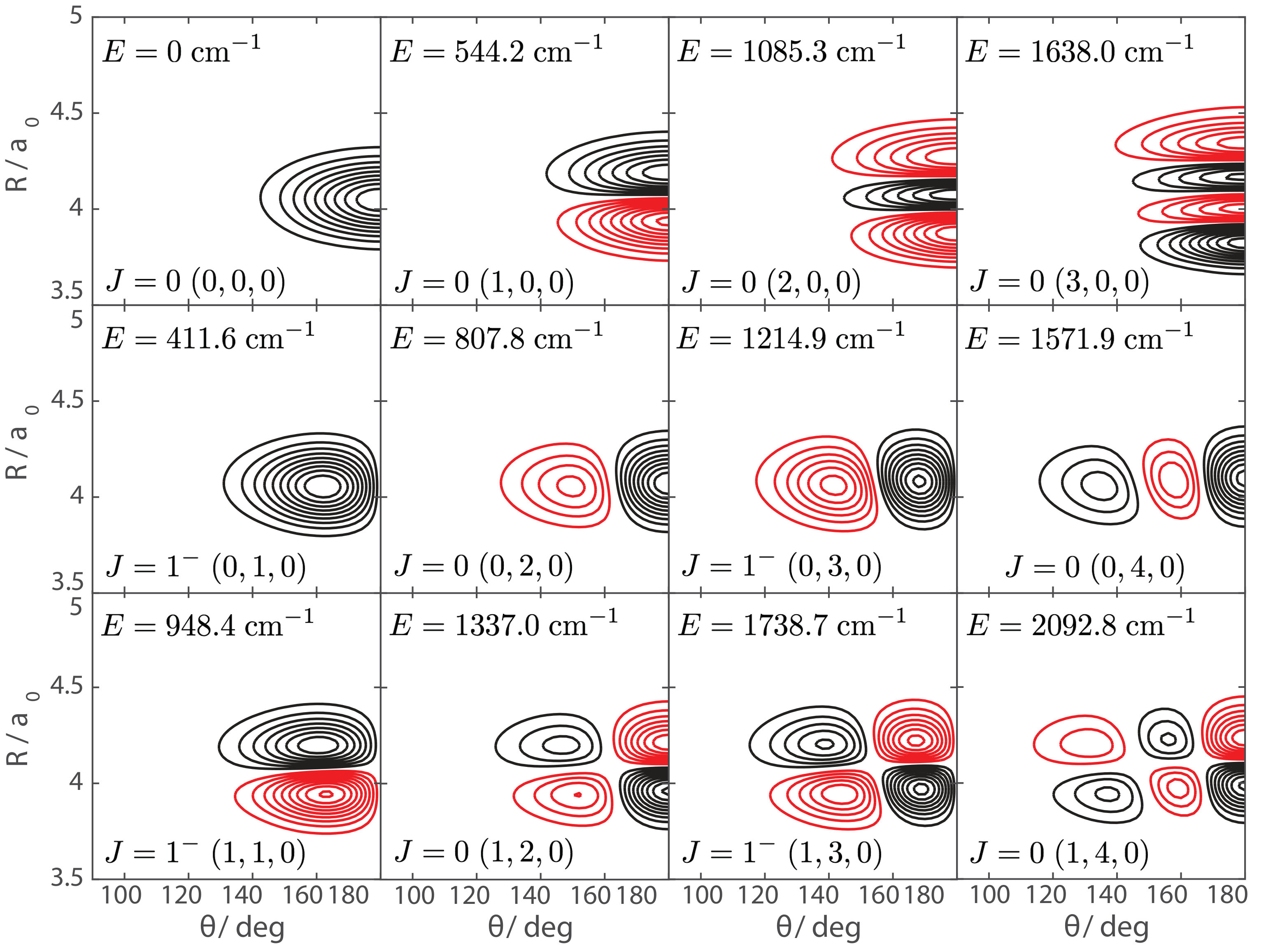 Figure 1
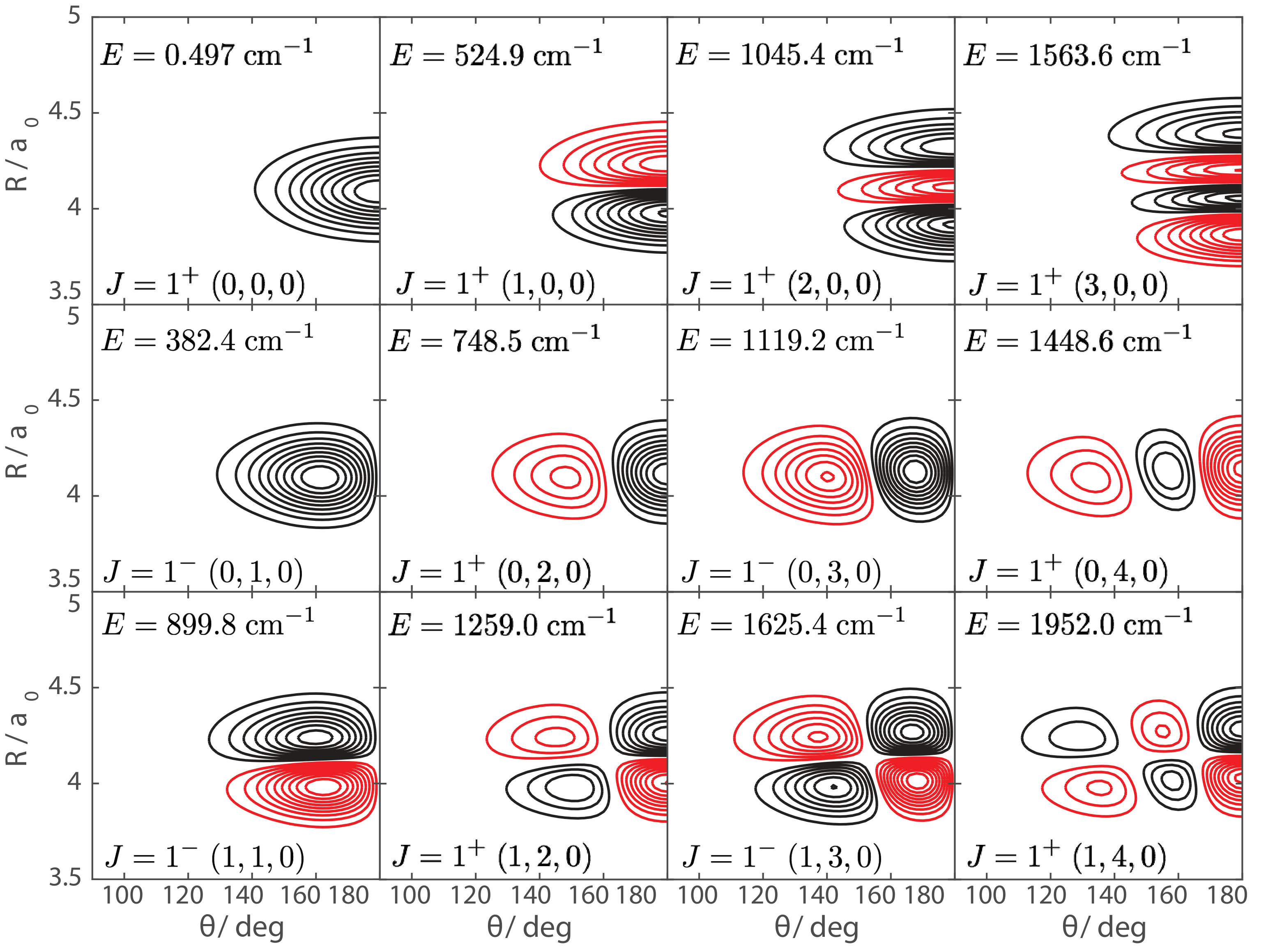 Figure 2
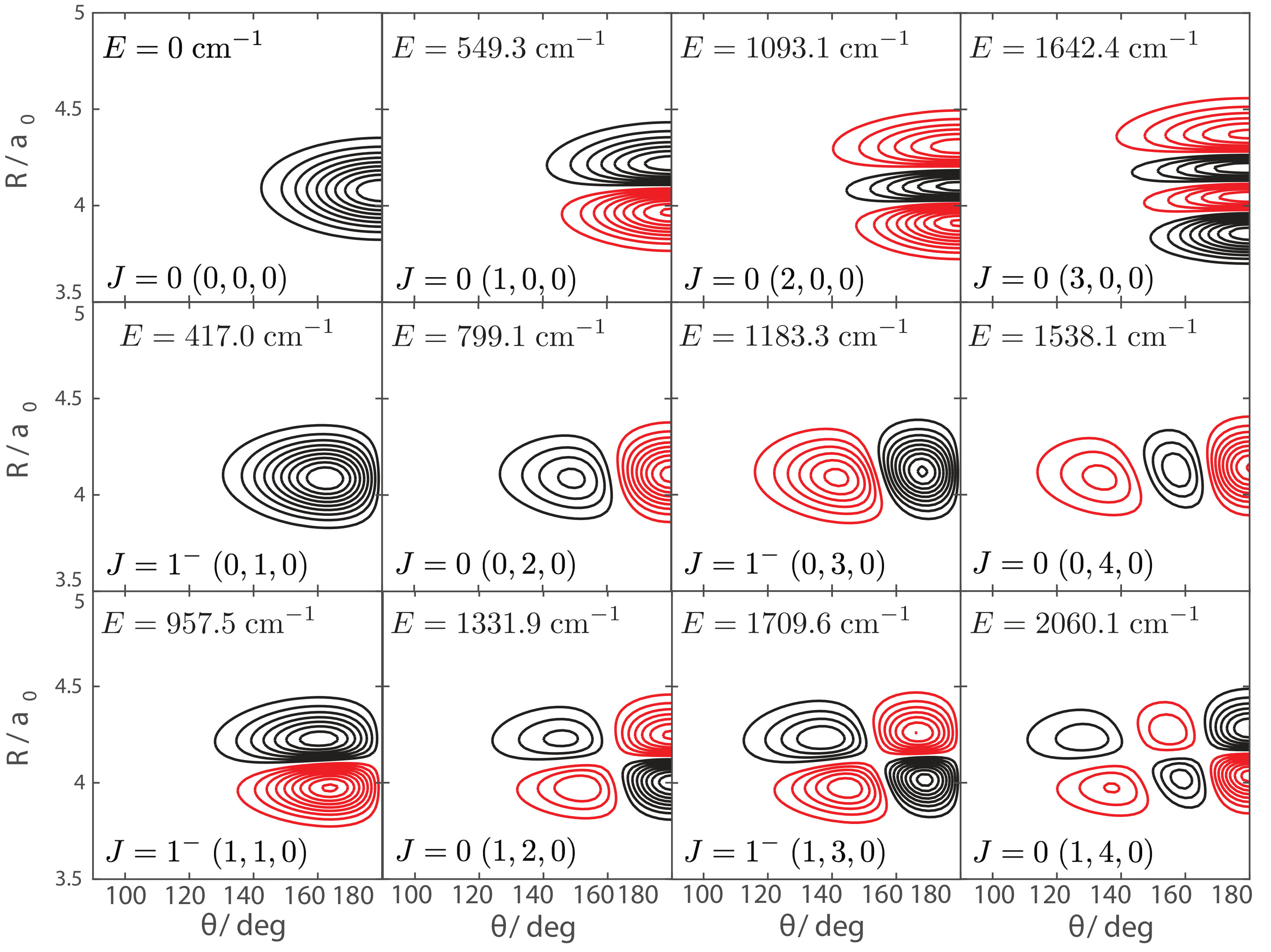 Figure 3
| State | Sr- | Sr- | Sr- | O- | H- |
|---|---|---|---|---|---|
| X | 0.9 | 0.1 | - | - | - |
| A | - | 0.9 | 0.1 | - | - |
| B | 0.2 | 0.4 | 0.3 | 0.3 |
| A\X | (000) | (100) | (200) | (300) | (010) | (110) |
|---|---|---|---|---|---|---|
| (000) | 0.940 | 0.058 | ||||
| (100) | 0.056 | 0.829 | 0.112 | 0.003 | ||
| (200) | 0.003 | 0.104 | 0.736 | 0.151 | ||
| (300) | 0.007 | 0.136 | 0.640 | |||
| (010) | 0.941 | 0.057 | ||||
| (110) | 0.055 | 0.832 | ||||
| B\X | (000) | (100) | (200) | (300) | (010) | (110) |
| (000) | 0.993 | 0.006 | ||||
| (100) | 0.006 | 0.981 | 0.011 | |||
| (200) | 0.011 | 0.969 | 0.017 | |||
| (300) | 0.017 | 0.962 | ||||
| (010) | 0.994 | 0.004 | ||||
| (110) | 0.004 | 0.984 | ||||
| A\B | (000) | (100) | (200) | (300) | (010) | (110) |
| (000) | 0.969 | 0.030 | ||||
| (100) | 0.028 | 0.911 | 0.060 | |||
| (200) | 0.002 | 0.053 | 0.862 | 0.081 | ||
| (300) | 0.004 | 0.067 | 0.795 | |||
| (010) | 0.967 | 0.033 | ||||
| (110) | 0.031 | 0.902 |
| Method | |||
| CCSD(T) | 524 | 382 | 748 |
| 2D-DVR Nguyen et al. (2018) | - | 322 | 638 |
| Exp. Presunka and Coxon (1993) | 527 | 364 | 703 |
| CCSD(T) | 544 | 412 | 808 |
| 2D-DVR Nguyen et al. (2018) | - | 308 | 614 |
| Exp. Presunka and Coxon (1993) | 543 | - | - |
| Exp. Presunka and Coxon (1995) | - | 378 | - |
| EOM-CCSD(dT) | 549 | 417 | 799 |
| 2D-DVR Nguyen et al. (2018) | - | 358 | 699 |
| Exp. Oberlander and Parson (1996) | 536 | - | - |
| Exp. Presunka and Coxon (1993) | - | 401 | 771 |
| A\X | (000) | (100) | (200) | (300) | (010) | (020) | (030) | (040) | (110) | (120) | (130) | (140) |
|---|---|---|---|---|---|---|---|---|---|---|---|---|
| (000) | 0.940 | 0.058 | ||||||||||
| (100) | 0.056 | 0.829 | 0.112 | 0.003 | ||||||||
| (200) | 0.003 | 0.104 | 0.736 | 0.151 | ||||||||
| (300) | 0.007 | 0.136 | 0.640 | |||||||||
| (010) | 0.941 | 0.057 | ||||||||||
| (020) | 0.940 | 0.057 | ||||||||||
| (030) | 0.942 | 0.054 | ||||||||||
| (040) | 0.942 | 0.051 | ||||||||||
| (110) | 0.055 | 0.832 | ||||||||||
| (120) | 0.055 | 0.832 | ||||||||||
| (130) | 0.052 | 0.839 | ||||||||||
| (140) | 0.049 | 0.844 |
| B\X | (000) | (100) | (200) | (300) | (010) | (020) | (030) | (040) | (110) | (120) | (130) | (140) |
|---|---|---|---|---|---|---|---|---|---|---|---|---|
| (000) | 0.993 | 0.006 | ||||||||||
| (100) | 0.006 | 0.981 | 0.011 | |||||||||
| (200) | 0.011 | 0.969 | 0.017 | |||||||||
| (300) | 0.017 | 0.962 | ||||||||||
| (010) | 0.994 | 0.004 | ||||||||||
| (020) | 0.994 | 0.003 | ||||||||||
| (030) | 0.992 | 0.003 | ||||||||||
| (040) | 0.996 | |||||||||||
| (110) | 0.004 | 0.984 | ||||||||||
| (120) | 0.003 | 0.987 | ||||||||||
| (130) | 0.002 | 0.979 | ||||||||||
| (140) | 0.982 |
| A\B | (000) | (100) | (200) | (300) | (010) | (020) | (030) | (040) | (110) | (120) | (130) | (140) |
|---|---|---|---|---|---|---|---|---|---|---|---|---|
| (000) | 0.969 | 0.030 | ||||||||||
| (100) | 0.028 | 0.911 | 0.060 | |||||||||
| (200) | 0.002 | 0.053 | 0.862 | 0.081 | ||||||||
| (300) | 0.004 | 0.067 | 0.795 | |||||||||
| (010) | 0.967 | 0.033 | ||||||||||
| (020) | 0.963 | 0.036 | ||||||||||
| (030) | 0.963 | 0.035 | ||||||||||
| (040) | 0.955 | 0.002 | 0.041 | |||||||||
| (110) | 0.031 | 0.002 | 0.902 | |||||||||
| (120) | 0.034 | 0.002 | 0.891 | |||||||||
| (130) | 0.032 | 0.887 | ||||||||||
| (140) | 0.040 | 0.862 |
Peer Reviews
No public reviews on file for this paper yet. If you reviewed it on a platform where reviews are public (OpenReview, ICLR, NeurIPS, ICML), you can paste yours below so the community can read it here.
Videos
No videos yet. Explain this paper in a talk, walkthrough, or lecture? Add one.
Emulating optical cycling centers in polyatomic molecules
Ming Li
Department of Physics, Temple University, Philadelphia, Pennsylvania 19122, USA
Jacek Kłos
Department of Physics, Temple University, Philadelphia, Pennsylvania 19122, USA
Department of Chemistry and Biochemistry, University of Maryland, College Park, Maryland 20742, USA
Alexander Petrov
Department of Physics, Temple University, Philadelphia, Pennsylvania 19122, USA
NRC, Kurchatov Institute PNPI, Gatchina, 188300, and Division of Quantum Mechanics, St. Petersburg State University, St. Petersburg, 199034, Russia
Svetlana Kotochigova
Department of Physics, Temple University, Philadelphia, Pennsylvania 19122, USA
Abstract
An optical cycling center (OCC) is a recently coined term to indicate two electronic states within a complex quantum object that can repeatedly experience optical laser excitation and spontaneous decay, while being well isolated from its environment. Here we present a quantitative understanding of electronic, vibrational, and rotational excitations of the polyatomic SrOH molecule, which possesses a localized OCC near its Sr atom. In particular, we describe the vibrationally-dependent trends in the Franck-Condon factors of the bending and stretching modes of the molecular electronic states coupled in the optical transition. These simulations required us to perform electronic structure calculations of the multi-dimensional potential energy surfaces of both ground and excited states, the determination of vibrational and bending modes, and corresponding Franck-Condon factors. We also discuss the extent to which the optical cycling center has diagonal Franck-Condon factors.
Laser cooling and trapping of atoms, enabled by the existence of closed optical cycling transitions, have revolutionized atomic physics and led to breakthroughs in several disciplines of science and technology Wieman et al. (1999). These advances enabled the simulation of exotic phases in quantum-degenerate atomic gases, the creation of a novel generation of atomic clocks, matter-wave interferometry, and the development of other highly-sensitive sensors. Temperatures below tens of microkelvin have also allowed the confinement of diatomic molecules, built from or associated with laser-cooled atoms, in electric, magnetic, and/or optical traps, where they are isolated from their environment and can be carefully studied.
Achieving similar temperatures for polyatomic molecules, however, remains challenging. Since polyatomic molecules are characterized by multiple degrees of freedom and have correspondingly more complex structures, it is far from obvious whether there exists polyatomic molecules that have the nearly-closed optical cycling transitions required for successful laser cooling. Such transitions could then repeatedly scatter photons.
A diverse list of promising applications for ultracold polyatomic molecules exists. This includes creating novel types of sensors, advancing quantum information science, simulation of complex exotic materials, performing precision spectroscopy to test the Standard Model of particle physics, and, excitingly, the promise of control of quantum chemical reactions when each molecule is prepared in a unique rovibrational quantum state. Moreover, the de Broglie wavelength of colliding ultracold molecules is much larger than the range of intermolecular forces and, thus, the science of the breaking and making of chemical bonds has entered into an unexplored regime.
Over the decades many spectroscopic studies of molecules consisting of an alkaline-earth metal atom (M) and a ligand have been performed Presunka and Coxon (1995); Wormsbecher et al. (1983a, b); Hilborn et al. (1983); Bernath and Kinsey-Nielsen (1984); Brazier and Bernath (1987); Bopegedera et al. (1987); Brazier and Bernath (1989); Bernath (1991), predominantly to determine their structure. The simplest polyatomic molecules of this type, the triatomic alkaline-earth monohydroxides M-OH, have attracted particular attention after the discovery of their peculiar ionic chemical bond. When a ground-state alkaline-earth atom is bound to OH one of its two outer-most electrons is transferred to the ligand, leaving the second electron in an open shell molecular orbital localized around the metal atom. This electron can be optically excited without disturbing the atom-ligand bond leading to so-called highly-diagonal FCFs and efficient optical cycling. High-resolution laser-spectroscopy experiments on CaOH (and CaOD) Hilborn et al. (1983) and SrOH (and SrOD) Nakagawa et al. (1983) were first to deduce the strong ionic character of the metal-hydroxide bond. Reference Jr. and Langhoff (1998) showed that the remaining valence electron of the metal atom can be easily promoted to any excited orbital.
Recently, Doppler laser cooling Dalibard and Cohen-Tannoudji (1985) of the simpler CaF, SrF, YbF, and YO dimers has been demonstrated Norrgard et al. (2016); Anderegg et al. (2017); Truppe et al. (2017); Collopy et al. (2018); Lim et al. (2018). Their success is associated with nearly-diagonal Franck-Condon factors (FCFs) on an allowed optical molecular transition. Diagonal FCFs ensure that spontaneous emission from vibrational state of the excited electronic state populates with near unit probability vibrational state of the ground electronic state. This closed two-level system can absorb and emit thousands of photons per molecule to achieve cooling.
Following these successful molecular cooling experiments, Isaev and Berger Isaev and Berger (2016) suggested that similar near-diagonality of FCFs exists in other classes of polyatomic molecules. It is now understood that metal-monohydroxides and even larger metal-monoalkoxide molecules with metal atom as Sr, Ca, or Ba are promising candidates for laser cooling. In 2017 the first optical cycling transitions in the polyatomic monohydroxide molecule SrOH was demonstrated by Dr. Doyle’s group Kozyryev et al. (2017). They succeeded in reducing the translational motion of SrOH to the record low temperature of 750 microkelvin starting from 50 milikelvin and using the near unit values of the FCFs. To eliminate rotational branching during the photon cycling process experimentalists use of the rotationally closed angular momentum transitions (see for details Refs. Kozyryev et al. (2017, 2019)).
A significant effort from the scientific community, however, is needed to identify and study the classes of polyatomic molecules with closed optical cycling transitions. Laser cooling of polyatomic molecules is relevant to those molecules that are able to scatter hundreds of photons (stimulated absorption followed by a spontaneous emission) between two vibrational states without loss to other vibrational states, i.e. have a cycling transition where for each cycle the kinetic energy of the molecule is reduced by K and 10 K depending on the cooling process and is the Boltzmann constant. The requirement of 100 scattering cycles is to a certain degree arbitrary but reasonable and implies that FCF larger than 0.99 are needed. A larger FCF will allow better cooling.
In fact, a comprehensive analysis of level structures that are amenable to laser cooling has to be conducted. Special attention must be given to finding excited-state molecular potentials that have: i) a shape that is similar to that of the ground-state potential; ii) a strong dipole electronic transition with the ground state; and iii) weak transitions to dark states that are not optically coupled to the excited state. It is to be expected that only a small number of polyatomic molecules have these three properties.
An engineering approach, however, can be used to add optical cycling centers (OCCs) to a variety of polyatomic molecules with increasing complexity Klos and Kotochigova (2019). For this approach to work we need to ensure that the electrons holding the optically active atom and the molecule together remain sufficiently localized so that the whole molecular system can be translationally cooled. This stringent requirement motivates our intent to conduct an assessment of the role of electron density and localization in the coupling to the ligand molecule. Recent theoretical studies on the cooling properties of alkaline-earth monohydroxides other than SrOH can be found in Refs. Isaev and Berger (2016); Kozyryev et al. (2016). They only determined molecular parameters and Frank-Condon factors for vibronic transitions between ground and excited states near equilibrium geometries.
Our objectives are to better quantify the extent to which polyatomic SrOH is an ideal platform for cooling with laser light as well as to determine the “global” shape of its ground and excited potential energy surfaces (PES) in anticipation of future research on dissociating SrOH into Sr and OH and on ultracold scattering between Sr and OH. In this paper, we describe a complex electronic structure determination of local and some global properties of four multi-dimensional intramolecular PESs of SrOH as well as calculate their corresponding vibrational structures. Our effort involves locating potential minima, potential avoided crossings as well as conical intersections (CIs), where two adiabatic PESs of the same electronic symmetry touch. We represent the PESs and thus the CIs both in terms of adiabatic and diabatic representations. We also determine Frank-Condon factors for not-only the lowest vibrational states but also higher-excited vibrational states of the potentials, where the transitions are no longer diagonal due to non-adiabatic and anharmonic corrections. At near linear geometries, we evaluate the Renner-Teller (RT) parameter Yarkony (1996) for some excited-state potentials.
**Results
Electronic potentials of SrOH**. The computation of PESs is crucial for defining the landscape in which the nuclei transverse upon interacting with one another. These surfaces can have many features in the context of their topology that are important for the internal transition mechanisms. We begin by describing our calculation of the ground and excited PESs of strontium monohydroxide SrOH. Past theoretical studies on M-OH were devoted to either spectroscopic characteristics near equilibrium geometries Kas et al. (2017) or the PESs for the lighter BeOH and MgOH with fixed O-H separation Theodorakopoulos et al. (1999). Experimental studies of CaOH Bernath (1991) and SrOH Presunka and Coxon (1995); Brazier and Bernath (1987); Bopegedera et al. (1987) predominantly focussed on their near-equilibrium ro-vibrational structure.
The relevant multi-dimensional PESs have been determined using a combination of coupled-cluster (CCSD(T)), equation-of-motion coupled-cluster (EOM-CC), and multi-reference configuration interaction (MRCI) methods. This combination allows us to overcome the limitations of the CCSD(T) and EOM-CC methods associated with their single reference nature and the MRCI method with its limits on the size of active space and characterize multiple avoided crossings between relevant PESs. Since the molecule contains one heavy atom, relativistic effects are embedded into the description of the core electrons. Potentials are presented in the Jacobi coordinates R and r defined in Fig. 1. For our purposes it is sufficient to determine the PESs, which are only functions of in the two-dimensional plane with the OH separation fixed to its diatomic equilibrium separation as the energy required to vibrationally excite OH is nearly seven times larger that than those of the Sr-OH stretch and bend. Coupling to the OH stretch can then be ignored for our objectives. (We always use and also suppress the dependence in our notation.)
The PESs and corresponding electronic wavefunctions are labeled by their total electronic spin angular momentum, here always a doublet or spin 1/2, as well as the irreducible representations of point groups for linear geometries and otherwise. In particular, we obtain four and two potentials using standard notation for the irreducible representations of , respectively. For linear geometries states connect to either or states of the symmetry group, while states always become states. Hence, we label potential surfaces by , where and indicate the energy ordering of states for and close to their equilibrium separations and .
CCSD(T) and EOM-CC calculations lead to the most-accurate PESs for each irreducible representation and, in principle, should return the corresponding adiabatic PES with avoided crossings from excited potentials in the same irreducible representations. Numerically, however, we find this not to be true due to the fact that the method use only excitations from a single reference configuration and that the electronic wavefunctions rapidly change from ionic to covalently bonded with small changes in the Jacobi coordinates, in particular regions of . In essence, for a given reference configuration the CCSD(T) or EOM-CC simulations return diabatic potentials with electronic wavefunctions that have either an ionic bond, where one of the outer valence electrons of Sr is now tightly bound to oxygen, or a covalent bond, where both valence electrons mostly remain in orbit around the Sr nucleus and barely couple with the OH electron cloud. The diabatic PESs have lines in the plane along which two potentials have the same energy.
Figure 2a shows four diabatic PESs of SrOH as functions of and obtained by CCSD(T) and EOM-CC methods. Details regarding electronic basis sets, coupled-cluster method for the individual and PESs, and interpolation can be found in Methods. The calculations are performed at ten angular and about 45 radial geometries. This data is then interpolated using an analytical functional form. The interpolated PESs are essential in recognizing system characteristics, such as minima and transition states, i. e. saddle points, as well as crossings. Near extrema the curvature or Hessian matrix is evaluated.
The optimized geometry for the ground-state SrOH molecule occurs at . Its electronic wavefunction has X symmetry and is ionically bonded. These observations are consistent with spectroscopic data Presunka and Coxon (1994) and the semi-empirical analyses of Ref. Nguyen et al. (2018). The and states also have ionic character and minima at . In fact, the minima of these three potentials have nearly the same equilibrium coordinates and curvatures providing excellent conditions for optical cycling. These conditions are further described in subsection “Wavefunction overlaps”.
The fourth diabatic PES is the shallow excited potential with a covalently bonded electronic state that dissociates to Sr(1S) and OH(X). For large the ionic PESs correlate to electronically-excited states of the Sr atom. Crucially, we observe that the three ionic diabatic PESs each have a curved line in the plane along which the potential equals the energy of the ionic potential. It is worth noting that to good approximation this curve is independent of . The potential is expected to play a crucial role in the zero-energy dissociation of SrOH to create ultracold OH fragments, an important radical for various scientific applications.
Figure 2b shows the interpolated adiabatic PESs of the SrOH molecule as functions of for six values of and obtained by diagonalizing the Hamiltonian with the diabatic PESs as diagonal matrix elements and coupling matrix elements described in subsection “Non-adiabatic couplings and conical intersections” at each . These cuts through the PESs exhibit several intriguing features. First, for and CIs, where two potentials still touch, are apparent. For other values of the crossings are avoided. The location of the CIs at linear geometries is specific to SrOH, other molecules will have CIs at other geometries. CIs lead to geometric or Berry phases Berry (1984), i. e. sign changes associated with an electronic wavefunction when transported along a closed path encircling a CI. These phases lead to interference that allows efficient non-adiabatic transitions between surfaces Xie et al. (2017), modify product rotational state distributions in chemical reactions, and influence ro-vibrationally averaged transition matrix elements.
We have similarly obtained two diabatic PESs. Both are states at linear geometries. On the energy scale of Fig. 2a their shapes are nearly indistinguishable from those of the and potentials. In fact, and as well as and are degenerate for linear geometries. Unlike the corresponding potentials, however, the two potentials do not possess CIs.
Non-adiabatic couplings and conical intersections. The adiabatic PESs in Fig. 2b are Born-Oppenheimer (BO) potentials Born and Oppenheimer (1927) that are typically used as a starting point in describing scattering and chemical processes. The BO approximation is based on the realization that the motion of nuclei and electrons occur on different time or energy scales and usually only a single PES is required. This leads to a significant simplification of the description of scattering and chemical processes.
For SrOH the BO approximation breaks down when potentials of symmetry come close and even become degenerate for one or more geometries. Couplings between these potentials can not then be neglected. The corresponding non-adiabatic transition probability for “hopping” between potentials increases dramatically especially for conical intersections and can greatly affect chemical properties Domcke et al. (2004).
Our CCSD(T) and EOM-CC calculations only resulted in diabatic PESs and electronic wavefunctions , due to their reliance on a single reference configuration. Here, index labels states and corresponding PESs. As the diabatic electronic wavefunctions are predominantly described by this single reference configuration, their dependence on and is weak and negligible, and suppressed in our notation.
Coupling matrix elements between the diabatic potentials are constructed by performing less-accurate MRCI calculations at the SD level with a basis set similar to that used for our CCSD(T) calculations (details are given in Methods.) Our MRCI calculations rely on two or more reference configurations and thus do lead to adiabatic BO potentials and adiabatic electronic wavefunctions , where index labels states. Adiabatic wavefunctions strongly depend on and near crossings or avoid crossings between potentials. We also compute diagonal overlap matrix elements at different geometries within the MRCI method.
Numerically, we find that the general shapes of the CCSD(T) and MRCI potentials are the same. Specifically, the geometries where diabatic potentials in Fig. 2a cross and adiabatic MRCI potentials avoid are in good agreement. We can then assume that away from the crossings for some diabatic index . Near avoided crossings the adiabatic wavefunction is a superposition of diabatic wavefunctions.
We focus on the coupling matrix element between the diabatic and states near as well as those between and near . We assume the coupling between the diabatic and states near is the same as between the ones. For each pair of states the adiabatic wavefunctions can then be approximated as the superposition Nikitin (2006)
[TABLE]
with indices and , respectively, where mixing angle is to be determined.
To determine the mixing angle we, first, identify a reference geometry for each away from the crossings, where , , and we can assume . The mixing angle at other radial geometries is then given by
[TABLE]
and the coupling matrix element between the two diabatic states and is
[TABLE]
In the limit this expression needs to be treated carefully. The mixing angle will approach and only at CIs .
In practice, we parametrize as we perform MRCI calculations only on a restricted set of geometries . We ensure a smooth functional dependence on at fixed by using
[TABLE]
where is the curve where and is a coupling width that is fitted to reproduce the MRCI overlap matrix at (at other it is found with the Akima interpolation method Akima (1970).) By construction is much smaller than . We use and for the pair of and states, respectively. Values for , , and are available upon request.
Figures 3a and b show mixing angles for the two diabatic and the two states, respectively. In both panels the mixing angle is seen to change relatively rapidly over a small range of , i. e. determined by , from nearly to . When we have . For the states in panel a, is largest for and is zero for and , indicative of CIs where has an infinitely sharp jump from to . For the states in panel b the width is nearly independent of and there is no CI. Finally, Fig. 3c shows the adiabatic potentials near the CI at and as determined by diagonalizing the matrix containing the relevant diabatic PESs coupled by the coupling matrix element at each . The figure corresponds to a surface plot of the data shown in Fig. 2b.
The Renner-Teller effect Renner (1934); Herzberg and Teller (1933) occurs in linear or quasi-linear, open-shell triatomic molecules and relies on non-adiabatic coupling between rovibrational and electronic motion in polyatomic molecules. It is associated with an energy degeneracy of electronic states for high-symmetry geometries that is lifted by vibrational bending motion. The motion causes degenerate potential energy surfaces to split and breaks the Born-Oppenheimer (BO) approximation. Stretching modes, which do not break linear symmetry, are not affected.
We calculate the RT parameter by estimating the non-adiabatic coupling between and PESs. These PESs are degenerate at co-linear geometries but split otherwise.
Figure 4 shows the potentials near the co-linear equilibrium separation as functions of the bending angle . The potentials are degenerate at . The slight anisotropy away from linear geometry causes the bending vibrational motion in the two PESs to differ. Our calculated bending energy relative to for the and states are cm*-1* and cm*-1*, respectively, corresponding to a 28 cm*-1* difference. In the harmonic approximation this differential splitting is characterized by the Renner-Teller parameter Presunka and Coxon (1994)
[TABLE]
Presunka & Coxon Presunka and Coxon (1994) estimated a Renner-Teller parameter of for these states from fitting this and other non-adiabatic parameters to spectroscopic data. Here, we calculate for the first time from ab-initio calculations and find agreement with spectroscopic estimate to within 15%.
Wavefunction overlaps. Laser cooling of SrOH Kozyryev et al. (2017) relied on optical cycling transitions between either or vibronic states. The success of the experiment is associated with near-diagonal FCFs between the sets of levels supported by these electronic potentials, which ensures that spontaneous emission from a rovibrational state of the excited electronic state populates with near unit probability the corresponding rovibrational state of the ground electronic state. This two-level system absorbs and emits many photons to achieve cooling Dalibard and Cohen-Tannoudji (1985).
Table 1 shows atomic orbital composition for the ground and A and B electronically excited states of SrOH. The X electronic ground state is mostly described by Sr- orbital as expected. One can notice that in the case of the A and B states there is some participation of -orbitals of Sr atom. For the A state that participation is quite small and the excited state is mainly formed by Sr- orbital participating in transition. The B state has quite a substantial component originating from Sr--orbitals indicating increased type hybridization with some participation of O- and H- atomic orbitals.
Our computation of vibrational wavefunctions and their overlap for electronic transitions is described in Methods. We focus on vibrational levels near the global minima of the diabatic PESs at as shown in Fig. 5. Effects from diabatic couplings, CIs, fine-structure interactions, and coriolis forces among the and surfaces can then be omitted. The lowest vibrational and rotational states are uniquely labeled by the three vibrational quantum numbers , , and , total trimer orbital angular momentum , and parity . Here, the vibrational quantum numbers correspond to the Sr-O stretch, the Sr-O-H bend, and the O-H stretch, respectively. We use the abbreviated notation and always have for frozen separation . Our vibrational energies are discussed and compared to results from existing literature in Methods.
Evaluation of Frank-Condon factors. Figure 6a examines our diagonal FCFs of stretching modes among the , , and the states. For the FCFs decrease linearly with increasing . In this regime, stretching modes with different bending quantum numbers are well separated in energy and FCFs based on the harmonic approximation of the potentials are in reasonable agreement with our more precise evaluation. The FCFs are largest for the to transition.
We observe a dramatic decrease of the FCFs for and , emphasized by a blue shaded area in Fig. 6a. We explain this behavior in terms of the complex overlap of vibrational wavefunctions in and . Figure 6b shows the expected angular extents of vibrational wavefunctions relative to the equilibrium linear geometry as functions of . For states the vibrational wavefunctions along are nodeless. We observe that the bending range for vibrational levels in all three electronic states is and that for the wavefunction is more extended. In fact, for the angular extent for the and states remains close but differ significantly from those of the state. This irregularity in the series coincides with the corresponding irregularity in FCFs, but clearly is not the whole story as we could conclude that the to transitions remain diagonal.
Figure 7 compares vibrational wavefunctions as functions of stretching-direction for linear geometry for the to and to transitions. We observe that for the (3,0,0) vibrational level the wavefunction of the three electronic potentials have similar shape, although the overlap for the and states is significantly better. For the (7,0,0) level neither overlap is good. Combining our observations on the angular extend in Fig. 6b with those on the stretching direction then explains the dramatic decrease of the FCFs for and .
Table 2 presents our diagonal and off-diagonal FCF matrix elements. For simplicity FCFs smaller than have been omitted. Overall the to vibronic transitions have higher diagonal FCFs and smaller off-diagonal FCFs than those for the to transition. The to FCFs for these electronic states was measured in Ref. Nguyen et al. (2018). They found 0.957(3) and 0.977(2) for the to and to transition, respectively. These value are smaller than those found in our calculations. Better agreement might be found by allowing the OH bond to change. Extended tables of the FCF matrices are presented in Supplementary Note 1.
Discussion
We have quantitatively analyzed the unique localized chemical bond between valence electrons of Sr and OH radical. We have shown that one of the two Sr valence electrons remains localized on the Sr+ cation and can be optically excited without disturbing the atom-ligand bond leading to highly-diagonal FCFs and efficient optical-cycling conditions. The goal of our theoretical work has been to analyze the cooling process based on a rigorous calculation of the electronic structure of this important molecule previously totally unknown, as a means to look into the nature of optical cycling centers in polyatomic molecules and help extend its generality. Furthermore, our work indicates that there are several electronic and vibrational states that can be used for the laser cooling with FCFs close to unity. We also explain why the X-B transitions have more diagonal FCFs than X-A transitions.
Our analysis of the electronic and vibrational energy landscape of SrOH also points to intriguing molecular features that require further explorations. For instance, we located conical intersections in SrOH that can have important implications for non-adiabatic transitions between PESs, collisional dynamics within this molecule, as well as its fragmentation. Our characterization of the geometric Renner-Teller effects provides better understanding of the coupling between electronic and vibrational motion and accounts for the possible nominally-forbidden loss channels.
Finally, Ref. Kozyryev et al. (2019) proposed that replacing the hydrogen atom in the monohydroxide with larger ligand should not significantly disturb the valence electron of metal-cation so that optical cycling and cooling even larger polyatomic molecule might remain possible. Detailed confirmation of this idea also awaits future research.
**Methods
Ab initio methods for the SrOH potential energy surfaces.** We have used the coupled-cluster CCSD(T) method from CFOUR Stanton et al. to calculate the ground and first excited diabatic PESs with total electron spin 1/2 of symmetry (ground state), symmetry (first excited state), and the highly excited diabatic PES with spin 1/2 of symmetry but with completely different reference configuration. They are labeled , and , respectively. The CCSD(T) calculations are based on the atomic bases sets def2-QZVPP (8s8p5d3f)/[7s5p4d3f] Weigend and Ahlrichs (2005) paired with the Stuttgart ECP28MDF effective core potential Lim et al. (2006) for Sr, the all electron aug-cc-pVQZ (13s7p4d3f2g)/[6s5p4d3f2g] for O, and aug-cc-pVQZ (7s4p3d2f)/[5s4p3d2f] for H Dunning (1989).
For all excited diabatic potentials, , , , , and , we employed the equation-of-motion coupled-cluster (EOM-CCSD(dT)) approach, implemented in Q-CHEM, version 5.0 Shao et al. (2015). The excitation-energy root space for the EOM-CCSD(dT) method spans four roots of symmetry and two roots of the symmetry. We use the Stuttgart ECP28MDF relativistic effective core potential Lim et al. (2006) along with Peterson’s pseudopotential based, polarized valence, correlation consistent triple-zeta (aug-cc-pVTZ-PP) basis for the Sr atom Li et al. (2013) and corresponding Dunning’s aug-cc-pVTZ basis for the O and H atoms Dunning (1989). These calculations allowed us to obtain the relative splittings between and PESs and between the and PESs.
The CC based methods used in construction of the and potentials are capable of providing highly accurate quantitative data about PESs. Unfortunately, these methods are unsuitable for the calculation of PESs near their crossing or avoided crossing. The way out is a MRCI calculation, which realistically, can only be done with an active space of limited size.
We characterize non-adiabatic couplings between states by using the MRCI calculations with single and double excitations, implemented in MOLPRO Werner et al. (2012). The ECP28MDF Köln pseudo-potential Lim et al. (2006) with the augmented correlation-consistent triple-zeta basis aug-cc-pVTZ-PP Li et al. (2013) for Sr and the all-electron aug-cc-pVQZ basis for O and H Dunning (1989) are applied. The calculations are performed with reference orbitals constructed from state-averaged multi-reference self-consistent-field calculations. Finally, all electronic structure calculations were performed with assumption that the OH separation is fixed at .
Interpolation of potential energy surfaces. The four and two two-dimensional diabatic SrOH potentials have been computed on a grid in Jacobi coordinates and . In order to find the potential energies at other coordinates we expand the angular dependence of each diabatic PESs in terms of Legendre polynomials via
[TABLE]
for with and radial expansion coefficients . For separations the PESs are fit to
[TABLE]
with dispersion coefficients . The radial coefficients and are determined by the Reproducing Kernel Hilbert Space (RKHS) interpolation method Ho and Rabitz (1996). The two expansions are smoothly joined using
[TABLE]
and The parameter values for describing , , , and are available upon request.
Bound state energies. For each diabatic PESs the corresponding vibrational Hamiltonian includes the kinetic-energy operators for Jacobi coordinates R and r with masses and , respectively. Here, is the mass of the Sr atom and that of the OH molecule. The vibrational Hamiltonian commutes with the trimer orbital-angular-momentum operator J = as well as the parity operator , the symmetry under spatial inversion of all electrons and nuclei around the center-of-mass position of the trimer. Here, and are the orbital-angular-momentum operators of ground-state OH and of Sr relative to the center of mass of OH, respectively.
We diagonalize the vibrational Hamiltonian by first creating a one-dimensional basis of bound states of the radial Hamiltonian using the distributed Gaussian basis approach and where is the interpolated PES computed at and ( is the reduced Planck constant.) Then the vibrational Hamiltonian is diagonalized in the product basis of radial bound states and superpositions of products of spherical harmonic functions for the orientation of R and r, such that the basis states are eigenstates of , , and parity .
Within these approximations we have computed several of the energetically-lowest vibrational levels with total angular momentum and of the diabatic , , , and . We focus on these rotational states as transitions from the ground state are used in laser cooling of SrOH Kozyryev et al. (2017).
In Table 3 we compare some of our calculated energies with total angular momentum to other semi-empirical results as well as experimental data. Our results for the Sr-O stretch and Sr-O-H bend energies agree well with experimental data, even though the OH bond is not allowed to stretch and diabatic couplings are omitted. The energy difference between the and states, the Sr-O stretching mode, are reproduced to better than 1% for the and states. The discrepancy increases to 2.5% for the state.
For the bending mode with quanta our theoretical energy differences are larger than those found experimentally, although the difference is no more than 10% for the three electronic states. Adding a second quanta in the bending mode shows that anharmonic contributions are non-negligible. We also corroborate the DFT and 2D-DVR results of Nguyen et al. Nguyen et al. (2018). Nguyen’s DFT results are based on the harmonic approximation.
The vibrational wavefunctions are used the compute FCFs among various pairs of ionic states. Their values and trends were presented in subsection “Wavefunction overlaps”. Additional bound-state energies and wavefunctions are shown in Supplementary Figures 1-3.
We can also quantify the quality of our potentials by a comparison of the dissociation energy and permanent dipole moments. The dissociation energy of the (0,0,0) vibrational state of our potential is cm*-1* and compares favorably with the experimental measurements ranging from cm*-1* to cm*-1* van der Hurk et al. (1974); Cotton and Jenkins (1968); Murad (1981). Our determination of the permanent dipole moments of the , , and states at their equilibrium geometries are 1.57 Debye, 0.314 Debye, and 0.396 Debye, respectively. Reference Steimle et al. (1992) measured 1.900(14) Debye and 0.396(61) Debye for the (0,0,0) vibrational state of the and potentials. The agreement is mixed. A direct comparison for the state can not be made as Ref. Steimle et al. (1992) presented a fine-structure resolved measurement, i.e. they found permanent dipole moments of 0.590(45) Debye and 0.424(5) Debye for and 3/2, respectively, suggesting that our value is too small. (The numbers in parenthesis are one-standard-deviation uncertainties in the last digits.)
**Data Availability
**The data sets generated during the current study are partially included in this published article (and its Supplementary Note 1) and also available from the corresponding author on reasonable request.
**Acknowledgment
**Work at Temple University is supported by the Army Research Office Grant No. W911NF-17-1-0563, the U.S. Air Force Office of Scientific Research Grant No. FA9550-14-1-0321 and the NSF Grant No. PHY-1908634.
Authors Contributions
S. K. conceived, designed, coordinated the work, and wrote the manuscript. Electronic structure calculations were performed by J. K., M. L. and A. P. Fitting of the potentials were performed by J. K and M. L. Bound states, wavefunctions and Franck-Condon factors calculations were performed by J. K. All authors contributed to the interpretation of the data and discussed the results.
**Competing Interests
**The authors declare no competing interests.
The reference list from the paper itself. Each links out to its DOI / PubMed record.
- 1Wieman et al. (1999) C. E. Wieman, D. E. Pritchard, and D. J. Wineland, “Atom cooling, trapping, and quantum manipulation,” in More Things in Heaven and Earth: A Celebration of Physics at the Millennium , edited by B. Bederson (Springer New York, New York, NY, 1999) pp. 426–441.
- 2Presunka and Coxon (1995) P. I. Presunka and J. A. Coxon, “Laser excitation and dispersed fluorescence investigations of the A Π 2 superscript Π 2 {}^{2}\Pi -X Σ + 2 superscript superscript Σ 2 {}^{2}\Sigma^{+} system of Sr OH,” Chem. Phys. 190 , 97–111 (1995).
- 3Wormsbecher et al. (1983 a) R. F. Wormsbecher, R. E. Penn, and D. O. Harris, “High-resolution laser spectroscopy of Ca NH 2 : Analysis of the C 2 2 \,{}^{2} A 1 -X 2 2 \,{}^{2} A 1 system,” J. Mol. Spec. 97 , 65–72 (1983 a).
- 4Wormsbecher et al. (1983 b) R. F. Wormsbecher, M. Trkula, C. Martner, R. E. Penn, and D. O. Harris, “Chemiluminescent reactions of alkaline-earth metals with water and hydrazine,” J. Mol. Spec. 97 , 29–36 (1983 b).
- 5Hilborn et al. (1983) R. C. Hilborn, Z. Qingshi, and D. O. Harris, “Laser spectroscopy of the A-X transitions of Ca OH and Ca OD,” J. Mol. Spec. 97 , 73–91 (1983).
- 6Bernath and Kinsey-Nielsen (1984) P.F. Bernath and S. Kinsey-Nielsen, “Dye laser spectroscopy of the B Σ + 2 superscript superscript Σ 2 {}^{2}\Sigma^{+} -X Σ + 2 superscript superscript Σ 2 {}^{2}\Sigma^{+} transition of Ca OH,” Chem. Phys. Lett. 105 , 663–666 (1984).
- 7Brazier and Bernath (1987) C. R. Brazier and P. F. Bernath, “Observation of gas phase organometallic free radicals: Monomethyl derivatives of calcium and strontium,” J. Chem. Phys. 86 , 5918–5922 (1987).
- 8Bopegedera et al. (1987) A. M. R. P. Bopegedera, C. R. Brazier, and P. F. Bernath, “Laser spectroscopy of strontium and calcium monoalkylamides,” J. Phys. Chem. 91 , 2779–2781 (1987).