The general linear group of degree $n$ for $3$D matrices $GL(n,n,p;F)$
Orgest Zaka

TL;DR
This paper defines the determinant and inverse for 3D matrices over a field, and introduces a new general linear group for 3D matrices, extending classical linear algebra concepts to higher dimensions.
Contribution
It constructs the general linear group of degree n for 3D matrices, expanding the algebraic framework for 3D matrix analysis.
Findings
Defined determinant for 3D matrices over a field
Introduced inverse for 3D matrices
Constructed the general linear group for 3D matrices
Abstract
In this article we give the meaning of the determinant for 3D matrices with elements from a field F, and the meaning of 3D inverse matrix. Based on my previous work titled '3D Matrix Rings', we want to constructed the 'general linear group of degree for 3D matrices, which i mark with ' for 3D-matrices, analog to 'general linear group of degree ' known.
Click any figure to enlarge with its caption.
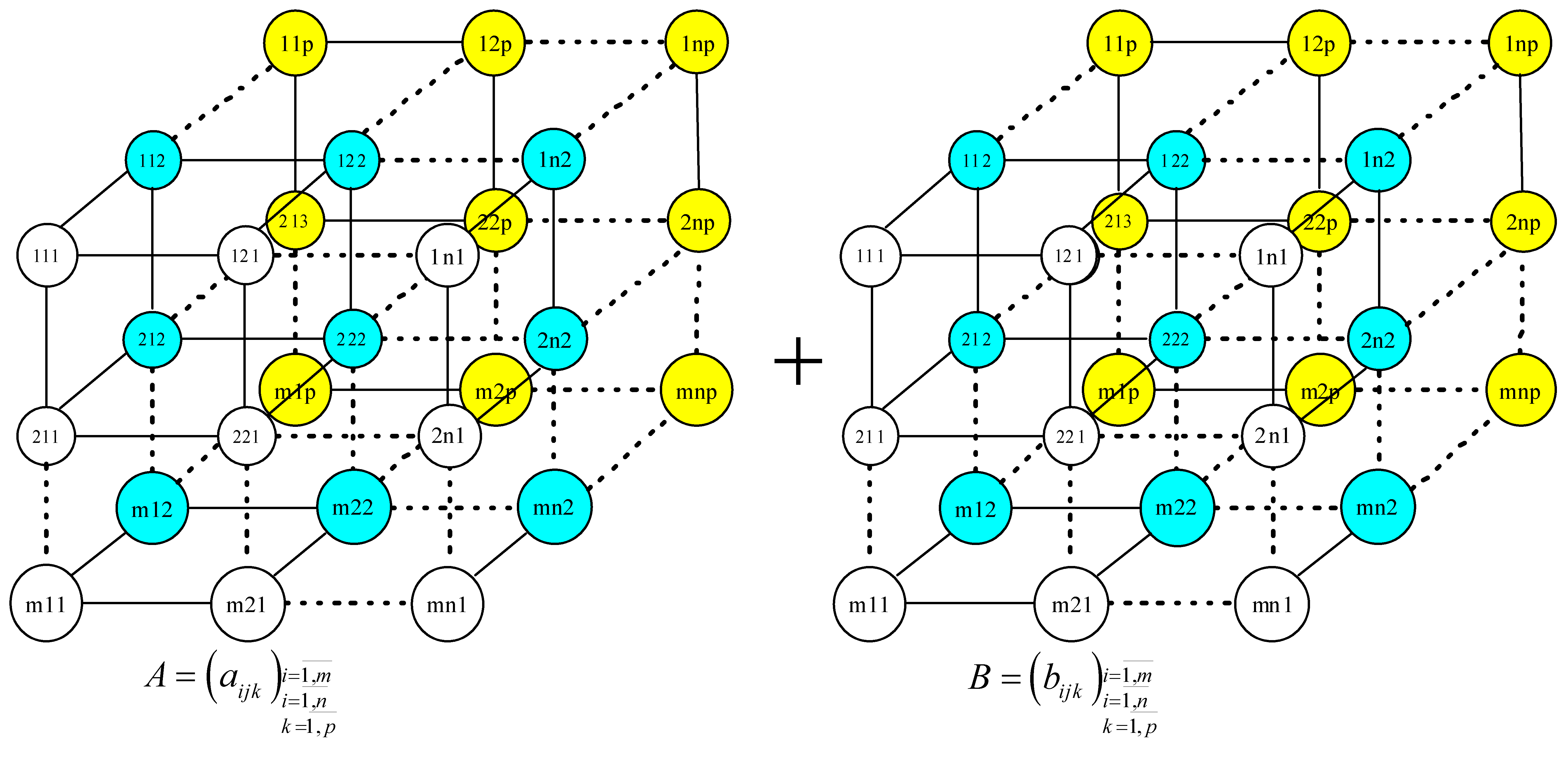 Figure 1
Peer Reviews
No public reviews on file for this paper yet. If you reviewed it on a platform where reviews are public (OpenReview, ICLR, NeurIPS, ICML), you can paste yours below so the community can read it here.
Videos
No videos yet. Explain this paper in a talk, walkthrough, or lecture? Add one.
The general
linear group of degree for 3D matrices
Orgest ZAKA
Department of Mathematics, Faculty of Technical Science, University of Vlora ”Ismail QEMAL”, Vlora, Albania
(Date: December 10, 2018)
Abstract.
In this article we give the meaning of the determinant for 3D matrices with elements from a field F, and the meaning of 3D inverse matrix. Based on my previous work titled ’3D Matrix Rings’, we want to constructed the ’general linear group of degree for 3D matrices, which i mark with ’ for 3D-matrices, analog to ’general linear group of degree ’ known.
Key words and phrases:
3D matrix, determinant for 3D matrices, inverse of 3D matrix, general linear group for 3D matrices
2000 Mathematics Subject Classification:
Primary15XX, 20XX, 47Dxx; Secondary 15A09, 15A15, 20H20,
1. Introduction, 3D matrix
This paper comes as a continuation of the ideas that arise based on my previous work, of the 3D matrix ring with element from an whatever field (see [1]). At this point we are making a brief summary associated with 3D matrices and the 3D matrix presented in [1]. Our objective is to constructed the ’general linear group of degree for 3D matrices, which i mark with ’ for 3D-matrices, analog to ’general linear group of degree ’ known. For this we need new notions, which we will give in the following points.
Definition 1**.**
[1]** 3-dimensional matrix will call, a matrix which has: m-horizontal layers (analogous to m-rows), n-vertical page (analogue with n-columns in the usual matrices) and p-vertical layers (p-1 of which are hidden).
The set of these matrixes the write how:
[TABLE]
1.1. ADDITION OF 3D MATRIX
Definition 2**.**
[1]** The addition of two matrices we will call the matrix:
[TABLE]
The appearance of the addition of 3D matrices will be as in Figure 1, where matrices and have the following appearance,
[TABLE]
Definition 3**.**
[1*]*The 3-D, Zero matrix we will called the matrix that has all its elements zero.
[TABLE]
Definition 4**.**
[1]** The opposite matric of an matrice
[TABLE]
will, called matrix
[TABLE]
Where is a opposite element of element so
[TABLE]
and is field, which satisfies the condition
[TABLE]
Theorem 1**.**
[1]* is abelian grup.*
1.2. THE MULTIPLICATION OF MATRICES
In the same way, as have the meaning of a 3D matrix multiplication to [1], we give the definition of 3D matrix multiplication for .
Definition 5**.**
[1]** The multiplication of two matrices we will call the matrix calculated as follows:
Matrices will normally have the appearance:
[TABLE]
If we write more briefly
[TABLE]
where and are the matrices Then
[TABLE]
where action is the usual multiplication of matrices.
2. Multi-Scalars and Multiplication of 3D matrices with multi-scalar
In this section we will introduce the concept of ’multi-scalar’, and we will give a clear idea of the multiplication of 3D matrices with multi-scalar.
Definition 6**.**
Multi-scalar will call one 3D matrix.
Remark 1**.**
A multi-scalar \ a_{1\times 1\times p}=\left[\begin{array}[]{c}\left(\alpha_{11p}\right)\\ \vdots\\ \left(\alpha_{112}\right)\\ \left(\alpha_{111}\right)\end{array}\right], we will call ”absolutely” different from zero only if For the ”absolutely zero” multi-scalar we will use the note wich is \ \widetilde{{}^{a}0_{\mathbf{F}}}=\left[\begin{array}[]{c}\left(0_{\mathbf{F},p}\right)\\ \vdots\\ \left(0_{\mathbf{F},2}\right)\\ \left(0_{\mathbf{F,}1}\right)\end{array}\right].
Let’s have a **multi-scalar **
[TABLE]
and 3D matrix
[TABLE]
Definition 7**.**
Multiplication of 3D-matrix with multi-scalar will we call the 3D matrix calculated as follows:
[TABLE]
[TABLE]
So multiplication of the 3D matrix with a multi-scalar is a function
[TABLE]
Example 1**.**
Let’s have a multi-scalar
[TABLE]
**
and 3D matrix
[TABLE]
Matrix obtained by multiplying the 3D matrix with multi-scalar it is the matrix:
[TABLE]
2.1. DETERMINANTS OF 3D-MATRICES
Regarding the determinant we will only talk about form matrices ie for matrices that vertical layers have square matrices.
Definition 8**.**
Determinant of the matrix we will call the multi-scalar
[TABLE]
where
[TABLE]
[TABLE]
[TABLE]
Referring to the multi-scalar note ’absolutely different from zero’, we say that for a 3D matrix
[TABLE]
Example 2**.**
Determinant of the matrix of example 1, is multi-scalar:
[TABLE]
Definition 9**.**
Inverted* of the multi-scalar a_{1\times 1\times p}=\left[\begin{array}[]{c}\left(\alpha_{11p}\right)\\ \vdots\\ \left(\alpha_{112}\right)\\ \left(\alpha_{111}\right)\end{array}\right], will called the multi-scalar:*
[TABLE]
Example 3**.**
Inverted* of the multi-scalar a_{1\times 1\times 3}=\left[\begin{array}[]{c}\left(2\right)\\ \left(5\right)\\ \left(3\right)\end{array}\right], is the multi-scalar:*
[TABLE]
3. THE MULTIPLICATION GROUP OF 3D MATRICES
Referring to [1], we have a 3D Matrix Ring, and in that paper we have shown the possibility of unitary ring. The rest of the assertions that lead us from unitary ring to a Skew-Field are summing up in this
Theorem 2**.**
The structure is a unitary semi-group.
Proof.
We show first that:
[TABLE]
truly,
\left[\mathbf{A}\odot\mathbf{B}\right]\odot\mathbf{C=}\left(\left[\begin{array}[]{c}\mathbf{A}_{p}\\ \vdots\\ \mathbf{A}_{2}\\ \mathbf{A}_{1}\end{array}\right]\odot\left[\begin{array}[]{c}\mathbf{B}_{p}\\ \vdots\\ \mathbf{B}_{2}\\ \mathbf{B}_{1}\end{array}\right]\right)\odot\left[\begin{array}[]{c}\mathbf{C}_{p}\\ \vdots\\ \mathbf{C}_{2}\\ \mathbf{C}_{1}\end{array}\right]=\left[\begin{array}[]{c}\mathbf{A}_{p}\cdot\mathbf{B}_{p}\\ \vdots\\ \mathbf{A}_{2}\cdot\mathbf{B}_{2}\\ \mathbf{A}_{1}\cdot\mathbf{B}_{1}\end{array}\right]\odot\left[\begin{array}[]{c}\mathbf{C}_{p}\\ \vdots\\ \mathbf{C}_{2}\\ \mathbf{C}_{1}\end{array}\right]=\left[\begin{array}[]{c}\left(\mathbf{A}_{p}\cdot\mathbf{B}_{p}\right)\cdot\mathbf{C}_{p}\\ \vdots\\ \left(\mathbf{A}_{2}\cdot\mathbf{B}_{2}\right)\cdot\mathbf{C}_{2}\\ \left(\mathbf{A}_{1}\cdot\mathbf{B}_{1}\right)\cdot\mathbf{C}_{1}\end{array}\right]=\left[\begin{array}[]{c}\mathbf{A}_{p}\cdot\left(\mathbf{B}_{p}\cdot\mathbf{C}_{p}\right)\\ \vdots\\ \mathbf{A}_{2}\cdot\left(\mathbf{B}_{2}\cdot\mathbf{C}_{2}\right)\\ \mathbf{A}_{1}\cdot\left(\mathbf{B}_{1}\cdot\mathbf{C}_{1}\right)\end{array}\right]=\left[\begin{array}[]{c}\mathbf{A}_{p}\\ \vdots\\ \mathbf{A}_{2}\\ \mathbf{A}_{1}\end{array}\right]\odot\left[\begin{array}[]{c}\mathbf{B}_{p}\cdot\mathbf{C}_{p}\\ \vdots\\ \mathbf{B}_{2}\cdot\mathbf{C}_{2}\\ \mathbf{B}_{1}\cdot\mathbf{C}_{1}\end{array}\right]
=\left[\begin{array}[]{c}\mathbf{A}_{p}\\ \vdots\\ \mathbf{A}_{2}\\ \mathbf{A}_{1}\end{array}\right]\odot\left(\left[\begin{array}[]{c}\mathbf{B}_{p}\\ \vdots\\ \mathbf{B}_{2}\\ \mathbf{B}_{1}\end{array}\right]\odot\left[\begin{array}[]{c}\mathbf{C}_{p}\\ \vdots\\ \mathbf{C}_{2}\\ \mathbf{C}_{1}\end{array}\right]\right)=\mathbf{A}\odot\left[\mathbf{B}\odot\mathbf{C}\right].
From the definition of multiplication to 3D matrices it is clear that:
[TABLE]
is unit element of , related to multiplication. ∎
Remark 2**.**
We mark with 3D matrix with determinants ’absolutely different from zero’, ie , (So vertical layers of 3D matrix, are 2D non-singular matrices.).
Proposition 1**.**
The set of is closed regarding multiplication.
Well!
[TABLE]
Proof.
Let’s have
[TABLE]
[TABLE]
So all 2D matrices and , , are non-singular matrices. A well-known result in Linear algebra, but also mentioned in [2], in pp.230, and [5] in pp317, which is
[TABLE]
We use this result as the vertical layers of 3D matrix are 2D-matries, and so we have that:
\det\left(\mathbf{A}\odot\mathbf{B}\right)\mathbf{=}\det\left(\left[\begin{array}[]{c}\mathbf{A}_{n\times n,p}\\ \vdots\\ \mathbf{A}_{n\times n,2}\\ \mathbf{A}_{n\times n,1}\end{array}\right]\odot\left[\begin{array}[]{c}\mathbf{B}_{n\times n,p}\\ \vdots\\ \mathbf{B}_{n\times n,2}\\ \mathbf{B}_{n\times n,1}\end{array}\right]\right)=\det\left[\begin{array}[]{c}\mathbf{A}_{n\times n,p}\cdot\mathbf{B}_{n\times n,p}\\ \vdots\\ \mathbf{A}_{n\times n,2}\cdot\mathbf{B}_{n\times n,2}\\ \mathbf{A}_{n\times n,1}\cdot\mathbf{B}_{n\times n,1}\end{array}\right]=\left[\begin{array}[]{c}\det\left(\mathbf{A}_{n\times n,p}\cdot\mathbf{B}_{n\times n,p}\right)\\ \vdots\\ \det\left(\mathbf{A}_{n\times n,2}\cdot\mathbf{B}_{n\times n,2}\right)\\ \det\left(\mathbf{A}_{n\times n,1}\cdot\mathbf{B}_{n\times n,1}\right)\end{array}\right]\overset{[2]}{=}\left[\begin{array}[]{c}\det\left(\mathbf{A}_{n\times n,p}\right)\cdot\det\left(\mathbf{B}_{n\times n,p}\right)\\ \vdots\\ \det\left(\mathbf{A}_{n\times n,2}\right)\cdot\det\left(\mathbf{B}_{n\times n,2}\right)\\ \det\left(\mathbf{A}_{n\times n,1}\right)\cdot\det\left(\mathbf{B}_{n\times n,1}\right)\end{array}\right]=
=\left[\begin{array}[]{c}\det\left(\mathbf{A}_{n\times n,p}\right)\\ \vdots\\ \det\left(\mathbf{A}_{n\times n,2}\right)\\ \det\left(\mathbf{A}_{n\times n,1}\right)\end{array}\right]\odot\left[\begin{array}[]{c}\det\left(\mathbf{B}_{n\times n,p}\right)\\ \vdots\\ \det\left(\mathbf{B}_{n\times n,2}\right)\\ \det\left(\mathbf{B}_{n\times n,1}\right)\end{array}\right]=\det\left(\mathbf{A}\right)\odot\det\left(\mathbf{B}\right)\neq\widetilde{{}^{a}0_{\mathbf{F}}}\Rightarrow
∎
Theorem 3**.**
The structure is a Group.
Set of 3D matrix with determinants ’absolutely different from zero’, ie , associated with ordinary multiplication is a Group.
Proof.
1. It is clear that the set is sub-set of , and in the foregoing assertion we showed that the multiplication is closed in this set, so we have that is subsemigroup of semigroup see [3], [4].
2. It is clear that the , after
[TABLE]
3. Show that: such that , such that
[TABLE]
Let’s have
[TABLE]
So we have, that: (as a 2D matrix), such that From this, we can write that, the inverse of 3D matrix \mathbf{A}_{n\times n\times p}=\left[\begin{array}[]{c}\mathbf{A}_{n\times n,p}\\ \vdots\\ \mathbf{A}_{n\times n,2}\\ \mathbf{A}_{n\times n,1}\end{array}\right] is a 3D matrix \mathbf{A}_{n\times n\times p}^{-1}=\left[\begin{array}[]{c}\mathbf{A}_{n\times n,p}^{-1}\\ \vdots\\ \mathbf{A}_{n\times n,2}^{-1}\\ \mathbf{A}_{n\times n,1}^{-1}\end{array}\right], because the
[TABLE]
.
Where
[TABLE]
∎
4. FINDING OF 3D-INVERSE MATRIX
In this section, we provide a way to find the 3D reverse matrix of a 3D matrix.
Proposition 2**.**
3D inverse matrix of the matrix we called the 3D-matrix which has the following form:
[TABLE]
where is the adjugate matrix of (exactly page by page)and has the form:
[TABLE]
I give a clearer view of matrices , as follows:
[TABLE]
Proof.
Verified with ease that:
[TABLE]
Where
[TABLE]
Let
[TABLE]
and
[TABLE]
to prove that it is true:
[TABLE]
really:
[TABLE]
[TABLE]
[TABLE]
[TABLE]
[TABLE]
[TABLE]
∎
Example 4**.**
Let’s have A_{3\times 3\times 2}=\left[\begin{array}[]{c}\left(\begin{array}[]{ccc}3&1&5\\ 0&2&1\\ 1&7&4\end{array}\right)\\ \left(\begin{array}[]{ccc}1&2&4\\ 8&1&1\\ 3&1&0\end{array}\right)\end{array}\right]\in\mathcal{M}_{3\times 3\times 2}^{\ast}(\mathbb{R}). Find its inverse matrix?
Solution 1**.**
The inverse matrix has form:
[TABLE]
we see that
[TABLE]
And
[TABLE]
Then,
[TABLE]
[TABLE]
The reference list from the paper itself. Each links out to its DOI / PubMed record.
- 1[1] Zaka, O. (2017) 3D Matrix Ring with a “Common” Multiplication. Open Access Library Journal , 4:e 3593. https://doi.org/10.4236/oalib.1103593
- 2[2] Strang, Gilbert (July 19, 2005), Linear Algebra and Its Applications (4th ed.), Brooks Cole, ISBN 978-0-03-010567-8.
- 3[3] Lang, Serge (2002), Algebra, Graduate Texts in Mathematics, 211 (Revised third ed.), New York: Springer-Verlag, ISBN 978-0-387-95385-4, MR 1878556
- 4[4] Grillet, Pierre A. (1995), Semigroups: An Introduction to the Structure Theory, Marcel Dekker, ISBN 978-0-8247-9662-4, Zbl 0830.20079
- 5[5] Sheldon Axler (2015). Linear Algebra Done Right, Third edition. Springer International Publishing. ISBN 978-3-319-11079-0. DOI 10.1007/978-3-319-11080-6