Complex ER bridges in EPRB decays
Oscar Brauer, Miguel Socolovsky

TL;DR
This paper proposes that a great circle in the 7-sphere functions as an Einstein-Rosen bridge within the context of Einstein-Podolsky-Rosen-Bohm decays, offering a novel geometric perspective.
Contribution
It introduces a new geometric interpretation of ER bridges using the 7-sphere in the framework of EPRB decays, connecting topology with quantum entanglement.
Findings
Identifies the 7-sphere's great circle as an ER bridge analog
Provides a geometric model linking topology and quantum entanglement
Suggests a new perspective on EPRB decay mechanisms
Abstract
We argue that a great circle in the 7-sphere plays the role of an Einstein-Rosen bridge in Einstein-Podolsky-Rosen-Bohm decays.
Click any figure to enlarge with its caption.
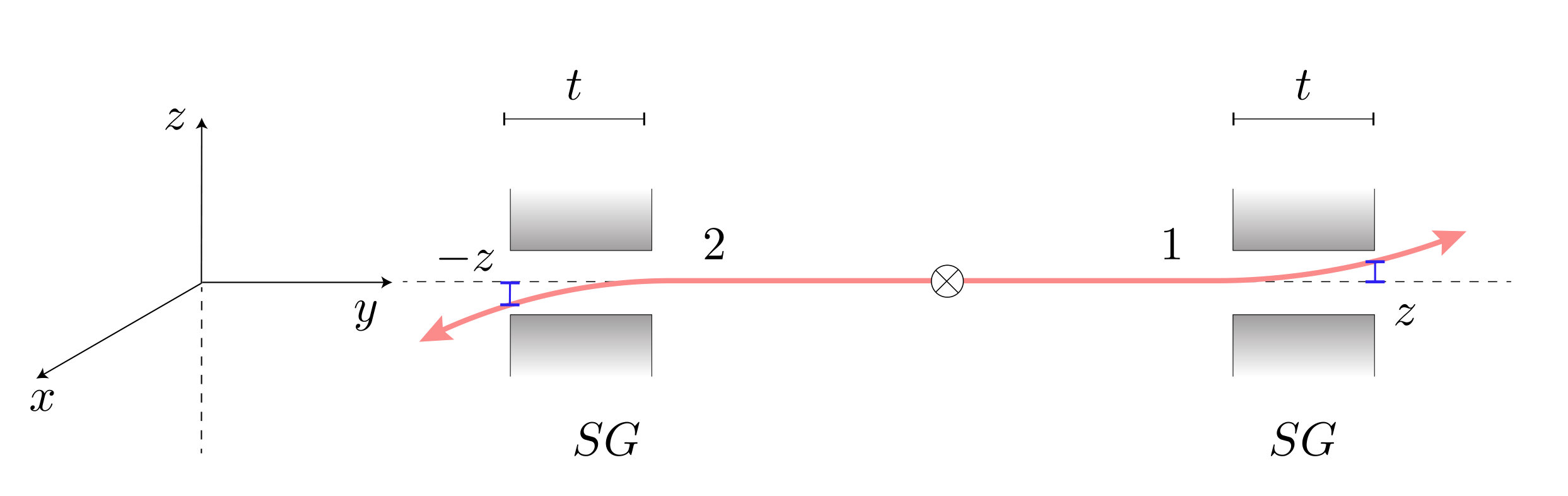 Figure 1
Peer Reviews
No public reviews on file for this paper yet. If you reviewed it on a platform where reviews are public (OpenReview, ICLR, NeurIPS, ICML), you can paste yours below so the community can read it here.
Videos
No videos yet. Explain this paper in a talk, walkthrough, or lecture? Add one.
Taxonomy
TopicsQuantum Mechanics and Applications · Biofield Effects and Biophysics · Quantum chaos and dynamical systems
Complex ER bridges in EPRB decays
Oscar Brauer and Miguel Socolovsky
Instituto de Ciencias Nucleares
Universidad Nacional Autónoma de México
e-mails: [email protected], [email protected]
Abstract
We argue that a great circle in the 7-sphere plays the role of an Einstein-Rosen bridge in Einstein-Podolsky-Rosen-Bohm decays.
Keywords: Entanglement, ER/EPR, Complex manifolds
1 Introduction
In recent years, it has been pointed out [1] that even in simple quantum mechanical entangled systems like Einstein-Podolsky-Rosen-Bohm (EPRB) [2,3] decaying processes producing pairs of spin particles or photons, an Einstein-Rosen bridge or wormhole between the decay products exists. However, except for qualitative arguments in favour of this idea, no explicite example for this fact exists in the literature.
In this note, for the case of an entangled pair of i) two spin massive particles flying (non relativistically) appart from each other, product of the decay of an initial particle in a singlet spin state, and ii) two photons e.g. in positronium decay (odd parity) [4] or in radiative cascade of calcium (even parity) [5], we show that the geometrical object which plays the role of a bridge between the decaying particles is a great circle of the unit 7-sphere (), geodesic [6] of the Fubini-Study metric [7] in the 3-dimensional complex projective space (). This great circle, however, does not live in ordinary space or spacetime, but in the complex space , which is the Hilbert space of the system.
2 Non relativistic EPRB decay
The initial normalized state of two massive spin particles with magnetic moment flying apart from each other in the y-direction, decay products of an initial particle with total zero spin, is the entangled pure state
[TABLE]
where we have chosen to make the spin measurements in the z-direction with two Stern-Gerlach (S.G.) apparata with exterior magnetic field , . (See Fig. 1, where are ordinary space coordinates, and is the time interval that each of the particles spends in the corresponding S.G.)
The total Hilbert space of the system is and clearly . After time the state vector becomes [3]
[TABLE]
with and since where and are the vertical deviation of the particles in the measurement process. When varies, so do and , and therefore . These changes reflect themselves in which moves along a great circle in . It can be shown that if is the average vertical ( direction) velocity of the decaying particles, the period for running through the circle is . In fact, , with implies which leads to the above using the initial condition . So plays the role of a bridge or “wormhole” between the two non interacting (and therefore not violating causality [8]) correlated (entangled) particles 1 and 2.
Since is equivalent to with , the “real” quantum state of the particles is represented by the great circle in
[TABLE]
which is nothing but a point in , base space of the -bundle
[TABLE]
is the space of complex lines through the origin in ; each complex line intersects in a unit great circle (3) which is a geodesic [6] of the Fubini-Study metric [7] of which, in terms of the affine coordinates , , in is given by
[TABLE]
where . labels the charts on ( in chart ) with
[TABLE]
It is easy to verify that any of the states in is entangled i.e. it has associated with it a non vanishing entanglement entropy (E.E.). In fact, the density operator of the pure state is
[TABLE]
with reduced density operators
[TABLE]
which in matrix form are
[TABLE]
Therefore, the entanglement entropy of is
[TABLE]
3 decays
The previous analysis repeats almost unmodified for two photon decays in the cases:
i) negative parity, e.g. , with
[TABLE]
and
ii) positive parity, e.g. ,
[TABLE]
In both cases,
[TABLE]
Again, the bridge between the escaping photons is a great circle in with the relevant -bundle.
4 Conclusions
We show that the unique candidate for playing the role of an Einstein-Rosen bridge in Einstein-Podolsky-Rosen-Bohm two particle decays, is a great unit circle in the 7-sphere. Though this does not live in ordinary spacetime but lies in the complex Hilbert space of the system (), it has an explicite relation with the spacetime variables of the measuring S.G. apparata. The period for running around the circle is , for , , and ; in this sense, if , is a traversable bridge, in contradistinction with the usual wormholes in the spacetime of black holes in general relativity [9].
Acknowledgement
We thank Prof. Ildefonso Castro for clarifying us about geodesics in complex projective 3-space.
References
-
J. Maldacena and L. Susskind, Cool horizons for entangled black holes, Fortschr. Phys. 61, 1-31 (2013).
-
A. Einstein, B. Podolsky, and N. Rosen, Can Quantum-Mechanical Description of Physical Reality Be Considered Complete?, Phys. Rev. 47, 777-780 (1935).
-
D. Bohm, Quantum Theory, Prentice-Hall, N.Y. (1951).
-
A. Peres, Quantum Theory, Concepts and Methods, Kluwer Academic Publishers, The Netherlands (1993).
-
A. Aspect, P. Grangier, and G. Roger, Experimental Tests of Realistic Local Theories via Bell’s Theorem, Phys. Rev. Lett. 47, 460-463 (1981).
-
I. Castro and L. Vrancken, Minimal Lagrangian submanifolds in and the sinh-Gordon equation, Result. Math. 40, 130-143 (2001).
-
T. Eguchi, P.B. Gilkey, and A.J. Hanson, Gravitation, Gauge Theories and Differential Geometry, Phys. Rep. 66, No. 6, 213-393 (1980).
-
M. Socolovsky, EPR, Bell, GHZ, and Hardy theorems, and quantum mechanics, Rev. Cub. Fís.** 22**, No. 2, 104-118 (2005).
-
E. Witten, Light Rays, Singularities, and All That, arXiv: hep-th/1901.03928.