High Spin-Wave Propagation Length Consistent with Low Damping in a Metallic Ferromagnet
Luis Flacke, Lukas Liensberger, Matthias Althammer, Hans Huebl,, Stephan Gepr\"ags, Katrin Schultheiss, Aleksandr Buzdakov, Tobias Hula,, Helmut Schultheiss, Eric R. J. Edwards, Hans T. Nembach, Justin M. Shaw,, Rudolf Gross, Mathias Weiler

TL;DR
This study demonstrates ultra-low magnetic damping and long spin-wave propagation lengths in Co25Fe75 heterostructures at room temperature, highlighting their potential for magnonic applications.
Contribution
It provides the first comprehensive measurement of intrinsic damping and spin-wave propagation lengths in Co25Fe75 at room temperature, confirming their suitability for low-loss magnonic devices.
Findings
Intrinsic damping as low as 3.18×10⁻⁴ in 26 nm Co25Fe75
Spin-wave propagation length of approximately 21 μm at room temperature
Excellent agreement between damping measurements and spin-wave propagation lengths
Abstract
We report ultra-low intrinsic magnetic damping in CoFe heterostructures, reaching the low regime at room temperature. By using a broadband ferromagnetic resonance technique, we extracted the dynamic magnetic properties of several CoFe-based heterostructures with varying ferromagnetic layer thickness. By estimating the eddy current contribution to damping, measuring radiative damping and spin pumping effects, we found the intrinsic damping of a 26\,nm thick sample to be $$\alpha_{\mathrm{0}} \lesssim 3.18\times10^{-4}$. Furthermore, using Brillouin light scattering microscopy we measured spin-wave propagation lengths of up to $(21\pm1)\,\mathrm{\mu m}$ in a 26 nm thick Co$_{\text{25}}$Fe$_{\text{75}}$ heterostructure at room temperature, which is in excellent agreement with the measured damping.
Click any figure to enlarge with its caption.
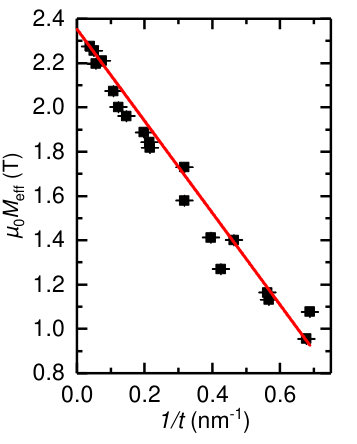 Figure 1
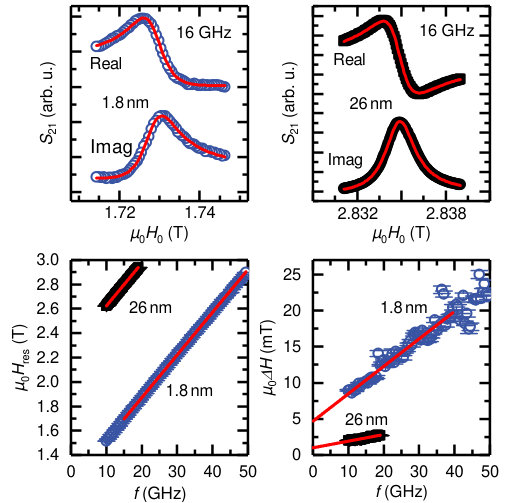 Figure 2
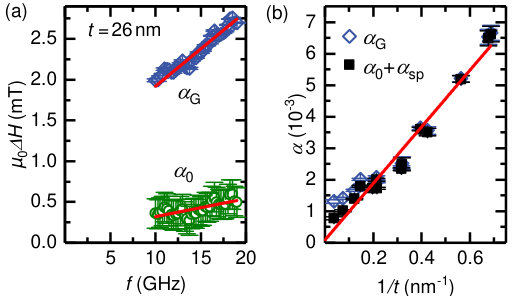 Figure 3
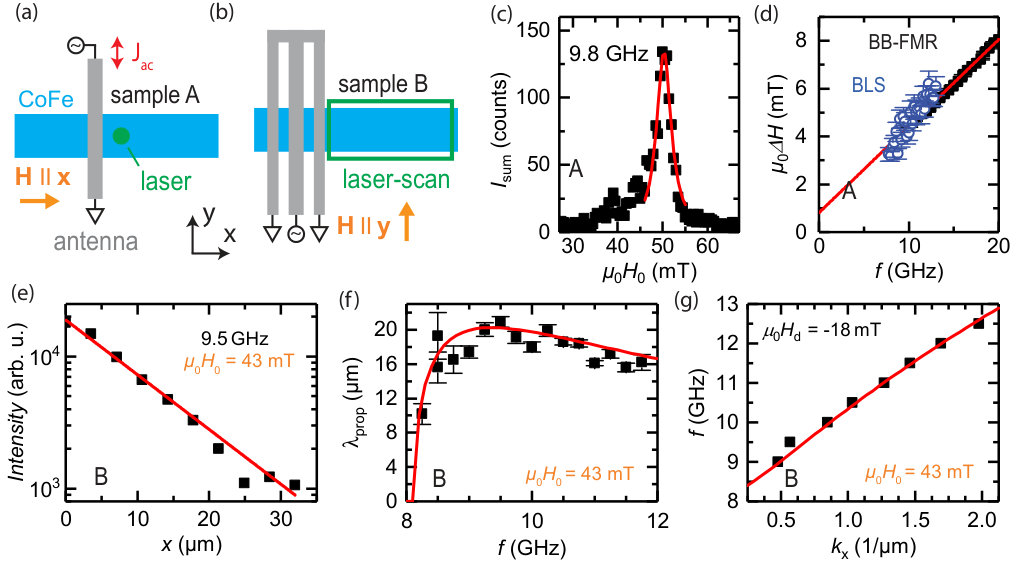 Figure 4
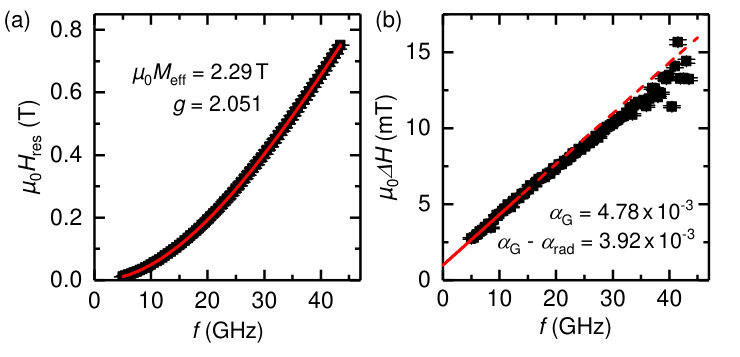 Figure 5
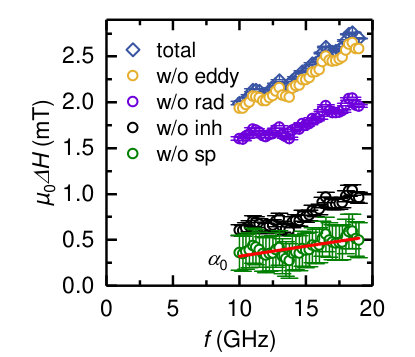 Figure 6
Peer Reviews
No public reviews on file for this paper yet. If you reviewed it on a platform where reviews are public (OpenReview, ICLR, NeurIPS, ICML), you can paste yours below so the community can read it here.
Videos
No videos yet. Explain this paper in a talk, walkthrough, or lecture? Add one.
High Spin-Wave Propagation Length Consistent with Low Damping in a Metallic Ferromagnet
Luis Flacke
Walther-Meißner Institute, Bayerische Akademie der Wissenschaften, 85748 Garching, Germany
Physics Department, Technical University of Munich, 85748 Garching, Germany
Lukas Liensberger
Walther-Meißner Institute, Bayerische Akademie der Wissenschaften, 85748 Garching, Germany
Physics Department, Technical University of Munich, 85748 Garching, Germany
Matthias Althammer
Walther-Meißner Institute, Bayerische Akademie der Wissenschaften, 85748 Garching, Germany
Physics Department, Technical University of Munich, 85748 Garching, Germany
Hans Huebl
Walther-Meißner Institute, Bayerische Akademie der Wissenschaften, 85748 Garching, Germany
Physics Department, Technical University of Munich, 85748 Garching, Germany
Nanosystems Initiative Munich, 80799 Munich, Germany
Munich Center for Quantum Science and Technology (MCQST), 80799 Munich, Germany
Stephan Geprägs
Walther-Meißner Institute, Bayerische Akademie der Wissenschaften, 85748 Garching, Germany
Katrin Schultheiss
Helmholtz-Zentrum Dresden-Rossendorf, 01328 Dresden, Germany
Aleksandr Buzdakov
Helmholtz-Zentrum Dresden-Rossendorf, 01328 Dresden, Germany
Tobias Hula
Helmholtz-Zentrum Dresden-Rossendorf, 01328 Dresden, Germany
Helmut Schultheiss
Helmholtz-Zentrum Dresden-Rossendorf, 01328 Dresden, Germany
Eric R. J. Edwards
Quantum Electromagnetics Division, National Institute of Standards and Technology, Boulder, CO 80305, USA
Hans T. Nembach
Quantum Electromagnetics Division, National Institute of Standards and Technology, Boulder, CO 80305, USA
Justin M. Shaw
Quantum Electromagnetics Division, National Institute of Standards and Technology, Boulder, CO 80305, USA
Rudolf Gross
Walther-Meißner Institute, Bayerische Akademie der Wissenschaften, 85748 Garching, Germany
Physics Department, Technical University of Munich, 85748 Garching, Germany
Nanosystems Initiative Munich, 80799 Munich, Germany
Munich Center for Quantum Science and Technology (MCQST), 80799 Munich, Germany
Mathias Weiler
Walther-Meißner Institute, Bayerische Akademie der Wissenschaften, 85748 Garching, Germany
Physics Department, Technical University of Munich, 85748 Garching, Germany
Abstract
We report ultra-low intrinsic magnetic damping in CoFe heterostructures, reaching the low regime at room temperature. By using a broadband ferromagnetic resonance technique in out-of-plane geometry, we extracted the dynamic magnetic properties of several CoFe-based heterostructures with varying ferromagnetic layer thickness. By measuring radiative damping and spin pumping effects, we found the intrinsic damping of a 26 nm thick sample to be . Furthermore, using Brillouin light scattering microscopy we measured spin-wave propagation lengths of up to in a 26 nm thick CoFe heterostructure at room temperature, which is in excellent agreement with the measured damping.
Itinerant ferromagnets (FM) are advantageous for spintronic and magnonic devices. They benefit from, e.g., large magnetoresistive effects and current-induced spin-orbit torques Gambardella and Miron (2011). In many magneto-resistive technologies (e.g., anisotropic magnetoresistance, giant magnetoresistance, tunnel magnetoresistance) electronic conductivity is indispensable. Moreover, due to high saturation magnetization in metallic FMs, spin-wave (SW) group velocities are in general significantly higher than in insulating ferrimagnets Wessels et al. (2016); Talalaevskij et al. (2017); Körner et al. (2017); Collet et al. (2017). High saturation magnetizations in general ease detection. Nevertheless, itinerant FMs typically have considerable magnetic damping Maksymov and Kostylev (2015); Twisselmann and McMichael (2003). This is unfavorable for many applications. For example, low damping is crucial for oscillators based on spin transfer torques and spin orbit torques as well as for achieving large spin-wave propagation lengths (SWPL) Demidov et al. (2014); Kruglyak, Demokritov, and Grundler (2010); Chumak et al. (2015). The need for thin film materials with low magnetic damping has triggered the interest in the insulating ferrimagnet yttrium-iron garnet (YFeO, YIG)Hauser et al. (2016); Evelt et al. (2016); Jungfleisch et al. (2015). Although for YIG, very small total (Gilbert) damping parameters in the order of , and large SWPLs of a few tens of micrometers (up to 25 m) in thin films ( 20 nm) have been reported Houchen Chang et al. (2014); Collet et al. (2017); Jungfleisch et al. (2015), its insulating properties and requirement for crystalline growth are challenges for large scale magnonic applications.
Schoen et al. recently observed ultra-low intrinsic magnetic damping in CoFe (CoFe) metallic thin films () Schoen et al. (2015), and Körner et al. reported PLs of in CoFe using time resolved scanning magneto-optical Kerr microscopy Körner et al. (2017). This motivated our study on sputter-deposited CoFe-based thin film heterostructures. We use broadband ferromagnetic resonance (BB-FMR) spectroscopy Kalarickal et al. (2006) in out-of-plane (OOP) geometry and Brillouin light scattering (BLS) microscopy Sebastian et al. (2015) and find intrinsic damping parameters in the lower regime as well as SWPLs of more than m. The damping is therefore comparable to YIG/heavy metal (HM) heterostructures Sun et al. (2013) and the SWPL is comparable to that of state-of-the-art YIG thin films Collet et al. (2017); Jungfleisch et al. (2015). Thin film CoFe is a promising candidate for all-metal magnonic devices, as it combines low magnetic damping with good electrical conductivity and large saturation magnetization, while enabling easy fabrication by room-temperature processing/deposition, no required annealing, polycrystalline structure, and scalability to the nanometer regime.
For BB-FMR, Ta(3 nm)/Al(3 nm)/CoFe()/ Al(3 nm)/Ta(3 nm) heterostructures with different thickness of the CoFe layer were sputter deposited on a thermally oxidized Si (100) substrate at an Ar pressure of bar at room temperature. No subsequent annealing process was performed. The CoFe layer thickness was varied between 1.4 nm 26 nm as determined by X-ray reflectometry.
The OOP BB-FMR measurements were performed at room temperature with a vector network analyzer (VNA). This geometry was chosen to determine the intrinsic magnetic damping without further damping contributions due to magnon-magnon scattering Hillebrands and Ounadjela (2003). The samples were placed directly on a coplanar waveguide (CPW), with a wide center conductor. For the measurements, the VNA frequency was kept constant and the microwave transmission parameter was recorded as a function of applied magnetic field for a range of frequencies at a VNA output power of 0 dBm. A representative set of data as measured of the real and imaginary part of at 16 GHz for samples with and is shown in Fig. 1 (a) and (b).
The magnetic response of the thin film FM magnetized out-of-plane is given by the susceptibility which is obtained by solving the Landau-Lifshitz-Gilbert (LLG) equation Nembach et al. (2011); Schoen et al. (2015):
[TABLE]
Here, is the saturation magnetization, is the resonance field, with being the gyromagnetic ratio and is the full width at half maximum (FWHM) linewidth of the resonance. The data in Fig 1 (a) and (b) is fitted to Berger et al. (2018)
[TABLE]
where is the background transmission through the CPW without magnetic resonance peak. It is determined from the fits as a complex linear background to the data . The factor is a complex-valued scaling parameter.
In the OOP geometry, the resonance condition for thin films is given by Kittel (1948)
[TABLE]
where is the effective magnetization, with the uniaxial out-of-plane anisotropy field . In Fig. 1 (c), we plot the determined vs. the frequency . From the fit to Eq. (3) (red solid lines in Fig. 1 (c)), we obtain and of the specific sample.
The FWHM linewidth vs. frequency data shown in Fig. 1 (d) is fitted to
[TABLE]
Here, is the inhomogeneous linewidth broadening and is the phenomenological Gilbert damping parameter Woltersdorf et al. (2013); McMichael, Twisselmann, and Kunz (2003). indicates the presence of long-range magnetic inhomogeneities, which become more relevant for thinner films, but do not contribute to our .
Several contributions to the measured total damping () were extracted from our data. In addition to the intrinsic damping of the magnetic material itself (), spin pumping () contributes significantly Tserkovnyak, Brataas, and Bauer (2002); Haertinger et al. (2015); Brataas et al. (2017) to the total damping in our thinner heterostructures due to the adjacent HM (Ta) layers. Furthermore, we consider additional damping contributions from eddy currents () and radiative damping ()Schoen et al. (2015); Berger et al. (2018). Due to these contributions, the total damping () depends on the FM thickness. We calculated damping due to eddy currents and measured radiative damping contributions to the total damping. The eddy current contribution is given bySchoen et al. (2015) . Here, T (see SI) and is the estimated weighted resistivity value of the CoFe film derived from the resistivities of iron and cobalt thin films with thicknesses of around 20 nmRaeburn and Aldridge (1978); De Vries (1988). With these values, we find an almost negligible eddy current contribution to the total damping. A quantitative determination analogous to Ref. 21 of the radiative damping is done by analyzing the magnitude of the measured inductance of all samples. The quantification of this contribution is important for BB-FMR, because it represents a damping by inductive power dissipation into the CPW and, hence, is not a property of the sample itself but depends on the setup. In possible applications like, e.g., magnonic waveguides or spin-Hall nano-oscillators, this contribution vanishes and the damping lowers by . With Eq. (2) above and Eq. (9) from Ref. 21, one obtains:
[TABLE]
Here, is the CPW impedance. It has been shown, that where and , due to the effect of inverse spin-orbit torques Berger et al. (2018). We extract from the FMR measurements, and the dipolar inductance from a fit of vs. for each sample. The radiative damping contribution is then given asSchoen et al. (2015)
[TABLE]
This analysis allows us to determine independently of geometrical parameters of the samples or CPWs and is used to quantitatively extract the dipolar inductance without any calibration of the microwave circuit. For the thickest sample we obtain , which is comparable to previously obtained values Schoen et al. (2015, 2016). The damping including the spin pumping contribution is given by
[TABLE]
where is the effective spin mixing conductanceSchoen et al. (2016). We substract and from the measured total damping (see Fig. 2 (a) and (b)) and plot the remaining damping as a function of 1/ in Fig. 2 (b) together with the total damping . From a linear fit (Eq. (7)) to , we obtain and . Herefore, we use as above and . The fitted is in agreement with literature valuesSchoen et al. (2015). The -intercept indicating the extrapolated intrinsic damping yields hence, the intrinsic damping is below the sensitivity of our approach. For the thickest sample shown in Fig. 2 (a), we obtain (see SI for details). Within the errors, this value lies close to the extrapolated value and is the lowest intrinsic damping for a thin film ferromagnetic metal reported so far. We attribute the slightly reduced intrinsic compared to Ref. 30 to the use of a different seed layer, which has a substantial impact on the damping of CoFeEdwards, Nembach, and Shaw (2019).
The low damping properties of the CoFe heterostructures, in combination with the high saturation magnetization are expected to result in long PLs of dipolar SWs. We use microfocused BLSSebastian et al. (2015) to study the SW propagation in patterned CoFe samples, which are schematically depicted in Fig. 3 (a) and (b).
For our experiments, we fabricated patterned stripes of a Pt(3 nm)/Cu(3 nm)/CoFe()/Cu(3 nm)/Ta(3 nm) heterostructure using laser (sample A) and electron beam (sample B) lithography, sputter deposition and a subsequent lift-off process. This stack sequence was used as lower in-plane damping was observed compared to the samples containing Al. Below, we present data on only two samples with a thickness of and a width for sample A and and for sample B, respectively. An aluminum antenna was placed on top of the CoFe strip to drive spin dynamics via a microwave drive applied to the antenna. For sample A we used a simple aluminum strip optimized for excitation of the uniform (FMR) mode, whereas for the sample B we used a CPW antenna optimized for an efficient excitation of SWs with wave number .
In order to compare the uniform FMR-mode linewidths of extended and patterned films, we used sample A in backward volume geometry and placed the laser spot close to the antenna, where the FMR mode is dominantly excited. We recorded BLS spectra for several magnetic fields for each frequency. The BLS intensity is integrated and the signal sum is then plotted vs. the external magnetic field in Fig. 3 (c). The FWHM-linewidth is determined by fitting a Lorentzian (red line). We then compared the fitted linewidth to the measured in-plane BB-FMR linewidth of a blanket film, deposited simultaneously with the structured BLS sample. In the in-plane configuration the total damping increases due to magnon-magnon scattering Hillebrands and Ounadjela (2003); Arias and Mills (1999) and possible anisotropic damping Chen et al. (2018); Seib, Steiauf, and Fähnle (2009); Steiauf and Fähnle (2005); Safonov (2002). As shown in Fig. 3 (d), the linewidths determined from BB-FMR (black sybmbols) and BLS (blue symbols) are very similar, indicating that the damping properties are not affected by the patterning, as expected in a lift-off process with micrometer feature sizes.
In the next set of experiments, we investigate the SWPL of sample B (see Fig. 3 (b)). Here, the magnitude of the external magnetic field was fixed at mT, while the field was applied perpendicular to the CoFe strip (Damon-Eshbach geometry). The BLS intensity was recorded as a function of position (,) over the CoFe strip. The BLS intensity decay in direction (i.e. the BLS intensity averaged over the width of the strip in order to suppress mode-beating effects Pirro et al. (2011); Demidov et al. (2009); Clausen et al. (2011)) is shown in Fig. 3 (e) for GHz. The SWPL is extracted by a fit to Demidov et al. (2016) and plotted vs. in Fig. 3 (f). From our experiments, we extract a maximum SWPL of , well exceeding previously obtained results for FeNi alloys Yamanoi et al. (2013) and CoFe Körner et al. (2017) and very comparable to values found for YIG thin films Collet et al. (2017); Jungfleisch et al. (2015). The red curve is the theoretical prediction, based on the analytical Kalinikos-Slavin model detailed below and using the magnetic parameters determined by in-plane BB-FMR ( T, T, , ) for a co-deposited reference sample (see SI).
Starting with a simplified version of Kalinikos and Slavin’s SW dispersion for the modes with Kalinikos and Slavin (1986); Liensberger et al. (2019)
[TABLE]
we calculated the group velocity . Here, is the in-plane wave vector of the travelling SW and is the effective interface anisotropy field. The calculation of the transversal wave vector component due to geometrical confinement was shown to be non-trivial and is used as a fitting parameter, as in Ref. 45. The resonance linewidth is given byStancil and Prabhakar (2009) and the lifetime of the SW is . Here, . The SWPL is . The demagnetization field in -direction was set to mT, as required for matching Eq. (8) to the SW dispersion obtained by phase-resolved BLS Sebastian et al. (2015) (see Fig. 3 (g)). This value for is in good agreement with the demagnetization ( mT) obtained for an ellipsoid with the axes corresponding to the CoFe-stripe dimensions Osborn (1945). We find excellent agreement between this model and our experimental data in Fig. 3 (f).
In summary, our sputter-deposited CoFe layers exhibit a record low intrinsic damping for metallic thin film ferromagnets of in OOP geometry. The damping properties of extended films are maintained for micropatterned films, and spin-wave propagation lengths are in very good agreement with the properties extracted from BB-FMR. The low magnetic damping, together with the high saturation magnetization, lead to spin-wave decay lengths of more than 20 at room temperature, which are the highest reported so far in itinerant magnetic systems. This property makes CoFe a promising material for all-metal spintronic and magnonic devices, compatible with semiconductor technology.
Acknowledgements.
We acknowledge financial support by the Deutsche Forschungsgemeinschaft (DFG, German Research Foundation) via WE5386/4, WE5386/5 and Germany’s Excellence Strategy EXC-2111-390814868.
The reference list from the paper itself. Each links out to its DOI / PubMed record.
- 1Gambardella and Miron (2011) P. Gambardella and I. M. Miron, Philosophical Transactions of the Royal Society A: Mathematical, Physical and Engineering Sciences 369 , 3175 (2011) . · doi ↗
- 2Wessels et al. (2016) P. Wessels, A. Vogel, J. N. Tödt, M. Wieland, G. Meier, and M. Drescher, Scientific Reports 6 , 1 (2016) . · doi ↗
- 3Talalaevskij et al. (2017) A. Talalaevskij, M. Decker, J. Stigloher, A. Mitra, H. S. Körner, O. Cespedes, C. H. Back, and B. J. Hickey, Physical Review B 95 , 1 (2017) . · doi ↗
- 4Körner et al. (2017) H. S. Körner, M. A. W. Schoen, T. Mayer, M. M. Decker, J. Stigloher, T. Weindler, T. N. G. Meier, M. Kronseder, and C. H. Back, Applied Physics Letters 111 , 132406 (2017) . · doi ↗
- 5Collet et al. (2017) M. Collet, O. Gladii, M. Evelt, V. Bessonov, L. Soumah, P. Bortolotti, S. O. Demokritov, Y. Henry, V. Cros, M. Bailleul, V. E. Demidov, and A. Anane, Applied Physics Letters 110 , 092408 (2017) . · doi ↗
- 6Maksymov and Kostylev (2015) I. S. Maksymov and M. Kostylev, Physica E: Low-Dimensional Systems and Nanostructures 69 , 253 (2015) . · doi ↗
- 7Twisselmann and Mc Michael (2003) D. J. Twisselmann and R. D. Mc Michael, Journal of Applied Physics 93 , 6903 (2003) . · doi ↗
- 8Demidov et al. (2014) V. E. Demidov, S. Urazhdin, A. Zholud, A. V. Sadovnikov, and S. O. Demokritov, Applied Physics Letters 105 , 172410 (2014) . · doi ↗