Neutrino-13C Cross Sections at Supernova Neutrino Energies
T. Suzuki, A.B. Balantekin, T. Kajino, and S. Chiba

TL;DR
This paper calculates neutrino capture cross sections on 13C at supernova energies, including charged-current, neutral-current, and elastic scattering, using statistical methods to aid supernova neutrino detection.
Contribution
It provides new detailed cross section calculations for 13C at supernova neutrino energies, covering multiple interaction channels.
Findings
Cross sections for charged-current reactions on 13C are quantified.
Neutral-current reaction cross sections are provided for supernova energies.
Elastic scattering cross section for 13C is calculated.
Abstract
We present neutrino capture cross sections on 13C at supernova neutrino energies, up to 50 MeV. For both charged-current and neutral-current reactions partial cross sections are calculated using statistical Hauser-Feschbach method. Coherent elastic neutrino scattering cross section for a 13C target is also provided.
Click any figure to enlarge with its caption.
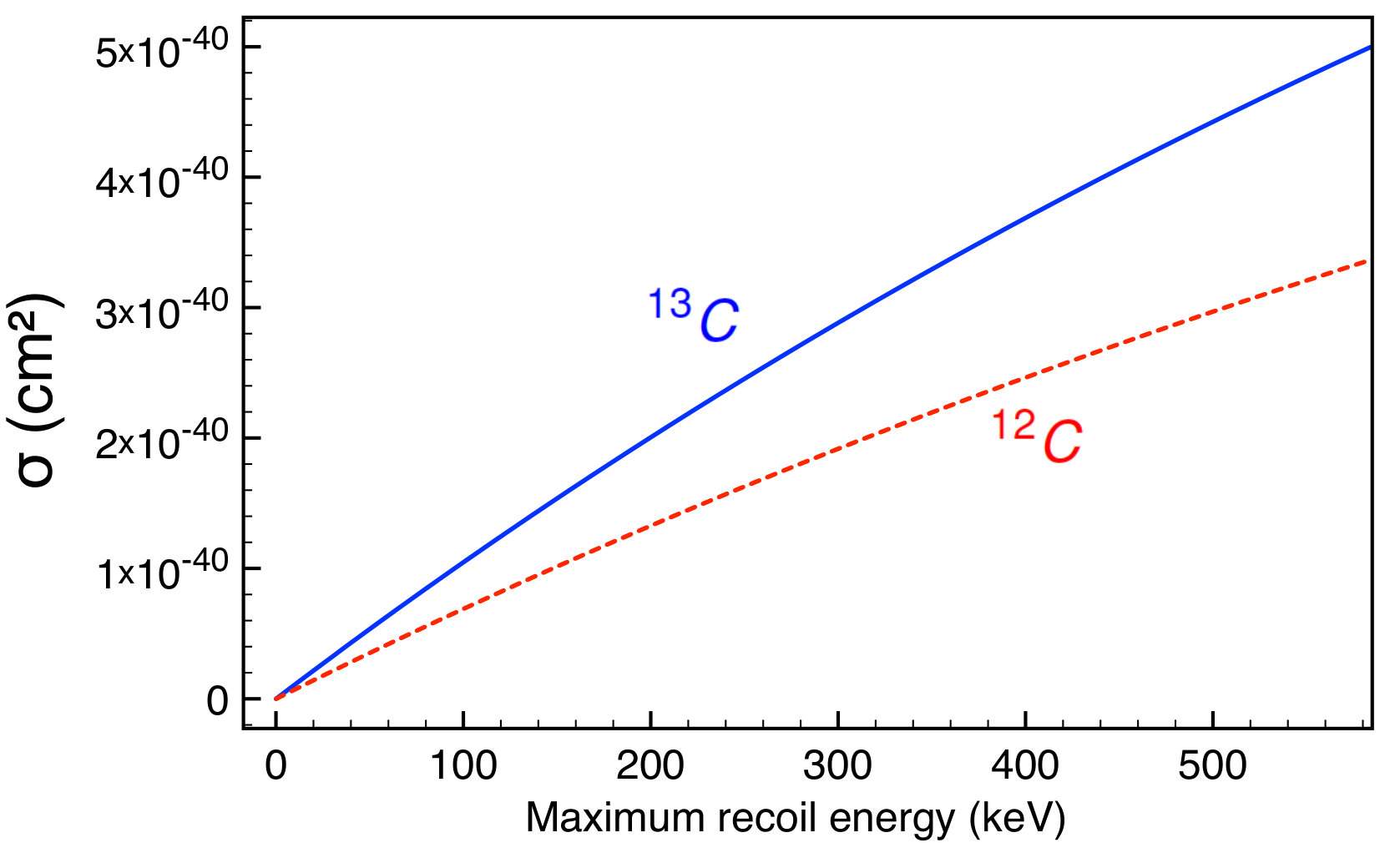 Figure 1
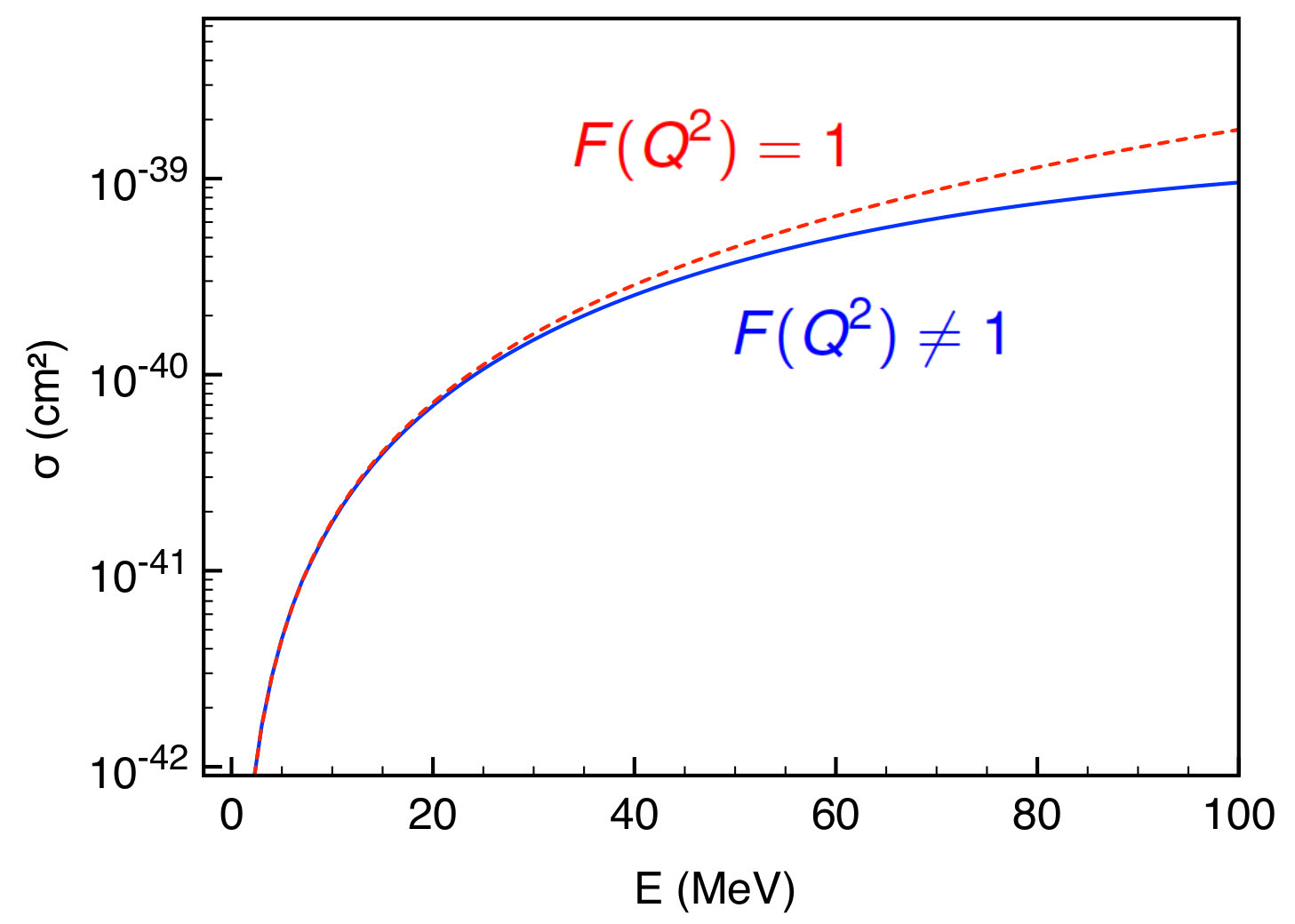 Figure 2
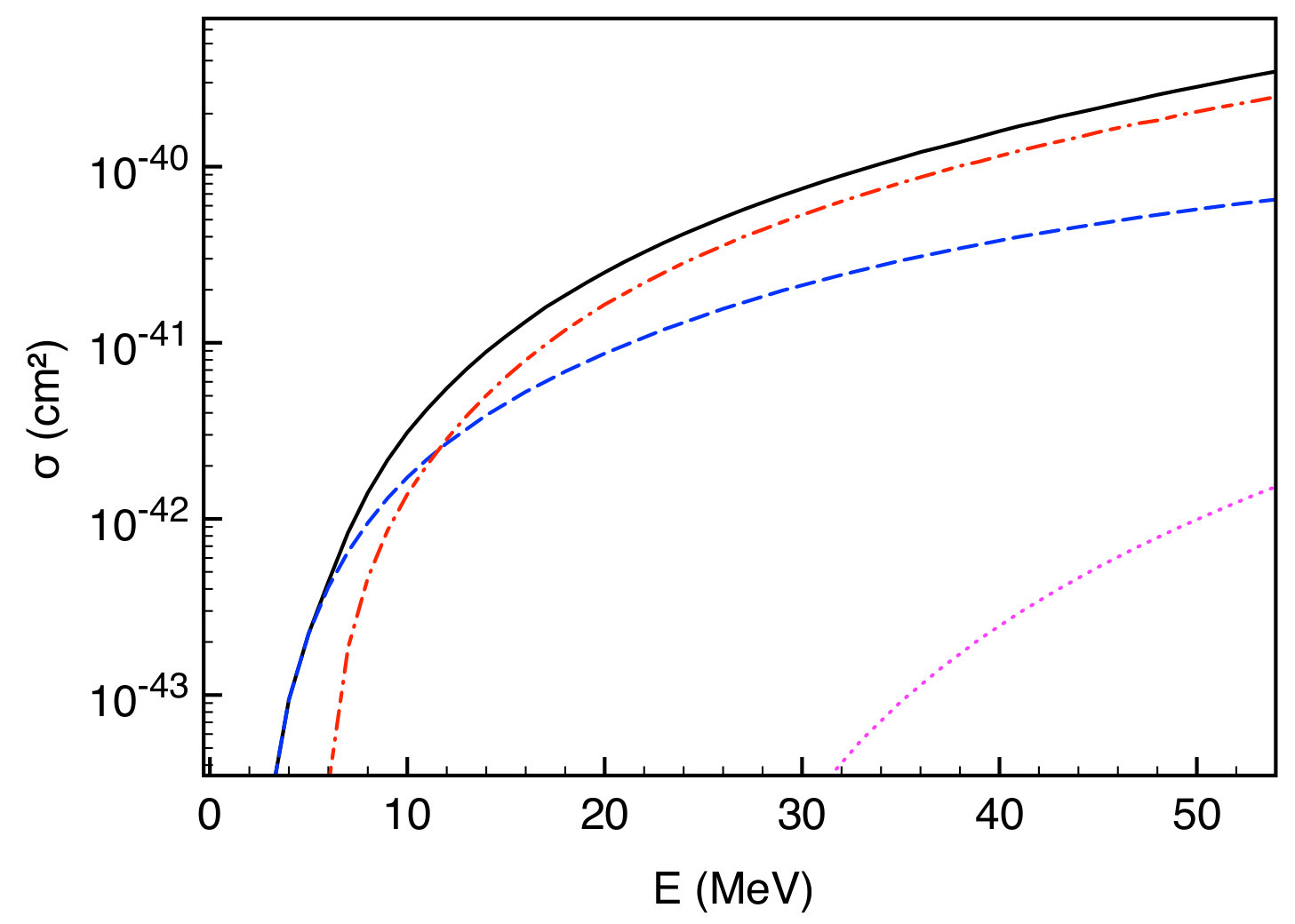 Figure 3
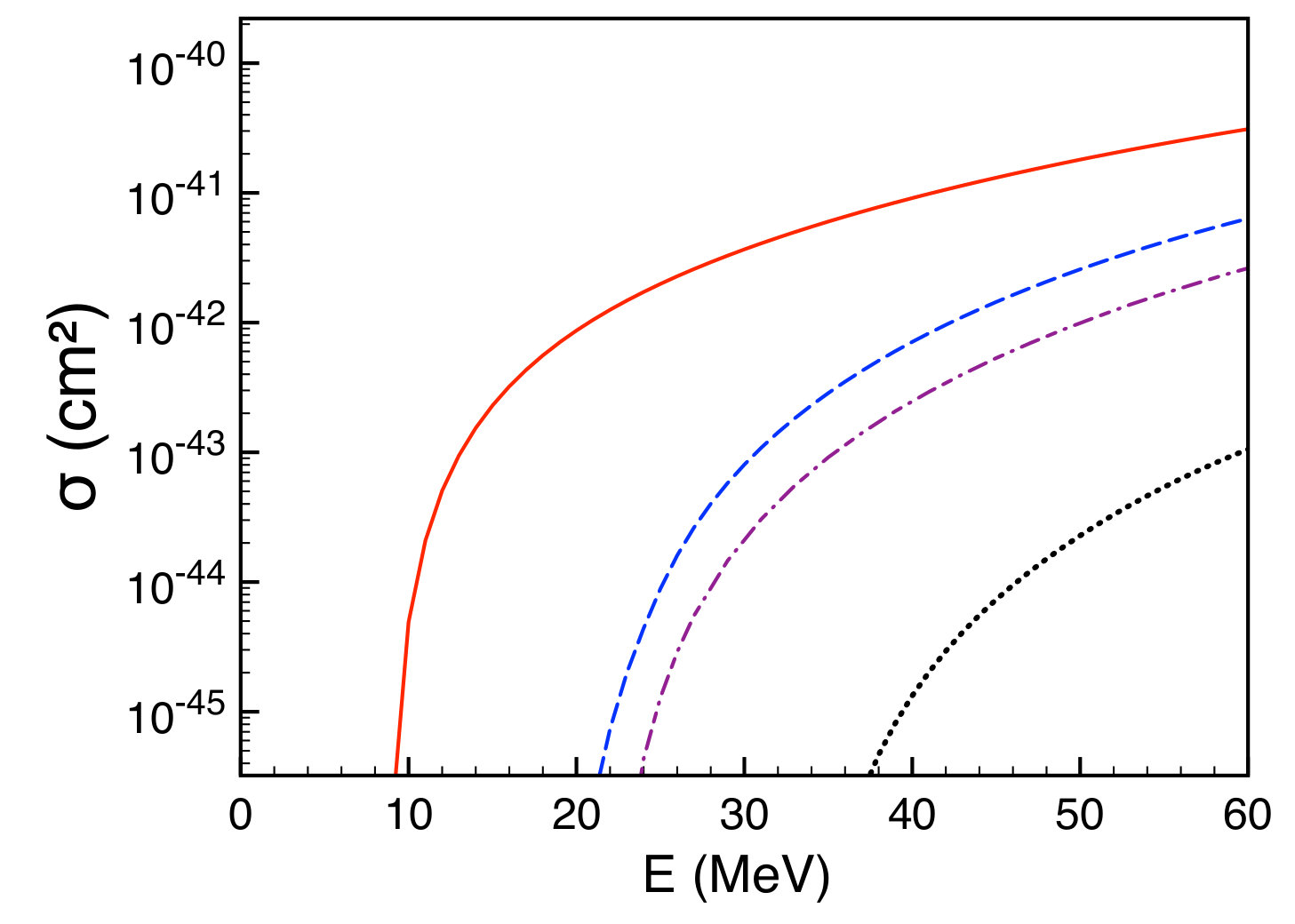 Figure 4
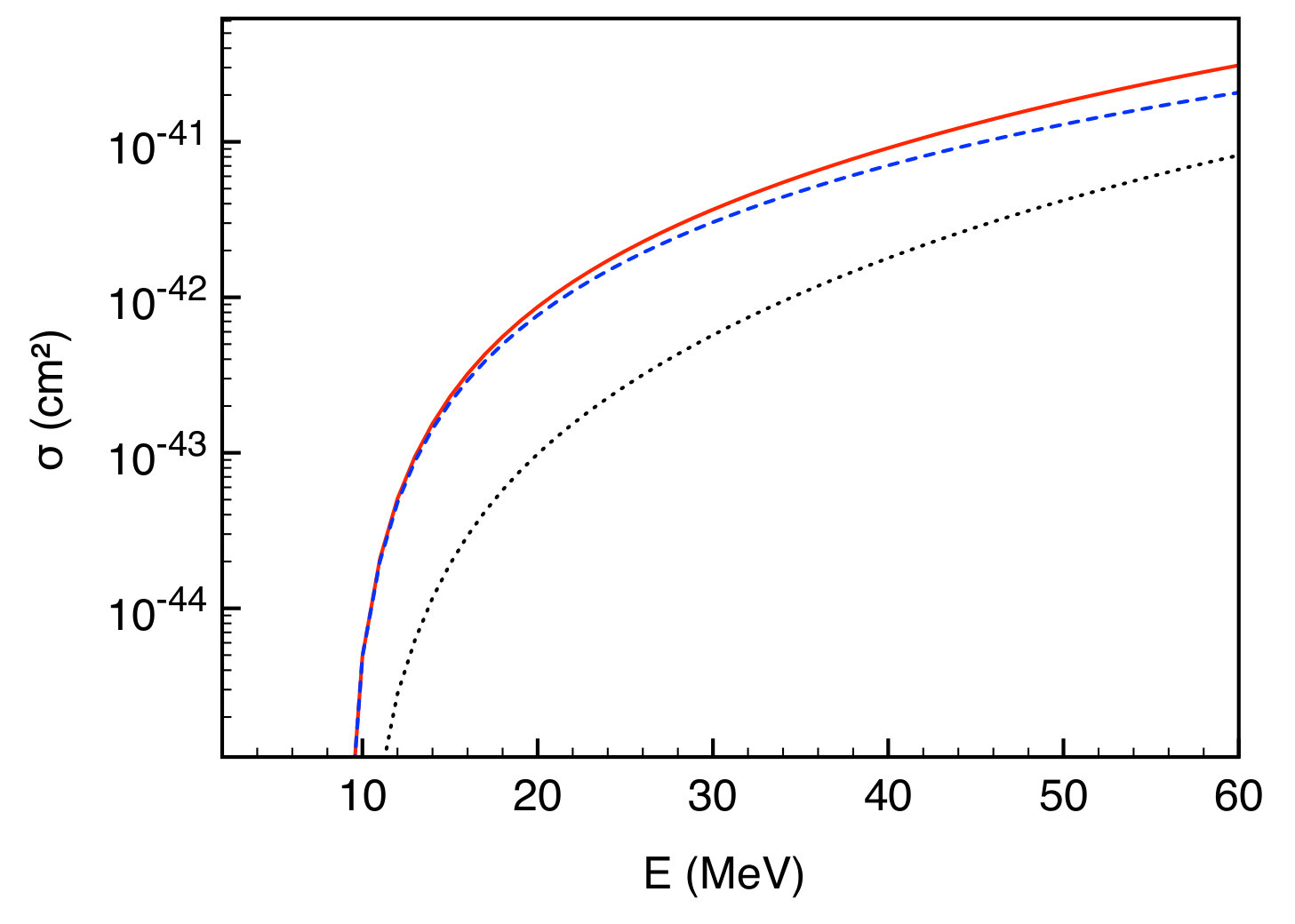 Figure 5
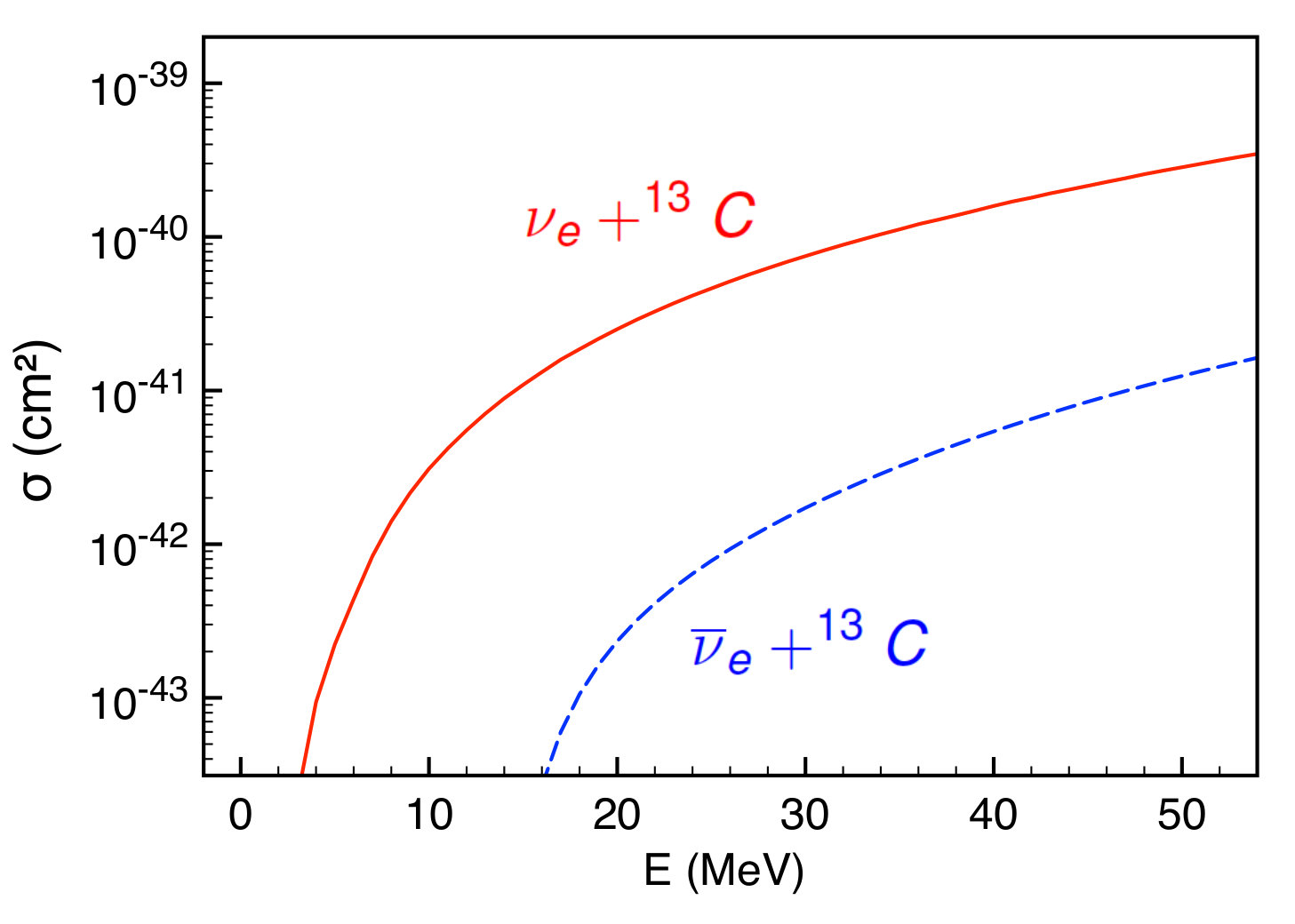 Figure 6
| (MeV) | (cm2) | (MeV) | (cm2) | (MeV) | (cm2) | (MeV) | (cm2) |
|---|---|---|---|---|---|---|---|
| 3 | 16 | 29 | 42 | ||||
| 4 | 17 | 30 | 43 | ||||
| 5 | 18 | 31 | 44 | ||||
| 6 | 19 | 32 | 45 | ||||
| 7 | 20 | 33 | 46 | ||||
| 8 | 21 | 34 | 47 | ||||
| 9 | 22 | 3.27 | 35 | 48 | |||
| 10 | 23 | 36 | 49 | ||||
| 11 | 24 | 37 | 50 | ||||
| 12 | 25 | 38 | 51 | ||||
| 13 | 26 | 39 | 52 | ||||
| 14 | 27 | 40 | 53 | ||||
| 15 | 28 | 41 | 54 |
| (MeV) | (cm2) | (MeV) | (cm2) | (MeV) | (cm2) | (MeV) | (cm2) |
|---|---|---|---|---|---|---|---|
| 5 | 17 | 29 | 41 | ||||
| 6 | 18 | 30 | 42 | ||||
| 7 | 19 | 31 | 43 | ||||
| 8 | 20 | 32 | 44 | ||||
| 9 | 21 | 1.88 | 33 | 45 | |||
| 10 | 22 | 34 | 46 | ||||
| 11 | 23 | 35 | 47 | ||||
| 12 | 24 | 36 | 48 | ||||
| 13 | 25 | 37 | 49 | ||||
| 14 | 26 | 38 | 50 | ||||
| 15 | 27 | 39 | 51 | ||||
| 16 | 28 | 40 | 52 |
| (MeV) | (cm2) | (MeV) | (cm2) | (MeV) | (cm2) | (MeV) | (cm2) |
|---|---|---|---|---|---|---|---|
| 1 | 15 | 29 | 43 | ||||
| 2 | 16 | 30 | 44 | ||||
| 3 | 17 | 31 | 45 | ||||
| 4 | 18 | 32 | 46 | ||||
| 5 | 19 | 33 | 47 | ||||
| 6 | 20 | 34 | 48 | ||||
| 7 | 21 | 35 | 49 | ||||
| 8 | 22 | 8.35 | 36 | 50 | |||
| 9 | 23 | 37 | 51 | ||||
| 10 | 24 | 38 | 52 | ||||
| 11 | 25 | 39 | 53 | ||||
| 12 | 26 | 40 | 54 | ||||
| 13 | 27 | 41 | 55 | ||||
| 14 | 28 | 42 | 56 |
| E (MeV) | C) (cm2) | C) (cm2) | E (MeV) | C) (cm2) | C) (cm2) |
|---|---|---|---|---|---|
| 6.00 | 0.161144 | 0.616611 | 34.00 | 0.548597 | 0.464032 |
| 7.00 | 0.498686 | 0.808538 | 35.00 | 0.601253 | 0.505865 |
| 8.00 | 0.170467 | 0.418146 | 36.00 | 0.656985 | 0.549798 |
| 9.00 | 0.144971 | 0.863204 | 37.00 | 0.715877 | 0.595865 |
| 10.00 | 0.492129 | 0.461908 | 38.00 | 0.778015 | 0.644095 |
| 11.00 | 0.208600 | 0.197935 | 39.00 | 0.843485 | 0.694513 |
| 12.00 | 0.506791 | 0.480249 | 40.00 | 0.912365 | 0.747139 |
| 13.00 | 0.947193 | 0.893967 | 41.00 | 0.984743 | 0.802002 |
| 14.00 | 0.154234 | 0.144903 | 42.00 | 0.106069 | 0.859116 |
| 15.00 | 0.229880 | 0.214934 | 43.00 | 0.114029 | 0.918500 |
| 16.00 | 0.322241 | 0.299761 | 44.00 | 0.122361 | 0.980158 |
| 17.00 | 0.431917 | 0.399709 | 45.00 | 0.131073 | 0.104410 |
| 18.00 | 0.559371 | 0.514967 | 46.00 | 0.140169 | 0.111034 |
| 19.00 | 0.705006 | 0.645647 | 47.00 | 0.149658 | 0.117888 |
| 20.00 | 0.869271 | 0.791903 | 48.00 | 0.159545 | 0.124970 |
| 21.00 | 0.105267 | 0.953917 | 49.00 | 0.169835 | 0.132282 |
| 22.00 | 0.125572 | 0.113190 | 50.00 | 0.180532 | 0.139820 |
| 23.00 | 0.147902 | 0.132610 | 51.00 | 0.191641 | 0.147584 |
| 24.00 | 0.172324 | 0.153684 | 52.00 | 0.203165 | 0.155572 |
| 25.00 | 0.198912 | 0.176455 | 53.00 | 0.215107 | 0.163783 |
| 26.00 | 0.227737 | 0.200959 | 54.00 | 0.227470 | 0.172212 |
| 27.00 | 0.258877 | 0.227231 | 55.00 | 0.240256 | 0.180857 |
| 28.00 | 0.292406 | 0.255312 | 56.00 | 0.253465 | 0.189715 |
| 29.00 | 0.328421 | 0.285245 | 57.00 | 0.267098 | 0.198781 |
| 30.00 | 0.366993 | 0.317070 | 58.00 | 0.281156 | 0.208052 |
| 31.00 | 0.408214 | 0.350828 | 59.00 | 0.295636 | 0.217522 |
| 32.00 | 0.452166 | 0.386550 | 60.00 | 0.310538 | 0.227187 |
| 33.00 | 0.498929 | 0.424272 |
| E (MeV) | (cm2) | (cm2) | E (MeV) | (cm2) | ) (cm2) |
|---|---|---|---|---|---|
| 8.00 | 5.53038 | 0 | 18.00 | 5.76896 | 5.41018 |
| 9.00 | 1.15214 | 1.03756 | 19.00 | 7.64158 | 7.13818 |
| 10.00 | 6.12058 | 5.95485 | 20.00 | 9. 84805 | 9.16268 |
| 11.00 | 7.68861 | 7.42909 | 21.00 | 1.24147 | 1.15038 |
| 12.00 | 2.81923 | 2.70849 | 22.00 | 1.53709 | 1.41834 |
| 13.00 | 6.26649 | 5.98553 | 23.00 | 1.87481 | 1.72247 |
| 14.00 | 1.16558 | 1.10949 | 24.00 | 2.25800 | 2.06520 |
| 15.00 | 1.92811 | 1.82982 | 25.00 | 2.69019 | 2.44904 |
| 16.00 | 2.93457 | 2.77418 | 26.00 | 3.17505 | 2.87653 |
| 17.00 | 4.20674 | 3.96067 | 27.00 | 3.71642 | 3.35024 |
Peer Reviews
No public reviews on file for this paper yet. If you reviewed it on a platform where reviews are public (OpenReview, ICLR, NeurIPS, ICML), you can paste yours below so the community can read it here.
Videos
No videos yet. Explain this paper in a talk, walkthrough, or lecture? Add one.
Neutrino- Cross Sections at Supernova Neutrino Energies
T. Suzuki
Department of Physics, College of Humanities and Sciences, Nihon University, Sakurajosui 3-25-40, Setagaya-ku, Tokyo 156-8550, Japan
National Astronomical Observatory of Japan 2-21-1 Osawa, Mitaka, Tokyo, 181-8588, Japan
A. B. Balantekin
Department of Physics, University of Wisconsin, Madison, WI 53706, USA
National Astronomical Observatory of Japan 2-21-1 Osawa, Mitaka, Tokyo, 181-8588, Japan
T. Kajino
National Astronomical Observatory of Japan 2-21-1 Osawa, Mitaka, Tokyo, 181-8588, Japan
Graduate School of Science, University of Tokyo, 7-3-1 Hongo, Bunkyo-ku, Tokyo, 113-0033, Japan
School of Physics, Beihang University, Beijing 100083, China
S. Chiba
Laboratory for Advanced Nuclear Energy, Institute of Innovative Research, Tokyo Institute of Technology, N1-9, 2-12-1 Ookayama, Meguro, Tokyo 152-8550
National Astronomical Observatory of Japan 2-21-1 Osawa, Mitaka, Tokyo, 181-8588, Japan
Abstract
We present neutrino capture cross sections on 13C at supernova neutrino energies, up to 50 MeV. For both charged-current and neutral-current reactions partial cross sections are calculated using statistical Hauser-Feschbach method. Coherent elastic neutrino scattering cross section for a 13C target is also provided.
Neutrino cross sections, scintillators, 13C
pacs:
25.30.Pt, 29.40.Mc, 24.80.+y, 13.15.+g
I Introduction
There has been outstanding progress in all aspects of neutrino physics during the past several decades. This progress increasingly necessitates the availability of accurate neutrino-nucleus cross sections. The most reliable calculations of such cross sections at lower energies (defined as reactor, solar and supernova neutrino energies) are based on the nuclear shell model. In parallel to the rapid progress in neutrino physics, new shell model Hamiltonians have been recently developed. These Hamiltonians, including the tensor forces, describe well nuclear spin responses and shell evolution towards the drip lines. Such a new shell model Hamiltonian for p-shell nuclei is the SFO (Suzuki, Fujimoto, Otsuka) Hamiltonian Suzuki:2003 .
Many large neutrino experiments such as currently operating Daya Bay Adey:2018zwh , RENO Bak:2018ydk , Double Chooz Kaneda:2018nma , BOREXINO Agostini:2018uly experiments, under construction JUNO experiment Miramonti:2018noj , and the proposed LENA experiment Wurm:2011zn utilize carbon-based liquid scintillators and liquid track detectors. Indeed that is one reason why the neutrino interactions with 12C is experimentally well studied Athanassopoulos:1997rm . The natural abundance of 13C is 1.07%, hence in a precision experiment neutrino interactions with 13C are no longer negligible. This cross section has not been directly measured, but may be accessible with a -enriched target. In addition, as we discuss in Section IVb, knowing the exact value of this cross section in the Standard Model would help searches for physics beyond the Standard Model. In the late 1980’s a 13C-enriched target was proposed as a possible solar neutrino detector Arafune:1988hx , motivating a calculation of this reaction Fukugita:1989wv both in the shell model (using Cohen-Kurath wave functions Cohen:1965qa ; Millener:1975zz ) and using the effective operator method Arima:1988xa . Ground-to-ground state transitions and inclusive cross sections were also given Pourkaviani:1991pb ; Mintz:2000xv . In a previous publication Suzuki:2012aa we provided a detailed calculation of the neutrino interactions with 13C using the SFO Hamiltonian at reactor energies. Carbon-based scintillators can be used as supernova detectors Scholberg:2012id ; Dasgupta:2011wg and multi-purpose neutrino observatories which use liquid scintillators have been proposed Wurm:2011zn . Sensitivity to all flavors of neutrinos and antineutrinos in a supernova burst is the ultimate goal of a supernova neutrino detector. This goal in turn requires knowing as many as possible cross sections for various potential detectors. The goal of the present paper is to extend our previous calculations of neutrino-13C cross sections to higher energies, up to about 50 MeV, relevant to supernova observations and experiments at the spallation neutron sources.
II Calculations with the SFO Hamiltonian
Starting from the Cohen-Kurath (CK) Cohen:1965qa and the Millener-Kurath (MK) Millener:1975zz Hamiltonians, a new shell-model Hamiltonian for the p-sd shell has been constructed. The CK Hamiltonians are phenomenological effective interactions for the p-shell obtained by fitting experimental low-lying energy levels. In one version, (8-16)2BE, single-particle energies for and orbits and two-body matrix elements are determined by using 35 energy data for nuclei with mass numbers A =8-16. The MK Hamiltonian is an effective particle-hole interaction for p-sd cross shell obtained by fitting to energy levels of non-normal parity states of nuclei with A =11-16. The strength parameters of central, tensor and two-body spin-orbit potentials are determined. The new Hamiltonian for the p-sd shell, SFO Suzuki:2003 , consists of p-shell, sd-shell and p-sd shell parts, where part is taken from the MK Hamiltonian while and sd-shell parts are from Kuo’s G-matrix calculation Kuo:1967 . The p-shell part is modified from (8-16)2BME by enhancing the magnitude of the monopole terms of the matrix elements for the orbits with zero isospin as well as the single-particle energy gap between the and orbits. The monopole term is changed by -2.14 MeV and the gap is enhanced from 0.14 MeV to 3.92 MeV.
Using a configuration space including up to excitations and a small (five percent) quenching of the axial-vector coupling constant and spin g factor, this Hamiltonian considerably improves the magnetic properties of the p-shell nuclei as compared with the earlier treatments using CK interactions. For example, the Gamow-Teller strength in 12C is well described by the SFO Hamiltonian, resulting in a good agreement with the experimental measurements Suzuki:2006qd . The enhancement of the magnitude of the monopole terms in the spin-isospin flip channel leads to more admixtures of and shell components in the wave functions and reduction of the strength. The enhancement of the single-particle energy gap, on the other hand, leads to less admixtures of and shell components and enhancement of the value. Spin and magnetic properties of nuclei are sensitive to the balance between the monopole terms and the single-particle energy gap. Their proper choice is important for the description of the spin degree’s of freedom in nuclei. The SFO Hamiltonian contains the proper tensor components consistent with the sign rules for the monopole-tensor terms Otsuka:2005zz , that is, attractive for j*⟩-j⟨* orbits (j*⟩=+1/2, j⟨* = -1/2) but repulsive for j*⟩-j⟩* or j*⟨-j⟨* orbits. The spin-isospin dependent part of the SFO interaction is strong enough to be consistent with this sign rule, while the CK interaction contains the tensor components with opposite signs to the proper ones due to its weak monopole terms in the spin-isospin flip channel Suzuki:2006qd . The description of spin and magnetic properties of p-shell nuclei is thus improved for the SFO Hamiltonian compared with the CK Hamiltonians. The SFO interaction is found to reproduce well the exclusive cross section 12C (, e*-*) 12N (1) as well as charged- and neutral-current inclusive reaction cross sections on 12C induced by pion DAR (decay-at-rest) neutrinos within error bars Suzuki:2006qd ; Suzuki:2013 . In particular in Fig. 4 of Ref. Suzuki:2013 , the exclusive cross section measured (Fig. 14 of Ref. Athanassopoulos:1997rm ), which is not folded over the DAR spectrum, is shown to be reproduced by SFO quite well. Another successful example of SFO interaction is the Gamow-Teller strength in 14C Suzuki:2003 . The strength is found to be almost vanished for the SFO interaction, where the proper inclusion of the tensor components in the interaction is essential. Note that the calculations with the SFO Hamiltonian are carried out in the - shell including up to 2 excitations with / = 0.95, whereas those for the comparison CK Hamiltonian are obtained within the -shell with a larger quenching factor, / = 0.69 Fukugita:1989wv , which is adjusted to reproduce the experimental values of 13N()13C, 15O()15N and 11C()11B. For the charged-current neutrino scattering on 13C the SFO Hamiltonian predicts an enhancement of the Gamow-Teller strength for the transition to the 3.50 MeV state in 13N as compared with the prediction of the CK Hamiltonian Suzuki:2012aa .
In our calculations neutrino-nucleus reaction cross sections are evaluated using the multipole expansion of the weak hadronic currents as described in Ref. Walecka:1975 . To calculate partial cross sections for the photon and particle emission channels statistical Hauser-Feschbach method is used. Branching ratios from each excited level are evaluated by taking into account single- and multiparticle decay channels involving neutron, proton, deuteron, , 3He, 3H and . All the levels obtained in the present shell-model calculations are adopted as levels in the decaying and daughter nuclei with specific isospin assignments. The particle transmission coefficients are calculated by the optical model Walter:1986 ; Avrigeanu:1994 . The transmission coefficients are calculated with the Brink formula. The E1 (elecric dipole) and M1 (magnetic dipole) parameters are taken from RIPL-2 database Belgya:2006 . The cascade in the initial excited nuclei and subsequent decays are fully considered.
III Charged-current Cross Sections
We present the total charged-current cross sections for C scattering in Table I. The cross sections given in this table include all possible channels.
The most dominant contribution to the total cross section comes from the proton knock-out reaction
[TABLE]
This cross section is given in Table II. This partial cross section can be observed if the scintillator is capable of pulse-shape discrimination. The second dominant contribution comes from the reaction
[TABLE]
Of significant interest is the neutron emission cross section
[TABLE]
These neutrons thermalize and capture abundant protons typically present in the scintillators, giving the characteristic signature of 2.2 MeV photons. However the cross section for the reaction in Eq. (III.3) is much smaller than the two dominant contributions mentioned above as depicted in Fig. 1. (Note that to avoid cluttering several other contributions which are the same order as the neutron emission cross section are not shown in this figure. These contributions come from emissions of photons, proton pairs, proton-neutron pairs, one proton and one alpha pairs or one proton along with a pair of alpha particles, but they are too small to be directly detectable).
The charged-current electron antineutrino capture cross section on 13C has a relatively high energy threshold ( MeV). In addition it is much smaller than the charged-current electron neutrino cross section on 13C. We compare those two cross section is Fig. 2.
12C also has a relatively high energy threshold for both electron neutrinos and electron antineutrinos. Hence a scintillator containing 12C, 13C and protons is sensitive to electron neutrinos only via their capture on 13C and can be used to search for new physics producing electron neutrinos in reactor flux. This is why such scintillators were also proposed as solar neutrino detectors Fukugita:1989wv ; Ianni:2005ki . It should also be mentioned that neutrinos coming from spallation neutron sources contain electron neutrinos in addition to muon neutrinos and antineutrinos; however electron antineutrinos are absent from their spectra Bolozdynya:2012xv .
IV Neutral Current Cross Sections
IV.1 Neutrino Coherent Scattering
Neutrino-nucleus coherent elastic scattering cross section is given by Freedman:1977xn ; Drukier:1983gj
[TABLE]
where is the recoil energy of the nucleus, is the energy of the incoming neutrino, is the mass of the target nucleus, is the momentum transfer, is the maximum nuclear recoil energy
[TABLE]
and
[TABLE]
is the weak charge of the nucleus. The form factor
[TABLE]
corrects for contributions to scattering that are not completely coherent as gets large. In this expression and are the neutron and proton density distributions in the nucleus, respectively. In writing Eq. (IV.3) nuclei are assumed to be at least nearly spherically symmetric. This reaction was experimentally observed for the first time only recently using a CsI scintillator Akimov:2017ade .
The total elastic scattering cross section is given by the expression
[TABLE]
We present the total elastic scattering cross section for 13C in Table 3.
Note that the nuclear recoil energies are very small. However, due to the extra neutron, neutrino elastic scattering from 13C is significantly more than the similar reaction of 12C. To illustrate this we compare the elastic scattering cross sections on 13C and 12C in Figure 3 as a function of the maximum nuclear recoil energy. In this figure the coherent scattering cross section for 12C is taken from Ref. Yoshida:2008zb . As this figure illustrates even a single extra neutron appreciably increases the coherent scattering cross section.
In Ref. Patton:2012jr an expansion of the form factor in Eq. (IV.3) was given in powers of the momentum transfer, . Since the proton contribution to the form factor is exceedingly small, neutrino coherent scattering primarily probes the neutron distribution. In the leading order the momentum transfer is given by
[TABLE]
For lighter nuclei an expansion of the form factor can be written as
[TABLE]
where the coefficients carry information about the neutron distribution. It can be shown that keeping terms up to and including in the expansion of Eq. (IV.6) contributes terms up to and including in the total cross section. This feature can be observed by writing the total cross section as an expansion:
[TABLE]
where . The following expansion of this expression may be more useful in applications:
[TABLE]
For 13C with only seven neutrons the contribution of even term is exceedingly small. In Fig. 4 we give a comparison of the total neutrino elastic scattering cross sections on 13C and the prediction of Eq.(IV.1) with . Clearly nuclear structure effects decrease the cross section from the value given in the limit where deviations from are ignored. It is important to include such effects when one is exploring the decrease of the elastic scattering cross section due to other physical effects such as possible production of sterile neutrinos. One should also mention that, since oscillations experiments established the non-zero values of the neutrino masses, dipole moments of neutrinos do not vanish, very small in the Standard Model, but may receive contributions from physics beyond the Standard Model. Such magnetic moments would provide an electromagnetic contribution to the coherent scattering, but that contribution is expected to be exceedingly small.
IV.2 Neutron knock-out
One interesting aspect of the neutral-current scattering of neutrinos and antineutrinos on 13C is the possibility of one neutron emission in the final state. These neutrons are detectable via the 2.2 MeV photons and can provide a useful signal. In these cross sections there are contributions from interference between vector and axial-vector currents, which have different signs between left-handed neutrinos and right-handed anti-neutrinos. This feature leads to a small difference between () and () cross sections. The total neutron emission cross sections are given in Table 4.
These cross sections have several components which can help analysis of data from supernova and neutron-spallation sources. These are compared in Fig. 5.
In this figure the small difference between neutrino and antineutrino cross sections described above, comparable to the width of lines drawn, is ignored. The solid line refers to the total neutral-current one-neutron emission cross section. The dashed line refers to the cross section for transition to the ground state in 12C:
[TABLE]
and the dotted line refers to the cross section for transition to the state in 12C at 4.44 MeV followed by decay into the 12C ground state:
[TABLE]
Short-baseline reactor neutrino experiments identified a shape distortion in the 5-7 MeV range in the measured neutrino spectrum Balantekin:2016vjt . This shape distortion appears as an excess over the predicted spectra. A recent proposal suggests Berryman:2018jxt a beyond the Standard Model solution to resolve this issue: Non-standard neutrino interactions which induce the reaction 13C( n)12C∗ followed by the de-excitation of 12C∗ yielding a prompt 4.44 MeV photon. The neutron produced would then lose its kinetic energy scattering off protons yielding scintillation light. It was proposed that this scintillation light along with the prompt photon would mimic the spectral distortion around 5 MeV. To help assess further investigation of such processes we tabulate the Standard Model 13C( n)12C∗ neutrino cross sections in Table 5.
Finally a comparison of the various neutron emission cross sections for interacting with carbon isotopes is given in Figure 6. The cross sections are roughly proportional to the phase space of the final states, , where is the initial neutrino energy and is the threshold energy for neutron emissions measured from the ground state of the parent nucleus. For neutral-current reactions, is equal to the neutron separation energy (), and =4.946 MeV and 18.721 MeV for 13C and 12C, respectively. For charged-current reactions, is the sum of in the daughter nucleus and the -decay Q-value. They are =22.284 MeV ( =20.064 MeV, Q =2.220 MeV) and 32.378 MeV ( =15.040 MeV, Q =17.338 MeV) for 13C and 12C, respectively. The difference in the magnitude of the calculated cross sections in Figure 6 can be understood in terms of the difference in the threshold energies except for some details due to the difference between 12C and 13C. In case of neutral-current reaction on 13C, the Gamow-Teller transition to the 1/2*-* state at =8.860 MeV gives the dominant contribution to the cross section near threshold, that is, at =9-12 MeV. At 15 MeV, the Gamow-Teller transition to the 3/2*-* state at =9.898 MeV gives a contribution comparable to the 1/2*-* state. In case of neutral-current reaction on 12C, excitations of spin-dipole states (0*-, 1-* and 2*-* states) above the threshold energy give more important contributions to the neutron-emission cross section than those of 1*+* states. Note that the 1*+* state at =15.11 MeV with the largest magnetic dipole strength is below the neutron emission threshold.
V Conclusions
Since 13C is naturally present in carbon-based scintillators, it is important to know its interaction cross section with neutrinos to achieve high precision in neutrino experiments using such scintillators. In an earlier publication we presented calculations of those cross sections at reactor neutrino energies. In this paper these cross sections both for charged-current and neutral-current reactions are given at higher energies, relevant to terrestrial supernova observations and measurements at the spallation neutron sources (such as the Oak Ridge facility used in the experiment of Ref. Akimov:2017ade ). Since there are ongoing and planned neutrino coherent scattering experiments at those spallation neutron sources, those cross sections are also provided. Since the processes with neutrons are present in the final state and could provide a convenient signal via the 2.2 MeV photons as well as help in the searches for physics beyond the Standard Model we provided the Standard Model values of the cross section for those processes as well.
Acknowledgments
This work was supported in part by Grants-in-Aid for Scientific Research of JSPS (15H03665, 15K05090, 17K05459), in part by the U.S. National Science Foundation Grants No. PHY-1806368 and and PHY-1630782. ABB is also supported in part by the visiting professor program at the National Astronomical Observatory of Japan.
The reference list from the paper itself. Each links out to its DOI / PubMed record.
- 1(1) T. Suzuki, R. Fujimoto and T. Otsuka, Phys. Rev. C 67 , 044302 (2003).
- 2(2) D. Adey et al. [Daya Bay Collaboration], Phys. Rev. Lett. 121 , no. 24, 241805 (2018) doi:10.1103/Phys Rev Lett.121.241805 [ar Xiv:1809.02261 [hep-ex]].
- 3(3) G. Bak et al. [RENO Collaboration], Phys. Rev. Lett. 121 , no. 20, 201801 (2018) doi:10.1103/Phys Rev Lett.121.201801 [ar Xiv:1806.00248 [hep-ex]].
- 4(4) M. Kaneda [Double Chooz Collaboration], Phys. Part. Nucl. 49 , no. 4, 709 (2018). doi:10.1134/S 1063779618040317
- 5(5) M. Agostini et al. [BOREXINO Collaboration], Nature 562 , no. 7728, 505 (2018). doi:10.1038/s 41586-018-0624-y
- 6(6) L. Miramonti [JUNO Collaboration], Universe 4 , no. 11, 126 (2018). doi:10.3390/universe 4110126
- 7(7) M. Wurm et al. [LENA Collaboration], Astropart. Phys. 35 , 685 (2012) doi:10.1016/j.astropartphys.2012.02.011 [ar Xiv:1104.5620 [astro-ph.IM]].
- 8(8) C. Athanassopoulos et al. [LSND Collaboration], Phys. Rev. C 55 , 2078 (1997) doi:10.1103/Phys Rev C.55.2078 [nucl-ex/9705001].