Quantum nondemolition measurement of an electron spin qubit
Takashi Nakajima, Akito Noiri, Jun Yoneda, Matthieu R. Delbecq, Peter, Stano, Tomohiro Otsuka, Kenta Takeda, Shinichi Amaha, Giles Allison, Kento, Kawasaki, Arne Ludwig, Andreas D. Wieck, Daniel Loss, Seigo Tarucha

TL;DR
This paper demonstrates an all-electrical quantum nondemolition measurement of a single electron spin in a quantum dot, enabling repeated, high-fidelity measurements with minimal disturbance, crucial for quantum information processing.
Contribution
It introduces a novel all-electrical QND measurement protocol for electron spins using an exchange-coupled ancilla qubit, achieving rapid, repetitive, and minimally invasive measurements.
Findings
Readout fidelity increases monotonically over 100 measurements
Measurement rate is two orders of magnitude faster than spin relaxation
Allows observation of quantum jumps in an isolated spin system
Abstract
Measurement of quantum systems inevitably involves disturbance in various forms. Within the limits imposed by quantum mechanics, however, one can design an "ideal" projective measurement that does not introduce a back action on the measured observable, known as a quantum nondemolition (QND) measurement. Here we demonstrate an all-electrical QND measurement of a single electron spin in a gate-defined quantum dot via an exchange-coupled ancilla qubit. The ancilla qubit, encoded in the singlet-triplet two-electron subspace, is entangled with the single spin and subsequently read out in a single shot projective measurement at a rate two orders of magnitude faster than the spin relaxation. The QND nature of the measurement protocol is evidenced by observing a monotonic increase of the readout fidelity over one hundred repetitive measurements against arbitrary input states. We extract…
Click any figure to enlarge with its caption.
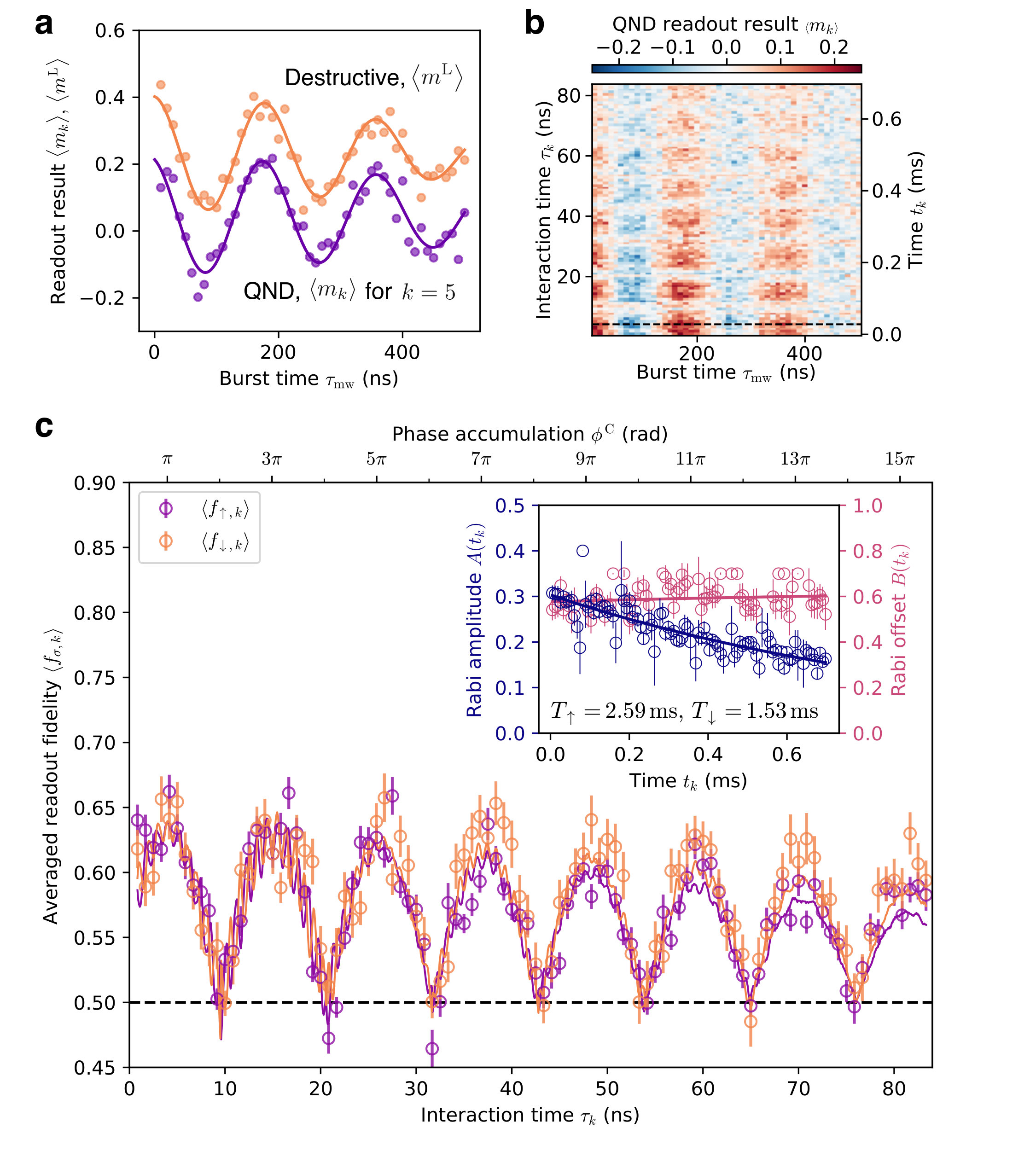 Figure 1
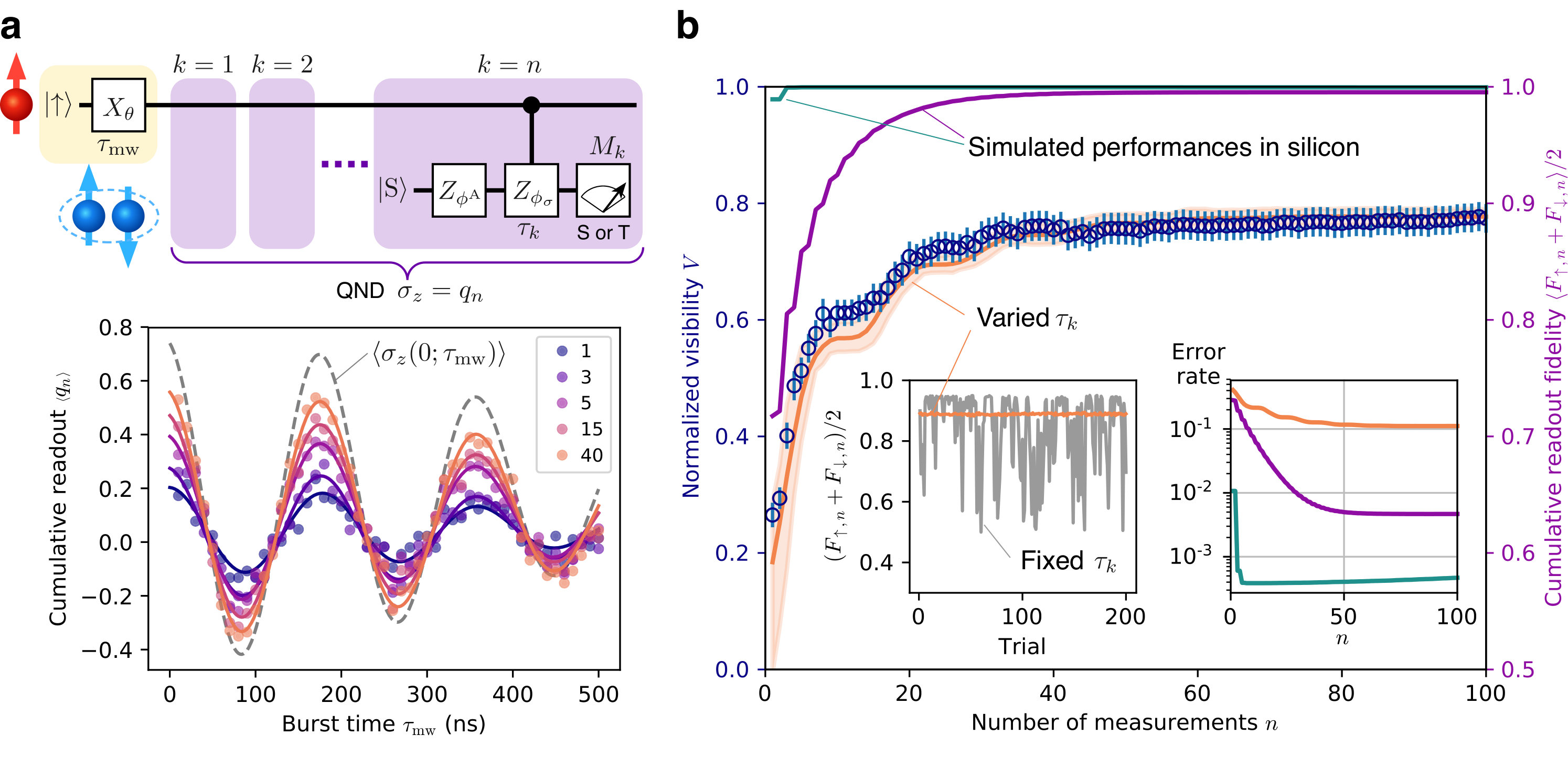 Figure 2
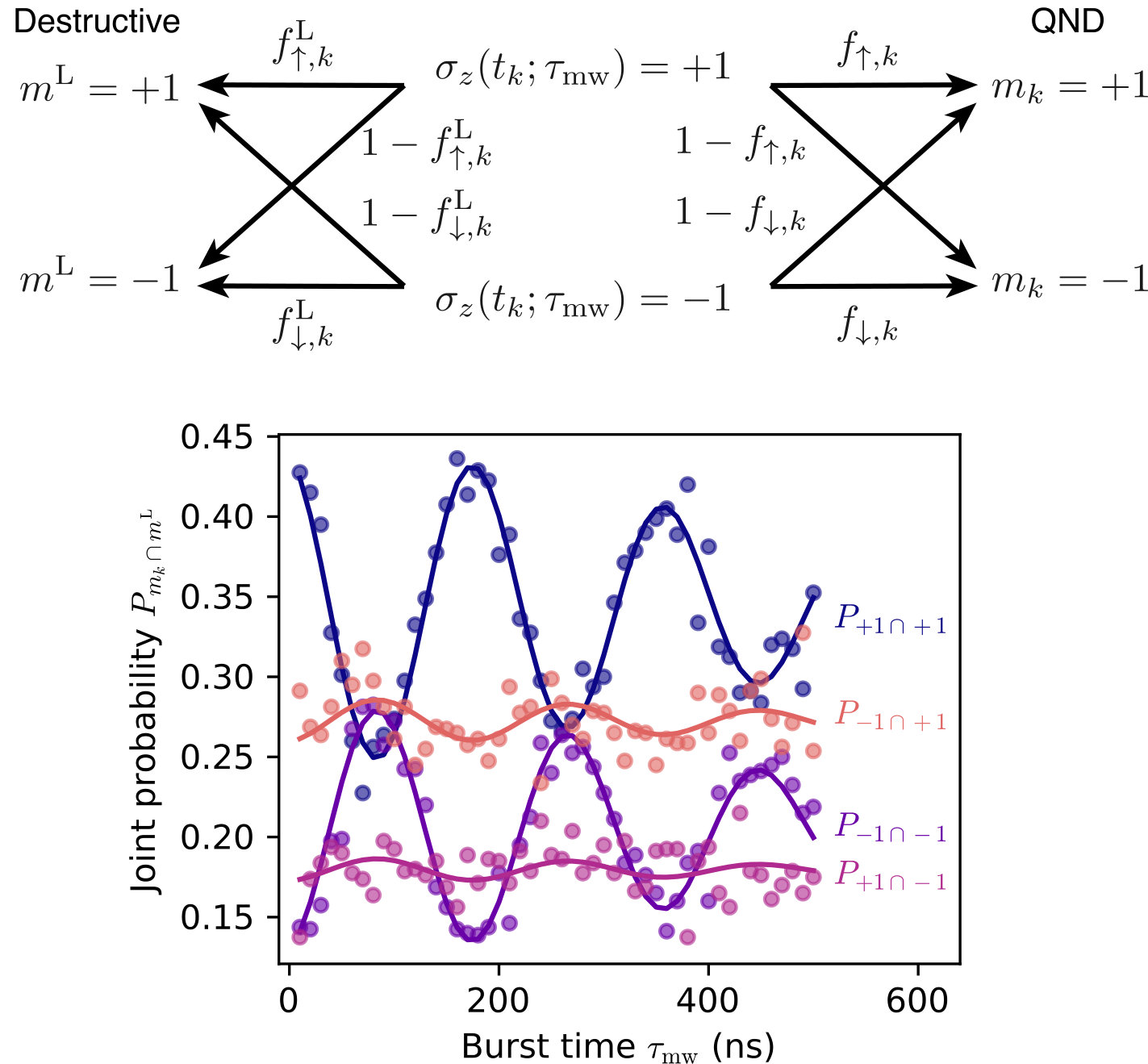 Figure 3
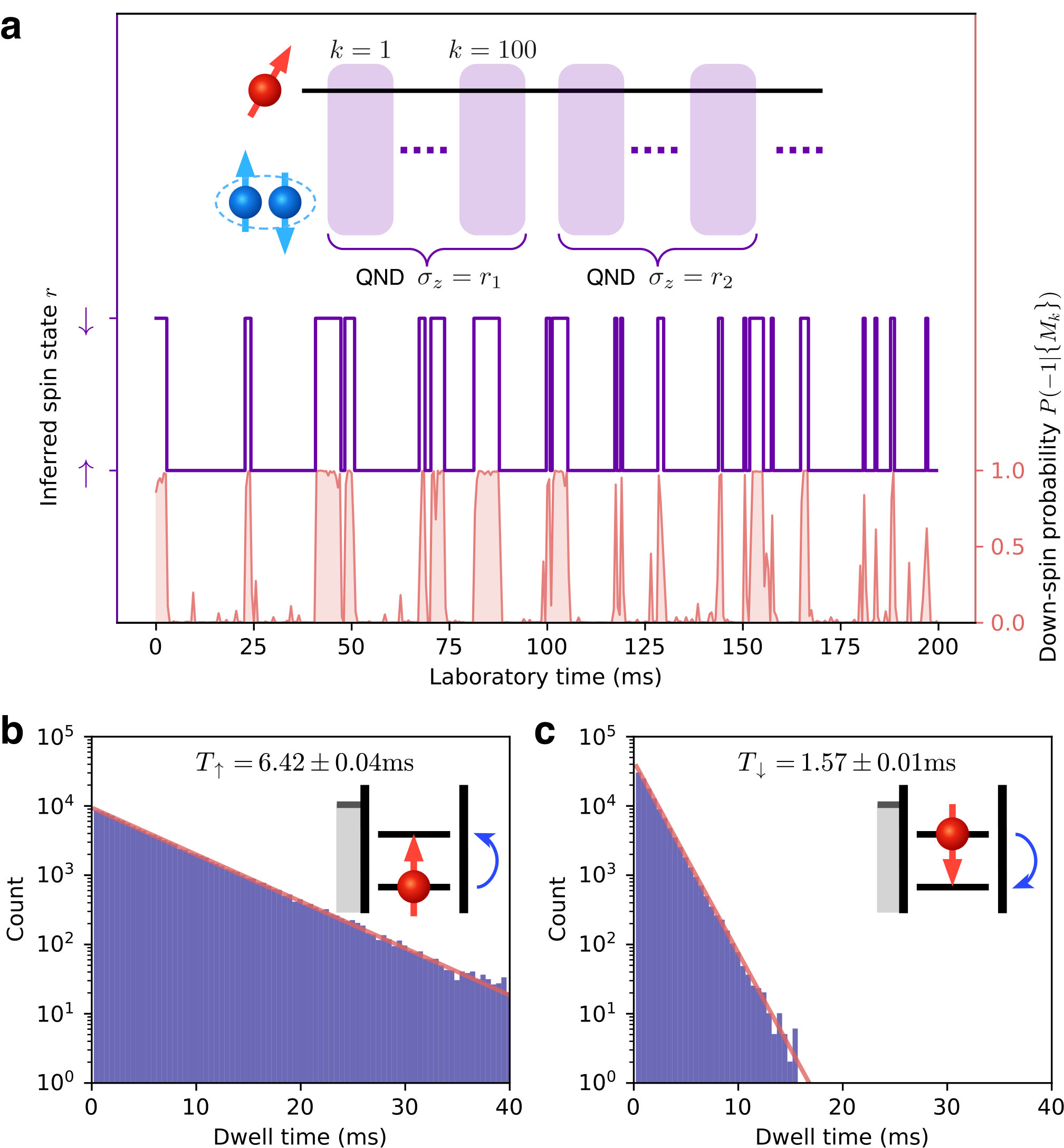 Figure 4
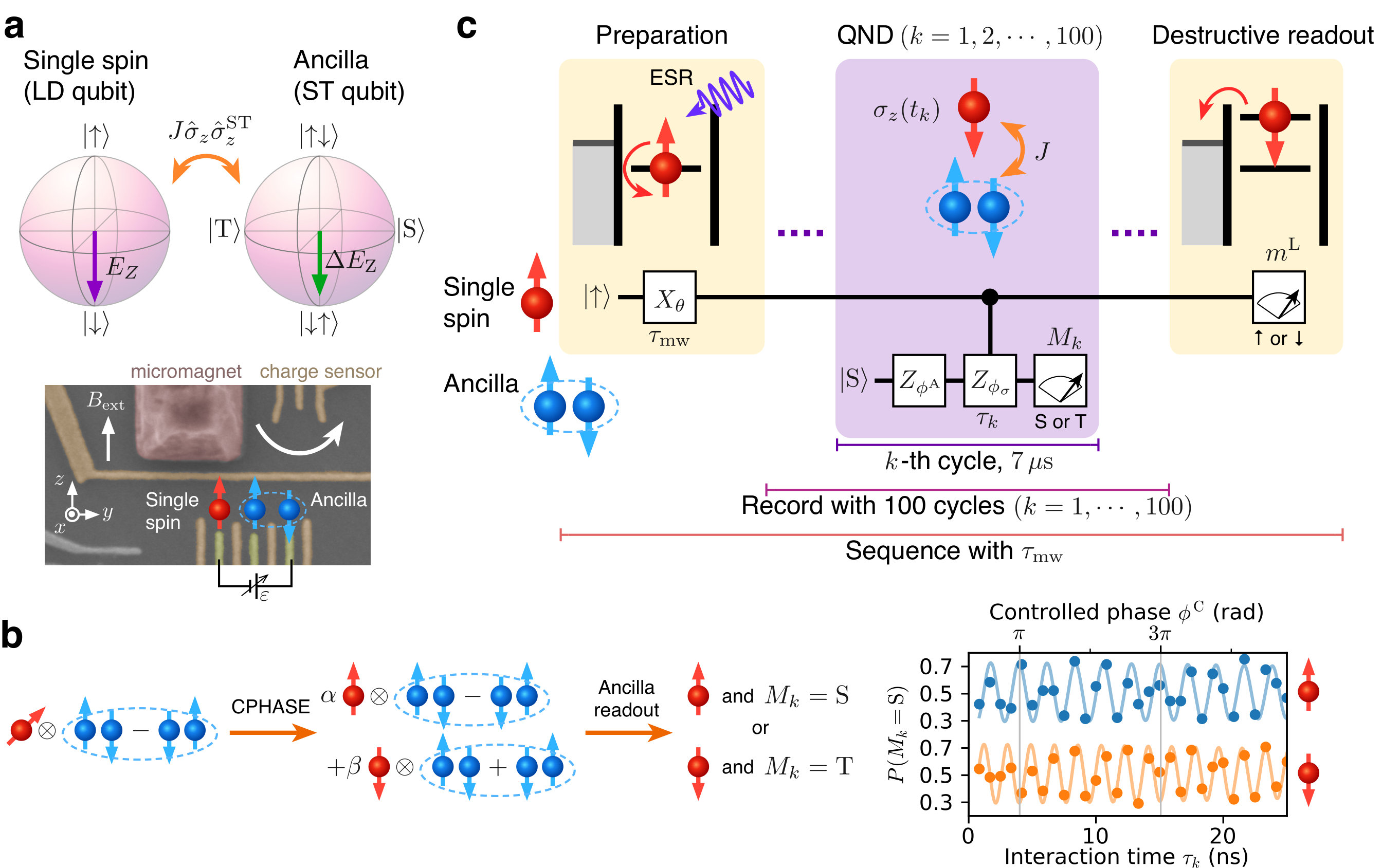 Figure 5
Peer Reviews
No public reviews on file for this paper yet. If you reviewed it on a platform where reviews are public (OpenReview, ICLR, NeurIPS, ICML), you can paste yours below so the community can read it here.
Videos
No videos yet. Explain this paper in a talk, walkthrough, or lecture? Add one.
Quantum nondemolition measurement of an electron spin qubit
Takashi Nakajima1†∗
Akito Noiri1†
Jun Yoneda1
Matthieu R. Delbecq1§
Peter Stano1,2
Tomohiro Otsuka1,3♯
Kenta Takeda1
Shinichi Amaha1
Giles Allison1
Kento Kawasaki4
Arne Ludwig5
Andreas D. Wieck5
Daniel Loss1,6 & Seigo Tarucha1,4∗
Abstract
Measurement of quantum systems inevitably involves disturbance in various forms. Within the limits imposed by quantum mechanics, however, one can design an “ideal” projective measurement that does not introduce a back action on the measured observable, known as a quantum nondemolition (QND) measurement[1, 2]. Here we demonstrate an all-electrical QND measurement of a single electron spin in a gate-defined quantum dot via an exchange-coupled ancilla qubit[3, 4]. The ancilla qubit, encoded in the singlet-triplet two-electron subspace, is entangled with the single spin and subsequently read out in a single shot projective measurement at a rate two orders of magnitude faster than the spin relaxation. The QND nature of the measurement protocol[5, 6] is evidenced by observing a monotonic increase of the readout fidelity over one hundred repetitive measurements against arbitrary input states. We extract information from the measurement record using the method of optimal inference, which is tolerant to the presence of the relaxation and dephasing. The QND measurement allows us to observe spontaneous spin flips (quantum jumps)[7] in an isolated system with small disturbance. Combined with the high-fidelity control of spin qubits[8, 9, 10, 11, 12, 13, 14], these results pave the way for various measurement-based quantum state manipulations including quantum error correction protocols[15, 16].
{affiliations}
Center for Emergent Matter Science, RIKEN, 2-1 Hirosawa, Wako-shi, Saitama 351-0198, Japan
Institute of Physics, Slovak Academy of Sciences, 845 11 Bratislava, Slovakia
JST, PRESTO, 4-1-8 Honcho, Kawaguchi, Saitama, 332-0012, Japan
Department of Applied Physics, University of Tokyo, 7-3-1 Hongo, Bunkyo-ku, Tokyo 113-8656, Japan
Lehrstuhl für Angewandte Festkörperphysik, Ruhr-Universität Bochum, D-44780 Bochum, Germany
Department of Physics, University of Basel, Klingelbergstrasse 82, CH-4056 Basel, Switzerland
These authors contributed equally to this work.
Correspondence should be addressed to [email protected] or [email protected]
Present address: Laboratoire Pierre Aigrain, Ecole Normale Supérieure-PSL Research University, CNRS, Université Pierre et Marie Curie-Sorbonne Universités, Université Paris Diderot-Sorbonne Paris Cité, 24 rue Lhomond, 75231 Paris Cedex 05, France
Present address: Research Institute of Electrical Communication, Tohoku University, 2-1-1 Katahira, Aoba-ku, Sendai 980-8577, Japan
Spin-based qubits in semiconductor quantum dots proposed by Loss and DiVincenzo[17] are a promising platform for universal quantum computing due to high-fidelity control of their coherent states[8, 9, 12, 10, 11, 13, 14] and the industry-compatible scalable architecture. One of the current bottlenecks for the single-electron spin qubit is the fidelity and the speed of its initialization and measurement. These limitations are posed by the inherent destructiveness of the currently used single-shot measurement method[18]. A QND measurement offers unique possibilities to overcome the limitations such as repetitive readout[6] and feedback-controlled initialization[19]. The QND measurement has remained elusive for electron spins in contrast to other solid-state systems such as superconducting qubits[5], or nuclear spins in diamond color centers[20, 21] and in silicon donors[22]. While particular types of the photonic readouts of electron spins[7, 23, 24] can be, in principle, QND, their QND nature has not been demonstrated so far. Moreover, the QND measurement via an ancillary qubit is crucial[16] for realizing measurement-based quantum algorithms including quantum error correction codes.
Here, we demonstrate the QND measurement of a single electron spin (LD qubit) via a readout ancilla based on a singlet-triplet qubit (ST qubit)[25] in a GaAs/AlGaAs triple quantum dot (TQD) device (Fig. 1a). The two states of the electron spin split by the Zeeman energy , |\mbox{\sigma}\rangle=|\mbox{\uparrow}\rangle or |\mbox{\downarrow}\rangle, serve as a natural basis of the LD qubit, while the ancilla ST qubit is encoded in a two-spin subspace of |\mbox{\uparrow\downarrow}\rangle and |\mbox{\downarrow\uparrow}\rangle split by the Zeeman field gradient between the center and the right dots (see Methods for the device design and setup). This system allows us to extract the information on the single spin state by rapidly measuring the ancilla state[26] after entangling the two by a controlled- rotation[3, 4](Fig. 1b). The QND nature of the protocol[16] is demonstrated by a monotonic increase of the readout fidelity in repeated ancilla measurements. We observe quantum jumps of the single spin dominated by spontaneous relaxation and thermal excitation, further demonstrating very small measurement-induced disturbance.
The experiment is performed by repeating the sequence shown in Fig. 1c. Each sequence begins with the preparation of the single spin, followed by the QND readout cycles indexed by , and finishes with a destructive readout. In the preparation step, the single spin is initialized to |\mbox{\uparrow}\rangle by the energy-selective tunneling[18] and coherently driven by the micromagnet electron spin resonance (MM-ESR)[27, 28]. The microwave burst duration is chosen to adjust the expectation value of the observable for the spin component. Its eigenvalue () corresponds to the |\mbox{\sigma}\rangle=|\mbox{\uparrow}\rangle ground state (|\mbox{\downarrow}\rangle excited state). The -th QND readout ‘cycle’ is performed at time to infer , the value of . The ancilla is initialized to the singlet state |\mbox{\text{S}}\rangle (an eigenstate of ) followed by a controlled- rotation[4] with a spin-dependent angle proportional to the interaction time . The ancilla is then projectively measured in the singlet-triplet basis, resulting in the outcome . This process correlates and , allowing us to infer to be as described below. [ is called an estimator for the unknown value of .] The QND readout cycle is consecutively repeated for , varying as . A hundred consecutive cycles, each of which takes to perform, constitutes a ‘record’. Finally, the sequence is finished by a destructive measurement of the single spin[18], with an outcome denoted by . The whole sequence is run times with varied from to . The block of these sequences is then repeated times.
In each QND measurement, we assign the spin to be () if the conditional probabilities for a given ancilla measurement outcome satisfy . This inequality is calculated using the Bayes’ theorem as where is the likelihood of finding an ancilla outcome for a given eigenvalue of the input . From an a priori characterization of the controlled- rotation[4], is found as
[TABLE]
where is the phase conditioned on , through which the single spin and the ancilla qubit are entangled. Here, is the inter-qubit exchange coupling and is the effective switching time of . The unconditional part represents the phase of a non-interacting ancilla qubit and is the dephasing time of the ancilla within a single record[29]. Imperfections of the protocol such as the state preparation and measurement errors of the ancilla qubit, tilt of the qubit rotation axis during the controlled- rotation, and leakage to non-qubit states are parameterized together by and . The values of all these parameters except are determined from the measured data by maximum-likelihood estimation prior to the QND measurement (see Methods for details). The value of in Eq. (1), which drifts randomly due to magnetic and charge noises throughout the experiment, is continuously monitored by the Bayesian inference and updated before every execution of the sequence[4, 29]. Figure 2a shows the estimator taken at and the destructive readout result as functions of the microwave burst time , ensemble-averaged over the blocks. Both measurement outcomes exhibit clear Rabi oscillations of the single spin. The QND readout estimators taken at different cycles are plotted in Fig. 2b, showing that the visibility of the oscillations varies with because the degree of the entanglement changes with .
An essential figure of merit in the QND readout is the fidelity, which is the probability of obtaining a correct estimator when a qubit with a known eigenvalue of is given at the time of measurement . Evaluation of the fidelity in this strict sense is, however, often impractical because it apparently demands a perfect preparation of the input state. We separate the state preparation error by analyzing the joint probabilities of the QND and destructive readouts for the same input states (see Methods for the detailed procedure). Figure 2c shows the extracted QND and destructive readout fidelities as well as the state preparation error parameterized by the amplitude and offset of the actual Rabi oscillation of . The QND readout fidelities and for up and down spin states show damped oscillations reflecting the accumulation of the controlled phase during the interaction; they reach maxima (minima) when is an odd (even) multiple of . Those extracted fidelity values agree very well with the numerical simulation (see Methods) plotted as the solid curves. The spin relaxation times extracted from the exponential decays of and suggest that the possible disturbance due to the readout protocol is small as discussed later in detail. This is a key feature of the QND measurement that allows one to repeat the measurement of an observable to enhance the readout fidelity.
To demonstrate this potential, we use a set of measurement outcomes obtained from consecutive QND readout cycles to calculate a single cumulative estimator, . The probability of the spin being initially in a state with is given by with
[TABLE]
where and the sum is taken over all possible realizations of the spin trajectories . This is the optimal estimation exploiting all the available information[30]. Since the spin lifetimes exceed the total measurement time , trajectories involving multiple spin flips are rarely realized and therefore neglected in the analysis below. Using the state transfer probability calculated from the rate equation (see Eq. (3) in Methods), we obtain an estimator again by imposing . Figure 3a shows the visibility improvement of the Rabi oscillations with increasing . The extracted visibility is plotted in Fig. 3b as a function of together with the numerical simulation of the averaged fidelity shown by the orange curve (see Methods for the fidelity derivation). We find monotonic increase of the fidelity up to with . We do not see noticeable increase of the fidelity at , with its upper bound mainly imposed by the spin relaxation. Indeed, one can no longer gain information from the readout outcomes at times when the spin becomes decorrelated with its initial state (see Supplementary Material for the explicit evaluation of the correlation).
One would expect the best cumulative readout fidelity by repeating the readout cycles with fixed at an optimal value such that the single readout fidelity is maximal. However, this would lead to the fluctuation of as plotted in the left inset of Fig. 3b. The reason is that the total phase of the ancilla qubit fluctuates record-by-record with the drift of , so that one cannot distinguish the spin state when . The fidelity can be made robust against the drift of by sampling with varied values of in a set of readout cycles as shown in Fig. 3b. On the other hand, the repetitive measurement with an optimal would be feasible in materials with less magnetic noise such as silicon. Since the spin relaxation time also tends to be longer in those materials, the QND readout fidelity will be boosted significantly. The purple curve in Fig. 3b shows the fidelity estimated for a natural silicon quantum dot[10, 13] with and ( assuming the same ratio of relaxation times for the ground and excited spin states), suggesting that the fidelity reaches at . With a better readout visibility of reported for the ST qubit[31], it even reaches at well beyond the fault-tolerant threshold[32] as shown by the green curve.
Finally, we demonstrate that we can follow the dynamics of an isolated electron spin in a quantum dot[7]. Figure 4 shows spontaneous spin-flip events continuously monitored by cumulative estimators for . Here the TQD gate conditions are adjusted to make a stronger confinement potential for the single spin and to suppress possible electron exchange with the reservoir. The statistics of the dwell times, acquired during the total acquisition time of , show relaxation times and for up and down spin states. Those values give an upper bound of the measurement-induced spin-flip rate of per cycle (or per record), which could be caused by, e.g., the state leakage or the spin-electric coupling to the measurement pulse. Those disturbances would, however, perturb the spin states randomly leading to an expectation . Since we do not observe such relation, we conclude that the excited-state lifetime is most probably dominated by the spin-environment coupling rather than the direct measurement disturbance. Indeed, the value is in line with the theoretical prediction[27] taking into account the large slanting Zeeman field of due to the micromagnet, although shorter than those reported for devices without micromagnets[33, 34]. Regarding the spin as a two-level system weakly coupled to a bath in thermal equilibrium with , we find the bath temperature significantly higher than the electron temperature measured by Coulomb blockade. This level of heating is reasonable because we observe that the electron temperature increases as the repetition frequency of the pulse for the QND protocol is increased. Heating could be reduced by either reducing the frequency or by increasing the dot-to-gate capacitive coupling so that the pulse amplitude can be decreased. Irrespective of these further precautions, the value of is almost unaffected by the protocol, evidencing the QND-ness of our measurement: the evolution of the measured observable is perturbed negligibly by the back action of the measurement or by undesired interactions[2, 16].
To summarize, we have implemented quantum nondemolition measurement of a single-electron spin qubit via an ancillary singlet-triplet qubit in an array of GaAs gated quantum dots. The fast and non-invasive readout of the single electron spin demonstrated here brings measurement-based quantum information processing protocols within experimental reach, opening a promising route towards quantum error correction. We conclude that the application of this technique to silicon spin qubits will enable qubit readout with high fidelity, well beyond the fault-tolerant threshold.
{methods}
Device design and setup
The TQD is fabricated on an epitaxially-grown GaAs/AlGaAs heterostructure wafer with a two-dimensional electron gas below the surface. The Ti/Au gate electrodes deposited on top of the wafer are negatively biased to confine single electrons in each of the TQD and to define the charge sensing quantum dot. The Co micromagnet is directly placed on the surface and magnetized by the in-plane magnetic field of . It is designed to provide the local Zeeman field difference of about () between the left and center (the center and right) dots as well as the slanting magnetic field necessary for the selective MM-ESR. At the same time, the Zeeman field difference leads to the |\mbox{\uparrow\downarrow}\rangle and |\mbox{\downarrow\uparrow}\rangle eigenstates of the ST qubit which are split from the spin-polarized triplet states by . The experiment was conducted in a dilution refrigerator and the electron temperature was measured to be about .
The initialization, manipulation and destructive readout of the single spin are performed within the charge configuration, where (, ) is the number of electrons in the left (center, right) quantum dot. The spin is initialized to the up-spin ground state by exchanging electrons with the reservoir, manipulated by the MM-ESR, and read out by the energy-selective tunneling to the reservoir. The ST qubit is also initialized to the doubly-occupied singlet state by exchanging electrons with the reservoir near the boundary between and . Then the singlet is brought to from by the rapid adiabatic passage[35] and the exchange coupling to the single-spin qubit is turned on near the - charge transition. The ST qubit is read out by bringing the system back to the region and detecting whether the double occupancy of the right dot is realized or not. If the measured charge state is we find the final state to be while the final state is found to be if the system remains in the charge state. More details of the device characterization and measurement schemes are given in Ref. 4.
Probability of finding singlet outcomes
The probability of finding a singlet outcome conditioned on the single-spin (LD qubit) state is ideally given by[4] P(M_{k}=\text{S}|\sigma_{z})=\langle\mbox{\sigma\text{S}}|\mbox{(Z^{\text{LD}}(-\phi^{\text{LD}}+\phi_{\downarrow})\otimes Z^{\text{ST}}(-\phi^{\text{A}}-\phi_{\uparrow}))CZ(-\phi^{\text{C}})}|\mbox{\sigma\text{S}}\rangle, where and are the phase gates for the LD and ST qubits and is the controlled- gate with an arbitrary rotation with phase . Here the LD qubit phase is given by with the total ramp time of the voltage step used when turning on the exchange interaction . Imperfections of the measurement and dephasing lead to the expression in Eq. (1). It comprises a number of parameters unchanged during the experiment and a few parameters varying with time. The latter includes the LD qubit state , the Zeeman energy of the ST qubit drifting with the nuclear spin diffusion or the charge noise, and the initial ST qubit phase which accumulates during the loading process from a doubly-occupied singlet in the right-most quantum dot. Here and contribute to via . Without requiring knowledge of the trajectories of those varying parameters in the data set, the values of the unchanged parameters are determined from maximum-likelihood estimators by marginalizing out , and . In this way, we find , , and . We also find that the value of is dependent on the spin state such that for and for (see Supplementary Material for the origin of the difference). Once the values of the constant parameters are specified, the drift of and is continuously monitored by the Bayesian inference, and then in Eq. (1) is updated from every record preceding each readout sequence. Reference 4 contains more details of this procedure.
For the data in Fig. 4, where the gate bias condition is slightly changed, the parameter values are re-estimated to be , , and ( and are assumed to be unchanged).
Evolution of the single electron spin
In the experimental sequence shown in Fig. 1c, the LD qubit state is initially prepared by the microwave burst of duration and then freely evolves with . The spin-up probability of the LD qubit is then written as , where the amplitude and the offset of the Rabi oscillation decay due to the spin relaxation. From fits such as those in Fig. 2a, we find the Rabi frequency , and the decay time .
We assume that the evolution of follows the rate equation
[TABLE]
where is the lifetime of the up (down) spin state. This leads to the exponential decay of and such that and with . We can thus derive the values of , , and from the fitting to the data on and .
Equation (3) also gives the qubit state transfer probability used in Eq. (2) which describes the probability of flipping the spin state from to between each measurement cycle. Namely, we obtain , , and with . Note that we define the initial qubit state to be , i.e., .
Extraction of readout fidelities from joint probabilities
We introduce fidelities and to denote the probabilities of measuring the spin state prepared in the -th cycle correctly by the -th QND readout and the final destructive readout, respectively (see Extended Data Fig. 1). Here both and depend on index , because is a function of the interaction time , while is influenced by the spin relaxation taking place during the time interval of before the destructive readout (see Fig. 1c). The joint probabilities of finding an estimator in the -th QND readout and an outcome in the destructive readout are given by
[TABLE]
Note that we use the fact that the QND readout and the destructive readout are perfomed on the same input state in each single-shot sequence. For each , we find Rabi oscillations of as shown in Extended Data Fig. 1. The correlation of the two readout schemes is clearly seen in the large oscillation amplitudes in the joint probabilities for while the anti-correlated signals () show only small residual oscillations due to readout errors. By fitting those oscillations, we obtain an overconstrained set of eight equations on , , , and . We derive the most likely values by the least mean squares method for each as shown in Fig. 2c.
Theoretical model of readout fidelities
When we perform a QND measurement and find an outcome from the ancilla readout in the -th cycle, we find a correct estimator for only if . The success probability is given by summing [ is the Heaviside step function] over all possible ancilla readout outcomes realized with probability ,
[TABLE]
Here, is approximated by given by Eq. (1), although may differ from due to the drifts of and between each cycle indexed by . [Note that is updated between each record but unchanged between each cycle.] Since the projection angle of the ST qubit against the readout basis changes with , the values of vary over time. Averaging over fluctuating gives the solid curves of in Fig. 2c, which agrees well with the data.
The fidelity of the cumulative readout using measurement outcomes is similarly calculated. Equation (4) is generalized to
[TABLE]
Here, is similar to in Eq. (2), but additionally taking into account the drifts of and between each cycle indexed by . Thus, rewriting the likelihood in Eq. (1) as , is given by
[TABLE]
We model the drifts by the Gaussian random walks as and (see Supplementary Material for the values of and ). The values of plotted in Fig. 3b are calculated by simulating numerically generated random sets of outcomes , each corresponding to a random trajectory of following Eq. (3), and following the Gaussian random walks.
Observation of quantum jumps
For the data in Fig. 4, each cumulative estimator is obtained imposing for the -th record of cycles. Using the Bayes theorem, is given by . When one has no prior knowledge of [], the readout fidelity expected in our experiment remains below as discussed in the main text. This imperfect fidelity leads to observation of fake quantum jumps and we find and values somewhat smaller than those presented in Fig. 4b,c.
To suppress the readout errors, we use the prior probability distribution , where is the state transfer probability between records and is the probability distribution obtained in the previous record. Here is given by , , and with . We initially use the values of and extracted in the above, calculate the spin trajectory, and re-extract the values of and . After repeating this procedure a few times, we find the values of and converge and obtain the result shown in Fig. 4. We tested this procedure in numerical simulations and confirmed that it gives a reliable estimate of and .
Data availability
The data that support the findings of this study are available from the corresponding authors upon reasonable request.
{addendum}
We thank N. Imoto for fruitful discussions. We thank RIKEN CEMS Emergent Matter Science Research Support Team and Microwave Research Group at Caltech for technical assistance. Part of this work was financially supported by CREST, JST (JPMJCR15N2, JPMJCR1675), the ImPACT Program of Council for Science, Technology and Innovation (Cabinet Office, Government of Japan), JSPS KAKENHI Grants No. 26220710, No. JP16H02204, and No. 18H01819. T.N., T.O., and J.Y. acknowledge financial support from RIKEN Incentive Research Projects. T.O. acknowledges support from JSPS KAKENHI Grants No. 16H00817 and No. 17H05187, PRESTO (JPMJPR16N3), JST, Yazaki Memorial Foundation for Science and Technology Research Grant, Advanced Technology Institute Research Grant, the Murata Science Foundation Research Grant, Izumi Science and Technology Foundation Research Grant, TEPCO Memorial Foundation Research Grant, The Thermal & Electric Energy Technology Foundation Research Grant, The Telecommunications Advancement Foundation Research Grant, Futaba Electronics Memorial Foundation Research Grant, and MST Foundation Research Grant. A.D.W. and A.L. greatfully acknowledge support from Mercur Pr2013-0001, BMBF Q.Com-H 16KIS0109, TRR160, and DFH/UFA CDFA-05-06.
T.N., M.R.D. and S.T. planned the project. A.L. and A.D.W grew the heterostructure and T.N. and A.N. fabricated the device. T.N. and A.N. conducted the experiment with the assistance of K.K.; T.N. and A.N. analyzed the data and wrote the manuscript with the inputs from J.Y. and P.S. All authors discussed the results and commented on the manuscript. The project was supervised by S.T.
Reprints and permissions information is available at www.nature.com/reprints. The authors declare no competing financial interests. Correspondence should be addressed to T.N. ([email protected]) or S.T. ([email protected]).
The reference list from the paper itself. Each links out to its DOI / PubMed record.
- 1[1] Grangier, P., Levenson, J. A. & Poizat, J. P. Quantum non-demolition measurements in optics. Nature 396 , 537–542 (1998). ar Xiv:1011.1669 v 3 .
- 2[2] Imoto, N., Haus, H. H. A. & Yamamoto, Y. Quantum nondemolition measurement of the photon number via the optical Kerr effect. Physical Review A 32 , 2287–2292 (1985). URL http://link.aps.org/doi/10.1103/Phys Rev A.32.2287 .
- 3[3] Mehl, S. & Di Vincenzo, D. P. Simple operation sequences to couple and interchange quantum information between spin qubits of different kinds. Physical Review B 92 , 115448 (2015).
- 4[4] Noiri, A. et al. A fast quantum interface between different spin qubit encodings. Nature communications 9 , 5066 (2018). URL http://arxiv.org/abs/1804.04764 . 1804.04764 .
- 5[5] Lupascu, A. et al. Quantum non-demolition measurement of a superconducting two-level system. Nature Physics 3 , 119–123 (2007). URL http://dx.doi.org/10.1038/nphys 509 http://www.nature.com/nphys/journal/v 3/n 2/pdf/nphys 509.pdf . 0611505 .
- 6[6] Jiang, L. et al. Repetitive Readout of a Single Electronic Spin via Quantum Logic with Nuclear Spin Ancillae. Science 326 , 267–272 (2009). URL http://www.sciencemag.org/cgi/doi/10.1126/science.1176496 .
- 7[7] Vamivakas, A. et al. Observation of spin-dependent quantum jumps via quantum dot resonance fluorescence. Nature 467 , 297–300 (2010). URL http://www.nature.com/nature/journal/v 467/n 7313/abs/nature 09359.html .
- 8[8] Veldhorst, M. et al. An addressable quantum dot qubit with fault-tolerant control-fidelity. Nature Nanotechnology 9 , 981–985 (2014). URL http://www.ncbi.nlm.nih.gov/pubmed/25305743 .