Thurston's sphere packings on 3-dimensional manifolds, I
Xiaokai He, Xu Xu

TL;DR
This paper establishes local and infinitesimal rigidity results for Thurston's Euclidean sphere packings on 3-manifolds, showing they are uniquely determined by combinatorial scalar curvature up to scaling.
Contribution
It generalizes previous rigidity results to Thurston's sphere packings on 3-manifolds, proving local determination and infinitesimal rigidity.
Findings
Thurston's Euclidean sphere packing is locally determined by combinatorial scalar curvature.
Thurston's Euclidean sphere packing cannot be deformed without changing curvature, except by scaling.
The results extend rigidity theory from 2D circle packings to 3D sphere packings.
Abstract
Thurston's sphere packing on a 3-dimensional manifold is a generalization of Thusrton's circle packing on a surface, the rigidity of which has been open for many years. In this paper, we prove that Thurston's Euclidean sphere packing is locally determined by combinatorial scalar curvature up to scaling, which generalizes Cooper-Rivin-Glickenstein's local rigidity for tangential sphere packing on 3-dimensional manifolds. We also prove the infinitesimal rigidity that Thurston's Euclidean sphere packing can not be deformed (except by scaling) while keeping the combinatorial Ricci curvature fixed.
Click any figure to enlarge with its caption.
 Figure 1
 Figure 2
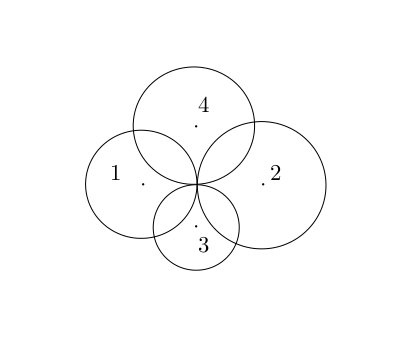 Figure 3
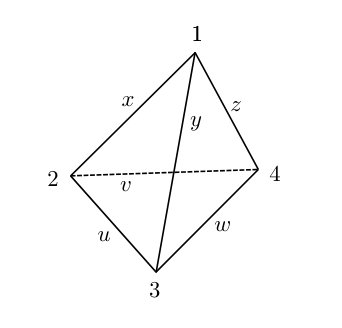 Figure 4
Peer Reviews
No public reviews on file for this paper yet. If you reviewed it on a platform where reviews are public (OpenReview, ICLR, NeurIPS, ICML), you can paste yours below so the community can read it here.
Videos
No videos yet. Explain this paper in a talk, walkthrough, or lecture? Add one.
Thurston’s sphere packings on 3-dimensional manifolds, I
Xiaokai He, Xu Xu
Abstract
Thurston’s sphere packing on a 3-dimensional manifold is an analogue of Thurston’s circle packing on a surface, the rigidity of which has been open for many years. In this paper, we prove that Thurston’s Euclidean sphere packing is locally determined by combinatorial scalar curvature up to scaling, which generalizes Cooper-Rivin-Glickenstein’s local rigidity for tangential sphere packing on 3-dimensional manifolds. We also prove the infinitesimal rigidity that Thurston’s Euclidean sphere packing can not be deformed (except by scaling) while keeping the combinatorial Ricci curvature fixed. The main tool used in the proof is a variational principle with the discrete Hilbert-Einstein functional as the action functional.
MSC (2010): 52C25; 52C26
**Keywords: ** Thurston’s sphere packing; Local rigidity; Infinitesimal rigidity
1 Introduction
In the study of hyperbolic metrics on 3-dimensional manifolds, Thurston ([35], Chapter 13) proved the Koebe-Andreev-Thurston theorem for circle packings with non-obtuse intersection angles on surfaces, the rigidity part of which states that a circle packing is determined by discrete curvatures on a triangulated surface. Thurston’s work generalizes Andreev’s work on the sphere [1, 2] and Koebe’s work [26] for tangential circle packing on the sphere. For a proof of Koebe-Andreev-Thurston theorem, see [4, 7, 10, 29, 30, 35, 39].
A longstanding problem is whether the circle packings on surfaces could be generalized to three or higher dimensional manifolds with the properties of circle packings on surfaces preserved, including the rigidity and existence. Cooper-Rivin [9] introduced the tangential sphere packing on a 3-dimensional manifold, which was proved to be locally rigid [9, 18, 19, 32] and globally rigid [36]. Glickenstein [20] and Thomas [34] studied the general discrete conformal deformations of -manifolds and obtained some rigidity results in some special cases. The deformations of tangential sphere packing metrics by discrete curvature flows were studied in [12, 13, 14, 15, 17, 16, 18, 19]. Thurston’s sphere packing on a -dimensional manifold is an analogue of Thusrton’s circle packing on a surface and a natural generalization of Cooper-Rivin’s tangential sphere packing on a -dimensional manifold, the rigidity of which has been open for many years. In this paper, we study the infinitesimal and local rigidity of Thurston’s Euclidean sphere packings on 3-dimensional manifolds.
Suppose is a 3-dimensional connected closed manifold with a triangulation , where the symbols represent the sets of vertices, edges, faces and tetrahedra, respectively. We denote a triangulated 3-manifold as and denote the simplices in as , where are vertices in .
Definition 1.1**.**
Suppose is a triangulated closed connected 3-dimensional manifold with a weight . Thurston’s Euclidean sphere packing metric is a map such that
(1)
The length of the edge between the vertices and is
[TABLE]
(2)
The lengths determine a nondegenerate Euclidean tetrahedron for each tetrahedron .
Remark 1**.**
Thurston’s sphere packing metric can also be defined for the hyperbolic background geometry with the length of the edge replaced by
[TABLE]
and the lengths determining a nondegenerate hyperbolic tetrahedron.
A triangulated 3-manifold with a weight is denoted as in the following. When , Thurston’s sphere packing metric is Cooper-Rivin’s tangential sphere packing metric [9]. In this paper, we focus on Thurston’s sphere packing metrics in Definition 1.1. For simplicity, we use Thurston’s sphere packing metrics to denote Thurston’s Euclidean sphere packing metrics in the following, if it causes no confusion in the context. The geometric meaning of Thurston’s sphere packing metric is as follows. Given a Thurston’s sphere packing metric on , a sphere of radius is attached to each vertex , with the intersection angle of attached to the end points of an edge given by . For each topological tetrahedron in , the sphere packing metric determines a nondegenerate Euclidean tetrahedron by Definition 1.1. Isometrically gluing the Euclidean tetrahedra along the faces gives rise to a piecewise linear -manifold, which has singularities along the edges and vertices. Here we use singularities to denote the points where the piecewise linear metric is not smooth. The combinatorial Ricci and scalar curvature are used to describe the singularities along the edges and vertices respectively.
Definition 1.2** ([31]).**
Suppose is a triangulated 3-manifold with a piecewise linear metric. The combinatorial Ricci curvature along the edge is defined to be
[TABLE]
where is the dihedral angle along the edge in the tetrahedron and the summation is taken over tetrahedra with as a common edge.
For a Riemannian manifold , Cheeger-Müller-Schrader [6] proved that converges in measure to the scalar curvature measure , where is the scalar curvature and is the volume form of .
We have the following infinitesimal rigidity for Thurston’s sphere packing with respect to the combinatorial Ricci curvature in Definition 1.2.
Theorem 1.3**.**
Suppose is a triangulated closed connected 3-manifold with a weight satisfying
[TABLE]
or
[TABLE]
Then Thurston’s sphere packings on can not be deformed (except by scaling) while keeping the combinatorial Ricci curvatures along the edges fixed.
Using the combinatorial Ricci curvature, one can further define the combinatorial scalar curvature for Thurston’s sphere packing metrics.
Definition 1.4** ([20]).**
Suppose is a weighted triangulated connected closed 3-manifold with a nondegenerate sphere packing metric . The combinatorial scalar curvature at a vertex for the sphere packing metric is defined to be
[TABLE]
where is the inner angle facing the edge with length in the triangle formed by three edges with lengths .
Remark 2**.**
The combinatorial scalar curvature in Definition 1.4 comes from the first variation of the Einstein-Hilbert functional with respect to Thurston’s sphere packing metrics. Please refer to Section 4 for more details. Glickenstein [20] once defined the combinatorial scalar curvature for general discrete conformal metrics on 3-manifolds. The combinatorial scalar curvature in Definition 1.4 is essentially the scalar curvature of Glickenstein divided by in the case of Thurston’s sphere packing metrics. If for any , then we have and , which is the combinatorial scalar curvature introduced by Cooper-Rivin [9]. Here is the solid angle at the vertex of the tetrahedron .
We have the following rigidity for Thurston’s sphere packings with respect to the combinatorial scalar curvature in Definition 1.4.
Theorem 1.5**.**
Suppose is a triangulated closed connected 3-manifold with a weight satisfying (1.2) or (1.3). If is a nondegenerate Thurston’s sphere packing metric on with , then there exists a neighborhood of such that the sphere packing metrics in are determined by combinatorial scalar curvatures up to scaling.
Theorem 1.5 is referred as the local rigidity for Thurston’s sphere packing, which means that Thurston’s sphere packing metric is locally parameterized by the combinatorial scalar curvatures. Note that there is a subtle difference between the notion of the infinitesimal rigidity in Theorem 1.3 and the notion of local rigidity in Theorem 1.5. For the combinatorial scalar curvature, the local rigidity of Thurston’s sphere packings implies the infinitesimal rigidity, which means that Thurston’s sphere packing on can not be deformed (except by scaling) while keeping the combinatorial scalar curvatures at the vertices fixed. For combinatorial Ricci curvature defined on the edges, Thurston’s sphere packings have infinitesimal rigidity by Theorem 1.3 and do not have local rigidity due to the dimension difference.
Remark 3**.**
The condition in Theorem 1.5 includes the case that with for the edge . Specially, if , there is no constraints on the combinatorial Ricci curvatures and Theorem 1.5 is reduced to the local rigidity of the tangential sphere packings in [9, 18, 19, 32]. Furthermore, the tangential sphere packings have global rigidity [36].
Corollary 1.6**.**
Suppose is a triangulated closed connected 3-manifold with a weight satisfying (1.2) or (1.3). If is a nondegenerate sphere packing metric on with for any , then there exists a neighborhood of such that the sphere packing metrics in are determined by the combinatorial scalar curvatures up to scaling.
The basic idea to prove Theorem 1.3 and Theorem 1.5 is using a variational principle with the discrete Hilbert-Einstein functional as the action functional. There are two main difficulties for the proof. The first difficulty comes from the connectedness of the admissible space of sphere packing metrics for a tetrahedron, i.e. Theorem 2.7, which is proved via the geometric center in Section 2. The main idea of the proof comes from a new proof [38] of Bowers-Stephenson conjecture for inversive distance circle packings on surfaces [5], which simplifies the proofs of the Bowers-Stephenson conjecture in [23, 28, 37]. The second difficulty comes from the negative semi-definiteness of discrete Laplacian for Thurston’s sphere packing metrics, i.e. Theorem 3.2, which is proved in Section 3 with the help of Glickenstein’s second variational formula for the discrete Hilbert-Einstein functional. The negative semi-definiteness is proved by the property of diagonally dominant matrix under the condition (1.2). While under the condition (1.3), the negative semi-definiteness is proved by continuity of eigenvalues of the discrete Laplacian and calculations of a 3-dimensional determinant which is quite difficult even in the tangential setting.
Note that the rigidity of Thurston’s sphere packings on closed 3-manifolds are not fully understood in Theorem 1.3 and Theorem 1.5. For example, very small, but not the same, perturbations of a tangential sphere packing are not allowed in Theorem 1.3 and Theorem 1.5, while the tangential sphere packings on closed 3-manifolds are proved to be globally rigid [36]. It is natural to ask whether the rigidity is true for all Thurston’s sphere packing metrics on closed 3-manifolds. Motivated by Theorem 1.3, Theorem 1.5 and the global rigidity for the tangential sphere packings in [36], we have the following conjecture on the rigidity of Thurston’s sphere packings on closed 3-manifolds.
Conjecture 1**.**
Suppose is a triangulated closed connected 3-manifold with a weight . In the space of Thurston’s sphere packing metrics on with , the sphere packing metric is determined by the combinatorial scalar curvature up to scaling.
Some constraints on the weight as that in Theorem 2.7 may be needed in Conjecture 1 to ensure that the admissible space of Thurston’s sphere packing metrics on a tetrahedron is simply connected. It is believed that the recent work of Doehrman-Glickenstein [11] will play a key role in the proof of Conjecture 1, especially in the proof of the negative semi-definiteness of discrete Laplacian for Thurston’s sphere packing metrics.
The paper is organized as follows. In Section 2, we prove the simply connectedness of the admissible space of Thurston’s sphere packing metrics for a tetrahedron, i.e. Theorem 2.7. In Section 3, we introduce the definition of discrete Laplacian for Thurston’s sphere packing metrics and prove its negative semi-definiteness, i.e. Theorem 3.2. In Section 4, using Glickenstein’s variational formulas for general discrete conformal variations of piecewise flat 3-manifolds and the negative semi-definiteness of discrete Laplacian, we prove the main results, i.e. Theorem 1.3 and Theorem 1.5.
Acknowledgements The authors thank the referee for reading the paper carefully, and providing many valuable and helpful comments, which help to improve the paper significantly. The work was started in March 2017 and finished when the first author was visiting University of British Columbia and the second author was visiting Rutgers University. The second author thanks Professor Feng Luo for his invitation to Rutgers University and communications and interesting on this work and thanks Professor Tian Yang for communications. The first author was supported by the Grant of NSF of Hunan province no. 2018JJ2073. The second author was supported by Hubei Provincial Natural Science Foundation of China under grant no. 2017CFB681, Fundamental Research Funds for the Central Universities and National Natural Science Foundation of China under grant no. 61772379 and no. 11301402.
2 Admissible space of Thurston’s sphere packing metrics for a tetrahedron
In this section, we study the admissible space of Thurston’s sphere packing metrics for a tetrahedron . Denote the vertices set, edge set and face set of the tetrahedron as and respectively. Set
[TABLE]
which is the Cayley-Menger matrix.
Theorem 2.1** ([3]).**
A Euclidean tetrahedron with edge lengths is nondegenerate in if and only if the lengths satisfy the triangle inequalities for each face and where is the determinant.
It is proved [3] that is a positive scalar multiplication of the square of the volume of the tetrahedron generated by . Furthermore, the triangle inequalities on the faces are satisfied if and only if the minors of containing the -entry are negative [3]. To simplify the notations, we set
[TABLE]
See Figure 1 for the notations. By direct calculations, we have
[TABLE]
where
[TABLE]
If the edge lengths are given by (1.1) with weights in , the triangle inequalities on the faces are satisfied ([35] Lemma 13.7.2, [37, 39]). By Theorem 2.1, we have the following criteria for non-degeneracy of Thurston’s sphere packing metrics.
Corollary 2.2**.**
A tetrahedron generated by a Thurston’s sphere packing metric is nondegenerate in if and only if .
For the following applications, set
[TABLE]
Note that there are some trivial cases that, for any , the tetrahedron generated by the sphere packing metric degenerates. For example, if the weights on the edges of the tetrahedron satisfy and , then it is straight forward to check for any , which implies the tetrahedron degenerates by Corollary 2.2. Geometrically, the conditions and mean that two pairs of tangential attached spheres meet orthogonally. Please refer to Figure 2 for a configuration of the four spheres. We can also choose another pair of opposite edges with weight and the other edges with weight [math], in which case the tetrahedron also degenerates for any . We will prove that these are the only exceptional cases that the admissible space of Thurston’s sphere packing metrics for a tetrahedron is empty.
Set as the set of weights on the edges of the tetrahedron with value on a pair of opposite edges and value [math] on the other edges, i.e.
[TABLE]
We require the weight on the edges to be a map with in the following, where . Set
[TABLE]
By Corollary 2.2, is a degenerate Thurston’s sphere packing metric if and only if the corresponding satisfies
[TABLE]
Remark 4**.**
Similar decomposition of in (2.5) appears in [18, 19] for tangential sphere packings. in (2.4) is closely related to the signed distance of the geometric center of the tetrahedron to the face . More precisely, if the tetrahedron is nondegenerate, we have
[TABLE]
where is the area of the triangle and is the volume of the tetrahedron. Please refer to Subsection 3.1 for the definition of geometric center and signed distance and refer to Subsubsection 3.2.1 for the derivation of the formula (2.6). Note that is defined only for nondegenerate sphere packing metrics, while is defined for any .
Suppose is a degenerate Thurston’s sphere packing metric for a tetrahedron , which implies by Corollary 2.2. In this case, we will prove none of is zero. Furthermore, only one of is negative and the others are positive.
Note that could be written as a quadratic inequality of
[TABLE]
with
[TABLE]
Lengthy direct calculations show that the discriminant is
[TABLE]
Note that
[TABLE]
for any and , which is in fact the square of the area of the triangle up to a positive factor [23, 37, 39]. We have the following lemma on the discriminant .
Lemma 2.3**.**
If , then the discriminant .
**Proof. **To check the positivity of the discriminant , we just need to check the negativity of the following function
[TABLE]
By direct calculations, we have
[TABLE]
which implies
[TABLE]
Denote the last function in (2.9) as . Taking the derivative of with respect to gives
[TABLE]
which implies
[TABLE]
By the condition , we have , which implies . Therefore, the discriminant .
Remark 5**.**
If we take as a quadratic function of , , results similar to Lemma 2.3 hold for .
Lemma 2.4**.**
Suppose is a degenerate Thurston’s sphere packing metric on the tetrahedron with the weight . Then none of is zero.
**Proof. **We prove the lemma by contradiction. If one of is zero, there should be another of which is nonpositive by (2.5). Without loss of generality, we assume and . By , we have
[TABLE]
where we have used the fact that and are all nonnegative. Eq.(2.10) implies that If , we take as a quadratic inequality of . Then we have by Lemma 2.3, which implies
[TABLE]
Therefore, by the definition of in (2.4), we have
[TABLE]
respectively, which contradicts to . Therefore, we have
[TABLE]
which implies
[TABLE]
by (2.10). By (2.11), at least one of is positive. Without loss of generality, we assume . Then we have and by (2.12), which implies or .
Note that is equivalent to
[TABLE]
In the case , (2.13) is equivalent to
[TABLE]
which is impossible. In the case , we have by (2.11). Then (2.13) is equivalent to
[TABLE]
which implies . This contradicts the condition . This completes the proof.
Remark 6**.**
Lemma 2.4 implies that, for a degenerate Thurston’s sphere packing metric on a tetrahedron with the weight , the geometric center can never lie in the planes determined by the faces.
By (2.5), Corollary 2.2 and Lemma 2.4, at least one of is negative and the others are nonzero if is a degenerate Thurston’s sphere packing metric on the tetrahedron. Furthermore, we have the following result.
Lemma 2.5**.**
Suppose is a degenerate Thurston’s sphere packing metric on a tetrahedron with . Then there exists no subset such that and .
**Proof. **Without loss of generality, we assume and . Then we have
[TABLE]
and
[TABLE]
which implies
[TABLE]
and the following function
[TABLE]
is positive.
We claim that under the condition and . Then the proof of the lemma follows by contradiction. The proof of the claim is as follows.
is decreasing in , which is obvious. Therefore, we have
[TABLE]
Denote the last function in (2.14) of as . By direct calculations, we have
[TABLE]
Therefore
[TABLE]
Denote the last function in (2.15) as . Note that Therefore
[TABLE]
In summary, we have
[TABLE]
This completes the proof of the claim.
Combining Lemma 2.4 and Lemma 2.5, we have the following proposition.
Proposition 2.6**.**
Suppose is a degenerate Thurston’s sphere packing metric on a tetrahedron with . Then one of is negative and the others are positive.
Remark 7**.**
Combining with Remark 4, Proposition 2.6 has an interesting geometric explanation as follows. Suppose a nondegenerate tetrahedron becomes degenerate as Thurston’s sphere packing metric , where is the admissible space of Thurston’s sphere packing metrics for a given weight with and is the boundary of in . Then the volume of the tetrahedron goes to zero as . Without loss of generality, we can assume by Proposition 2.6. By Remark 4, we have . This implies that, as , the geometric center and the tetrahedron will lie in different half spaces relative to the plane determined by the face , while and the tetrahedron will lie in the same half spaces relative to the planes determined by the faces .
Now we can prove the main result of this section.
Theorem 2.7**.**
Suppose is a tetrahedron of . Then the admissible space of Thurston’s sphere packing metrics for a given weight with is a simply connected nonempty set.
**Proof. **Suppose is a degenerate sphere packing metric, then the corresponding satisfies (2.5). By Proposition 2.6, one of is negative and the others are positive. Without loss of generality, we assume . Then we have by the definition of . Take as a quadratic inequality of , where are given by (2.7). As , we have by Lemma 2.3. Therefore,
[TABLE]
Note that is equivalent to by definition of . Therefore, , which implies and .
In the case , we set
[TABLE]
which is a closed domain in bounded by an analytic graph on and contained in . are defined similarly, if the corresponding . Note that are mutually disjoint by Lemma 2.5, if they are nonempty.
If for and for , then the space of degenerate sphere packing metrics is . The corresponding admissible space of sphere packing metric is
[TABLE]
which is nonempty. Note that is homotopy equivalent to because are mutually disjoint and bounded by analytic graphs on . This implies that, for any fixed weight with , the admissible space of sphere packing metrics is simply connected.
Corollary 2.8**.**
Suppose is a tetrahedron of . is a weight on with . Then the admissible space if and only if all of the inequalities
[TABLE]
are true. Specially, if
[TABLE]
for any face , then the admissible space of Thurston’s sphere packing metrics is .
**Proof. **The first part of Corollary 2.8 follows from the proof of Theorem 2.7. For the second part, note that
[TABLE]
For , we have
[TABLE]
Therefore, if we have and . Similarly, if
[TABLE]
we have respectively.
Remark 8**.**
The condition (2.16) in Corollary 2.8 includes the case that . Furthermore, the condition (2.16) allows some of the intersection angles to take values in . However, the cases illustrated in Figure 2 should be excluded.
Remark 9**.**
The simply connectedness of the admissible space of tangential sphere packing metrics for a tetrahedron was first proved by Cooper-Rivin [9]. The second author [36] gave a different proof of the simply connectedness with an explicit description of the boundary of the admissible space. Ge-Jiang-Shen [13] and Ge-Hua [12] gave some new viewpoints on the method in [36] for tangential sphere packings. The proof of Theorem 2.7 for Thurston’s sphere packing metrics unifies the proofs for simply connectedness in [13, 36]. This method was applied to prove the simply connectedness of the admissible space of Thurston’s hyperbolic sphere packing metrics for a tetrahedron [25]. This method has also been applied to give a new proof of the Bowers-Stephenson conjecture for the inversive distance circle packings on triangulated surfaces [38], which simplifies the proofs of the Bowers-Stephenson conjecture in [23, 28, 37].
Using , we can further define the following 10-dimensional set
[TABLE]
where we take as a function of and .
Corollary 2.9**.**
The set is connected.
The proof of Corollary 2.9 follows easily from Theorem 2.7, the connectedness of together with the continuity of and is almost the same as that of Lemma 2.8 in [38], so we omit the proof of Corollary 2.9 here.
If is a connected subset of , we can also define
[TABLE]
Similar to Corollary 2.9, we have
Corollary 2.10**.**
The set is connected.
3 Discrete Laplacian of Thurston’s sphere packing metrics
3.1 Definition of Discrete Laplacian
If a nondegenerate tetrahedron is generated by a Thurston’s sphere packing metric, then the tetrahedron can be assigned a geometric center and a geometric dual structure as follows. Suppose is a nondegenerate Euclidean tetrahedron generated by a sphere packing metric. Then every pair of spheres attached to the vertices determines a unique plane perpendicular to the edge . is the plane determined by the circle if , otherwise it is the common tangent plane of and if the two spheres are externally tangent. Then the six planes associated to the six edges intersect at a common point [21], which is called the geometric center of the tetrahedron . Projections of the center to the four faces generate the four centers of the four faces respectively. The centers of the faces could be further projected to the edges to generate the edge centers of the edges respectively, which are the intersections of edges and the corresponding perpendicular planes. Note that the geometric center may not be in the tetrahedron . The signed distance of to is denoted by , which is positive if is on the same side of the plane determined by the face as the tetrahedron, otherwise it is negative (or zero if the center is in the plane determined by ). Similarly, we can define the signed distance of the center to the edge . The signed distance of to vertex is and the signed distance of to vertex is . Obviously, we have . For Thurston’s sphere packing metrics,
[TABLE]
The dual of the edge in the tetrahedron is defined to be the planar quadrilateral determined by and the dual area of the edge in the tetrahedron is defined to be the signed area of the planar quadrilateral determined by , i.e.
[TABLE]
For a weighted triangulated 3-manifold with a nondegenerate Thurston’s sphere packing metric, we can also define the dual area of the edge , which is
[TABLE]
where the summation is taken over the tetrahedra with as a common edge. Please refer to [18, 19, 20, 21, 22] for more information on geometric center and geometric dual in general cases. Using the geometric dual, the discrete Laplacian for Thurston’s sphere packing metrics is defined as follows.
Definition 3.1** ([20]).**
Suppose is a triangulated 3-manifold with a weight . The discrete Laplacian of a nondegenerate sphere packing metric is defined to be a linear map such that
[TABLE]
for any , where is the dual area of the edge given by (3.2).
The discrete Laplacian could be defined for more general discrete conformal geometric structures [20, 21] and graphs [8].
3.2 Negative semi-definiteness of the discrete Laplacian
We will prove that the discrete Laplacian is negative semi-definite for a large class of Thurston’s sphere packing metrics on 3-manifolds.
Theorem 3.2**.**
Suppose is a triangulated closed connected 3-manifold with a weight satisfying (1.2) or (1.3). Then the discrete Laplacian for Thurston’s sphere packing metrics is negative semi-definite with one dimensional kernel .
Under the condition (1.2), the negative semi-definiteness of the discrete Laplacian is proved using the property of diagonally dominant matrix. While under the condition (1.3), the negative semi-definiteness of the discrete Laplacian is proved by the continuity of the eigenvalue of the discrete Laplacian on a connected domain. As the proofs of negative semi-definiteness of the discrete Laplacian under the condition (1.2) and condition (1.3) are different, we present the proofs separately.
3.2.1 Proof of Theorem 3.2 under the condition (1.2)
**Proof. **By the Definition 3.1 of discrete Laplacian, for , we have
[TABLE]
The negative semi-definiteness of the discrete Laplacian is equivalent to
[TABLE]
An approach to prove the negative semi-definiteness of is to prove , . Recall that
[TABLE]
To prove , we just need to prove , , and . Note that and can be computed by
[TABLE]
and
[TABLE]
where is the inner angle at the vertex of the triangle and is the dihedral angle along the edge in the tetrahedron . See [20, 21] for (3.3) and (3.4).
To simplify the notations, we denote Submitting and into (3.3), we have
[TABLE]
where is the area of the triangle , and . Note that this is the result obtained in Lemma 2.5 of [37] with a different definition of . Here we compute it directly.
It is straight forward to check that by the condition . Furthermore, if and only if and , which corresponds to and . Therefore, under the condition (1.2), we have .
To compute , take a unit sphere at , which determines a spherical triangle with edge lengths , , and opposite inner angles , , respectively. By the spherical cosine law, we have
[TABLE]
where and are the areas of triangles and respectively. Submitting (1.1), (3.5), (3.6) into (3.4), after lengthy calculations, we have
[TABLE]
where is the volume of the tetrahedron and the formula is used in the calculations. Similar to the proof of Corollary 2.8, we have under the condition (1.2). This completes the proof of Theorem under the condition (1.2).
3.2.2 Proof of Theorem 3.2 under the condition (1.3)
For a generic weight , could be negative or zero. See [19] for an example in the tangential case. The method in Subsubsection 3.2.1 no longer works. In this case, we take the discrete Laplacian as a matrix , where
[TABLE]
Note that where is a matrix defined for a tetrahedron with
[TABLE]
and is the matrix extended by zeroes to a matrix so that the matrix acts on a vector only on the coordinates corresponding to the vertices in . This notation is taken from [21]. Therefore, to prove the discrete Laplacian is negative semi-definite, we just need to prove each matrix is negative semi-definite. Following Glickenstein’s approach in Appendix of [19], we have the following result for the matrix .
Proposition 3.3**.**
Suppose is a nondegenerate tetrahedron generated by Thurston’s sphere packing metrics with a weight . Then and the kernel of is .
As the proof of Proposition 3.3 is tedious direct calculations and not the main part of paper, we put it in Appendix 5.
Proof of Theorem 3.2 under the condition (1.3) As , to prove is negative semi-definite, we just need to prove that the three nonzero eigenvalues of are negative for any and any , where
[TABLE]
with
[TABLE]
It is straight forward that is connected, which implies is connected by Corollary 2.10. Especially, for and , we have . By (3.5) and (3.7), we have , which implies is negative semi-definite with rank by the the proof in Subsubsection 3.2.1. Therefore three nonzero eigenvalues of are negative.
By Proposition 3.3, the rank of is 3 for any . Combining the continuity of eigenvalues and the connectedness of in Corollary 2.10, we have three nonzero eigenvalues of are negative for any . This implies the negative semi-definiteness of and .
The kernel of is follows from the connectedness of the manifold and the kernel of is for any .
4 Rigidity of Thurston’s sphere packing
Recall the definition of discrete Hilbert-Einstein functional
[TABLE]
By the Schläfli formula, we have , which implies
[TABLE]
Further calculations show
[TABLE]
which implies
[TABLE]
where
[TABLE]
[TABLE]
Recall the following important result of Glickenstein.
Theorem 4.1** ([20], Theorem 31).**
Suppose is a nondegenerate tetrahedron generated by a sphere packing metric . Set . Then we have
(1)
if , then
[TABLE]
(2)
[TABLE]
Remark 10**.**
For the case of Euclidean tangential sphere packings on 3-dimensional manifolds, Theorem 4.1 was first proved by Glickenstein [18]. Theorem 4.1 is valid for much more general discrete conformal variations introduced by Glickenstein [20], including the inversive distance sphere packing [5, 20, 21] and vertex scaling [27, 33] on three dimensional manifolds. Please refer to [20, 22] for more details.
Applying Theorem 4.1 to (4.1), we have
[TABLE]
where and is the matrix corresponding to the discrete Laplacian. By direct calculations, we have
[TABLE]
embedded as a matrix, which is positive semi-definite and has as a null vector. Therefore,
[TABLE]
By Theorem 3.2, is in the kernel of , which implies has a zero eigenvalue for any sphere packing metric.
Proof of Theorem 1.5 If is a sphere packing metric with , then and the kernel of is by (4.2) and Theorem 3.2. Therefore, has a zero eigenvalue and nonzero eigenvalues. Note that has a zero eigenvalue with eigenvector for any sphere packing metric . Therefore, there exists a convex neighborhood of such that and the kernel of is for any .
Suppose there are two different sphere packing metrics and in such that . Set Then we have
[TABLE]
By , we have . Furthermore,
[TABLE]
by in , which implies is nondecreasing for . By , we have and in , which implies by the fact that the kernel of is for any .
For a generic Thurston’s sphere packing metric, we have the following result, which is equivalent to Theorem 1.3.
Theorem 4.2**.**
Suppose is a triangulated closed connected 3-manifold with a weight satisfying (1.2) or (1.3). Any nondegenerate Thurston’s sphere packing metric admits a neighborhood such that if has the same combinatorial Ricci curvature as , then for some positive constant .
**Proof. **We take the modified discrete Hilbert-Einstein functional
[TABLE]
as a function of . By direct calculations, we have
[TABLE]
It is straight forward to check that , which implies that . Furthermore, , which is positive semi-definite with kernel . This implies that at .
Note that the rank of a symmetric matrix is the number of nonzero eigenvalues. By the continuity of the eigenvalues and , there is a convex neighborhood of such that and is positive semi-definite with kernel for any .
Note that
[TABLE]
If for some , then we have Define then is a convex function on by . implies , which gives on . Then we have which implies that by is positive semi-definite with kernel .
5 Appendix: Proof of Proposition 3.3
In this appendix, we describe a proof of Proposition 3.3. By the definition of , is in the kernel of . We just need to show that . Set
[TABLE]
then (3.5) and (3.6) can be rewritten as
[TABLE]
Moreover, can be calculated as
[TABLE]
where we have used the fact Set then we have
[TABLE]
Combining (5.1), (5.2) with(3.1) gives
[TABLE]
Let Then
[TABLE]
the numerator and denominator of which are polynomials of .
In order to show , we just need to prove that a -dimensional minor of is nonzero, which is a complicated symbolic calculation. Denote the determinant of the minor of the matrix by , which is the submatrix of with the -th row and the -th column removed. We will show that if the Euclidean tetrahedron is nondegenerate as follows.
Let then for . Set
[TABLE]
to kill the denominator of . Without loss of generality, one can set by the scaling property of and . Direct calculations show that the nondegenerate condition is , where
[TABLE]
Therefore, the nondegenerate condition is equivalent to . The calculations of and are accomplished with the help of Mathematica. We provide the full Mathematica codes and the relevant outputs of those codes as an ancillary file (determinant1.pdf) with the arXiv version of this paper [24].
Set
[TABLE]
Direct calculations with the help of Mathematica show , which implies is equivalent to under the condition that the tetrahedron is nondegenerate. The decomposition of is accomplished again with the help of Mathematica. The result is
[TABLE]
With the help of Mathematica, we give all the graphs and expressions of the coefficient functions for , which shows that the coefficients are non-positive when and not all zero at the same value of . Therefore, we have if the sphere packing metric is nondegenerate, which completes the proof of Proposition 3.3. For the calculations of , decomposition of and graphs and expressions of , we provide the full Mathematica codes and the relevant outputs of those codes as an ancillary file (determinant2.pdf) with the arXiv version of this paper [24].
Here we give the full expression of for some special weights. When ,
[TABLE]
which coincides with the result obtained by Glickenstein [18, 19] for tangential sphere packing metrics. If ,
[TABLE]
In Proposition 3.3, we only prove the case that the intersection angles are all the same for any edge due to the computer performance. However, it is conceivable that Proposition 3.3 is true for any weight . If Proposition 3.3 is true for any weight , then Theorem 1.3 and Theorem 1.5 are true for any weight .
The reference list from the paper itself. Each links out to its DOI / PubMed record.
- 1[1] E. M. Andreev, On convex polyhedra of finite volume in Lobac̆evskiĭ spaces , Math. USSR-Sb. 12 (1970), 255-259.
- 2[2] E. M. Andreev, On convex polyhedra in Lobac̆evskiĭ spaces , Math. USSR-Sb. 10 (1970), 412-440.
- 3[3] L. M. Blumenthal. Theory and Applications of Distance Geometry . Clarendon Press, Oxford, 1953.
- 4[4] A.I. Bobenko, B.A. Springborn, Variational principles for circle patterns and Koebe’s theorem , Trans. Amer. Math. Soc. 356 (2) (2004) 659-689.
- 5[5] P. L. Bowers, K. Stephenson, Uniformizing dessins and Belyĭ maps via circle packing . Mem. Amer. Math. Soc. 170 (2004), no. 805
- 6[6] J. Cheeger, W. Müller, R. Schrader On the curvature of piecewise flat spaces . Comm. Math. Phys. 92 (1984), no. 3, 405-454.
- 7[7] B. Chow, F. Luo, Combinatorial Ricci flows on surfaces , J. Differential Geom. 63 (2003), no. 1, 97-129.
- 8[8] F.R.K. Chung. Spectral Graph Theory , CBMS Regional Conference Series in Mathematics, 92. American Mathematical Society, Providence, RI, 1997.