Collider Constraints on $Z^\prime$ Models for Neutral Current $B-$Anomalies
B.C. Allanach, J.M. Butterworth, Tyler Corbett

TL;DR
This paper analyzes collider data to constrain $Z'$ models proposed for explaining neutral current $B$-anomalies, finding significant bounds on model parameters from LHC measurements and $B_s$ mixing.
Contribution
It provides the first comprehensive collider constraints on simple $Z'$ models addressing $B$-anomalies, including the impact of LHC SM measurements and specific model bounds.
Findings
The MDM model is strongly constrained by ATLAS di-muon searches.
The MUM model faces weaker collider constraints.
In the Third Family Hypercharge Model, $Z'$ mass must exceed 1.2 TeV based on combined constraints.
Abstract
We examine current collider constraints on some simple models that fit neutral current anomalies, including constraints coming from measurements of Standard Model (SM) signatures at the LHC. The `MDM' simplified model is not constrained by the SM measurements but {\em is} strongly constrained by a 139 fb 13 TeV ATLAS di-muon search. Constraints upon the `MUM' simplified model are much weaker. A combination of the current mixing constraint and ATLAS' search implies TeV in the Third Family Hypercharge Model example case. LHC SM measurements rule out a portion of the parameter space of the model for TeV.
Click any figure to enlarge with its caption.
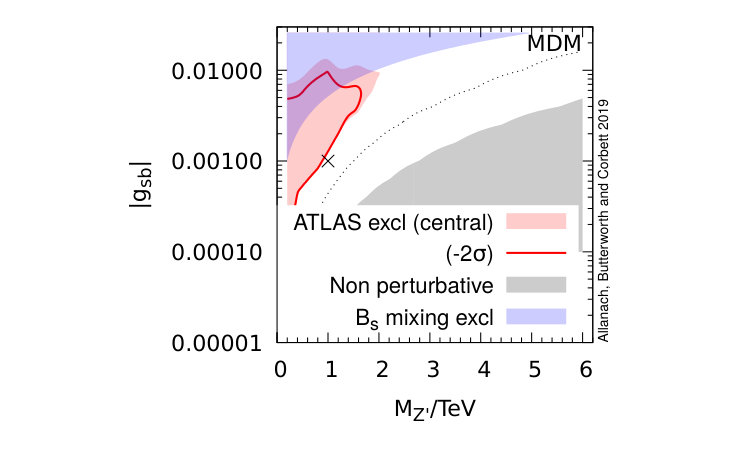 Figure 1
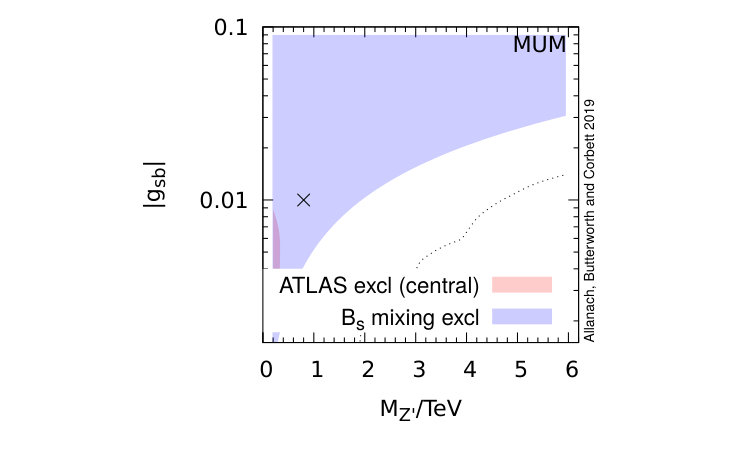 Figure 2
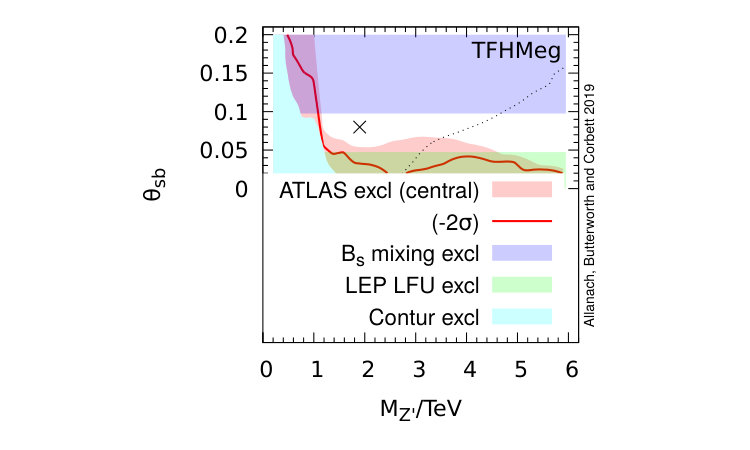 Figure 3
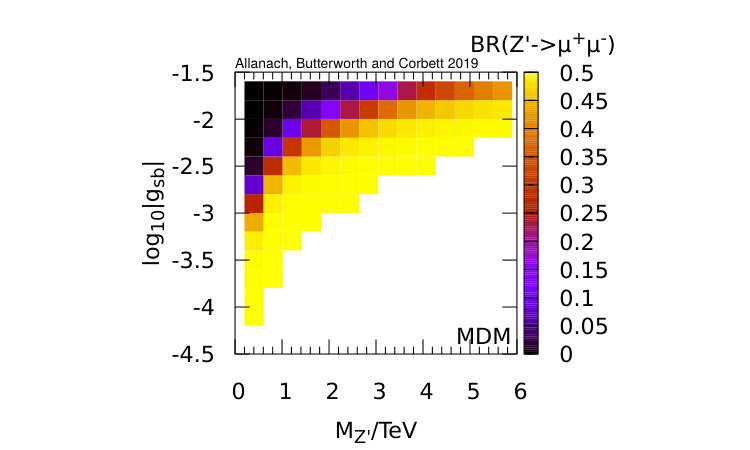 Figure 4
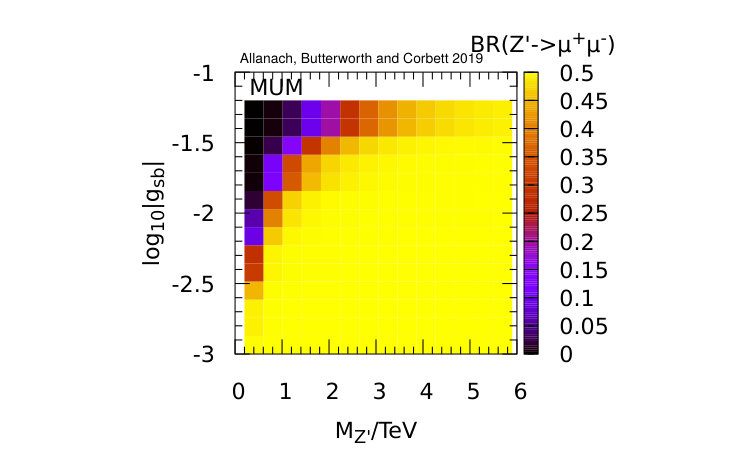 Figure 5
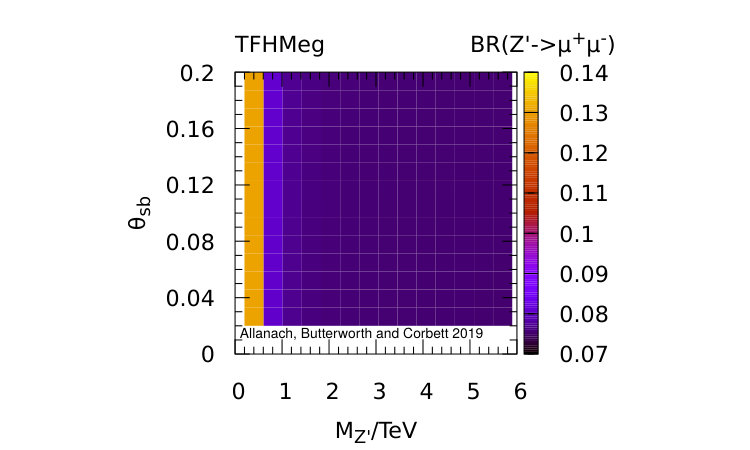 Figure 6
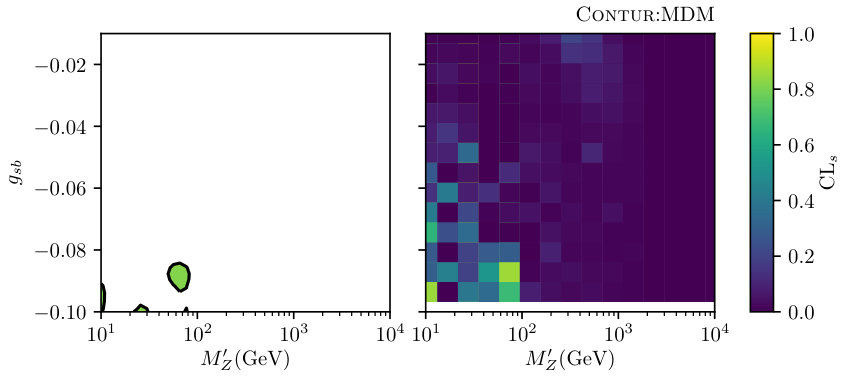 Figure 7
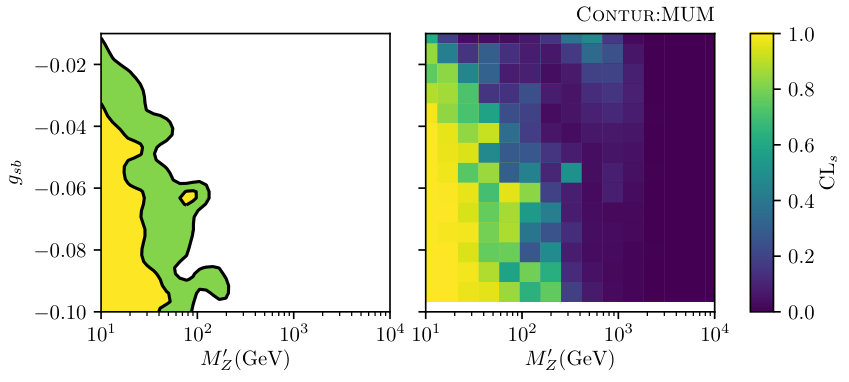 Figure 8
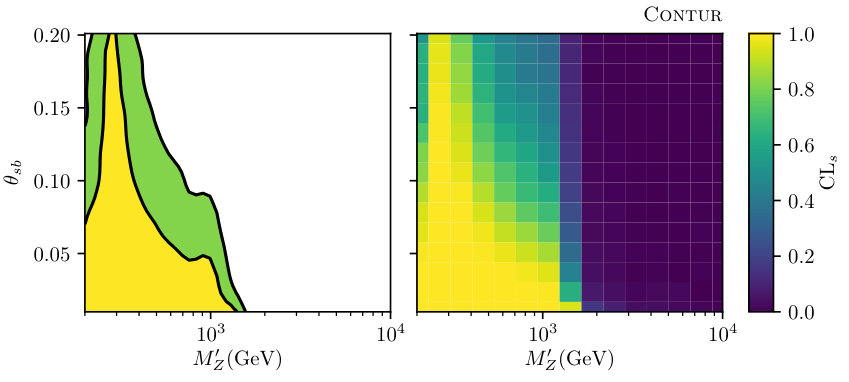 Figure 9
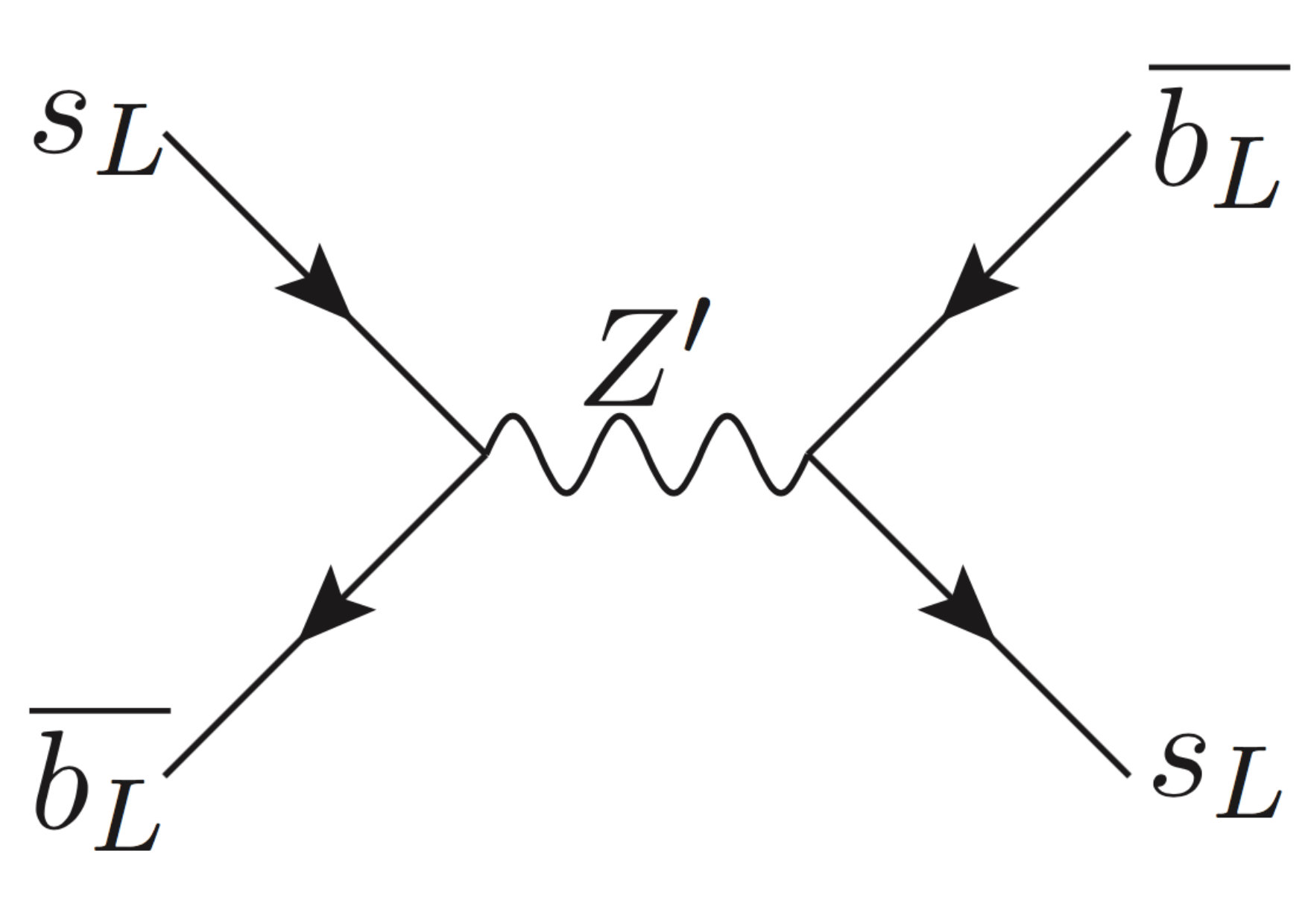 Figure 1
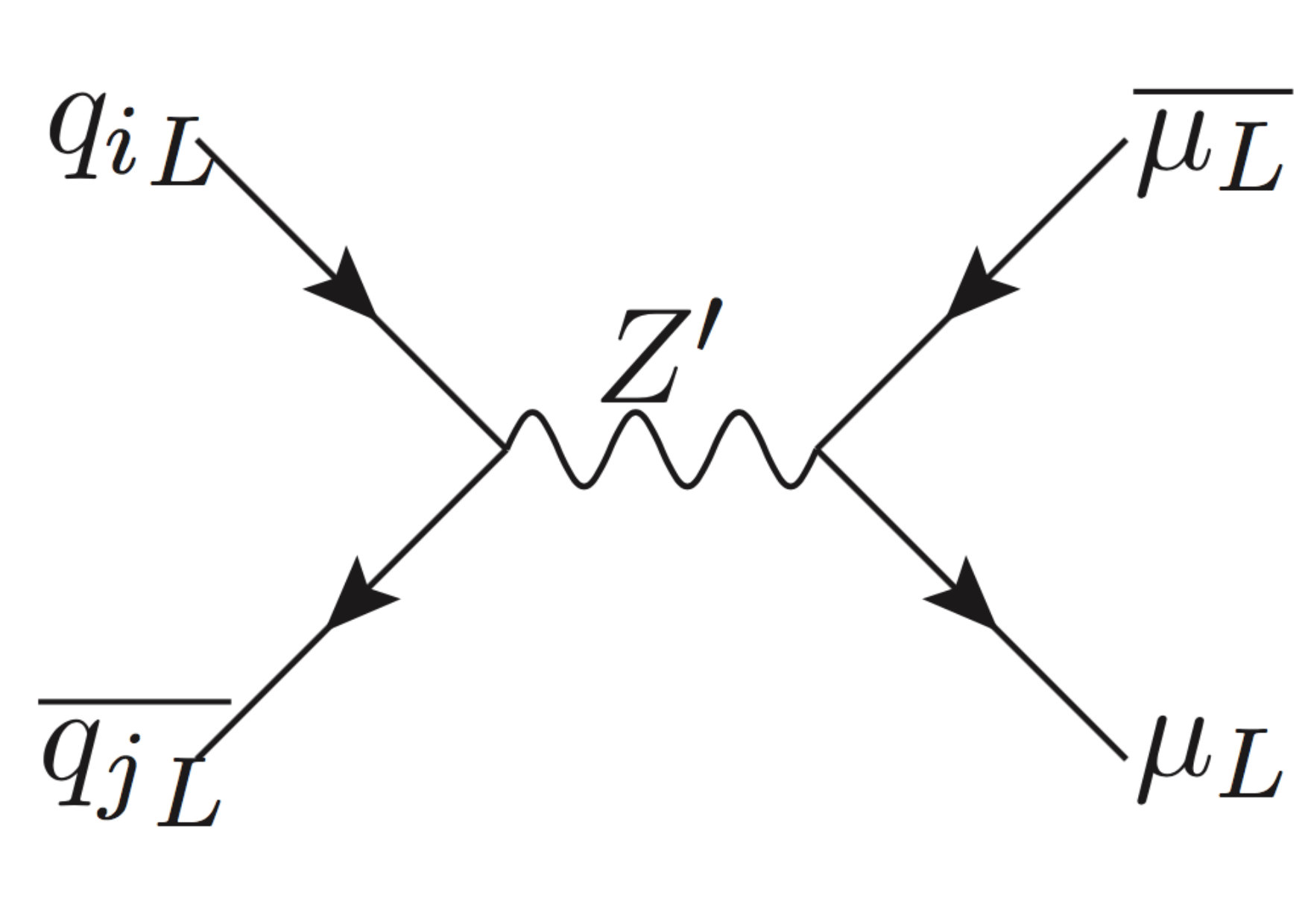 Figure 3
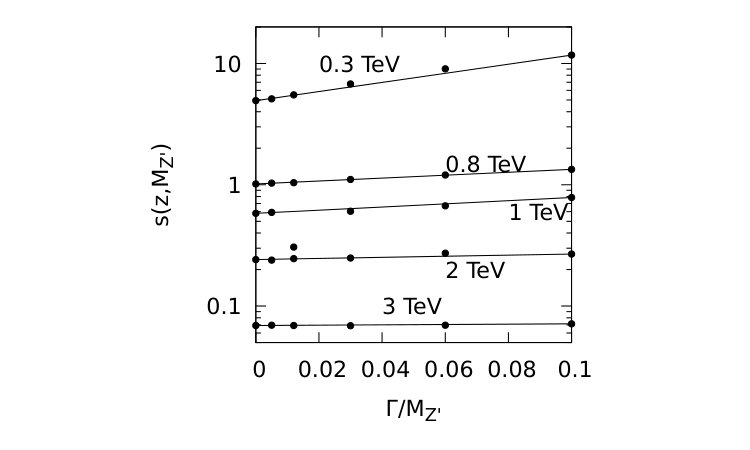 Figure 12
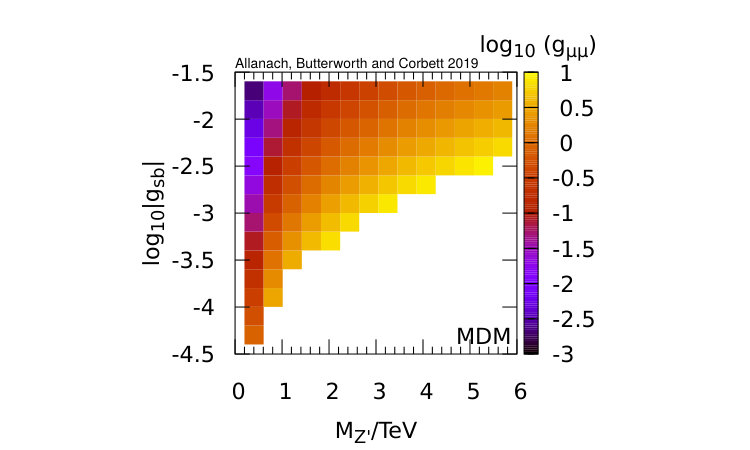 Figure 13
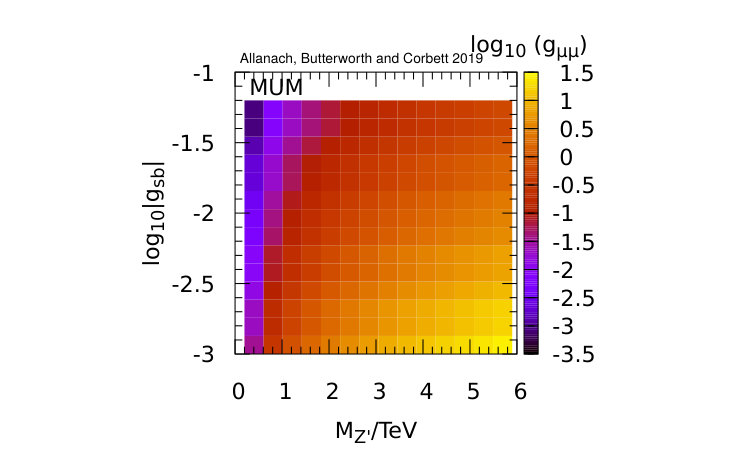 Figure 14
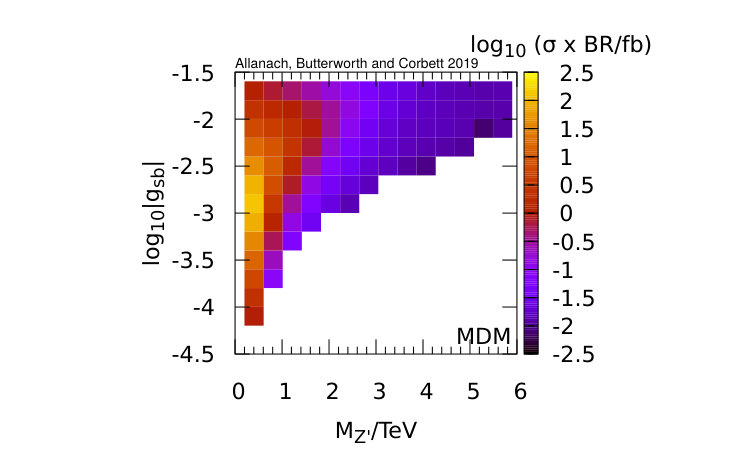 Figure 15
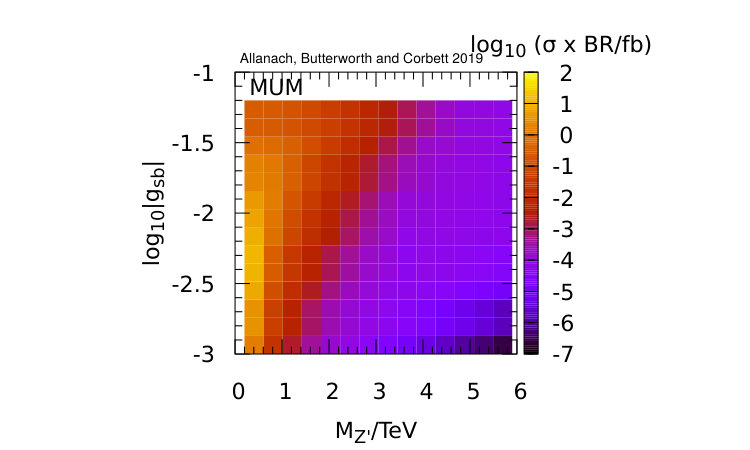 Figure 16
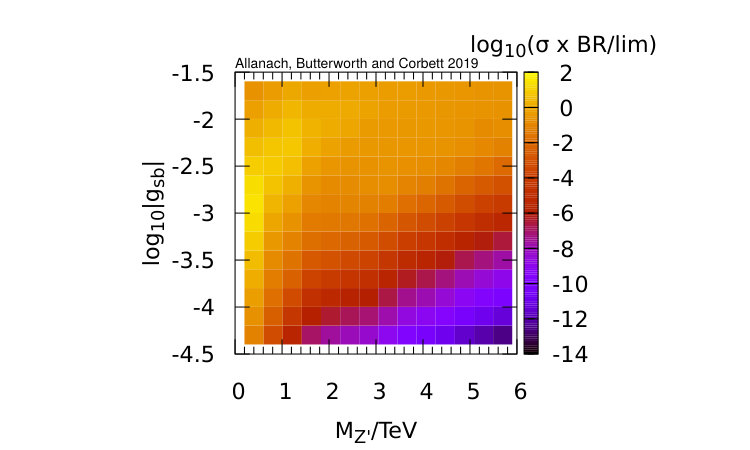 Figure 17
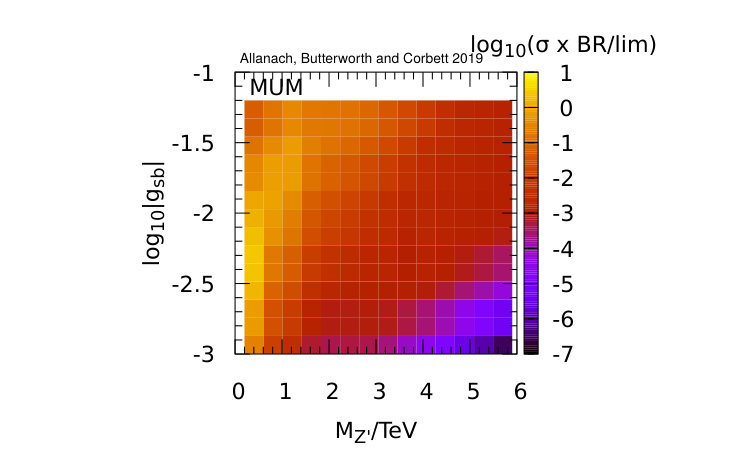 Figure 18
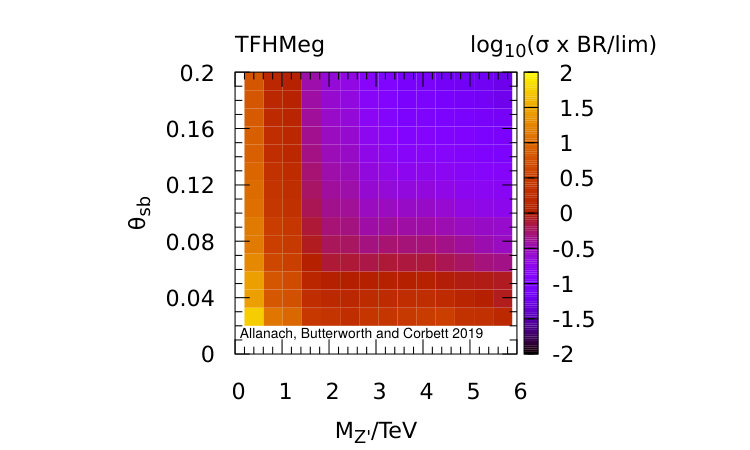 Figure 19
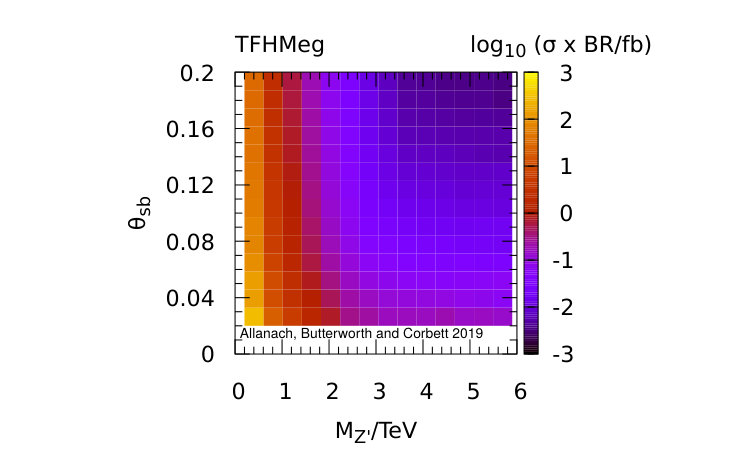 Figure 20
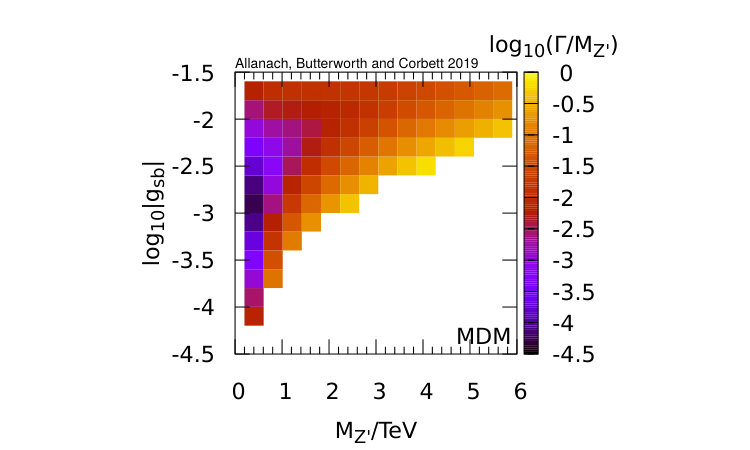 Figure 21
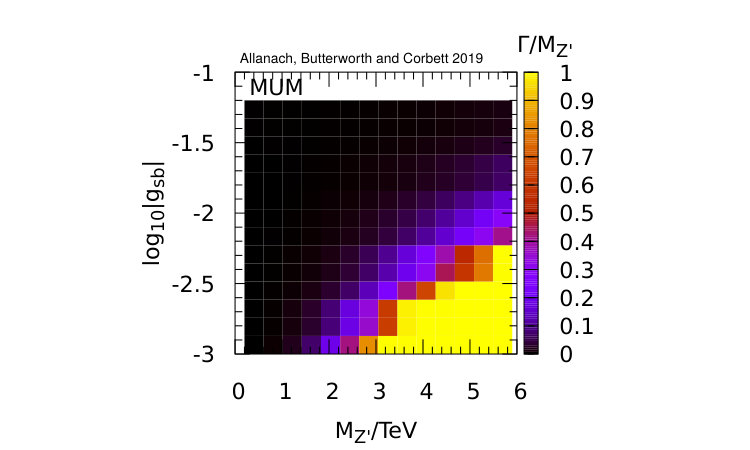 Figure 22
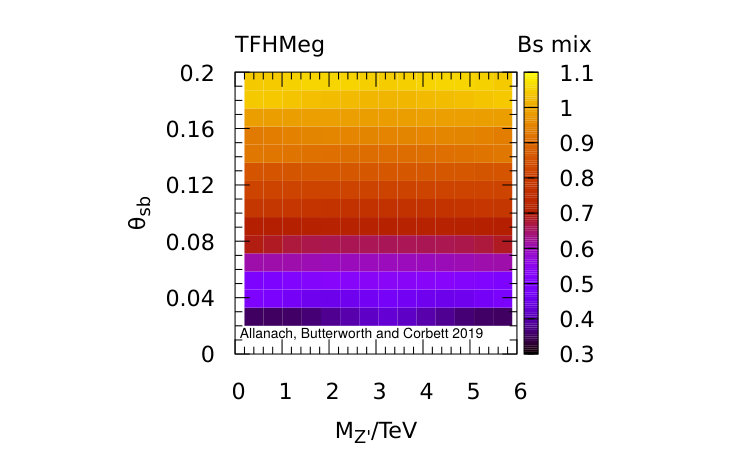 Figure 23
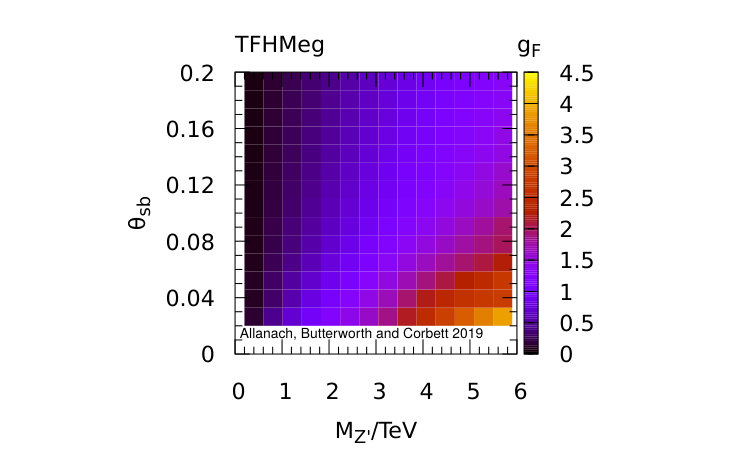 Figure 24
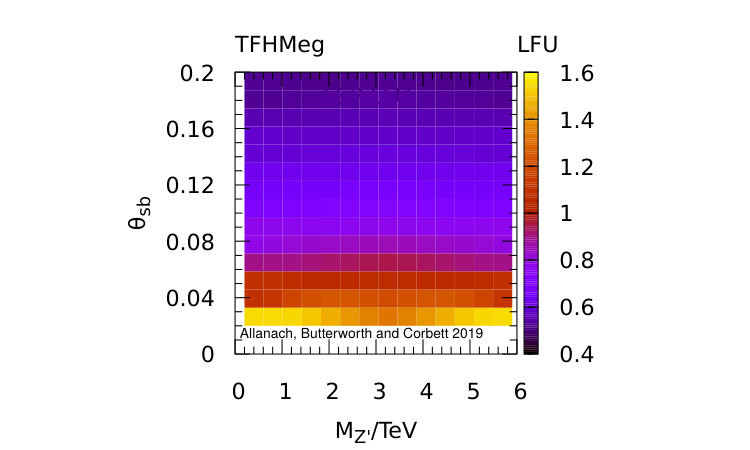 Figure 25
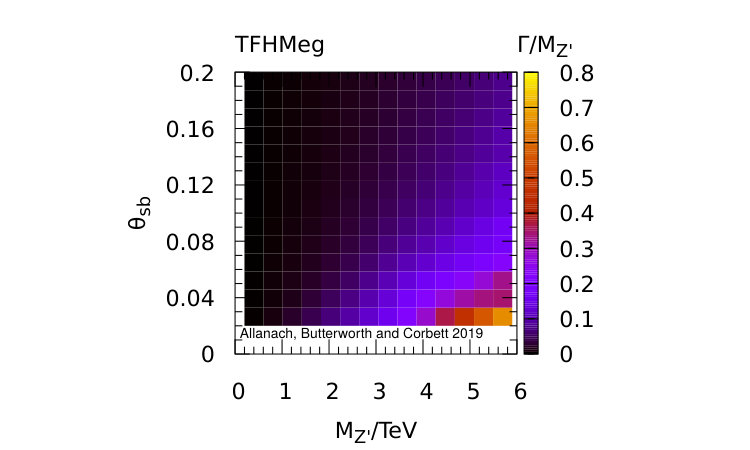 Figure 26
| MDM | MUM | TFHMeg | |||
|---|---|---|---|---|---|
| parameter | value | parameter | value | parameter | value |
| 1 TeV | 0.8 TeV | 1.9 TeV | |||
| -0.001 | 0.01 | 0.08 | |||
| 0.82 | -0.052 | 0.67 | |||
| quantity | value | quantity | value | quantity | value |
| 0.018 | 8.4 | 0.020 | |||
| 0.50 | 0.43 | 0.08 | |||
| 1.3 | 2.6 | 0.42 | |||
| 1.3 | 0.09 | 0.13 | |||
| 0.04 | 0.30 | ||||
| channel | /fb | channel | /fb | channel | /fb |
| 0.31 | 0.13 | ||||
| 0.001 | 0.45 | 0.001 | |||
| 0.002 | |||||
| total | 0.31 | total | 0.45 | total | 0.13 |
| upper limit | 0.37 | upper limit | 0.92 | upper limit | 0.25 |
| Channel | |||||
|---|---|---|---|---|---|
| /fb | 0.02 | 0.08 | 0.07 | 0.03 | 0.02 |
Peer Reviews
No public reviews on file for this paper yet. If you reviewed it on a platform where reviews are public (OpenReview, ICLR, NeurIPS, ICML), you can paste yours below so the community can read it here.
Videos
No videos yet. Explain this paper in a talk, walkthrough, or lecture? Add one.
aainstitutetext: DAMTP, University of Cambridge, Wilberforce Road, Cambridge, CB3 0WA, United Kingdombbinstitutetext: Department of Physics & Astronomy, University College London, Gower St, London, WC1E 6BT, United Kingdomccinstitutetext: The Niels Bohr International Academy, Blegdamsvej 17, University of Copenhagen, DK-2100 Copenhagen, Denmark
Collider Constraints on
Models for Neutral Current Anomalies
B.C. Allanach b
J. M. Butterworth c
Tyler Corbett111Corresponding author.
Abstract
We examine current collider constraints on some simple models that fit neutral current anomalies, including constraints coming from measurements of Standard Model (SM) signatures at the LHC. The ‘MDM’ simplified model is not constrained by the SM measurements but is strongly constrained by a 139 fb*-1* 13 TeV ATLAS di-muon search. Constraints upon the ‘MUM’ simplified model are much weaker. A combination of the current mixing constraint and ATLAS’ search implies TeV in the Third Family Hypercharge Model example case. LHC SM measurements rule out a portion of the parameter space of the model for TeV.
††preprint: MCnet-19-08
1 Introduction
Data involving the effective Lagrangian operator are currently disagreeing with Standard Model (SM) predictions. Each individual measurement typically disagrees at the 2-3 level and over many measurements, a coherent picture is emerging. In particular are predicted to be 1.00 in the SM, for lepton invariant mass squared bin GeV2. In this bin, current LHCb measurements Aaij:2017vbb ; CERN-EP-2019-043 imply and . The branching ratio Aaboud:2018mst ; Chatrchyan:2013bka ; CMS:2014xfa ; Aaij:2017vad is also measured to be lower than the SM prediction, which should be accurate to the percent level. Angular distributions in the decays have Aaij:2013qta ; Aaij:2015oid ; ATLAS-CONF-2017-023 ; CMS-PAS-BPH-15-008 a higher level of disagreement with SM predictions Khachatryan:2015isa ; Bobeth:2017vxj , although here theoretical uncertainties in the SM prediction are significant. There are several other indications of disagreements between SM predictions and measurements and broadly speaking, the data are consistent with a beyond-the-SM (BSM) contribution to the vertex Altmannshofer:2013foa ; Altmannshofer:2014rta ; Altmannshofer:2017yso ; Ciuchini:2017mik ; Capdevila:2017bsm ; Geng:2017svp ; DAmico:2017mtc ; DiChiara:2017cjq . We call these disagreements between measurements and SM predictions the Neutral Current Anomalies (NCBAs). Measurements of relevant quantities from Belle II with different systematic uncertainties are eagerly awaited Albrecht:2017odf , as are updates from the LHC experiments.
The operators giving BSM contributions favoured by fits to the flavour data are
[TABLE]
where and are Wilson coefficients, with dimensions of inverse mass squared. There have been several global fits of such BSM operators that explain recent data involving : Alguero:2019ptt ; Alok:2019ufo ; Ciuchini:2019usw ; Aebischer:2019mlg ; Kowalska:2019ley ; Arbey:2019duh . Details of the fit methodology and results vary, but they all find that a fit involving and can provide a significant improvement over a poor fit to the SM. There is evidence against sizeable BSM operators involving and in the global fits. For definiteness, we shall use the results of the fit of Ref. Aebischer:2019mlg . There, only provides a good fit to NCBA data (6.5 better than the SM prediction). A vector-like coupling (i.e. ) to muons is a 5.8 better fit than the SM at the best-fit point, whereas an axial coupling () coupling to muons is 5.6 better than the SM at the best-fit point.
At tree-level, a BSM contribution to or can come from leptoquarks and/or s, either of which must have flavour dependent couplings. Here, we shall focus on the possibility. Many models based on spontaneously broken flavour-dependent gauged symmetries Ellis:2017nrp ; Allanach:2018vjg have been proposed from which such s may result, for example from and related groups Gauld:2013qba ; Buras:2013dea ; Buras:2013qja ; Altmannshofer:2014cfa ; Buras:2014yna ; Crivellin:2015mga ; Crivellin:2015lwa ; Sierra:2015fma ; Crivellin:2015era ; Celis:2015ara ; Greljo:2015mma ; Altmannshofer:2015mqa ; Allanach:2015gkd ; Falkowski:2015zwa ; Chiang:2016qov ; Becirevic:2016zri ; Boucenna:2016wpr ; Boucenna:2016qad ; Ko:2017lzd ; Alonso:2017bff ; Alonso:2017uky ; 1674-1137-42-3-033104 ; Bonilla:2017lsq ; Bhatia:2017tgo ; Ellis:2017nrp ; CHEN2018420 ; Faisel:2017glo ; PhysRevD.97.115003 ; Bian:2017xzg ; PhysRevD.97.075035 ; King:2018fcg ; Duan:2018akc ; Allanach:2018lvl ; Allanach:2018odd . Some models also have several abelian groups Crivellin:2016ejn leading to multiple s. Some other models Kamenik:2017tnu ; Camargo-Molina:2018cwu generate the operator with a loop-level penguin diagram.
In Ref. Chivukula:2017qsi , Run I di-jet and di-lepton resonance searches (and early Run II searches) were used to constrain simple models that fit the NCBAs. In Refs. Allanach:2017bta ; Allanach:2018odd , the sensitivity of future hadron colliders to models that fit the NCBAs was estimated. A 100 TeV future circular collider (FCC) Mangano:2018mur would have sensitivity to the whole of parameter space for one model (MDM) and the majority of parameter space for another (MUM). However, given recent updates on LHC searches released by the ATLAS experiment and on the NCBAs, it seems that the time is ripe for a fresh analysis of the resulting constraints upon models that fit the NCBAs.
ATLAS has released 13 TeV 36.1 fb*-1* searches Aaboud:2018mjh ; Aaboud:2019roo , which impose fb for large . There is also a search Aad:2015osa for for 10 fb*-1* of 8 TeV data, which rules out fb for large . These searches constrain, in principle, some of the flavourful models that we introduce below, but they produce less stringent constraints upon the models that we study than an ATLAS search for in 139 fb*-1* of 13 TeV collisions Aad:2019fac . We shall therefore concentrate upon this search, recasting it for some models that solve the NCBAs. The constraints are in the form of upper limits upon the fiducial cross-section times branching ratio to di-muons as a function of . At large TeV, fb atlasData and indeed this will prove to be the most stringent direct search constraint (being stronger than the others mentioned above) on the models which we study.
In § 2, we introduce simplified models which can provide a good fit to the NCBAs, examining the important mixing constraint in § 2.1. In § 2.2, we define the mixed-up muon (MUM) and mixed-down muon (MDM) simplified models, followed by the more complete Third Family Hypercharge Model (TFHM). In § 3, we describe how we recast the ATLAS search and outline how other Run I and Run II measurements are checked against the model. Example parameter space points for each model are listed for illustration in § 4, before the combined collider constraints upon the models are presented. We summarise in § 5. In Appendix A we define the fields. Properties of the three models studied throughout their parameter space are relegated to Appendix B.
2 Models and Constraints
We consider two representative models of s, following Ref. Allanach:2017bta , which introduced the naïve and the models. The tree-level Lagrangian couplings that should be present in models in order to explain the NCBAs are
[TABLE]
A global fit to NCBAs and in Ref. Aebischer:2019mlg found that the couplings and masses of particles are constrained to be
[TABLE]
if and are real, where in the recent fit to the NCBAs from Ref. Aebischer:2019mlg . Throughout this paper, we shall enforce Eq. 3, typically taking the central value from the fit. In general, and are complex. However, here, we take to be real and positive and to be negative. In the models we introduce below, may have a small imaginary part. Since the full effects of complex phases are outside the scope of this work, whenever we refer to below, we shall implicitly refer to the real part of its value.
2.1 mixing constraint
models are subject to a number of constraints, a particularly strong one originating from measurements of mixing, which constrains a function of and . A Feynman diagram depicting the contribution is shown in Fig. 1. The bound on a non-SM contribution depends upon the hadronic decay constant and bag parameter . The experimental measurement of the mixing parameter is Amhis:2016xyh . We use a determination of the SM prediction using recent lattice data and sum rules King:2019lal
[TABLE]
In order to calculate the resulting bound on models, we follow Ref. DiLuzio:2017fdq . In a model inducing the BSM operator
[TABLE]
where GeV*-2* is the Fermi coupling constant, the SM prediction of mixing is modified to , where . Our flavour changing s induce the Wilson coefficient
[TABLE]
takes renormalisation between and into account. It is a slow (logarithmic) function of : for TeV, whereas for TeV (we shall be concerned here with TeV). Here, we shall take whatever , since this value gives the stronger limit out of the two numbers quoted and since is quite insensitive to anyway. Eq. 4 implies the 2 lower bound ps*-1*, leaving room for a BSM contribution to make up a shortfall to the experimental upper bound if (by substituting into Eq. 6)222This inferred bound has changed in recent years due to changes in data and lattice inputs: pre-2016, the denominator was TeV DAmico:2017mtc , whereas from 2016-2019 the inferred denominator became 600 TeV DiLuzio:2017fdq .
[TABLE]
This places a strong constraint upon models that explain the NCBAs DiLuzio:2017fdq .
2.2 Model definitions and couplings
Following Ref. Allanach:2018odd , we begin with simplified models originating from assuming that the only couples to left-handed quarks and to left-handed leptons. Our direct search collider constraints are not strongly dependent upon the spin-structure of the couplings and so this model should suffice to cover others (for example sharing the BSM operator between left-handed and right-handed muons). The couplings to the mass eigenstate fermions in the model are
[TABLE]
where we have written the Cabibbo-Kobayashi-Maskawa (CKM) matrix as and the Pontecorvo-Maki-Nakagawa-Sakata matrix as (see Appendix 2.2 for field definitions). and are 3 by 3 matrices of dimensionless couplings. In order to reproduce a coupling to left-handed muons, as required to fit the anomalies, we use
[TABLE]
The two simplified models introduced involve two different limiting assumptions for , in order to provide an estimate of how much the assumption changes predictions:
The ‘mixed-up-muon’ (MUM) model, with
[TABLE] 2. 2.
The ‘mixed-down-muon’ (MDM) model, with
[TABLE]
Matching here with Eq. 2 identifies
[TABLE]
In the present article, we are not concerned with the effects of small complex phases: we shall take to be real333Although we include the effects of phases in the CKM matrix in our numerical simulations, they are not important for our results and we ignore them in analytic discussion.. ensures as required by Eq. 3, since and .
We may characterise the MUM and MDM simplified models by three important parameters: , and . In practice, we shall use and , whilst fixing so as to fit the central values of the NCBAs in Eq. 3. We note here that, since the MUM and MDM models are simplified, in reality the might have more couplings than the ones introduced and so could be wider than predicted in the strict MUM or MDM limit. One could, instead of calculating the width , use the MUM or MDM limit as a lower bound and allow it to vary independently of and . We expect that increasing will weaken search constraints, and so in some sense, neglecting this ‘additional width’ effect (which is the approach we shall take) is conservative.
The Third Family Hypercharge Model (TFHM) is based Allanach:2018lvl on a gauge extension to the Standard Model, only the Higgs doublet, a new complex scalar SM singlet and third family fermions have non-zero quantum numbers. The heavy comes from spontaneously breaking the and it is thus a more complete model than the MUM and MDM models. The model explains, in broad brush-strokes, the hierarchical heaviness of the third family of charged fermions and the smallness of CKM mixing angles. Anomaly cancellation implies that the quantum numbers of the third family fields are proportional to their hypercharges. The couplings are, up to corrections
[TABLE]
where we have defined the 3 by 3 dimensionless Hermitian coupling matrices
[TABLE]
and
[TABLE]
The are unitary 3 by 3 matrices in family space and is the dimensionless gauge coupling of . For definiteness, we shall examine the phenomenological example case introduced in Ref. Allanach:2018lvl :
[TABLE]
, . To summarise, in the TFHM example case (TFHMeg), we have free parameters , and . In practice, we vary and , setting so as to satisfy the central value of the NCBAs, i.e. Eq. 3, which translates to
[TABLE]
with .
3 Re-casting Collider Constraints
In its recent search, ATLAS defines Aad:2019fac a fiducial cross-section where each muon has transverse momentum GeV and pseudo-rapidity . The di-muon invariant mass, GeV. No evidence for a significant bump in was found, and so 95 upper limits on .
Re-casting constraints from such a bump-hunt in different models is fairly simple: we must just calculate for the model in question and apply the bound at the relevant value of and . Efficiencies are taken into account in the experimental bound and so there is no need for us to perform a detector simulation. For generic , we interpolate/extrapolate the upper bound on from those given by ATLAS at and . In practice, we use a linear interpolation in :
[TABLE]
Fig. 2 shows examples of such a fit for five different values of compared to ATLAS upper limits. One point not lying on the line is due to a statistical fluctuation in data, but generally, the figure validates Eq. 18 as being a reasonable fit within the range . In general, we shall also use Eq. 18 to extrapolate out of this range, however this will only turn out to play a rôle in part of the TFHMeg parameter space, which we shall delineate.
For the TFHMeg, we made a UFO file444The UFO file is included in the ancillary information submitted with the arXiv version of this paper. by using FeynRules Degrande:2011ua ; Alloul:2013bka . The MUM model and MDM model files are taken from Ref. Allanach:2018odd . These UFO files allow the MadGraph calculation of by MadGraph_2_6_5 Alwall:2014hca . MadGraph estimates of the tree-level production processes shown in Fig. 3 in 13 TeV centre of mass energy collisions. We use 5-flavour parton distribution functions in order to re-sum the logarithms associated with the initial state -quark Lim:2016wjo .
3.1 Constraints from Contur
Introducing the BSM terms discussed above leads to other possible new processes and signatures in collisions in addition to the di-muon channel already considered. For example, in the TFHMeg model, the has a branching fraction in the range 10-20% to , up to 40% to and 20-30% to . It is often produced in association with additional -jets, and the cross section for associated production with an isolated photon can be as high as a few femtobarns. Many relevant measurements of such signatures have already been made by the LHC experiments, and we use the Contur Butterworth:2016sqg tool to check whether these measurements already disfavour any of the parameter space of our model. We use Herwig7 Bellm:2015jjp ; Bellm:2017bvx and its UFO interface to calculate the cross section for all the new processes implied at the LHC by our models, and to inclusively generate the implied events. These events are then passed to Rivet Buckley:2010ar version 2.7, which contains an extensive library of particle-level collider measurements, especially from LHC Run I but also increasingly now from Run II. While these will not be as sensitive as individual searches using the full data set, they have the advantage of relative model-independence and ease of reinterpretation. All these measurements are in agreement with the SM, and Contur therefore treats them as SM background to a potential contribution from our models, evaluating whether the presence of an additional BSM contribution (in particular a mass peak) would have been visible within the experimental uncertainty. This is then converted into an exclusion limit. Previous studies Butterworth:2016sqg ; Brooijmans:2018xbu ; Amrith:2018yfb have shown that this approach typically gives a comparable sensitivity to dedicated searches and can sometimes pick up unexpected additional signatures.
4 Results
In Table 1, we display one point for each model studied, where the model parameters are chosen to fit the NCBAs and to be close to the exclusion of the ATLAS di-muon search in each case. We see that each point has a narrow : (however, there are other points with larger values, as we shall see). In each model, the branching ratio into neutrinos is identical to that of muons and tagging an additional jet would result in a monojet invisible signature at the LHC. In the MUM model, we note the possible flavour changing channels , , which could also be used for searches. In the TFHMeg, decays to top pairs are 6 times more prevalent than those into muon pairs, which could prove to be an important channel for searches, as could decays into tau pairs (4 times more prevalent than muon pairs). Although these channels have a higher branching ratio than di-muons, the current bounds are sufficiently weaker such that di-muons (the only channel currently having been analysed for the full 139 fb*-1* LHC Run II dataset) provide the strongest constraint. The table is instructive by exemplifying which PDFs are important for production in each case. In the MDM model and the TFHMeg, dominates, whereas in the MUM model, dominates. The upper limit from the ATLAS di-muon search is shown for the particular of the parameter point, for the narrow width limit. In what follows, we include the dependence of these upper limits upon the width, as described in § 3.
Fig. 4a displays the collider constraints on the MDM model. We see that the bounds from the ATLAS di-muon search rule out a significant portion of parameter space that fits the central value of the NCBAs and is otherwise allowed. The shape of the various regions shown in Fig. 4a can be understood by looking at the properties of the model across parameter space, as shown in Fig. 6.
Since the is produced through the quark coupling, the higher , the higher the production cross-section, although it is suppressed by higher values of through the PDFs, as shown in Fig. 6c. Fitting the NCBAs means that is small at small and large , as displayed by Fig. 6d. This region has small , as Fig. 6b shows, which limits the exclusion of the ATLAS di-muon search in the top left-hand corner of Fig. 4a. Conversely, the region with large and small requires such a large value of that the model becomes non-perturbative (where the width is equal to or larger than the mass), and we could not trust our results there. Fortunately, this does not impact any of the bounds we have derived.
Constraints on the MUM model are summarised in Fig. 4b. We see here that the mixing constraint already covers all of the region which the ATLAS di-muon search excludes (which is hardly visible in the plot), in contrast to the MDM model shown in Fig. 4a. The production processes do not benefit from the large contribution present in the MDM model, as Table 1 illustrates. This is essentially because the MDM model has a coupling i.e. enhanced by . We may understand the shape of the ATLAS constraint by referring to Fig. 7 in Appendix B: the branching ratio into muons increases for smaller and larger , which competes with the cross-section which increases toward the top left-hand corner of Fig. 4b. Everywhere that the ATLAS di-muon constraints are active, the is narrow.
Combined constraints on the TFHMeg are shown in Fig. 4c. We see that the ATLAS di-muon search has a strong effect on the parameter space when combined with the mixing constraint: TeV, for a central fit to the NCBAs. The region excluded by LEP flavour universality was calculated in Ref. Allanach:2018lvl , and occurs because the picks up small differences in its couplings to electrons as compared to muons due to mixing. The model is non-perturbative for TeV Allanach:2018lvl . The white region is a relatively small portion of parameter space, but really one should take the weaker limits at ‘’, given the possibility of statistical variations of the fit to the NCBAs. The region to the right-hand side of the dotted line has , and so involves an extrapolation of the fit to data given in Eq. 18 for this region (rather than an interpolation).
Contur exclusion limits are displayed at the left-hand side of the figure and the excluded region is marked ‘Contur excl’. There are no such exclusion limits in the parameter region shown for MDM or MUM, as the detailed Contur plots in Fig. 5 show. The Contur constraints show ‘due diligence’, in that the interesting parameter space is not yet ruled out by a large number of LHC SM measurements. Even though some measurements do receive BSM contributions to the fiducial cross section (for example the ATLAS 13 TeV Aaboud:2018eki and 8 TeV di-lepton-plus-di-jet measurements Aaboud:2016ftt , and the CMS 13 TeV measurement Khachatryan:2016mnb ), the measurement precision is not yet sufficient to have a strong exclusion impact. Such exclusion as there is comes mainly from the ATLAS 8 TeV high-mass Drell-Yan measurement Aad:2016zzw , and thus does not have the reach of the 13 TeV full Run II search.
5 Summary
Our focal results are the combined dominant constraints on models (the MUM model, the MDM model and the TFHMeg) which fit the NBCAs and are shown in Fig. 4. The mixing constraint is important, as well as a recent ATLAS search, performed on 139 fb*-1* of 13 TeV LHC collisions. The ATLAS search is probing the otherwise allowed parameter space of the MDM simplified model, and we may expect the TeV HL-LHC to increase coverage of the parameter space Allanach:2017bta ; Allanach:2018odd . On the other hand, the MUM simplified model is currently more constrained by the mixing constraint, and likely will require an increase in energy Allanach:2017bta ; Allanach:2018odd (for example to HE-LHC CidVidal:2018eel or FCC,Mangano:2018mur ) for di-muon searches to probe the remaining parameter space. The mixing constraint is particularly constraining, but there has been significant movement on it in the last four years, mainly due to different estimates of the SM contribution. The 95 bound has been TeV, respectively. We might therefore expect further movement upon the bound in the future, and this could have a large impact on the constraints. Taking the current bound of 194 TeV at face value, we extract (from the ‘(-2)’ bounds in Fig. 4c and from Fig. 8b) that fb in the TFHMeg at a centre of mass energy TeV. The lower bound is saturated for TeV, . At TeV, we estimate (from this point) the minimum cross-sections in Table 2. Since the nominal integrated luminosity for the HL-LHC is fb*-1*, we may expect at least signal events. We are therefore hopeful of the TFHMeg HL-LHC search prospects555Background estimates, which are beyond the scope of this work, would be required to properly calculate the sensitivity..
Acknowledgements
This work has been partially supported by STFC consolidated grants ST/P000681/1 and ST/N000285/1. BCA and JMB thank the (Re)interpreting the results of new physics searches at the LHC workshop, where part of this work was carried out. BCA thanks A Lenz and the Cambridge SUSY Working Group for discussions. This work has received funding from the European Union’s Horizon 2020 research and innovation programme as part of the Marie Skłodowska-Curie Innovative Training Network MCnetITN3 (grant agreement no. 722104).
Appendix A Field Definitions
We use the following field definitions in terms of representations of : , , , where bold face denotes a 3-dimensional vector in family space. These fields are implicitly written in the mass eigenbasis.
Appendix B Properties of the Models
We display the Contur constraints on the different models in Fig. 5. There are essentially no constraints upon the MDM model, whereas the MUM model is somewhat constrained for GeV. The strongest constraints are upon the TFHMeg, which extend to TeV, for low (where is high).
We display some properties of the MDM model across parameter space in Fig. 6, some of the MUM model in Fig. 7 and some of the TFHMeg in Fig. 8.
The reference list from the paper itself. Each links out to its DOI / PubMed record.
- 1(1) LH Cb Collaboration, R. Aaij et. al. , Test of lepton universality with B 0 → K ∗ 0 ℓ + ℓ − → superscript 𝐵 0 superscript 𝐾 absent 0 superscript ℓ superscript ℓ B^{0}\rightarrow K^{*0}\ell^{+}\ell^{-} decays , JHEP 08 (2017) 055 [ 1705.05802 ].
- 2(2) LH Cb Collaboration Collaboration, Search for lepton-universality violation in B + → K + ℓ + ℓ − → superscript 𝐵 superscript 𝐾 superscript ℓ superscript ℓ B^{+}\to K^{+}\ell^{+}\ell^{-} decays , Tech. Rep. CERN-EP-2019-043. LHCB-PAPER-2019-009, CERN, Geneva, Mar, 2019.
- 3(3) ATLAS Collaboration, M. Aaboud et. al. , Study of the rare decays of B s 0 subscript superscript 𝐵 0 𝑠 B^{0}_{s} and B 0 superscript 𝐵 0 B^{0} mesons into muon pairs using data collected during 2015 and 2016 with the ATLAS detector , JHEP 04 (2019) 098 [ 1812.03017 ].
- 4(4) CMS Collaboration, S. Chatrchyan et. al. , Measurement of the B s 0 → μ + μ − → subscript superscript 𝐵 0 𝑠 superscript 𝜇 superscript 𝜇 B^{0}_{s}\to\mu^{+}\mu^{-} Branching Fraction and Search for B 0 → μ + μ − → superscript 𝐵 0 superscript 𝜇 superscript 𝜇 B^{0}\to\mu^{+}\mu^{-} with the CMS Experiment , Phys. Rev. Lett. 111 (2013) 101804 [ 1307.5025 ].
- 5(5) CMS, LH Cb Collaboration, V. Khachatryan et. al. , Observation of the rare B s 0 → μ + μ − → subscript superscript 𝐵 0 𝑠 superscript 𝜇 superscript 𝜇 B^{0}_{s}\to\mu^{+}\mu^{-} decay from the combined analysis of CMS and LH Cb data , Nature 522 (2015) 68–72 [ 1411.4413 ].
- 6(6) LH Cb Collaboration, R. Aaij et. al. , Measurement of the B s 0 → μ + μ − → subscript superscript 𝐵 0 𝑠 superscript 𝜇 superscript 𝜇 B^{0}_{s}\to\mu^{+}\mu^{-} branching fraction and effective lifetime and search for B 0 → μ + μ − → superscript 𝐵 0 superscript 𝜇 superscript 𝜇 B^{0}\to\mu^{+}\mu^{-} decays , Phys. Rev. Lett. 118 (2017), no. 19 191801 [ 1703.05747 ].
- 7(7) LH Cb Collaboration, R. Aaij et. al. , Measurement of Form-Factor-Independent Observables in the Decay B 0 → K ∗ 0 μ + μ − → superscript 𝐵 0 superscript 𝐾 absent 0 superscript 𝜇 superscript 𝜇 B^{0}\to K^{*0}\mu^{+}\mu^{-} , Phys. Rev. Lett. 111 (2013) 191801 [ 1308.1707 ].
- 8(8) LH Cb Collaboration, R. Aaij et. al. , Angular analysis of the B 0 → K ∗ 0 μ + μ − → superscript 𝐵 0 superscript 𝐾 absent 0 superscript 𝜇 superscript 𝜇 B^{0}\to K^{*0}\mu^{+}\mu^{-} decay using 3 fb -1 of integrated luminosity , JHEP 02 (2016) 104 [ 1512.04442 ].