CoRoT: The First Space-Based Transit Survey to Explore the Close-in Planet Population
Magali Deleuil, Malcolm Fridlund

TL;DR
CoRoT was the first space-based mission dedicated to exoplanet discovery and asteroseismology, successfully identifying numerous planetary systems, brown dwarfs, and candidates, and pioneering data organization for future missions.
Contribution
It was the first space mission to discover rocky exoplanets and close-in brown dwarfs, establishing a legacy for future European exoplanet missions.
Findings
Discovered 37 planetary systems and brown dwarfs.
Identified about 100 planet candidates.
Collected 177,454 light curves over 6 years.
Abstract
The CoRoT (COnvection, internal ROtation and Transiting planets) space mission was launched in the last days of 2006, becoming the first major space mission dedicated to the search for and study of exoplanets, as well as doing the same for asteroseismological studies of stars. Designed as a small mission, it became highly successful, with, among other things discovering the first planet proved by the measurements of its radius and mass to be definitely "Rocky" or Earth like in its composition and the first close-in brown dwarf with a measured radius. Designed for a lifetime of 3 years it survived in a 900 km orbit around the Earth for 6 years discovering in total 37 planetary systems or brown dwarfs, as well as about one hundred planet candidates and 2269 eclipsing binaires, detached or in contact. In total CoRoT acquired 177 454 light curves, varying in duration from about 30 - 150…
Click any figure to enlarge with its caption.
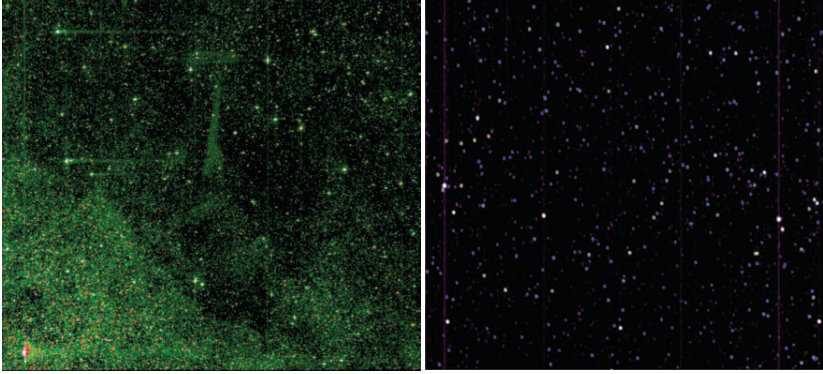 Figure 1
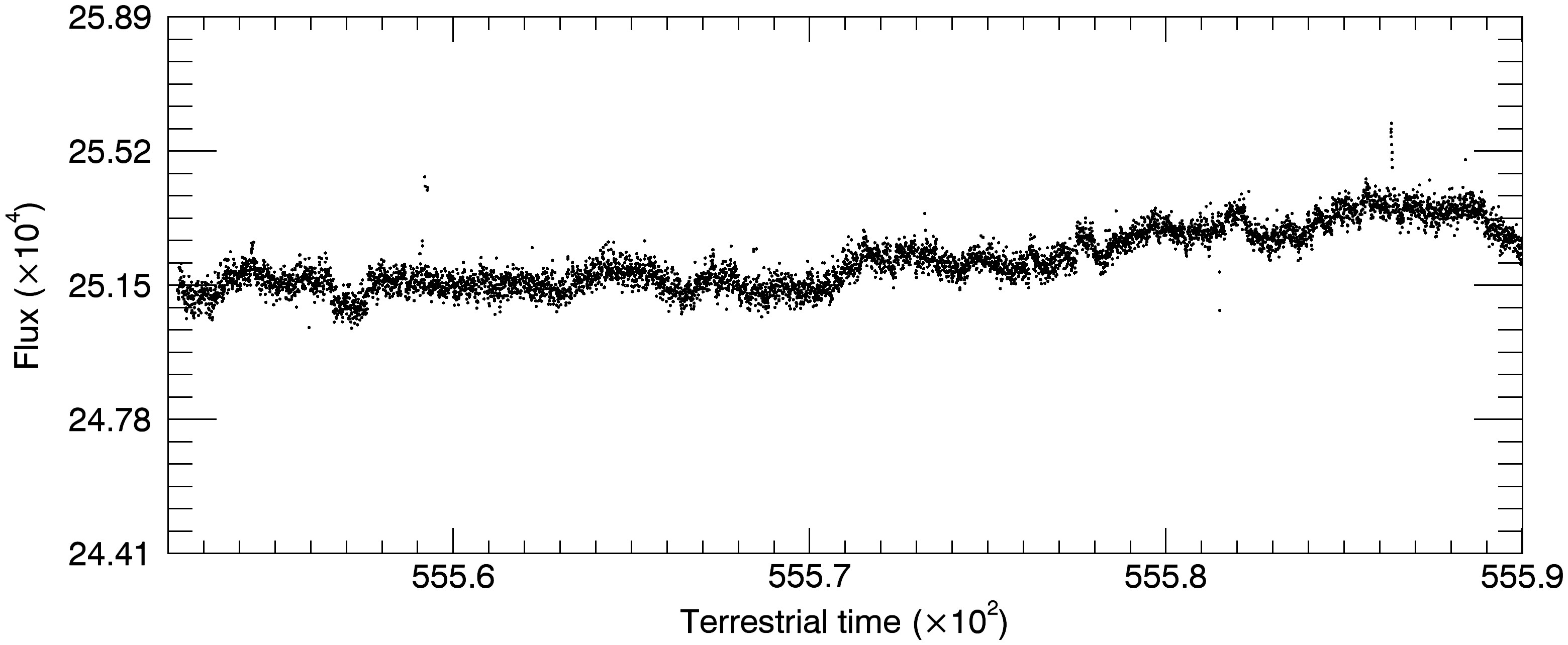 Figure 2
 Figure 3
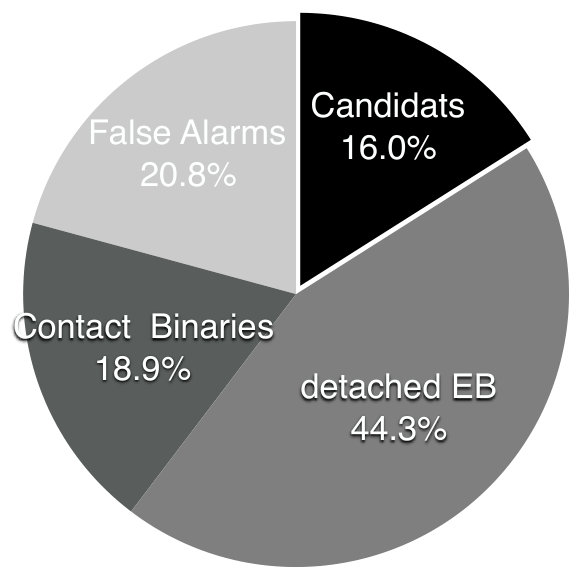 Figure 4
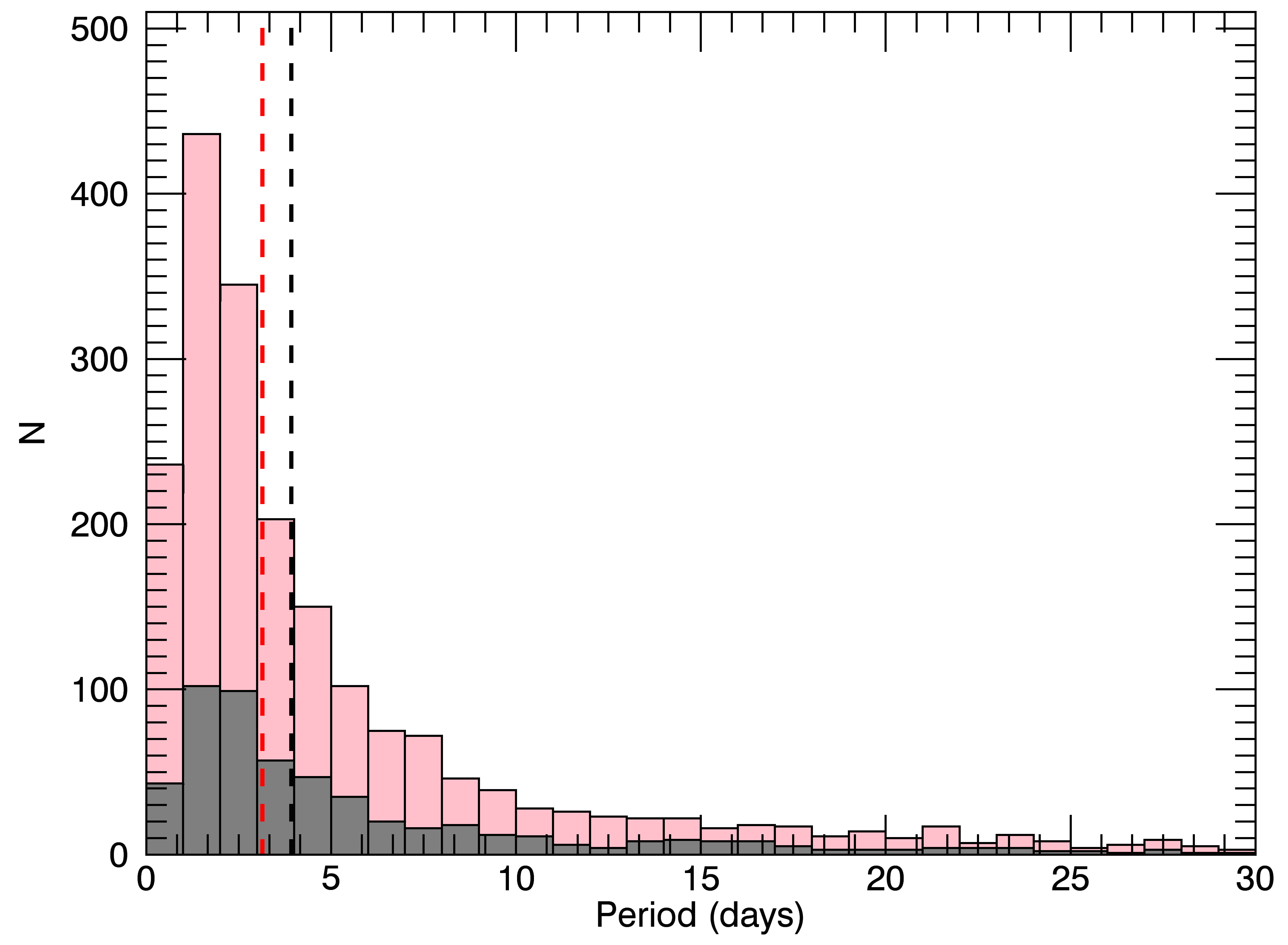 Figure 5
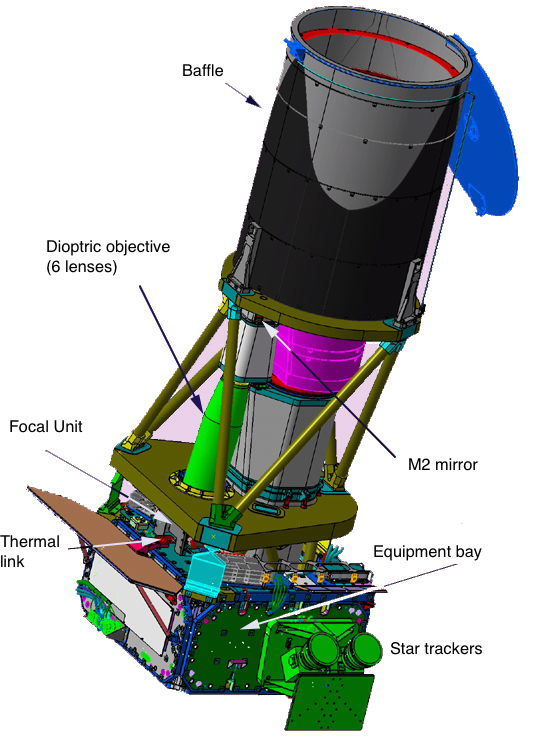 Figure 6
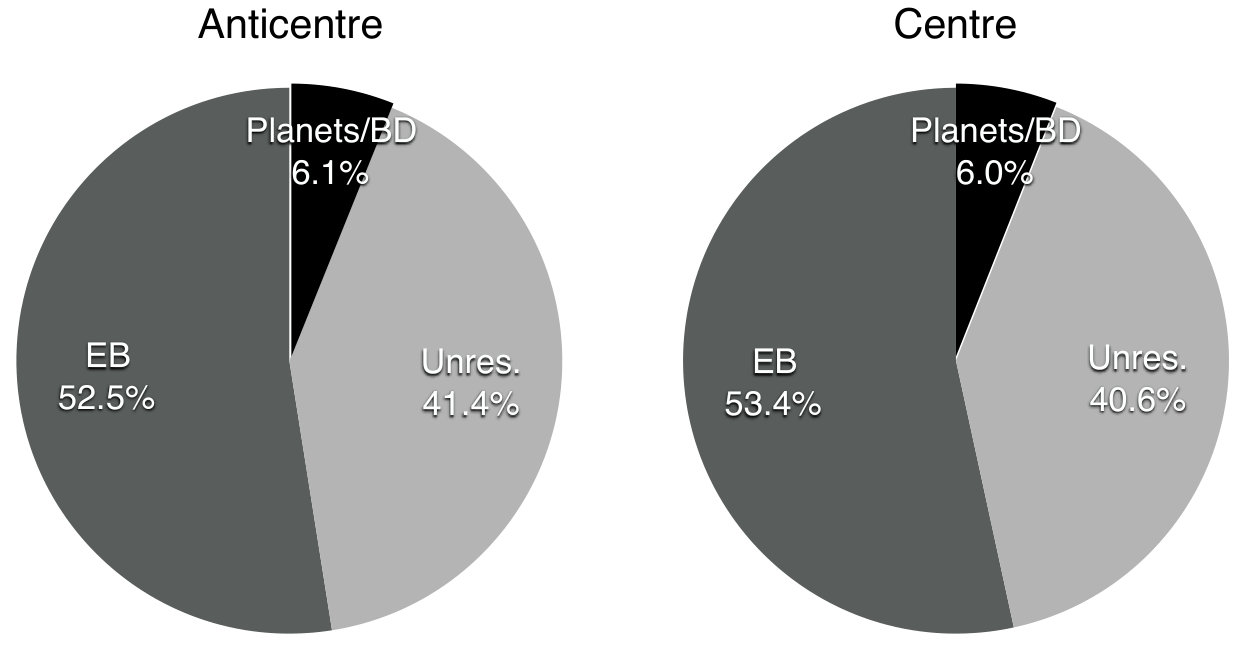 Figure 7
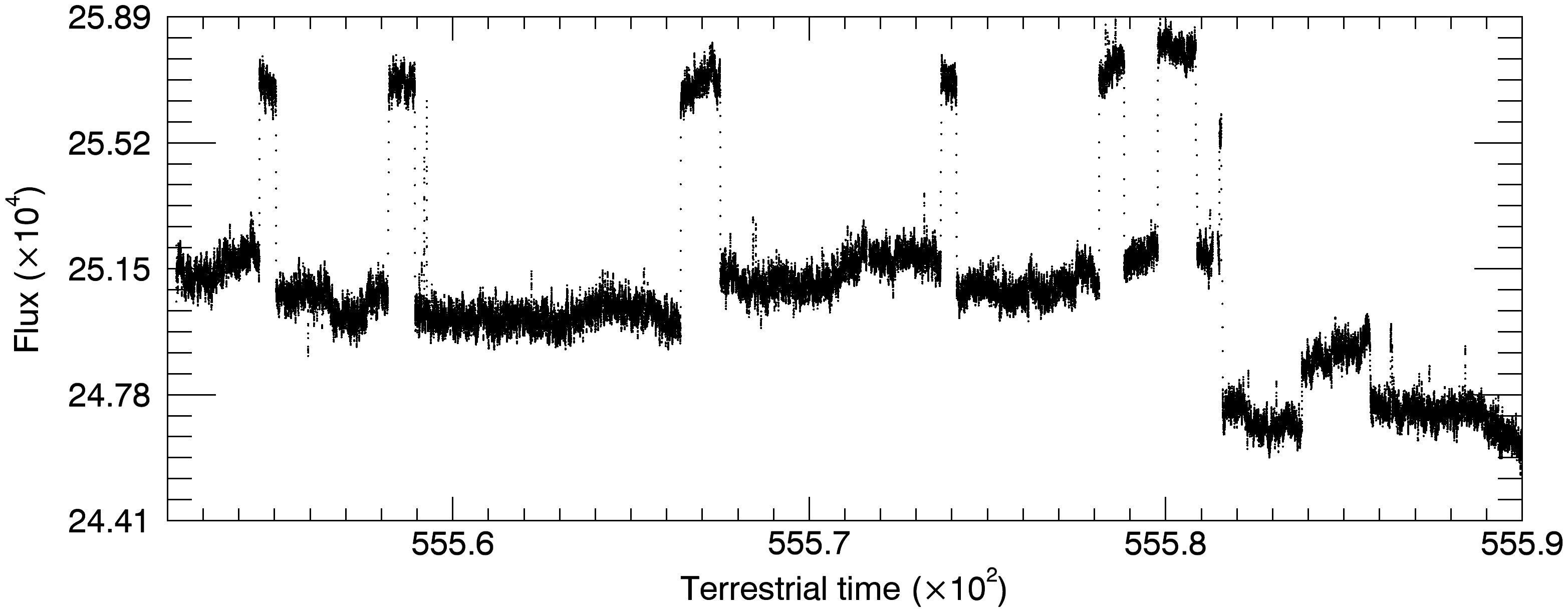 Figure 8
| Field | CCD | Duration | Overlap | Observed | Targ. 1 | Targ. 2 | Targ. 3 | Dwarfs |
|---|---|---|---|---|---|---|---|---|
| (days) | targets | (IV/V) | ||||||
| \svhline IRa01 | 2 | 54.3 | LRa01/LRa06 | 9921 | 8216 | 821 | 884 | 6550 |
| LRa01 | 2 | 131.5 | IRa01/LRa06 | 11448 | 11448 | 0 | 0 | 8961 |
| SRa01 | 2 | 23.4 | SRa05 | 8190 | 5822 | 2368 | 0 | 4218 |
| SRa02 | 2 | 31.8 | LRa07 | 10305 | 10305 | 0 | 0 | 7990 |
| LRa02 | 2 | 114.7 | 11448 | 11448 | 0 | 0 | 9410 | |
| LRa03 | 1 | 148.3 | 5329 | 5329 | 0 | 0 | 3862 | |
| SRa03 | 1 | 24.3 | 4169 | 4169 | 0 | 0 | 3038 | |
| LRa04 | 1 | 77.6 | 4262 | 4262 | 0 | 0 | 2967 | |
| LRa05 | 1 | 90.5 | 4648 | 4648 | 0 | 0 | 3332 | |
| SRa04 | 1 | 52.3 | 5588 | 5588 | 0 | 0 | 3840 | |
| SRa05 | 1 | 38.7 | SRa01 | 4213 | 4213 | 0 | 0 | 2452 |
| LRa06 | 1 | 76.7 | LRa01/IRa01 | 5724 | 1356 | 3484 | 884 | 947 |
| LRa07 | 1 | 29.3 | SRa02 | 4844 | 4390 | 454 | 0 | 3173 |
| SRc01 | 2 | 25.6 | 7015 | 7015 | 0 | 0 | 4484 | |
| LRc01 | 2 | 142.1 | 11448 | 11448 | 0 | 0 | 4922 | |
| LRc02 | 2 | 145 | LRc06/LRc05 | 11448 | 11448 | 0 | 0 | 6239 |
| SRc02 | 2 | 20.9 | 11448 | 11448 | 0 | 0 | 3477 | |
| LRc03 | 1 | 89.2 | 5724 | 5724 | 0 | 0 | 3639 | |
| LRc04 | 1 | 84.2 | LRc10 | 5724 | 5724 | 0 | 0 | 4200 |
| LRc05 | 1 | 87.3 | LRc06 | 5724 | 5724 | 0 | 0 | 2456 |
| LRc06 | 1 | 77.4 | LRc02/LRc05 | 5724 | 3836 | 1880 | 8 | 2029 |
| LRc07 | 1 | 81.3 | LRc08/LRc10 | 5724 | 3953 | 1771 | 0 | 1784 |
| SRc03 | 1 | 20.9 | LRc02/LRc06 | 652 | 85 | 559 | 8 | 0 |
| LRc08 | 1 | 83.6 | LRc07/LRc10 | 5724 | 5724 | 0 | 0 | 2658 |
| LRc09 | 1 | 83.6 | 5724 | 5724 | 0 | 0 | 2630 | |
| LRc10 | 1 | 83.5 | LRc04/LRc07 | 5286 | 4618 | 668 | 0 | 1825 |
| Total | 177454 | 163665 | 12005 | 892 | 101083 | |||
| \svhline |
| Planet | Period | Rp | Mp | M⋆ | R⋆ | Teff | v sin i | Fe/H | Prot | Age | ||
|---|---|---|---|---|---|---|---|---|---|---|---|---|
| (days) | (R | (M | (AU) | (M⊙) | (R⊙ ) | (K) | (km/s) | (days) | (Gyr) | |||
| \svhline 1b1 | 1.5089557 | 1.49 | 1.03 | 0.006 | 0.0254 | 0.95 | 1.11 | 5950 | 5.2 | -0.3 | 10.7 | |
| 0.00000064 | 0.08 | 0.12 | 0.012 | 0.0004 | 0.15 | 0.05 | 150 | 1.0 | 0.25 | 2.2 | ||
| 2b2 | 1.7429964 | 1.47 | 3.31 | 0.036 | 0.0281 | 0.97 | 0.90 | 5625 | 11.85 | -0.04 | 4.52 | 0.03-0.3 |
| 0.0000017 | 0.03 | 0.16 | 0.033 | 0.0009 | 0.06 | 0.02 | 120 | 0.5 | 0.1 | 0.14 | ||
| 3b3 | 4.2567994 | 1.01 | 21.77 | 0.012 | 0.057 | 1.37 | 1.56 | 6740 | 18 | -0.02 | 4.6 | 1.6-2.8 |
| 0.000004 | 0.07 | 1.0 | 0.01 | 0.003 | 0.09 | 0.09 | 140 | 3.0 | 0.06 | 0.4 | ||
| 4b4 | 9.20205 | 1.19 | 0.72 | 0.27 | 0.090 | 1.16 | 1.17 | 6190 | 6.4 | +0.05 | 8.9 | 0.7-2.0 |
| 0.00037 | 0.06 | 0.08 | 0.15 | 0.001 | 0.03 | 0.03 | 60 | 1.0 | 0.07 | 1.1 | ||
| 5b5 | 4.037896 | 1.33 | 0.47 | 0.086 | 0.0495 | 1.00 | 1.19 | 6100 | 1.0 | -0.25 | 50.0 | 5.5-8.3 |
| 0.000002 | 0.05 | 0.05 | 0.07 | 0.0003 | 0.02 | 0.04 | 65 | 1.0 | 0.06 | 10 | ||
| 6b6 | 8.886593 | 1.17 | 2.96 | 0.18 | 0.0855 | 1.05 | 1.025 | 6090 | 7.5 | -0.20 | 6.4 | 2.0-4.0 |
| 0.000004 | 0.04 | 0.34 | 0.12 | 0.0015 | 0.05 | 0.03 | 50 | 1.0 | 0.1 | 0.5 | ||
| 7b7 | 0.85359163 | 0.141 | 0.017 | 0.137 | 0.017 | 0.91 | 0.82 | 5275 | 1.5 | +0.12 | 23.6 | 1.32 |
| 5.8E-7 | 0.009 | 0.003 | 0.094 | 1.6E-4 | 0.02 | 0.02 | 60 | 1.0 | 0.06 | 0.1 | 0.75 | |
| 7c7 | 3.698 | - | 0.026 | 0 | 0.046 | 0.91 | 0.82 | 5275 | 1.5 | +0.12 | 23.6 | 1.32 |
| 0.003 | - | 0.003 | fixed | - | 0.03 | 0.04 | 60 | 1.0 | 0.06 | 0.1 | 0.75 | |
| 8b8 | 6.21229 | 0.57 | 0.22 | 0 | 0.063 | 0.88 | 0.77 | 5080 | 2.0 | 0.3 | 20.0 | 0.5-3.0 |
| 0.00003 | 0.02 | 0.03 | fixed | 0.001 | 0.04 | 0.02 | 80 | 1.0 | 0.1 | 5 | ||
| 9b9 | 95.273804 | 0.94 | 0.84 | 0.11 | 0.407 | 0.99 | 0.94 | 5625 | 3.5 | -0.01 | 14.0 | 0.5-8.0 |
| 0.0014 | 0.04 | 0.07 | 0.039 | 0.005 | 0.04 | 0.04 | 80 | 1.0 | 0.06 | 5 | ||
| 10b10 | 13.2406 | 0.97 | 2.75 | 0.53 | 0.1055 | 0.89 | 0.79 | 5075 | 2.0 | +0.26 | 2.0 | 0.5-3.0 |
| 0.0002 | 0.07 | 0.16 | 0.04 | 0.0021 | 0.05 | 0.05 | 75 | 0.5 | 0.07 | 0.5 | ||
| 11b11 | 2.99433 | 1.43 | 2.33 | 0.35 | 0.0436 | 1.27 | 1.37 | 6440 | 40.0 | -0.03 | 1.7 | 1-3 |
| 0.000011 | 0.03 | 0.34 | 0.03 | 0.005 | 0.05 | 0.03 | 120 | 5.0 | 0.08 | 0.2 | ||
| 12b12 | 2.828042 | 1.44 | 0.92 | 0.07 | 0.0402 | 1.08 | 1.1 | 5675 | 1.0 | +0.16 | 68.0 | 3.2-9.4 |
| 0.000013 | 0.13 | 0.07 | 0.06 | 0.0009 | 0.08 | 0.1 | 80 | 1.0 | 0.1 | 10 | ||
| 13b13 | 4.03519 | 0.89 | 1.31 | 0. | 0.051 | 1.09 | 1.01 | 5945 | 4.0 | +0.01 | 13.0 | 0.1-3.2 |
| 0.00003 | 0.01 | 0.07 | fixed | 0.0031 | 0.02 | 0.03 | 90 | 1.0 | 0.07 | 5 | ||
| 14b14 | 1.51214 | 1.09 | 7.6 | 0. | 0.027 | 1.13 | 1.21 | 6035 | 9.0 | +0.05 | 5.7 | 0.4-8.0 |
| 0.00013 | 0.07 | 0.6 | fixed | 0.002 | 0.09 | 0.08 | 100 | 0.5 | 0. | 15 | ||
| 15b15 | 3.06036 | 1.12 | 63.3 | 0 | 0.045 | 1.32 | 1.46 | 6350 | 19 | +0.1 | 3.0 | 1.1-3.4 |
| 0.00003 | 0.30 | 4.1 | fixed | 0.014 | 0.12 | 0.31 | 200 | 1.0 | 0.2 | 0.1 | ||
| 16b16 | 5.35227 | 1.17 | 0.54 | 0.33 | 0.0618 | 1.1 | 1.19 | 5650 | 0.5 | +0.19 | 60.0 | 3.7-9.7 |
| 0.0000 | 0.15 | 0.09 | 0.10 | 0.0015 | 0.08 | 0.14 | 10 | 1.0 | 0.06 | 10 | ||
| 17b17 | 3.7681 | 1.02 | 2.43 | 0. | 0.0461 | 1.04 | 1.59 | 5740 | 4.5 | +0.00 | 20.0 | 9.7-11 |
| 0.0000 | 0.07 | 0.30 | fixed | 0.0008 | 0.1 | 0.07 | 80 | 0.5 | 0.1 | 5 | ||
| 18b18 | 1.900069 | 1.31 | 3.47 | 0.04 | 0.0295 | 0.95 | 1.00 | 5440 | 8.0 | -0.10 | 5.4 | 0.05-1 |
| 0.0000 | 0.18 | 0.38 | 0.04 | 0.0016 | 0.15 | 0.13 | 100 | 1.0 | 0.1 | 0.4 | ||
| 19b19 | 3.89713 | 1.29 | 1.11 | 0.047 | 00518 | 1.21 | 1.65 | 6090 | 6.0 | -0.02 | 15.0 | 4.0-6.0 |
| 0.0000 | 0.03 | 0.06 | 0.045 | 0.0008 | 0.05 | 0.04 | 70 | 1.0 | 0.1 | 5 | ||
| 20b20 | 9.24285 | 0.84 | 4.24 | 0.562 | 0.0902 | 1.14 | 1.02 | 5880 | 4.5 | +0.14 | 11.5 | 0.06-0.9 |
| 0.0000 | 0.04 | 0.23 | 0.013 | 0.0021 | 0.08 | 0.05 | 90 | 1.0 | 0.12 | 3 | ||
| 21b21 | 2.72474 | 1.30 | 2.26 | 0 | 0.0417 | 1.29 | 1.95 | 6200 | 11.0 | +0.00 | 10.0 | 3.0-5.0 |
| 0.0000 | 0.14 | 0.31 | fixed | 0.0011 | 0.09 | 0.21 | 100 | 1.0 | 0.1 | 3.0 | ||
| 22b22 | 9.75598 | 0.435 | 0.038 | 0.077 | 0.0920 | 1.099 | 1.136 | 5939 | 4.0 | +0.17 | 16.0 | 3.3 |
| 0.00011 | 0.035 | 0.044 | 0.042 | 0.0014 | 0.049 | 0.09 | 120 | 1.5 | 0.12 | 2.0 | ||
| 23b23 | 3.6313 | 1.05 | 2.8 | 0.16 | 0.048 | 1.14 | 1.61 | 5900 | 9.0 | +0.05 | 9.2 | 6.2-7.7 |
| 0.0001 | 0.13 | 0.3 | 0.02 | 0.004 | 0.08 | 0.18 | 100 | 1.0 | 0.1 | 1.5 | ||
| 24b24 | 5.1134. | 0.33 | 0.018 | 0. | 0.056 | 0.91 | 0.86 | 4950. | 2.0 | +0.3 | 29 | 11 |
| 0.0006 | 0.04 | fixed | 0.002 | 0.09 | 0.09 | 150 | 1.5 | 0.15 | ||||
| 24c24 | 11.759 | 0.44 | 0.088 | 0 | 0.098 | 0.91 | 0.86 | 4950 | 2.0 | +0.3 | ||
| 0.0063 | 0.04 | 0.035 | 0.003 | 0.09 | 0.09 | 150 | 1.5 | 0.15 | ||||
| 25b25 | 4.86069 | 1.08 | 0.27 | 0.0 | 0.0578 | 1.09 | 1.19 | 6040 | 4.3 | -0.01 | 14.1 | 4.5 |
| 0.00006 | 0.1 | 0.04 | fixed | 0.002 | 0.11 | 0.14 | 90 | 0.5 | 0.13 | 2.9 | 2.0 | |
| 26b25 | 4.20474 | 1.26 | 0.52 | 0.0 | 0.0526 | 1.09 | 1.79 | 5590 | 2.0 | +0.01 | 45.3 | 8.6 |
| 0.00005 | 0.13 | 0.05 | fixed | 0.0010 | 0.06 | 0.18 | 100 | 1.0 | 0.13 | 25.0 | 1.8 | |
| 27b26 | 3.57532 | 1.007 | 10.39 | 0.065 | 0.0476 | 1.05 | 1.08 | 5900 | 4.0 | -0.1 | 13.6 | 4.21 |
| 0.00006 | 0.044 | 0.55 | 0.0066 | 0.11 | 0.18 | 120 | 1.0 | 0.1 | 4.3 | 2.72 | ||
| 28b27 | 5.20851 | 0.9550 | 0.484 | 0.0470 | 0.0603 | 1.01 | 1.78 | 5150 | 3.0 | +0.15 | 30 | 12.0 |
| 0.00038 | 0.0660 | 0.087 | 0.0550 | 0.0050 | 0.14 | 0.11 | 100 | 0.5 | 0.10 | 1.5 | ||
| 29b27 | 2.850570 | 0.9 | 0.850 | 0.0820 | 0.0386 | 0.97 | 0.90 | 5260 | 3.5 | +0.20 | 413 | 4.5 |
| 0.000006 | 0.16 | 0.20 | 0.0810 | 0.0059 | 0.14 | 0.12 | 100 | 0.5 | 0.10 | 3.5 | ||
| 30b28 | 9.06005 | 1.009 | 2.90 | 0.007 | 0.0844 | 0.98 | 0.91 | 5650 | 4.3 | +0.02 | 10.8 | 3.0 |
| 0.00024 | 0.076 | 0.22 | 0.031 | 0.0012 | 0.05 | 0.09 | 107 | 0.4 | 0.10 | 1.3 | 3.7 | |
| 31b28 | 4.62941 | 1.46 | 0.84 | 0.02 | 0.0586 | 1.25 | 2.15 | 5730 | 2.8 | +0.00 | 38.9 | 4.7 |
| 0.00075 | 0.30 | 0.34 | 0.16 | 0.0034 | 0.22 | 0.56 | 126 | 0.5 | 0.10 | 12.7 | 2.2 | |
| 32b29 | 6.71837 | 0.57 | 0.15 | 0.0 | 0.071 | 1.08 | 0.79 | 5970 | 3.2 | +0.00 | 14.0 | - |
| 0.00001 | 0.06 | 0.10 | fixed | 0.001 | 0.08 | 0.09 | 100 | 1.0 | 0.20 | 6.0 | ||
| 33b30 | 5.819143 | 1.10 | 59.0 | 0.0700 | 0.0579 | 0.86 | 0.94 | 5225 | 5.7 | 0.44 | 8.95 | 4.6 |
| 0.000018 | 0.53 | 1.8 | 0.0016 | 0.04 | 0.14 | 80 | 0.4 | 0.1 |
Peer Reviews
No public reviews on file for this paper yet. If you reviewed it on a platform where reviews are public (OpenReview, ICLR, NeurIPS, ICML), you can paste yours below so the community can read it here.
Videos
No videos yet. Explain this paper in a talk, walkthrough, or lecture? Add one.
11institutetext: Magali Deleuil 22institutetext: Aix Marseille Université, CNRS, CNES, LAM (Laboratoire d’Astrophysique de Marseille) UMR 7326, 13388, Marseille, France, 22email: [email protected] 33institutetext: Malcolm Fridlund 44institutetext: Leiden Observatory P.O. Box 9513 NL-2300 RA Leiden The Netherlands 44email: [email protected]
CoRoT: a first space-based transiting survey to explore the close-in planets populations
Magali Deleuil and Malcolm Fridlund
Abstract
The CoRoT (COnvection, internal ROtation and Transiting planets) space mission was launched in the last days of 2006, becoming the first major space mission dedicated to the search for and study of exoplanets, as well as doing the same for asteroseismological studies of stars. Designed as a small mission, it became highly successful, with, among other things discovering the first planet proved by the measurements of its radius and mass to be definitely ”Rocky” or Earth like in its composition and the first close-in brown dwarf with a measured radius. Designed for a lifetime of 3 years it survived in a 900 km orbit around the Earth for 6 years discovering in total 37 planetary systems or brown dwarfs, as well as about one hundred planet candidates and 2269 eclipsing binaires, detached or in contact. In total CoRoT acquired 177 454 light curves, varying in duration from about 30 - 150 days. CoRoT was also a pioneer in the organisation and archiving of such an exoplanetary survey.
The development and utilization of this spacecraft has left a legacy of knowledge, both as what concerns the scientific objectives as well as the technical know-how, that is currently being utilized in the construction of the European CHEOPS and PLATO missions.
1 Introduction
The CoRoT mission is a space observatory launched by CNES, the French space agency in December 2006. It has its roots in the new science of asteroseismology, which in itself originated from helioseismology, the study of the microvariations of our Sun. Such observations could literally look inside the Sun and determine parameters such as density profiles, internal rotation and age among other things.
The mission was first proposed in 1993, when CNES issued a call for ideas for what they called small missions. This gave French scientists the opportunity to propose and develop a much more ambitious mission than the smaller asteroseismology instrument EVRIS that had already flown on a Russian spacecraft. This was the origin of CoRoT, devoted to the study of stellar COnvection and internal ROTation. The original objective of CoRoT was to carry out very high-precision observations of stellar oscillation mode frequencies, for a dozen of bright solar to F-type stars, in order to detect p-modes (microvariations where pressure, p, is the restoring force) in order to obtain constraints for models of internal structure, and to begin to quantify the internal rotation of stars other than the Sun. CNES selected the project at the end of 1994 for a launch in 1998! The detection of the first exoplanet, 51 Peg, Mayor and Queloz (1995) led to the realization that the CoRoT requirements should also allow the detection of transiting exoplanets. The detection of transiting planets was added in 1997 to the new scientific program of CoRoT whose name was changed to COnvection, internal ROtation and Transiting planets.
Different financial and administrative problems led to enlarge the participation to other countries: Austria, Belgium, Brazil, Germany, and Spain, and the ESA Science Program decided to contribute to the project, giving to CoRoT an European and even wider impact. The final mission selection took place only in 2000, with a launch foreseen in 2006 after a development phase that started in 2003. The latter is described fully in Baglin et al. (2016) and Fridlund et al. (2006) and will not be detailed here. The development time was 4 years only, short compared to what is usually required, but the mission succeeded in being launched on December 27, 2006. CoRoT was placed very accurately (errors of order a few hundred meters) by the Soyuz/Fregat launch vehicle into the desired orbit. The launcher was the first version of the Soyuz-Fregat rocket later to be used by the ESA as its medium-size launch vehicle (Lam-Trong 2006b). The fact that the Fregat stage could steer CoRoT into the exact orbit saved enough propulsion capacity to last for the whole extended mission. The spacecraft was placed into orbit in perfect condition. The tests and evaluations of the spacecraft used up only half the allotted time and, on January 17, 2007, observations of the first field began.
2 The Spacecraft
The CoRoT satellite was sent into a circular polar orbit with an altitude of 896 km and remained operative there until November 2, 2012, when a computer error terminated the mission. CoRoT was designed as a low-cost mission utilizing a proven spacecraft bus of the PROTEUS family (of which 5 were manufactured for a number of missions) allowing a faster and cheaper development. Together the plateform and the instrument measure 4.2 m along the longest dimension and with a launch wet mass of 626 kg, and the payload comprising 300 kg was thus relatively small. The payload consisted of a 27 cm off-axis telescope, the associated camera, and the mechanical structures and electronics (Fig 1). The spacecraft bus consumed 300 W of power, while the payload required another 150 W (Lam-Trong 2006a).
In order to comply with its scientific objectives, the instrument had to deliver a very stable signal. This stringent stability requirement implied: (i) a high level of straylight rejection, most of it due to the nearby Earth, (ii) a high pointing stability, and (iii) a high level of performance for the thermal control subsystem. The stability requirements associated with this required the use of hyper stable materials to control the various sources of noise and ensure to reach the photon noise limit (Boisnard and Auvergne 2006). The opto-mechanical design for the telescope, its control of jitter, and its high-performance compact baffling concept were implemented for the first time and its performance has now been fully demonstrated in flight.
To accommodate the two prime scientific objectives, instead of having two separate instruments, the adopted approach consisted in splitting the focal plane in two parts, each dedicated to one of the mission goal. At that time, the exoplanet and seismology observations aimed at targeting stars of different brightnesses. Indeed, while achieving the detection of solar oscillations with a precision of the order of 0.1 Hz required to match the photon noise on bright stars with a very high temporal cadence of one measurement every second, for the transit detection the low transit probability required to observe thousands of stars in order to increase the chance of detection. To fulfill this requirement with the limited field of view of the instrument, the exoplanet program targeted stars in the range 11 to nearly 16. A pair of CCDs was thus dedicated to each program and they could not be interchanged. The asteroseismology program concentrated on very bright stars, typically in the magnitude range 6 to 9. The CCDs for the asteroseismology program were defocused while the exoplanet CCDs were on focus but with a small biprism inserted above the devices (Fig. 2). The resulting point spread function (PSF) in the faint star channel is an on-axis spectrum at a very low spectral resolution. The goal was to provide a chromatic information in order to disentangle true planetary transits from stellar activity features, like spots, or background eclipsing binaries (Rouan et al. 1999).
The two onboard data processing units (DPU) controlled each two CCDs at the time but one for asteroseismology and one for exoplanetology, thereby providing redundancy. The breakdown of the first data processing unit (DPU1), which occurred in March 2009, caused the loss of one CCD in each of the exoplanet and seismology channels and reduced the field-of-view by half but didn t cause the stop of one of the programs.
In the exoplanet channel, the onboard processing and telemetry capacity of the satellite enabled the observation of up to 6000 target stars per CCD. At the start of each observing run, an image of the complete field of view was obtained and downloaded to the ground. Based on this image, each target star was automatically assigned a photometric aperture selected from a library of 254 predefined masks, built so as to optimize the signal-to-noise ratio of the integrated flux (Llebaria and Guterman 2006). For these target stars, the photometry was carried out onboard, and only the light curves were downloaded to Earth. In addition, twenty 10 by 15 pixels windows were downloaded from each CCD in order to provide sky reference images and monitor changes in the background level. A further 80 such windows, designated ”imagettes”, initially foreseen as calibration, were assigned to selected special (bright) targets of interest and were downloaded as pixel-level data enabling a dedicated photometric analysis on the ground. The nominal magnitude range of the mission, for the targets in the exoplanet channel, were of magnitude 11 to 16, but a number of brighter stars were also observed, despite being saturated, and the data from most of these were downloaded as imagettes allowing a more precise photometry to be optimized in later processing.
For stars with magnitude 15 or brighter, the photometric aperture was divided along detector column boundaries into three regions of the PSF corresponding approximately to the red, green, and blue parts of the visible spectrum. This way three color light curves were acquired for each such object for up to 5000 stars per CCD. These color light curves were summed together on the ground to give a corresponding white light curve. For stars with magnitudes larger than 15 only, white light curves were extracted, and no color information was available.
The cadence of the observations could be set to either 32 sec or 512 sec in the faint channel mode, while the asteroseismology channel allowed settings down to 1 sec. The basic faint channel integration time was 32 sec, but the flux of 16 readouts was coadded on board over a 8.5 min time span before being downloaded to accommodate with the telemetry budget. The nominal sampling time of 32 sec was however preserved for 1000 selected targets (500 per CCD), known as oversampled targets. These targets were selected at the beginning of each run, but the list was then updated every week, thanks to a quick look analysis of the crudely processed light curves and the pre-detection of transits.
In 2016, the complete set of CoRoT light curves that is those from both the bright and faint channels were homogeneously processed with the latest version of the pipeline and released to the community (Chaintreuil et al. 2016). A complete description of the different steps of the final data reduction pipeline and of the associated algorithms is provided in (Ollivier et al. 2016). In addition to the regular corrections, such as crosstalk or background contribution corrections, which were already included in the pipeline (Auvergne et al. 2009), but updated in this last version, new corrections were implemented. With this latest release, the user can thus get ready-to-use light curves corrected from the jumps in the photometry such as those induced by a change in temperature or by impacts of protons onto the CCD but also from systematics (Guterman et al. 2016) (Fig. 3).
As mentioned above, CoRoT was based on the multipurpose PROTEUS spacecraft bus. This configuration, while saving cost and time in development, restricted the mission to a low Earth orbit (LEO). Because of this limitation, and in order to be able to observe the same field of view for as long time as possible, at least up to 6 months, and at the same time without allowing either too much scattered solar light to enter the telescope, or experience too many occultations by the Earth, the satellite had to be injected into a polar orbit and restricted to observe along line of sights roughly perpendicular to the orbital plane. Every six months (in April and October), to avoid blinding by the Sun, the satellite was rotated by 180 deg with respect to the polar axis and a new observation period started in the opposite direction. As a consequence, the continuous viewing zones of CoRoT were two almost circular regions of 10o radius, called the CoRoT eyes. They are centered on the galactic plane at 6h 50d (near the galactic anti-center) and 18h 50d (near the galactic center), respectively.
3 The Scientific Organisation
In CoRoT, two scientific topics were coexisting in the same instrument. The asteroseismology segment had as its objective to divulge the internal physical parameters of stars for the first time. The objective of the exoplanet element was to discover new transiting exoplanets, to measure their diameter with unprecedented precision and further determine their properties. While these two objectives could at first appear very different, it is actually true that both the technology behind the actual measurements, namely ultrahigh-precision photometry, as well as the science in them, have a deep connection. One of the superb achievements brought by the CoRoT results is that the understanding of exoplanets is based on an equally deep understanding of the host star. Planets are orbiting a host star, the physics of which governs their evolution and properties. But the opposite is also true. During the formation phase of a planetary system both star and planets are tightly connected through the transfer of angular momentum and through chemical changes in the accretion disk that must take place as star and planets accrete from the original material.
Nevertheless, we will here mainly discuss the exoplanetary part of the mission.
The CoRoT project was committed to deliver to the scientific community light curves that were properly reduced and corrected for the main instrumental defects and ready for scientific analyses. The detection of planetary transits was thus left to the discretion of the science team with the exception of a real-time detection carried out in the Alarm Mode on a weekly basis (Quentin et al. 2006; Surace et al. 2008). The Alarm Mode was carried out to retune the cadence of the observations of that particular star to sample the light curve every 32s instead of 512s, allowing the possibility to observe forthcoming transit events with higher temporal resolution. In order to interpret the actual transit shape in terms of physical parameters of both the host star and the planet it is imperative to have the highest temporal resolution. In addition, this real-time detection allows to save time in the follow-up process of the planet candidates.
During the years that preceded the launch of the satellite, the scientists who were involved in the exoplanetary program of the mission made the decision to work as a single international team. The goal was to share the workload and results so that to increase the scientific return of the mission and to avoid time wasted in competition. This team thus came to consist of individual scientists from all the nations who were partners in the project and including members from ESA s science department. It took the name of CoRoT Exoplanet Science Team (CEST) and organized every aspects of the analysis, starting from the transit-like features detection to the detailed analysis of the planet’s properties. One important aspect of this collaborative work was the follow-up observations of planet candidate s. The CoRoT exoplanet program has been indeed supported by a large accompanying ground-based observation program (Deleuil et al. 2006). Operating more than a dozen of telescopes in various places, Europe, Hawaii, Israel, and Chile, with size varying from 1 m to 8 m, the team used various techniques: photometric observations (Deeg et al. 2009), high-contrast imaging (Guenther et al. 2013), and spectroscopy including radial velocity measurements (Bouchy et al. 2009). The goal was to identify false positives, to fully secure planets, and to determine their complete set of parameters in order to derive the planetary properties.
The reference list from the paper itself. Each links out to its DOI / PubMed record.
- 1Aigrain et al. (2008) Aigrain S, Collier Cameron A, Ollivier M et al. (2008) Transiting exoplanets from the Co Ro T space mission. IV. Co Ro T-Exo-4b: a transiting planet in a 9.2 day synchronous orbit. A&A 488:L 43–L 46
- 2Almenara et al. (2013) Almenara JM, Bouchy F, Gaulme P et al. (2013) Transiting exoplanets from the Co Ro T space mission. XXIV. Co Ro T-25b and Co Ro T-26b: two low-density giant planets. A&A 555:A 118
- 3Alonso et al. (2008) Alonso R, Auvergne M, Baglin A et al. (2008) Transiting exoplanets from the Co Ro T space mission. II. Co Ro T-Exo-2b: a transiting planet around an active G star. A&A 482:L 21–L 24
- 4Alonso et al. (2009) Alonso R, Guillot T, Mazeh T et al. (2009) The secondary eclipse of the transiting exoplanet Co Ro T-2b. A&A 501:L 23–L 26
- 5Alonso et al. (2014) Alonso R, Moutou C, Endl M et al. (2014) Transiting exoplanets from the Co Ro T space mission. XXVI. Co Ro T-24: a transiting multiplanet system. A&A 567:A 112
- 6Auvergne et al. (2009) Auvergne M, Bodin P, Boisnard L et al. (2009) The Co Ro T satellite in flight: description and performance. A&A 506:411–424
- 7Baglin et al. (2016) Baglin A, Lam-Trong T, Vandermarcq O, Donny C Burgaud S (2016) I.3 The Co Ro T story. In: Co Rot Team (ed) The Co Ro T Legacy Book: The Adventure of the Ultrahigh-Precision Photometry from Space, p 11, DOI 10.1051/978-2-7598-1876-1.c 013
- 8Barge et al. (2008) Barge P, Baglin A, Auvergne M et al. (2008) Transiting exoplanets from the Co Ro T space mission. I. Co Ro T-Exo-1b: a low-density short-period planet around a G 0V star. A&A 482:L 17–L 20