Orbital differentiation in Hund metals
Fabian B. Kugler, Seung-Sup B. Lee, Andreas Weichselbaum, Gabriel, Kotliar, Jan von Delft

TL;DR
This paper investigates orbital differentiation in Hund metals using a three-orbital Hubbard model and the numerical renormalization group, revealing key phenomena near the orbital-selective Mott transition.
Contribution
It introduces a highly accurate real-frequency dynamical mean-field study of Hund metals, uncovering new insights into orbital differentiation and associated quantum phenomena.
Findings
Suppressed spin coherence scale near the transition
Emergence of a singular Fermi liquid
Interband doublon-holon excitations
Abstract
Orbital differentiation is a common theme in multiorbital systems, yet a complete understanding of it is still missing. Here, we consider a minimal model for orbital differentiation in Hund metals with a highly accurate method: We use the numerical renormalization group as a real-frequency impurity solver for a dynamical mean-field study of three-orbital Hubbard models, where a crystal field shifts one orbital in energy. The individual phases are characterized with dynamic correlation functions and their relation to diverse Kondo temperatures. Upon approaching the orbital-selective Mott transition, we find a strongly suppressed spin coherence scale and uncover the emergence of a singular Fermi liquid and interband doublon-holon excitations. Our theory describes the diverse polarization-driven phenomena in the bands of materials such as ruthenates and iron-based superconductors,…
Click any figure to enlarge with its caption.
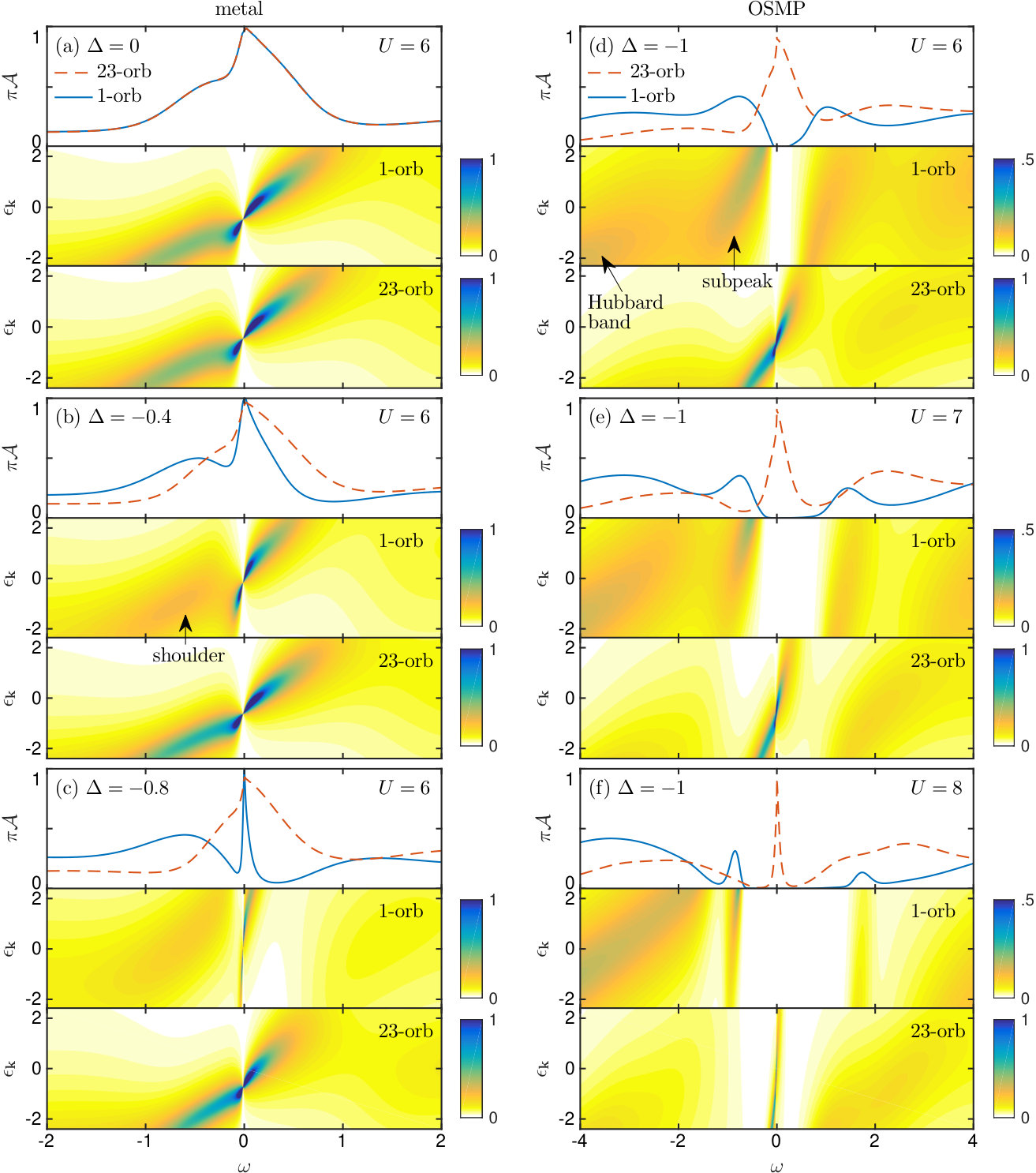 Figure 1
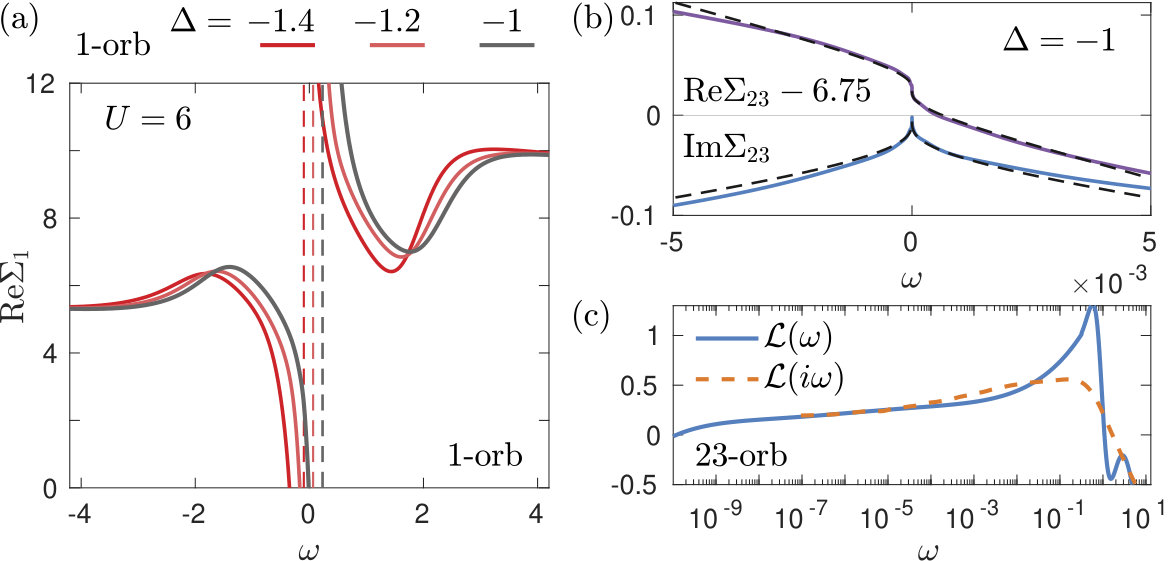 Figure 2
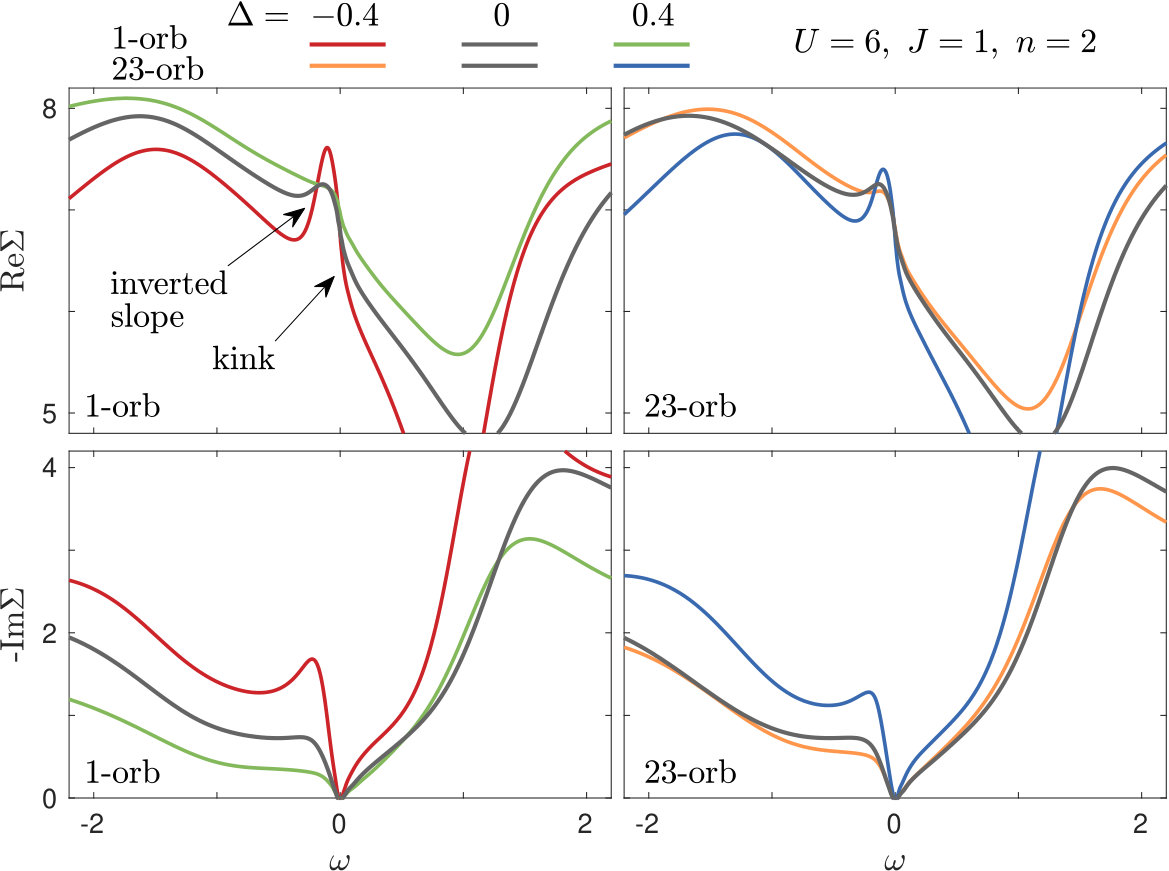 Figure 3
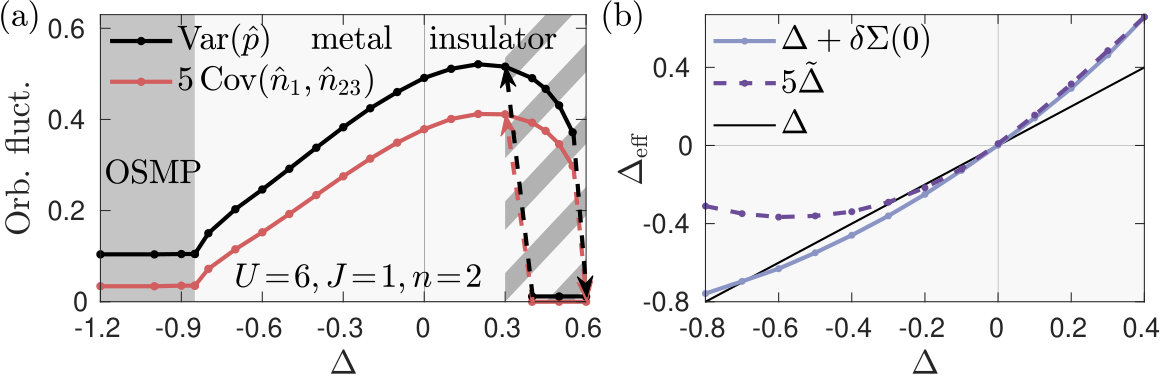 Figure 4
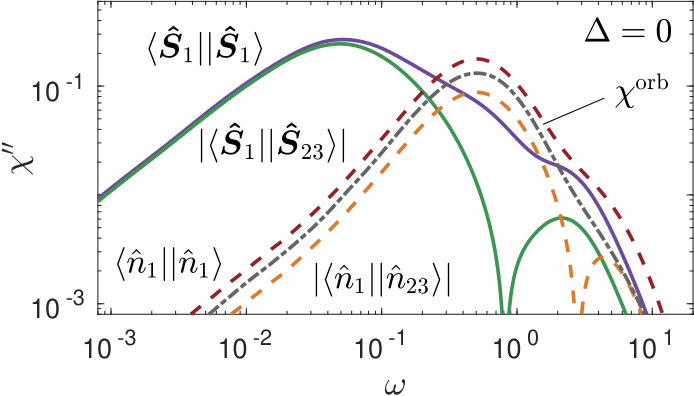 Figure 5
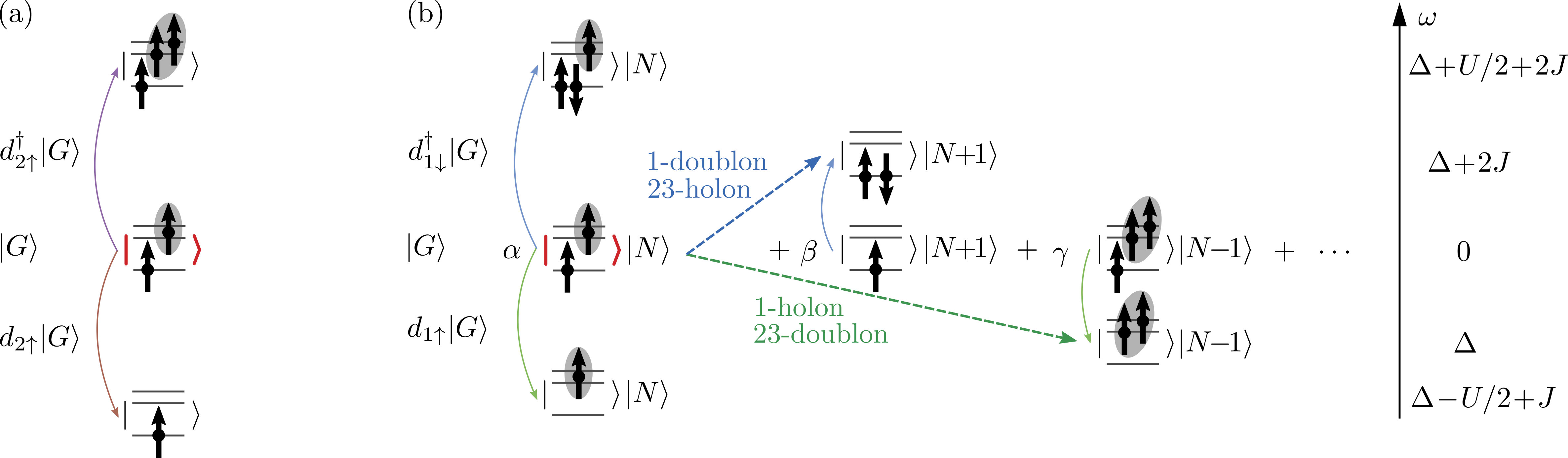 Figure 6
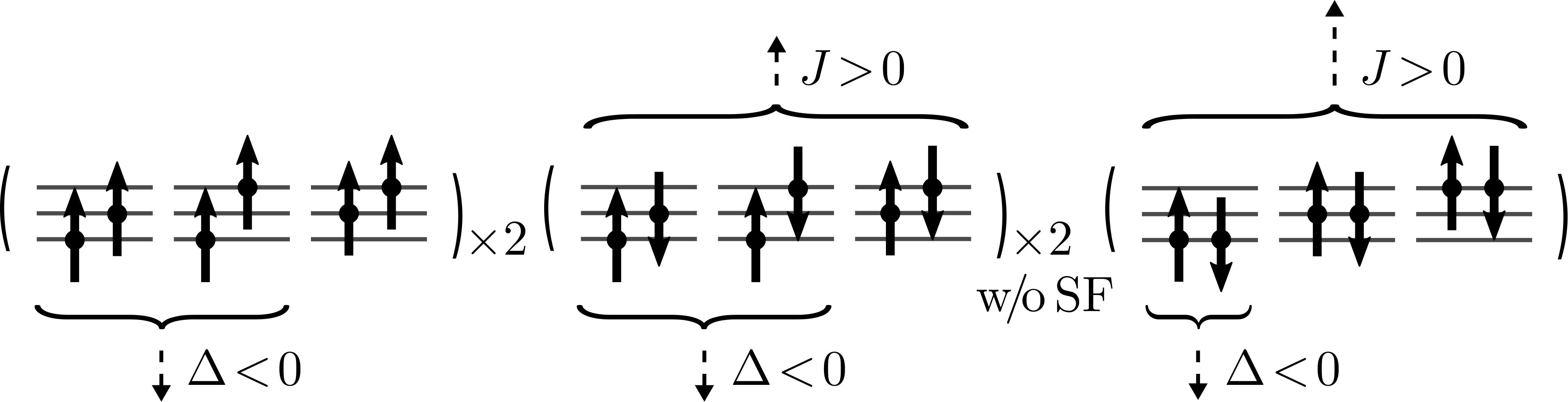 Figure 7
 Figure 8
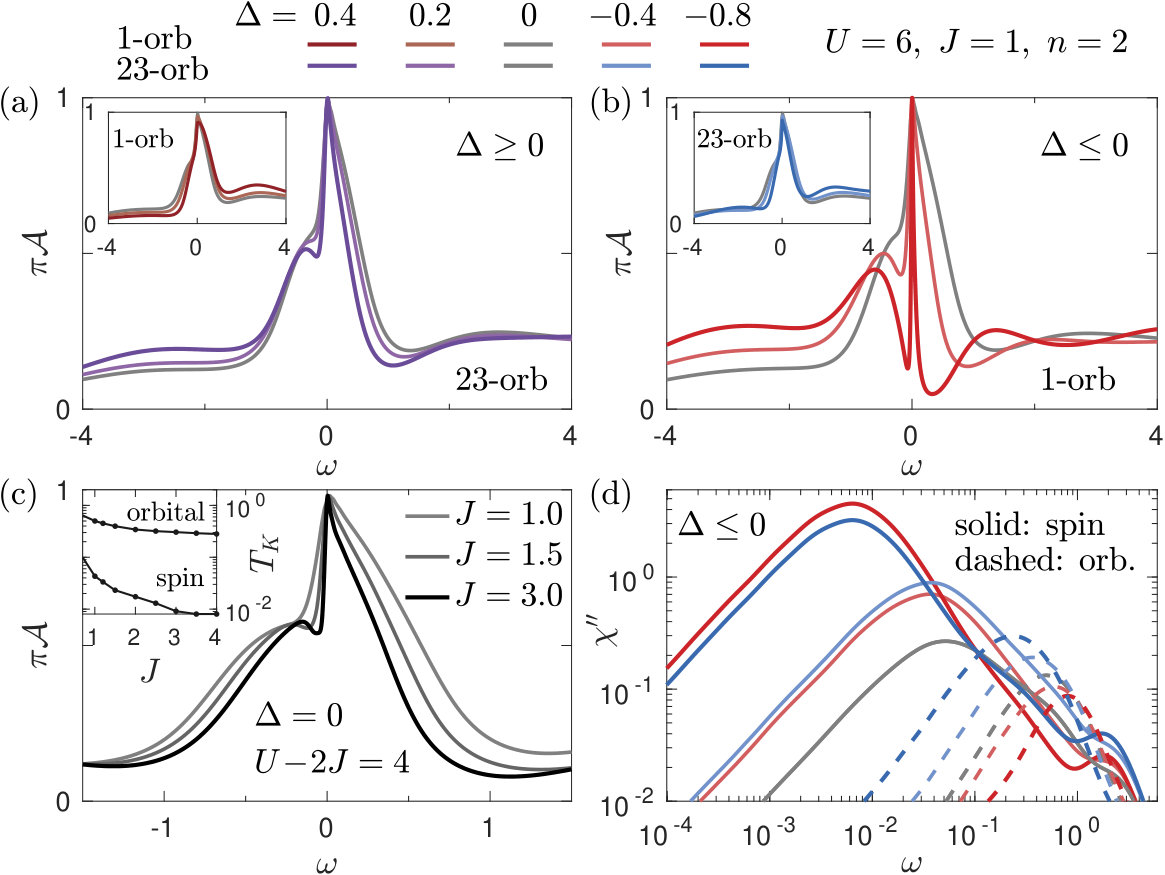 Figure 9
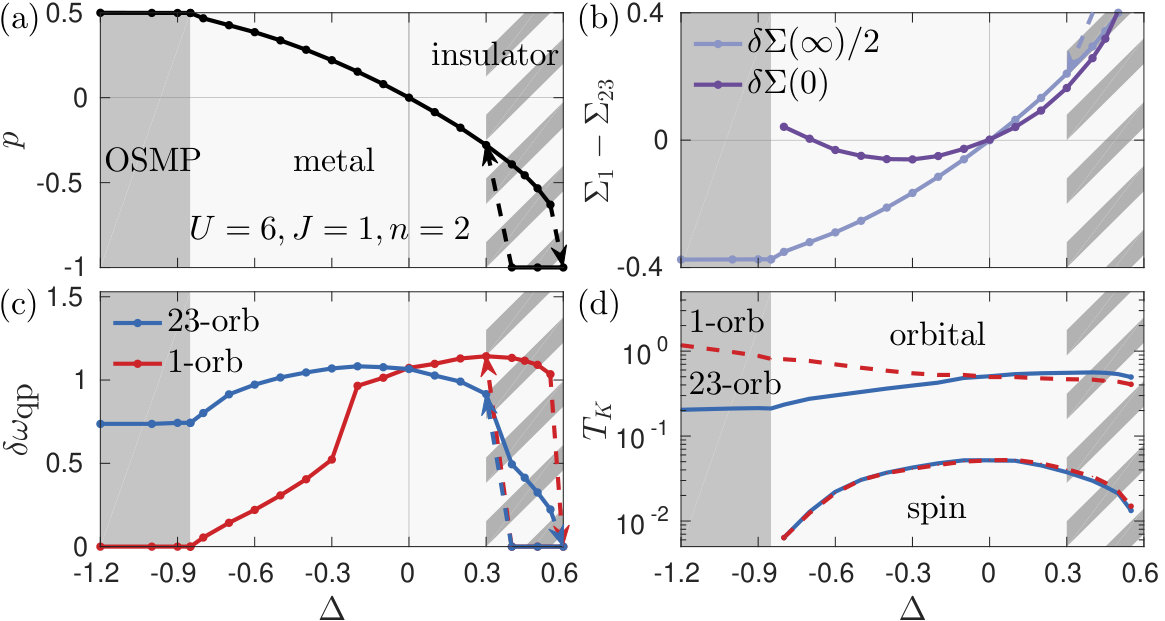 Figure 10
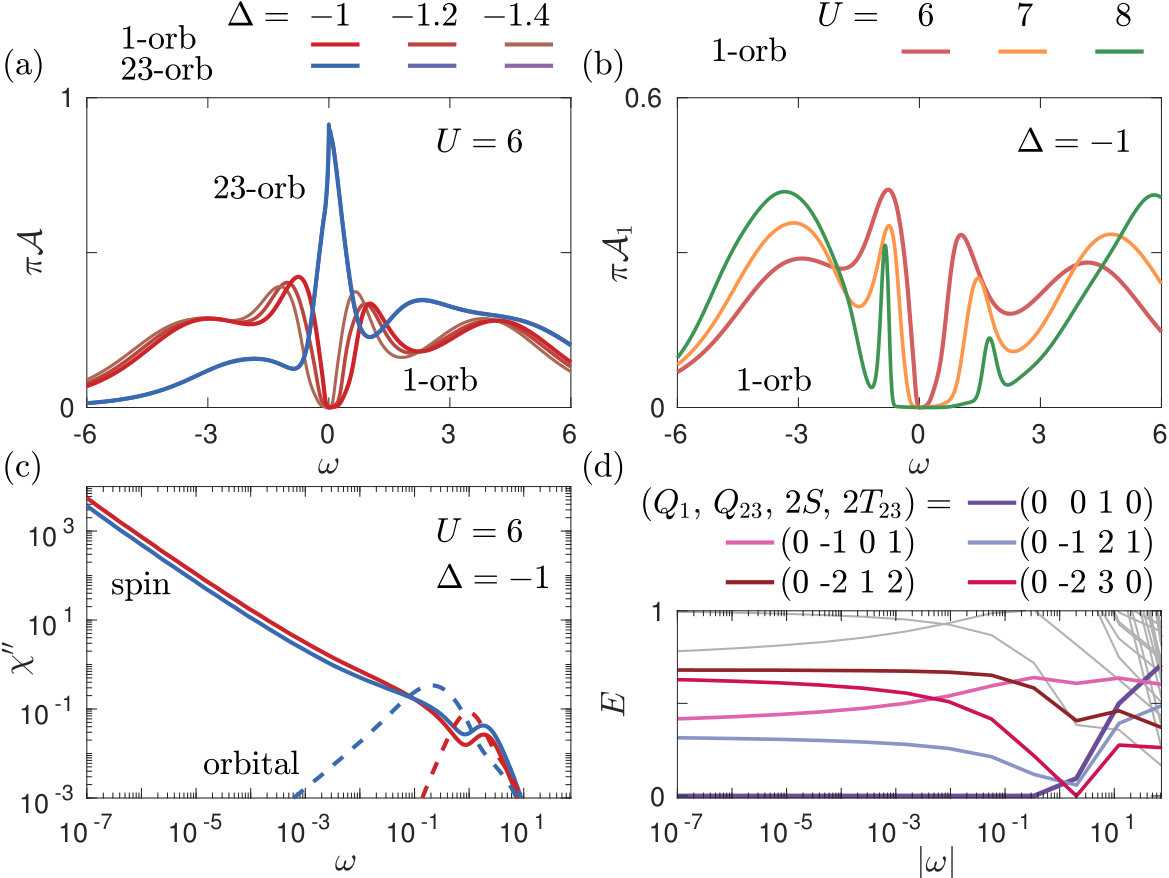 Figure 11
Peer Reviews
No public reviews on file for this paper yet. If you reviewed it on a platform where reviews are public (OpenReview, ICLR, NeurIPS, ICML), you can paste yours below so the community can read it here.
Videos
No videos yet. Explain this paper in a talk, walkthrough, or lecture? Add one.
Orbital differentiation in Hund metals
Fabian B. Kugler
Arnold Sommerfeld Center for Theoretical Physics, Center for NanoScience, and Munich Center for
Quantum Science and Technology, Ludwig-Maximilians-Universität München, 80333 Munich, Germany
Seung-Sup B. Lee
Arnold Sommerfeld Center for Theoretical Physics, Center for NanoScience, and Munich Center for
Quantum Science and Technology, Ludwig-Maximilians-Universität München, 80333 Munich, Germany
Andreas Weichselbaum
Condensed Matter Physics and Materials Science Department, Brookhaven National Laboratory, Upton, NY 11973, USA
Arnold Sommerfeld Center for Theoretical Physics, Center for NanoScience, and Munich Center for
Quantum Science and Technology, Ludwig-Maximilians-Universität München, 80333 Munich, Germany
Gabriel Kotliar
Condensed Matter Physics and Materials Science Department, Brookhaven National Laboratory, Upton, NY 11973, USA
Department of Physics and Astronomy, Rutgers University, Piscataway, NJ 08854, USA
Jan von Delft
Arnold Sommerfeld Center for Theoretical Physics, Center for NanoScience, and Munich Center for
Quantum Science and Technology, Ludwig-Maximilians-Universität München, 80333 Munich, Germany
(September 27, 2019)
Abstract
Orbital differentiation is a common theme in multiorbital systems, yet a complete understanding of it is still missing. Here, we consider a minimal model for orbital differentiation in Hund metals with a highly accurate method: We use the numerical renormalization group as a real-frequency impurity solver for a dynamical mean-field study of three-orbital Hubbard models, where a crystal field shifts one orbital in energy. The individual phases are characterized with dynamic correlation functions and their relation to diverse Kondo temperatures. Upon approaching the orbital-selective Mott transition, we find a strongly suppressed spin coherence scale and uncover the emergence of a singular Fermi liquid and interband doublon-holon excitations. Our theory describes the diverse polarization-driven phenomena in the bands of materials such as ruthenates and iron-based superconductors, and our methodological advances pave the way toward real-frequency analyses of strongly correlated materials.
I Introduction
The discovery of superconductivity in the iron pnictides and chalcogenides Kamihara et al. (2006, 2008) (FeSCs) has led to renewed interest in multiorbital systems. Both theoretical and experimental studies of these systems have uncovered the remarkable phenomenon of orbital differentiation: In an almost degenerate manifold of states, some orbitals are markedly more correlated than others. For instance, in FeSexTe1-x Liu et al. (2015), LiFeAs Miao et al. (2016), and K0.76Fe1.72Se2 Yi et al. (2015), among the states, only the orbital disappears from photoemission spectra as temperature is raised. Orbital differentiation is also seen in tunneling experiments Sprau et al. (2017) and is a key ingredient in theoretical frameworks to describe FeSCs Yin et al. (2011); de’ Medici et al. (2014); de’ Medici (2014). It is not unique to the FeSCs; it has further been documented in the ruthenates Sutter et al. (2019) and likely takes place in all Hund metals Haule and Kotliar (2009); Georges et al. (2013).
An extreme form of orbital differentiation is the orbital-selective Mott transition (OSMT) Anisimov et al. (2002), where some orbitals become insulating, while others remain metallic. Despite its importance, the OSMT in three-band systems has not yet been systematically investigated with a controlled method enabling access to low temperatures, where Fermi liquids form. Controversial questions include: For a given sign of crystal-field splitting, which orbitals localize? Is the OSMT of first or second order? Do correlations enhance or reduce orbital polarization as one approaches the OSMT? Is it true that quenching of orbital fluctuations makes the orbitals behave independently? Do the itinerant electrons in the OSM phase (OSMP) form a Fermi liquid? Finally, how are the precursors of the OSMT related to the physics of Hund metals?
In this paper, we use a minimal model (see motivation below) for orbital differentiation in Hund metals to answer these questions in a unified picture. Our conceptual arguments are supported by a numerical method of unprecedented accuracy: We use the numerical renormalization group (NRG) Bulla et al. (2008) as a real-frequency impurity solver for dynamical mean-field theory (DMFT) Georges et al. (1996), extending the tools of Ref. Stadler et al., 2015 from full SU(3) to reduced orbital symmetry. Whereas different bandwidths directly lead to different effective interaction strengths among the orbitals (as extensively studied for two-orbital models; see, e.g., Inaba and Koga (2007) for a list of references), we focus here on the more intricate case where a crystal field shifts one orbital in energy w.r.t. two degenerate orbitals de’ Medici et al. (2009); Werner et al. (2009); Kita et al. (2011); Huang et al. (2012); Wang et al. (2016). Thereby, we can isolate polarization effects and drive the system through band+Mott insulating, metallic, and OSM phases, reminiscent of Ca2RuO4 Anisimov et al. (2002), Sr2RuO4 Mravlje et al. (2011), and FeSCs, respectively.
Theoretically, the OSMP has been under debate both w.r.t. the precise form of the (conducting) self-energy Biermann et al. (2005); Werner and Millis (2006); de’ Medici et al. (2009); de’ Medici (2011); Huang et al. (2012) and w.r.t. subpeaks in the insulating spectral function de’ Medici et al. (2005); Ferrero et al. (2005); Kita et al. (2011); de’ Medici (2011). Whereas previous studies were limited by finite-size effects of exact diagonalization or finite temperature in Monte Carlo data (requiring analytic continuation), our NRG results yield conclusive numerical evidence down to the lowest energy scales. We give a detailed phase diagram including coexistence regimes (lacking hitherto) and characterize the individual phases with real-frequency properties and their relation to Kondo temperatures spanning several orders of magnitude. Upon approaching the OSMT, we find a strongly suppressed spin coherence scale and uncover the emergence of a singular Fermi liquid Coleman and Pépin (2003); Mehta et al. (2005); Koller et al. (2005); Biermann et al. (2005); Greger et al. and interband doublon-holon excitations Yee et al. (2010); Haule et al. (2010); Núñez-Fernández et al. (2018); Komijani et al. (2019) (both of which were previously realized only separately and in two-orbital models).
II Model and method
The Hamiltonian of our three-orbital Hubbard model is given by
[TABLE]
where creates an electron on lattice site in orbital with spin . The first term describes nearest-neighbor hopping within each orbital on the lattice of uniform amplitude , which thus sets the unit of energy. As local interaction, we use the following “minimal rotationally invariant” form Dworin and Narath (1970); Georges et al. (2013); Stadler et al. (2015); Horvat et al. (2016),
[TABLE]
Here, is the total spin operator; , , and are number operators with expectation values , , and , respectively. This interaction yields an intraorbital Coulomb interaction of size , interorbital Coulomb interactions of size and for opposite and equal spins, respectively, and a spin-flip term proportional to [cf. Eq. (1)]. With only two parameters, it exhibits the full SU(3) symmetry, as opposed to the SO(3) symmetry of the usual Hubbard–Kanamori Hamiltonian Kanamori (1963); Georges et al. (2013). We mostly fix these parameters to and .
Our only source of orbital differentiation comes from the last term in via the crystal-field splitting , defined as relative shift among the on-site energies (cf. Fig. 1): . (The index “” indicates shared properties of the degenerate doublet, e.g., .) The overall shift of is determined by the average filling , taken one away from half filling as characteristic for Hund metals. Note that, for to act nontrivially, this setting requires at least three orbitals. While the effect of in uncorrelated systems is rather straightforward, the interplay of with and especially in Hund metals leads to intriguing phenomena.
Within the DMFT approximation, the lattice Hamiltonian is mapped to an impurity problem with self-consistently determined hybridization Georges et al. (1996). We use a semicircular lattice density of states (half-bandwidth 2), for convenience, and restrict ourselves to paramagnetic solutions at zero temperature (, in practice). The impurity problem is solved on the real-frequency axis by means of the full-density matrix Weichselbaum and von Delft (2007) NRG. The numerical challenge of three orbitals with reduced symmetry is overcome by interleaving the Wilson chains Mitchell et al. (2014); Stadler et al. (2016) of the 1-orbital and 23-doublet, while fully exploiting the remaining symmetry, using the QSpace tensor library Weichselbaum (2012a, b). We set the overall discretization parameter to and keep up to 30000 multiplets ( states) during the iterative diagonalization. While NRG can famously resolve arbitrarily small energy scales very accurately, we also obtain a sufficiently accurate resolution at high energies via adaptive broadening Lee and Weichselbaum (2016); Lee et al. (2017a) of the discrete spectral data obtained for two different shifts Žitko and Pruschke (2009). As dynamic correlation functions, we compute the impurity self-energy Bulla et al. (1998), also used to extract the DMFT local spectral function , as well as spin and orbital susceptibilities , defined in Appendix D.
III Crystal-field splitting
As we tune , the system undergoes (for suitable interaction strength) several phase transitions. The nature of the different phases can be easily understood by looking at the occupations in the atomic limit (Fig. 1) Werner et al. (2009); Huang et al. (2012): For large , the 1-orbital has highest energy; both electrons reside in the half-filled 23-doublet and are likely to form a Mott insulator de’ Medici et al. (2011). For the symmetric model at , the two electrons are equally distributed among the three degenerate orbitals with occupation each, giving rise to metallic behavior (for not too strong interaction). Finally, for large , the filling of the lowest orbital is eventually increased up to half filling, , and the remaining electron occupies the quarter-filled 23-doublet. For intermediate interaction strengths 111For , the Mott transition of the half-filled 1-orbital depends mainly on , with a critical similar to the single-orbital case Georges et al. (1996). The Mott transition in the quarter-filled, 23-doublet requires much stronger interaction Blümer and Gorelik (2013); Lee et al. (2018). Hence, our choice and is close to the minimal interaction strength required for the OSMP., the half-filled 1-orbital is Mott-insulating while the quarter-filled 23-doublet remains metallic, thereby realizing an OSMP. By decreasing even further, one reenters a metallic () and ultimately a band-insulating phase ().
These considerations anticipate the mechanism driving the phase transitions de’ Medici et al. (2009); Werner et al. (2009); Kita et al. (2011); Huang et al. (2012); Wang et al. (2016); Steinbauer et al. (2019): primarily induces orbital polarization; i.e., it changes the relative filling of the orbitals. Starting from the orbitally symmetric, metallic phase, the different orbitals can become band-insulating or undergo a filling-driven Mott transition. If there are partially filled orbitals of different occupations and/or degeneracies, as in Fig. 1(c), this leads to different critical interaction strengths for the Mott transition, and an OSMP can be realized.
We now investigate the precise nature of these phase transitions as function of for fixed , , . Figure 2(a) shows the orbital polarization, . Starting from the symmetric case (, ) and increasing , decreases to its minimum [cf. Fig. 1(a)]. For large , we observe a coexistence region when approaching from below or above, giving rise to the definitions , . If we decrease starting from , increases until it saturates for at . This regime constitutes the OSMP, for which we find no hysteresis w.r.t. . Clearly, the -driven OSMT is much more second-order-like than the ordinary Mott transition at . We also note that, while appears differentiable at the OSMT, exhibits a kink [cf. Fig. 8(a)]. The OSMP is stable from down to , where one enters a strongly polarized () metallic phase (not shown).
To address the effect of correlations on orbital differentiation, we examine the difference in the real part of the self-energies, , which adds to a renormalized crystal field Kita et al. (2011), [cf. also Fig. 8(b)]. The overall shift of the self-energies is given by the Hartree part, , which can directly be calculated:
[TABLE]
The difference, , increases monotonically with (via ) for , such that interactions overall enhance orbital differentiation Georges et al. (2013). However, the renormalization of at low energies must be determined numerically. Figure 2(b) displays at : is smaller in magnitude than (plot shows ) and increases monotonically with only for . For , bends upward and eventually increases with decreasing , thereby counteracting the splitting.
Next, Fig. 2(c) shows the width of the quasiparticle peak, , of the spectral function (cf. Fig. 4) to confirm the conducting vs. insulating character of the different phases. For positive and negative , we indeed find that the 23- and 1-orbital(s), respectively, undergo a Mott transition, with gradually decreasing . The sharp decline in around corresponds to the formation of a subpeak (see below). For , the 1-orbital shows a slight increase of and eventually becomes band-insulating, while, for , of the 23-orbitals decreases until it saturates in the OSMP. Note that the quasiparticle weight, , often used to describe the single-orbital Mott transition, is not ideal to characterize the full range of orbital differentiation: For , when the 1-orbital gets emptied out, increases although the whole quasiparticle peak gradually disappears; for large , of the insulating 1-orbital does not vanish throughout the OSMP, yet in the metallic 23-orbitals, as further explained below.
We complete our phase diagram by showing in Fig. 2(d) the -dependence of Kondo temperatures, defined as the energy scale at which the corresponding susceptibility, , is maximal [cf. Fig. 4(d)]. As typical for Hund metals Georges et al. (2013); Stadler et al. (2015), we observe spin–orbital separation in terms of Kondo scales: orbital fluctuations are screened at much higher energies than spin fluctuations (). While characterizes orbital fluctuations within the 23-doublet, describes those between the (separated) 1-orbital and the 23-doublet [cf. Eq. (11)] and reduces to the bare energy scale for large splitting. At sizable , both orbitals have the same Greger et al. (2013), and, strikingly, strongly decreases with increasing .
This can be understood as follows: It is well-known that finite decreases Okada and Yosida (1973); Georges et al. (2013); Stadler et al. (2019), as it splits the impurity ground-state manifold. Intuitively, a smaller ground-state degeneracy implies a reduced effective hybridization and thus a reduced Kondo temperature. For and finite , the ground-state degeneracy is reduced even further, particularly for ; see Fig. 3. Moreover, the DMFT self-consistency suppresses the low-energy hybridization strength of the orbital approaching the Mott transition. In the OSMP, and eventually vanish altogether.
IV Metallic spectrum
Let us now examine in detail how the spectral functions change with in the metallic phase. Figures 4(a,b) show that, for both positive and negative , the most important change with stronger correlations occurs in the orbital(s) approaching a Mott transition (main panels). The other orbitals (insets) mostly adjust the spectral weight. At [gray lines in Figs. 4(a–c)], the spectral functions exhibit the typical shoulder in the quasiparticle (qp) peak Stadler et al. (2015, 2019) (below half filling at ). In Ref. Stadler et al., 2019, this has been explained as the combination of a sharp SU(2) spin Kondo resonance (“needle” with width ) and a wider SU(3) orbital Kondo resonance (“base” with width ). If we first stay with the orbitally symmetric case [Fig. 4(c)] and use and as tuning parameters Stadler et al. (2019), we can reduce by increasing while only mildly affecting . As a consequence, the needle sharpens while the wide base remains, revealing a subpeak.
Similarly, increasing drastically decreases [Figs. 2(d), 4(d)] and causes a thin qp needle. Additionally, finite , which acts in orbital space similarly to a magnetic field in spin space, splits the qp base. For , the orbital Kondo resonance is destroyed and subpeaks on both sides of remain. In fact, the orbital-resonance shoulder is remarkably accurately centered at [Fig. 4(c)], and crosses over to an interband doublon-holon excitation at (see below) for . Note that the authors of Ref. Horvat et al., 2016 similarly marked strong influence of by .
Generally, finite amplifies Hund-metal features in some orbitals while suppressing them in others. This is apparent in spectral functions (Fig. 4) as well as self-energies; see Fig. 5. For , we find the typical Iwasawa et al. (2005); Mravlje et al. (2011) inverted slope in for small and kink in for small (with related by Kramers–Kronig transform). These features are enhanced as the orbital becomes more correlated, and suppressed as it becomes less correlated. The degree of correlation follows from proximity to half filling: approaches as decreases; approaches as increases.
V OSMP
For , and the qp needle vanish altogether; the 1-orbital becomes a Mott insulator while the 23-doublet retains spectral weight at [Fig. 6(a)]. In the metallic orbitals, Luttinger pinning Müller-Hartmann (1989) via the semicircular lattice density of states , with and , is fulfilled throughout [leading to at quarter filling ]. Yet, the spectral function of the half-filled 1-orbital strongly differs from a single-orbital Mott insulator. Next to the standard Hubbard bands, charge fluctuations in the 23-doublet enable interband doublon-holon excitations (previously identified in a two-band DMFT+DMRG study Núñez-Fernández et al. (2018); cf. Yee et al. (2010); Haule et al. (2010) for experimental signatures) in the insulating spectral function. Here, they occur at energies and , as derived in Appendix B. These gap-filling states give its soft form. They are shifted with , leading to a “tilt” of around . A hard gap is revealed when pushing the subpeaks apart (via ) and decreasing their weight (via ) by suppressing -charge fluctuations [Fig. 6(b)]. The subpeaks’ distinct nature Lee et al. (2017a, b) is further underlined in plots of the momentum-resolved spectral function, shown in Appendix C, where one can also see how the widths of the 23-qp peak and 1-orbital subpeaks narrow together with increasing .
As the insulating 1-orbital does not contribute to spin screening, the OSMP inherits properties of an underscreened (spin) Kondo effect Greger et al. , as manifested in a divergent spin susceptibility [Fig. 6(c)]. Within our DMFT description of the OSMP, the impurity electron in the 1-orbital and that in the 23-doublet form a combined spin 1, due to Hund’s coupling. However, the 1-orbital hybridization () has zero weight at low enough energies. Hence, given the diagonal hybridization, only the 23-contribution to the impurity spin can be screened, while its 1-orbital contribution remains unscreened. The underscreened Kondo effect in turn leads to the singular Fermi-liquid (SFL) state of the OSMP, as strikingly evident in the NRG flow diagram Bulla et al. (2008); Stadler et al. (2015, 2019): Fig. 6(d) shows that the rescaled, lowest-lying energy levels of the iteratively diagonalized Wilson chain reach the Fermi-liquid (FL) fixed point only asymptotically Mehta et al. (2005).
The self-energy of the insulating -orbital diverges. In Fig. 7(a), we see that the singularity of is not bound to ; instead, its position shifts with . This implies that does not vanish throughout the OSMP and is thus not suited to mark the insulating character of the -orbital in the OSMP. A low-energy zoom of the self-energy in the metallic 23-orbitals [Fig. 7(b)] reveals strong deviations from the standard zero-temperature FL form, and . Instead, it exhibits logarithmic singularities that can be well fitted [dashed lines in Fig. 7(b)] to the SFL relations Biermann et al. (2005); Greger et al. ; Wright (2011)
[TABLE]
The logarithmic singularity in implies that despite the conducting character of the 23-orbitals with finite spectral weight at the Fermi level [Fig. 6(a)]. To further scrutinize the singularity, we consider the logarithmic derivative of the imaginary part of ,
[TABLE]
both for real frequencies, with , and for imaginary frequencies, . This quantity is well suited to discriminate between singularities of logarithmic or fractional power-law type:
[TABLE]
In Fig. 7(c), we clearly see that , confirming the logarithmic nature of the singularity. Note that a smoothening postprocessing was used to suppress minor oscillations in very small values of . The imaginary-frequency data , available for , perfectly match the low-frequency behavior but does not suffice to follow the decay up to . In fact, if the imaginary-frequency data were available only in a limited temperature range, as is the case in Monte Carlo studies, say, and , one might easily be tempted to conclude that saturates at .
VI Conclusion
We have shown that DMFT+NRG can be used to study three-orbital Hubbard models with reduced orbital symmetry, used this method to accurately describe polarization-driven phase transitions induced by a crystal field , and uncovered the rich real-frequency structure inherent in the interplay of Hund-metal physics and orbital differentiation. Our analysis leads to a conclusion of major conceptual significance: The popular notion that orbital screening, facilitated by , makes the orbitals behave almost independently de’ Medici et al. (2009, 2011); de’ Medici (2011); Georges et al. (2013); de’ Medici et al. (2014); de’ Medici (2014); Fanfarillo and Bascones (2015); Sutter et al. (2019) [as seen, e.g., in static correlations de’ Medici et al. (2009); de’ Medici (2011); Fanfarillo and Bascones (2015); cf. also Fig. 8(a)] misses the importance of spin fluctuations. It must be revised when looking at dynamic correlation functions, as (i) a suppressed hybridization in one orbital suppresses the spin Kondo temperature of all orbitals (at sizable ), (ii) charge fluctuations in some orbitals enable interband doublon-holon excitations Núñez-Fernández et al. (2018) in the spectrum of other orbitals, and (iii) the presence of localized spins implies singular Fermi-liquid behavior of the remaining itinerant electrons Greger et al. .
With our methodological advances, NRG is ready to be used as a real-frequency impurity solver in a DFT+DMFT description of three-orbital materials with reduced orbital symmetry Kugler et al. . Future studies should further investigate the stability of the OSMP against interorbital hopping Yu and Si (2017).
Acknowledgments
We thank A. Georges and K. M. Stadler for fruitful discussions, and K. Hallberg for a helpful correspondence. FBK, S-SBL, and JvD were supported by the Deutsche Forschungsgemeinschaft under Germany’s Excellence Strategy–EXC-2111–390814868; S-SBL further by Grant. No. LE3883/2-1. FBK acknowledges funding from the research school IMPRS-QST. AW was funded by DOE-DE-SC0012704. GK was supported by NSF-DMR-1733071.
Appendix A Additions to the phase diagram
In the discussion of the phase diagram in Fig. 2, we mentioned that the polarization , with and , varies with in a differentiable way throughout the OSMT. Regarding the nature of the phase transition, it is then interesting to note that exhibits a kink at the OSMT [Fig. 8(a)]. Further, we have elaborated on the intricate interorbital effects on dynamic correlation functions, such as a strongly suppressed spin coherence scale, singular Fermi-liquid behavior, and interband doublon-holon excitations. These effects are completely hidden when looking at static properties like the interorbital correlator , which, generally, is rather weak [Fig. 8(b)] and has a kink at analogous to de’ Medici et al. (2009); de’ Medici (2011).
To gauge the influence of correlations on orbital differentiation, we investigated , which contributes to a renormalized crystal field, , for electronic degrees of freedom. An alternative definition for an effective crystal field, , is given by , which constitutes a splitting for quasiparticle excitations Kita et al. (2011). Figure 8(b) shows that both variants of vary similarly with : In a region around , the self-energy difference increases the magnitude of , i.e., for and for moderate . However, for large, negative , we find that for , thus decreasing . The quasiparticle effective crystal field, , is much smaller in magnitude than the bare crystal field, but, nonetheless, shows a trend similar to that of : It depends monotonically on in a region around but bends upward for large, negative , thereby counteracting the splitting.
Appendix B Doublon-holon excitations
The spectrum of the insulating 1-orbital in the OSMP can be qualitatively explained from the atomic level structure. In the atomic limit, the ground state consists of eigenstates of the impurity Hamiltonian with one electron in the - and -orbital(s) each [the first contribution to in Fig. 9(b), marked in red, is a representative]. However, the metallic character of the -orbitals implies charge fluctuations, such that the actual ground state also contains admixtures from states where the -levels of the impurity are empty or doubly occupied [second and third contributions to in Fig. 9(b)]. At fixed filling, the residual charge is carried by the bath [second “ket” in the tensor-product notation of Fig. 9(b)].
At large interaction, the first term of with impurity occupation 2 is dominant. Single-particle and -hole excitations in the -orbital on top of this state mark the Hubbard bands [first “column” in Fig. 9(b)]. Single-particle and -hole excitations to the other contributions make states accessible which are inaccessible in the atomic limit [second and third “column” in Fig. 9(b)]. If we relate these states to the dominant part of the ground state, we can identify them as interband doublon-holon excitations Núñez-Fernández et al. (2018): The charge on the impurity remains 2 while an electron is removed in the -orbital and added in the -orbital [blue dashed line in Fig. 9(b)] or vice versa (green dashed line).
We can also estimate the positions of both the Hubbard bands and the doublon-holon peaks in from the atomic level structure. To this end, we first recall the impurity Hamiltonian, , with
[TABLE]
The ground-state energy can be estimated from the impurity eigenstate with dominant weight, having one electron in the -orbital and another spin-aligned one in the -doublet, as . The difference in on-site energies is determined by the crystal field, , and the occupation of in the OSMP sets a range for their overall shift. Additionally, a specific value for can be found by looking at charge fluctuations in the -doublet, as shown next.
Charge fluctuations in the 23-orbitals
Charge fluctuations in the -doublet on top of the dominant ground-state contribution connect the states shown in Fig. 9(a) with atomic energies
[TABLE]
The energy cost for the respective transitions, giving the position of Hubbard bands in the -doublet, is
[TABLE]
Equilibrium at filling 2 is thus obtained when
[TABLE]
Inserting the values and mostly used, this means and , corresponding to the bumps in at [Fig. 6(a)].
Hubbard bands in the 1-orbital
Single-particle and -hole excitations in the -orbital on top of the dominant ground-state contribution lead to the states shown in the first “column” of Fig. 9(b) with energies
[TABLE]
Excitations to these states mark the 1-orbital Hubbard bands, which are found in the spectral function at
[TABLE]
Inserting the value for from Eq. (4) yields
[TABLE]
If we further insert the values , , and of Fig. 6(a), we get the peak positions and . Increasing up to , with as in Fig. 6(b), increases their magnitude up to and , respectively. These numbers match the curves in Fig. 6(a,b) very well.
Doublon-holon subpeaks
The doublon-holon excitation energies are found from single-particle or -hole excitations on top of the subleading contributions to the ground state with an empty or doubly occupied -doublet [second and third “column” of Fig. 9(b)]. The atomic energies of the excited states are
[TABLE]
The energy difference to the dominant ground-state contribution [dashed lines in Fig.9(b)] gives the position of the subpeaks in the insulating spectral function. Using , we have
[TABLE]
Interestingly, these peak positions only depend on the difference of the energy levels, , and on Hund’s coupling, . Inserting the values for Fig. 6(a) gives and , and those for Fig. 6(b) yield and , in perfect agreement with the plots.
Both the charge fluctuations in the -doublet and the interband doublon-holon excitations are determined by the same subleading contributions to the ground state (such as the terms with coefficients and in Fig. 9). Hence, the widths of the quasiparticle peak in the -doublet and the subpeaks in the -orbital are closely tied together. By increasing , one can then decrease both the widths of the -quasiparticle peak and the -subpeaks. On the other hand, by tuning and at constant , one can shift the positions of the -subpeaks, while the weights of the -quasiparticle peak and the -subpeaks remain roughly the same.
Appendix C Momentum-resolved spectral function
In Fig. 10, we plot the local spectral function, , together with the momentum-resolved one, . As explained in the caption, strong particle-hole asymmetry, decreasing quasiparticle weight, and localization of the 1-electrons can be nicely seen. Moreover, it is interesting to observe that the crossover between the shoulder and the interband doublon-holon subpeak at is accompanied by a transfer of spectral weight from to . In the OSMP, the doublon-holon subpeak at , can be very well distinguished from the Hubbard band at , . Especially in the momentum-resolved plot, these interband doublon-holon subpeaks resemble the intraband doublon-holon subpeaks known from the single-orbital strongly correlated metallic phase Lee et al. (2017a, b).
Appendix D Susceptibilities
Here, we give the definitions for the various susceptibilities computed. The total spin operator is given by with and Pauli matrices . We further define , and mainly compute the spin susceptibilities
[TABLE]
Further, we use the angular-momentum operator with and compute orbital susceptibilities according to and
[TABLE]
In fact, as the system exhibits full SU(2) orbital symmetry in the 23-doublet, we can also use the fully symmetrized and
[TABLE]
In the literature, orbital susceptibilities are sometimes computed from charge fluctuations in the individual orbitals. In this language, with , one has
[TABLE]
Using orbital SU(2) symmetry with , one further obtains
[TABLE]
In the fully symmetric case at , we can also extract the spin and orbital Kondo temperatures from
[TABLE]
where with SU(3) Gell-Mann matrices normalized as .
For illustration, we finally show in Fig. 11 intra- and inter-orbital susceptibilities of spin and number operators. As the inter-orbital ones, and , change sign within , they are shown in absolute value. We see that the orbital Kondo scale, read off from the position of the maximum in (dash-dotted line), can also be determined from orbital-resolved charge susceptibilities (dashed lines), corresponding to their explicit relation given in Eq. (14). It is interesting to note that spins align, meaning , for due to Hund’s coupling, and the individual charges antagonize, meaning , for to minimize the Coulomb repulsion.
The reference list from the paper itself. Each links out to its DOI / PubMed record.
- 1Kamihara et al. (2006) Y. Kamihara, H. Hiramatsu, M. Hirano, R. Kawamura, H. Yanagi, T. Kamiya, and H. Hosono, J. Am. Chem. Soc. 128 , 10012 (2006) . · doi ↗
- 2Kamihara et al. (2008) Y. Kamihara, T. Watanabe, M. Hirano, and H. Hosono, J. Am. Chem. Soc. 130 , 3296 (2008) . · doi ↗
- 3Liu et al. (2015) Z. K. Liu, M. Yi, Y. Zhang, J. Hu, R. Yu, J.-X. Zhu, R.-H. He, Y. L. Chen, M. Hashimoto, R. G. Moore, S.-K. Mo, Z. Hussain, Q. Si, Z. Q. Mao, D. H. Lu, and Z.-X. Shen, Phys. Rev. B 92 , 235138 (2015) . · doi ↗
- 4Miao et al. (2016) H. Miao, Z. P. Yin, S. F. Wu, J. M. Li, J. Ma, B.-Q. Lv, X. P. Wang, T. Qian, P. Richard, L.-Y. Xing, X.-C. Wang, C. Q. Jin, K. Haule, G. Kotliar, and H. Ding, Phys. Rev. B 94 , 201109 (2016) . · doi ↗
- 5Yi et al. (2015) M. Yi, Z.-K. Liu, Y. Zhang, R. Yu, J.-X. Zhu, J. Lee, R. Moore, F. Schmitt, W. Li, S. Riggs, J.-H. Chu, B. Lv, J. Hu, M. Hashimoto, S.-K. Mo, Z. Hussain, Z. Mao, C. Chu, I. Fisher, Q. Si, Z.-X. Shen, and D. Lu, Nat. Commun. 6 , 7777 (2015) . · doi ↗
- 6Sprau et al. (2017) P. O. Sprau, A. Kostin, A. Kreisel, A. E. Böhmer, V. Taufour, P. C. Canfield, S. Mukherjee, P. J. Hirschfeld, B. M. Andersen, and J. C. S. Davis, Science 357 , 75 (2017) . · doi ↗
- 7Yin et al. (2011) Z. P. Yin, K. Haule, and G. Kotliar, Nat. Mater. 10 , 932 (2011) . · doi ↗
- 8de’ Medici et al. (2014) L. de’ Medici, G. Giovannetti, and M. Capone, Phys. Rev. Lett. 112 , 177001 (2014) . · doi ↗