Enhanced spin-triplet pairing in magnetic junctions with s-wave superconductors
Thomas Vezin, Chenghao Shen, Jong E. Han, Igor \v{Z}uti\'c

TL;DR
This paper predicts that simple magnetic junctions with s-wave superconductors can exhibit strong spin-triplet superconductivity due to interfacial spin-orbit coupling, leading to significant conductance magnetoanisotropy.
Contribution
It introduces a novel mechanism where interfacial spin-orbit coupling enables near-perfect spin-triplet proximity effects in simple magnetic junctions.
Findings
Enhanced spin-triplet proximity effect due to interfacial spin-orbit coupling.
Order of magnitude increase in conductance magnetoanisotropy.
Effective perfect transparency in magnetic junctions with small spin polarization.
Abstract
A common path to superconducting spintronics, Majorana fermions, and topologically-protected quantum computing relies on spin-triplet superconductivity. While naturally occurring spin-triplet pairing is elusive and even common spin-triplet candidates, such as SrRuO, support alternative explanations, proximity effects in heterostructures can overcome these limitations. It is expected that robust spin-triplet superconductivity in magnetic junctions should rely on highly spin-polarized magnets or complex magnetic multilayers. Instead, we predict that the interplay of interfacial spin-orbit coupling and the barrier strength in simple magnetic junctions, with only a small spin polarization and s-wave superconductors, can lead to nearly complete spin-triplet superconducting proximity effects. This peculiar behavior arises from an effective perfect transparency: interfacial spin-orbit…
Click any figure to enlarge with its caption.
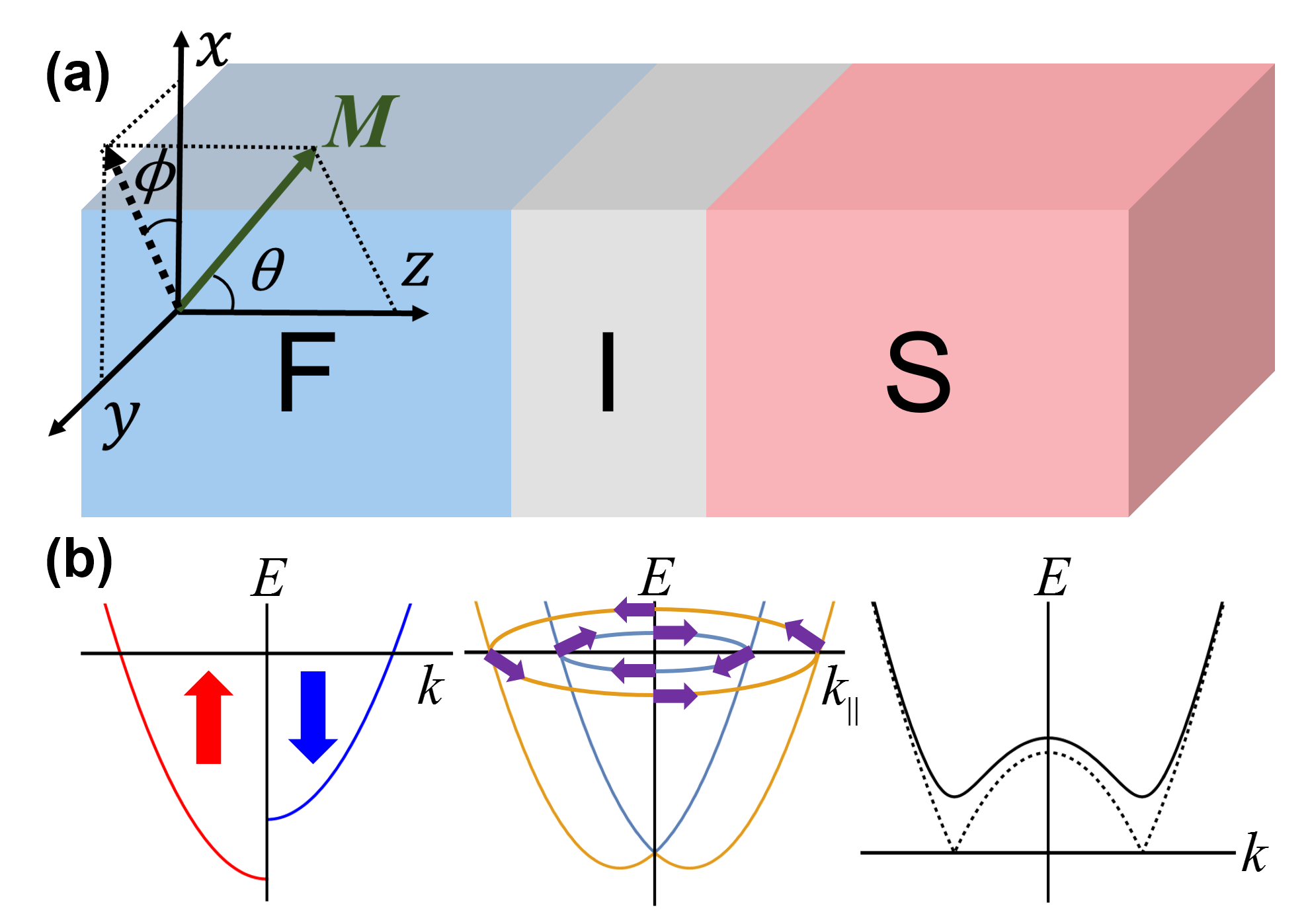 Figure 1
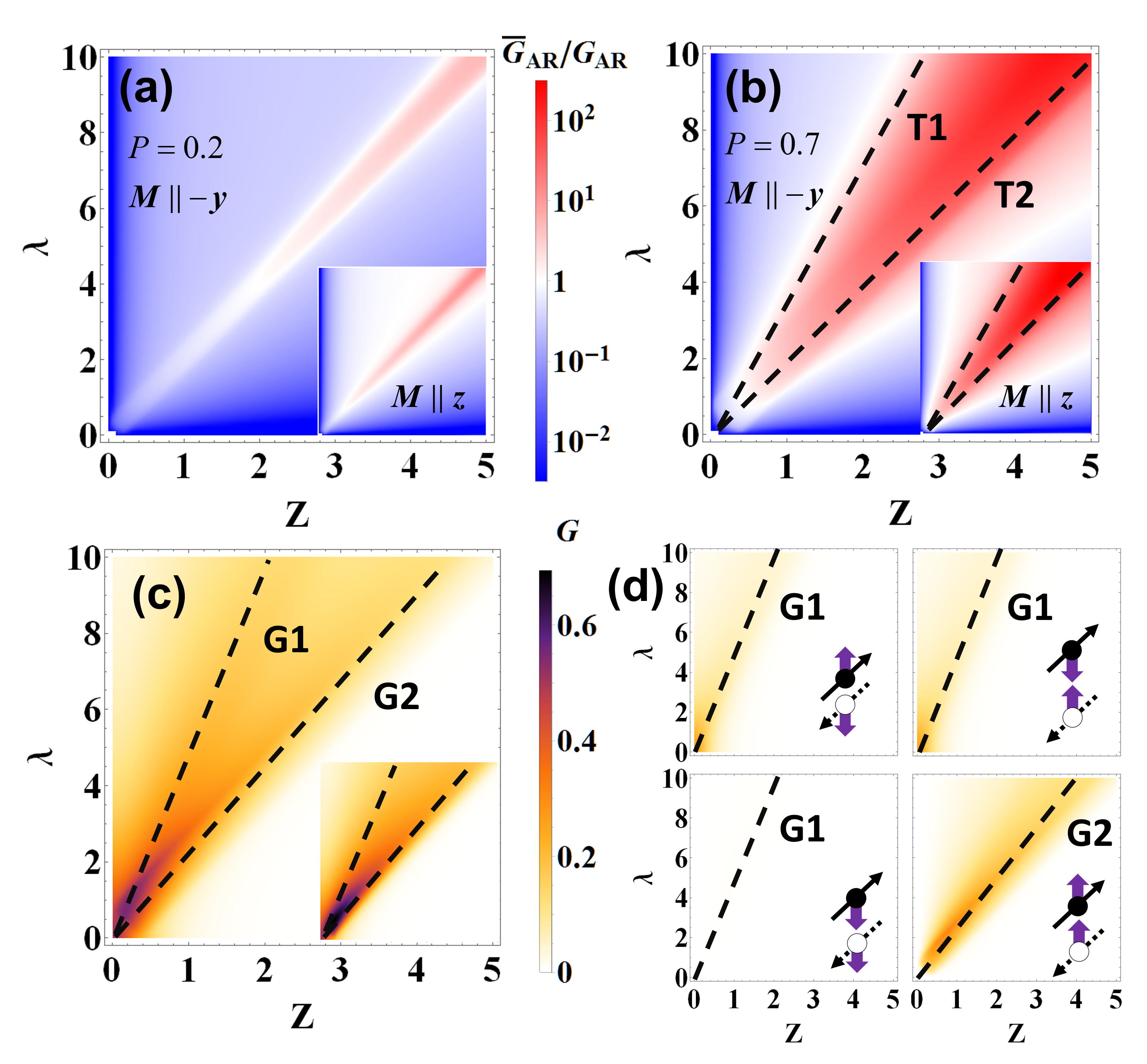 Figure 2
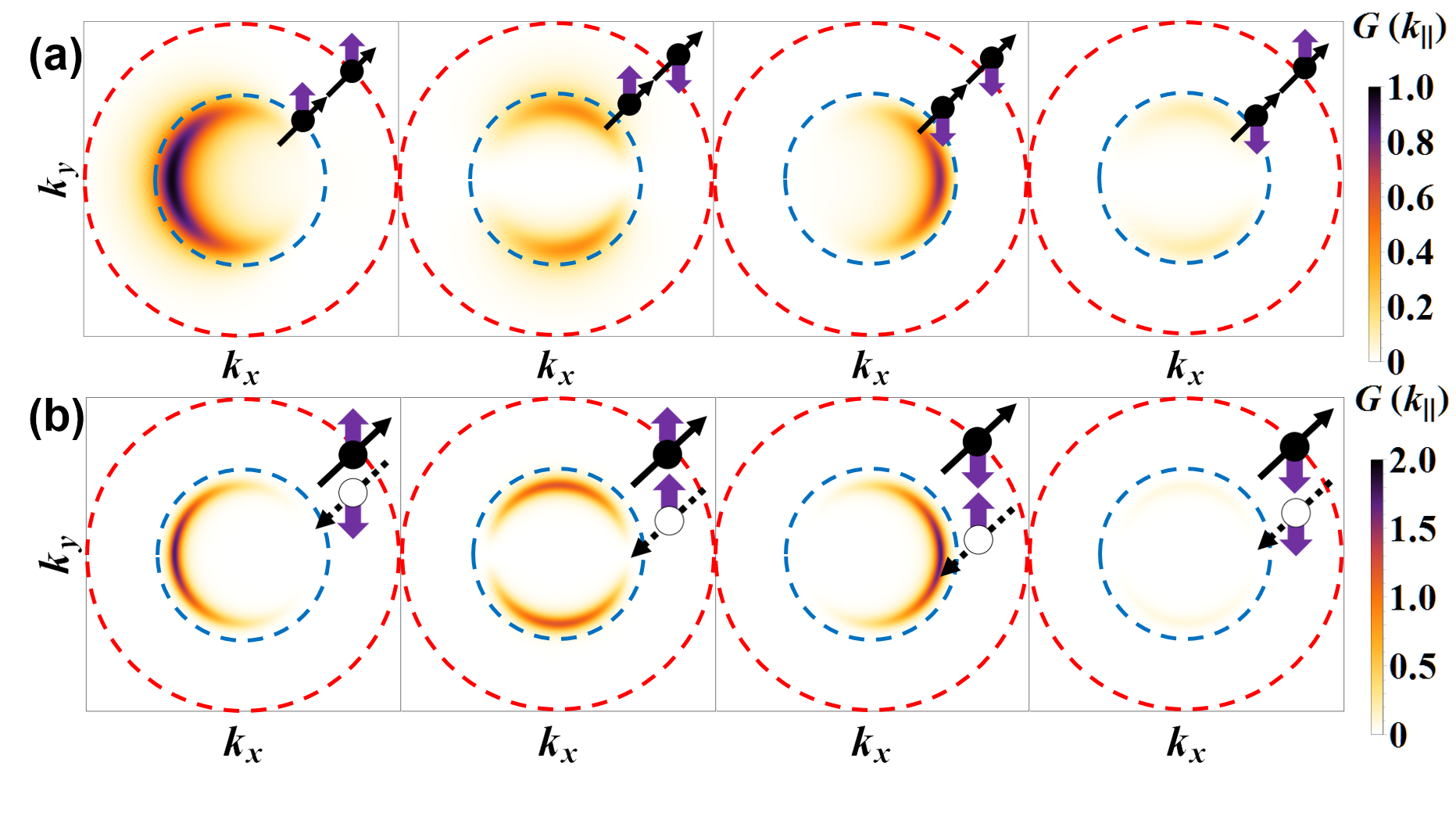 Figure 3
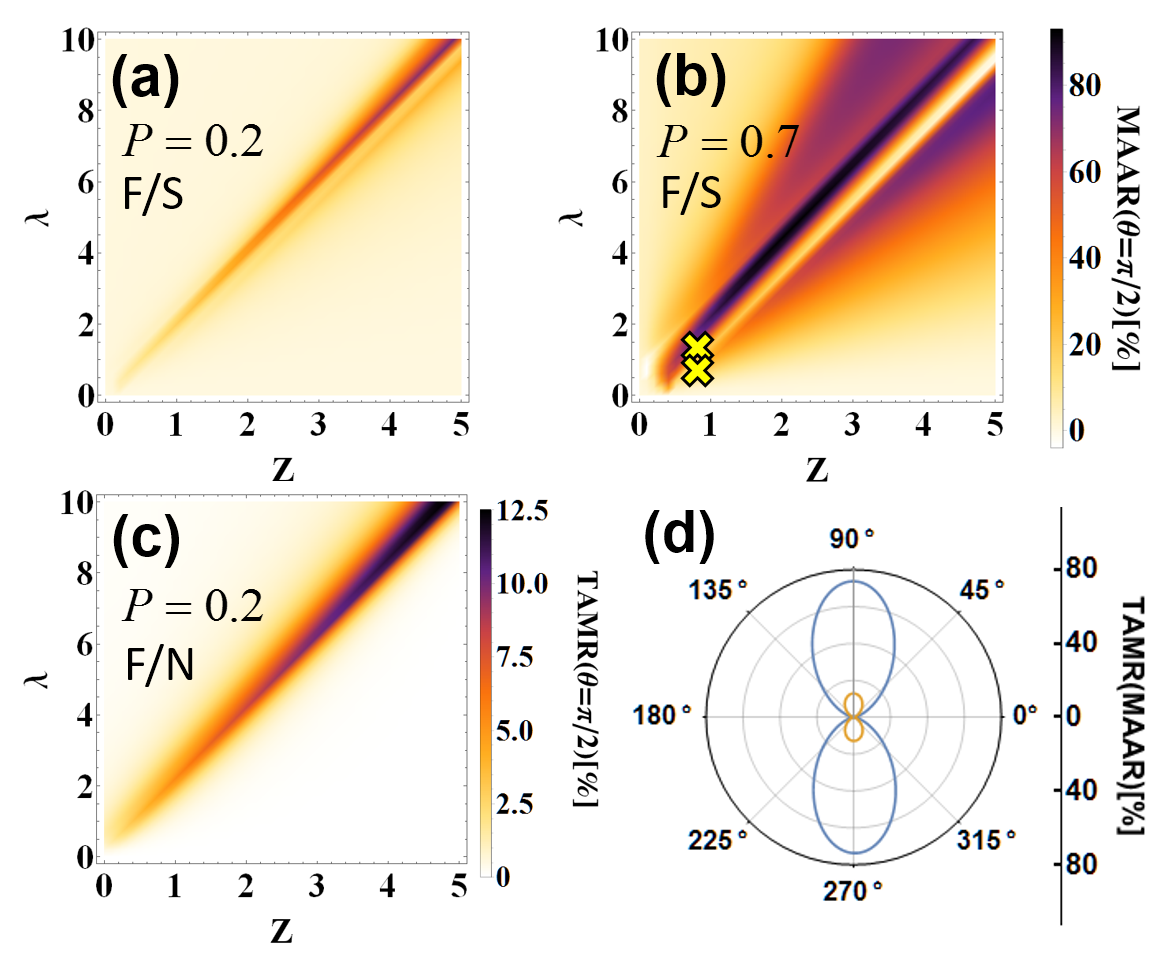 Figure 4
Peer Reviews
No public reviews on file for this paper yet. If you reviewed it on a platform where reviews are public (OpenReview, ICLR, NeurIPS, ICML), you can paste yours below so the community can read it here.
Videos
No videos yet. Explain this paper in a talk, walkthrough, or lecture? Add one.
Enhanced spin-triplet pairing in magnetic junctions with s-wave superconductors
Thomas Vezin
Department of Physics, University at Buffalo, State University of New York, Buffalo, NY 14260, USA
Laboratoire des Solides Irradies, Ecole Polytechnique, Universite Paris-Saclay, F-91767 Palaiseau Cedex, France
Chenghao Shen
Department of Physics, University at Buffalo, State University of New York, Buffalo, NY 14260, USA
Jong E. Han
Department of Physics, University at Buffalo, State University of New York, Buffalo, NY 14260, USA
Igor Žutić
Department of Physics, University at Buffalo, State University of New York, Buffalo, NY 14260, USA
Laboratoire des Solides Irradies, Ecole Polytechnique, Universite Paris-Saclay, F-91767 Palaiseau Cedex, France
Abstract
A common path to superconducting spintronics, Majorana fermions, and topologically-protected quantum computing relies on spin-triplet superconductivity. While naturally occurring spin-triplet pairing is elusive and even common spin-triplet candidates, such as Sr2RuO4, support alternative explanations, proximity effects in heterostructures can overcome these limitations. It is expected that robust spin-triplet superconductivity in magnetic junctions should rely on highly spin-polarized magnets or complex magnetic multilayers. Instead, we predict that the interplay of interfacial spin-orbit coupling and the barrier strength in simple magnetic junctions, with only a small spin polarization and s-wave superconductors, can lead to nearly complete spin-triplet superconducting proximity effects. This peculiar behavior arises from an effective perfect transparency: interfacial spin-orbit coupling counteracts the native potential barrier for states of a given spin and wave vector. We show that the enhanced spin-triplet regime is characterized by a huge increase in conductance magnetoanisotropy, orders of magnitude larger than in the normal state.
Realizing equal-spin triplet superconductivity provides an important platform for implementing superconducting spintronics and topologically-protected Majorana bound states (MBS) Eschrig (2011); Linder and Robinson (2015); Martinez et al. (2016); Aasen et al. (2016); Kitaev (2001); Mourik et al. (2012); Rokhinson et al. (2012). While naturally occurring triplet pairing remains elusive, transforming materials through proximity effects Žutić et al. (2019) offers a promising path to tailor the desired superconducting pairing Kontos et al. (2001); Ryazanov et al. (2001); Fu and Kane (2008); Buzdin (2005); Bergeret et al. (2005).
For superconducting spintronics equal-spin triplet supports pure spin currents and the coexistence of superconductivity and ferromagnetism through long-range superconducting proximity effects in ferromagnet/superconductor (F/S) junctions Buzdin (2005); Bergeret et al. (2005); Eschrig (2015). Such junctions typically rely on multiple ferromagnetic and superconducting regions Buzdin (2005); Bergeret et al. (2005); Gingrich et al. (2016); Cottet (2011); Khaire et al. (2010), complex ferromagnets with spiral magnetization Robinson et al. (2010), or complete spin polarization in half-metallic ferromagnets Singh et al. (2015); Ali ; Keizer et al. (2006),
With alternative paths towards spin-triplet pairing, where interfacial spin-orbit coupling (SOC) could relax the requirement of a complex magnetic structure, it is expected that both a strong spin polarization and strong SOC are needed Jeon et al. (2018); Banerjee et al. (2018); Satchell and Birge (2018); Johnsen et al. (2019). However, we reveal that for nearly complete spin-triplet proximity-induced superconductivity even weakly spin-polarized ferromagnet and smaller SOC could be desirable. Our findings could complement the paths towards MBS where proximity-induced spin-triplet pairing is sought through strong SOC and half-metallic ferromagnets Fu and Kane (2008); Duckheim and Brouwer (2011); Lutchyn et al. (2010); Oreg et al. (2010).
A microscopic understanding of a superconducting proximity effect is obtained from the process of Andreev reflection (AR) at interfaces with superconductors where an electron is reflected backwards and converted into a hole with opposite charge and spin. This implies the doubling of the normal state conductance Blonder et al. (1982) since two electrons are transferred across the interface into the S region where they form a spin-singlet Cooper pair. In contrast to this conventional AR, a spin-active interface with interfacial spin-flip scattering also yields AR with an equal spin of electrons and holes Žutić and Das Sarma (1999), responsible for a spin-triplet Cooper pair.
We consider F/S junction, depicted in Fig. 1, having a flat interface (I) at with potential and Rashba SOC scattering Žutić et al. (2004). We generalize the Blonder-Tinkham-Klapwijk formalism Blonder et al. (1982); Kashiwaya and Tanaka (2000); Granstrom et al. (2017) to solve Bogoliubov-de Gennes equation for quasiparticle states with energy E Högl et al. (2015),
[TABLE]
where the single-particle Hamiltonian for electrons is and for holes . They contain the effective mass , the chemical potential , and the exchange spin splitting . Magnetization, , has orientation , are Pauli matrices, and is wave vector. The interfacial scattering is modeled by delta-like potential barrier with effective height and width and the Rashba SOC with strength , due to structure inversion asymmetry Žutić et al. (2004). The s-wave superconductor is described by the constant pair potential .
Since the in-plane wave vector is conserved, the scattering states for incident spin electron are given by in a four-component basis Žutić and Das Sarma (1999) where the “bar” symbol denotes the spin-flip contribution
[TABLE]
In the F region, the eigenspinors for electrons and holes are and with
[TABLE]
where refer to spin parallel (antiparallel) to and the -components of the wave vector are , with a spin-averaged Fermi wave vector, Žutić and Valls (2000). In the S region, coherence factors, , , satisfy , while the -components of the wave vector are , with the Fermi wave vector. Similar to Snell’s law Žutić and Valls (2000), for a large these -components can become imaginary representing evanescent states which carry no net current.
From the charge current conservation, we can express zero-temperature conductance at applied bias, ,
[TABLE]
normalized by the Sharvin conductance Žutić et al. (2004), where is the interfacial area. Only the probability amplitudes from the F region are needed, for Andreev and specular reflection .
We focus on the zero-bias conductance, , where there is no quasiparticle transmission and, from the probability conservation Žutić and Das Sarma (1999); Högl et al. (2015), can be expressed using AR such that in Eq. (4) the integration kernel is . The total conductance can be decomposed into four processes: conventional and spin-flip AR for spin-up (spin-down) () incident electrons corresponding, respectively, to the spin-singlet and spin-triplet superconducting correlations at the interface. It is convenient to introduce spin polarization , and dimensionless parameters for barrier strength and Rashba SOC . As we present trends for a large parameter space, unless otherwise specified, we will consider the case for and .
In Figs. 2(a) and (b) we show the conductance ratio between the spin-flip and conventional AR, , our proxy for singlet and triplet interfacial pairing, as function of the barrier strength and SOC. Remarkably, , even for a small spin polarization, , a nearly complete triplet pairing is possible, () for in-plane (out-of-plane) . A striking enhancement of the triplet contribution is feasible for a wide range of barrier strengths, accompanied with a suitable SOC. As shown in Fig. 2, the triangle region of this dominance increases considerably for a larger and it is approximately delimited with lines T1 and T2,
[TABLE]
excluding the half-metals, . Our findings suggest that even simple -wave junctions with only one magnetic region of a small and interfacial SOC can support robust spin-triplet currents. These trends are also preserved for an out-of-plane [Figs. 2(a), (b) inset].
To explore this peculiar behavior and the origin of the triangle region with enhanced triplet pairing, in Fig. 2(c) we consider the total for showing G1 and G2 which denote local maxima in . This high- region, delimited by G1,2, shows a similarity, but not complete overlap with the enhanced triplet region. Such a relatively high-subgap is in contrast to the common expectation that for a strong barrier () normal metal/S (N/S) junction would resemble a tunnel contact with a small interfacial transparency Blonder et al. (1982).
For highly-polarized F region, , conventional AR is strongly suppressed Žutić et al. (2004); Soulen Jr. et al. (1998). for such F/S junction should be even lower than for the N/S counterpart with the same large . A striking discrepancy with these expectations comes from the neglect of the SOC and unconventional AR. Even for a strongly-polarized F region, high is compatible with large and strong SOC. In the opposite regime of no SOC (), the triplet component will vanish [Fig. 2(b)], but there is still a region with only small SOC, , and a large triplet pairing.
In Fig. 2(d) we resolve for four AR processes, responsible for proximity effects, to examine the evolution of relative contribution of singlet and triplet pairing with interfacial parameters. While local maxima of along G1 arise from singlet contributions , and a tiny minority spin-triplet pairing , G2 occurs from majority spin-triplet pairing . This opens a path to tailor junctions parameters which would selectively remove the singlet contribution and ensure that transport properties are dominated by (majority) spin-triplet pairing.
The origin the dominant triplet contribution bounded by the T1 and T2 can be traced to the normal-state properties in the corresponding F/N junction by taking . This is further shown in Supplemental Material (See Ref. SM (1)). At the interface (barrier region), the dispersion relation is . The energy band is split due to SOC [see Fig. 1(b)] and shifted up by the barrier potential (assuming , but gives the same results). A spinor of an incident electron with can be decomposed into barrier eigenspinors, , , with helicity , where . We recognize that these two helicities for outer/inner band have inequivalent effective barriers SM (1)
[TABLE]
Since , for positive helicity the barrier is enhanced, . However, for negative helicity, at , becomes effectively completely transparent and can give a dramatically increased .
The effect of this selective barrier transparency and the resulting open channels for a given and , can be clearly seen in Fig. 3(a). The dominant contribution to -resolved conductance comes from the open channels located on the circle of radius . To maximize for the F/N junction, we can identify several contributing factors. (i) The number of open channels, , should be large. Located on the circle of radius , their number increases with the perimeter, . (ii) The open channels should exclude evanescent waves for large , not contributing to . This range of follows from the Snell’s law Žutić and Valls (2000), for incident () electron: (). In the extreme cases, and , we recover exactly T1 and T2 from Eq. (5). (iii) With spin-momentum locking of interfacial helical states, an enhanced F/N transmission depends also on the spin matching with the incident spin SM (1), in addition to the usual wave vector matching Žutić and Das Sarma (1999).
From these considerations we can understand why, instead of having full circles of open channels, in Fig. 3 we see crescent-like shapes with completely open channels only for both spin and matching. This picture can be verified from a simple, but accurate, analytical description of F/N transmission using selective junction transparency SM (1). The transmission decomposed into spin-conserving and spin-flip part, , yields
[TABLE]
confirming and symmetry from Fig. 3(a), respectively. Here previously given angles and describe the in-plane orientation of and the barrier eigenspinor.
This analysis applies also to F/S junctions, revealing in Fig. 3(b) a similar angular dependence of -resolved due to conventional and spin-flip AR. Some quantitive modifications from the F/N case, can be understood already without SOC due to a different condition for a perfect F/S transparency at normal incidence were all the wave vectors can be unequal Žutić and Das Sarma (1999); Žutić and Valls (2000). For F/S junctions the condition for open channels again requires which excludes the evanescent states in AR. The only subtlety is from spin-flip AR where we could expect that is also possible. However, such a large would result in a strongly decaying wave vector in the S region [recall the expression for ] with its inverse smaller than the BCS coherence length and thus render ineffective any contribution for spin-majority pairing with . This provides a guidance for a choice of junction parameters giving an enhanced spin-triplet paring between the lines T1 and T2 in Eq. (5), even for previously unexpected regimes with only a small .
In addition to directly measuring the spin structure of or spin current, an experimental test of our predictions for enhanced spin-triplet pairing could be realized through probing magnetic anisotropy of conductance in F/S junctions, referred to as magnetic anisotropic Andreev reflection (MAAR) Högl et al. (2015). MAAR and it is better studied normal-state analog, tunneling anisotropic magnetoresistance (TAMR) Moser et al. (2007); Fabian et al. (2007), can be expressed for out-of-plane rotation of [Fig. 1(a)] as Högl et al. (2015)
[TABLE]
where angle is between and the interface normal. From the evolution of MAAR, shown in Figs. 4(a) and (b) for and , we see that it closely follows the trends of the enhanced majority spin-triplet pairing from Figs. 2(a) and (b). It is this spin-triplet component that is responsible for a large increase of MAAR compared to TAMR, in the normal state, Figs. 4(a), (c), (d). Even for the resulting increase can reach an order of magnitude and become much larger for where it was recently measured in all-epitaxial Fe/MgO/V junctions Martinez et al. (2018a) to exceed 1000! Rather than change MAAR to TAMR by increasing the temperature above the critical temperature (for vanadium K), experimentally it is more convenient to reach the normal state by increasing the bias, at a fixed temperature Martinez et al. (2018a).
Such Fe/MgO/V junctions simplify the analysis of the observed magnetic anisotropy since they have two stable zero-field () states with mutually orthogonal : in-plane and out-of-plane Martinez et al. (2018a, b). This removes common complications in other F/S junction by decoupling the influence of the -field required for rotating which could alter the magnitude of magnetic anisotropy and create spurious effects from vortices. Junction parameters ( eV, d=17 nm), , 1.44 ( eVÅ2), describing two measured Fe/MgO/V samples with MAAR of 10-20 % (TAMR only 0.01 %) Martinez et al. (2018a) are marked in Fig. 4(b). This small SOC, , smaller than in Fe/GaAs/Au TAMR studies Moser et al. (2007), is already sufficient for a dominant triplet pairing.
While we employ a simple approach which naturally suggests a number of generalizations, from inclusion of the self-consistent pair potential, finite -fields, study of critical temperature, or more complex barrier description Wu et al. (2014); Miyoshi et al. (2005); Simensen and Linder (2018); Barsic and Valls (2009); Valls et al. (2010); Costa et al. (2017), its transparency already reveals several important trends and can support peculiar experimental observation of a giant MAAR Martinez et al. (2018a). Our implications for enhanced triplet pairing and MAAR detection could also be relevant for two-dimensional materials, as supported by the work in Refs. Beiranvand et al. (2016); Lv et al. (2018). Another extension of this work could include the role of magnetic textures which themselves result in synthetic spin-orbit coupling and could be used to control Majorana bound states Desjardins et al. (2019); Fatin et al. (2016); Matos-Abiague et al. (2017); Klinovaja et al. (2013); Yang et al. (2016); Zhou et al. (2019); Güngördü et al. (2018); Mohanta et al. (2019).
Similar to the advances in realizing large magnetoresistive effect, not by employing complex ferromagnets with nearly complete spin polarization, but rather choosing a suitable nonmagnetic barrier Parkin et al. (2004); Yuasa et al. (2004), our findings suggest what could constitute a suitable interface to realize enhanced spin-triplet proximity. In particular, to further enhance such triplet pairing with only a very small spin polarization of a ferromagnet, a challenge would be to design interfaces which could simultaneously provide a large spin-orbit coupling and large potential barrier.
We thank Petra Högel and Farkhad Aliev for valuable discussions. This work is supported by Department of Energy, Basic Energy Sciences Grant DE-SC0004890 and the UB Center for Computational Research.
The reference list from the paper itself. Each links out to its DOI / PubMed record.
- 1Eschrig (2011) M. Eschrig, “Spin-polarized supercurrents for spintronics,” Phys. Today 64 , 43 (2011).
- 2Linder and Robinson (2015) J. Linder and J. W. A. Robinson, “Superconducting spintronics,” Nat. Phys. 11 , 307 (2015).
- 3Martinez et al. (2016) W. M. Martinez, W. P. Pratt, Jr., and N. O. Birge, “Amplitude control of the spin-triplet supercurrent in S/F/S Josephson junctions,” Phys. Rev. Lett. 116 , 077001 (2016).
- 4Aasen et al. (2016) D. Aasen, M. Hell, R. V. Mishmash, A. Higginbotham, J. Danon, M. Leijnse, T. S. Jespersen, J. A. Folk, C. M. Marcus, K. Flensberg, and J. Alicea, “Milestones toward Majorana-based quantum computing,” Phys. Rev. X 6 , 031016 (2016) . · doi ↗
- 5Kitaev (2001) A. Yu Kitaev, “Unpaired Majorana fermions in quantum wires,” Phys.-Usp. 44 , 131 (2001).
- 6Mourik et al. (2012) V. Mourik, K. Zuo, S. M. Frolov, S. R. Plissard, E. P. A. M. Bakkers, and L. P. Kouwenhoven, “Signatures of Majorana fermions in hybrid superconductor-semiconductor nanowire devices,” Science 336 , 1003 (2012).
- 7Rokhinson et al. (2012) L. P. Rokhinson, X. Liu, and J. K. Furdyna, “The fractional a.c. Josephson effect in a semiconductor-superconductor nanowire as a signature of Majorana particles,” Nat. Phys. 8 , 795 (2012) . · doi ↗
- 8Žutić et al. (2019) I. Žutić, A. Matos-Abiague, B. Scharf, H. Dery, and K. Belashchenko, “Proximitized materials,” Mater. Today 22 , 85 (2019).