Measurement of the mass difference and the binding energy of the hypertriton and antihypertriton
STAR Collaboration: J. Adam, L. Adamczyk, J. R. Adams, J. K. Adkins,, G. Agakishiev, M. M. Aggarwal, Z. Ahammed, I. Alekseev, D. M. Anderson, R., Aoyama, A. Aparin, D. Arkhipkin, E. C. Aschenauer, M. U. Ashraf, F. Atetalla,, A. Attri, G. S. Averichev, V. Bairathi, K. Barish

TL;DR
This study measures the mass difference and binding energy of hypertriton and antihypertriton to test CPT symmetry in strange nuclear matter, providing new insights into hyperon-nucleon interactions and neutron star composition.
Contribution
It provides the first precise comparison of hypertriton and antihypertriton masses, testing CPT symmetry in a strange nucleus with improved constraints on hyperon-nucleon interactions.
Findings
No deviation from CPT symmetry observed.
Hypertriton binding energy differs from previous values.
Results constrain hyperon-nucleon interaction models.
Abstract
According to the CPT theorem, which states that the combined operation of charge conjugation, parity transformation and time reversal must be conserved, particles and their antiparticles should have the same mass and lifetime but opposite charge and magnetic moment. Here, we test CPT symmetry in a nucleus containing a strange quark, more specifically in the hypertriton. This hypernucleus is the lightest one yet discovered and consists of a proton, a neutron, and a hyperon. With data recorded by the STAR detector{\cite{TPC,HFT,TOF}} at the Relativistic Heavy Ion Collider, we measure the hyperon binding energy for the hypertriton, and find that it differs from the widely used value{\cite{B_1973}} and from predictions{\cite{2019_weak, 1995_weak, 2002_weak, 2014_weak}}, where the hypertriton is treated as a weakly bound system. Our results place stringent…
Click any figure to enlarge with its caption.
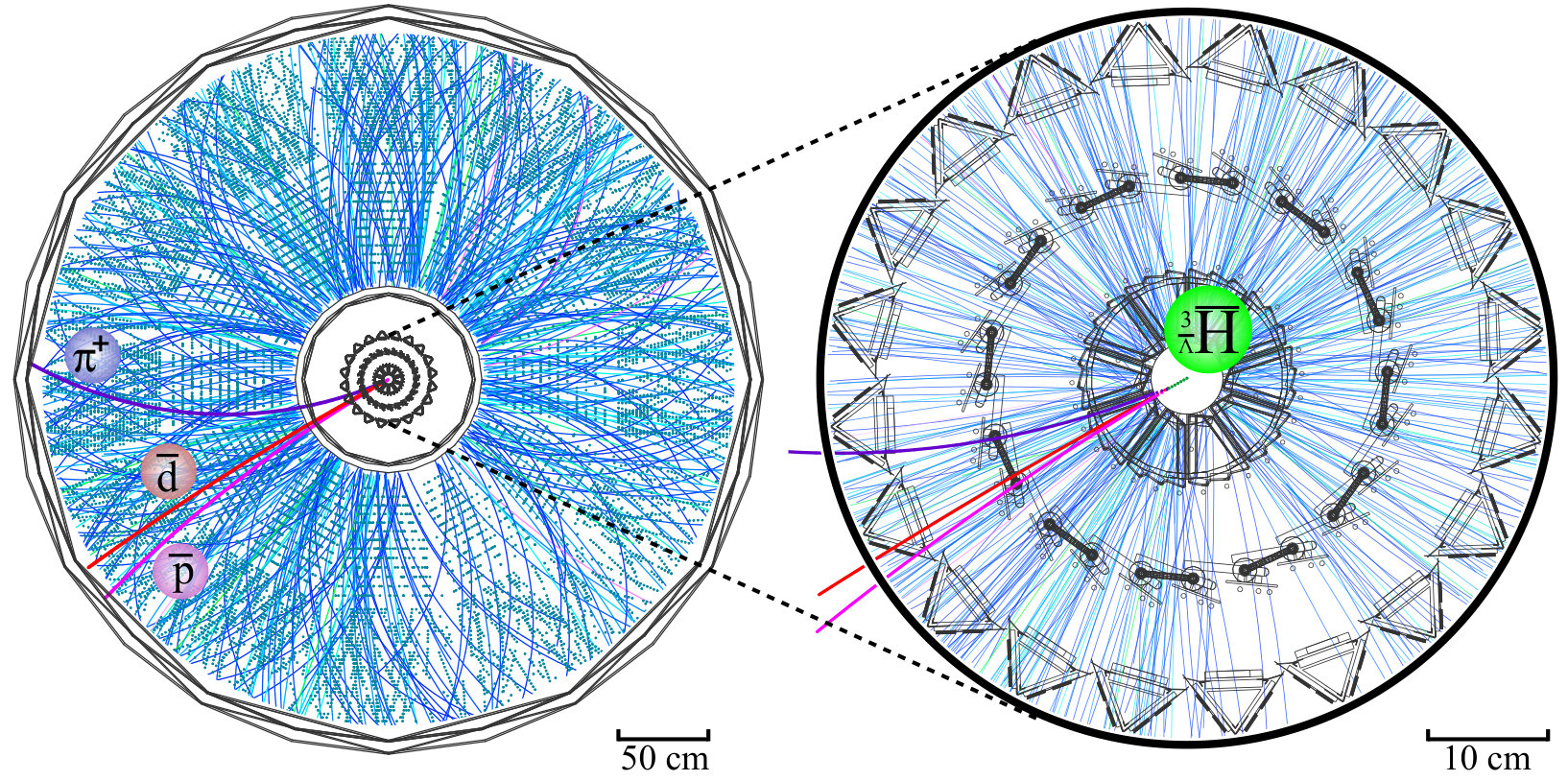 Figure 1
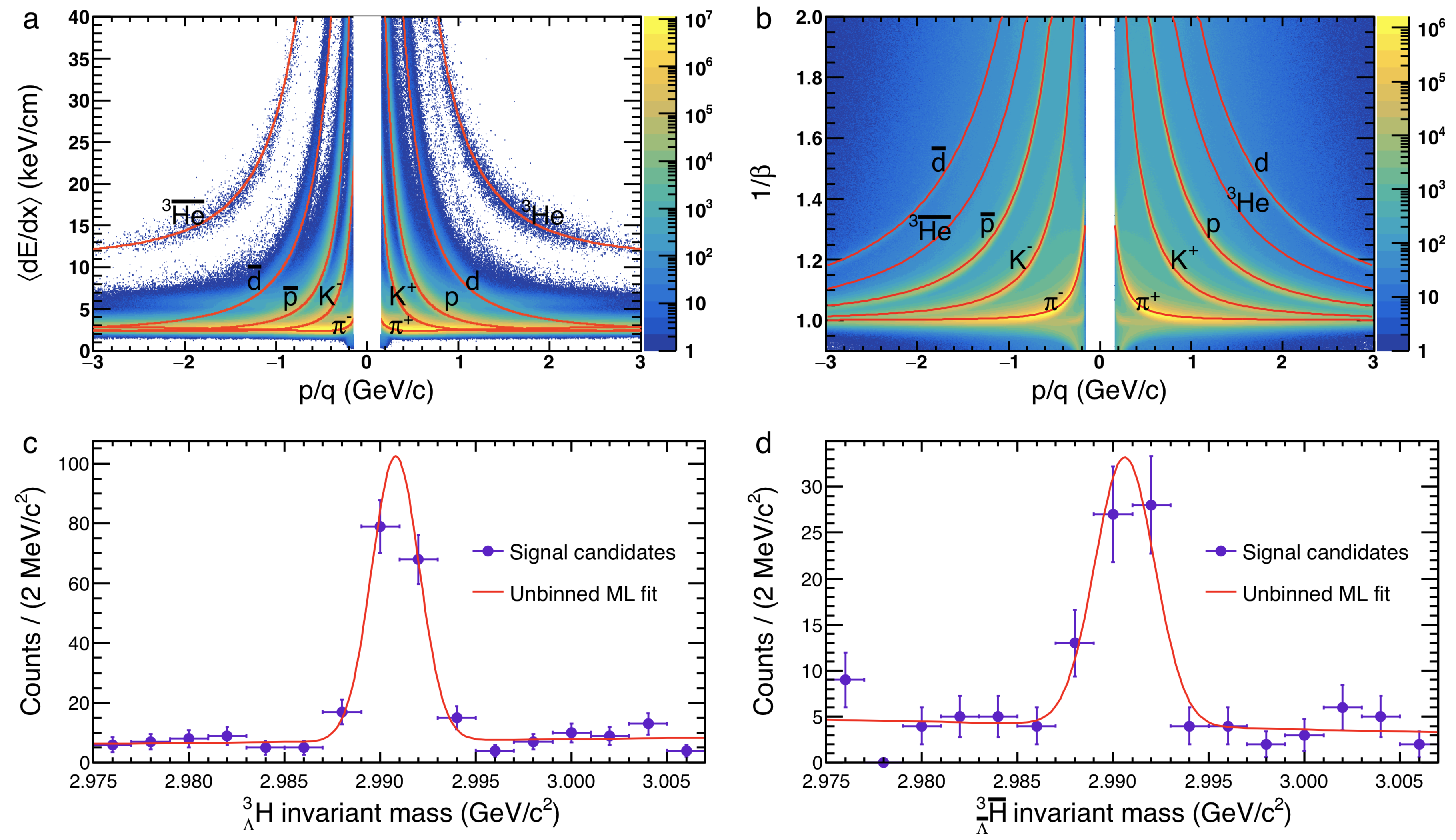 Figure 2
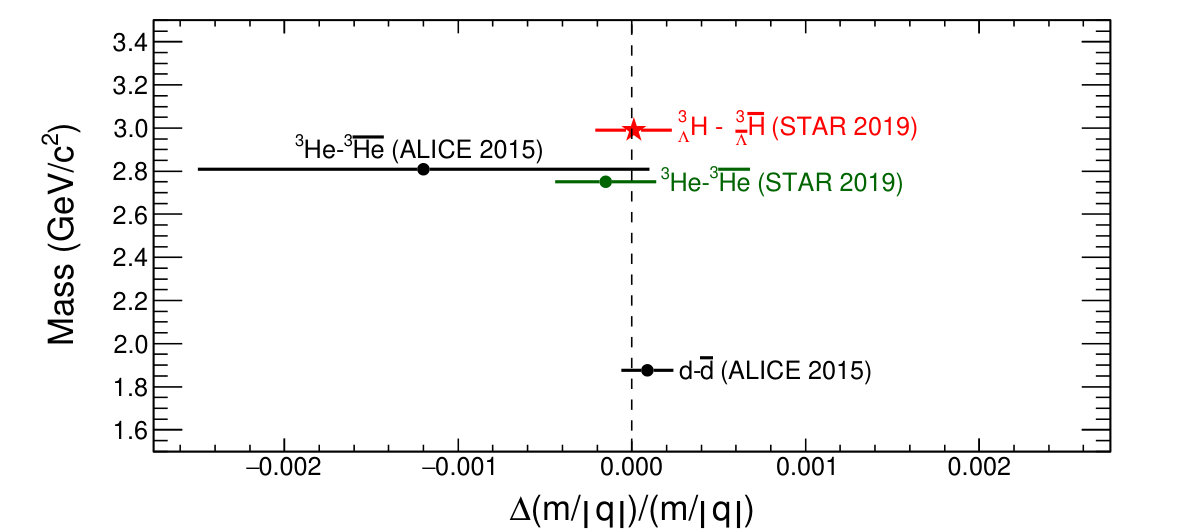 Figure 3
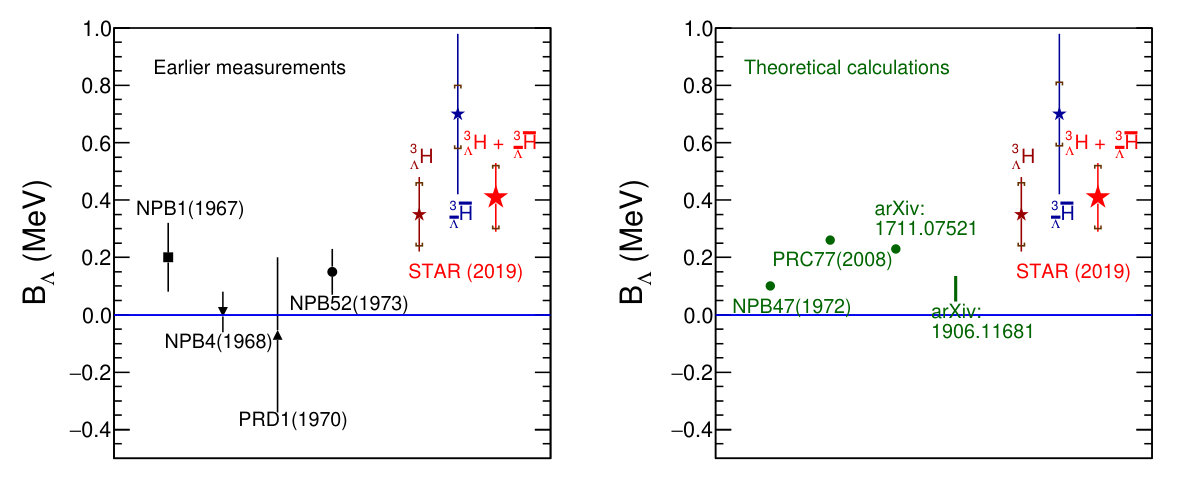 Figure 4
Peer Reviews
No public reviews on file for this paper yet. If you reviewed it on a platform where reviews are public (OpenReview, ICLR, NeurIPS, ICML), you can paste yours below so the community can read it here.
Videos
No videos yet. Explain this paper in a talk, walkthrough, or lecture? Add one.
Measurement of the mass difference and the binding energy of the hypertriton and antihypertriton
The STAR Collaboration
According to the CPT theorem, which states that the combined operation of charge conjugation, parity transformation and time reversal must be conserved, particles and their antiparticles should have the same mass and lifetime but opposite charge and magnetic moment. Here, we test CPT symmetry in a nucleus containing a strange quark, more specifically in the hypertriton. This hypernucleus is the lightest one yet discovered and consists of a proton, a neutron, and a hyperon. With data recorded by the STAR detector[1, 2, 3] at the Relativistic Heavy Ion Collider, we measure the hyperon binding energy for the hypertriton, and find that it differs from the widely used value[4] and from predictions[5, 6, 7, 8], where the hypertriton is treated as a weakly bound system. Our results place stringent constraints on the hyperon-nucleon interaction[9, 10], and have implications for understanding neutron star interiors, where strange matter may be present[11]. A precise comparison of the masses of the hypertriton and the antihypertriton allows us to test CPT symmetry in a nucleus with strangeness for the first time, and we observe no deviation from the expected exact symmetry.
The CPT theorem holds that all processes must exactly conserve the combined operation of C (charge conjugation, which interchanges a particle with its antiparticle), P (parity, which reverses the direction of all spatial axes), and T (time reversal). No CPT violation has ever been observed [12, 13]. Qualitatively different tests of CPT symmetry are a continuing priority for fundamental physics, as are revisitations of past tests with improved accuracy. While CPT invariance has been verified to a precision of in the strange quark sector for kaons[12], we present here the first test of CPT symmetry in a nucleus (multi-baryon cluster) having strangeness content. Similar to recent CPT tests[14, 15, 16] on parameters of the Standard Model Extension[17, 18], the mass difference between hypertriton and antihypertriton is directly constructed from the Lorentz invariant product of the four-momenta of their weak-decay daughters.
Hypernuclei are natural hyperon-baryon correlation systems, and provide direct access to the hyperon-nucleon () interaction through measurements of the binding energy in a hypernucleus[19]. However, in a half-century of research, the creation of the hypertriton and precise measurement of its properties have proven difficult, in contrast to heavier hypernuclei produced via a kaon beam incident on a nuclear target. Early measurements of the hypertriton are consistent with zero and span a wide range characterized by a full width at half-maximum of 2.1 MeV[20]. Modern facilities now permit an improved understanding of the interaction, via improved measurements of hyperon binding in hypernuclei, and through new hypertriton lifetime measurements[21, 22]. Progress in understanding the interaction and the equation of state (EOS) of hypernuclear matter has implications for understanding neutron star properties. Inclusion of hyperons in the cores of neutron stars softens the equation of state, and thus reduces the stellar masses[11, 23]. In model calculations, the maximum mass of the neutron star depends on the assumed interaction which is directly related to the binding energy in hypernuclei[23, 24]. A precise binding energy measurement of this simplest hypernucleus together with other light hypernuclei will also help us understand the few-body system and the strong interaction involving hyperons[25].
Nuclear collisions at ultrarelativistic energies, such as those studied at the Relativistic Heavy Ion Collider (RHIC), create a hot and dense phase of matter containing approximately equal numbers of quarks and antiquarks. In this phase, called the quark-gluon plasma (QGP), quarks are free to move throughout the volume of the nuclear collision region. The QGP persists for only a few times seconds, then cools and transitions into a lower temperature phase comprised of mesons, baryons and antibaryons, including the occasional antinucleus or antihypernucleus [10, 26]. Thus these collisions offer an ideal laboratory to explore fundamental physics involving nuclei, hypernuclei, and their antimatter partners.
In this letter, we present two measurements from gold-gold collisions at a center-of-mass energy per nucleon pair of GeV: the relative mass difference between (the hypertriton) and (the antihypertriton), as well as the hyperon binding energy for and . The binding energy of is defined as , where , , are the deuteron mass taken from the CODATA[27], the hyperon mass published by the Particle Data Group (PDG)[12], and the H mass reported in this letter, and is the speed of light. The main detectors used in this analysis are the Solenoidal Tracker At RHIC (STAR) Time Projection Chamber (TPC)[1] and the Heavy Flavor Tracker (HFT)[2] for high-precision tracking, and the TPC and the Time Of Flight detector (TOF)[3] for charged particle identification. The TPC and HFT are immersed in a solenoidal magnetic field of 0.5 T parallel to the beam direction, and are used for charged particle tracking in three dimensions. The HFT includes three subsystems: Pixel (PXL), which consists of two cylindrical layers at radii 2.8 and 8 cm from the beam, the Intermediate Silicon Tracker (IST) at a radius of 14 cm, and the Silicon Strip Detector (SSD) at a radius of 22 cm. The spatial resolution of the HFT[2] is better than 30 m for tracks with a momentum of 1 GeV/c. The mean energy loss per unit track length () in the TPC gas and the speed () determined from TOF measurements are used to identify particles. The resolution[1] is 7.5% and the TOF timing resolution[3] is 95 ps.
The hypernucleus is reconstructed through its mesonic decay channels (2-body decay) and (3-body decay). Fig. 1 depicts a typical event in which a candidate decays to in the STAR HFT and TPC. The candidate is produced at the primary vertex of a gold-gold collision and remains in flight for a distance on the order of centimeters, as shown by the dashed green curve starting at the center of the right-hand side of the figure, before decaying as depicted by the bold coloured curves.
Comparisons of the measured and values for each track with their expected values under different mass hypotheses allow decay daughters to be identified. Panel a of Fig. 2 presents versus rigidity (, where is the momentum and is the electric charge in units of the elementary charge ), while panel b shows versus rigidity. It can be seen that the decay daughter species for H and are cleanly identified over a wide rigidity range. The helical trajectories of the decay daughter particles can be followed back in time to each secondary decay vertex and used to reconstruct the decay topology of the parent hypernucleus or antihypernucleus. The effects of energy loss (ranging from about 0.2% for to about 3% for 3He) and TPC field distortion on the measured momenta of the decay daughters are corrected for by data-driven calibration using the world-average mass compiled by the PDG [12]. Due to the high-precision tracking and particle identification capabilities of the STAR experiment, the invariant mass (, where is the energy and the momentum of the th decay daughter) of each parent is reconstructed with a low level of background as shown in panels c and d of Fig. 2. The background originates from combinatorial contamination and particle misidentification. The significance , where is signal counts and is background counts in the invariant mass window GeV, is 11.4 for H and 6.4 for . The signal counts from 2-body/3-body decay channels are about 121/35 for H and 36/21 for , respectively. The H signal-to-background ratio is close to a factor of 23 better than an earlier measurement from the same experiment using only the TPC[22].
The hypernucleus and antihypernucleus invariant mass distributions reconstructed through 2-body and 3-body decays are each fitted with a Gaussian function plus a straight line, using the unbinned maximum likelihood method. Mass parameters are extracted from the peaks of the invariant mass distributions. Final results are the average of the masses from 2-body and 3-body decays weighted by the reciprocal of the squared statistical uncertainties. The main systematic uncertainty arises from imperfections in the energy loss and field distortion corrections applied to the tracking of decay daughters, estimated to be 0.11 MeV/ (37 ppm). Other sources of systematic uncertainty, including those from event selection, track quality cuts, decay topology cuts and fit procedure, are negligible. Accordingly, the measured masses are
[TABLE]
[TABLE]
The average mass (weighted by the reciprocal of squared statistical uncertainties) for H and combined is
[TABLE]
By taking into account the current best limits for the mass differences of 3He and reported by ALICE[13], the mass differences between and are and for 2-body and 3-body decay channels, respectively. The relative mass difference of 2-body and 3-body decay combined is (see Methods section for details)
[TABLE]
If we assume CPT symmetry is true for the decay daughters, the relative mass difference between H and would be . In addition, by taking the difference between the masses measured in the 2-body and 3-body decay channels of H in conjunction with the deuteron masses reported by ALICE[13], we can place a new constraint on the relative mass difference between and , namely = [-1.5 2.6 (stat.) 1.2 (syst.)] (see Methods section for details). These results are displayed in Fig. 3 along with the relative mass-to-charge ratio differences between and and between 3He and measured by the ALICE Collaboration[13]. The mass difference between H and observed in the present data is consistent with zero, and the precision is an order of magnitude improved over the early data with same mass number[13]. The current measurement extends the validation of CPT invariance to a nucleus containing a strange quark.
The binding energy for H and is calculated using the mass measurement shown in equation (1). We obtain
[TABLE]
This binding energy is presented in Fig. 4 (left panel) along with earlier measurements[28, 29, 30, 4] from nuclear emulsion and helium bubble chamber experiments. The current STAR result differs from zero with a statistical significance of 3.4 and the central value of the current STAR measurement is larger than the commonly used measurement from 1973[4]. It has been pointed out in Ref. [20] that for measurements of for p-shell hypernuclei, there exists a discrepancy in the range of 0.4 to 0.8 MeV between emulsion data and other modern measurements. Whether the effect would be similar in s-shell hypernuclei such as the hypertriton is unclear, but such a discrepancy is much larger than the systematic uncertainty of 0.04 MeV assigned to emulsion measurements[31]. Until this discrepancy is well understood, an average of the current measurement with early results cannot be reliably carried out.
Theoretical calculations of for H are also available (see right panel of Fig. 4). For example, Dalitz reported the calculation MeV in 1972[32]. In recent calculations, MeV was obtained through SU(6) quark model baryon-baryon interactions[33], and was calculated to be 0.23 MeV using auxiliary field diffusion Monte Carlo (AFDMC)[34]. A span of values ranging from 0.046 MeV to 0.135 MeV was obtained in SU(3) chiral effective field theory[5]. The divergence of results among different calculations emphasizes the need for a precise determination of from experiment. In Ref.[35] a model based on effective field theory is used to extract a scattering length of fm from the earlier average value of ; when applied to our value of it yields a significantly smaller value of fm. The larger and shorter effective scattering length suggest a stronger interaction between the and the relatively low-density nuclear core of the H[36]. This, in certain models, requires SU(3) symmetry breaking and a more repulsive interaction at high density, consistent with implications from the range of masses observed for neutron stars[5].
The reference list from the paper itself. Each links out to its DOI / PubMed record.
- 1[1] Anderson, M. et al. The STAR time projection chamber: a unique tool for studying high multiplicity events at RHIC. Nucl. Inst. Methods Phys. Res. A 499 , 659-678 (2003).
- 2[2] Contin, G. et al. The STAR MAPS-based Pi Xe L detector. Nucl. Inst. Methods Phys. Res. A 907 , 60-80 (2018).
- 3[3] Llope, W. J. (For the STAR Collaboration). Multigap RP Cs in the STAR experiment at RHIC. Nucl. Inst. Methods Phys. Res. A 661 , S 110-S 113 (2012).
- 4[4] Juric, M. et al. A new determination of the binding-energy values of the light hypernuclei ( A ≤ 15 ) 𝐴 15 \left(A\leq 15\right) . Nucl. Phys. B 52 , 1-30 (1973).
- 5[5] Haidenbauer, J., Meißner, U.-G. & Nogga, A. Hyperon-nucleon interaction within chiral effective field theory revisited. Preprint at https://arxiv.org/abs/1906.11681 (2019).
- 6[6] Miyagawa, K., Kamada, H., Glöckle, W. & Stoks, V. Properties of the bound Λ Λ \Lambda ( Σ Σ \Sigma ) N N 𝑁 𝑁 NN system and hyperon-nucleon interactions. Phys. Rev. C 51 , 2905-2913 (1995).
- 7[7] Nogga, A., Kamada, H. & Glöckle, W. The hypernuclei Λ 4 subscript superscript absent 4 Λ {}^{4}_{\Lambda} He and Λ 4 subscript superscript absent 4 Λ {}^{4}_{\Lambda} H: Challenges for modern hyperon-nucleon forces. Phys. Rev. Lett. 88 , 172501 (2002).
- 8[8] Wirth, R. et al. Ab initio description of p-Shell hypernuclei. Phys. Rev. Lett. 113 , 192502 (2014).