Photon echoes in optically dense media
Sergey Moiseev, Mahmood Sabooni, Ravil Urmancheev

TL;DR
This paper extends the McCall-Hahn area theorem to describe photon echo formation in dense media, revealing a series of self-reviving echo signals that could enhance quantum control and spectroscopy techniques.
Contribution
It generalizes the area theorem for multi-pulse excitation in dense media, uncovering new photon echo dynamics and pulse train behaviors.
Findings
Self-reviving echo signals with total area of 2π or 0π
Echo pulse train as an alternative to solitons or breathers
Enhanced understanding of photon echo generation in dense media
Abstract
Coherent nonlinear multi-pulse processes, nonlinear waves and echo effects in resonant media are the topical problems of modern optics and important tools of coherent spectroscopy and quantum information science. We generalize the McCall-Hahn area theorem to the formation of an arbitrary photon echo generated during the multi-pulse excitation of the optically dense resonant media. The derived theorem made it possible to reveal the nonlinear mechanism of generation and evolution of the photon echo signals inside the media after a two-pulse excitation. We find that a series of self-reviving echo signals with total area of or is excited and propagates in the media depth, with each pulse having an individual area less than . The resulting echo pulse train is a new alternative to the well-known soliton or breather. The developed pulse-area approach paves the way for more…
Click any figure to enlarge with its caption.
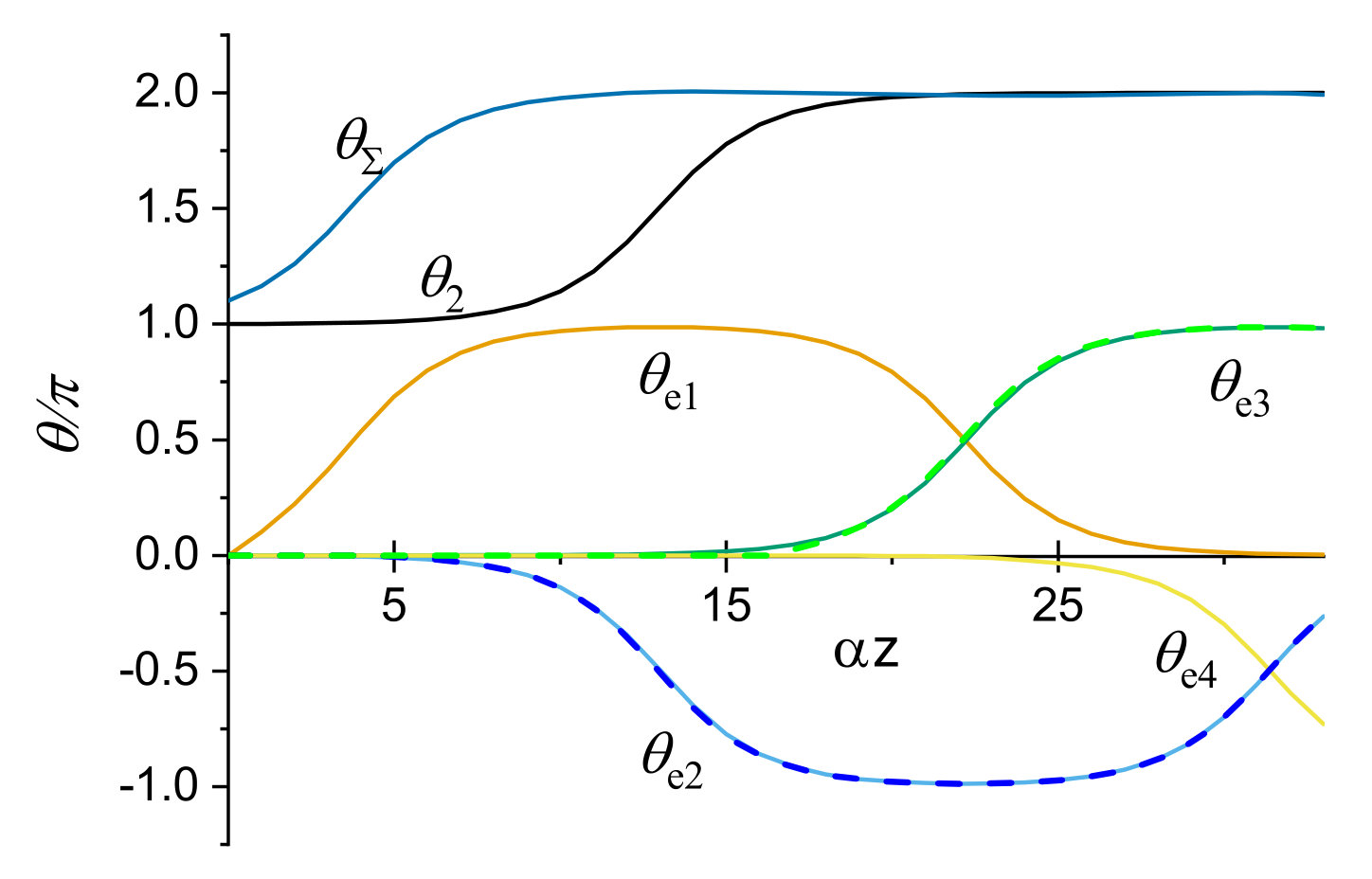 Figure 1
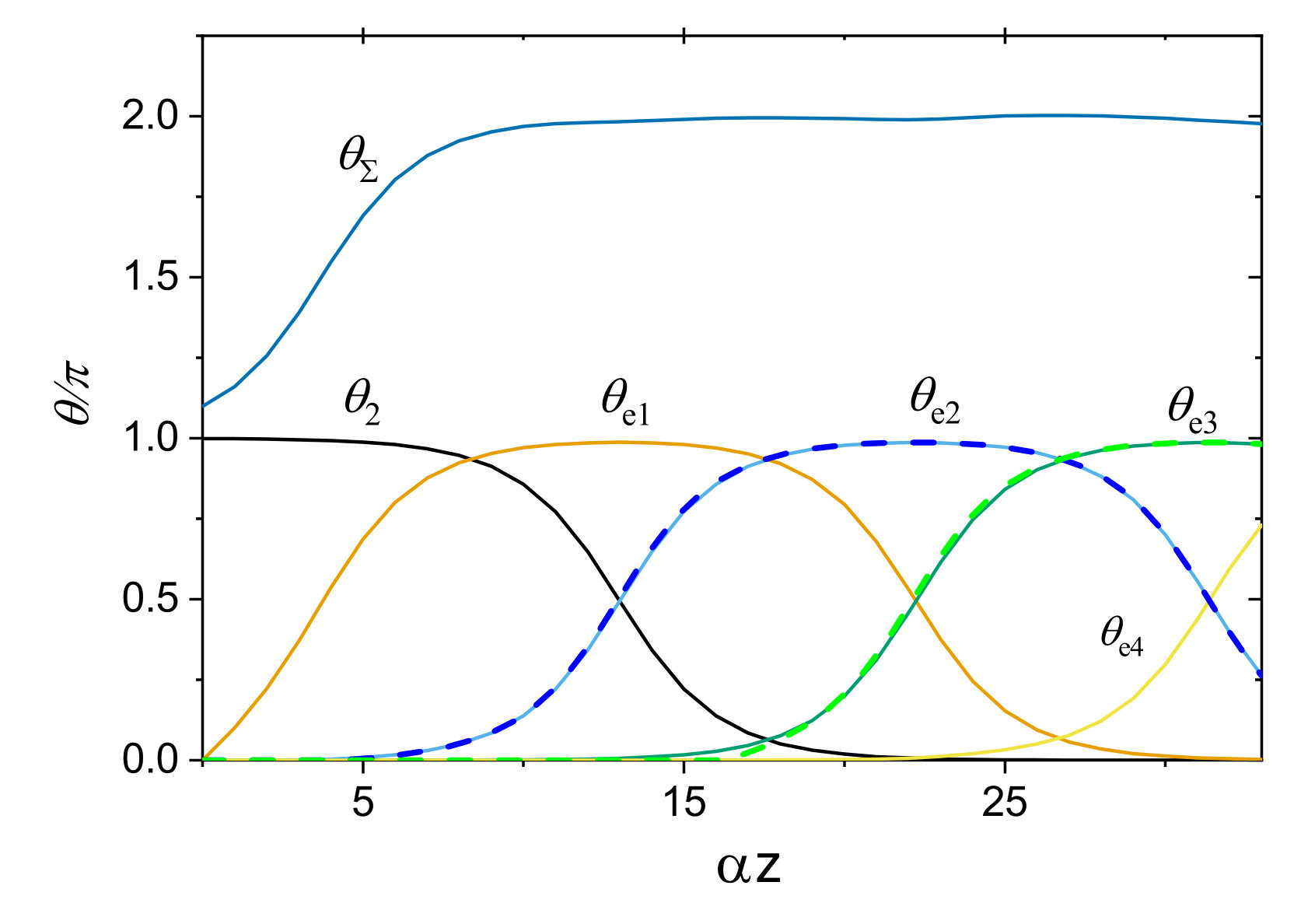 Figure 2
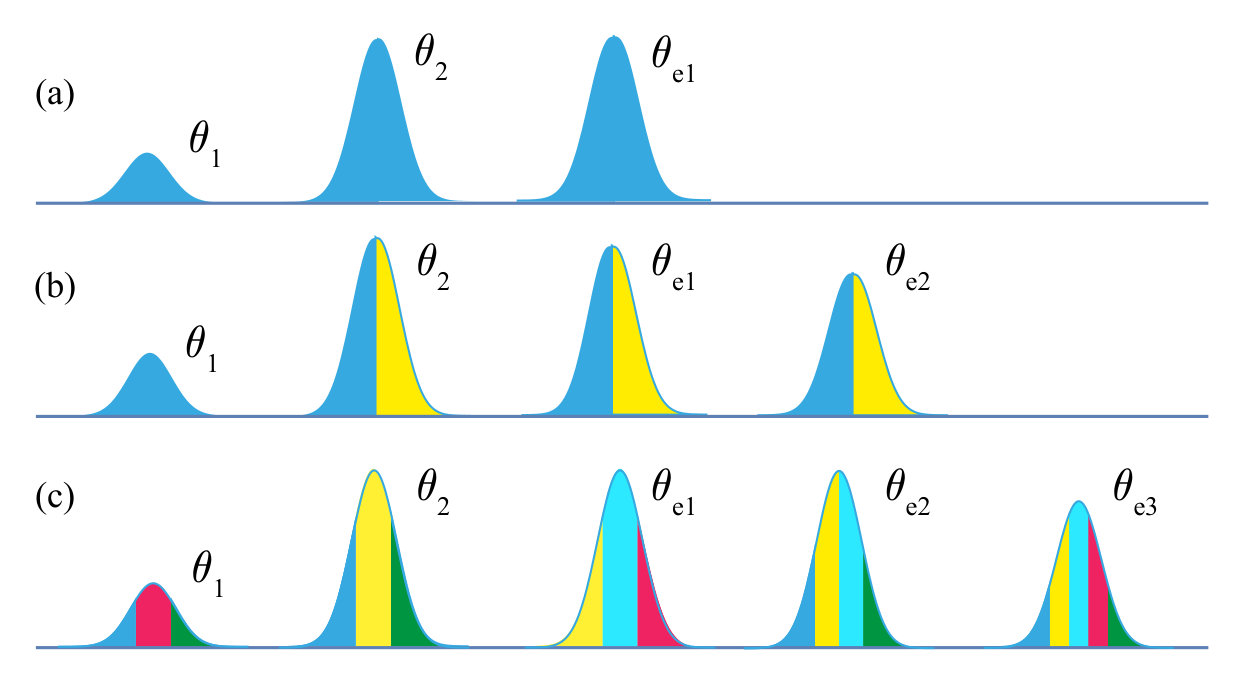 Figure 3
Peer Reviews
No public reviews on file for this paper yet. If you reviewed it on a platform where reviews are public (OpenReview, ICLR, NeurIPS, ICML), you can paste yours below so the community can read it here.
Videos
No videos yet. Explain this paper in a talk, walkthrough, or lecture? Add one.
Photon echoes in optically dense media
Sergey A. Moiseev1
Mahmood Sabooni2,3
Ravil V. Urmancheev1
1Kazan Quantum Center, Kazan National Research Technical University n.a. A.N.Tupolev-KAI, 10 K. Marx, Kazan 420111, Russia
2Institute for Quantum Computing, Department of Physics and Astronomy, University of Waterloo, Waterloo, Ontario, N2L 3G1, Canada
3Department of Physics, University of Tehran, 14399-55961, Tehran, Iran
Abstract
Coherent nonlinear multi-pulse processes, nonlinear waves and echo effects in resonant media are the topical problems of modern optics and important tools of coherent spectroscopy and quantum information science. We generalize the McCall-Hahn area theorem to the formation of an arbitrary photon echo generated during the multi-pulse excitation of the optically dense resonant media. The derived theorem made it possible to reveal the nonlinear mechanism of generation and evolution of the photon echo signals inside the media after a two-pulse excitation. We find that a series of self-reviving echo signals with total area of or is excited and propagates in the media depth, with each pulse having an individual area less than . The resulting echo pulse train is a new alternative to the well-known soliton or breather. The developed pulse-area approach paves the way for more precise coherent spectroscopy, studies of different photon echo signals and quantum control of light pulses in the optically dense media.
Studies of coherent multi-pulse nonlinear effects like photon echo and four-wave mixing open wide opportunities for understating of light-atom interactions, fundamental processes of nonlinear and quantum optics, provide powerful techniques for spectroscopic investigation of atoms and molecules and are considered as a principal tool for implementation of basic processes in practical quantum information science Yetzbacher et al. (2007); Christensson et al. (2008); Dorfman et al. (2016); Pezzè et al. (2018); Mourou (2019). Herein, photon echo technique Kopvillem and Nagibarov (1963); Kurnit et al. (1964) attracts an especial everlasting attention in coherent spectroscopy Kurnit et al. (1964) and light pulse storage Heer and McManamon (1977); Zuikov et al. (1980); Shtyrkov et al. (1981); Mossberg (1982); Carlson et al. (1983). Recently, the photon echo in optically dense media opened promising opportunities for quantum storage of a large number of light pulses Moiseev and Kröll (2001); Tittel et al. (2009); Lvovsky et al. (2009); Hosseini et al. (2011a); Usmani et al. (2010) and quantum processing Bussières et al. (2013) that determined a steady interest and elaboration of numerous protocols of photon echo based quantum memory Tittel et al. (2009); Hosseini et al. (2011b); Rančić et al. (2017); Minnegaliev et al. (2018); Saglamyurek et al. (2018); Guo et al. (2019); Mazelanik et al. (2019), which are important for the creation of quantum repeater Sangouard et al. (2011), microwave quantum memory Wu et al. (2010); Moiseev et al. (2018), etc.
The study of the properties of a two- and three-pulse photon echoes in optically dense media is the main task in the development of the multi-pulse spectroscopy and photon echo quantum memory schemes in such media. The most general theoretical description of the coherent resonant interaction of multi-pulse light fields with resonant atoms can be provided by the pulse area theorem McCall and Hahn (1969); Lamb (1971); Allen and Eberly (1975); Eberly (1998); Eberly and Kozlov (2002); Chanelière (2014); Shchedrin et al. (2015); Gutiérrez-Cuevas and Eberly (2016). In early works on the two-pulse (primary) photon echo, it was found that the initial excitation could result in the generation of multiple echo signals Hahn et al. (1971); Allen and Eberly (1975) followed by a long-term investigation of the underlying mechanism Friedberg and Hartmann (1971); Lamb (1971); Allen and Eberly (1975); Moiseev (1987); Azadeh et al. (1998); Wang et al. (1998, 1999); Ruggiero et al. (2009); Li and Yu (2010); Tsang et al. (2003). Quite early an analytic solution for total area of all the echoes was obtained Hahn et al. (1971); Allen and Eberly (1975); Azadeh et al. (1998), that proved that the total pulse area can tend asymptotically towards in the media depth if the initial pulse area of two exciting laser pulses exceeds . However, this solution does not allow one to describe the behavior of each individual echo pulse.
Previously acquired solution for the primary echo pulse area predicted that the echo pulse area never exceeds and generally decays in the depth of the media Moiseev (1987) . This finding again stressed the ambiguity of the known physical picture behind the formation of the total nonlinear response to the multi-pulse excitation. In the recent years the stakes were raised by the demand for an efficient optical solid-state quantum memory and the noted interest in coherent multi-pulse interactions in the optically dense media.
In this Rapid Communication we find an analytical solution of the photon echo pulse area theorem posed in Hahn et al. (1971); Friedberg and Hartmann (1971); Lamb (1971) in 1971. By analysing the solution we for the first time discover the mechanism of self-induced transparency McCall and Hahn (1969) for two- and many-pulse excitation of the atomic media leading to the formation of many echo pulses. To do that we find the general analytic solution for the pulse area of an arbitrary secondary photon echo signal. The found solutions show that the echo signals are excited coherently one after another in a certain area of the medium and then disappear, generating new echo signals and creating a self-reviving echo sequence. We show that depending on the input pulse areas this echo pulse train forms a multi-pulse analogue to the well-known single pulse optical soliton or a optical breather despite each individual echo pulse area never exceeding . Herein, by using the highly non-linear nature of the light-atom interaction we can control the total response of the media. Being near the thresh-old, when the incoming area of the second pulse is close to , and by slightly changing it to being or one can initiate a huge change in the outcome from an optical soliton to an optical breather, respectively. This also demonstrates the potential of the pulse area approach for coherent spectroscopy of the optically dense media.
First we reproduce the McCall-Hahn area theorem and derive the general equation for the pulse area of an arbitrary echo pulse starting with the usual reduced set of Maxwell-Bloch equations Allen and Eberly (1975) for the light field and atomic system:
[TABLE]
where is the Bloch vector, each component depending on time , spatial coordinate and atomic detuning ; - atomic polarization, electric field is described by a complex light field envelope with corresponding Rabi frequency ; , , is the coherence lifetime of the atomic transition and is the averaging over the inhomogeneous broadening. From now on for simplicity, we do not denote the existing dependence on in atomic and field variables and .
By transferring to the pulse area and follow McCall and Hahn (1969); Eberly (1998) to find that incoming pulse areas satisfy the well-known pulse area theorem:
[TABLE]
where is the initial inversion of the atomic system, is the resonant absorption coefficient Allen and Eberly (1975). The first pulse propagates in the undisturbed media, with and partially inverts for the second pulse, so . Substituting into Eq. (2) we get the well-known solutions Allen and Eberly (1975):
[TABLE]
where and .
Eqs. (2) and (3) can be used to find the total area of all excited photon echoes Hahn et al. (1971); Friedberg and Hartmann (1971); Allen and Eberly (1975); Azadeh et al. (1998):
[TABLE]
This solution predicts that if , the total area of all echo pulses asymptotically tends to Hahn et al. (1971). It leaves however a lot of uncertainty about the mechanism and physics of the photon echo generation, since any information about the particular photon echo signals remains hidden. How exactly different echoes combine into pulse area? What is the contribution of an individual echo? Moreover, if input pulse areas , Eq. (4) predicts the sum of all echoes to be [math]. What happens with the different echo signals in this case and does that mean that there will be no echoes? To answer all these questions, we have to analyze the generation of each echo signal individually.
To find the area theorem for an arbitrary individual photon echo signal we integrate the first of Eqs. (1) over time around the time of echo emission , from to , where is the delay between the pulses. We should also clarify the time scales assumed for the following derivation. Firstly, we assume non-overlapping pulses with pulse duration being much smaller than coherence time , , to neglect the relaxation during the pulses. Secondly, inhomogeneous broadening of the atomic system is much larger that the pulse spectrum . Thirdly, for simplicity we consider a solid state system, meaning and thus we can neglect the population decay between the pulses. In short, .
The expressions under the integrals, and are complex expressions consisting of several oscillating components. However most of these components will give [math] after averaging over in Eq. (1). To find the proper expression for the echo area we need to only take into account the phasing components of polarization and inversion that contribute to the echo formation. The details of the integration and equation handling can be found in the Supplemental material.
As a result we obtain the general equation for an arbitrary echo pulse area:
[TABLE]
where and are the initial values () of the Bloch vector resonance components with which only give nonzero response in the field equation in (1). After transition to we get a linear equation with clear solution.
Equation (14) describes the pulse area of a chosen echo signal given the phasing coherence in a presence of spectral uniform inversion and Eq. (14) comes down to finding and for each echo signal. In Supplemental material we describe the algorithm that allows to find the for an arbitrary echo. But whatever they may be, we note that never exceeds . Below we investigate the analytic solutions for the pulse areas of all the echo signals.
For primary echo we have , and the correct phasing components of Moiseev (1987); Urmancheev et al. (2019):
[TABLE]
where is the relaxation term. Corresponding Eq. (14) gives primary photon echo pulse area:
[TABLE]
After the incoming pulses and the primary echo pulse we have and the phasing components are:
[TABLE]
The first terms in both equations and are proportional to and vanish when the first pulse is absorbed. They are responsible for stimulated photon echo generated by incoming pulses and the primary echo pulse. The other two components and are proportional to are correspond to the secondary two-pulse photon echo created by the second pulse and the primary echo pulse.
Analysis of the successive echoes follows the same procedure but requires more calculations since and have more terms with each step. In the Supplemental material we introduce the phasing polarization and inversion components for the third and the fourth echoes and discuss the physical meaning of different contributions. It is obvious that the described procedure can be applied for the case with comparable transverse and longitudinal relaxations and for other light-atom equations.
We will now proceed to clarify the mechanism of the total pulse area formation when . Figure 1 shows the spatial behavior of the area of incoming pulses, echo pulses and the total area depending on the optical density of the medium for . We see that incoming pulses excite primary and secondary echoes that in turn excite subsequent echos. Each echo pulse is born, propagates and eventually dies out within a finite spatial interval. However the total area of all existing pulses behaves strictly in accordance with McCall-Hahn area theorem Eq. (4) and remains close to . This is realized due to the precise spatial consistency of all the echoes involved.
The case of really helps to highlight the benefits of looking at an individual echo signal rather than at the sum of all echo signals. The second incoming pulse is big enough to form a -soliton on its own, and McCall-Hahn area theorem predicts that the sum of all echoes will equal . The impression could be that after some point in the medium there are no echoes at all. The real picture however is much more vivid, there are many hidden echoes with nontrivial areas working together to comply with the McCall-Hahn area theorem. Figure 2 showcases this echo pulses’ behavior for . Each two of the subsequent echoes have opposite phases, so they are canceling each other in a dynamical equilibrium, resulting in total pulse area at any point of the medium. Figure 2 also shows that the primary echo assists the formation of the total area, which would otherwise happen much further into the medium.
We note that the echo areas in Figs. 1,2 behave very similar, differing only in their spatial delays. This is the case, when we can neglect the stimulated echo terms in Eqs. (8) and find a highly accurate approximate analytic solution for each pulse area. For example, we write for the secondary echo area ():
[TABLE]
where is given in Eq. (7) with the initial pulse areas taken at the transition point : . By doing so we assume that at the first pulse was successfully absorbed by the media and neglect polarization and inversion components acquired at . solution for is shown with dashed lines in Figs. 1,2.
Equations (7) and (9) describe the pulse area at the output of the optically dense media. Moreover, given they can also accurately describe the peak energy of the echo pulse Wang et al. (1999); Urmancheev et al. (2019). This easy to measure quantity can be used for coherent multi-pulse spectroscopy of the optically dense media, where usual spectroscopy is complicated due to strong nonlinear light-atoms interaction. In this highly nonlinear regime the conventional Beer law is not valid while Eq. (7) can be used to measure dependence.
It also is interesting to discuss the experimental detection of photon echo train generation and what it can lead to. As it is seen in Figs. 1,2, one can experimentally observe only or light pulses at the output of the optical density medium, while other pulses will be highly suppressed. Herein in media with higher optical densities, we will see only higher order echo pulses, characterized experimentally by later arrival times. The photon echo experiments in such media are quite typical for many quantum memory protocols. In particular, interesting opportunity is to try detecting the spatial evolution of photon echo inside such media, for example in the rare-earth ions doped crystals Tittel et al. (2009); Chanelière et al. (2018); Hua et al. (2018).
One possible candidate for high optical density and large Rabi frequency is transition of Nd3+:YVO4 at with dipole moment . Considering and beam radius of m one could reach up to . The -pulses can be as brief as several nanoseconds which is much shorter than . These pulses are spatially squeezed in the medium up to 4 orders of magnitude by the group velocity reduction in the presence of a spectral hole in the optical transition Sabooni et al. (2013), this would allow to observe spatial evolution of the solitons and echo pulses inside the medium.
It is worth noting that only soliton-like pulses can propagate through the medium without changing their temporal form and transferring atoms to their initial state. Accordingly, the photon echo pulses in the generated train will be stretch in time and ultimately overlap with each other deep in the medium forming a single -soliton in case of Fig. 1. Similarly the stretching echo pulses will asymptotically form a -breather, for the case of Fig. 2. In the core of these transformations lies conservation laws of Maxwell-Bloch equations Lamb et al. (1972).
Finally, we summarize and conclude the long-lasting derivation of the two-pulse photon echo area theorem started over 45 years ago in Hahn et al. (1971); Friedberg and Hartmann (1971); Lamb (1971), providing an analytic solution for the pulse area of any desired photon echo signal. We showcase the power of the pulse area approach by exploring the rich physics behind the two-pulse echo excitation of an optically dense medium in two previously understudied cases: . For the first time we demonstrate that in both these cases a self-reviving echo train is excited deep in the medium with total pulse area in the first case and in the second previously unknown case. Thus a slight change in the second pulse area can lead to the dramatic change in the nonlinear multi-pulse media response: an optical soliton in one case or a soliton followed by a breather in the other case. At the same time the complex spatial dynamic of the total nonlinear media response after the two-pulse excitation is precisely aligned with the general McCall-Hahn area theorem prediction.
The developed approach of photon echo pulse area theorem can provide new insights in general analysis of coherent multi-pulse interactions with various photon echo experiments. Although the two-pulse photon echo itself cannot be used for quantum storage Ruggiero et al. (2009), the developed pulse area approach provides intensity independent universal tool for deeper studies of quantum memory (especially for intensive light pulses and cavity assisted storage), coherent spectroscopy and generation of nonlinear waves in optically dense media. It could also be used in both optical and microwave wavelength regions, for two- and three-level atomic ensembles with arbitrary transverse and longitudinal relaxation times, etc. Next important analytic step could be to generalize and extend the results acquired here for multi-pulse excitation using inverse scattering transform, as was done in Kaup (1977) for McCall-Hahn area theorem.
The reported study was funded by Russian Foundation for Basic Research, research project no.17-52-560009.
Supplemental material
.1 Arbitrary echo pulse area
Here we derive the general equation for an arbitrary individual echo pulse area. To do so we integrate the first of Eqs. (1) over time around the time of echo emission , from to , where is the delay between the pulses. By assuming that , being the pulse duration, we arrive to the equation for pulse area where we substitute the formal solution for from Eqs. (1):
[TABLE]
where we introduced .
The key to finding the correct solution is proper handling of the integrals over in these two terms. One can show that and can be presented as a sum of several components and with the total number of the components depending on the echo signal of interest (see Eqs. (17) and (18) and the following discussion). These components have a from , the phase is either [math] or .
For , and are rapidly oscillating functions of near the echo pulse emission time since . Averaging over leads to that only the slowly varying terms and contribute to the echo pulse area in Eq. (10). After using , we simply integrate the first term by taking into account: (this limit is valid assuming no temporal overlapping between the light pulses). In the second term we switch the order of temporal integrals, similar to Allen and Eberly (1975); Eberly (1998), and arrive to the integral:
[TABLE]
where we have also taken into account that and are even functions of . Thus Eq. (10) comes to:
[TABLE]
where is the resonant absorption coefficient, is the resonant component of the phased coherence, is the resonant component of the atomic inversion. To find and to integrate Eq. (12), we write the Bloch equation set for the case , ignoring relaxation during the pulses, since :
[TABLE]
where , and is a resonant part of the phased coherence, .
Equation (12) can now be integrated, and after reassigning we obtain Eq. (5):
[TABLE]
.2 Phasing components of polarization and inversion
Here we show in detail the calculation of and for the secondary echo and give the expressions for the third and the fourth echoes. We assume that the medium is excited by two incoming pulses having pulse areas , that give rise to multiple photon echoes having pulse areas .
Under a multi-pulse excitation a two level system engages in two processes: it is either interacting with the electric field of the applied pulse, or it is left to its own devices and experiences free oscillations decaying as . In the assumed timescales of these processes the influence of the pulse with area can be written as a rotation of the Bloch vector around -axis:
[TABLE]
And free nutation is described with another rotation matrix, this time around -axis:
[TABLE]
The secondary echo is emitted at the time , and to find the phasing parts of the coherence and inversion we write the Bloch vector . The calculation gives:
[TABLE]
here we use a short notation for trigonometric functions: .
This includes the phasing components, responsible for the echo generation and that are proportional to and non phasing components. For example the first term of contains only and is non phasing, while the second term contains , so we get a phasing term that contributes to . For it is similar, except we are now interested in the time independent terms, like the first term in Eq. (18). The terms with or also contribute since where the second term will vanish after averaging over .
We now leave only the terms that contribute to the echo:
[TABLE]
and we get for and :
[TABLE]
The first terms in Eqs. (19) and (20) are very similar to those of primary echo pulse and correspond to the two-pulse echo generation by the . This contribution to the secondary echo is presented as color yellow in Fig. 3. The second terms in Eqs. (19),(20) correspond to the stimulated echo generation and are presented by the color blue in Fig. 3.
In the same fashion we can write the phasing coherence and inversion after four pulses, two incoming pulses and two echo pulses:
[TABLE]
The first term in is the stimulated echo from the two incoming and the second echo pulses naturally proportional to . The second term is another stimulated echo generated by the second incoming and the first two echo pulses. The third term represents the contribution of the two-pulse echo from the two echo pulses. The next term is the two-pulse echo generated by the first incoming and primary echo pulses. The last term, is the revived primary echo, generated by the first two incoming pulses and recovered by the second echo pulse (first echo pulse just suppresses its amplitude by the factor ).
The reference list from the paper itself. Each links out to its DOI / PubMed record.
- 1Yetzbacher et al. (2007) M. K. Yetzbacher, N. Belabas, K. A. Kitney, and D. M. Jonas, The Journal of Chemical Physics 126 , 044511 (2007) . · doi ↗
- 2Christensson et al. (2008) N. Christensson, B. Dietzek, T. Pascher, A. Yartsev, and T. Pullerits, Chemical Physics Letters 457 , 106 (2008) . · doi ↗
- 3Dorfman et al. (2016) K. E. Dorfman, F. Schlawin, and S. Mukamel, Rev. Mod. Phys. 88 , 045008 (2016) . · doi ↗
- 4Pezzè et al. (2018) L. Pezzè, A. Smerzi, M. K. Oberthaler, R. Schmied, and P. Treutlein, Rev. Mod. Phys. 90 , 035005 (2018) . · doi ↗
- 5Mourou (2019) G. Mourou, Rev. Mod. Phys. 91 , 030501 (2019) . · doi ↗
- 6Kopvillem and Nagibarov (1963) U. K. Kopvillem and V. R. Nagibarov, Fiz. Metal. i Metalloved. 15 , 313 (1963).
- 7Kurnit et al. (1964) N. A. Kurnit, I. D. Abella, and S. R. Hartmann, Phys. Rev. Lett. 13 , 567 (1964) . · doi ↗
- 8Heer and Mc Manamon (1977) C. V. Heer and P. F. Mc Manamon, Optics Communications 23 , 49 (1977) . · doi ↗