B-meson charged current anomalies: the post-Moriond status
Debjyoti Bardhan, Diptimoy Ghosh

TL;DR
This paper reviews how recent Belle results influence theoretical explanations of B-meson charged current anomalies, showing that some previously disfavoured models are now viable due to updated experimental data.
Contribution
It provides a critical re-evaluation of the impact of recent experimental results on theoretical models explaining B-meson anomalies, especially regarding tensor and right-chiral vector solutions.
Findings
Pure tensor explanation now allowed due to reduced experimental tension.
Right-chiral vector solution is within 2σ of LHC search bounds.
LEP data constraints on Bc decay are weaker than previously assumed.
Abstract
In this note, we discuss the impact of the recent Belle result on the various theoretical explanations of the and anomalies. The pure tensor explanation, which was strongly disfavoured by the measurements of and high- searches before Moriond, is now completely allowed because of reduction of the experimental world-average. Moreover, the pure right-chiral vector solution (involving right-chiral neutrinos) has now moved into the allowed range of the LHC searches. We also critically re-examine the bound on from LEP data and show that the bound is considerably weaker than the number often used in the recent literature.
Click any figure to enlarge with its caption.
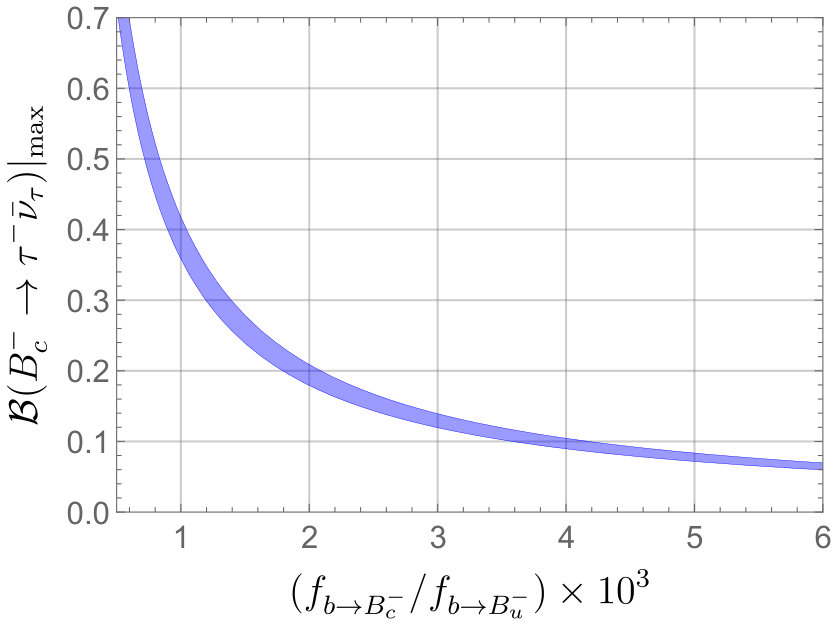 Figure 1
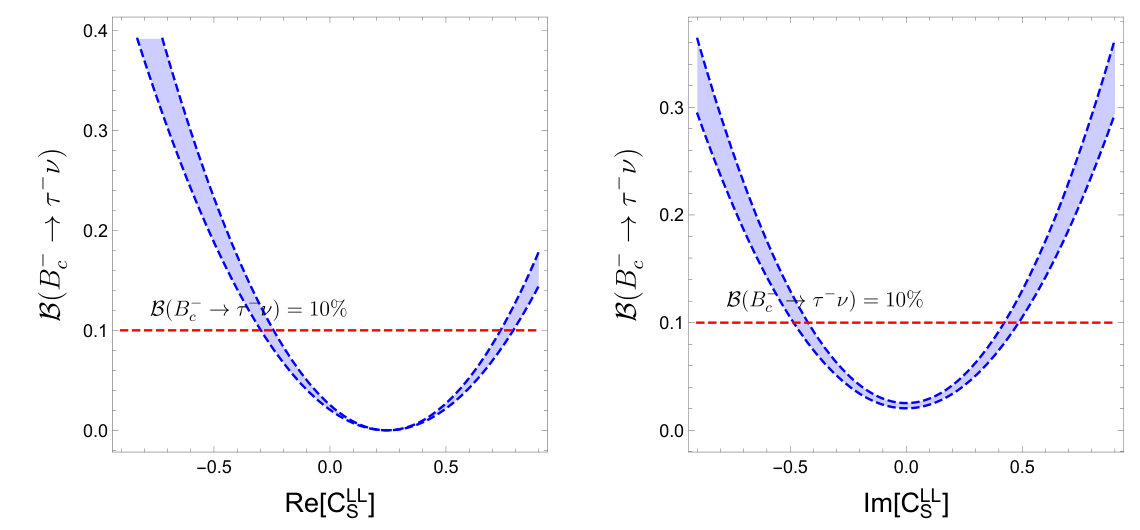 Figure 2
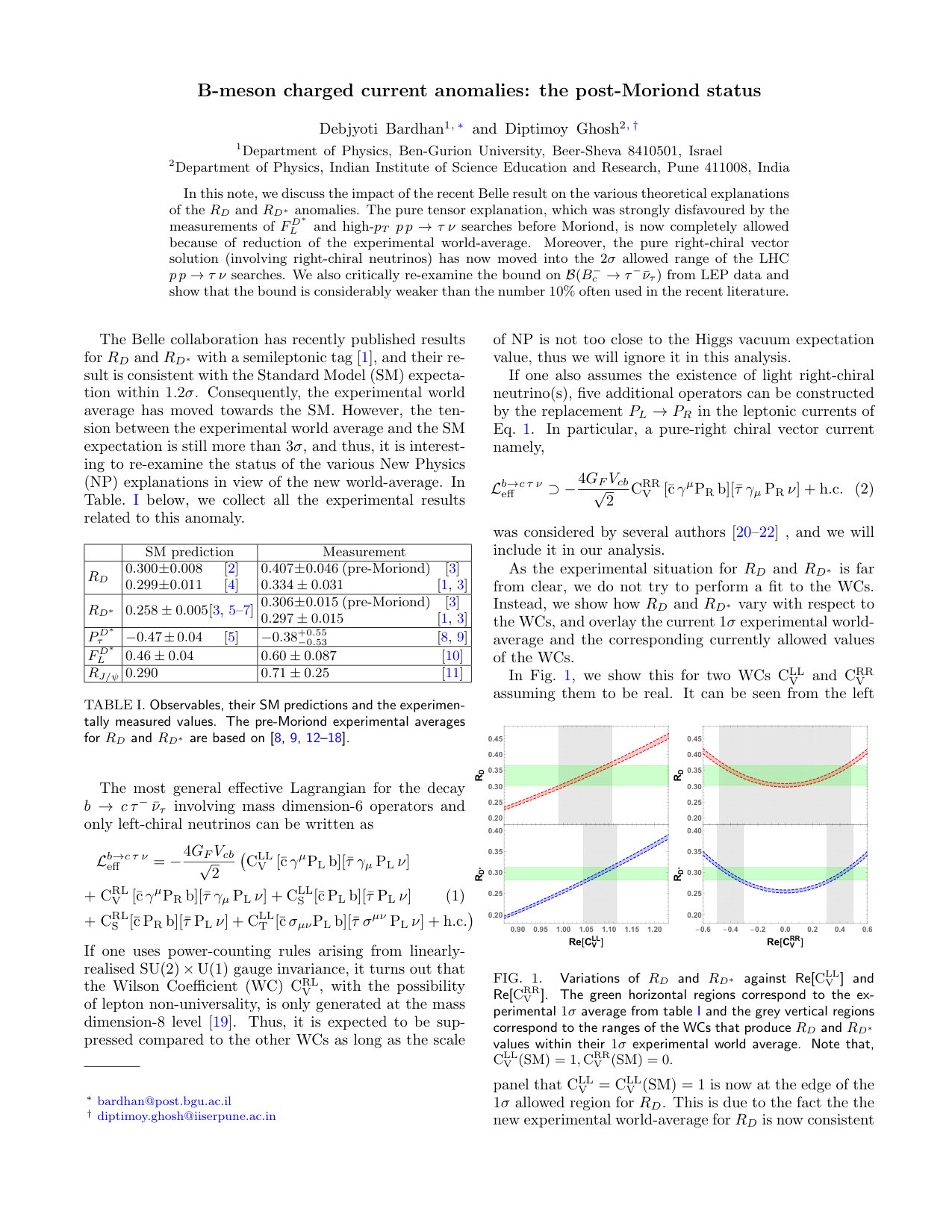 Figure 3
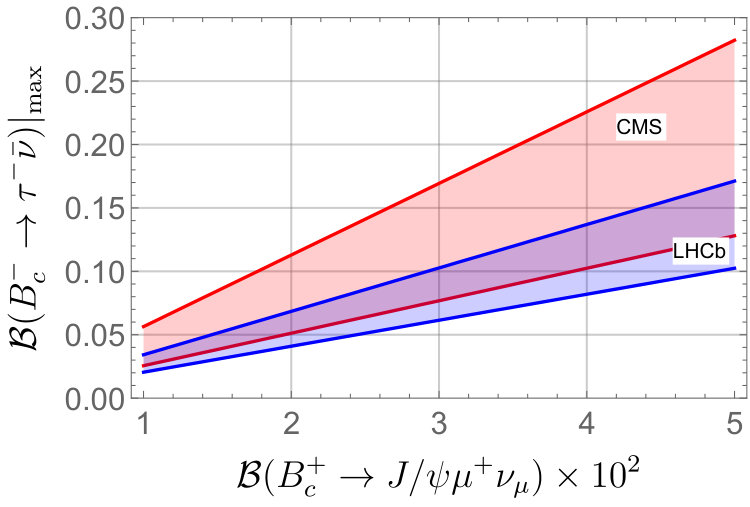 Figure 4
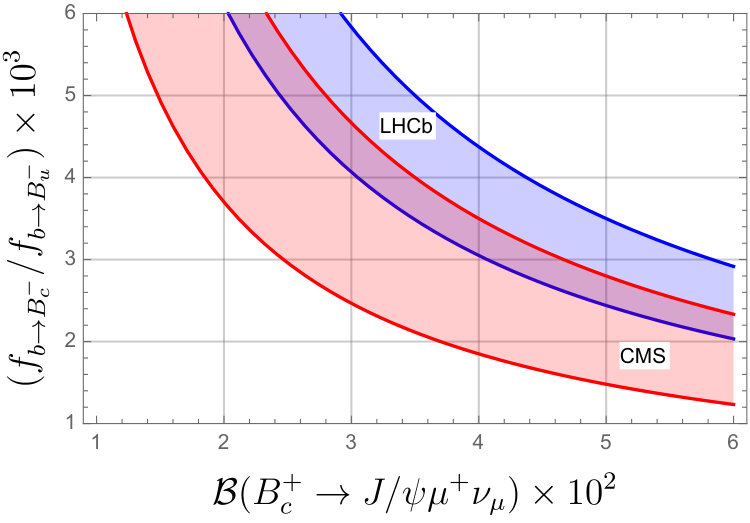 Figure 5
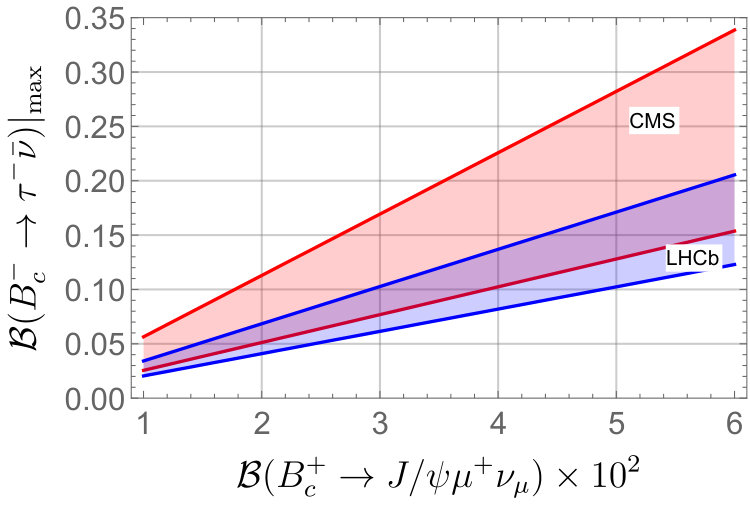 Figure 6
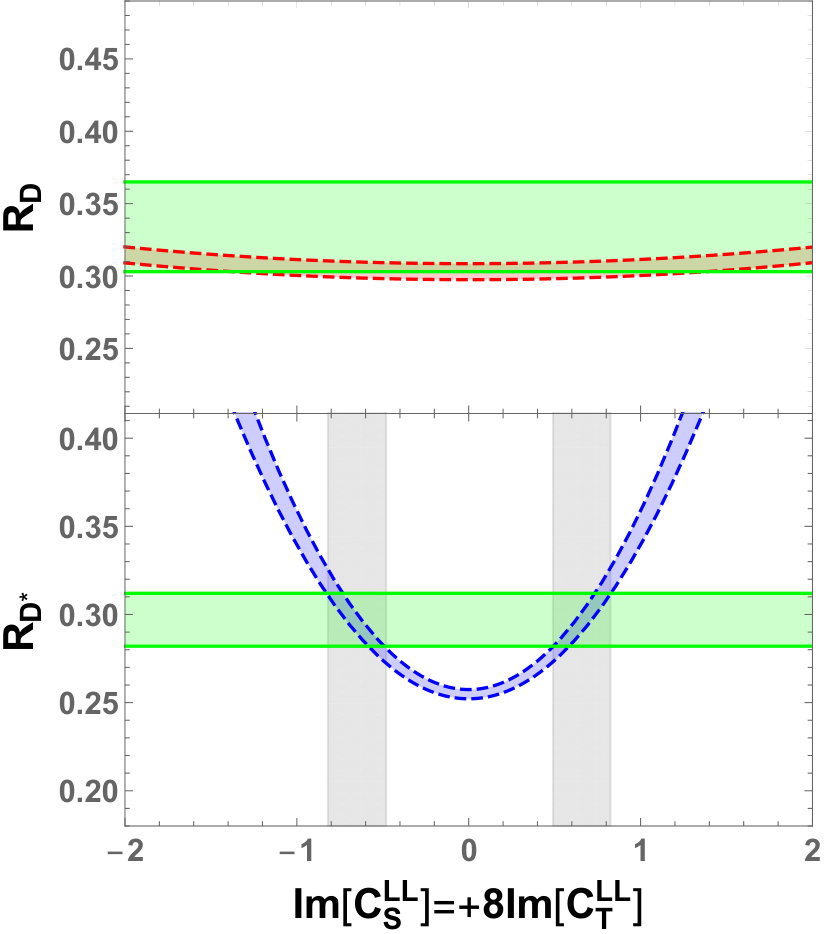 Figure 7
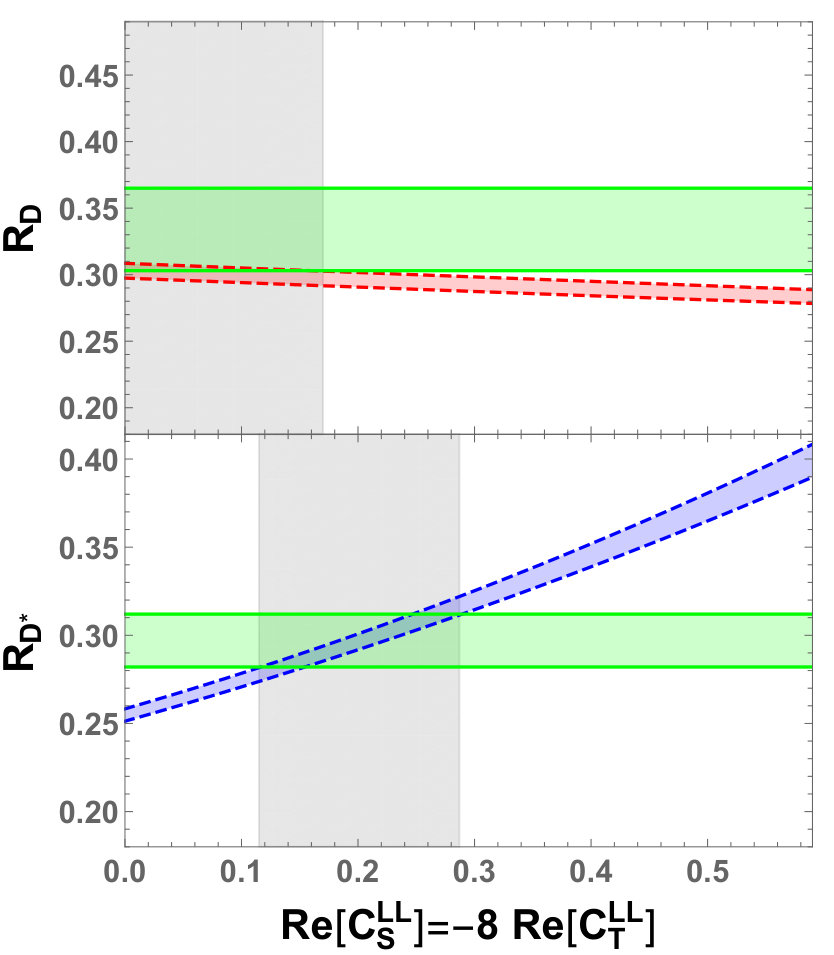 Figure 8
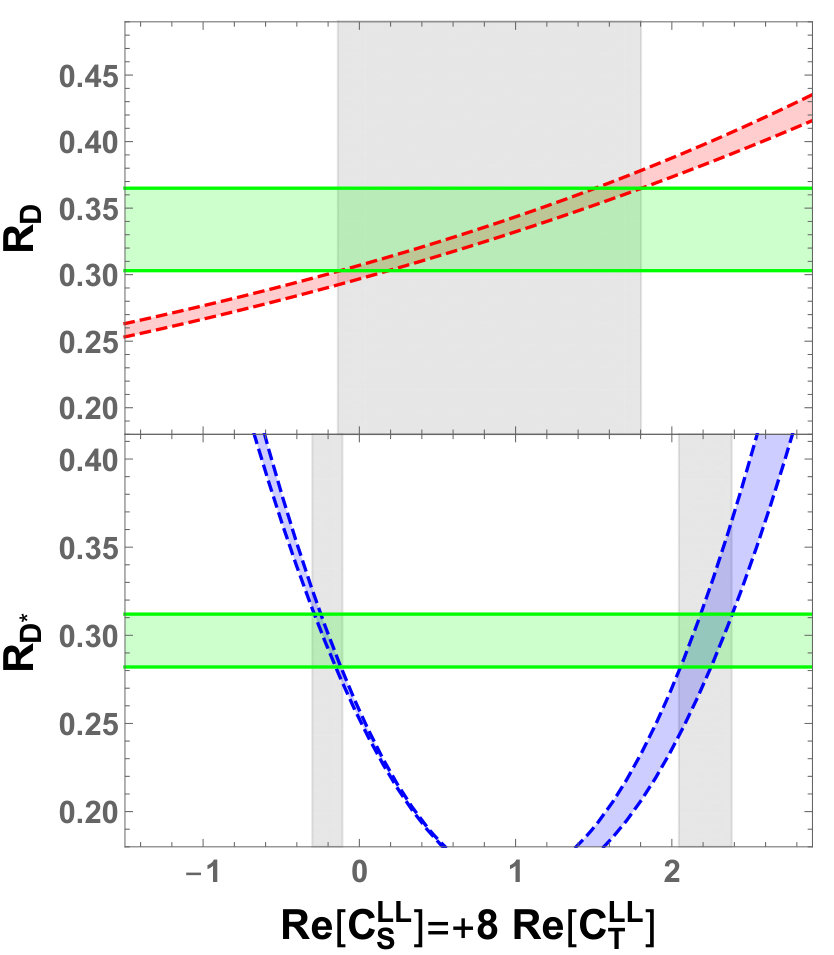 Figure 9
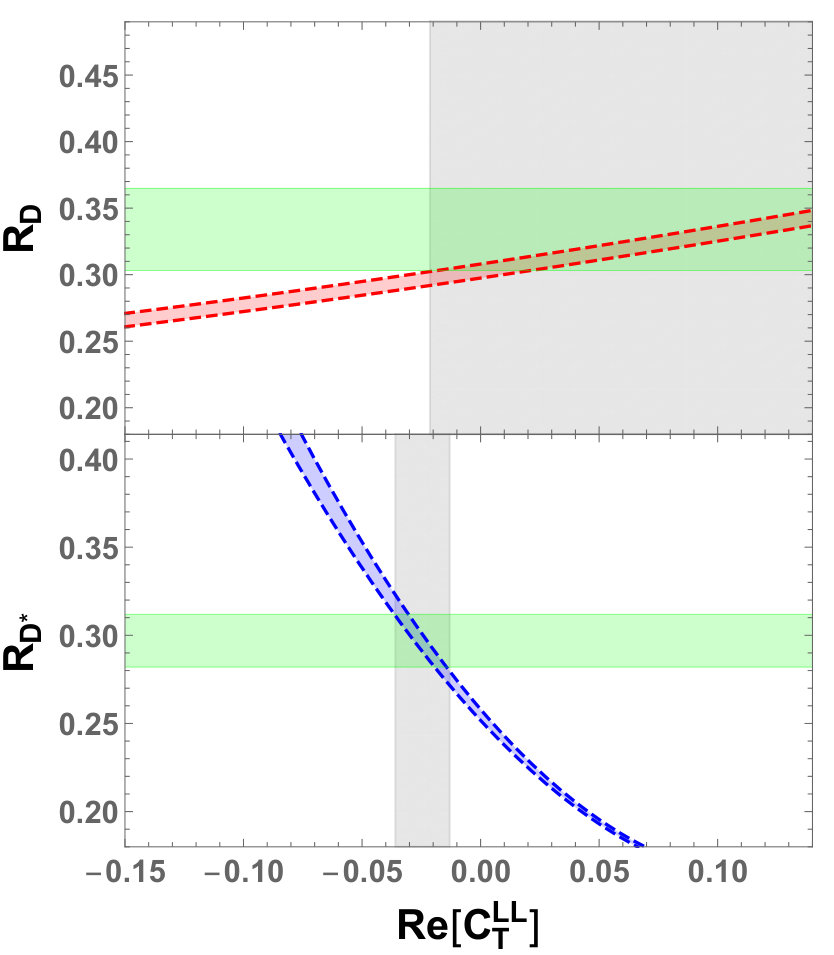 Figure 10
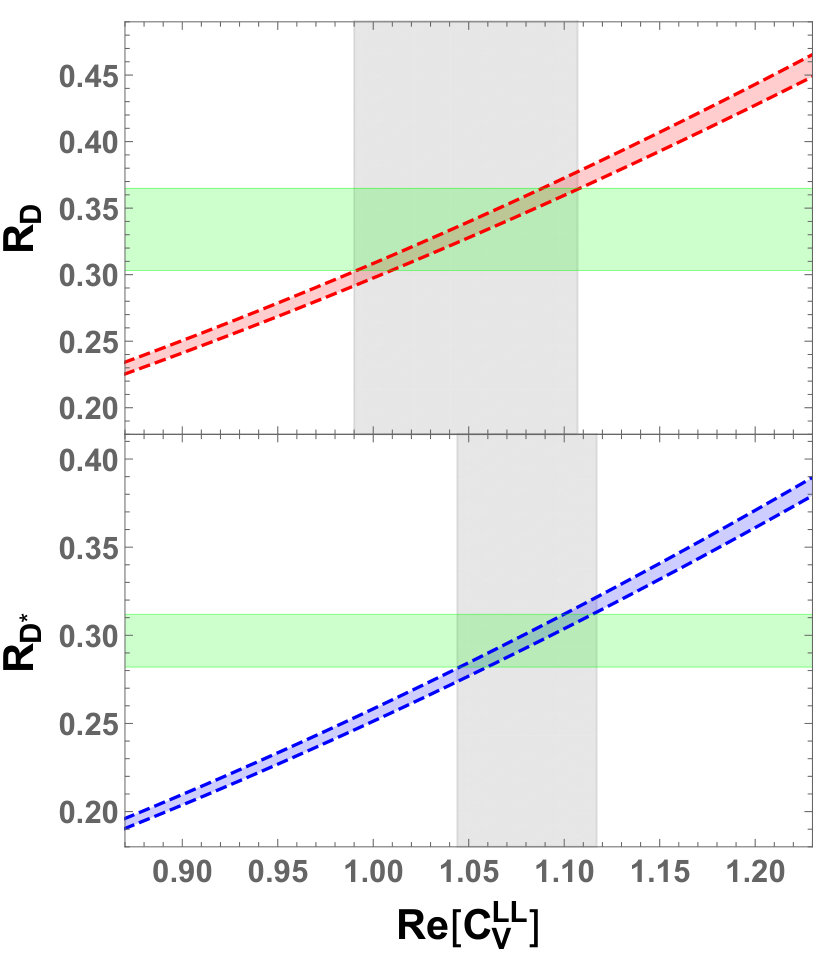 Figure 11
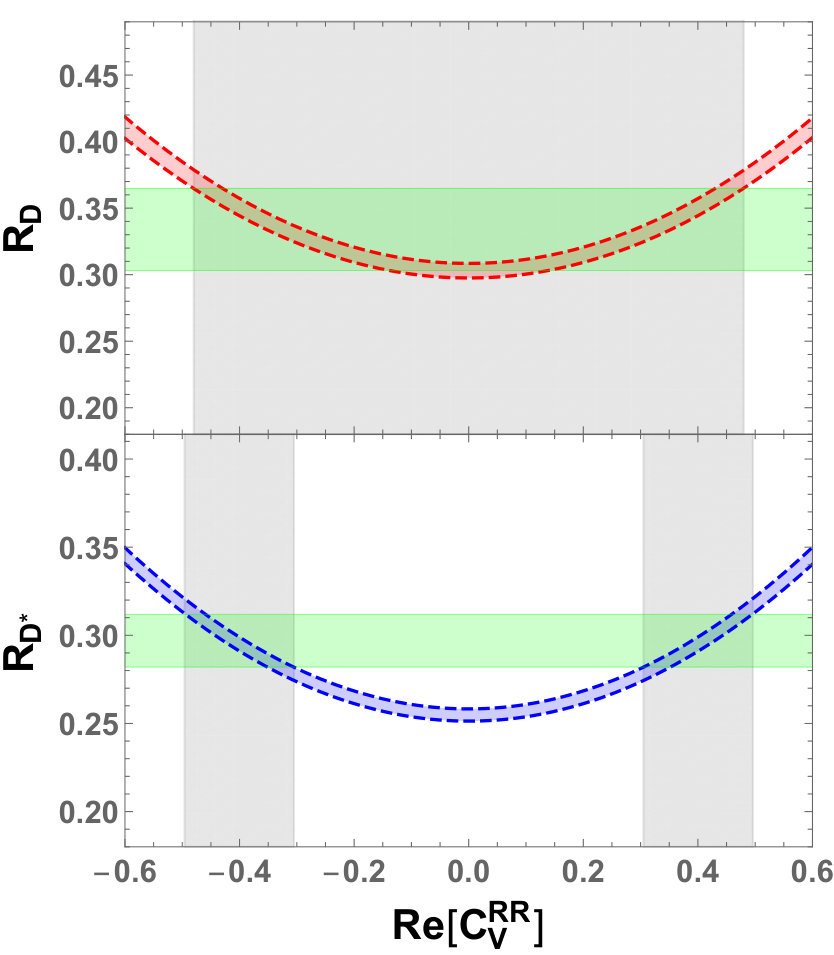 Figure 12
| SM prediction | Measurement | |||
| Aoki:2016frl | (pre-Moriond) | Amhis:2016xyh | ||
| Na:2015kha | Amhis:2016xyh ; Belle2019 ; Abdesselam:2019dgh | |||
| Bigi:2017jbd ; Jaiswal:2017rve ; Bernlochner:2017jka ; Amhis:2016xyh | (pre-Moriond) | Amhis:2016xyh | ||
| Amhis:2016xyh ; Belle2019 | ||||
| Bigi:2017jbd | Hirose:2016wfn ; Hirose:2017dxl | |||
| Abdesselam:2019wbt | ||||
| Aaij:2017tyk | ||||
| LHC 7 TeV | ||||
| I | 0.255 | |||
| LHC 7 TeV | ||||
| II | 0.301 | |||
| LHC 7 TeV | ||||
| only | ||||
| III | 0.374 | |||
| LHC 7 TeV | ||||
| and | ||||
| IV | 0.255 | |||
| V | LEP (at the Z peak) | 0.42 |
Peer Reviews
No public reviews on file for this paper yet. If you reviewed it on a platform where reviews are public (OpenReview, ICLR, NeurIPS, ICML), you can paste yours below so the community can read it here.
Videos
No videos yet. Explain this paper in a talk, walkthrough, or lecture? Add one.
B-meson charged current anomalies: the post-Moriond status
Debjyoti Bardhan
Department of Physics, Ben-Gurion University, Beer-Sheva 8410501, Israel
Diptimoy Ghosh
Department of Physics, Indian Institute of Science Education and Research, Pune 411008, India
Abstract
In this note, we discuss the impact of the recent Belle result on the various theoretical explanations of the and anomalies. The pure tensor explanation, which was strongly disfavoured by the measurements of and high- searches before Moriond, is now completely allowed because of reduction of the experimental world-average. Moreover, the pure right-chiral vector solution (involving right-chiral neutrinos) has now moved into the allowed range of the LHC searches. We also critically re-examine the bound on from LEP data and show that the bound is considerably weaker than the number often used in the recent literature.
The Belle collaboration has recently published results for and with a semileptonic tag Belle2019 ; Abdesselam:2019dgh , and their result is consistent with the Standard Model (SM) expectation within . Consequently, the experimental world average has moved towards the SM. However, the tension between the experimental world average and the SM expectation is still more than , and thus, it is interesting to re-examine the status of the various New Physics (NP) explanations in view of the new world-average. In Table. 1 below, we collect all the experimental results related to this anomaly.
The most general effective Lagrangian for the decay involving mass dimension-6 operators and only left-chiral neutrinos can be written as
[TABLE]
If one uses power-counting rules arising from linearly-realised gauge invariance, it turns out that the Wilson Coefficient (WC) , with the possibility of lepton non-universality, is only generated at the mass dimension-8 level Azatov:2018knx . Thus, it is expected to be suppressed compared to the other WCs as long as the scale of NP is not too close to the Higgs vacuum expectation value, thus we will ignore it in this analysis.
If one also assumes the existence of light right-chiral neutrino(s), as was first done in Becirevic:2016yqi to solve the anomaly, five additional operators can be constructed by the replacement in the leptonic currents of Eq. 1. In particular, a pure-right chiral vector current namely,
[TABLE]
was considered by several authors Asadi:2018wea ; Greljo:2018ogz ; Azatov:2018kzb , and we will include it in our analysis.
As the experimental situation for and is far from clear, we do not try to perform a fit to the WCs; for an early global fit, see Freytsis:2015qca . Instead, we show how and vary with respect to the WCs, and overlay the current experimental world-average and the corresponding currently allowed values of the WCs.
In Fig. 1, we show this for two WCs and assuming them to be real.
It can be seen from the left panel that is now at the edge of the allowed region for . This is due to the fact the the new experimental world-average for is now consistent with the SM expectation at level. So the anomaly is mostly driven by . In order to be consistent with both and simultaneously at the level, has to be in the range . So there has not been a qualitative change in the situation after the new Belle measurement. Similarly, the allowed range for now is . The lower edge of this range, , is now consistent with the upper bound from the LHC searches Greljo:2018tzh 111Note, however, that for , the value of is at the lower edge of the experimental 1 allowed region. Moreover, the sensitivity of the current high- measurements is not enough to constrain the left-handed scenario . Thus, the right-handed scenario is statistically worse than the solution. (bound from LHC searches was also studied in Altmannshofer:2017poe ; Iguro:2018fni ). Note that, both the WCs and can be generated by a single Leptoquark mediator Alonso:2015sja ; Barbieri:2015yvd ; DiLuzio:2017vat ; Azatov:2018kzb ; Calibbi:2017qbu .
Variations of and with respect to and are shown in Fig. 2. It can be seen from the left panel of Fig. 2 that a simultaneous solution of and is possible for in the range . We remind the readers that the corresponding value of before the recent Belle result was Bardhan:2016uhr ; Azatov:2018knx which was strongly disfavoured both by the LHC searches Aaboud:2018vgh ; Sirunyan:2018lbg ; Greljo:2018tzh as well as the measurement of mitp-talk . The new allowed range for , on the other hand, is completely safe. Thus, this has been a qualitative change after the new Belle measurement.
The specific relation (at the scale) shown on the right panel is interesting because it is generated by a single Leptoquark mediator Bauer:2015knc . The allowed range of the WC in this case is [0.113, 0.170] which, as can be seen from Fig. 3, produces less then its SM value, and thus is completely safe.
Another single mediator solution that has been discussed in the literature is the so-called Leptoquark Dorsner:2013tla ; Becirevic:2018afm . which, contrary to the Leptoquark mediator, generates (see the sign difference) at the scale222Note that, the relation are approximately true only at the scale. It is obtained by QCD renormalization group flow from the leptoquark matching scale () where the actual relations are .. In the left panel of Fig. 4, we show this case assuming real values of the WCs. It can be seen that, the combination at most can produce and at the lower edge of their experimental world-average if a simultaneous solution is desired (for ). A much better description of the data is possible if imaginary WCs are assumed as shown in the right panel of Fig. 4. The case of imaginary WCs in this context was first discussed in Sakaki:2014sea , and later also in Becirevic:2018afm ; Blanke:2018yud ; Iguro:2018vqb ; Biswas:2018jun ; Huang:2018nnq .
In this case, one needs in the range [0.480, 0.820] which gives , see Fig. 3. However, the authors of Ref. Akeroyd:2017mhr claimed an upper bound of on this branching ratio, arising from the LEP data taken on the peak. Thus, the solution seems to be in slight tension if the upper bound is taken at face value. While some authors Blanke:2018yud expressed concerns about the validity of this bound, not much effort was made to estimate as to how much this bound can be relaxed. We will discuss this in detail in the next section.
As the operator alone cannot explain and simultaneously, we do not discuss it anymore.
Before concluding this section, we would like to make a couple of comments on the impact of and on the various scenarios. In all the scenarios explaining the and anomalies, the variation of is less than from the SM prediction. Unfortunately, this is also true about , the only exception being the solution in which case the variation can be below the SM. Thus, distinguishing the various explanations by either or looks difficult at the moment.
**LEP bound on : **
As mentioned in the previous section, the authors of Akeroyd:2017mhr used the LEP data Acciarri:1996bv collected at the peak to put an upper bound on the branching fraction of . As this constraint has potentially interesting consequences for the and anomalies, in this section we will revisit it in detail.
In Ref. Acciarri:1996bv , the L3 collaboration obtained an upper bound on the number of events, . Based on this, they provided an upper bound
[TABLE]
As where, is the inclusive probability that a quark hadronizes into a or a meson, and Ref. Acciarri:1996bv uses a value , the bound in Eq. 3 can be translated into the following bound
[TABLE]
Separating the total number of events into those coming from and decays, we get
[TABLE]
This gives,
[TABLE]
The quantities and are known experimentally:
[TABLE]
Note that, the hadronization fractions in decays do not necessarily need to be identical to those in collisions because of the different momentum distributions of the b-quark in these processes; in collisions, the quarks have momenta close to , rather than in decays. In fact, CDF and LHCb collaborations have reported evidence for a strong dependence of he fraction Aaij:2011jp ; Aaltonen:2008zd ; Aaltonen:2008eu ; Aaij:2014jyk . The LHCb and the ATLAS collaborations have also studied the dependence of Aaij:2013qqa ; Aad:2015cda , but the results are not conclusive yet.
Therefore, we use the measurement of from LEP only and plot the upper bound on as a function of in Fig. 8. The upper bound corresponds to .
In order to find a real upper bound on we need to know the value of , or at least a lower bound on . Moreover, we need to know at LEP, and with the exact kinematical cuts used in Acciarri:1996bv .
Ref. Akeroyd:2017mhr tries to find the ratio from measurements of and defined as
[TABLE]
It then follows that
[TABLE]
Using
[TABLE]
we get,
[TABLE]
As the LHCb and CMS measurements of are about away from each other, we consider them separately and do not use their average. Moreover, while the LHCb Collaboration uses the cuts and in their analysis (at ), the CMS Collaboration uses and (at ). Thus the discrepancy could be due to the dependence of on kinematics.
Plugging Eqs. 18 and 19 into Eq. 6, one can obtain a bound on directly as a function of . This is shown in the right panel of Fig. 6.
Using , as used in Akeroyd:2017mhr , we get and from the CMS data, the latter being similar but slightly weaker than Akeroyd:2017mhr .
We would like to make two comments at this stage:
- •
The bound on depends linearly on . As has not yet been measured, a model independent bound is not possible. Moreover, even the SM calculation, and in particular the uncertainty, is not fully under control at the moment. Thus, a precise bound on cannot be obtained currently.
- •
Even in the presence of better information on , Eqs. (18) and (19) provide values of at the LHC and for the specific kinematic regions used in Aaij:2014ija and Khachatryan:2014nfa . As discussed before, the value of at LEP may be different from the above because of 1) larger average of the b-mesons produced at LEP 2) pairs produced at LEP are in the colour singlet state contrary to most of the pairs produced at the LHC which are in the colour octet state.
In view of the above, we try to estimate the ratio at LEP using the event generator Pythia8 Sjostrand:2006za ; Sjostrand:2014zea which has Hadronization model tuned to provide a good description of the available experimental data. The results are shown in Table. 2. In each of the cases presented in Table. 2, we have generated 1 million events in order to reduce the statistical uncertainty. In Case-I, we have used the same and cuts as in Khachatryan:2014nfa , and we get a value which is much smaller than which was used to obtain a bound . Note that, from Eq. 19, would correspond to (see the left panel of Fig. 6) which is much larger than the values considered in Akeroyd:2017mhr .
In the third row of Table. 2, we changed the cut to in order to check the dependence of the Hadronization fractions. In this case, we get which is considerably larger than that in Case-I. This is consistent with the general findings in Aaij:2011jp ; Aaltonen:2008zd ; Aaltonen:2008eu ; Aaij:2014jyk ; Aaij:2013qqa ; Aad:2015cda and confirms that the measurement of from LHCb (Eq. 15 and 18) which uses is indeed not expected to be the same as that measured in CMS (Eq. 16 and 19) which used . In rows 4 and 5 of Table. 2, we considered production through only Z boson (produced are in QCD singlet state) and through only QCD interactions (produced are in QCD triplet state) respectively. We observed only variation in the between these two cases.
Finally, at the Z peak, we obtain , (not shown in the table), and , the first two numbers being consistent with their experimental measurements Amhis:2016xyh ; Tanabashi:2018oca . Using the number , from Fig. 5, we get
[TABLE]
We warn the readers that this bound should only be taken as an estimate because, after all, Pythia only uses a Hadronization model adjusted to describe a large amount of available experimental data well (as we saw, indeed it reproduced the correct values for and ), and the value of obtained from Pythia is neither based on any first principle calculation nor on direct experimental data.
To summarise, in this short note, we have shown that
- •
the recent Belle results on and have interesting implications on the various possible EFT explanations of the data. The most important being that the pure tensor explanation is now completely allowed both by the measurement of and the high- searches by ATLAS and CMS.
- •
the solution in terms of a pure right-chiral vector current (involving right-chiral neutrinos) has now moved into the allowed range of the LHC searches.
- •
the upper bound on the branching fraction of from the LEP data is much weaker than the bound used in the recent literature. Our estimate of this bound, based on the Hadronization model implemented in Pythia8, is approximately . This bound, while being independently important, may also have interesting implications on the various scalar-pseudoscalar explanations of the and data.
**Acknowledgement **
The research of DB was supported in part by the Israel Science Foundation (grant no. 780/17) and by the Kreitman Foundation Post-Doctoral Fellowship. DG would like to acknowledge support through Ramanujan Fellowships of the Department of Science and Technology, Government of India.
**References **
The reference list from the paper itself. Each links out to its DOI / PubMed record.
- 1(1) G. Caria. http://moriond.in 2p 3.fr/2019/EW/slides/6_Friday/3_YSF/1_gcaria_moriond 2019.pdf , Talk given at Rencontres de Moriond, March 22 2019.
- 2(2) Belle collaboration, A. Abdesselam et al., Measurement of ℛ ( D ) ℛ 𝐷 \mathcal{R}(D) and ℛ ( D ∗ ) ℛ superscript 𝐷 ∗ \mathcal{R}(D^{\ast}) with a semileptonic tagging method , 1904.08794 .
- 3(3) S. Aoki et al., Review of lattice results concerning low-energy particle physics , Eur. Phys. J. C 77 (2017) 112 , [ 1607.00299 ]. · doi ↗
- 4(4) Y. Amhis et al., Averages of b 𝑏 b -hadron, c 𝑐 c -hadron, and τ 𝜏 \tau -lepton properties as of summer 2016, Online update at http://www.slac.stanford.edu/xorg/hflav/semi/fpcp 17/RDR Ds.html , 1612.07233 .
- 5(5) HPQCD collaboration, H. Na, C. M. Bouchard, G. P. Lepage, C. Monahan and J. Shigemitsu, B → D l ν → 𝐵 𝐷 𝑙 𝜈 B\rightarrow Dl\nu form factors at nonzero recoil and extraction of | V c b | subscript 𝑉 𝑐 𝑏 |V_{cb}| , Phys. Rev. D 92 (2015) 054510 , [ 1505.03925 ]. [Erratum: Phys. Rev.D 93,no.11,119906(2016)]. · doi ↗
- 6(6) D. Bigi, P. Gambino and S. Schacht, R ( D ∗ ) 𝑅 superscript 𝐷 R(D^{*}) , | V c b | subscript 𝑉 𝑐 𝑏 |V_{cb}| , and the Heavy Quark Symmetry relations between form factors , JHEP 11 (2017) 061 , [ 1707.09509 ]. · doi ↗
- 7(7) S. Jaiswal, S. Nandi and S. K. Patra, Extraction of | V c b | subscript 𝑉 𝑐 𝑏 |V_{cb}| from B → D ( ∗ ) ℓ ν ℓ → 𝐵 superscript 𝐷 ℓ subscript 𝜈 ℓ B\to D^{(*)}\ell\nu_{\ell} and the Standard Model predictions of R ( D ( ∗ ) ) 𝑅 superscript 𝐷 R(D^{(*)}) , JHEP 12 (2017) 060 , [ 1707.09977 ]. · doi ↗
- 8(8) F. U. Bernlochner, Z. Ligeti, M. Papucci and D. J. Robinson, Combined analysis of semileptonic B 𝐵 B decays to D 𝐷 D and D ∗ superscript 𝐷 D^{*} : R ( D ( ∗ ) ) 𝑅 superscript 𝐷 R(D^{(*)}) , | V c b | subscript 𝑉 𝑐 𝑏 |V_{cb}| , and new physics , Phys. Rev. D 95 (2017) 115008 , [ 1703.05330 ]. [Erratum: Phys. Rev.D 97,no.5,059902(2018)]. · doi ↗