Direct estimation of electron density in the Orion Bar PDR from mm-wave carbon recombination lines
S. Cuadrado, P. Salas, J. R. Goicoechea, J. Cernicharo, A. G. G. M., Tielens, A. Baez-Rubio

TL;DR
This study measures electron density in the Orion Bar PDR using millimeter-wave carbon recombination lines and [13CII] observations, revealing higher densities and pressures than previously estimated, supporting a photoevaporative PDR model.
Contribution
First direct determination of electron density in the Orion Bar PDR using mm-wave carbon recombination lines and [13CII], providing new insights into PDR physical conditions.
Findings
Electron density n_e = 60-100 cm^-3 in the PDR.
High thermal pressure P_th > 2-4 x 10^8 cm^-3 K.
Electron densities are an order of magnitude higher than previous estimates.
Abstract
A significant fraction of the molecular gas in star-forming regions is irradiated by stellar UV photons. In these environments, the electron density (n_e) plays a critical role in the gas dynamics, chemistry, and collisional excitation of certain molecules. We determine n_e in the prototypical strongly irradiated photodissociation region (PDR), the Orion Bar, from the detection of new millimeter-wave carbon recombination lines (mmCRLs) and existing far-IR [13CII] hyperfine line observations. We detect 12 mmCRLs (including alpha, beta, and gamma transitions) observed with the IRAM 30m telescope, at ~25'' angular resolution, toward the H/H2 dissociation front (DF) of the Bar. We also present a mmCRL emission cut across the PDR. These lines trace the C+/C/CO gas transition layer. As the much lower frequency carbon radio recombination lines, mmCRLs arise from neutral PDR gas and not from…
Click any figure to enlarge with its caption.
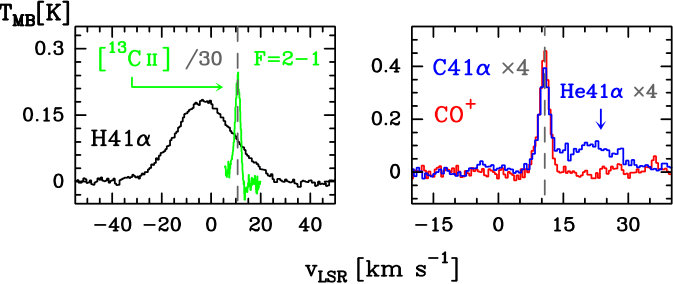 Figure 1
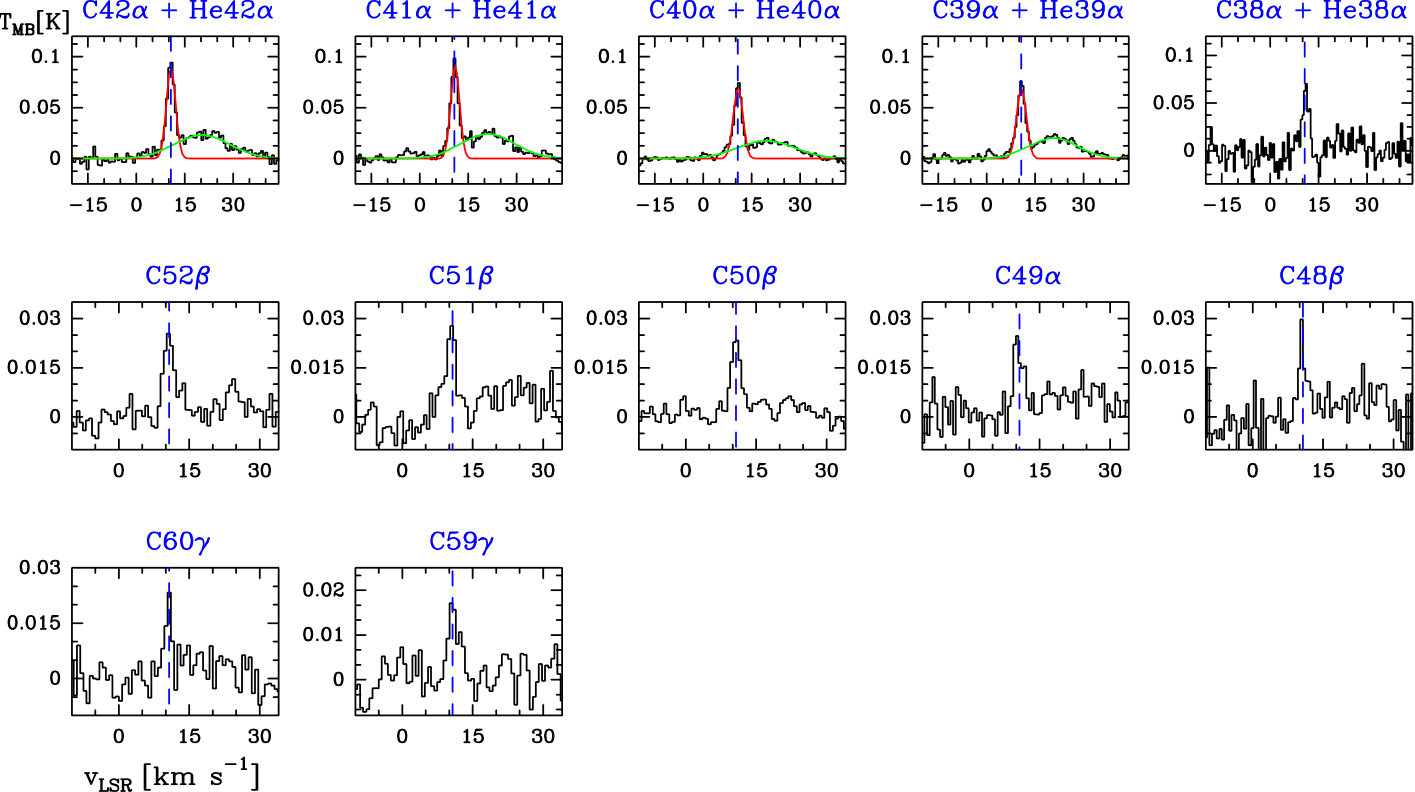 Figure 2
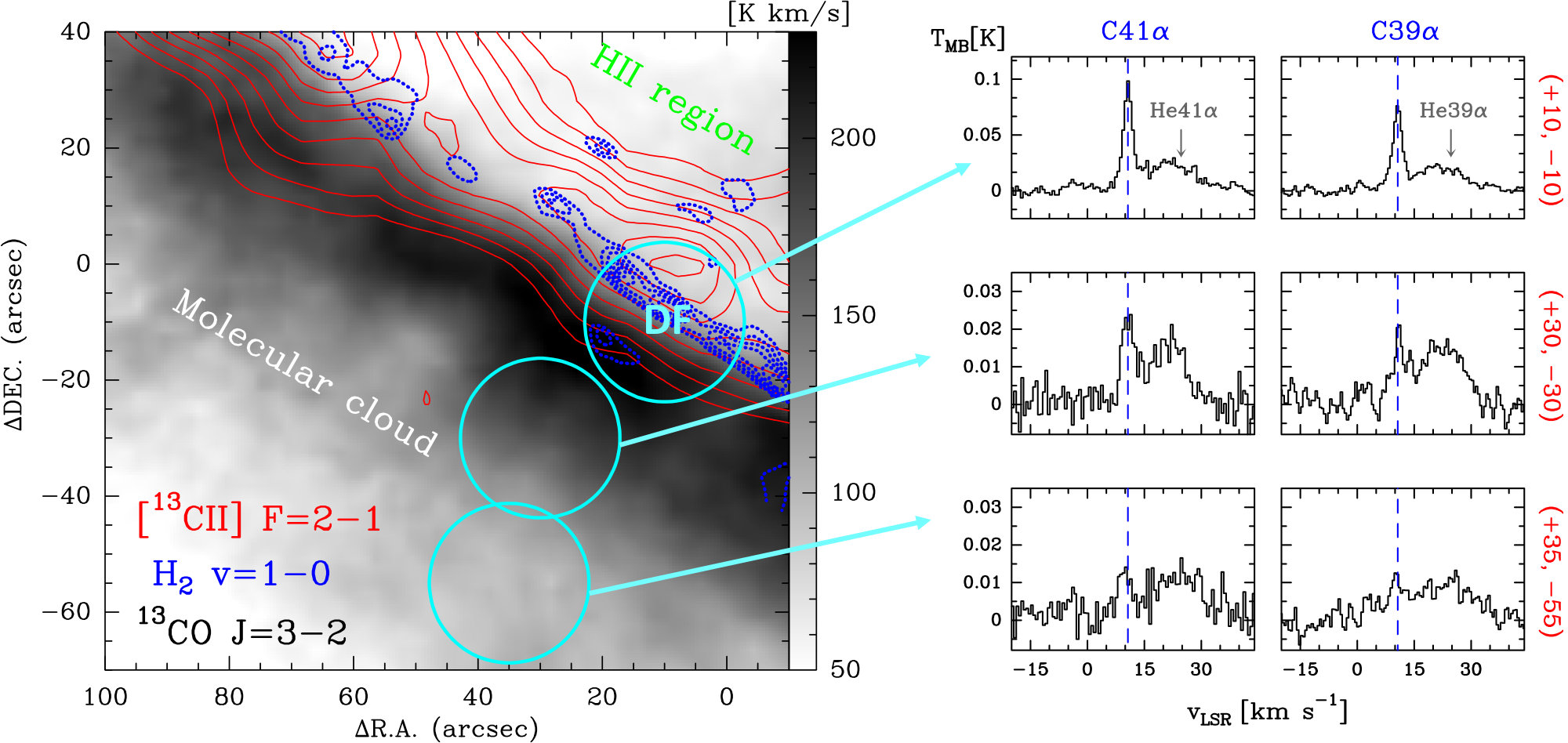 Figure 3
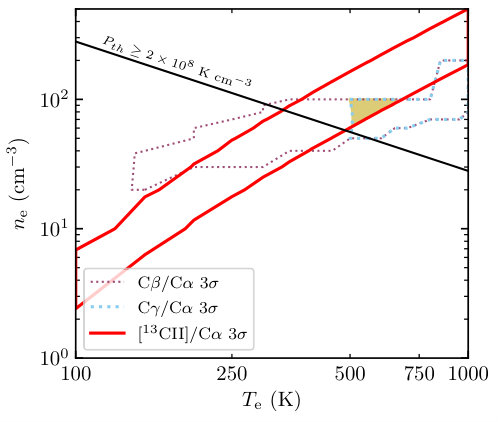 Figure 4
| Line | Frequency | d | HPBW | ||||
| [MHz] | [mK km s-1] | [km s-1] | [km s-1] | [mK] | [arcsec] | ||
| C42 | 85731.14 | 226.8 (10.5) | 10.6 (0.1) | 2.6 (0.1) | 83.1 | 21 | 28.7 |
| C41 | 92080.35 | 248.9 (14.2) | 10.8 (0.1) | 2.7 (0.1) | 85.6 | 17 | 26.7 |
| C40 | 99072.36 | 172.6 (7.2) | 10.7 (0.1) | 2.5 (0.1) | 63.6 | 23 | 24.8 |
| C39 | 106790.61 | 190.9 (13.3) | 10.7 (0.1) | 2.9 (0.2) | 53.5 | 12 | 23.0 |
| C38 | 115331.91 | 163.9 (19.6) | 10.9 (0.2) | 2.4 (0.3) | 65.4 | 5 | 21.3 |
| C52 | 88449.80 | 53.8 (9.4) | 10.7 (0.2) | 2.9 (0.5) | 24.5 | 6 | 27.8 |
| C51 | 93654.02 | 55.2 (8.3) | 10.5 (0.2) | 2.9 (0.6) | 24.8 | 6 | 26.3 |
| C50 | 99274.72 | 47.7 (6.0) | 10.7 (0.1) | 2.7 (0.3) | 23.6 | 8 | 24.8 |
| C49 | 105354.40 | 42.4 (8.5) | 10.6 (0.2) | 2.6 (0.5) | 21.5 | 4 | 23.3 |
| C48 | 111940.89 | 36.9 (11.0) | 10.6 (0.2) | 2.3 (0.6) | 21.8 | 4 | 22.0 |
| C60 | 84956.76 | 27.8 (8.2) | 10.5 (0.2) | 1.7 (0.5) | 22.3 | 5 | 29.0 |
| C59 | 89243.05 | 35.1 (8.3) | 10.9 (0.3) | 3.0 (0.6) | 15.4 | 4 | 27.6 |
Peer Reviews
No public reviews on file for this paper yet. If you reviewed it on a platform where reviews are public (OpenReview, ICLR, NeurIPS, ICML), you can paste yours below so the community can read it here.
Videos
No videos yet. Explain this paper in a talk, walkthrough, or lecture? Add one.
11institutetext: Instituto de Física Fundamental (IFF-CSIC). Calle Serrano 121-123, E28006 Madrid, Spain 22institutetext: Leiden Observatory, Leiden University, P.O. Box 9513, NL-2300 RA Leiden, The Netherlands 33institutetext: Centro de Astrobiología (CSIC-INTA), Ctra. de Torrejón a Ajalvir, km 4, E28850 Torrejón de Ardoz, Madrid, Spain
Direct estimation of electron density in the Orion Bar PDR
from mm-wave carbon recombination lines ††thanks: Based on observations obtained with the IRAM 30 m telescope supported by INSU/CNRS (France), MPG (Germany), and IGN (Spain).
S. Cuadrado Direct estimation of electron density in the Orion Bar PDR from mm-wave carbon recombination lines ††thanks: Based on observations obtained with the IRAM 30 m telescope supported by INSU/CNRS (France), MPG (Germany), and IGN (Spain).Direct estimation of electron density in the Orion Bar PDR from mm-wave carbon recombination lines ††thanks: Based on observations obtained with the IRAM 30 m telescope supported by INSU/CNRS (France), MPG (Germany), and IGN (Spain).
P. Salas Direct estimation of electron density in the Orion Bar PDR from mm-wave carbon recombination lines ††thanks: Based on observations obtained with the IRAM 30 m telescope supported by INSU/CNRS (France), MPG (Germany), and IGN (Spain).Direct estimation of electron density in the Orion Bar PDR from mm-wave carbon recombination lines ††thanks: Based on observations obtained with the IRAM 30 m telescope supported by INSU/CNRS (France), MPG (Germany), and IGN (Spain).
J. R. Goicoechea Corresponding author, Direct estimation of electron density in the Orion Bar PDR from mm-wave carbon recombination lines ††thanks: Based on observations obtained with the IRAM 30 m telescope supported by INSU/CNRS (France), MPG (Germany), and IGN (Spain).Direct estimation of electron density in the Orion Bar PDR from mm-wave carbon recombination lines ††thanks: Based on observations obtained with the IRAM 30 m telescope supported by INSU/CNRS (France), MPG (Germany), and IGN (Spain). [email protected]
J. Cernicharo Direct estimation of electron density in the Orion Bar PDR from mm-wave carbon recombination lines ††thanks: Based on observations obtained with the IRAM 30 m telescope supported by INSU/CNRS (France), MPG (Germany), and IGN (Spain).Direct estimation of electron density in the Orion Bar PDR from mm-wave carbon recombination lines ††thanks: Based on observations obtained with the IRAM 30 m telescope supported by INSU/CNRS (France), MPG (Germany), and IGN (Spain).
A. G. G. M. Tielens Direct estimation of electron density in the Orion Bar PDR from mm-wave carbon recombination lines ††thanks: Based on observations obtained with the IRAM 30 m telescope supported by INSU/CNRS (France), MPG (Germany), and IGN (Spain).Direct estimation of electron density in the Orion Bar PDR from mm-wave carbon recombination lines ††thanks: Based on observations obtained with the IRAM 30 m telescope supported by INSU/CNRS (France), MPG (Germany), and IGN (Spain).
A. Báez-Rubio Direct estimation of electron density in the Orion Bar PDR from mm-wave carbon recombination lines ††thanks: Based on observations obtained with the IRAM 30 m telescope supported by INSU/CNRS (France), MPG (Germany), and IGN (Spain).Direct estimation of electron density in the Orion Bar PDR from mm-wave carbon recombination lines ††thanks: Based on observations obtained with the IRAM 30 m telescope supported by INSU/CNRS (France), MPG (Germany), and IGN (Spain).
(Received 27 March 2019 / Accepted 16 April 2019)
Abstract
*Context. *A significant fraction of the molecular gas in star-forming regions is irradiated by stellar UV photons. In these environments, the electron density () plays a critical role in the gas dynamics, chemistry, and collisional excitation of certain molecules.
*Aims. *We determine in the prototypical strongly irradiated photodissociation region (PDR), the Orion Bar, from the detection of new millimeter-wave carbon recombination lines (mmCRLs) and existing far-IR [13C ii] hyperfine line observations.
Methods. We detect 12 mmCRLs (including , , and transitions) observed with the IRAM 30 m telescope, at 25′′ angular resolution, toward the H / H2 dissociation front (DF) of the Bar. We also present a mmCRL emission cut across the PDR.
Results. These lines trace the C+ / C / CO gas transition layer. As the much lower frequency carbon radio recombination lines, mmCRLs arise from neutral PDR gas and not from ionized gas in the adjacent H ii region. This is readily seen from their narrow line profiles ( km s-1) and line peak velocities ( km s*-1*). Optically thin [13C ii] hyperfine lines and molecular lines – emitted close to the DF by trace species such as reactive ions CO+ and HOC+ – show the same line profiles. We use non-LTE excitation models of [13C ii] and mmCRLs and derive 60 – 100 cm*-3* and 500 – 600 K toward the DF.
Conclusions. The inferred electron densities are high, up to an order of magnitude higher than previously thought. They provide a lower limit to the gas thermal pressure at the PDR edge without using molecular tracers. We obtain cm-3 K assuming that the electron abundance is equal to or lower than the gas-phase elemental abundance of carbon. Such elevated thermal pressures leave little room for magnetic pressure support and agree with a scenario in which the PDR photoevaporates.
Key Words.:
Astrochemistry - surveys - ISM: photon-dominated region (PDR) - ISM – H ii regions – ISM: clouds
1 Introduction
Much of the mass and most of the volume occupied by molecular gas in star-forming regions lies at low visual extinction ( 6, e.g., Pety et al. 2017). This means that, in the vicinity of OB-type massive stars, a significant fraction of the molecular gas is irradiated by relatively intense UV photon fluxes (e.g., Goicoechea et al. 2019). The interface layers between the hot ionized gas and the cold molecular cloud are photodissociation regions (PDRs; Hollenbach & Tielens 1999). PDRs host the critical H+ / H / H2 and C+ / C / CO transition layers of the interstellar medium (ISM). Far-UV (FUV) photons with eV permeate molecular clouds, ionizing atoms, molecules, and dust grains of lower ionization potential (IPs). One signature of FUV-irradiated gas is an ionization fraction, defined as the abundance of electrons with respect to H nuclei ( = ), higher than about . Cold molecular cores shielded from external FUV radiation show much lower ionization fractions, , as the abundance of electrons is driven by the gentle flux of cosmic-ray particles rather than penetrating stellar FUV photons (Guelin et al. 1982; Caselli et al. 1998; Maret & Bergin 2007; Goicoechea et al. 2009).
Electrons play a fundamental role in the chemistry and dynamics of the neutral interstellar gas (meaning neutral atomic or molecular hydrogen, but not ionized). The electron density () controls the preponderance of ion-neutral reactions, i.e., the main formation route for many ISM molecules (Herbst & Klemperer 1973; Oppenheimer & Dalgarno 1974). The ionization fraction also controls the coupling of matter and magnetic fields. In addition, in high environments, the large cross sections for inelastic collisions of electrons with certain high-dipole molecules such as HCN provide an additional source of rotational excitation (Goldsmith & Kauffmann 2017). In these cases, the observed molecular line emission is no longer controlled by the most abundant collisional partner, H2. Hence, the actual value of affects how gas densities are estimated.
A direct determination of in molecular clouds is usually not possible and we have to rely on indirect methods such as the observation of molecular ions and chemical modeling. In FUV-illuminated environments, electrons are supplied by the photoionization of abundant elements such as carbon and sulfur (both with IP 13.6 eV), and also by the photoelectric effect on dust grains and polycyclic aromatic hydrocarbon (PAH) molecules (Bakes & Tielens 1994). In diffuse and translucent clouds, and at the FUV-irradiated edges of dense molecular clouds, most electrons arise from the ionization of carbon atoms. Carbon recombination lines (CRLs), in which a free electron recombines with carbon ions (C+) and cascades down from Rydberg electronic states to the ground while emitting photons, are expected to arise from neutral gas close to the C+ / C / CO transition layer (e.g., Natta et al. 1994) and not from the hot (electron temperature K) ionized gas in the adjacent H ii region. This is readily seen from the narrower CRLs profiles compared to the broad H and He recombination lines ( 20 km s*-1*, e.g., Churchwell et al. 1978). This conclusion is also in line with photoionization models where, in H ii regions, carbon is mainly in the form of higher ionization states (e.g., C*++*) (Rubin et al. 1991; Kaufman et al. 2006).
The fine-structure emission of singly ionized carbon (IP 11.3 eV), the famous [C ii] 158 m line, is bright and often shows an intensity linearly proportional to the C+ column density (the so-called effectively thin emission regime; Goldsmith et al. 2012). However, the line reaches moderate opacities toward bright and dense PDRs such as the Orion Bar (e.g., Ossenkopf et al. 2013; Goicoechea et al. 2015). Carbon recombination lines are optically thin (see Sect. 4) with an intensity proportional to . Although much fainter, mmCRLs can be observed from ground-based telescopes and can be used to infer and in FUV-irradiated neutral gas (Pankonin & Walmsley 1978; Salgado et al. 2017; Salas et al. 2018). CRLs have historically been detected at very low radio frequencies (e.g., at 43 MHz for C539 or 8.6 GHz for C91). Pushing to higher frequencies (i.e., lower principal quantum numbers ) greatly improves the angular resolution of the observation even with single-dish telescopes. This allows us to access much smaller spatial scales and, potentially, to spatially resolve the narrow C+ / C / CO gas transition layer.
In this work we present the detection of several (), (), and () mmCRLs (C) observed from 85 GHz to 115 GHz toward the strongly FUV-irradiated ( 104) PDR, the Orion Bar. This is a nearly edge-on interface of the Orion molecular cloud (OMC-1) with the “Huygens” dense H ii region, photoionized by young massive stars in the Trapezium cluster (e.g., Tielens et al. 1993; O’Dell 2001; Goicoechea et al. 2016; Pabst et al. 2019). Using the Effelsberg 100 m telescope, Natta et al. (1994) previously detected the C91 line toward several positions of the irradiated surface of OMC-1. The same line was mapped with the VLA along the Bar by Wyrowski et al. (1997). They showed that the C91 emission basically coincides with the emission in the 1–0 (1) line from vibrationally excited molecular hydrogen (H). Most models of the Bar use cm*-3* for the edge of the PDR (e.g., van der Tak et al. 2012, 2013). This value implies relatively low gas densities ( 105 cm*-3*) and thermal pressures in the CRL emitting layers, and through the PDR if the classical constant-density PDR model is adopted. The newly detected mmCRLs allow us to determine and , and to independently estimate the gas thermal pressure. This provides additional insights into the PDR structure and dynamics.
2 Observations and data reduction
We used the IRAM 30 m telescope at Pico Veleta (Sierra Nevada, Spain) to observe the Orion Bar in the mm band. We employed the E0 EMIR receiver (80 GHz 116 GHz) and fast Fourier transform spectrometer (FFTS) backend at 200 kHz spectral resolution (0.7 km s*-1* at 90 GHz). These observations are part of a complete line survey (80 GHz 360 GHz; Cuadrado et al. 2015, 2016, 2017) toward a position close to the H2 dissociation front (DF; the H / H2 transition layer), almost coincident with what is known as the CO+ emission peak (Stoerzer et al. 1995). Here we present results obtained from deep observations in the 3 mm band toward three positions across the PDR (see Fig. 1). Their offsets with respect to , are (+10*′′, 10′′) DF, (+30′′, 30′′), and (+35′′, 55′′). In order to avoid the extended emission from OMC-1, we employed the position switching observing procedure with a reference position at offset (600′′, 0′′*).
The half power beam width (HPBW) at 3 mm ranges from 31*′′* to 21*′′* (see Table 1). We reduced and analyzed the data using the GILDAS software,111http://www.iram.fr/IRAMFR/GILDAS/ as described in Cuadrado et al. (2015). The rms noise obtained after 4 h 5 h integrations is typically 1 mK 5 mK per resolution channel. The antenna temperature, , was converted to the main beam temperature, , through the = relation, where is the antenna efficiency, which is defined as the ratio between main beam efficiency, , and forward efficiency, 222http://www.iram.es/IRAMES/mainWiki/Iram30mEfficiencies. All line intensities in figures and tables are in units of main beam temperature.
The intensities of the Cn$$\alpha lines were extracted from a two-Gaussian fit to each observed feature: one narrow Gaussian for the Cn$$\alpha lines, and a broader one for the Hen$$\alpha lines (see fits in Fig. 4). With these fits we determined the contribution, , of the Hen$$\alpha line wings to the observed emission at Cn$$\alpha velocities. We used this value to estimate the contribution of the putative Hen$$\beta and Hen$$\gamma line wings to the faint Cn$$\beta and Cn$$\gamma lines. We conclude that the uncertainty (calibration and line overlap) of our mmCRL intensities is . The resulting mmCRL spectroscopic parameters are given in Table 1.
We also made use of the [13C ii] map taken by Herschel/HIFI toward OMC-1 (Goicoechea et al. 2015). We analyzed the strongest, yet optically thin, [13C ii] 2–1 hyperfine emission component at 1900.466 GHz (red contours in Fig. 1). To make a comparison with the mmCRLs, we smoothed the map to an angular resolution of 25*′′* and extracted the [13C ii] ( 2–1) integrated line intensity, 20 3 K km s*-1*, toward the DF.
3 Results
Figure 1 shows the observed positions over a map of the optically thin 13CO ( = 3-2) and [13C ii] (, = 2–1) emission lines along the Bar. We detect 12 mmCRLs toward the DF: C42 to C38, C52 to C48, and C60 to C59. All lines are shown in Fig. 4 of the Appendix. The emission from these lines gets fainter as we go from the DF to the more shielded molecular gas, thus mmCRLs trace the FUV-irradiated edge of the molecular cloud. The Cn$$\alpha lines show an emission shoulder shifted by 10 km s*-1*. This feature is produced by He recombination lines (IP 24.6 eV). Helium lines do not arise from the neutral PDR; they are emitted from the surrounding “Huygens” H ii region and from foreground layers of ionized gas that extend all the way to the edge of Orion’s Veil (see, e.g., Rubin et al. 2011; O’Dell et al. 2017; Pabst et al. 2019).
The observed mmCRLs have line profiles that are very different from those of H and He recombination lines (Fig. 2). The H and He recombination lines show much broader line widths ( km s*-1*) produced by the high electron temperatures and pressures of the fully ionized gas. They peak at to 11 km s*-1*, consistent with ionized gas that flows toward the observer.
Carbon recombination lines, however, peak at km s*-1* and show narrow line profiles, km s*-1*. These values are nearly identical to those displayed by [13C ii] and by molecular lines observed toward the DF position at comparable angular resolution (e.g., Cuadrado et al. 2015). In particular, mmCRLs and [13C ii] line profiles are analogous to those of HOC+ and CO+ (Fig. 2). These reactive molecular ions form by chemical reactions involving C+ with H2O and OH, respectively (e.g., Fuente et al. 2003; Goicoechea et al. 2017). Hence, they likely trace the same gas component.
For optically thin emission, line widths are determined by thermal broadening ( ) and by nonthermal broadening produced by gas turbulence and macroscopic motions in the PDR. Adopting a nonthermal velocity dispersion333Calculated from detailed nonlocal radiative transfer models of the molecular line emission toward the DF (Goicoechea et al. 2016, 2017). of = 1.0 0.1 km s*-1* ( = 2.355 ), the observed mmCRL widths imply a beam-averaged gas temperature of K. The [C ii] 158 m line shows a broader line width, 4.1 0.1 km s*-1*, toward the DF. Because the line emission is moderately optically thick ( 1–2; see Ossenkopf et al. 2013; Goicoechea et al. 2015), these line width differences are, at least in part, produced by opacity-broadening of the [C ii] 158 m line. However, Ossenkopf et al. (2013) pointed out that opacity-broadening alone does not fully explain the broader [C ii] line profile compared to [13C ii]. These line width differences may suggest that, in comparison to [13C ii] and mmCRLs, the [C ii] 158 m emission has a significant contribution from hotter gas in the mostly atomic PDR ( ), thus closer to the ionization front (the PDR / H ii interface).
4 Analysis
Our 3 mm-wave observations have allowed us to detect several , , and CRLs toward the Bar. The observed dependence of their line strengths is determined by the level populations. These can be modeled and used to derive and (see theory in e.g., Walmsley & Watson 1982; Salgado et al. 2017).
Figure 3 shows results of a grid of non-LTE444The observed mmCRL intensity ratios approach LTE for 500 K. Assuming LTE excitation results in mmCRL intensities brighter by . Hence, the estimated in LTE are lower. excitation models for ranging from 1 cm*-3* to 500 cm*-3*, and ranging from 100 K to 1000 K. Our models use non-LTE level populations computed by Salgado et al. (2017) without a background radiation field. Models assume that the observed lines are optically thin (for the conditions prevailing in the Bar, we determine that the opacity of the C line is ). Our models also compute the [13C ii] excitation, and use the [12C/13C] 67 isotopic abundance ratio inferred in Orion (Langer et al. 1984). The colored area in Fig. 3 shows the best models fitting line intensity ratios that include all555The properties of the observed , , and carbon recombination lines vary slowly with . In order to increase the statistical significance of our comparison between models and observations, we used the inverse-variance weighted intensity averages of the observed C ( from 38 to 42), C ( from 48 to 52), and C ( from 59 to 60) lines. observed , , and mmCRLs and [13C ii]. The black line shows where the gas thermal pressure () is 2 108 cm*-3* K. To plot this line we assume [C / H]; in other words, all free electrons come from the ionization of carbon atoms, with an gas-phase abundance of [C / H] = 1.4 10*-4* with respect to H nuclei in Orion (Sofia et al. 2004). Absolute line intensity predictions depend on the assumed path-length along the line of sight. The 25*′′* beam-averaged C+ column density, (C+), estimated from [13C ii] is (C+) 1019 cm*-2* (Goicoechea et al. 2015). Assuming a representative density of 105 cm*-3* in the atomic PDR (Tielens et al. 1993), the inferred (C+) is equivalent to 0.2 pc. This is consistent with other estimations based on the infrared dust emission ( 0.28 0.06 pc, Salgado et al. 2016). If the gas density is a factor of ten higher (e.g., Andree-Labsch et al. 2017) then 0.02 pc.
Our absolute intensity and line ratio models restrict and toward the DF position to 60 – 100 cm*-3* and 500 – 600 K, respectively. The inferred electron temperatures in the colored area of Fig. 3 fall within the thermal line widths derived from the observed mmCRL profiles (see previous section). Assuming666Our inferred and values are lower limits if mmCRLs arise from PDR gas layers where a significant fraction of carbon is not locked in C+, and thus and (C+). 1.410*-4*, the derived electron densities are equivalent to gas densities of (4 – 7) 105 cm*-3*. Thus, gas thermal pressures of (2 – 4)108 cm*-3* K toward the DF.
5 Discussion and prospects
Using mmCRL observations and models, we inferred 60–100 cm*-3* at the H / H2 dissociation front of the Orion Bar PDR. These electron densities are higher than the cm*-3* values typically used in molecular excitation models of the region (e.g., van der Tak et al. 2012, 2013). In addition, by assuming 1.410*-4*, we estimated a lower limit6 to in the DF. The high inferred gas thermal pressures confirm earlier estimations based on the analysis of ALMA images of the molecular gas emission (Goicoechea et al. 2016, 2017) and of Herschel observations of specific tracers of the DF (e.g., high- CO and CH+ rotational lines; Nagy et al. 2013; Joblin et al. 2018). Nonstationary photoevaporating PDR models (e.g., Bertoldi & Draine 1996; Bron et al. 2019) predict such high pressures in PDRs. In these time-dependent models, the strong stellar FUV field heats, compresses, and gradually evaporates the molecular cloud edge if the pressure of the surrounding medium (the adjacent H ii region) is not significantly higher. The derived thermal pressure toward the DF, 2108 cm*-3* K, is indeed higher than that of the ionized gas at the ionization front ( 6107 cm*-3* K, Walmsley et al. 2000) and, in contrast to previous indirect studies of the pressure in the Bar (Pellegrini et al. 2009), leaves little room for magnetic pressure support. This conclusion is in line with the relatively modest plane-of-the-sky magnetic field strength reported from far-IR polarimetric observations with SOFIA/HAWC+ (Chuss et al. 2019).
Unfortunately, the 25*′′* resolution of our single-dish observations does not allow us to spatially resolve the [13C ii] and mmCRLs emitting layers. We note that = 1, roughly the width of the H / H2 transition layer, implies 3.2*′′* 1.6*′′* for = 105 and 106 cm*-3*, respectively. The 10*′′* resolution VLA map of the C91 line (Wyrowski et al. 1997) shows that the C+ gas layer seen in this CRL is spatially coincident with the IR emission from H that traces the H / H2 dissociation front (shown in Fig. 1). This result is somewhat surprising because constant-density stationary PDR models have long predicted that the C+ / C / CO transition in the Bar should be located deeper inside the cloud, and separated from the DF by several arcsec (e.g., Tielens et al. 1993). In addition, single-dish observations show that the [C i] 492 GHz emission spatially correlates with that of 13CO ( = 2–1) (Tauber et al. 1995). This suggests that the classical C+ / C / CO sandwich structure of a PDR may not be discernible, or even exist, in the sense that there would be no layer in the Bar where neutral atomic carbon is the most abundant carbon reservoir. Indeed, ALMA images of the Bar at 1*′′* resolution show that there is also no appreciable offset between the H emission and the edge of the HCO+ and CO emission (Goicoechea et al. 2016). All these new observations thus suggest that we still do not fully understand the properties and exact location of the C+ / C / CO transition in interstellar clouds.
In this work we provided evidence that the electron density at the edge of the Orion Bar PDR is quite high, and this may have consequences for the coupling of matter with the magnetic field and the excitation of certain molecules. Much higher resolution ALMA observations of mmCRLs and of neutral atomic carbon [C i] fine-structure lines are clearly needed to spatially resolve these critical interface layers of the ISM.
Acknowledgements.
We thank the Spanish MICIU for funding support under grant AYA2017-85111-P and the ERC for support under grant ERC-2013-Syg-610256-NANOCOSMOS. A.B.-R. also acknowledges support by the MICIU and FEDER funding under grants ESP2015-65597-C4-1-R and ESP2017-86582-C4-1-R. P.S. and A.G.G.M.T. acknowledge financial support from the Dutch Science Organisation through TOP grant 614.001.351.
Appendix A Tables and figures
The reference list from the paper itself. Each links out to its DOI / PubMed record.
- 1Andree-Labsch et al. (2017) Andree-Labsch, S., Ossenkopf-Okada, V., & Röllig, M. 2017, A&A, 598, A 2
- 2Bakes & Tielens (1994) Bakes, E. L. O. & Tielens, A. G. G. M. 1994, Ap J, 427, 822
- 3Bertoldi & Draine (1996) Bertoldi, F. & Draine, B. T. 1996, Ap J, 458, 222
- 4Bron et al. (2019) Bron, E., Agúndez, M., Goicoechea, J. R., & Cernicharo, J. 2019, ar Xiv e-prints
- 5Caselli et al. (1998) Caselli, P., Walmsley, C. M., Terzieva, R., & Herbst, E. 1998, Ap J, 499, 234
- 6Churchwell et al. (1978) Churchwell, E., Smith, L. F., Mathis, J., Mezger, P. G., & Huchtmeier, W. 1978, A&A, 70, 719
- 7Chuss et al. (2019) Chuss, D. T., Andersson, B.-G., Bally, J., et al. 2019, Ap J, 872, 187
- 8Cuadrado et al. (2017) Cuadrado, S., Goicoechea, J. R., Cernicharo, J., et al. 2017, A&A, 603, A 124