A family of fern-like ternary complex trees
Bernat Espigule

TL;DR
This paper explores a mathematical family of fern-like ternary complex trees related to the golden ratio, analyzing their topology, unstable sets, algebraic properties, and fractal dimensions.
Contribution
It introduces a parametric family of complex trees, studies their unstable sets, and computes fractal dimensions and paths for boundary elements, advancing the mathematical understanding of complex tree structures.
Findings
Identification of a family of complex trees related to the golden ratio
Mapping of the unstable set $\\mathcal{M}$ for the family
Calculation of Hausdorff dimension and shortest paths for boundary elements
Abstract
A ternary complex tree related to the golden ratio is used to show how the theory of complex trees works. We use the topological set of this tree to obtain a parametric family of trees in one complex variable. Even though some real ferns and leaves are reminiscent to elements of our family of study, here we only consider the underlying mathematics. We provide aesthetically appealing examples and a map of the unstable set for this family. Moreover we show that some elements found in the boundary of the unstable set possess interesting algebraic properties, and we explain how to compute the Hausdorff dimension and the shortest path of self-similar sets described by trees found outside the interior of the unstable set .
Click any figure to enlarge with its caption.
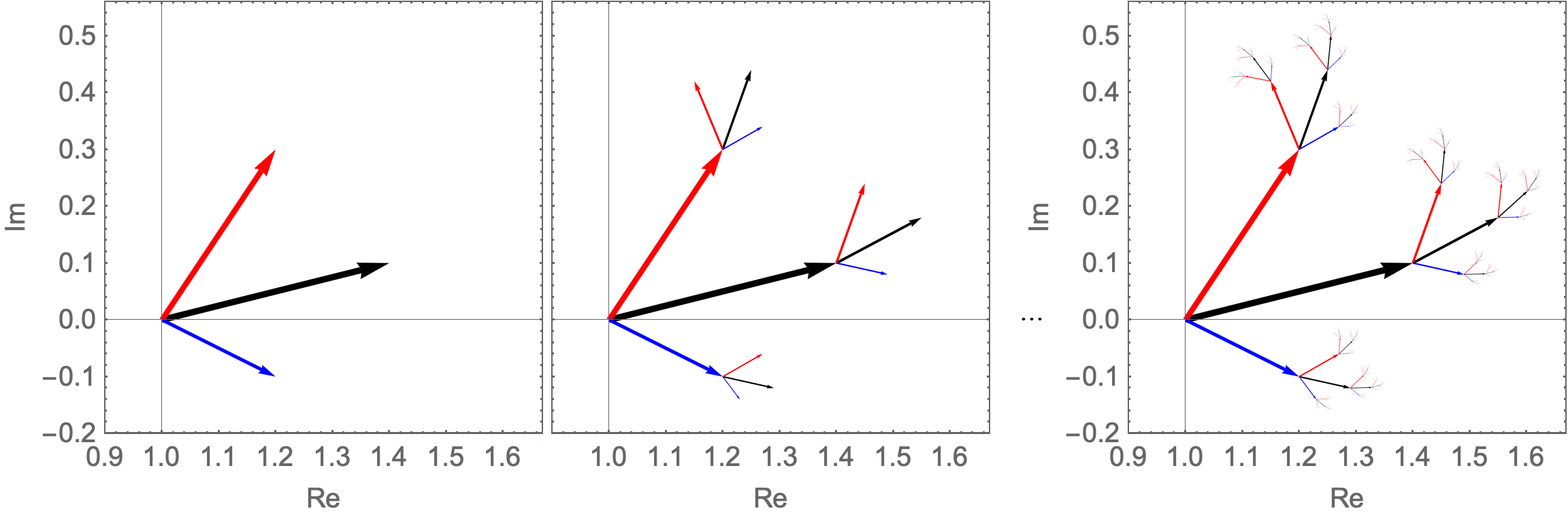 Figure 0
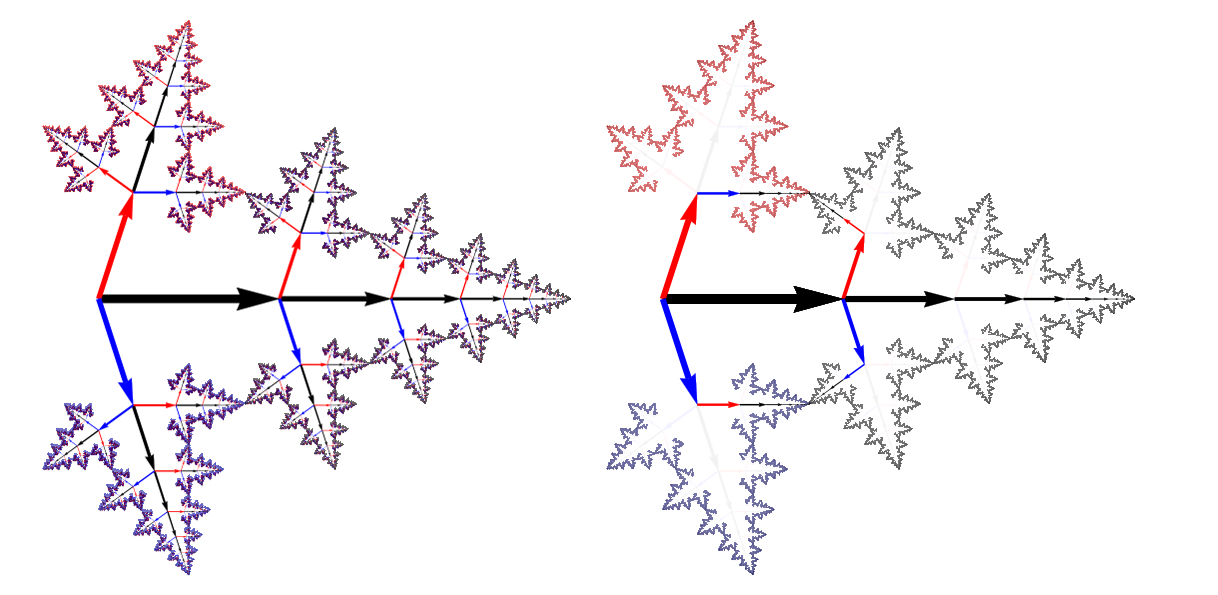 Figure 1
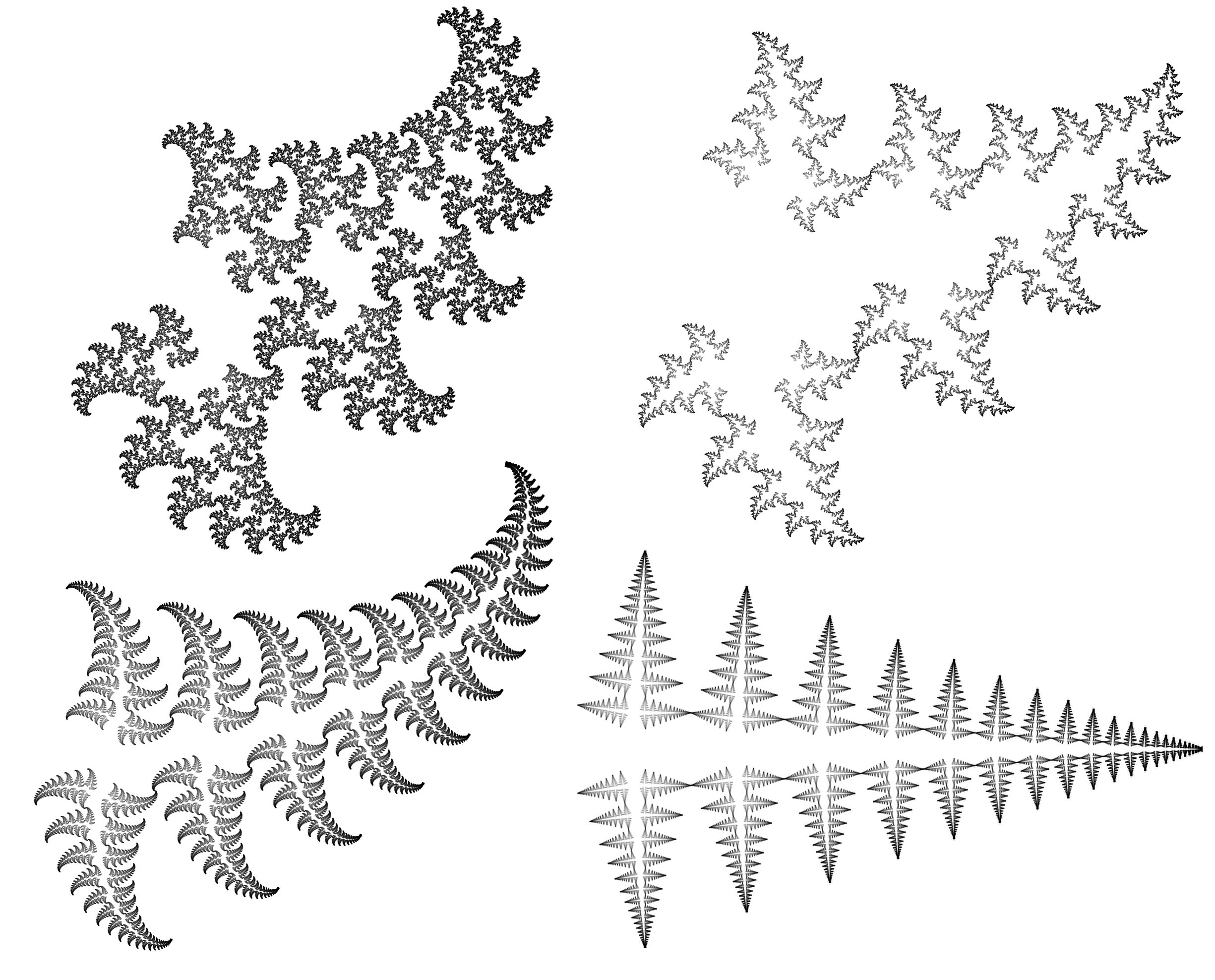 Figure 2
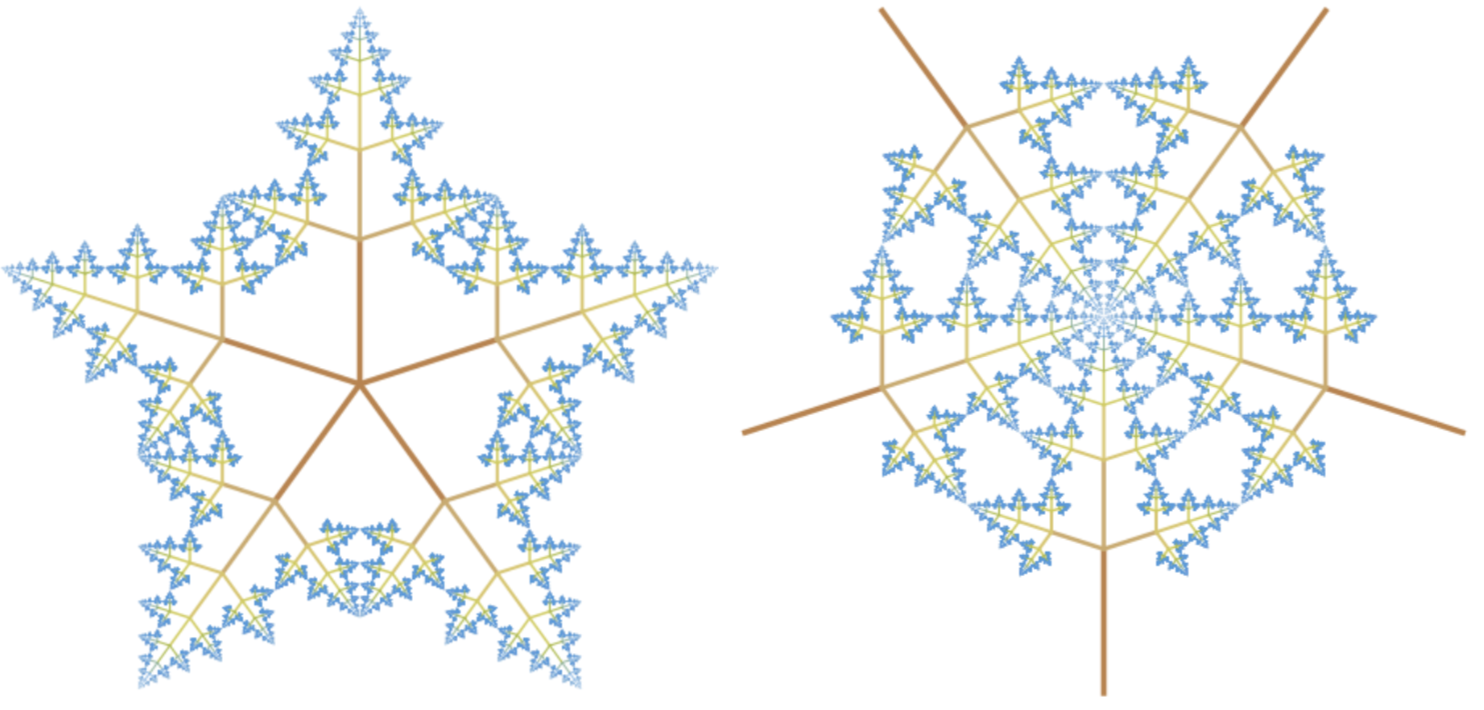 Figure 2
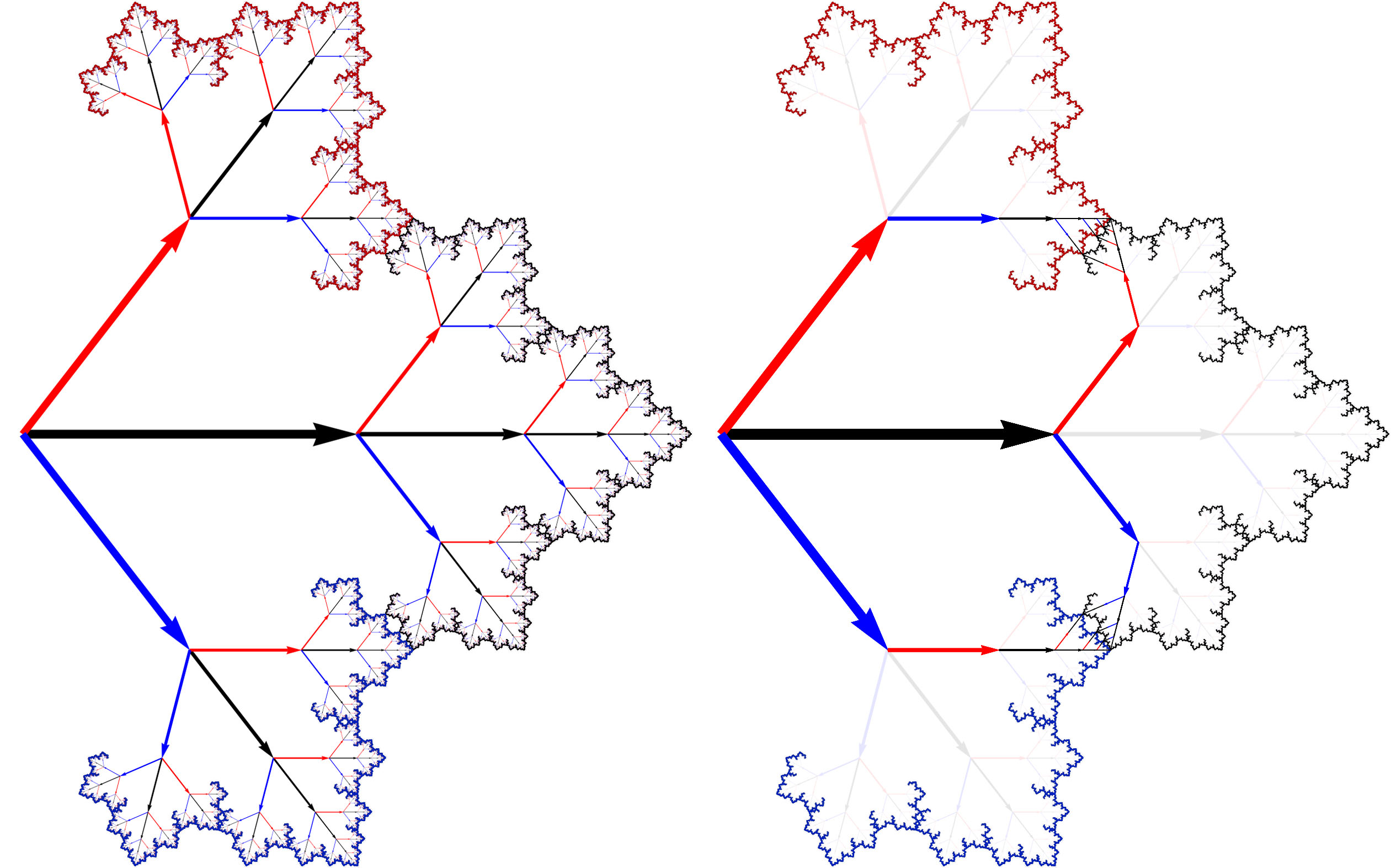 Figure 3
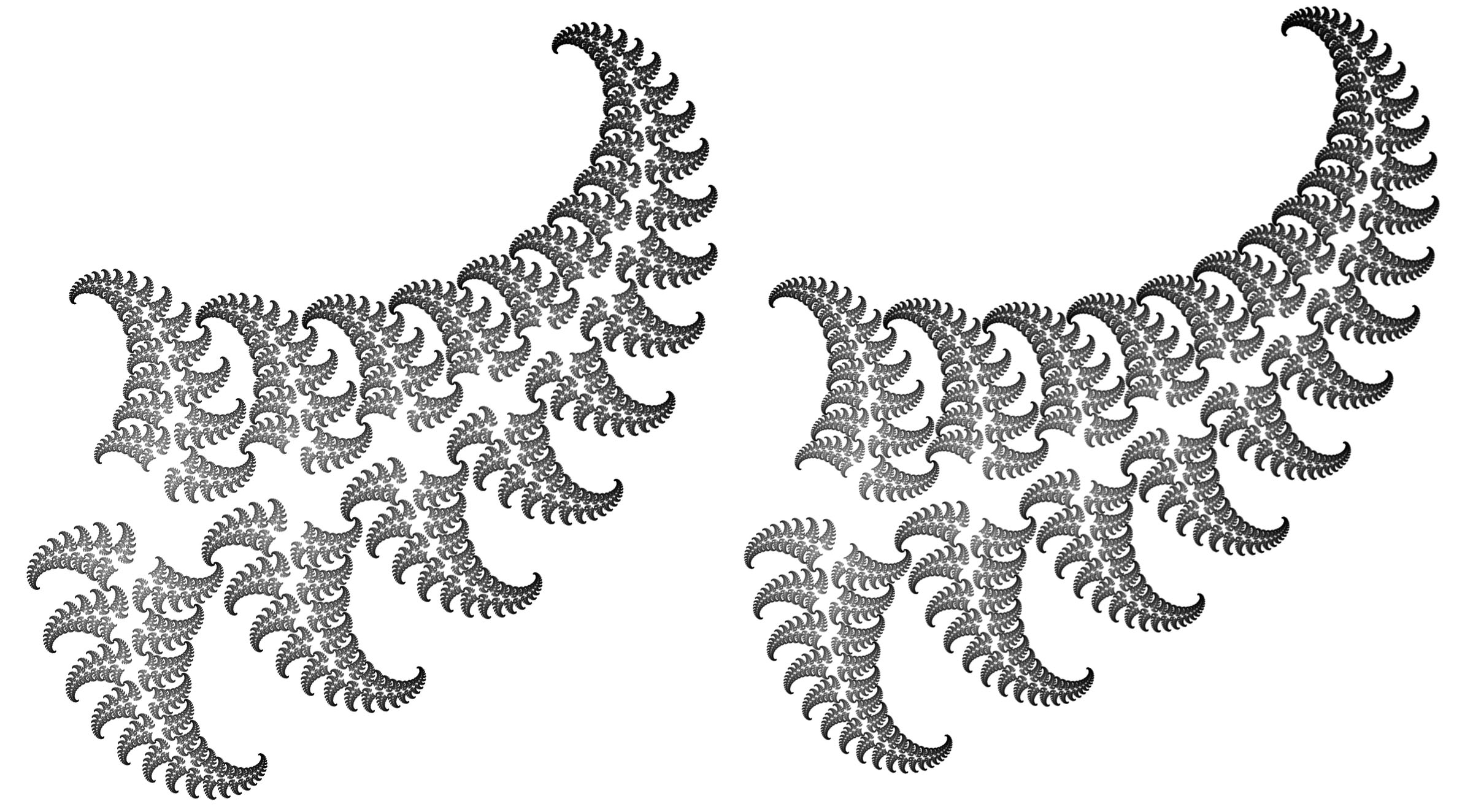 Figure 5
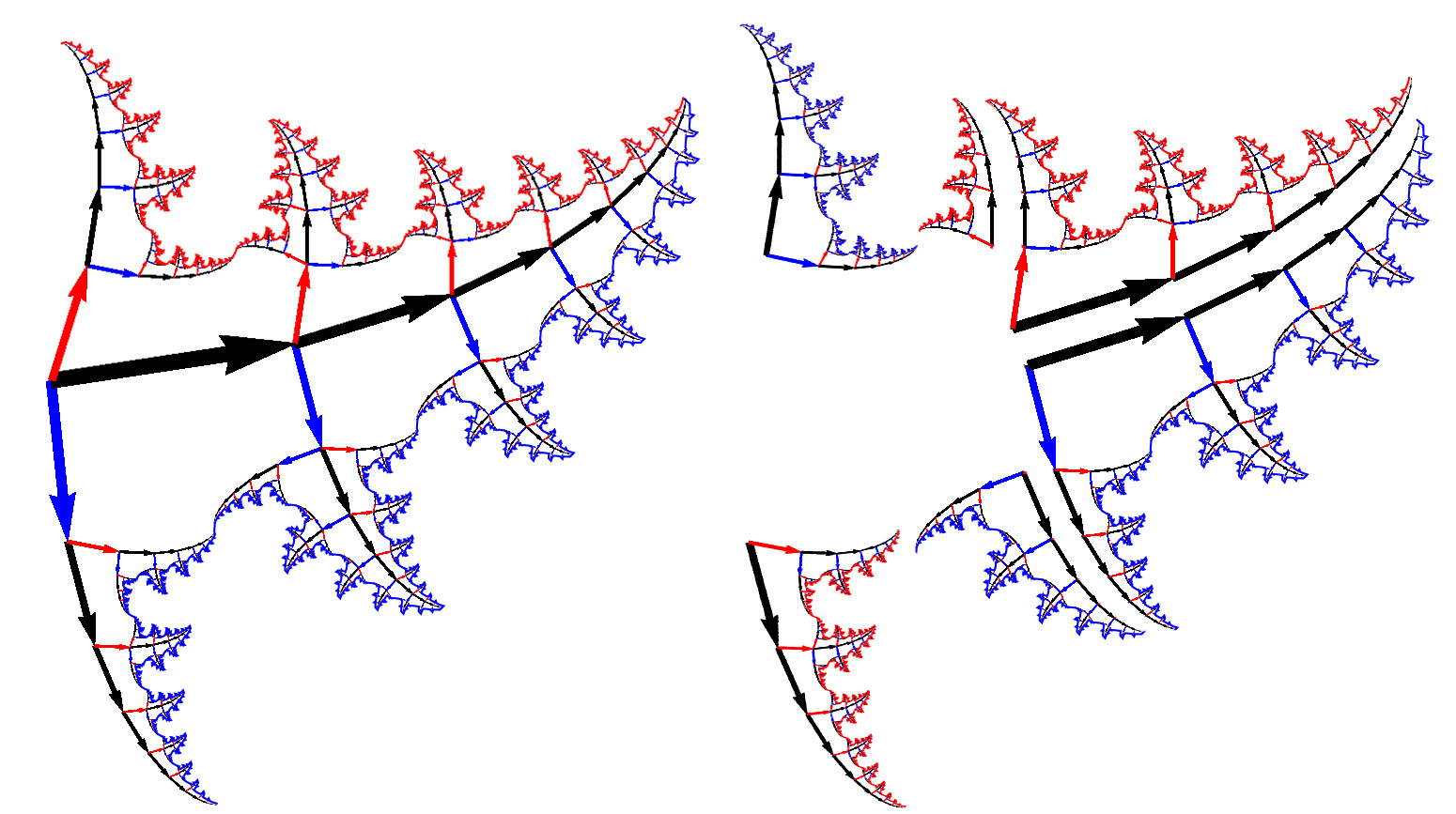 Figure 7
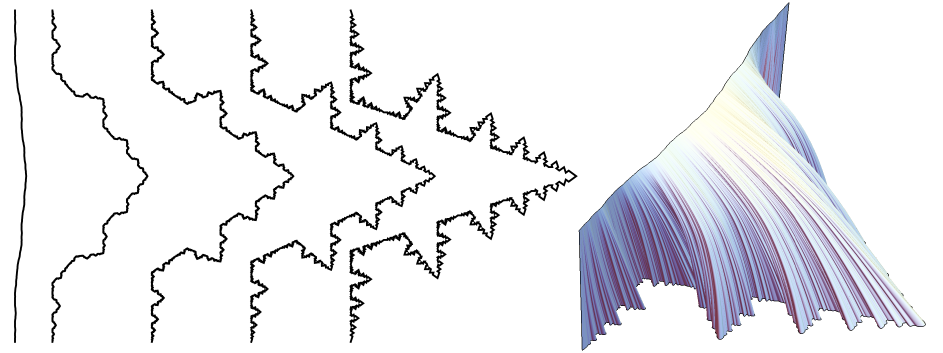 Figure 8
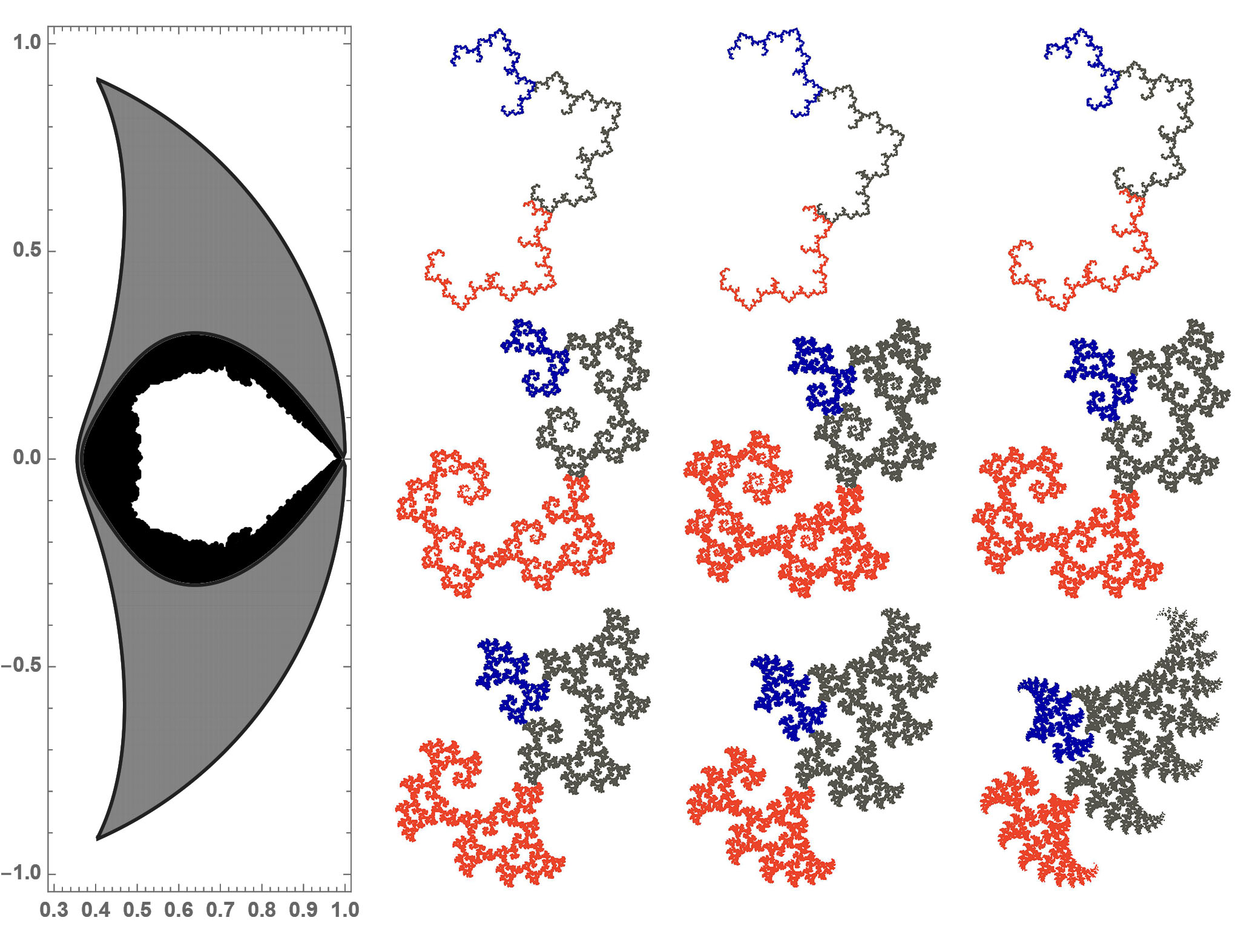 Figure 9
Peer Reviews
No public reviews on file for this paper yet. If you reviewed it on a platform where reviews are public (OpenReview, ICLR, NeurIPS, ICML), you can paste yours below so the community can read it here.
Videos
No videos yet. Explain this paper in a talk, walkthrough, or lecture? Add one.
Taxonomy
TopicsMathematical Dynamics and Fractals · Advanced Mathematical Theories and Applications · Topological and Geometric Data Analysis
A Family of Fern-like Ternary Complex Trees
Bernat Espigulé
Abstract
A ternary complex tree related to the golden ratio is used to show how the theory of complex trees works. We use the topological set of this tree to obtain a parametric family of trees in one complex variable. Even though some real ferns and leaves are reminiscent to elements of our family of study, here we only consider the underlying mathematics. We provide aesthetically appealing examples and a map of the unstable set for this family. Moreover we show that some elements found in the boundary of the unstable set possess interesting algebraic properties, and we explain how to compute the Hausdorff dimension and the shortest path of self-similar sets described by trees found outside the interior of the unstable set .
A ternary complex tree is a fractal tree with all of its branch-nodes encoded by the geometric map introduced in [1] that sends any word composed of complex-valued letters taken from a ternary alphabet to a complex point in the following geometric series style
[TABLE]
If a word has a finite sequence of letters, , then the point is called a node of the complex tree . But if a word has infinite length, then is called a tip point of the complex tree and we express it as an infinite sum
[TABLE]
where each summand is assumed to be the complex multiplication of the individual letters of the word pruned up to its th letter. For , we have that where is the empty string with assigned value equal to 1. The node is called the root of the complex tree where the three first-level nodes, , , and , sprout from, see figure 1.
By imposing a color code, , a word of a node can be retrieved by reading the color sequence of the branch-path that goes from the root to the desired node . From now on, letters found in words will be replaced by the numeric symbols to facilitate reading, for example . Infinite sequence of letters that are eventually periodic have their associated tip point reduced to algebraic expressions in terms of . For example, tip points labeled in figure 2 get reduced to the following algebraic expressions:
[TABLE]
The set of all tip points is called the tipset of the complex tree . A tipset is a self-similar set
[TABLE]
generated by an iterated function system composed of three contractive mappings , , and defined as
[TABLE]
where and . The self-similar nature of the tipset implies that the tip-to-tip intersections between the three first-level pieces , , and is the only piece of information needed for capturing the topological structure of a tipset . We define the topological set of a complex tree as the following set of tip-to-tip equivalence relations
[TABLE]
For example, the topological set of ternary trees in figures 1-2 is and respectively since the tipset of the first one is topologically homeomorphic to a Cantor set, and for the second one, the intersection of first-level pieces and is a pair of singletons uniquely encoded by and .
A Family of Fern-Like Connected Self-Similar Sets
The method introduced in [1] to obtain families of connected self-similar sets from topological sets of certain complex trees can be applied for the tree depicted in figure 2. If we consider the topological set as a system of two equations with letters set as three unknown complex variables, then the system admits a parametric solution in one complex variable with as unknown:
[TABLE]
This one-parameter family is defined for . Notice that by construction we have that for all , i.e. all tipsets are connected. Therefore the connectivity locus for this family of self-similar sets is the entire region .
The Unstable Set
A much more informative map about the topological structure of the family is given by what we call the unstable set defined as . The complement of is the stable set entirely composed of points with tipsets topologically homeomorphic to shown in figure 2, i.e. . Such tipsets are structurally stable because we can always find an -neighborhood of with constant topological set . On the other hand, for , such neighborhoods do not exist and the tipsets are structurally unstable, any perturbation away from will destroy the original topological set . Examples of stable and unstable trees are shown in figure 3 and figures 4-5 respectively.
A direct way to determine points in the unstable set with the aid of a computer software like Mathematica consists in imposing an extra tip-to-tip equivalence relation and then solving the equality with complex-valued letters , , and replaced by those of the parametric alphabet . For example, with we get since gets reduced into:
[TABLE]
Therefore the mirror-symmetric tree shown in figure 5 is unstable. Notice that the topological set of has a numerable infinite number of tip-to-tip equivalence relations, , but only one extra equivalence relation was actually needed to compute . By automating this process of computing points from extra equivalence relations with we can approximate the unstable set , see figure 4.
This brute-force method to compute is exact but rather slow. A big chunk of the unstable set is better obtained by an analytic method considered in [1] which is based on the Hausdorff dimension and the open set condition. For our family of study we have that the analytic region is given by
[TABLE]
see the gray region in figure 4. For the self-similar tipset satisfies the open set condition and their Hausdorff dimension coincides with the similarity dimension which is the positive number satisfying
[TABLE]
If , then the Hausdorff dimension of a tipset is not easy to compute in general and eq. (7) does not apply except in rare occasions when there are no overlaps and the pieces just-touch. This is precisely what happens for where the open set condition still applies. Another remarkable property of the boundary is that extreme points penetrating into the stable set turn out to be interesting algebraic numbers, see the pair of examples in figure 6 with Hausdorff dimension and respectively.
The Shortest Path from to
Christoph Bandt considered the notion of geodesics in self-similar sets, his method reported in [2] can be adapted to tipsets for parameters in the stable set our family of study. The shortest path from the tip point to that goes through is given by and where and are the curves depicted in figure 7. When we move the parameter along the real line starting at , trees are mirror-symmetric and the fractal dimension of starts to increase, see figure 8. As a final application, consider stacking these curves at heights given by the parameter , with and fixed at the same position. The result is the three-dimensional surface depicted in figure 8.
Summary and Conclusions
The family considered in this paper represents a tiny sample of what is out there. The space of possible parametric families of tipset connected -ary complex trees is incredibly vast and rich. Nonetheless we believe that the family covered here ranks hight in this space and it deserved to be considered apart. The theoretical basis set in [1] provides a unified approach to previously known results on symmetric fractal trees and self-similar sets in general, see [2] [3] and references within.
Acknowledgements
The author specially thanks the referees for suggesting several improvements, and IMUB’s Holomorphic Dynamics group, Núria Fagella, Xavier Jarque, Toni Garijo, Robert Florido, etc for all their support, dedication, and valuable discussions during the author’s research project on complex trees 2017-19. This project was partially supported by a research grant awarded by IMUB and the University of Barcelona. The author also thanks Wolfram Research and in particular Theodore Gray, Chris Carlson, Michael Trott, Vitaliy Kaurov, Todd Rowland, and Stephen Wolfram for showing interest on the author’s early work and for being a source of inspiration when it comes to computational experiments [5]. All the figures and diagrams of this paper were done with Mathematica. Finally, the author would like to express his gratitude to Susanne Krömker, Jofre Espigulé, Pere Pascual, Gaspar Orriols, Warren Dicks, Tara Taylor, Hans Walser, Robert Fathauer, Tom Verhoeff, Henry Segerman, Saul Schleimer, Michael Barnsley, Przemyslaw Prusinkiewicz, and many others for all their time and encouragement received from them during an early stage of the author’s research 2012-14.
The reference list from the paper itself. Each links out to its DOI / PubMed record.
- 1[1] Bernat Espigule. Families of connected self-similar sets generated by complex trees. ar Xiv preprint ar Xiv:1902.11282 , 2019.
- 2[2] Christoph Bandt. Geometry of self-similar sets. In Fractals, Wavelets, and their Applications , pages 21–36. Springer, 2014.
- 3[3] Bernat Espigule. Generalized self-contacting symmetric fractal trees. Journal Symmetry , 24(1-4):320–338, 2013.
- 4[4] B. Espigule. Adventures into the Mathematical Forest of Fractal Trees The Wolfram Blog May 2014 https://blog.wolfram.com/2014/05/22/adventures-into-the-mathematical-forest-of-fractal-trees/
- 5[5] Stephen Wolfram. Implications for Everyday Systems A New Kind of Science . Wolfram Media Champaign, 2002. http://www.wolframscience.com/nks/notes-8-6–parameter-space-sets/