Correlation in noncollinear antiferromagnetic $\alpha$-Mn
Aki Pulkkinen, Bernardo Barbiellini, Johannes Nokelainen, Vladimir, Sokolovskiy, Danil Baygutlin, Olga Miroshkina, Mikhail Zagrebin, Vasiliy, Buchelnikov, Christopher Lane, Robert S. Markiewicz, Arun Bansil, Jianwei, Sun, Erkki L\"ahderanta

TL;DR
This paper explores the complex magnetic and structural interactions in $ ext{Mn}$, demonstrating that advanced electronic and magnetic modeling accurately predicts its equilibrium volume and intricate magnetic patterns.
Contribution
It introduces a refined computational approach that captures the detailed charge and spin configurations in $ ext{Mn}$, resolving previous discrepancies in volume predictions.
Findings
Accurate modeling of magnetic interactions improves volume predictions.
First detailed charge and spin pattern characterization in $ ext{Mn}$.
Identification of spin canting in $ ext{Mn}$'s complex structure.
Abstract
We have investigated the interplay between magnetic and structural degrees of freedom in elemental Mn. The equilibrium volume is shown to depend critically on the magnetic interactions between the Mn atoms. While the standard generalized-gradient-approximation underestimates the equilibrium volume, a more accurate treatment of the effects of electronic localization and magnetism is found to solve this longstanding problem. We capture well the complexity of the large 58 atoms per unit cell -Mn system for the first time, including its charge and spin patterns and the canting of spins with respect to the average magnetization direction.
Click any figure to enlarge with its caption.
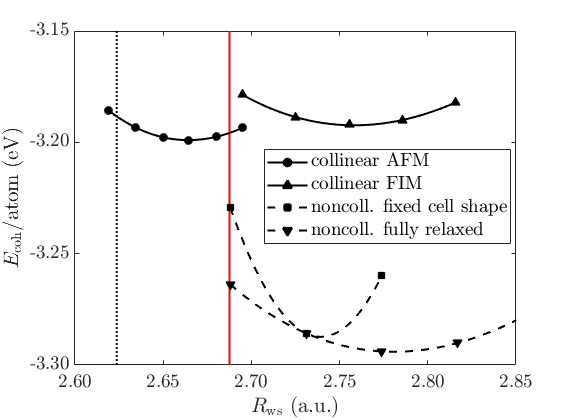 Figure 3
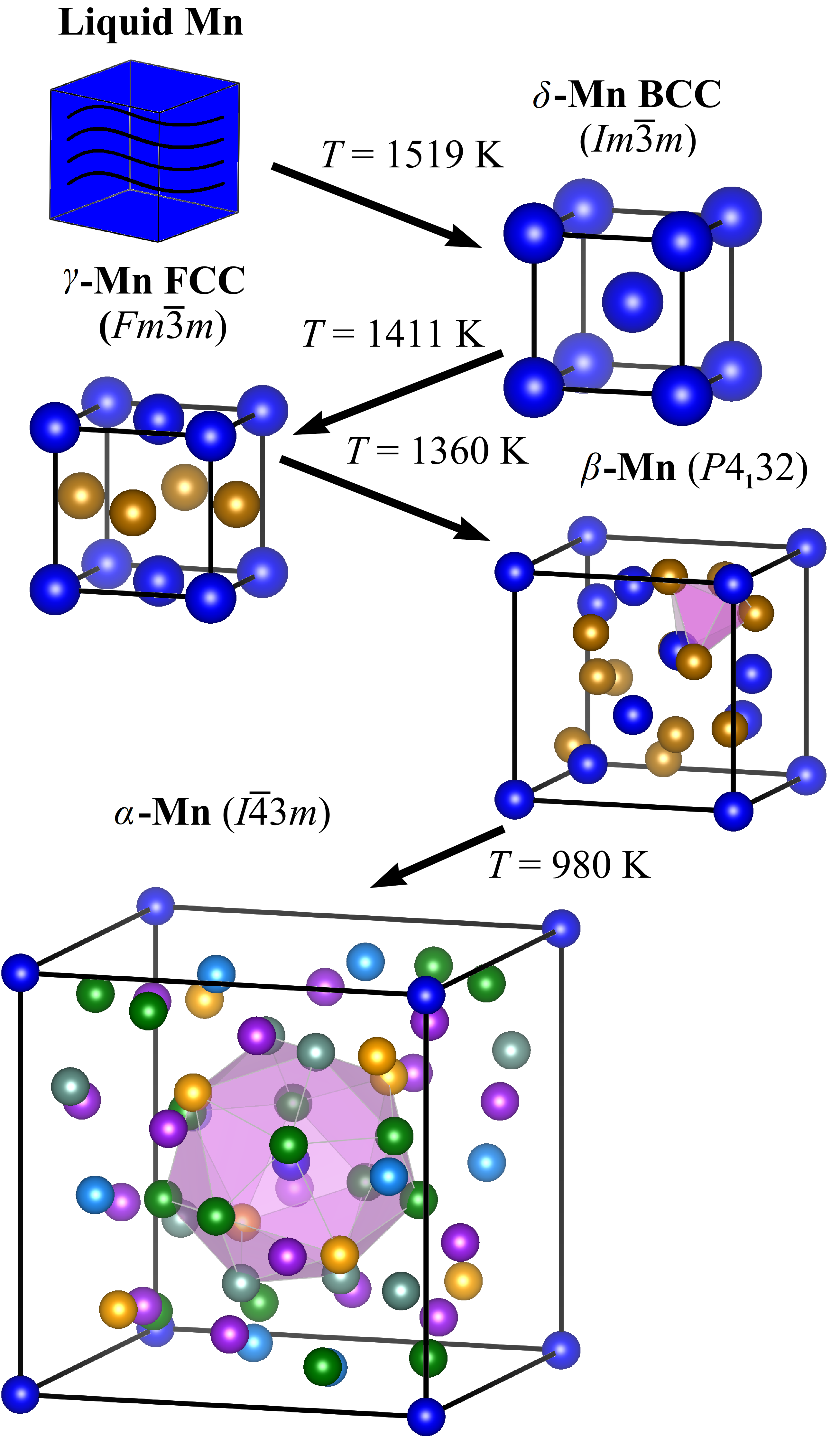 Figure 1
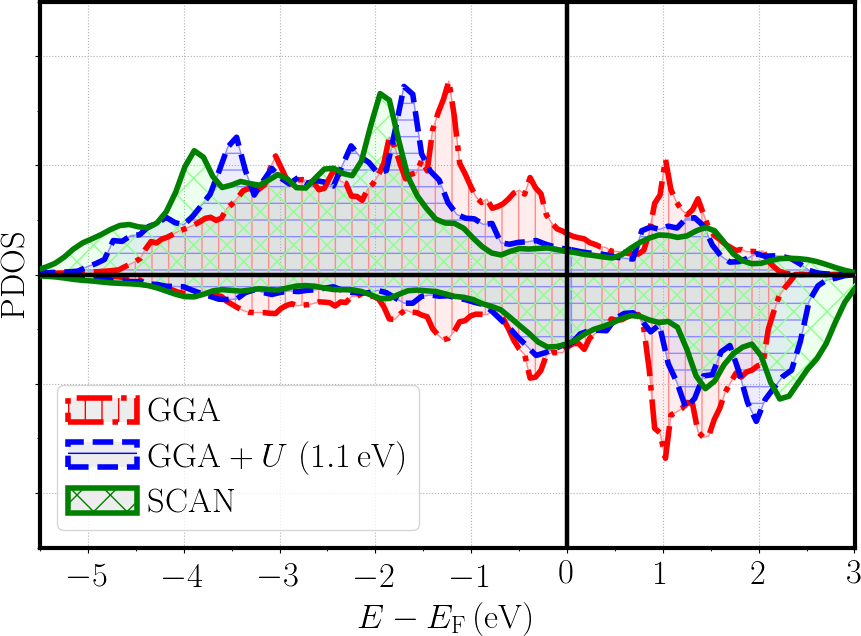 Figure 3
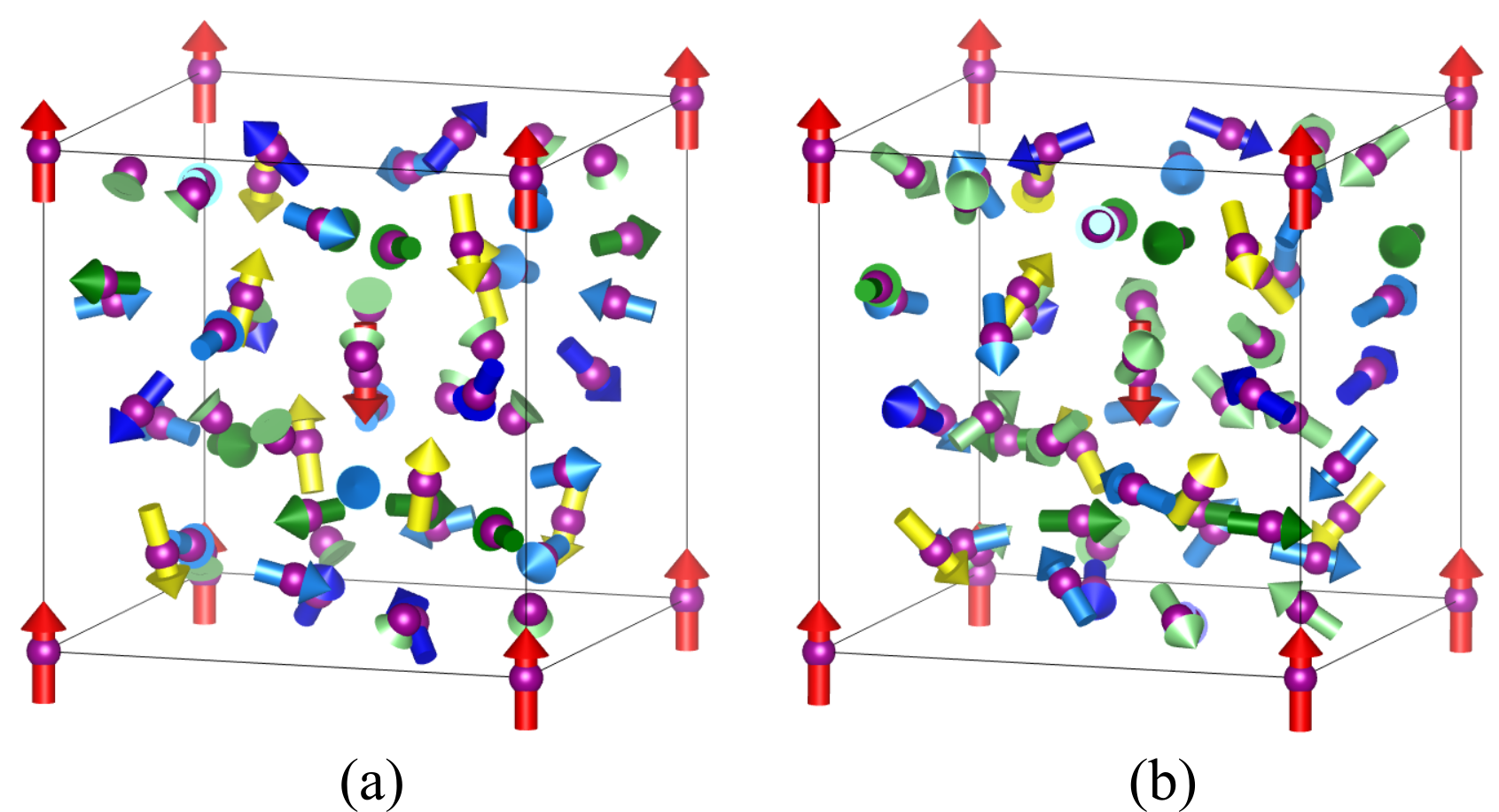 Figure 4
Peer Reviews
No public reviews on file for this paper yet. If you reviewed it on a platform where reviews are public (OpenReview, ICLR, NeurIPS, ICML), you can paste yours below so the community can read it here.
Videos
No videos yet. Explain this paper in a talk, walkthrough, or lecture? Add one.
Coulomb correlation in noncollinear antiferromagnetic -Mn
Aki Pulkkinen
School of Engineering Science, LUT University, 53850 Lappeenranta, Finland
Bernardo Barbiellini
School of Engineering Science, LUT University, 53850 Lappeenranta, Finland
Department of Physics, Northeastern University, Massachusetts 02115 Boston, USA
Johannes Nokelainen
School of Engineering Science, LUT University, 53850 Lappeenranta, Finland
Vladimir Sokolovskiy
Faculty of Physics, Chelyabinsk State University, 454001 Chelyabinsk, Russia
National University of Science and Technology ,“MISiS”, 119049 Moscow, Russia
Danil Baigutlin
Faculty of Physics, Chelyabinsk State University, 454001 Chelyabinsk, Russia
School of Engineering Science, LUT University, 53850 Lappeenranta, Finland
Olga Miroshkina
Faculty of Physics, Chelyabinsk State University, 454001 Chelyabinsk, Russia
Mikhail Zagrebin
Faculty of Physics, Chelyabinsk State University, 454001 Chelyabinsk, Russia
National Research South Ural State University, 454080 Chelyabinsk, Russia
Vasiliy Buchelnikov
Faculty of Physics, Chelyabinsk State University, 454001 Chelyabinsk, Russia
National University of Science and Technology ,“MISiS”, 119049 Moscow, Russia
Christopher Lane
Robert S. Markiewicz
Arun Bansil
Department of Physics, Northeastern University, Massachusetts 02115 Boston, USA
Jianwei Sun
Department of Physics and Engineering Physics, Tulane University, Louisiana 70118 New Orleans, USA
Katariina Pussi
School of Engineering Science, LUT University, 53850 Lappeenranta, Finland
Erkki Lähderanta
School of Engineering Science, LUT University, 53850 Lappeenranta, Finland
Abstract
We discuss the interplay between magnetic and structural degrees of freedom in elemental Mn. The equilibrium volume is shown to be sensitive to magnetic interactions between the Mn atoms. While the standard generalized-gradient-approximation underestimates the equilibrium volume, a more accurate treatment of the effects of electronic localization and magnetism is found to solve this longstanding problem. Our calculations also reveal the presence of a magnetic phase in strained -Mn that has been reported previously in experiments. This new phase of strained -Mn exhibits a noncollinear spin structure with large magnetic moments.
I Introduction
Manganese is one of the most complex metallic elements Hobbs and Hafner (2001); Hobbs et al. (2003); Hafner and Hobbs (2003); Ehteshami and Korzhavyi (2017); Ehteshami and Ruban (2018); Lee et al. (2014); Kolesnikov et al. (2016) that assumes many different stable crystal phases. On cooling the liquid, the sequence of crystal phases Bigdeli et al. (2015); Kübler (2009); Proult and Donnadieu (1995) obtained includes body-centered cubic (BCC) -Mn, face-centered cubic (FCC) -Mn, -Mn, and -Mn as illustrated in Fig. 1. -Mn has 58 atoms per unit cell with space group (No. 217) Bennett and Watson (1987) and it may be looked upon as an intermetallic involving Mn atoms in different electronic and magnetic configurations Bradley and Thewlis (1927) on four crystallographic sublattices (I, II, III and IV). Neutron diffraction experiments Lawson et al. (1994) have shown that sublattices III and IV further split into two types (IIIa, IIIb, IVa and IVb) when the antiferromagnetic ordering is taken into account. Large, almost collinear magnetic moments reside on sites I and II, while substantially smaller and strongly canted moments are on sites III and IV Lawson et al. (1994).
Density functional theory (DFT) results by Hobbs et al. Hobbs and Hafner (2001); Hobbs et al. (2003) using either the local-spin-density approximation (LSDA) or the generalized-gradient approximation (GGA) are not in agreement with experiments because the tendency of LSDA and GGA to overbind produces a collinear spin structure at the theoretical equilibrium volume. However, a noncollinear spin structure develops when the lattice is expanded beyond the experimental volume Hobbs et al. (2003). A semiempirical tight-binding method using Hubbard-like correlation effects Sasaki et al. (1983) has predicted a noncollinear magnetic structure for -Mn at the experimental volume in qualitative agreement with experiment, but a more recent tight-binding study failed to converge to the noncollinear solution Süss and Krey (1993).
In order to address the deficiencies of the LSDA and GGA, exchange-correlation corrections must be improved. One approach is to introduce an ad hoc Hubbard parameter Huang et al. (2018); Liechtenstein et al. (1995); Dudarev et al. (1998); Cococcioni and de Gironcoli (2005); Ricca et al. (2019), which attempts to correct for self-interaction errors on localized orbitals of Mn by replacing LSDA and GGA potentials with orbital-dependent terms. An important test in this connection is the Mn2 dimer Huang et al. (2018) which is discussed in the Supplemental Material (SM) SM (see also references Vosko et al. (1980); von Barth and Hedin (1972); Moruzzi et al. (1978); H. Ebert et al. (2017) therein). Note that a DFT+ approach requires both Hubbard-repulsion and Hund-exchange integral as ad hoc parameters Yang et al. (2001). Here the strongly-constrained-and-appropriately-normed (SCAN) functional Sun et al. (2015), which is a semi-local functional that satisfies seventeen exact constraints, provides a systematic improvement over the GGA. It should be noted that SCAN leads to overestimated magnetic moments in itinerant ferromagnetic transition metals such as iron Isaacs and Wolverton (2018); Ekholm et al. (2018); Fu and Singh (2018). However, there are many studies of antiferromagnetic materials such as the cuprates Lane et al. (2018); Furness et al. (2018); Zhang et al. (2019), spinel LiMn2O4 cathode material Hafiz et al. (2019) and perovskite oxides Varignon et al. (2019) where SCAN yields a good estimate of magnetic moments. This has also been shown to be the case in some Mn-rich Heusler alloys Buchelnikov et al. (2019); Barbiellini et al. (2019), where the magnetic electrons are quite localized on the Mn atoms.
In this paper, we show that SCAN significantly improves the description of the ground-state electronic and magnetic structure of -Mn with respect to the LSDA and GGA by correctly accounting for conflicting trends for maximizing the magnetic spin moment and the bond strength. In this way, SCAN successfully captures the complex charge and noncollinear magnetic ordering that occurs in -Mn at low temperatures.
II Computational methods
The present DFT calculations were performed with the plane-wave method implemented in the Vienna Ab Initio Simulation Package (VASP) Kresse and Hafner (1993); Kresse and Furthmüller (1996a, b) with the projector augmented wave (PAW) method Kresse and Joubert (1999). The GGA exchange-correlation functional is based on the Perdew-Burke-Ernzerhof (PBE) formulation Perdew et al. (1996) while the meta-GGA follows the SCAN implementation Sun et al. (2015). Structural relaxations were performed with an energy cutoff of 550\text{,}\mathrm{eV} and a k-point spacing of $<$0.02\text{\,}{\mathrm{\SIUnitSymbolAngstrom}}^{-1}. The Methfessel-Paxton smearing method Methfessel and Paxton (1989) was used with a width of in geometry optimization runs, and the tetrahedron smearing method with Blöchl corrections Blöchl et al. (1994) was used in self-consistency cycles as well as for generating the electronic density of states (DOS). Total energies were converged to . In geometry optimizations, forces on all atoms were converged to . Spin polarization effects and the variational freedom for noncollinear spin arrangements were included for the -Mn structure. Note that the inclusion of noncollinearity in calculations significantly increases the computational cost as the electron density becomes a matrix Hobbs et al. (2000); Zelený et al. (2009).
III Results
We first examine -Mn with four Mn atoms per unit cell (see SM SM for details). Asada and Terakura Asada and Terakura (1993) have shown that the LSDA underestimates the lattice constant and fails to predict the antiferromagnetic ground state. Our GGA and SCAN total energy calculations for the non-magnetic, ferromagnetic, and antiferromagnetic AF1 and AF2 phases confirm that the ground state of -Mn is AF1, where the sign of the moment alternates between the planes stacked along the direction. These phases are described by Kubler in Ref. Kübler (2009). GGA gives the Wigner-Seitz radius corresponding to the equilibrium volume 111The Wigner-Seitz radius is related to the volume per Mn atom by: . of 2.635\text{,}\mathrm{a},\mathrm{u},, while SCAN gives $R_{\mathrm{ws}}=$2.732\text{\,}\mathrm{a}\,\mathrm{u}\,, which is in better agreement with the experimental value of 2.752\text{,}\mathrm{a},\mathrm{u}, Endoh and Ishikawa ([1971](#bib.bib49)). The structure is found to be tetragonally distorted with $c/a=$0.95 for GGA, while SCAN produces 0.98$$. The calculated magnetic moments increase with the equilibrium volume, thus GGA yields whereas SCAN gives a higher value of .
In order to gauge the strength of corrections beyond the GGA captured by SCAN, we compare SCAN, GGA and GGA+ results, and extract an effective value which reproduces the experimental equilibrium volume. In this way, we find that for 1.1\text{,}\mathrm{e}\mathrm{V}, the equilibrium Wigner-Seitz radius is $R_{\mathrm{ws}}=$2.722\text{\,}\mathrm{a}\,\mathrm{u}\, with a Mn magnetic moment of and 0.98. These results are consistent with those reported previously by Podloucky & Redinger Podloucky and Redinger ([2018](#bib.bib50)) and Di Marco *et al.* Di Marco *et al.* ([2009a](#bib.bib51), [b](#bib.bib52)). Figure [2](#S3.F2) highlights the effect of $U$ on the Mn partial DOS (PDOS) at the experimental volume. The GGA PDOS is seen to differ significantly from SCAN, but for $U=$1.1\text{\,}\mathrm{e}\mathrm{V} the two Mn PDOSs becomes closer. These results are also consistent with the observation of Hubbard bands in -Mn with angle-resolved photoemission spectroscopy Biermann et al. (2004).
In -Mn, sublattices I, II and IV are occupied by close-packed polyhedra although this is not the case for sublattice III Frank and Kasper (1958); Bennett and Watson (1987). This close packing results in shrinking of the Wigner-Seitz radius to the experimental value Lawson et al. (1994) of 2.688\text{,}\mathrm{a},\mathrm{u},$$ Figure 3 shows the cohesive energy as a function of for a collinear solution. Even with this constraint SCAN significantly corrects the GGA volume. Moreover, the calculated bulk modulus of is in good agreement with the experimental value of Fujihisa and Takemura (1995). The computed magnetic moment distribution follows trends consistent with the experimental results given in Table II of Ref. Hobbs et al. (2003). However, exact comparisons with theory are difficult because the moments extracted from the experimental data depend sensitively on the choice of the form factors used Kasper and Roberts (1956); Oberteuffer et al. (1968); Kunitomi et al. (1969); Yamada et al. (1970); Yamagata and Asayama (1972); Lawson et al. (1994). Interestingly, our computations predict the existence of an additional collinear (metastable) solution at a higher volume with a bulk modulus of . The magnetic distribution for this solution becomes weakly ferrimagnetic with an average moment of per Mn atom and the corresponding charge distribution involves Mn atoms in six different electronic configurations with charge differences reaching 0.4 . When spin-orbit coupling (SOC) is included in the calculations, a noncollinear magnetic structure develops to reduce frustration. We have performed two different types of noncollinear calculations in this connection. The first involved fully relaxed atomic positions with a fixed cell-shape222In the fixed cell-shape calculations, the atomic positions were allowed to relax but the overall cell shape ( ratio) was kept fixed at the experimental value (). When both the cell shape and atom positions are allowed to relax, the c/a-ratio becomes 1.002., while the second achieved full structural relaxation. The corresponding cohesive energies as a function of are shown in Fig. 3.
In the GGA the structure remains collinear at the experimental volume Hobbs et al. (2003) but in SCAN the moments rotate out of their collinear orientations. [The SCAN-generated magnetic structure is noncollinear for both the calculations shown in Fig. 4.] In contrast to GGA, SCAN thus predicts noncollinear magnetic ordering at the experimental volume. In fact, as we noted above, we obtain two distinct magnetic structures, both with large collinear magnetic moments on Mn I sites, while the moments on Mn II sites are slightly smaller and canted away from the collinear direction. For the first solution, which is based on the fully-relaxed structure, we obtain a.u., and this solution might correspond to the strained -phase reported experimentally by Dedkov et al. Dedkov et al. (2010). The second solution involves computations with a fixed cell shape. Here the determination of the equilibrium volume is more delicate since several degenerate solutions with different spin structures can coexist as is the case in YBa2Cu3O7 Zhang et al. (2019) cuprate high-Tc superconductor. We note, however, that since SCAN tends to favor solutions with large magnetic moments, the stabilization of the strained -phase we have found might be due to the exaggerated corrections in SCAN Buchelnikov et al. (2019); Mejía-Rodríguez and Trickey (2019). Noncollinear magnetism in manganese nanostructures has been reported also within the GGA Zelený et al. (2009).
The present noncollinear implementation of VASP Hobbs et al. (2000); Zelený et al. (2009) neglects noncollinear correlation effects beyond the LSDA Eich and Gross (2013); Pittalis et al. (2017), which could possibly be the reason that SCAN yields solutions with too large equilibrium volume in -Mn333Interestingly, it is possible to stabilize a noncollinear solution for -Mn within SCAN. The collinear SCAN calculation yields a.u. while the noncollinear calculation gives a.u., which is in better agreement with the experimental value of a.u. [The PBE value is a.u.] Notably, the collinear SCAN result is only 3 meV/atom more stable than our noncollinear solution. Increase in the lattice constant for the noncollinear case is only 0.8%. The lattice expansion with noncollinearity in -Mn is thus not large., see Fig. 3. At the GGA level, a noncollinear spin structure stabilizes when the lattice is expanded beyond the experimental volume. In fact, in order to converge towards a noncollinear solution, Hobbs et al. Hobbs et al. (2003) had to start their calculations with a strongly expanded initial volume ( a.u.), which however was not the final converged volume. The preceding results suggest that SCAN is a step in the right direction for stabilizing noncollinear solutions.
Overmagnetization in transition metals Isaacs and Wolverton (2018); Ekholm et al. (2018); Fu and Singh (2018) has been found in recent SCAN calculations. This issue has been addressed with a deorbitalized potential Mejía-Rodríguez and Trickey (2019). A similar problem is present in DFT+, where the magnetic moment changes considerably if one adopts either the fully-localized limit or the mean-field approximation Stojić and Binggeli (2008). Here also a deorbitalized potential for states at the Fermi level has been suggested as a possible cure Barbiellini and Bansil (2005).
IV Summary and Conclusions
Our results are relevant for smart materials such as the shape-memory and magnetocaloric Mn-rich Heusler alloys Entel et al. (2018); Buchelnikov and Sokolovskiy (2011); Planes et al. (2009) because elemental Mn and the Mn-rich Heusler alloys present phase diagrams with common features. For example, BCC -Mn and FCC -Mn can be viewed as austenite and martensite phases of Heusler alloys, respectively. Although we have shown previously Buchelnikov et al. (2019) that SCAN corrections beyond the GGA are small for Mn-poor compounds, our results here indicate that we can expect substantial differences between the GGA and SCAN in Mn-rich compounds such as . SCAN corrections should work particularly well for short Mn-Mn distances where antiferromagnetic coupling tends to suppress itinerant ferromagnetismCardias et al. (2017). In fact, the presence of spin- and charge-density wave like orderings in -Mn could help rationalize the complex phase diagrams of Heusler alloys and the associated phase instabilities driven by Fermi-surface nestings Opeil et al. (2008); Ye et al. (2010); Weber et al. (2015). Since SCAN tends to promote complex solutions Zhang et al. (2019), future investigations of Mn-rich materials should consider large simulation cells to capture modulated phases, which could be more stable than the simple martensitic Himmetoglu et al. (2012) phase.
Our study provides a robust self-consistent scheme to correct the overbinding in elemental Mn in LSDA and GGA. The SCAN corrections for the equilibrium volume also yield noncollinear antiferromagnetism with complex charge and spin patterns in -Mn. These results demonstrate that the density-functional framework is capable of capturing the subtle correlation effects needed to predict technologically relevant Mn-rich materials for shape-memory, magnetocaloric and other applications.
Acknowledgements.
It is a pleasure to acknowledge important discussions with John Perdew. The authors acknowledge CSC-IT Center for Science, Finland, for computational resources. The work of Chelyabinsk State University was supported by RSF-Russian Science Foundation project No. 17-72-20022 (calculations for - and -Mn). The work at Northeastern University was supported by the US Department of Energy (DOE), Office of Science, Basic Energy Sciences grant number DE-FG02-07ER46352 (core research), and benefited from Northeastern University’s Advanced Scientific Computation Center (ASCC), the NERSC supercomputing center through DOE grant number DE-AC02-05CH11231, and support (testing efficacy of advanced functionals) from the DOE EFRC: Center for Complex Materials from First Principles (CCM) under grant number DE-SC0012575. The work at Tulane University was supported by the startup funding from Tulane University. B.B. acknowledges support from the COST Action CA16218.
The reference list from the paper itself. Each links out to its DOI / PubMed record.
- 1Hobbs and Hafner (2001) D. Hobbs and J. Hafner, J. Phys.: Condens. Matter 13 , L 681 (2001).
- 2Hobbs et al. (2003) D. Hobbs, J. Hafner, and D. Spišák, Phys. Rev. B 68 , 014407 (2003).
- 3Hafner and Hobbs (2003) J. Hafner and D. Hobbs, Phys. Rev. B 68 , 014408 (2003).
- 4Ehteshami and Korzhavyi (2017) H. Ehteshami and P. A. Korzhavyi, Phys. Rev. Materials 1 , 073803 (2017).
- 5Ehteshami and Ruban (2018) H. Ehteshami and A. V. Ruban, Phys. Rev. Mater. 2 , 034405 (2018).
- 6Lee et al. (2014) S. Lee, C. Leighton, and F. S. Bates, PNAS 111 , 17723 (2014).
- 7Kolesnikov et al. (2016) A. I. Kolesnikov, A. Podlesnyak, R. A. Sadykov, V. E. Antonov, M. A. Kuzovnikov, G. Ehlers, and G. E. Granroth, Phys. Rev. B 94 , 134301 (2016).
- 8Bigdeli et al. (2015) S. Bigdeli, H. Mao, and M. Selleby, Phys. Status Solidi B 252 , 2199 (2015).