Analyzing doubly heavy tetra- and penta-quark states by variational method
Ruilin Zhu, Xuejie Liu, Hongxia Huang, Cong-Feng Qiao

TL;DR
This paper uses a variational method within a non-relativistic quark model to analyze the spectra of doubly-heavy pentaquarks and tetraquarks, providing possible assignments for recently observed LHCb pentaquarks and proposing experimental detection channels.
Contribution
It introduces a model-independent variational approach to classify doubly-heavy pentaquarks and tetraquarks, offering new insights into their structure and decay properties.
Findings
$P_c(4312)^+$ may be the ground state with $J^P=1/2^-$ or $3/2^-$
$P_c(4440)^+$ and $P_c(4457)^+$ are likely excited states with $J^P=1/2^-$
Several channels for experimental observation are proposed.
Abstract
Motivated by the very recent observations of hidden charm pentaquarks , and of the LHCb Collaboration, we systematically study the spectra of the doubly-heavy (with or without charm/bottom numbers) pentaquarks and tetraquarks in non-relativistic constituent quark model. The model independent variational method is employed to solve the Schr\"odinger equation, where the test functions adopted are symmetric for the light quarks. In our study, the may be assigned as the ground state with spin-parity or , while the and may be assigned as the excited states with , which might all belong to the sextet with and . It is notable that our working framework is quite similar to that of Hydrogen molecule, but with different potential…
Click any figure to enlarge with its caption.
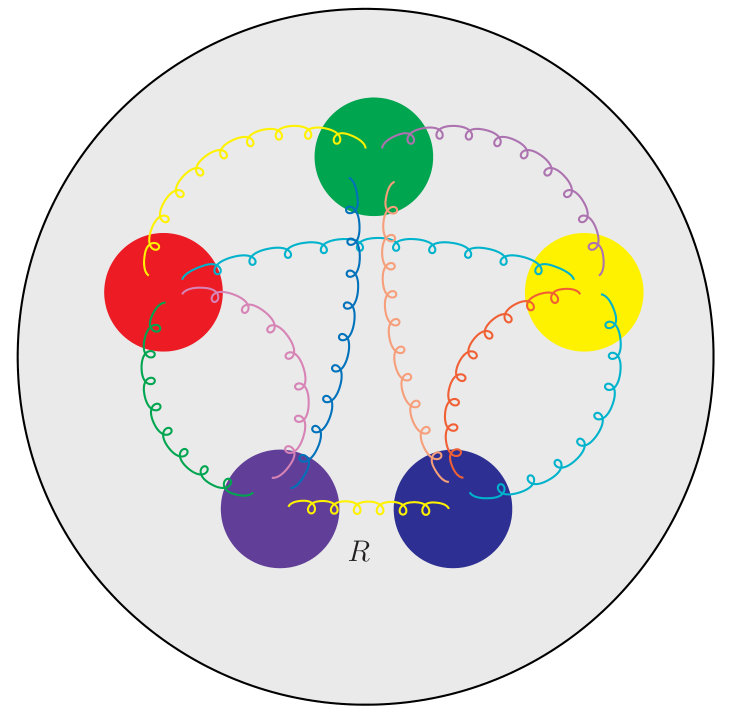 Figure 1
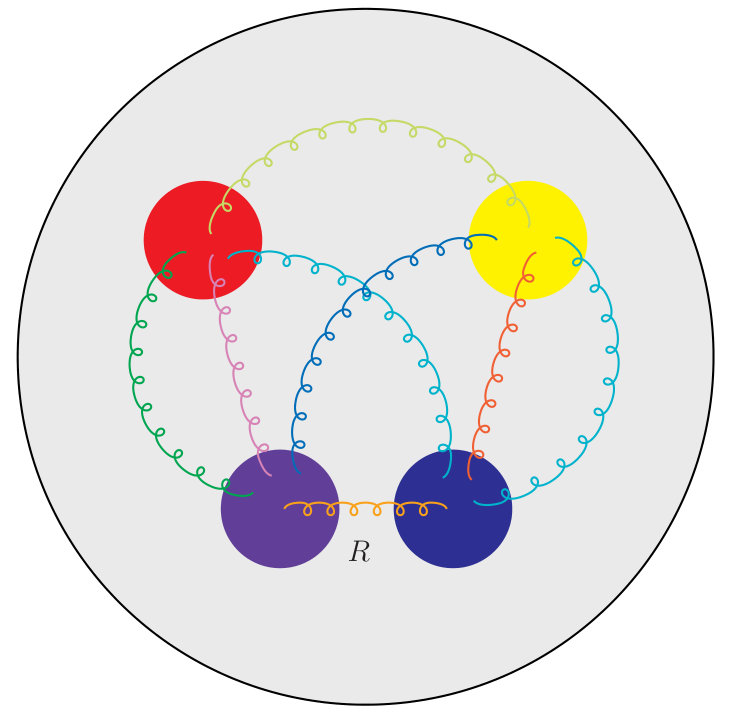 Figure 2
| Constituents | Color structure | Mass | or | Multiplet or singlet | Label | |||
| 0 | Triplet | 1 | ||||||
| 0 | Triplet | 2 | ||||||
| 0 | Triplet | 3 | ||||||
| 0 | Doublet | 1 | ||||||
| 0 | Doublet | 2 | ||||||
| 1 | Sextet | 1 | ||||||
| 1 | Sextet | 2 | ||||||
| 1 | Sextet | 3 | ||||||
| 1 | Sextet | 4 | ||||||
| 1 | Sextet | 5 | ||||||
| 1 | Sextet | 6 | ||||||
| 1 | Sextet | 1 | ||||||
| 1 | Sextet | 2 | ||||||
| 1 | Sextet | 3 | ||||||
| 1 | Sextet | 4 | ||||||
| 1 | Sextet | 5 | ||||||
| 1 | Sextet | 6 | ||||||
| 0 | Singlet | 1 | ||||||
| 0 | Singlet | 1 | ||||||
| 1 | Quartet | 1 | ||||||
| 1 | Quartet | 2 | ||||||
| 1 | Quartet | 3 | ||||||
| 1 | Quartet | 4 | ||||||
| 1 | Triplet | 1 | ||||||
| 1 | Triplet | 2 | ||||||
| 1 | Triplet | 3 |
| Constituents | Color structure | Mass | or | Multiplet or singlet | Label | |||
| 0 | Triplet | 1 | ||||||
| 0 | Triplet | 2 | ||||||
| 0 | Triplet | 3 | ||||||
| 0 | Doublet | 1 | ||||||
| 0 | Doublet | 2 | ||||||
| 1 | Sextet | 1 | ||||||
| 1 | Sextet | 2 | ||||||
| 1 | Sextet | 3 | ||||||
| 1 | Sextet | 4 | ||||||
| 1 | Sextet | 5 | ||||||
| 1 | Sextet | 6 | ||||||
| 1 | Sextet | 1 | ||||||
| 1 | Sextet | 2 | ||||||
| 1 | Sextet | 3 | ||||||
| 1 | Sextet | 4 | ||||||
| 1 | Sextet | 5 | ||||||
| 1 | Sextet | 6 | ||||||
| 0 | Singlet | 1 | ||||||
| 0 | Singlet | 1 | ||||||
| 1 | Quartet | 1 | ||||||
| 1 | Quartet | 2 | ||||||
| 1 | Quartet | 3 | ||||||
| 1 | Quartet | 4 | ||||||
| 1 | Triplet | 1 | ||||||
| 1 | Triplet | 2 | ||||||
| 1 | Triplet | 3 |
Peer Reviews
No public reviews on file for this paper yet. If you reviewed it on a platform where reviews are public (OpenReview, ICLR, NeurIPS, ICML), you can paste yours below so the community can read it here.
Videos
No videos yet. Explain this paper in a talk, walkthrough, or lecture? Add one.
Analyzing doubly heavy tetra- and penta-quark states by variational method
Ruilin Zhu1, Xuejie Liu1, Hongxia Huang1, Cong-Feng Qiao2,3 111Corresponding author:[email protected]
1Department of Physics and Institute of Theoretical Physics, Nanjing Normal University, Nanjing, Jiangsu 210023, China
2School of Physics, University of Chinese Academy of Sciences, YuQuan Road 19A, Beijing 100049, China
3CAS Center for Excellence in Particle Physics, Beijing 100049, China
Abstract
Motivated by the very recent observations of hidden charm pentaquarks , and of the LHCb Collaboration, we systematically study the spectra of the doubly-heavy (with or without charm/bottom numbers) pentaquarks and tetraquarks in non-relativistic constituent quark model. The model independent variational method is employed to solve the Schrödinger equation, where the test functions adopted are symmetric for the light quarks. In our study, the may be assigned as the ground state with spin-parity or , while the and may be assigned as the excited states with , which might all belong to the sextet with and . It is notable that our working framework is quite similar to that of Hydrogen molecule, but with different potential structure. We also classify these pentaquarks and tetraquarks in light of the heavy quark symmetry and their decay properties are analyzed. Several promising channels for the observation of doubly-heavy pentaquarks and doubly-heavy tetraquarks in experiment are proposed.
I Introduction
The discovery of exotic states greatly enriches the hadron family and our knowledge of the nature of QCD. Up to date, more than thirty exotic states or candidates, denoted as and states, have been observed in experiment. To understand the properties of those exotic states and find more possible states are urgent tasks in hadron physics. However, it seems the journey of exotic baryon study has just begun.
Very recently, the LHCb Collaboration announced the observations of hidden charm pentaquarks , and by the in decays LHCb2019 ; Aaij:2019vzc . The data are consistent with the 2015 results which led to two pentaquarks wide and narrow Aaij:2015tga . New data indicated that the previous bump actually belongs to two states and , while is a novel candidate of hidden charm pentaquark. Their masses and decay widths go as Aaij:2019vzc :
[TABLE]
[TABLE]
[TABLE]
There appear several theoretical interpretations for these three hidden charm pentaquarks in the literature Chen:2019asm ; Chen:2019bip ; Liu:2019tjn ; Guo:2019fdo ; He:2019ify ; Liu:2019zoy ; Xiao:2019mvs ; Ali:2019npk ; Shimizu:2019ptd ; Huang:2019jlf ; Guo:2019kdc ; Cao:2019kst ; Weng:2019ynv ; Mutuk:2019snd . In Ref. Chen:2019asm , the three narrow structures , and were depicted as the molecular with (I=1/2, J=1/2), with (I=1/2, J=1/2) and with (I=1/2, J=3/2), respectively. In Ref. Chen:2019bip , was suggested to be the molecular with (I=1/2, J=5/2). Authors of Refs. Liu:2019tjn ; He:2019ify thought and are compatible when taking both and as the bound state.
In the literature, people attempted to investigate the hidden charm pentaquark system with four quarks and one anti-quark by different techniques: say meson-baryon molecular models where the energy spectrum was calculated by the chiral quark model Wang:2011rga , the coupled channel unitary approach Wu:2010jy ; Wu:2012md , the chiral effective Lagrangian approach Yang:2011wz ; Chen:2015loa , the QCD sum rules Chen:2015moa , the color-screen potential model Huang:2015uda , the scattering amplitudes approach Roca:2015dva ; the diquark-diquark-antiquark model Maiani:2015vwa ; Anisovich:2015cia ; Li:2015gta ; Ghosh:2015ksa ; Wang:2015epa , and the compact diquark-triquark model Lebed:2015tna ; Zhu:2015bba . In these approaches, for the sakes of simplicity and feasibility the five-body interaction is usually reduced to quasi two-body or three-body cluster interactions. In reality, in fact, there is no priori and sound justification for the establishment of these clusters in multiquark system. In other words, the practical configurations of multiquark systems are still an open question.
In this paper, we study the spectra of hidden heavy flavor222Throughout the paper, the heavy flavors mean only the charm and beauty quarks. The top quark mostly decays before forming a bound state, therefore will not be considered. The light flavors here mean up and down quarks, of which the isospin symmetry is satisfied. pentaquarks, doubly heavy flavor pentaquarks, hidden heavy flavor tetraquarks and doubly heavy flavor tetraquarks in non-relativistic constituent quark model. Since it is hard to find the exact solution for the Schrödinger equation of multi-body system and considering the heavy quark masses are much larger than the light ones, in the calculation we assume that within the pentaquark system the light quarks move fast around the two heavy quarks, similar to the situation of a hydrogen molecule.
The paper is organized as followed. In Sec. II, we give out the Schrödinger equations of the multi-body systems. By virtue of the variational method, with test functions we obtain the optimal values for the “free” variables. In Sec. III, we calculate the spectra of hidden heavy flavor pentaquarks, doubly heavy flavor pentaquarks, hidden heavy flavor tetraquarks and doubly heavy flavor tetraquarks. Promising decay channels for observation of those multiquark states are analyzed. The last section is left for summary and conclusions.
II formulae
II.1 Five-quark system
In non-relativistic constituent quark model, the Hamitonian operator for the hidden charm pentaquark () or the doubly charm pentaquark () can be written as (natural units implied)
[TABLE]
Here, and denote the mass and the position vector of quark , while is the distance between two quarks; is the Gell-mann matrix of SU(3) color group; represents the Laplace operator while is the strong coupling constant. Of this Hamitonian, the first term includes the mass and kinetic energy of individual quarks; the second term shows the color Coulomb interaction; the third one is the color linear confining term with an unknown coefficients ; the fourth and the fifth ones are spin-dependent and orbital excited terms as in Refs. Jaffe:2004ph ; Maiani:2004vq ; Ali:2011ug ; Xing:2018bqt ; Zhu:2015bba . Therein, the spin-dependent term can be expressed as
[TABLE]
where denotes the quark spin operator with Pauli matrix .
The Schrödinger equation for the multi-quark states goes as
[TABLE]
of which the exact solution is not ready and appears to be a tough issue. Considering the spin-dependent term is usually treated as the source of the hyperfine splitting, it plays less influence to calculate the ground state. Meanwhile, the orbital term also relates to the excited states. As for the color linear confinement term, we do know much about it and the coefficients still have large variation degree of freedom. We may get the ground states from the first two terms of Hamitonian (2) through the variational method. Taking account of the spin-dependent and orbit dependent terms, we can then obtain the whole spectra of concerned multiquark states.
Considering the heavy quark masses are much larger than those of the light quarks, we will use Born-Oppenheimer approximation for simplification. The total energy for the five quark system will be split into two heavy quark masses, three light quark masses, kinetic and potential energies of the light degree of freedom, and the spin dependent and orbital excited terms. This separation is valid at the leading order in non-relativistic expansion in velocity of heavy quarks, viz., the two heavy quarks are rest. We assume the distance between two heavy quarks is , a free parameter varying in certain range.
Therefore the Hamitonian operator for the kinetic and potential energies of the light quarks reads
[TABLE]
Here we especially highlight the heavy quarks by letters “a” and “b”.
For pentaquark (), where light degrees of freedom orbit around the two rest charm quarks, the wave function can be separated into three sectors, i.e.
[TABLE]
Here is the wave function for the three light quarks, while and are color and spin wave functions for the heavy quarks, respectively. Note that can be decomposed into different sectors, viz. space-coordinate, flavor, color, and spin subspaces,
[TABLE]
where , , , and are the radial, flavor, color, and spin wave functions, respectively. Note, since the isospin symmetry holds in the light degree of freedom, is symmetric under the exchange of two light quarks.
For pentaquark (), the color structure of may be in either or representation, so does the color structure of , since . In practice, pentaquark appears in color singlet, and hence can not be in the configuration.
On the other hand, for pentaquark (), the color structure of can be in either or representation, meanwhile the color structure of would be either in or representation, because . In this case, the can not take the configuration.
The color bases for the pentaquark () then appear as and . It is not unique for the color bases of the pentaquark (). However, other structures, like and , may also exist.
The color operators can be written as
[TABLE]
with being the quadratic Casimir operator and satisfying
[TABLE]
For the color singlet , , while for color triplet , .
The exact solution of the five-body Schrödinger equation is not available and hard to get. In the following, we will adopt the variational method with a test function. The radial wave function of the three light quarks in the ground state of pentaquarks can be assumed as
[TABLE]
where the test function is chosen as and is the free parameter. The normalization constant is expressed as
[TABLE]
therein the overlap integral is defined as
[TABLE]
II.2 Four quarks system
Similarly, the total energy of the four quark system may be decomposed as two heavy quark masses, two light quark masses, the kinetic and potential energies of the two light quarks, and the spin dependent and orbital excited terms. The Hamitonian for the kinetic and potential energies of the two light quarks with trivial orbital angular momentum reads
[TABLE]
For the tetraquark () where two light quarks orbit around the two rest charm quarks, the wave function can be separated into two part
[TABLE]
where
[TABLE]
Due to the Isospin symmetry for the light quarks, is also symmetrical.
For the Tetraquark (), the color structure of is or representation, while the color structure of is or representation. Considering the anti-symmetrical properties for identical fermions, the spin quantum number of is 0 for color triplet and 1 for color anti-sextet, while the spin quantum number of is 0 for color anti-triplet and 1 for color sextet. For the Tetraquark (), the color structure is or representation for both and .
The strict solution for the four-body Schrödinger equation is also not clear. The radial wave function of the two light quarks in the ground state of pentaquarks can be assumed as
[TABLE]
where the normalization constant is expressed as
[TABLE]
III Results and discusstion
Combining the spin parts, the spin-color bases for the pentaquark () can be written as
[TABLE]
Similarly, the spin-color bases for the pentaquark (), tetraquark (, and tetraquark () can be written as
[TABLE]
[TABLE]
and
[TABLE]
respectively.
Note, in our approach, and are free parameters. The linear confinement potential is also unknown because of the lack of the information of and . For simplicity, in the calculation we do not consider the linear confinement potential contribution but let parameters and vary. The color and spin matrix elements are given in Tabs. 1, 2, 3, and 4. The constituent quark masses are chosen as employed in Maiani:2004vq ; Ali:2011ug ; Wang:2016tsi ; Wang:2017vnc , i.e. MeV, MeV, and MeV for mesons (Set I); MeV, MeV, and MeV for baryons (Set II). Therein we vary the light quark mass by 20 MeV while the heavy quark mass by 10 MeV. Thus the central values of constituent quarks masses threshold become 3.950 GeV for charm tetraquarks, 10.63 GeV for bottom tetraquarks, 4.528 GeV for charm pentaquarks, and 11.19 GeV for bottom pentaquarks. The couplings are chosen as MeV, MeV, MeV and MeV, MeV, MeV, MeV, MeV Xing:2018bqt , where 10 percent uncertainty is implied.
Through the calculation, we find that the optimal value of is around 50 MeV, while the optimal value of is around fm for doubly heavy flavor tetraquarks. For hidden heavy flavor tetraquark, hidden heavy flavor pentaquark, and doubly heavy flavor pentaquark, the optimal value of is around 100 MeV, while the optimal value of is 0 which leads to divergence. We find the and system becomes more attractive than the and systems when the heavy flavor distance tends to small. To avoid the divergence, we set a typical value of 1 fm for for hidden heavy flavor tetraquarks and heavy flavor pentaquarks. Noticing the test function in the variational method may induce some uncertainties, we estimate this type of error induced by calculating the variance, the square of the standard deviation , which is about 100 MeV for hidden heavy flavor tetraquarks, hidden heavy flavor pentaquarks and doubly heavy flavor pentaquarks, while about 50 MeV for doubly heavy flavor tetraquarks.
The spectra of the pentaquarks are given in Tabs. 5 and 6, where the values of the parameters are chosen as Set II. These pentaquarks are grouped into different multiplets or singlets under the heavy quark symmetry. Here we only focus on the S-wave states and ignore the orbitally excited states. Considering of the LHCb data for the hidden charm pentaquarks, the may be assigned to the ground state with spin-parity or ; the and may be assigned to the excited states with or . Besides, the wide resonance may be assigned to the excited state with , or the ground state with , or from the interference by two states with . Of course, one may notice that the and state might also be the ground state of or the excited states of if we employ the parameter values of Set I.
The spectra of the hidden charm tetraquarks are (in GeV)
[TABLE]
Considering of the available data for the hidden charm tetraquarks, the state Bhardwaj:2013rmw may be thought of the ground hidden charm tetraquark state with ; Ablikim:2013mio may be assigned as the hidden charm tetraquark state with ; and Ablikim:2013wzq may be assigned as one of the excited states of hidden charm tetraquark state with or , or the ground hidden charm tetraquark state with .
The spectra of the doubly charm tetraquarks become (in GeV)
[TABLE]
From the above analysis, there exist three separated singlets and one triplet for hidden charm tetraquarks, while exist one singlet and one triplet for doubly charmed tetraquarks.
Similarly, the spectra of the hidden bottom tetraquarks become (in GeV)
[TABLE]
The spectra of the doubly bottom tetraquarks are (in GeV)
[TABLE]
We calculate the spectra of the S-wave multi-quark states with two heavy flavors. The orbitally excited states are not considered here. To pin down these multi-quark states, finding some experimentally accessible channels are necessary and important. For the hidden heavy flavor pentaquarks, based on certain analysis, we believe , , and processes are hopefully detectable in currently running experiments. For the doubly heavy flavor pentaquarks, the process might be accessible, and for the doubly heavy flavor tetraquarks, one may pay attention to and processes.
Note, one may get the information of relative ratios of different processes via the analysis of heavy quark spin symmetry Isgur:1991wq ; Sakai:2019qph . Take the two-body exclusive decay of hidden charm pentaquark to S-wave a charmonium and a light baryon as an example, the decay widths in the heavy quark symmetry tells
[TABLE]
in terms of the 6j symbols of Clebsch-Gordan coefficients. Here, denotes the orbital angular momentum of the emitted light baryon; is the light degree of freedom in final states; represents the total angular momentum of the pentaquark while is the total angular momentum of the charmonium and light baryon.
To summarize, we give some explanation on the calculation yields in the following:
- •
Considering the LHCb measurements of , the spin of heavy quark pair can only be 1 under the heavy quark symmetry. Possible choices for , and imply that they all belong to the sextet with and in Tab. 5. So their spin-parity cold be either or . Due to the parity conservation, the orbital angular momentum of the light baryon can only be odd. If one ignores the phase space effect, the ratios of different decay channels under the heavy quark symmetry can be obtained, which are listed in Tab. 7.
- •
For double-charm pentaquark decays, we present the relative ratios in Tab. 7. For tetraquarks decays, the processes are legitimate under the heavy quark symmetry and thus the states may be assigned to tetraquarks . Moreover, there are still many of other channels are allowed in heavy quark symmetry, such as , , , which may be explored in experiment for the study of exotic states.
- •
Different theoretical frameworks may lead to different conclusions on the LHCb states. The molecular pentaquark model is one of the attractive options. Based on it, as an example, the molecular states with , with and with can well fit to the data Huang:2019jlf ; Huang:2018wed .
IV Conclusion
In this work we calculated the spectra of the hidden heavy flavor and doubly heavy flavor pentaquarks, hidden heavy flavor and doubly heavy flavor tetraquarks by virtue of the variational method. We adopted the model for multiquark system similar to a hydrogen molecule but with SU(3) color interactions. According to our results, the Set II, state observed by LHCb Collaboration could be a ground state of the multiquark system with spin-parity or , while the and might be excited states with . These three pentaquarks may all belong to the sextet with and . The hydrogen-like model indicates that the and systems become more attractive and stable than the and systems when the heavy flavor distance shrinks. We presented some promising decay channels of those multiquark states considered, which are left for experiment confirmation. A deeper and wider investigation on multiquark system shall no doubt enlighten us on the exotic hadrons and the nature of QCD.
Acknowledgments
The authors thank the useful discussions with Prof. Jialun Ping. This work was supported in part by the National Natural Science Foundation of China under Grant No. 11705092, 11635009, and 11675080, by Natural Science Foundation of Jiangsu under Grant No. BK20171471, by the Ministry of Science and Technology of the Peoples’ Republic of China(2015CB856703).
The reference list from the paper itself. Each links out to its DOI / PubMed record.
- 1(1) Tomasz Skwarnicki on behalf of the LH Cb collaboration, Hadron spectroscopy and exotic states at LH Cb, talk given at Moriond QCD 2019, http://moriond.in 2p 3.fr/2019/QCD/Program.html.
- 2(2) R. Aaij et al. [LH Cb Collaboration], Phys. Rev. Lett. 122 , no. 22, 222001 (2019) doi:10.1103/Phys Rev Lett.122.222001 [ar Xiv:1904.03947 [hep-ex]].
- 3(3) R. Aaij et al. [LH Cb Collaboration], Phys. Rev. Lett. 115 , 072001 (2015) doi:10.1103/Phys Rev Lett.115.072001 [ar Xiv:1507.03414 [hep-ex]].
- 4(4) R. Chen, Z. F. Sun, X. Liu and S. L. Zhu, Phys. Rev. D 100 , no. 1, 011502 (2019) doi:10.1103/Phys Rev D.100.011502 [ar Xiv:1903.11013 [hep-ph]].
- 5(5) H. X. Chen, W. Chen and S. L. Zhu, ar Xiv:1903.11001 [hep-ph].
- 6(6) M. Z. Liu, Y. W. Pan, F. Z. Peng, M. S nchez S nchez, L. S. Geng, A. Hosaka and M. Pavon Valderrama, Phys. Rev. Lett. 122 , no. 24, 242001 (2019) doi:10.1103/Phys Rev Lett.122.242001 [ar Xiv:1903.11560 [hep-ph]].
- 7(7) F. K. Guo, H. J. Jing, U. G. Mei?ner and S. Sakai, Phys. Rev. D 99 , no. 9, 091501 (2019) doi:10.1103/Phys Rev D.99.091501 [ar Xiv:1903.11503 [hep-ph]].
- 8(8) J. He, Eur. Phys. J. C 79 , no. 5, 393 (2019) doi:10.1140/epjc/s 10052-019-6906-1 [ar Xiv:1903.11872 [hep-ph]].