This paper proves that a specific two-variable fragment of Term Modal Logic is decidable, contrasting with the undecidability of similar fragments in first-order modal logic.
Contribution
It establishes the decidability of the two-variable fragment of Term Modal Logic, a notable exception in the landscape of undecidable modal logics.
Findings
01
Two-variable fragment of TML is decidable.
02
Contrasts with undecidability of two-variable first-order modal logic.
03
Provides a new decidability result for complex modal logics.
Abstract
Term modal logics (TML) are modal logics with unboundedly many modalities, with quantification over modal indices, so that we can have formulas of the form ∃y.∀x.(□xP(x,y)⊃◊yP(y,x)). Like First order modal logic, TML is also "notoriously" undecidable, in the sense that even very simple fragments are undecidable. In this paper, we show the decidability of one interesting fragment, that of two variable TML. This is in contrast to two-variable First order modal logic, which is undecidable.
\begin{array}[]{|lcl|}\hline\cr M,w,\sigma\vDash P(x_{1},\ldots,x_{n})&\Leftrightarrow&(\sigma(x_{1}),\ldots,\sigma(x_{n}))\in\rho(w,P)\\
M,w,\sigma\vDash\neg\varphi&\Leftrightarrow&M,w,\sigma\nvDash\varphi\\
M,w,\sigma\vDash(\varphi\land\psi)&\Leftrightarrow&M,w,\sigma\vDash\varphi\text{ and }M,w,\sigma\vDash\psi\\
M,w,\sigma\vDash\exists x\leavevmode\nobreak\ \varphi&\Leftrightarrow&\text{there is some $d\in\delta(w)$ such that M, w, $\sigma_{[x\mapsto d]}\vDash\varphi$ }\\
M,w,\sigma\vDash\Box_{x}\leavevmode\nobreak\ \varphi&\Leftrightarrow&M,v,\sigma\vDash\varphi\text{ for all $v$ s.t.\ $(w,\sigma(x),v)\in R$}\\
\hline\cr\end{array}
\begin{array}[]{|lcl|}\hline\cr M,w,\sigma\vDash P(x_{1},\ldots,x_{n})&\Leftrightarrow&(\sigma(x_{1}),\ldots,\sigma(x_{n}))\in\rho(w,P)\\
M,w,\sigma\vDash\neg\varphi&\Leftrightarrow&M,w,\sigma\nvDash\varphi\\
M,w,\sigma\vDash(\varphi\land\psi)&\Leftrightarrow&M,w,\sigma\vDash\varphi\text{ and }M,w,\sigma\vDash\psi\\
M,w,\sigma\vDash\exists x\leavevmode\nobreak\ \varphi&\Leftrightarrow&\text{there is some $d\in\delta(w)$ such that M, w, $\sigma_{[x\mapsto d]}\vDash\varphi$ }\\
M,w,\sigma\vDash\Box_{x}\leavevmode\nobreak\ \varphi&\Leftrightarrow&M,v,\sigma\vDash\varphi\text{ for all $v$ s.t.\ $(w,\sigma(x),v)\in R$}\\
\hline\cr\end{array}
No public reviews on file for this paper yet. If you reviewed it on a platform where reviews are public (OpenReview, ICLR, NeurIPS, ICML), you can paste yours below so the community can read it here.
Videos
No videos yet. Explain this paper in a talk, walkthrough, or lecture? Add one.
Full text
Institute of Mathematical Sciences, HBNI, Chennai, [email protected]://orcid.org/0000-0002-4265-5772Institute of Mathematical Sciences, HBNI, Chennai, [email protected]
\CopyrightAnantha Padmanabha and R Ramanujam\ccsdescTheory of computation Modal and temporal logics
\supplement\funding
Acknowledgements.
We thank Kamal Lodaya, Sreejith and Yanjing Wang for the insightful discussions.
\EventEditorsPeter Rossmanith, Pinar Heggernes, and Joost-Pieter Katoen
\EventNoEds3
\EventLongTitle44th International Symposium on Mathematical Foundations of Computer Science (MFCS 2019)
\EventShortTitleMFCS 2019
\EventAcronymMFCS
\EventYear2019
\EventDateAugust 26–30, 2019
\EventLocationAachen, Germany
\EventLogo
\SeriesVolume138
\ArticleNo36
\hideLIPIcs
Two variable fragment of Term Modal Logic
Anantha Padmanabha
R Ramanujam
Abstract
Term modal logics (TML) are modal logics with unboundedly many modalities, with
quantification over modal indices, so that we can have formulas of the form
∃y∀x\leavevmode(□xP(x,y)⊃◊yP(y,x)). Like First order
modal logic, TML is also ‘notoriously’ undecidable, in the sense that even
very simple fragments are undecidable. In this paper, we show the decidability
of one interesting fragment, that of two variable TML. This is in
contrast to two-variable First order modal logic, which is undecidable.
keywords:
Term modal logic, satisfiability problem, two variable fragment, decidability.
category:
1 Introduction
Propositional multi-modal logics (ML) are extensively used in many areas
of computer science and artifical intelligence ([2, 9]).
ML is built upon propositional logic by adding modal operators □i
and ◊i for every index i in a fixed finite set Ag which is often
interpreted as a set of agents (or reasoners). Typically, the satisfiability
problem is decidable for most instances of ML.
A natural question arises when we wish the set of modalities to be unbounded.
This is motivated by a range of applications such as client-server systems,
dynamic networks of processes, games with unboundedly many players, etc. In
such systems, the number of agents is not fixed a priori. For some cases, the agent set can vary not
only across models, but also from state to state (ex. when new clients enter
the system or old clients exit the system).
Term Modal logic (TML) introduced by Fitting,
Voronkov and Thalmann [6] addresses this requirement. TML is built upon first order logic, but
the variables now range over modalities: so we can index the modality by terms
(□xα) and these terms can be quantified over. State assertions
describe properties of these ‘agents’. Thus we can write formulas of the form:
∀x(□xP(x)⊃∃y\leavevmode□y◊xR(x,y)). In [15]
we have advocated PTML, the propositional fragment of TML, as a suitable logical
language for reasoning about systems with unboundedly many agents. TML has
been studied in dynamic epistemic contexts in [11] and in modelling situations
where the identity of agents is not common knowledge among the agents [22].
The following examples illustrate the flavour of properties that can be expressed in TML.
•
For every agent x there is some agent y such that P(x,y) holds at all x-successors or there is some y-successor where ¬P(x,y) holds.
Since TML contains first order logic, its satisfiability is clearly undecidable.
We are then led to ask: can we build term modal logics over decidable fragments of
first order logic? Natural candidates are the monadic fragment, the two-variable
fragment and the guarded fragment [13, 1].
TML itself can be seen as a fragment of first order modal logic (FOML)
[5] which is built upon first order logic by adding modal operators.
There is a natural translation of TML into FOML by inductively
translating □xα into □(P(x)⊃α) and ◊xα
into ◊(P(x)∧α) to get an equi-satisfiable formula, where P is
a new unary predicate. Sadly, this does not help much, since FOML is notorious for
undecidability. The modal extension of many simple decidable fragments of first order
logic become undecidable. For instance, the monadic fragment[12] or the two variable fragment [10]
of FOML are undecidable. In fact FOML with two variables and a single unary predicate is already undecidable [18]. Analogously, in [15] we
show that the satisfiability problem for TML is undecidable even when the atoms
are restricted to propositions. In the presence of equality (even without propositions), this result can be
further strengthened to show ‘Trakhtenbrot’ like theorem of mutual recursive inseparability.
On the other hand, as we show in [15], the monodic fragment of PTML
(the propositional fragment) is decidable (a formula φ is monodic if each of its
modal subformulas of the form □xψ or ◊xψ has a restriction that the free variables of ψ is contained in {x}). Further,
via the FOML translation above, we can show that the monodic restriction of TML based on
the guarded fragment of first order logic and monadic first order logic are decidable
[23].
In a different direction, Wang ([21]) considered a fragment of
FOML in which modalities and quantifiers are bound to
each other. In particular he considered the fragment with ∃□ and showed
it to be decidable in PSPACE. In [17] it is proved that this technique of
bundling quantifiers and modalities gives us interesting decidable fragments
of FOML, and as a corollary, the bundled fragment of TML is decidable where
quantifiers and modalities always occur in bundled form: ∀x□xα,∃x□xα and their duals. However, more general bundled fragments
of TML (such as those based on the guarded fragment of first order logic) have
been shown to be decidable by Orlandelli and Corsi ([14]), and by
Shtakser ([19]). From all these results, it is clear that the one variable fragment of TML
is decidable, and that the three variable fragment of PTML is undecidable.
In this
paper, we show that the two variable fragment of TML (TML2) is decidable. This is in
contrast with FOML, for which the two variable fragment is undecidable [10]. Quoting Wolter and Zakharyaschev from [23], where they discuss the root of undecidability of FOML fragments:
All undecidability proofs of modal predicate logics exploit formulas of the form □\leavevmodeψ(x,y) in which the necessity operator applies to subformulas of more than one free variable; in fact, such formulas play an essential role in the reduction of undecidable problems to those fragments…
Note that this is not expressible in TML2 where there is no ‘free’ modality;
every modality is bound an index (x or y). With a third variable z, we could indeed
encode □P(x,y) as ∀z□zP(x,y), but we do not have it. The
decidability of the two variable fragment of TML, without constants or
equality, hinges crucially on this lack of expressiveness. Thus, TML2 provides a decidable fragment of FOML2. From FO2 view point, Gradel and Otto[8] show that most of the natural extensions of FO2 (like transitive closure, lfp) are undecidable except for the counting quantifiers. In this sense, 2-variable TML can be seen as another rare extension of FO2 that still remains decidable. Note that in this paper we consider the two variable
fragment of TML without the bundling or guarded or monodic restriction. Also, there is no natural translation of two variable TML to any known decidable fragment of FO such as the two variable fragment of FO with 2 equivalence relations etc (cf [20]).
Thus, the contribution of this paper is technical, mainly in the identification
of a decidable fragment of TML. As is standard with two variable
logics, we first introduce a normal form which is a combination of Fine’s normal
form for modal logics ([4]) and the Scott normal form ([7])
for FO2. We then prove a bounded agent property using an argument that
can be construed as modal depth induction over the ‘classical’ bounded model construction
for FO2.
2 TML syntax and semantics
We consider relational vocabulary with no constants or function symbols, and
without equality.
Definition 2.1** (TML syntax).**
Given a countable set of variables Var and a countable set of predicate symbols P,
the syntax of TML is defined as follows:
[TABLE]
where x∈Var, x is a vector of length n over Var and P∈P of arity n.
The free and bound occurrences of variables are defined
as in FO with Fv(□xφ)=Fv(φ)∪{x}. We write φ(x)
if all the free variables in φ are included in x.
Given a TML formula φ and x,y∈Var, if y∈Fv(φ) then we write φ[y/x] for the
formula obtained by replacing every occurrence of x by y in φ. A formula φ is called
a sentence if Fv(φ)=∅. The notion of modal depth of
a formula φ (denoted by md(φ)) is also standard, which is simply the maximum number of nested modalities occurring in φ. The length of a formula φ is denoted by
∣φ∣ and is simply the number of symbols occurring in φ.
In the semantics, the number of accessibility relations is not fixed, but
specified along with the structure. Thus the Kripke frame for TML is given
by (W,D,R) where W is a set of worlds, D is the potential set of agents and
R⊆(W×D×W). The agent dynamics is captured by a function
(δ:W→2D below) that specifies, at any world w, the set of
agents live (or meaningful) at w. The condition that whenever (u,d,v)∈R, we
have that d∈δ(u) ensures only an agent alive at u can consider v accessible.
A monotonicity condition is imposed on the accessibility relation as well:
whenever (u,d,v)∈R, we have that δ(u)⊆δ(v). This
is required to handle interpretations of free variables (cf [3, 6, 5]).
Hence the models are called ‘increasing agent’ models.
Definition 2.2** (TML structure).**
An increasing agent model for TML is defined as the tuple M=(W,D,δ,R,ρ) where
W is a non-empty countable set of worlds, D is a non-empty countable set of agents,
R⊆(W×D×W) and δ:W→2D. The map δ assigns to each
w∈W a non-empty local domain such that whenever
(w,d,v)∈R we have d∈δ(w)⊆δ(v) and
ρ:(W×P)→⋃n∈ω2Dn is the valuation function
where for all P∈P of arity n we have ρ(w,P)⊆[δ(w)]n.
For a given model M, we use WM,DM,δM,RM,ρM to refer to the
corresponding components. We drop the superscript when M is clear from the
context. We often write Dw for δ(w). A constant agent model
is one where Dw=D for all w∈W. To interpret free variables, we need a
variable assignment σ:Var→D. Call σrelevant at
w∈W if σ(x)∈δ(w) for all x∈Var. The increasing
agent condition ensures that if σ is relevant at w and
(w,d,v)∈R then σ is relevant at v as well. In a constant agent
model, every assignment σ is relevant at all the worlds.
Definition 2.3** (TML semantics).**
Given a TML structure M=(W,D,δ,R,ρ) and a TML formula φ, for all w∈W and σ relevant at w,
define M,w,σ⊨φ inductively as follows:
[TABLE]
where σ[x↦d] denotes another assignment that is the same as σ
except for mapping x to d.
The semantics for φ∨ψ,∀x\leavevmodeφ and ◊x\leavevmodeφ are defined analogously. Note that M,w,σ⊨φ is inductively defined only when σ is
relevant at w. We often abuse notation and say ‘for all w and for all
interpretations σ’, when we mean ‘for all w and for all interpretations
σ relevant at w’ (and we will ensure that relevant σ are used in
proofs). In general, when considering the truth of φ in a model, it
suffices to consider σ:Fv(φ)↦D, assignment restricted to the variables
occurring free in φ. When Fv(φ)⊆{x1,…,xn} and d∈[Dw]n is a vector of length n over Dw, we write M,w⊨φ[d] to denote M,w,σ⊨φ(x) where for all i≤n,σ(xi)=di.
When φ is a sentence, we simply write M,w⊨φ. A formula φ is valid, if φ is true in all models M at all w for all interpretations σ (relevant
at w). A formula φ is satisfiable if ¬φ is not valid.
Now we take up the satisfiability problem which is the central theme of this paper. First we observe that the satisfiability problem is equally hard for constant and increasing agent models for TML.
First we prove that the satisfiability problem over constant agent structures and increasing agent structures is equally hard for most fragments.
To see why this is true, if a formula φ∈TML is satisfiable in some increasing agent model,
then we can turn the model into constant agent model as follows. We introduce a new unary
predicate E and ensure that E(d) is true at w if d is a member of δ(w) in
the given increasing agent model. But now, all quantifications have to be relativized with
respect to the new predicate E. This translation is similar
in approach to the one for FOML[23]. The syntactic translation is defined as follows:
Definition 2.4**.**
Let φ be any TML formula and let E be a new unary predicate not occurring in φ. The translation is defined inductively as follows:
With this translation, we also need to ensure that the predicate E respects monotonicity.
Hence we have
\gamma_{\varphi}=\bigwedge\limits_{i+j\leq\textsf{md}(\varphi)}(\forall y\Box_{y})^{i}\big{(}\forall x\leavevmode\nobreak\ E(x)\supset(\forall y\Box_{y})^{j}E(x)\big{)}. Now, we can prove that φ is
satisfiable in an increasing model iff Tr1(φ)∧γφ
is satisfiable in a constant agent model. Moreover, both the formulas are satisfiable over the same agent set D.
Lemma 2.5**.**
Let φ be any TML formula. φ is satisfiable in an increasing agent model with agent set D iff γφ∧Tr1(φ) is satisfiable in a constant agent model with agent set D.
Proof 2.6**.**
(⇒)* Suppose MI=(W,D,δI,R,ρI) is an increasing agent model with r∈W such that MI,r,σ⊨φ. Define the constant domain model MC=(W,D,δC,R,ρC) where δC(w)=D for all w∈W and ρC is the same as ρI for all predicates except E and for all w∈W and d∈D we have d∈ρC(w,E) iff d∈δ(w).*
Since δI is monotone, MC,r,σ⊨γφ. Note that MI,w⊨P(d) iff MC,w⊨P(d) and we have d∈δI(w) iff MC,w⊨E(d). Thus, we can set up a routine induction and prove that for all subformulas ψ of φ and for all w∈W and for all interpretation σ′ relevant at w, we have MI,w,σ′⊨ψ iff MC,w,σ′⊨Tr1(ψ). Hence, MC,r,σ⊨Tr1(φ).
(⇐)* Suppose MC=(W,D,δC,R,ρC) is a tree model of depth at most md(φ) with r∈W such that MC,r,σ⊨γφ∧Tr1(φ). Define the increasing agent model MI=(W,D,δI,R,ρ) where c∈δI(w) iff M,w⊨E(c).*
Note that δI defined above is monotone since MC,r⊨γφ. Again, we can set up a routine induction and prove that for all subformulas ψ of φ and for all w∈W and for all interpretation σ′ relevant at w we have MC,w,σ′⊨Tr1(ψ) iff MI,w,σ′⊨ψ.
The propositional term modal logic (PTML) is a fragment of TML where the atoms are restricted to propositions. Note that the variables still appear as index of modalities. For PTML, the valuation function can be simply written as ρ:W↦2P where P is the set of propositions.
Now we prove that the satisfiability problem for PTML is as hard as that for TML.
The reduction is based on the translation of an arbitrary atomic predicate P(x1,…,xn) to ◊x1…◊xnp where p is a new proposition which represents the predicate P. However, this cannot be used always111for instance, this translation will not work for the formula ∃x\leavevmodeP(x)∧∀y\leavevmode□y⊥. Thus, we use a new proposition q, to distinguish the ‘real worlds’ from the ones that are added because of the translation. But now, the modal formulas have to be relativized with respect to the proposition q. The formal translation is given as follows:
Definition 2.7**.**
Let φ be any TML formula where P1,…,Pm are the predicates that occur in φ. Let {p1,…,pm}∪{q} be a new set of propositions not occurring in φ. The translation with respect to q is defined inductively as follows:
Tr2(¬φ;q)=¬Tr2(φ;q)* and Tr2(φ∧ψ;q)=Tr2(φ;q)∧Tr2(ψ;q)*
•
Tr2(□xφ;q)=□x(q⊃Tr2(φ;q))**
•
Tr2(∃x\leavevmodeφ;q)=∃x\leavevmodeTr2(φ;q)**
Lemma 2.8**.**
For any TML formula φ, we have φ is satisfiable in an increasing (constant) agent model with agent set D iff q∧Tr2(φ;q) is satisfiable in an increasing (constant) agent model with agent set D.
Proof 2.9**.**
Let Pφ be the set of all predicates occurring in φ and k be the maximum arity among the predicates in Pφ. For any model M and u∈W let c∈Du∗ denote a (possibly empty) string of finite length over Du.
(⇒)* Suppose the TML formula φ is satisfiable. Let MT=(WT,D,δT,RT,ρT) be a TML model and w∈W such that MT,w,σ⊨φ. Define the PTML model MP=(WP,D,δP,RP,valP) where:*
ρP(uϵ)={s∣s* is a proposition in Pφ and M,u⊨s}∪{q} and*
ρP(uc1…cn)={pi∣M,u⊨Pi(c1,…,cn)}.
Note that MT,u,σ⊨Pi(x1,…,xn) iff MP,uϵ,σ⊨◊x1(¬q∧◊x2(…¬q∧◊xn(¬q∧pi)…)) and for all u∈WT we have M,uϵ⊨q. Thus a standard inductive argument shows that for all subformulas ψ of φ and for all u∈WT and for all interpretation σ′ we have MT,u,σ′⊨ψ iff MP,uϵ,σ′⊨r∧Tr2(ψ).
Also note that if MT is an increasing (constant) agent model over D then MP is also an increasing (constant) agent model over D.
(⇐)* Suppose MP=(WP,D,δP,RP,ρP) such that M,w⊨r∧Tr2(φ). Define MT=(WT,D,δT,RT,ρT) where*
Note that for all u∈WP we have MP,u⊨◊c1(¬q∧(…◊cn(¬q∧pi) iff MT,w⊨Pi(c1,…,cn). Also, since MP,w⊨q we have w∈WT. Again, an inductive argument shows that for all subformulas ψ of φ and for all u∈WT and for all interpretation σ′ relevant at w, we have MP,u,σ′⊨Tr2(ψ) iff MT,u,σ′⊨ψ. Thus we have MT,w,σ⊨φ.
To complete the proof, again note that if MP is an increasing (constant) agent model over D then MT is also an increasing(constant) agent model over D.
3 Two variable fragment
Note that all the examples discussed in the introduction section use only 2 variables. Thus,
TML can express interesting properties even when restricted to two variables.
We now consider the satisfiability problem of TML2.
The translation in Def. 2.7
preserves the number of variables. Therefore it suffices to consider the satisfiability
problem for the two variable fragment of PTML.
Let PTML2 denote the two variable fragment of PTML. We first consider a normal form
for the logic. In [4], Fine introduces a normal form for propositional
modal logics which is a disjunctive normal form (DNF) with every clause of the form
(i⋀(si)∧□α∧j⋀◊βj)
where si are literals and α,βj are again in the normal form. For FO2, we
have Scott normal form [7] where every FO2 sentence has an equi-satisfiable
formula of the form
∀x∀y\leavevmodeφ∧i⋀∀x∃y\leavevmodeψi
where φ and ψi are all quantifier free.
For PTML2, we introduce a combination of these two normal forms, which we call the Fine Scott Normal form given by a DNF, where every clause is of the form:
[TABLE]
where a,mx,my,nx,ny,b≥0 and si denotes literals. Further, α,βj are recursively in the normal form and γ,δk,φ,ψl do not have quantifiers at the outermost level and all modal subformulas occurring in these formulas are (recursively) in the normal form. The normal form is formally defined in the next subsection.
Note that the first two conjuncts mimic the modal normal form and the last two conjuncts mimic the FO2 normal form. The additional conjuncts handle the intermediate step where only one of the variable is quantified and the other is free.
We now formally define the normal form and prove that every PTML2 formula has a corresponding
equi-satisfiable formula in the normal form. After this we prove the bounded agent
property for formulas in the normal form using an inductive FO2 type model construction.
3.1 Normal form
We use {x,y}⊆Var as the two variables of PTML2. We use z to refer to either x or y and refer to variables z1,z2 to indicate the variables x,y in either order. We use Δz to denote any modal operator Δ∈{□,◊} and z∈{x,y}. A literal is either a proposition or its negation. Also, we assume that the formulas are given in negation normal form(NNF) where the negations are pushed in to the literals.
Definition 3.1** (FSNF normal form).**
We define the following terms to introduce the Fine Scott normal form (FSNF) for PTML2:
•
A formula φ is a module if φ is a literal or φ is of the form Δzα.
•
For any formula φ, the outer most components of φ given by C(φ) is defined inductively where for any φ which is a module, C(φ)={φ} and C(Qzφ)={Qzφ} where z∈{x,y} and Q∈{∀,∃}. Finally C(φ⊙ψ)=C(φ)∪C(ψ) where ⊙∈{∧,∨}.
•
A formula φ is quantifier-safe if every ψ∈C(φ) is a module.
•
We define Fine\leavevmodeScott\leavevmodenormal\leavevmodeform(FSNF) normal form (DNF* and conjunctions) inductively as follows:*
–
Any conjunction of literals is an FSNF conjunction.
–
φ* is said to be in FSNF\leavevmodeDNF if φ is a disjunction where every clause is an FSNF conjunction.*
–
*Suppose φ is quantifier-safe and for every Δzψ∈C(φ) if ψ is in FSNF\leavevmodeDNF normal form then we call φ a quantifier-safe *normal formula.
–
*Let a,b,mx,my,nx,ny≥0. *
Suppose s1,…,sa are literals, αx,αy,β1x,…,βmxx,β1y,…,βmyy are formulas in FSNF\leavevmodeDNF and γx,γy,δ1x,…,δnxx,δ1y,…,δnyy,φ,ψ1,…,ψb are quantifier-safe ** normal formulas then:
[TABLE]
is an FSNF conjunction.
Quantifier-safe formulas are those in which no quantifiers occur outside the scope of modalities. Note that the superscripts in αx,αy etc only indicate which variable the formula is associated with, so that it simplifies the notation. For instance, αx does not say anything about the free variables in αx. In fact there is no restriction on free variables in any of these formulas.
Further, note that by setting the appropriate indices to [math], we can have FSNF conjunctions where one or more of the components corresponding to si,βx,βy,δx,δy,ψl are absent. We also consider the conjunctions where one or more of the components corresponding to □xαx,□yαy,φ are also absent. As we will see in the next lemma, for any sentence φ∈PTML2, we can obtain an equi-satisfiable sentence, which at the outer most level, is a DNF where every clause is of the form i≤a⋀si\leavevmode∧\leavevmode∀x∀y\leavevmodeφ∧l≤b⋀∀x∃y\leavevmodeψl.
Lemma 3.2**.**
For every formula φ∈PTML2 there is a corresponding formula ψ in FSNF\leavevmodeDNF such that φ and ψ are equi-satisfiable.
Proof 3.3**.**
We prove this by induction on the modal depth of θ. Suppose θ has modal depth [math], then all modules occurring in φ are literals. Observe that if α is a propositional formula then for Q∈{∀,∃} and z∈{x,y} and for all model M we have M,w,σ⊨Qz\leavevmodeα iff M,w,σ⊨α. Hence we can simply ignore all the quantifiers and get an equivalent DNF over literals, which is an FSNF\leavevmodeDNF.
For the induction step, suppose md(θ)=h. First observe that we can get an equivalent DNF formula for θ (say θ1) over C(θ) using propositional validities. Now if θ1 is an FSNF\leavevmodeDNF then we are done. Otherwise, there are some clauses in θ1 that are not FSNF clause. Let θ1:=⋁iζi and Iθ={ζi∣ζi is not a FSNF clause} be the clauses that are not FSNF conjunctions. To reduce θ1 in to FSNF\leavevmodeDNF, we replace every ζi∈Iθ with their corresponding equi-satisfiable FSNF\leavevmodeDNF in θ1.
Pick a clause ζ∈Iθ and let ζ:=ω1∧…∧ωn that is not an FSNF conjunction. If md(ζ)<h then by induction hypothesis, there is an equi-satisfiable FSNF\leavevmodeDNF formula of ζ. Thus ζ can be replaced by its corresponding equi-satisfiable FSNF\leavevmodeDNF in θ1. Now suppose md(ζ)=h. Call each ωi as a conjunct.
In the first step, consider the conjuncts with exactly 1 free variable. Let Iz={ωi∣Fv(ω)={z}} for z∈{x,y} be the index of all conjuncts where z is the only free variable. Let z1,z2 be the variables x,y in either order. Pick any ωi∈Iz1 which means z2 is bounded in ωi. Hence, without loss of generality, ωi is of the form ∀z2\leavevmodeη. We will first ensure that η is quantifier-safe. This is done by iteratively removing the non-modules from C(η) and replacing it with a equi-satisfiable quantifier-safe formula. Set χ0:=∀z2\leavevmodeη.
a.
if there is some strict subformula of the form Qz2λ∈C(χ0) where λ is quantifier-safe, let P be a new (intermediate) unary predicate. Define χ1:=χ0[P(z1)/Qz2\leavevmodeλ] and τ1:=P(z1)⇔Qz2\leavevmodeλ. Note that if Q=∀ then τ1 can be equivalently written as ∀z2\leavevmode(¬P(z1)∨λ)∧∃z2\leavevmode(P(z1)∨¬λ) and if Q=∃ then τ1 will be ∃z2\leavevmode(¬P(z1)∨λ)∧∀z2\leavevmode(P(z1)∨¬λ).
2. b.
if there is some strict subformula of the form Qz1\leavevmodeλ∈C(χ0) where λ is quantifier-safe, let P be a new unary predicate. Define χ1:=χ0[P(z2)/Qz1\leavevmodeλ] and τ1:=∀z2\leavevmode(P(z2)⇔Qz1\leavevmodeλ). Again, that if Q=∀ then τ1 is equivalent to ∀z2∀z1(¬P(z2)∨λ)∧∀z2∃z1(P(z2)∨¬λ) and if Q=∃ then τ1 is ∀z2∀z1\leavevmode(P(z2)∨¬λ)∧∀z2∃z1\leavevmode(¬P(z2)∨λ).
Now remove the conjunct ωi from ζ and replace it with χ1∧τ1. Note that χ1 has at least one less quantifier than χ0 and τ1 introduces either conjuncts with no free variables or a formula with one free variable of the form Qz\leavevmodeλ where λ is quantifier-safe. To see that this step preserves equi-satisfiability, note that in both cases, χ1∧τ1 implies χ0 and for the other direction, we can define the valuation ρ for the new unary predicate P appropriately in the given model in which ψ is satisfiable.
Repeat this step for χ1,χ2,…,χm till χm is of the form ∀z2λ where λ is quantifier-safe. Then we would have χm∧τ1…∧τm as new conjuncts replacing ωi in ζ. Now this step increases the number of conjuncts in ζ which have no free variables, but all new conjuncts with one free variable is of the form Qz\leavevmodeλ where λ is quantifier-safe (it needs to be further refined since it is not yet quantifier-safe FSNF).
Repeat this step for all ωi∈Iz for z∈{x,y}. Let the resulting clause be ζ1 which is equi-satisfiable to ζ. Now for z∈{x,y}, if there are two conjuncts of the form ∀z\leavevmodeλ and ∀z\leavevmodeλ′ in ζ1, remove both of them from and add ∀z\leavevmode(λ∧λ′) to ζ1. Repeat this till there a single conjunct in ζ1 of the form ∀z\leavevmodeγz for each z∈{x,y} where γz is quantifier-safe. Note that there are some new unary predicates introduced and hence this intermediate formula ζ1 is not in PTML2 (but is in TML2).
Let ζ1:=ω1′∧…∧ωn1′ which is the result of rewriting of the clause ζ after the above steps. Now consider conjuncts with no free variables and make them quantifier-safe. Let I={ωi′∣Fv(ψ′)={x,y}}. For any ωi′∈I, since neither variable is free, without loss of generality assume that ωi′ is of the form ∀x\leavevmodeη.
Pick any ωi′∈I and set χ0:=∀x\leavevmodeη and z1,z2 refer to x,y in either order. If Qz2\leavevmodeλ∈C(η), let P be a new unary predicate.
Define χ1:=χ0[P(z1)/Qz2\leavevmodeλ] and τ1:=∀z1\leavevmode(P(z1)⇔Qz2\leavevmodeλ). Similar to previous step, τ1 can be equivalently written as two conjuncts of the form ∀z1∀z2\leavevmodeλ∧∀z1∃z2\leavevmodeλ where λ and λ′ are quantifier-safe formulas (but not quantifier-safe FSNF, yet).
Now remove the conjunct ωi′ from ζ1 and replace it with χ1∧τ1. Note that χ1 has at least one less quantifier than χ0 and τ1 introduces only conjuncts of the form Q1z1Q2\leavevmodez2\leavevmodeλ where λ is quantifier-safe. Again for the equi-satisfiability argument, note that χ1∧τ1⊃χ0 is a validity and for the other direction, the new predicates can be interpreted appropriately in the same model of ζ1.
Repeat this step for χ1,χ2,…,χm till χm is of the form ∀xλ where λ is quantifier-safe. Then we would have χm∧τ1…∧τm as new conjuncts replacing ωi′.
Now rename the variables appropriately in the newly introduced conjuncts so that we have formulas only of the form ∀x∀y\leavevmodeλ or ∀x∃y\leavevmodeλ′ where λ,λ′ are quantifier-safe formulas.
Repeat this step for all ωi′∈I. Let the resulting conjunct be ζ2 which is equi-satisfiable to ζ1. Now if there are two conjuncts of the form ∀x∀y\leavevmodeλ and ∀x∀y\leavevmodeλ′ in ζ2, remove both of them and add a new conjunct ∀x∀y\leavevmode(λ∧λ′) to ζ2. Repeat this till at most one conjunct the form ∀x∀y\leavevmodeλ in ζ2. Note that we still have unary predicates in ζ2 and hence ζ2 is also a TML2 formula but not a PTML2 formula. Further, all subformulas inside the scope of quantifiers are now quantifier-safe, but needs to be converted into quantifier-safe FSNF.
Let ζ2:=ω1′′∧…∧ωn2′′ be the resulting formula after the above steps. Now to eliminate the newly introduced unary predicates, apply the translation in definition 2.7 to ζ2 and obtain an equi-satisfiable PTML formula ζ3. It is clear from the construction that the new predicates are introduced only at the outermost level (not inside the scope of any modality). Thus, in the translation occurrence of the newly introduced predicate of the form P(z) will be replaced by ◊z(¬r∧p) and ¬P(z) will be translated to ¬◊z(¬r∧p) which can be equivalently written as □z(r∨¬p).
Now consider conjuncts that are modal formulas. For z∈{x,y}, if there are two conjuncts of the form □z\leavevmodeλ and □z\leavevmodeλ′ in ζ3, remove both of them from and add □z\leavevmode(λ∧λ′) to ζ3. Repeat this till there at most one conjunct in ζ3 of the form □z\leavevmodeαz for each z∈{x,y}.
Note that this step preserves equi-satisfiability because of the validity \forall z\leavevmode\nobreak\ \big{(}(\Box_{z}\alpha\land\Box_{z}\beta)\Leftrightarrow\Box_{z}(\alpha\land\beta)\big{)}.
By rearranging the conjuncts, we obtain the formula ζ3 in the form:
[TABLE]
where γ,δkz,φ and ψl are quantifier-safe.
As a final step, we need to ensure that
αx,αy,β1x,…,βmxx,β1y,…,βmyy are formulas in FSNF\leavevmodeDNF and γx,γy,δ1x,…,δnxx,δ1y,…,δnyy,φ,ψ1,…,ψb are not just quantifier-safe, but also quantifier-safe FSNF formulas.
Note αz,βjz have modal depth less than h. Hence, inductively we have equi-satisfiable FSNF\leavevmodeDNF which each of them can be correspondingly replaced in ζ3.
This preserves equi-satisfiability since we can inductive maintain that the translated formulas are satisfied in the same model of the given formula by just by tweaking the ρ function.
To translate the formulas γx,γy,δ1x,…,δnxx,δ1y,…,δnyy,φ,ψ1,…,ψb into quantifier-safe FSNF, first note that these formulas are already quantifier-safe. Now for every Δzχ∈C(μ) for μ is one of the above formulas, we have md(χ)≤h. Again, inductively we have equi-satisfiable FSNF formulas for each of them. Replacing each such subformula with their corresponding FSNF\leavevmodeDNF formula gives us the required FSNF conjunction ζ4 which is equi-satisfiable to ζ that we started with. Thus ζ can be replaced by ζ4 in θ1.
Repeating this for every ζ∈Iθ and replacing it in θ1 we obtain an equi-satisfiable FSNF\leavevmodeDNF for θ.
Since we repeatedly convert the formula into DNF (inside the scope of every modality), if we start with a formula of length n, the final translated formula has length 2O(n2). However, observe that the number of modules in the translated formula is linear in the size of the given formula φ. Furthermore, the given formula is satisfiable in a model M iff the translation is satisfiable in M with appropriate modification of the ρ (valuation function).
3.2 Bounded agent property
Now we prove that any formula θ∈PTML2 in FSNF\leavevmodeDNF is satisfiable iff θ is satisfiable in a model M where the size of D is bounded. Note that for any PTML formula θ, if M,w,σ⊨θ then MT,w,σ⊨θ where MT is the standard tree unravelling of M with w as root [15]. Further, MT can be restricted to be of height at most md(θ). Hence, we restrict our attention to tree models of finite depth.
First we define the notion of types for agents at every world. In classical FO2 the 2-types are defined on atomic predicates. In PTML2 we need to define the types with respect to modules. In any given tree model M rooted at r, for any w∈W and c,d∈Dw the 2-type of (c,d) at w is simply the set of all modules that are true at w where the two variables are assigned c,d in either order. The 1-type of c at w includes the set of all modules that are true at w when both x,y are assigned c. Further, for every non-root node w, suppose (w′aw) then the 1-type of any c∈Dw should capture how c behaves with respect to a and the 1-type(w,c) should also include the information of how c acts with respect to d, for every d∈Dw. Thus the 1-type of c at w is given by a 3-tuple where the first component is the set of all modules that are true when both x,y are assigned c, the second component captures how c behaves with respect to the incoming edge of w and the third component is a set of subsets of formulas such that for each d∈Dw there is a corresponding subset of formulas capturing the 2-type of c,d.
To ensure that the type definition also carries the information of the height of the world w, if w is at height h then we restrict 1-type and 2-type at w to modules of modal depth at most md(φ)−h.
For any formula φ, let SF(φ) be the set of all subformulas of φ closed under negation. We always assume222Let p0 be some proposition occurring in φ, then ⊤ is defined as p0∨¬p0. that ⊤∈SF(φ). Let SFh(φ)⊆SF(φ) be the set of all subformulas of modal depth at most md(φ)−h. Thus we have SF(φ)=SF0(φ)⊇SF1(φ)⊇…⊇SFmd(φ)(φ).
Definition 3.4** (PTML\leavevmodetype).**
For any PTML2 formula φ and for any tree model M rooted at r with height at most md(φ), for all w∈W at height h:
•
For all c,d∈δ(w), define 2-type(w,c,d)=(Γxy;Γyx)* where*
Γxy={ψ(x,y)∈SFh(φ)∣M,w⊨ψ(c,d)}* and *
Γyx={ψ(x,y)∈SFh(φ)∣M,w⊨ψ(d,c)}.
•
If w is a non root node, (say w′aw) then for all c∈δ(w) define 1-type(w,c)=(Λ1;Λ2;Λ3)* where
Λ1=2-type(w,c,c) and Λ2=2-type(w,c,a) and
Λ3={2-type(w,c,d)∣d∈δ(w)}.*
•
For the root node r, for all c∈δ(r) define 1-type(w,c)=(Λ1;{⊤};Λ3)* where *
Λ1=2-type(w,c,c)* and
Λ3={2-type(w,c,d)∣d∈δ(w)}.*
The second component of 1-type(r,c) is added to maintain uniformity. For all w∈W define 1-type(w)={1-type(w,c)∣c∈Dw} and 2-type(w)={2-type(w,c,d)∣c,d∈Dw}. We use Λ,Π to represent elements of 1-type(w) and Λ1,Π2 etc for the respective components.
If a formula θ is satisfiable in a tree model, the strategy is to inductively come up with bounded agent models for every subtree of the given tree (based on types), starting from leaves to the root. While doing this, when we add new type based agents to a world at height h, to maintain monotonicity, we need to propagate the newly added agents throughout its descendants. For this, we define the notion of extending any tree model by addition of some new set of agents.
Suppose in a tree model M, world w has local agent set Dw and we want to extend Dw to Dw∪C, then first we have Ω:C↦Dw which assigns every new agent to some already existing agent. The intended meaning is that the newly added agent c∈C at w mimics the ‘type’ of Ω(c).
If w is a leaf node, we can simply extend δ(w) to Dw∪C. If w is at some arbitrary height, along with adding the new agents to the live agent set to w, we also need to create successors for every c∈C, one for each successor subtree of Ω(c) and inductively add C to all the successor subtrees.
Definition 3.5** (Model extension).**
Suppose M is a tree model rooted at r with finite agent set D and for every w∈W let Mw be the subtree rooted at w. Let C be some finite set such that C∩D=∅ and for any w∈W let Ω:C↦Dw be a function mapping C to agent set live at w. Define the operation of ‘adding C to Mw guided by Ω’ by induction on the height of w to obtain a new subtree rooted at w (denoted by M(C,Ω)w and the components denoted by δ′,ρ′ etc).
•
If w is a leaf, then M(C,Ω)w is a tree with a single node w with new δ′(w)=δ(w)∪C and ρ′(w)=ρ(w).
•
If w is at height h then the new tree M(C,Ω)w is obtained from Mw rooted at w with new δ′(w)=δ(w)∪C and ρ′(w)=ρ(w) and replacing all the subtrees Mu rooted at every successor u of w by M(C,Ω)u. Furthermore, for every c∈C and every (w,Ω(c),u)∈R create a new copy of M(C,Ω)u and rename its root as uc and add an edge (w,c,uc) to R′.
Since we do not have equality in the language, this transformation will still continue to satisfy the same formulas.
Lemma 3.6**.**
Let M be any tree model of finite depth rooted at r with finite agent set D and let w∈W. Let M(C,Ω)w (rooted at w) be an appropriate model extension of Mw (rooted at w). For any interpretation σ:Var↦(C∪Dw) let σ^:Var↦Dw where σ^(x)=Ω(σ(x)) if σ(x)∈C and σ^(x)=σ(x) if σ(x)∈Dw. Then for all u∈W which is a descendant of w in M and for all σ:Var↦(C∪Dw) and for all PTML formula φ, we have M(C,Ω)w,u,σ⊨φ iff M,u,σ^⊨φ.
Proof 3.7**.**
The proof is by reverse induction on the height of w. In the base case w is a leaf. Note that ρ(w) remains the same both the models. Hence all propositional formulas continue to equi-satisfy in both the models at w. Since w is a leaf, there are no descendants in both the models and hence all modal formulas continue to equi-satisfy. Finally, since δ is non-empty in both the models at w, for all formula α∈PTML we have M(C,Ω)w,w,σ⊨Q\leavevmodex\leavevmodeα iff M,w,σ^⊨Q\leavevmodex\leavevmodeα where for Q∈{∀,∃}.
For the induction step, let w be at height h. Now we induct on the structure of φ. Again, if φ is a proposition, then the claim follows since ρ(w) remains same. The cases of ¬ and ∧ are standard.
For the case of ◊x\leavevmodeφ, we need to consider two cases: when σ(x)∈C and σ(x)∈Dw.
•
If σ(x)∈C then let Ω(c)=d and hence σ^(x)=d. Now, if
M(C,Ω)w,w,σ⊨◊xφ then there is some (w,c,w′)∈R(C,Ω)w such that M(C,Ω)w,w′,σ⊨φ. By construction, w′ is of the form uc and the subtree rooted at uc is a copy of M(C,Ω)u for some (w,d,u)∈R. Hence
M(C,Ω)u,u,σ⊨φ and by induction hypothesis M,u,σ^⊨φ. Thus, M,w,σ^⊨◊xφ.
Suppose M,w,σ^⊨◊xφ, then there is some (w,d,u)∈R such that M,u,σ^⊨φ. By induction hypothesis, M(C,Ω)u,u,σ⊨φ . Now, since Ω(c)=d, by construction there is (w,d,uc)∈R(C,Ω)w such that the sub-tree rooted at uc is a copy of M(C,Ω)u. Hence M(C,Ω)w,uc,σ⊨φ. Thus M(C,Ω)w,w,σ⊨◊xφ.
•
If σ(x)∈Dw, let σ(x)=d. Now
M(C,Ω)w,w,σ⊨◊xφ iff there is some (w,d,u)∈R(C,Ω)w such that M(C,Ω)w,u,σ⊨φ iff (by construction) (w,d,u)∈R and the sub-tree rooted at u in M(C,Ω)w is a copy of M(C,Ω)u iff M(C,Ω)u,u,σ⊨φ iff (by induction) M,u,σ^⊨φ iff M,w,σ^⊨◊xφ.
For the case of ∃x\leavevmodeφ, we have M(C,Ω)w,w,σ⊨∃x\leavevmodeφ iff there is some c∈C∪Dw such that M(C,Ω)w,w,σ[x↦c]⊨φ iff (by induction) M,w,σ^[x↦c]⊨φ iff M,w,σ^⊨∃x\leavevmodeφ.
For any formula in the normal form, we use the same notations as in Def. 3.1. For a given formula θ∈PTML2 in FSNF\leavevmodeDNF form, let δθx={∃y\leavevmodeδx∈SF(θ)}. Similarly we have δθy={∃x\leavevmodeδy∈SF(θ)} and ψθ={∀x∃y\leavevmodeψ∈SF(φ)}.
For any tree model M, let #∈D. For every w∈W and for all ∃y\leavevmodeδ∈δθx let the function gδw:Dw↦Dw∪{#} be a mapping such that M,w⊨δ(c,gδw(c)) and gδw(c)=# only if there is no d∈Dw such that M,w⊨δ(c,d).
Similarly for all ∃x\leavevmodeδ∈δθy let hδw:Dw↦Dw∪{#} such that M,w⊨δ(hδw(c),h) and hδw(c)=# only if there is no d∈Dw such that M,w⊨δ(d,c). Again for all ∀x∃y\leavevmodeψ∈ψθ let fψw:Dw↦Dw∪{#} such that M,w⊨ψ(c,fψw(c)) and fψw(c)=# only if there is no d∈Dw such that M,w⊨ψ(c,d).
The functions g,h,f provide the witnesses at a world for every agent (if it exists) for the existential formulas respectively.
Theorem 3.8**.**
Let θ∈PTML2 be in an FSNF\leavevmodeDNF sentence. Then θ is satisfiable iff θ is satisfiable in a model with bounded number of agents.
Proof 3.9**.**
It suffices to prove (⇒). Let M be a tree model of height at most md(θ) rooted at r such that M,r⊨θ.
Let Eθ=δθx∪δθy∪ψθ and hence ∣Eθ∣≤∣θ∣ (say q). Let Eθ={χ1,…χq} be some enumeration. For every w∈W and a∈δ(w) let Wit(a)={b1…bq} be the witnesses for a where bi=gδw(c) if χi is of the form ∃y\leavevmodeδ∈δθx (similarly bi=hδw(c) or bi=fψw(c) corresponding to χi of the from ∃x\leavevmodeδy and ∀x∃y\leavevmodeψ respectively). If bi=# then set bi=b for some arbitrary but fixed b∈δ(w).
For all w∈W and \Lambda\in\leavevmode\nobreak\1-type(w) fix some aΛw∈δ(w) such that 1-type(w,aΛw)=Λ. Furthermore, if c is the incoming edge of w and 1-type(w,c)=Λ then let aΛw=c. Let Aw={aΛw∣Λ∈1-type(w)}.
Now we define the bounded agent model. For every w∈W let Mw be the subtree model rooted at w∈W. For every such Mw, we define a corresponding type based model with respect to θ (denoted by Tθw with components denoted by δθw,ρθw etc) inductively as follows:
•
If w is a leaf then Tθw is a tree with a single node w with
δθw(w)=* 1-type(w)×[1…q]×{0,1,2} and ρθw(w)=ρ(w).*
•
If w is at height h, Tθw is a tree rooted at w with δθw(w)= 1-type(w)×[1…q]×{0,1,2}* and ρθw(w)=ρ(w).*
Before defining the successors of w in Tθw note that for every (w,a,u)∈R we have Tθu which is the inductively constructed type based model rooted at u.
Also, inductively we have δθu(u)=1-type(u)×[1…q]×{0,1,2}.
Now for every aΛw∈Aw let {b1…bq} be the corresponding witnesses as described above. For every successor (w,aΛw,u)∈R and for every 1≤e≤q and f∈{0,1,2}, create a new copy of Tθu (call it N(Λ,e,f)) and name its root as u(Λ,e,f). Now add δθw(w) to N(Λ,e,f) at u(Λ,e,f) guided by Ω where Ω is defined as follows:
–
For all Π∈1-type(w)* we have aΠw∈Aw. Define Ω((Π,e,f))=(1-type(u,aΠw),e,f).*
–
for all k≤q if 1-type(u,bk)=Π* then *Ω((Π,k,f′))=(1-type(u,bk),e,f)
where f′=f+1mod3.
–
Let f′=f−1mod3. For all \Pi\in\leavevmode\nobreak\1-type(w) let the witness set of aΠw be {d1…dq}.
For all l≤q if 1-type(w,dl)=Λ*
then by Λ3 component, there is some a∈δ(w) such that 2-type(w,dl,aΠw)=2-type(w,aΛw,a). Define Ω((Π,l,f′))=(1-type(u,a),e,f).*
–
For all (Π,e′,f′)∈δθw(w) if Ω(Π,e′,f′) is not yet defined, then set Ω(Π,e′,f′)=(1-type(u,aΠw),e,f).
Add an edge (w,(Λ,e,f),u(Λ,e,f)) to Rθw.
Note that Ω is well defined since the first three steps are defined for the indices f,(f+1mod3) and (f-1mod3) respectively, which are always distinct. Also note that Tθr is a model that satisfies bounded agent property. Thus, it is sufficient to prove that Tθr,r⊨θ.
Claim.* For every w∈W at height h and for all λ∈SFh(θ) the following holds:*
Suppose λ is a sentence and M,w⊨λ then Tθw,w⊨λ.
2. 2.
If Fv(λ)⊆{x,y} and for all \Lambda,\Pi\in\leavevmode\nobreak\1-type(w) if M,w,[x↦aΛw,y↦aΠw]⊨λ then for all 1≤e≤q and f∈{0,1,2} we have Tθw,w,[x↦(Λ,e,f),y↦(Π,e,f)]⊨λ.
Note that the theorem follows from claim (1), since θ is sentence and M,r⊨θ.
The proof of the claim is by reverse induction on h. In the base case h=md(θ) which implies λ is modal free and hence is a DNF over literals. Thus, both the claims follow since ρ(w)=ρθw(w).
For the induction step, let w be at height h. Now we induct on the structure of λ. Again if λ is a literal then both the the claims follow since ρ(w)=ρθw(w). The case of ∧ and ∨ are standard.
For the case □xλ, we only need to prove claim(2).
Now suppose M,w,[x↦aΛw,y↦aΠw]⊨□xλ. Pick arbitrary e and f. We need to prove that Tθw,w,[x↦(Λ,e,f),y↦(Π,e,f)]⊨□xλ. Pick any (w,(Λ,e,f),u(Λ,e,f))∈Rθw, then by construction we have (w,aΛw,u)∈R and since M,w,[x↦aΛw,y↦aΠw]⊨□xλ, we have M,u,[x↦aΛw,y↦aΠw]⊨λ. Let aΠ′u∈Au such that 1-type(u,aΠ′u)=1-type(u,aΠw) and since aΛw is the incoming edge of u, by Π2 component, we have 2-type(u,aΠw,aΛw)=2-type(u,aΠ′u,aΛw) and also aΛw∈Au . Hence M,u,[x↦aΛw,y↦aΠ′u]⊨λ and by induction hypothesis Tθu,u,[x↦(1-type(u,aΛw),e,f),y↦(1-type(u,aΠ′u),e,f)]⊨λ. Now by construction, at u(Λ,e,f) we have Ω(Λ,e,f)=(1-type(w,aΛw),e,f) and Ω(Π,e,f)=(1-type(u,aΠ′u),e,f). Thus, by Lemma 3.6, Tθw,u(Λ,e,f),[x↦(Λ,e,f),y↦(Π,e,f)]⊨λ. Hence, we have Tθw,w,[x↦(Λ,e,f),y↦(Π,e,f)]⊨□xλ. The case for □yλ is analogous.
For the case ◊yλ, again only claim(2) applies. Suppose M,w,[x↦aΛw,y↦aΠw]⊨◊yλ. Now pick e and f appropriately. We need to prove that Tθw,w,[x↦(Γ,e,f),y↦(Π,e,f)]⊨◊yλ.
By supposition, there is some waΠwu such that M,u,[x↦aΛw,y↦aΠw]⊨λ.
Using the argument similar to the previous case, we can prove that Tθw,u(Λ,e,f),[x↦(Λ,e,f),y↦(Π,e,f)]⊨λ and hence Tθw,w,[x↦(Γ,e,f),y↦(Π,e,f)]⊨◊yλ. The case of ◊xλ is symmetric.
For the case ∃y\leavevmodeλ (where x is free at the outer most level), for claim (2) first note that since θ is in the normal form, λ is quantifier-safe. Also note that ∃y\leavevmodeλ=χi for some χi∈Eθ. Now, suppose M,w,[x↦aΛw]⊨∃y\leavevmodeλ then we need to prove that Tθw,w,[x↦(Λ,e,f)]⊨∃y\leavevmodeλ. Let the ith witness of aΛw be bi and hence M,w,[x↦aΛw,y↦bi]⊨λ. Let 1-type(w,bi)=Π′, we claim that Tθw,w,[x↦(Λ,e,f),y↦(Π′,i,f′)]⊨λ where f′=f+1mod3. Suppose not, then ∧ and ∨ can be broken down and we get some module such that M,w,[x↦aΛw,y↦bi]⊨Δzλ′ and Tθw,w,[x↦(Λ,e,f),y↦(Π′,i,f′)]⊨Δzλ′ where Δ∈{□,◊} and z∈{x,y}. Assume Δ=□ and z=x (other cases are analogous). This implies Tθw,w,[x↦(Λ,e,f),y↦(Π′,i,f′)]⊨◊x¬λ′ and hence there is some w(Λ,e,f)u(Λ,e,f) such that Tθw,u(Λ,e,f),[x↦(Λ,e,f),y↦(Π′,i,f′)]⊨¬λ′(). By construction, there is a corresponding waΛwu in M. Now since M,w,[x↦aΛw,y↦bi]⊨□xλ′, we have M,u,[x↦aΛw,y↦bi]⊨λ′. Let bi′∈Au such that 1-type(u,bi)=1-type(u,bi′). Since aΛw is the incoming edge to u by Π2′ component, we have 2-type(u,bi,aΛw)=2-type(u,bi′,aΛw) and aΛw∈Au. Thus, M,u,[x↦aΛw,y↦bi′]⊨λ′ and by induction hypothesis, Tθu,u,[x↦(Λ,e,f),y↦(1-type(u,bi′),e,f)]⊨λ′. Again by construction, at u we have Ω((Λ,e,f))=(Λ,e,f) and Ω((Π′,i,f′))=(1-type(u,bi′),e,f) and hence by Lemma 3.6, Tθw,u(Λ,e,f),[x↦(Λ,e,f),y↦(Π′,i,f′)]⊨λ′ which is a contradiction to (). The case of ∃y\leavevmodeλ is analogous.
For the case of ∀x\leavevmodeλ (where y is free at the outer most level), suppose M,w,[y↦aΠw]⊨∀x\leavevmodeλ. We need to prove that Tθw,w,[y↦(Π,e,f)]⊨∀x\leavevmodeλ. Pick any (Λ′,e′,f′)∈δθw(w), now we claim Tθw,w,[x↦(Λ′,e′,f′),y↦(Π,e,f)]⊨λ (otherwise, like in the previous case, since λ is quantifier-safe, we can reach a module where they differ and obtain a contradiction). The case ∀y\leavevmodeλ is analogous.
Finally we come to sentences which are relevant for claim (1). Note that in the normal form, at the outermost level, a sentence will have only literals or formulas of the form ∀x∃y\leavevmodeψl or ∀x∀y\leavevmodeφ.
For the case M,w⊨∀x∃y\leavevmodeψl, let ∀x∃y\leavevmodeψl be ith formula in Eθ. We need to prove Tθw,w⊨∀x∃y\leavevmodeψl. Pick any (Λ,e,f)∈δθw(w) and we have aΛw∈Aw. Let the ith witness for aΛw be bi. Thus we have M,w,[x↦aΓ,y↦bi]⊨ψl. Let 1-type(w,bi)=Π′. Again we claim that Tθw,w,[x↦(Γ,e,f),y↦[Π′,e,f′)]⊨ψl where f′=f+1mod3. Suppose not, again ∧ and ∨ can be broken down and we get some module such that M,w,[x↦aΛw,y↦bi]⊨Δzλ′ and Tθw,w,[x↦(Λ,e,f),y↦(Π′,i,f′)]⊨Δzλ′ where Δ∈{□,◊} and z∈{x,y}. Assume Δ=◊ and z=y (other cases are analogous). This implies Tθw,w,[x↦(Λ,e,f),y↦(Π′,i,f′)]⊨□y¬λ′ ().
Now let aΠ′w∈Aw such that 1-type(w,aΠ′w)=1-type(w,bi)=Π′. Thus by Π3′ component, there is some d∈δθw such that 2-type(w,aΠ′w,d)=2-type(w,bi,aΛw) and hence M,w,[x↦d,y↦aΠ′w]⊨◊yλ′. Hence there is some waΠ′wu such that M,u,[x↦d,y↦aΠ′w]⊨λ′. Now let 1-type(u,d)=1-type(u,d′) such that d′∈Au and since aΠ′w is the incoming edge, we have M,u,[x↦d′,y↦aΠ′w]⊨λ′ and by induction hypothesis, Tθu,u,[x↦(1-type(u,d′),i,f′),y↦(1-type(u,aΠ′w),i,f′)]⊨λ′ and while constructing u(Π′,i,f′) (case 3 applies for aΛw since its ith witness has same 1-type as aΠ′w) we have Ω((Λ,e,f′−1))=(1-type(u,d′),i,f′). Thus by Lemma 3.6 (since f′−1=f), Tθw,u(Π′,i,f′),[x↦(Λ,e,f),y↦(Π′,i,f′)]⊨λ′ which contradicts ().
Finally, for the case ∀x∀y\leavevmodeφ suppose M,w⊨∀x∀y\leavevmodeφ, then for any (Γ,e,f),\leavevmode(Δ,e′,f′)∈δθw(w) we claim that Tθw,w,[x↦(Γ,e,f),y↦(Δ,e′,f′)]⊨φ (else again, go to the smallest module and prove contradiction).
Note that in the type based model, at any world w we have ∣δθw∣=22O(∣SF(θ)∣). Now if we start with a PTML2 formula φ, then though its corresponding equi-satisfiable formula θ is exponentially larger, the number of distinct subformulas in θ is still linear in the size of φ.
Corollary 3.10**.**
TML2* satisfiability is in 2-EXPSPACE.*
Proof 3.11**.**
Any TML2 formula α is satisfiable iff (by Lemma.2.8) its corresponding PTML2 translation φ is satisfiable iff (by Theorem 3.8) the corresponding normal form θ of φ is satisfiable over agent set D of size 22O(∣φ∣) iff (by Lemma. 2.5) θ^∈PTML2 is satisfiable in a constant domain model over D.
Thus we can expand the quantifiers of θ^ by corresponding ⋀ and ⋁ for ∀ and ∃ respectively and we get a propositional multi-modal formula. This satisfiability is in PSPACE. But in terms of the size of the formulas, ∣θ^∣=22∣α∣2. Thus we have a 2-EXPSPACE algorithm.
3.3 Example
We illustrate the construction of type based models with an example.
Consider the PTML2 sentence θ:=∀x\leavevmode□x□x⊥∧∀x∃y\leavevmode(□x(◊y(¬p)∧∃y\leavevmode◊yp)) which is in FSNF\leavevmodeDNF.
Let M be the model described in Fig. 1 where
•
W={r}∪{ui,vi,wi∣i∈N}
•
D=N
•
δ(r)={2i∣i∈N} (all even numbers) and
δ(wi)=δ(ui)=δ(vi)=N
•
R={(r,2i,wi),(wi,2i+1,ui),(wi,2i+2,vi)∣i∈N}
•
ρ(r)=ρ(wi)=ρ(vi)=∅ and ρ(ui)=p for all i∈N.
Clearly, M,r⊨θ. Let fr:Dr↦Dr be defined by fr(2i)=2i+2 and at all wi, gi(j)=2i+1 for all i∈N be the two (relevant) witness functions. The one and two types at every world are described as follows:
At leaf nodes ui and vi there is only one distinct one type and two types.
At wi, note that r2iwi is the incoming edge and only 2i+1 and 2i+2 have outgoing edges. Thus, there are 3 distinct 1-type members at wi, each for (2i+1),(2i+2) and [the rest]. Let b,c,d be the respective types. Finally at the root again we have only a single distinct type (call it a).
Since there are 2 existential formulas, the root of the type based model has (1×2×3)=6 agents let it be {afe∣1≤e≤2,\leavevmode0≤f≤2} and [math] be the representative.
At w0 we have (3×2×3)=18 agents. Let the representatives be 1,2,0 for b,c,d respectively. Note that we cannot pick any other representative for [the rest] other than [math] since [math] is the incoming edge to w0. Let the bounded agent set be {bfe,\leavevmodecfe,\leavevmodedfe∣1≤e≤2,\leavevmode0≤f≤2}. The corresponding bounded model M′ is described in Figure 2. It can be verified that M′,r⊨θ.
4 Discussion
We have proved that the two variable fragment of PTML2 (and hence TML2) is
decidable. The upper bound shown is in 2-EXPSPACE. A NEXPTIME lower bound
follows since FO2 satisfiability can be reduced to PTML2 satisfiability.
We believe that by careful management of the normal form, space can be reused
and the upper bound can in fact be brought down by one exponent. That would still leave a significant
gap between lower and upper bounds to be addressed in future work.
We can also prove that addition of constants makes PTML2 undecidable. In fact, with
the addition of a single constant c we can use □c to simulate the ‘free’
□ of FOML2, thus yielding undecidability. When it comes to equality, the
situation is more tricky: note that we can no longer use model extension
(Def.3.5 and Lemma 3.6) since equality might restrict the number of
agents at every world.
The most important issue is expressiveness. What kind of accessibility relations
or model classes can be characterized by 2-variable TML? This is unclear,
but there are sufficiently intriguing examples and applications making the
issue an interesting challenge.
Bibliography23
The reference list from the paper itself. Each links out to its DOI / PubMed record.
1[1] Hajnal Andréka, István Németi, and Johan van Benthem. Modal languages and bounded fragments of predicate logic. Journal of philosophical logic , 27(3):217–274, 1998.
2[2] Patrick Blackburn, Maarten de Rijke, and Yde Venema. Modal Logic (Cambridge Tracts in Theoretical Computer Science) . Cambridge University Press, 2001. URL: http://www.amazon.com/Cambridge-Tracts-Theoretical-Computer-Science/dp/0521802008%3F Subscription Id%3D 0JYN 1NVW 651KCA 56C 102%26tag%3Dtechkie-20%26link Code%3Dxm 2%26camp%3D 2025%26creative%3D 165953%26creative ASIN%3D 0521802008 .
3[3] Giovanna Corsi. A unified completeness theorem for quantified modal logics. The Journal of Symbolic Logic , 67(4):1483–1510, 2002.
4[4] Kit Fine et al. Normal forms in modal logic. Notre Dame journal of formal logic , 16(2):229–237, 1975.
6[6] Melvin Fitting, Lars Thalmann, and Andrei Voronkov. Term-modal logics. Studia Logica , 69(1):133–169, 2001. URL: http://dx.doi.org/10.1023/A:1013842612702 , doi:10.1023/A:1013842612702 . · doi ↗
7[7] Erich Grädel, Phokion G Kolaitis, and Moshe Y Vardi. On the decision problem for two-variable first-order logic. Bulletin of symbolic logic , 3(1):53–69, 1997.
8[8] Erich Grädel and Martin Otto. On logics with two variables. Theoretical computer science , 224(1-2):73–113, 1999.

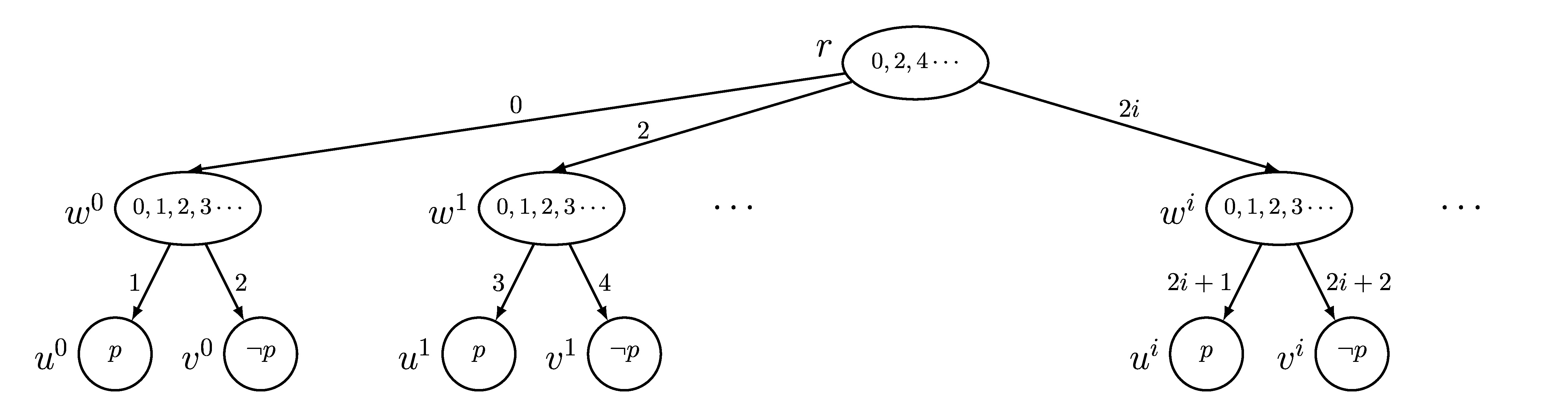 Figure 1
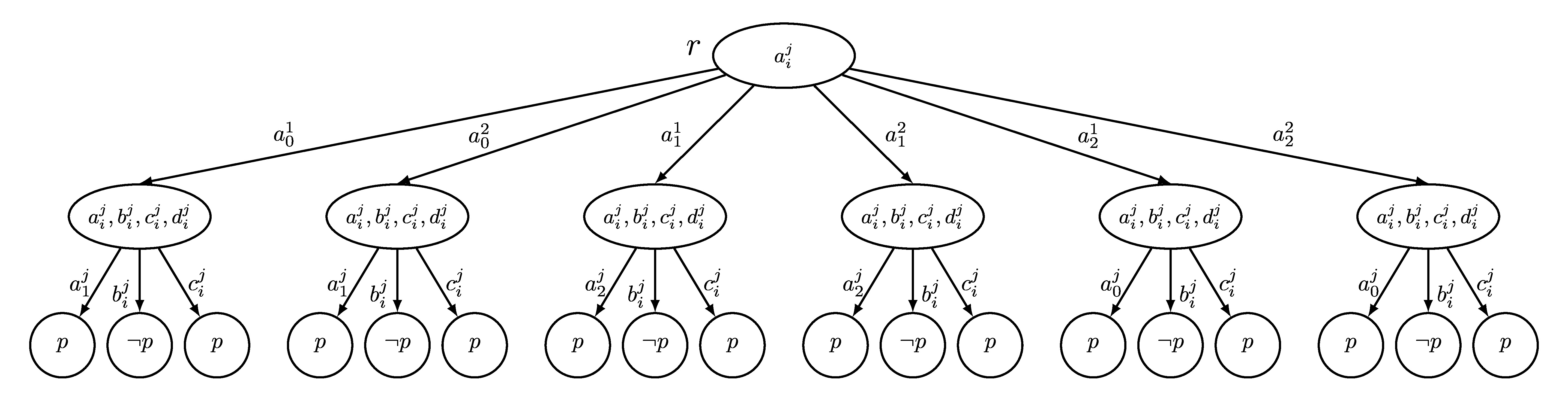 Figure 2
 Figure 3