Nonvanishing of Cartan CR curvature on boundaries of Grauert tubes around hyperbolic surfaces
Wei Guo Foo (AMSS-Beijing), Joel Merker (LM-Orsay), The-Anh Ta, (LM-Orsay)

TL;DR
This paper proves that the boundaries of certain Grauert tubes around hyperbolic surfaces have nowhere vanishing Cartan CR-curvature, providing examples of 3D CR manifolds without CR-umbilical points, using advanced curvature formulas.
Contribution
It demonstrates the nonvanishing of Cartan CR-curvature on Grauert tube boundaries around hyperbolic surfaces, introducing two methods for calculating this curvature.
Findings
Boundaries of Grauert tubes have nowhere vanishing Cartan CR-curvature.
Provides examples of CR manifolds with no CR-umbilical points.
Develops two formulas for calculating Cartan CR-curvature in complex surfaces.
Abstract
We show that the boundaries of thin strongly pseudoconvex Grauert tubes, with respect to the Guillemin-Stenzel K\"{a}hler metric canonically associated with the Poincar\'e metric on closed hyperbolic real-analytic surfaces, has nowhere vanishing Cartan CR-curvature. This result provides a wealth of examples of compact -dimensional Levi nondegenerate CR manifolds having no CR-umbilical point. We provide two proofs utilizing two recent formulas for determining the Cartan CR-curvature of any local -smooth hypersurfaces in . One was obtained in 2012 by the second named author joint with Sabzevari, and it is an expanded explicit formula, valid for locally graphed hypersurfaces, containing millions of terms. The other formula, which we published in 2018 when studying Webster's ellipsoidal hypersurfaces, is not expanded, but more suitable for calculations with…
Click any figure to enlarge with its caption.
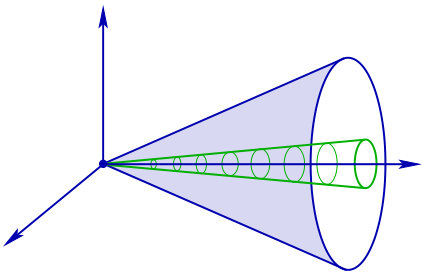 Figure 1
 Figure 2
 Figure 3
 Figure 4
Peer Reviews
No public reviews on file for this paper yet. If you reviewed it on a platform where reviews are public (OpenReview, ICLR, NeurIPS, ICML), you can paste yours below so the community can read it here.
Videos
No videos yet. Explain this paper in a talk, walkthrough, or lecture? Add one.
Taxonomy
TopicsHolomorphic and Operator Theory · Geometric Analysis and Curvature Flows · Geometry and complex manifolds
Nonvanishing of Cartan CR curvature
on boundaries of Grauert tubes
around hyperbolic surfaces
Wei Guo Foo
Hua Loo-Keng center for mathematical sciences, Academy of Mathematics and Systems Sciences, Chinese Academy of Sciences, Beijing, China
,
Joël Merker
Laboratoire de Mathématiques d’Orsay, Bâtiment 307, Université Paris-Sud, CNRS, Université Paris-Saclay, 91405 Orsay Cedex, France
[email protected], [email protected]
and
The-Anh Ta
Abstract.
We show that the boundaries of thin strongly pseudoconvex Grauert tubes, with respect to the Guillemin-Stenzel Kähler metric canonically associated with the Poincaré metric on closed hyperbolic real-analytic surfaces, has nowhere vanishing Cartan CR-curvature. This result provides a wealth of examples of compact -dimensional Levi nondegenerate CR manifolds having no CR-umbilical point.
We provide two proofs utilizing two recent formulas for determining the Cartan CR-curvature of any local -smooth hypersurfaces in . One was obtained in 2012 by the second named author joint with Sabzevari, and it is an expanded explicit formula, valid for locally graphed hypersurfaces, containing millions of terms. The other formula, which we published in 2018 when studying Webster’s ellipsoidal hypersurfaces, is not expanded, but more suitable for calculations with a hypersurface in that is represented as the zero locus of some implicit — but ‘simple’ in some sense, e.g. quadratic — defining function.
We also discuss Grauert tubes constructed with respect to extrinsic metrics depending on embeddings in complex surfaces, together with a certain combinatorics of product metrics.
Key words and phrases:
Poincaré metric, Cartan CR-curvature, Grauert tube, Umbilical points
2000 Mathematics Subject Classification:
32V25, 32V40
1. Introduction
The equivalence problem for local real-analytic hypersurfaces with respect to local biholomorphisms in was first studied by Poincaré [23], and was later solved by Cartan [4] with the introduction of the so-called method of equivalence. The theory was later developed in by Chern and Moser [5], and resulted in the set up of invariant CR-curvatures, called Cartan curvatures in complex dimension 2, and Hachtroudi-Chern curvatures when .
For a long time, little was known about these curvatures due to their high computational complexity. Nonetheless, Webster [25], and later Huang and Ji [16] were able to investigate the case of real ellipsoidal hypersurfaces. In recent years, new variants and explicit formulas (see [7, 20, 21, 10]) made it possible to determine the vanishing locus of the Cartan curvatures for new classes of -dimensional CR manifolds. For instance, we were able to find a whole explicit curve of points of vanishing Cartan curvature on general ellipsoids in in [10].
In their landmark paper [5, p. 247], Chern and Moser raised the following
Problem 1.1**.**
Are there compact strictly pseudoconvex hypersurfaces without CR-umbilical points? Are there such manifolds diffeomorphic to the sphere .
It is well known that a standard -torus in has no Riemannian-umbilic point. Similarly, it is not difficult to verify ([7]) that the boundaries of thin Grauert tubes around the flat 2-dimensional torus have empty CR-umbilical locus. Thus, a topological restriction like must be assumed.
In this paper, we are interested in the question of whether a similar phenomenon holds for higher genus surfaces. Let therefore be a closed compact real-analytic () surface of genus which is hyperbolic in the sense that its universal cover is the unit disc . As a special case of a theorem of Bruhat and Whitney [3] in dimension 2, admits an extrinsic complexification, namely there exists a complex manifold of complex dimension 2, together with an analytic totally real embedding of into . Moreover, the work [15] of Guillemin and Stenzel provides a canonical Kähler potential defined in a small neighborhood of in (see Section 2 below). In particular, for each with , the set \Omega_{\varepsilon}:=\rho^{-1}\big{(}[0,\varepsilon)\big{)}, called the Grauert tube of radius around , has strongly pseudoconvex boundary contained in the complex surface , to which Cartan’s method of equivalence applies. Our main result is the following.
Theorem 1.2**.**
There exists such that for every with , the real and imaginary parts of the primary complex Cartan curvature vanish nowhere on the boundary of .
Equivalently:
Corollary 1.3**.**
The boundaries of these have no CR-umbilical point.∎
So far, our construction of the Grauert tubes take a complete intrisic point of view, since the Guillemin-Stenzel potential is obtained only from a given intrinsic metric on the surface . It is then natural to look at the Grauert tubes from an extrinsic point of view, that is we consider the surface as being totally really embedded in a given (local) complex surface equipped with a given metric. Already in the case of a torus embedded in the standard , the extrinsic contruction will provide several new examples of compact hypersurfaces without CR-umbilical points (see Example 7.4). Further constructions in this vein are provided in Section 7.
This paper is organized as follows. In Section 2, we recall the construction of the canonical Kähler potential of Guillemin and Stenzel in [15], and we find an explicit formula for the potential in the case of hyperbolic surfaces. Section 3 discusses two standard examples of complexification of the round sphere and the flat torus. In Section 4, we work out the defining function for the Grauert tube around the Poincaré upper half-plane. The formula then will be used in Section 5 to calculate the Cartan curvatures on the boundaries of Grauert tubes of hyperbolic surfaces by explicit expressions given in [20] and [10], and to show that the Cartan curvatures do not vanish for small enough radii. Section 6 explains in details how nonvanishing of the Cartan curvature on the boundary of Grauert tubes around hyperbolic surfaces can be deduced from the calculations in Section 5. Finally, in Section 7, we discuss some extrinsic constructions of Grauert tubes based on product metrics.
2. The Canonical Kähler Potential on Grauert Tubes
For any compact real-analytic () manifold of dimension , Bruhat and Whitney showed in [3] that there exists an -dimensional complex manifold , and a real-analytic embedding which is totally real, i.e. such that the real tangent spaces to contain no complex lines in the complex tangent spaces to . The changes of charts for , where , become , where , and where means substituting for in the punctual convergent power series of , giving the complex manifold structure of . The Taylor coefficients of such diffeomorphisms are real, the complex conjugation transfers coherently as , which shows that is the set of fixed points of the antiholomorphic involution obtained from in any chart.
Also by substituting for in power series, every function extends uniquely as a holomorphic function with f^{c}\big{|}_{M}=f, in some open neighborhood of in , and f\big{|}_{M}\equiv 0 if and only if in some subneighborhood .
According to Grauert [14], there exists a strictly plurisubharmonic function defined in some open neighborhood of in with \rho\circ\sigma=\rho,M=\rho^{-1}(0),d\rho\big{|}_{M}\equiv 0, and such that has no critical point in , for some subneighborhood . Hence for all small enough , the domain , a tubular neighborhood of in , has strictly pseudoconvex boundary , and is called the Grauert tube of radius around .
When the manifold is equipped with some Riemannian metric , Guillemin and Stenzel gave in [15] a very elegant construction of such a strictly plurisubharmonic function
[TABLE]
uniquely associated to that will be called the canonical Kähler potential on . Their construction can be summarized as follows.
Embed by and let be an open neighborhood of in . If is thin enough, for any pair , the local uniqueness and distance minimizing properties of geodesics with respect to guarantees that is the -length of the geodesic from to , and an inspection of the -length formula convinces that the (symmetric) squared distance function:
[TABLE]
is , hence can be complexified.
Since in local coordinates, we will denote and in and introduce with in , let us denote a pair of points in the global abstract product similarly as , and let us abbreviate as . Also, let us use the embedding:
[TABLE]
compatible with which makes totally real in , and let be a thin open neighborhood of in invariant under the conjugation (z,w)\longmapsto\big{(}\overline{w},\overline{z}\big{)} and satisfying .
M$$M^{c}$$W^{c}$$W^{c}$$M^{c}$$W$$W$$M
Then complexifies as defined and holomorphic for , with f^{c}\big{|}_{M}\equiv f and enjoys the symmetry . Furthermore, the reality condition of yields via complexification:
[TABLE]
hence putting , and using the symmetry, we see the reality:
[TABLE]
Proposition 2.1**.**
([15], p. 565)* The real-valued function f^{c}\big{(}z,\overline{z}\big{)} is equal to [math] on and takes values outside .*
So in W^{c}\big{\backslash}\{f^{c}=0\}, the square root is -valued, and the canonical Kähler potential is defined to be:
[TABLE]
so that is well defined in .
Finally, a consequence of Gauss’ orthogonality lemma ([15], p. 564) which provides the annihilation:
[TABLE]
yields via complexification the Monge-Ampère equation:
[TABLE]
In [15], Guillemin and Stenzel established the uniqueness of the Kähler metric on satisfying this and restricting to g=\omega\big{|}_{M} on .
Of particular interest to us is the computational fact that has explicit, workable expressions once is given, especially in the case of surfaces.
3. Two Examples: Round Sphere and Flat Torus
Example 3.1**.**
[15, Section 4] Consider to be the -dimensional sphere:
[TABLE]
equipped with the standard round metric, whence the squared geodesic distance between two points is:
[TABLE]
The Bruhat-Whitney complexification of can be represented extrinsically as:
[TABLE]
and on it, we have the useful relation:
[TABLE]
The complexification of is:
[TABLE]
hence letting and using the two identities:
[TABLE]
we get:
[TABLE]
whence, coming back to the definition 2.2 of , we obtain:
[TABLE]
Example 3.3**.**
[7, Section 3] Consider M:=\mathbb{T}^{2}=\mathbb{R}^{2}\big{/}(2\pi\mathbb{Z}^{2}) to be the flat torus. Its complexification is M^{c}:=\mathbb{C}^{2}\big{/}(2\pi\mathbb{Z}^{2}). The geodesic distance between two close points on is computed along straight lines within the flat universal cover \big{(}\mathbb{R}^{2},d_{\sf Eucl}\big{)}. So, in a fundamental domain for on , the squared distance and its complexification are
[TABLE]
hence letting , we get by the definition 2.2 of :
[TABLE]
4. **Semi-global Grauert Tube Around Poincaré’s Upper
Half-Plane**
For our purpose, we need to find the Kähler potential locally on the Bruhat-Whitney complexification of any compact surface of genus . When is viewed as a Riemann surface, the uniformization theorem ([11, Chap. 27]) states that its universal cover is the upper half-plane , and that:
[TABLE]
We will then transfer geometric objects from to .
But in this section, our calculations will be done entirely in , viewed as a real surface equipped with the Poincaré metric . Since the squared Poincaré distance between two points and of , with , is:
[TABLE]
it comes by complexification
[TABLE]
with and , provided that certain inequalities are satisfied by and for this formula to be meaningful. Here, the complexification of reads as:
[TABLE]
Lemma 4.2**.**
The domain of definition of in contains:
[TABLE]
Proof.
Indeed, the argument of arccosh in (4.1) is real and . But with , for to be real , since its imaginary part:
[TABLE]
vanishes if and only if , and since whenever , necessarily , hence:
[TABLE]
for some , whence:
[TABLE]
Then forces:
[TABLE]
the first inequality being equivalent to , while the second holds trivially. ∎
For later convenience, let us rewrite the local complex coordinates as and . Furthermore, let us restrict our considerations to the subdomain of the above domain defined by:
[TABLE]
which guarantees that \text{\footnotesize{\sf arccosh}}\,\big{(}1-2\,\frac{y^{2}+v^{2}}{x^{2}+v^{2}}\big{)} is single valued in [0,\frac{\pi}{2}\big{]}.
\big{\{}2y^{2}+v^{2}\leqslant x^{2}\big{\}}$$\Omega_{\varepsilon}$$y$$v$$x,u[math]
Drawing as a single right half-axis in order to keep two directions for the - and -axes, this domain looks like a "security cone" which will contain all subsequent Grauert tubes .
Then by the relation:
[TABLE]
we get from 4.1 in this subdomain of :
[TABLE]
hence coming back to (2.2):
[TABLE]
Lemma 4.4**.**
For every 0<\varepsilon<\big{(}\frac{\pi}{2}\big{)}^{2}, the Grauert tube around in for the canonical Kähler potential associated with the Poincaré metric on :
[TABLE]
has strongly pseudoconvex boundary of equation:
[TABLE]
Proof.
Since the function arccos is a decreasing diffeomorphism [0,1)\longrightarrow(0,\frac{\pi}{2}\big{]}, we have:
[TABLE]
Since , the term in the differential guarantees that is geometrically smooth at every point.
Furthermore, with and , dropping pluriharmonic terms:
[TABLE]
we see that is strictly plurisubharmonic, whence is strongly pseudoconvex. ∎
In particular, the result holds for thin tubes corresponding to 0<\varepsilon\ll\big{(}\frac{\pi}{2}\big{)}^{2}.
5. **Calculation of the Complex Cartan Curvature of
**
In [7], the authors proved the non-existence of CR-umbilical points on the boundaries of Grauert tubes around flat tori by showing the nonvanishing of a certain invariant determinant introduced in [6], which vanishes exactly when the Cartan curvatures vanish. In this paper, we shall use an explicit expression of Cartan curvatures obtained before by the second named author and Sabzevari in [20, 21] for locally graphed hypersufaces, and alternatively a formula in [10] for hypersurfaces given as zero locus of implicit functions.
For a -smooth Levi-nondegenerate real 3-dimensional hypersurface represented in complex coordinates , by a local graphing function:
[TABLE]
the Cartan essential curvatures of are two real invariants , expressed in [20, Theorem 1.1] by following a Tanaka approach, explicitly in terms of , both containing more than 1, 500, 000 terms when expanded.
An equivalent approach [21] closer to Cartan’s [4] can be summarized as follows. Local generators of and are:
[TABLE]
and their commutator:
[TABLE]
incorporates the real coefficient, so-called Levi factor:
[TABLE]
which is nowhere vanishing if and only if is Levi nondegenerate.
Abbreviating the coefficients of and as:
[TABLE]
then in terms of the following key function (the expansion of which is page long):
[TABLE]
the (single) essential Cartan complex invariant expresses in non-expanded form as:
[TABLE]
and a comparison with [20] done at the end of [21] shows that it also expresses as:
[TABLE]
where the quantity is a group parameter of a certain initial -structure, and it has the following signification.
Suppose there really is a local biholomorphic equivalence which transfers into , so that in some appropriate target coordinates , , the (localized) image is also graphed as:
[TABLE]
Compute similarly , , , , , but extract parts independent of group parameters:
[TABLE]
Because the differential leaves invariant complex tangents, whence h_{*}\big{(}T^{1,0}M\big{)}=T^{1,0}M^{\prime}, there is a nowhere vanishing function such that:
[TABLE]
At a basic level, it is an easy exercise ([19, p. 44]) to express the invariancy of the levi factors and through the biholomorphism as:
[TABLE]
and at a higher level, a standard feature of Cartan’s method of equivalence then shows that:
[TABLE]
which justifies, since vanishes nowhere, the invariancy, under changes of holomorphic coordinates, of the following
Définition 5.2**.**
A point at which is called a CR-umbilical point.
In continuation with Lemma 4.4 above, we are now ready to state and to establish the main proposition. Inside the complexification of Poincaré’s upper half-plane:
[TABLE]
consider for every 0<\varepsilon<\big{(}\frac{\pi}{2}\big{)}^{2} the hypersurface:
[TABLE]
Proposition 5.3**.**
All hypersurfaces with 0<\varepsilon<\big{(}\frac{\pi}{2}\big{)}^{2} have no CR-umbilical point.
Proof.
The plain global linear biholomorphism of :
[TABLE]
transforms into:
[TABLE]
and it is appropriate to set — mind the change varepsilon epsilon —:
[TABLE]
so that the equation of becomes a bit simpler (dropping the primes):
[TABLE]
Since this fractional map has derivative:
[TABLE]
everywhere positive, it is a diffeomorphism (0,\frac{\pi^{2}}{4}\big{)}\longrightarrow(0,1), so that the new varies plainly in the open unit real segment:
[TABLE]
Reminding that , this new equation:
[TABLE]
shows that, a bit similarly as for the flat torus in Example 3.3, either or at any point.
Suppose therefore firstly that . For the graph:
[TABLE]
a direct calculation of from the formula (5.1), by hand or with help of a computer, provides a compact, serendipitous expression:
[TABLE]
which visibly vanishes nowhere since whence .
Suppose secondly that . Since only points with are not already examined, assume . For the graph:
[TABLE]
at points with , another direct calculation of the invariant from (5.1) also provides a compact, nowhere vanishing expression:
[TABLE]
and this completes the proof of inexistence of CR-umbilical points on . ∎
Second proof of Proposition 5.3.
The formula (5.1), explicit as it is, usually gives long and complicated expression for the combined complex-valued Cartan invariant . This reality is due to the iterated process of taking roots, derivatives, quotients, etc. when the graphing function of the hypersurfaces under consideration is not simple, including taking roots for example (see, for example, the formulas given in [21] and [9]). There are instances where the hypersurfaces actually have much simpler representation by mean of implicit functions. An example is the case of general ellipsoidal hypersurfaces in considered in [10], where a direct calculation from the formula (5.1) for a graphing function of the ellipsoids gives a very complicated expression for , while an alternative formula (cf. [10, Corollary 12]) applied to simple implicit defining functions of the ellipsoids allows one to see a whole curve of CR-umbilical points. As the implicit defining function of is also very simple, we shall use the formulation in [10] to verify the nonvanishing of the Cartan curvature of once again.
Let us recall the necessary formulas from [10]. For a Levi nondegenerate analytic hypersurface in given by an implicit defining function:
[TABLE]
we set
[TABLE]
Theorem 5.4**.**
([10]) On the domain , the Cartan invariant of vanishes exactly on the zero locus of
[TABLE]
where
[TABLE]
With this formula (5.5) for checking the nonvanishing of the Cartan curvature at hand, we now return to our hypersurface . We again take advantage of the elementary biholomorphic transformation as above, and consider the equivalent model whose defining function writes with . Switching the notation for coordinates in order to reach , namely using instead:
[TABLE]
we can then rewrite:
[TABLE]
so that , and then as wanted we have the nowhere vanishing:
[TABLE]
on thanks to our constant assumption . Thus, the vanishing locus of is exactly the set of CR-umbilical points of in this case.
Now, direct calculation from the formula (5.5), by hand or preferably on a computer, and keeping in mind that on we always have , gives us:
[TABLE]
It is then evident that is everywhere nonzero on because . This completes our second justification of the inexistence of CR-umbilical points on .
Proof.
6. **Transfer to Hyperbolic Genus Compact
Surfaces**
Now, let be a closed compact oriented surface of genus , considered as a Riemann surface. The Poincaré-Köbe uniformization theorem provides a holomorphic covering:
[TABLE]
The Poincaré metric ds_{\mathbb{H}}^{2}=\lambda\,\big{(}dx_{1}^{2}+dx_{2}^{2}\big{)} with on has constant Gaussian curvature:
[TABLE]
and is furthermore kept invariant by all elements of the group of holomorphic automorphisms of :
[TABLE]
which acts transitively (and isometrically) on the homogeneous space .
Furthermore, the group of all covering automorphisms of happens to be a discrete subgroup:
[TABLE]
Consequently (and as is well known), descends by push-forward, independently of preimage points, as a metric on :
[TABLE]
having the same curvature .
Next, forget the holomorphic structure on , consider now as a real surface equipped with this metric , and denote the Bruhat-Whitney complexification of by . Then Section 2 gives by complexification a unique strictly plurisubharmonic Kähler potential whose sublevel sets:
[TABLE]
for all small enough , are strongly pseudoconvex domains bounded by the hypersurfaces:
[TABLE]
Here, might well be quite small, depending on the convergence radii of the real-analytic objects that are complexified.
Lemma 6.1**.**
Shrinking if necessary, has no CR-umbilical point for all .
Proof.
The uniformizing map, viewed as a map , also complexifies to become a holomorphic map:
[TABLE]
where is some open neighborhood of in : , possibly narrowing much as one reaches , and where is also an open neighborhood of in : .
Since is a covering map, hence a local diffeomorphism, each point has a small open neighborhood on which there exist -diffeomorphic inverses of , namely maps:
[TABLE]
that are uniquely defined as soon as a central point has been chosen in the fiber to fix a level. Shrinking if necessary, the complexification of is also locally biholomorphic at .
By compactness of , there exists a finite open cover of :
[TABLE]
together with biholomorphic inverses of the complexification :
[TABLE]
If necessary, shrink so that, for all :
[TABLE]
Now, take any point . How to convince oneself that the Cartan CR-curvatures of the strongly pseudoconvex hypersurface is nonzero at ?
This is very simple. For sure, for some . Remind also the tube . Then because the metric on is the push-forward of Poincaré’s metric on , the tubes and correspond to each other, namely sends biholomorphically onto with:
[TABLE]
and since the nonvanishing of Cartan CR-curvatures is a biholomorphically invariant property, Proposition 5.3 offers what was wanted. ∎
With some basic knowledge on Fuchsian groups, we can also provide a
Variation on the proof of
Lemma 6.1.
As already seen, the quotient map:
[TABLE]
is locally isometric. Abbreviate:
[TABLE]
Définition 6.2**.**
A fundamental domain for is an open subset whose -translates cover:
[TABLE]
being mutually disjoint:
[TABLE]
and which has the further property of being locally finite in the sense that each compact subset meets only finitely many -images of .
Theorem 6.3**.**
([1, Chap. 9])* Relatively compact fundamental domains having piecewise boundary consisting of geodesic segments always exist on the universal cover of any genus compact Riemann surface.∎*
Then in place of a (rough) finite Borel-Lebesgue covering as used in the first proof, we can employ a geometrically more meaningful covering. For such a fundamental domain of , there is an atlas of consisting of open charts:
itself;
slightly thickened thin neighborhoods of the sides of .
Further, one can arrange that the restrictions:
[TABLE]
are diffeomorphisms. Complexifying their inverses as:
[TABLE]
we can now reason similarly as in the first proof, and this concludes. ∎
Remark 6.4**.**
We observe the following interesting facts about the (non)vanishing of the essential curvatures and on the boundaries of Grauert tubes of small radii around closed surfaces .
- (1)
If is the -sphere with the standard round metric, both and vanish identically.
- (2)
If is a -dimensional flat torus, we leave as an exercise to the reader to verify that never vanishes, while vanishes identically.
- (3)
If is a closed genus hyberbolic surface, then both and vanish nowhere.
7. Grauert Tubes with Respect to Extrinsic Metrics
In Section 2, Grauert tubes are constructed with respect to metrics obtained from given intrinsic Riemannian metrics on surfaces. In this section, we look at constructions of Grauert tubes around surfaces from an extrinsic point of view. More precisely, let us consider a totally real embedding of a surface into a complex manifold of complex dimension 2. We will identify the surface with its image under the embedding, so that is viewed as a submanifold of . A given Riemannian metric on always induces an extrinsic metric on and the Grauert tubes around also can be defined with respect to as for small enough positive .
Recall that for a real dimensional submanifold of a complex dimensional manifold , a point of is called a complex point if the tangent vector space of at contains at least one complex line with respect to the complex structure on the tangent bundle of , that is . An embedding of into is called a totally real embedding if does not contain any complex point.
It is known that every affine -dimensional totally real vector subspace is affinely holomorphically equivalent to . It is also known that every real -dimensional submanifold is locally holomorphically equivalent to , namely at any point , there is an open neighborhood and a biholomorphism with such that h\big{(}M\cap U\big{)}=\mathbb{R}^{n}\cap V. Hence an alternative description of maximally real submanifolds is as follows.
Définition 7.1**.**
A real -dimensional submanifold of a complex -dimensional manifold is totally real if there exists a family indexed by of biholomorphisms:
[TABLE]
with open, with open, with X=\mathbin{\scalebox{1.5}{\cup}}_{\alpha}V_{\alpha}, such that:
if , then \varphi_{\alpha}\big{(}U_{\alpha}\big{)}\cap M=\emptyset;
if , then the restriction:
[TABLE]
is a real diffeomorphism.
Example 7.2**.**
By looking at the standard complex atlas of the complex projective space , it is clear that is totally real in . On , there is a canonical round metric induced from the round metric on its double cover . The Guillemin-Stenzel metric associated to this round metric on is nothing but the Fubini-Study metric on . The complexified manifold is a double cover of , which is a real dimensional submanifold in the fibration of .
Example 7.3**.**
Of particular interest for us here is the fact that a product of two totally real submanifolds is also totally real, which is evident from either definition.
Example 7.4**.**
Let us look at Example 3.3 once again, this time from an extrinsic point of view. Consider a 2-dimensional real vector subspace of which passes through the origin, with coordinates . The intersections of with the -axis and -axis are two real line. Therefore can be written in exactly one of the following three forms.
Case 1: V=\big{\{}y=\alpha\,x,\,v=\beta\,u\big{\}}, where are real. The Grauert tube of radius around with respect to the standard distance in is given by:
[TABLE]
In order to obtain a compact hypersurface, we take the quotient of by the translations by on each real coordinates of . Then can be embedded into as:
[TABLE]
Any point on the boundary of admits the same local defining function as its preimage on the boundary of . Solving the local defining function for the variable gives the graph:
[TABLE]
A direct calculation of the Cartan invariant using the formula (5.1) provides:
[TABLE]
and this result is nowhere vanishing. So the boundary of also does not contain any CR-umbilical point.
Case 2: V=\big{\{}x=0,\,v=\beta u\big{\}}, where is again real. The Grauert tube of radius around with respect to the standard distance in is now given by:
[TABLE]
A point on the boundary of or of admits the local graphing function:
[TABLE]
of which the (relative) Cartan curvature can be computed from the formula (5.1) to be:
[TABLE]
Thus, the (relative) invariant is also nowhere vanishing on the boundary.
Note that can be embedded into as:
[TABLE]
Case 3: V=\big{\{}x=0=u\big{\}}. A point on which can be embedded into as:
[TABLE]
now admits the local defining function
[TABLE]
In this case, we do not obtain a local graphing function of the form , but a simple calculation using the alternative formula (5.5) for the implicit defining function shows that the relative invariant is proportional to:
[TABLE]
So it is evident that the boundary of also does not contain any CR-umbilical point.
For two given Riemannian manifolds , the distance with respect to the product metric on is:
[TABLE]
assuming that are uniquely geodesic, i.e. there exists a unique geodesic between any two points.
Our next examples of Grauert tubes in will be constructed with respect to products of two extrinsic metrics on . For the two possible component metrics on , we will consider the three standard ones: flat, elliptic and hyperbolic.
Flat metric on . Denote by the flat Pythagorean metric on . Consider the totally real line in . The flat distance from any point to is:
[TABLE]
Elliptic metric on . For the elliptic metric , we look at the local chart of Since is not uniquely geodesic, we consider a small neighborhood of in , which is uniquely geodesic for small positive thanks to the fact that the injective radius of is positive. Then is totally real in
Lemma 7.7**.**
The elliptic distance from any point of to is given by:
[TABLE]
Proof.
A point of corresponds to the point \big{(}\frac{1}{\sqrt{1+x^{2}+y^{2}}},\frac{x}{\sqrt{1+x^{2}+y^{2}}},\frac{y}{\sqrt{1+x^{2}+y^{2}}}\big{)} of embedded in , and a point of corresponds to \big{(}\frac{1}{\sqrt{1+\alpha^{2}}},\frac{\alpha}{\sqrt{1+\alpha^{2}}},0\big{)}.
Now d_{{\sf Ell}}\big{(}(x,y),V_{{\sf Ell}}\big{)} is exactly the spherical distance between P=\big{(}\frac{1}{\sqrt{1+x^{2}+y^{2}}},\frac{x}{\sqrt{1+x^{2}+y^{2}}},\frac{y}{\sqrt{1+x^{2}+y^{2}}}\big{)} and the arc , that is:
[TABLE]
Using the Cauchy-Schwartz inequality, we have:
[TABLE]
where the maximum is attained at . ∎
Hyperbolic metric on . For the hyperbolic metric , we may consider a small open neighborhood of 0 in the Poincaré disc, and the totally real interval in , but it is more convenient to work with the corresponding domain of on the upper-half plane model, which is an open neighborhood of . The corresponding totally real interval in is .
Lemma 7.9**.**
The hyperbolic distance from any point in to is given by:
[TABLE]
Proof.
Recall that for a hyperbolic triangle on the upper-half plane with angles , , and opposite sides of lengths , , , the rule of sine reads:
[TABLE]
Thus, given the angle and the side , the side is of maximal length when because the function sinh is monotone and because:
[TABLE]
It follows that to find the hyperbolic distance from a given point to the line , we look at the geodesic line passing through and orthogonal to , which is the half-circle on the upper-half plane model with centre at 0 and of radius . This geodesic line intersects at the point \big{(}0,\sqrt{x^{2}+y^{2}}\big{)}\approx 0+{\scriptstyle{\sqrt{-1}}}\,\sqrt{x^{2}+y^{2}}. Thus, we have:
[TABLE]
We are now in position to give some non-trivial examples of Grauert tubes with respect to extrinsic metrics.
Proposition 7.12**.**
The Grauert tubes of radius with respect to the product metric around the totally real submanifold in admit local defining functions:
[TABLE]
where for is one of the three models:
[TABLE]
In particular, we obtain six examples of Grauert tubes with respect to the corresponding extrinsic product metrics.
Remark 7.13**.**
Notice here that our examples are of local nature, and not compact. When both and are flat metrics, one recovers the local graphing function of the flat torus as in Example 3.3, since:
[TABLE]
However, the remaining five examples are very different from those obtained from intrinsic metrics in Example 3.1, Example 3.3 and Lemma 4.4. Thus, the Grauert tubes around the same totally real manifolds with respect to intrinsic and extrinsic metrics look very different.
Lemma 7.14**.**
In terms of:
[TABLE]
and of:
[TABLE]
the local defining functions for the boundaries of the Grauert tubes of radius with respect to the product metrics are given by Table 1.
Proof.
We only treat the case of the product between the hyperbolic and flat metrics, in which the local graphing function is given by:
[TABLE]
while the calculations for the other cases can be done in a similar way.
The defining function for the boundary of the Grauert tube is obtained by solving the equation for the variable as follows:
[TABLE]
So, the defining function belongs to the rigid case with the graph:
[TABLE]
Unfortunately, except for the case of , the expressions of the Cartan invariant obtained by calculations with either formula (5.1) or (5.5), though explicit, are overwhelmingly complicated, and so do not allows us to see the CR-umbilical locii.
The reference list from the paper itself. Each links out to its DOI / PubMed record.
- 1[1] E. Beardon, The geometry of discrete groups , Graduate Texts in Mathematics, 91, Springer Verlag, Berlin, 1995, xii+337 pp.
- 2[2] E. Bishop, Differentiable manifolds in complex Euclidean space , Duke Mathematical Journal 32 (1965), 1–21.
- 3[3] F. Bruhat and H. Whitney, Quelques propriétés fondamentales des ensembles analytiques-réels , Commentarii Mathematici Helvetici 33 (1959), 132–160.
- 4[4] É. Cartan, Sur la géométrie pseudo-conforme des hypersurfaces de l’espace de deux variables complexes II , Annali della Scuola Normale Superiore di Pisa — Classe di Scienze 1 4 (1932), 333–354.
- 5[5] S.S. Chern and J. Moser, Real hypersurfaces in complex manifolds , Acta Mathematica 133 (1974), 219–271.
- 6[6] P. Ebenfelt and D. Zaitsev, Invariants and umbilical points on three dimensional CR manifolds embedded in ℂ 2 superscript ℂ 2 \mathbb{C}^{2} , arxiv.org/abs/1605.08709/
- 7[7] P. Ebenfelt, N.S. Duong and D. Zaitsev, A family of compact strictly pseudoconvex hypersurfaces in ℂ 2 superscript ℂ 2 \mathbb{C}^{2} without umbilical points , Mathematical Research Letters 25 (2018), no. 1, 75–84.
- 8[8] Y. Eliashberg and V. Kharlamov, Some remarks on the number of complex points of a real surface in a complex one , Proceeding of the Leningrad Institue Topology Conference 1982, pp. 143–148, Nauka Leningrad Otdel., Leningrad, 1983.