Ribbon homology cobordisms
Aliakbar Daemi, Tye Lidman, David Shea Vela-Vick, C.-M. Michael Wong

TL;DR
This paper investigates 4-dimensional homology cobordisms without 3-handles, exploring their interactions with geometric and topological invariants, and deriving obstructions and applications related to knot theory and Dehn surgeries.
Contribution
It introduces new obstructions to homology cobordisms without 3-handles and generalizes results on knot Floer homology under ribbon concordances.
Findings
Obstructions derived from Thurston geometries and Floer homologies.
Generalization of knot Floer homology behavior under ribbon concordances.
Applications to Dehn surgery problems.
Abstract
We study 4-dimensional homology cobordisms without 3-handles, showing that they interact nicely with Thurston geometries, character varieties, and instanton and Heegaard Floer homologies. Using these, we derive obstructions to such cobordisms. As one example of these obstructions, we generalize other recent results on the behavior of knot Floer homology under ribbon concordances. Finally, we provide topological applications, including to Dehn surgery problems.
Click any figure to enlarge with its caption.
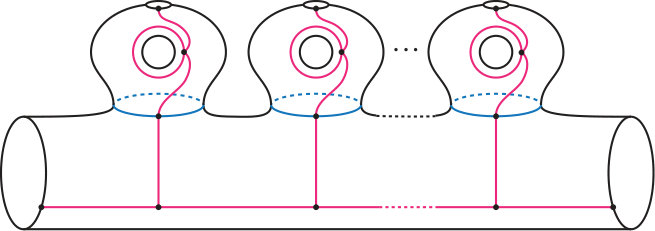 Figure 1
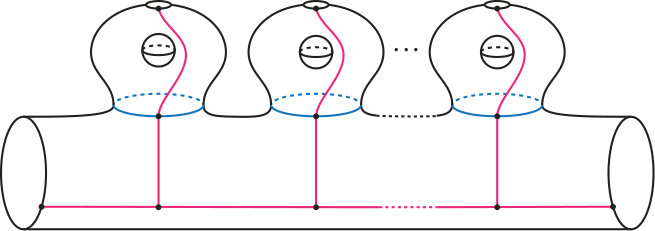 Figure 2
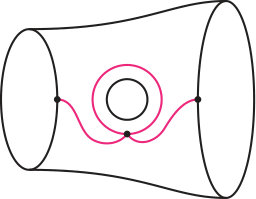 Figure 3
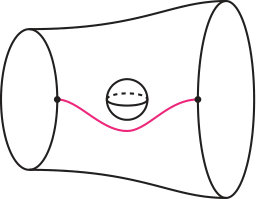 Figure 4
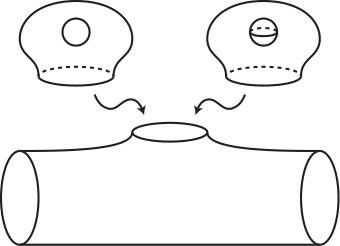 Figure 5
Peer Reviews
No public reviews on file for this paper yet. If you reviewed it on a platform where reviews are public (OpenReview, ICLR, NeurIPS, ICML), you can paste yours below so the community can read it here.
Videos
No videos yet. Explain this paper in a talk, walkthrough, or lecture? Add one.
MnLargeSymbols’164 MnLargeSymbols’171
stmry"71 stmry"79
Ribbon homology cobordisms
Aliakbar Daemi
Department of Mathematics
Washington University in St. Louis
St. Louis, MO 63130
[email protected] https://www.math.wustl.edu/~adaemi/ ,
Tye Lidman
Department of Mathematics
North Carolina State University
Raleigh, NC 27695
[email protected] https://sites.google.com/ncsu.edu/tlid/ ,
David Shea Vela-Vick
Department of Mathematics
Louisiana State University
Baton Rouge, LA 70803
[email protected] https://www.math.lsu.edu/~shea/ and
C.-M. Michael Wong
Department of Mathematics
Dartmouth College
Hanover, NH 03755
[email protected] https://math.dartmouth.edu/~wong/
Abstract.
We study -dimensional homology cobordisms without -handles, showing that they interact nicely with Thurston geometries, character varieties, and instanton and Heegaard Floer homologies. Using these, we derive obstructions to such cobordisms. As one example of these obstructions, we generalize other recent results on the behavior of knot Floer homology under ribbon concordances. Finally, we provide topological applications, including to Dehn surgery problems.
1. Introduction
The advent of topological quantum field theories (TQFTs) in the past few decades has renewed interest in smooth cobordisms and the associated category. In dimension , Seiberg–Witten Floer homology, a gauge-theoretic TQFT, was recently used by Manolescu [Man16] to study the homology cobordism group , disproving the Triangulation Conjecture in dimensions . Many questions remain: For example, it is unknown whether has any torsion.
In this article, we study -dimensional cobordisms from a new perspective, in terms of their directionality. More precisely, we study ribbon cobordisms, which are -dimensional manifolds that can be built from -handles with . They arise in at least two natural ways: as Stein cobordisms between closed, contact manifolds, and as the exterior of (strongly homotopy-) ribbon surfaces, which are cobordisms between link exteriors [Gor81]. Note that every (homology) cobordism can be split into two ribbon (homology) cobordisms. While homology cobordism is an equivalence relation, ribbon homology cobordisms are not symmetric. In fact, as we will see, ribbon homology cobordisms give rise to a preorder on -manifolds that seems to agree with orderings by various invariants and Thurston geometries. We conjecture:
Conjecture 1.1** (cf. [Gor81, Conjecture 1.1]).**
The preorder on the set of homeomorphism classes of closed, connected, oriented -manifolds given by ribbon -homology cobordisms is a partial order.
Here, an -homology cobordism between two compact, oriented -manifolds and is an oriented, smooth cobordism such that for . For example, the exterior of a knot concordance is a -homology cobordism. Our results can be summarized as:
Metatheorem**.**
Let and be compact, connected, oriented -manifolds possibly with boundary, and suppose that there exists a ribbon homology cobordism from to . Then the complexity of is no greater than that of , as measured by each of the following invariants:
- (A)
The fundamental group; 2. (B)
The -character variety, for a compact, connected Lie group , and its Zariski tangent space at a conjugacy class; 3. (C)
Various flavors of instanton and Heegaard Floer homologies.
These comparisons are sometimes realized by explicit morphisms in the appropriate category.
Note that (A) was proved by Gordon [Gor81] in the case that and have toroidal boundary, and his proof immediately generalizes to the closed case following Geometrization; see Section 1.1 for context. We will provide more precise statements for (B) and (C) in Section 1.2 and Section 1.3.
Our metatheorem has many topological applications, which we will discuss below. But first, (A) and Geometrization together give us the following:
Theorem 1.2**.**
There is a hierarchy among the Thurston geometries with respect to ribbon -homology cobordisms, given by the diagram
[TABLE]
In other words, suppose that and are compact -manifolds with empty or toroidal boundary that admit distinct geometries, and that there exists a ribbon -homology cobordism from to . Then there is a sequence of arrows from the geometry of to that of in the diagram above.
A more refined version of Theorem 1.2 is stated in Theorem 3.4.
Remark 1.3**.**
It is natural to ask how the ribbon -homology cobordism preorder interacts with the JSJ decomposition. Unfortunately, there exist examples where is hyperbolic and has non-trivial JSJ decomposition; see Remark 8.7 for more details.
Evidence for Conjecture 1.1 is provided by the metatheorem and Theorem 1.2, as well as Corollary 1.16, and Corollary 4.3 below. Conjecture 1.1 is analogous to [Gor81, Conjecture 1.1], which states that the preorder on the set of knots in by ribbon concordance is a partial order.
Remark 1.4**.**
Another major open problem regarding ribbon concordance is the Slice–Ribbon Conjecture. In a similar spirit, a natural question to ask is whether a -homology sphere bounding a -homology -ball always bounds a -homology -ball without -handles.
We now turn to some new applications. We begin with an application to Seifert fibered homology spheres that illustrates the use of several different tools described above.
Theorem 1.5**.**
Suppose that and are the Seifert fibered homology spheres and respectively, and that there exists a ribbon -homology cobordism from to . Then
- (1)
The Casson invariants of and satisfy ; 2. (2)
Either and both bound negative-definite plumbings, or both bound positive-definite plumbings; and 3. (3)
The numbers of exceptional fibers satisfy .
The first two items above can be proved with either instanton or Heegaard Floer homology using Metatheorem (C). However, the authors do not know of a Floer-homology proof of (3).
Next, we have applications to ribbon concordance. Recall that a strongly homotopy-ribbon concordance is a knot concordance in whose exterior is ribbon.111All ribbon concordances are strongly homotopy-ribbon.
Corollary 1.6**.**
Suppose that and are Montesinos knots in of determinant , and that the number of rational tangles in with denominator at most is greater than that of . Then there does not exist a strongly homotopy-ribbon concordance from to .
Recall that a knot in is small if there are no closed, non–boundary-parallel, incompressible surfaces in its exterior, and that torus knots are small.
Corollary 1.7**.**
Suppose that is a composite knot in , and that is a small knot in . Then there does not exist a strongly homotopy-ribbon concordance from to .
We also obtain applications to reducible Dehn surgery problems. The following is a sample theorem; see Section 9 for its proof, as well as another similar result. The same techniques can be used to obtain other results along the same lines, which we do not pursue in this article.
Theorem 1.8**.**
Suppose that is an irreducible -homology sphere, is a null-homotopic link in of components, and , where denotes the result of [math]-surgery along each component of . Then is orientation-preserving homeomorphic to .
Remark 1.9**.**
Since the first appearance of this article, Hom and the second author [HL20, Corollary 1.2] have used Theorem 1.8 to show that when is a knot, must in fact be trivial.
Remark 1.10**.**
The technique used to prove Theorem 1.8 can also be applied to the case where is an -space -homology sphere and is a non-trivial knot. In this case, one could show that does not contain an summand, which follows from Ni [Ni13, p. 1144].
Finally, we also obtain an application to the computation of the Furuta–Ohta invariant for -homology ’s [FO93].
Corollary 1.11**.**
Suppose that and are -homology spheres, and that is a ribbon -homology cobordism, and that is the -homology obtained by gluing the ends of by the identity. Then . In particular, agrees with the Rokhlin invariant of mod .
Remark 1.12**.**
We believe that the proof of Corollary 1.11 can be adapted to show the analogous statement for the Mrowka–Ruberman–Saveliev invariant [MRS11]. This would verify the conjecture that [MRS11, Conjecture B], for -homology ’s that are of the form . See Remark 4.16 for more details.
Remark 1.13**.**
Suppose that is a -homology sphere. Then for any -homology sphere , a ribbon -homology cobordism from to is in fact a ribbon -homology cobordism, and the existence of such a cobordism implies that is also a -homology sphere. See Lemma 3.2 for the proof. This is relevant, for example, to Theorem 1.5 and Corollary 1.11, as well as Theorem 4.1 and Theorem 4.8 later.
To ease our discussion, we set up some conventions for the article.
Conventions**.**
All - and -manifolds are assumed to be oriented and smooth, and, except in Section 7.1, they are also assumed to be connected.222Connectedness is often not essential in our statements, but we impose it for ease of exposition. Accordingly, we also assume that handle decompositions of cobordisms between non-empty -manifolds have no [math]- or -handles. We say that a handle decomposition is ribbon if it has no -handles. We always denote the ends of a ribbon homology cobordism by ; for results that hold for more general cobordisms, we typically denote the cobordism by, for example, . All sutured manifolds are assumed to be balanced. We denote by the interval . Unless otherwise specified, all singular homologies have coefficients in , instanton Floer homologies have coefficients in , and Heegaard Floer homologies have coefficients in .
1.1. Context
In the seminal work of Gordon [Gor81] on ribbon concordance, the key theorem, which is very special to the absence of -handles, is the following.
Theorem 1.14** (Gordon [Gor81, Lemma 3.1]).**
Let and be compact -manifolds possibly with boundary, and suppose that is a ribbon -homology cobordism. Then
- (1)
The map induced by inclusion is injective; and 2. (2)
The map induced by inclusion is surjective.
(While Gordon’s original statement is only for exteriors of ribbon concordances, the more general result holds, as explained in this subsection.) Gordon uses the theorem above, combined with various properties of knot groups, to study questions related to ribbon concordance.
Our employment of several different approaches above is motivated by two observations. First, since Gordon’s work, there have been many breakthroughs in low-dimensional topology, including the Geometrization Theorem for -manifolds, the applications of representation theory and gauge theory, and, relatedly, the advent of Floer theory. Each of these constitutes a new, powerful tool that can be applied in the context of ribbon homology cobordisms, and a major goal of the present article is to systematically carry out these applications. In particular, we will develop obstructions from these theories, which we will then use for topological gain.
Second, while the approaches reflect very different perspectives, there are interesting theoretical connections between them. To illustrate this point, we discuss Theorem 1.14 further. This theorem follows from the deep property of residual finiteness of -manifold groups together with the elegant results of Gerstenhaber and Rothaus [GR62] on the representations of finitely presented groups to a compact, connected Lie group . (The residual finiteness of closed -manifold groups has only been known after the proof of the Geometrization Theorem; this new development is the ingredient that extends Gordon’s original statement to closed -manifolds in Theorem 1.14.) The statement of Gerstenhaber and Rothaus can be reinterpreted as saying that the -representations of extend to those of , and Theorem 1.14 (2) implies that any non-trivial representation of determines a non-trivial representation of by pullback. Thus, Theorem 1.14 naturally leads to the study of the character varieties of . Moving further, focusing on , we observe that the -representations of are related to the instanton Floer homology of . Like instanton Floer homology, Heegaard Floer homology is defined by considering certain moduli spaces of solutions; however, while they share many formal properties, the exact relationship between these two theories remains somewhat unclear. Finally, we note that the Geometrization Theorem implies that if is geometric, its geometry can be determined from in many situations.
In fact, apart from theoretical connections, there is considerable interplay among these perspectives even in their applications. We direct the interested reader to Theorem 1.5, Remark 1.17, and Remark 3.6 for a few examples.
1.2. Character varieties and ribbon homology cobordisms
As briefly mentioned above, the proof of Theorem 1.14 requires understanding the relationship between -representations of and . Consequently, given a ribbon -homology cobordism , we will also obtain relations between the character varieties of and . Recall that for a group and compact, connected Lie group (e.g. ), we can define the representation variety , which is the set of -representations of ; we can also quotient by the conjugation action to obtain the character variety . For a path-connected space , we will write for , and for . As discussed above, we have the following proposition.
Proposition 1.15**.**
Let and be compact -manifolds possibly with boundary, and suppose that is a ribbon -homology cobordism. Then any can be extended to an element that pulls back to an element , and distinct elements in corresponds to distinct elements in . The analogous statement for also holds.
See Proposition 2.1 for a restatement and proof. Recall that the Chern–Simons functional gives an -valued function on ; the image of this function is a finite subset of , which we call the –Chern–Simons invariants of . Proposition 1.15 implies a relation between the –Chern–Simons invariants of and .
Corollary 1.16**.**
Let and be closed -manifolds, and suppose that there exists a ribbon -homology cobordism from to . Then the set of –Chern–Simons invariants of is a subset of that of .
Remark 1.17**.**
Stein manifolds provide a large family of -manifolds without -handles. It is interesting to compare the discussion above with the work of Baldwin and Sivek [BS18], who use instanton Floer homology to prove that if is a -homology sphere that admits a Stein filling with non-trivial homology, then admits an irreducible -representation. In comparison, if is a Stein -homology cobordism, and admits a non-trivial -representation, then it extends to an -representation of that pulls back to a non-trivial -representation of by Proposition 1.15, which requires no gauge theory.
In fact, with a bit more work, we can compare the local structures of the character varieties. For a path-connected space and a representation , recall that the Zariski tangent space to at the conjugacy class is the first group cohomology of with coefficients in the adjoint representation associated to , denoted by ; see Section 2.2 for more details. Below, we also consider the zeroth group cohomology .
Proposition 1.18**.**
Let and be compact -manifolds possibly with boundary, and suppose that is a ribbon -homology cobordism. Fix , choose an extension , and denote by the pullback of . Suppose that . Then
[TABLE]
This seemingly technical result, applied to ribbon -homology cobordisms between Seifert fibered homology spheres, will be our avenue to prove Theorem 1.5 (3).
1.3. Floer homologies and ribbon homology cobordisms
Another way that representations appear in - and -manifold topology is through instanton Floer homology, where we specialize to or . Recall that a Floer homology associates a vector space or module to a -manifold, and a linear transformation or homomorphism to a cobordism. In the case of instanton Floer homology, the associated group comes roughly from counting or representations of the fundamental group. Below, we state a theorem for the behavior of a general Floer homology theory under ribbon homology cobordisms. In Section 4, we give results for most versions of Floer homology with precise conditions on the -manifolds and the ribbon homology cobordism.
Theorem 1.19**.**
Let be one of the -manifold Floer homology theories discussed in Section 4. Let and be compact -manifolds, and suppose that is a ribbon homology cobordism. Then includes into as a summand.333For some flavors of Floer homology, we prove the weaker statement that is isomorphic to a summand of .
Very recently, Zemke and his collaborators [Zem19c, MZ21, LZ19] have shown that ribbon concordances induce injections on knot Heegaard Floer homology and Khovanov homology, and this has led to several other interesting results [JMZ20, Sar20], including an exciting relationship between knot Heegaard Floer homology and the bridge index [JMZ20, Corollary 1.9]. In the special case that is sutured Heegaard Floer homology, and is the exterior of a strongly-homotopy ribbon concordance, Theorem 1.19 recovers the results of Zemke [Zem19c, Theorem 1.1] and Miller and Zemke [MZ21, Theorem 1.2] on knot Heegaard Floer homology. (For a more precise statement, see Corollary 4.13.)
While much of the work involving Floer homologies is inspired by the work of Zemke et al., our proofs use a different argument that holds in a more general context.
Organization
In Section 2, we study the relationship between ribbon homology cobordisms and character varieties, proving Proposition 1.15 and Proposition 1.18. In Section 3, we prove Theorem 1.2, pertaining to Thurston geometries.
Next, in Section 4, we give the precise statements associated with Theorem 1.19, on the behavior of various versions of Floer homology under ribbon homology cobordisms. The following three sections are then devoted to proving these Floer-theoretic results. First, in Section 5, we give the necessary topological background to analyze the double of a ribbon homology cobordism, and give a short application to metrics with positive scalar curvature. In Section 6, after giving an overview of the Chern–Simons functional (proving Corollary 1.16) and instanton Floer homology, we prove Theorem 4.1 to Theorem 4.8 which are instantiations of Theorem 1.19 for instanton Floer homology, as well as Corollary 1.11; we also outline a proof of one of these theorems via character varieties. In Section 7, we set up the necessary tools for Heegaard Floer homology and prove Theorem 4.10 to Theorem 4.15 which are versions of Theorem 1.19 for Heegaard Floer homology.
Combining the results above, in Section 8, we prove some specific obstructions that arise from results discussed so far, including Theorem 1.5, Corollary 1.6, Corollary 1.7, and other statements. Finally, in Section 9, we provide further applications of ribbon homology cobordisms to Dehn surgery problems, proving Theorem 1.8.
We provide a few routes for the reader. The reader solely interested in character varieties, Thurston geometries, or Dehn surgeries can read only Section 2, Section 3, or Section 9, respectively. If the sole interest is in instanton Floer homology, then refer to Section 4, Section 5 and Section 6. For Heegaard Floer homology, see Section 4, Section 5 and Section 7.
Acknowledgements
Many of these ideas were developed while TL was visiting AD at Columbia University and DSV and CMMW at Louisiana State University, and we thank both departments for their support and hospitality. Part of the research was conducted while AD was at the Simons Center for Geometry and Physics. The authors are grateful to Steven Sivek for helping them strengthen Corollary 1.7 to hold for all composite knots , to Cameron Gordon for pointing out a mistake in Lemma 3.2 in a previous version, and to Ian Zemke for pointing out the extension of Theorem 4.10 from -homology spheres to closed -manifolds, as well as the equivalence between his two graph TQFTs in Section 7.1. The authors also thank Riley Casper, John Etnyre, Sherry Gong, Jen Hom, Misha Kapovich, Zhenkun Li, Lenny Ng, and Yi Ni for helpful discussions. Last but not least, the authors thank the anonymous referee for many helpful comments that improved the exposition of the article.
AD was partially supported by NSF Grant DMS-1812033. TL was partially supported by NSF Grant DMS-1709702 and a Sloan Fellowship. DSV was partially supported by NSF Grant DMS-1907654 and Simons Foundation Grant 524876. CMMW was partially supported by NSF Grant DMS-2039688 and an AMS–Simons Travel Grant.
2. The fundamental group and character varieties
In this section, we study the fundamental groups and character varieties of -manifolds related by ribbon cobordisms.
2.1. Background
Throughout, we let denote a compact, connected Lie group. For a group , let denote the space of -representations. If is a connected manifold, we write for . We write for the set of conjugacy classes of -representations. We will omit from the notation when .
We first prove the following proposition, which is a restatement of Theorem 1.14 and Proposition 1.15. The argument, using work of Gerstenhaber and Rothaus [GR62], repeats that of Gordon [Gor81] and also that of Cornwell, Ng, and Sivek [CNS16].
Proposition 2.1**.**
Let and be compact -manifolds possibly with boundary, and suppose that is a ribbon -homology cobordism. Then the inclusion induces a surjection and an injection , and the inclusion induces an injection and a surjection .
Proof.
Since consists entirely of - and -handles, we may flip upside down and view it as a cobordism from to . From this perspective, is obtained by attaching - and -handles to . It follows that the inclusion from into induces a surjection from to .
For , we will prove the second claim first. Choose a representation . Since is a -homology cobordism, it admits a handle decomposition with an equal number of - and -handles. This allows us to write \pi_{1}(W)\cong(\pi_{1}(Y_{-})\mathbin{*}\mathchoice{\left\langle b_{1},\dotsc,b_{m}\right\rangle}{\langle b_{1},\dotsc,b_{m}\rangle}{\langle b_{1},\dotsc,b_{m}\rangle}{\langle b_{1},\dotsc,b_{m}\rangle})/\mathchoice{\left\llangle v_{1},\dotsc,v_{m}\right\rrangle}{\llangle v_{1},\dotsc,v_{m}\rrangle}{\llangle v_{1},\dotsc,v_{m}\rrangle}{\llangle v_{1},\dotsc,v_{m}\rrangle}, where the generators are induced by the -handles and the relators are induced by the -handles. The words induce a map , and the existence of an extension of to is equivalent to solving the equation . (To handle the elements in that appear in , we apply to the element to view it in .) By quotienting out by , each element induces a word in the free group . Consider the matrix whose coordinate is the signed number of times that appears in . Since , we see that . It now follows from [GR62, Theorem 1] that there exists a solution to the equation .
Now we show that the inclusion map from to is injective. The residual finiteness property of -manifold groups implies that for any non-trivial , there exists a finite quotient of by a normal subgroup such that . We claim that the induced map \overline{(\iota_{-})_{*}}\colon H\to\pi_{1}(W)/\mathchoice{\left\llangle(\iota_{-})_{*}(N)\right\rrangle}{\llangle(\iota_{-})_{*}(N)\rrangle}{\llangle(\iota_{-})_{*}(N)\rrangle}{\llangle(\iota_{-})_{*}(N)\rrangle} is injective; this will imply that is a non-trivial element of . To prove our claim, note that \pi_{1}(W)/\mathchoice{\left\llangle(\iota_{-})_{*}(N)\right\rrangle}{\llangle(\iota_{-})_{*}(N)\rrangle}{\llangle(\iota_{-})_{*}(N)\rrangle}{\llangle(\iota_{-})_{*}(N)\rrangle}\cong(H\mathbin{*}\mathchoice{\left\langle b_{1},\dotsc,b_{m}\right\rangle}{\langle b_{1},\dotsc,b_{m}\rangle}{\langle b_{1},\dotsc,b_{m}\rangle}{\langle b_{1},\dotsc,b_{m}\rangle})/\mathchoice{\left\llangle v_{1}^{\prime\prime},\dotsc,v_{m}^{\prime\prime}\right\rrangle}{\llangle v_{1}^{\prime\prime},\dotsc,v_{m}^{\prime\prime}\rrangle}{\llangle v_{1}^{\prime\prime},\dotsc,v_{m}^{\prime\prime}\rrangle}{\llangle v_{1}^{\prime\prime},\dotsc,v_{m}^{\prime\prime}\rrangle}, where is obtained from by reducing the elements in to . Now [GR62, Theorem 2] says that there is a finite extension containing elements such that for each . In other words, there is a homomorphism \Phi\colon\pi_{1}(W)/\mathchoice{\left\llangle(\iota_{-})_{*}(N)\right\rrangle}{\llangle(\iota_{-})_{*}(N)\rrangle}{\llangle(\iota_{-})_{*}(N)\rrangle}{\llangle(\iota_{-})_{*}(N)\rrangle}\to\widetilde{H} such that is the inclusion of into . This implies that is injective, and our proof is complete. ∎
Corollary 2.2**.**
Let and be compact -manifolds possibly with boundary, and suppose that is a ribbon -homology cobordism. If is finite, then is finite.
Proof.
This is a direct consequence of Proposition 2.1. ∎
In the next subsection, we give a more structured comparison of the character varieties with a bit more work.
2.2. Group cohomology computations and Zariski tangent spaces
We briefly review some definitions and constructions in group cohomology; see [Bro94] for more details. Let be a group and let be a -module. The group cohomology with coefficients in is defined by taking a projective -resolution of , where has the -module structure where acts by the identity. Then is defined by applying \operatorname{Hom}_{\mathbb{Z}[\pi]}(\scalebox{0.75}[1.0]{\mathord{-}},M), and omitting , as in
[TABLE]
and is the cohomology of this cochain complex. A natural way of constructing a free resolution of is as follows. Consider an aspherical CW complex with , and lift this to a CW structure on the universal cover . Then, the (augmented/reduced) CW chain complex for naturally inherits a -module structure, where acts by the deck transformation group action, and this is a free -resolution of . (The lift of an individual cell in yields a ’s worth of cells upstairs, and these constitute a single copy of in the cellular chain complex for the universal cover.) Recall that a presentation determines a CW structure on with one [math]-cell, one -cell for each generator , and one -cell for each relator ; then can be computed from a cochain complex with Abelian groups
[TABLE]
and possibly non-trivial higher cochain groups for that we will not be concerned with. The ( component of the differential from to is non-zero only if appears in . Indeed, in , if , then the same is true in the universal cover.
Now, given a representation , we can consider the -module , which is the Lie algebra of with the -action where acts by the composition of and the adjoint representation. Note that is in fact an -module, and so is an –vector space. Recall also that is the Zariski tangent space of at . We are now ready to show that ribbon homology cobordisms induce relations between the Zariski tangent spaces.
Proof of Proposition 1.18.
We begin by comparing and . First, we recall the inflation–restriction exact sequence in group cohomology (see, for example, [Wei94, 6.8.3]), which says that, given a normal subgroup of and a -module , there exists an injection of into , where is the subgroup of elements of fixed by the action of restricted to . It is clear that naturally inherits a -module structure. (Further, if actually has an -module structure, then everything respects the –vector space structures.)
In our case, we take , take to be the kernel of the quotient map from to , and take ; then is a -module. By construction, ; thus, acts by the identity on , and so is in fact . Therefore, we conclude that .
Next, we consider the restriction of to . Suppose that has a presentation of the form . (We do not require to be closed, and so there may not exist a balanced presentation.) Then admits a presentation of the form
[TABLE]
As discussed above, is the cohomology of a cochain complex of the form
[TABLE]
Thus, , and . We consider a similar setup for , where (resp. ) has (resp. ) copies of , and write and for the associated differentials. It is obvious now that the condition implies that .
We now aim to compare and . Note that we have an –vector space decomposition for . Since the relators do not interact with the additional generators in , we have a block decomposition
[TABLE]
Writing , we note that is a ()-matrix and is a ()-matrix. We deduce
[TABLE]
which completes the proof. ∎
3. Thurston geometries
In this section, we study the relationship between ribbon -homology cobordisms between compact -manifolds and the Thurston geometries that these manifolds admit.
We first prove a homology version of Theorem 1.14.
Lemma 3.1**.**
Let and be compact -manifolds possibly with boundary, and suppose that is a ribbon -homology cobordism. Then
- (1)
The inclusion of into induces an injection on ; and 2. (2)
The inclusion of into induces a surjection on .
Proof.
For (1), view as constructed by attaching - and -handles to ; the fact that is a -homology cobordism implies that the attaching circles of the -handles are linearly independent in , implying that . The statement now follows from the long exact sequence associated to the pair .
The statement (2) follows from Abelianizing the statement of Theorem 1.14 (2). ∎
This has the following consequence, explaining Remark 1.13:
Lemma 3.2**.**
Suppose that and are -homology spheres such that and are isomorphic. Then any ribbon -homology cobordism from to is in fact a ribbon -homology cobordism. In particular, in view of Lemma 3.1, the same conclusion holds in the case that is a -homology sphere.
Proof.
First note that for any ribbon -homology cobordism, we have , by considering the attachment of - and -handles to to form . Analogously, we also have . Thus, in general, the only possibly nonzero relative homology groups are , which are torsion. (These are isomorphic via .)
When , Lemma 3.1 implies that , , and all have the same finite cardinality, and so the injection of into must be an isomorphism; thus, . ∎
The authors thank Cameron Gordon for pointing out that Lemma 3.2 is false when ; this case was mistakenly included in a previous version.
We now turn to the key lemma that relates and under a ribbon -homology cobordism.
Lemma 3.3**.**
Let be one of the following properties of groups:
- (1)
Finite; 2. (2)
Cyclic; 3. (3)
Abelian; 4. (4)
Nilpotent; 5. (5)
Solvable; or 6. (6)
Virtually , where is one of the properties above.
Let and be compact -manifolds. Suppose that has property , while does not. Then there does not exist a ribbon -homology cobordism from to .
Proof.
Suppose that there exists a ribbon -homology cobordism . By Theorem 1.14, is a subgroup of , which is a quotient of . For (1) to (5), the lemma is now evident. For (6), a simple algebraic argument shows that if is a property inherited by subgroups (resp. quotients), then so is the property “virtually ”. ∎
Let be a compact -manifold with empty or toroidal boundary. These are the only cases that we will be interested in. Then according to [AFW15, Theorem 1.11.1], belongs to one of the classes in Figure 1 (if is closed) or Figure 2 (if has toroidal boundary). Indeed, if is spherical or has a finite solvable cover that is a torus bundle, then is obviously closed. In the latter case, by [AFW15, Theorem 1.10.1], admits either a Euclidean, -, or -geometry; by [AFW15, Theorem 1.9.3], is itself geometric, and, according to [AFW15, Table 1.1], also admits one of these geometries. That the last rows of Figure 1 and Figure 2 encompass all remaining cases is a consequence of the Geometric Decomposition Theorem; see [AFW15, Theorem 1.9.1]. Note that five out of seven ()-manifolds [Sco83, p. 457] either have as a boundary component or are not orientable; the other two are and . Also, if is geometric and has toroidal boundary, and is not homeomorphic to , , or , then it must have ()-, -, or hyperbolic geometry.
Theorem 3.4**.**
Suppose that and are compact -manifolds with empty or toroidal boundary that belong to distinct classes in Figure 1 or Figure 2, such that there does not exist a sequence of arrows from the class of to the class of . Then there does not exist a ribbon -homology cobordism from to .
Proof.
We begin by inspecting Figure 1, which consists of two columns corresponding to whether is finite; we call them the finite column and the infinite column respectively. Focusing on each of these columns separately, successive application of Lemma 3.3 shows that there are no arrows that point up. Of course, one must check that the manifolds in each class indeed have fundamental groups that are characterized by the property on the left. For the finite column, is a lens space if and only if is cyclic, and is solvable unless it is the direct sum of a cyclic group and the binary icosahedral group (in which case is known as a type- manifold); the only spherical -manifold with fundamental group is the Poincaré homology sphere . See [AFW15, Section 1.7] for a discussion. For the infinite column, the classification by follows from [AFW15, Table 1.1 and Table 1.2]; the fact there are no arrows between and reflects the fact that their -homologies have different ranks.
We now move on to arrows between the two columns. First, there are clearly no arrows from the infinite to the finite column. Also, the ranks of the -homologies obstruct any arrow from the finite column to . The only remaining obstructions are as follows. There are no arrows
- (1)
From lens spaces to . Indeed, Lemma 3.1 implies that is a subgroup of a quotient of , and thus can only be the trivial group, , or . Since is a lens space, it has non-trivial cyclic ; thus, . Suppose there exists a ribbon -homology cobordism from to ; then bounds a -homology ball. This implies that is a perfect square, which is a contradiction. 2. (2)
From spherical manifolds that are not cyclically covered by to .555An alternative proof can be given here as follows. First deduce that with an argument involving perfect squares, which implies that the ribbon -homology cobordism is a -homology cobordism. Then observe that by [Doi15, Example 15], the set of -invariants of does not match that of , a contradiction. Here, is a non–lens space spherical manifold. Recall that such a manifold has isomorphic to a central extension of a polyhedral group, which in particular is a non-cyclic group, with elements of order , that does not embed into a dihedral group; see [AFW15, Section 1.7] and [Orl72, Section 6.2]. Suppose there exists a ribbon -homology cobordism from to ; then Theorem 1.14 implies that is a subgroup of a quotient of . However, it is an elementary exercise to see that each quotient of is either a cyclic group, a dihedral group, or itself (which does not contain elements of order ). In any case, cannot be a subgroup of a quotient of , which is a contradiction. 3. (3)
From type- manifolds to any manifold with solvable ; for manifolds in the infinite column, these are exactly the ones with virtually solvable (see [AFW15, Theorem 1.11.1]), i.e. all classes except the one in the last row.
For Figure 2, it suffices to observe that, in the first row, the -homology of differs from those of and , and Lemma 3.1 shows that there is no ribbon -homology cobordism from to . ∎
Remark 3.5**.**
It is easy to construct a ribbon -homology cobordism from to .
Remark 3.6**.**
Boyer, Gordon, and Watson [BGW13, Theorem 2] show that all -homology spheres with -geometry are -spaces. By Corollary 8.8, there do not exist ribbon -homology cobordisms from any -homology sphere that is not an -space to a manifold that admits a -geometry. Observe that this is consistent with Figure 1, since -homology spheres with spherical, ()-, Euclidean, and -geometry are also -spaces [BGW13, Proposition 5].
4. Statements of results on Floer homologies
In the next few sections of this article, we will prove a number of results of the following flavor: If is a ribbon homology cobordism, then is a summand of , where is a version of Floer homology (e.g. sutured instanton Floer homology, involutive Heegaard Floer homology, etc.). In the theorems below, we give the precise statements, which have varying technical hypotheses and conclusions. However, the rough idea is the same throughout and indeed quite simple, which is to show that the double of induces an isomorphism on Floer homology. All cobordism maps and isomorphisms can easily be checked to be graded; we leave this task to the reader, although we do use this fact in Theorem 1.5 and Corollary 8.9 below.
We begin with results for instanton Floer homology. We start with Floer’s original homology for -homology spheres [Flo88].
Theorem 4.1**.**
Let and be -homology spheres, and suppose that is a ribbon -homology cobordism. Then the cobordism map is the identity map up to a sign, and includes into as a summand.
Next, we have an analogous statement for the framed instanton Floer homology [KM11b].
Theorem 4.2**.**
Let and be closed -manifolds, and suppose that is a ribbon -homology cobordism. Then the cobordism map satisfies
[TABLE]
up to a sign, and includes into as a summand.
Theorem 4.2 implies the following corollary, which may also be proved using Theorem 4.10 below for ribbon -homology cobordisms.
Corollary 4.3**.**
Let and be closed -manifolds, and suppose that there exists a ribbon -homology cobordism from to . Then the unit Thurston norm ball of includes that of .
Proof.
This follows from the fact that detects the Thurston norm [KM10], together with the fact that a ribbon -homology cobordism induces a concrete identification between and . ∎
The following is an analogue for the sutured instanton Floer homology [KM10]. Here and below, by a cobordism between sutured manifolds, we mean a cobordism obtained by attaching interior handles to a product cobordism; this means that the -manifolds have isomorphic sutured boundaries. This definition is narrower than the one used by Juhász [Juh16]. See Definition 6.6 for a precise definition.
Theorem 4.4**.**
Let and be sutured manifolds, and suppose that is a ribbon -homology cobordism. Then the cobordism map satisfies
[TABLE]
up to a sign, and includes into as a summand.
Recall that for a knot in a closed -manifold , the sutured instanton Floer homology of the exterior of is also denoted by [KM10]. By the isomorphism between and the reduced singular knot instanton Floer homology [KM11a], Theorem 4.4 implies the following result.
Corollary 4.5**.**
Let and be closed -manifolds, and let and be knots in and respectively. Suppose that there exists a concordance in a cobordism , such that the exterior of is a ribbon -homology cobordism. Then the cobordism map satisfies
[TABLE]
up to a sign, and includes into as a summand.
Remark 4.6**.**
Sherry Gong has informed the authors of a direct proof of a version of Corollary 4.5 with coefficients in for concordances in , without appealing to the isomorphism between and .666Since the first appearance of this article, a version of Gong’s argument has appeared in the work of Kronheimer and Mrowka [KM21, Theorem 7.4]. Kang [Kan22] has very recently provided a general proof of Corollary 4.5 for conic strong Khovanov–Floer theories for concordances in , which may be used to recover the version of Corollary 4.5 for ribbon concordances in .
Remark 4.7**.**
One can easily see that the double cover of branched along the concordance is a ribbon -homology cobordism, and so Theorem 4.2 applies to show an inclusion of into , for knots and in . A similar statement holds for surgeries along . We omit these statements for brevity.
We also provide a version for equivariant instanton Floer homologies [Don02, Dae20]. Denote by any of the equivariant instanton Floer homologies , , and .777The homologies , , and may be viewed as analogues of , , and respectively. (We adopt the notation in [Dae20] for these homologies.)
Theorem 4.8**.**
Let and be -homology spheres, and suppose that is a ribbon -homology cobordism. Then the cobordism map includes into as a summand.
Remark 4.9**.**
Equivariant instanton Floer homologies can be extended to -homology spheres (with certain auxiliary data) [Mil19, AB96]. We expect (but do not prove) that Theorem 4.8 holds also for these extensions.
We now turn to Heegaard Floer homology [OSz04c]. Denote by any of the Heegaard Floer homologies , , , and , and by the corresponding cobordism map.
Theorem 4.10**.**
Let and be closed -manifolds, and suppose that is a ribbon -homology cobordism. Then the cobordism map includes into as a summand. In fact, is the identity map.
Remark 4.11**.**
We also provide a -refinement of Theorem 4.10; see Theorem 7.7 for the precise statement.
As in instanton Floer theory, there is also a version for the sutured Heegaard Floer homology [Juh06]. We expect that the stated isomorphism below coincides with the cobordism map defined by Juhász [Juh16], although we do not prove it.
Theorem 4.12**.**
Let and be sutured manifolds, and suppose that there exists a ribbon -homology cobordism from to . Then is isomorphic to a summand of .
As in Corollary 4.5, by the isomorphism [Juh06, Proposition 9.2] between the knot Heegaard Floer homology [OSz04a, Ras03] of a null-homologous knot and of its exterior, Theorem 4.12 immediately implies the following statement for such concordances. This recovers a version of the results in [Zem19c] and [MZ21] when the concordance is in ;888Note that the exterior of a concordance in is a -homology cobordism. again, we do not prove that the stated isomorphism coincides with the knot cobordism map.
Corollary 4.13** **(cf. [Zem19c, Theorem 1.1] and
[MZ21, Theorem 1.2]).
Let and be closed -manifolds, and let and be null-homologous knots in and respectively. Suppose that there exists a concordance from to in a cobordism from to , whose exterior is a ribbon -homology cobordism. Then is isomorphic to a summand of . ∎
Remark 4.14**.**
Corollary 4.13 has been used to obtain a genus bound on knots related by ribbon concordance [Zem19c, Theorem 1.5] analogous to Corollary 4.3, and on band connected sums of knots [Zem19c, Theorem 1.6]; Corollary 4.5 provides an alternative proof of these results using knot instanton Floer homology. It also recovers the well-known theorem that, if a ribbon concordance exists in from to , where and have the same genus, then the fiberedness of implies that of .
As explained in Remark 4.7, one could also use Theorem 4.10 to obtain analogous statements for of certain cyclic covers of branched along , and for surgeries along .
We also give an extension for the involutive Heegaard Floer homology [HM17].
Theorem 4.15**.**
Let and be closed -manifolds, and suppose that there exists a ribbon -homology cobordism from to . Then is isomorphic to a summand of .
The rough strategy for proving all of the theorems above is fairly straightforward. First, a topological argument (Proposition 5.1 below) shows that is given by surgery along a collection of loops in . By using surgery formulas, it can be shown that the induced map for is the same as that for the -manifold obtained by surgering along the cores of the summands, which is just . Of course, this induces the identity map.
We will also outline an alternative proof of Theorem 4.1 in Section 6.7 that passes more directly through the fundamental group and Theorem 1.14.
Remark 4.16**.**
We expect the analogue of Theorem 4.10 to hold also for the monopole Floer homology groups , , and [KM07]. Note that by the isomorphisms between Heegaard and monopole Floer homologies [KLT, CGH11, Tau10], we already know that is isomorphic to a summand of . In order to prove that the isomorphism coincides with the cobordism map, one could, for example, prove a surgery formula analogous to Proposition 7.1 for monopole Floer homology. Although we expect that this surgery formula holds for monopole Floer homology (especially because an analogous result holds for a variation of Bauer–Furuta invariants [KLS20, Example 1.4]), we do not give a proof of this result for brevity.
We also expect an analogue of Corollary 1.11 to hold for the Mrowka–Ruberman–Saveliev invariant [MRS11]. Using the splitting theorem [LRS18], we have
[TABLE]
where is the monopole Frøyshov invariant. Since the Casson invariant of can alternatively be computed as , we would obtain that . In particular, we have . This would verify [MRS11, Conjecture B] for the -manifolds with the -homology of that have the form .
5. Topology of the double of a ribbon cobordism
Recall that the double of a cobordism is formed by gluing and along . In analogy with the arguments used in ribbon concordance, our strategy to prove Theorem 4.1, Theorem 4.2, and Theorem 4.10 will be to prove the cobordism map on Floer homology induced by is an isomorphism, when is ribbon. First, we need a topological description of . In what follows, we will use to denote any field. Note that a ribbon -homology cobordism has the same number of - and -handles.
Proposition 5.1**.**
Let and be compact -manifolds, and suppose that is a ribbon cobordism, where the number of -handles is , and that of -handles is . Then can be described by surgery on along disjoint simple closed curves .
Suppose that, in addition, is also an -homology cobordism, and denote by the homology class of the core of the summand. Then, writing
[TABLE]
we have that the matrix is invertible over , and ; in particular,
[TABLE]
where is the ideal generated by , is an equality of non-zero elements.
Of course, working with elements in is the same as first projecting to the submodule corresponding to the summands and then working in the exterior algebra there. See Figure 3 for a schematic diagram when .
Before we prove Proposition 5.1, we first establish an elementary fact.
Lemma 5.2**.**
Let and be -manifolds, and suppose that is a cobordism associated to attaching an -dimensional -handle . Then the double can be described by surgery on along some given by the attaching sphere of .
Proof.
Write , where is the dual handle of . The cocore of and the core of together form an with trivial normal bundle, which may be identified with . (The case where and is described, for example, in [GS99, Example 4.6.3].) Note that meets the lower , and meets the upper , at the same attaching region , with the same framing. Thus, removing from would result in . In other words, may be formed by removing from and replacing it with , which is the definition of surgery. ∎
In the case where and , the handles and above can be described by a Kirby diagram consisting of a loop with some (possibly non-zero) framing and the linking circle of with zero framing; the fact that this corresponds to surgery is well known to experts; see, for example, [Akb99, p. 500].
Proof of Proposition 5.1.
First, decompose into a cobordism from to and a cobordism from to , corresponding to the attachment of - and -handles respectively. Below, we will compare with .
Applying Lemma 5.2 to each of the -handles in , we see that can be described by surgery on along some , where the ’s are given by the attaching circles of the -handles. (Perform isotopies and handleslides first, if necessary, to ensure that the attaching regions of the -handles lie in and are disjoint.)
Note that is diffeomorphic to . Thus, we see that can be described by surgery on along .
Finally, suppose is a ribbon -homology cobordism; then . Present the differential by a matrix ; then in the corresponding cellular chain complex of , the presentation matrix of the differential is of the form
[TABLE]
where is an ()-matrix representing the attachment of the -handles in . As the ’s are given by the attaching circles of these -handles, we see that is given by the algebraic intersection number of with in the summand, and so . Since is an -homology cobordism, we have , implying that is surjective, and hence invertible. It is now clear that , and the equality in is obvious. ∎
While it will not be used later in the paper, we conclude this section with the following geometric result, which may be of independent interest.
Proposition 5.3**.**
Suppose that is a compact -manifold with connected boundary and a ribbon handle decomposition. Then admits a metric with positive scalar curvature.
Proof.
By Proposition 5.1, is obtained by surgery on a collection of loops in . First, it is well known that has a p.s.c. metric. By the work of Gromov and Lawson [GL80, Theorem A], admits a p.s.c. metric. Next, surgery on loops is a codimension- surgery, and so we may again apply the result of Gromov and Lawson to see that admits a p.s.c. metric. Since is a codimension-[math] submanifold of , it inherits a p.s.c. metric as well. ∎
6. Instanton Floer homology
6.1. The Chern–Simons functional
Let be a compact, connected, simply connected, simple Lie group, and let be a principal -bundle on . Any such bundle can be trivialized, and we fix one such trivialization. Denote by the adjoint bundle associated to ; this vector bundle is induced by the adjoint action of on its Lie algebra . The space of connections on is an affine space modeled on , with a distinguished element , which is the trivial connection (associated to the trivialization we chose). Given a connection , let be the connection on the bundle over that is equal to the pull-back of on and the pull-back of on . The Chern–Simons functional of is defined by the Chern–Weil integral
[TABLE]
where is the -valued curvature -form, and is the corresponding induced element of . The constant is the dual Coxeter number, which depends on ; it is equal to when .
Let be the space of smooth maps from to . This space can be identified with the group of automorphisms of , known as the gauge group; in particular, any acts on by mapping a connection to its pull-back . The integral in (6.1) is not necessarily invariant with respect to this -action; however, it always changes by multiples of a fixed constant, and the normalization in (6.1) is chosen such that the change in is always an integer. In particular, if we denote by the quotient of by this -action, then (6.1) induces a map . An important feature of is that it is a topological function, in that its definition does not require a metric on .
It is not hard to see from the definition that a connection is a critical point of if and only if has vanishing curvature, i.e. if is flat. Given a flat connection, one may take its holonomy along closed loops in to obtain a homomorphism , i.e. an element of the representation variety . This is not necessarily a one-to-one correspondence, but if we quotient the space of flat connections by the gauge group action and quotient by conjugation, we do get an identification of the isomorphism classes of flat connections with the character variety . In other words, is the set of critical points of . Further, the set of critical values of the Chern–Simons functional is a finite set, which is a topological invariant of .
In the definition of the Chern–Simons functional, the assumptions on the Lie group are not essential. Indeed, we may take to be a compact, connected, simple Lie group that is possibly not simply connected, with universal cover . An important example to keep in mind is when and . Instead of a trivial principal bundle, we consider a possibly non-trivial principal -bundle on . We may still form the space of connections as before, and we may form the configuration space by quotienting by the -action (rather than the -action). There is no longer a distinguished element . Instead, we arbitrarily choose a connection , which plays the role of in the definitions of ; this determines an -valued functional on that is well defined up to addition by a constant (representing the indeterminacy of the choice of ). The critical points of are isomorphism classes of flat connections on . Moreover, the set of (relative) values of the Chern–Simons functional at this set of critical points is a topological invariant of the pair .
Proof of Corollary 1.16.
Let be a ribbon -homology cobordism. Let be a flat connection on , whose holonomy gives an element . By Proposition 1.15, we may extend to an element , which pulls back to an element . We may then choose a corresponding flat connection on . By Auckly [Auc94], the Chern–Simons invariants of and agree. ∎
6.2. An overview of instanton Floer theory
In this section, we review the two main versions of instanton Floer homology and develop some properties of the associated cobordism maps. (Other versions will be discussed later in this section.) Throughout, we work only with coefficients in . We begin with Floer’s original version of instanton Floer homology [Flo88], which associates to any -homology sphere a -graded vector space . To a -homology cobordism of -homology spheres, the theory associates a homomorphism of vector spaces [Don02].999The homomorphism is also defined for more general cobordisms ; see [Don02] for details. We focus on -homology cobordisms here for ease of exposition, as this specialization suffices for our purposes.
The vector space is the homology of a chain complex . The chain complex is defined roughly as the Morse homology of the Chern–Simons functional with the Lie group and the trivial bundle on . Recall from Section 6.1 that the critical set of is exactly the space of isomorphism classes of flat connections; in this setup, all non-trivial flat connections are irreducible. Here, a connection is irreducible if its isotropy group is ; when the connection is flat, this is equivalent to the condition that the associated representation is irreducible.
In order to achieve Morse–Smale transversality, one perturbs the Chern–Simons functional. The critical set of the perturbed Chern–Simons functional still contains the trivial connection; the other critical points are no longer necessarily flat, but the perturbation can be chosen to be small, which guarantees that the non-trivial critical points are still (isomorphism classes of) irreducible connections.101010For simplicity, it is customary to blur the line between connections and isomorphism classes of connections (i.e. connections up to the gauge group action). From now on, we will often follow this custom; for example, by an irreducible element of , we will mean an isomorphism class of irreducible connections. We denote the set of all non-trivial critical points by .111111Although it is not reflected in the notation, the set depends on the choice of perturbation of the Chern–Simons functional. Then is the -vector space generated by the elements of , equipped with the differential , where the coefficients are given by the signed count of index- gradient flow lines of the perturbation of that are asymptotic to and . A useful observation, which is also essential in the development of the analytical aspects of the theory, is that the gradient flow lines of (a perturbation of) may be viewed as the solutions of (a corresponding perturbation of) the ASD (anti–self-dual) equation for the trivial -bundle on .
The cobordism map is also defined with the aid of the ASD equation. We first attach cylindrical ends to and fix a Riemannian metric on this new manifold, which we also denote by by abuse of notation. For any pair , we may form a moduli space of connections that satisfy a perturbed ASD equation for the trivial -bundle on and that are asymptotic to and on the ends. Here, the perturbation of the ASD equation is chosen such that it is compatible with the perturbations of the Chern–Simons functionals of and , and guarantees that each connected component of is a smooth manifold, of possibly different dimensions. We write for the union of the -dimensional connected components of . The value of mod is determined by and . We then define a chain map by
[TABLE]
Here, is the signed count of the elements of . The homomorphism is the map induced by at the level of homology. It turns out that this map depends only on and is independent of the choice of Riemannian metric on and perturbation of the ASD equation.
A variation of instanton Floer homology is obtained by replacing the trivial -bundles with non-trivial -bundles. Fix a closed -manifold . The isomorphism class of an -bundle on is determined by its second Stiefel–Whitney class . As described in Section 6.1, we may define a Chern–Simons functional on the configuration space of connections on up to gauge group action. We say that is an admissible pair if the pairing of with is not trivial. This condition guarantees that the set of critical points of , or equivalently, the set of flat connections on , consists only of irreducible elements of . This assumption considerably simplifies the analytical aspects of gauge theory and allows us to define an instanton Floer homology for an admissible pair, analogous to instanton Floer homology of a -homology sphere. As in the previous case, we apply a small perturbation to to obtain a Morse–Smale functional with the critical set . Again, the critical points of the perturbed functional are no longer necessarily flat, but they remain irreducible. We define to be the -vector space generated by , equipped with a differential defined using gradient flow lines of the perturbed Chern–Simons functional.
Instanton Floer homology of admissible pairs is also functorial with respect to cobordisms. Let and be admissible pairs, let be an arbitrary cobordism (i.e. not necessarily a -homology cobordism), and let be a cohomology class whose restriction to is equal to . The cohomology class determines an -bundle on , and solutions to a perturbed ASD equation for connections on this bundle that are asymptotic to and give rise to the moduli space . As in the previous case, the perturbation of the ASD equation is chosen such that it is compatible with the perturbations of the Chern–Simons functionals of and and that each component of a smooth manifold. As in (6.2), these moduli spaces can be used to define a homomorphism . In general, this map is defined only up to a sign; this sign can be determined if we fix a homology orientation on , which is an orientation of . Here is the subspace of represented by self-dual harmonic -forms on . (See, for example, [KM11b] for more details on how to use homology orientations to remove the sign ambiguity of .) In particular, for a -homology cobordism , there is a canonical choice of homology orientation.
There are more general cobordism maps defined for instanton Floer homology of admissible pairs. Let be the -graded algebra , where the elements in have degree . For any with degree , a standard construction gives rise to a cohomology class of degree in , represented by a linear combination of submanifolds of codimension ; see, for example, [DK90, Chapter 5]. Then the homomorphism defined by
[TABLE]
is a chain map, and the induced homomorphism at the level of homology is independent of the choice of metric, perturbation, and the representative submanifold . The homomorphism depends linearly on , and is again defined up to a sign that can be fixed using a homology orientation on . It is also functorial: Let , , and be admissible pairs, and be cobordisms equipped with homology orientations, and be an element of whose restrictions to and are denoted by and respectively, and fix and ; then , defined using the composed homology orientation, is equal to .
It is natural to ask whether for a cobordism between -homology spheres, the definition of the cobordism map can also be extended to a homomorphism for . In this context, it would also be useful to define when is not a -homology cobordism, e.g. when ; to do so, we would also need to make use of homology orientations to remove the sign ambiguity. In general, the main obstruction to defining this extension is the existence of reducible ASD connections on : One can still define a subspace of in the case that , but might not be compact because of the existence of reducible connections. Thus one cannot proceed easily, as in (6.3), to define . In the case that , the cobordism map is defined for any ; see [Don02, Chapter 6]. For our purposes, we need to consider the case where and the degree of is sufficiently small. The following compactness result provides the essential analytical input to define in this context.
Lemma 6.1**.**
Let and be -homology spheres, and let and . Suppose that is a cobordism with and , and that is a sequence of connections on each representing an element of , where . Then there are , , a finite set of points , and an irreducible connection on representing an element of , such that
- (1)
; and 2. (2)
after possibly passing to a subsequence and changing each connection by an action of the gauge group, the sequence of connections converges in -norm to on any compact subspace of the complement of .
Proof.
This is a consequence of the standard compactness theorem for the solutions of the ASD equation on manifolds with cylindrical ends (see, for example, [Don02, Chapter 5]), together with the following observation. If the chosen perturbations of the Chern–Simons functionals of and and of the ASD equation on are small enough, then any reducible ASD connection on is a (singular) element of a moduli space of the form , where is the trivial connection, and . A straightforward index computation shows that such reducible connections do not appear as limits of a sequence in when . ∎
Suppose that is a cobordism as in the statement of Lemma 6.1. We equip with a homology orientation by fixing an orientation for the vector space . Suppose also that has degree at most . Lemma 6.1 together with a standard counting argument shows that the moduli space is compact. Thus we may use a formula similar to (6.3) to define the cobordism map . A standard argument shows that this map is independent of the choice of metric, perturbation, and representative submanifold for the cohomology class associated to .
6.3. Surgery and cobordism maps in instanton Floer theory
We first start with two basic propositions, in which we will relate certain cobordism maps associated to two cobordisms and , where is the result of surgery on along a loop . First, we have a surgery formula for instanton Floer homology of admissible pairs.
Proposition 6.2**.**
Let and be admissible pairs, and let be a cobordism. Suppose that is a loop with neighborhood , and denote by the result of surgery on along . Fix a properly embedded surface supported away from , such that the cohomology class dual to restricts to and on and respectively, and denote by the class in determined by . Suppose that admits representatives for its homology classes that are supported away from , and denote by the class in determined by these representatives. Then up to a sign,
[TABLE]
Proof.
This is essentially [Don02, Theorem 7.16], and the same proof works in this set up. ∎
Similarly, we have a surgery formula for instanton Floer homology of -homology spheres.
Proposition 6.3**.**
Let and be -homology spheres, and suppose that is a cobordism with and . Suppose that is a loop with neighborhood , and denote by the result of surgery on along . Suppose that has degree at most and admits representatives for its homology classes that are supported away from , and denote by the class in determined by these representatives. Then up to a sign,
[TABLE]
Proof.
This is again essentially [Don02, Theorem 7.16]. ∎
Remark 6.4**.**
While we do not provide a proof, we expect that it is possible to remove the sign ambiguities in Proposition 6.2 and Proposition 6.3, which would then remove the sign ambiguities in Theorem 4.1, Theorem 4.2, Theorem 4.4, and Corollary 4.5. In the case that , both sides of the equation vanish. In the case that , we would have to choose homology orientations. Note that, in this case, and . Fix a homology orientation on ; we may set , where is determined by . With this choice, we expect the equations in Proposition 6.2 and Proposition 6.3 to hold without a sign adjustment.
We now use the propositions above to study ribbon homology cobordisms. First, we verify an analogue of Theorem 4.1 for admissible pairs, which we will use in the following subsections.
Theorem 6.5**.**
Let and be admissible pairs, and suppose that is a ribbon -homology cobordism. Fix a properly embedded surface supported away from the cocores in a ribbon handle decomposition of , such that the cohomology class dual to restricts to and on and respectively, and denote by and the cohomology classes determined by . Then up to a sign, the cobordism map satisfies
[TABLE]
In particular, if is the pull-back of , then up to a sign,
[TABLE]
and includes into as a summand.
Proof.
By Proposition 5.1, is described by surgery on along disjoint circles , with
[TABLE]
where is the homology class of the core of the summand, is the multiplicity of in , and . Applying Proposition 6.2 with , we have that, up to a sign,
[TABLE]
We claim that
[TABLE]
where we are using on both sides of the equation; indeed, by the linearity of , it suffices to show that for . To see this, we may apply Proposition 6.2 in the opposite direction to see that for some cobordism with at least one connected summand; the general vanishing theorem for connected sums implies that this map is zero. (The interested reader may compare this argument with the penultimate paragraph of the proof of Theorem 4.10 in Section 7.1.) Note that up to a sign.
Applying Proposition 6.2 again with , we see that up to a sign,
[TABLE]
This completes our proof. ∎
Similarly, we prove Theorem 4.1.
Proof of Theorem 4.1.
The proof is completely analogous to that of Theorem 6.5, without the need to keep track of the cohomology classes or consider elements of . ∎
Proof of Corollary 1.11.
A standard gluing argument shows that the signed count of elements in the moduli space of index-[math] (perturbed) ASD connections on is equal to . (See [Don02, Theorem 6.7] for a similar gluing result.) By definition, the former count is equal to , and by Theorem 4.1, the Lefschetz number is the Euler characteristic of , which is precisely twice the Casson invariant of . ∎
6.4. Framed instanton Floer theory
Instanton Floer homology of admissible pairs can be used to define a 3-manifold invariant called framed instanton Floer homology [KM11b]. First, by a framed manifold, we mean a closed -manifold with a framed basepoint. Fix to be the admissible pair of the -dimensional torus and the element of given by the dual of for some point . Let be a framed manifold with a framed basepoint . Then define to be , where the connected sum takes place in a neighborhood of , and let be the class induced by the trivial class in and in . Let be the class of degree determined by the homology class of a point in . The operator acts on the -graded vector space , and satisfies [KM10, Corollary 7.2]. The framed instanton Floer homology of , denoted by , is defined to be the kernel of ; it inherits a -grading from . This flavor of instanton Floer homology is conjectured to agree with the hat flavor of Heegaard Floer homology, when both are computed over .
Framed instanton Floer homology is functorial with respect to cobordisms of framed manifolds. Given framed -manifolds and with framed basepoints and respectively, a framed cobordism is a cobordism together with a choice of an embedded framed path in between and . A framed cobordism can be used to define a cobordism by taking the sum with along a regular neighborhood of the framed path in . A homology orientation on induces a homology orientation on in an obvious way. Moreover, the dual of defines a cohomology class that restricts to and on and respectively. The functoriality of instanton Floer homology of admissible pairs implies that
[TABLE]
In particular, gives rise to a homomorphism .
Proof of Theorem 4.2.
Let be a ribbon -homology cobordism of framed -manifolds. We also denote by and the cohomology classes in and induced by respectively. Then , , , and satisfy the conditions of Theorem 6.5, and we can thus apply it to conclude that, up to a sign, is equal to multiplication by . Since this map clearly respects the eigenspace decomposition of , we obtain the analogous statement for . ∎
6.5. Sutured instanton Floer theory
We first define what we mean by a cobordism of sutured manifolds. Note that this definition is narrower than the one used by Juhász [Juh16].
Definition 6.6**.**
Let and be sutured manifolds. A cobordism is a -manifold obtained by a sequence of interior handle attachments on . In particular, there is a natural diffeomorphism of and that identifies with .
If is a framed -manifold, then we can define a sutured manifold , where is the complement of a regular neighborhood of the basepoint diffeomorphic to the -ball, and is the equator in . A framed cobordism of framed -manifolds then induces a cobordism of the sutured manifolds associated to and .
More generally, the theory of instanton Floer homology of admissible pairs can be also used to define a functorial invariant of sutured manifolds, generalizing the framed instanton Floer construction. Instanton homology of sutured manifolds is defined using closures of sutured manifolds, which we now recall.
Let be a sutured manifold whose set of sutures has elements. Denote by the genus- surface with boundary components. Fix an arbitrary ; we glue to the product sutured manifold by identifying with . The resulting space has two boundary components , which are closed surfaces of the same genus; we choose a diffeomorphism of these two boundary components that fixes some point , and glue together by to obtain a closed -manifold . Then determines a closed curve in , and we write for its Poincaré dual. The image of gives rise to an embedded oriented surface of a certain genus in with , and is an admissible pair because the pairing of with is not trivial. At this point, we require ; this could be ensured by the sufficient (but not necessary) condition that we choose . Then, induces an endomorphism
[TABLE]
If , then the instanton homology of is defined by
[TABLE]
In the case that , the operator acts trivially and the definition of should be modified using the operator , where is the class given by a point. Thus, if , we define
[TABLE]
In any case, the key fact is that this construction of above is independent of all choices made in the process. (The interested reader may compare the above with the proof of Theorem 4.12 in Section 7.3, in the context of sutured Heegaard Floer theory.)
We also have an analogous construction for a cobordism of sutured manifolds . First, fix , and glue the product of an interval and the product sutured manifold to to obtain a cobordism of manifolds with boundary, where the induced cobordism of the boundary components is the trivial cobordism to itself. Using the diffeomorphism of and , we identify with to obtain a cobordism from a closure of to a closure of . (As before, we require that the image of has genus .) Also, the product of an interval and determines a properly embedded surface in , whose Poincaré dual restricts to for . Thus, we obtain a cobordism map of admissible pairs. It turns out that respects the eigenspace decompositions of and , and so we obtain a homomorphism simply by restricting to the ()-eigenspace.
Proof of Theorem 4.4.
This follows directly from Theorem 6.5 together with the description of sutured instanton Floer homology as the eigenspace of the instanton Floer homology for an admissible pair. ∎
The sutured instanton homology of the sutured manifold associated to a framed -manifold is isomorphic to . In fact, the manifold can be obtained as a closure of the sutured manifold associated to , where we use the product sutured manifold in the construction of the closure.
Proof of Corollary 4.5.
The main idea of this proof is that the known isomorphism between and is natural with respect to cobordism maps. To simplify the exposition, we focus on the cobordism maps associated to below.
To make this precise, we first recall an explicit description of , as contained in [KM10, Section 5.1 and Section 7.6]. Let be a knot in a closed, oriented -manifold ; first, we associate to the pair the sutured manifold , where is the exterior of , and consists of two sutures that are oppositely oriented meridians. Then is defined as . As described earlier in this subsection, is in turn defined by taking a closure; we choose to work with the closure associated to , the genus-[math] surface with boundary components, and denote this closure by . According to [KM10, Section 5.1], the closed -manifold admits an equivalent description. It is formed by gluing to , with being identified with a longitude of on , and being identified with the meridian of on . In this new description, the element is the Poincaré dual of the oriented loop , where is some oriented, non-separating loop. The embedded oriented surface is then , where is another non-separating loop in that intersects at exactly one point. This, in particular, means that has genus , and so
[TABLE]
where is a degree- operator determined by a point . By [KM10, Corollary 7.2], one can see that has eigenvalues (so that ), each of whose eigenspace has half the dimension of . In particular, one concludes that the dimension of is half that of .
Next, we recall the isomorphism between and . In [KM11a, Section 5], a degree- involution is constructed, whose associated quotient is denoted ; then, using a version of Floer’s Excision Theorem, it is shown that there is an isomorphism . From this, one again concludes that the dimension of is half that of , and thus that is isomorphic to .
Let and be as in the statement. We now argue that the isomorphism between and is natural with respect to cobordism maps associated to . To begin, let be the cobordism of sutured manifolds, in the sense of Definition 6.6, obtained by removing a regular neighborhood of from ; obviously, is a ribbon -homology cobordism. Then, the cobordism map
[TABLE]
is defined as the cobordism map
[TABLE]
By Theorem 4.4, we know that, up to a sign,
[TABLE]
which in particular implies that it is a degree-[math] map. Passing to the closure, this homomorphism is in turn induced by a cobordism map
[TABLE]
of admissible pairs that commutes with , where . In particular, is the restriction of to the ()-eigenspace of . Taking into account the facts that is a -graded vector space and that is a degree- map, we conclude that itself must satisfy
[TABLE]
up to a sign.
Now commutes with the degree- involution [KM11a, Section 5], and thus induces a map
[TABLE]
on the quotients. Clearly, this must also satisfy
[TABLE]
up to a sign. Finally, we claim that intertwines with :
[TABLE]
Indeed, this claim follows from the fact that the excision map is itself a cobordism map, meaning that the two sides of the identity above can be interpreted as two homomorphisms associated to diffeomorphic cobordisms. This implies that the desired result that
[TABLE]
holds, up to a sign. ∎
6.6. Equivariant instanton Floer theory
For a -homology sphere , one can define a stronger invariant that contains the information of and . Let be the instanton Floer chain complex whose homology is equal to . We consider a larger chain complex defined by , where denotes the complex with the -grading shifted up by . The complex is equipped with a -grading on by assigning degree [math] to the summand . With respect to the direct sum decomposition of above, the differential , which has degree , has the matrix form
[TABLE]
where is a degree-preserving map, is a functional on that is not zero only on elements of degree , and is a degree- element in . We refer the reader to [Don02, Frø02] for more details on the definition of , , and . Here we use the same conventions as in [Dae20], where an exposition of the definition of is given. The characterizing feature of the special form of in (6.5) is that it anti-commutes with the endomorphism of given by
[TABLE]
We call a chain complex over whose differential has the form in (6.5) an -complex.121212For a topological space with an -action that has a unique fixed point, one can form an -complex whose homology is the homology of the space. This justifies the terminology -complex.
The chain complex depends on some auxiliary choices, namely the Riemannian metric on and the perturbation of the Chern–Simons functional of . However, the chain homotopy type of is an invariant of in an appropriate sense. Suppose is the chain complex that is obtained from another set of auxiliary choices. Then there is a degree-[math] chain map , such that
[TABLE]
Notice that the map commutes with . Similarly, there is a degree-[math] chain map with the same form as (6.6), with playing the role of . Moreover, there are degree- maps and that anti-commute with , such that
[TABLE]
As is customary in Floer theories, the existence of the maps and is a consequence of a more general functoriality of the theory. In fact, for any -homology cobordism , there is a chain map of the form in (6.6). In particular, this morphism contains in its data a chain map , which induces the cobordism map on the level of homology.
For general -complexes, a chain map of the form (6.6), with the number possibly replaced by a non-zero rational number, is called an -morphism. An -homotopy from an -morphism to another -morphism is given by a map of degree that anti-commutes with , such that
[TABLE]
and we say that two -complexes and are -homotopy equivalent if there are -morphisms and such that and are -homotopic to identity maps. In other words, the discussion above shows that the -homotopy type of is an invariant of .
The -homotopy type of the complex contains the information of the instanton homology groups and . It is clear from the definition that is the homology of the quotient complex , whose chain homotopy type can be recovered from the -homotopy type of . The homology of the chain complex is also isomorphic to [Sca15].
One could extract from several other homologies, which are analogous to , , and in Heegaard Floer theory respectively. Following [Don02, Dae20], consider the -graded chain complexes and defined by
[TABLE]
Here, the degree of is defined to be . The homology of and are denoted by and respectively. They are modules over the polynomial ring , with the action of given by the endomorphisms
[TABLE]
We define to be the -module with the trivial differential; although it is independent of , it is convenient to consider it and its homology . Together, , , and are called the equivariant instanton Floer homologies of .
The modules , and fit into an exact triangle
[TABLE]
where the module homomorphisms are induced by the maps
[TABLE]
As is apparent from the definitions, the construction of the equivariant instanton homologies and the exact triangle (6.7) from is completely algebraic and does not require any additional geometric input. In particular, for any -complex , one can define the chain complexes , , their homologies , , and the analogue of the exact triangle (6.7). These constructions are functorial; given an -morphism , there are corresponding chain maps , , and , which induce module homomorphisms , , and that commute with the exact triangles associated to and , as explained in [Dae20, Section 2.3]. An -homotopy between two -morphisms and induces a homotopy between and , a homotopy between and , and a homotopy between and . Moreover, the maps corresponding to the composition of two -morphisms are equal to the compositions of the maps corresponding to and . As a consequence of this functoriality, the equivariant instanton homologies , , and the exact triangle (6.7) are invariants of , and do not depend on the auxiliary choices in the definition of .
We now turn our attention to the behavior of equivariant instanton Floer homologies under ribbon -homology cobordisms. (Recall from Remark 1.13 that -homology cobordisms between -homology spheres are in fact -homology cobordisms.) The key statement is the following proposition about the associated -complexes.
Proposition 6.7**.**
Let and be -homology spheres, and suppose that is a ribbon -homology cobordism. Then the -morphism is -homotopic to an -isomorphism.
Proof.
Write the differential of the -complex as in (6.5), with the maps , , , and , and write the -morphism as in (6.6), with the maps , , , and . Since we are working with chain complexes over a field, our argument in Section 6.3 shows that there is a chain homotopy such that . Defining the map by
[TABLE]
we immediately see that anti-commutes with ; moreover, we can compute that
[TABLE]
and so is an -homotopy between and , which is clearly invertible over . ∎
Proof of Theorem 4.8.
Proposition 6.7 and the discussion above it together imply that , , and , where , , and are the chain maps corresponding to some -isomorphism . It is clear that , , and are -module isomorphisms. ∎
6.7. A character variety approach to
In this subsection, we sketch a different approach to prove Theorem 4.1 and Theorem 4.2. For simplicity, we focus on the proof of Theorem 4.1. In particular, let and be -homology spheres, and suppose that is a ribbon -homology cobordism. (See Remark 1.13.) Our approach in this section is based on the relationship between the character varieties of and . A key component of our proof is an energy argument that also appears in [BD95, Fuk96, DFL21].
Fix a Riemannian metric on and a cylindrical metric on that is compatible with the metric on . For simplicity, we first assume that these metrics allow us to define the instanton Floer homology and the cobordism map without perturbing the Chern–Simons functional of or the ASD equation on . In particular, is the homology of a chain complex , where is generated by gauge equivalence classes of non-trivial flat connections, or equivalently, non-trivial elements of the character variety of . The cobordism map is defined using the moduli spaces , i.e. gauge equivalence classes of solutions of the (unperturbed) ASD equation
[TABLE]
where is an -connection on asymptotic to the non-trivial flat -connections and on the ends of .
Let be the space of gauge equivalence classes of connections on that are asymptotic to and on the ends (that may or may not satisfy (6.8)). For a connection representing an element of , the topological energy of , given by the Chern–Weil integral
[TABLE]
can easily be verified to be invariant under the action of the gauge group, and also under continuous deformation of . Moreover, (6.8) implies that, for connections that represent an element in , we always have , and if and only if is a flat connection. We will also need the following fact, which says that the topological energy of determines the dimension of the component of the moduli space that contains .
Lemma 6.8**.**
There exists a function that associates to each non-trivial (i.e. irreducible) flat connection on a real number , such that the equality
[TABLE]
holds whenever .
Proof.
To each connection representing an element of , we may associate the ASD operator , which is an elliptic operator; if represents an element of , then is equal to the index of . Therefore, it suffices to show that, for some choice of ,
[TABLE]
We first verify this formula when . Since index and topological energy are invariant under continuous deformation, we may assume without loss of generality that the connection is the pull-back of a fixed flat connection on the cylindrical ends of . In particular, induces a connection on the closed -manifold obtained by gluing the incoming and the outgoing ends of by the identity. Clearly, the topological energy of and are equal to each other. Moreover, the additive property of indices with respect to gluing (see [Don02, Chapter 3]) implies that . Since has the same -homology as , the standard index theorems for the ASD operator on closed -manifolds imply that
[TABLE]
This shows that (6.9) holds in the case that .
In the more general case, we fix an arbitrary irreducible flat connection on , and set . For any other irreducible flat connection , we take an arbitrary connection on that is equal to the pull-backs of representatives of and on and respectively, and define
[TABLE]
One can check that is well defined, and it only depends on the gauge equivalence class of . Another application of the additive property of the index of ASD operators with respect to gluing completes the proof of the lemma. ∎
Lemma 6.9**.**
If the moduli space is not empty, then either , or . Moreover, the moduli space consists of an odd number of flat connections.
Proof.
Lemma 6.8 implies that, if there is an element in , then . Moreover, if , then the connection has to be flat, which is to say that represents an element of the character variety . In particular, Proposition 2.1 implies that . By assumption, any element of is cut out regularly, and we do not need to perform any perturbation. Regularity of a flat connection on is equivalent to the property that is trivial. The proof of Proposition 2.1 implies that the -representations of that extend a given representation of is the set of solutions of , where is a map of degree . Since the solutions of these equations are cut out transversely, the number of solutions of this extension problem is an odd integer. ∎
Lemma 6.9 implies that if we sort flat connections on based on their -values, then the chain map is upper triangular with non-zero diagonal entries. In particular, is an isomorphism.
In general, we need to consider perturbations of the Chern–Simons functional of and the ASD equation on . There are standard functions on the space of connections on that give rise to perturbed Chern–Simons functionals of (see [Don02, Chapter 5]) that are sufficient to define the instanton Floer homology . Any such perturbation can be extended to a perturbation of the ASD equation on that is time independent in the sense defined by Braam and Donaldson [BD95]. The main point of considering such perturbations is that, even after we slightly modify the definition of topological energy, the solutions of the perturbed ASD equation will still have non-negative topological energy. Having fixed the above, another technical issue would be to know whether the solutions of the perturbed ASD equation with vanishing topological energy are cut out regularly. If we happen to know that our chosen perturbation has this additional property, then we can proceed as above to show that the map is an isomorphism. However, the authors have not checked whether there is a time-independent perturbation with this property.
7. Heegaard Floer homology
7.1. Surgery and cobordism maps in Heegaard Floer theory
In light of Proposition 5.1, our strategy to prove Theorem 4.10 will be to show that the cobordism map for is actually just determined by that for and the homology classes of the ’s, and hence must agree with that of . We will first focus on ; it will be shown later in the proof of Theorem 4.10 that this is sufficient to recover the result for the other flavors. The necessary tool is Proposition 7.1 below, which shows the behavior of the Heegaard Floer cobordism maps under surgery along circles, and is the counterpart of Proposition 6.2 and Proposition 6.3 for Heegaard Floer homology. This statement is known to experts, and can be derived from the link cobordism TQFT of Zemke; see Remark 7.2 below. A closely related result is also already established in [KLS20, Example 1.4]. For completeness, we provide a proof in this subsection. Note that we do not assume - and -manifolds to be connected in this subsection.
Recall that given a connected -cobordism between closed, connected -manifolds, Ozsváth and Szabó [OSz06] define cobordism maps
[TABLE]
These maps have the property that
[TABLE]
whenever satisfies , where and is induced by inclusion; see [OSz03a, p. 186]. We may also sum over all -structures on , and obtain a total map
[TABLE]
satisfying a property analogous to (7.1). We are now ready to state:
Proposition 7.1**.**
Let and be closed, connected -manifolds, and let be a connected cobordism. Suppose that are loops with disjoint neighborhoods , and denote by the result of surgery on along . Then for ,
[TABLE]
Thus, depends only on and .
Remark 7.2**.**
A surgery formula for link cobordisms and link Floer homology, similar to Proposition 7.1, is provided by Zemke [Zem19a, Proposition 5.4]. One may obtain Proposition 7.1 via an identification, also provided by Zemke [Zem19d, Theorem C], of link cobordism maps with maps induced by cobordisms between -manifolds. In this paper, we instead provide a direct proof without mentioning any link cobordism theory, in the interest of providing a self-contained discussion.
Before giving the proof, we describe the idea informally. Surgery on is the result of removing a copy of and replacing it with . The cobordism map for agrees with that of if one contracts the latter map by the generator of . Composing with the cobordism map for , the result follows. However, to prove this carefully, we must cut and re-glue several different codimension-[math] submanifolds, and thus need to use the graph TQFT framework by Zemke [Zem21b]. Below, we give a brief review of the necessary elements.
Let be a possibly disconnected -manifold, and let be a set of points in with at least one point in each component. Let be a cobordism, and let be a graph embedded in with . Then, Zemke [Zem21b] constructs Heegaard Floer homology groups and cobordism maps .
In a later paper, Zemke [Zem19b] constructs cobordism maps
[TABLE]
for each , for various flavors of Heegaard Floer homology groups. One may also take the sum over all to obtain maps and . In this theory, for , the graph needs to be equipped with a cyclic ordering of the edges adjacent to each vertex; however, for , the map is independent of this choice of a cyclic ordering [Zem19b, Lemma 4.5]. Furthermore, for , the maps and coincide, as can be seen by combining [Zem19b, Lemma 5.7] and the definitions of the type- and type- graph action maps [Zem19b, Equation (7.1) and Equation (7.2)].
As pointed out to the authors by Ian Zemke, for , the maps in fact agree with . Indeed, it suffices to check this for maps associated to -dimensional -, -, and -handles, as well as maps associated to three elementary graph cobordisms: free-stabilization cobordisms, free-destabilization cobordisms, and wye-shaped cobordisms [Zem21b, Figure 1.1 (-1) and (-2)]. For handles, the definitions of [Zem21b, Section 2.4 and Section 3] and [Zem19b, Section 8 and Section 9] coincide, as they are ultimately equal to the maps described by Ozsváth and Szabó [OSz06]. For graph cobordisms, is computed in [Zem21b, Section 4], while are computed in [Zem21a, Section 4]. This equivalence between the two graph TQFTs helps us establish some of the properties for in the following theorem.
Theorem 7.3** (Zemke [Zem21b, Zem19b]).**
The cobordism maps satisfy the following.
- (1)
Under disjoint union, we have that , and . 2. (2)
Given and , then ; see **[Zem21b, Theorem 1.2 (2)]**. 3. (3)
* admits a decomposition by -structures in the usual way. In particular, , and*
[TABLE]
see **[Zem19b, Theorem C]**. (We take the convention that this equation remains valid when , in which case both sides of the equation are identically zero.) 4. (4)
If is an arc from the boundary of some to , then , where is the generator of ; see **[Zem19b, Proposition 11.1]**. 5. (5)
Suppose that and are connected, and each consist of a single point, and is a path. Then , where is the original Ozsváth–Szabó cobordism map; see **[Zem21b, Theorem 1.2 (1)]**. (Implicitly, the Ozsváth–Szabó cobordism map requires a choice of basepoints and a choice of path, but the injectivity statement in Theorem 4.10 is independent of both choices.) 6. (6)
Suppose again that and are connected, and each consist of a single point, and is a path. Let be a simple closed loop in that intersects at a single point. Then , where the left-hand side is the Ozsváth–Szabó cobordism map defined above; see **[Zem21b, Lemma 4.3]**. 7. (7)
As a special case of (6), Let be connected and let consist of a single point. Consider . Choose a simple closed loop in based at and let be the graph obtained by appending to . Denote the cobordism map by . Then, depends only on . Furthermore, and . Here, is a simple closed loop in the based homotopy class of the concatenation.
We now need a slight generalization of Theorem 7.3 (6), i.e. [Zem21b, Lemma 4.3], which will allow us to analyze the effect on the cobordism map of appending multiple loops to a path. We begin with the identity cobordism.
Lemma 7.4**.**
Suppose that is connected, and that consists of a single point. Suppose that is a graph obtained by taking and appending to it disjoint simple closed curves , which each intersect only at a single point. Then
[TABLE]
where the left-hand side is the Ozsváth–Szabó cobordism map.
Proof.
This is implicit in the work of Zemke [Zem21b], but we give the proof for completeness. By a homotopy, and hence isotopy, in , we may arrange that . Therefore, using Theorem 7.3 (2), we can write as a composition of the maps . Viewing as a function from to , Theorem 7.3 (7) implies that this descends to the exterior algebra. ∎
We move on to more general cobordisms.
Lemma 7.5**.**
Suppose that and are connected, and that and each consist of a single point. Let be a connected cobordism. Suppose that is a graph obtained by taking a path from to and appending to it disjoint simple closed loops , which each intersect only at a single point. Then
[TABLE]
where the left-hand side is the Ozsváth–Szabó cobordism map.
Proof.
We may decompose as a composition of three cobordisms: , where consists only of 1-handles and is a path; , where consists of a graph in as in the statement of Lemma 7.4; and , where consists of - and -handles, and is again a path. The result now follows from Lemma 7.4 together with Theorem 7.3 (2). ∎
With this generalization, we may now complete the proof of Proposition 7.1.
Proof of Proposition 7.1.
Let be a neighborhood of , and let . Let , where . We construct a properly embedded graph in as follows; see Figure 4.
We begin with the vertex set. Choose points in the interior of , and points and in and respectively. Choose points with , which are copies of . Choose points with . Finally, let be a point in for each .
Now we define the edge sets. Choose any collection of embedded arcs with connecting and . Let be an arc from to . Connect and by arcs , and and by arcs , in . We may choose the edges above in such a way that their interiors are mutually disjoint, avoid the , and are contained in the interior of . Then, the edge set of consists of the edges , , , , and . In accordance with Theorem 7.3 (1), we view the cobordism map for as a map
[TABLE]
It follows from Lemma 7.5 as well as Theorem 7.3 (1) and (4) that
[TABLE]
where is the generator of . (We can first contract the homology elements, and then contract the arcs .) Let be the intersection of with , which can alternatively be obtained by excising the and arcs.
Note that . Here, we suppress the choice of gluing from the notation. Similarly, we let where ; then , where each is a punctured . Let be an arc in that connects and ; then we define in to be , and define in as the union of the arcs . See Figure 5 for an illustration of .
Viewing the cobordism map for as a map , we have
[TABLE]
again by Theorem 7.3 (4). Thus, (7.2) will follow if we can show
[TABLE]
To do so, let , and let be the intersection of with . Both and are cobordisms from to ; see Figure 6.
Viewing as a cobordism from , by Theorem 7.3 (1) and (2), we have that
[TABLE]
and
[TABLE]
Thus, we need only to show that for each . On the one hand, Theorem 7.3 (6) together with (7.1) imply that
[TABLE]
Since is simply a -handle attachment to , its cobordism map, by Ozsváth and Szabó’s definition, sends to the topmost generator of (see [OSz06, p. 364]), and the action by sends this to the bottommost generator (see [OSz04b, Proposition 6.4]). On the other hand, Theorem 7.3 (5) implies that
[TABLE]
Since is simply a [math]-framed -handle attachment along the unknot in , its cobordism map sends to the bottommost generator of . (One could directly compute the map from the definition on [OSz06, pp. 356–357] using the standard Heegaard triple diagram for . Alternatively, one could observe that must not be zero because of the exact triangle for surgery along the unknot; since the cobordism map respects the -action, and the -action on is trivial, this means that is in the kernel of the -action on .) Consequently, as desired. ∎
Proof of Theorem 4.10.
We consider the hat flavor first. Consider the double of . Then, by Proposition 5.1, is described by surgery on along circles , where , and is the homology class of the core of the summand. Note that the same description is true of ; in this case, the surgery is performed along the core circles of the ’s themselves.
Applying Proposition 7.1 with , we have that
[TABLE]
Now consider as surgery on along the cores . Applying Proposition 7.1 again, this time with , we have
[TABLE]
Since in , by the linearity of , it suffices to show that for and . Indeed, this will imply that , and we have the desired result for .
Note that is generated by elements of the form , where is a wedge of elements in and ; we would like to show that if is of this form, then for . Therefore, let be of this form. The idea is that misses at least one summand, and the cobordism map associated to a twice punctured , without an -action, is identically zero. Concretely, choose , and write , where is the summand punctured once, and ; then determines a graph in such that , and we may assume that . Let , where . As in Theorem 7.3 (4), choose an arc from to that intersects once, and let ; then we have
[TABLE]
where is the generator of . Writing , it is also clear that
[TABLE]
Since is simply a path, . Note that is obtained by adding a -handle and a -handle to , and so a direct computation shows that ; thus, , as desired.
To obtain the analogous result for the other flavors of Heegaard Floer homology, we use that the long exact sequences relating the various flavors are natural with respect to cobordism maps. It is straightforward to see that only an isomorphism on can induce the identity map on , and similarly for . Finally, only an isomorphism on can induce an isomorphism on both and . ∎
7.2. A -refinement of
We now provide a -refinement of Theorem 4.10. First, observe that any -structure on a cobordism can be extended to a -structure on , since on and on coincide on the intersection . We now have the following observation when is a ribbon -homology cobordism.
Lemma 7.6**.**
Let and be closed -manifolds, and suppose that is a ribbon -homology cobordism. If a -structure on can be extended to a -structure on , then the extension is unique; moreover, in this case, is the unique -structure on that restricts to on .
Proof.
For the first statement, consider
[TABLE]
from the long exact sequence of the pair . By the Poincaré Duality, . Take a ribbon handle decomposition of ; since is a -homology cobordism, the numbers of - and - handles are the same, and the differential in the cellular chain complex is given by a homomorphism such that is an isomorphism. This means that , and hence , are injective, and so . Thus, the map induced by inclusion is injective, proving that any extension of is unique.
For the second statement, consider
[TABLE]
from the Mayer–Vietoris exact sequence; we wish to prove the first map is surjective. In fact, we will prove that the map is an isomorphism. To do so, consider the map . Since is a -homology cobordism, we have , and we denote this number by ; then the map in question is given by some homomorphism , where and are torsion, with matrix
[TABLE]
Viewing upside down, it is built from by adding - and -handles, which implies that is surjective; in particular, is also surjective, and thus an isomorphism. By the Universal Coefficient Theorem, the map is exactly given by the transpose , which is also an isomorphism. Returning to the exact sequence, we see that the third map is injective, showing that the extension from to is unique. ∎
We are now ready to state the following refinement of Theorem 4.10.
Theorem 7.7**.**
Let and be closed -manifolds, and suppose that is a ribbon -homology cobordism. Fix a -structure on . Then the sum of cobordism maps
[TABLE]
includes into the codomain as a summand. In fact,
[TABLE]
is the identity map.
Proof.
The assertion that the first map is injective is a direct consequence of Theorem 4.10, since it is simply the restriction of to the summand of . (However, in writing the codomain as the direct sum above, we have implicitly used the fact that for distinct , their restrictions are distinct, which is a consequence of Lemma 7.6.) The second assertion is obtained by restricting the identity map in Theorem 4.10 to the summand , and observing that all -structures on are of the form , which follows from Lemma 7.6. ∎
With the additional condition that is a -homology cobordism, a structure on determines a unique on , and hence a unique on . We have:
Corollary 7.8**.**
Let and be -manifolds, and suppose that is a ribbon -homology cobordism. Fix a -structure on , and let and be the corresponding structures on and respectively. Then the cobordism map includes into as a summand. ∎
7.3. Sutured Heegaard Floer theory
First, we mention that the definition of a cobordism of sutured manifolds is given in Definition 6.6.
We now use Theorem 7.7 to prove the sutured analogue.
Proof of Theorem 4.12.
Recall from Lekili’s work [Lek13, Theorem 24] that the sutured Floer homology of a sutured manifold can be described in terms of the Heegaard Floer homology of the sutured closure and a closed surface in obtained from , where is a surface of genus and boundary components. For more details on the construction of and , see Section 6.5. Then we have the isomorphism
[TABLE]
Now, given a ribbon -homology cobordism between sutured manifolds, we can attach to obtain a ribbon -homology cobordism between the sutured closures. Furthermore, for any -structure on ,
[TABLE]
Consequently, the desired result follows from Theorem 7.7. ∎
7.4. Involutive Heegaard Floer theory
We now extend our work in Section 7.1 to prove Theorem 4.15. Recall that is defined as the homology of the mapping cone of , where is a chain homotopy equivalence on coming from -conjugation. Since we are working over , we have that is in fact isomorphic to the homology of the mapping cone of . Unfortunately, the theory of cobordism maps is not fully developed in the theory, but we can still compare the involutive Heegaard Floer homologies under ribbon homology cobordisms.
Proof of Theorem 4.15.
Fix a self-conjugate -structure on , which determines a unique -structure on and a unique on . Then we have the commutative diagram
[TABLE]
The result now follows from Theorem 7.7. ∎
8. Some specific obstructions
In this section, we derive some obstructions to ribbon homology cobordisms from our results on character varieties (Section 2) and Floer homologies (Section 4).
8.1. Ribbon cobordisms between Seifert fibered homology spheres
First, we prove Theorem 1.5, a statement on ribbon -homology cobordisms between Seifert fibered homology spheres. Since Theorem 1.5 (1) and (2) will follow easily from instanton or Heegaard Floer homology, our main goal is to prove the following, which is a restatement of Theorem 1.5 (3). The complete proofs of Theorem 1.5 and Corollary 1.6 are given at the end of this subsection.
Theorem 8.1**.**
Suppose that there exists a ribbon -homology cobordism from the Seifert fibered homology sphere to . Then the numbers of fibers satisfy .
Our strategy will be to use Proposition 1.18 with . We begin by mentioning a basic fact about -representations. Every representation is either trivial, Abelian, or irreducible, and is respectively , , or [math], according to this trichotomy.
We now review some useful facts from the work of Fintushel and Stern [FS90] on -representations for Seifert fibered homology spheres (see also the work of Boyer [Boy88]). To fix our notation, the Seifert fibered homology sphere has base orbifold and presentation , where we do not require that , but do require that and are relatively prime, and that
[TABLE]
Then the fundamental group of is given by
[TABLE]
Theorem 8.2** **(Fintushel and Stern
[FS90]).
Suppose that is irreducible. Then
- (1)
[FS90, Lemma 2.1]** ; 2. (2)
[FS90, Lemma 2.2]** for at least three values of ; and 3. (3)
[FS90, Proposition 2.5]** , where is the number of ’s such that .
We also recall their recipe for constructing conjugacy classes of irreducible -representations. For this, it will be useful to think of elements of as unit quaternions. After choosing the sign of , we may choose an integer and define , as long as and . Next, for each , we choose an integer with analogous constraints and consider ; we will eventually define to be some element conjugate to this. (The choice of the integers is also subject to Theorem 8.2 (2).) Note that once we choose , they will determine by the equation
[TABLE]
the difficulty, however, lies in ensuring that is also conjugate to for some integer with analogous constraints. Plugging this last condition into (8.1), we see that must satisfy
[TABLE]
To fulfill this condition, let denote the set of elements in conjugate to , for each . If , then is a copy of . In any case, consider the map given by
[TABLE]
where is defined to be the value such that is conjugate to . If is in the image of , then, for each integer such that and , there exists some choice of such that is conjugate to (and hence (8.2) holds). This determines a well-defined representation . Finally, note that since the Abelianization of is trivial, there are no non-trivial Abelian -representations, and every non-trivial representation is irreducible.
We now proceed towards the proof of Theorem 8.1. The main technical proposition we will prove is the following. While this is well known, we include a direct proof for completeness.
Proposition 8.3**.**
Suppose that is the Seifert fibered homology sphere . Then there exists an irreducible such that has the maximal dimension possible, i.e. .
We now briefly describe our strategy to prove this proposition. By Theorem 8.2 (3), we would like to show that admits an irreducible -representation that does not send any to . The idea is to reduce to the case where there are exactly three singular fibers; in other words, we will construct such a representation from an irreducible -representation of , by a pinching argument. A subtlety here is that for this pinching argument to work, we will require the representation of to be of a certain form; to show that this exists, we will assume the primality of the ’s. Thus, we begin by reducing to the case that all the ’s are prime.
Lemma 8.4**.**
Let . Suppose that admits an irreducible representation such that for . Then the same holds for , where is relatively prime to .
Proof.
Fix a presentation for ; then
[TABLE]
We denote by and the respective generators of and associated to the singular fibers, but we abusively write for the central generator in both groups. Consider the homomorphism defined by
[TABLE]
which can be easily checked to be well-defined. (For completeness, we note that is induced by the -fold cover of branched over the singular fiber of order .)
Since is irreducible, so is , and the number of ’s such that is exactly the same as the number of ’s such that . Therefore, by Theorem 8.2 (3), we conclude that . ∎
Next, we reduce to the case where there are exactly three singular fibers. Given , let . Denote the generators for corresponding to the singular fibers by , and those for by , , and respectively; we continue to write for the central generator. Note that the ’s are not assumed to be prime in the following lemma; their primality will instead be used later.
Lemma 8.5**.**
Suppose that . Then there exists a surjective homomorphism
[TABLE]
such that, for every irreducible where is conjugate to with relatively prime to , we have that is irreducible and for all ; in other words, is maximal.
Recall that there exists a degree- map from to given by pinching along a suitable vertical torus in the Seifert fibration. The homomorphism above is induced by this map.
Proof.
Fix a presentation for , and let . Then
[TABLE]
(Since the ’s are pairwise relatively prime, and are relatively prime.) The two fundamental groups are
[TABLE]
With these presentations, we now define . Since the ’s are pairwise relatively prime, for each , we may choose an integer such that mod . Clearly, and are relatively prime for each . We define
[TABLE]
where and . (Note that does not depend on the choice of .) Observe that mod for each , which implies that mod ; using this fact, it is straightforward to check that is a well-defined group homomorphism.
We now claim that, for an irreducible satisfying the conditions in the lemma, we have for . This is clear for and . For , suppose that for some ; then , implying that , which is a contradiction since is relatively prime to . ∎
We now demonstrate the existence of an irreducible satisfying the conditions of Lemma 8.5, in the case that the ’s are pairwise prime.
Proposition 8.6**.**
Suppose that , and that are positive prime numbers. There exists an irreducible such that is conjugate to , where is relatively prime to .
Proof.
We continue to write , and use the same presentation for as before. First, we make some general observations. Recall the construction of irreducible -representations in the paragraph after Theorem 8.2. Observe that is conjugate to for some relatively prime to if and only if is conjugate to for some relatively prime to ; thus, the goal is to show that after picking appropriate values for , , and satisfying (for us to define and decree to be conjugate to ), there exists an integer such that
- (1)
is relatively prime to ; 2. (2)
; and 3. (3)
is in the image of .
Since is continuous, to satisfy (3), we simply need to exhibit choices (i.e. elements and that are conjugate to ) such that
[TABLE]
Our strategy will be to find , , and two values of of opposite parities satisfying (1) and (3); then exactly one of them will satisfy (2). Finally, by construction, is not trivial, and thus is irreducible.
First, we consider the special case that . In this case, we may choose a presentation where and is odd (at the expense of changing ). We take , , and . We claim that the image of contains , where . Note that these two numbers are both integers relatively prime to , and have opposite parities; thus, if are both in the image of , the proof will be complete in this case. To prove our claim, note that if we choose and , which are both conjugate to , then since , we have
[TABLE]
in other words, (8.3) is satisfied.
We may now assume that all the ’s are odd. Next, we consider the special case that and . Again, we may choose a presentation where and are both odd, and take and . We again claim that the image of contains , where . Indeed, if we choose and , both of which are conjugate to , then since , we have
[TABLE]
and (8.3) is satisfied.
By dispensing with the two cases above, we may assume that all the ’s are odd, and further that . In this case, there are several choices we could take for and ; for concreteness, we choose a presentation where and are both even, and take and . We choose and , and compute the arguments to be
[TABLE]
As before, we now wish to find two values and for , of opposite parities, each relatively prime to , such that (8.3) is satisfied, i.e.
[TABLE]
Let denote the interval governed by the above inequality. Note that the length of this interval is , and . Therefore, we may choose an integer with , such that ; we can rewrite this as
[TABLE]
In fact, since , we have
[TABLE]
Let and . Note that and are between [math] and , and have opposite parities since is odd. It remains to see that and are relatively prime to . First, since and is prime, we see that is relatively prime to ; thus, mod . At the same time, for , we observe that mod and mod ; since the ’s are odd, prime, and greater than , we have that and are also relatively prime to . Putting this together, we conclude that are relatively prime to , which completes the proof. ∎
Proof of Proposition 8.3.
Since the Casson invariant of any Seifert fibered homology sphere is never zero, we have that the result trivially holds for . For , the result follows from combining Lemma 8.4, Lemma 8.5, and Proposition 8.6. ∎
Proof of Theorem 8.1.
Theorem 8.2 (3) says that the Zariski tangent space to the -character variety of has dimension less than or equal to . By Proposition 8.3, the equality is always realized at some irreducible representation. The result then follows from Proposition 1.18. ∎
Proof of Theorem 1.5.
(1) This follows from Theorem 4.1, since for a Seifert fibered homology sphere [Sav92].
(2) The only Seifert fibered homology sphere with trivial Casson invariant is , which bounds both positive- and negative-definite plumbings. Again by [Sav92], is supported in one -grading; this -grading determines the sign of and hence the definiteness of the plumbing bounds. Theorem 4.1 implies that is supported in the same -grading.
(3) This is Theorem 8.1. ∎
Note that the first two items above can also be proved using Heegaard Floer homology, by [OSz03a, Theorem 1.3] and [OSz03b, Corollary 1.4].
Remark 8.7**.**
While the conclusions in Theorem 1.5 seem strong, the authors do not know of any ribbon -homology cobordisms between two Seifert fibered homology spheres distinct from , or from a non–Seifert fibered space to a Seifert fibered space. For comparison, given any closed -manifold , one can always construct a ribbon -homology cobordism from to a hyperbolic -manifold, and one to a -manifold with non-trivial JSJ decomposition, as explained below.
To construct a ribbon -homology cobordism to a hyperbolic -manifold, first attach a -handle to , so that the positive end is . Let be a hyperbolic knot that is homotopic to ; such a knot exists by a result of Myers [Mye93, Theorem 1.1]. Attaching a -handle along with any framing will then yield a ribbon -homology cobordism. By Thurston’s Hyperbolic Dehn Surgery Theorem, all but finitely many surgeries along will yield a hyperbolic -manifold. In other words, for any choice among all but finitely many surgery slopes, we have constructed a ribbon -homology cobordism from to a hyperbolic -manifold.
To construct a ribbon -homology cobordism to a -manifold with non-trivial JSJ decomposition, recall that the exterior of a hyperbolic knot has incompressible boundary. Again, we attach a -handle to , and choose a hyperbolic knot that is homotopic to . This time, we will attach a -handle along a satellite knot with as the companion; for any framing, this will give a ribbon -homology cobordism as long as the pattern of the satellite knot has winding number , since and will be homologous. To carry this out, take a hyperbolic knot with winding number , such as the Mazur pattern; note that Thurston’s Hyperbolic Dehn Surgery Theorem again implies that all but finitely many surgeries along will give rise to a hyperbolic -manifold. A -manifold obtained via surgery along the satellite can be expressed as the union of and a surgery along . In other words, for any choice among all but finitely many surgery slopes, the positive end of the ribbon -homology cobordism we have constructed is obtained by gluing two hyperbolic -manifolds with incompressible torus boundary, which is exactly a -manifold with non-trivial JSJ decomposition.
Theorem 1.5 (3) immediately implies a statement on Montesinos knots.
Proof of Corollary 1.6.
Let be a strongly homotopy-ribbon concordance from to . The branched double cover of gives a ribbon -homology cobordism between Seifert fibered homology spheres , where the number of exceptional fibers in is precisely the number of rational tangles in the Montesinos knot with denominator at most 2. ∎
8.2. Ribbon homology cobordisms and -spaces
We now utilize the -action on to derive two obstructions to ribbon homology cobordisms involving -spaces.
Recall that the reduced Heegaard Floer homology is the -torsion submodule of , and a -homology sphere is an -space if .131313Technically, should be called a –Heegaard -space. One could also define -spaces with other coefficients, or with instanton Floer homology. However, we never consider these concepts of -spaces in the present article.
Corollary 8.8**.**
Suppose that and are -homology spheres, and that is an -space while is not. Then there does not exist a ribbon -homology cobordism from to .
Note that this applies whenever is a toroidal -homology sphere, since such a manifold is necessarily not an -space [Eft18, Theorem 1.1] (see also [HRW17, Corollary 10]).
Proof.
Suppose that is a ribbon -homology cobordism; then Theorem 4.10 implies that is injective. Under this map, -torsion elements must be mapped to -torsion elements; thus, we obtain an injection on as well. ∎
Corollary 8.9**.**
Suppose that and are -homology spheres that are not -spaces. Then there does not exist a ribbon -homology cobordism from to a Seifert fibered space.
Proof.
If and both have non-trivial , then in both -gradings, is not trivial. Indeed, by the Künneth formula [OSz04b, Theorem 1.5], contains a summand isomorphic to two copies of , with one copy shifted in grading by . (One comes from the tensor product and one from the term.) Meanwhile, Seifert fibered spaces have supported in a single -grading [OSz03b, Corollary 1.4]. ∎
8.3. Ribbon homology cobordisms from connected sums
Corollary 8.9 concerns the existence of ribbon homology cobordisms from a connected sum. The following corollary also concerns connected sums, but is proved using .
Corollary 8.10**.**
Let and be compact -manifolds, and suppose that . Then there does not exist a ribbon -homology cobordism from to .
Proof of Corollary 8.10.
First, we fix some notation. Let be a group, and let be a compact, connected Lie group. Fix a presentation of . For each , the words give a smooth map ; denote by the derivative of at , and we define by
[TABLE]
(The reader may wish to compare here with the map in (2.1).) It is not difficult to check that is independent of the presentation of . We also define
[TABLE]
and write for , for a path-connected space .
Suppose that , , , , , and are as in Proposition 1.15. By Proposition 2.1, we have
[TABLE]
Indeed, since is obtained from by adding relations, the matrix for contains that for as a block, with additional rows; similarly, the matrix for contains that for as a block, with additional rows and columns. Consequently, we see that
[TABLE]
Now suppose that there exists a ribbon -homology cobordism . Homology considerations show that must be a -homology sphere (cf. Remark 1.13 and Lemma 3.1). This means that cannot be solvable, since the Abelianization of a solvable group is trivial. Thus, the residual finiteness of -manifold groups implies the existence of a non-trivial, finite quotient of . Since is perfect, the quotient is also perfect. Take any non-trivial, irreducible representation of in ; by Weyl’s trick, we may turn it into a non-trivial, irreducible, unitary representation from to ; since is Abelian and is perfect, we may assume . (Of course, the possible choices for depend on .) Let be the associated representation, and choose that maximizes . Consider the free product representation . It follows from the definitions that
[TABLE]
It is easy to see that since is irreducible, we have . We see that , which contradicts (8.4). ∎
Note that Corollary 8.10 can alternatively be proved if has non-trivial , by an application of the Künneth formula, as in the proof of Corollary 8.9. However, such an argument does not work for , since this is an -space. (In fact, in this case, is even -homology cobordant to .) The same issue arises for framed instanton Floer homology . For , it is difficult to study the instanton Floer homology of connected sums in general.
Corollary 8.10 can be viewed as obstructing ribbon homology cobordisms from a -manifold with an essential sphere to one without. We now turn to proving Corollary 1.7, which is a statement for knots with a similar flavor: It states that there are no strongly homotopy-ribbon concordances from a connected sum to a knot without a closed, non–boundary-parallel, incompressible surface in its exterior.
Proof of Corollary 1.7.
Write . For a knot , denote a fixed meridian by , and a fixed longitude by . Also, write for and for . First, recall from the proof of [Kla91, Proposition 12] that if and satisfy , then we can amalgamate and into a -parameter family of representations , by fixing on one summand and conjugating it on the other by the -stabilizer of the peripheral subgroup.
Now by [SZ22, Theorem 4.1], for a non-trivial knot , at least one of the following holds:
- (1)
There is a smooth -parameter family of irreducible , such that and , for in some interval ; or 2. (2)
There is a smooth -parameter family of irreducible , such that , where , for some .
Note that in either case, there is a representation with . (See also [KM10, Corollary 7.17].) If (2) holds for both and , then we may amalgamate representations with the same eigenvalue on the meridian to get a -parameter family . If (1) holds for , then we may amalgamate this -parameter family with , again to obtain a -parameter family of representations .
In any case, note that these representations can in fact be conjugated. Thus, we have shown that has an open submanifold of dimension at least on which the conjugation action by is free. Suppose that there is a strongly homotopy-ribbon concordance ; Proposition 2.1 implies that has an open submanifold of dimension at least on which acts freely. (Although the representation variety is not a smooth manifold in general, it is a real algebraic variety and hence can be stratified into the union of finitely many smooth manifolds [Whi57]; it is easy to see that the maps and in Proposition 2.1 induce smooth maps on an open subset of each stratum.) Thus, must have a component of dimension at least . By [Kla91, Proposition 15], this implies that is not small, which is a contradiction. ∎
Remark 8.11**.**
Eliashberg [Eli90] shows that a Stein filling of a connected sum is a boundary sum of Stein fillings. It is interesting to compare this with the two results above.
9. Surgery obstructions
In this section, we give some applications of the work above on ribbon homology cobordisms to reducible Dehn surgery problems. We first explain the main idea in this section. Let be a -homology sphere, and a null-homologous link of components in . Denote by the result of [math]-surgery along each component of . Suppose that ; in this case, we may deduce facts about or with the following construction.
Consider the cobordism obtained by attaching a [math]-framed -handle along each of the components of , and then a -handle along some in each of the summands of . Flipping upside down and reversing its orientation, we obtain a cobordism .
Lemma 9.1**.**
Suppose that is a -homology sphere, is a null-homologous link of components in , and . Then the cobordism constructed above is a ribbon -homology cobordism.
Proof.
On the one hand, since is null-homologous, we have , where is given by the linking matrix. On the other hand, we have . Since , rank considerations imply that is trivial. (In particular, the linking matrix of must be identically zero.) Thus, we have .
Now the cobordism consists of the same number of - and -handles and so is ribbon. It is a -homology cobordism if and only if the attaching circles of the -handles are linearly independent in , which is obviously true since the -manifold resulting from the -handle attachments is , which has . By Lemma 3.2, is in fact a ribbon -homology cobordism. ∎
9.1. Null-homotopic links and reducing spheres
In this subsection, we focus on proving Theorem 1.8, which we recall asserts that when [math]-surgery on an -component null-homotopic link in an irreducible -homology sphere produces , then is orientation-preserving homeomorphic to . Recall that a closed -manifold is aspherical if it is irreducible and has infinite fundamental group.
We begin by relating the fundamental groups of and :
Proposition 9.2**.**
Suppose that is an irreducible -homology sphere, is a null-homotopic link of components in , and . Then there is an orientation-preserving degree- map from to that induces isomorphisms on . Moreover, the inclusions of and into the cobordism constructed above also induce isomorphisms on .
Proof.
Consider the -homology cobordism constructed above, and decompose into two cobordisms and , corresponding to the attachment of - and -handles respectively. We claim that there is a retraction .
Indeed, first observe that since is null-homotopic, is homotopy equivalent to , which retracts onto . More precisely, there is a retraction given by deformation retracting the -handles to their cores, homotoping the attaching curves of the -handles to a point, and collapsing the resulting summands. Next, we see that extends to . Indeed, to prove that extends over the -handles, it suffices to see that for each summand in , the image is null-homotopic. (Recall that the -handles are attached along the copies of .) Since is irreducible, the Sphere Theorem implies that , and extends to a retraction .
We now claim that pre-composing with the inclusion results in a map that induces an isomorphism on . First, we check that the induced map is injective. Indeed, by Lemma 9.1, is a ribbon -homology cobordism, which implies that is injective by Theorem 1.14 (1). Turning to , note that since is a retraction, we have . This implies that is injective; at the same time, Theorem 1.14 (2) states that is surjective. Thus, , and hence , is an isomorphism. This shows that is injective.
Next, observe that , which implies that is an isomorphism, since is a retraction. In fact, since also induces an isomorphism on , we see that sends to (and not ), which means that is an orientation-preserving degree- map.
We claim that such a map must induce a surjection , for otherwise we could factor the map through a non-trivial cover of corresponding to , showing that its degree is not . We conclude that is an isomorphism. This gives the first claim. For the second claim, since is an isomorphism, we see that is also an isomorphism. Since we have already proved that is an isomorphism, this concludes the proof. ∎
To deal with the case that is a spherical manifold, we will need one additional technical lemma. In what follows, we will fix a basepoint and a basepoint . We will say that is an unoriented (resp. oriented) -cover of if corresponds to a concrete subgroup of and is unoriented (resp. orientation-preserving) homeomorphic to . Here, we do not consider subgroups up to conjugacy. Note that, since is spherical, is finite, and so all covers we consider are finite.
Lemma 9.3**.**
Suppose that does not admit an orientation-reversing homeomorphism, and that both the hypotheses and conclusions of Theorem 1.8 hold for . Suppose that also satisfies the hypotheses of Theorem 1.8. If is unoriented homeomorphic to and has an odd number of unoriented -covers, then satisfies the conclusions of Theorem 1.8.
Proof.
By assumption, we know that and are homeomorphic. We assume for contradiction that they are not orientation-preserving homeomorphic, and in particular that .
Suppose that and consider the (non-ribbon) -homology cobordism constructed in the paragraph preceding Lemma 9.1. Since we are working with covers, we will be a bit pedantic with basepoints for the cautious reader. Pick a path in that starts at and ends at ; this gives rise to a change-of-basepoint isomorphism . By Proposition 9.2, the inclusions and are isomorphisms. (In this pedantic language, the map on induced by in Proposition 9.2 is , and the isomorphism is really .)
Choose an oriented -cover corresponding to a subgroup of index . Consider and its associated oriented cover of . This is a cobordism whose incoming end is , and whose outgoing end is the oriented cover of corresponding to . Note that is path connected, because is path connected and corresponds to a concrete subgroup of . Since and are isomorphisms, each oriented -cover of produces a distinct oriented cover of .
Since is built out of the same number of - and -handles, we see that is built by attaching the same number of - and -handles to . (To see this, simply pull back a Morse function on using the covering map.) Since the attaching curves for the -handles in are null-homotopic, the attaching curves for the -handles in form a null-homotopic link . Note also that does not contain any non-separating 2-spheres, since . Now, since is connected, the result of the surgery along in must be of the form , since, from the upside-down perspective, it is also the result of attaching -handles along copies of . For homology reasons, we see that the surgery coefficients for must be identically [math]. By our assumption, Theorem 1.8 holds for , and so we see that is orientation-preserving homeomorphic to , and hence to .
Note that a simple orientation-reversal argument shows that Theorem 1.8 also holds for , and so we may also repeat the above arguments for oriented ()-covers, where the corresponding covers of are then orientation-preserving homeomorphic to .
Suppose that has (resp. ) oriented -covers (resp. ()-covers); then . Then has (resp. ) oriented ()-covers (resp. -covers). However, by the above argument, each oriented -cover of induces a distinct oriented -cover of , which implies that . This contradicts the fact that is odd. ∎
With this, we are ready to prove Theorem 1.8. We use the notation as above.
Proof of Theorem 1.8.
First, suppose that is aspherical. Since is irreducible and detects irreducibility [Sta59], it follows from Proposition 9.2 that is also irreducible. Proposition 9.2 also states that there is an orientation-preserving, degree- map from to that induces an isomorphism on . Asphericity implies that this map is an orientation-preserving homotopy equivalence by Whitehead’s Theorem. It is thus homotopic to a homeomorphism by the Borel Conjecture in dimension ; see, for example, [KL09, Theorem 0.7]. Note that this homeomorphism must also preserve orientation, since this property is preserved under homotopy. This concludes the proof when is an aspherical -homology sphere.
Therefore, we may assume that is finite, or equivalently, that and have spherical geometry. We first dispense with the case that and are lens spaces. Recall from Lemma 9.1 that and are -homology cobordant. Two -homology cobordant lens spaces are orientation-preserving homeomorphic; see, for example, the discussion in [DW15]. This concludes the proof when is a lens space.
It remains to consider the case that is spherical but not a lens space. Recall that two spherical -manifolds with isomorphic fundamental groups are (possibly orientation-reversing) homeomorphic unless they are lens spaces; therefore, Proposition 9.2 implies that and are homeomorphic. Recall also that a non–lens space spherical -manifold has isomorphic to a central extension of a polyhedral group, and in particular, , where and is odd; see [AFW15, Section 1.7] and [Orl72, Section 6.2]. In the following, we will provide a proof, first for the case that by inducting on , and then generalizing to the case that .
Before we proceed, we collect three additional observations here. First, if the fundamental group of a lens space has order with , then it does not admit an orientation-reversing homeomorphism, since is not a square mod . Second, a non–lens space spherical manifold also does not admit an orientation-reversing homeomorphism. Indeed, by considering an order- subgroup of , we see that such a manifold has an unoriented -cover. (Recall that there are no -manifolds with , and .) An orientation-reversing homeomorphism of would induce an orientation-reversing homeomorphism of , which is impossible. Third, the number of index- subgroups of any finite group is odd. Indeed, the index- subgroups of correspond to non-trivial homomorphisms to , and is a vector space over , which has even cardinality.
We begin by showing that the theorem holds in the case that . As mentioned, we will induct on ; to help illustrate the idea of the proof, we will give a more detailed description for small values of . If , then is a lens space . If , then has an odd number of index- subgroups; in other words, has an odd number of unoriented -covers. We may thus apply Lemma 9.3 with , and conclude that the theorem holds for spherical manifolds with order .
Next, if , again has an odd number of index- subgroups. This means that the total number of unoriented covers of (of possibly distinct unoriented homeomorphism types) whose has order is odd. Hence, there must be an unoriented homeomorphism type of spherical manifolds with , such that has an odd number of (-sheeted) unoriented -covers. Again we may apply Lemma 9.3 with this choice of , and the proof is complete for those spherical manifolds with . (Here, may be a lens space , or the unique type- manifold with isomorphic to the quaternion group ; in either case, the actual homeomorphism type of is irrelevant, and we are simply relying on the fact that there is no orientation-reversing homeomorphism of , in order to invoke Lemma 9.3.) Similarly, we may now continue this induction on to complete the proof in the case that with .
Finally, we consider the case that is a non–lens space spherical manifold with , where and is odd. In this case, the Sylow -subgroups of have order , and there are an odd number of them by the Third Sylow Theorem. Hence, there exists an unoriented homeomorphism type of spherical manifolds with , such that has an odd number of finite, unoriented -covers. We may now apply a similar argument using Lemma 9.3. This completes the proof. ∎
The reference list from the paper itself. Each links out to its DOI / PubMed record.
- 1[AB 96] David M. Austin and Peter J. Braam, Equivariant Floer theory and gluing Donaldson polynomials , Topology 35 (1996), no. 1, 167–200. MR 1367280
- 2[AFW 15] Matthias Aschenbrenner, Stefan Friedl, and Henry Wilton, 3-manifold groups , EMS Series of Lectures in Mathematics, European Mathematical Society (EMS), Zürich, 2015. MR 3444187
- 3[Akb 99] Selman Akbulut, Scharlemann’s manifold is standard , Ann. of Math. (2) 149 (1999), no. 2, 497–510. MR 1689337
- 4[Auc 94] David R. Auckly, Topological methods to compute Chern–Simons invariants , Math. Proc. Cambridge Philos. Soc. 115 (1994), no. 2, 229–251. MR 1277058
- 5[BD 95] P. J. Braam and S. K. Donaldson, Floer’s work on instanton homology, knots and surgery , The Floer memorial volume, Progr. Math., vol. 133, Birkhäuser, Basel, 1995, pp. 195–256. MR 1362829
- 6[BGW 13] Steven Boyer, Cameron Mc A. Gordon, and Liam Watson, On L-spaces and left-orderable fundamental groups , Math. Ann. 356 (2013), no. 4, 1213–1245. MR 3072799
- 7[Boy 88] Steven Boyer, On proper powers in free products and Dehn surgery , J. Pure Appl. Algebra 51 (1988), no. 3, 217–229. MR 946573
- 8[Bro 94] Kenneth S. Brown, Cohomology of groups , Graduate Texts in Mathematics, vol. 87, Springer-Verlag, New York, 1994, Corrected reprint of the 1982 original. MR 1324339