The weak n-inner product space
Nicusor Minculete, Radu Paltanea

TL;DR
This paper introduces the concept of weak n-inner products, generalizes the n-iterated 2-inner product, and explores their representations and applications in linear regression and Chebyshev functionals.
Contribution
It defines the weak n-inner product, relates it to standard k-inner products via Dodgson's identity, and applies it to statistical modeling and functional analysis.
Findings
Representation of n-iterated 2-inner product in terms of standard k-inner products
Characterization of linear regression models using weak n-inner products
Generalization of Chebyshev functional with n-iterated 2-inner product
Abstract
In this article we study a generalization of the n-inner product which we name weak n-inner product. As particular case we consider the n-iterated 2-inner product and we give its representation in terms of the standard k-inner products, k<= n, using the Dodgson's identity for determinants. Finally, we present several applications, including a brief characterization of a linear regression model for the random variables in discrete case and a generalization of the Chebyshev functional using the n-iterated 2-inner product.
Click any figure to enlarge with its caption.
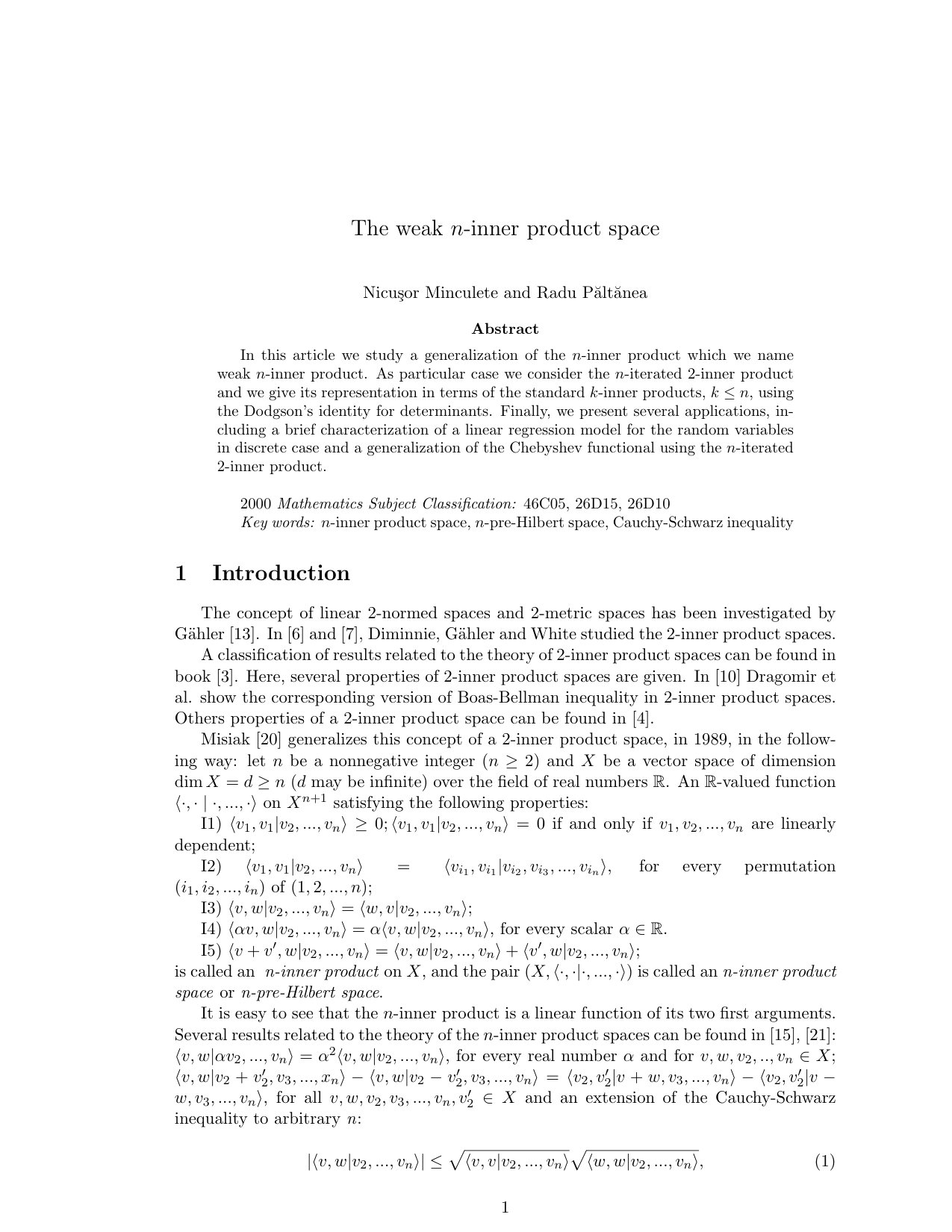 Figure 1
Peer Reviews
No public reviews on file for this paper yet. If you reviewed it on a platform where reviews are public (OpenReview, ICLR, NeurIPS, ICML), you can paste yours below so the community can read it here.
Videos
No videos yet. Explain this paper in a talk, walkthrough, or lecture? Add one.
Taxonomy
TopicsApproximation Theory and Sequence Spaces · Advanced Algebra and Logic · Functional Equations Stability Results
The weak -inner product space
Nicuşor Minculete and Radu Păltănea
Abstract
In this article we study a generalization of the -inner product which we name weak -inner product. As particular case we consider the -iterated -inner product and we give its representation in terms of the standard -inner products, , using the Dodgson’s identity for determinants. Finally, we present several applications, including a brief characterization of a linear regression model for the random variables in discrete case and a generalization of the Chebyshev functional using the -iterated -inner product.
2000 Mathematics Subject Classification: 46C05, 26D15, 26D10
Key words: -inner product space, -pre-Hilbert space, Cauchy-Schwarz inequality
1 Introduction
The concept of linear 2-normed spaces and 2-metric spaces has been investigated by Gähler [13]. In [6] and [7], Diminnie, Gähler and White studied the 2-inner product spaces.
A classification of results related to the theory of 2-inner product spaces can be found in book [3]. Here, several properties of 2-inner product spaces are given. In [10] Dragomir et al. show the corresponding version of Boas-Bellman inequality in 2-inner product spaces. Others properties of a 2-inner product space can be found in [4].
Misiak [20] generalizes this concept of a 2-inner product space, in 1989, in the following way: let be a nonnegative integer and be a vector space of dimension ( may be infinite) over the field of real numbers . An -valued function on satisfying the following properties:
I1) if and only if are linearly dependent;
I2) , for every permutation of ;
I3) ;
I4) , for every scalar .
I5) ;
is called an * n-inner product* on , and the pair is called an n-inner product space or n-pre-Hilbert space.
It is easy to see that the -inner product is a linear function of its two first arguments. Several results related to the theory of the -inner product spaces can be found in [15], [21]: , for every real number and for ; , for all and an extension of the Cauchy-Schwarz inequality to arbitrary n:
[TABLE]
for all . The equality holds in (1) if and only if are linearly dependent.
Other consequences from the above properties can be inferred very easily:
[TABLE]
[TABLE]
for all .
Let be an -inner product space, . We can define a function on by
[TABLE]
for all , which in [20] is shown that satisfies the following conditions:
N1) and if and only if are linearly dependent;
N2) is invariant under permutation;
N3) , for any scalar
N4) ,
for all
A function defined on and satisfying the above conditions is called an n-norm on X and is called a linear n-normed space.
It is easy to see that if is an n-inner product space over the field of real numbers , then is a linear n-normed space and the n-norm is generated by the n-inner product .
Furthermore, we have the parallelogram law [3],
[TABLE]
for all and the polarization identity (see e.g. [3] and [4]),
[TABLE]
for all
The standard -inner product on an inner product space is given by:
[TABLE]
which generates -norm representing the volume of the -dimensional parallelepiped spanned by
Various type of applications of -inner products and -norms can be found in recent papers [2], [16], [17], [18], [22], [23], [25], [26].
Remark 1**.**
The standard -inner product satisfies also the following additional condition:
I6) If are linearly dependent, then ,
for .**
The motivation of this article is to study another type of -inner product built based on the properties of the -inner product, except property I2. We will define the weak -inner product and the -iterated -inner product and we will give its representation in terms of the standard -inner products, , using the Dodgson’s identity for determinants. We also present a brief characterization of a linear regression model for the random variables in discrete case. Finally, we generalize the Chebyshev functional using the -iterated -inner product.
2 The weak -inner product
Let be a real vector space.
Definition 1**.**
An -valued function on , , satisfying the following properties:
P1)* Positivity: if and only if are linearly dependent;*
P2)* Interchangeability: ;*
P3)* Symmetry: ;*
P4)* Homogeneity: , for every scalar .*
P5)* Additivity: ;
is called a weak -inner product on , and the pair is called a weak -inner product space or weak n-pre-Hilbert space.*
Remark 2**.**
It is easy to see that:
[TABLE]
Remark 3**.**
Obviously an -inner product is a weak -inner product, so an -inner product space is a weak -inner product space, but the reciprocal is not true. This fact will be shown in Remark 4.
For a weak -inner product is also an -inner product. For a weak -inner product can be build, for instance, by formula
[TABLE]
where is a -inner product* and is a function with properties and iff are linearly dependent (in the case , this means ).*
In the next lemma we generalize a property that exists in the case of -inner products. The method of the proof is based on the method used in [4].
Lemma 1**.**
Let . If are linearly dependent, then
[TABLE]
Proof We consider two cases.
Case 1. are linearly independent. Consider the vector
[TABLE]
Then from P1) we hve . This inequality is equivalent to
[TABLE]
Since are linearly dependent, from P1) we obtain and hence
[TABLE]
Since are linearly independent it follows that . Consequently one obtains (5).
Case 2. are linearly dependent. Then also are are linearly dependent. We have
[TABLE]
Because , , relation (5) follows.
Theorem 1**.**
Suppose that is a weak n-inner product space over the field of real numbers . Let , be fixed. Denote . Define the quotient space , where , . Then function , , is well defined and is a semi-inner product on . Moreover, if are linearly independent, then is an inner product.
Proof Let , such that and . Using Lemma 1 we get . This means that is well defined.
From P1) we have . Moreover, if , then , which implies that are linearly dependent. If are linearly independent it follows that . Then .
The other properties of the inner product follow in a simple manner from conditions P3), P4) and P5).
Theorem 2**.**
( Schwarz type inequality)* Let be a weak -inner product space. For any we have*
[TABLE]
In the case when are linearly independent, then the equality holds in (6) if and only if there exist and such that .
Proof By taking into account Theorem 1 and the notations given there, we have
[TABLE]
If are linearly independent, then the equality holds in (6) iff there is , such that , i.e. exists for which . .
Definition 2**.**
Let be a weak -inner product space, . We can define a function on by
[TABLE]
Proposition 1**.**
If is a weak -inner product space, then function defined in (7) satisfies the following conditions:
- C1)
* and if and only if are linearly dependent;*
- C2)
;
- C3)
, for any scalar
- C4)
**
for all
Proof Conditions C1)-C4) follow immediately from conditions P1)-P5) and Definition 2.
Definition 3**.**
Let be a real vector space. A real function defined on and satisfying conditions C1)-C4) is called a weak -norm on and is called a linear weak -normed space.
It follows that if is a weak n-inner product space over the field of real numbers , then is a linear weak n-normed space and the weak n-norm is generated by the weak n-inner product .
Theorem 3**.**
In conditions of Theorem 1, function , , is well defined and is a semi-norm on . Moreover, if are linearly independent, then is a norm.
Proof It follows immediately from Theorem 1, since , , where function was defined in this theorem.
In an inner product space, a special weak -inner product can be defined by recurrence starting from the -inner product. Recall that the -inner product was studied in [3], [4].
Definition 4**.**
Let be a real pre-Hilbert space. The -iterated -inner product, or standard weak -inner product is defined for as follows. For , coincides with the standard -inner product, i.e.
[TABLE]
Then, if and , define:
[TABLE]
Theorem 4**.**
If is a real pre-Hilbert space, then for any function given in Definition 4 is a weak -inner product.
Proof Consider proposition : the -iterated -inner product satisfies conditions P1)-P6). We prove this proposition by mathematical induction, for .
For , is true since we know from [3], [4], that the standard -inner product, , satisfies conditions .
Suppose is true and prove that proposition is true. The -iterated -inner product is given by
[TABLE]
Let us prove P1) for . First we prove that , for .
Case 1: . Then, from property P1) for , it results that are linearly dependent. From the hypothesis of induction and from Lemma 1 it follows that . Then
[TABLE]
Case 2: . From P1) for we have , for all , then
[TABLE]
We obtain the following relation:
[TABLE]
Since , the discriminant of this polynomial in variable is not strictly positive. Hence So, in both cases we obtain .
On the other hand, let us suppose that , which means that
[TABLE]
If , the expression above is equal to , where is the discriminat of the polynomial equation of degree 2 in : , where . Since the discriminat is [math], then there exists , for which . From condition P1) for it follows that are linearly dependent. Then, there are the numbers , not all null, such that . Therefore, are linearly dependent. If , then are linearly dependent from P1) for . Then are linearly dependent. Condition P1) is completely proved for .
We prove condition P2) for :
[TABLE]
[TABLE]
Consequently, condition P2) is true for .
We pass to the verification of condition P3). We have
[TABLE]
[TABLE]
because , for any square matrix and . So, the -iterated -inner product satisfies condition P3) for .
We pass now to condition P4). Since we have
[TABLE]
[TABLE]
it follows that condition P4) is proved for .
For condition P5) for , we take into account that can be expressed by a determinat of second order, having on the first line the elements and , respectively, and on the second line, elements which do not depend on and . Then, using by induction the additivity in the first argument of the products above, and then the additivity of the determinant with regard to the first line, it follows immediately that
[TABLE]
Proposition 2**.**
Let be a real pre-Hilbert space. For , and :
[TABLE]
Proof For , Then, it follows by mathematical induction.
Remark 4**.**
Theorem 4 allows us to furnish an example of weak -inner product which is not a -inner product. For this, let endowed with the usual inner product. Then, from Theorem 4, -iterated -inner product is a weak -inner product, but it is not a -inner product. Indeed, if axiom I2) would be true for -iterated -inner product then we must have:
[TABLE]
But, if we choose , , we have
[TABLE]
and on other hand
[TABLE]
Hence relation (11) is not true. Consequently axiom I2) is not satisfied. Therefore -iterated -inner product is not a -inner product.
3 Representation of the -iterated -inner product in terms of the standard -inner products,
In this section we obtain a representation of the -iterated -inner product, given in Definition 4 in terms of the standard -inner products . For this we use Dodgson’s identity for determinants, [8], [9]. Historical notes about this identity, in connection with Chiò’s formula can be found in [1]. To express this identity we adopt the compact notation used by Eves [11]. If is a square matrix, denote the determinant of by and the sub-determinant involving rows and columns by . In [11] - Theorem 3.6.3, the following Dodgson type identity is proved:
[TABLE]
For us it is more convenient to use the following identity :
[TABLE]
For one has:
[TABLE]
Formula (13) can be easily obtained applying formula (12). Indeed, first note that
[TABLE]
Then, applying rule (12) for our new matrix we find
[TABLE]
Note that, conversely, from relation (13) one can deduce relation (12).
Let be an inner product space. For , from (13), for we deduce
[TABLE]
Hence, we obtained
[TABLE]
Also, using formula (13), for and then formula (15) we obtain :
[TABLE]
[TABLE]
Hence
[TABLE]
The results obtained in (15) and (16) can be generalized as it is shown in the next theorem. We extend the definition of the standard weak -inner product, for , by the convention .
Theorem 5**.**
Let be an inner product space. For , consider the vectors . Then
[TABLE]
where and
[TABLE]
Proof For the theorem is immediate, since and . For the theorem follows from relation (15), for the choice and . Then . For we prove by induction. Suppose the theorem true for and let us prove it for . Using the hypothesis of induction we get
[TABLE]
We transform all the four elements from the above determinant. Each of them is a determinant of order . First, in the following determinant, changing the order of the last lines and then changing the order of the last columns we obtain successively
[TABLE]
Next, for the second determinant, we change the order of all the columns and then we change the order of the last lines we obtain:
[TABLE]
since
Similar operations there can be made for the third determinant. We change the order of all the lines and then we change the order of the last columns and we get:
[TABLE]
Finally, applying formula I2) we have
[TABLE]
Consider the matrix
[TABLE]
Denote the elements of by , . Using the notation given in the beginning of the section we can write .
From formula (20) we obtain .
From formula (21) we obtain .
From formula (22) we obtain .
From formula (23) we obtain .
Then applying formula (13) for instead of we arrive to
[TABLE]
If we change the order of the last lines and of the last columns in the determinant does not change, i.e.
[TABLE]
But
[TABLE]
Therefore,
[TABLE]
Also, if we change the order of the lines and columns in determinat , the value does not change. Hence
[TABLE]
But
[TABLE]
Therefore,
[TABLE]
From relations (24), (25) and (26) we conclude that
[TABLE]
Replacing in (19) we obtain
[TABLE]
Since it results, finally, that
[TABLE]
4 Several applications of the iterated -inner product
1. Let be an inner product space. Let . From Definition 4 we deduce
[TABLE]
Relation (28) can be written as
[TABLE]
Since , then we obtain the inequality from Lupu and Schwarz [19] given by the following:
[TABLE]
2. Formula (15) can be written in the form
[TABLE]
Therefore, for , we have Also, since in the case , the determinant in (31) is the Gram’s determinant , from relation (31) we can deduce:
[TABLE]
Since, also and it results
[TABLE]
3. From Theorem 5 for we find that the iterated -inner product can be given in the following way:
[TABLE]
From relation (34), for we deduce:
[TABLE]
where is the Gram’s determinant.
In [4], Cho, Matić and Pec̆arić, used Gram’s determinant of the vectors with respect to the vector by:
[TABLE]
We consider the following determinant, which can be rewritten using formula (14):
[TABLE]
From relations (34) and (37) we find the following identity:
[TABLE]
which implies the relation:
[TABLE]
4. Let be vectors in the inner product space over the field of real numbers and the vectors being linearly independent, such that
[TABLE]
where
We want to study the problem of determining the scalars . Using the inner product and its properties, we deduce
[TABLE]
Therefore, we have to solve this system with three equations and three unknowns The matrix of the system is
[TABLE]
From formula (31) we find:
[TABLE]
From P1) is zero if and only if the vectors are linearly dependent. But, the vectors are linearly independent, therefore, we have . Using the Cramer method, we find that
[TABLE]
In the particular case when we obtain:
[TABLE]
5. Next, we will make a correlation of the previous calculations with the coefficients that appear in the case of a multiple linear regression model.
A process is called multiple linear regression, when we have more than one independent variable [12]. For a general linear model for two independent variables and and a dependent variable , , where ; ; with probabilities , , for any
We can describe the underlying relationship between and involving error term by .
If we take , then we have to find Using the Lagrange method, we obtain
[TABLE]
By simple calculations, we deduce
[TABLE]
Now, we take the vector space For we have
[TABLE]
[TABLE]
and
[TABLE]
If , where , then the average of vector is \mu_{x}=\bigg{\langle}\frac{x}{\|u\|},e\bigg{\rangle}=\frac{1}{n}\sum_{i=1}^{n}x_{i}, and we have
[TABLE]
Therefore, in , we define the variance of a vector by var(x):=\bigg{\|}\frac{x}{\|u\|}|e\bigg{\|}^{2}.
The standard deviation of is defined by , so we deduce that \sigma(x)=\bigg{\|}\frac{x}{\|u\|}|e\bigg{\|}. Since, using the standard -inner product, we have
[TABLE]
it is easy to define the covariance of two vectors and by
[TABLE]
It is easy to see that, we obtain
[TABLE]
We observe that by the vector method we obtain the same coefficients as by the Lagrange method.
6. In [24], the Chebyshev functional is defined by
[TABLE]
for all , where is a given nonzero vector.
It is easy to see that if the standard -inner product is defined by the inner product then we have .
Therefore, we generalize this Chebyshev functional to the following functional:
[TABLE]
which we will call n-Chebyshev functional, so
[TABLE]
for all , where are given nonzero vectors.
In a particular case, when , we have
[TABLE]
so, we have
[TABLE]
Therefore, the Cauchy-Schwarz inequality in terms of the -Chebyshev functional becomes:
[TABLE]
5 Conclusions
In this paper we exemplified the weak -inner product only by the weak iterated -inner product. This particular case of weak -inner product does not exhaust all the possibilities of particular cases. The weak -inner product is clearly more general then the -inner product and consequently it offers more possibilities. An important connection is between the vector method and the Lagrange method given above. In the future, we will determine a formula for multiple regression for independent variables.
Acknowledgment. The authors would like to thank to the reviewers for the pertinent remarks, which led to an improvement of the paper.
The reference list from the paper itself. Each links out to its DOI / PubMed record.
- 1[1] Abeles, F. F.: Chió’s and Dodgson’s determinantal identities. Linear Algebra and Its Applications 454 , 130-137 (2014)
- 2[2] Brzdȩk, J., Ciepliński, K.: A fixed point theorem in n 𝑛 n -Banach spaces and Ulam stability. J. Math. Anal. Appl. 470 (1), 632-646 (2019)
- 3[3] Cho, Y.J., Lin, P.C.S., Kim, S.S., Misiak, A.: Theory of 2 2 2 -inner Product Spaces. Nova Science Publishes Inc., New York (2001)
- 4[4] Cho, Y.J., Matic, M., Pec̆arić, J.E.: On Gram’s determinant in 2 2 2 -inner product spaces. J. Korean Math. Soc. 38 (6), 1125-1156 (2001)
- 5[5] Debnath, P., Saha, M.: Categorization of n 𝑛 n -inner product space. Asian Research J. Math. 11 (4). 1-10 (2018)
- 6[6] Diminnie, C., Gähler, S., White, A.: 2 2 2 -inner product spaces. Demonstr. Math. 6 , 525-536 (1973)
- 7[7] Diminnie, C., Gähler, S., White, A.: 2 2 2 -inner product spaces. II. Demonstr. Math. 10 , 169-188 (1977)
- 8[8] Dodgson, C.L.: Condensation of determinants, being a new and brief method for computing their arithmetical values, In: Proceedings of the Royal Society XV, 1866, 150–155, Reprint [Abeles, F. F. (Ed.): The Mathematical Pamphlets of Charles Lutwidge Dodgson and Related Pieces, Lewis Carroll Society of North America/University Press of Virginia, New York, Charlottesville (1994)]