
TL;DR
This paper constructs new types of corks for infinite nonabelian groups, expanding the understanding of exotic smooth structures on 4-manifolds and answering a question posed by Tange.
Contribution
It introduces the first examples of $G$-corks for infinite nonabelian groups and combines previous results to achieve this construction.
Findings
Constructed $G$-corks for any extension of $\\mathbb Z^m$ by finite subgroups of $SO(4)$.
Provided weakly equivariant $G$-corks for extensions by finite solvable groups.
Applied Gompf's results to produce exotic $\\mathbb R^4$'s with diffeotopy groups containing all poly-cyclic groups.
Abstract
We construct -corks for any extension of by any finite subgroup of and weakly equivariant -corks for any extension of by any finite solvable group. In particular, this is the first example of -corks for an infinite nonabelian group and answers a question by Tange. The construction is a combination of previous results by Auckly-Kim-Melvin-Ruberman, Gompf, and Tange. Using Gompf's results about exotic 's, we give an application to construct exotic 's whose diffeotopy group contains all poly-cyclic groups.
Click any figure to enlarge with its caption.
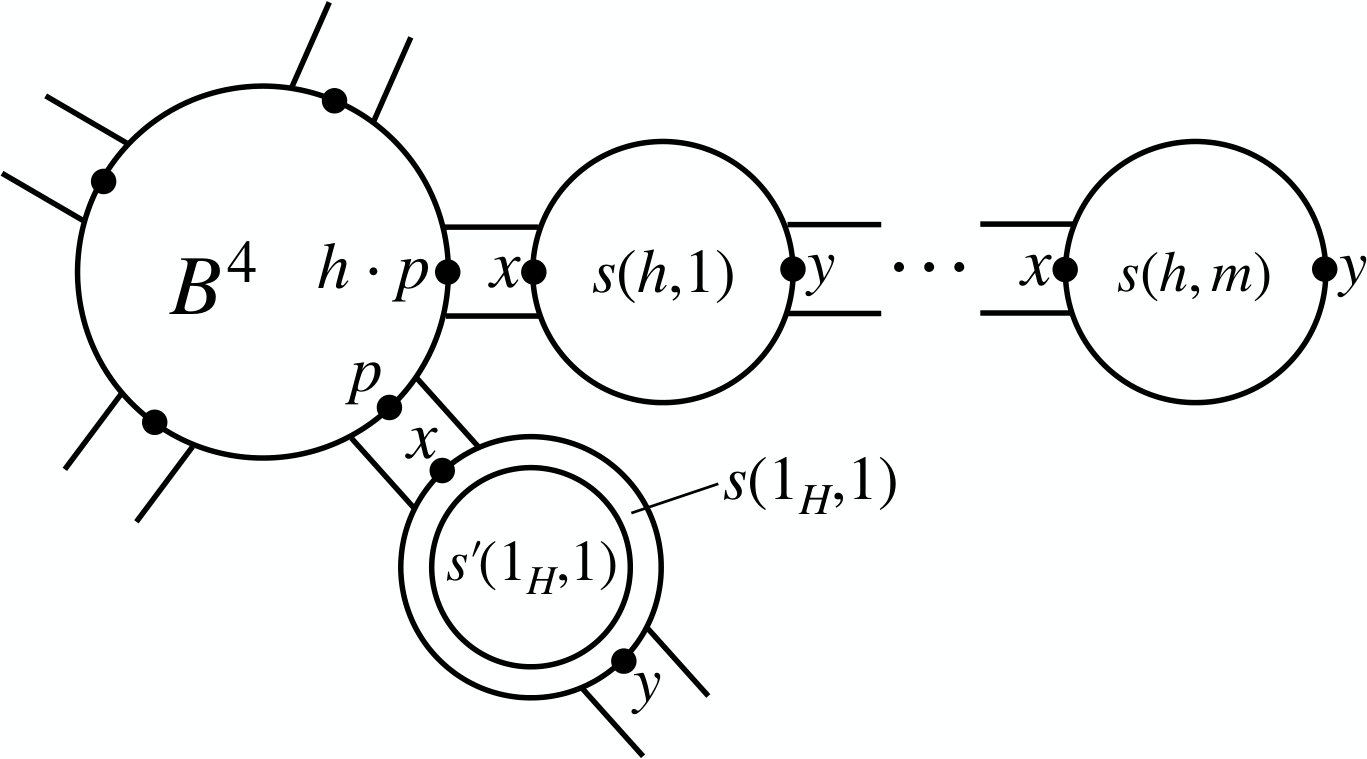 Figure 1
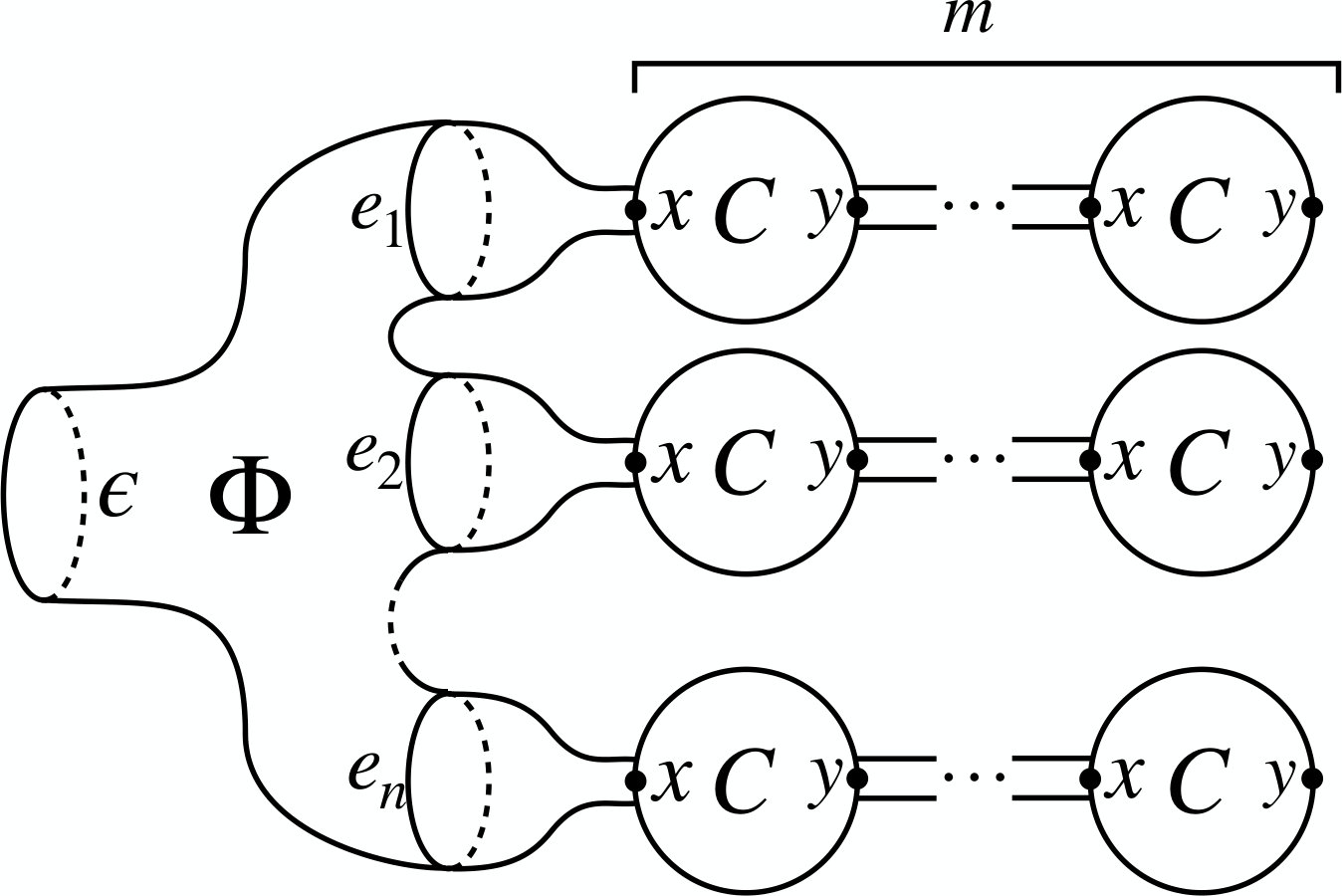 Figure 2
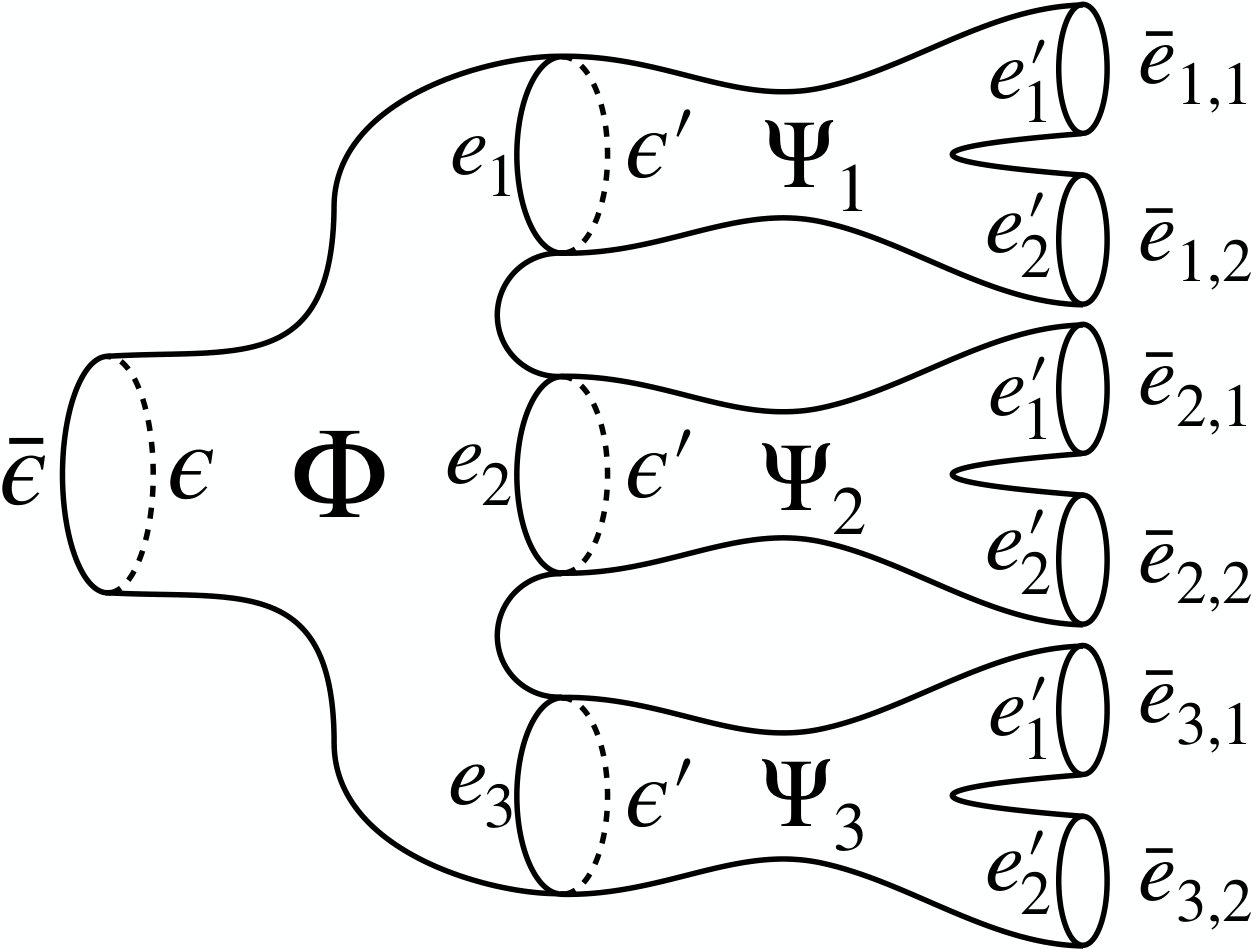 Figure 3
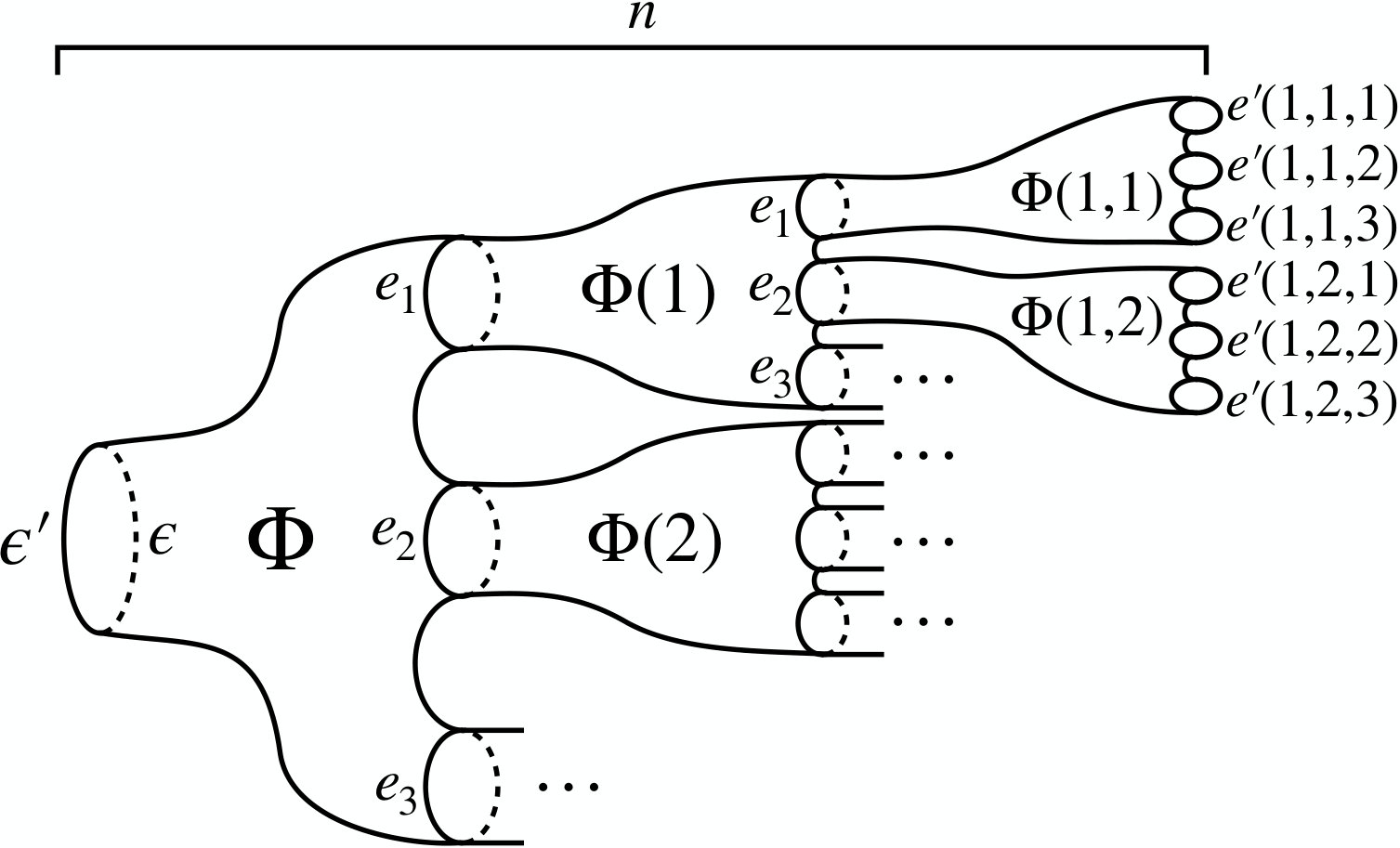 Figure 4
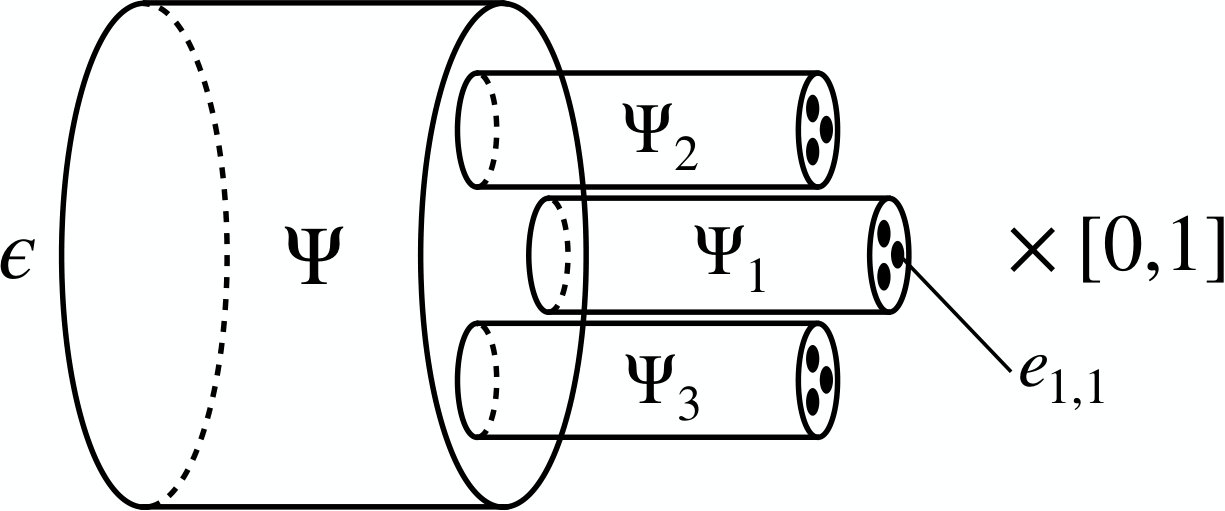 Figure 5
Peer Reviews
No public reviews on file for this paper yet. If you reviewed it on a platform where reviews are public (OpenReview, ICLR, NeurIPS, ICML), you can paste yours below so the community can read it here.
Videos
No videos yet. Explain this paper in a talk, walkthrough, or lecture? Add one.
Taxonomy
TopicsGeometric and Algebraic Topology
Infinite nonabelian corks
Hiroto Masuda
Department of Mathematics Faculty of Science and Technology, Keio University Yagami Campus: 3-14-1 Hiyoshi, Kohoku-ku, Yokohama, 223-8522, Japan
Abstract.
We construct -corks for any extension of by any finite subgroup of and weakly equivariant -corks for any extension of by any finite solvable group. In particular, this is the first example of -corks for an infinite nonabelian group and answers a question by Tange. The construction is a combination of previous results by Auckly-Kim-Melvin-Ruberman, Gompf, and Tange. Using Gompf’s results about exotic ’s, we give an application to construct exotic ’s whose diffeotopy group contains all poly-cyclic groups.
1. Introduction
Understanding all smooth structures on a given topological 4-manifold is a fundamental problem in 4-manifold theory. In dimension 4, manifolds often have a lot of exotic structures. For example, there are uncountably many ones on ([19]). Closed -manifolds can also have infinite ones. These contrast sharply with facts in other dimensions (cf. [11, Theorem 1.1.8, 1.1.9]). The richness of exotic structures in dimension is usually proved with the result of Freedman about topological -manifolds and that of Donaldson about smooth -manifolds (cf. [11]).
In 4-manifold theory, surgeries to create exotic structures on manifolds are studied actively. A cork twist is one of them. A cork is the pair of a compact contractible 4-manifold and an involution on its boundary which does not extend to a diffeomorphism on the whole manifold. For a closed 4-manifold and an embedding of into , we consider a new manifold obtained by cutting out and regluing it by the boundary diffeomorphism . This operation is called a cork twist. The two manifolds and are always homeomorphic (see Theorem 2.6). Curtis-Freedman-Hsiang-Stong and Matveyev proved in [6] and [12] that for any two simply connected homeomorphic 4-manifolds, there exists an embedded cork in one of them such that the other is obtained by the cork twist. We will refer to this as the cork theorem. There are many studies about corks and their applications from various viewpoints (cf. [1], [2], [3], [21], [4], [20]).
The notion of a cork is extended to that of a -cork and a weakly equivariant -cork, where is a group. Instead of an involution, a -cork uses a -action on the boundary and a weakly equivariant -cork uses a group homomorphism from to the diffeotopy group 111 The diffeotopy group of a manifold is . In other words, it is a mapping class group in the smooth category. of the boundary. Tange first found -corks in [17]. Auckly-Kim-Melvin-Ruberman constructed -corks for any finite subgroup of and weakly equivariant -corks for any finite abelian group 222The construction in [5, Theorem B] can be used for any finite abelian group . with an ingenious trick in [5]. Gompf constructed -corks in [8] and this work was extended to -corks by Tange in [18].
In spite of these active studies on -corks, a -cork or a weakly equivariant -cork for an infinite and nonabelian group has not been found, as Tange noted in [18, Question 1.5]. We deal with this problem. The aim of this research is determining large classes of infinite nonabelian groups for each in which there exists a -cork or a weakly equivariant -cork. Additionally, we consider if corks have an effective embedding, that is, an embedding into a closed 4-manifold whose cork twist yields pairwise homeomorphic but nondiffeomorphic 4-manifolds.
This theme is worth studying for the following reasons. First, it is interesting from the viewpoint of the diffeomorphism group of a homology -sphere. The boundary of a -cork (resp. a weakly equivariant -cork) is a homology -sphere and its diffeomorphism group (resp. its diffeotopy group) contains a subgroup isomorphic to . Secondly, cork theory is closely related to the diffeotopy group of an exotic by Gompf ([10]). Progress about cork theory may bring new results about exotic ’s. Indeed, (the proof of) our main theorem has an interesting application about them (Theorem 1.2). Thirdly, Tange pointed out that cork twists define a nontrivial structure on the set of all smooth structures on a given -manifold. He showed that a -cork analog of the cork theorem is false in [16] (cf. [21]). Moreover, Melvin-Schwartz showed that a -cork analog is true in [13]. Thus we should consider -corks and weakly equivariant -corks for an infinite group to reveal this structure.
We state our main theorem and an outline of its proof. First, we remark that we can not extend the trick in [5] directly to the case of infinite groups. Finiteness of a group is inherent in it because the resulting -cork is the boundary sum of copies of a cork. However, substituting Gompf’s cork for the cork in the trick gives extra -actions on the resulting -cork. We analyze the action generated by these - and extra -actions in detail and find a class of infinite nonabelian groups with -corks. Moreover, we see that we can iterate our idea in the case of weakly equivariant -corks. With group theoretical considerations, it shows that there exist weakly equivariant -corks for in a quite large class of nonabelian groups.
Theorem 1.1**.**
Let be any extension of by any finite group for any integer .
- (1)
If is a (finite) subgroup of , there exists a -cork. 2. (2)
There exists a generalized -cork. 3. (3)
If is solvable, there exists a weakly equivariant -cork. 4. (4)
If is solvable, there exists a Stein weakly equivariant -cork.
A generalized -cork is a -cork which can be non-contractible. The term ‘extension’ means that there exists an exact sequence .
We add a few remarks to the theorem. All corks in the theorem have an effective embedding into a closed -manifold. The corks in (1) and (3) (resp. (4)) are boundary sums of copies of Gompf’s cork (resp. Akbulut’s cork). Since whether Gompf’s corks admit Stein structures is unsolved ([9, Remarks (b)]), we do not know whether the corks in (1) and (3) are Stein.
The theorem implies the following two facts. First, we have a -cork since is an extension of by . This is the first example of -corks for a free product of two nontrivial groups. Secondly, it follows that for any finite solvable group , there exists a homology -sphere admitting a Stein fillable contact structure whose diffeotopy group contains .
We explain how cork theory is applied to exotic ’s and what our theorem implies. There is an open analog of the cork theorem, which twists an embedded exotic in a manifold to change its smooth structure instead of a cork (cf. [11, Theorem 9.2.18 and 9.3.1]). Using this similarity of corks and exotic ’s, Gompf imported the trick in [5] to the context of exotic ’s and constructed uncountably many exotic ’s whose diffeotopy group contains interesting subgroups, such as the direct product of countable copies of and the countably generated free group ([10]). However, groups with torsion elements were not dealt with very much. It is natural to ask what finite groups diffeotopy groups of exotic ’s can contain. Combining Gompf’s idea with our theorem, we get the following theorem, which gives a partial answer to this problem.
Theorem 1.2**.**
There exists an exotic whose diffeotopy group contains any poly-cyclic group.
For the definition of a poly-cyclic group, see Definition 5.3. We remark that all finite solvable groups are poly-cyclic by the definition.
This paper consists of 5 sections. In Section 2, we first see basic facts about a wreath product of groups. It plays a key role in our proof of Theorem 1.1. We then check the precise definitions of corks and state previous results needed later. We prove Theorem 1.1 (1) and (2) in Section 3 and Theorem 1.1 (3) and (4) in Section 4. In both sections, we first show them in the case of wreath products of certain groups and see that it is in fact equivalent to the general one. In Section 5, we prove Theorem 1.2.
2. Preliminaries
In this section, we first review the definition of a wreath product of groups and its properties. We then define some terminologies about corks and state some previous results needed later.
Throughout this paper, all manifolds are smooth. A closed (resp. compact) manifold is a manifold which is compact and without a boundary (resp. with a nonempty boundary). A diffeomorphism is orientation preserving unless otherwise stated. A diffeotopy is a smooth ambient isotopy. For a manifold , denotes the diffeomorphism group of and denotes the diffeotopy group of . The symbol or denotes the unit in a group .
2.1. Wreath products
A wreath product is a well-known operation in group theory. For more details, see [14]. This operation will be used repeatedly in our construction.
Let and be groups. The symbol denotes the set of all maps from to . It has the natural group structure defined by the pointwise multiplication. For any and , we define by for all . This determines a left action of on .
Definition 2.1**.**
The wreath product of by is the semidirect product of by with respect to the left action .
Note that the multiplication is defined by for all , . The group is an extension of by since is a normal subgroup with . If and are subgroups, can be embedded into . 333An embedding of a group means an injective homomorphism.
The following theorem states an important property of a wreath product.
Theorem 2.2** ([14, Theorem 10.9]).**
Let be a normal subgroup. The group can be embedded into the group .
This implies the following corollary. For the sake of simplicity, we omit parentheses in an iterated wreath product, i.e., we write simply
[TABLE]
although a wreath product is not associative.
Corollary 2.3** ([14, Corollary of Theorem 10.9]).**
Let be a subnormal series and let be its quotient group. The group G can be embedded into the iterated wreath product .
In particular, we have the following.
Corollary 2.4** ([14, the paragraph below Corollary of Theorem 10.9]).**
For any finite solvable group , there exist prime numbers such that can be embedded into .
Since is an extension of by , an inductive argument shows that is also solvable.
Lastly, we state the following slightly complicated proposition. This will be used in subsequent sections.
Proposition 2.5**.**
Let be groups, let be a finite group, let be a homomorphism, and let be homomorphisms indexed by elements . We assume that for any and , we have . Moreover, we assume that for any and with , we have . Then the map defined by is a homomorphism.
Note that is well-defined by the assumptions, that is, the order of multiplication of does not affect the result. An straightforward argument shows the proposition.
2.2. Corks
We first review terminologies related to corks. We follow the conventions in [5]. 444 The definition of a cork in this section is slightly different from that in Section 1. In this section, the boundary diffeomorphism of a cork does not have to be an involution. In Section 1, we followed [3] except for the Stein condition for the sake of the explanation. Note that there are different ones (cf. [2]).
Let be a compact contractible 4-manifold. A cork is the pair of and a diffeomorphism on . Furthermore, let be a group and let be a -action on . We consider as a homomorphism . The pair is called a -cork if maps any nontrivial element to a diffeomorphism on which does not extend over . Similarly, let be a homomorphism. The pair is called a weakly equivariant -cork if a representative of does not extend over for any nontrivial element as above. This is well-defined.
Let be as above and let be an embedding into a closed 4-manifold . Assume that is a cork. Cutting in and regluing it by , we get the new manifold . This operation is called a cork twist. The manifold is always homeomorphic to by the following theorem.
Theorem 2.6**.**
Let be a compact contractible 4-manifold and let be a diffeomorphism on . Then extends over homeomorphically.
A short proof of this theorem using Freedman’s results ([7]) can be found in [9, Remarks (a)]. If is not diffeomorphic to , is called effective. Next, assume that is a -cork. Identifying and , we write simply instead of . (Note that is always injective by the definition.) If the manifolds for are pairwise nondiffeomorphic, is called -effective. Lastly, assume that is a weakly equivariant -cork. For any , choose a representative of . The diffeomorphism type of does not depend on the choice of . It is denoted by . A -effective embedding is defined in the same way.
Next, we define a generalized -cork 555We can also define a generalized cork and a generalized weakly equivariant -cork but we do not use them.. This term was used by Tange in [15]. Let be a -cork. If we allow to be non-contractible and assume that is connected 666Tange does not assume to be connected explicitly in [15]. and that all the diffeomorphisms on for extend over homeomorphically, we call a generalized -cork. A -effective embedding of a generalized -cork is defined in the same way.
We will use the following results about disjoint embeddings of a cork and a -cork. Hereafter, for integers , and with and , denotes Gompf’s -cork constructed in [8] and denotes the generator of the -action on .
Theorem 2.7** (Auckly-Kim-Melvin-Ruberman [5, Lemma 2.2]).**
For any , there exist a closed 4-manifold , a cork , and disjoint embeddings for such that and are nondiffeomorphic for any with . Moreover, we can take to be diffeomorphic to the boundary sum of copies of Akbulut’s cork and thus Stein.
Theorem 2.8** (Tange [18, Theorem 1 and its proof]).**
Fix integers with and . For any , there exist a closed 4-manifold and disjoint embeddings for such that and are nondiffeomorphic for any , with . Consequently, we obtain a -cork by joining them with 1-handles.
For the definition of Akbulut’s cork, see [11, Section 9.3]. Note that is the manifold obtained by twisting each by . In Theorem 2.7, we can assume that is a -cork as they mentioned in [5] but we do not need this fact.
3. Constructing -corks
In this section, we prove the following theorem equivalent to Theorem 1.1 (1) and (2).
Theorem 3.1**.**
Let be an integer.
- (1)
For any finite subgroup , there exists a -cork. 2. (2)
For any finite group , there exists a generalized -cork.
Proposition 3.2**.**
Theorem 3.1 (1) and (2) are equivalent to Theorem 1.1 (1) and (2) respectively.
Proof.
Theorem 2.2 and the fact that is an extension of by imply the proposition. ∎
We prove (1) and (2) in the same way. The main idea is substituting Gompf’s -cork for a -cork in [5, the proof of Theorem A]. Recall that denotes Gompf’s cork and denotes the generator of the -action (see Section 2).
Proof of Theorem 3.1 (1)..
Fix with and and let . Let be a closed 4-manifold and be disjoint embeddings indexed by . For , we use to denote the manifold obtained by twisting each cork by . By Theorem 2.8, we can assume that two manifolds and are nondiffeomorphic if .
Next, we use the trick in [5]. Let be an embedding of a 4-ball which is disjoint from . Choose a point such that for any with . Now acts on by linear transformations. Let be fixed points of . We connect with , with , …, and with for all by -handles. The resulting manifold embedded in is denoted by . See Figure 1.
Let be an embedding obtained by shrinking . 777This is also part of the trick in [5]. To be more precise, is the composition of and a shrinking map isotopic to the identity on . We define . It is embedded in naturally, where denotes the element in whose value is 1 at and 0 otherwise. Let be the embedding of into .
We define actions on . By its construction, has the -action which is the linear action on and extended on Gompf’s corks and 1-handles trivially. Since we have , the restriction of the action to it defines a boundary action of . Next, we define -actions on indexed by . For any , let be the diffeomorphism which is on the support of 888This denotes the closure of the set . in the boundary of each Gompf’s cork and the identity on the rest. Note that the exponent of the power is doubled . The actions and for satisfy the assumptions of Proposition 2.5 and we get the homomorphism .
Lastly, we twist in . For any , we have . Therefore, they are pairwise nondiffeomorphic and is -effective. ∎
Proof of Theorem 3.1 (2).
Let and be as above. We connect in the following way. We choose indexed by and in the fixed points of . For each and , we attach a 1-handle to and . Thus, and are connected by two 1-handles and . Then we connect with by a 1-handle for any . The resulting manifold is the Cayley graph of whose vertices are boundary sums of copies of and edges are doubled 1-handles. Note that is connected.
Let be a shrunk and define and . The manifold is embedded in . Let be the -action on defined by for any , , and on each Gompf’s cork and extended over 1-handles. Thus, we have and , and these are the identities. We restrict it to . Let for be the -actions on same as the above proof. By Proposition 2.5, we get the homomorphism .
For any , extends homeomorphically over since the diffeomorphism on extends homeomorphically over by Theorem 2.6. We have , where is the inclusion map. It shows that is -effective. ∎
Question 3.3**.**
Does there exists a simply connected generalized -cork for any finite group ?
4. Constructing weakly equivariant -corks
In this section, we prove the following theorem equivalent to Theorem 1.1 (3) and (4).
Theorem 4.1**.**
Let and be any integers.
- (1)
There exists a weakly equivariant -cork. 2. (2)
There exists a weakly equivariant Stein -cork.
Recall that we omit parentheses in an iterated wreath product, see Section 2.
Proposition 4.2**.**
Theorem 4.1 (1) and (2) are equivalent to Theorem 1.1 (3) and (4) respectively.
Proof.
Theorem 2.2 and Corollary 2.4 imply the proposition. ∎
We use several lemmas to prove them. First, we define a block, which will be used throughout this section.
Definition 4.3**.**
A block is the tuple of a compact 4-manifold diffeomorphic to and disjoint embeddings .
Although is diffeomorphic to , it becomes useful later to use distinguishable symbols for of blocks. This is the reason why we include in the above definition.
Let be a diffeomorphism on . If we have and there exists such that for all , we call a diffeomorphism of the block . The set of all diffeomorphisms of is denoted by . The natural homomorphism defined by is denoted by , i.e., . Two diffeomorphisms and of are called diffeotopic over if there exists a diffeotopy between and consisting of diffeomorphisms in . The set of all diffeotopy classes over is denoted by . The homomorphism factors through the quotient map and we use the same symbol .
Definition 4.4**.**
Let be a group. For a homomorphism , we define the following two properties:
- (P1)
The map is injective. 2. (P2)
There exists such that are pairwise different for all .
Remark 4.5*.*
The above definitions are inspired by the definition of in [10, Section 4].
Lemma 4.6**.**
Let be a group. Assume that there exist a block and a homomorphism with (P2). Then there exists a weakly equivariant -cork for any and a weakly equivariant Stein -cork.
Though the proof is similar to that of Theorem 3.1, we describe it in detail. Recall again that denotes Gompf’s cork and denotes the generator of the -action (see Section 2).
Proof.
First, we prove the former. Fix integers ,, and with and , and let .
Let be a closed 4-manifold and let be disjoint embeddings indexed by . For , we use to denote the manifold obtained by twisting each by . By Theorem 2.8, we can assume that two manifolds and are nondiffeomorphic if .
Next, we join them via embedded . Let be an embedding of into disjoint from . Choose two fixed points of . We connect with , with , …, and with by 1-handles for each . The resulting submanifold in is denoted by . See Figure 2.
Let be a point as in (P2). We use the trick in [5]. Let be a shrunk as in the proof of Theorem 3.1. We define and . The manifold is embedded in naturally.
We define actions on . Let be the homomorphism which is on and extended over to be the permutation of components of by . We restrict to the boundary and get the homomorphism ; we use the same symbol . Next, fix and let . For any , let be the diffeomorphism which is on the support of in for all and the identity otherwise. Note that the exponent is doubled. The map is a group homomorphism. Composing the quotient map , we get ; we use the same symbol again. Since and for satisfy the assumptions in Proposition 2.5, we get the homomorphism .
The inclusion map is a -effective embedding since we have for any , where is the element defined by for any and and otherwise. Thus is a weakly equivariant -cork.
The latter is proved in the same way, and it is exactly the trick by Auckly-Kim-Melvin-Ruberman in [5]. Replace Theorem 2.8 with Theorem 2.7 and Gompf’s cork with the cork in Theorem 2.7, and ignore the -actions in the above proof. ∎
Lemma 4.7**.**
Let , be groups. Assume that there exist two blocks and and two homomorphisms and such that is (P2) and is (P1). Then there exist a block and a homomorphism such that is (P1).
Proof.
We first glue and copies of in the following way: for any , we glue in the block and in the -th copy of . The resulting manifold is denoted by . Let be in for and let be in . We define a block . See Figure 3.
We extend to defined to be the permutation of by on the rest. Let be a point as in (P2). Fix and let . We extend on the -th copy of to which is the identity on the rest. These and for satisfy the assumptions in Proposition 2.5 and we get the homomorphism . It is easy to see that is (P1). ∎
Lemma 4.8**.**
For any , there exist a block and a homomorphism with (P2).
Proof.
We first define a block . Let be , let be a ball whose center is , and let be one whose center is for . We define by , which is the -rotation of for .
Next, we connect with copies of . We glue in and in for . The resulting manifold is denoted by . Let be in and be in . We combine them to get the block . See Figure 4.
For any , let be the trivial extension of on , and let be the extension of on defined to be the cyclic permutation of on the rest. We define a homomorphism by . Let be the composition of and the quotient map.
Since is the Dehn twists along each -ball in , , , , and these -balls can be pushed into the boundary disjointly, we have in by [5, Lemma 3.1]. Thus factors through the quotient map and we get . It is easy to see that this satisfy (P2). ∎
Lemma 4.9**.**
If there exist a block and a homomorphism with (P1), there exist another block and another homomorphism with (P2).
Proof.
We combine copies of to obtain . First, let be copies of . (We use the notation to indicate an index rather than since indices will become complicated.) We glue in and in for all . Next, for , let be a copy of . Again we glue in and in for all . Repeat this process times. Let be the resulting manifold, let be in for , and let be in . We define a block . See Figure 5.
For any and any , we extend to which is the permutation of the components joined to by and the identity on the one joined to . We define a homomorphism by
[TABLE]
Note that does not depend on the order of multiplication.
Since we have and is (P1), is (P2) ∎
Proof of Theorem 4.1 (1) and (2).
Let and be integers. By Lemma 4.8, there exist a block and a (P2) homomorphism . Applying Lemma 4.7 repeatedly, we get a block and a (P1) homomorphism . Lemma 4.9 implies that there exist a block and a (P2) homomorphism . We get a weakly equivariant -cork and a weakly equivariant Stein -cork by Lemma 4.6. ∎
Question 4.10**.**
Does there exists a weakly equivariant (Stein) -cork for any finite (or even countable) group ?
Question 4.11**.**
Are Theorem 1.1 (3) and (4) true if we assume a weakly equivariant -cork to be boundary sum irreducible?
5. Applications to diffeotopy groups of exotic ’s
Gompf recently applied cork theory and constructed exotic ’s with large diffeotopy groups in [10]. We can also use the wreath product approach in this context and get the following theorem. Hereafter, we define .
Theorem 5.1**.**
There exists an exotic such that there exists an embedding for any .
Remark 5.2*.*
- (a)
Gompf already mentioned the key point of the proof of the theorem in [10, the last sentence of Example 4.3 (a)]. The author specified the groups in it and used weak actions 999A weak action indicates a homomorphism into the diffeotopy group of a manifold. in [10, Theorem 4.4]. 2. (b)
Since the resulting manifold of the proof of the theorem is same as that of [10, Theorem 4.4], we can assume that meets same conditions as [10, Theorem 4.4].
We see subgroups of .
Definition 5.3** ([14, p.122]).**
A group is said to be poly-cyclic if there exists a subnormal series such that each quotient group is a (finite or infinite) cyclic group.
A finite solvable group is poly-cyclic. We have the following theorem in the same way as Corollary 2.4.
Corollary 5.4**.**
For any poly-cyclic group , there exist natural numbers which are prime or [math] such that can be embedded into .
Thus, in Theorem 5.1 contains any poly-cyclic group and we get Theorem 1.2.
The proof of Theorem 5.1 is very similar to that of [10, Theorem 4.4]. While Gompf mainly considered group actions, we use weak group actions.
First, we consider an open analog of a block in Section 4. An open block is the tuple of an open manifold diffeomorphic to and disjoint embeddings each of which is proper. Since we consider open manifolds now, can be countably infinite. Note that we do not assume that the disjoint union of for and is proper, i.e., the embedding
[TABLE]
can be non-proper.
We define , , , and the (P1) and (P2) properties in the same way, except we use the symmetric group on the set instead of . To be more precise, a diffeomorphism of is in if and only if we have and there exists with for all , is the quotient group of by diffeotopies through it, and we define .
Definition 5.5**.**
We define to be the set of isomorphic classes of groups each of which has a (P) homomorphism into for some open block , where .
The set is an analog of in [10] with weak actions. Note that the (P2) condition was used in [10, Theorem 4.6].
Theorem 5.6**.**
There exists an exotic R whose diffeotopy group contains any group in .
This theorem can be shown in the completely same way as [10, Theorem 4.4].
We then prove an open analog of Lemma 4.7. This is what Gompf already mentioned implicitly (see Remark 5.2 (a)).
Lemma 5.7**.**
For any and , we have .
Proof.
The proof is same as that of Lemma 4.7, except we need Proposition 2.5 with infinite .
Let and be open blocks and let and be homomorphisms with (P2) and (P1), respectively. We connect with copies of indexed by as in the proof of Lemma 4.7, using end summing instead of boundary summing. The resulting manifold is the end sum of finite or countably infinite copies of and thus diffeomorphic to (see [10, the proof of Theorem 4.4] for how to deal with non-properness of the map (1)). Let be in . We get the open block .
The homomorphism extends to naturally. Let be a point as in (P2). We define for to be on for all and the identity on the rest. The map defined by is a homomorphism with (P1). ∎
Lastly, we prove an open analog of Lemma 4.8.
Lemma 5.8**.**
For any with , we have .
Allowing manifolds to be open implies the case of .
Proof.
The case of follows from Lemma 4.8. Thus we consider the case of . Let be a smooth function with on and on . Let be the tubular neighborhood of in and let be that of in it. Then the tuple is an open block. The diffeomorphism of defined by generates a (P2) homomorphism . ∎
Proof of Theorem 5.1..
For any , Lemma 5.8 and Lemma 5.7 imply and thus the theorem follows from Theorem 5.6. ∎
Remark 5.9*.*
An analog of [10, Theorem 4.6] is also true, i.e., there exists an exotic such that every group has an embedding with . See [10] for details.
Question 5.10**.**
Does there exist an exotic whose diffeotopy group contains any finite (or even countable) group? If this is false, for any finite (or countable) group , does there exist an exotic whose diffeotopy group contains ?
Acknowledgements
The author would like to thank his advisor Kenta Hayano for encouragement and useful comments.
The reference list from the paper itself. Each links out to its DOI / PubMed record.
- 1[1] Selman Akbulut. A fake compact contractible 4 4 4 -manifold. J. Differential Geom. , 33(2):335–356, 1991.
- 2[2] Selman Akbulut and Kouichi Yasui. Corks, plugs and exotic structures. J. Gökova Geom. Topol. GGT , 2:40–82, 2008.
- 3[3] Selman Akbulut and Kouichi Yasui. Knotting corks. J. Topol. , 2(4):823–839, 2009.
- 4[4] Dave Auckly, Hee Jung Kim, Paul Melvin, and Daniel Ruberman. Stable isotopy in four dimensions. J. Lond. Math. Soc. (2) , 91(2):439–463, 2015.
- 5[5] Dave Auckly, Hee Jung Kim, Paul Melvin, and Daniel Ruberman. Equivariant corks. Algebr. Geom. Topol. , 17(3):1771–1783, 2017.
- 6[6] C. L. Curtis, M. H. Freedman, W. C. Hsiang, and R. Stong. A decomposition theorem for h ℎ h -cobordant smooth simply-connected compact 4 4 4 -manifolds. Invent. Math. , 123(2):343–348, 1996.
- 7[7] Michael Hartley Freedman. The topology of four-dimensional manifolds. J. Differential Geom. , 17(3):357–453, 1982.
- 8[8] Robert E. Gompf. Infinite order corks. Geom. Topol. , 21(4):2475–2484, 2017.