Experimental observation of dynamical bulk-surface correspondence for topological phases
Ya Wang, Wentao Ji, Zihua Chai, Yuhang Guo, Mengqi Wang, Xiangyu Ye,, Pei Yu, Long Zhang, Xi Qin, Pengfei Wang, Fazhan Shi, Xing Rong, Dawei Lu,, Xiong-Jun Liu, Jiangfeng Du

TL;DR
This paper demonstrates a method to classify topological quantum phases dynamically using NV centers in diamond, revealing a bulk-surface correspondence in momentum space through a quench process.
Contribution
It introduces a robust dynamical classification approach for topological phases that is independent of quench methods and resilient to decoherence effects.
Findings
Measured dynamical topological invariants via spin-texture imaging
Observed high topological numbers in experiments
Validated the robustness of the dynamical classification method
Abstract
We experimentally demonstrate a dynamical classification approach for investigation of topological quantum phases using a solid-state spin system through nitrogen-vacancy (NV) center in diamond. Similar to the bulkboundary correspondence in real space at equilibrium, we observe a dynamical bulk-surface correspondence in the momentum space from a dynamical quench process. An emergent dynamical topological invariant is precisely measured in experiment by imaging the dynamical spin-textures on the recently defined band-inversion surfaces, with high topological numbers being implemented. Importantly, the dynamical classification approach is shown to be independent of quench ways and robust to the decoherence effects, offering a novel and practical strategy for dynamical topology characterization, especially for high dimensional gapped topological phases.
Click any figure to enlarge with its caption.
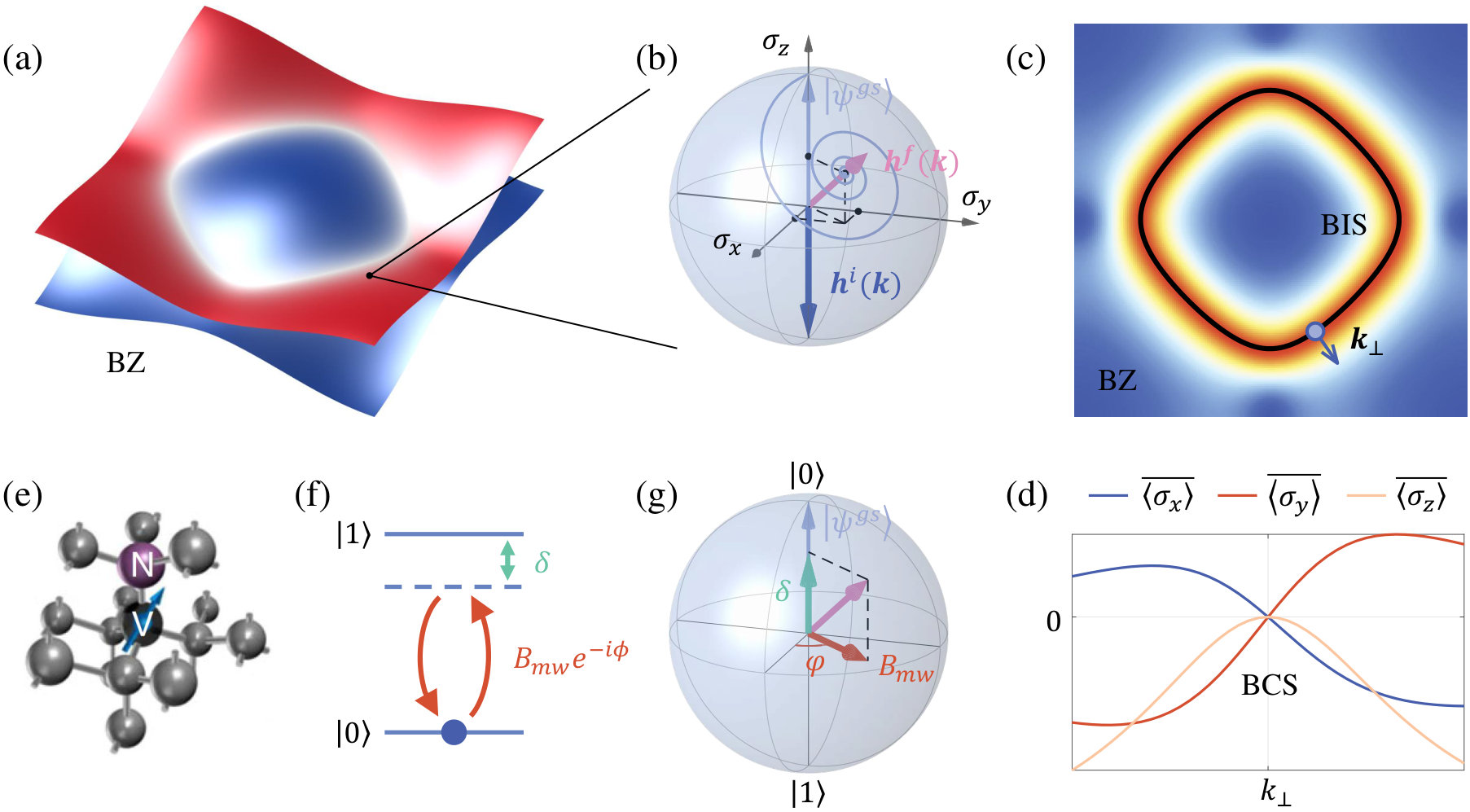 Figure 1
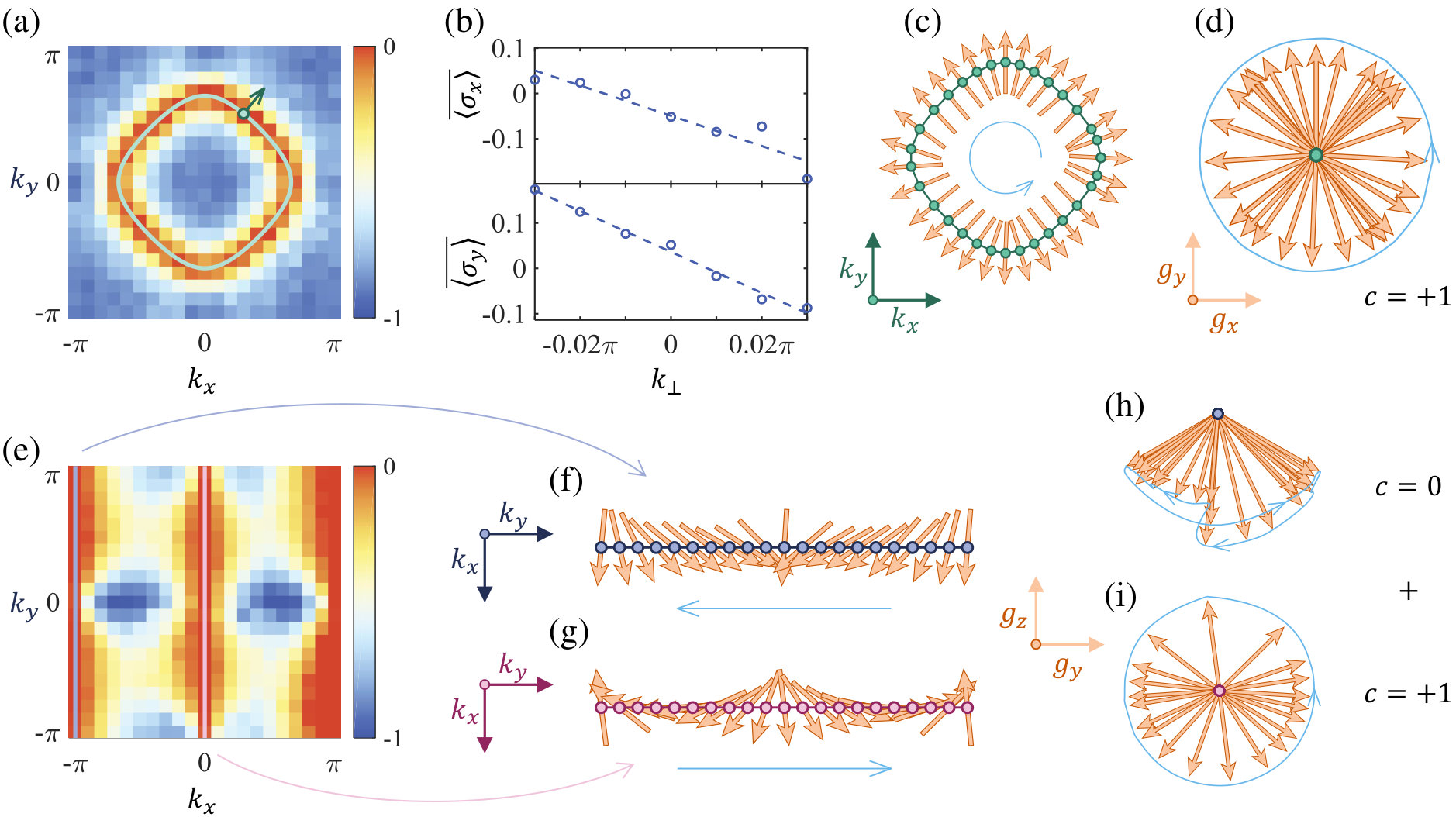 Figure 2
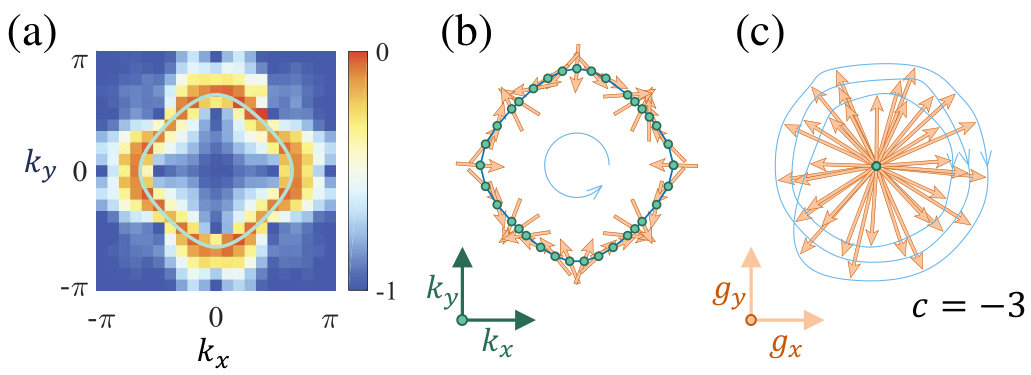 Figure 3
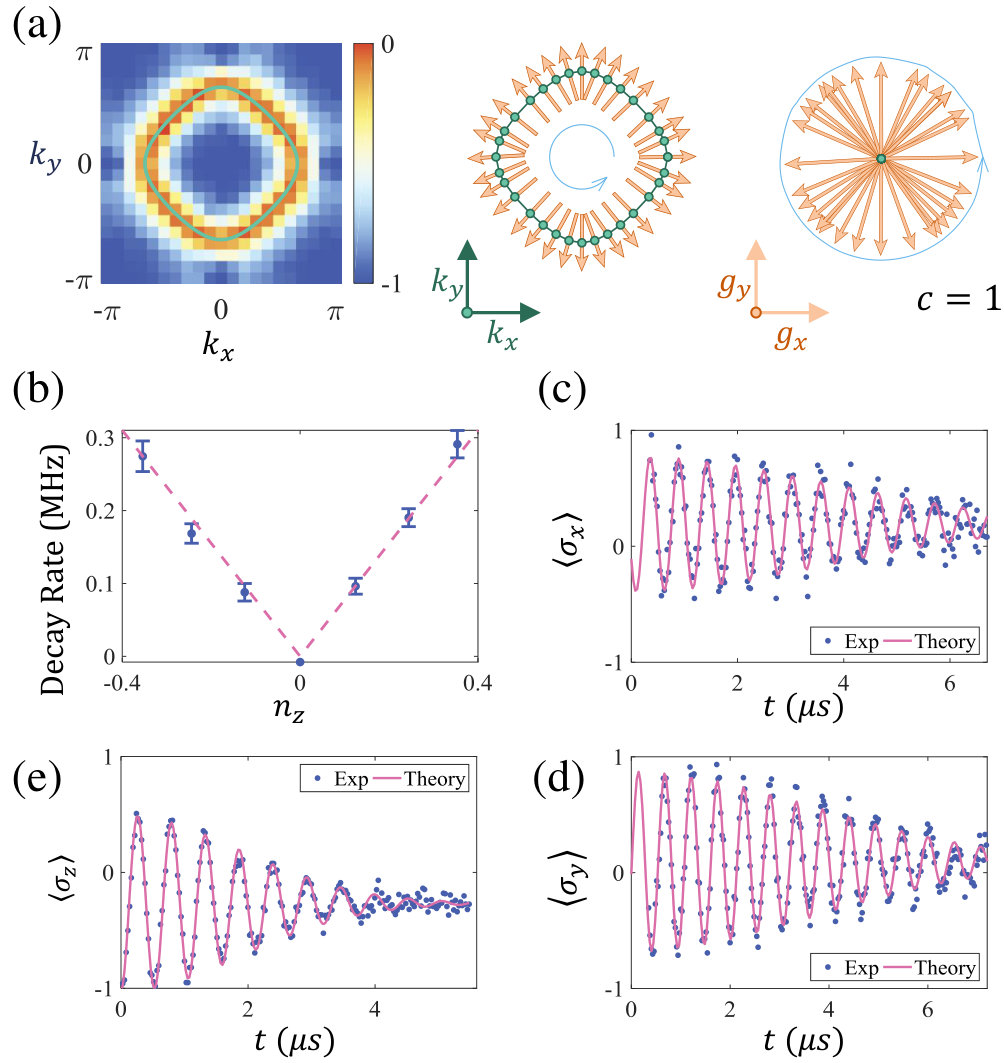 Figure 4
Peer Reviews
No public reviews on file for this paper yet. If you reviewed it on a platform where reviews are public (OpenReview, ICLR, NeurIPS, ICML), you can paste yours below so the community can read it here.
Videos
No videos yet. Explain this paper in a talk, walkthrough, or lecture? Add one.
Experimental observation of dynamical bulk-surface correspondence for topological phases
Ya Wang
Hefei National Laboratory for Physical Sciences at the Microscale and Department of Modern Physics, University of Science and Technology of China, Hefei 230026, China
CAS Key Laboratory of Microscale Magnetic Resonance, University of Science and Technology of China
Synergetic Innovation Center of Quantum Information and Quantum Physics, University of Science and Technology of China
Wentao Ji
Hefei National Laboratory for Physical Sciences at the Microscale and Department of Modern Physics, University of Science and Technology of China, Hefei 230026, China
CAS Key Laboratory of Microscale Magnetic Resonance, University of Science and Technology of China
Synergetic Innovation Center of Quantum Information and Quantum Physics, University of Science and Technology of China
Zihua Chai
Hefei National Laboratory for Physical Sciences at the Microscale and Department of Modern Physics, University of Science and Technology of China, Hefei 230026, China
CAS Key Laboratory of Microscale Magnetic Resonance, University of Science and Technology of China
Synergetic Innovation Center of Quantum Information and Quantum Physics, University of Science and Technology of China
Yuhang Guo
Hefei National Laboratory for Physical Sciences at the Microscale and Department of Modern Physics, University of Science and Technology of China, Hefei 230026, China
CAS Key Laboratory of Microscale Magnetic Resonance, University of Science and Technology of China
Synergetic Innovation Center of Quantum Information and Quantum Physics, University of Science and Technology of China
Mengqi Wang
Hefei National Laboratory for Physical Sciences at the Microscale and Department of Modern Physics, University of Science and Technology of China, Hefei 230026, China
CAS Key Laboratory of Microscale Magnetic Resonance, University of Science and Technology of China
Synergetic Innovation Center of Quantum Information and Quantum Physics, University of Science and Technology of China
Xiangyu Ye
Hefei National Laboratory for Physical Sciences at the Microscale and Department of Modern Physics, University of Science and Technology of China, Hefei 230026, China
CAS Key Laboratory of Microscale Magnetic Resonance, University of Science and Technology of China
Synergetic Innovation Center of Quantum Information and Quantum Physics, University of Science and Technology of China
Pei Yu
Hefei National Laboratory for Physical Sciences at the Microscale and Department of Modern Physics, University of Science and Technology of China, Hefei 230026, China
CAS Key Laboratory of Microscale Magnetic Resonance, University of Science and Technology of China
Synergetic Innovation Center of Quantum Information and Quantum Physics, University of Science and Technology of China
Long Zhang
International Center for Quantum Materials, School of Physics, Peking University, Beijing 100871, China
Collaborative Innovation Center of Quantum Matter, Beijing 100871, China
Xi Qin
Hefei National Laboratory for Physical Sciences at the Microscale and Department of Modern Physics, University of Science and Technology of China, Hefei 230026, China
CAS Key Laboratory of Microscale Magnetic Resonance, University of Science and Technology of China
Synergetic Innovation Center of Quantum Information and Quantum Physics, University of Science and Technology of China
Pengfei Wang
Hefei National Laboratory for Physical Sciences at the Microscale and Department of Modern Physics, University of Science and Technology of China, Hefei 230026, China
CAS Key Laboratory of Microscale Magnetic Resonance, University of Science and Technology of China
Synergetic Innovation Center of Quantum Information and Quantum Physics, University of Science and Technology of China
Fazhan Shi
Hefei National Laboratory for Physical Sciences at the Microscale and Department of Modern Physics, University of Science and Technology of China, Hefei 230026, China
CAS Key Laboratory of Microscale Magnetic Resonance, University of Science and Technology of China
Synergetic Innovation Center of Quantum Information and Quantum Physics, University of Science and Technology of China
Xing Rong
Hefei National Laboratory for Physical Sciences at the Microscale and Department of Modern Physics, University of Science and Technology of China, Hefei 230026, China
CAS Key Laboratory of Microscale Magnetic Resonance, University of Science and Technology of China
Synergetic Innovation Center of Quantum Information and Quantum Physics, University of Science and Technology of China
Dawei Lu
Shenzhen Institute for Quantum Science and Engineering and Department of Physics, Southern University of Science and Technology, Shenzhen 518055, China
Center for Quantum Computing, Peng Cheng Laboratory, Shenzhen 518055, China
Shenzhen Key Laboratory of Quantum Science and Engineering, Shenzhen 518055, China
Xiong-Jun Liu
International Center for Quantum Materials, School of Physics, Peking University, Beijing 100871, China
Collaborative Innovation Center of Quantum Matter, Beijing 100871, China
Shenzhen Institute for Quantum Science and Engineering and Department of Physics, Southern University of Science and Technology, Shenzhen 518055, China
Beijing Academy of Quantum Information Science, Beijing 100193, China
Jiangfeng Du
Hefei National Laboratory for Physical Sciences at the Microscale and Department of Modern Physics, University of Science and Technology of China, Hefei 230026, China
CAS Key Laboratory of Microscale Magnetic Resonance, University of Science and Technology of China
Synergetic Innovation Center of Quantum Information and Quantum Physics, University of Science and Technology of China
Abstract
We experimentally demonstrate a dynamical classification approach for investigation of topological quantum phases using a solid-state spin system through nitrogen-vacancy (NV) center in diamond. Similar to the bulk-boundary correspondence in real space at equilibrium, we observe a dynamical bulk-surface correspondence in the momentum space from a dynamical quench process. An emergent dynamical topological invariant is precisely measured in experiment by imaging the dynamical spin-textures on the recently defined band-inversion surfaces, with high topological numbers being implemented. Importantly, the dynamical classification approach is shown to be independent of quench ways and robust to the decoherence effects, offering a novel and practical strategy for dynamical topology characterization, especially for high dimensional gapped topological phases.
The topology of quantum systems has been developed into a major focus of research in physics since the discovery of quantum Hall effect Klitzing et al. (1980); Tsui et al. (1982). Beyond the states of quantum matter characterized by Landau symmetry-breaking theory, the topological quantum phases bear a myriad of properties depending only on the topology Xiao et al. (2010); Thouless et al. (1982); Wen (1990), with the most celebrated paradigms discovered recently including the topological insulators Kane and Mele (2005); Bernevig and Zhang (2006); Konig et al. (2007); Hsieh et al. (2008); Xia et al. (2009); Chang et al. (2013) and semimetals Xu et al. (2015); Lv et al. (2015). Among the many exotic features emerging in a topological matter, the bulk-boundary correspondence is the most fundamental phenomenon showing that on the boundary gapless states can be obtained corresponding to and protected by the nontrivial topology in the bulk Hasan and Kane (2010); Qi and Zhang (2011).
At equilibrium, the number of topologically protected surface (edge) states is uniquely related to the bulk topological invariants Hasan and Kane (2010); Qi and Zhang (2011). This allows to detect topological insulators Konig et al. (2007); Hsieh et al. (2008); Xia et al. (2009); Chang et al. (2013) and semimetals Xu et al. (2015); Lv et al. (2015) by resolving the surface states from transport measurement or angle resolved photoemission spectroscopy. Apart from the direct measurement in condensed matter physics, quantum simulation may provide new strategies for the characterization Aidelsburger et al. (2013); Liu et al. (2013a); Miyake et al. (2013); Atala et al. (2013); Su et al. (1979); Jotzu et al. (2014); Aidelsburger et al. (2015); Lohse et al. (2016); Nakajima et al. (2016); Schweizer et al. (2016); Song et al. (2018); Flaschner et al. (2016); Liu et al. (2013b); Wu et al. (2016). For example, the band topology of 1D Su-Schrieffer-Heeger (SSH) chain can be determined by measuring the Zak phaseAtala et al. (2013); Su et al. (1979), the bulk topology of a 2D Chern insulator can be observed by Hall transport studies Jotzu et al. (2014); Aidelsburger et al. (2015), by Berry curvature mapping Flaschner et al. (2016), or by a minimal measurement strategy Liu et al. (2013b) of imaging the spin texture at symmetric Bloch spaceWu et al. (2016). In addition, these systems naturally offer powerful probes and controllability in comparison with their condensed matter counterpart, which enables the study of non-equilibrium physics across topological phase transitions. A generic protocol in state-of-the-art experiments is to prepare a topologically trivial initial state and then observe the non-equilibrium dynamics after the Hamiltonian has been quenched into a topological regime. For such non-equilibrium process, the bulk-boundary correspondence, however, is no-longer valid D’Alessio and Rigol (2015); Caio et al. (2015); Hu et al. (2016); Wilson et al. (2016). A natural challenge is to find a generic method to reveal dynamical signatures of topology. Recent works Heyl and Budich (2017); Tarnowski et al. (2017); Wang et al. (2017); Zhang et al. (2018) start to study this question. In particular, a novel dynamical classification theory Zhang et al. (2018), which applies to a generic -dimensional (D) gapped topological phase, was proposed to address this fundamental issue theoretically. It shows that the equilibrium bulk topology universally corresponds to the dynamical topology emerging in the D momentum subspace called band inversion surfaces (BISs). An initial experiment implementing this scheme has been performed in atomic systems Sun et al. (2018) very recently. However, the essential dynamical bulk-surface correspondence, which necessitates to observe the dynamical topological invariant on BISs, is still not observed.
In this letter, we experimentally study the dynamical classification scheme with a diamond nitrogen-vacancy (NV) center spin system. We observe a dynamical bulk-surface correspondence Zhang et al. (2018) that the nontrivial bulk topology is related to a topological dynamical field emerging on BISs in the momentum subspace. Further, we show that this dynamical correspondence is not only universal in different quenching dynamics, but more importantly, invulnerable even in the presence of decoherence. Our results show a novel and practical strategy for dynamical topology characterization, which has broad applications in exploring topological quantum matter.
We consider the 2D quantum anomalous Hall model Liu et al. (2014) realized in recent experiments Wu et al. (2016) to illustrate the scheme,
[TABLE]
where represents the momentum, denotes the spin-conserved coefficients, and denotes spin-flip hopping coefficients corresponding to the 2D spin-orbit (SO) coupling, with Pauli matrices. It is equivalent to an effective Zeeman field depending on the momentum k applied in the Brillouin zone (BZ). By tuning the term , the quantum system is trivial for or topologically nontrivial for and . Fig. 1(a) shows a typical band structure of the system in the topological regime, which exhibits band crossings. The general idea of our dynamical quenching method is summarized in Fig. 1(b-d). Through a sudden change of h(k) from a trivial regime to a topological regime , the initial quantum state (ground state of ) will evolve under the final Hamiltonian ). For example, Fig. 1(b) displays a general momentum-dependent spin dynamics by quenching along the axis. The time averaged spin polarization (only component shows here) vanishes on a closed ring (Fig. 1(c)), indicating the BIS for the 2D system, while near the BIS the dynamical spin polarizations ( and components) can reconstruct the SO field and determine the topological invariant (Fig. 1(d)).
We realize the scheme in a highly controllable solid-state system, which is a color defect named the NV center in diamond (Fig. 1(e)) Doherty et al. (2013). The electrons around the defect form an effective electron spin with a spin triplet ground state (S = 1). In an external magnetic field along the NV axis, the electron spin states are well separated from each other and the states are used to study the two-band mode (Fig. 1(f)). In the simulation, a green laser pulse is used to initialize the electron spin into state which can then be prepared into the ground state of by unitary control, while a microwave pulse is applied to realize the final Hamiltonian. In the rotating frame, the Hamiltonian is written as , where is the detuning of the microwave frequency, and are the driving amplitude and phase of the pulse. By choosing , and , the electron spin of NV center in subspace spanned by evolves exactly under the Hamiltonian (Fig. 1(g)).
The experiment was performed on a confocal setup at room temperature. The NV center was created by nitrogen ion implantation Pezzagna et al. (2010) with an energy of 30 Kev. To improve the photon collection efficiency, a nanopillar structure Momenzadeh et al. (2015); Shi et al. (2018) was fabricated. An external static magnetic field around 370 Gauss was applied to remove the degeneracy between and . Microwave pulses were irradiated via a coplanar waveguide and controlled by an arbitrary wave generator (CRS-AWG-C2S10N02, ChinaInstru Quantum Tech). An arbitrary sequence generator (ASG-GT50-C, ChinaInstru Quantum Tech) with 50 picosecond time resolution was used to control the timing sequences of the excitation laser and microwaves.
The quench study is performed by suddenly tuning the magnetization from an initial trivial phase into a topological regime. To measure the dynamical topological invariant emerging on BIS, we resolve the spin in a complete set of basis composed of through a combination of microwave and laser pulses. The Rabi oscillations following quench are recorded at all points, from which the time-averaged spin polarizations are measured based on the first four periods. In Fig. 2 we consider two sets of examples for the detection. As shown in Fig. 2(a-d), we first quench the system along axis with the post-quench parameters being . After determining the BIS by measuring , the time-averaged spin polarizations are measured at momentum points along the norm vector of BIS (Fig.1(c)). Fig. 2(b) shows the linear area of Fig. 1(b), from which one obtains a dynamical spin-texture field Zhang et al. (2018) with the components by measuring the slope, with the normalization factor. Fig. 2(c) shows the full imaging of this dynamical field, from which the topological invariant can be obtained through . Here instead we use the definition of winding number directly. Fig. 2(c) shows the visualization of the spin-texture field by redrawing them with the vector starting points jointed. One can count the number of revolutions to obtain the magnitude of topological invariant, and determine its sign according to the rotation direction. A counterclockwise full rotation is observed indicating that the winding number is , directly corresponding to Chern number of the bulk.
Further, we implement the experimental measurement by quenching along axis [Fig. 2(e-g)], with the parameters being fixed. The Hamiltonian reads . The quenching parameter is suddenly varied from to 0. In this case the initial state is prepared as through a green laser pulse followed by a pulse. The BISs (Fig. 2(e)) are measured by reading out the evolution in the basis. This quenching leads to different configurations of BISs, which are identified as two lines at and connecting the edges of Brillouin zone Zhang et al. (2018). The dynamical fields on the BISs are further obtained from the measurements in the basis of and . As shown in Fig. 2(f) and (g), the dynamical field shows a trivial pattern along at but a nontrivial pattern at , giving the total winding number being . These results show that while the configurations of BISs and quench dynamics are sharply different in different quench processes, the emergent topology in the quench dynamics is identical, showing from experiment that the dynamical characterization is universal.
We further apply this dynamical approach to characterize the topological phase with high Chern number . For this we implement the Hamiltonian that , with before quench and after quench. It can be shown that in equilibrium the lower Bloch band of the post-quench Hamiltonian has a high Chern number with . The measured results for quenching along axis are shown in Fig. 3. On BIS [see (a,b)], the length of the dynamical field in Fig. 3(c) is varied for a clear display. Three full clockwise rotations along the closed BIS are explicitly observed, giving the dynamical winding number as , which corresponds to the 2D Chern number of the bulk.
Finally, we explore an important issue, the validity of the dynamical classification in the presence of decoherence, which is a crucial issue generically existing in quantum dynamics. To investigate the effect of decoherence, we repeat the whole process as in Fig. 2(a-d), but with much longer evolution time. As shown in Fig. 4(c-e), this induces an obvious decay in all spin components () of the spin dynamics. Surprisingly, we find that the dynamical classification method is very robust to the decoherence. As shown in Fig. 4(a), the BIS and topological invariant are almost the same as the results shown in Fig. 2(a-d). To gain a deep understanding of this excellent feature, we model the quench dynamics by considering the dominant dephasing noise arising from the nuclear spin bath around the central NV electron spinDu et al. (2009); Zhao et al. (2012)
[TABLE]
Here the last -term in the right hand side represents the static magnetic noise which satisfies Gaussian distribution with the standard deviation . In the realistic case, we consider a relatively weak noise with strength . The time-evolution of the spin polarization () following quench is given by
[TABLE]
where and are determined by initial condition. As shown in Fig. 4(b-c), this analytical form explains the experimental observations quite well. After time averaging, the time-dependent part vanishes and only the constant term is left, giving . Accordingly, the dynamical topology emerging on the BIS is not affected by the decoherence and well characterizes the post-quench topology.
The above result shows that the the present dynamical classification approach is fully immune to the dephasing effect. The essential reason is because the dynamical characterization adopts only the time-averaged terms, which naturally involve only the diagonal parts of the density matrix and insensitive to decoherence. Actually, the dephasing evolves an arbitrary initial state to the mixed one described by a density matrix . With the mixed density matrix the spin polarizations at each momentum is unchanged, so is the topology. The high stability of the emergent dynamical topology on BIS may have potential applications in the future.
We have experimentally demonstrated a powerful dynamical classification approach in exploring topological quantum states. A dynamical bulk-surface correspondence was observed and demonstrated to be universal in different quenching dynamics. More importantly, we found that the emergent topology of quench dynamics is robust even in the presence of decoherence. As shown in a latest theory Zhang et al. , the similar decoherence arises from correlation effects in the dynamical characterization of an interacting topological system. Our study implies that the present dynamical simulator based on NV center may be useful to further emulate effectively the correlation effects in the topological characterization. This study can be generalized to high dimensional gapped topological phases.
Acknowledgement.- This work is supported by the National Key RD Program of China (Grant No. 2018YFA0306600, 2017YFA0305000, 2016YFA0301604, 2016YFB0501603), the NNSFC (Grants No. 11775209, 81788101, 11761131011, 11761161003, 11722544, 11574008, 11825401, 11605005, 11875159, U1801661), the CAS (Grants No. GJJSTD20170001, No. QYZDY-SSW-SLH004, No. QYZDB-SSW-SLH005), Anhui Initiative in Quantum Information Technologies (Grant No. AHY050000), the Fundamental Research Funds for the Central Universities, the Innovative Program of Development Foundation of Hefei Center for Physical Science and Technology (Grants No. 2017FXCX005), Science, Technology and Innovation Commission of Shenzhen Municipality (Grants No. ZDSYS20170303165926217, JCYJ20170412152620376), Guangdong Innovative and Entrepreneurial Research Team Program (Grant No. 2016ZT06D348), the Thousand-Young-Talent Program of China and the Youth Innovation Promotion Association of Chinese Academy of Sciences.
The reference list from the paper itself. Each links out to its DOI / PubMed record.
- 1Klitzing et al. (1980) K. v. Klitzing, G. Dorda, and M. Pepper, Phys. Rev. Lett. 45 , 494 (1980) . · doi ↗
- 2Tsui et al. (1982) D. C. Tsui, H. L. Stormer, and A. C. Gossard, Phys. Rev. Lett. 48 , 1559 (1982) . · doi ↗
- 3Xiao et al. (2010) D. Xiao, M. C. Chang, and Q. Niu, Rev. Mod. Phys. 82 , 1959 (2010) . · doi ↗
- 4Thouless et al. (1982) D. J. Thouless, M. Kohmoto, M. P. Nightingale, and M. den Nijs, Phys. Rev. Lett. 49 , 405 (1982) . · doi ↗
- 5Wen (1990) X. G. Wen, International Journal of Modern Physics B 04 , 239 (1990) . · doi ↗
- 6Kane and Mele (2005) C. L. Kane and E. J. Mele, Phys. Rev. Lett. 95 , 146802 (2005) . · doi ↗
- 7Bernevig and Zhang (2006) B. A. Bernevig and S.-C. Zhang, Phys. Rev. Lett. 96 , 106802 (2006) . · doi ↗
- 8Konig et al. (2007) M. Konig, S. Wiedmann, C. Brune, A. Roth, H. Buhmann, L. W. Molenkamp, X. L. Qi, and S. C. Zhang, Science 318 , 766 (2007) . · doi ↗