Dynamical spin-orbit coupling of a quantum gas
Ronen M. Kroeze, Yudan Guo, and Benjamin L. Lev

TL;DR
This paper demonstrates the realization of dynamical one-dimensional spin-orbit coupling in a Bose-Einstein condensate within an optical cavity, revealing a superradiant phase transition that induces spinor-helix polariton condensates with potential for exploring exotic quantum states.
Contribution
It introduces a novel method to generate dynamical spin-orbit coupling in a quantum gas using cavity QED, linking superradiance with spin-orbit effects in a controlled setting.
Findings
Observation of superradiant phase transition with spin-orbit coupling
Formation of spinor-helix polariton condensates
Emergence of SOC through spin-resolved momentum imaging
Abstract
We realize the dynamical 1D spin-orbit-coupling (SOC) of a Bose-Einstein condensate confined within an optical cavity. The SOC emerges through spin-correlated momentum impulses delivered to the atoms via Raman transitions. These are effected by classical pump fields acting in concert with the quantum dynamical cavity field. Above a critical pump power, the Raman coupling emerges as the atoms superradiantly populate the cavity mode with photons. Concomitantly, these photons cause a back-action onto the atoms, forcing them to order their spin-spatial state. This SOC-inducing superradiant Dicke phase transition results in a spinor-helix polariton condensate. We observe emergent SOC through spin-resolved atomic momentum imaging. Dynamical SOC in quantum gas cavity QED, and the extension to dynamical gauge fields, may enable the creation of Meissner-like effects, topological superfluids, and…
Click any figure to enlarge with its caption.
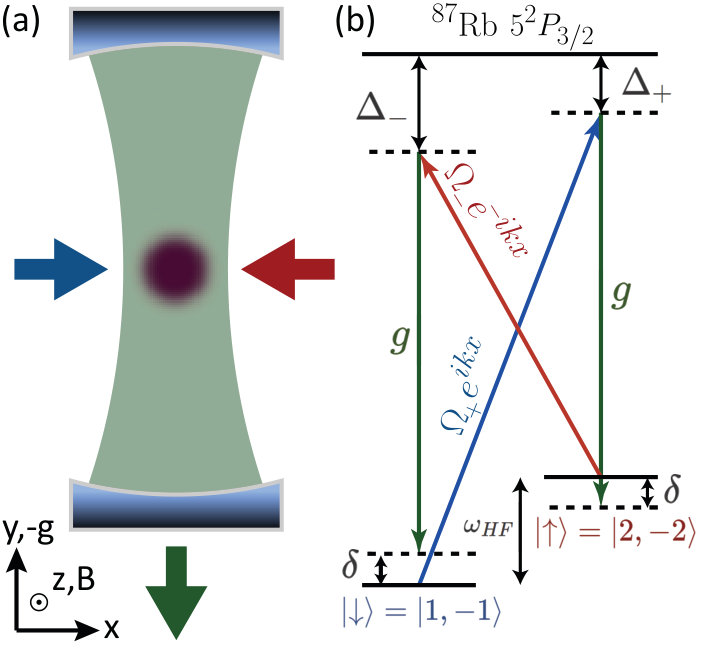 Figure 1
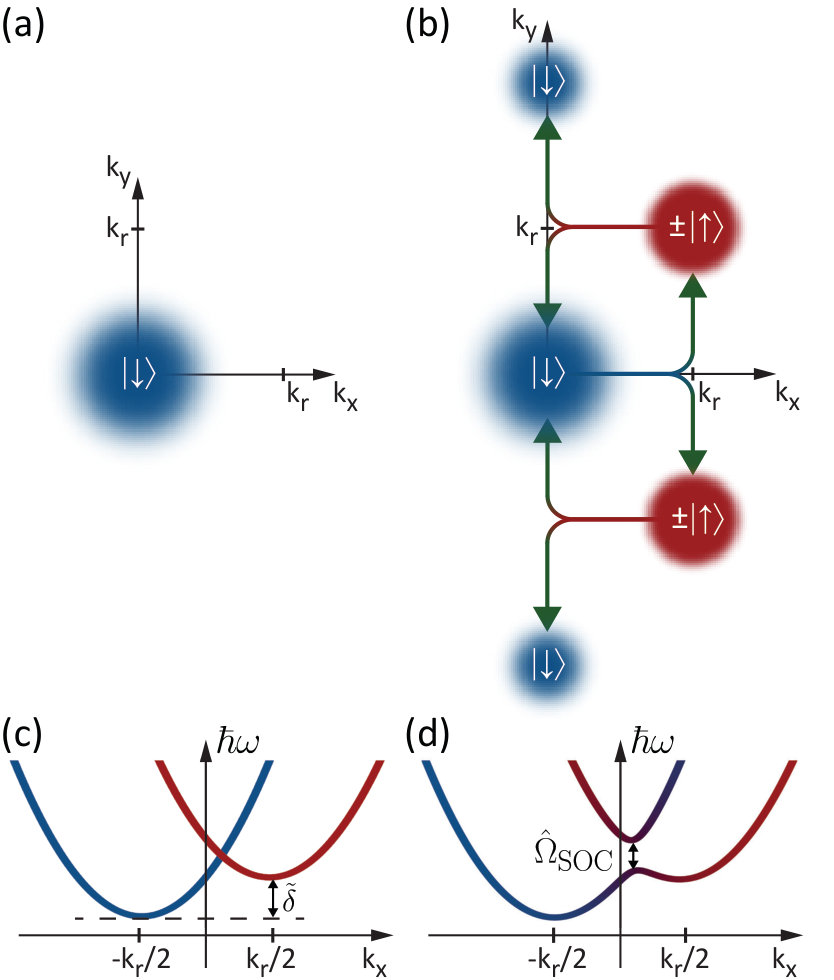 Figure 2
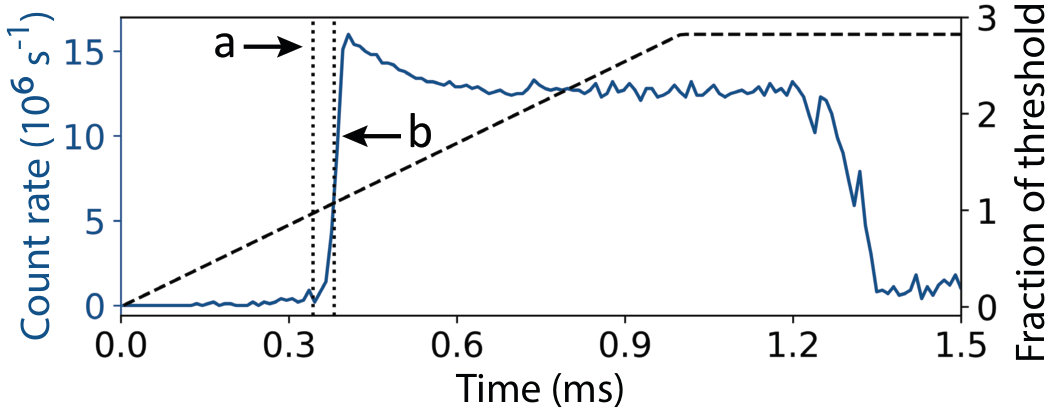 Figure 3
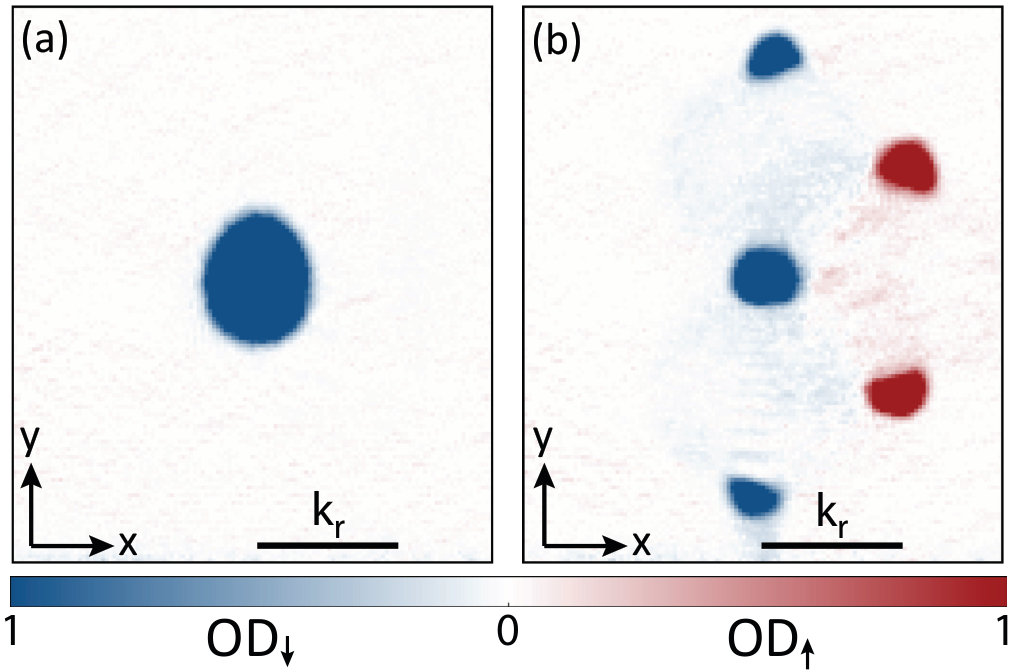 Figure 4
Peer Reviews
No public reviews on file for this paper yet. If you reviewed it on a platform where reviews are public (OpenReview, ICLR, NeurIPS, ICML), you can paste yours below so the community can read it here.
Videos
No videos yet. Explain this paper in a talk, walkthrough, or lecture? Add one.
Dynamical spin-orbit coupling of a quantum gas
Ronen M. Kroeze
Department of Physics, Stanford University, Stanford, CA 94305, USA
E. L. Ginzton Laboratory, Stanford University, Stanford, CA 94305, USA
Yudan Guo
Department of Physics, Stanford University, Stanford, CA 94305, USA
E. L. Ginzton Laboratory, Stanford University, Stanford, CA 94305, USA
Benjamin L. Lev
Department of Physics, Stanford University, Stanford, CA 94305, USA
E. L. Ginzton Laboratory, Stanford University, Stanford, CA 94305, USA
Department of Applied Physics, Stanford University, Stanford, CA 94305, USA
Abstract
We realize the dynamical 1D spin-orbit-coupling (SOC) of a Bose-Einstein condensate confined within an optical cavity. The SOC emerges through spin-correlated momentum impulses delivered to the atoms via Raman transitions. These are effected by classical pump fields acting in concert with the quantum dynamical cavity field. Above a critical pump power, the Raman coupling emerges as the atoms superradiantly populate the cavity mode with photons. Concomitantly, these photons cause a back-action onto the atoms, forcing them to order their spin-spatial state. This SOC-inducing superradiant Dicke phase transition results in a spinor-helix polariton condensate. We observe emergent SOC through spin-resolved atomic momentum imaging. Dynamical SOC in quantum gas cavity QED, and the extension to dynamical gauge fields, may enable the creation of Meissner-like effects, topological superfluids, and exotic quantum Hall states in coupled light-matter systems.
Quantum simulation in the ultracold atomic physics setting has been enriched by techniques using laser-induced atomic transitions to create synthetic gauge fields Spielman (2009); Dalibard et al. (2011); Goldman et al. (2014), including spin-orbit-coupling (SOC) Lin et al. (2011). Quantum gases in synthetic gauge fields may allow the creation of exotic quantum phases such as topological superfluids in a pristine environment Jiang et al. (2011); Goldman et al. (2014); Ruhman et al. (2015). At the same time, strong and tunable atom-atom interactions mediated by cavity QED light-matter coupling has introduced new capabilities into quantum simulation Kimble (1998); Ritsch et al. (2013); Vaidya et al. (2018); Guo et al. (2018a, b). As such, many-body cavity QED provides unique opportunities for exploring quantum phases and transitions away from equilibrium Diehl et al. (2010); Sieberer et al. (2013); Ritsch et al. (2013); Sieberer et al. (2016); Kirton et al. (2018).
Our work combines these two techniques—many-body cavity QED and synthetic gauge fields—for the creation of a novel quantum system exhibiting dynamical spin-orbit coupling. We experimentally demonstrate the emergence of SOC in a Bose-Einstein condensate (BEC) via the use of a cavity field possessing its own quantum dynamics. Our experiment realizes key aspects of several (previously unrealized) theoretical proposals for creating exotic quantum many-body states via cavity-induced dynamical gauge fields, including SOC Mivehvar and Feder (2014); Deng et al. (2014); Padhi and Ghosh (2014); Dong et al. (2014, 2015); Mivehvar and Feder (2015); Zhu et al. (2016); Kollath et al. (2016); Sheikhan et al. (2016a); Zheng and Cooper (2016); Sheikhan et al. (2016b); Halati et al. (2017, 2019) 111The ring cavity proposals Mivehvar and Feder (2014); Dong et al. (2014, 2015); Mivehvar and Feder (2015); Zhu et al. (2016) induce SOC by directly driving the cavity modes with coherent fields. This fixes the relative phase of the driving fields at any field strength. By contrast, the Fabry-Pérot cavity proposals Deng et al. (2014); Padhi and Ghosh (2014); Kollath et al. (2016); Sheikhan et al. (2016a); Zheng and Cooper (2016); Sheikhan et al. (2016b); Halati et al. (2017, 2019), including this work, allow the cavity field to be populated from vacuum through a scattering process where phase locking (and hence Raman coupling) emerges dynamically.. By doing so, this work opens avenues toward observing exotic phenomena predicted in these works as well as the creation of dynamical gauge fields, complementing recent progress demonstrating density-dependent gauge fields using optical lattices Clark et al. (2018); Görg et al. (2018). Specifically, one might be able to explore unusual nonlinear dynamics Dong et al. (2014), novel cooling effects in cavity optomechanics Yasir et al. (2017), striped and quantum Hall-like phases Mivehvar and Feder (2014); Deng et al. (2014); Mivehvar and Feder (2015), artificial Meissner-like effects Ballantine et al. (2017); Halati et al. (2019), exotic magnetism Padhi and Ghosh (2014); Mivehvar et al. (2019), and topological superradiant states Pan et al. (2015); Yu et al. (2018); Zheng et al. (2018). Adding intracavity optical lattices could create states with directed transport, chiral liquids, and chiral insulators Zheng and Cooper (2016); Kollath et al. (2016); Sheikhan et al. (2016a, b); Halati et al. (2019).
Static SOC has been realized in free-space Bose and Fermi quantum gases using two-photon Raman transitions between atomic spin states Lin et al. (2011); Wu et al. (2016); Wang et al. (2012); Cheuk et al. (2012); Burdick et al. (2016), where the two lasers forming the Raman transition are in classical coherent states with externally fixed intensity. The Raman transition realizes SOC by transferring a recoil momentum to each atom as the spin is flipped, with the recoil direction being correlated with the spin state. The key to our dynamical SOC realization is the replacement of one of these classical fields with a cavity mode; see Fig. 1a and b. Vacuum fluctuations of the cavity mode stimulate Raman scattering of the pump into this mode. The scattering rate is slow while the atomic spins and positions are disordered. However, at sufficiently high external pump power, the scattering becomes superradiant due to atomic ordering into a jointly organized spin and motional state, reflecting the spin-orbit coupled nature of the system. Because the cavity field feeds back onto the atoms, the scattering process generating the SOC is dynamical: the SOC depends on the spatial and spin organization of the atoms and vice-versa.
In contrast to systems with standing-wave pump fields in which no SOC arises 222For standing-wave pumps, the resulting state of spinful atoms in a BEC has been experimentally shown to be a ‘spinor polariton condensate,’ i.e., a jointly organized spin and spatial light-matter state of macroscopic population Kroeze et al. (2018). While the ground state of the BEC is necessary for macroscopic population of the ground and first excited momentum states, the broken gauge symmetry of the BEC is not relevant., SOC emerges at the transition threshold when running-wave fields are used as pumps. This is because the running-wave pumps, in conjunction with the cavity mode, impart momentum kicks to the atoms as they flip the atomic spins 333Checkerboard density wave organization also arises in running-wave-pumped cavities Arnold et al. (2012).. Momentum is transferred only along the pump axis because the the cavity field is a standing wave. Figure 2 depicts the emergence of SOC, both in terms of occupation of momentum states and in the coupling between the bands. The phase transition results in a spinor-helix-like state where the spin state rotates along with a period commensurate with the pump wavelength. While the total density remains translationally invariant along , both spin and density are modulated along the cavity axis, as described below.
This dynamical SOC may also be understood from the perspective of cavity-field phase fluctuations. Below threshold, the scattering into the cavity is due to the pump light coupling to incoherent atomic spin and density wave fluctuations Kroeze et al. (2018). These spinor density-wave fluctuations cause the resonating light to possess a phase that is both uncorrelated and time-varying with respect to that of the pump field. Therefore, coherent Raman transitions—and thus, SOC—are suppressed due to the random diffusion of the relative phase between the pump and cavity fields.
Stable SOC emerges only once the phase of the cavity field locks with respect to the pump fields. This locking occurs when the pump power reaches a threshold for triggering a nonequilibrium (Hepp-Lieb) Dicke superradiant phase transition Ritsch et al. (2013); Kirton et al. (2018). At threshold, the atomic spinor state condenses into helical patterns oriented along the pump axis . There is a helix at each antinode of the cavity field along and the phase of neighboring helices differ by ; the resultant state is 444Reference Mivehvar et al. (2019) also proposed the existence of such a state.. The broken symmetry of the phase transition is reflected in the spontaneous choice of the sign, which determines the helix phase (0 or ) with respect to the phase of the pump fields. The helix pattern serves as a grating for the Bragg-diffraction (i.e., superradiant scattering) of pump photons into the cavity mode. Superradiance increases the coherent field of the cavity by a factor proportional to the number of atoms. Moreover, it locks the cavity phase to either 0 or with respect to the phase of the Raman lasers. This phase choice is correlated with the -sign choice in .
The experiment employs two counterpropagating pump beams with amplitudes and to couple two internal states and of a 87Rb BEC. This is illustrated in Figs. 1a and b. The fields induce two cavity-assisted Raman processes that together generate the Hamiltonian . Here, is the cavity detuning, () is the annihilation (creation) operator for the intracavity field, and is a spinor containing the atomic annihilation operators . The SOC Hamiltonian is
[TABLE]
where is the recoil momentum of the transverse pumps, is the unit vector in , is the effective two-level spin splitting set by the Raman detuning minus the (small) AC light shift, and is the dispersive shift 555Since the differential dispersive shift is small compared to the other terms, we will neglect it from here forward.. The dynamical Raman coupling strength is
[TABLE]
where GHz is the atomic detuning for each pump, GHz the total hyperfine and Zeeman splitting between the two spin states, and the spatially dependent single-atom atom-cavity coupling strength. See supplemental material for a derivation of this SOC Hamiltonian model and its mapping to the Dicke model. This model is similar to that considered in the recent proposal paper Halati et al. (2019), where exotic Meissner-like effects were predicted to exist, as also discussed in Ref. Ballantine et al. (2017). Another recent proposal paper considered a similar Raman coupling scheme in the context of generating exotic spin Hamiltonians Mivehvar et al. (2019).
The SOC arises in this model because each spin state is addressed by only one of the two Raman processes. For instance, an atom in can only scatter photons into the cavity from , since is off-resonance by . Due to the running-wave nature of the transverse pumps, each scattering event imparts a net momentum along onto the atom, because the accompanying momentum change along the cavity direction averages to zero since either direction is equally probable. Likewise, an atom originating in will receive a net momentum kick along , where the direction is opposite due to the counterpropagating orientation of the running-wave pump beams. The result—opposite spin states moving in opposite directions—thus realizes SOC. Note however, that the Raman coupling term contains the cavity field operators and . Since the cavity field is determined self-consistently by the dynamics of the atom-spin-cavity system, and is initially in a vacuum state, the SOC term emerges dynamically as the atoms organize to scatter superradiantly.
We now present data demonstrating emergent SOC. A BEC of 87Rb atoms, all prepared in , is placed at the center of a cavity by an optical dipole trap; see Refs. Kollár et al. (2015); Kroeze et al. (2018); Guo et al. (2018a) for details. The cavity and pump fields are tuned such that MHz and kHz. We record the light emitted from the cavity on a single-photon counter. The power of the transverse pumps is gradually increased and then held constant, shown by the black dashed line in Fig. 3. The recorded cavity emission is shown in blue, and rapidly increases when the optical power reaches threshold, indicating the emergence of superradiant scattering and, consequently, the nonzero Raman coupling needed for SOC 666We note that the duration of emission is longer than that from a single spin-flip process Zhang et al. (2018), implying steady-state SOC instead of transient effects.. The superradiance lifetime is presumably limited by the dephasing of the two pumping beams, which we independently verified is also on the millisecond timescale.
We have observed that the SOC-induced Bragg peaks emerge at the same pump power as the threshold for superradiant cavity emission, as expected; see Fig. 2. This is determined by correlating the cavity emission signal in Fig. 3 with the spin-resolved, time-of-flight imaging of the atomic gas in Figs. 4a and b 777See Ref. Kroeze et al. (2018) for how spin-resolved imaging is performed in our apparatus. These images provide full information about each spin-species’ momentum distribution. Below threshold, the cavity emission is weak and all atoms are in the initial state, i.e., a zero-momentum spin-polarized state. This is shown in Fig. 4a. At a time shortly after reaching threshold, a fraction of the atoms have undergone a spin-flip and have scattered into the two Bragg peaks at , as shown in Fig. 4b. Additionally, the reverse process occurs, mediated by , and repopulates the zero-momentum component as well as scattering some atoms into 888These secondary diffraction peaks do not occur in a single spin-flip process.. Crucially, the spin-species have now separated in momentum space, with a net difference in momentum component along . This is evidence for the SOC state, and the observed momentum distribution indicates that the spin distribution (up to global phase factors) corresponds to the aforementioned spinor-helix state . This state possesses similarities to the persistent spin-helix state observed in semiconductors Bernevig et al. (2006); Koralek et al. (2009) and could be extended to Abelian or non-Abelian ‘Majorana’ spinor-helix states through the use of high-spin lanthanide atoms such as dysprosium (on timescales less than that set by dipolar relaxation) Lian et al. (2012); Cui et al. (2013); Burdick et al. (2015, 2016). The limited superradiance lifetime hampered our ability to measure both the excitation spectrum of the spinor-helix mode and the position of the SOC band minima in Fig. 2(d) versus the emergent Raman coupling strength. Future improvements to the Raman laser lock should improve this lifetime and enable these measurements.
In conclusion, we have observed spin-orbit coupling that emerges through a process of spin-spatial (spinor) self-organization. This organization arises due to the scattering of running-wave pump fields into the cavity field. Quantum fluctuations of the cavity field stimulate this scattering process, generating a cavity field incoherent with the pump field. At higher pump power, a runaway self-organization transition induces the superradiant scattering of a field whose phase is locked with the pumps. The resulting coherent Raman coupling—arising from the mutually coherent pump and cavity fields—induces dynamical SOC. Moreover, the BEC-cavity QED system is strongly coupled and therefore quantum fluctuations can play a role in the SOC dynamics. This is because the spin-spatial self-organization takes place at an SOC threshold corresponding to only a few cavity photons wherein quantum fluctuations are non-negligible. Consequences of this will be explored in future work.
The addition of dynamical SOC to the toolbox of quantum simulation in the nonequilibrium context opens new avenues for the exploration of a wide range of phenomena in quantum gases, e.g., topological superradiant superfluids. Moreover, dynamical artificial gauge fields can be created by a simple modification of the present experiment. Specifically, by using a multimode cavity (possible with our present apparatus Kollár et al. (2015)) and by choosing the pump laser frequencies to enhance the effects of their differential dispersive light shift on the spin states, Meissner-like effects can be observed Ballantine et al. (2017). We speculate that with dynamical gauge fields, combined with the strong, sign-changing, and tunable-range photon-mediated interactions provided by multimode cavities Vaidya et al. (2018); Guo et al. (2018a, b), quantum simulators will be able to create a wide variety of exotic, nonequilibrium quantum matter.
We thank Jonathan Keeling and Sarang Gopalakrishnan for helpful discussions. We are grateful for funding support from the Army Research Office.
I Supplemental Material
I.1 Cavity-mediated spin-orbit coupling
For a pair of counterpropagating running-wave Raman lasers with amplitudes , phases , and wavenumber , the terms of the total Hamiltonian for the system, including the cavity-assisted Raman coupling between the two spin states and , are given by
[TABLE]
Here, is an explicitly notated version of the -dependence of the atom-cavity coupling strength, and
[TABLE]
is the differential Stark shift due to the two pump beams, with the energy splitting between the two spin states. Note that we have defined the cavity axis along such that is the quantization axis defined by the magnetic field that we apply and is the direction of the Raman beams. To write the Hamiltonian in the form of a familiar spin-orbit coupling Hamiltonian, we apply the unitary transformations
[TABLE]
where and . After this transformation, the different parts of the Hamiltonian become
[TABLE]
This Hamiltonian exhibits a typical form of spin-orbit coupling Spielman (2009); Dalibard et al. (2011); Goldman et al. (2014), since the kinetic energy term is modified differently for each spin species.
I.2 Mapping to the Dicke model
To make a connection with existing literature regarding transversely pumped ultracold gases in a cavity, the above Hamiltonian can also be mapped onto the superradiant (Hepp-Lieb) Dicke model Ritsch et al. (2013); Kirton et al. (2018) using the single-recoil approximation. In the lab frame, this corresponds to and , with
[TABLE]
After the unitary transformation in Eq. 5, these become and . Inserting these into the above equations, and evaluating the integrals, simplifies the Hamiltonian to
[TABLE]
where is the recoil energy. Taking the Raman couplings to be equal,
[TABLE]
and defining the spin-operators as
[TABLE]
this Hamiltonian becomes
[TABLE]
We have assumed here that the normalization condition , where denotes the total number of atoms, and we have discarded a constant energy offset and a term , which is small in the single-recoil limit. The Hamiltonian therefore realizes the Dicke model exhibiting a superradiant phase transition Ritsch et al. (2013); Kirton et al. (2018).
The reference list from the paper itself. Each links out to its DOI / PubMed record.
- 1Spielman (2009) I. B. Spielman, “Raman processes and effective gauge potentials,” Phys. Rev. A 79 , 063613 (2009) . · doi ↗
- 2Dalibard et al. (2011) J. Dalibard, F. Gerbier, G. Juzeliūnas, and P. Öhberg, “Colloquium: Artificial gauge potentials for neutral atoms,” Rev. Mod. Phys. 83 , 1523 (2011) . · doi ↗
- 3Goldman et al. (2014) N. Goldman, G. Juzeliūnas, P. Öhberg, and I. B. Spielman, “Light-induced gauge fields for ultracold atoms,” Reports on Progress in Physics 77 , 126401 (2014).
- 4Lin et al. (2011) Y. J. Lin, K. Jiménez-García, and I. B. Spielman, “Spin-orbit-coupled Bose-Einstein condensates,” Nature 471 , 83 (2011).
- 5Jiang et al. (2011) L. Jiang, T. Kitagawa, J. Alicea, A. R. Akhmerov, D. Pekker, G. Refael, J. I. Cirac, E. Demler, M. D. Lukin, and P. Zoller, “Majorana Fermions in Equilibrium and in Driven Cold-Atom Quantum Wires,” Phys. Rev. Lett. 106 , 220402 (2011).
- 6Ruhman et al. (2015) J. Ruhman, E. Berg, and E. Altman, “Topological States in a One-Dimensional Fermi Gas with Attractive Interaction,” Phys. Rev. Lett. 114 , 100401 (2015).
- 7Kimble (1998) H. J. Kimble, “Strong Interactions of Single Atoms and Photons in Cavity QED,” Phys. Scr. T 76 , 127 (1998) . · doi ↗
- 8Ritsch et al. (2013) H. Ritsch, P. Domokos, F. Brennecke, and T. Esslinger, “Cold atoms in cavity-generated dynamical optical potentials,” Rev. Mod. Phys. 85 , 553 (2013) . · doi ↗