Phonon anomalies with doping in superconducting oxychlorides Ca2-xCuO2Cl2
Blair W. Lebert, Hajime Yamamoto, Masaki Azuma, Rolf Heid, Satoshi, Tsutsui, Hiroshi Uchiyama, Alfred Q.R. Baron, Beno\^it Baptiste, Matteo, d'Astuto

TL;DR
This study investigates how doping affects phonon behavior in superconducting oxychlorides, revealing anisotropic effects and discrepancies between theoretical predictions and experimental observations at different doping levels.
Contribution
It provides the first detailed measurement of Cu-O bond-stretching phonons in Ca$_2$CuO$_2$Cl$_2$ and compares experimental results with density functional theory, highlighting doping-dependent anisotropic effects.
Findings
Phonon dispersion shows anisotropic doping effects.
Density functional theory overestimates doping effects at optimal doping.
Experimental results differ from theoretical predictions at certain doping levels.
Abstract
We measure the dispersion of the Cu-O bond-stretching phonon mode in the high-temperature superconducting parent compound CaCuOCl. Our density functional theory calculations predict a cosine-shaped bending of the dispersion along both the (00) and (0) directions, while comparison with previous results on CaCuOCl show it only along (00), suggesting an anisotropic effect which is not reproduced in calculation at optimal doping. Comparison with isostructural LaSrCuO suggests that these calculations reproduce well the overdoped regime, however they overestimate the doping effect on the Cu-O bond-stretching mode at optimal doping.
Click any figure to enlarge with its caption.
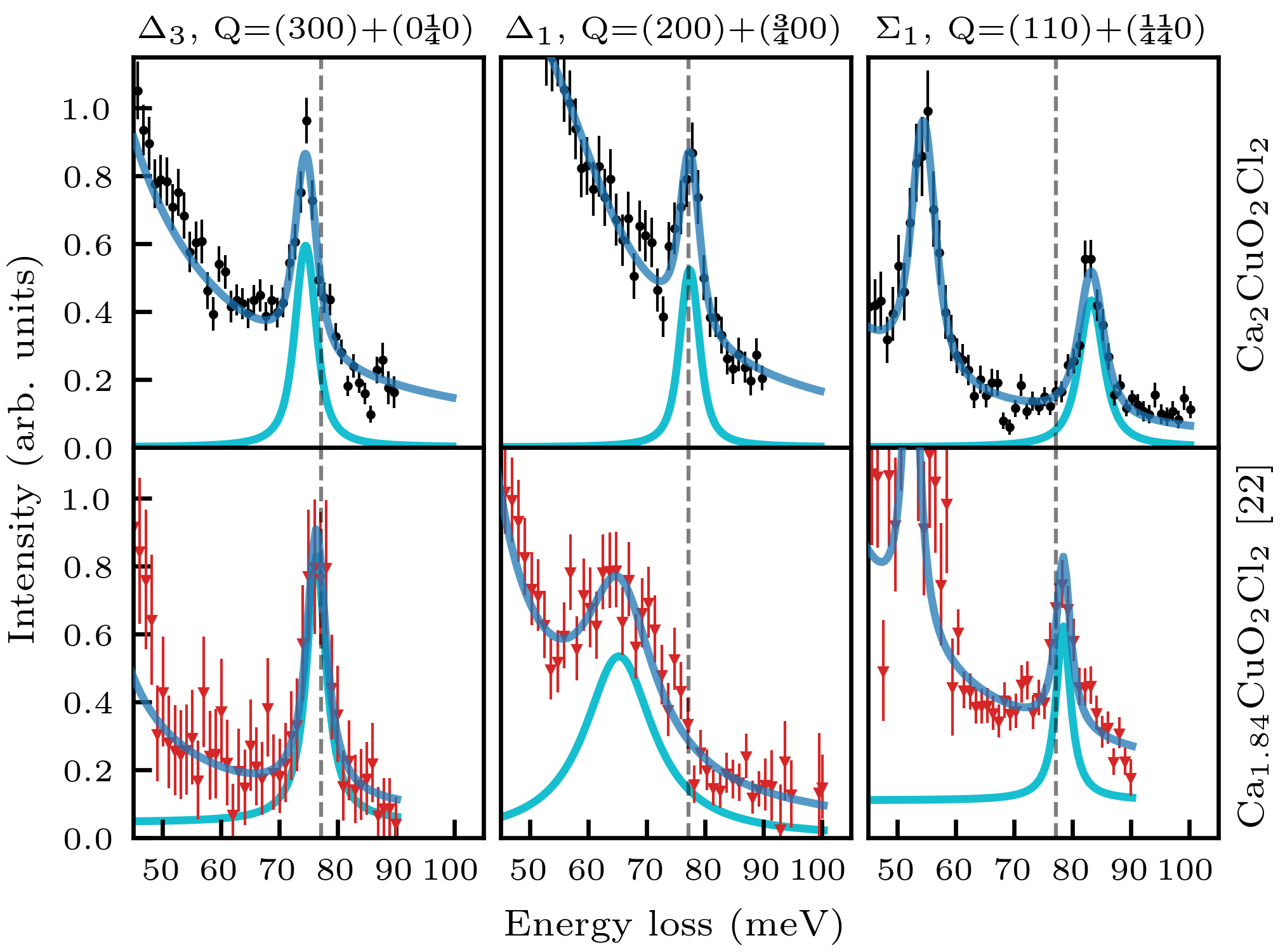 Figure 2
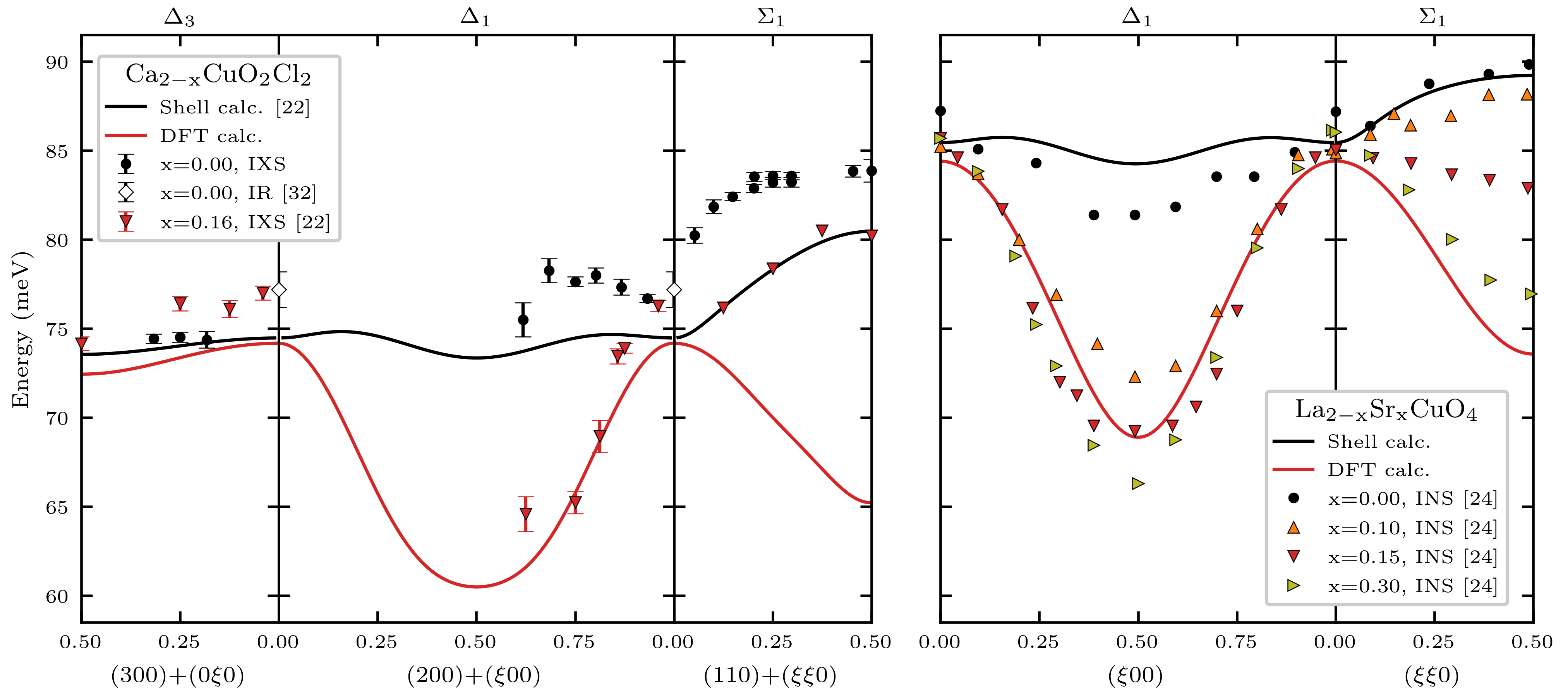 Figure 3
 Figure 3
Peer Reviews
No public reviews on file for this paper yet. If you reviewed it on a platform where reviews are public (OpenReview, ICLR, NeurIPS, ICML), you can paste yours below so the community can read it here.
Videos
No videos yet. Explain this paper in a talk, walkthrough, or lecture? Add one.
Phonon anomalies with doping in superconducting oxychlorides Ca2-xCuO2Cl2
Blair W. Lebert
IMPMC, UMR CNRS 7590, Sorbonne Universités-UPMC University Paris 06, MNHN, IRD, 4 Place Jussieu, F-75005 Paris, France
Hajime Yamamoto
Masaki Azuma
Materials and Structures Laboratory, Tokyo Institute of Technology, 4259 Nagatsuta, Midori-ku, Yokohama, 226-8503, Japan
Rolf Heid
Institute for Solid State Physics, Karlsruhe Institute of Technology, D-76021 Karlsruhe, Germany
Satoshi Tsutsui
Hiroshi Uchiyama
Japan Synchrotron Radiation Research Institute (JASRI), SPring-8, 1-1-1 Kouto, Sayo, Hyogo 679-5198, Japan
Alfred Q.R. Baron
Materials Dynamics Laboratory, RIKEN SPring-8 Center, RIKEN, 1-1-1 Kouto, Sayo Hyogo 679-5148.
Benoît Baptiste
IMPMC, UMR CNRS 7590, Sorbonne Universités-UPMC University Paris 06, MNHN, IRD, 4 Place Jussieu, F-75005 Paris, France
Matteo d’Astuto
IMPMC, UMR CNRS 7590, Sorbonne Universités-UPMC University Paris 06, MNHN, IRD, 4 Place Jussieu, F-75005 Paris, France
Institut NEEL CNRS/UGA UPR2940, 25 rue des Martyrs BP 166, 38042 Grenoble cedex 9
Abstract
We measure the dispersion of the Cu-O bond-stretching phonon mode in the high-temperature superconducting parent compound . Our density functional theory calculations predict a cosine-shaped bending of the dispersion along both the (00) and (0) directions, while comparison with previous results on show it only along (00), suggesting an anisotropic effect which is not reproduced in calculation at optimal doping. Comparison with isostructural suggests that these calculations reproduce well the overdoped regime, however they overestimate the doping effect on the Cu-O bond-stretching mode at optimal doping.
Superconductivity, Phonons, Hole-doped Cuprate, Phonon-electron interactions, Phonon dispersion, Inelastic X-ray Scattering
pacs:
74.72.Gh, 63.20.D-, 63.20.kd, 78.70.Ck
The role of electron-phonon coupling in high-temperature superconducting (HTS) cuprates has been debated since their discovery Bednorz and Müller (1986). Although the general belief is that coupling with phonons is not the main mechanism driving Cooper pair formation in HTS cuprates Bonn (2006), their role is still not completely understood. For example, the electron-phonon coupling exhibits anomalous doping dependence with a very large oxygen isotope effect close to 1/8 doping Crawford et al. (1990); Chen et al. (2007). A decade ago, the debate around the role of electron-phonon coupling was revived by the observation of a strong kink in the electronic band dispersion measured by angle-resolved photoemission spectroscopy (ARPES) Lanzara et al. (2001) which was thought to originate from phonon interactions. The Cu-O bond stretching phonon Pintschovius and Reichardt (1998); McQueeney et al. (1999); d’Astuto et al. (2002); Uchiyama et al. (2004); Fukuda et al. (2005); Reznik et al. (2006); Reznik (2010), which softens with doping, is the most likely candidate for this interaction Graf et al. (2008). Subsequent density functional theory (DFT) calculations Bohnen et al. (2003); Giustino et al. (2008); Heid et al. (2008), could explain rather well the phonon softening despite small electron-phonon coupling, but they could not explain the large ARPES kink. However, it was suggested that large couplings may still exist due to many-body effects in the presence of strong electron-electron correlations Rösch and Gunnarsson (2004) which are not captured by these DFT calculations.
In this Letter, we present inelastic x-ray scattering (IXS) measurements of the parent compound Hiroi et al. (2002); Kohsaka et al. (2002). We demonstrate that doping induces a softening of the Cu-O bond-stretching phonon by comparing with previous reports d’Astuto et al. (2013) on the vacancy-doped compound Yamada et al. (2005), which is near optimal doping. This result is consistent with the above cited reports of doping-induced softening in other HTS cuprates. The softening however is anisotropic which disagrees with our DFT calculations. We show by comparison with Pintschovius et al. (2006), since cannot be overdoped, that DFT calculations actually reproduce the strongly overdoped region in HTS cuprates. The failure of the DFT calculations to reproduce this important phonon mode near optimal doping naturally explains its inability to reproduce the observed large ARPES kink. In the future our results on , coupled with previous reports on d’Astuto et al. (2013), may help bridge this gap between theory and experiment in the HTS cuprates. The system is ideally suited to advanced many-body calculations trying to capture the predicted larger electron-phonon coupling due to electronic correlations because of its light elements and simple structure Foyevtsova et al. (2014); Wagner (2015a).
Single crystals of were grown by the flux method as described in Ref. Baptiste et al., 2018. The phonons were measured using inelastic x-ray scattering (IXS) at the BL35XU beamline of SPring-8 Baron et al. (2000). Grease/oil was used to protect the hygroscopic samples from air and to mount them on copper sample holders in a cryostat. The cryostat was used just for its vacuum to protect the samples and minimize air scattering. However, the measurements were taken at room temperature which is possible with because the lower energy modes are weaker due to the low atoms and therefore do not wash out the higher energy modes d’Astuto et al. (2013). The main monochromator was set to the Si(999) Bragg reflection giving a wavelength of 0.6968 Å (17.7935 eV) and the beam size at the sample was 0.09 0.09 mm2 FWHM (see Ref. Baron et al. (2000) for details). The angular width of the (400) Bragg reflection rocking curve from the samples was FWHM.
DFT calculations of the phonon dispersion for and were carried out using the linear response or density-functional perturbation theory implemented in the framework of the mixed-basis pseudopotential method Heid and Bohnen (1999). The lattice structure of was fully relaxed prior to the phonon calculations. In the case of , we used the experimental lattice constants of with x=0.3 Radaelli et al. (1994) and only relaxed the internal structural parameters. In both systems we have used the stoichiometry of the undoped parent compounds, however the present LDA calculations are unable to describe the charge-transfer insulating ground state and instead predict a metallic state. Thus the calculated phonon dispersions are more representative of the doped compounds. Shell calculations were based on a common interatomic potential model for cuprates Chaplot et al. (1995) and adapted to in a previous work d’Astuto et al. (2013).
In Fig. 2 we show representative IXS spectra for (top) and (bottom, from Ref. d’Astuto et al., 2013) at the midpoints of the three symmetry lines we explored: , longitudinal along (00); , transverse along (00); and , longitudinal along (0). The blue lines are a fit of the entire spectra consisting of Lorentzian functions convoluted with the instrumental function, while the cyan lines shown the Cu-O bond stretching phonon contribution.
Our results are summarized in Fig. 3 where we compare the measured and calculated Cu-O bond-stretching phonon dispersion of (left) and (right). Our dispersion from IXS on , shell calculations on , and DFT calculations on and are complemented by infrared absorption measurements on Zenitani et al. (2005), shell calculations on d’Astuto et al. (2013), and dispersion from inelastic neutron scattering (INS) on Pintschovius et al. (2006).
Our measurements of confirm that near optimal doping the Cu-O bond-stretching phonon in softens along , which agrees with previous reports on and other HTS cuprates Pintschovius and Reichardt (1998); McQueeney et al. (1999); d’Astuto et al. (2002); Uchiyama et al. (2004); Fukuda et al. (2005); Reznik et al. (2006); Reznik (2010). However, with respect to the undoped compounds, there is an upward dispersion in unlike the downward dispersion found in . There is also a doping-induced softening along , however the upward dispersion of persists with doping unlike the downward bending seen in with doping. We find a strangely fast dispersion along near the zone center in which does however decrease upon doping. The measurements along with transverse polarization show no doping dependence, which stresses the fact that only the Cu-O bond stretching mode is softened with doping, as for the other cuprates Pintschovius and Reichardt (1998); d’Astuto et al. (2002); Reznik (2010)
Our DFT and shell model empirical calculations are shown in Fig. 3 as red and black lines respectively. We stress that the DFT calculations are more representative of doped HTS cuprates, despite being performed with an undoped stoichiometry, since they cannot open the charge-transfer gap and instead predict a metallic state. Indeed, we find good agreement between these calculations along for both and . On the other hand, the shell model empirical calculations account for screening and are fit to doped samples, however they are more representative of undoped HTS cuprates as seen in Fig. 3. Except for a slight shift, the higher optic mode along agrees well with shell calculations.
The DFT calculations predict a softening along similar to that along . We found however that near optimal doping DFT calculations fail in both compounds along . The difference near the zone center is small, however it grows larger near the zone boundary since DFT predicts a strong downward dispersion towards the zone boundary. We find the opposite trend in which actually has an upward dispersion, while does disperse downwards but quite weakly.
The apparent contradiction between theory and experiment is resolved by considering the overdoped HTS cuprates. As shown in the right panel of Fig, 3, the dispersion of along both and agrees much better with DFT calculations. We conclude that standard DFT calculations on HTS cuprates overestimate the doping effects of the Cu-O bond-stretching mode.
Unfortunately, a similar comparison cannot be made with since it has never been overdoped, neither with sodium Hiroi et al. (2002); Kohsaka et al. (2002) nor with vacancies Yamada et al. (2005). Nonetheless, our IXS results on coupled with those on d’Astuto et al. (2013) provide an experimental test bed for future theoretical calculations trying to improve upon DFT by including correlation effects. In order to minimize relativistic effects, these quantum many-body calculations are mainly done on systems with light atoms Foyevtsova et al. (2014); Wagner (2015b). and are the closest examples to such systems among the bulk HTS cuprates. The system also has the advantage of a simple single-layer quadratic structure without any doping- or temperature-induced structural transitions which can affect phonon mode frequencies.
The failure of DFT calculations to reproduce the dispersion along at optimal doping was also found in Heid et al. (2007) which suggests that this phenomenon is universal in the HTS cuprates. In Ref. Giustino et al., 2008 the mode is not shown, but earlier DFT phonon calculations Wang et al. (1999) found a similar difference with experiment. The authors of Ref. Wang et al., 1999 noted that the difference was not as drastic and temperature-sensitive as previous models which included Jahn-Teller effects, however they did not elaborate further on the actual difference Fil et al. (1992). Moreover, their calculated frequencies were shifted since they used an idealized tetragonal structure for undoped . On the contrary, our present calculations shown in Fig. 3 use the experimental lattice constants for and agree with experimental results at and along the other branches without an energy shift. The difference between DFT calculations and experiment along in the underdoped to optimally doped regime can be simulated using phenomenological models of the dipole and charge fluctuations Falter et al. (2006), however this technique is not first-principles since it uses a shell-model approach with fitted parameters.
In conclusion, we show that the softening of the Cu-O bond-stretching mode induced by doping in is anisotropic near optimal doping, with a marked difference along and , i.e. full- and half-breathing modes. This is in striking disagreement with DFT calculations which we show actually reproduces the modes in overdoped cuprates, using as an example. This in turn could explain a smaller calculated effect on the ARPES extracted self-energy in DFT. An anisotropic electron-phonon coupling could be relevant to understanding the physics of cuprate superconductivity as pointed out by Chen et al. (2007), and oxychloride cuprates are an optimal playground to test advanced many-body calculations trying to capture the effects of electronic correlations.
Acknowledgements.
The synchrotron radiation experiments were performed at the BL35XU of SPring-8 with the approval of the Japan Synchrotron Radiation Research Institute (JASRI) (Proposal No. 2015B1720). The authors are very grateful to Lise-Marie Chamoreau for her assistance in sample orientation and acknowledge the use of the x-ray diffractometer instrument at the “Plateforme Diffraction”, IPCM, Paris. The authors thank Laura Chaix for critical reading of the manuscript. B.W.L acknowledges financial support from the French state funds managed by the ANR within the “Investissements d’Avenir” programme under reference ANR-11-IDEX-0004-02, and within the framework of the Cluster of Excellence MATISSE led by Sorbonne Université as well as from the LLB/SOLEIL PhD fellowship program. B.W.L also acknowledges travel within Japan, housing and user fees covered by SPring-8 through the ”Budding Researchers Support” program.
The reference list from the paper itself. Each links out to its DOI / PubMed record.
- 1Bednorz and Müller (1986) J. G. Bednorz and K. A. Müller, Z. Phys. B 64 , 189 (1986).
- 2Bonn (2006) D. A. Bonn, Nature Physics 2 , 158 (2006).
- 3Crawford et al. (1990) M. K. Crawford, W. E. Farneth, E. M. Mc Carronn, R. L. Harlow, and A. H. Moudden, Science 250 , 1390 (1990) . · doi ↗
- 4Chen et al. (2007) X.-J. Chen, V. V. Struzhkin, Z. Wu, H.-Q. Lin, R. J. Hemley, and H.-k. Mao, Proceedings of the National Academy of Sciences 104 , 3732 (2007) , https://www.pnas.org/content/104/10/3732.full.pdf . · doi ↗
- 5Lanzara et al. (2001) A. Lanzara, P. V. Bogdanov, X. J. Zhou, S. A. Kellar, D. L. Feng, E. D. Lu, T. Yoshida, H. Eisaki, A. Fujimori, K. Kishio, J.-I. Shimoyama, T. Noda, S. Uchida, Z. Hussain, and Z.-X. Shen, Nature 412 , 510 (2001).
- 6Pintschovius and Reichardt (1998) L. Pintschovius and W. Reichardt, in Physics and Chemistry of Materials with Low-Dimensional Structures , Vol. 20, edited by A. Furrer (Kluwer Academic Publishers, Dordrecht, 1998) p. 165.
- 7Mc Queeney et al. (1999) R. J. Mc Queeney, Y. Petrov, T. Egami, M. Yethiraj, G. Shirane, and Y. Endoh, Phys. Rev. Lett. 82 , 628 (1999).
- 8d’Astuto et al. (2002) M. d’Astuto, P. K. Mang, P. Giura, A. Shukla, P. Ghigna, A. Mirone, M. Braden, M. Greven, M. Krisch, and F. Sette, Phys. Rev. Lett. 88 , 167002 (2002) . · doi ↗