
TL;DR
This paper extends quantum metrology to include quantum memory, introducing a framework for estimating quantum combs and revealing the significant impact of memory effects on quantum sensor performance.
Contribution
It develops a theoretical framework for quantum comb metrology and derives a general upper bound for the quantum Fisher information in this context.
Findings
Derived a general upper bound for quantum comb Fisher information.
Showed the bound can be attained up to a factor of four.
Demonstrated the crucial role of memory in quantum sensors.
Abstract
Quantum metrology concerns estimating a parameter from multiple identical uses of a quantum channel. We extend quantum metrology beyond this standard setting and consider estimation of a physical process with quantum memory, here referred to as a parametrized quantum comb. We present a theoretic framework of metrology of quantum combs, and derive a general upper bound of the comb quantum Fisher information. The bound can be operationally interpreted as the quantum Fisher information of a memoryless quantum channel times a dimensional factor. We then show an example where the bound can be attained up to a factor of four. With the example and the bound, we show that memory in quantum sensors plays an even more crucial role in the estimation of combs than in the standard setting of quantum metrology.
Click any figure to enlarge with its caption.
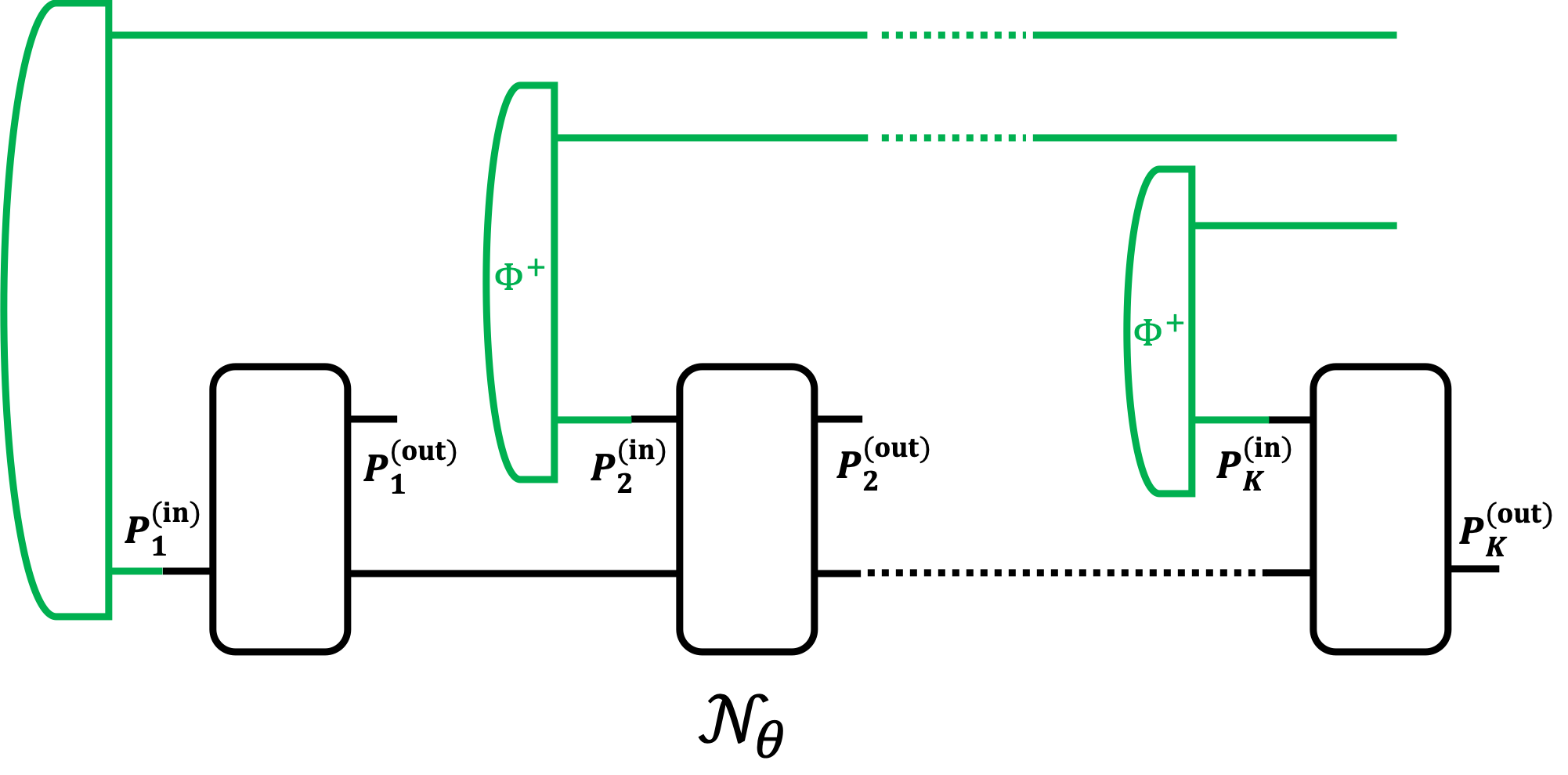 Figure 1
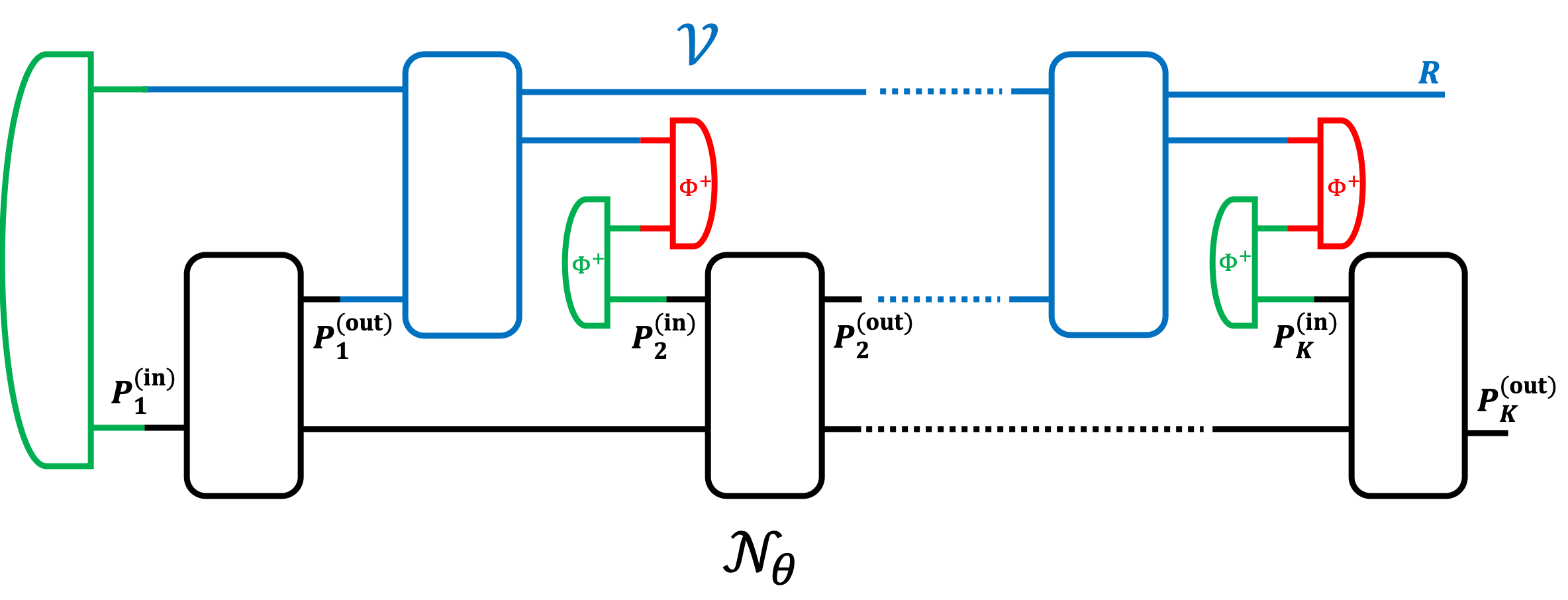 Figure 2
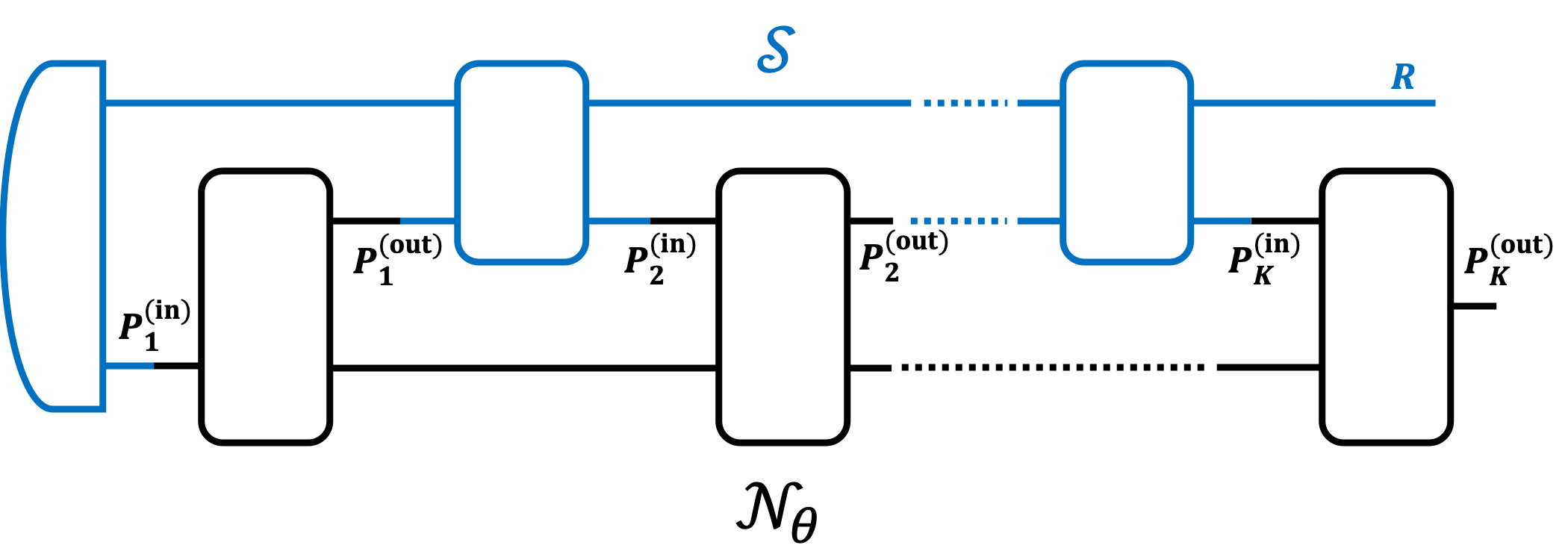 Figure 3
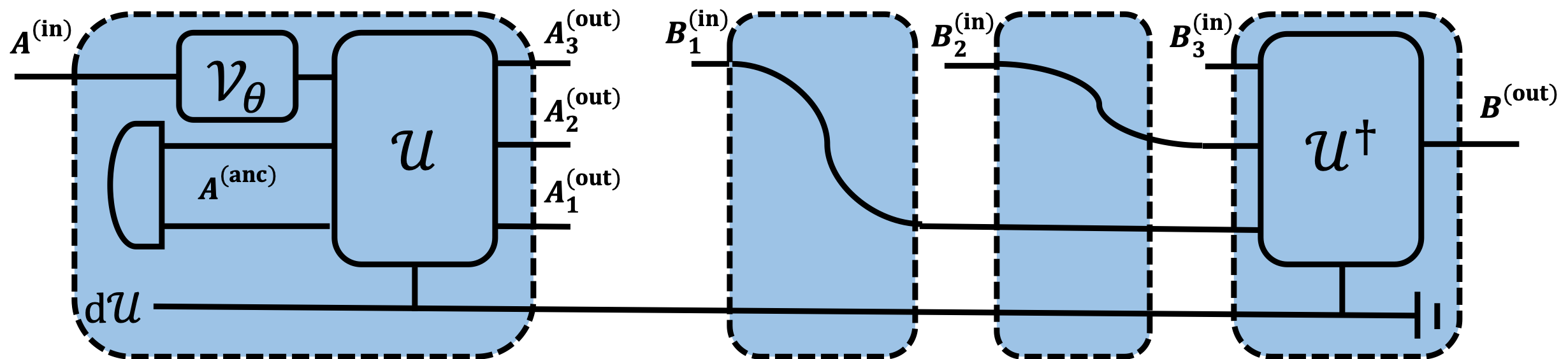 Figure 4
Peer Reviews
No public reviews on file for this paper yet. If you reviewed it on a platform where reviews are public (OpenReview, ICLR, NeurIPS, ICML), you can paste yours below so the community can read it here.
Videos
No videos yet. Explain this paper in a talk, walkthrough, or lecture? Add one.
Memory Effects in Quantum Metrology
Yuxiang Yang
Institute for Theoretical Physics, ETH Zürich, 8093 Zürich, Switzerland
Abstract
Quantum metrology concerns estimating a parameter from multiple identical uses of a quantum channel. We extend quantum metrology beyond this standard setting and consider estimation of a physical process with quantum memory, here referred to as a parametrized quantum comb. We present a theoretic framework of metrology of quantum combs, and derive a general upper bound of the comb quantum Fisher information. The bound can be operationally interpreted as the quantum Fisher information of a memoryless quantum channel times a dimensional factor. We then show an example where the bound can be attained up to a factor of four. With the example and the bound, we show that memory in quantum sensors plays an even more crucial role in the estimation of combs than in the standard setting of quantum metrology.
*Introduction. * Steady developments in quantum communication and quantum memory allow us to measure a physical quantity with higher precision degen2017quantum ; pirandola2018advances . By harnessing quantum control and ancillary memory qubits, adaptive metrological strategies can improve the performance of sensing even in the presence of noise dur2014improved ; yuan2015optimal ; sekatski2017quantum ; zhou2018achieving .
In standard quantum metrology, the goal is often to estimate identical copies of the same quantum gate, possibly subject to noise escher2011general ; kolodynski2013efficient ; chin2012quantum , that are available either in parallel giovannetti2006quantum or in arbitrary order van2007optimal ; ji2008parameter . With the advance of quantum technologies, however, the focus is transitioning to more complex and realistic settings, where the parameter to estimate is contained in a network or an adaptive physical process komar2014quantum ; proctor2018multiparameter ; ge2018distributed ; eldredge2018optimal . In such settings, one would have to deal with a circuit with a complex underlying structure, or in a network equipped with communication channels and memories, which requires a model with a higher-order structure than parametrized quantum gates.
In this Letter, we extend quantum metrology beyond the standard setting of estimating parametrized quantum channels. We consider estimating an unknown parameter from a physical process consisting in sequentially arranged parametrized quantum channels interconnected by quantum memory, here referred to as a (parametrized) comb. We present a theoretic framework of quantum metrology with such parametrized combs, and derive a general upper bound of the -comb quantum Fisher information (QFI). The QFI bound can be operationally interpreted as the quantum Fisher information of a memoryless channel times a dimensional factor that grows exponentially in . We then show an example of estimating a protected parameter, where the QFI bound can be attained up to a factor of four, revealing that the best possible precision of estimating a comb can decay exponentially with . With the example and the QFI bound, we capture the power and the limitation of memory effects in quantum metrology, previously observed in the discrimination of quantum channels chiribella2008memory . In particular, memory in quantum sensors plays an even more crucial role in the estimation of quantum combs than in the standard setting of quantum metrology.
*Quantum metrology in the presence of memory. * In this Letter, our goal is to estimate an unknown parameter given access to a quantum machine that has its own memory, which belongs to a family of parametrized quantum machines . This quantum machine could be, for instance, a quantum circuit with ancillary qubits or a noisy physical process with an inaccessible environment. To show memory effects in quantum metrology in the most straightforward way, we focus on single parameter estimation and . It is convenient to characterize such a quantum machine by a parametrized quantum comb chiribella2008quantum ; chiribella2009theoretical ; bisio2011quantum . A quantum comb is mathematically characterized by a positive operator, called the Choi operator choi1975completely , that satisfies a series of normalization constraints. More details on quantum combs can be found in the original Letter chiribella2008quantum .
As illustrated in Fig. 1, the action of the comb is naturally divided into consecutive phases . Each phase is connected to the next phase by a quantum memory (or quantum communication, if the phases are spatially separate). For each phase , the comb takes a quantum state from an input port , performs a -dependent quantum channel jointly on the input and the memory, and produces a quantum state from an output port . From now on, we will refer to it as a (parametrized) comb.
In the standard context of quantum gate estimation, one prepares a quantum state and sends it through unknown gates. Here, to estimate a comb , we need to connect it to a quantum sensor with memory (hereafter referred to as a sensor), which could be a complex composition of quantum states, gates, memory, and communication channels. Mathematically, the sensor is also modeled by a quantum comb, which takes (for ) as its input ports and (for ) as well as an ancillary system as its output ports. This means that a sensor is such a quantum comb that it “eats” the comb and “spits” a quantum state. Formally, this is taken care of by the link product chiribella2008quantum ; chiribella2009theoretical ; bisio2011quantum , which is an operation to composite two combs in a way that any input/output ports sharing the same tag are concatenated. In our case, the link product of the comb and the sensor results in a new quantum comb, denoted as . As shown in Fig. 1, all ports (for ) and (for ) of the comb are connected to the corresponding ports of the sensor. Therefore, is in fact a family of quantum states on . Here denotes the Hilbert space of .
A distinctive difference between quantum comb metrology and quantum gate estimation that makes the former more tricky to deal with is the memory effect of both the sensor and the comb. Unlike quantum states that are used to probe parametrized gates, sensors are capable of memorizing the information on (possibly in the quantum form) at the end of each phase and send refined information back into the comb. Similarly, the comb is also capable of storing the input from the sensor in its underlying structure and making it interact with future inputs. Our goal is to see the impact of such effects on the best achievable precision.
Physically, the role of the sensor is to extract from the comb and to encode it into a quantum state. The QFI of quantum combs can be defined via the Fisher information of quantum states, by optimizing over all possible sensors:
Definition 1**.**
The quantum Fisher information of is defined as
[TABLE]
where denotes the QFI of a quantum state and the maximum is taken over all sensors such that is a quantum state.
With this definition of the comb QFI, we can apply the quantum Cramér-Rao bound helstrom1976quantum ; holevo2011probabilistic ; braunstein1994statistical ; hayashi2017quantum and extend it to quantum combs: Denoting by the root-mean-square error of estimating from , we have
[TABLE]
where in the first step the minimum is taken over all quantum estimators that measure the state and output an unbiased estimate of , and is the number of repetitions of the experiment.
*A general upper bound on the comb QFI. * From the above discussion, we can see that the precision of estimating is determined by the QFI of a comb. However, the derivation of the QFI is not easy even for the simplest case, when the comb is reduced to a quantum channel. A closed-form expression of the QFI was derived only for particular types of quantum channels (see, for instance, Refs. hayashi2011comparison ; demkowicz2014using ; takeoka2016optimal ; pirandola2017ultimate ). Therefore, it is more sensible to look for an upper bound of the comb QFI so as to see the power and the limitation of metrology with a quantum comb.
In the following, we derive such an upper bound of the comb QFI, which implies a lower bound on the error of parameter estimation from the comb. We will use the abbreviation of pure state density matrices and denote by a maximally entangled state .
First, observe that any sensor can be decomposed as , where is a suitable input state (with being a reference system) and is a quantum comb. An obstacle in determining is that the information on can flow out of via an output port and then back into via subsequent input ports, owing to the memory effect of . To overcome this obstacle, we use a trick of postselection, which works by noticing that the action of a sensor is equivalent to the following probabilistic protocol, as depicted in Fig. 2:
Send a proper state into the first input port and a maximally entangled state into the -th input port for , with being the maximally entangled state on (with ). 2. 2.
Feed all but the last of the output ports of into a quantum comb . 3. 3.
Perform a Bell test on the -th output port of and the open end of (for ); postselect the outcome .
Notice that we are abusing a bit the notation here, since the quantum comb has different (but isomorphic) output Hilbert spaces from the one in the decomposition of .
In view of estimating the parameter , this probabilistic protocol can be regarded as one step of probabilistic metrology fiuravsek2006optimal ; chiribella2013quantum ; gendra2013quantum , where one performs a measurement and postselects one particular outcome to enhance the performance of parameter estimation. The limitation of probabilistic quantum metrology can be made clear via the following equation (combes2014quantum, , Eq. (30)): For a family of parametrized quantum states and a quantum operation (i. e. a completely positive, trace-nonincreasing linear map) , we have
[TABLE]
where is the success probability of the postselection and is the output state of .
In our case, the probability that the teleportation of a -dimensional system succeeds without a unitary correction is . The success probability of the postselection is thus
[TABLE]
where is the dimension of the -th output port. The comb QFI is thus bounded as
[TABLE]
where [see also Fig. 2] is the Choi state choi1975completely ; chiribella2008quantum of , defined as
[TABLE]
Moreover, the output ports of are now detached from the input ports of thanks to the postselection. Noticing that data processing does not increase distinguishability (hayashi2017quantum, , Chapter 6), to maximize the comb QFI we should always take the quantum comb to be a sequence of isometries. Under this condition, we have
[TABLE]
Combining Eqs. (4), (5), and (7), we get that the QFI of is bounded by times the QFI of the quantum state [see Fig. 2]. In summary, we derived the following theorem:
Theorem 1**.**
The QFI of a comb is upper bounded as
[TABLE]
where is defined in Eq. (6) and the maximum is taken over all with being a reference system.
Theorem 1 provides an upper bound on the QFI of an arbitrary quantum comb. The only optimization required in the upper bound (8) is the maximization of the QFI over input states to the first port. Notice that, since the quantum comb has only one input port, the optimization is equivalent to finding the QFI of a quantum channel.
The QFI term on the right hand side of Eq. (8) is attained by a phase-parallel scheme, namely by feeding a quantum state into each of the input ports and collecting the states from the output ports for measurement. In a phase-parallel scheme, the comb is treated as a quantum channel with a multipartite input. The information on never flows back into the comb . Therefore, the comb QFI bound (8) shows that the memory effect of a sensor improves the sensitivity of parameter estimation at most by a factor exponential in . Note that a phase-parallel scheme is not necessarily local, since a phase of may consist of joint operations on multiple physical nodes in a realistic quantum network.
It is the main objective of quantum metrology to compare different strategies in terms of the asymptotic scalings of their QFIs with respect to the amount of required resources. In the conventional setting of parallel gate estimation giovannetti2004quantum ; giovannetti2006quantum , for instance, the resource is taken to be the number of calls to the parametrized quantum gate. Here in a quantum comb, the resource is quantified by the number of phases . An obvious observation is that the scaling suggested by the bound (8) is distinct from what one encounters when estimating a comb that does not have a memory. For instance, if one gets back to the standard context of quantum metrology and considers each phase to be an individual quantum channel , the scaling of the comb QFI is at most the Heisenberg scaling if one applies a suitable adaptive strategy de2005quantum ; higgins2007entanglement , whereas a phase-parallel scheme achieves the standard quantum limit scaling . In Eq. (8), in contrast, if all the input dimensions are equal to , we get
[TABLE]
where corresponds to the optimization term in Eq. (8). Next, we present a scenario of quantum metrology in the presence of memory effects, where the above bound is saturated up to a constant factor.
*Estimating a protected parameter. * We now consider a scenario where the optimal strategy is exponentially more efficient than the phase-parallel strategy in Eq. (8). As illustrated in Fig. 3, the comb in this scenario encodes a parameter in a unitary gate, and then uses a shield-key system to protect the parameter. We label the first phase as and the remaining phases as , and we shall use the convention for a unitary. In the first phase, the input state goes through a parametrized unitary and then it is mixed up with an ancillary state by a shielding unitary sampled with the Haar measure of . In the -th phase (), the comb simply stores the input state and outputs nothing. In the -th (last) phase, the comb merges the input with all the previously stored states, and performs the key unitary jointly on all these input states.
Here we consider the case when is an even number, and . For the dimensions to match, we have for and
[TABLE]
The ancillary system, denoted as , has dimension , and we assume its state to be the maximally mixed state.
Denote by a quantum state in the Hilbert space of and a reference system such that the QFI of , with denoting the identity channel on the reference, achieves the maximum. The optimal scheme is to send (perhaps a part of) through the input port and then to connect to the corresponding input port for every . With this approach, the shield cancels out with the key , and thus the optimal QFI for this comb is
[TABLE]
Obviously, the optimal scheme requires a quantum memory in between different phases. We now compare it to the phase-parallel scheme corresponding to the right hand side term of Eq. (8). For this purpose, we need to evaluate , which is the QFI of the output state when the comb is fed with the state . For conciseness, we denote by the phases , and the input state can be rewritten as . The output state for this input can be derived by invoking symmetry properties of the comb. Because of the twirling effect of the comb, will be partially entangled with a two-dimensional subspace of . Explicitly, the output state reads
[TABLE]
where is the maximally mixed state, for a bipartite system, is a -independent state, is a -dependent state, is the joint system of and , and is defined via the decomposition . The derivation is left to the Appendix.
Next, we apply the convexity of the QFI of states, i. e., for two parametrized state families and (see, for instance, (hayashi2017quantum, , Chapter 6)). Using the convexity and observing that has no QFI, we can bound the QFI of the output state as
[TABLE]
We remark that the first inequality is actually an equality since and are orthogonal to each other.
Since is such an input state that the QFI attains its maximum, from Eq. (13) we get
[TABLE]
Finally, we get the relation between the QFI of and the QFI of as
[TABLE]
by substituting Eq. (14) and Eq. (10) into Eq. (11). This clearly shows that the bound (8) is tight up to a factor of four for this scenario of estimating a protected phase. Memory effects in quantum metrology are thus manifested by the fact that the optimal adaptive sensor is exponentially more powerful than the phase-parallel sensor.
*Conclusion. * We established a framework for quantum comb metrology and showed the effect of memory in quantum metrology. This could be the start of a new research direction, which deals with metrology in a fully quantum network or estimation of non-Markovian processes pollock2018non . Our work also fits the current trend of studying quantum information processing of higher-order structures gour2018entropy ; yuan2018hypothesis ; liu2019resource . We conclude with a remark that the quantum combs considered here have definite causal structures, while it was recently shown that interesting phenomena can be observed in quantum communication networks with an indefinite causal structure ebler2018enhanced . It is thus meaningful to ask whether these phenomena extend to metrology, which may be related to probing an unknown spacetime structure.
Acknowledgements.
The author is grateful to Giulio Chiribella, Joseph M. Renes, and anonymous referees for valuable comments, to Masahito Hayashi for discussions, and to Mark Wilde for suggesting references. This work is supported by the Swiss National Science Foundation via the National Center for Competence in Research “QSIT” as well as via project No. 200020_165843 and by the Hong Kong Research Grant Council through Grant No. 17300918.
Appendix A Derivation of Eq. (12).
We can write any input state to the first port as , where is a matrix constrained by and is the identity matrix on . Since the ancillary system is in the maximally mixed state with , we first consider its purification and trace out in the end. The output state is thus
[TABLE]
where denotes the maximally entangled state between the product systems and and denotes the partial trace operation. Using the elementary property
[TABLE]
that holds for any matrix , the output state can be rewritten as
[TABLE]
where is a twirling channel and denotes the conjugate of .
By Schur’s lemma [42], the output of the twirling channel is of the form , where for a bipartite system. Then we obtain the action of the twirling on as
[TABLE]
Operationally, this twirling swaps the entanglement with from to with a success probability , by performing correlated random unitaries.
Now, we consider the action of the partial trace operation on the state in Eq. (18). Note that is isomorphic to with and , , and . With this and substituting Eq. (18) into Eq. (17), we obtain the output state as
[TABLE]
having used Eq. (16), , and the relation in the last step. Here is a quantum state. Finally, using we get Eq. (12).
The reference list from the paper itself. Each links out to its DOI / PubMed record.
- 1(1) Christian L Degen, F Reinhard, and P Cappellaro. Quantum sensing. Reviews of Modern Physics , 89(3):035002, 2017.
- 2(2) Stefano Pirandola, Bhaskar Roy Bardhan, Tobias Gehring, Christian Weedbrook, and Seth Lloyd. Advances in photonic quantum sensing. Nature Photonics , 12(12):724, 2018.
- 3(3) W Dür, M Skotiniotis, Florian Froewis, and B Kraus. Improved quantum metrology using quantum error correction. Physical Review Letters , 112(8):080801, 2014.
- 4(4) Haidong Yuan and Chi-Hang Fred Fung. Optimal feedback scheme and universal time scaling for Hamiltonian parameter estimation. Physical Review Letters , 115(11):110401, 2015.
- 5(5) Pavel Sekatski, Michalis Skotiniotis, Janek Kołodyński, and Wolfgang Dür. Quantum metrology with full and fast quantum control. Quantum , 1:27, 2017.
- 6(6) Sisi Zhou, Mengzhen Zhang, John Preskill, and Liang Jiang. Achieving the Heisenberg limit in quantum metrology using quantum error correction. Nature Communications , 9(1):78, 2018.
- 7(7) BM Escher, RL de Matos Filho, and L Davidovich. General framework for estimating the ultimate precision limit in noisy quantum-enhanced metrology. Nature Physics , 7(5):406, 2011.
- 8(8) Jan Kołodyński and Rafał Demkowicz-Dobrzański. Efficient tools for quantum metrology with uncorrelated noise. New Journal of Physics , 15(7):073043, 2013.