A Linear Upper Bound on the Weisfeiler-Leman Dimension of Graphs of Bounded Genus
Martin Grohe, Sandra Kiefer

TL;DR
This paper establishes a linear upper bound on the Weisfeiler-Leman dimension for graphs embeddable on surfaces of bounded genus, improving understanding of their structural complexity.
Contribution
It provides the first linear upper bounds on WL dimension for graphs of bounded genus, extending previous results known for planar graphs.
Findings
WL dimension of graphs on surfaces of genus g is at most 4g+3
WL dimension of graphs on orientable surfaces of genus g is at most 2g+3
Boundaries are linear in the genus g
Abstract
The Weisfeiler-Leman (WL) dimension of a graph is a measure for the inherent descriptive complexity of the graph. While originally derived from a combinatorial graph isomorphism test called the Weisfeiler-Leman algorithm, the WL dimension can also be characterised in terms of the number of variables that is required to describe the graph up to isomorphism in first-order logic with counting quantifiers. It is known that the WL dimension is upper-bounded for all graphs that exclude some fixed graph as a minor (Grohe, JACM 2012). However, the bounds that can be derived from this general result are astronomic. Only recently, it was proved that the WL dimension of planar graphs is at most 3 (Kiefer, Ponomarenko, and Schweitzer, LICS 2017). In this paper, we prove that the WL dimension of graphs embeddable in a surface of Euler genus is at most . For the WL dimension of graphs…
Click any figure to enlarge with its caption.
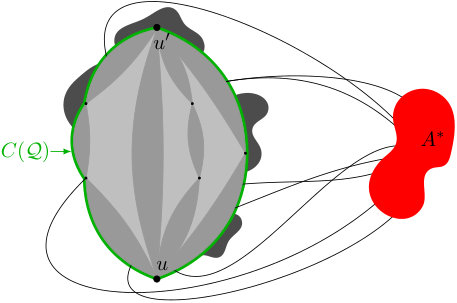 Figure 1
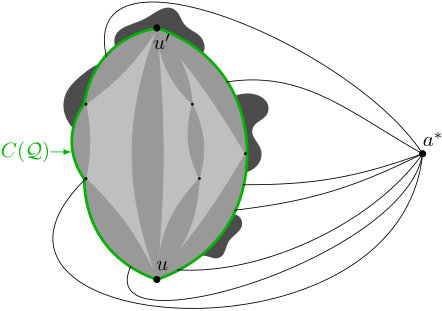 Figure 2
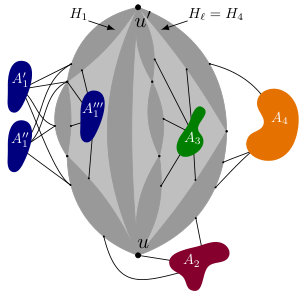 Figure 3
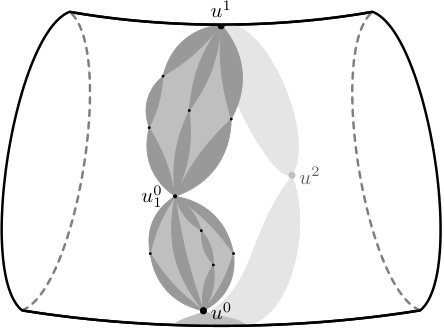 Figure 4
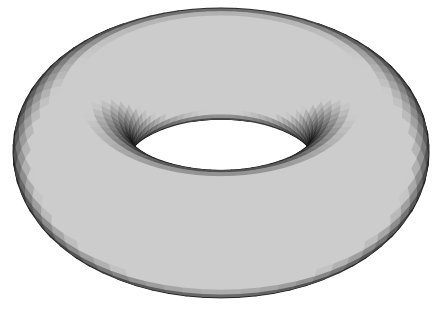 Figure 5
Peer Reviews
No public reviews on file for this paper yet. If you reviewed it on a platform where reviews are public (OpenReview, ICLR, NeurIPS, ICML), you can paste yours below so the community can read it here.
Videos
No videos yet. Explain this paper in a talk, walkthrough, or lecture? Add one.