Cooling in the shade of warped transition disks
Simon Casassus, Sebastian Perez, Axel Osses, Sebastian Marino

TL;DR
This paper investigates how shadow-induced cooling in warped circumstellar disks affects gas temperature and how these effects can constrain the disk's mass, using models and observations of specific systems.
Contribution
It introduces a simple model linking shadow-induced cooling effects to disk surface density, providing a new method to estimate disk mass from temperature shifts.
Findings
Shadow effects depend on disk surface density and radiative diffusion.
Application to HD142527 suggests a massive disk with Sigma > 8.3 g/cm2.
Application to DoAr44 constrains Sigma to less than 13 g/cm2.
Abstract
The mass of the gaseous reservoir in young circumstellar disks is a crucial initial condition for the formation of planetary systems, but estimates vary by orders of magnitude. In some disks with resolvable cavities, sharp inner disk warps cast two-sided shadows on the outer rings; can the cooling of the gas as it crosses the shadows bring constraints on its mass? The finite cooling timescale should result in dust temperature decrements shifted ahead of the optical/IR shadows in the direction of rotation. However, some systems show temperature drops, while others do not. The depth of the drops and the amplitude of the shift depend on the outer disk surface density Sigma through the extent of cooling during the shadow crossing time, and also on the efficiency of radiative diffusion. These phenomena may bear observational counterparts, which we describe with a simple one-dimensional…
Click any figure to enlarge with its caption.
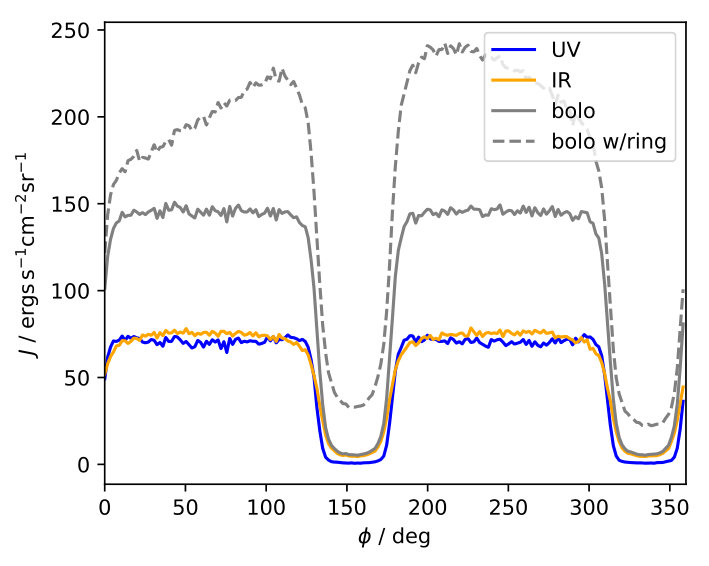 Figure 1
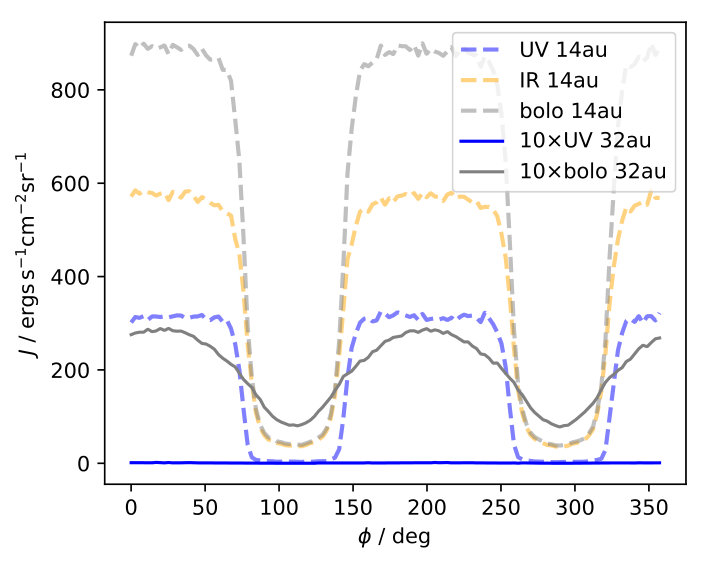 Figure 2
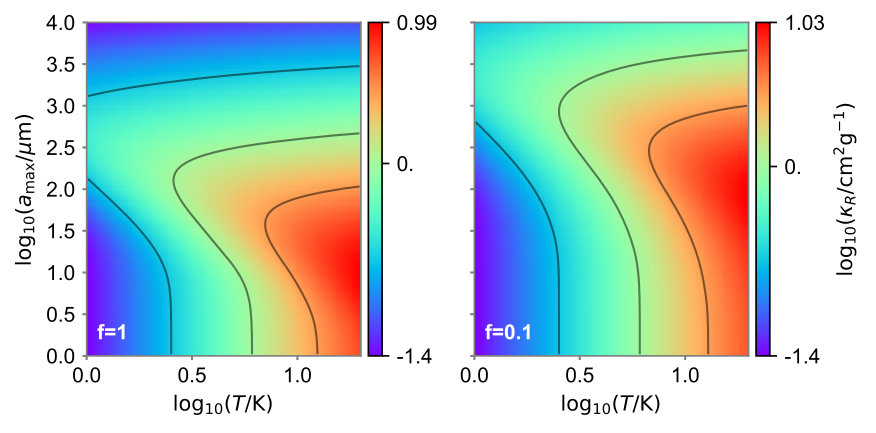 Figure 3
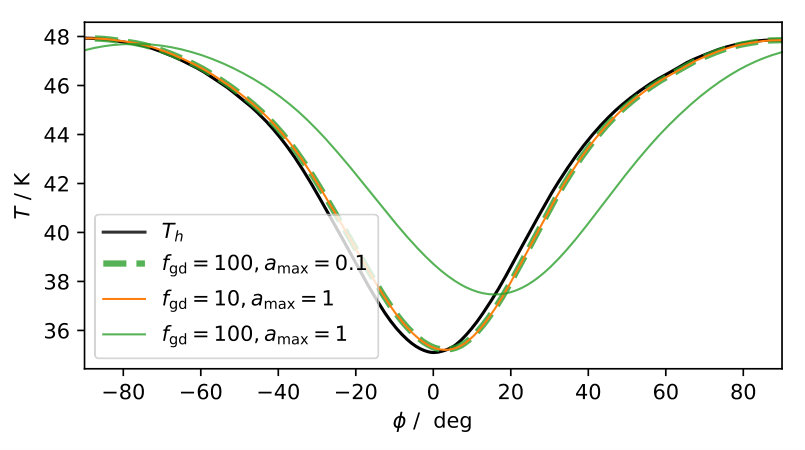 Figure 4
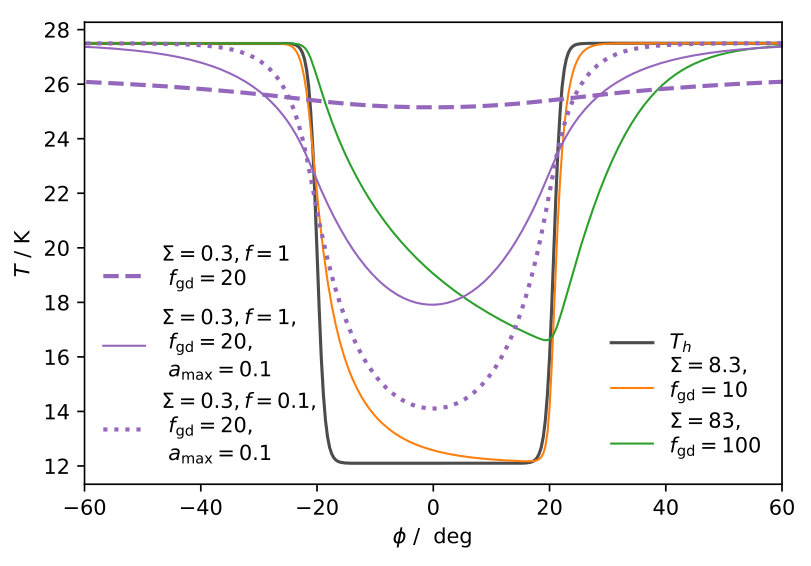 Figure 5
Peer Reviews
No public reviews on file for this paper yet. If you reviewed it on a platform where reviews are public (OpenReview, ICLR, NeurIPS, ICML), you can paste yours below so the community can read it here.
Videos
No videos yet. Explain this paper in a talk, walkthrough, or lecture? Add one.
Cooling in the shade of warped transition disks
Simon Casassus,1,2 Sebastián Pérez,1,2,3 Axel Osses,4 Sebastián Marino,5
1Departamento de Astronomía, Universidad de Chile, Casilla 36-D, Santiago, Chile
2Millennium Nucleus “Protoplanetary Disks”, Chile
3Universidad de Santiago de Chile, Av. Ecuador 3659, Santiago
4Departamento de Ingeniería Matemática, Facultad de Ciencias Físicas y Matemáticas, Universidad de Chile, Beauchef 851, Santiago, Chile
5Max Planck Institute for Astronomy, Königstuhl 17, 69117 Heidelberg, Germany E-mail: [email protected]
(Accepted XXX. Received YYY; in original form ZZZ)
Abstract
The mass of the gaseous reservoir in young circumstellar disks is a crucial initial condition for the formation of planetary systems, but estimates vary by orders of magnitude. In some disks with resolvable cavities, sharp inner disk warps cast two-sided shadows on the outer rings; can the cooling of the gas as it crosses the shadows bring constraints on its mass? The finite cooling timescale should result in dust temperature decrements shifted ahead of the optical/IR shadows in the direction of rotation. However, some systems show temperature drops, while others do not. The depth of the drops and the amplitude of the shift depend on the outer disk surface density through the extent of cooling during the shadow crossing time, and also on the efficiency of radiative diffusion. These phenomena may bear observational counterparts, which we describe with a simple one-dimensional model. An application to the HD 142527 disk suggests an asymmetry in its shadows, and predicts a 10 deg shift for a massive gaseous disk, with peak g cm*-2*. Another application to the DoAr 44 disk limits the peak surface density to g cm*-2*.
keywords:
protoplanetary discs — accretion, accretion discs
††pubyear: 2019††pagerange: Cooling in the shade of warped transition disks–Cooling in the shade of warped transition disks
1 Introduction
Warped disk geometries have been proposed to account for optical/IR (OIR) illumination effects seen in high-contrast images of Class ii young stellar objects. Such two-sided shadows stand out in the outer disks of systems with a resolvable central cavity, i.e. in transition disks, as in HD 142527 (Marino et al., 2015), HD 100453 (Casassus, 2016; Benisty et al., 2017; Long et al., 2017), DoAr 44 (Casassus et al., 2018), and HD 143006 (Benisty et al., 2018). The position and shape of the shadows place constraints on the orientation of the inner disk relative to the outer disk (Min et al., 2017), with consistent kinematics when resolved CO or HCO+ rotational line data are available (Casassus et al., 2015a; Pérez et al., 2018).
An interesting consequence of tilted inner disks is that the outer rings are directly exposed to stellar radiations, except in the shadowed regions. If the shadow crossing time is larger or comparable to the gas cooling timescale, if , and depending on the extent of radiation diffusion from the rest of the disk, the gas and dust under the shadows may cool down appreciably, possibly resulting in a radio continuum drop. This seems to be the case in HD 142527, with a temperature drop of 30% in its northern shadow, as inferred from the grey-body analysis in Casassus et al. (2015b). Intriguingly, the existing 12CO data in HD 142527 do not show any decrement, and the southern shadow is not matched by a continuum decrement as clear as in the northern shadow. Radio continuum counterparts to the OIR decrements have also been seen in DoAr 44 (Casassus et al., 2018), and in J1604-2130 (Mayama et al., 2018), even though in this source the shadows are variable (Pinilla et al., 2018). However, they are absent in other warped disks, such as in HD 143006 (Pérez et al., 2018) and in HD 100453 (van der Plas et al., 2019). Why is there such a broad variety in radio continuum responses under the shadows?
If , the thermal lag in the shadowed gas and dust may be important, and the radio decrements could also lead the OIR shadows in the direction of Keplerian rotation, by an angular shift . Can the position and shape of the temperature decrements constrain the outer disk mass? The depth of the radio decrements and the shift may provide a measurement of the gas cooling timescale, which depends on the internal energy reservoir and hence on the gas mass. Quantitative predictions and limits based on measurement accuracies will require full-blown radiative transfer (RT) models that include the advection of internal energy in a prescribed velocity field. Meanwhile, Section 2 presents a one-dimensional model for the azimuthal temperature profile in the shadowed material, which Sec. 3 applies to the cases of HD 142527 and DoAr 44. Sec. 4 concludes on the two questions that motivate this letter.
2 Model for the temperature drop of shadowed material
In a two-layer model for a passive disk (Chiang & Goldreich, 1997), where the bulk mass is in the interior at a temperature , the internal energy per unit surface in the disk is
[TABLE]
where is the gas mass surface density, is the adiabatic index ( for diatomic gas), is the Boltzmann constant, is the mean molecular weight and is the proton mass. An approximation to cooling per unit area in the disk due to radiation from both disk surfaces is given by dust emission at a representative temperature ,
[TABLE]
where , and is the Planck-averaged absorption opacity (as in the deviation coefficients used by Dullemond et al., 2001). In the absence of shadows, the heating per unit area of the interior layer due to the stellar radiation transferred by the two surface layers can be written in terms of another temperature ,
[TABLE]
The factor in Eq. 3 allows for in steady state, and in the absence of shadows, i.e. is the equilibrium temperature of the irradiated disk, as in Chiang & Goldreich (1997).
We will assume perfect thermal coupling of dust and gas, so that for the interior layer. The error involved in this approximation is within , if it is similar to the difference in equilibrium temperature, evaluated at the midplane, for the small and large grain populations in the RT models used in Sec. 3. Under the isothermal approximation and with perfect thermal coupling, the cooling timescale can be defined as
[TABLE]
If drops suddenly to [math] at when entering a shadow that extends to along a straight line , then (keeping fixed at the unshadowed value),
[TABLE]
This approximation neglects cooling due to transport of mechanical energy, as in the work required in launching spiral arms (Montesinos et al., 2016). We assume that the power dissipated in spirals is similar to viscous heat dissipation, which is much less than that due to stellar radiation beyond a few au (e.g. Bitsch et al., 2013).
In optically thick media, with a gas density , the transport of radiative energy density is due to diffusion, with a local flux
[TABLE]
in direction . The Rosseland-mean opacity is given by
[TABLE]
in which is the total mass opacity at frequency . The dimensionless control factor for the Rosseland approximation, which requires a small photon effective mean-free-path (the net displacement due to scattering before absorption, Rybicki & Lightman, 1986), i.e. at the Wien wavelength. This condition can be approximated as . In the applications below , so in order to extend Eq. 6 to the optically thin transition we parametrise the control factor as in Dobbs-Dixon et al. (2010, their Eqs. 11 and 12).
The radii of cavities that can be resolved by direct imaging are 30 au, where the equilibrium temperature in the midplane is usually K for Herbig Ae/Be and TTauri stars. The mass opacity is therefore due to grains with water ice mantles. The available formulae for focus on higher temperatures and use a small maximum grain size, typically of m (e.g. Zhu et al., 2012). Since the large rings in Class ii disks are associated with dust trapping, and possibly grain growth, we compute for a mix of water ice, silicates and graphite, with mass fractions of 0.4, 0.3, and 0.3, and an internal grain density g cm*-3*. The analytical formulae in Kataoka et al. (2014) give the absorption and scattering cross sections and for spherical grains with radii and filling factor . For a power-law size distribution with exponent ,
[TABLE]
We set ; this rather shallow value anticipates an application to transition disk rings, thought to undergo grain growth. The resulting Rosseland-mean opacities are shown in Fig. 1, for a gas-to-dust mass ratio .
The total radiative flux in the azimuthal direction, i.e. in the direction , through a section of the disk at constant , is
[TABLE]
for some small interval in stellocentric radius . Eq. 6 is applicable only to the disk interior, above the disk surface the radiation field points in the vertical direction, whereas in the low density limit Eq. 6 yields equal components in all directions. We assume that azimuthal radiation transport occurs at mid-plane densities, and that it extends over a vertical full-width-half-maximum,
[TABLE]
for a hydrostatic and vertically isothermal disk with thickness , where is the disk aspect ratio. We checked this approximation a-posteriori, using the temperature profiles in the applications of Sec. 3 by modulating Eq. 6 with the hydrostatic Gaussian, finding that Eq. 10 underestimates Eq.9 by a factor , which we chose to ignore. The net heating per unit disk surface is thus
[TABLE]
Likewise, in the radial direction, the total flux of radiative diffusion through an arc length is , and the net heating per unit disk surface is
[TABLE]
Radial diffusion turns out to be small compared to . For a power-law disk with , , , a constant , , setting and at the peak surface density with ,
[TABLE]
where the last approximation assumes and .
For an incompressible Keplerian flow, at a fixed radius and at constant velocity in the direction , the net internal energy advected into a volume is . The net heating per unit disk surface due to advection is thus
[TABLE]
This advection term is similar to that in the usual convective derivative. We neglect the random-walk delay associated to vertical diffusion, , which is of order a few days for IR photons.
Energy balance requires that
[TABLE]
where we have neglected radial diffusion. Following Eq. 3, we parametrise the heat source with an effective temperature , so that . We replace by for simplicity, and Eq. 15 gives:
[TABLE]
In steady state . We solve Eq. 16 with centered second-order finite differences, starting with a flat initial condition, and with periodic boundary conditions in .
We can now estimate a spatial scale associated to the smoothing effect of azimuthal radiation transport. For an infinite line along , in the absence of a heat source beyond the onset of a shadow at , without advection, and in the limit , Eq. 16 yields an exponential decay with e-folding length . However, if , assuming exponential decay yields , and radiation will strongly smooth out any temperature decrement. Likewise, away from the mid-plane, Eq. 6 suggests larger radiation flux at lower . In the rarefied disk surface, e.g. where 12CO rotational lines originate, the medium is optically thin and we qualitatively expect that the much larger photon mean-free path will smooth out the decrements.
3 Applications
The shape of the shadows and can potentially be constrained by observations and RT modeling. If we consider the details of as fixed, as well as and , which are given by the disk structure, then in this simplified model the only free parameters governing the gas temperature as it crosses the shadows are: the disk surface density , the gas-to-dust mass ratio , the maximum grain-size , and the grain filling factor .
3.1 HD 142527
The very lopsided ring of HD 142527 (Casassus et al., 2013) originates fairly optically thick mm-continuum in a stratified disk, so that the continuum profile is not axially symmetric, which hampers an isothermal description. A detailed comparison of the effect of advection under the shadows requires 3D RT models, as well as fine angular resolution data to infer the observed continuum temperature profile. Also, despite this source being the first in which sharp shadows from an inner disk were inferred, the precise location of the center of the shadows in the outer disk midplane has not yet been worked out. For now we use our simplified model to make qualitative predictions on the shape of the temperature decrements.
Under the shadows some radiative heating persists mainly due to IR thermal radiation from the inner disk. To guide the choice of the heat source , we examine the mean radiation intensity field in a parametric RT model meant to approximate the disk of HD 142527 at a distance of 140 pc, so somewhat less than the GAIA distance of 156 pc (hereafter the RT1425 model, Marino et al., 2015; Casassus et al., 2015a, b). This model was computed with the RADMC3D package (Dullemond et al., 2015). The gas and the small grains are heated by UV radiation in the surface layers, while dust in the midplane will absorb transferred IR radiation. Using the RT1425 model, we compute the mean radiation intensity inside the cavity, right at the inner edge and in the midplane of the gaseous outer disk (so at a radius of 115 au). Fig. 2 compares the mean intensity field for m, , with the mean field for m, , and with the bolometric field , both in the presence and absence of the outer disk. About one third of is thermal emission from the outer disk, hence its harmonic modulation in azimuth and its smoother profile under the shadows.
Since the dust responsible for the mm-continuum is thought to be trapped at the pressure maximum in the outer disk, radiation will be attenuated as it is transferred through the intervening material. This can be incorporated by setting the unshadowed temperature to the temperature of the larger grains (i.e. 1 mm – 1 cm). Since Eq. 16 accounts for outer disk radiation in the limited diffusion approximation, once we have set , should follow only radiation stemming from the star and the inner disk, which appears to be fairly square. The choice of a square profile for , with a total width for each shadow, and a floor temperature , is also useful to estimate how the shape of the shadows maps into the temperature profile . We use hyperbolic tangents to round the edges.
The temperature for the largest grains close to the northern shadow is observed to be K (Casassus et al., 2015b). The floor temperature can be inferred from the drop in radiation intensity, from in the unshadowed regions, to under the shadows, . Inspired by in Fig. 2, we set for RT1425.
The peak gas surface density in the RT1425 model is 83 g cm*-2*, at 155 au, for a gas to dust mass ratio . The corresponding peak dust surface density is similar, within 50%, to that reported by Boehler et al. (2017) and Muto et al. (2015). In the analysis of Boehler et al. (2017) of CO isotopologue data, at the position of the peak in dust continuum, the gas-to-dust mass ratio is only , increasing to in the direction of the minimum in continuum emission. For the northern shadow, there is general agreement in the literature on the dust surface density peak, around g cm*-2*. Since , we vary only . The maximum grain size in the dust trap is at least cm (Casassus et al., 2015b), for which cm2 g*-1* if , and cm2 g*-1* if , so that to . The cooling timescale is yr. The shadow crossing time is 152 yr, for a stellar mass of 2.0 M⊙ (Mendigutía et al., 2014), and for a shadow width 40 deg. Thus, if under the northern shadow, we expect dust to cool but not down to the floor temperature, since . Since , the smoothing effect of radiative diffusion should have little impact. This scenario appears to be observed, given the temperature drop of 30% reported by Casassus et al. (2015b).
Example solutions of Eq. 16, with the above parameters, are shown in Fig. 3. We see that for , radiative diffusion has no impact and the profile follows a cooling curve close to Eq. 5. A massive disk results in conspicuous shifts between the temperature minimum and the centroid of the illumination pattern. For , deg if and cm, while for , deg if and deg if .
For the southern shadow, in the RT1425 model the maximum grain size that is not affected by azimuthal trapping is 0.1 cm, for which cm*-2* g*-1* if , and cm*-2* g*-1* if (both values at 27.5 K). We consider a single case for : a gaseous disk mass contrast of 3 as in Boehler et al. (2017), with and g cm*-2*, so if , and if . Gas should cool much faster than in the northern shadow, since , but radiative diffusion should have more of an impact. Example solutions are shown in Fig. 3, where we also include a curve for cm and , for which . In this latter case the averaging effect of radiation transport almost completely smooths out the temperature decrement.
3.2 DoAr 44
The cavity in DoAr 44 is very different from HD 142527. In the parametric model of Casassus et al. (2018, hereafter RTDoAr44 ), the polarized-intensity image in -band is reproduced with a gaseous cavity radius 14 au, while the continuum at 336 GHz corresponds to a larger cavity for the mm-sized dust, with 32 au. Thus, if due to shadowing, the continuum drops seen at 336 GHz, of 24%, result from a heat source profile that has been substantially processed by intervening material, composed of gas and small dust (with radii m in RTDoAr44). This is illustrated in Fig. 4, which plots the bolometric mean intensity field at the edge of the gaseous cavity at and at , in the absence of the outer disk. The broad and V-shaped decrements in are very different from square profiles. Instead, for we use , extracted at the edge of the large-dust cavity, i.e. at au, smoothed and normalized so that the peak temperature is that computed in the RTDoAr44 model (with the outer disk, and for the large dust population). The stellar mass for DoAr 44 is 1.3 M⊙ (Espaillat et al., 2010), and its distance in RTDoAr44 is 120 pc (now revised to 145.9 pc, Gaia Collaboration et al., 2016). The RTDoAr 44 model suggests that the disk aspect ratio is at , coincident with the peak gas surface density of g cm*-2* for , if mm.
As summarised in Fig. 5, the effect of advection is more important for a massive outer disk. In particular, the case for , , cm, with K)=0.06 cm*-2g, corresponds to g cm-2* for the same mass in dust smaller than 1 mm as in RTDoAr 44, and results in a large shift between the azimuthal position of the minimum in and that of the minimum in : deg. The curves for , cm, and , cm, both correspond to g cm*-2* (given the grain size exponent of ), and deg. A run for , cm (K)=0.40 cm*-2*g, not shown in Fig. 5), results in deg. In all runs .
From the available observations Casassus et al. (2018) report deg, which is a shift along the direction of rotation if the disk is rotating clock-wise (so if the northern side is the far side). With this direction of rotation the faint arc to the North-West (seen in polarized intensity, Avenhaus et al., 2018) can be seen as a trailing spiral arm. However, the substantial disk thickness in the -band, and the finite inclination, result in a model deg, as calculated with the RTDoAr 44 predictions at native angular resolutions. After plane filtering, the shift is deg. If we take this offset of 4.3 deg as an indication of systematics, the observed value would be deg. A very massive disk can thus easily be ruled out, and we can also discard at 5 the cases with , cm, and , cm. A 3D RT model that incorporates advection, along with finer angular resolution data, could eventually refine these limits.
4 Conclusion
The midplane gas and dust cool when flowing across shadows cast by inner warps. In this letter we propose a simplified 1D model to explain the broad variety of temperature responses under the shadows, and to assess how the shape and depth of the temperature profiles depend on the outer disk mass. At low surface densities , such that , or in the disk surface, radiation will smooth out the temperature decrements. In massive rings, such that , the temperature minimum will be shifted in the direction of rotation relative to the centroid of the illumination pattern due to advection. This shift is a probe of the gas-to-dust mass ratio for a given dust population.
Detailed applications to specific objects require the incorporation of advection in 3D radiative transfer. Meanwhile we report some of the prediction from our 1D model. The square illumination profile in HD 142527 allows to illustrate the impact of advection, even if in the isothermal approximation. A massive disk with near the continuum peak should result in a conspicuous shift, degdeg. A comparison with observations requires high angular resolution continuum data. In DoAr 44, the available observations rule out a massive disk with g cm*-2* at 5, and given a standard dust population.
Acknowledgments
The referee, Kees Dullemond, provided important and constructive input on the disk optical depth and the limits of the Rosseland approximation. We acknowledge further useful comments from Zhaohuan Zhu, Wladimir Lyra and Philipp Weber. Support was provided by Millennium Nucleus RC130007 (Chilean Ministry of Economy), FONDECYT grants 1171624 and 1151512, and by CONICYT-Gemini grant 32130007. This work used the Brelka cluster (FONDEQUIP project EQM140101) hosted at DAS/U. de Chile.
The reference list from the paper itself. Each links out to its DOI / PubMed record.
- 1Avenhaus et al. (2018) Avenhaus H., et al., 2018, Ap J , 863, 44 · doi ↗
- 2Benisty et al. (2017) Benisty M., et al., 2017, A&A , 597, A 42 · doi ↗
- 3Benisty et al. (2018) Benisty M., et al., 2018, preprint, ( ar Xiv:1809.01082 )
- 4Bitsch et al. (2013) Bitsch B., Crida A., Morbidelli A., Kley W., Dobbs-Dixon I., 2013, A&A , 549, A 124 · doi ↗
- 5Boehler et al. (2017) Boehler Y., Weaver E., Isella A., Ricci L., Grady C., Carpenter J., Perez L., 2017, Ap J , 840, 60 · doi ↗
- 6Casassus (2016) Casassus S., 2016, PASA , 33, e 013 · doi ↗
- 7Casassus et al. (2013) Casassus S., et al., 2013, Nature , 493, 191 · doi ↗
- 8Casassus et al. (2015 a) Casassus S., et al., 2015 a, Ap J , 811, 92 · doi ↗