Nodal surface and persistent spin texture in a Weyl semimetal without mirror symmetry
Wujun Shi, Gang Li

TL;DR
This study uncovers a nodal plane and unique spin textures in a Weyl semimetal without mirror symmetry, highlighting its potential for novel chiral anomaly phenomena and spintronic applications.
Contribution
It reveals the existence of a nodal plane, Weyl points, and spin textures in Ag$_{2}$Se, demonstrating features absent in systems with mirror symmetry and suggesting new physical phenomena.
Findings
Discovered a nodal plane at $k_{z}= ext{pi}$ protected by symmetry.
Identified 24 Weyl points with Fermi arcs and notable QPI patterns.
Revealed direction-selective spin polarization on the surface.
Abstract
By utilizing symmetry analysis and electronic structure calculations, we investigated the low-temperature orthorhombic phase of AgSe in ~17. In addition to the discovery of a nodal plane at protected by the joint operation of time-reversal () and the 2-fold screw rotation , we found 24 Weyl points mainly residing at the plane with notable Fermi arc and large quasiparticle interference pattern (QPI). Due to the absence of mirror symmetry, a pair of Weyl points with opposite chirality reside at different binding energies, which makes this system an excellent material candidate for realizing the novel chiral anomaly related phenomenon, such as the quantized circular photogalvanic and the chiral magnetic effects. Furthermore, we also reveal the striking spin textures at plane which demonstrates, in a large region of the…
Click any figure to enlarge with its caption.
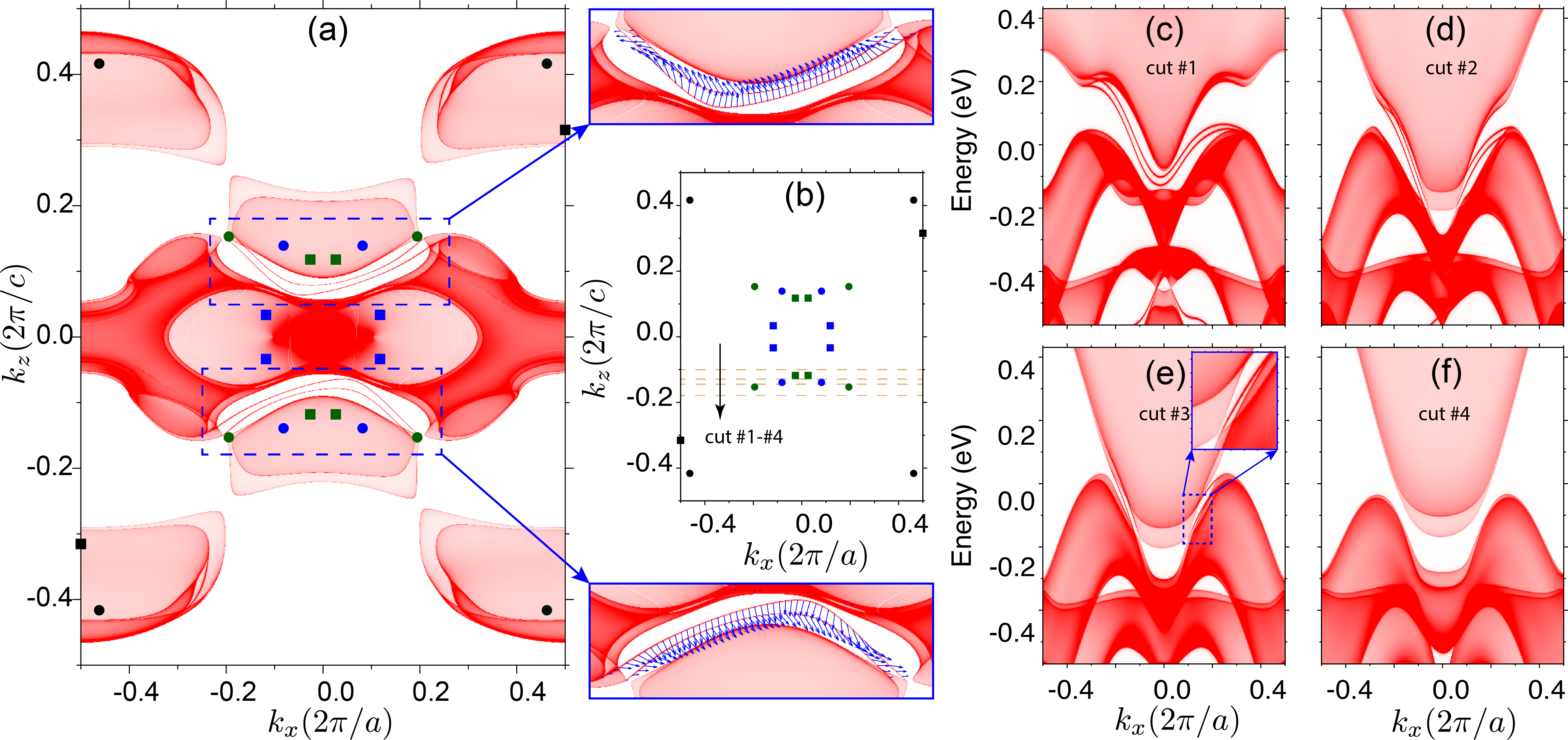 Figure 1
 Figure 2
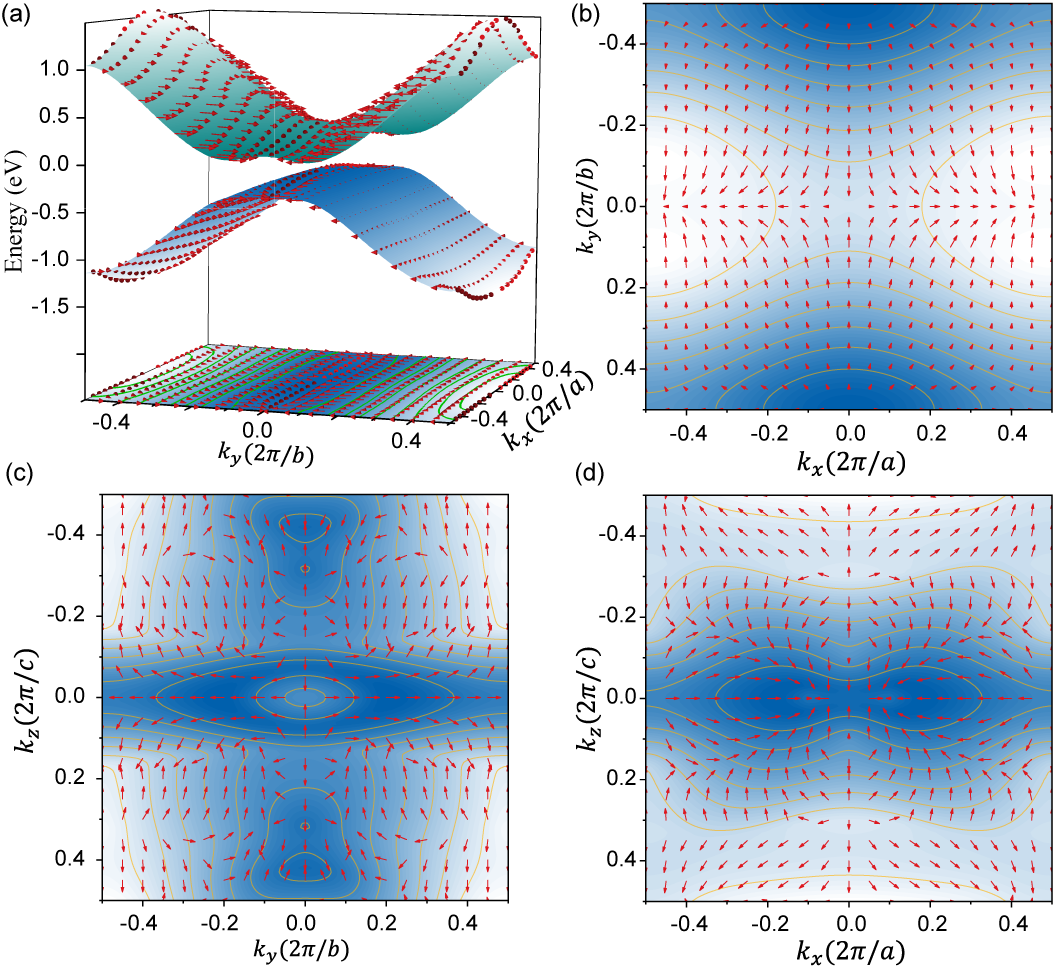 Figure 3
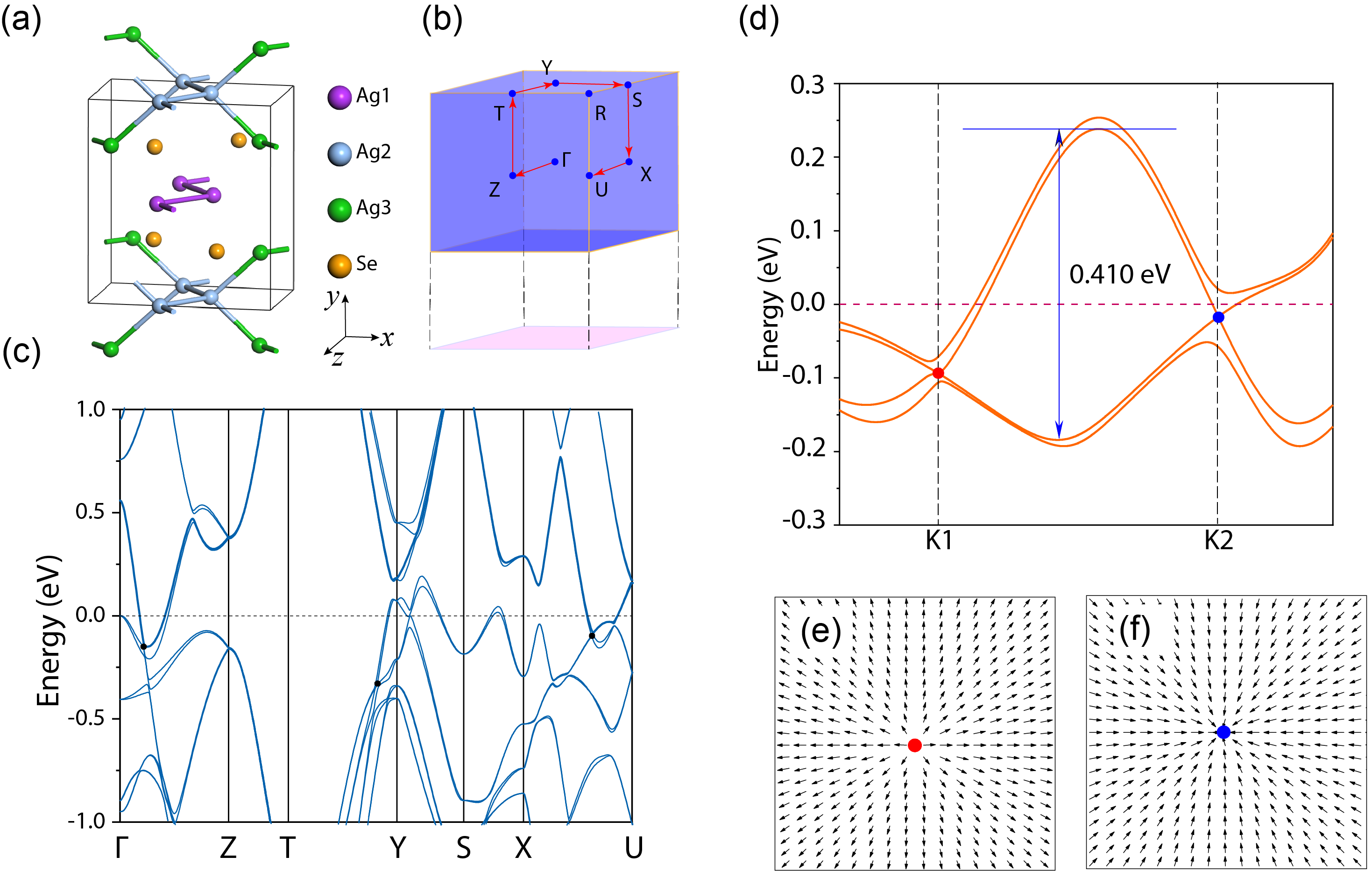 Figure 4
| WPs | Coordinates | Chern | |
|---|---|---|---|
| () | (eV) | number | |
| (0.082, 0.000, 0.139) | -0.191 | ||
| (0.195, 0.000, 0.153) | -0.017 | ||
| (0.462, 0.000, 0.416) | -0.043 | ||
| (0.026, 0.000, 0.118) | -0.199 | ||
| (0.118, 0.500, 0.034) | 0.200 | ||
| (0.500, 0.000, 0.315) | -0.094 |
Peer Reviews
No public reviews on file for this paper yet. If you reviewed it on a platform where reviews are public (OpenReview, ICLR, NeurIPS, ICML), you can paste yours below so the community can read it here.
Videos
No videos yet. Explain this paper in a talk, walkthrough, or lecture? Add one.
Nodal surface and persistent spin texture in a Weyl semimetal without mirror symmetry
Wujun Shi
School of Physical Science and Technology, ShanghaiTech University, Shanghai 200031, China
Gang Li
School of Physical Science and Technology, ShanghaiTech University, Shanghai 200031, China
ShanghaiTech Laboratory for Topological Physics, ShanghaiTech University, Shanghai 200031, China
Abstract
By utilizing symmetry analysis and electronic structure calculations, we investigated the low-temperature orthorhombic phase of Ag2Se in 17. In addition to the discovery of a nodal plane at protected by the joint operation of time-reversal () and the 2-fold screw rotation , we found 24 Weyl points mainly residing at the plane with notable Fermi arc and large quasiparticle interference pattern (QPI). Due to the absence of mirror symmetry, a pair of Weyl points with opposite chirality reside at different binding energies, which makes this system an excellent material candidate for realizing the novel chiral anomaly related phenomenon, such as the quantized circular photogalvanic and the chiral magnetic effects. Furthermore, we also reveal the striking spin textures at plane which demonstrates, in a large region of the surface Brillouin Zone, a direction-selective spin polarization, which has a strong implication to spintronic applications.
I Introduction
Equipped with the predicting power of the topological band theory, the study of topological materials has revolutionized the conventional viewpoint on the state of matter and triggered a great interest in the nontrivial Berry curvature of the Bloch wavefunctionWan et al. (2011); Weng et al. (2015); Huang et al. (2015); Lv et al. (2015); Xu et al. (2015a); Wang et al. (2016a); Sun et al. (2015); Soluyanov et al. (2015); Jiang et al. (2017); Vafek and Vishwanath (2014); Wang et al. (2016b); Armitage et al. (2017). Among the many new states of matter, the study of three-dimensional (3D) Weyl semimetal (WSM) has emerged as a new research discipline known as topological semimetal, where the lower-energy excitations around a degenerate Weyl point (WP) between two energy bands are well described as a 3D Weyl fermion. In solids, WPs always appear in pairs of opposite chiralities with quantized Chern number Wan et al. (2011), acting as the the monopole source and sink of the Berry curvature, which leads to the striking predicitons of the Fermi arc electronic states on the surfaceWeng et al. (2015); Huang et al. (2015); Lv et al. (2015); Xu et al. (2015a); Wang et al. (2016a); Sun et al. (2015); Soluyanov et al. (2015); Jiang et al. (2017).
Macroscopically, WPs are known to correlate to many exotic phenomena, such as negative magnetoresistance (also known as chiral anomaly)Xu et al. (2015a, b), intrinsic spin Hall effectSun et al. (2016), and anomalous Hall effectBurkov and Balents (2011); Xu et al. (2011); Zhang et al. (2017). Notably, if WPs with opposite chiral charges have different energies the quantized circular photogalvanic effect (CPGE) de Juan et al. (2017) and the chiral magnetic effect (CME) are also supposed to happenFukushima et al. (2008); Başar et al. (2014); Goswami et al. (2015); Chang and Yang (2015); Chen et al. (2013); Vazifeh and Franz (2013). The CME has attracted much theoretical interest because of the existence of a nonzero chiral current induced by a static magnetic field at zero temperatureBaşar et al. (2014). The CME and CPGE were first proposed by theoretical study and was recently observed in RhSi Rees et al. (2019). Early theoretically proposed material candidates for WSMs have mirror symmetry, which confines the WPs with opposit chiral charges to the same energy. Some recently proposed materials, which do not have mirror symmetry, have the WPs with higher chiral charges (), such as the double Weyl fermions in SrSi2Huang et al. (2016), TlTeO6 and Ag2Se related familiesChang et al. (2016), and the spin-3/2 Rarita-Schwinger-Weyl fermions in CoSiBradlyn et al. (2016); Tang et al. (2017); Pshenay-Severin et al. (2017); Chang et al. (2017). Therefore, a Weyl semimetal with opposite unit chiral charges being at different energies is highly demanded, which would provide an ideal experimental platform facilitating further examination of those exotic effects in the near future.
In this paper, based on the first-principle calculations and simple symmetry argument, we predict Ag2Se at low temperature with space group () 17 as a Weyl semimetal lacking of the protection of mirror symmetry. As a result, the WPs with opposite chirality charge reside at different energies. We found 24 WPs in this material with 20 of WPs locate below Fermi level(). By tuning the energy relative to , this system can serve as an ideal platform to study the significant CPGE and CME in experiments. The persistent spin current discovered at surface further makes this system a good material candidate for spintronics.
II Crystal structure and symmetry.
At atmospheric pressure, the Ag2Se crystallizes in two phases. At high temperature Ag2Se crystallizes in the bcc cubic phase (Im)Oliveria et al. (1988); Asadov et al. (2015). At 406 K a structure transition to the orthorhombic phase occurs, where Ag2Se can have two different structures with 17 ()Baer et al. (1962); Asadov et al. (2015). and 19 ()Wiegers (1971); Yu and Yun (2011); Asadov et al. (2015). The topological properties of 19 phase Ag2Se has been examinedKim et al. (2016). Here, we studied the 17 phase whose topological nature, to the best of our knowledge, has not been explored.
Beside identity, 17 contains three symmetries: a 2-fold rotation symmetry about axis, i.e. , and two screw rotation symmetries about and axis, i.e. and . Their operations are expressed as: , , , where the spin manipulation is indicated by the corresponding Pauli matrices. Due to the absence of inversion symmetry and the Kramer degeneracy, at generic momentum every Bloch band is non-degenerate. However, higher band degeneracy can still be expected in this : (1) each band at the eight time-reversal invariant momenta (TRIM) are doubly degenerate protected by the time-reversal symmetry , i.e. and are orthogonal and energetically degenerate at TRIM. (2) Screw symmetry protects crossings between two bands carrying different eigenvalues. It is easy to understand that, after applying twice, every atom moves along axis with one lattice spacing, resulting in an additional phase factor in the Bloch wavefunction, i.e. with the minus sign from the spin operation. As commutes with the Hamiltonian, each Bloch state can be labelled by the eigenvalue of as well. Although are equivalent Brillouin Zone (BZ) boundaries, the eigenvalue of takes different values, i.e. at and at . Thus, to satisfy the periodic boundary condition of the BZ the bands with opposite eigenvalues shall always appear in pairs Young and Kane (2015) and cross at somewhere along the high symmetry lines protected by . There are four k-paths of this type protected with band crossings, i.e. .
(3) At plane every band are doubly degenerate due to the protection of the joint protection of and , i.e. there exists a nodal plane in as shown below. After defining , one can easily prove that the momentum at planes are invariant under , While, in real-space after applying twice the and coordinates are kept invariant, but coordinate will be shifted by one lattice spacing , As a result, for each Bloch band . At plane, acting as a time-reversal operator which allows a double band degeneracy everywhere in this plane. The other screw rotation, i.e. , however does not bring in any additional band degeneracy, as applying twice will not result in additional lattice translation so that .
(4) What is more striking about 17 is the protection of nonequilibrium spin polarization along the boundary of surface, which strongly connects to the nodal nature of this plane, resulting in a persistent spin texture allowed only in selective directions in momentum space. As is energetically degenerate with , it is easy to verify due to the fact that anticommutes with and commutes with . Adding up the contributions from the two degenerate states yields a vanishing spin polarization along direction. However, the other two spin components survive as . We note that this strongly contrasts to the spin textures in centrosymmetric systems, where the Kramer’s degeneracy enforces the doubly degenerate bands to have perfectly opposite spin textures. Therefore a cancellation of spin polarization happens everywhere in the BZ. Here the protected nodal plane promotes the cancellation only for the component, leaving the spin momentum fully planar.
III bulk electronic structure
For systems in this the more interesting thing is the presence of WPs at generic momentum due to the broken of inversion symmetry, which cannot be obtained from the above symmetry analysis. To this end, we calculated the electronic band structure and search the possible WPs in the first BZ by using the density functional theory (DFT) as implemented in the Vienna ab-initio Simulation Package (VASP)Kresse and Hafner (1993) with projector augmented wave method Blöchl (1994); Kresse and Joubert (1999). The electron exchange-correlation potential is described by the generalized gradient approximation of Perdew-Burke-Ernzerhof (GGA-PBE) schemePerdew et al. (1996). The kinetic energy cutoff of the plane wave basis is set to 300 eV as default. A -centered -mesh is used to sample the BZ. To calculate the surface states, the surface Green’s function method was employed with the tight-binding Hamiltonian constructed by the maximally localized Wannier orbitalsMostofi et al. (2008, 2014), where the Se , ; and Ag , , and orbitals were considered. The experiment lattice parameters ( Å, Å, and Å) were employed in the calculations with the crystal structure shown in Fig. 1(a). The BZ and the corresponding (010) surface BZ are displayed in Fig. 1(b). The electronic structure calculated with spin-orbit coupling (SOC) along the high symmetry path is shown in Fig. 1(c).
Bloch states along -Z, T-Y and X-U are the eigenstates of screw symmetry, therefore there will be enforced band crossings at these three lines as explained before. Along each line we marked one such crossing point by black dot and we note that each band will at least have one crossing point with another band carrying different eigenvalues. However, their locations in momentum-energy space are unpredictable by symmetry and is material-dependent. In addition to the symmetry-enforced band crossing at high-symmetry lines confirmed by our DFT calculations, the protected nodal plane () was also verified numerically, where every band is confirmed to be doubly degenerate.
In Fig. 2(a) we show the bottom conduction band and the top valence band at plane, where each band is doubly degenerate and spin momentum contains only in-plane components, i.e. and . For a better visualization, the spin texture for the valence band is projected to the plane. We first note that, along lines, only the component is nonzero. This is due to the additional constraint from which keeps the momentum invariant along these lines and it commute with the Hamiltonian. Each eigenstate of the Hamiltonian, thus, will carry a definite eigenvalue of as well. From , the eigenvalue of can be either or , which classifies the Bloch states into two groups. For a given state , for example with eigenvalue , the anti-commutation relation results in . As a consequence, along lines at plane the only non-zero component of the spin is , which forces the spin transports only along direction. As displayed in Fig. 2(b), the spin texture along these lines are perfectly aligning to direction only. The transport of spin current would then be protected by the symmetry against impurities and defects scattering. More interestingly, we find that, in Ag2Se, the persistent of spin texture extends to a large regime around these lines, making the majority of spin texture at plane orientated to . The persistent spin texture has been predicted to support long spin lifetime and create non-equilibrium spin polarization Edelstein (1990) which is crucial for spintronic applications Tao and Tsymbal (2018). In the other two planes, i.e. in Fig. 2(c) and in Fig. 2(d), the spin textures are three dimensional and are much more random than the plane.
IV Weyl points, surface states and qpi
Furthermore, we found 24 WPs around the Fermi level, see Table 1 for their positions in momentum-energy space. These WPs are symmetry related. Given a WP at an arbitrary point (), , rotation symmetry and guarantee that there will be three more WPs locating at (), (), and (). As neither and changes Chern number, all these symmetry-connected WPs have the same chirality. Therefore, the 24 WPs can be devided into six groups. Within each group, the WPs are related by and . However, WPs from different groups have different energies due to the broken of mirror symmetry. Thus, a net chirality charge can be achieved by tuning the Fermi level in this system, which has a strong implication to the surface states and the realization of CME and CPGE at low temperature.
To see clearly the energy difference between a pair of WPs, we show in Fig. 1(d) the bands connecting a chosen pair of WPs. The location of two WPs ( and ) are denoted in this figure by the red and blue dots. The energy separation of the two WPs is as large as 70 meV. We also notice that the two bands forming this pair of WPs exchange orders between and resulting in a band inversion, whose strength is characterized by an energy gap of 0.410 eV. In Fig. 1 (e) and (f) the Berry curvature around this pair of WPs demonstrate clear opposite chirality.
The characteristic feature of Weyl systems is the charge transport between the Weyl points through the Fermi arc. In Fig. 3 the states at the Fermi level are displayed for (010) surface. We find four arcs as highlighted inside the dashed line box where their spin textures are also displayed. As the WPs reside at different energies, it is impossible to get a pair of WPs on the same energy cut. Instead, one can inspect the relation of the Fermi arcs with the Chern number by introducing momentum cut. In Fig. 3(b) we show the locations of the 24 WPs in the surface BZ. We use square and circle to denote the positive and negative chirality. The different colors represent the different groups. We note that some WPs are not visible in this plot as they stay vertically below/above some of these WPs in energy. As shown in Fig. 3(b), we introduce four momentum cuts along axis. Each momentum cut separates the BZ into two parts, each of which encloses different number of WPs yielding a net Chern number. Consequently, there will be surface states passing through this momentum cut if the enclosed Chern number is nonzero. The number of the topological surface states must be same as the enclosed Chern number. The calculated results are displayed in Fig. 3(c-f). For cut #1, the enclosed Chern number is , therefore, will be 2 surface states. For cut #2, the there are four topological surface states, it is consistent with the enclosed Chern number , while for cut #3, the Chern number decreases to because of two more Chern number WPs are enclosed, there are two topological surface states. For cut #4, the enclosed Chern number is zero. Consequently, there is no topological surface state at all passing through this momentum cut.
Through both energy- and momentum-cut we have verified that the discovered 24 WPs are indeed topological and Ag2Se in 17 is a Weyl semimetal holding great potential for CME and CPGE. To help experimental characterization and verification of this topologically nontrivial system, we further calculate the quasiparticle interference (QPI) pattern which can be directly probed by scanning tunneling spectroscopy (STM). QPI measures the scattering pattern between the initial surface states at , and the final states at at a fixed energy, which is theoretically represented by the joint density of states (JDOS) Kourtis et al. (2016) , where is the Fourier-transformed density of states with spin at point and energy , which can be obtain from the imaginary part of the surface Green’s function. To trace the scattering pattern resulted solely by the topological nature of this system, we only consider the QPI between the surface Fermi arc shown in Fig. 3 (a). For a better understanding, we dissemble the Fermi arc shown in Fig. 3 and calculate the JDOS associated with them. With only one branch of the Fermi arcs, scattering is allowed only between the states within this arc. As shown in Fig. 4(b) the Fermi arc in Fig. 4 results in a bow tie shape QPI distributing around the BZ center. With the inclusion of the other branch shown in Fig. 4(c), the scattering between the two Fermi arcs is now allowed, which additionally leads to the QPI patten locating above/below the bow tie QPI. The entire QPI spans over a large territory of the surface BZ, which provides a great opportunity for STM to detect it. We hope this would stimulate interest for relevant experimental techniques.
V Conclusion
We have studied the 17 whose symmetry operation is simple but astonishingly rich phases can be derived which have strong implication to many exciting phenomena. We found a symmetry protected nodal plane in this noncentrosymmetric system protected by the joint operation of time-reversal and screw rotation symmetries. Along the edge of the nodal plane, a direction selective spin polarization is achieved. Unlike the quantum spin Hall system, the polarization of the spin current does not require the presence of perfectly long edge which is technically hard to achieve. The direction selective spin polarization is a bulk quantity determined completely by the symmetry. The presence of persistent spin texture in momentum space may utilize potential applications in spintronics. By using the first-principle calculations, we also found 24 WPs locating at generic momentum with notable Ferm arcs and large QPI. The absence of mirror symmetry makes this system also a perfect material platform for quantized circular photogalvanic and the chiral magnetic effect.
Acknowledgements.
W.S. would like to thank Max Planck Institute for Chemical Physics of Solids at Dresden for the hospitality where part of this work was done. W.S. wants to acknowledge Yan Sun and Claudia Felser for the fruitful collaborations in other projects. G.L. wants to thank Shilei Zhang for helpful discussions on the momentum-space Skyrmion texture. G.L. acknowledges the starting grant of ShanghaiTech University and the Program for Professor of Special Appointment (Shanghai Eastern Scholar). Calculations were partly carried out at the HPC Platform of ShanghaiTech University Library and Information Services, as well as School of Physical Science and Technology.
The reference list from the paper itself. Each links out to its DOI / PubMed record.
- 1Wan et al. (2011) Xian Gang Wan, Ari M Turner, Ashvin Vishwanath, and Sergey Y Savrasov, “Topological semimetal and Fermi-arc surface states in the electronic structure of pyrochlore iridates,” Phys. Rev. B 83 , 205101 (2011).
- 2Weng et al. (2015) Hongming Weng, Chen Fang, Zhong Fang, B. Andrei Bernevig, and Xi Dai, “Weyl Semimetal Phase in Noncentrosymmetric Transition-Metal Monophosphides,” Phys. Rev. X 5 , 011029 (2015).
- 3Huang et al. (2015) Shin-Ming Huang, Su-Yang Xu, Ilya Belopolski, Chi-Cheng Lee, Guoqing Chang, Bao Kai Wang, Nasser Alidoust, Guang Bian, Madhab Neupane, Chenglong Zhang, Shuang Jia, Arun Bansil, Hsin Lin, and M Z Hasan, “A Weyl Fermion semimetal with surface Fermi arcs in the transition metal monopnictide Ta As class,” Nat. Commun. 6 , 8373 (2015).
- 4Lv et al. (2015) B Q Lv, H M Weng, B B Fu, X P Wang, H Miao, J Ma, P Richard, X C Huang, L X Zhao, G F Chen, Z. Fang, X. Dai, T Qian, and H Ding, “Experimental Discovery of Weyl Semimetal Ta As,” Phys. Rev. X 5 , 031013 (2015).
- 5Xu et al. (2015 a) Su-Yang Xu, Ilya Belopolski, Nasser Alidoust, Madhab Neupane, Guang Bian, Chenglong Zhang, Raman Sankar, Guoqing Chang, Yuan Zhujun, Chi-Cheng Lee, Huang Shin-Ming, Hao Zheng, Jie Ma, Daniel S. Sanchez, Bao Kai Wang, Arun Bansil, Fangcheng Chou, Pavel P. Shibayev, Hsin Lin, Shuang Jia, and M. Zahid Hasan, “Discovery of a Weyl fermion semimetal and topological Fermi arcs,” Science 349 , 613 (2015 a).
- 6Wang et al. (2016 a) Zhijun Wang, Dominik Gresch, Alexey A Soluyanov, Weiwei Xie, S Kushwaha, Xi Dai, Matthias Troyer, Robert J Cava, and B. Andrei Bernevig, “Mo Te 2: A Type-II Weyl Topological Metal,” Phys. Rev. Lett. 117 , 056805 (2016 a).
- 7Sun et al. (2015) Y. Sun, S C Wu, M N Ali, C. Felser, and B Yan, “Prediction of Weyl semimetal in orthorhombic Mo Te 2,” Phys. Rev. B 92 , 161107(R) (2015).
- 8Soluyanov et al. (2015) Alexey A Soluyanov, Dominik Gresch, Zhijun Wang, Quansheng Wu, Matthias Troyer, Xi Dai, and B. Andrei Bernevig, “Type-II Weyl semimetals,” Nature 527 , 495–498 (2015).