Electromagnetic self-force in the five dimensional Myers-Perry space time
Hamideh Nadi, Behrouz Mirza, Zahra Mirzaiyan

TL;DR
This paper calculates the electromagnetic self-force on a charged particle in a five-dimensional Myers-Perry space-time, revealing a unique point where the force switches from attractive to repulsive, differing from four-dimensional cases.
Contribution
It introduces a novel calculation of electromagnetic self-force in five dimensions using quaternion methods, extending previous four-dimensional analyses.
Findings
Self-force vanishes at a specific radius r0.
Force is attractive for r < r0 and repulsive for r > r0.
Distinct behavior compared to four-dimensional space-times.
Abstract
We calculate the effects of the electromagnetic self-force on a charged particle outside a five dimensional Myers-Perry space-time. Based on our earlier work [1], we obtain the self-force using quaternions in Janis-Newman and Giampieri algorithms. In four dimensional rotating space-time the electromagnetic self-force is repulsive at any point, however, in five dimensional rotational space-time, we find a point r0 where the electromagnetic self-force vanishes. For r < r0 (r > r0) the electromagnetic self-force is attractive (repulsive).
Click any figure to enlarge with its caption.
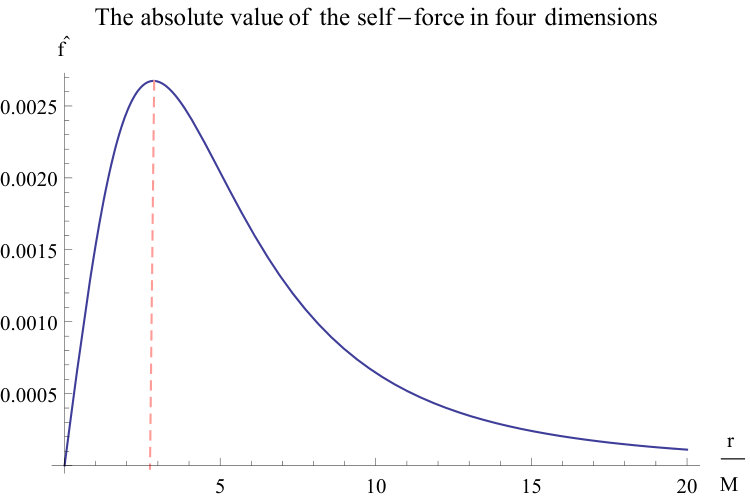 Figure 1
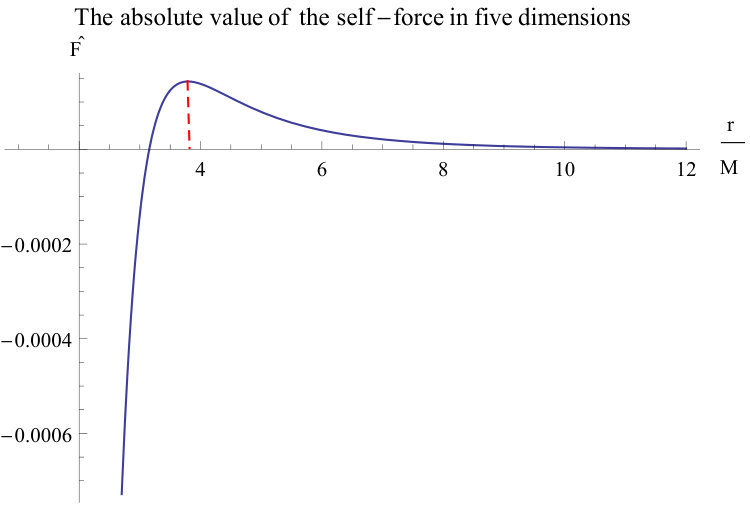 Figure 2
| 1 | i | j | k | |
| 1 | 1 | i | j | k |
| i | i | -1 | k | -j |
| j | j | -k | -1 | i |
| k | k | j | -i | -1 |
Peer Reviews
No public reviews on file for this paper yet. If you reviewed it on a platform where reviews are public (OpenReview, ICLR, NeurIPS, ICML), you can paste yours below so the community can read it here.
Videos
No videos yet. Explain this paper in a talk, walkthrough, or lecture? Add one.
Electromagnetic self-force in the five dimensional Myers-Perry space time
Hamideh Nadi
Behrouz Mirza
Department of Physics, Isfahan University of Technology, Isfahan 84156-83111, Iran
Zahra Mirzaiyan
Department of Physics, Isfahan University of Technology, Isfahan 84156-83111, Iran
Erwin Schrödinger Institute for Mathematics and Physics (ESI), Boltzmanngasse 9A, 1090 Wien , Austria
Abstract
We calculate the effects of the electromagnetic self-force on a charged particle outside a five dimensional Myers-Perry space-time. Based on our earlier work zahra , we obtain the self-force using quaternions in Janis-Newman and Giampieri algorithms. In four dimensional rotating space-time the electromagnetic self-force is repulsive at any point, however, in five dimensional rotational space-time, we find a point where the electromagnetic self-force vanishes. For () the electromagnetic self-force is attractive (repulsive).
I Introduction
The interesting subject of self-force was proposed for the first time in the seminal work by Dirac in which the motion of the electron in flat space-time was studied Dirac . The Dirac’s work was generalized by DeWitt and Brehme in 1960 for the motion of a point particle in curved space-time Dewitt in three cases: a scalar charge, an electric charge and a point mass in a curved space-time poisson . The so called “self-force” comes from the interaction of a point particle with its own field. Although this force is usually very small and negligible, it deviates the point mass from moving on the background’s geodesics.
The gravitational self-force for a point particle outside the Schwarzschild space-time was calculated in Barack . For the case of Schwarzschild and Kerr space-times in four dimensions, the electromagnetic self-force for a static charge was obtained in a closed form Smith ; BL . Also in five dimensional black hole with the Schwarzschild-Tangherlini metric, the electromagnetic self-force for a charged particle was computed in poisson2 . For some recent works on self-force see JSW2015 ; Taylor2015 ; Ce2015 ; Har2016 ; ax ; rec ; poisson2018 ; cas2018 . Recently a new approach was presented to find the effects of self-force (electromagnetic) on a charged particle in Kerr space-time based on the Janis-Newman (JN) algorithm Broccoili . This result is for an arbitrary polar angle which is a more general result than BL . This new method, which has already been defined for the conversion of static metrics to rotating ones, simplifies the self-force calculations and the corresponding force in Kerr space-time is recovered successfully in Broccoili . For more on Janis-Newman algorithm and Giampieri simplification see NJ ; KN ; Erbin ; Erbin2 ; Erbin3 ; Erbin4 ; Giampieri .
In this paper, we obtain the electromagnetic self-force acting on a static charged particle in the five dimensional Myers-Perry space-time Myersperry by applying the JN algorithm on the self-force in static space-time derived in poisson2 . Our work is based on our recent proposal zahra for finding the five dimensional Myers-Perry black hole from the static solution using quaternion’s algebra. The novelty of the recent proposal was using the quaternions’ algebra for the first time for calculating the metric of rotating black holes in dimensions higher than four, especially the five dimensional Myers-Perry black hole. Our approach for the self-force in five dimensions, leads to a closed form for the electromagnetic self-force in 5D rotating space-time. Our result for the electromagnetic self-force is novel and there is no other calculation of the self-force in 5D rotating space-time, however, it is a conjecture and should be confirmed by other methods.
This paper is organized as follows: In Section II we describe the JN algorithm and Giampieri simplification and derive the Kerr solution from the Schwarzschild metric. We also rewrite the results obtained in reference Broccoili for the electromagnetic self-force acting on the static charged particle outside the Kerr space-time. In Section III, which is the main part of our paper, we obtain the electromagnetic self-force for the static charged particle in five dimensional Myers-Perry black hole by using quaternions’ algebra. Finally, Section IV is devoted to the conclusions.
II The self-force of a static charge in Kerr background using Janis-Newman algorithm and Giampieri simplification
Janis-Newman (JN) approach is a method for deriving the rotating solution from the static one in four dimensions based on the original work in 1965 NJ . To use this algorithm, one has to introduce a set of null tetrads which is usually a complicated process. Giampieri simplified the JN approach in 1990 Giampieri . Using Giampieri’s suggestion, null tetrads could be avoided and one can work with the background metric. More details may be found in Erbin2 . Starting from the Schwarzschild metric:
[TABLE]
One can formulate the algorithm for deriving the Kerr metric in the following steps:
- Transforming the metric to the Eddington-Finkelstein (EF) coordinates, where, and () with . Schwarzschild metric in Eddington-Finkelstein coordinates is as follows:
[TABLE]
- Complexification of the coordinates and . We obtain the following differentials:
[TABLE]
Introducing the angle , the four dimensional space-time is embeded into a five dimensional complex space-time.
- Complex transformation of . Since depends on the coordinates and (complex conjugate of ), due to the rule , transforms as
[TABLE]
- Angle fixing. Using the ansatz , helps to find a real metric as follows (by omitting the primes):
[TABLE]
where we have defined
[TABLE]
- Go back to the Boyer-Lindquist coordinates by using transformations and . Applying the conditions functions and can be obtained as follows:
[TABLE]
where is introduced as
[TABLE]
Finally, we obtain the Kerr metric in the Boyer-Lindquist coordinates as follows (omitting the primes):
[TABLE]
The electromagnetic self-force can also be derived using the above algorithm. Recently an original approach to compute the self-force in Kerr space-time was presented in Broccoili , where JN approach was used. Although there is not any proof that the JN approach and Giampieri simplification can be used for deriving the electromagnetic self-force, the corresponding force in Kerr space-time is recovered successfully. That means one can find the self-force in Kerr space-time from the self-force in Schwarzschild background, just by using JN algorithm on the forces. In the following part we review deriving the self-force in rotating background in four dimensions.
Considering a static charged particle (with electric charge ) in the Schwarzschild background, the radial component is the only non-zero part of self-force and reads as follows poisson
[TABLE]
The self-force (9) can be written in Eddington-Finkelstein (EF) coordinates by using the tensorial transformation as
[TABLE]
Writing the one form in Eddington-Finkelstein coordinates leads to (one can lower indices by using Eq. (2))
[TABLE]
At this stage one has to complexify the Eddington-Finkelstein coordinates with some specified rules as
[TABLE]
where, is already introduced in Eq. (6).
Applying JN algorithm by using Eq.(II), the self-force in Kerr space-time reads as follows
[TABLE]
The self-force in Boyer-Lindquist coordinates in Kerr background is obtained as
[TABLE]
The absolute value of the self-force (16) is defined as . The absolute value of the self-force is obtained as
[TABLE]
where, for the case of a static particle located in , the above relation reduces to the self-force calculated in BL . Equation (17) is depicted in Fig.(1). As it can be seen from the diagram, there is a peak in the plot that appears in .
III The electromagnetic self-force of a static charged particle in five dimensional Myers-Perry space-time
In the following, we review deriving the Myers-Perry black hole with two distinct angular momenta in a five dimensional space-time using quaternions zahra . We derive the electromagnetic self-force of a static charged particle in 5-dimensional rotating space-time for the first time.
Starting with the 5-dimensional Schwarzschild solution as:
[TABLE]
where, and is the induced metric on the three dimensional sphere in the Hopf coordinates which can be written as follows:
[TABLE]
We repeat the same steps used in Sec. (II).
- The Myers-Perry metric in five dimensions in Eddington-Finklestein retarded null coordinates can be written as:
[TABLE]
- Complexification of coordinates and using quaternions. Therefore, we obtain the following differentials
[TABLE]
In (III), and are the orthogonal basis of quaternions. Also, and are defined as parameters related to independent angular momenta. We may embed our five dimensional metric into a seven dimensional complex space-time.
- Complex transformation of . depends on and its complex conjugate . Under the defined transformations, transforms as (Note that )
[TABLE]
- Angle fixing.
[TABLE]
Substituting (III) and (III) in metric (20) and by using angle fixing (III), we obtain the following form for the transformed metric
[TABLE]
Using the symmetrizing angle part method and the fact that quaternions are not commutative , we can now obtain the transformed metric as follows (all the primes are omitted). See Appendixes A and B for more details.
[TABLE]
where, .
- For going to the Boyer-Lindquist coordinates, we use the following transformations:
[TABLE]
where,
[TABLE]
Based on the definition of and , we can obtain the five dimensional Myers-Perry solution in the Boyer-Lindquist coordinates as follows (omitting the primes):
[TABLE]
Since we know how to find the Myers-Perry metric from the non-rotating one in five dimensions with the proper algorithm, we may obtain the electromagnetic self-force for a charged particle in five dimensional Myers-Perry space-time. Since the self-force in Kerr space-time can be derived successfully with this method Broccoili , we expect our method leads to a correct form of self-force in five dimensional rotating background.
Considering a charged particle at the fixed position in the five dimensional Schwarzschild background (18), only the radial component of self-force , is non-zero and is given by poisson2 :
[TABLE]
where, is the radius of event horizon that is related to ADM mass , , is the electric charge and,
[TABLE]
Also and . The self-force is dependent on an unidentified parameter which it can be interpreted as the radius of the charged particle.
We can obtain two non-zero components for the self force in Eddington-Finkelstein (EF) coordinates as
[TABLE]
The one form in Eddington-Finkelstein coordinates is written as (one can lower indices by using Eq. (20))
[TABLE]
To use the Janis-Newman algorithm, we need the following specified rules
[TABLE]
[TABLE]
where, .
Applying the above rules along with Eqs. (III) with the angle fixing ansatz (III), the self-force (33) acting on a static charge in five dimensional Myers-Perry space-time reads as follows
[TABLE]
where, and
[TABLE]
We can easily find the self-force in Boyer-Lindquist coordinates in five dimensional Myers-Perry space-time using Eqs. (III) and (III) as
[TABLE]
Through raising indices by using the metric (28), we can calculate absolute value of the self-force, , as follows (Note that the sign of is chosen such that it agrees with the sign of )
[TABLE]
The absolute value of self-force in five dimensions, Eq. (39) is plotted in Fig.(2) as a function of distance. An interesting feature in five dimensions for the self-force is that for some specific values of angular momentum, there is a point () where the value of self-force vanishes. The self-force becomes attractive (repulsive) for (), however in four dimensions the self-force is positive for all values of . Therefore if we live in a five dimensional space-time the extra dimension may be explored using experimental methods111We would like to thank anonymous referee for suggesting this idea.. Also for the specific case of , Equation (39) is consistent with the self-force calculated for the non-rotating black hole in poisson2 .
Moreover note that there is no explicit calculation for the absolute value of self-force of a charged particle in five dimensional rotating Myers-Perry space-time. Our proposal is based on JN algorithm and should be confirmed by other methods.
IV Conclusion
In this work, we derived the self-force of a static charged particle in five dimensional Myers-Perry space-time. In this process, we used quaternion’s algebra and their non-commutative property. We also showed that for specific values of angular momenta, self-force vanishes and make the particle move on the circular geodesics while this does not happens in four dimensions. This behavior might be used in the future experiments to measure self-force and therefore discovering possible extra dimensions. It will be very interesting to investigate this behavior in other examples and higher dimensions.
Acknowledgements:
ZM acknowledge the Erwin Schrödinger Institute for Mathematics and Physics (ESI) scientific atmosphere. ZM was partially supported by the Erwin Schrödinger JRF fund.
Appendix A Quaternions
Quaternions are a system of basis in mathematics that are represented in a specific form as follows:
[TABLE]
where and are quaternion’s units and and are real numbers. Quaternion multiplications are presented in Table 1.
Appendix B Transforming the angular part of the five dimensional metric using symmetrizing angular terms and non-commutative feature of quaternions
We show how the angular part in metric (24) transforms using the symmetrizing method introduced in zahra . By the angular part we mean .
As the angular part in the metric need to be transformed, we show how each term transforms separately as follows
1.The first term, :
[TABLE]
- The second term, :
[TABLE]
We replace the term by the following ansatz (see Eq.(III)):
[TABLE]
where, we used a symmetric form for quaternion’s products. It should be noted that .
Using (B), we can write (42) as follows:
[TABLE]
where, is used in the third line and the substitution of which is the angle fixing condition in (III).
- The third term, :
[TABLE]
Using the angle fixing, , we have
[TABLE]
Substituting Eqs. (41), (B) and (46) in (24) one can find the transformed metric (25).
The reference list from the paper itself. Each links out to its DOI / PubMed record.
- 1(1) Z. Mirzaiyan, B. Mirza, E. Sharifian, “Generating five-dimensional Myers-Perry black hole solution using quaternions”, Annals of Physics 389 (2018) 11-18, [ar Xiv:1708.08969].
- 2(2) P. Dirac, “Classical theory of radiating electrons”, Proc. R. Soc. London, Ser. A 167 , 148 (1938).
- 3(3) B. De Witt and R. Brehme, “Radiation Damping in a Gravitational Field”, Ann. Phys. (N.Y.) 9 , 220 (1960).
- 4(4) E. Poisson, A. Pound, and I. Vega, “The motion of point particles in curved spacetime”. Living Rev. Rel, 14:7 , 2011.
- 5(5) L. Barack, Y. Mino, H. Nakano, A. Ori, and M. Sasaki, “Calculating the gravitational self-force in Schwarzschild spacetime”, Phys. Rev. Lett. 88 , 091101 (2002), [ar Xiv:gr-qc/0111001].
- 6(6) A.G. Smith and C.M. Will, “Force on a static charge out-side a Schwarzschild black hole”. Phys. Rev, D 22 : 1276-1284, 1980.
- 7(7) B. L´eaut´e and B. Linet, “Self interaction of a point charge in the Kerr space-time”. J. Phys., A 15 : 1821-1825, 1982.
- 8(8) M. J.S. Beach, E. Poisson, B. G. Nickel, “ Self-force on a charge outside a five-dimensional black hole”, Phys. Rev, D.89 .124014, [ar Xiv:1404.1031].