The $W \gamma$ decay of the elusive charged Higgs boson in the two-Higgs-doublet model with vectorlike fermions
Jeonghyeon Song, Yeo Woong Yoon

TL;DR
This paper explores the potential of the W gamma decay channel to detect the charged Higgs boson in a two-Higgs-doublet model with vectorlike fermions, showing enhanced branching ratios and sizable signal rates at the LHC.
Contribution
It introduces the W gamma decay mode as a new probe for the charged Higgs in a specific two-Higgs-doublet model with vectorlike fermions, with detailed analysis of production channels and parameter space.
Findings
Branching ratio of H± to W gamma can reach ~0.01 in certain parameter regions.
Signal cross section times branching ratio exceeds 10 fb in some scenarios.
The proposed channel offers a promising new avenue for charged Higgs searches at the LHC.
Abstract
The LHC search for the charged Higgs boson in the intermediate-mass range () is actively being performed after the next-to-leading order calculation of the total production cross section of . In the decay part, only the mode is mainly concerned because of the experimental difficulty in the mode. In the framework of a two-Higgs-doublet model, we suggest that the channel can be helpful in probing this charged Higgs boson, if introducing vectorlike fermions. In type-I-II model where the SM fermions are assigned in type-I while the vectorlike fermions are in type-II, the branching ratio is greatly enhanced up to in a large portion of the parameter space allowed by the Higgs precision data, the electroweak oblique parameters, and the direct search bounds at the LHC. Two kinds of production…
Click any figure to enlarge with its caption.
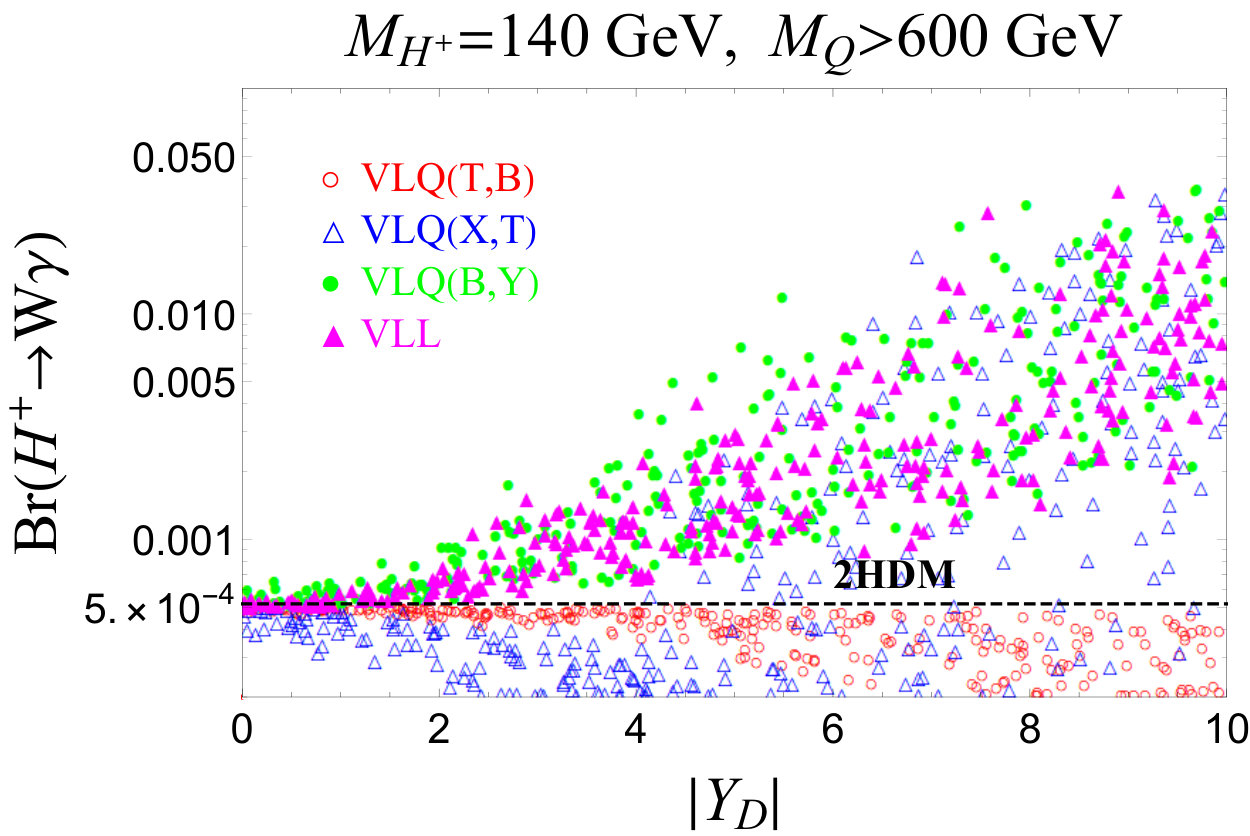 Figure 1
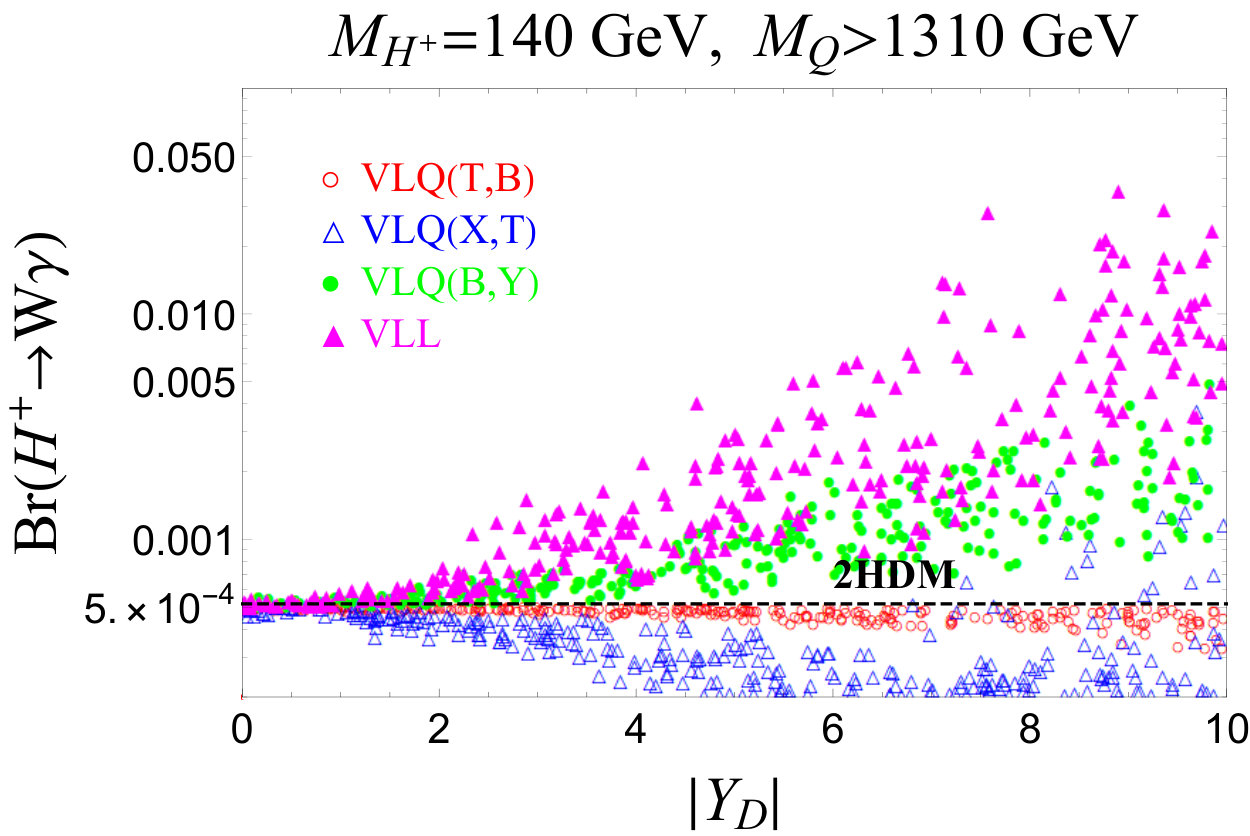 Figure 2
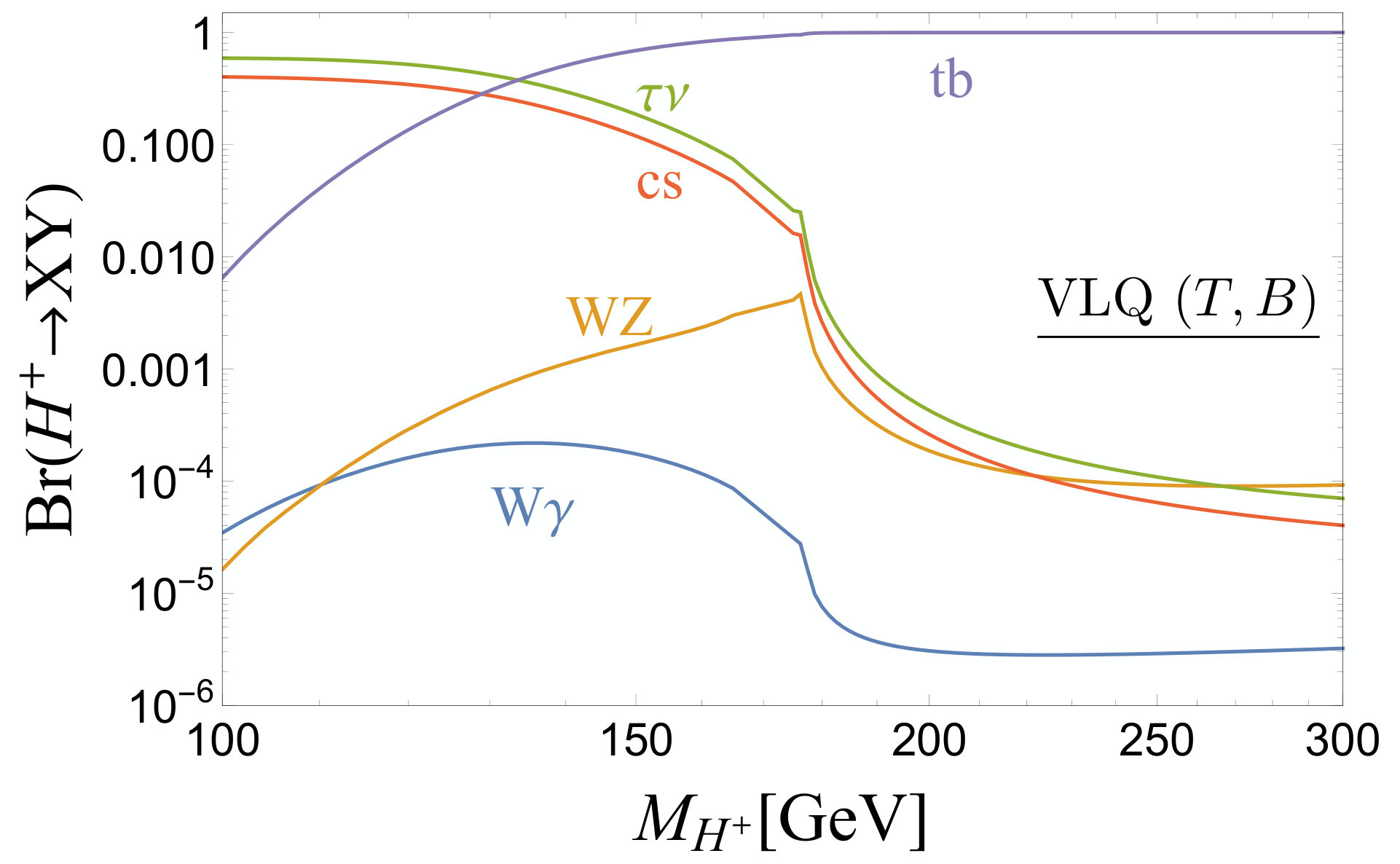 Figure 3
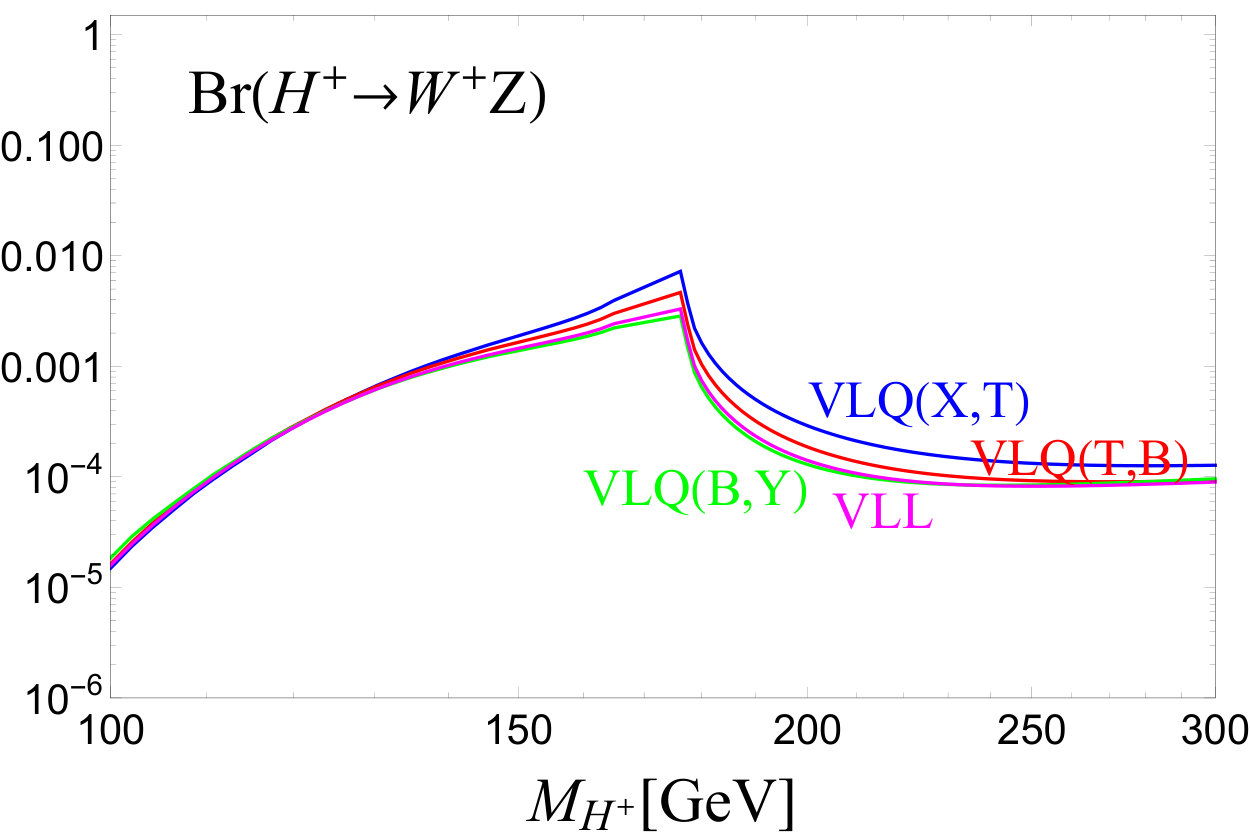 Figure 4
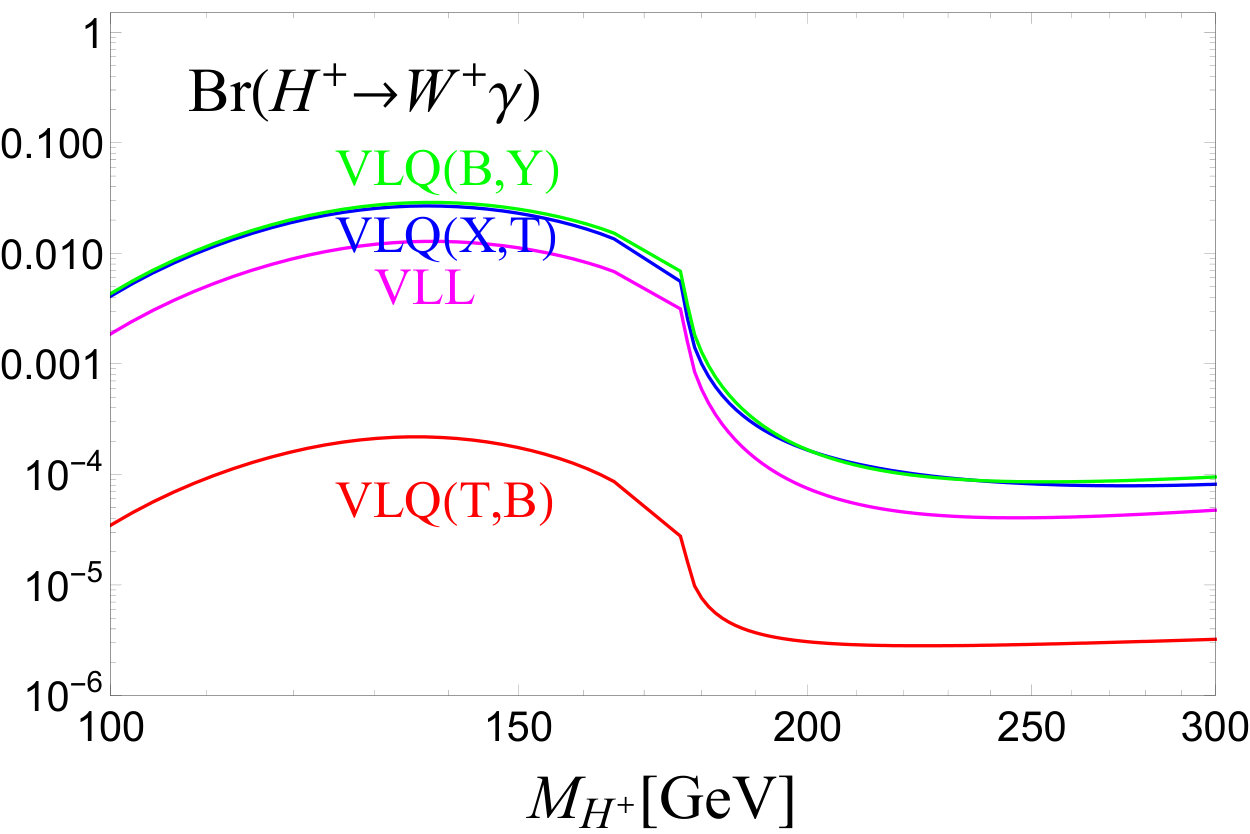 Figure 5
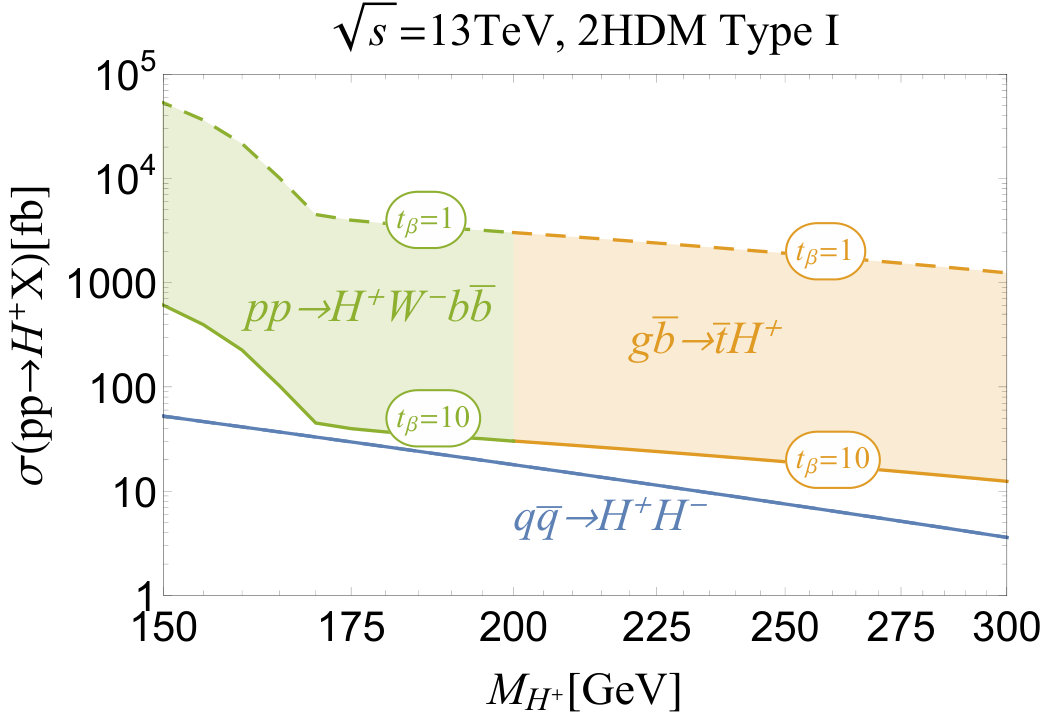 Figure 6
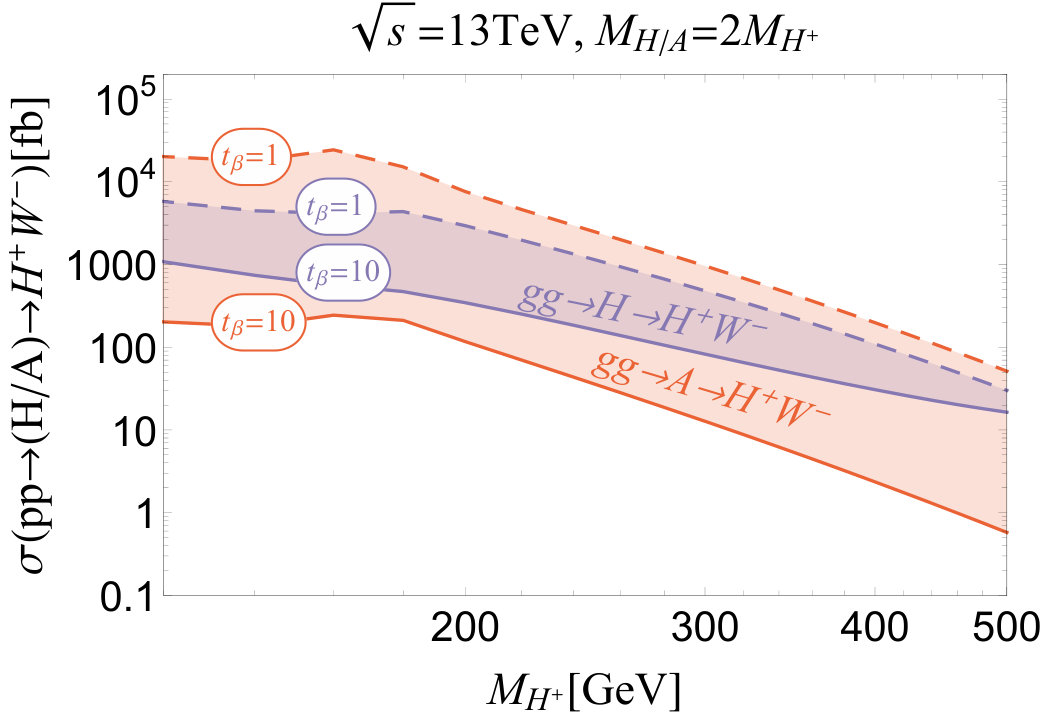 Figure 7
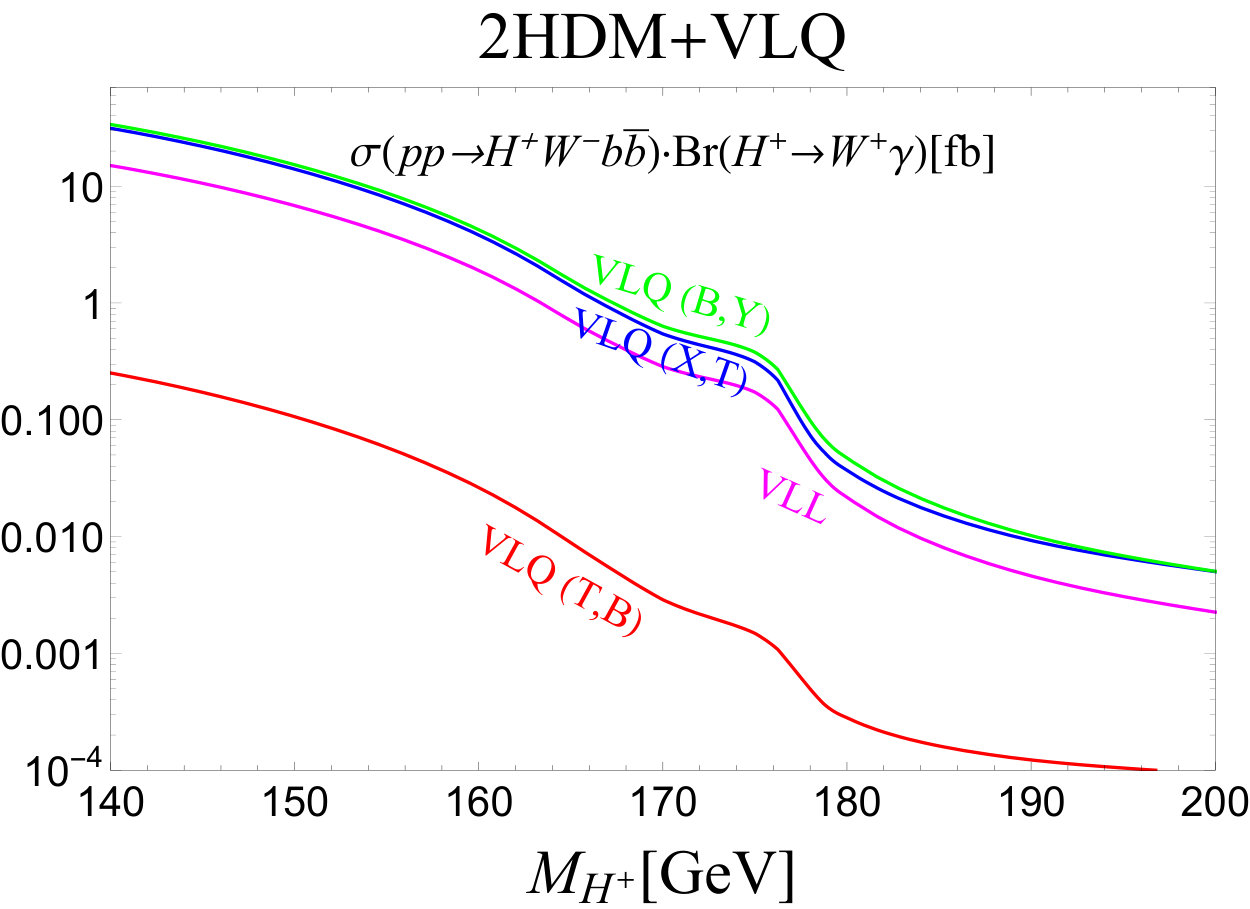 Figure 8
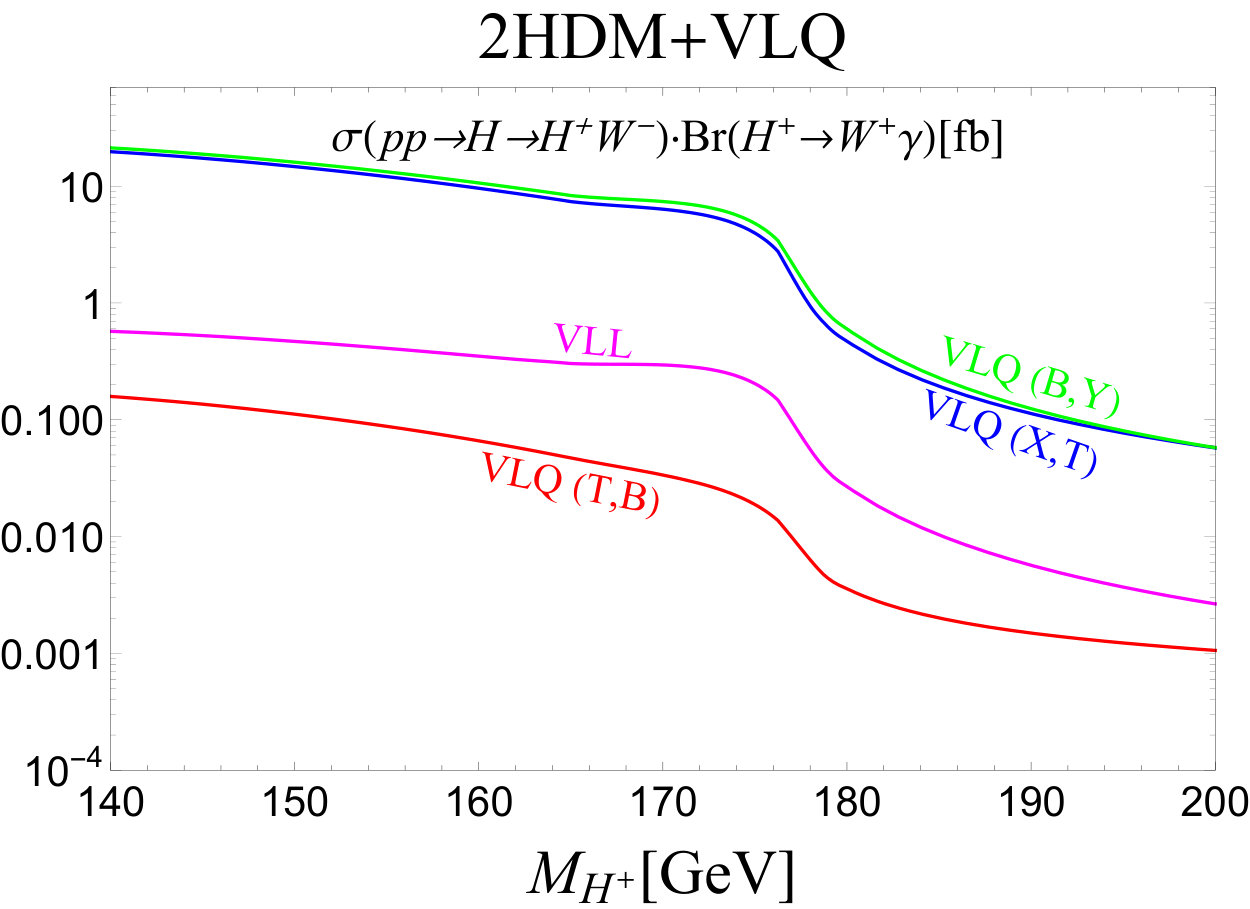 Figure 9
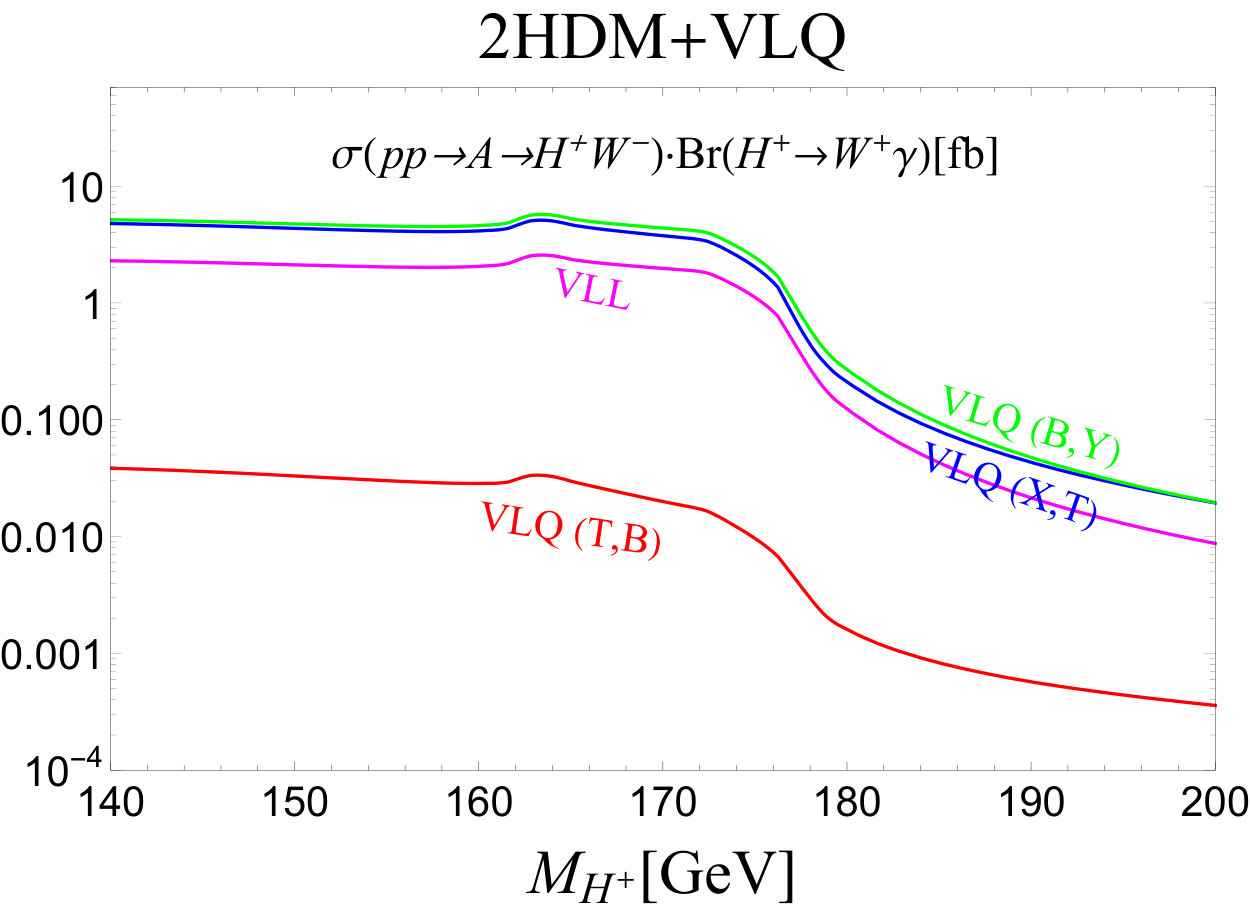 Figure 10
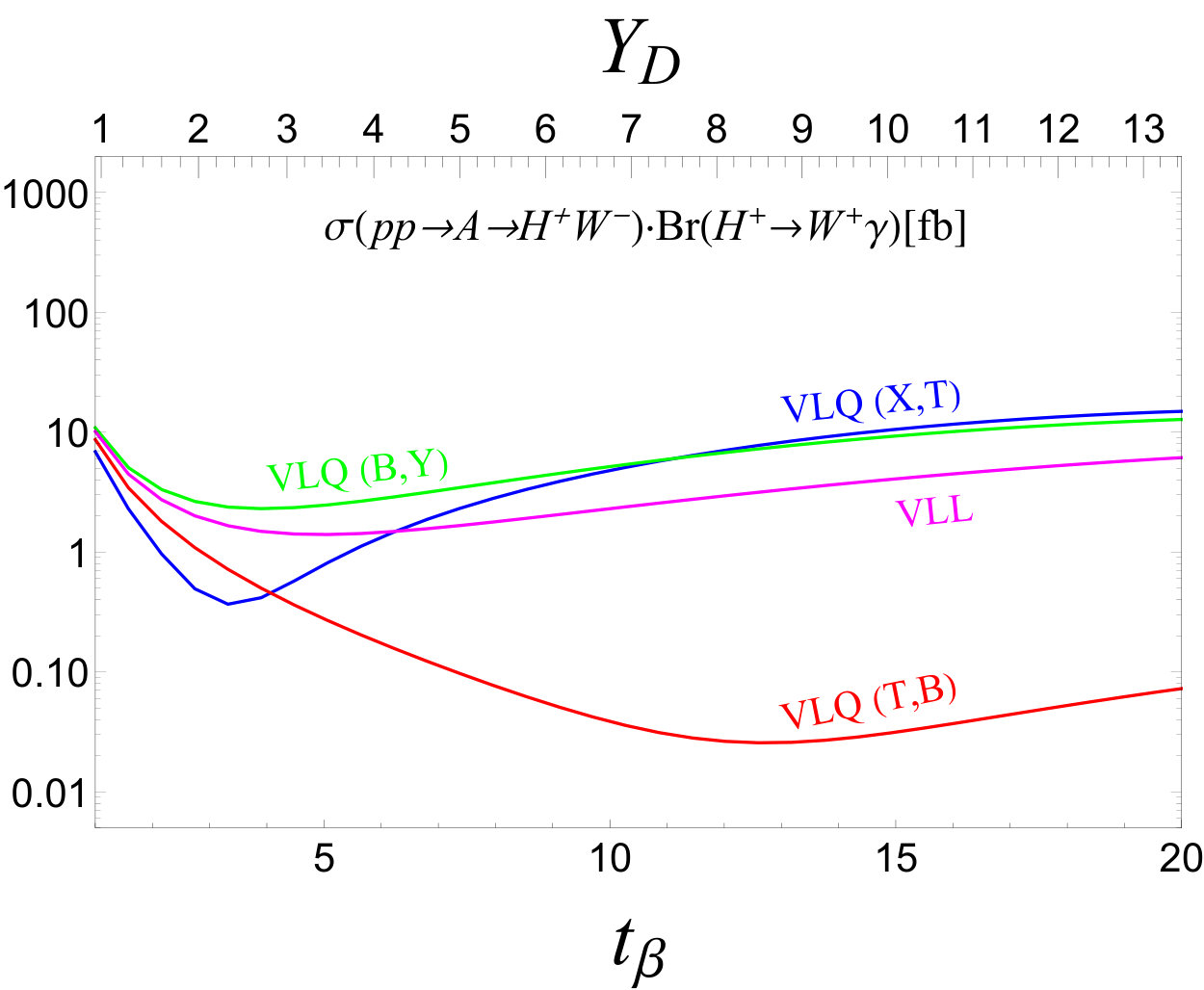 Figure 11
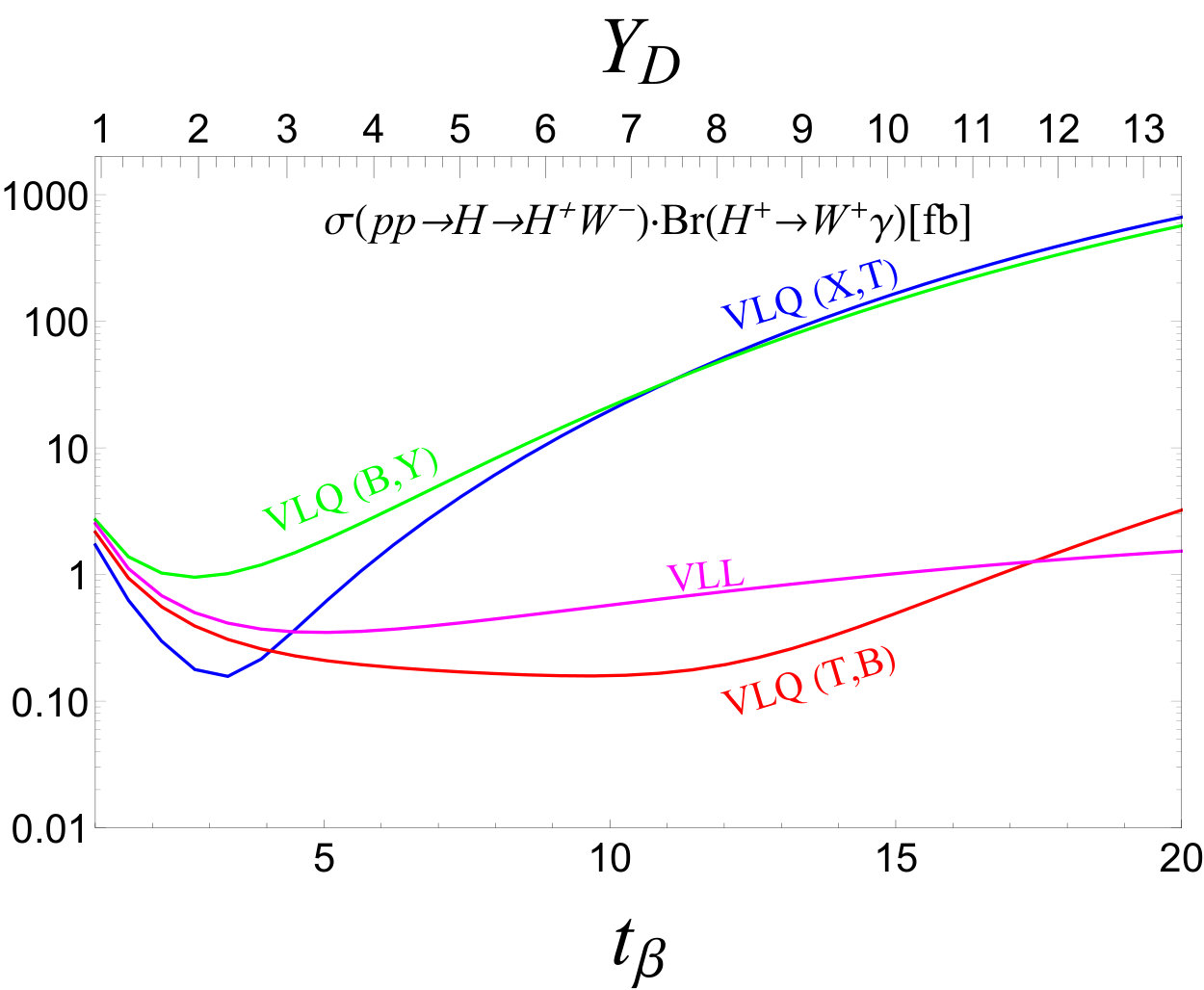 Figure 12
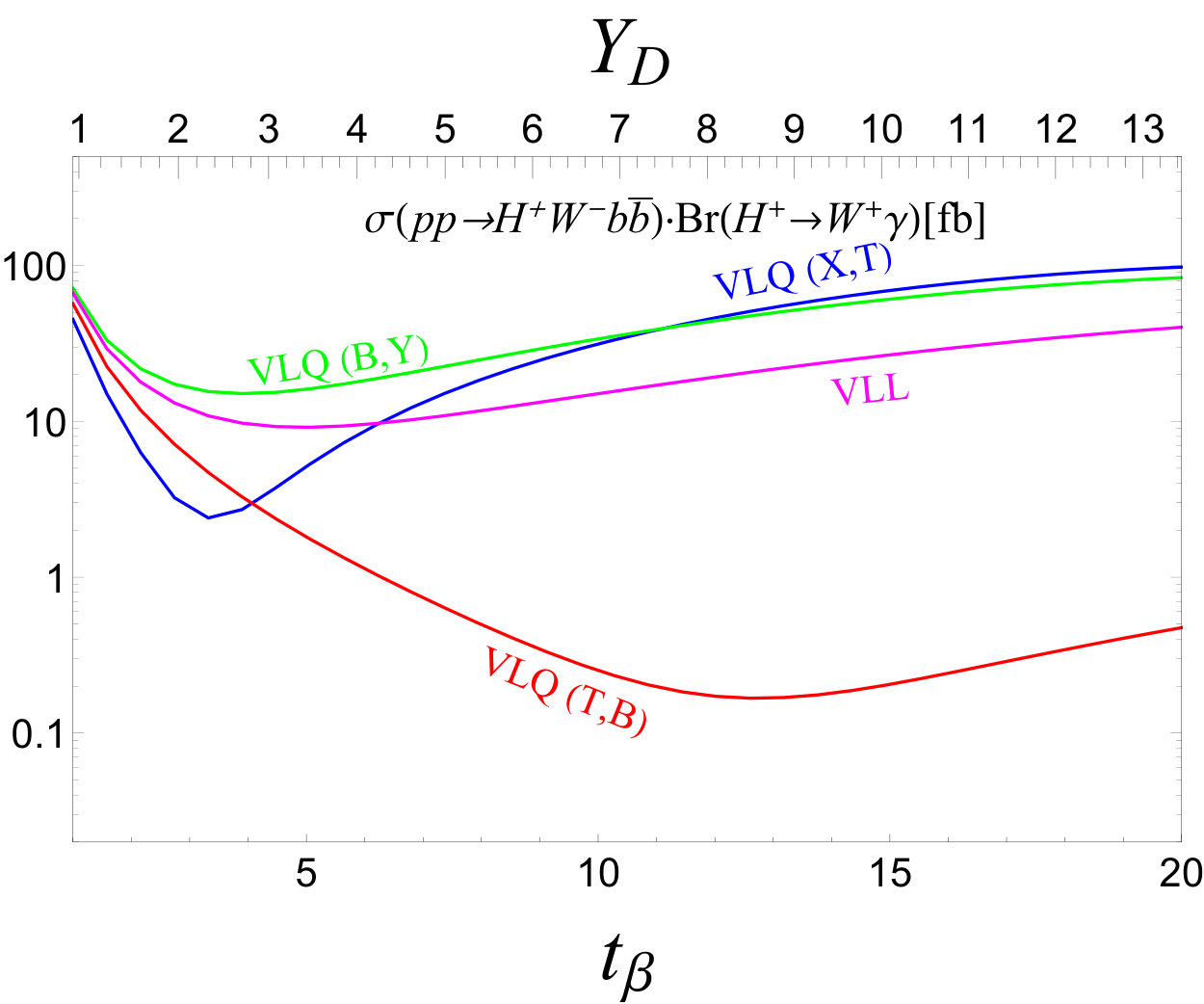 Figure 13
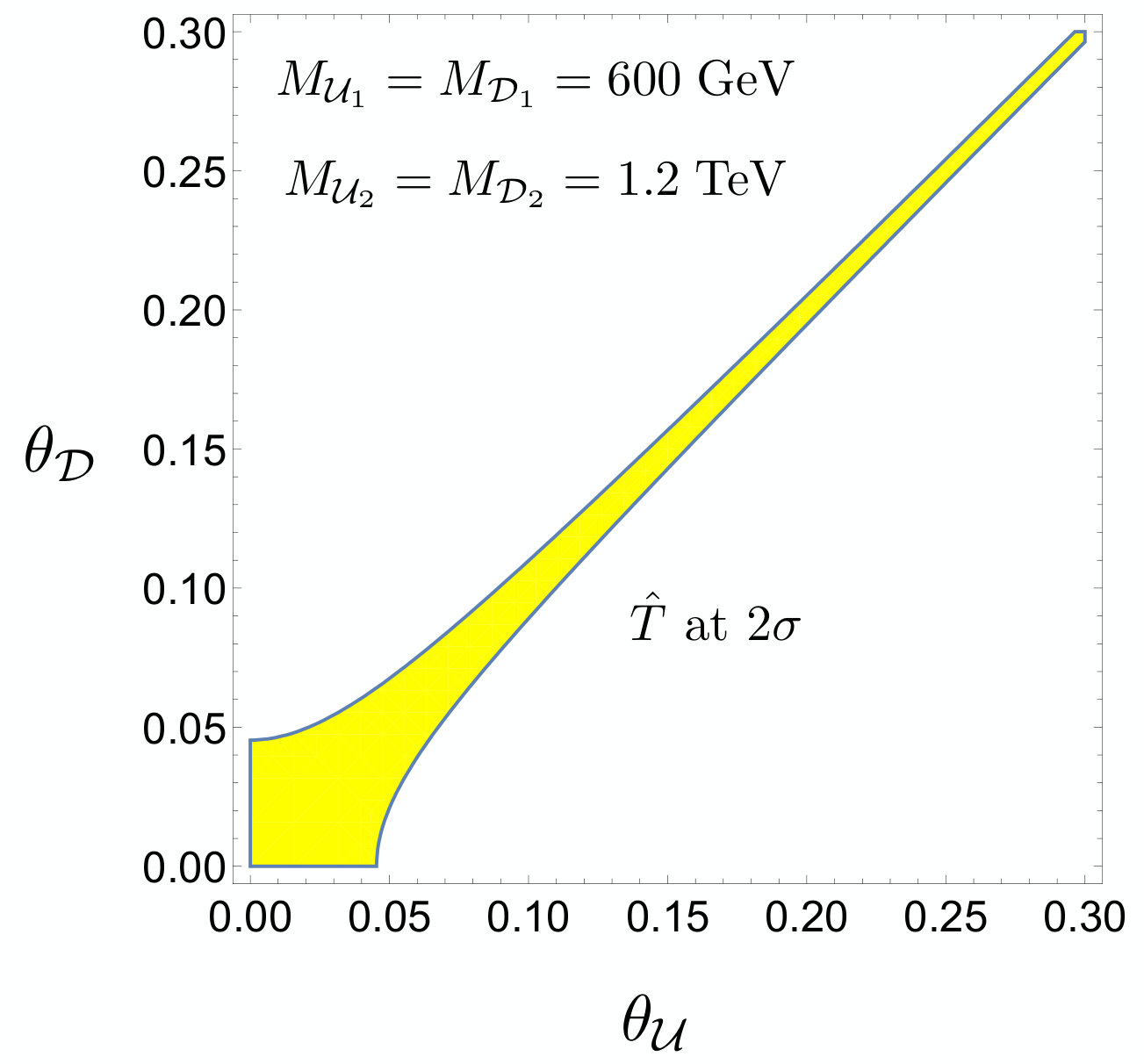 Figure 14
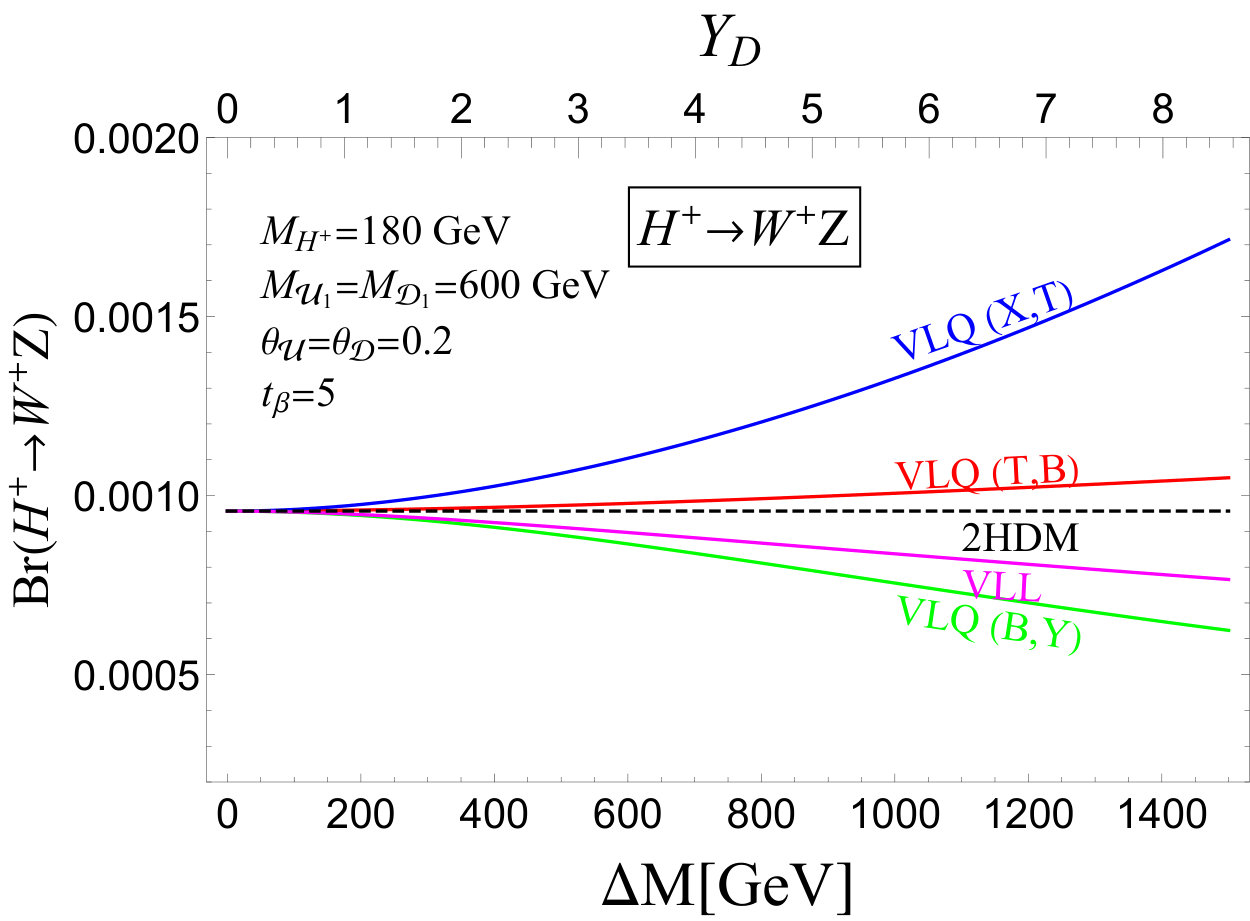 Figure 15
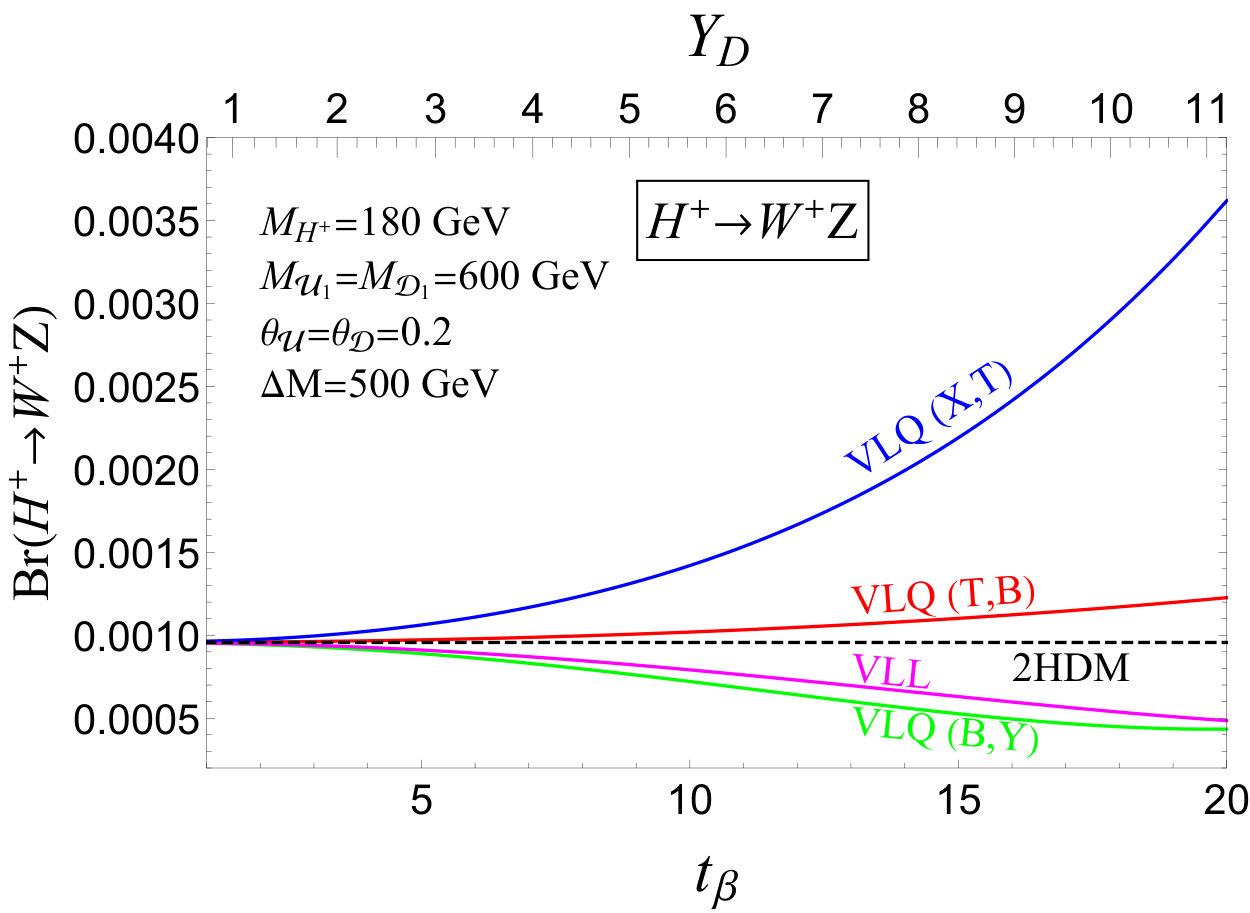 Figure 16
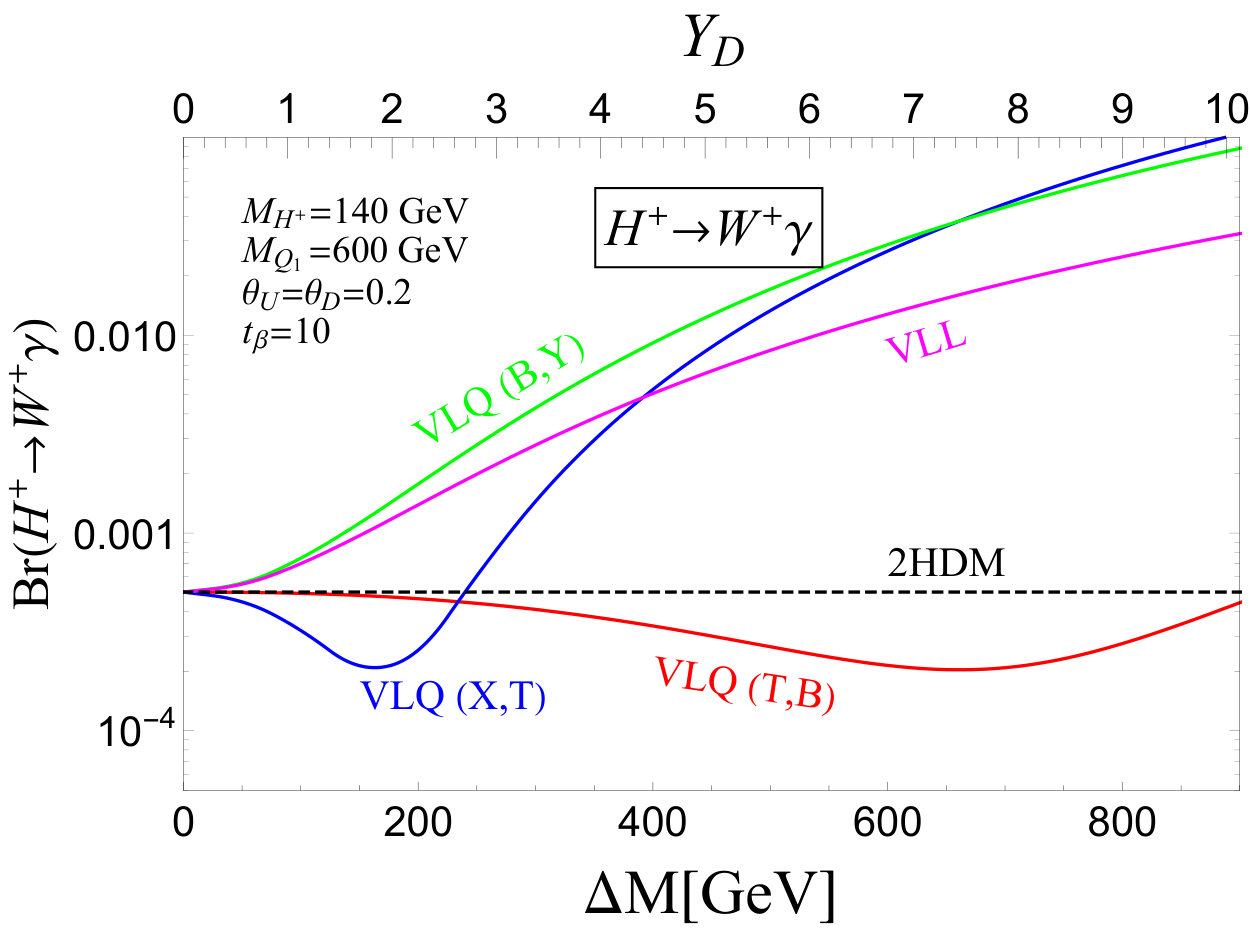 Figure 17
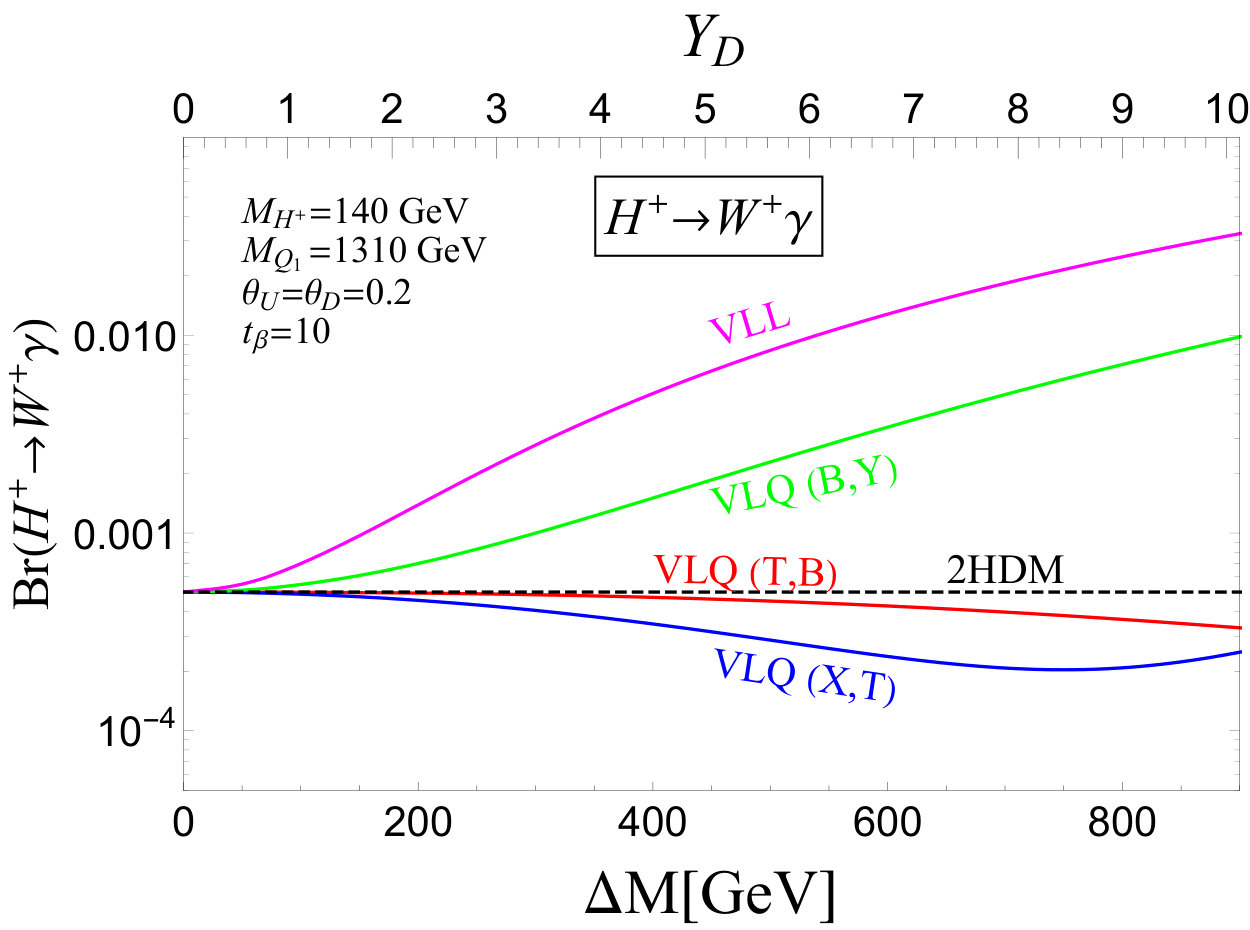 Figure 18
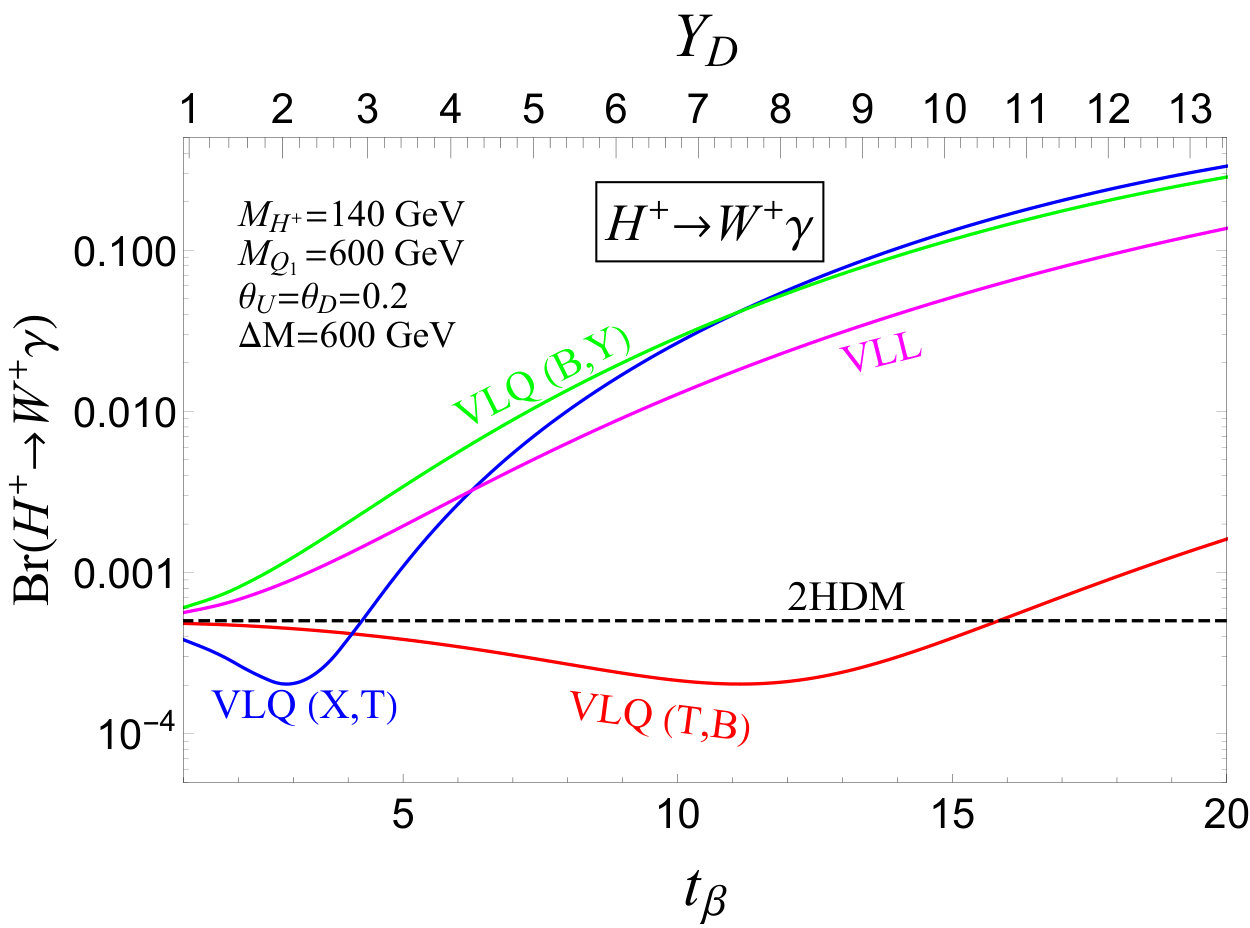 Figure 19
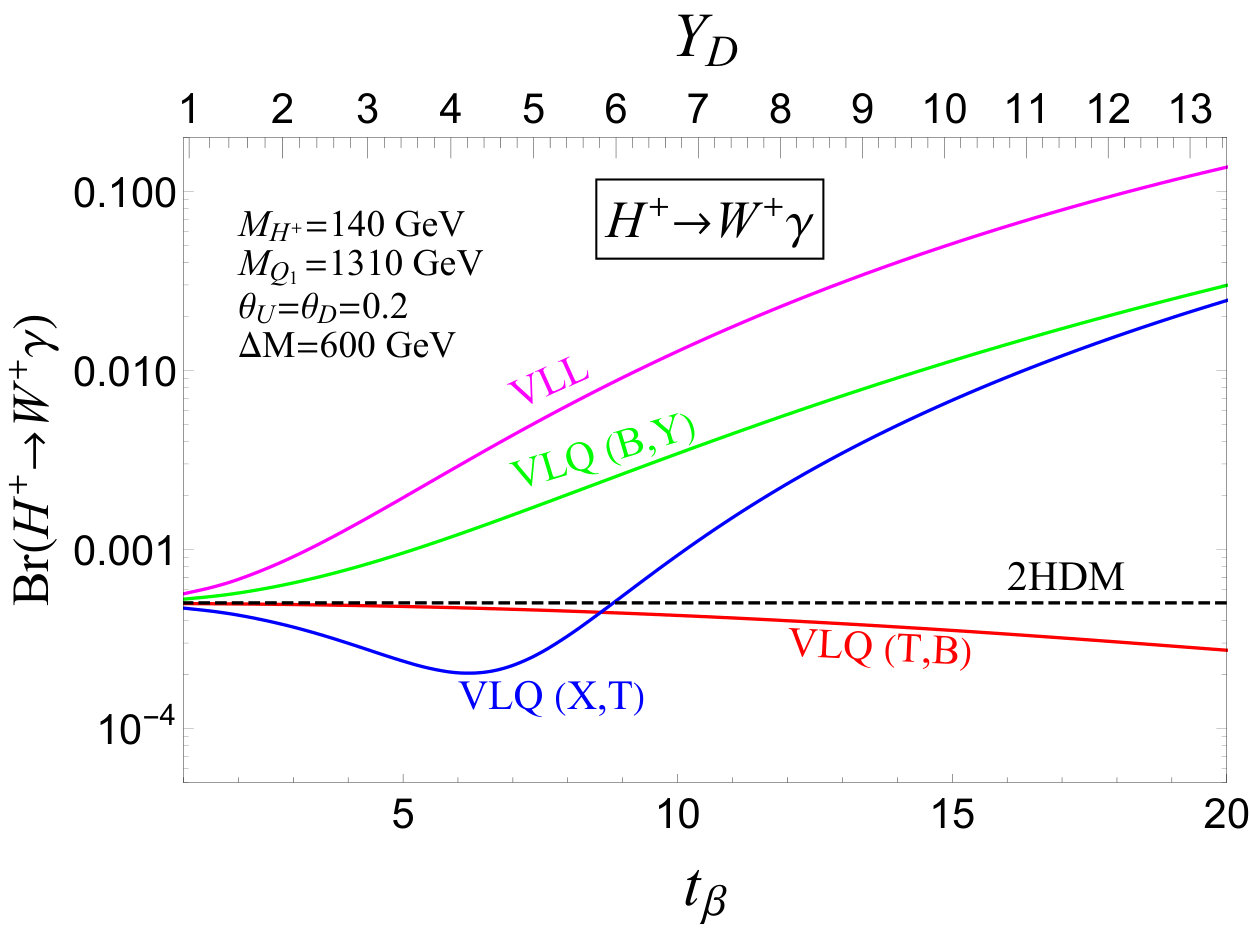 Figure 20
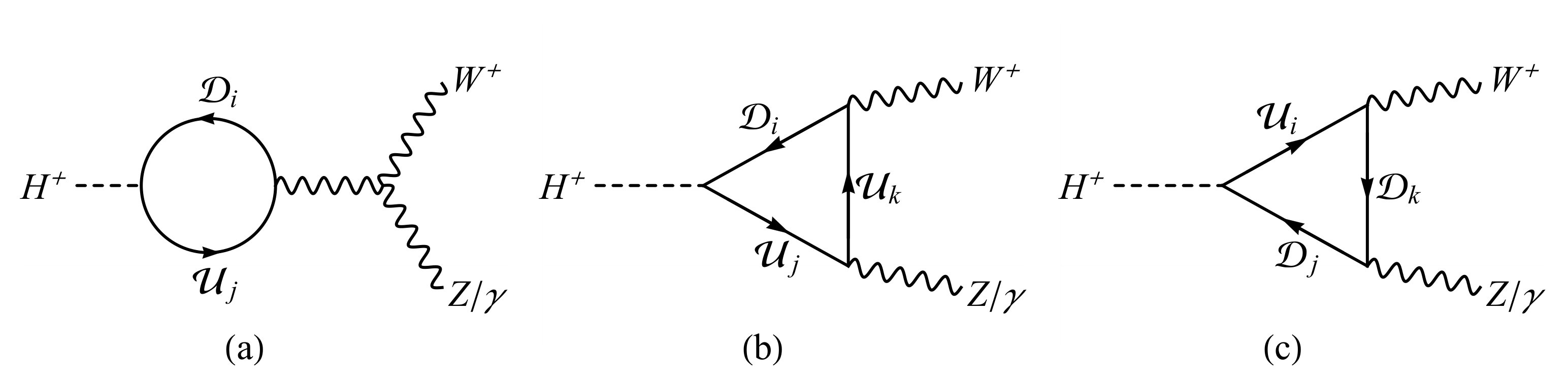 Figure 21
| SM | |||
|---|---|---|---|
| type-I | |||
| VLF | |||
| type-II |
| diagram (a): | ||
|---|---|---|
| diagram (b) and (c): | (111), (112), (121), (122) | |
| (211), (212), (221), (222) |
Peer Reviews
No public reviews on file for this paper yet. If you reviewed it on a platform where reviews are public (OpenReview, ICLR, NeurIPS, ICML), you can paste yours below so the community can read it here.
Videos
No videos yet. Explain this paper in a talk, walkthrough, or lecture? Add one.
The decay of the elusive charged Higgs boson
in the two-Higgs-doublet model with vectorlike fermions
Jeonghyeon Song, and Yeo Woong Yoon
Department of Physics, Konkuk University, Seoul 05029, Korea
Abstract
The LHC search for the charged Higgs boson in the intermediate-mass range () is actively being performed after the next-to-leading order calculation of the total production cross section of . In the decay part, only the mode is mainly concerned because of the experimental difficulty in the mode. In the framework of a two-Higgs-doublet model, we suggest that the channel can be helpful in probing this charged Higgs boson, if introducing vectorlike fermions. In type-I-II model where the SM fermions are assigned in type-I while the vectorlike fermions are in type-II, the branching ratio is greatly enhanced up to in a large portion of the parameter space allowed by the Higgs precision data, the electroweak oblique parameters, and the direct search bounds at the LHC. Two kinds of production channels, and , are also studied. We find that the signal rate is quite sizable, more than 10 fb in some parameter space.
I Introduction
The repeated phrase “no excess above the estimated standard model (SM) background” in every new physics study at the LHC is disappointing to many particle physicists. Before we are resigned to no prospect of the new signal, we need to draw upon the planned high-luminosity of the LHC. We shall be able to probe some faint signals if any. In the meantime, all we can and should do is to search every hole and corner of the given parameter space. The common method of finding a new particle is to consider the main production channel and the main decay mode, which spans the bulk of the parameter space most effectively. In order to target faint signals, however, each portion of parameter space requires a customized approach, which is sometimes unorthodox.
A good example is a charged Higgs boson in the two-Higgs-doublet model (2HDM) Branco:2011iw . Since the -- vertex does not exist at the tree level and the -- vertex vanishes in the alignment limit Campos:2017dgc , the charged Higgs boson mostly decays into fermions in the normal scenario of 111 In the inverted scenario where the observed Higgs boson is the heavy CP-even (), the decay of is dominant in the alignment limit of Arbey:2017gmh . . The search strategy at the LHC Aad:2014kga ; Khachatryan:2015qxa ; Aad:2013hla ; Khachatryan:2015uua ; Sirunyan:2018dvm ; Aaboud:2016dig ; Aad:2015typ depends on the charged Higgs boson mass . If it is significantly lighter than the top quark mass (), is mainly produced from the on-shell top quark decay in the top quark pair production, and then decays into . If it is heavy like , the production channel is , followed by the decay .
As for the intermediate-mass region with , the interplay between the top quark resonant and non-resonant diagrams is important. Recently, the total production cross section of the full process including resonant and non-resonant top quark diagrams was computed at next-to-leading order (NLO) accruacy Degrande:2016hyf . This NLO computation stimulates the charged Higgs search for the intermediate mass region. In the decay part, only the mode has been searched for Aaboud:2018gjj ; Sirunyan:2019hkq , because the mode is experimentally very difficult. Being kinematically below the threshold, the intermediate-mass charged Higgs boson has more chance to be probed through other decay channels since the decay channel, once open, is severely dominant. Therefore, alternative decay modes shall be especially helpful for the intermediate-mass charged Higgs boson.
Non-fermionic decay channels of are only the radiative decays of and . The and modes as a new resonance search at the LHC Aad:2014fha ; Aaboud:2018fgi have been studied in other new physics models. A representative one is the Georgi-Machacek (GM) model Georgi:1985nv where the custodial-fiveplet (both singly and doubly) charged Higgs boson is fermiphobic, mainly decaying into or through the tree level couplings Chiang:2012cn ; Chiang:2018cgb ; Hartling:2014zca ; Chiang:2014bia . Below the kinematic threshold, the loop-induced decays into were studied Logan:2018wtm ; Degrande:2017naf . In a generalized inert doublet model with a broken symmetry, called the stealth Higgs doublet model, was also studied Enberg:2013jba .
In the usual 2HDM, the branching ratios of both and modes are very suppressed, at most . So we question whether the branching ratios can be meaningfully enhanced if we extend the 2HDM by introducing vectorlike fermions (VLFs) Ellis:2015oso . A VLF with a mass around the electroweak scale appears in many new physics models Lavoura:1992np ; Aguilar-Saavedra:2013qpa . One of the biggest advantages of VLFs is the consistency with the Higgs precision data unlike heavy chiral fermions Anastasiou:2011qw ; Anastasiou:2016cez . However, enhancing the branching ratios of the radiative decays is very challenging. Naively raising the Yukawa couplings of the VLFs with the charged Higgs boson shall confront the constraints from the electroweak oblique parameters since the VLF loop corrections to the vertex of -- () are usually correlated with those to the vacuum polarization amplitudes of the SM gauge bosons. We need to contrive a model which accommodates significantly large loop-induced decays while satisfying the other direct and indirect constraints. As shall be shown, if we assign the SM fermions in type-I and the new VLFs in type-II, the goal is achieved. In a large portion of the parameter space, for the intermediate-mass charged Higgs boson is greatly enhanced by a few orders of magnitude. However, the decay mode does not change much because of the strong correlation with the electroweak oblique parameter . This is our main result.
The paper is organized in the following way. In Sec. II, we review our model, the 2HDM with the SM fermions in type-I and the VLFs in type-II. Section III deals with indirect and direct constraints such as the Higgs precision data, the direct searches for the charged Higgs boson and the VLFs at the LHC, and the electroweak oblique parameters. Particularly for the electroweak oblique parameter , we shall suggest our ansatz for the parameters. In Sec. IV, we first present the one-loop level calculation of the decay rates of via the VLF loops. This is a new calculation. Then, we show that the branching ratio of can be highly enhanced by one or two orders of magnitude, relative to that without the VLF contributions. Section V covers the production channels of the charged Higgs boson in our model as well as the 13 TeV LHC sensitivity to the mode. Section VI contains our conclusions.
II 2HDM with Vectorlike Fermions
We consider a 2HDM with vectorlike fermions in the alignment limit. The Higgs sector is extended by introducing two complex Higgs doublet scalar fields, and Branco:2011iw :
[TABLE]
where , and are the nonzero vacuum expectation values (VEVs) of . Using the simplified notation of , , and , we take . The electroweak symmetry breaking occurs by the nonzero VEV of .
The fermion sector of the SM is also extended by introducing one doublet VLF and two singlet VLFs as follows:
[TABLE]
Here and denote the up-type and down-type fermions, respectively. We shall consider various kinds of the VLFs: , the vectorlike quark (VLQ) with the electric charges of ; , the VLQ with ; , the VLQ with ; , the vectorlike lepton (VLL) with Aguilar-Saavedra:2013qpa .
In order to avoid the flavor changing neutral currents (FCNC) at tree level, we introduce a discrete symmetry under which and Glashow:1976nt ; Paschos:1976ay . The parities of and dictate the scalar potential to be
[TABLE]
where we allow softly broken parity but maintain the CP invariance. Five physical Higgs bosons (the light CP-even scalar at a mass of 125 GeV, the heavy CP-even scalar , the CP-odd pseudoscalar , and two charged Higgs bosons ) are related with the weak eigenstates via
[TABLE]
where and are the Goldstone bosons that will be eaten by the and bosons, respectively. The rotation matrix is
[TABLE]
The SM Higgs field is a linear combination of and , . Because the observed Higgs boson at a mass of 125 GeV is very SM-like, we take the alignment limit of
[TABLE]
The fermions can have different parities. For the SM fermions, we fix and under parity transformation. Then, there are four different choices of parities for the right-handed SM fermion fields, leading to type-I, type-II, type-X, and type-Y. The VLFs need not to have the same parity with the SM fermions. Since our main purpose is to explore the possibility of highly enhancing , we consider type-I-II, where the SM fermions are assigned in type-I while the VLFs are in type-II (see Table 1). The Lagrangian for the mass and Yukawa terms of the VLFs is then
[TABLE]
where and we assume and .
The VLF masses are from the Dirac mass parameters as well as from the Higgs VEVs. The mass matrices and in the basis of and , respectively, are
[TABLE]
In the large limit where and , the off-diagonal terms of are suppressed. The VLF mass matrices are diagonalized by the rotation matrices as for , leading to the mass eigenstates of the VLFs as
[TABLE]
When , and are doublet-like while and are singlet-like. In what follows, we use and for notational simplicity. The VLF mixing angles satisfy
[TABLE]
The Yukawa Lagrangian for the SM fermions and the VLFs in terms of mass eigenstates is
[TABLE]
where , , and . In our type-I-II model, the normalized Yukawa couplings are
[TABLE]
Additionally, we shall impose the alignment condition, .
The Yukawa couplings of the VLFs with neutral Higgs bosons are
[TABLE]
and those with the charged Higgs boson are
[TABLE]
The gauge interaction Lagrangian of the VLF mass eigenstates is
[TABLE]
where , , and is the cosine of the electroweak mixing angle. The normalized gauge couplings are
[TABLE]
where .
III Constraints on the type-I-II 2HDM
Before investigating the allowed parameter space by the current data, we make some comments on the decays of the VLQs in the type-I-II 2HDM. As being colored fermions, the VLQs are copiously produced through the gluon fusion. The decays depend on the mixing with the SM fermions. Here we assume that the mixing is very suppressed, below , so that the mixing effects on the and FCNC processes are negligible. Then the decays of the VLQs are determined by the Yukawa interactions with the Higgs fields. For example, the case in the type-I-II model has
[TABLE]
Since the first term yields the mixing between and the SM up-type quarks and the second term generates the vertices of -- and --, the decays of and are and .
Another comment is on the most sensitive FCNC process, . The comparison between the Belle result Saito:2014das and the SM calculation with NNLO QCD correction Chetyrkin:1996vx ; Buras:1997bk ; Buras:2002tp ; Misiak:2004ew ; Neubert:2004dd ; Melnikov:2005bx ; Misiak:2006zs ; Misiak:2006ab ; Czakon:2006ss ; Boughezal:2007ny ; Ewerth:2008nv ; Misiak:2010sk ; Ferroglia:2010xe ; Misiak:2010tk ; Czakon:2015exa generally puts significant constraints on in the 2HDM Ciafaloni:1997un ; Ciuchini:1997xe ; Borzumati:1998tg ; Bobeth:1999ww ; Gambino:2001ew ; Misiak:2015xwa . Since the SM fermions are assigned in type-I and the VLF contributions are assumed negligible, the process does not practically constrain for Misiak:2017bgg .
Now we study other constraints on the model such as the Higgs precision data, the direct searches for the charged Higgs boson and VLFs at the LHC, and the electroweak oblique parameters. Based on the results, we shall suggest a benchmark scenario for this model.
III.1 Constraints from the LHC Higgs precision data
The new VLFs change the loop-induced -- and -- vertices which are stringently constrained by the current Higgs precision measurement. New physics effects are usually parametrized by the coupling modifier . Since is mainly from loop, the most sensitive one is , which the VLFs change into
[TABLE]
where the loop function is given in Ref. Djouadi:2005gi , , , and . As explicitly shown in Eq. (46), the vectorlike nature of new fermions yields
[TABLE]
Unless is very different from , the contribution from is considerably canceled by that from . The ATLAS and CMS combined result at Khachatryan:2016vau , , is satisfied in most of the parameter space.
III.2 Constraints from direct searches at the LHC
The VLQ searches have been performed by both ATLAS Aad:2015mba ; Aad:2015kqa ; Aad:2015voa ; Aad:2016qpo ; Aad:2016shx ; Aaboud:2017qpr ; Aaboud:2017zfn ; Aaboud:2018xuw ; Aaboud:2018uek ; Aaboud:2018saj ; Aaboud:2018wxv ; Aaboud:2018pii and CMS Chatrchyan:2013wfa ; Khachatryan:2015gza ; Khachatryan:2015oba ; Khachatryan:2016vph ; Sirunyan:2016ipo ; Sirunyan:2017ezy ; Sirunyan:2017tfc ; Sirunyan:2017usq ; Sirunyan:2017ynj ; Spiezia:2017ueo Collaborations. No signal of any VLQ gives the lower bound on the VLQ mass, depending on the assumption of the decay modes. If () decays only into (), the bound is very stringent like () Aaboud:2018pii . The mass bounds are relaxed by allowing other decay channels of the VLQs Chala:2017xgc . For example, if or decays into a light quark associated with and , the mass bound is Aad:2015tba . If mode is additionally open, the VLQ mass bound can be lower. As for the VLL, multi-leptonic event searches at the LHC lead to from the ATLAS data Dermisek:2014qca and from the CMS data Falkowski:2013jya . For the numerical analysis, therefore, we consider two cases of and for the VLQs, and one case of for the VLLs. We shall also consider the LHC direct search bound on the charged Higgs boson, Aaboud:2018gjj .
III.3 Constraints from the electroweak oblique parameter
The electroweak precision test puts one of the strongest indirect-constraints on new fermions that affect the Peskin-Takeuchi oblique parameters , , and Peskin:1991sw . For more general parametrization, Barbieri et al. extended the parameters into , , , and Barbieri:2004qk , which are defined as follows. We begin with , the transverse vacuum polarization amplitude of the gauge boson. Expanding the term of up to quadratic order as
[TABLE]
we define , , , and as
[TABLE]
The traditional Peskin-Takeuchi parameters and are related with and as
[TABLE]
The current experimental constraints are Barbieri:2004qk ; Tanabashi:2018oca
[TABLE]
We focus on the most sensitive oblique parameter to new fermions. The discussions on , , and are in Appendix A. For the general vector and axial-vector gauge couplings defined by , from a single diagram mediated by two fermions with masses and is Cynolter:2008ea
[TABLE]
where the subscript in is omitted for simplicity and are
[TABLE]
Here is the divergence term in the dimensional regularization, , and is the renormalization scale. The divergences from the VLF contributions are properly canceled out and there is no dependence on . The vectorlike nature of new fermions makes depend only on , defined by
[TABLE]
Then, in our model is
[TABLE]
where for the VLQ (VLL).
It is generally known that the small prefers very degenerate masses of the new fermions in the loop, which is clearly seen from
[TABLE]
As will be shown, however, the crucial condition for the enhancement of is the sizable mass difference between the up-type and down-type VLFs. It seems that the constraint excludes the possibility of the enhancement. Here comes the advantage of our model with vectorlike doublet and singlet fermions. The new fermion spectrum includes , , , and , leading to six terms in Eq. (60). Now each term can be sizable while is kept small if the first two terms are canceled by the last four terms. We find that this cancellation occurs when and . In Fig. 1, we show the allowed region of by the electroweak oblique parameter for and . In conclusion, we find the following simple ansatz to satisfy :
[TABLE]
III.4 Benchmark scenario for the numerical analysis
Considering all of the constraints discussed above, we take the following benchmark scenario:
[TABLE]
where is the electric charges of the particle . Note that the ansatz in Eq. (62) relates the up-type Yukawa coupling with the down-type Yukawa coupling as
[TABLE]
which can be clearly seen from Eq. (43).
IV Loop induced decays of the charged Higgs boson
In our model, the decays of and occur radiatively through the VLFs as well as the SM top and bottom quarks, as shown in Fig. 2. The loop-induced decay amplitude of () is parametrized by
[TABLE]
where is the color factor of the fermion in the loop. We further express in terms of three dimensionless form-factors as
[TABLE]
where and are the momenta of and respectively.
In our model, each () receives the contributions from various VLF combinations through the Feynman diagrams (a), (b), and (c) in Fig. 2. Since there are two up-type VLFs and two down-type VLFs ( and ), we index the form-factors by the superscripts for the diagrams and by the subscripts for the VLFs:
[TABLE]
We summarize the indices of , , and for and in Table 2.
For decay, the Ward-identity of from the gauge invariance relates with as
[TABLE]
where . The partial decay rate for is
[TABLE]
The partial decay rate for is
[TABLE]
where and the Ward identity in Eq. (77) does not apply. Note that increases with because of the longitudinal polarization contribution which is proportional to , i.e., . The detailed expressions of , , and from the VLF loops as well as the SM and quark loops are shown in Appendix B. Our calculation of the VLF contributions is new. We checked that our expressions for the SM contributions are numerically consistent with those in Ref. CapdequiPeyranere:1990qk .
In Fig. 3, we show the branching ratios of as a function of for , , , and . Here we take the VLQ case as a representative. The main decay modes of the charged Higgs boson in the 2HDM are still fermionic, for and for lighter . Nevertheless the radiative decays of and modes are not negligible for the intermediate-mass charged Higgs boson: reaches the maximum at and becomes the largest at .
Fig. 4 shows (left panel) and (right panel) for other VLF cases. Both and are suppressed above the threshold because the decay mode is very dominant. For the intermediate-mass charged Higgs boson (), the radiative decays are sizable. In the details, the and modes are different. is very similar for all of the VLF cases, which reaches its maximum of the order of at the threshold. On the other hand, the VLF contributions to vary dramatically according to the quantum numbers of the VLFs, although its shape as a function of is similar for all of the VLF cases. The VLQ , , and VLL have very large , exceeding at .
In order to see the parameter dependence of , we show the branching ratios of as a function of for the fixed (left panel), and as a function of for the fixed (right panel) in Fig. 5. We set , for the VLQs, for the VLLs, and . Since is determined by , , and in our ansatz, we additionally show the values of in the plot. Note that too large or endangers the perturbativity of the VLF Yukawa couplings since the value of increases with and .
Let us discuss the characteristic features of . In the ordinary 2HDM without the VLFs (dashed lines), the branching ratio is very suppressed like . It would probably be impossible to discover the charged Higgs boson through the mode at the LHC. When the VLFs come in the loop, the effects are not only dramatic but also very different according to their electric charges. The VLQ contribution destructively interferes with the SM contributions in the most of the parameter space of and , yielding smaller than that without the VLFs. The contribution is destructive for small or small but rapidly exceeds the SM contributions for large or large . Both and contributions are always positive. The most remarkable result is that is highly enhanced, except for the case: one order of magnitude enhancement is easily achieved with moderately large and . If we push the parameters further up to the marginal point satisfying the perturbativity of , can be as large as .
The whole behavior of , especially its sensitive dependence on the VLF electric charges, is not easy to understand since it involves the complicated loop effects from various combinations of the VLFs as in Fig. 2 as well as the SM quarks. Nevertheless, we find the reason when the VLF loop effects are dominant. Since and (see Appendix B), non-vanishing contributions are from and . As can be seen in Eq. (102), is proportional to while is proportional to . Here () is the electric charge of the up-type (down-type) fermion. In the case, the sign of is opposite to that of , which yields substantial cancellation between and . And the remaining contribution destructively interferes with the SM contribution. Other cases of , , and with the same-sign and can have large branching ratios.
In order to see the VLF mass dependence, we show for heavy VLQs with in Fig. 6. The shapes of as a function of and remain similar to those for light VLQs. However, the magnitude of is reduced significantly, by an order of magnitude, for heavier VLQs with about twice mass. But still can be an order of magnitude larger than that without the VLFs.
In Fig. 7, we show that the branching ratios of as a function of for the fixed (left panels) and for the fixed (right panels). We take , for the VLQs, for the VLLs, and . The VLQ loop contribution to is not as large as that to , typically a few tens of percent for . We find that there is a strong correlation between and the electroweak oblique parameter . Our ansatz which guarantees suppresses new contributions to .
The reader may question whether the large enhancement of happens only in the benchmark scenario. To answer the question, we take the case and scan all of the parameters in the range of
[TABLE]
Note that we independently span and , not imposing the condition of . The parameters in Eq. (80) determine and through Eq. (43). Then we select the parameter sets that satisfy the constraints from the Higgs precision data on , the upper bound on , the electroweak oblique parameter , and the perturbativity . For the surviving parameter sets, we show the scatter plots of as a function of for the VLQs with low masses (left panel) and with high masses (right panel) in Fig. 8. It is true that the benchmark scenario in Eq. (63) yields very large , though not the maximum. Nonetheless, considerable parameter sets for the , , and cases allow at least one order of magnitude enhancement of for . It is fair to say that the VLFs in our model greatly enhance the branching ratio of . We caution the reader that the benchmark point for the case does not represent the whole parameter space: even for large , the contribution to can be very destructive or very constructive, while the benchmark point always enhances the branching ratio. For heavier VLQ masses (right panel), the range of the scatter plot is not as wide as that for low VLQ masses. The scatter ranges of the , , and cases are quite separated.
V mode at the LHC
At the LHC, the charged Higgs boson in the 2HDM is produced in two ways, through the SM particles or through the resonant decay of or . The first category includes
[TABLE]
The process for is the same as followed by . For , it is effectively . For the intermediate-mass (), the full process at NLO should be considered because of the non-negligible effects from finite top-width, the significant interference between non-resonant and top-resonant diagrams, and the sizable -factor () Degrande:2016hyf . Other production processes such as , , and have very small cross section, one order of magnitude smaller than those in Eq. (81). Note that all of these production processes occur at tree level: the VLFs do not play a role here.
In Fig. 9, we show the cross sections of the production channels in Eq. (81) as a function of at the 13 TeV LHC. For , we use the full for type-I 2HDM Degrande:2016hyf . For , the production process of Kidonakis:2004ib ; Zhu:2001nt ; Plehn:2002vy ; Berger:2003sm is presented, by using NNPDF Ball:2014uwa for the parton distribution function inside the proton. We consider two cases, (dashed line) and (solid line). The production cross section, inversely proportional to , decreases with increasing , which is opposite to . The pair production Willenbrock:1986ry via -channel diagrams mediated by and is independent of . The production cross section of is very small in the whole range of , being .
Another way to produce the charged Higgs boson at the LHC is through the resonant decay of other heavy Higgs bosons222 The process , which has more model-dependence, is not considered here.:
[TABLE]
Note that the VLF contributions to the gluon fusion production of or are essentially negligible: (i) the scattering amplitude of is proportional to the axial-vector coupling of the fermion in the loop, which vanishes for the VLFs; (ii) the VLF effects on the production process are very small because of the relation . The decays of and occur from the following Lagrangian terms:
[TABLE]
Fig. 10 shows the production cross section of as a function of . We set , , , and for two cases of (dashed line) and (solid line). Both and have sizable cross section of for the intermediate-mass charged Higgs boson. For , is more dominant while for , is more important. A crucial factor is the unknown parameter , which is set to be in Fig. 10. With increasing , drops quickly: if we double , is about 30% of that with and is only 10%. On the other hand, decreases only a few percent.
In Fig. 11, we show the signal rate as a function of at the LHC with . We set , for the VLQs, for the VLLs, , and . The common feature is that drops fast with increasing , especially after the threshold. In the mass range of , the mode has a sizable at the LHC, except for the case.
Fig. 12 presents (left panel) and (right panel) as a function of at the 13 TeV LHC. We set , , for the VLQs, for the VLLs, , and . As a resonance production process, the drop in the signal rate with increasing is not as much as in the process. The and cases have before the threshold.
Now we further investigate the dependence of the model parameters on the signal rate. The most crucial one is , because of decreasing but increasing with increasing . In Fig. 13, we show as a function of at the 13 TeV LHC. We set , for the VLQs, for the VLLs, , and . All of the four VLF cases show similar behaviors of about . Up to some critical value of , decreases because of decreasing with increasing . After some critical value of , increases with as the branching ratio increase is dominant. It is remarkable that there exists a sizable portion of parameter which allows significant signal rate for all of the VLF cases. For the , , and VLL cases, in the whole range of . The tricky case has a chance for the discovery in the small region: when .
Next we present as a function of in Fig. 14, the -resonance one (left panel) and the -resonance one (right panel). We set , , for the VLQs, for the VLLs, , and . Since the suppression of the production cross section by large is weak for the resonance as shown in Fig. 10, the increase of with respect to is much larger for the production channel. Through the -radiation, can excess if : even is possible if . The resonant production of the charged Higgs boson is also very sizable for the and cases. can be achieved for .
VI Conclusions
Targeting the intermediated-mass charged Higgs boson , we have explored the theoretical possibility that the branching ratios of its radiative decays into and are large enough for the LHC discovery. We considered a two-Higgs-doublet model with a vectorlike fermion (VLF) doublet and two singlets and . Various VLF cases with different electric charges have been studied, including the vectorlike lepton with the electric charge as well as the vectorlike quarks with , with , and with . For the large enhancement of the loop-induced decays, we suggest the type-I-II 2HDM where the SM fermions are assigned in type-I while the VLFs are in type-II.
Introducing a VLF doublet and two singlets, which is necessary for the interaction with the Higgs doublet fields, plays a crucial role. As being vectorlike, one generation of the new fermions has two up-type fermions, and , and two down-type fermions, and . This new fermion spectrum allows significant cancellation among different VLF contributions to the Higgs precision data as well as to the electroweak oblique parameters, especially . Sizable cancellation to the -- vertex occurs naturally because the coupling is opposite to . The cancellation for the electroweak oblique parameter requires some fine-tuning. We proposed an ansatz to ensure such that , , and , which is not so artificial. We have also included the constraints from direct search bounds on the VLFs and charged Higgs boson at the LHC.
We presented the loop-induced amplitudes of and from the VLFs as well as the SM and quarks. The branching ratios of two radiative decays as a function of show that the mode is very efficient for the mass range of and the mode is good for . We found that is not changed much by the VLF contributions, because of the strong correlation with the electroweak oblique parameter . On the other hand, the mode can be greatly enhanced for large and large : even two orders of magnitude increase is possible. In the details, the four VLF cases show different behaviors. In the and cases, the branching ratio is enhanced in the whole parameter region. In the and cases, however, the branching ratio for moderate and is smaller than that without the VLFs because of the destructive interference with the top and bottom quark contributions. For large and , the new physics contributions win the SM ones, enhancing the branching ratio. But the case requires very large or for positive contribution, which endangers the perturbativity of the down-type Yukawa coupling.
We have also studied the production of the charged Higgs boson at the LHC, through the SM particles, , and the resonant decay of a heavy Higgs boson or , . The production cross sections decrease with increasing , more rapidly for . The signal rate at the 13 TeV LHC was also calculated. In a large portion of the parameter space, for the intermediate-mass charged Higgs boson exceeds 10 fb.
In conclusion, the radiative decay mode can serve as an alternative channel to probe the intermediate-mass charged Higgs boson. A theoretically viable model in the extended type-I 2HDM with the vectorlike fermions was suggested to allow the great enhancement of the branching ratio. We expect that this study helps the LHC to search for the charged Higgs boson.
Acknowledgements.
We thank Eung Jin Chun for the helpful comments. The work of J.S. was supported by the National Research Foundation of Korea, Grant No. NRF-2016R1D1A1B03932102. Y.W.Y was supported by Basic Science Research Program through the National Research Foundation of Korea, Grant No. 2017R1A6A3A11036365.
Appendix A Vacuum-polarization amplitudes of the SM gauge bosons
For the electroweak oblique parameters , , and , we need the first and second derivatives of the transverse vacuum polarization amplitudes of the SM gauge bosons, which are explicitly shown in Ref. Cynolter:2008ea . However, we found some typos in their results. The correct ones are
[TABLE]
In our type-I-II 2HDM, is
[TABLE]
where for VLQ (VLL) is the color factor. and are
[TABLE]
Appendix B Decay Form-Factors for
B.1 Loop function
For the one loop calculation, we express the result in term of the loop functions of the LoopTools Hahn:1998yk . Two point function defines ’s as
[TABLE]
where is the renormalization scale, , and .
The tensorial integral for the one-loop three point function is defined by
[TABLE]
The decompositions of the tensorial integrals up to rank 2 are
[TABLE]
where and . All of the coefficient functions of , and are numerically computed by LoopTools. Note that and have UV divergence which should be canceled out.
B.2 Decay Form-Factors from the SM quark contributions
We describe the form factors defined in Eq. (75) for each single diagram shown in Fig. 2. We compute the diagrams in the unitary gauge, and use the dimensional regularization with in the scheme. As for the UV divergence, we show only the term. Since there is no tree-level coupling for the vertex, all of the UV divergences should be canceled out among themselves after summing all the diagrams. This cancellation serves as a validation of the calculation. For notational simplicity, we introduce the normalized gauge couplings and Yukawa couplings as
[TABLE]
We first present the results for . In the SM model, the main contribution is from the top and bottom quarks. Since the decay involves a photon, is determined by through the Ward identity in Eq. (77). We separately present the expressions of and from the diagrams (a), (b), and (c) in Fig. 2. ’s are
[TABLE]
and ’s are
[TABLE]
Here and are
[TABLE]
For , is not related with , given by
[TABLE]
The and for are
[TABLE]
The and are as follows:
[TABLE]
B.3 Decay Form Factors from the VLQ contributions
We first present the form factors of and for () through the VLQ loop as
[TABLE]
where denotes interchanging and for the terms in the square parenthesis of the previous formula while remaining the indices. Note that because of the vectorlike nature of the VLFs, i.e., . The full expressions of , , and are
[TABLE]
For , ’s are independent from , given by
[TABLE]
The reference list from the paper itself. Each links out to its DOI / PubMed record.
- 1(1) G. C. Branco, P. M. Ferreira, L. Lavoura, M. N. Rebelo, M. Sher and J. P. Silva, Phys. Rept. 516 , 1 (2012) doi:10.1016/j.physrep.2012.02.002 [ar Xiv:1106.0034 [hep-ph]].
- 2(2) M. D. Campos, D. Cogollo, M. Lindner, T. Melo, F. S. Queiroz and W. Rodejohann, JHEP 1708 , 092 (2017) doi:10.1007/JHEP 08(2017)092 [ar Xiv:1705.05388 [hep-ph]].
- 3(3) A. Arbey, F. Mahmoudi, O. Stal and T. Stefaniak, Eur. Phys. J. C 78 , no. 3, 182 (2018) doi:10.1140/epjc/s 10052-018-5651-1 [ar Xiv:1706.07414 [hep-ph]].
- 4(4) G. Aad et al. [ATLAS Collaboration], JHEP 1503 , 088 (2015) doi:10.1007/JHEP 03(2015)088 [ar Xiv:1412.6663 [hep-ex]].
- 5(5) V. Khachatryan et al. [CMS Collaboration], JHEP 1511 , 018 (2015) doi:10.1007/JHEP 11(2015)018 [ar Xiv:1508.07774 [hep-ex]].
- 6(6) G. Aad et al. [ATLAS Collaboration], Eur. Phys. J. C 73 , no. 6, 2465 (2013) doi:10.1140/epjc/s 10052-013-2465-z [ar Xiv:1302.3694 [hep-ex]].
- 7(7) V. Khachatryan et al. [CMS Collaboration], JHEP 1512 , 178 (2015) doi:10.1007/JHEP 12(2015)178 [ar Xiv:1510.04252 [hep-ex]].
- 8(8) A. M. Sirunyan et al. [CMS Collaboration], JHEP 1811 , 115 (2018) doi:10.1007/JHEP 11(2018)115 [ar Xiv:1808.06575 [hep-ex]].