Adiabatic almost-topological pumping of fractional charges in non-interacting quantum dots
Masahiro Hasegawa, Etienne Jussiau, Robert S. Whitney

TL;DR
This paper demonstrates theoretically that adiabatic modulation of a quantum dot's coupling can pump fractional charges, with quantization determined by the reservoir's band-structure, revealing a form of topological charge pumping without exotic particles.
Contribution
The study introduces the concept of adiabatic almost-topological pumping of fractional charges in non-interacting quantum dots, highlighting the role of Berry curvature and reservoir band-structure.
Findings
Pumped charge is quantized at a fraction of an electron per cycle.
The fractional quantization depends on the ratio of Lamb shift to level-broadening.
Topological protection is limited to adiabatic conditions, with non-adiabatic corrections growing linearly.
Abstract
We use exact techniques to demonstrate theoretically the pumping of fractional charges in a single-level non-interacting quantum dot, when the dot-reservoir coupling is adiabatically driven from weak to strong coupling. The pumped charge averaged over many cycles is quantized at a fraction of an electron per cycle, determined by the ratio of Lamb shift to level-broadening; this ratio is imposed by the reservoir band-structure. For uniform density of states, half an electron is pumped per cycle. We call this "adiabatic almost-topological pumping", because the pumping's Berry curvature is sharply peaked in the parameter space. Hence, so long as the pumping contour does not touch the peak, the pumped charge depends only on how many times the contour winds around the peak (up to exponentially small corrections). However, the topology does not protect against non-adiabatic corrections, which…
Click any figure to enlarge with its caption.
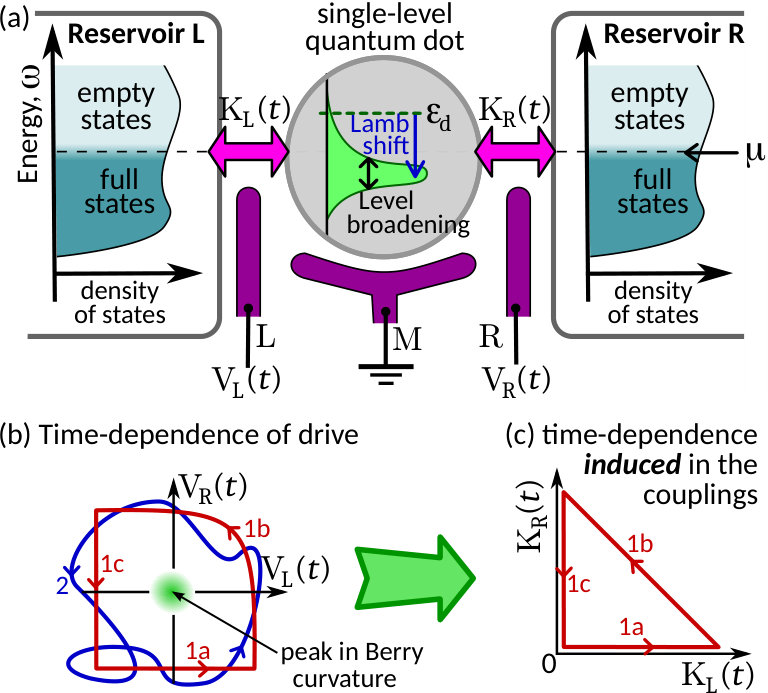 Figure 1
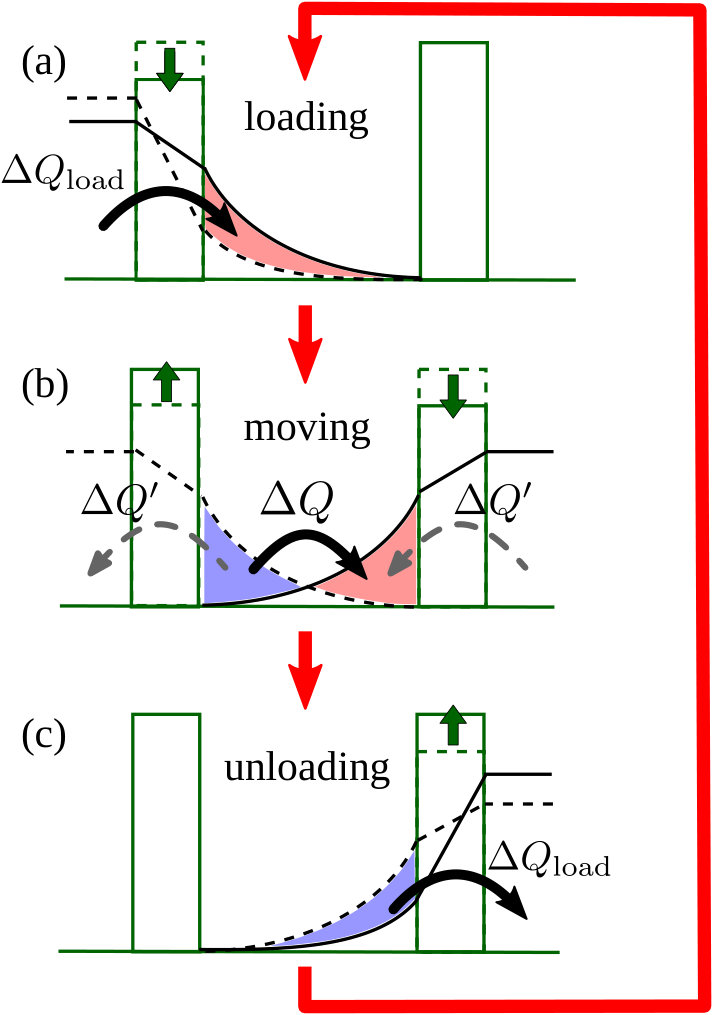 Figure 2
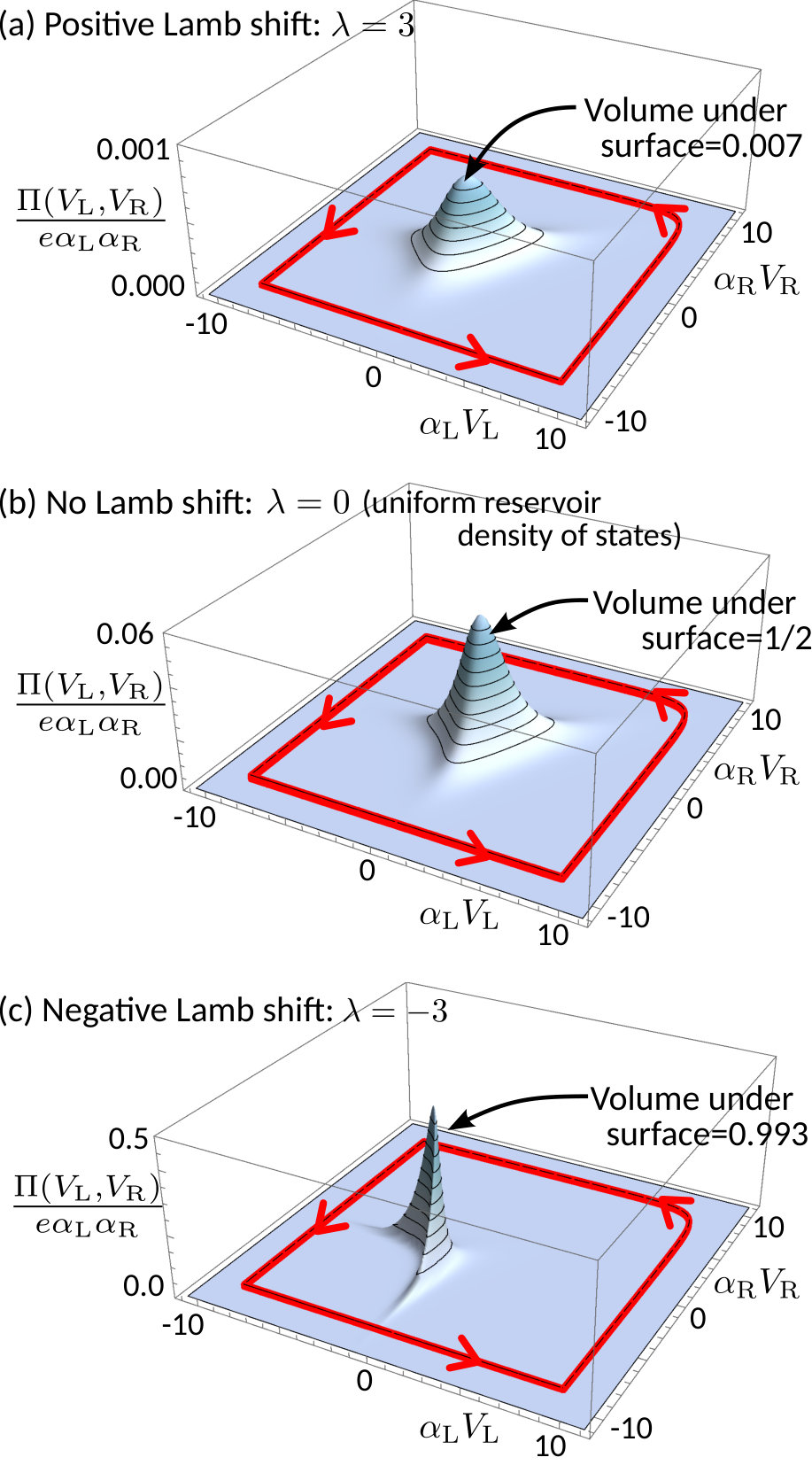 Figure 3
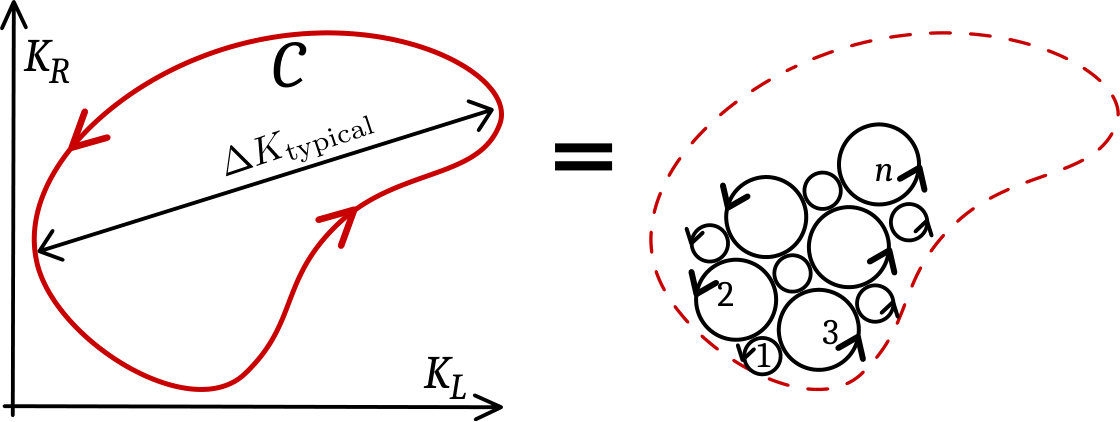 Figure 4
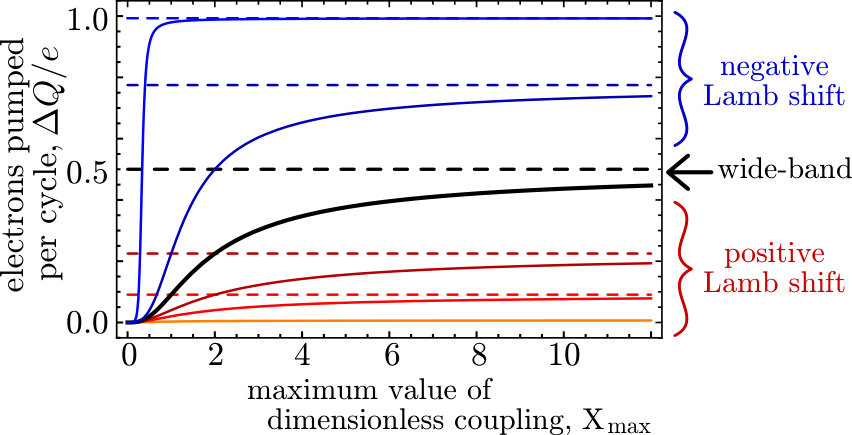 Figure 5
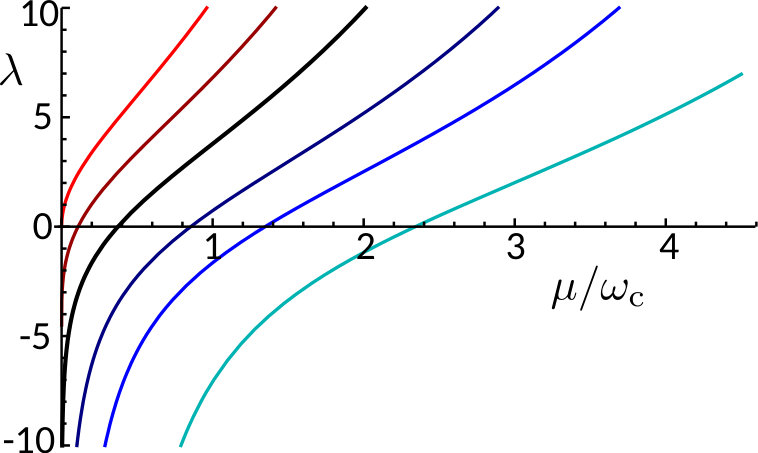 Figure 6
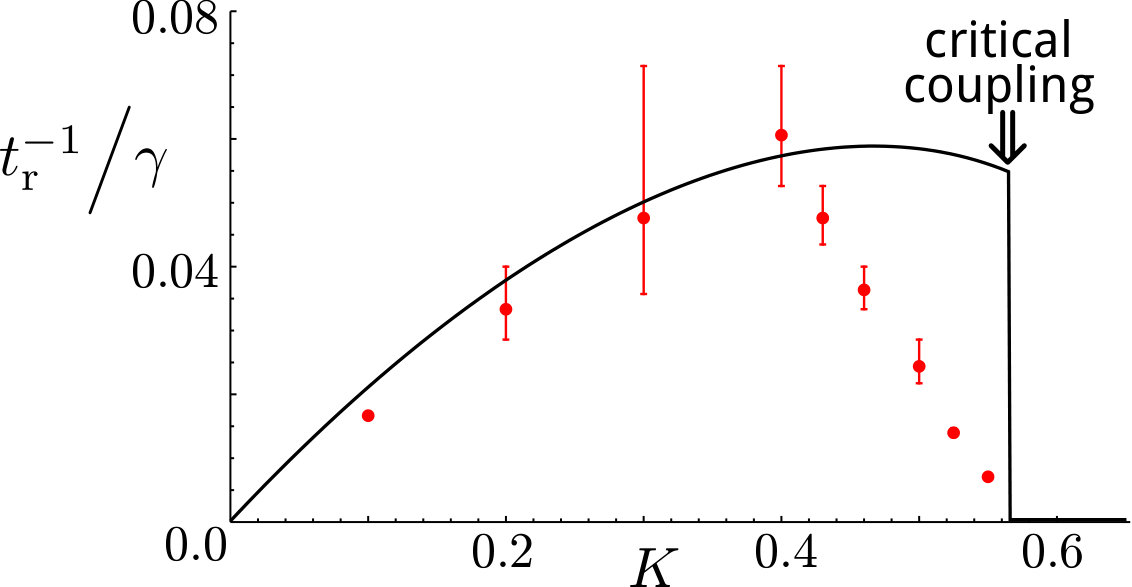 Figure 7
Peer Reviews
No public reviews on file for this paper yet. If you reviewed it on a platform where reviews are public (OpenReview, ICLR, NeurIPS, ICML), you can paste yours below so the community can read it here.
Videos
No videos yet. Explain this paper in a talk, walkthrough, or lecture? Add one.
Adiabatic almost-topological pumping of fractional charges in non-interacting quantum dots
Masahiro Hasegawa
Institute for Solid State Physics, The University of Tokyo, Kashiwa, Chiba 277-8581, Japan
Étienne Jussiau
Robert S. Whitney
Laboratoire de Physique et Modélisation des Milieux Condensés, Université Grenoble Alpes and CNRS, BP 166, 38042 Grenoble, France.
(May 29, 2019)
Abstract
We use exact techniques to demonstrate theoretically the pumping of fractional charges in a single-level non-interacting quantum dot, when the dot-reservoir coupling is adiabatically driven from weak to strong coupling. The pumped charge averaged over many cycles is quantized at a fraction of an electron per cycle, determined by the ratio of Lamb shift to level-broadening; this ratio is imposed by the reservoir band-structure. For uniform density of states, half an electron is pumped per cycle. We call this adiabatic almost-topological pumping, because the pumping’s Berry curvature is sharply peaked in the parameter space. Hence, so long as the pumping contour does not touch the peak, the pumped charge depends only on how many times the contour winds around the peak (up to exponentially small corrections). However, the topology does not protect against non-adiabatic corrections, which grow linearly with pump speed. In one limit the peak becomes a delta-function, so the adiabatic pumping of fractional charges becomes entirely topological. Our results show that quantization of the adiabatic pumped charge at a fraction of an electron does not require fractional particles or other exotic physics.
I Introduction
Since the seminal work of Thouless on quantum pumping Thouless (1983), there have been many pumping and turnstile protocols discussed in nanoscale systemsKouwenhoven et al. (1991); Pothier et al. (1992); Büttiker et al. (1994); Aleiner and Andreev (1998); Brouwer (1998); Kohler et al. (2005); Andergassen et al. (2010); Xiao et al. (2010); Haupt et al. (2013); Pekola et al. (2013); Kaestner and Kashcheyevs (2015) and cold atom experiments.Lohse et al. (2015); Nakajima et al. (2016) In recent years there has been great interest in exotic systems which exhibit topological pumping of fractional charges, meaning that any two driving contours with the same topology will drive the same fractional charge. Such fractional charge pumping has been found in models of Coulomb-blockaded quantum dotsCalvo et al. (2012); Placke et al. (2018), topological insulatorsGrusdt and Höning (2014); Marra et al. (2015); Santos and Béri (2018); Bardyn et al. (2019), systems with fractional quantum Hall physics,Zeng et al. (2015); Santos and Béri (2018) fermionic gases with short range interactions,Taddia et al. (2017) fractional levitons,Moskalets (2016) and the Bose-Hubbard model.González-Cuadra et al. (2019) These models have either strong interaction effects or non-trivial topological properties (non-zero Chern numbers, or similar). This makes us ask if either are necessary; can a non-interacting topologically-trivial system also exhibit fractional pumping of a topological nature?
We consider a non-interacting single-level quantum dot at low temperatures. Using the fact that it is an exactly soluble model, we consider adiabatic pumping in this model without approximation (particularly without assuming weak dot-reservoir coupling). Our results show the adiabatic pumping of a fraction of an electron in an almost topological manner. That is to say, any pumping contour with the same topology (see Fig. 1b) will pump the same fractional charge (up to exponentially small corrections), if the pumping is slow enough to be adiabatic. However, the topology does not protect against non-adiabatic corrections which go like one over the pumping period. This is much less robust than many of the topological pumps mentioned above, in which the topology also means that the non-adiabatic corrections decay exponentially with increasing pumping period.
The fractional pumping that we present here occurs when the dot-reservoir couplings, and , are adiabatically driven from weak to strong-coupling and back around the pumping cycle, with the dot-level fixed at energy . We take to be above the reservoirs’ electro-chemical potential, . Here “strong” coupling means that it induces a level-broadening larger than ), so the dot level becomes a resonance that spreads across the electrochemical potential. The pumped charge is given by the integral over the Berry curvature inside the contour, which is sharply peaked and decays exponentially away from the peak. Formally, the adiabatic pumping would be topological if this peak was a Dirac -function. Here the peak has a finite extent, so we refer to the pumping as almost topological, because it depends only on how many times the contour winds around the peak — up to exponentially small corrections — for any pumping contour that does not impinge on the peak. Half an electron is pumped per cycle, if the reservoirs have a uniform density of states (and so impose no Lamb shift of the quantum dot). However, in general the fraction of an electron pumped per cycle (between zero and one) is given by the ratio of the Lamb shift imposed by the reservoirs to the level-broadening. This ratio is entirely determined by the reservoirs’ density of states, which is imposed by their band-structure.
Earlier works on pumping of dot-reservoir coupling — with direct driving of the dot-level,Entin-Wohlman et al. (2002) a Lamb shift induced by the reservoir band-structure,Entin-Wohlman et al. (2002); Kashcheyevs et al. (2004) Coulomb blockade effects, Splettstoesser et al. (2005, 2006) or non-adiabatic drivingBattista and Samuelsson (2011) — did not investigate large level-broadening, and so did not find the quantized pumping of fractional charges.
Note that we consider the average charge per cycle. There are no fractionally charged quasi-particles in our non-interacting system, so we expect that there is a certain probability that electrons are pumped (for integer ) in any given cycle. Yet these probabilities are such that the average over many cycles will reveal itself as a fraction per cycle. Hence the observation of a topological fractional average charge per cycle in adiabatic pumping does not require the existence of fractionally charged quasi-particles, or other exotic physics.
It is not yet clear to us if there is a connection to the fractional charges recently discussed in Ref. [Riwar, 2018].
I.1 Organisation of this work
Sec. II introduces our model Hamiltonian, and Sec. III.1 outlines our main result about adiabatic almost-topological pumping of fractional charges. Sec. IV shows this is half an electron per cycle for readers familiar with scattering theory (others can skip this section). Sec. V explains that the pumping is not simply related to as changes in the dot occupation. Sec. VI and VII use the Keldysh formalism to get our main result, Eq. (49). Sec. VIII discusses the non-adiabatic corrections. Sec. IX gives our conclusions.
II Model Hamiltonian
We consider a non-interacting single-level quantum dot connected to two electron reservoirs with time-dependent couplings, described by the Hamiltonian,
[TABLE]
often called the Fano-Anderson model.Fano (1961); Anderson (1961) Here, and are creation and annihilation operator of the dot state, which has energy , while and are those for the state with wavenumber and energy in the reservoir . The tunnel-coupling between the system and the mode in reservoir is , which is taken to vary slowly with time. This model neglects electron-electron interactions on the dot; the simplest experimental implementation is discussed in Sec. III.4. The fact this model is quadratic in the creation and annihilation operators means that it is exactly soluble. As a result, we will get its adiabatic pumping properties without making any approximations (in particular, we will not need to assume weak dot-reservoir coupling).
We take the reservoirs to have a continuum of states, and assume they both have the same density of states . In general, this density of states may have energy () dependence, band-gaps, etc. The system’s coupling to each reservoir is described in terms of the time-dependent function
[TABLE]
where the coupling parameter . A second crucial quantity for the physics of this model is
[TABLE]
where the integral is the principal value. For compactness of what follows, we also define
[TABLE]
We refer to as level-broadening, and to as a Lamb shift. This is a slight abuse of terminology, but it is justified by the dot’s local density of statesFano (1961); Anderson (1961) being \Gamma(\omega)\big{/}\big{[}\big{(}\omega-\epsilon_{\rm d}-\Lambda(\omega)\big{)}^{2}+\Gamma^{2}(\omega)\big{]}. So if and are -independent, then they are the level-broadening and Lamb shift, respectively. We simply keep this terminology for cases where and have an -dependence.
In what follows, our results will be simplest if is written in terms of the dimensionless coupling , which measures the level-broadening in units of the distance of the dot level from the electrochemical potential;
[TABLE]
where is the density of states at the electrochemical potential, and the factor of two makes formulas compact.
We drive the gate-voltages , not the couplings , so we need a relation between them. Typically, the dot is coupled to reservoir through tunnel-barriers of height and width , so with . For large and , even small changes in will make large percentage changes in , so we can expand up to linear order in about . Since electrons are negatively charged, this gives
[TABLE]
with \alpha_{i}=-\big{(}{{\rm d}\kappa\big{/}{\rm d}V_{i}}\big{)}>0, where is chosen to coincide with . We mainly work with Eq. (7), but the almost topological fractional pumping also holds for for any which is very positive for , and is very negative for (see the end of Sec. VII.1). This covers many physical systems.
III Adiabatic almost-topological pumping of a fraction of an electron per cycle
Let us now briefly overview our main results, with the detailed calculations postponed to Sec. VII. Firstly, for a dot coupled to reservoirs without band-structure, there is a topological pumping at half an electron per cycle. Secondly, one can choose the reservoir band-structure to ensure the pumped charge is topologically quantized at an arbitrary fraction of an electron per cycle.
III.1 Half an electron per cycle
Here we consider a situation where the reservoir density of states is energy independent (-independent), which is know as the wide band limit, and so . Then the reservoir induces a level-broadening of the quantum dot’s energy level, but induces no Lamb shift; in Eq. (5). Our calculations (using scattering theory in section IV or Keldysh theory in section VI) show that this control of the level-broadening allows the pumping of half an electron per cycle in the low temperature limit.
The dot level is taken to be above the reservoir’s electro-chemical potential, , and the pumping cycle is taken to be cycle 1 in Fig. 1b,c, with neither nor change during the pumping cycle. The basic physical process, sketched in Fig. 2 is the following:
- (a)
Loading (segment 1a in Fig. 1c): The dot starts weakly coupled to the reservoirs ( and very negative) so the dot’s level-broadening is much less than , as a result the dot’s occupation is negligible. The coupling to reservoir L is increased ( increased), so that the reservoir wavefunctions spread into the dot (as in Fig. 2a), as the dot state hybridizes with reservoir states. The dot thus absorbs a charge of . Once the level-broadening is much more than , one reaches the limit where half the broadened level is below the reservoir’s Fermi energy. In this limit, there is half an electron in the dot, ; in other words a 50% chance of finding the dot level occupied.
- (b)
Moving (segment 1b in Fig. 1c): The coupling to reservoir L is slowly reduced to zero, while that to reservoir R is slowly increased to its maximum value ( reduced and increased), in such a way that the sum of the two couplings remains constant. Thus, the wavefunctions of reservoir R spread more into the dot, while those of reservoir L spread less into the dot. The occupation of the dot remains the same, but the dot state’s hybridization moves from reservoir L to reservoir R.
- (c)
Unloading (segment 1c in Fig. 1c): The coupling to R is reduced ( reduced) so the level-broadening again becomes much less than . As a result, the dot level empties into reservoir R, as the reservoir wavefunctions spread into the dot become negligible, and one returns the dot to its initial state.
This cycle transfers a charge of from reservoir L to reservoir R, with . When the coupling is large enough that the level-broadening in step 1b is much more than , then .
III.2 Seeing the topology
The adiabatic charge pumped per cycle can be said to be topological when it is the same for all adiabatic pumping cycles of the gate voltages that have the same topology. We will show this is the case for the cycle of and outlined above under certain conditions, and up to exponentially small corrections; so we call it “adiabatic almost-topological” pumping.
To see what this means, one must write the charge pumped into R as the surface integral,
[TABLE]
where is the surface in the - plane enclosed by the pumping cycle ,
Then one calculates , which is known as the Berry curvature, for the pumping. If one finds that this Berry curvature is a Dirac -function, then the pumping is entirely topological; the adiabatically pumped charge only depends on how many times the pumping contour winds around the -function. Here, our central result, Eq. (49), is that the Berry curvature is not a -function, but it is strongly peaked with an exponential decay away from the peak, see Fig. 3. Then we call the pumping almost topological, because it depends only on the contour’s topology (how many times it winds around the peak) if the contour stays away from the peak, and if we neglect the exponentially small corrections coming from the tail of the peak. Thus contours 1 and 2 in Fig. 1b pump the same charge (up to exponentially small corrections) because they both have the same topology — each winds once around the peak.
Fig. 3b shows the peak for reservoirs with uniform density of states. The integral over this peak is , so the contours in Fig. 3b will thus pump the charge
[TABLE]
In the limit of thick tunnel barriers, , one sees that in Eq. (7) also goes to infinity. Then the Berry curvature peak becomes a Dirac -function in the - plane. This means that the adiabatic pumping will becomes entirely topological. However, for , the tunnel coupling is exponentially small, so we require exponentially small temperatures, so can be as small as the couplings, to ensure we can make and of order one, so the pumping contour can enclose the -function peak.
III.3 Different fractions of an electron per cycle
Let us now consider reservoirs with a non-uniform density of states, so depends on . In this case, the Lamb shift in Eq. (5) is non-zero; this means that the dot-reservoir coupling does not only broaden the dot-level into a resonance, it also causes the centre of that resonance to be shifted in energy. Sec. VII will use Keldysh theory to show that the adiabatic almost-topological pumping is quantized at a fraction of an electron (between 0 and 1), which is given by the ratio of the Lamb shift to the level-broadening. We define as the following dimensionless measure of this ratio at ,
[TABLE]
where the factor of 2 is to make our results compact. We will show that the almost topological charge that is pumped by the cycle described in Sec. III.1 above is
[TABLE]
Hence, for this pumping cycle, is a monotonically decaying function of , and it take values between and 0. More precisely, equals \left[1-2\big{/}(3\pi\lambda^{2})\right]e for , equals at , and equals 2e\big{/}(3\pi\lambda^{2}) for .
It is surprising that the exact result for pumping at low-temperatures only depends on the ratio of the Lamb shift at the electro-chemical potential to the level-broadening at the electro-chemical potential, when many other observables depend on these quantities integrated over all energies (see e.g. is Sec. V). It is not easy to explain how this quantity emerges in the exact calculation, but we believe it is because we are at very low temperature and zero bias, so all charge flow between reservoirs occurs at energies at (or extremely close to) the electro-chemical potential. Hence the pumped charge also only depends on the physics of the Lamb shift and level-broadening at the electro-chemical potential.
Crucially, is entirely determined by the reservoir band-structure since Eqs. (4), (5) and (10) mean that
[TABLE]
so it is independent of , and . Hence, any given reservoir band-structure will have a given , and hence a given quantized fraction of an electron pumped per cycle. By choosing a suitable reservoir band-structure, one can choose that fraction.
III.4 Requirements for experimental observation
There are four requirements for observing this quantized pumping of a fraction of an electron per cycle.
The first requirement is a quantum dot that mimics the Hamiltonian in Eq. (1), which neglects electron-electron interactions on the dot. The simplest experimental implementation of Eq. (1) is an interacting quantum dot (described by an Anderson impurity Hamiltonian) in a large enough magnetic field that the dot’s spin-state with higher energy is always empty, which makes the on-dot interaction term negligible.
The second requirement is that is much smaller than , larger temperatures will destroy the quantization. At the same time should be small enough that we can make the dot-reservoir coupling . Thus we require that , which means the required value of depends on how strongly the dot can be coupled to the reservoirs.
The third requirement is related to the fact that the charge pumping is probabilistic, with only the average charge being quantized. This probabilistic nature of the pumping is typical whenever there is part of the pumping cycle in which the dot is coupled to both reservoirs at the same time (segment 1b of the cycle). Thus in any given cycle electrons might flow. Central limit theorem tells us that averaging over many cycles will give an answer that will converge to the quantized fraction that we predict.
The fourth requirement is due to our assumption that is time-independent during the pumping cycle. Unfortunately, in practice, the electrostatic gates that vary and , will also have a capacitive coupling to the dot-level, causing to vary. Gate M in Fig. 1a will minimize this capacitive coupling, by partially screening the dot from gates L and R. Any remaining capacitive coupling to gates L and R will act much like the Lamb shift. However, this coupling goes linearly in and , while the level-broadening and Lamb shift (if present) go exponentially, as above Eq. (7). Hence any effect of the capacitive coupling on will become negligible compared to the broadening at large .
IV Scattering theory
The central calculation in this work uses the Keldysh technique, however as a warm up exercise, we can use the scattering theory of quantum pumpingBrouwer (1998) for the special case where the reservoirs have uniform density of states. Readers interested in the Keldysh calculation of the general case can skip this section.
The scattering matrix of a single-level dot (see e.g. Refs. Fyodorov and Sommers, 1997; Alhassid, 2000) at energy is
[TABLE]
where is a 2-by-2 unit matrix. The scattering theoryBrouwer (1998) for pumping of and around the contour , gives the charge pumped per cycle into reservoir R as the integral over the surface enclosed by ,
[TABLE]
where the Berry curvature for our system is
[TABLE]
Substituting in Eq. (18) and using Eq. (6), one find that the zero-temperature result for pumped charge per cycle (in units of ) is given by the dimensionless integral
[TABLE]
where . The surface of integration is that enclosed by the contour in Eq. (19) rescaled using Eq. (6). One can showBrouwer (1998) that .
Now we cast this result in terms of the gate-voltages that control the couplings. Using Eq. (7), is given by Eq. (8) with the Berry curvature
[TABLE]
This is shown in Fig. 3b. The crucial feature is that this is highly peaked at small and decays exponentially with increasing (for both and ). Hence it fulfils the conditions for adiabatic almost-topological pumping discussed in section III.2.
To find the charge pumped by a contour that encloses the above peak once, we take contour 1 in Fig. 1b, whose segment 1b is chosen such that is constant. We then go back to Eq. (21), for which this contour maps via Eq. (7) to the triangular contour shown in Fig. 1c. The contour is the triangle defined by going from , where X_{\rm max}=\rho K_{\rm max}\big{/}\big{[}2(\epsilon_{\rm d}-\mu)\big{]}. We write
[TABLE]
where . Then
[TABLE]
for the above triangular contour. This goes to for large , which corresponds to encircling the peak in Eq. (22). Hence, for uniform reservoir density of states, the pumping is quantized at half an electron per cycle.
We do not know of a scattering theory for non-uniform reservoir density of states, so we use the Keldysh formalism to treat such cases in sections VI-VII.
V Comparison with dot occupation
One might naively guess that the pump is simply due to filling the dot state from L in the “loading” part of the cycle, and then emptying it into R in the “unloading” part of the cycle. Then the charge transferred from L to R would equal the charge loaded into the dot, . We show here that this is not the case; there is no simple relation between the pumped charge and .
We are pumping adiabatically slowly, so electrons are continuously tunnelling in and out of the dot from L and R (and tunnelling though the dot from L to R) during the “moving” part of the cycle. They have too little energy to remain in the dot, but the uncertainty principle means they can be there for a time of order \hbar\big{/}(\epsilon_{\rm d}-\mu). So there is no reason to assume the pumped charge is related to the dot occupation. Indeed, the occupation of the dot at low temperatures, see e.g. Refs. Yang et al., 2015; Jussiau et al., 2019, is
[TABLE]
For a uniform density of states , the integrand is a Lorentzian, and so n(\bm{K})=\arctan\left[X\right]\big{/}\pi. Then
[TABLE]
From Eq. (24), we see the pumped charge is smaller than by a factor of \Delta Q^{\prime}=eX_{\rm max}\big{/}\big{[}\pi(1+X_{\rm max}^{2})\big{]}, which vanishes when . This means that the “moving” part of the pumping cycle in section III.1 involves a small flow, , from the R to L through the dot (the dashed arrows in the Fig. 2b).
For non-uniform density of states, depends on the -dependence of and for all . In contrast, the pumped charge in Eq. (11) depends only on their values at . Thus in general and will not be related in any way, although both will be between [math] and . Either can be larger, so can be of either sign. Indeed, two different set-ups can have the same and different , or vice-versa.
VI Keldysh formalism
The dot’s occupation and current into reservoir at time areJauho et al. (1994); Haug and Jauho (2008); Fransson (2010); Hasegawa and Kato (2017, 2018)
[TABLE]
respectively, in terms of the Keldysh Green’s functions in Appendix A. We will derive the pumped charge for a large driving contour , by summing the contributions from all infinitesimal circular contours inside it (see Fig. 4), as was done in scattering theory by Ref. [Brouwer, 1998].
The infinitesimal contour satisfies
[TABLE]
where is a pumping frequency, is an infinitesimally small amplitude of driving around the time-independent point . Under this infinitesimal driving, the time-dependent charge current into reservoir is
[TABLE]
where is the Fourier transform of the dynamic conductance for the infinitesimal contour ;
[TABLE]
This is given in terms of Keldysh Green’s functions in Appendix A, and it only depends on the time differences because it is evaluated for . We assume the condition for adiabatic driving;
[TABLE]
where is the typical time for electrons in the dot to relax. Then it is sufficient to take the dynamic conductance at leading order in the pumping frequency ; . Substituting this into Eq. (33), and integrating from [math] to , we find the charge pumped per cycle on the infinitesimal contour is .
Summing all infinitesimal contours inside the large contour , gives charge pumped per cycle around as
[TABLE]
where we define the Berry connection as the vector . Re-writing this in terms of a surface integral using Stokes theorem, we get
[TABLE]
where is the Berry curvature. This integral is over the surface which is enclosed by the pumping contour . As this surface is the - plane, only the component of perpendicular to this plane contributes; we call this component
[TABLE]
we will calculate this for our model in the next section.
We end this derivation with an adiabaticity condition for the large contour . Given Eq. (35) for the infinitesimal circular contours, adiabaticity on requires
[TABLE]
where is the typical scale of the contour (see Fig. 4), and is the relaxation time of the dot state. The magnitude of is discussed in Sec. VIII.
VII Results for our model.
For the Hamiltonian in Eq. (1), we find that the Berry connection in Eq. (36) contains two terms
[TABLE]
because involves a derivative with respect to , and that derivative can act on the level-broadening (giving ) or the Lamb shift (giving ). If there is no Lamb shift then , while if the Lamb shift is much greater than the level-broadening, then Eq. (40) is dominated by . The Keldysh calculations outlined in Appendix A give
[TABLE]
where and are L or R, and is the Fermi function. The primed denotes the partial derivative with respect to . The quantities and are given in Eqs. (2-5), while and , with given in Eq. (61).
Turning to the Berry curvature in Eq. (38), we see that it contains two derivatives (with respect to ), because contained one. Hence contains three terms; a “broad-broad” term due to both derivatives acting on the broadening, a “shift-shift” term due to both derivatives acting the Lamb shift, and a “shift-broad” term with one derivative on each of them. The “shift-shift” term turns out to be zero, showing that the Lamb shift alone is not enough to do pumping. Intuitively, this can be understood as the Lamb shift only moving the dot level, which is not enough to do pumping. Hence
[TABLE]
and , with
[TABLE]
where we have used the fact that and are proportional to . A bit more algebra gives
[TABLE]
This depends on the sum of the couplings, , but not the difference .
VII.1 Low temperature pumping
In the limit of small temperature, we can make the approximation \left(\partial f\big{/}\partial\omega\right)=-\delta(\omega-\mu) in Eq. (46). To justify this approximation, one needs the other terms in the integrand of Eq. (46) to vary little over the window of given by . Then, the Berry curvature is
[TABLE]
Writing this in terms of in Eq. (10), the low-temperature result for pumped charge per cycle (in units of ) is given by the dimensionless integral
[TABLE]
where is defined in Eq. (6), with being and . The surface of integration is that enclosed by the contour in Eq. (19) rescaled using Eq. (6).
As explained in Sec. II, we control gate-voltages , in experiments. By substituting Eq. (7) into Eq. (48), we find the Berry curvature in the -plane
[TABLE]
shown in Fig. 3. This is our central result, because the fractional and topological nature of the adiabatic pumping both follow from it, as we now show.
Eq. (49) has a peak at small , and decays exponentially as grows. Hence, any pumping contour that encloses the peak without encroaching on it will give the same pumped charge per cycle (up to exponentially small corrections), ensuring quantized pumping.
To calculate the charge pumped by such a cycle, we return to Eq. (48) and consider a triangular contour explained above Eq. (23). Eq. (7) means that for large this triangular contour corresponds to contour 1 in Fig. 1b, that encloses the peak in . We transform to and as in Eq. (23), then
[TABLE]
see Fig. 5. It reduces to Eq. (24) for , since . We take to get the pumping for a contour that corresponds to one enclosing the peak of Eq. (49); this gives Eq. (11).
This analysis has given us our main results; the adiabatic pumping is almost topological, and pumps a fraction of an electron (between 0 and 1) given by the value of , which is determined purely by the reservoir’s band-structure.
To generalise to a voltage dependence of the form below Eq. (7), we substitute it into Eq. (48). Then Eq. (49) changes, but it remains strongly peaked with exponentially small tails. This ensures that there is still adiabatic almost-topological pumping. Further more, the faction pumped per cycle is the same for any voltage dependence, since it was calculated directly from Eq. (48).
VIII Adiabaticity and band gaps
Up to now this work has only discussed pumping in the adiabatic limit. However, from the argument in section VI, it is clear that a large but finite pumping period T_{\rm period}\sim\Delta K_{\rm typical}\big{/}(d\bm{K}/dt)\gg\tau, will induce a non-adiabatic correction of order . This non-adiabatic correction is much larger than that in many proposals for topological pumping, in which the topology makes the non-adiabatic corrections exponentially small at large . Thus to observe the topological pumping in our system it is crucial to estimate , and then choose the pumping to be slow enough (large ) to make corrections of order negligible.
It is simple to estimate when the reservoirs have uniform density of states, since there the dot state decays at the rate given by the level-broadening in section II; . For systems with non-uniform density of states we can place a lower bound on by saying that , where is the minimal value of the density of states.
However, this poses a problem for reservoirs with band-gaps, as the density of states vanishes in the band-gap, so the above lower-bound does not allow us to say when the pumping is slow enough to be considered adiabatic. To investigate this further we consider the case where the electro-chemical potential is near a band-edge in the reservoir, so the reservoir’s density of states is
[TABLE]
where, without loss of generality, we measure energy from the band-edge. Then the level-broadening is , and the Lamb shift is (see e.g. Refs. Zhang et al., 2012; Jussiau et al., 2019),
[TABLE]
Fig. 6 plots this, and shows that a suitable choice of and will give almost any desired value of .
It has long been known that this model exhibits an infinite-lifetime bound-stateShiba (1973); John and Wang (1990, 1991); John and Quang (1994); Kofman et al. (1994), see Refs. Angelakis et al., 2004; Chang et al., 2018 for reviews. Electron dynamics in various time-dependent versions of this model have been studied; particularly the decay of an initially prepared dot stateZhang et al. (2012); Xiong et al. (2015); Tu et al. (2016); Ali et al. (2015); Lin et al. (2016); Ali and Zhang (2017), the response to switching on a bias,Dhar and Sen (2006); Stefanucci (2007) or the response to periodic driving.Jin et al. (2010); Basko (2017) For , this bound-state appears when the coupling exceeds a critical value Dhar and Sen (2006); Stefanucci (2007); Jin et al. (2010); Xiong et al. (2015); Yang et al. (2015); Ali et al. (2015); Tu et al. (2016); Zhang et al. (2012); Engelhardt et al. (2016); Lin et al. (2016); Ali and Zhang (2017); Jussiau et al. (2019) . This state has , so pumping never satisfies the adiabaticity condition in Eq. (39) when . Intriguingly, the Berry curvature in Eq. (46) does not contain ; it is a smooth function across this line of critical coupling . However, the Berry curvature in Eq. (46) ceases to have a physical meaning when one crosses the line of critical coupling, because non-adiabatic contributions dominate beyond this line (), no matter how slow the pumping is.
For , it is difficult to determine the dot’s decay rate, , because it contains terms with an oscillatory powerlaw decay, for which there is no unique way to define . Fig. 7 is an attempt to give a feeling for how depends on the coupling. The red data points are the inverse time for the dot occupation to decay to threshold (using the method reviewed in Refs. Yang et al., 2015; Jussiau et al., 2019) that we set at 2% of its initial value, i.e. we plot the that satisfies
[TABLE]
The solid curve is the time taken to reach this threshold, if one approximates the decay to an exponential at the rate given by the imaginary part of the resonance’s energy (i.e. neglecting all powerlaw or oscillatory components in the decay). This approximation captures much of the true decay, but misses the sharp drop in as . This sharp drop shown by the data points indicates that the timescale to decay diverges as approaches . Hence it is increasingly difficult to pump slowly enough to be adiabatic as gets closer to .
The “error bars” on the data in Fig. 7 are not numerical uncertainties in (such uncertainties are about the size of the red dots). They indicate the period of the oscillations in the decay, which is maximal for . A small change in the system parameters (e.g. a change of or ) would shift the phase of the oscillations, thereby shifting where the oscillating decay crosses the threshold to a different place on the vertical “error bar”. Hence, we can expect a change in system parameters to induce a large change in when , while the change will be modest for and .
IX Conclusions
We show that a system without exotic physics (a non-interacting single-level quantum dot at low temperature) can exhibit an adiabatic almost-topological pumping of a fraction of an electron per cycle, when averaged over many cycles. We call it “almost” topological because the pumped charge depending only on the number of times the contour winds around the peak in the Berry curvature, shown in Fig. 3, under the conditions that (i) the contour does not touch the peak, and (ii) we neglect the exponentially small corrections coming from the tail of the peak. Sec. III.2 mentions a specific limit in which the adiabatic pumping is entirely topological. The fraction pumped (between zero and one electron) is determined by the ratio of the Lamb shift to the level-broadening. This ratio is imposed by the reservoir band-structure, which can be chosen to give the desired fraction. A uniform reservoir density of states gives the quantized pumping of half an electron per cycle. We emphasize that it is the average charge pumped per cycle that is (almost) topological and fractional. Each cycle has a finite probability that electrons are pumped for ; the quantized fraction is only revealed by averaging over many cycles.
Hence, if one wants to prove the existence of fractionally charged particles in some system, one would need more evidence than just adiabatic pumping of fractional average charge. This evidence could be that non-adiabatic corrections decay exponentially when the period of the pumping cycle is made large, since these corrections only decay like one over this period in our model.
X Acknowledgements
MH acknowledges the financial support of the Advanced Leading Graduate Course for Photon Science. EJ and RW acknowledge the support of the French National Research Agency program ANR-15-IDEX-02, via the Université Grenoble Alpes QuEnG project.
Appendix A Keldysh Green’s functions
The quantum dot’s Green’s functions are defined asJauho et al. (1994); Haug and Jauho (2008); Fransson (2010)
[TABLE]
where is a Heaviside function and is an anti-commutator. Their algebraic form is given by Dyson’s equations
[TABLE]
for , and
[TABLE]
Here are Green’s function of electron of the isolated quantum dot, and are the one-particle-irreducible self-energy for ,
[TABLE]
with . Here is a Green’s function of electrons in the isolated electron reservoirs,
[TABLE]
The dynamic conductance in Eq. (34) is
[TABLE]
where we define AB\big{|}CD=[AB](t,t_{1})[CD](t_{1},t) with .
One can Fourier transform to get
[TABLE]
The reference list from the paper itself. Each links out to its DOI / PubMed record.
- 1Thouless (1983) D. J. Thouless, “Quantization of particle transport,” Phys. Rev. B 27 , 6083–6087 (1983) . · doi ↗
- 2Kouwenhoven et al. (1991) L. P. Kouwenhoven, A. T. Johnson, N. C. van der Vaart, C. J. P. M. Harmans, and C. T. Foxon, “Quantized current in a quantum-dot turnstile using oscillating tunnel barriers,” Phys. Rev. Lett. 67 , 1626–1629 (1991) . · doi ↗
- 3Pothier et al. (1992) H. Pothier, P. Lafarge, C. Urbina, D. Esteve, and M. H. Devoret, “Single-electron pump based on charging effects,” EPL 17 , 249 (1992) .
- 4Büttiker et al. (1994) M. Büttiker, H. Thomas, and A. Prêtre, “Current partition in multiprobe conductors in the presence of slowly oscillating external potentials,” Z. Phys. B Condensed Matter 94 , 133–137 (1994).
- 5Aleiner and Andreev (1998) I. L. Aleiner and A. V. Andreev, “Adiabatic charge pumping in almost open dots,” Phys. Rev. Lett. 81 , 1286–1289 (1998) . · doi ↗
- 6Brouwer (1998) P. W. Brouwer, “Scattering approach to parametric pumping,” Phys. Rev. B 58 , R 10135–R 10138 (1998) . · doi ↗
- 7Kohler et al. (2005) S. Kohler, J. Lehmann, and P. Hänggi, “Driven quantum transport on the nanoscale,” Phys. Rep. 406 , 379–443 (2005) . · doi ↗
- 8Andergassen et al. (2010) S. Andergassen, V. Meden, H. Schoeller, J. Splettstoesser, and M. R. Wegewijs, “Charge transport through single molecules, quantum dots and quantum wires,” Nanotechnology 21 , 272001 (2010) .