Scrambling in strongly chaotic weakly coupled bipartite systems: Universality beyond the Ehrenfest time-scale
Ravi Prakash, Arul Lakshminarayan

TL;DR
This paper investigates the growth of out-of-time-order correlators in bipartite quantum systems, revealing two distinct phases of scrambling: an initial intra-system exponential growth and a universal interaction-driven saturation, modeled by random matrices.
Contribution
It introduces a two-phase model of quantum chaos in bipartite systems, extending understanding beyond the Ehrenfest time with a solvable random matrix approach.
Findings
Initial phase shows intra-subsystem exponential growth independent of interaction.
Second phase exhibits universal exponential approach to saturation described by a random matrix model.
Participation ratio indicates delocalization and mixing during the two phases.
Abstract
Out-of-time-order correlators (OTOC), vigorously being explored as a measure of quantum chaos and information scrambling, is studied here in the natural and simplest multi-particle context of bipartite systems. We show that two strongly chaotic and weakly interacting subsystems display two distinct phases in the growth of OTOC.The first is dominated by intra-subsystem scrambling, when an exponential growth with a positive Lyapunov exponent is observed till the Ehrenfest time. This phase is essentially independent of the interaction, while the second phase is an interaction dominated exponential approach to saturation that is universal and described by a random matrix model. This simple random matrix model of weakly interacting strongly chaotic bipartite systems, previously employed for studying entanglement and spectral transitions, is approximately analytically solvable for its OTOC.…
Click any figure to enlarge with its caption.
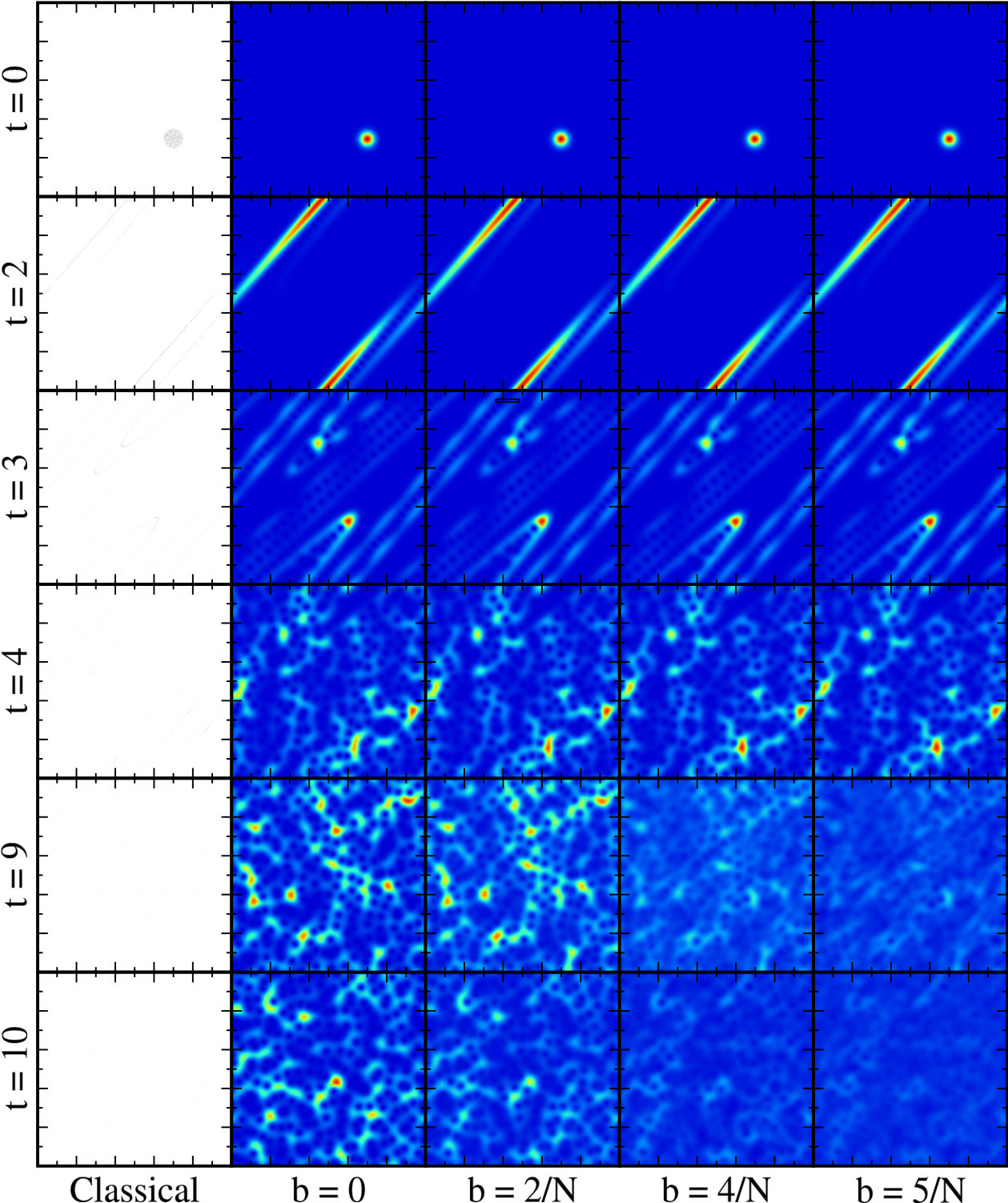 Figure 1
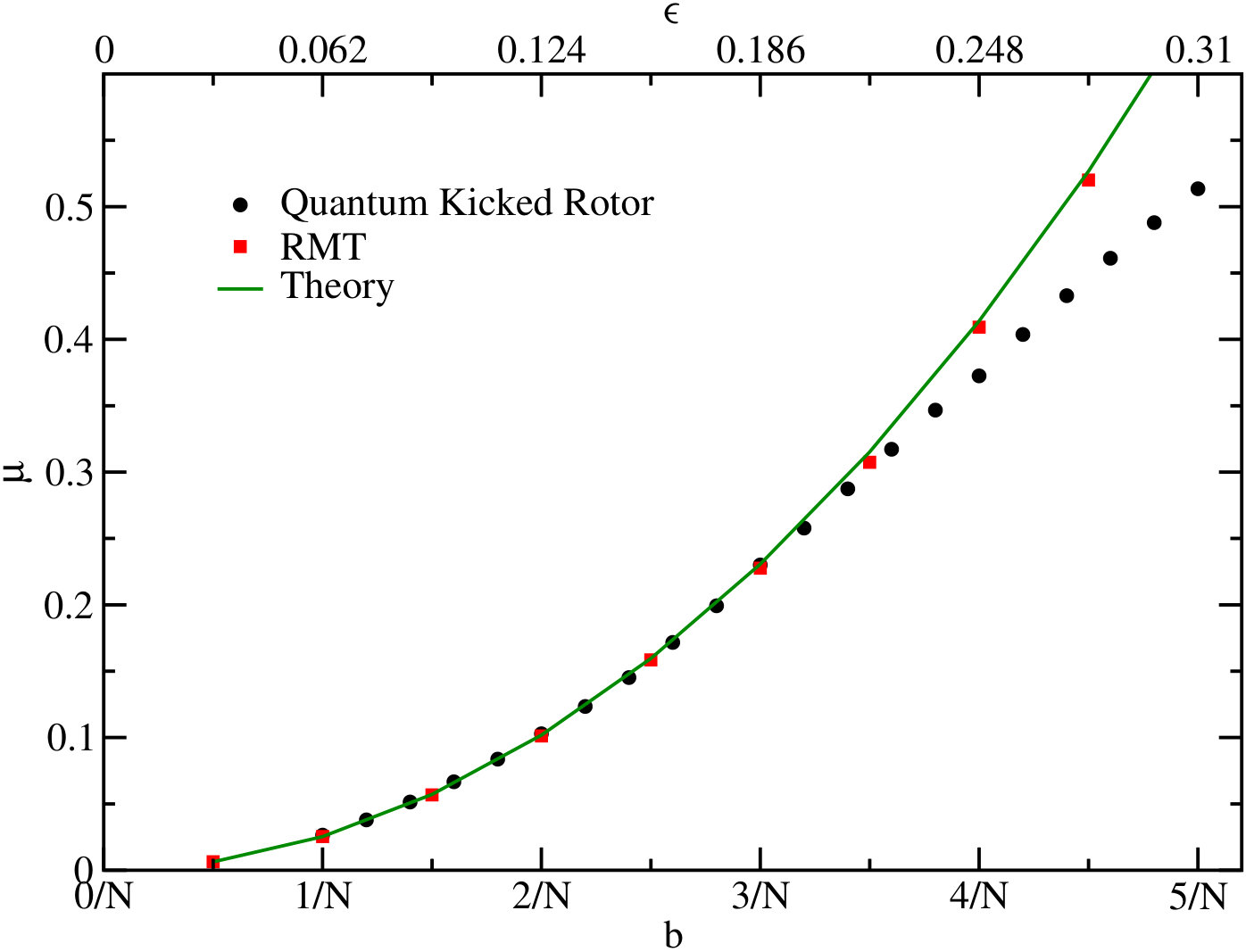 Figure 2
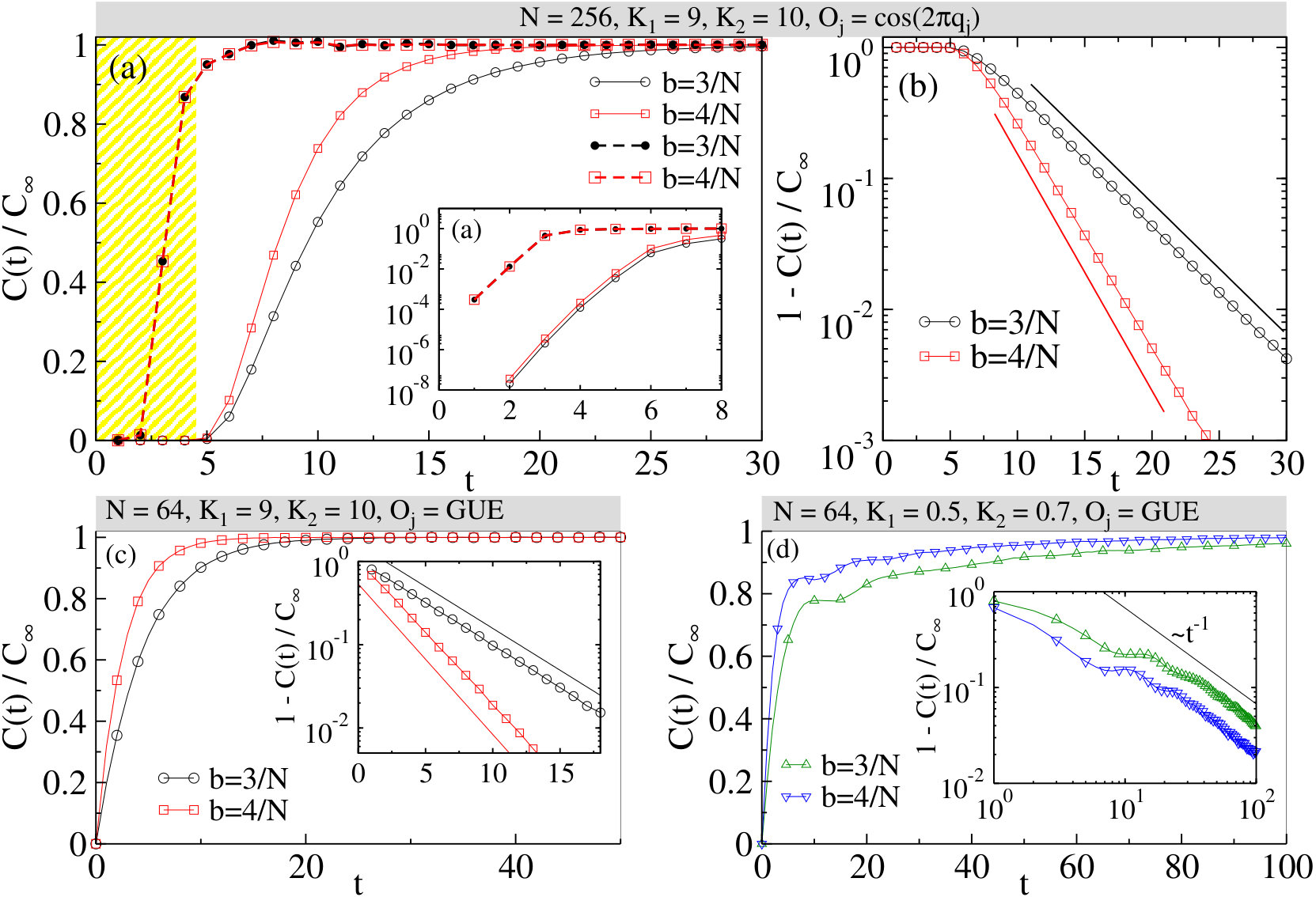 Figure 3
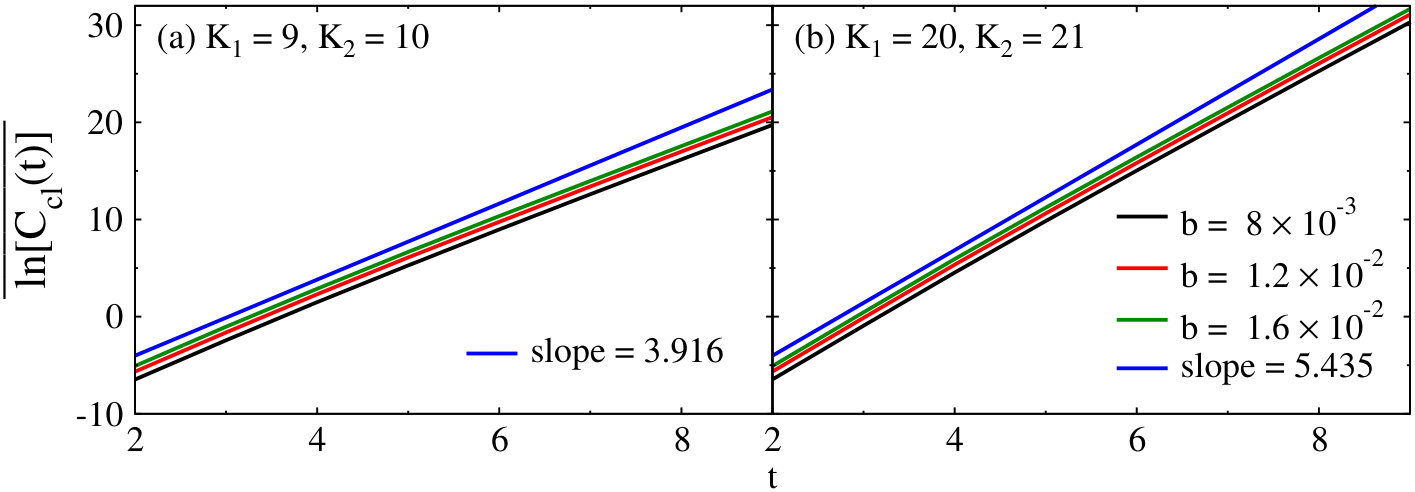 Figure 4
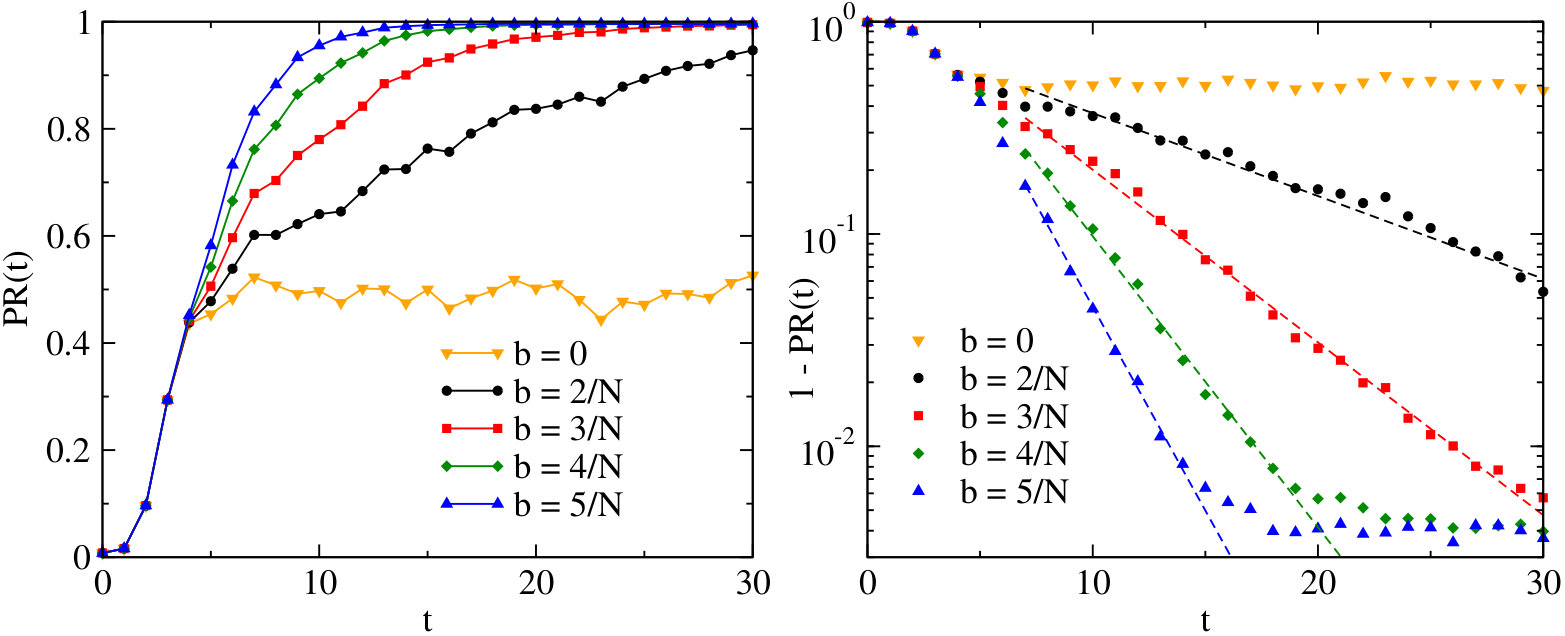 Figure 5
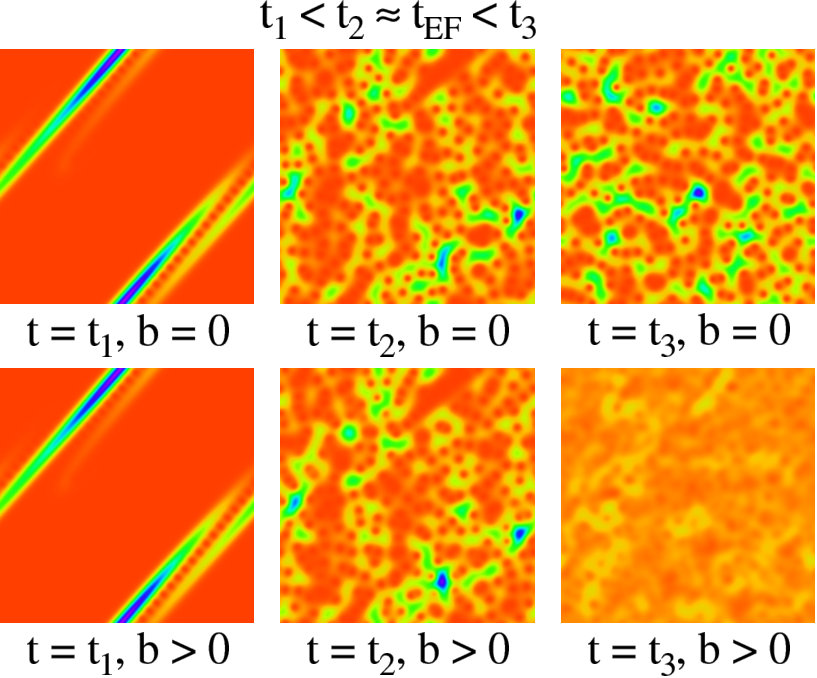 Figure 6
Peer Reviews
No public reviews on file for this paper yet. If you reviewed it on a platform where reviews are public (OpenReview, ICLR, NeurIPS, ICML), you can paste yours below so the community can read it here.
Videos
No videos yet. Explain this paper in a talk, walkthrough, or lecture? Add one.
Scrambling in strongly chaotic weakly coupled bipartite systems: Universality beyond the Ehrenfest time-scale
Ravi Prakash
Arul Lakshminarayan
Indian Institute of Technology Madras, Chennai – 600036, India
Abstract
Out-of-time-order correlators (OTOC), vigorously being explored as a measure of quantum chaos and information scrambling, is studied here in the natural and simplest multi-particle context of bipartite systems. We show that two strongly chaotic and weakly interacting subsystems display two distinct phases in the growth of OTOC. The first is dominated by intra-subsystem scrambling, when an exponential growth with a positive Lyapunov exponent is observed till the Ehrenfest time. This phase is essentially independent of the interaction, while the second phase is an interaction dominated exponential approach to saturation that is universal and described by a random matrix model. This simple random matrix model of weakly interacting strongly chaotic bipartite systems, previously employed for studying entanglement and spectral transitions, is approximately analytically solvable for its OTOC. The example of two coupled kicked rotors is used to demonstrate the two phases, and the extent to which the random matrix model is applicable. That the two phases correspond to delocalization in the subsystems followed by inter-subsystem mixing is seen via the participation ratio in phase-space. We also point out that the second, universal, phase alone exists when the observables are in a sense already scrambled. Thus, while the post-Ehrenfest time OTOC growth is in general not well-understood, the case of strongly chaotic and weakly coupled systems presents an, perhaps important, exception.
The quantum mechanics of classically chaotic, or in general non-integrable, systems known generically as quantum chaos presents a complex of interesting features. The universal spectral fluctuations of quantum chaotic systems are widely studied using random matrix theory (RMT) Mehta (2004); Akemann et al. (2011); Porter (1965); Brody et al. (1981), while semiclassical spectra are described via periodic orbit theories Gutzwiller (1970, 1990). A large part of the previous works studied either time-evolving states or eigenspectra Cerruti and Tomsovic (2003); Gorin et al. (2004), while a recent trend concerns operator evolution and is therefore tied in more directly to the evolution of classical observables. Operator spreading or scrambling and out-of-time-ordered correlators (OTOC) are two quantities on which much attention has been bestowed from diverse areas Shen et al. (2017); Slagle et al. (2017); Cotler et al. (2017); Campisi and Goold (2017); Hashimoto et al. (2017); Fan et al. (2017); von Keyserlingk et al. (2018); Nahum et al. (2018); Rozenbaum et al. (2017); Jalabert et al. (2018); Lakshminarayan (2018); Rakovszky et al. (2018); García-Mata et al. (2018); Chen and Zhou (2018); Moudgalya et al. (2018); Haehl et al. (2017).
OTOC, introduced in the context of superconductivity Larkin and Ovchinnikov (1969), is now being widely studied in many contexts, such as quantum gravity field theories and many-body physics, including many-body localization, models such as random quantum circuits as well as quantum walks and weak measurements Fan et al. (2017); Chen et al. (2017); Slagle et al. (2017); von Keyserlingk et al. (2018); Omanakuttan and Lakshminarayan (2019); González Alonso et al. (2019). The OTOCs have been recently related to the other measures of quantum chaos such as spectral statistics, participation ratio and Loschmidt echo Borgonovi et al. (2019); Yan et al. (2019); Rozenbaum et al. (2019, 2018). Thus the OTOC provides a window far beyond conventional settings of quantum chaos besides providing an opportunity for new quantum measures of complexity. In particular, for chaotic systems the OTOC grow exponentially till the Ehrenfest time Berry (1979); Berry et al. (1979) providing a quantum Lyapunov exponent Rozenbaum et al. (2017); Maldacena et al. (2016).
The correspondence is most transparent in the increase of non-commutativity of two (say Hermitian) operators, one evolving with time. Consider
[TABLE]
where represents the thermal average over an ensemble at temperature . A standard semiclassical argument makes it plausible that this can increase exponentially with time. If and are the position and momentum operator the commutator is semiclassically the Poisson bracket, , which grows exponentially for chaotic systems, as due to the sensitive dependence on initial conditions. It is argued that the rate has an upper bound, Maldacena et al. (2016). The Sachdev-Ye-Kitaev (SYK) model, a disordered model of Fermions with all-to-all interactions, is one of the maximally chaotic system which saturates the bound Sachdev and Ye (1993); Kitaev (2015). Similar bound was found in earlier studies of scrambling of quantum information around a black hole horizon Shenker and Stanford (2014); Hayden and Preskill (2007).
The exponential growth of , the Lyapunov phase, occurs in a time window where is a diffusion time scale that is comparatively small and does not scale with the system size, while is the Ehrenfest time and could be the time of breakdown of classical-quantum correspondence if a classical limit exists. There have now been several studies of the OTOC on models of quantum chaos, such as the quantum standard map, the quantum bakers map, the cat map, and the kicked top, and on all-to-all connected spin models Rozenbaum et al. (2017); Cotler et al. (2018); Chen and Zhou (2018); García-Mata et al. (2018); Hamazaki et al. (2018). All these display the expected exponential growth till the Ehrenfest time, which scales as , where is the Hilbert space dimension.
Beyond the Ehrenfest time, the corrections start dominating Cotler et al. (2018), and there exists no classical correspondence for the OTOC, even if the system has a well-defined semiclassical limit, marking a less understood phase that is important to study in various settings. This Letter is concerned with the simplest multipartite system, a generic bipartite one given by where are strongly chaotic subsystem Hamiltonians and is an interaction which is kept small by requiring the dimensionless .
Consider and to be localized to either subsystem. For the most part we will be concerned with the interesting case when they are localized on different subsystems: . The Heisenberg evolution of operator renders it entangled and therefore fails to commute with for . Thus this is the simplest multipartite setting in which entanglement is responsible for the OTOC growth and information scrambling. We find that if the operators , have smooth classical limits, there are two distinct epochs, the first being one of exponential growth, the Lyapunov phase, lasting for the Ehrenfest time of the subsystems. This epoch is dominated by intra-subsystem scrambling and the Lyapunov exponent is largely independent of the interaction strength .
The second epoch is one of exponential relaxation with a rate that is strongly interaction dependent. This marks an era of inter-subsystem scrambling and is universal in some sense, the rate being well predicted by a random matrix model that we develop here. Fig. (1) illustrates this scenario in the phase space evolution of localized densities. As a quantitative measure we also show that the participation ratio in phase space, a measure of its delocalization exhibits a clear difference between the intra- and inter- subsystem scrambling phases.
If the observables used are not smooth operators, or are in some sense pre-scrambled the Lyapunov phase can be entirely absent and the OTOC relaxes exponentially from the start with the universal rate. It is interesting that even in the absence of the Lyapunov phase, it is possible to distinguish a chaotic system from non-chaotic ones, as we provide some numerical evidence that in the latter case, a putative saturation is approached algebraically () rather than exponentially.
To begin with, we study a concrete dynamical system, two coupled kicked rotors, illustrating the main features, and later use RMT to derive the exponential relaxation rate. Rather than using thermal averages, we consider the infinite temperature limit, the OTOC for two operators and given in Eq. (1) is then where
[TABLE]
and is an 4-point out-of-time ordered correlator.
OTOC for coupled quantum kicked rotors: A rich, yet simple, class of models results when the subsystems Hamiltonians are 1-degree of freedom periodically forced systems. A well-studied paradigmatic model is that of two coupled kicked rotors Wang et al. (1990); Wood et al. (1990); Lakshminarayan (2001); Richter et al. (2014) , for which , and , where . The parameter is the interaction while the individual rotor parameters determine local chaos. The single rotor is integrable only for vanishing kick strengths , and there is a mixed phase space, with a finite measure of chaotic and stable regions as increases, with widespread chaos for .
As is well-known, the quantum dynamics of the kicked rotors with torus boundary conditions occurs in a finite dimensional Hilbert space of dimension say , so that both position and momentum have discrete values. The Hilbert space of two coupled rotors is the tensor product space of dimension on which the Floquet operator is of the form
[TABLE]
where are Floquet operators of individual rotors and is the interaction, explicit expressions are in sup . Since position and momentum are both discrete, it is convenient to have local observables to be constructed from their translation operators and , and . In particular the observables we study are locally simply with in position basis, the classical limit being . We consider cases when the two rotor parameters are large and hence the subsystems are strongly chaotic.
The OTOC from Eq. (2), with and and the coupled standard map from Eq. (3), is shown in Fig. (2).
The uncoupled subsystems are highly chaotic and nearly identical. The interactions, being only of the order implies that measures of chaos such as the Lyapunov exponent is that of the uncoupled systems . There are clearly two phases, first is an exponential growth corresponding to the Lyapunov phase till the Ehrenfest time corresponding roughly to that of the uncoupled subsystems . This phase is dominated by the sub-system chaos and the rate of exponential growth is to a good approximation independent of the interaction. This would be the regime of intra-subsystem scrambling with the coupling determining only the prefactor of the OTOC which is . Here comes from a classical Poisson bracket evaluation of , and is systematically larger than sup . The interactions although classically small, are large enough that the stationary state properties of the coupled system are that of random matrices. There is a dimensionless transition parameter Srivastava et al. (2016) which is such that if , the nearest neighbor spacing statistics is Wigner and the eigenfunctions are highly entangled. Thus we are already in the strong coupling regime as far as the stationary state properties are concerned.
That this first phase is dominated by intra-subsystem scrambling is further evidenced by the OTOC between observables in the same subsystem. Thus if , the OTOC grows only the first phase and already saturates without a second phase as shown in Fig. (2a). Different interaction strengths do not affect the growth significantly, and we turn to the more interesting case of the post-Ehrenfest growth of the OTOC when the observables are local on different subsystems.
In this case. the second phase is a slower exponential relaxation to the saturation value during which the relaxation rate is strongly interaction dependent and practically independent of the subsystem parameters . This inter-subsystem scrambling is responsible for the entanglement and eventually leads to random states on the product Hilbert space. This phase is universal in being only dependent on the fact that the subsystems are strongly chaotic and therefore is amenable to a random matrix treatment. Thus the numerical results support an approximate OTOC:
[TABLE]
here and are independent of time. We now turn to deriving this relaxation based on random matrix theory, in particular we show that for the standard map discussed above
[TABLE]
where is a Bessel function and this is valid for . The exponential relaxation in the second phase is shown in Fig. (2b) along with lines of this slope showing that this is a good approximation even for relatively large values of the coupling, till sup . The saturation value is obtained presently from an RMT analysis.
Pre-scrambled operators: While the second phase is universal and independent of the observables, the first phase can be completely absent if the observables do not have a smooth classical equivalent, say through the Weyl-Wigner symbol. An extreme case of this, could be termed as a pre-scrambled operator, which has fluctuations at the scale of and is already ergodic in some sense. We take realizations of Gaussian random matrices as the local observables, , where is a complex matrix, whose entry’s real and imaginary parts are i.i.d. Gaussian random numbers with [math] mean and unit variance, in other words from the GUE ensemble Mehta (2004); Akemann et al. (2011).
Fig. (2c) shows that the log-time growth is absent and that the relaxation is well described by the second part of Eq. (4) with the rate given by Eq. (5). The role of subsystem chaos in the second phase is to lead to an exponential relaxation. If the subsystems were not chaotic, say and , the second phase with GUE observables shows a clear algebraic approach to saturation and numerical results support a approach as shown in Fig. (2d). It maybe noted that integrable spin chains have been observed to have such a behavior Lin and Motrunich (2018); Bao and Zhang (2019), and we postpone the study of the rich and complex scenario of mixed phase-spaces, turning to an analytical treatment of the strongly chaotic cases.
OTOC in a bipartite RMT model: In the case of strong subsystem chaos, the form of the Floquet operator in Eq. (3) motivates replacing the local unitary maps with random unitary matrices, and for analytical tractability it is expedient and useful to take these as independent at different time steps. Thus, we take for the powers the ensemble
[TABLE]
where the and are independent realizations from the circular unitary ensemble, CUE that samples matrices uniformly from the group . The interaction is taken as a random diagonal matrix , where are uniform random in and independent for each time . It has been shown that as increases from [math], there is a transition in nearest neighbor level spacing statistics from an uncorrelated Poisson to the Wigner distribution Srivastava et al. (2016) and this is accompanied by a universal transition in eigenstate entanglement from [math] to the nearly maximal random state average Tomsovic et al. (2018). We now explore this in the time domain mainly via the OTOC, but also via participation ratio in phase space.
With a view towards deriving a recursive scheme, write the four point function in Eq. (2) as,
[TABLE]
Averaging over elements of and utilizing the unentangled form of results in sup ,
[TABLE]
where denotes a local unitary evolution of the operator backward in time. Importantly, it is also unentangled and hence the resultant correlator is again of the form in Eq. (2). Recursive use of these approximations yields
[TABLE]
Interestingly we did not have to average over the local operators , but we have verified that this also leads to the same result. The derivation also assumes that is not very small, and hence is valid for , which is the case of weak interactions. In practice we find that the formula is good till sup .
If the operators are diagonal in the same basis as the interaction, a situation in the standard map numerics we use, then the recursion is stopped after steps and the is same as in Eq. (9) with replaced by . The two point correlator is approximated by the average over as well as the local unitary dynamics to result in
[TABLE]
Thus within these approximations, the two point correlator is trivially constant for all time and equal to , details are in sup . Collecting the terms, the OTOC (for diagonal operators) is
[TABLE]
The OTOC of the random matrix model approaches saturation with an exponential decay with a rate that is universal in the sense that it is independent of the choice of operators and depends only on the interaction.
For dynamical systems, with interaction propagator , replaces , the average is found by considering the as random variables. Thus for quantum maps with the time between kicks being ( in the numerical results)
[TABLE]
which for the case of the coupled rotors considered here, with , leads to Eq. (5) and its validity is illustrated in Fig. (2). In the final approximation is the variance of the interaction.
The picture of intra-subsystem scrambling giving way to inter-subsystem scrambling after the Ehrenfest time, is supported by studying the delocalization of initially localized (coherent) states in phase space: The Husimi function of the reduced density matrix of the subsystem of the time evolved state is helpful in visualizing the state in a given subsystem (Fig. (1) is for the coupled rotors with , , , , , , ) and a measure of its delocalization is the participation ratio (PR) defined as, , with the maximum value of being the most delocalized in the subsystem phase-space. The participation ratio plotted in Fig. (3) illustrates strikingly that during the first phase the delocalization is independent of the interaction and essentially is that of the uncoupled system. It reaches the random matrix value pertaining to a random pure state, namely at the Ehrenfest time before embarking on a interaction dependent second phase at which it relaxes to almost the maximum indicating global delocalization Bandyopadhyay and Lakshminarayan (2004). While the relaxation is also exponential as the OTOC, the rate is different and we do not yet have a precise estimate for it.
A similar scenario as above is found in preliminary many-body studies with spin-chains, which forms a natural extension. The study of mixed phases spaces, or when one of the subsystems is chaotic and other regular are of interest. Strong interaction results in the loss of subsystem identities and it is interesting that the RMT model described above overestimates the rate of relaxation. Connections to relaxation rates such as the Ruelle-Pollicott resonances is also of interest.
Acknowledgements.
R.P. acknowledges the SERB NPDF scheme (File No. PDF/2016/002900) for financial support.
The reference list from the paper itself. Each links out to its DOI / PubMed record.
- 1Mehta (2004) M. L. Mehta, Random Matrices , Pure and Applied Mathematics, Vol. 142 (Elsevier Science, Amsterdam, 2004).
- 2Akemann et al. (2011) G. Akemann, J. Baik, and P. D. Francesco, The Oxford Handbook of Random Matrix Theory (Oxford University Press, New York, 2011).
- 3Porter (1965) C. E. Porter, Statistical Theories of Spectra: Fluctuations (Academic Press INC, New York, 1965).
- 4Brody et al. (1981) T. A. Brody, J. Flores, J. B. French, P. A. Mello, A. Pandey, and S. S. M. Wong, Rev. Mod. Phys. 53 , 385 (1981) . · doi ↗
- 5Gutzwiller (1970) M. C. Gutzwiller, J. Math. Phys. 11 , 1791 (1970) . · doi ↗
- 6Gutzwiller (1990) M. C. Gutzwiller, Chaos in Classical and Quantum Mechanics (Springer, New York, 1990).
- 7Cerruti and Tomsovic (2003) N. R. Cerruti and S. Tomsovic, J. Phys. A: Math. Gen. 36 , 3451 (2003) .
- 8Gorin et al. (2004) T. Gorin, T. Prosen, and T. H. Seligman, New J. Phys. 6 , 20 (2004) .