Derivation of RKKY Interaction between Multipole Moments in CeB$_6$ by the Effective Wannier Model based on the Bandstructure Calculation
Takemi Yamada, Katsurou Hanzawa

TL;DR
This study calculates the RKKY interactions among multipole moments in CeB$_6$ using a detailed Wannier model derived from bandstructure calculations, explaining various ordered phases and providing a method applicable to similar materials.
Contribution
The paper introduces a realistic Wannier-based approach to compute RKKY interactions for all multipole moments in CeB$_6$, linking bandstructure data to magnetic ordering phenomena.
Findings
Enhanced quadrupole and octupole couplings at specific wavevectors explain phase II ordering.
Large couplings for certain octupoles suggest possible phase IV ordering.
Intersite RKKY couplings show diverse long-range behaviors depending on multipole type.
Abstract
We have investigated the electronic states of CeB and have directly calculated the RKKY interaction on the basis of the 74-orbital effective Wannier model which includes 14 Ce- orbitals and 60 conduction () orbitals of Ce- and B- derived from the density-functional theory bandstructure calculation. By using not only the -band dispersion but also the - mixing matrix elements of the Wannier model, the realistic couplings for all 15 active multipole moments in quartet subspace are obtained in the wavevector -space and real-space. Both of the quadrupoles and the octupole couplings are maximally enhanced with which naturally explains the phase II of the antiferro-quadrupolar ordering at K, and are also enhanced with corresponding to the elastic…
Click any figure to enlarge with its caption.
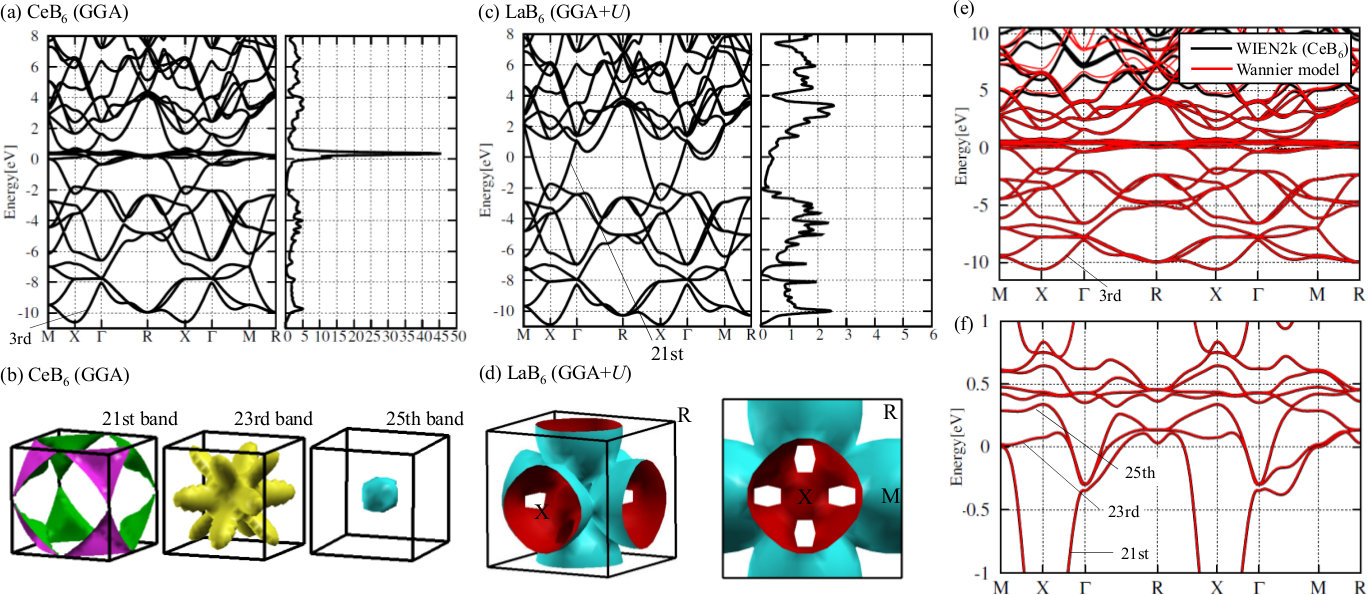 Figure 1
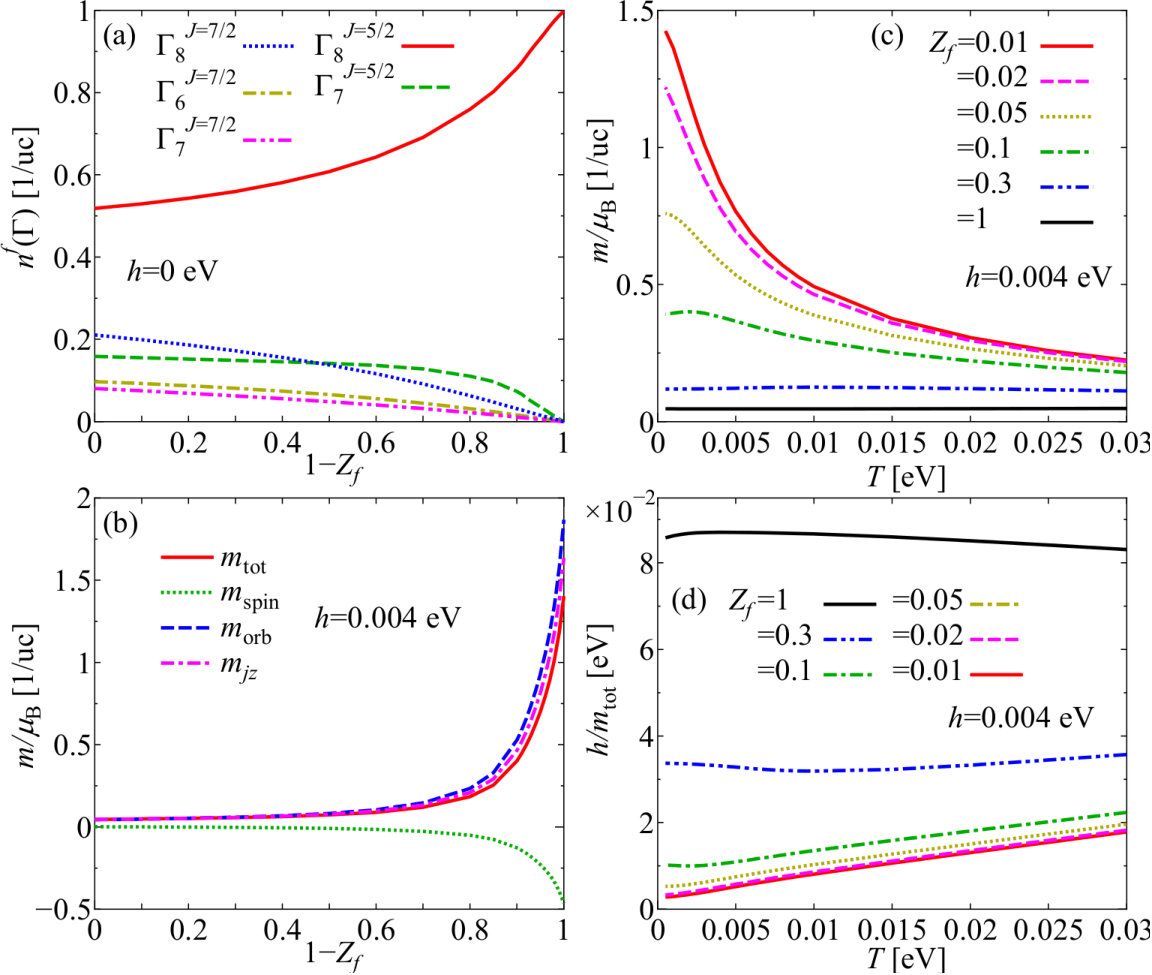 Figure 2
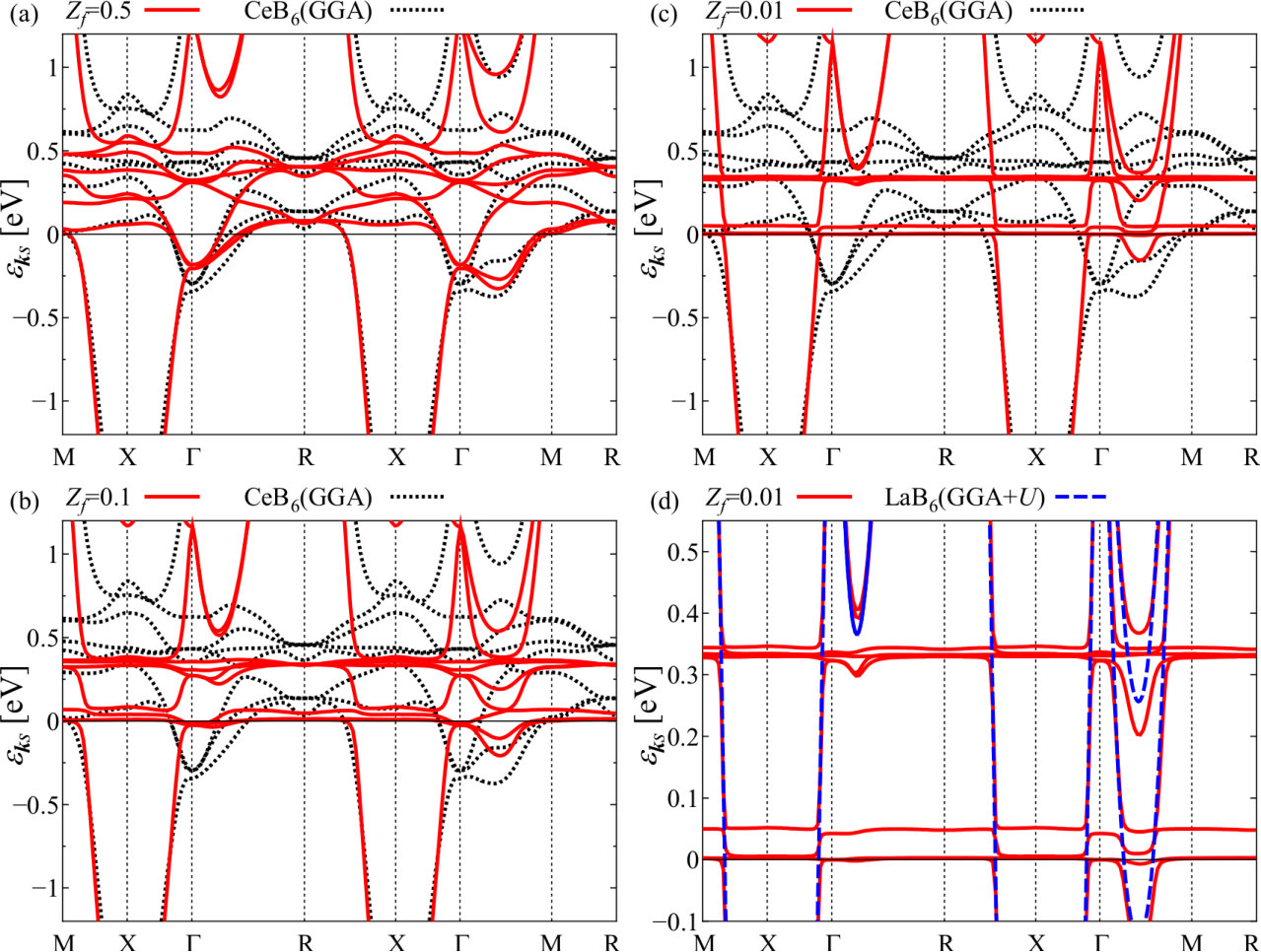 Figure 3
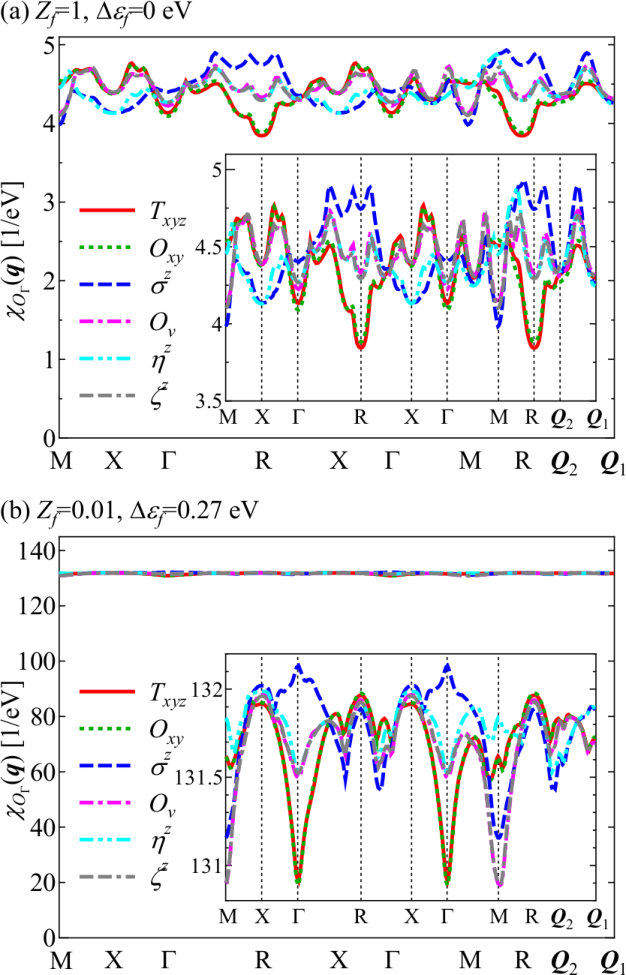 Figure 4
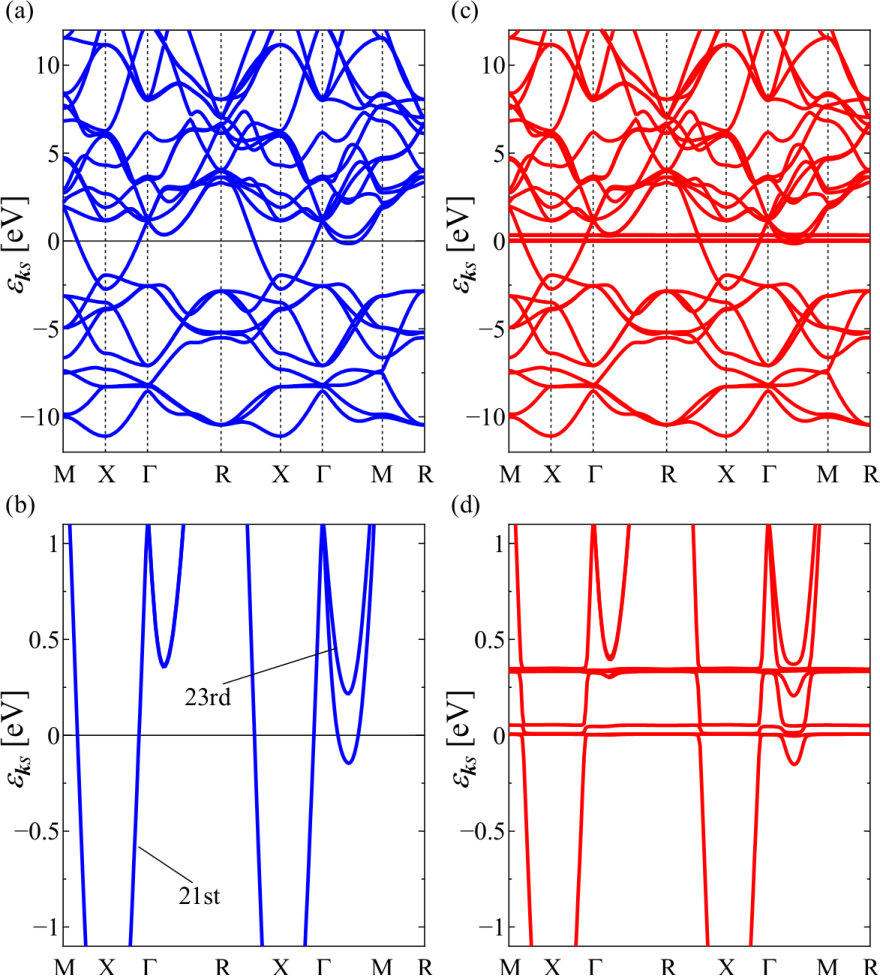 Figure 5
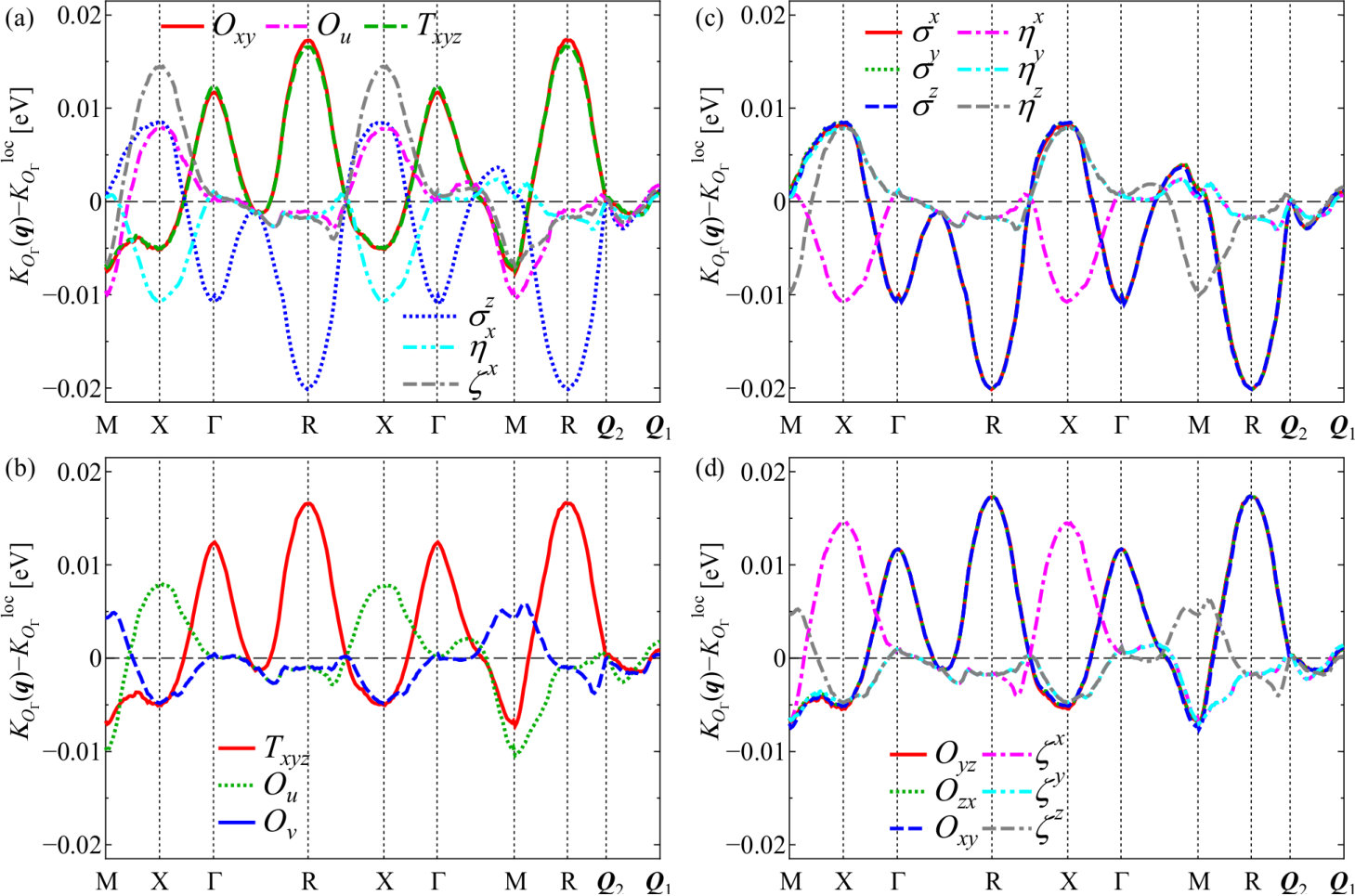 Figure 6
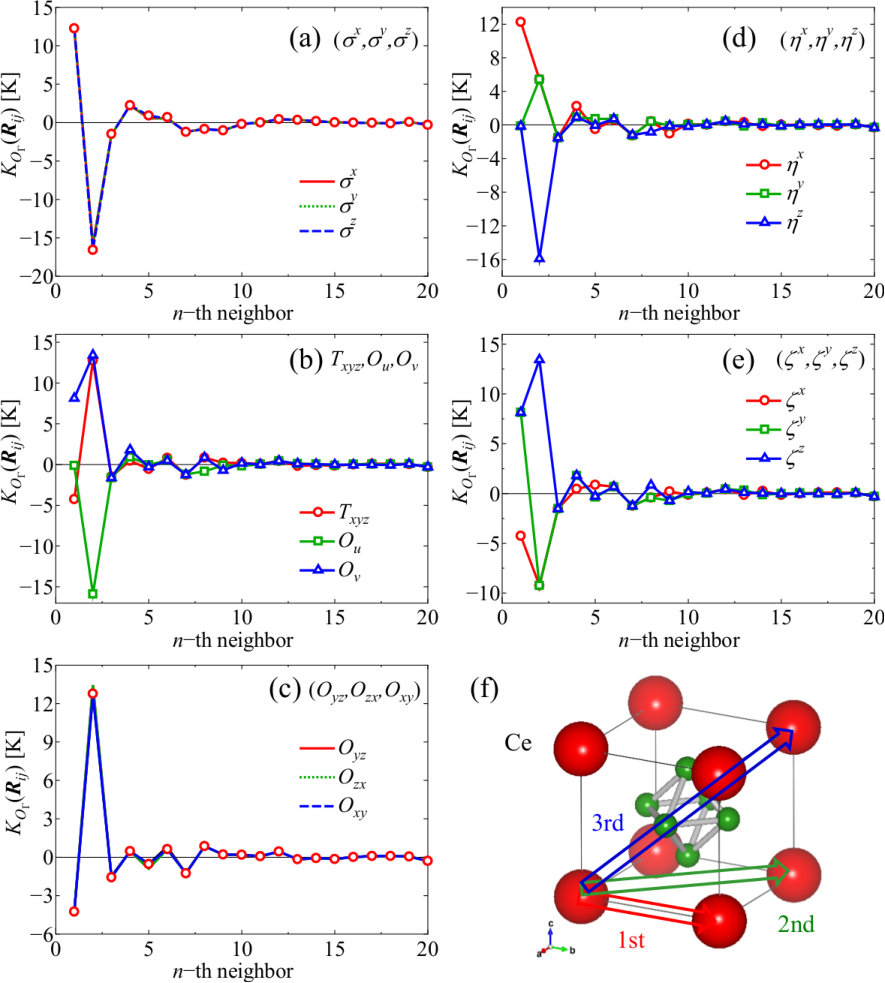 Figure 7
| IRR [dimension] | vector | pseudospin | multipole |
|---|---|---|---|
| [1] | |||
| [2] | |||
| [3] | |||
| [3] | |||
| [3] | |||
| [3] |
| rank | IRR | multipole | wavevector | value [meV] | ratio | ||||||
| 1 | 17.26 | 1.00 | |||||||||
| \hdashline 2 | 16.56 | 0.96 | |||||||||
| 3 |
|
|
14.48 | 0.84 | |||||||
| \hdashline 4 |
|
|
14.08 | 0.82 | |||||||
| 5 | 12.43 | 0.72 | |||||||||
| \hdashline 6 | 11.69 | 0.68 | |||||||||
| 7 |
|
|
8.41 | 0.49 | |||||||
| 8 |
|
|
8.11 | 0.47 | |||||||
| 9 |
|
|
7.87 | 0.46 | |||||||
| \hdashline 10 |
|
|
7.78 | 0.45 |
Peer Reviews
No public reviews on file for this paper yet. If you reviewed it on a platform where reviews are public (OpenReview, ICLR, NeurIPS, ICML), you can paste yours below so the community can read it here.
Videos
No videos yet. Explain this paper in a talk, walkthrough, or lecture? Add one.
Derivation of RKKY Interaction between Multipole Moments in CeB6 by the Effective Wannier Model based on the Bandstructure Calculation
Takemi YAMADA and Katsurou HANZAWA E-mail address: [email protected] Department of Physics Department of Physics Faculty of Science and Technology Faculty of Science and Technology Tokyo University of Science Tokyo University of Science Chiba Chiba 278-8510 278-8510 Japan Japan
Abstract
We have investigated the electronic states of CeB6 and have directly calculated the RKKY interaction on the basis of the 74-orbital effective Wannier model which includes 14 Ce- orbitals and 60 conduction () orbitals of Ce- and B- derived from the density-functional theory bandstructure calculation. By using not only the -band dispersion but also the - mixing matrix elements of the Wannier model, the realistic couplings for all 15 active multipole moments in quartet subspace are obtained in the wavevector -space and real-space. Both of the quadrupoles and the octupole couplings are maximally enhanced with which naturally explains the phase II of the antiferro-quadrupolar ordering at K, and are also enhanced with corresponding to the elastic softening of . Also the couplings of the octupoles , and are quite large for , and , which yields the antiferro-octupolar ordering of a possible candidate for phase IV of CexLa1-xB6. The intersite vector dependence of the RKKY couplings exhibit different long-range, oscillating, isotropic and anisotropic behaviors depending on the types of the multipole moments. The present approach enables us to provide the information about the possible multipole ordering in an unbiased way and is easily available for other localized electron materials once the states and - mixing elements are given from the bandstructure calculation.
1 Introduction
CeB6 has been known as a typical and remarkable compound exhibiting a rich phase diagram of the multipole orderings [1, 2, 3, 4] and extensively studied experimentally [4, 5, 6, 7, 8, 9, 10, 11, 12, 13, 14, 15, 16, 17, 18, 19, 20, 21, 22, 23, 24, 25, 26, 27, 28, 29, 30, 31] and theoretically[32, 33, 34, 35, 36, 37, 38, 39, 40, 41]. Due to the large spin-orbit coupling (SOC) and the cubic crystalline electric field (CEF), the ground state of 4 in Ce3+ ion is the quartet separated from the excited doublet by 540 K[8], and has a inherently the degrees of freedom of 15 active multipole moments as shown in Table 1.
Up to now, three phases exist in temperature and external magnetic field plane of CeB6. Normal phase (phase I) from a room temperature down to a few K with is a typical Kondo lattice metal with a highly-enhanced specific-heat coefficient[9, 10] mJ/molK2. With decreasing , phase II emerges at a critical temperature K with the ordering wavevector and is confirmed by the antiferro-quadrupolar (AFQ) ordering of the quadrupoles . The ordering tendency of the quadrupole moment is supported from the elastic-softening of at low temperature[15, 16, 17, 18]. Interestingly, increases with increasing the applied field , where the octupole moment is induced by in addition to the quadrupoles, which is well understood by the analysis of NMR[21]. The phase III is a antiferro-magnetic (AFM) ordering of magnetic moments at K with the double--structure of and .
4 electron state of CeB6 is believed to be almost localized in Ce3+-ion from the several experiments of the magnetic and transport properties. More directly, the Fermi-surface (FS) has been observed in the de Haas-van Alphen (dHvA) experiments[26, 27], the angle resolved photoemission spectroscopy (ARPES)[28, 29, 30] and the high-resolution photoemission tomography[31]. They has indicated an ellipsoidal FS centered at X point in the Brillouin zone (BZ) which is almost the same as that of LaB6 with the 4 state. Hence the 4 state in CeB6 is localized and hardly participates in the formation of FS.
In such a localized electron picture, Ruderman-Kittel-Kasuya-Yosida (RKKY) interaction[42, 43, 44] plays an important role for the multipole ordering where the intersite coupling between the multipole moments of electrons is mediated by the itinerant band electrons[45, 46]. The RKKY model of CeB6 was proposed by Ohkawa[32, 33] firstly, and later developed by Shiina et al.,[34, 35] where all 15 active multipole moments had been taken into account in correct symmetry, and reproduced the experimental - phase diagram where only nearest neighbor couplings and the largest quadrupoles couplings were assumed. This assumption was discussed from the symmetry of the RKKY couplings[36, 37], but there was no explicit calculation for the signs and values of the couplings, and also no discussion about the long-range property of the RKKY multipole coupling of CeB6. Later Sakurai et al.,[38, 39] studied the RKKY multipole couplings of CeB6 microscopically such as the effect of the and intermediate states, band number dependence and the ratio of the - mixing elements described by the Slater-Koster (SK) parameters, but plausible ordering moment types and wavevectors could not be obtained.
As is often discussed in the RKKY mechanism, the band states and their couplings with the states in the realistic materials must be important for determining the ordering moment types and wavevectors. Therefore the microscopic description of the band states and - mixing elements from the realistic bandstructure calculation is needed, though such studies are quite limited[47, 48]. In these studies[47, 48], the states is described by the Wannier orbitals obtained from the bandstructure calculation but the - mixing elements using the calculation of the RKKY coupling are treated by the SK parameters only with the nearest neighbor sites, where several arbitrary parameters and assumptions are included. Hence more decisive and widely-applicable approach reflecting the individual material properties is highly desired.
In this paper, we study the electronic states of CeB6 and calculate the RKKY interaction based on the 74-orbital effective Wannier model derived from the bandstructure calculation directly. In Sec. 2, we calculate the bandstructures of CeB6 and LaB6 and construct the effective Wannier model of CeB6, and examine the quasi-particles states and their multipole fluctuations based on the renormalized Wannier model in Sec. 3. Next in Sec. 4, we formulate the present RKKY mechanism based on the multi-orbital Kondo lattice model with both of the quartet and 60 orbitals, and present the results of the RKKY multipole couplings for all moments as functions of the wavevector and intersite vectors. Finally we give the summary and discussion in Sec. 5.
2 Bandstructure calculation & Wannier model
2.1 DFT Bandstructure calculation of CeB6 & LaB6
First we calculate the electronic states of CeB6 and LaB6 by using the WIEN2k code[49, 50, 51], based on the framework of the density-functional theory (DFT) with the generalized gradient approximation (GGA)[52]. The SOC is fully included within the second variation approximation. The crystallographical parameters are the space group (No. 221), the lattice constant and the internal coordinates for Ce and for B with [53]. In self-consistent calculation, we use 156 -points in the irreducible part of the simple cubic BZ, the muffin-tin radii a.u. for Ce (B) and the plane-wave cuttoff of . For the calculation of LaB6, we use the same parameters of CeB6 but employ the GGA+ method with eV for La- level so as to eliminate the weights in the bands, since we focus the pure band state of CeB6 not bulk property of LaB6.
The obtained bandstructures with the density-of-states (DOSs) and FSs are shown in Fig.1 for CeB6 [(a) & (b)] and LaB6 [(c) & (d)]. In CeB6, the large contribution due to the 14 spin-orbital states around Fermi energy () is observed with the strong peak of DOS as shown in the right panel of Fig. 1 (a). On the other hands in LaB6 the states is absent in the bandstructure and DOS [Fig. 1 (b)] as expected due to the effect of the GGA+. Except for the band states, the global bandstructures of CeB6 and LaB6 are closely resembled below and above . The calculated FSs of CeB6 and LaB6 are plotted in Figs. 1 (b) and (d), respectively. Three FSs are obtained from the 21st, 23rd and 25th bands for CeB6 while for LaB6 an ellipsoidal FS centered at X point slightly connected each other is obtained from the 21th-band. Here we note that all bands have two-folded degeneracy due to the time-reversal symmetry and two additional bands (1st and 2nd bands) are located in eV (not shown) which are the lowest bands in the Wannier model in next subsection.
2.2 Construction of Wannier model for CeB6
Next we construct the 74-orbital effective Wannier model based on the maximally localized Wannier functions (MLWFs) method[54, 55, 56, 57, 58] from the DFT bandstructure of CeB6, where we prepare 14 -states from Ce- (7 orbital 2 spin) and 60 -states from Ce- (5 orbital 2 spin), Ce- (1 orbital 2 spin), B- (6 site 3 orbital 2 spin) and B- (6 site 1 orbital 2 spin) as basis functions, and set considerably wide energy window in order to ensure the good localization of Wannier orbitals in the disentanglement procedure. The obtained bandstructure of the Wannier model is plotted in Figs. 1 (e) and (f) together with the DFT bandstructure of CeB6 (black), where the Wannier model is well reproduced the DFT bandstructure upto eV and the shapes of the Wannier orbitals are similar to the atomic-orbitals significantly.
The obtained model can be written by the following tight-binding (TB) Hamiltonian as,
[TABLE]
where is a creation operator for a electron with unit-cell and 14 (60) spin-orbital states . Here 14 states of are represented by the CEF eigenstates as quartet and doublet with the total angular momentum , and , doublets and quartet with . The - (-) matrix element of includes the energy levels, SOC couplings, CEF splittings and - (-) hopping integrals, and is the - mixing element which is finite only for the intersite terms due to the inversion symmetry. The wavevector -representation of is given by,
[TABLE]
where is the eigenenergy with and band-index and is a creation operator for a electron with , which is transformed into and states as where is the eigenvector component of state.
Several atomic parameters are obtained from the Wannier model, such as the SOC splitting for Ce- between and states eV close to the experimental value of 3000 K, the atomic CEF splitting between and , meV which is smaller than the experimental value of 540 K (= meV). The electron number per unit-cell is () and the total number is . All the electron number for each CEF state becomes finite where and for and , , and for , due to the considerable - hopping and - mixing, which is indispensable within the DFT-based calculation.
3 Quasi-particle band states & Multipole fluctuations
3.1 Renormalized tight-binding model
As mentioned in Sec. 2, the electron state obtained here is fully itinerant and differs from the expected situation in the real material as . In this section, we examine the change of the electronic states and its multipole fluctuations from the itinerant band state to the localized state when in the realistic CeB6 bandstructures. For this purpose, we introduce a renormalization factor , which is explicitly derived from the Fermi-liquid (FL) theory [59], where the many-body correlation effect of the local - Coulomb interaction is introduced through the self-energy which is almost local and can be expanded around by the following form,
[TABLE]
where corresponds to an inverse mass-enhancement , and and are a shift of the energy-level and a dumping rate of the quasi-particles respectively. Hence in the itinerant quasi-particle picture, our original model of is renormalized by and , yielding the renormalized tight-binding model as explicitly given by,
[TABLE]
where the renormalized - (-) matrix elements are written as,
[TABLE]
where is a energy-level of the CEF state , where for , and the -dependence of and are dropped for simplicity as and , where is set to eV so as to satisfy and at . Hence the - (-) hopping elements are renormalized by . Throughout the calculation, we determine a chemical potential so as to satisfy with 643 -meshes in the entire BZ.
3.2 Renormalized electronic states
Figure 2 (a) shows the -dependence of electron number per CEF eigenstates with eV, where , , and , and () corresponds to the DFT-band (localized ) limit. With decreasing , increases and finally becomes when while and all other decrease and reach zero at . The change of is rapidly for where the effective mass-enhancement reaches . The electron magnetization as a function of is also plotted in Fig. 2 (b) together with its spin, orbital and -components , and , respectively, where the magnetic field is applied along the -direction with eV. The Zeemann Hamiltonian is given by , and and are explicitly written as,
[TABLE]
where is a -component of spin Pauli (orbital angular momentum) matrix for -basis and is the Fermi distribution function . With decreasing , increases and finally reaches the saturated value of the state as 1.5 together with an opposite sign between and due to the SOC effect.
The -dependence of the magnetization and inverse magnetization for several values of are plotted in Figs. 2 (c) and (d) respectively. For the weak -dependence of is observed as a Pauli paramagnetic behavior of the itinerant electron, while for increases with decreasing , exhibiting the Curie paramagnetic behavior of the localized electron , which is more clearly observed in the inverse magnetization with a linear -dependence. In such situations for , the electronic state is similar to the purely localized electron state on a single Ce-ion usually analyzed in the experiments. However in this study the - mixings are still finite and the quasi-particle hybridization bands are formed with the wide-bandwidth band dispersion having the ellipsoidal FS observed ARPES of CeB6.
Next we check such renormalized bandstructures for several values of as shown in Figs. 3 (a)-(d) together with the DFT-bandstructure of CeB6 [Figs. 3 (a)-(c)] and the LaB6 GGA+ band without weights [Fig. 3 (d)]. From [Fig. 3 (a)] to [Fig. 3 (b)], the whole bandstructures are still close to the DFT-band of CeB6 but their band-widths become narrow gradually, exhibiting a separation between the lower bands and higher bands. In Fig. 3 (d) with corresponding to , the almost flatted bands, and and bands of are clearly observed around , and they slightly hybridize with the wide-bandwidth bands expanding from the X point in the BZ. Interestingly, the band dispersion with (red) is almost overlapping the LaB6 band with the GGA+ (black) as shown in Fig. 3 (d) except for the highly-flatted bands, resulting in the formation of almost the same FS of LaB6. Hence the bands of CeB6 with almost localized electron state coincides that of LaB6 without the La- contribution, and then their FS is also almost the same as that of LaB6 as shown in Fig. 1 (d). These results strongly support the localized electron picture for CeB6, and then the approach based on the periodic Anderson model and its perturbation w. r. t. the - mixing is expected to giving a good starting point for treating this system.
3.3 Multipole fluctuations in the quasi-particle bands
Before going to the calculation of the RKKY interaction, we examine the multipole fluctuations under the renormalized bands on CeB6 by calculating the multipole susceptibility with the multipole operator shown in Table 1 and the wavevector which is given by,
[TABLE]
where and is the normalized 44 matrix element of in subspace[3], and is the irreducible electron susceptibility which depends on the distribution of states in the bandstructures through the renormalized - mixing .
Figure 4 (a) shows the -dependence of for each multipole moment with and eV corresponding to the DFT band limit as shown in Figs. 1 (e) and (f). The obtained -dependence is considerably weak and the explicit values of fall within the only small range eV*-1* for all multipole moments and wavevectors . Among them the magnetic multipole susceptibility, where and are degenerate with , is barely large for the incommensurate wavevector around , while the quadrupole and the ocutupole susceptibilities does not become large for the AFQ wavevector . The weak- dependence of becomes more notable for the almost localized case with and eV as shown in Fig. 4 (b), where becomes also maximum but its wavevector shifts to as shown in the inset of Fig. 4 (b).
In such a situation, the actual value of becomes huge, where the extremely narrow bands are located in the very near and just above with tiny - mixing, and then the hybridized band is highly degenerate for wide-range of the BZ, giving rise to the sizable enhancement of the Lindhard function of in Eq. (13). As far as such -independent , it is difficult to describe the development of the -AFQ mode with by the perturbation of the - Coulomb interaction such as the random phase approximation (RPA) and its extensions.
4 RKKY Interaction of CeB6
4.1 Derivation of RKKY Hamiltonian
Here we consider the RKKY interaction between the multipole moments of quartet. For this purpose, we eliminate the energy-levels but use the - mixing of the original Wannier model. The bandstructure for the calculation of RKKY couplings is shown in Figs. 5 (a) and (b), which is almost the same as that of LaB6 as mentioned in Sec. 3 and is compared to the strongly renormalized quasi-particles case with as shown in Figs. 5 (c) and (d). During the calculation, is determined so as to keep and is set to eV.
The multi-orbital Kondo lattice Hamiltonian for the present model is given by,
[TABLE]
where represents 4-states in quartet with an degenerate energy-level , which are given with the -base of explicitly as, , , and . Here we note that in Eq. (8) for of and is pushed up from the bare energy-level due to the DFT Hartree and GGA potentials which is of the order of a few eV. The - matrix element includes the orbital energy for and the - hopping for . The second term is rewritten by the band eigenstate with the eigenenergy and eigenvector .
The Kondo coupling in the third term consists of the - and -intermediate process. In this paper, we take simple two assumptions for ; (1) only -process is considered and the contribution of -process is same as that of -process and, (2) the scattered orbital energies are fixed to , namely . Then the Kondo coupling can be written by the following simple form,
[TABLE]
where the prefactor 2 comes from the assumption (1) and is the -represented - mixing element in Eq. (2).
The RKKY Hamiltonian can be obtained from the second-order perturbation w. r. t. the third term of together with the thermal average for the states. The final form is given by,
[TABLE]
where is the RKKY coupling between the states at the unit-cell and the states at and represents a summation for the intercell vectors . The key quantity is given by,
[TABLE]
which consists of a square of the energy denominator , 4-producted - mixings and the band eigenvectors, and the Lindhard function with . Thus it has components of -basis for each , and has to be summed for the orbitals (604) and the band-indexes (). Then we introduce a - mixing matrix between via the band state with as follows,
[TABLE]
which includes whole information about the state scattering between through the state with , and has only components of for each with a summation for (602). Hence once we calculate , can be easily obtained by the following compact form,
[TABLE]
This expression helps us calculate all the contributions of the 60 electron charge and/or orbital fluctuations to the RKKY multipole couplings.
In order to search the actual multipole ordering, we employ the mean-field (MF) approximation w. r. t. the multipole operator , resulting in the MF Hamiltonian as follows,
[TABLE]
where the multipole coupling and and the MF order parameter are given by,
[TABLE]
where and is MF multipole order parameter defined at the unit-cell vector . Then the MF multipole susceptibility is written by,
[TABLE]
which is enhanced towards the multipole ordering instability for the ordering moment and wavevector , and finally diverges at a critical point of the multipole ordering transition temperature where reaches unity. The -dependence of is weak as shown in Sec. 3, and then the sign and maximum value of determines the multipole ordering moment and wavevector for any given . Hereafter we set eV for simplicity, since this factor is independent of and , and hence does no affect the ordering type and wavevector, whose effect is discussed in Sec. 5.
4.2 -dependence of RKKY coupling
The obtained RKKY multipole couplings for several multipole moments along the high symmetry line in the BZ are plotted as shown in Figs. 6 (a)-(d), where the positive (negative) coupling for a certain multipole and wavevector enhances (suppresses) the corresponding multipole fluctuation as explained in Eq. (24), and its positive maximum value gives a leading multipole ordering mode. The obtained results for the leading multipole ordering modes upto the 10th largest coupling are summarized in Table 2.
The couplings of the quadrupoles for become largest among all moments and , which perfectly corresponds to the AFQ ordering of CeB6. In addition, ocutupole coupling is quite large and comparable to the quadrupoles with the same wavevector as shown in Fig. 6 (a) but slightly small within the present calculation accuracy as shown in Table 2, which seems to be the same value from the previous discussions[36, 37] where and have almost same matrix elements and yield the similar fluctuations in phase I. Furthermore the quadupoles and octupole couplings also take a substantial peak for as shown in Figs. 6 (a) and (d) and correspond to the elastic softening of [15, 16, 17, 18].
The next largest coupling is the octupole at [Figs. 6 (a) & (d)] which is degenerate for octupole at due to the cubic symmetry. The role of the octupoles is also discussed for the phase IV observed in the La-doping system CexLa1-xB6 with [60, 61, 62, 63, 64, 65, 66], where the antiferro-octupolar (AFO) ordering of is considered to be a possible mode. In contrast, the present theory suggests the AFO with the domained structure of , and for , and , respectively, and this point will be discussed in the next subsection.
In addition to this, the quadrupole coupling is quite large for (not shown) and becomes similar value of the octupole coupling as shown in Table 2, which is also degenerate for the rotated moments to the each principle-axis and . This is namely the -AFQ mode where the moment directions and wavevectors are perpendicular such as the multipole moments of , and with the corresponding wavevectors for , and respectively.
The magnetic multipole couplings of and are plotted in Fig. 4 (d) and their maximum values in -space are smaller than that of the quadrupole and octupole couplings as shown in Table 2, where the maximum peak values are less than half of the first leading peak value of the -. At the AFM ordering vectors for phase III, and , the couplings of the magnetic multipoles have small peaks as shown in Fig. 4 (e) and they shall be enhanced and dominant only when the system enters into phase II, which is not discussed in the present paper.
As usually discussed in the itinerant electron picture with the multi-orbital Hubbard model[67, 68, 69], the weak coupling theory like the RPA and its extensions yields largely enhanced magnetic multipole (spin) fluctuations which become always larger than the nonmagnetic multipole (orbital) fluctuations like multipoles here. As for CeB6, the electron itself is already localized at each Ce site and the remained magnetic and nonmagnetic multipole moments interact with the RKKY intersite couplings, where the magnetic multipole coupling does not necessarily dominate over the nonmagnetic one, since the dominant RKKY coupling is determined by the detail of the - mixing and the meditating electron charge and/or orbital fluctuations.
Here we note the electron charge and orbital fluctuations and their contribution to the coupling . By changing summation for the orbital-set in Eq. (18) and the band-index in Eq. (20), we have obtained that both effects of the Ce- orbitals of and distributed in the 21st and 23rd bands and the charge fluctuation of B6-molecule having a maximum at and large values along R-M line play significant roles for the AFQ mode. In particular, we observe a non-negligible contribution from the 23rd band which does not have FS but is very close to along the -M direction as shown in Fig. 5 (b). The explicit results and further analysis of such electron contributions to the multipole couplings will be presented in elsewhere.
4.3 -dependence of RKKY coupling
In general, the RKKY interaction is known to have long-range and oscillating features discussed in the early studies[45, 46]. For the multipole ordering of CeB6, however, the coupling is limited only in the nearest neighbor terms in the previous studies[32, 33, 34, 35, 36, 37, 38, 39]. In contrast, the present formalism provides the real space dependent couplings which is explicitly written as
[TABLE]
where is given in Eq. (17).
Figure 7 shows the site-dependence of the RKKY multipole couplings with the intersite vector upto 20-th neighbor sites as shown in Table 7, where the positive (negative) sign corresponds to the ferro (antiffero) coupling for each neighboring site.
As shown in Fig. 7 (a), the magnetic multipole couplings exhibit several sign changes with a few site-intervals and degeneracy due to the symmetry of paramagnetic phase for all -th neighbors, where , and corresponds to the - and -moment direction respectively. We also confirm that a monopole operator defined as a unit matrix for -basis is also degenerate with possessing the same oscillating feature. The couplings of and are isotropic, where for example they have the same value for 6 first neighbor sites , and .
The and multipoles couplings which gives the leading AFQ mode show staggered and isotropic behaviors, where the first, second and third neighbor couplings show positive, negative and positive signs respectively as shown in Figs. 7 (b) [] and (c) [], which clearly enhance cooperatively the antiferro ordering. In particular, the second neighbor coupling becomes largest with positive sign, which also enhances the AFQ mode as a main driving force.
On the other hands, the main origin of the -AFO with octupole is the anisotropic first neighbor couplings as shown in Fig. 5 (e), where the coupling of which the intersite vector and moment direction are parallel (perpendicular) each other has negative (positive) sign such as and for , which yields for the perpendicular first neighbors and , resulting in the enhancement of the mode by .
With this matter in mind, we might be able to explain the doping phase diagram of CexLa1-xB6, where the doping effect is simply treated by the reduction of the multipole coupling depending the coordination number for each site, since a La-substituted site has no multipole moment. Consequently, the first leading -AFQ mode in decreases with decreasing more rapidly than the second -AFO mode due to the difference of the coordination numbers : 6 first neighbors and 12 second neighbors for , while 2 parallel first neighbors and 4 perpendicular first neighbors and so on for . This turnover of the dominant mode may be consistent with the recent inelastic neutron scattering (INS) experiments in the La-doping system[25] where the intensity is developed and becomes dominant mode for .
As well as the couplings, the quadrupoles and multipole couplings exhibit the anisotropic behavior as shown in Figs. 7 (b) and (d). The obtained results of such long-range, oscillating, isotropic or anisotropic behaviors depending on the multipole moments seem to be worthwhile to study from now on.
5 Summary and Discussion
In summary, we study the electronic states of CeB6 and perform a direct calculation of the RKKY interaction based on the 74-orbital effective Wannier model derived from the bandstructure calculation and obtain the following results.
(1) When the - hopping and - mixing of the Wannier model are suppressed by the renormalization factor based on the FL theory, the quasi-particle band states are observed where the fully dispersionless bands slightly hybridize with the wide-bandwidth bands, which is almost the same as the GGA+-band of LaB6 having a single ellipsoidal FS centered at X point. This is in good agreement with the recent ARPES[28, 29, 30, 31] and early dHvA experiments[26, 27] and strongly supports the localized electron picture for CeB6.
(2) By using the LaB6-like band states together with the - mixing elements of the CeB6 Wannier model, we calculate the RKKY couplings for all active multipole moments in subspace explicitly as functions of wavevector and inter-cell vector , where we derive a useful expression in order to treat all 60 -orbital contributions.
(3) The couplings of the quadrupole together with the octupole are highly enhanced for as the 1st and 2nd leading modes, and as the 5th and 6th leading modes, where the former explains the AFQ ordering of the phase II and the latter corresponds to the elastic softening of . The 3rd (4th) leading mode is the -AFO (-AFQ) of , and (, and ) with the corresponding wavevectors for , and respectively, which are almost degenerate each other and differ from the discussed AFO-mode with at [60, 61, 62, 63, 64, 65, 66].
(4) All the obtained RKKY couplings have long-range and oscillating behavior as a function of , where the quadrupole and octupole couplings indicate the sign-reversing for each neighboring site and have a positive largest value at the second neighbor which cooperatively enhances the AFQ with , while for the second leading AFO mode, the anisotropic first neighbor couplings are significant. This induces the leading mode shift with increasing the La-substitution rate in CexLa1-xB6 from the -AFQ with (phase II) to the -AFO with (phase IV) which may be also consistent with the peak in the INS data[25].
(5) The present approach can determine the possible type of the multipole moment and the ordering vector definitely once the band states and - mixings are given by the bandstructure calculation, which enables us to discuss the inherent feature and the concrete situation of actual compounds such as the changes of FSs, carrier densities, lattice constants and internal coordinates of atoms.
In this study, we take only the -process and assume that the contribution from -process is the same as that of , since the -process is fully one-body effect and directly obtained from the DFT-bandstructure calculation. As mentioned in Sec. 4, we take eV, but the excitation energy from the -stable to -intermediate states in CeB6 is roughly estimated by eV[29, 31], so that our results of obtained in Sec. 4 should be multiplied by a single reduction factor , which yields the same order of the actual transition temperature of CeB6 as a few K, for example, the inter-quadrupole coupling value K[17].
The explicit determination of the couplings and the transition temperatures needs the many-body energy difference between the ground and intermediate and states, where to what extent the many-body effect from the and more multiple processes changes the present result is an important question elucidating the multipole ordering system with different valence materials such as PrB6 and NdB6. The explicit calculation of the coupling including the -process and/or more many-body contribution, and the whole phase diagram in - plane will be presented in the subsequent paper.
As a complementary approach to the present localized electron treatment, the dynamical mean field theory[70] enabling to take account of the full local correlation effect and its extensions[71] including the intersite correlation could be valid for directly describing the fully localized states starting from the itinerant states and their multiple ordering phenomena including superconductivity[72]. The application of such many-body theory to the realistic materials and their comparison with present theory are also the essential future problems.
{acknowledgment}
We would like to thank Y. Ōno and Y. Iizuka for valuable comments and discussions.
The reference list from the paper itself. Each links out to its DOI / PubMed record.
- 1[1] P. Santini, S. Carretta, G. Amorett, R. Caeiuffo, N. Mabnani, and G. H. Lander: Rev. Mod. Phys. 81 (2009) 807.
- 2[2] Y. Kuramoto, H. Kusunose, and A. Kiss: J. Phys. Soc. Jpn. 78 (2009) 072001.
- 3[3] H. Kusunose: J. Phys. Soc. Jpn. 77 (2008) 064710.
- 4[4] A. S. Cameron, G. Friemel, and D. S. Inosov: Rev. Prog. Phys. 79 (2016) 066502.
- 5[5] T. Fujita, M. Suzuki, T. Komatsubara, S. Kunii, T. Kasuya, and T. Ohtsuka: Solid State Commun. 35 (1980) 569.
- 6[6] M. Kawakami, S. Kunii, T. Komatsubara, and T. Kasuya: Solid State Commun. 36 (1980) 435.
- 7[7] A. Takase, K. Kojima, and T. K. and T. Kasuya: Solid State Commun. 36 (1980) 461.
- 8[8] E. Zirngiebl, B. Hillebrands, S. Blumenr o ¨ ¨ o \ddot{\rm o} der, G. G u ¨ ¨ u \ddot{\rm u} ntherodt, M. Loewenhaupt, J. M. Carpenter, K. Winzer, and Z. Fisk: Phys. Rev. B 30 (1984) 4052.