Bimolecular theory of non-radiative recombination in semiconductors with disorder
Oleg Rubel

TL;DR
This paper extends Shockley-Read-Hall recombination statistics to include localized excitations, modeling non-radiative recombination as a bimolecular process and analyzing the interplay between different radiative channels in disordered semiconductors.
Contribution
It introduces a bimolecular model for non-radiative recombination involving localized excitations and provides analytical and numerical insights into thermal quenching behavior.
Findings
Recombination is better described as bimolecular rather than monomolecular.
Analytical expression for thermal quenching in low pump intensity regime.
Critical evaluation of empirical fitting functions for photoluminescence quenching.
Abstract
The original Shockley-Read-Hall recombination statistics is extended to include recombination of localized excitations. The recombination is treated as a bimolecular process rather than a monomolecular recombination of excitons. The emphasis is placed on an interplay between two distinct channels of radiative recombination (shallow localized states vs extended states) mediated by trapping of photogenerated charge carriers by non-radiative centers. Results of a numerical solution for a given set of parameters are complemented by an approximate analytical expression for the thermal quenching of the photoluminescence intensity in non-degenerate semiconductors derived in the limit of low pump intensities. The merit of a popular double-exponential empirical function for fitting the thermal quenching of the photoluminescence intensity is critically examined.
Click any figure to enlarge with its caption.
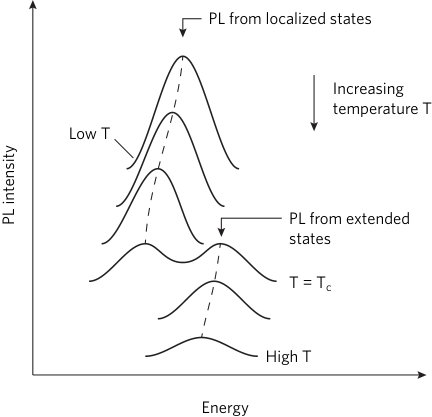 Figure 1
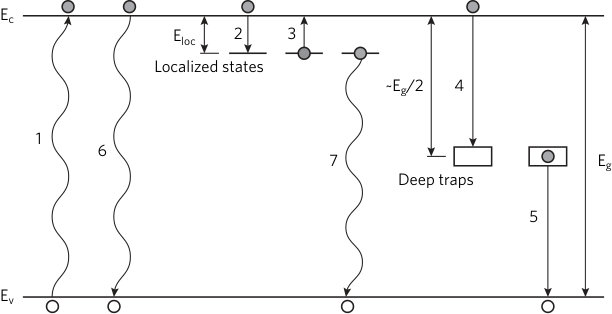 Figure 2
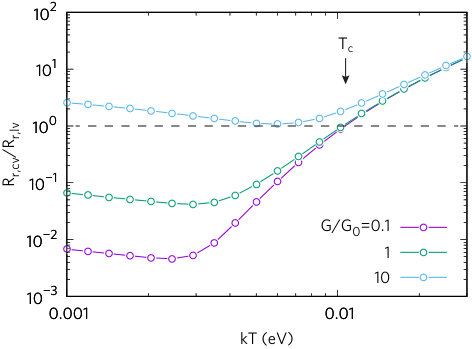 Figure 3
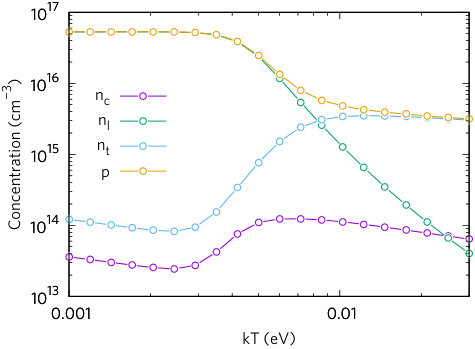 Figure 4
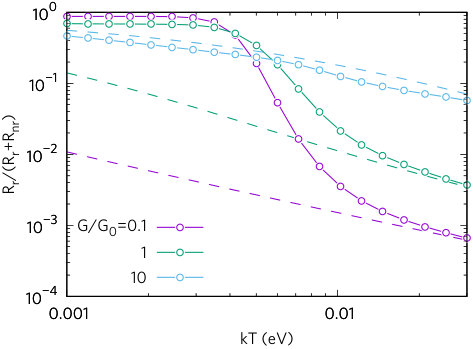 Figure 5
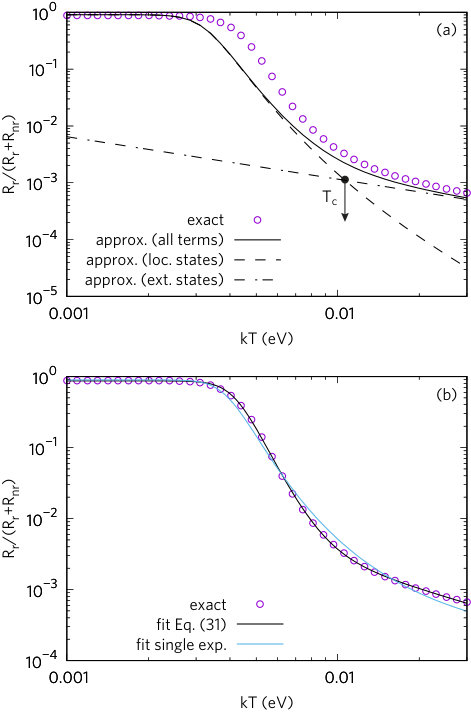 Figure 6
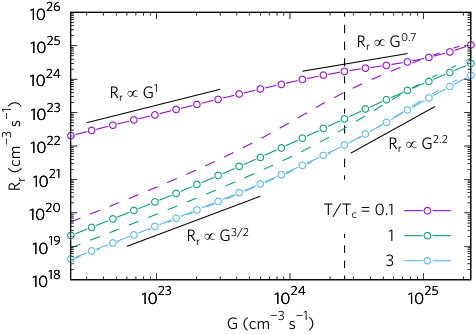 Figure 7
| Symbol | Description | Value | Units |
|---|---|---|---|
| Localization energy relative to (Fig. 2) | eV | ||
| Effective density of extended states in the conduction band | cm-3 | ||
| Effective density of extended states in the valence band | cm-3 | ||
| Density of localized states | cm-3 | ||
| Density of deep traps | cm-3 | ||
| Electron capture cross section for localized states and deep traps111The same cross section is assumed for localized states and deep traps to make the algebra more simple. | cm2 | ||
| Electron thermal velocity | cm s-1 | ||
| Electron capture coefficient for localized states and deep traps | cm3 s-1 | ||
| Hole capture coefficient for deep traps | cm3 s-1 | ||
| Bimolecular recombination coefficient for extended states222The bimolecular recombination coefficient is assumed temperature independent since a functional form of this dependence is unknown. However, it generally shows a strong temperature dependence with a tendency to decrease with decreasing temperature. | cm3 s-1 | ||
| Bimolecular recombination coefficient for localized states | cm3 s-1 |
Peer Reviews
No public reviews on file for this paper yet. If you reviewed it on a platform where reviews are public (OpenReview, ICLR, NeurIPS, ICML), you can paste yours below so the community can read it here.
Videos
No videos yet. Explain this paper in a talk, walkthrough, or lecture? Add one.
Taxonomy
TopicsAdvanced Chemical Physics Studies · Semiconductor Quantum Structures and Devices · Spectroscopy and Quantum Chemical Studies
Bimolecular theory of non-radiative recombination in semiconductors with disorder
Oleg Rubel
Department of Materials Science and Engineering, McMaster University, 1280 Main Street West, Hamilton, Ontario L8S 4L8, Canada
Abstract
The original Shockley-Read-Hall recombination statistics is extended to include recombination of localized excitations. The recombination is treated as a bimolecular process rather than a monomolecular recombination of excitons. The emphasis is placed on an interplay between two distinct channels of radiative recombination (shallow localized states vs extended states) mediated by trapping of photogenerated charge carriers by non-radiative centers. Results of a numerical solution for a given set of parameters are complemented by an approximate analytical expression for the thermal quenching of the photoluminescence intensity in non-degenerate semiconductors derived in the limit of low pump intensities. The merit of a popular double-exponential empirical function for fitting the thermal quenching of the photoluminescence intensity is critically examined.
I Introduction
Compound semiconductors and their solid solutions grown at non-equilibrium conditions are susceptible to formation of defect states (deep traps) Harris Jr. et al. (2005); Batool et al. (2013). Those defects act as non-radiative recombination centers and limit a carrier lifetime, in particular at higher temperatures. This process competes with band-to-band radiative recombination that involves extended as well as shallow localized states (see Fig. 1) formed due to composition fluctuations Ouadjaout and Marfaing (1990). The non-radiative recombination manifests in quenching of the photoluminescence (PL) yield with increasing temperature that is accessible experimentally for a wide range of materials, including recent studies of hybrid halide perovskites Wu et al. (2014); He et al. (2016); Diroll et al. (2017), 2D materials Jadczak et al. (2017), group III-V dilute bismides Wilson et al. (2018); Hidouri et al. (2019), and GaN:Mg Reshchikov et al. (2018). Measurements of provide access to material characteristics—such as a localization energy, density of localized states and traps—when combined with a physics-based theory.
Under continuous-wave (CW) excitation conditions, the carrier generation rate is balanced by radiative and non-radiative recombination rates
[TABLE]
The PL yield can be expressed in terms of the non-radiative recombination rate as
[TABLE]
Shockley, Read, and Hall Shockley and Read (1952); Hall (1952) (SRH) proposed the non-radiative recombination rate in the form
[TABLE]
where and are the concentration of electrons and holes in extended states, and are the corresponding capture coefficients, and is the trap density. Here, the thermal generation is assumed to be negligible (see note in Sec. II). SRH expression is widely used to describe recombination via traps in device simulations Li et al. (2017). Equation (3) is general and does not require a modification even in the presence of localized states. However, the presence of localized states will greatly influence the carrier concentrations and . Finding an exact analytical solution taking into account various competing processes (even without involving localized states) is a formidable task. This inspired a number of approximations and Monte-Carlo simulations in attempt to describe dependence that will be briefly reviewed below.
Starting with Gee and Kastner (1979), a stream of theories emerged where localized states are explicitly considered as the only source of radiative recombination. The non-radiative recombination was attributed to a thermal activation of excitons from localized states to the mobility edge. This model was later augmented Rubel et al. (2006) to include recapture of excitons into radiative states with the probability of , where and correspond to the concentration of non-radiative traps and localized states, respectively. Shakfa et al. (2015) supplemented the ratio of concentrations with different capture cross sections for traps and localized states. The relative PL yield as a function of temperature becomes Gee and Kastner (1979); Rubel et al. (2006); Shakfa et al. (2015)
[TABLE]
for a set of localized states with the localization energy . Here, is the attempt to escape frequency, is the radiative lifetime of excitons captured into localized states, is the capture cross section which is different for two kind of states, and is the Boltzmann constant. The advantage of Eq. (4) is that it can be readily extended to an arbitrary function for the density of localized states. However, this stream of theories has two deficiencies: (i) excitons are assumed even at temperatures that greatly exceed the exciton binding energy, and (ii) extended states are assumed to be dark. The second limitation was lifted by Jandieri et al. (2013), but the analysis was presented for K only.
Among empirical dependencies for fitting the temperature quenching of the integrated PL intensity, a double-exponential function is a popular choice Lambkin et al. (1994)
[TABLE]
It incorporates two thermally activated non-radiative recombination channels A and B, characterized by activation energies . The energy barrier is typically of the order 10 meV Sun et al. (2006). It is often ascribed to release of carriers from localized state implying that similar to Eq. (4). The energy is of the order of 100 meV, and its interpretation is more broad, including confinement energy for quantum heterostructures Sun et al. (2006) or a reorganization energy associated with vibronic transitions Stoneham (1981). The pre-exponential factors (typically, ) are interpreted as a ratio between radiative and non-radiative lifetime for each individual channel Daly et al. (1995). This ratio is proportional to the concentration of non-radiative centers Buyanova et al. (2003). Equation (5) performs remarkably well for a variety of materials including chlorine-doped ZnSe layers Wang et al. (2001), Ga(AsSbN) quantum wells Lourenco et al. (2003), and hybrid halide perovskites \ceCH3NH3PbBr3 He et al. (2016) to name a few. However, a relation between the double-exponential dependence and the SRH statistics remains obscure.
The goal of this paper is to bridge the gap between the original SRH recombination statistics, which exclusively relies on extended states, and the stream of theories that focus on recombination of localized excitations. The model proposed here extends the well-established SRH recombination statistics and explicitly includes localized states as illustrated in Fig. 2. The recombination is treated as a bimolecular process rather than a monomolecular recombination of excitons, as the former is physically more plausible for a wide range of temperatures. It is anticipated that localized states will have a profound influence on the recombination statistics and its temperature dependence. The emphasis is placed on an interplay between two distinct channels of radiative recombination (shallow localized states vs extended states) mediated by trapping of photogenerated charge carriers by non-radiative centers. The final goal is not only to present a numerical solution for a given set of parameters, but also to derive an approximate analytical expression for the thermal quenching of the PL intensity in non-degenerate semiconductors at the limit of low pump intensities. The result is later compared to the double-exponential Eq. (5) to discuss its merit.
II Rate equations
Relevant excitation and recombination processes are illustrated in Fig. 2. They include transitions originally considered by Shockley and Read (1952) and additional ones due to localized states. All recombination events are treated as bimolecular processes that require the knowledge of concentration of electrons and holes. The total concentration of electrons is subdivided into three components, which represent free electrons at the mobility edge , electrons trapped into non-radiative deep centers , and those captured into localized states . Their time evolution is governed by the set of coupled non-linear rate equations presented below:
[TABLE]
Here, the order of terms corresponds to the processes 4, 2, 3, 6, and 1 shown in Fig. 2. The comprehensive list of model parameters can be found in Table 1. The rate equation for electrons in deep traps is
[TABLE]
The two terms represent processes 4 and 7 in Fig. 2. The rate equation for electrons in localized states is
[TABLE]
where the terms reflect processes 2, 3, and 7 in Fig. 2. The concentration of holes is governed by
[TABLE]
The order of terms is mapped to processes 5, 6, 7, and 1 in Fig. 2. The focus of this paper is on the CW excitation condition, i.e., we are looking for a steady-state solution of Eqs. (II)–(9).
It should be noted that the temperature enters into the model not only through the exponential term . The capture coefficients are proportional to the thermal velocity of charge carriers leading to (Table 1). The effective density of extended states also depends on the temperature as . The bimolecular recombination coefficients are kept temperature independent for the sake of simplicity.
The original Shockley and Read (1952) model also includes thermally-assisted release of electrons trapped into deep non-radiative states and capture of electrons from the valence band. These processes are disregarded here for simplicity. This assumption can be justified, provided the following conditions are fulfilled: , and the photo-generation rate is high enough to keep at all temperatures under consideration.
III Results and discussion
III.1 Critical temperature
Temperature-dependent PL measurements performed on disordered semiconductors often reveal a so-called “S-shape” shown schematically in Fig. 1. Here, the low-temperature PL is attributed to emission from localized states, while the high-temperature PL is dominated by recombination of free charge carriers. The transition between two regimes occurs at a critical temperature . This temperature corresponds to a simultaneous broadening and shift of PL spectrum to higher energies. This effect is also sensitive to the pump intensity Wilson et al. (2018), which is related to saturation of localized states at high intensities. The saturation generation rate can be defined as
[TABLE]
which represents the upper limit of the radiative recombination rate through localized states under CW excitation. The low excitation intensity conditions are referred to .
The relative contribution of the two radiative channels ( for localized states and for extended states) to PL as a function of temperature is shown in Fig. 3. Results are presented for three ratios to illustrate a difference between low and high excitation intensities. The excitation intensity affects the low-temperature PL composition in favor of recombination from localized states at low intensities. The transition temperature eV corresponds to the equal ratio of localized/extended states contribution to PL. We can see that it is less than the localization energy eV used as the model parameter.
At the crossover temperature both localized and extended electron-hole pair recombination rates have equal contribution
[TABLE]
which yields the ratio of electron concentrations
[TABLE]
At steady-state conditions and (i.e., ), Eq. (II) yields
[TABLE]
Since is high enough, most of the generated carriers recombine non-radiatively. The hole concentration can be approximated as
[TABLE]
It originates from Eq. (9) after neglecting radiative terms and taking into account that the majority of photogenerated electrons reside in traps, implying at (see Fig. 4). After combining Eqs. (12)–(14) we obtain
[TABLE]
It is a transcendental equation since , , and also depend on temperature (see Table 1). The analytical expression yields eV, which agrees with the numerical result in Fig. 3. The dominant term in the square brackets in Eq. (15) is at . It is responsible for a sizable difference between and . It should be mentioned that qualitatively similar behavior is observed when recombination of localized excitons is considered Rubel et al. (2005).
III.2 Numerical results for
The radiative recombination efficiency is shown in Fig. 5 as a function of temperature at several generation rates. The generation rates are selected such as to cover the range of high rates (, saturated localized states), low rates (, negligible population effects), and an intermediate condition. The thermal quenching of PL is most pronounced at low generation rates; it drops by 3 orders of magnitude when approaching the room temperature. The PL efficiency shows a characteristic plateau at low temperatures that is often observed experimentally. Previously, it was attributed to a hopping energy relaxation of recombining excitations Rubel et al. (2006). Current results suggest that the same effect can also be observed in a multiple trapping regime even with a monoenergetic distribution of localized states. It is intriguing to decompose the PL quenching into contributions from localized and extended states.
Dashed lines in Fig. 5 correspond to the same material parameters (density of traps, etc.) with processes 2, 3, and 7 (Fig. 2) eliminated from the model. The remaining processes are those limited to extended states and traps considered originally by Shockley and Read (1952). The PL yield without localized states demonstrates a non-exponential (power) temperature dependence
[TABLE]
with for different generation rates . Its origin will be discussed later.
Interestingly, the model with localized states and the original SRH model agree in the limit of high temperatures or high excitation intensities. Neither Eq. (4) nor Eq. (5) allude to this result. The PL yield in the presence of localized states is substantially higher than in the case of free carrier recombination. Thus, localized states promote the radiative recombination, particularly at low temperatures. This conclusion is not apparent in the framework of the excitonic model Rubel et al. (2006); Shakfa et al. (2015), where only one source of radiative recombination (localized states) is considered.
At first glance, this result seems contradicting experimental observation. Usually, crystalline semiconductors with a strongest localization (e.g., dilute nitrides and bismides) also exhibit greatest PL thermal quenching. The key factor here is growth conditions Borkovska et al. (2006). Highly mismatched alloys are grown at non-equilibrium growth conditions that favor incorporation of nitrogen or bismuth. Their growth is also accompanied by a higher defect/trap density at the same time.
III.3 Analytical approximation for
The nonlinear set of Eqs. (II)–(9) is prohibitively complicated for a general solution even in the steady-state regime. Our strategy is to derive analytical approximation for two limits ( K and ) and combine them together. We will aim at as it is the most interesting regime for studding traces of localization. Also, we can neglect finite population effects in this regime, assuming that the carrier density is much less than the density of states (including traps). The starting point is Eq. (2) with the non-radiative rate approximated as [see Eq. (7)]
[TABLE]
with the unknown temperature-dependent concentration of free electrons .
In the low-temperature limit radiative recombination of free carriers and thermal excitation of electrons captured in localized states can be neglected. Under such circumstances, Eq. (II) takes the form
[TABLE]
It leads to the free electron concentration
[TABLE]
After combining Eqs. (2), (17), and (19) we obtain the radiative efficiency in the low-temperature limit
[TABLE]
In the high-temperature limit (), it is convenient to present the steady-state limit of Eq. (II) using Eq. (II) as
[TABLE]
Here, the balance of capture and release from localized states is replaced by the recombination rate from localized states. Even though the term in Eq. (21) is not the leading term, it is kept for the sake of comparison of the result with the low-temperature limit at a later stage. At high temperatures localized and extended states have equal fractional occupancy leading to
[TABLE]
Combining this result and Eq. (14), the high-temperature radiative rate from localized states becomes
[TABLE]
The equilibrium concentration of free electrons can be found after combining Eqs. (14), (21), and (23)
[TABLE]
After combining Eqs. (2), (17), and (24) we obtain the radiative efficiency in the high-temperature limit
[TABLE]
The obtained result has a general form of
[TABLE]
where is a ratio between a radiative recombination rate for a specific channel and the non-radiative recombination rate
[TABLE]
Since the free carrier recombination dominates at high temperatures and low generation rates (Fig. 3), Eq. (25) can be further simplified
[TABLE]
Generalization of to an arbitrary requires a better approximation for . Equations (20) and (25) infer the low- and high-temperature limits
[TABLE]
Since the carrier release from localized states is an activated process, we can employ an exponential sigmoidal function
[TABLE]
to approximate the dependence with proper limits and the activation energy .
After substitution of Eq. (30) into Eq. (26) the expression for the temperature-dependent PL intensity reads
[TABLE]
Here, the degree symbol (∘) indicates a value of material parameters taken at standard conditions. The following dimensionless parameters are used
[TABLE]
and
[TABLE]
The exponents
[TABLE]
and
[TABLE]
are governed by the temperature dependence of , , and (Table 1). The expectation value for agrees with the exponent in Eq. (16) obtained by fitting to numerical results.
Figure 6(a) illustrates a comparison between the exact numerical solution and Eq. (31) with model parameters from Table 1. It should be stressed that the solid line in Figure 6(a) is not a fitting to the data points. We can see that is governed by recombination of localized carriers at and free carriers at . The agreement between the approximate analytical solution and numerical results is satisfactory.
Performance of a single-exponential form of Eq. (5) is evaluated by fitting to the exact numerical results in Fig. 6(b). The single-exponential form is selected due to the presence of only one non-radiative channel in our model. The success or failure of the fitting function is judged based on its ability to extract meaningful material parameters rather than a minimum of the residual error on the plot. The extracted fitting parameters are and eV. The pre-exponential factor is the radiative/non-radiative lifetime ratio in the high- limit, which corresponds to the inverse ratio or rates that agrees reasonably well with . This factor is indeed proportional to the trap density as can be seen in Eq. (33). The apparent activation energy overestimates the localization energy eV almost twice.
The fitting performance of Eq. (31) was also tested and shown in Fig. 6(b). The fit yields vs the anticipated value of , eV vs 0.02 eV, and vs . Even though Eq. (31) is more complex, it provides more reliable parameters that the single-exponential Eq. (5).
III.4 Proportionality between generation and radiative recombination rates
Mazur et al. (2013) noted that the PL intensity in GaAs1-xBix/GaAs quantum well is linearly proportional to excitation intensity at a low temperature and low ; the dependence becomes weaker at higher ’s. On the other hand, a superliner dependence of the PL intensity vs was reported for \ceCH3NH3PbBr3 films with the exponent of 1.2 He et al. (2016). The exponent also tends to increase with temperature for (GaIn)(SbBi) and Ga(AsBi) layers Linhart et al. (2017); Wilson et al. (2018).
Results of calculations obtained in the framework of the present model (Fig. 7) suggest a general relationship between excitation and recombination rates in the form
[TABLE]
The exponent is sensitive to the presence of localized states in the model and also varies with the temperature and excitation intensity very similar to the experimental report by Wilson et al. (2018). It approaches the value of at low and only when localized states dominate in the PL emission (purple circles in Fig. 7). The original SRH model (without localized states) has a different exponent under identical conditions (purple dashed line in Fig. 7). The same exponent () is observed in the model with localized states at high temperatures and low generation rates .
Next, we consider few limiting cases to elucidate the origin of the exponent in Eq. (36). The generation and recombination rates are linked via
[TABLE]
that results from Eqs. (1) and (2). Thus, the linear proportionality between generation and recombination () is only possible when the PL yield is independent of the excitation intensity. It is the case at and low when localized states are present. The PL efficiency is then governed by Eq. (20) that yields the proportionality
[TABLE]
At higher temperatures () the PL yield becomes dependent as approximated by Eq. (28). As a result, the recombination rate becomes a superlinear function of generation
[TABLE]
This result is different from and suggested by Schmidt et al. (1992) for free-to-bound exciton transitions and free carrier recombination, respectively.
The sublinear dependence ( as observed in Ref. 27) occurs only in the model with localized states at and (Fig. 7). The generation rate is governed by the excitation energy flux. The order of magnitude of for solar cell applications can be estimated from a product of the photon flux and the absorption coefficient. Taking the photon flux of , which corresponds to the energy flux of at the average photon energy of 2 eV for sun irradiation, and the absorption coefficient of , we obtain . This value corresponds to for the set of material parameters in Table 1. Thus, it is possible to reach saturation of localized states under concentrated sun light, which is realistic under operating conditions for multi-junction solar cells.
IV Conclusions
The model proposed here extends the well-established Shockley-Read-Hall recombination statistics and explicitly includes localized states. The recombination is treated as a bimolecular process as it is physically more plausible for a wide range of temperatures. The band-to-band radiative recombination involves extended as well as shallow localized states. The low-temperature photoluminescence (PL) is attributed to emission from localized states, while the high-temperature PL is dominated by recombination of free charge carriers. The transition temperature corresponding to the equal ratio of localized/extended states is linked to the localization energy , however, this temperature is significantly less than expected from . It is a relatively high effective density of extended states in the conduction band that promotes thermal release of electrons captured into localized states.
The original Shockley-Read-Hall model (i.e., without localized states) demonstrates a non-exponential (power) temperature dependence of the PL yield. In the presence of localized states, the thermal quenching of PL is most pronounced at low excitation rates when the localized states are not fully saturated. Both models (with localized states and the original Shockley-Read-Hall model) agree in the limit of high temperatures or high excitation intensities when the extended states contribute most to the PL. Localized states promote radiative recombination at low temperatures and enhance the radiative recombination efficiency.
An analytical expression is derived for the temperature-dependent PL yield showing the interplay between two radiative recombination channels. It is compared to a widely-used double-exponential empirical dependence for the thermal quenching of the relative PL intensity. Physical merit and ability to extract material parameters, from fitting to exact numerical solution is tested. The newly proposed expression provides more reliable material parameters, especially the localization energy. Additional insight is given to a pre-exponential factor used in the empirical expression. It is linked not only to the trap density, but also to electron and hole capture coefficients, a bimolecular recombination coefficient for extended states and the excitation rate.
Finally, a relationship between excitation and radiative recombination rates is established. The radiative recombination is linearly proportional to excitation only at low temperatures and low generation rates when localized states dominate in the PL emission. The radiative recombination of excitations from extended states shows a superlinear dependence on the generation rate with the exponent of 3/2.
Acknowledgements.
Funding provided by the Natural Sciences and Engineering Research Council of Canada under the Discovery Grant Programs RGPIN-2015-04518 is gratefully acknowledged.
The reference list from the paper itself. Each links out to its DOI / PubMed record.
- 1Harris Jr. et al. (2005) J. S. Harris Jr., H. Yuen, S. Bank, M. Wistey, V. Lordi, T. Gugov, H. Bae, and L. Goddard, “Dilute nitride semiconductors,” (Elsevier Ltd., 2005) Chap. MBE Growth and Characterization of Long Wavelength Dilute Nitride III-V Alloys, pp. 1–92.
- 2Batool et al. (2013) Z. Batool, S. Chatterjee, A. Chernikov, A. Duzik, R. Fritz, C. Gogineni, K. Hild, T. J. C. Hosea, S. Imhof, S. R. Johnson, Z. Jiang, S. Jin, M. Koch, S. W. Koch, K. Kolata, R. B. Lewis, X. Lu, M. Masnadi-Shirazi, J. M. Millunchick, P. M. Mooney, N. A. Riordan, O. Rubel, S. J. Sweeney, J. C. Thomas, A. Thränhardt, T. Tiedje, and K. Volz, in Molecular Beam Epitaxy , edited by M. Henini (Elsevier, 2013) pp. 139–158. · doi ↗
- 3Ouadjaout and Marfaing (1990) D. Ouadjaout and Y. Marfaing, Phys. Rev. B 41 , 12096 (1990) . · doi ↗
- 4Wu et al. (2014) K. Wu, A. Bera, C. Ma, Y. Du, Y. Yang, L. Li, and T. Wu, Phys. Chem. Chem. Phys. 16 , 22476 (2014) . · doi ↗
- 5He et al. (2016) H. He, Q. Yu, H. Li, J. Li, J. Si, Y. Jin, N. Wang, J. Wang, J. He, X. Wang, Y. Zhang, and Z. Ye, Nat. Commun. 7 , 10896 (2016).
- 6Diroll et al. (2017) B. T. Diroll, G. Nedelcu, M. V. Kovalenko, and R. D. Schaller, Adv. Funct. Mater. 27 , 1606750 (2017) . · doi ↗
- 7Jadczak et al. (2017) J. Jadczak, J. Kutrowska-Girzycka, P. Kapuściński, Y. S. Huang, A. Wójs, and L. Bryja, Nanotechnology 28 , 395702 (2017) . · doi ↗
- 8Wilson et al. (2018) T. Wilson, N. P. Hylton, Y. Harada, P. Pearce, D. Alonso-Álvarez, A. Mellor, R. D. Richards, J. P. R. David, and N. J. Ekins-Daukes, Sci. Rep. 8 (2018), 10.1038/s 41598-018-24696-2 . · doi ↗