Approximation of tensor fields on surfaces of arbitrary topology based on local Monge parametrizations
Alejandro Torres-S\'anchez, Daniel Santos-Oliv\'an, Marino Arroyo

TL;DR
The paper introduces the Local Monge Parametrizations (LMP) method for approximating tensor fields on arbitrary surfaces, enabling efficient numerical solutions of tensor PDEs without increasing PDE order or restricting surface topology.
Contribution
The LMP method provides a general, efficient approach for tensor approximation on complex surfaces using local Monge maps, overcoming limitations of previous methods.
Findings
LMP accurately approximates vector and tensor fields on various surfaces.
LMP successfully solves physical tensor PDEs on complex topologies.
The method uses optimal degrees of freedom for tensor representation.
Abstract
We introduce a new method, the Local Monge Parametrizations (LMP) method, to approximate tensor fields on general surfaces given by a collection of local parametrizations, e.g.~as in finite element or NURBS surface representations. Our goal is to use this method to solve numerically tensor-valued partial differential equations (PDE) on surfaces. Previous methods use scalar potentials to numerically describe vector fields on surfaces, at the expense of requiring higher-order derivatives of the approximated fields and limited to simply connected surfaces, or represent tangential tensor fields as tensor fields in 3D subjected to constraints, thus increasing the essential number of degrees of freedom. In contrast, the LMP method uses an optimal number of degrees of freedom to represent a tensor, is general with regards to the topology of the surface, and does not increase the order of the…
Click any figure to enlarge with its caption.
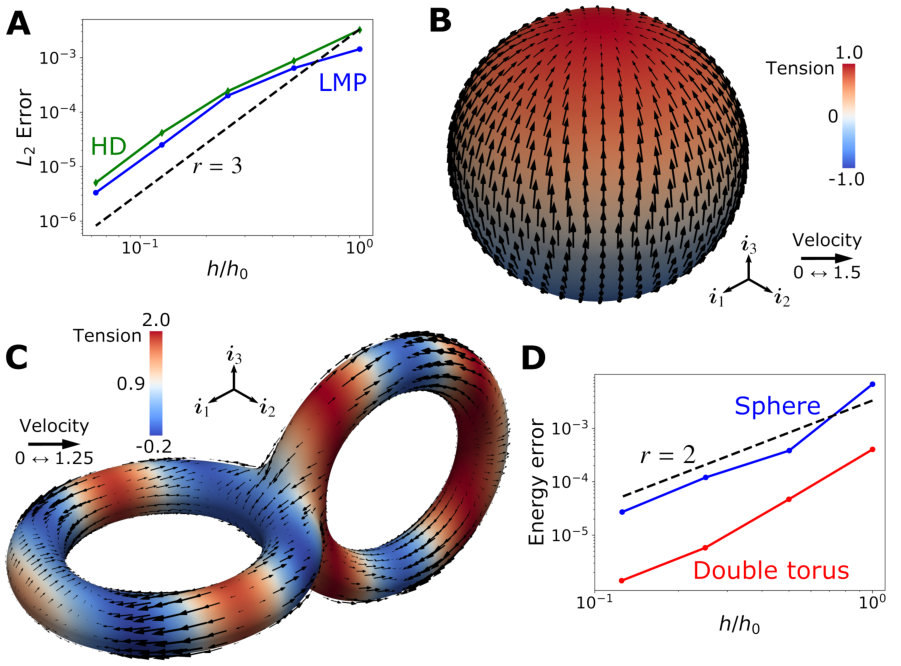 Figure 1
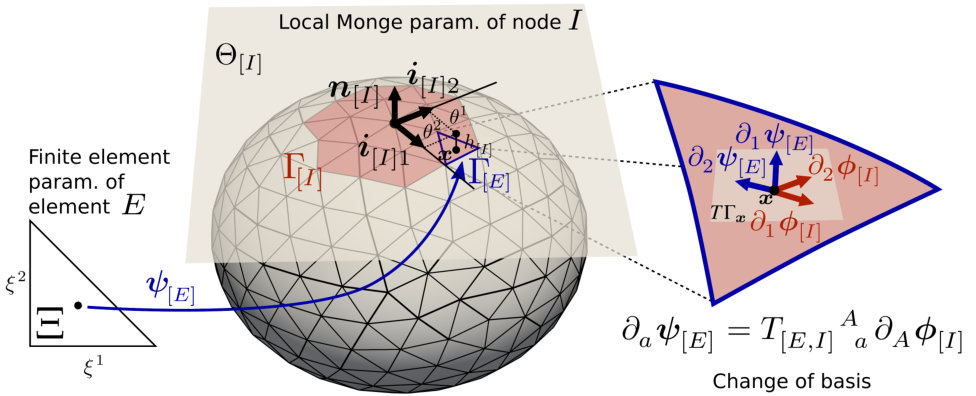 Figure 2
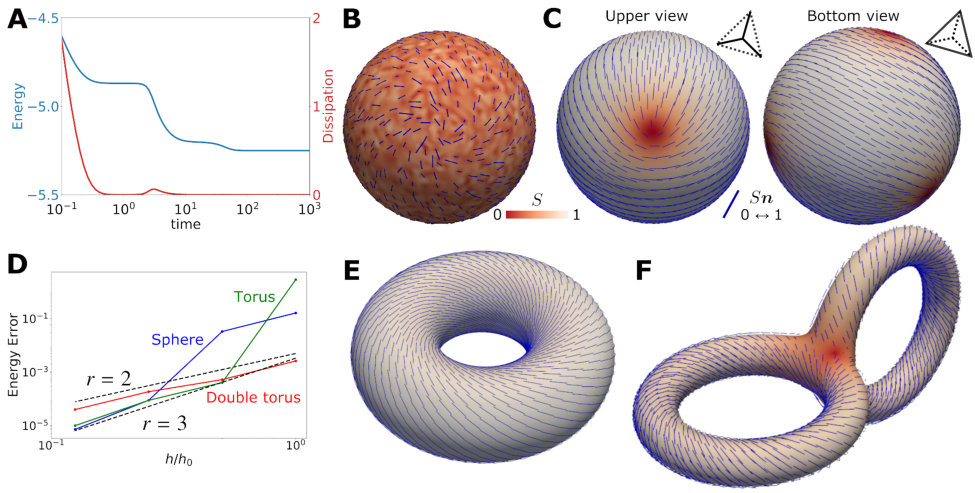 Figure 3
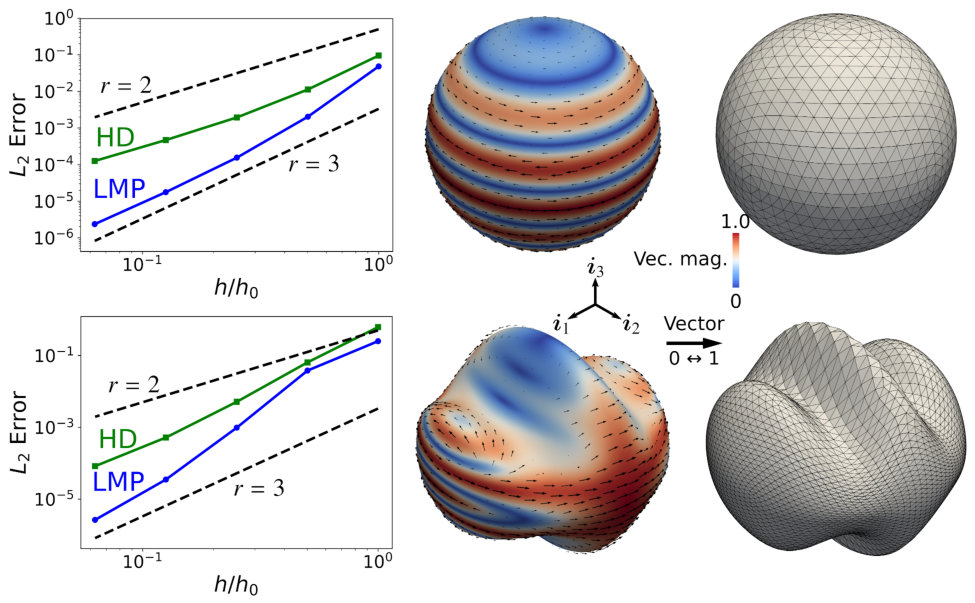 Figure 4
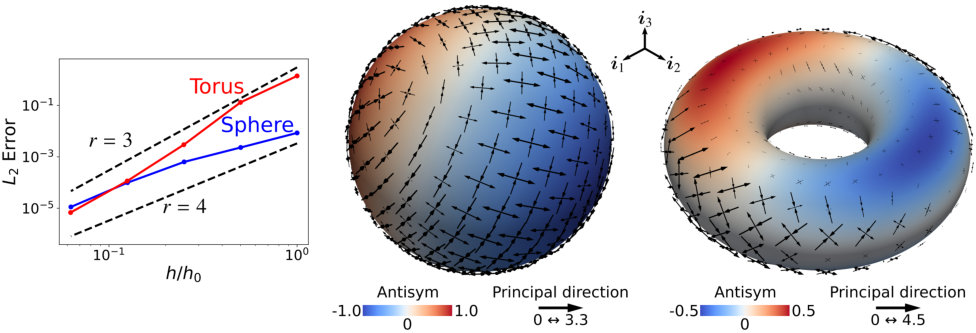 Figure 5
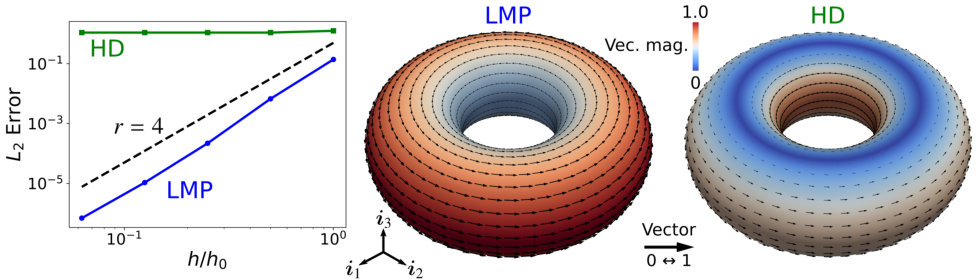 Figure 6
Peer Reviews
No public reviews on file for this paper yet. If you reviewed it on a platform where reviews are public (OpenReview, ICLR, NeurIPS, ICML), you can paste yours below so the community can read it here.
Videos
No videos yet. Explain this paper in a talk, walkthrough, or lecture? Add one.