Density response of holographic metallic IR fixed points with translational pseudo-spontaneous symmetry breaking
Aurelio Romero-Berm\'udez

TL;DR
This paper investigates how density responses in holographic metallic systems with pseudo-spontaneous translational symmetry breaking differ from those with perfect translational invariance, revealing broad asymmetric peaks instead of sharp modes.
Contribution
It demonstrates that pseudo-spontaneous symmetry breaking leads to a broad, asymmetric density response, contrasting with the zero-sound dominated response in translationally invariant systems.
Findings
Density response exhibits broad asymmetric peaks.
Attenuation does not increase monotonically with momentum and temperature.
No single isolated mode dominates the low-momentum response.
Abstract
The density response of charged liquids contains a collective excitation known as the plasmon. In holographic systems with translational invariance the origin of this collective excitation is traced back to the presence of zero-sound. Using a holographic model in which translational symmetry is broken pseudo-spontaneously, we show the density response is not dominated by a single isolated mode at low momentum and temperature. As a consequence, the density response contains a broad asymmetric peak with an attenuation which does not increase monotonically with momentum and temperature.
Click any figure to enlarge with its caption.
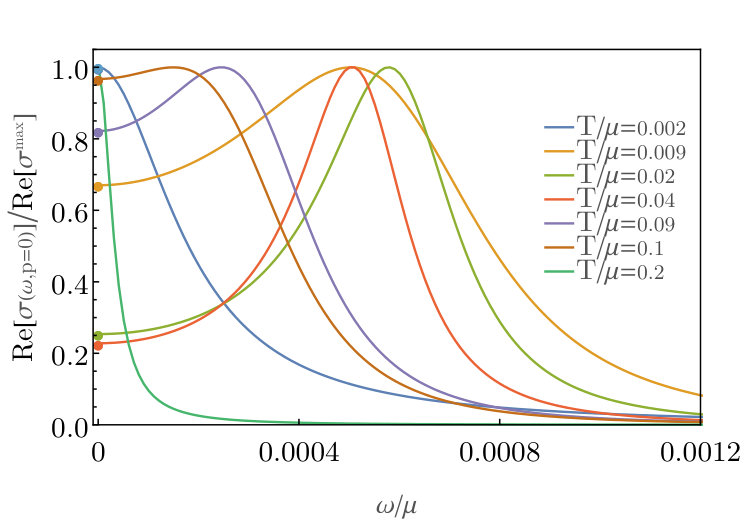 Figure 1
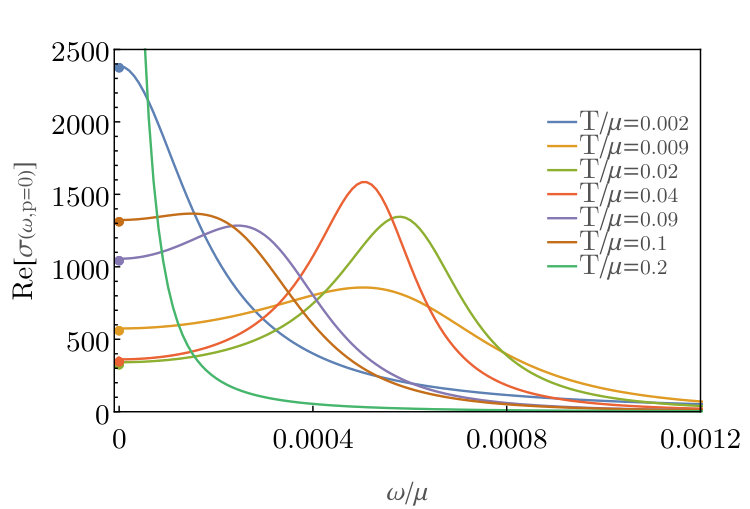 Figure 2
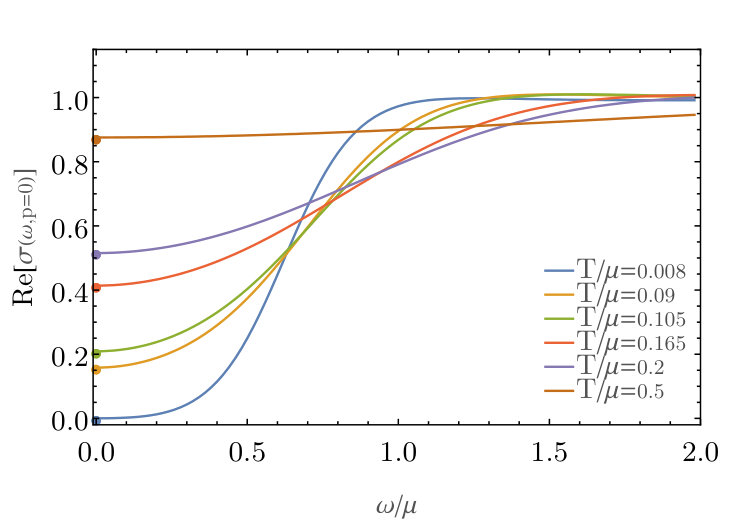 Figure 3
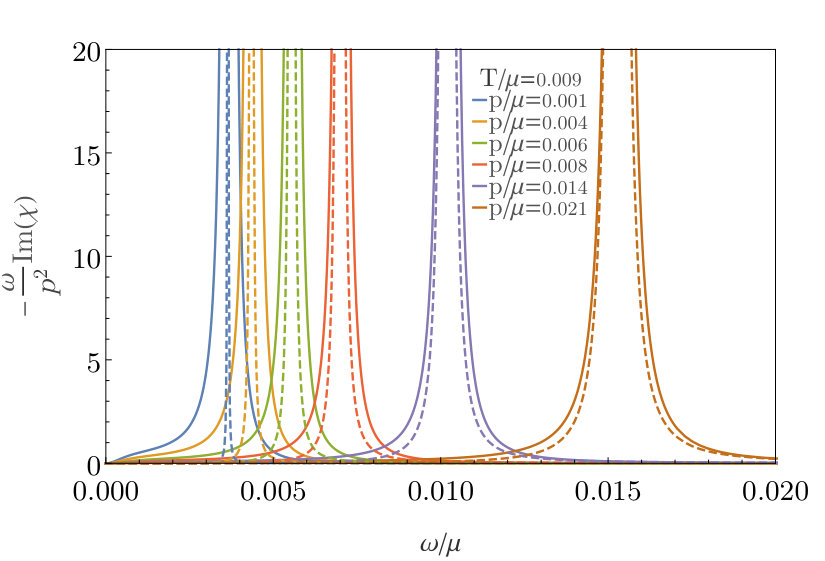 Figure 4
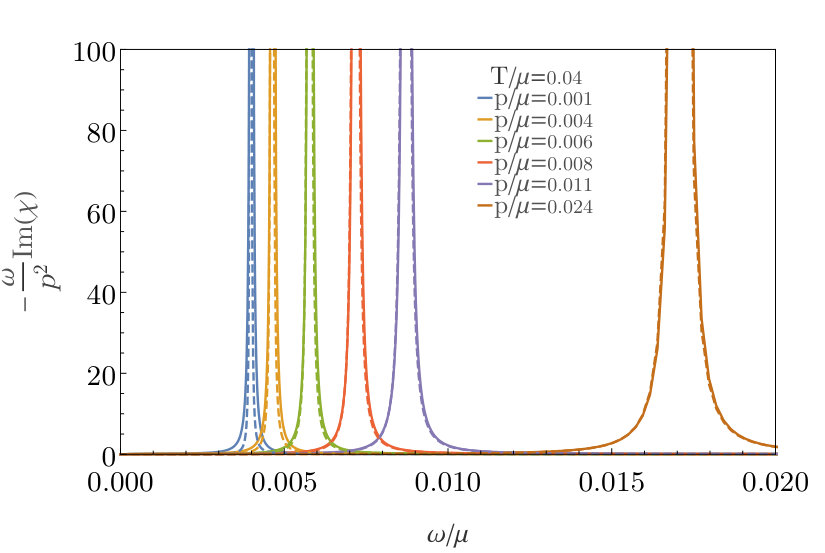 Figure 5
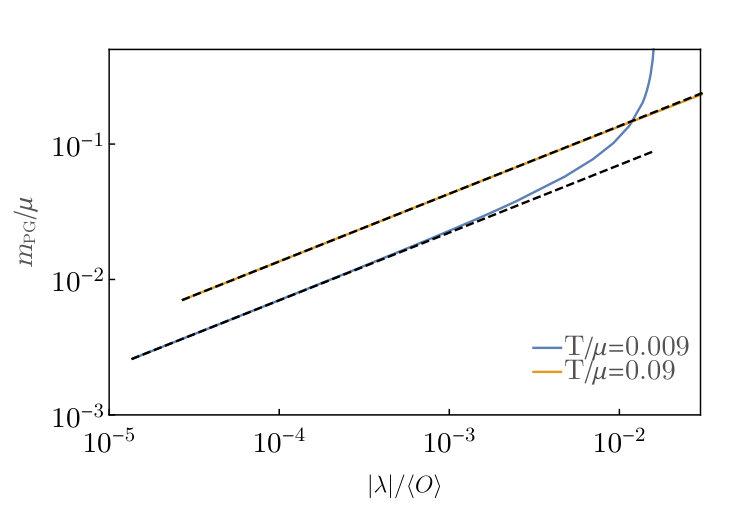 Figure 6
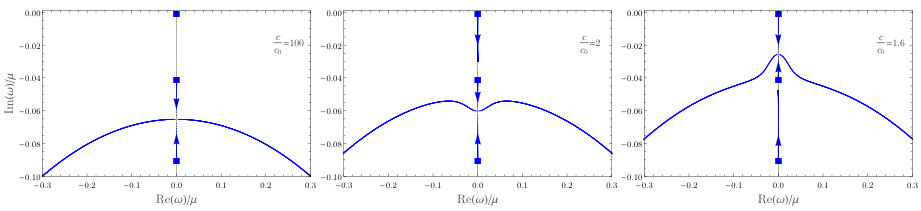 Figure 7
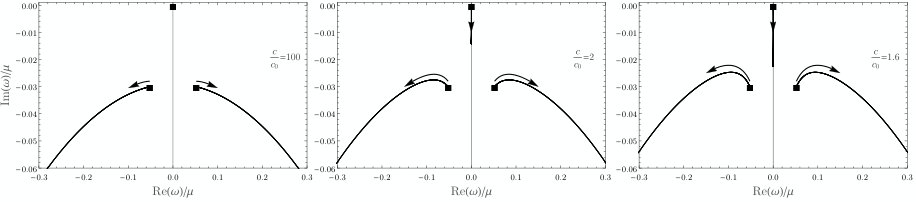 Figure 8
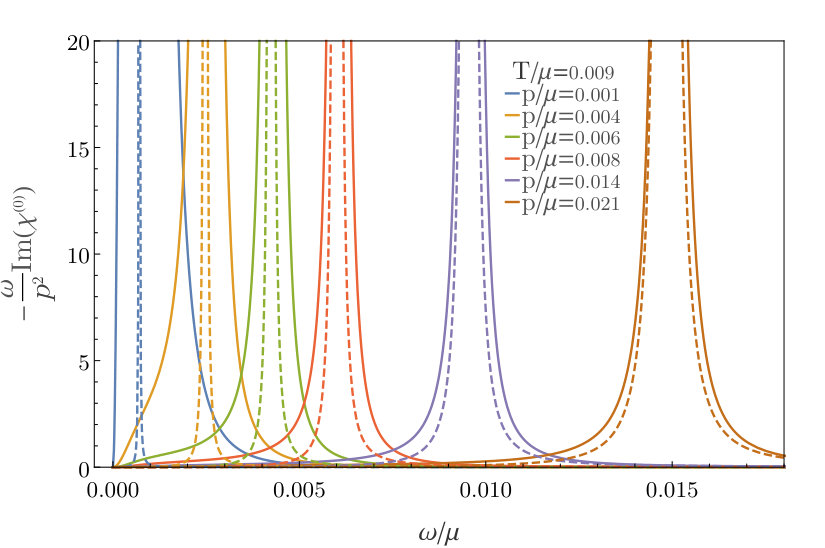 Figure 9
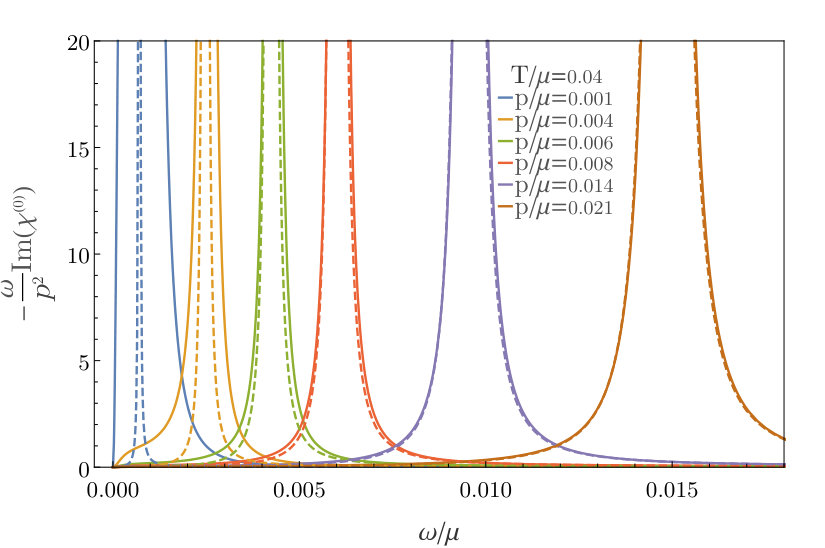 Figure 10
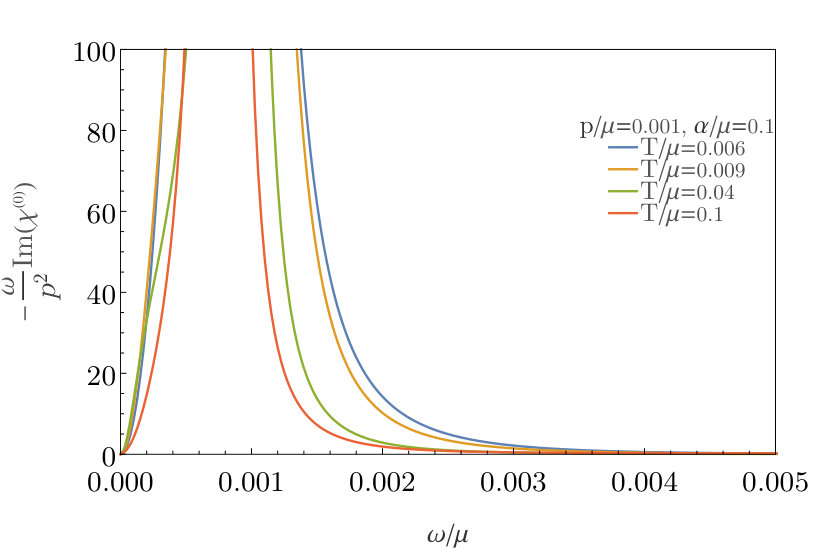 Figure 11
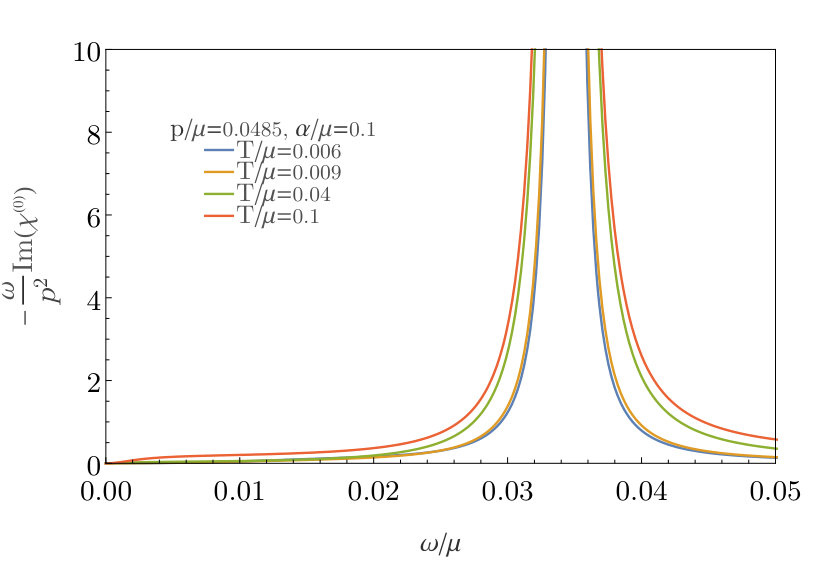 Figure 12
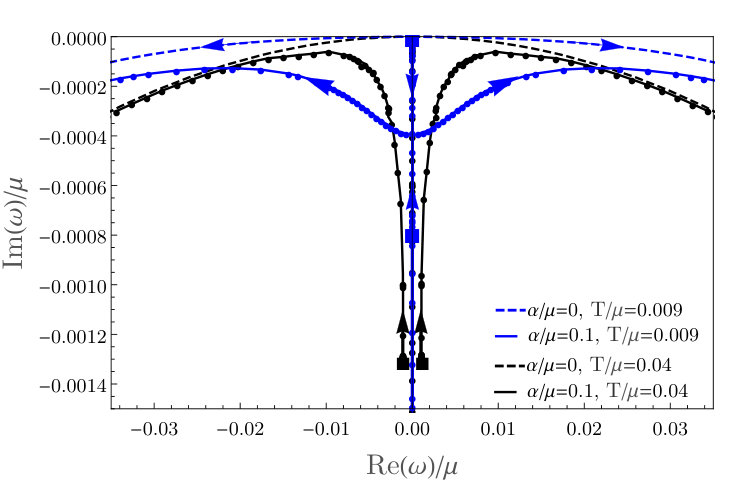 Figure 13
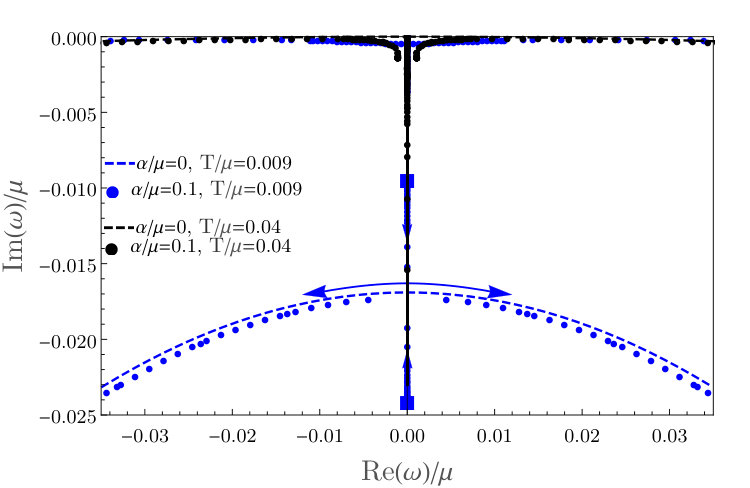 Figure 14
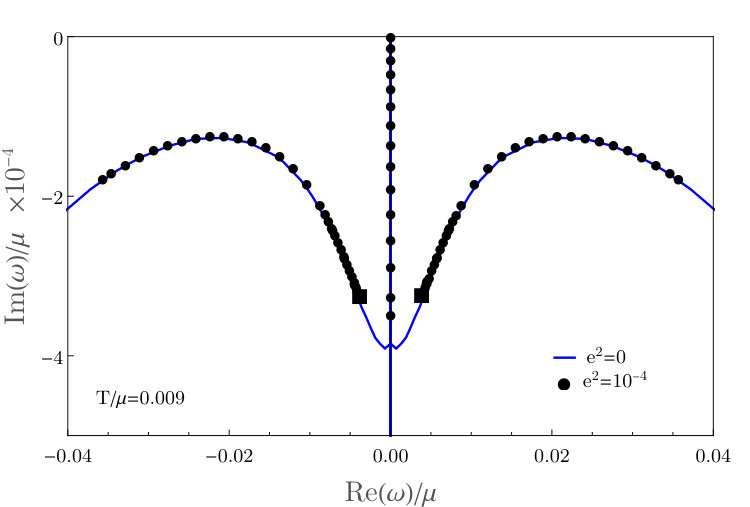 Figure 15
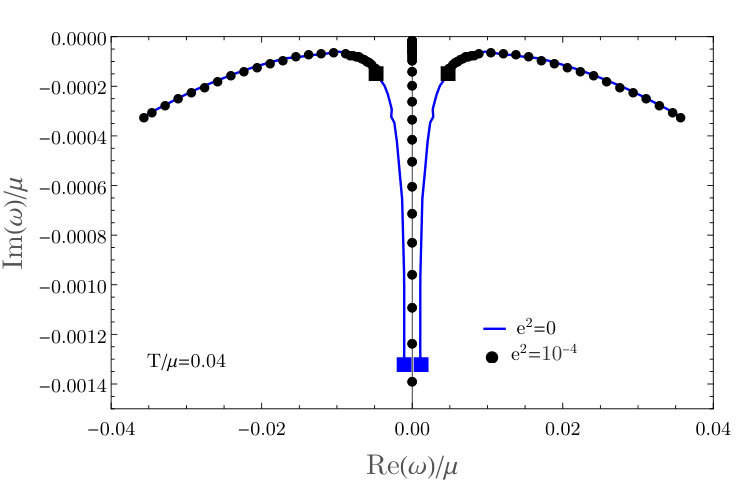 Figure 16
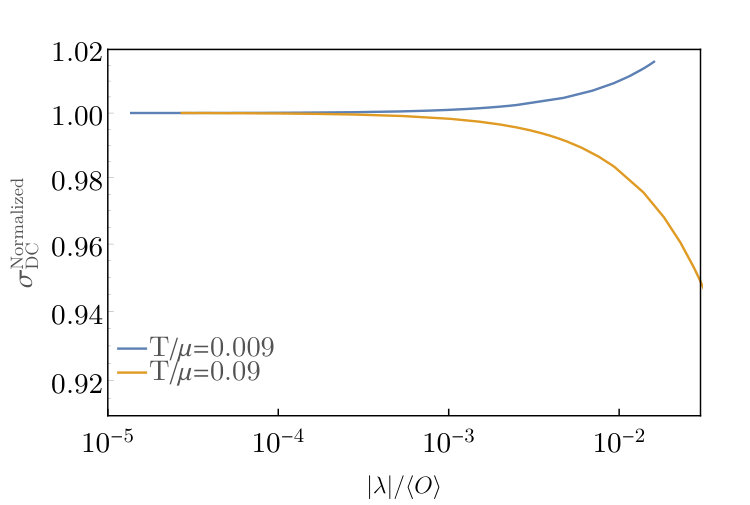 Figure 17
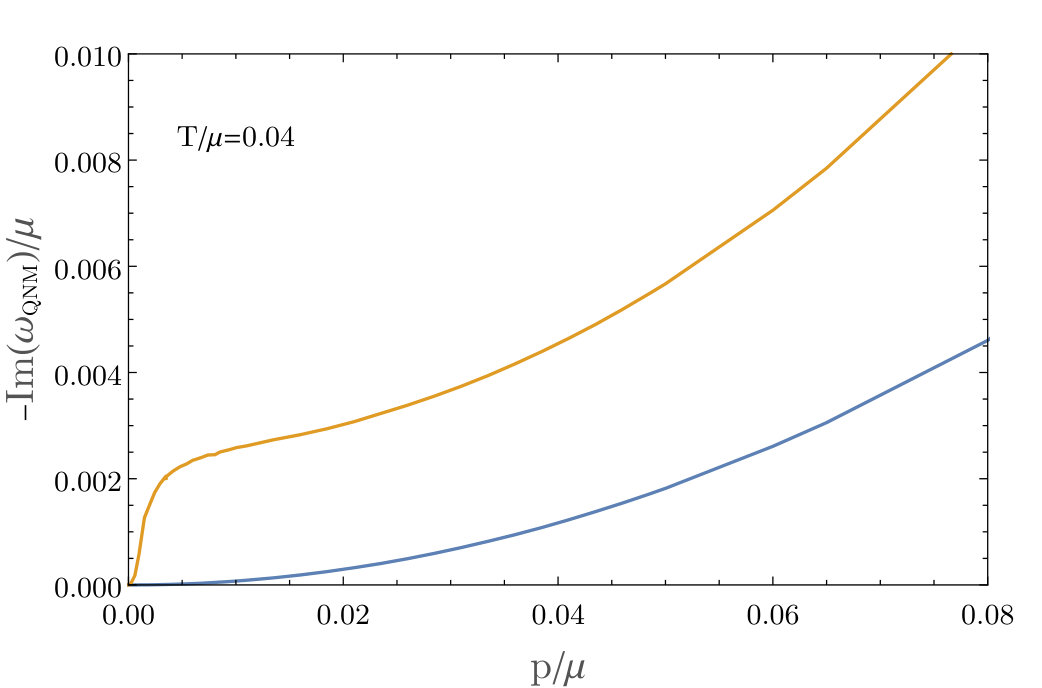 Figure 18
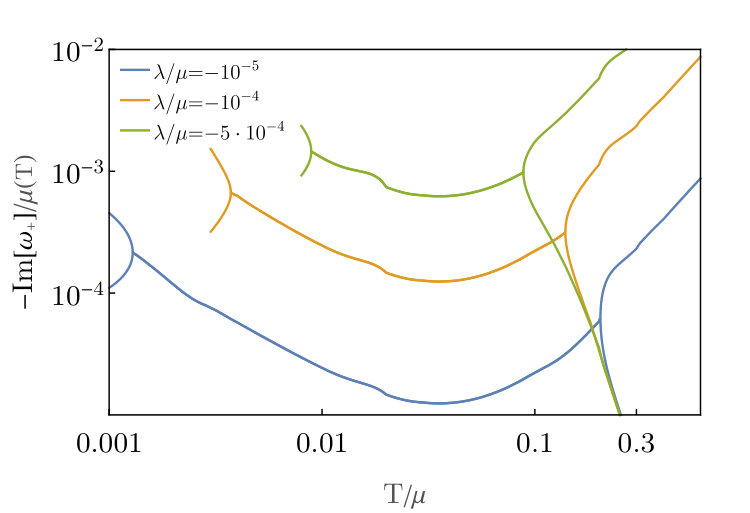 Figure 19
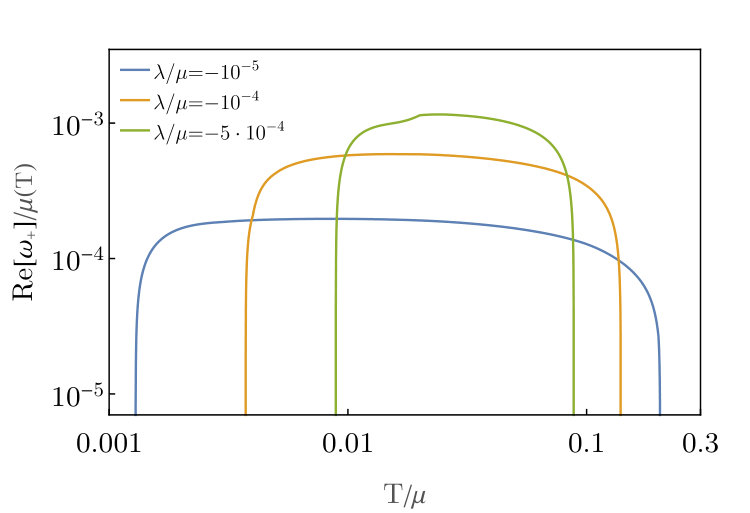 Figure 20
Peer Reviews
No public reviews on file for this paper yet. If you reviewed it on a platform where reviews are public (OpenReview, ICLR, NeurIPS, ICML), you can paste yours below so the community can read it here.
Videos
No videos yet. Explain this paper in a talk, walkthrough, or lecture? Add one.
††institutetext: Instituut-Lorentz, ITP, Universiteit Leiden, P.O. Box 9506, 2300 RA Leiden, The Netherlands
Density response of holographic metallic IR fixed points with translational pseudo-spontaneous symmetry breaking
Aurelio Romero-Bermúdez
Abstract
The density response of charged liquids contains a collective excitation known as the plasmon. In holographic systems with translational invariance the origin of this collective excitation is traced back to the presence of zero-sound. Using a holographic model in which translational symmetry is broken pseudo-spontaneously, we show the density response is not dominated by a single isolated mode at low momentum and temperature. As a consequence, the density response contains a broad asymmetric peak with an attenuation which does not increase monotonically with momentum and temperature.
1 Introduction
The density response of interacting charged liquids is expected to display a gapped propagating mode known as the plasmon. The plasmon may be understood by dressing a collective zero-sound excitation with the long-range electromagnetic interaction. In conventional metals (Fermi liquids), the plasmon is gapped and kinematically protected at low momentum because of the lack of available phase-space: the electron-hole (Lindhard) continuum vanishes quadratically in momentum Nozieres1999 . Therefore, in this low-energy regime the gapped plasmon is protected from decay. However, this paradigmatic picture fails in strongly-correlated materials, like copper-oxides strange metals in the normal phase, across a wide range of doping. More specifically, optical measurements suggest the plasmon is on the verge of being over-damped, i.e., the damping/attenuation rate is of the order of the plasmon frequency Bozovic1987 ; Slakey1991 . Similarly, over-damped dispersive plasmons were observed using energy transmission electron loss spectroscopy Nucker1989 ; Nucker1991 ; Fink1994 . Recent experiments using low energy reflection electron loss spectroscopy with improved momentum resolution suggest the plasmon may be absent and the density response to be given by a featureless continuum Mitrano2017 ; Husain2019 . Clearly, this recent data is in tension with the optical measurements where the plasmon is still visible, albeit over-damped. Despite the controversy regarding the exact features of the plasmon in these materials, it is certain that they cannot be understood from the Fermi liquid wisdom. In this paper, we use holography to study the density response in a locally quantum critical strange metal with infinite dynamical Lifshitz and hyperscaling violation exponents. In other words, the model has a flow to a metallic state in the IR with Sommerfeld entropy . On the other hand, at high temperatures, the temperature scaling of the DC conductivity is typical of an electric insulator Amoretti2018 . Moreover, the model used here allows to study a phase in which translational symmetry is broken spontaneously, and by giving a small mass to the Goldstone, it also has a phase in which this symmetry is broken pseudo-spontaneously. However, it does not allow to study the transition between the two phases. (Pseudo)-spontaneous breaking patterns of translational symmetry have been studied recently in holography and field theory frameworks Son2005 ; Nicolis2013 ; Baggioli2014 ; Andrade2017 ; Amoretti2017 ; Amoretti2017a ; Amoretti2018 ; Alberte2018 ; Alberte2018a ; Musso2018 ; Andrade2018 ; Donos2019 . In the holographic context, the focus has mainly been on the zero momentum optical conductivity. Here, we extend this analysis to finite momentum and focus on the density response, which may easily be related to the electric conductivity by a Ward identity. Furthermore, in holography, the neutral density response and the holographic zero-sound excitation have also been extensively explored in various probe-brane models Karch:2009 ; Kulaxizi2008 ; Kulaxizi2009 ; Hoyos2010 ; Kaminski2010 ; Davison:2011 , back-reacted Dirac-Born-Infeld models Gushterov2018 , as well as in bottom-up effective models Edalati2010c ; Davison2011b . More recently, the effects of the boundary Coulomb interaction have also been considered in holographic setups to correctly account for plasmon physics Aronsson2017 ; Aronsson2018 ; Gran2018 ; Gran2018b ; Mauri2018 ; Romero-Bermudez2018 . However, these studies have invariably neglected the effects of breaking translational symmetry, which we aim to explore in this paper.
Spatial ordering plays an important role in the response properties of strange metals and interesting ordering phenomena of charge and spin occurs in many cases, see Fradkin2015 and references therein. Effective long-wavelength hydrodynamical descriptions of electronic spatial ordering are usually very useful because they are the most efficient way to systematically capture the low-energy dynamics of Goldstone excitations Lubensky_book . For example, recent descriptions of the collective hydrodynamic behaviour in charge density waves show that indeed the Goldstone bosons are the key ingredients of the low energy description and control the linear response Delacretaz2016 ; Delacretaz2017a . However, in some cases, like in the pseudo-gap phase, it is believed that some features cannot be captured by these effective low-energy descriptions Keimer2014 . Holography provides another approach as an effective description of strongly coupled matter with two types of degrees of freedom or sectors. From the point of view of the longitudinal response we can call these sectors the zero sound sector, and the “quantum critical” (QC) continuum. The role of this holographic QC continuum on transport properties has been extensively studied in the literature ZaanenBook ; Hartnoll:2016Rev ; Zaanen:2018 . The precise way in which it enters in the density response of a translationally invariant holographic system was studied in detail in Romero-Bermudez2018 . Here, we extend this study using an effective model in which we can study the role of the pseudo-phonons associated to the pseudo-spontaneous translational symmetry breaking. This model provides an effective description for fluctuating weakly-pinned translational order in which the zero-momentum optical conductivity is qualitatively different from the usual Drude response Amoretti2018 :
[TABLE]
where is the charge density, the static momentum susceptibility and is the phase relaxation rate related to the small mass of the pseudo-Goldstone Delacretaz2016 ; Delacretaz2017a . The main feature of this formula is that the maximum of is shifted to a finite frequency. This behaviour of the conductivity, sometimes referred to as anomalous Drude, has been observed in various materials at large temperatures where they become bad metals. For example, in Lantanum copper oxides, the development of a dip of the optical conductivity at low frequency has been suggested to indicate the absence of a zero-frequency collective mode, characteristic of bad metals and has been attributed to effects of strong interactions Hussey2004 . Other cuprates, like (Bi-2212) have also been shown to develop this behaviour for a wide range of doping Lupi2000 ; Hwang2007 . It is not yet clear whether this anomalous Drude behaviour with a pinned peak in the conductivity is actually observed in the regime of temperature and doping relevant for the observations of plasmons.111These measurements are currently being revisited and there is evidence suggesting that in the regime where the plasmon is over-damped, the conductivity in this family of materials (Bi-) is Drude-like (private communication with Erik van Heumen and Jan Zaanen). Here, we limit ourselves to study the plasmon seen in the density response in an effective holographic theory which displays anomalous Drude behaviour of the optical conductivity in some range of temperature.
In this paper we first study in Sec. 3 the electric response at zero momentum in phases where translational symmetry is broken spontaneously and pseudo-spontaneously. The most salient feature, already presented in Amoretti2018 , is the presence of a pinned peak whose position does not depend monotonically on temperature. We also show the range of parameters where DC conductivity is independent of the pseudo-Goldstone mass; this is the regime in which the symmetry can be said to be broken pseudo-spontaneously. In Sec. 4, we focus on the main interest of the paper: the finite momentum density response. The main results can be summarized as follows: at fixed temperature and low frequencies, the neutral density response displays an asymmetric peak which is not due to a single isolated sound mode. This is in contrast with translational invariant setups in which the zero-sound mode dominates the response. As momentum increases, the attenuation (broadening) of this peak decreases at first, and then increases following the usual sound attenuation. We refer to this effect as momentum broadening inversion. Similarly, for fixed momentum, increasing temperature also makes the non-Lorentzian peak narrower at first, and then the peak widens as it becomes dominated by the sound mode. We comment on the similarities with an effective hydrodynamical description which includes the pseudo-Goldstone. We finish by dressing the density response with the Coulomb interaction, which corresponds to gauging the boundary theory.
2 A holographic model with translational (pseudo)-spontaneous symmetry breaking
In this paper, we focus on the gravitational model given by Eq. (1). This model has been shown to be useful as a holographic description of the phenomenology of strongly coupled systems with translational order Amoretti2017 ; Amoretti2018 . As we explain below, for the choice of couplings done here it is closely related to the holographic Q-lattices model introduced some time ago Donos2014b ; Donos2014e .
[TABLE]
We choose , and , which fixes the behaviour of the scalar field near : . Without loss of generality we choose the AdS radius , the bulk couplings for gravity and for the gauge field . We use the metric ansatz
[TABLE]
and solve the background using the DeTurck method as a boundary value problem as explained in Appendix A.
This model can be regarded as a description dual to a charge density wave or of a Wigner crystal, in which translational symmetry is broken in one dimension for the first, or all spatial dimensions for the latter Amoretti2017 ; Amoretti2018 . The reason is better understood by looking instead at a related model involving two complex scalar fields :222More generally, one can take the kinetic term to be without changing the important features related to translational symmetry breaking. The connection to the model of Eq. (1) is most simply seen by taking , but a similar argument applies for general Donos2014e .
[TABLE]
where run over the dual boundary theory spatial dimensions. This model is dual to a CFT deformed by the complex scalars and, in addition to the Abelian gauge symmetry: , , there are two global associated to the constant phase rotation of the two complex fields . In other words, these global symmetries are related to a shift symmetry of . Moreover, we are interested in a solution with . In this situation, the shift and translational symmetries are broken to the diagonal group and a consistent gravitational background may be found.333While the field configuration chosen for breaks both of these symmetries, a transformation combining the generators of both of these symmetries leaves the space time invariant. For example, under the transformations (field shift), and (translation) the combined transformation for the non-trivial fields is and leaves and the rest of the fields invariant if . This is the diagonal subgroup of the internal (field shift) and translational symmetries. Importantly, the breaking of translational symmetry is explicit or spontaneous depending on whether the field that breaks this symmetry (or ) is sourced or not: it is spontaneous if , and explicit if , where and , .
The dynamics of the phase of the complex scalar field: is the key ingredient that reflects the translational symmetry breaking pattern at the level of linear response. In other words, they encapsulate the (pseudo)-Goldstone dynamics.444The Goldstone modes can be identified by acting on the background solution with the Lie derivative along a spatial dimension. This leaves all fields invariant except . Therefore, the dynamics of the Goldstones are given by the linear response fluctuations . Moreover, these dynamics may equally be studied by using the model in Eq. (1), because near the boundary it is possible to rewrite the action of Eq. (3) as that of Eq. (1) by setting and expanding for small and Donos2014e ; Amoretti2017 . Therefore, upon consistent choice of the couplings and potentials, both models are equivalent asymptotically in the UV. This choice is important. For example, the mapping between both actions is only possible if we choose the coupling in Eq. (1) such that it is quadratic for small : . In this case, the term is mapped to a term in the expansion of the kinetic term with . If we choose instead, there would not such mapping of to any term in the expansion of . In this case, the model of Eq. (1) can only describe the effects of explicit breaking of translational symmetry.
To summarize, with the model and couplings given in of Eq. (1) translations are broken spontaneously if we impose , or explicitly if , where . Therefore, in the limit when is the smallest scale, translations can be considered to be broken pseudo-spontaneously. We note however that, despite the freedom to choose the pattern of translational symmetry breaking, this model does not allow to study the linear response across the transition between a state in which translational symmetry is broken spontaneously or explicitly. The reason is that in these two situations the boundary conditions of the perturbation fields are different and cannot be deformed into each other, see Appendix A. This suggests that the linear response observables are discontinuous across the transition between a phase with explicit breaking of translations and a phase with spontaneously broken translations. Recently, this observation was also made in related models where the transition may be studied Donos2019 .
3 Electric Response at zero momentum
In this section we summarize known results regarding the electric conductivity in phases with spontaneously and explicitly broken translational symmetry Amoretti2018 . We first study in Sec. 3.1 the spontaneously broken symmetry phase, where a massless Goldstone excitation is present. Then in Sec. 3.2 we give a small mass to this Goldstone and study the dependence of conductivity on this mass.
3.1 Electric response with spontaneously broken translations
When the massive scalar field in the model of Eq. (1) is not sourced but has a non-trivial VEV, translational symmetry is broken spontaneously giving rise to a gapless fluctuation parametrized by the massless scalar fields. This gapless (Goldstone) mode plays the role of the phonon. The role of this mode on transport has recently been studied in various holographic constructions Baggioli2014 ; Andrade2017 ; Amoretti2017 ; Alberte2018 ; Alberte2018a ; Amoretti2018 ; Donos2019 . In this phase, the electric DC conductivity has an infinite component parametrized by a Drude weight. The Drude weight is given by the ratio of susceptibilities Amoretti2018 , which saturates the Mazur-Suzuki bound of the Drude weight Garcia-Garcia2016a . Moreover, the regular part of the DC electric conductivity at zero momentum is given by Amoretti2018
[TABLE]
where , is the charge density and a non-zero value of the parameter breaks translations .555Contrary to the incoherent contribution to the conductivity, which is a horizon property, the DC-conductivity Eq. (4) also depends on thermodynamic quantities which in general depend on the bulk details Donos2018 . In this case the bulk integral in Eq. (4) is related to the shear modulus as we show below. Moreover, the entropy density, , scales linearly with temperature at low temperature. In Fig. 1, we show in dots the DC-conductivity computed from Eq. (4) on top of the numerical optical conductivity, which increases monotonically with frequency. At low momentum, the longitudinal channel666To study the modes, we consider a finite-momentum perturbation along the x-direction. The coupled longitudinal modes are specified in Appendix A.1. is dominated by two diffusive poles plus a propagating mode with linear dispersion and an attenuation that increases quadratically with momentum. This hydrodynamic-like attenuation is a consequence of interactions and temperature. In a zero-temperature effective description of a non-Lorentz invariant Goldstone boson, the leading interaction is . Therefore, Goldstone can decay into two other ones with a decay rate that goes like , where is momentum and space dimensions. However, in finite-temeprature holographic descriptions, the Goldstone boson couples to other “thermal degrees of freedom” resulting in a hydrodynamical decay . It would be interesting to explore the Goldstone decay rate in holographic setups with spontaneous breaking of translations at strictly zero temperature. In addition to these three modes, there is also gapped purely imaginary pole, which will eventually collide with one of the diffusive modes for larger momentum.
Moreover, from the holographic renormalization and Ward identities it follows that the shear modulus is
[TABLE]
which enters, at lowest order, in Eq. (4), and in the momentum susceptibility: . It is also of interest for us the following transport coefficient
[TABLE]
which enters in the diffusive channel of the phonon response at zero momentum Amoretti2018 . This transport coefficient will become important in the next section when we consider pseudo-spontaneous translational symmetry breaking.
3.2 Electric response in a holographic Wigner crystal with a light Goldstone
As explained in Sec. 2, when the massive scalar field is sourced with :
[TABLE]
transational symmetry is formally broken explicitly. However, by taking this scale of explicit symmetry breaking to be the smallest scale in the problem, it is possible to retain some of the physics of the (pseudo-) Goldstone mode which now acquires a small mass Amoretti2018 . The gapping of the Goldstone associated to breaking of translations leaves a clear imprint on the electric response, namely the shift of spectral weight from the Drude weight at zero frequency to finite frequencies as shown in Fig. 2 Delacretaz2016 ; Delacretaz2017a ; Andrade2017 ; Amoretti2018 . This is qualitatively similar to the optical measurement in certain cuprate oxides in the bad metallic phase Hussey2004 ; Lupi2000 ; Hwang2007 . We note however that there is an important distinction. Fig. 2 shows that the position of the peak does not increase monotonically with temperature, but instead shifts back to smaller frequencies until eventually the conductivity becomes Drude-like. We can understand this behaviour by looking at the hydrodynamic modes that dominate the longitudinal channel at zero momentum Delacretaz2016 ; Delacretaz2017a
[TABLE]
where and are the momentum and phase relaxation rates, respectively. The phase relaxation rate originates from the pseudo-Goldstone term which enters in the modified hydrodynamical equation for non-conservation of momentum Delacretaz2016 ; Delacretaz2017a :
[TABLE]
where is the shear modulus, is the mass of the pseudo-Goldstone . In the holographic model used here, the phase relaxation rate is given by Amoretti2018
[TABLE]
Eq. (8) shows the hydrodynamic modes have a real part whenever , and are purely imaginary otherwise. In the first case, the conductivity displays a pinned peak at . On the other hand, when is purely imaginary the optical conductivity will be Drude-like. As shown in Fig. 3, both the temperature and the explicity symmetry breaking scale control which of these two situations is realized. It is also clear that, for the range of temperatures where , does not depend monotonically on temperature. Moreover, as the scale of explicit symmetry breaking increases the temperature range for which a pinned peak exists shrinks. This is associated to a progressive breakdown of translational symmetry being broken pseudo-spontaneously in favour of an explicit translational symmetry breaking, where the AC-conductivity is Drude-like.
Contrary to the position of the pinned peak Fig. 3-(a), the DC-conductivity, which is given by
[TABLE]
is approximately insensitive to the value of , and as a consequence, independent of the pseudo-Goldstone mass, see Fig. 4-(a). The region where is approximately constant as a function of is the region where and we can say translational symmetry is broken pseudo-spontaneously. On the other hand, the deviation from this constant value gives an indication when translational symmetry should be considered broken explicitly.
Moreover, Eq. (11) is valid for any non-zero value of , while Eq. (4) is for strictly spontaneous symmetry breaking . However, in the range of parameters explored , we have observed these two formulas give drastically different results. The different orders of magnitude of the DC-conductivities in Figs. 1 and 2 suggests that, indeed, there might be a discontinuity in the DC-conductivity at the transition between a phase with spontaneous and pseudo-spontaneous symmetry breaking. This observation has been made in similar models where the transition may be studied explicitly Andrade2018 ; Donos2019 . Physically, it is easy to understand that the transfer of spectral weight contained in the Dirac delta at zero frequency in the strict spontaneous symmetry-breaking phase to finite frequencies when will result in a change of the DC-conductivity. However, here we cannot study this spectral weight shift across the transition between and .
Finally, we show in Fig. 4-(b) the relation between the pseudo-Goldstone mass and the scale of symmetry breaking . In our holographic model, it turns out that the is related to the phase relaxation rate and the diffusive transport coefficient given in Eq. (6) Amoretti2018 , and, for a fixed temperature, it goes as (dashed lines in Fig. 4-(b)). Again, the deviation from the square-root behavior gives a rough estimation of the crossover to a phase where translational symmetry is broken explicitly.
4 Response to a density perturbation in a holographic Wigner crystal
In the previous section we studied the longitudinal electric response to a perturbation with zero wave-vector. Here we turn on a finite wave-vector perturbation and study the density response instead. In order to compute the density-density correlation function, we source the density operator in the boundary by turning on the boundary value of the temporal component of the bulk gauge field . The boundary generating functional is then:
[TABLE]
As usual in holography the response to this perturbation is then obtained from the decaying modes of the perturbed field:
[TABLE]
where A_{0}(p;u)\Big{|}_{u\rightarrow 0}\sim a(p)\big{(}1+\mathcal{O}(u)\big{)}+u^{\beta}b(p)\big{(}1+O(u)\big{)}, for some . This is the response in a dual theory with a global , i.e., it is the response in a neutral system with conserved density but which does not include the effects of electromagnetism. As explained in detail in Romero-Bermudez2018 , the charged response is obtained by gauging the boundary . This is achieved by deforming the action with a Coulomb-potential term so that, in the non-relativistic limit, the generating functional is
[TABLE]
where . In practical terms, the effect of this deformation is to modify the boundary conditions of the time component of the gauge field . The correct boundary conditions are now mixed Robin boundary conditions:
[TABLE]
Physically, this is understood as a redefinition of the source . Therefore, the holographic prescription to compute the dressed, or charged, response function is modified to Romero-Bermudez2018
[TABLE]
where is the deformed action bulk action: and .
4.1 Neutral density response at finite momentum
We first study the response in a neutral system, Eq. (13), with pseudo-spontaneous translational symmetry breaking. In this section we take the scale of explicit symmetry breaking to be and . For reference, we compare this density-response with that of a translational invariant system , analysed in detail in Romero-Bermudez2018 . The main difference with respect to the latter case is that in the translational invariant system at low temperature the density response is dominated by the sound collective excitation. On the other hand, in the presence of pseudo-spontaneous symmetry breaking at a low, fixed temperature, the density-density response function undergoes a ‘crossover’ from being dominated by a diffusive mode plus a gapped purely imaginary mode to eventually being dominated by the sound mode. The scale of explicit symmetry breaking controls the scale where this crossover occurs. The crossover between these two regimes is manifested as a momentum broadening inversion shown in Fig. 5. At low momentum, is dominated by a peak which is clearly not symmetric and this it is not due to a single isolated mode, see continuous lines in Fig. 5. This shape is, in fact, characteristic of two or more nearby purely imaginary poles . In contrast, the response in a translationally invariant system (dashed lines) at the same momentum and temperature is a sharp Lorentzian peak. As momentum increases, the response in the phase with broken translations transitions to a Lorentzian peak and agrees with the data of the translational invariant system, signalling that the density response becomes dominated by the sound mode.
This momentum broadening inversion is more easily understood from the dynamics of the poles of the density-density correlator as momentum varies. In Fig. 6, we show the modes that dominate this response. At low momentum, there is not only a single dominant pole near the origin. In fact, the response is dominated by four modes; one “non-hydrodynamical mode” that appears at finite momentum plus three hydrodynamical modes which we will analyse in the next section.777We use the term “non-hydrodynamical mode” loosely because it is not included in the three hydrodynamical modes of next section. At and , these modes are purely imaginary (blue squares in Fig. 6-(a)). As momentum increases, two of these poles move closer to each other, collide and approach the real line with an increasing non-zero real part. The location of this collision in the imaginary axis is controlled by the symmetry-breaking scale . Note that this dissipative behaviour is opposite to the usual sound attenuation. Namely, for some range of momenta, the attenuation of the density response peak decreases as momentum increases. Then, for even larger momentum, these modes eventually become ‘sound-like’ and move down in the complex plane. In this regime, these poles approach the dashed lines, which correspond the sound mode of the same model but with translational symmetry restored (). The behaviour of the imaginary part of these modes is consistent with what we observe in the full density response in Fig. 5-(a): starts as a broad asymmetric peak at low momentum, and as momentum increases, the peak becomes narrower at first and then broadens up and eventually becomes symmetric at larger momentum.
At and exactly zero momentum, there are only two purely imaginary modes, which disperse down the imaginary axis as momentum increases. Their dispersion relations are shown in Fig. 7. Contrary to the dynamics at , the other two dominant poles at zero momentum, which are given by Eq. (8), have a small real part, see black squares in Fig. 6-(a). This is because in Eq. (8). As momentum increases, they move up towards the real line and eventually become ‘sound-like’. However, since their real part is much smaller than their imaginary part at low momentum, these two poles together with the two purely imaginary poles also result into the asymmetric and broad peak in the density response shown in Fig. 5-(b). As before, for larger momentum, the density response peak becomes sharper at first and then broadens up and becomes ‘sound-dominated’ giving rise to a symmetric peak.
Finally, Fig. 6-(b) shows that for (blue), a secondary collision of purely imaginary poles occurs further away from the origin. This collision however, occurs at larger momentum than the collision shown in Fig. 6-(a). In fact, this collision occurs at a scale where the system does not ‘feel’ the effect of translational symmetry breaking, which is reflected by how close the dots (system without translational symmetry) are to the dashed lines (translationally invariant system).
4.1.1 Hydrodynamical modes with pseudo-broken translations
Hydrodynamics may be adapted to describe the effects of a light pseudo-Goldstone boson associated to the breaking of translational symmetry. The modification is based on changing the free energy to incorporate the pseudo-Goldstone degrees of freedom. This results on the modification of the momentum “conservation” equation with a term that explicitly breaks translations plus a term involving the pseudo-Goldstone mass, Eq. (9) Delacretaz2017a .888An effective field theory based on the coset construction, where the conserved symmetry subgroup is a combination of translations plus internal shift symmetry, has also been presented in Nicolis2013 . Rather than repeating this construction we limit ourselves to study the low-momentum dynamics of these modes. At low momentum the hydrodynamical modes can be obtained as roots of Delacretaz2017a :
[TABLE]
Eq. (17) shows that hydrodynamics predicts three modes.999In order to make connection to our holographic model we set . One of this modes is diffusive and thus is always purely imaginary. Depending on the sign of , the other two modes may acquire a real part, even at zero momentum (see Eq. (8)): for they are non-degenerate and purely imaginary, and for they have non-zero real part. These two scenarios are indeed seen in the holographic modes shown in Fig. 6, where at (squares) the modes shown in blue lie on the imaginary axis but the modes shown in black have non-zero real part. For , the two modes are degenerate and purely imaginary. For non zero momentum, the expressions of the roots of Eq. (17) are too lengthy to analyse explicitly. Instead, we show the possible dynamics of the hydrodynamical modes depending on the various parameters in Fig. 8. Given the parametrization it is easy to understand that controls the slope of the dispersion of the poles. Namely, the trajectories become steeper for larger . The effect of the two speeds of sound is shown in Figs. 8, both in the regime where they collide and when they do not. The speed of sound controls the diffusive pole. As expected, in the limit the diffusive pole does not seem to move in the left poles of Fig. 8. Moreover, the sound-like poles have a monotonically increasing attenuation with momentum. For smaller values of the dynamics of the poles change. When , there is a collision between two purely imaginary poles. Depending on the precise value of , this collision may involve the diffusive pole (top right) or not (top centre).101010Although not shown in Fig. 8, when it is also possible to have a collision involving the diffusive mode, like in top-right of Fig. 8, but the trajectory of the resulting dispersive modes is similar to that of top-centre of Fig. 8. On the other hand, when , there is no collision and the ratio controls the initial dependence of the attenuation on momentum (bottom row).
As explained in the previous section, the dynamics of these quasinormal modes explain the momentum broadening inversion of the peak in the density-density correlator. Indeed, the dynamics seen in the middle plots of each row in Fig. 8 is qualitatively similar to that seen in Fig. 6-(a). We note however, that in the holographic model, a fourth purely imaginary mode is present, see yellow line in Fig. 7. Therefore, even when , the density-density correlator at low momentum is given by an asymmetric peak dominated by two nearby purely imaginary poles.
4.1.2 Thermal broadening
In this section, we show that the effect of temperature on the density response is similar to the effect of momentum shown in the previous section. More specifically, we observe a thermal broadening inversion, i.e., instead of the expected increase of the damping rate as temperature increases, we show the existence of a range of temperature in which this damping rate decreases as temperature increases. Beyond this range of temperature, the general expectation of stronger damping for larger temperature is recovered. This effect is nothing but the finite-momentum generalisation of the phenomenon displayed in the zero-momentum optical conductivity of Sec. 3.2, where the position of the pinned peak does not depend monotonically on temperature. The thermal broadening inversion is observed at low momentum, Fig. 9-(a), while for larger momentum, Fig. 9-(b), the damping rate increases with temperature. This is again due to the interplay between the different scales: the explicit symmetry breaking scale (that controls the pseudo-Goldstone mass), temperature and momentum. At low temperature and momentum, multiple poles contribute in a similar way to the response but have different dispersion relations. On the other hand, at large momentum or temperature, a sound-like mode with the usual dispersion dominates the response and the system behaves similarly to the translationally invariant system studied in Romero-Bermudez2018 . Similar effects due to temperature have been observed in the dynamics of the quasinormal modes in related models Alberte2018 ; Andrade2018 .
4.2 Density response dressed with the Coulomb interaction
We now study how the density response is modified by gauging the boundary global symmetry. As explained in the beginning of the section this is achieved by deforming the theory as in Eq. (14) Romero-Bermudez2018 . Such deformation changes the boundary conditions and the holographic prescription to compute the two-point function, see Eq. (16).
As explained in Romero-Bermudez2018 , for a translationally invariant system, the presence of a sound excitation in the neutral response implies the existence of a gapped mode in the dressed response. This follows immediately from Eq. (16), together with the general parametrization of the neutral response shown in Eq. (18).
[TABLE]
where is the speed of sound, is the sound attenuation, is the residue of the sound pole and encapsulates the quantum critical sector of the theory. Substituting Eq. (18) into (16) and expanding for low momentum it is easy to see the dressed response is indeed gapped and the attenuation in the limit is finite and controlled by the QC continuum sector :
[TABLE]
However, as shown in Figs. 5 and 6-(a), when translational symmetry is broken pseudo-spontaneously, the density response at low temperatures and momentum is not controlled by a single isolated sound pole, but instead by various nearby poles. Therefore, in this case it is not very illuminating to substitute a complicated parametrization for the neutral response with four poles plus into Eq. (16) to obtain the pole structure of the dressed response . Instead, we show directly the effect of including the boundary Coulomb interaction in the two representative cases shown in Fig. 5-(a). Figure 10 shows that effect of turning on the boundary Coulomb interaction, controlled by , is to move the two purely imaginary colliding poles at (blue dots in Fig. 6) off the imaginary axis. These to poles now acquire a finite real part in the limit and lie precisely on the same trajectory that the colliding poles of Fig. 6 were following; for clarity we show this trajectory as a continuous line also in Fig. 10-(a). Similarly, the two poles that were further away from the origin at , in the absence of boundary Coulomb interaction (blue squares in Fig. 10-(b)) have now been shifted closer to the origin (black squares in Fig. 10-(b)) and again follow the same trajectory (blue line) of the poles of the neutral response as momentum increases. Therefore, we see that when the boundary Coulomb interaction is turned on , there are two gapped plasmon modes which follow the expected dispersion. This happens regardless of whether the corresponding naked modes are purely imaginary (colliding modes like in the top row Fig. 8) or not (bottom row Fig. 8).
The shift and gapping of the hydrodynamic modes of the density correlator towards the real line and with larger real part suggests the dressed density response at vanishing momentum displays a gapped excitation which is narrower compared to the neutral response. Indeed, this is the behaviour seen by comparing the continuous lines of Figs. 11 and 5. In Fig. 11, the dashed lines correspond the response of the equivalent translationally invariant system at the same temperature and momentum. As the momentum or temperature increases, the effects of translational symmetry breaking in the dressed response are again negligible.
5 Conclusions
The surprisingly over-damped plasmons observed in strange metals have revitalized the research on the study of the density response in these systems Nucker1989 ; Nucker1991 ; Fink1994 ; Mitrano2017 ; Husain2019 . As usual in this context, measurements in strange metals challenge the intuition based on the Fermi-liquid paradigm and open up the possibility to new exciting mechanisms Zaanen:2018 . Holography provides a powerful tool where one can hope to identify universal qualitative features caused by strong interactions. Here, we have extended previous efforts on describing the phenomenology of holographic plasmons Aronsson2017 ; Aronsson2018 ; Gran2018 ; Gran2018b ; Mauri2018 ; Romero-Bermudez2018 . In particular, we have carried the first study of the finite-momentum density response in a holographic setup in which translational symmetry is broken pseudo-spontaneously. The model we chose is metallic at low temperature, has infinite dynamical Lifshitz and Hyperscaling exponents, and displays linear scaling of entropy at low temperature. For some range of temperature, the zero-momentum optical conductivity has a pinned peak at finite frequency, which has been suggested to be behind the spectral shift to finite frequencies in many strange metals when they become bad metals at large temperature Delacretaz2016 . However, contrary to experimental evidence, the location of the pinned peak in the conductivity in our model has a non-monotonic dependence on temperature. We also study the effect of temperature and momentum on the density-density correlation function. When translations are broken, the neutral and dressed density responses at low momentum are not dominated by the sound-mode. Instead, a broad but distinct asymmetric peak is observed in the density responses. We have also observed that the attenuation of this peak depends non-monotonically on momentum and temperature, similarly to the non-monotonic temperature-dependence of the location of the pinned peak in optical the conductivity.
A final note regarding the connection to the over-damped plasmon measured experimentally is in order Nucker1989 ; Nucker1991 ; Fink1994 ; Mitrano2017 ; Husain2019 . Previous measurements of the optical conductivity in materials where the plasmon is being measured, like the Bi-2212 and Bi-2201 families, indicate the existence of spectral weight transfer to finite frequencies Lupi2000 ; Hwang2007 . This connects partially to the phenomenology of the model used here, where a peak at finite frequency is also seen. However, the location of the pinned peak in our model depends non-monotonically on temperature. On the other hand, the spectral weight shift observed in the experiments occurs gradually as a function of temperature when entering the bad-metallic phase. Therefore, this puts into question whether the momentum and temperature attenuation inversion of the holographic plasmons described here is relevant for the density response measured in these materials. Moreover, the existence of a non-Drude-like optical conductivity in these materials is currently been revisited by various experimental groups. In order to connect with experiments, it would be interesting to find holographic models where the AC-conductivity is Drude-like, but the dressed density response does not display big and narrow peaks Romero-Bermudez2019 . It would also be interesting to explore holographically the mismatch between the longitudinal and transverse density responses in the low momentum regime observed in cuprates Setty2018 .
Acknowledgements.
It is a pleasure to thank Daniel Areán, Andrea Amoretti, Pau Figueras, Erik van Heumen, Alexander Krikun, Daniele Musso, Koenraad Schalm, Jan Zaanen and Vaios Ziogas for interesting discussions on various theoretical and practical aspects of this research. This work was supported by the Netherlands Organization for Scientific Research/Ministry of Science and Education (NWO/OCW), by the Foundation for Research into Fundamental Matter (FOM).
Appendix A Equations of motion and boundary conditions
The equations of motion for the background fields following from the action (1) are:
[TABLE]
These equations result in a system of coupled ordinary equaitons which may be solved using the shooting method in the harmonic gauge Garcia-Garcia2016 ; Amoretti2018 . Here we choose to use the DeTruck method to solve the equations as a boundary value problem Headrick2010 ; Adam2012 ; Rangamani:2015 ; Andrade:2017b ; Krikun2018 . We choose the Reissner-Nordström black hole as reference metric. Therefore, the temperature is set by the parameter
[TABLE]
and we can set without loss of generality. We use the Newton’s method to solve the resulting nonlinear elliptic equation in an unifrom grid. The boundary conditions are such that the metric is asymptotically AdS for :
[TABLE]
where we choose for to have spontaneously translations or for pseudo-spontaneous breaking. In the horizon, we impose to have a static background, and the boundary conditions are the usual constraints on the expansion coefficients of each field, obtained from expanding the equations of motion near the horizon.
A.1 Linear response equations
In order to evaluate the density-density correlator we first introduce the linear perturbations of all the fields with finite frequency and momentum:
[TABLE]
and focus on the longitudinal modes
[TABLE]
We impose the DeDonder gauge in and Lorentz gauge in Rangamani:2015 :
[TABLE]
where is the background metric. This procedure results in 12 second order elliptic equations of motion.
In order to study the spontaneous symmetry breaking we redefine the fields
[TABLE]
where . The factor imposes ingoing boundary conditions are imposed in the horizon. Moreover, the other factors are chosen so that the first term in the expansion of the tilde-fields expand is a constant both in the UV and horizon. Dependending on whether we study the electric conductivity or the density response, we turn on a source or , respectively. No other source is turned on (trivial Dirichlet boundary conditions at ). On the horizon, the boundary conditions are imposed as usual: we use expansion of the equations near , which imposes constraints betweeen the expansion coefficients of the fields. These constraints result in mixed boundary conditions at . In order to study pseudo-spontaneous and explicit breaking of translational symmetry, the only change is the redefinition of Eq. (28), which now should be .
The equations are solved by linearizing and discretizing them which allows to recast the equations as a linear algebraic problem
[TABLE]
where the right hand side corresponds to the sources being turned on. We also can obtain the quasinormal modes as the solutions to the Sturm-Liuville problem
[TABLE]
as the eigenvalues of .
As explained in the main text, the plasmon quasinormal modes are obtained in a similar way, but using the mixed Robin boundary conditions (15) Romero-Bermudez2018 . This results in a different matrix associated to the linear system of equations .
The reference list from the paper itself. Each links out to its DOI / PubMed record.
- 1(1) P. Nozieres and D. Pines, Theory Of Quantum Liquids , Advanced Books Classics. Avalon Publishing, 1999.
- 2(2) I. Bozovic, D. Kirillov, A. Kapitulnik, K. Char, M. R. Hahn, M. R. Beasley et al., Optical measurements on oriented thin yba 2 subscript yba 2 {\mathrm{yba}}_{2} cu 3 subscript cu 3 {\mathrm{cu}}_{3} o 7 − δ subscript o 7 𝛿 {\mathrm{o}}_{7\mathrm{-}\mathrm{\delta}} films: Lack of evidence for excitonic superconductivity , Phys. Rev. Lett. 59 (1987) 2219 . · doi ↗
- 3(3) F. Slakey, M. V. Klein, J. P. Rice and D. M. Ginsberg, Raman investigation of the yba 2 subscript yba 2 {\mathrm{yba}}_{2} cu 3 subscript cu 3 {\mathrm{cu}}_{3} o 7 subscript o 7 {\mathrm{o}}_{7} imaginary response function , Phys. Rev. B 43 (1991) 3764 . · doi ↗
- 4(4) N. Nücker, H. Romberg, S. Nakai, B. Scheerer, J. Fink, Y. F. Yan et al., Plasmons and interband transitions in bi 2 sr 2 ca cu 2 o 8 , Physical Review B 39 (1989) 12379.
- 5(5) N. Nücker, U. Eckern, J. Fink and P. Müller, Long-wavelength collective excitations of charge carriers in high-t c superconductors , Physical Review B 44 (1991) 7155.
- 6(6) M. Knupfer, G. Roth, J. Fink, J. Karpinski and E. Kaldis, Plasmon dispersion and the dielectric function in Y Ba 2 Cu 4 O 8 single crystals , Physica C Superconductivity 230 (1994) 121 . · doi ↗
- 7(7) M. Mitrano, A. A. Husain, S. Vig, A. Kogar, M. S. Rak, S. I. Rubeck et al., Anomalous density fluctuations in a strange metal , Proc. Natl. Acad. Sci. 115 (2018) 5392 [ 1708.01929 ]. · doi ↗
- 8(8) A. Husain, M. Mitrano, M. S. Rak, S. Rubeck, B. Uchoa, J. Schneeloch et al., Crossover of Charge Fluctuations across the Strange Metal Phase Diagram , 1903.04038 v 1 .