Combination of searches for invisible Higgs boson decays with the ATLAS experiment
ATLAS Collaboration

TL;DR
This paper combines multiple ATLAS searches for invisible Higgs decays to improve constraints on dark matter production, setting the most stringent limits to date on the Higgs invisible branching ratio.
Contribution
It presents a novel statistical combination of different Higgs decay channels at multiple energies, enhancing sensitivity to invisible decays.
Findings
Excludes Higgs invisible branching ratio above 0.26 at 95% CL
Combines data from 7, 8, and 13 TeV collisions for improved limits
Sets the most stringent constraints on Higgs invisible decays to date
Abstract
Dark matter particles, if sufficiently light, may be produced in decays of the Higgs boson. This Letter presents a statistical combination of searches for decays where is produced according to the Standard Model via vector boson fusion, , and , all performed with the ATLAS detector using 36.1 fb of collisions at a center-of-mass energy of TeV at the LHC. In combination with the results at and 8 TeV, an exclusion limit on the branching ratio of at 95% confidence level is observed (expected).
Click any figure to enlarge with its caption.
 Figure 1
 Figure 2
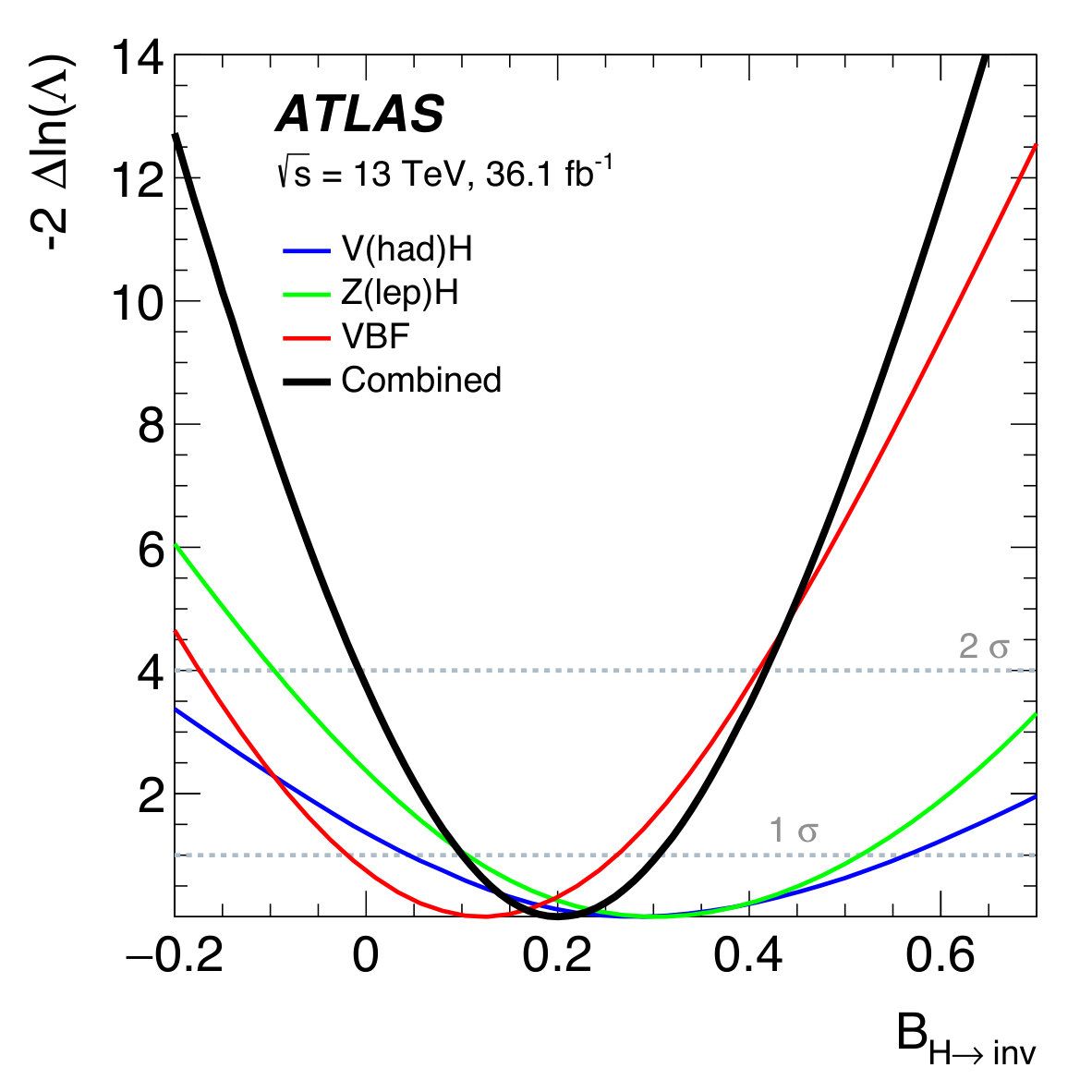 Figure 1
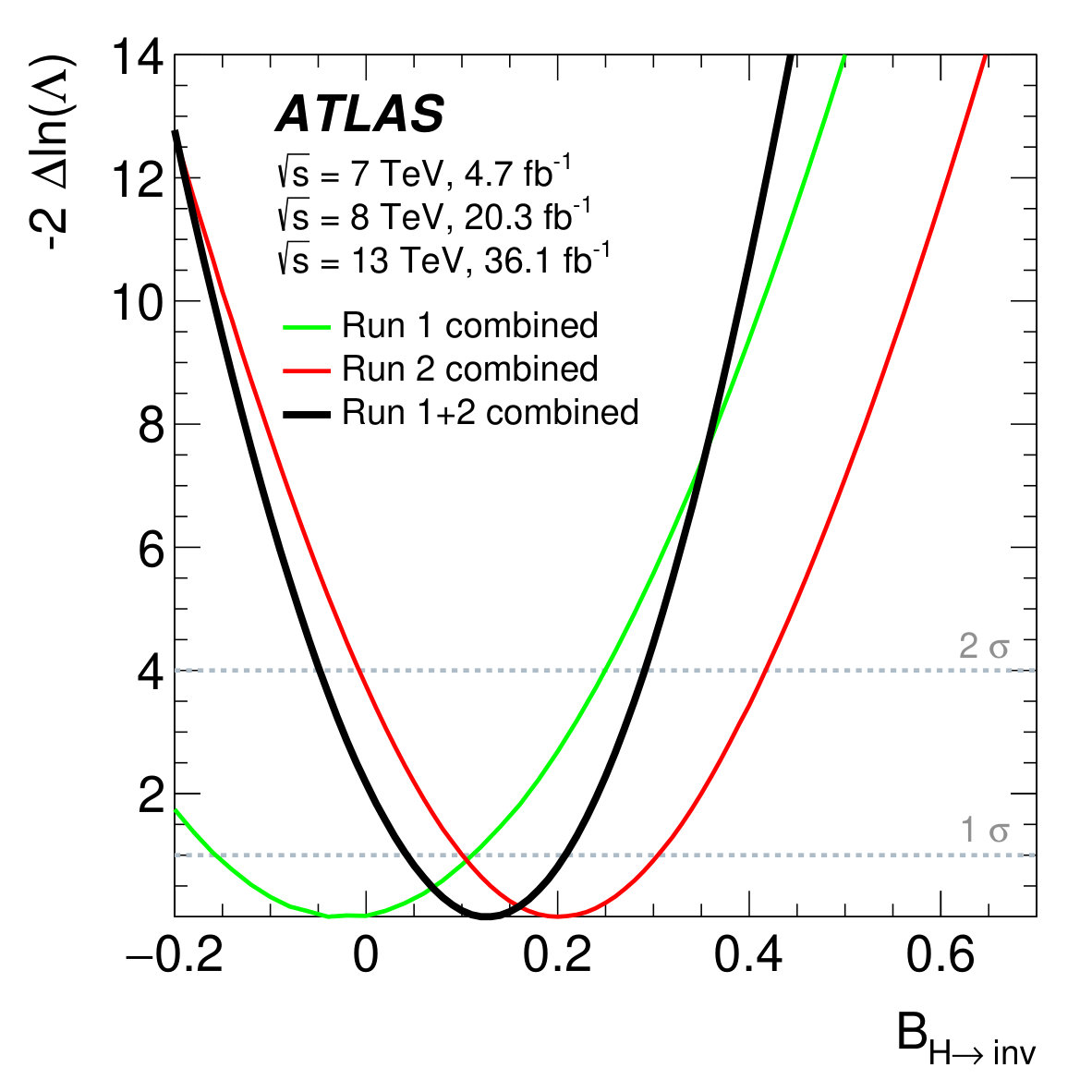 Figure 1
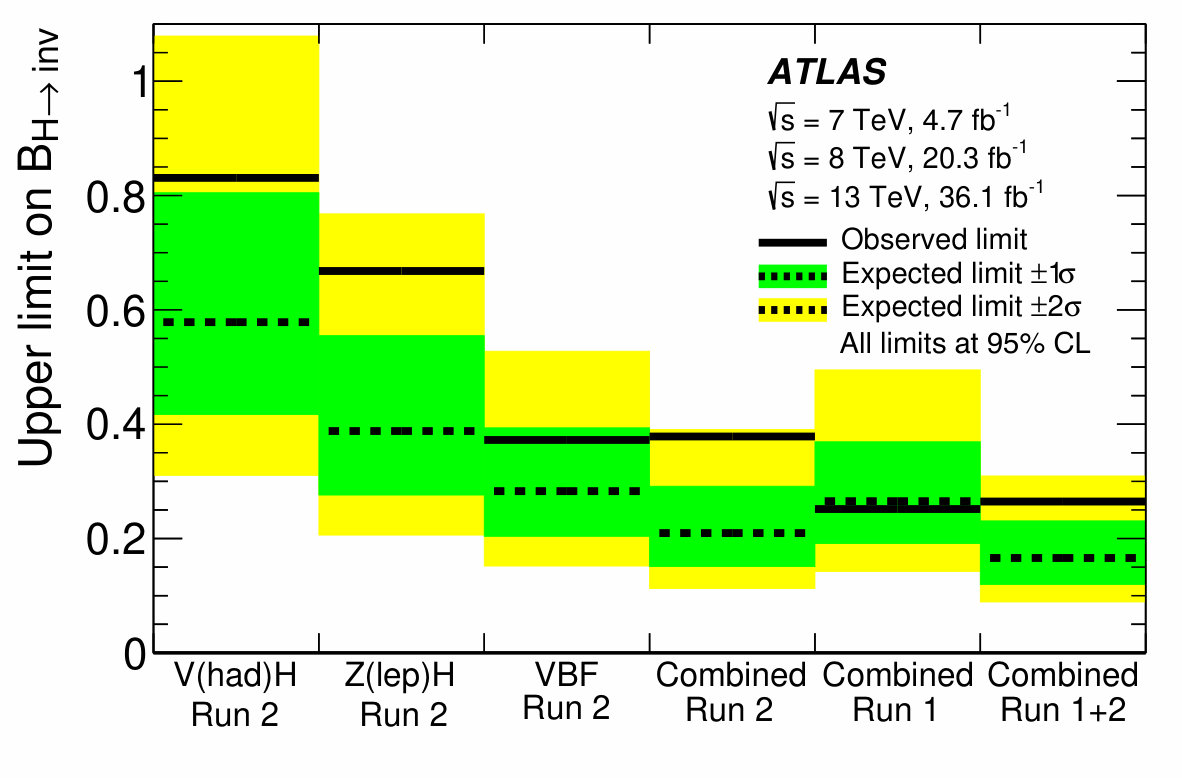 Figure 2
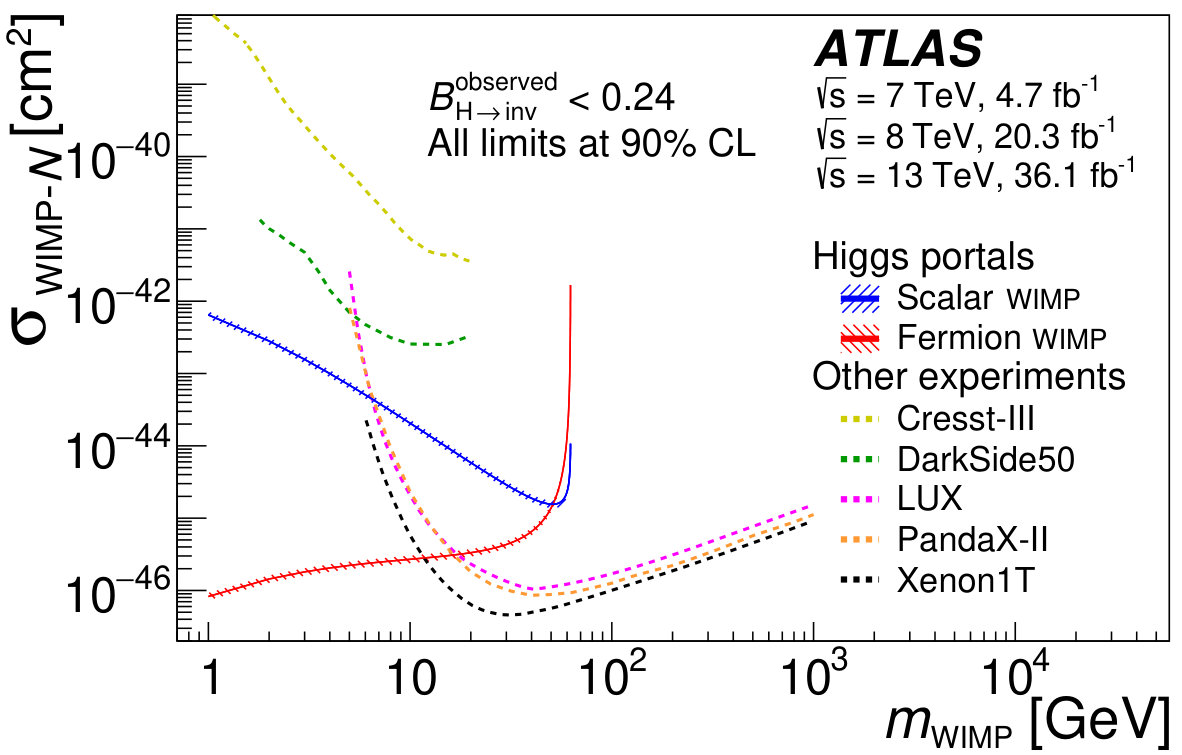 Figure 3
Peer Reviews
No public reviews on file for this paper yet. If you reviewed it on a platform where reviews are public (OpenReview, ICLR, NeurIPS, ICML), you can paste yours below so the community can read it here.
Videos
No videos yet. Explain this paper in a talk, walkthrough, or lecture? Add one.
\AtlasTitle
Combination of searches for invisible Higgs boson decays with the ATLAS experiment \AtlasAbstract Dark matter particles, if sufficiently light, may be produced in decays of the Higgs boson. This Letter presents a statistical combination of searches for decays where is produced according to the Standard Model via vector boson fusion, , and , all performed with the ATLAS detector using 36.1 fb*-1* of collisions at a center-of-mass energy of TeV at the LHC. In combination with the results at and 8 TeV, an exclusion limit on the branching ratio of at 95% confidence level is observed (expected).
\AtlasRefCodeHIGG-2018-54 \AtlasCoverSupportingNotePaper drafthttps://cds.cern.ch/record/2644319 \AtlasCoverSupportingNoteSupport notehttps://cds.cern.ch/record/2320415 \AtlasCoverAnalysisTeamOleg Brandt, Song-Ming Wang, Hideki Okawa, Patrick Rieck, Yusheng Wu, Jike Wang, Iouri Naryshkin, Anna Shcherbakova, Loan Truong, Wei Wang, Rui Zou, Cong Geng, Paul Philipp Gadow, Benjamin Taylor Carlson, Sascha Simon Dreyer, Makoto Teshima \AtlasCoverEdBoardMemberPierre-Hugues, Beauchemin (Tufts) (chair) \AtlasCoverEdBoardMemberLydia, Iconomidou-Fayard (Orsay LAL) \AtlasCoverEdBoardMemberPaolo, Francavilla (Pisa) \[email protected] \AtlasCoverEgroupEdBoardatlas-HIGG-2018-54-editorial-board@cern.ch \PreprintIdNumberCERN-EP-2019-046 \AtlasJournalPhys. Rev. Lett. \AtlasJournalRefPhys. Rev. Lett. 122 (2019) 231801 \AtlasDOI10.1103/PhysRevLett.122.231801
One of the central open questions in physics today is the nature of dark matter (DM) that is found to comprise most of the matter in the universe [1, 2, 3, 4]. A compelling candidate for DM is a stable electrically neutral particle whose non-gravitational interactions with Standard Model (SM) particles are weak. Such a particle with a mass comparable to the mass scale of the electroweak sector particles could be detectable [5, 6, 7] and accommodate the observed DM relic density [8, 9]. Numerous models predict detectable production rates of such DM particles at the Large Hadron Collider (LHC) [10, 11, 12]. In a wide class of those models, the 125 GeV Higgs boson [13, 14] acts as a portal between a dark sector and the SM sector, either through Yukawa-type couplings to fermionic dark matter, or other mechanisms [15, 16, 17, 18, 19, 20, 21, 22, 23, 24, 25, 26, 27, 28]. If kinematically allowed, decays of the Higgs boson to DM particles represent a distinct signature in such models. Higgs boson decays to DM particles can only be indirectly inferred through missing transverse momentum111ATLAS uses a right-handed coordinate system with its origin at the nominal interaction point (IP) in the center of the detector and the -axis along the beam pipe. The -axis points to the center of the LHC ring, and the -axis points upward. Cylindrical coordinates are used in the transverse plane, being the azimuthal angle around the -axis. The pseudorapidity is defined in terms of the polar angle as . The distance between two objects in – space is . Transverse momentum is defined by . due to DM particles escaping detection, and are therefore termed “invisible” (inv).
Direct searches for invisible Higgs boson decays have been carried out with the ATLAS detector [29, 30, 31] in Run 1 of the LHC, using up to 4.7 fb*-1of collision data at a center-of-mass energy of and up to 20.3 fb-1* at 8 TeV. Different event topologies were considered, assuming SM production rates: vector boson fusion (VBF) [32], Higgsstrahlung from a boson decaying into a pair of electrons or muons () [33], and Higgsstrahlung from a or boson decaying into hadrons () [34]. These searches for invisible Higgs boson decays have been statistically combined, and an upper limit at 95% confidence level (CL) on the invisible Higgs boson branching ratio of [35] was observed (expected). In combination with visible decay modes of the Higgs boson, the upper observed (expected) limit improved to 0.23 (0.24) [35]. Direct searches for invisible Higgs decays were performed using up to 36.1 fb*-1* of collision data at recorded in 2015 and 2016 in the VBF [36], [37], and [38] topologies at ATLAS. The aforementioned results at will be referred to as “Run 2 results” in the following. Similar searches were performed by the CMS Collaboration [39, 40, 41, 42, 43].
This Letter presents the statistical combination of the Run 2 searches with 36.1 fb*-1*of data for invisible decays of the Higgs boson using the ATLAS detector. Subsequently, a statistical combination with the combined Run 1 result [35] from ATLAS is performed. An overview of all results used as inputs in this combination is given in Table 1. The analysis is performed under the assumption of SM Higgs boson production. Visible decay modes of the Higgs boson are not considered.
A brief overview of the Run 2 searches for is given below.
- •
**VBF topology [36]: ** The analysis of the VBF production mode employs a trigger that is 98% efficient or better in the considered region of phase space. The event selection requires . Jets () are reconstructed up to from energy clusters in the calorimeter using the anti- algorithm [44] with a radius parameter . The two jets leading in are required to be separated by . There should be no additional jets with GeV and no isolated electron or muon candidate with GeV. These requirements serve to reduce the contribution from production in association with jets (). In the search signal region (SR) the distribution of the background falls more rapidly than the signal, where represents the invariant mass of the two selected leading jets. Thus the SR is divided into three regions (, , and ) to improve the search sensitivity. The dominant background sources are and production, where the charged lepton is not detected. Control regions (CR) enriched in and processes with are defined to determine the respective normalization factors in the SR. The main contributions to uncertainties are from the finite number of simulated Monte Carlo (MC) events, the modelling of production, and accuracy of the jet energy scale (JES). The final discriminant is the number of events in the three regions.
- •
** topology [37]: ** This search is conducted in the Higgsstrahlung channel where the boson decays into a pair of electrons or muons. A selected candidate event must pass at least one of the various single-lepton triggers, fulfill GeV and , where is calculated as the scalar sum of the of the selected leptons and jets, and have exactly one pair of isolated electrons or muons with an invariant mass that is consistent with that of the boson. The transverse momentum requirement on the leading (subleading) charged lepton is (20) GeV. To reduce the background, the dilepton system must be aligned back-to-back relative to the vector in the transverse plane. Events with jets originating from -quarks (-jets) are vetoed to suppress backgrounds from top quark pair () production and boson production in association with a single top quark (). The irreducible background is estimated from MC simulations and its production yield is normalized to the theoretical prediction of Ref. [45, 46]. The background contribution is also predicted with MC simulations and is normalized by a scale factor that is obtained from a CR enriched in events. The background is estimated with a data-driven method that uses -enriched CRs. The final discriminant is .
- •
** topology [38]: ** This analysis considers the Higgsstrahlung channel where the associated or boson decays into hadrons. The final state signature of large and jets also receives contributions from Higgs boson production via gluon fusion with jets originating from initial state radiation, and production via the VBF process. Selected events must pass a trigger and must not contain an isolated electron or muon with . As a is boosted, the two jets from its decay become increasingly collimated and are eventually merged into one single reconstructed jet. Thus, this search is conducted in two topological channels. In the “merged” topology, the SR is defined with GeV and has at least one trimmed [47, 48] large- jet () that is reconstructed using the anti- algorithm with . The signal large- jet is the one with the highest . For the “resolved” topology, the selected event should have GeV and at least two small- jets () with . Each event is first passed through the merged topology selection and, if it fails, it is passed through the resolved topology selection. To improve the search sensitivity, the selected events are further split into categories with zero, one, and two identified -jets, and into two mass regions of the invariant mass of the signal large- jet (two signal small- jets) for the merged (resolved) topology. The low mass region () targets the hadronic / boson decays of the associated production, whereas the high mass region () is sensitive to gluon fusion and VBF production. The main background contributions are from the and processes. The predictions from MC simulations are constrained with CRs that contained one or two leptons, and are kinematically similar to the SR. The final discriminant is .
The SRs and CRs of the individual input analyses are either orthogonal by construction, or were shown to have an overlap below 1%, which is neglected in the following.
The statistical combination of the analyses is performed by constructing the product of their likelihoods and maximizing the resulting likelihood ratio [49]. This is done following the implementation described in Ref. [50, 51], with as the parameter of interest. Systematic uncertainties are modeled in the likelihood function as nuisance parameters constrained by Gaussian or log-normal probability density functions [35]. Expected results are obtained using the Asimov dataset technique [49].
In the combination of Run 2 results, most experimental systematic uncertainties as well as the uncertainty on the integrated luminosity and the modeling of additional collisions in the same and neighboring bunch crossings (pile-up) are correlated across all search channels. Some experimental uncertainties related to flavor tagging and the JES are represented through different parameterizations in the input analyses and are therefore treated as uncorrelated. The impact of this assumption on the combined result is estimated using alternative correlation models where the leading sources of systematic uncertainty in the respective parameterizations are treated as correlated, and found to have an absolute effect on the limit of the order of . The systematic uncertainties on the total signal cross section due to the choice of parton distribution functions (PDF) are considered correlated among all channels. By contrast, uncertainties due to missing higher order corrections are estimated through variations of factorization and renormalisation scales and treated as correlated between the and processes. This is not done for VBF, which represents a distinct topology. The impact of the corresponding uncertainties on the acceptance rather than the total cross section of production is evaluated and found negligible. Few systematic uncertainties that are tightly constrained in a given analysis are left uncorrelated in order not to introduce any potential phase space specific biases.
The negative logarithmic profile likelihood ratios as a function of of the individual analyses and of the combined Run 2 result are shown in Fig. 1, corresponding to a best-fit combined value of . The dominant uncertainty sources are finite event yields in data and MC simulations, reconstruction of jets and leptons, and modelling of diboson and production. In absence of a significant excess, an upper limit at 95% CL of is observed (expected) with the formalism [52] using the profile likelihood ratio as a test statistic. The excess in data corresponds to a -value of 3% under the SM hypothesis of , and is a direct consequence of the excesses that are present in each of the three input analyses, see Table 1. Each of the individual analyses has been scrutinized and these excesses have been found non-significant and independent.
Subsequently, the above Run 2 result is combined with the Run 1 searches for decays [35]. Due to the differences between the detector layouts and data-taking conditions, reconstruction algorithms and their calibrations, and treatment of systematic uncertainties, the correlations between the runs are not clearly identifiable. Hence, no correlations between Run 1 and 2 are assumed for most instrumental uncertainties. The uncertainties related to the modeling of the calorimeter response dependence on jet flavor and pile-up are taken as either correlated or uncorrelated between the runs, and the choice which results in a weaker expected exclusion limit on is adopted. The uncertainty on the JES of -quark jets was estimated using MC simulations [53, 54] and is therefore considered correlated. For the signal modeling, the parton shower uncertainty in the channel, the uncertainty from missing higher order corrections in the analysis, and the uncertainty on the jet multiplicity in the VBF channel [55] are each taken as correlated between the runs since the estimated uncertainties stem from the same source. For the same reason, the uncertainty from missing higher order corrections on the observable in the dominant background from diboson production in the search is treated as correlated. All other background modeling uncertainties are considered uncorrelated. The impact of these correlation assumptions on the combined limit is found to be at most 0.005. In addition, the impact on in scenarios ranging from full anti-correlation to full correlation is studied using the Best Linear Unbiased Estimator (BLUE) [56] for the components of the JES uncertainty, the background, and diboson production that are nominally not correlated due to different parameterisations in Run 1 and 2. The resulting absolute effect on the limit is at most 0.01.
The observed ratio of the combined Run 1+2 result is represented in Fig. 1, alongside the individual Run 1 and Run 2 combinations. A best-fit value of is obtained, corresponding to an observed (expected) upper limit of at 95% CL. The -value under the SM hypothesis is 10%, and the compatibility between the Run 1 and Run 2 results is standard deviations. The final result, together with the results in the individual Run 2 analyses as well as the Run 2-only and the Run 1-only combinations, are summarized in Table 1, and the upper limits on are graphically represented in Fig. 2. The results are consistent with a similar statistical combination in Ref. [39].
The constraint from the combined observed Run 1+2 exclusion limit of at 90% CL is compared to the results from representative direct DM detection experiments [57, 58, 59, 60, 61] in Fig. 3. This comparison is performed in the context of Higgs portal models [62]. The translation of the result into a weak interacting massive particle–nucleon scattering cross section relies on an effective field theory approach [32] under the assumption that invisible Higgs decays to a pair of WIMPs are kinematically possible and that the WIMP is a scalar or a fermion [23, 63, 64], using the nuclear form factor [65]. The excluded values range down to 2\times 10^{-45}\leavevmode\nobreak\cm2 in the scalar WIMP scenario. In the fermion WIMP case, the effective coupling is reduced by [32], excluding values down to 10^{-46}\leavevmode\nobreak\cm2. While the ATLAS exclusion limits extend to , that region is subject to uncertainties in modelling of the nuclear recoil and is therefore not included in Figure 3.
In summary, direct searches for invisible Higgs boson decays using 36.1 fb*-1* of collision data at recorded in 2015 and 2016 in the VBF, , and topologies are statistically combined assuming SM-like Higgs boson production. An upper limit on the invisible Higgs branching ratio of is observed (expected) at 95% CL. A statistical combination of this result with the combination of direct searches using up to 4.7 fb*-1* of collision data at and up to 20.3 fb*-1* at 8 TeV collected in Run 1 of the LHC yields an observed (expected) upper limit of at 95% CL. The combined Run 1+2 result is translated into upper limits on the WIMP–nucleon scattering cross section for Higgs portal models. The derived limits range down to 2\times 10^{-45}\leavevmode\nobreak\cm2 in the scalar and 10^{-46}\leavevmode\nobreak\cm2 in the fermion WIMP scenarios, highlighting the complementarity of DM searches at the LHC and direct detection experiments.
We thank CERN for the very successful operation of the LHC, as well as the support staff from our institutions without whom ATLAS could not be operated efficiently.
We acknowledge the support of ANPCyT, Argentina; YerPhI, Armenia; ARC, Australia; BMWFW and FWF, Austria; ANAS, Azerbaijan; SSTC, Belarus; CNPq and FAPESP, Brazil; NSERC, NRC and CFI, Canada; CERN; CONICYT, Chile; CAS, MOST and NSFC, China; COLCIENCIAS, Colombia; MSMT CR, MPO CR and VSC CR, Czech Republic; DNRF and DNSRC, Denmark; IN2P3-CNRS, CEA-DRF/IRFU, France; SRNSFG, Georgia; BMBF, HGF, and MPG, Germany; GSRT, Greece; RGC, Hong Kong SAR, China; ISF and Benoziyo Center, Israel; INFN, Italy; MEXT and JSPS, Japan; CNRST, Morocco; NWO, Netherlands; RCN, Norway; MNiSW and NCN, Poland; FCT, Portugal; MNE/IFA, Romania; MES of Russia and NRC KI, Russian Federation; JINR; MESTD, Serbia; MSSR, Slovakia; ARRS and MIZŠ, Slovenia; DST/NRF, South Africa; MINECO, Spain; SRC and Wallenberg Foundation, Sweden; SERI, SNSF and Cantons of Bern and Geneva, Switzerland; MOST, Taiwan; TAEK, Turkey; STFC, United Kingdom; DOE and NSF, United States of America. In addition, individual groups and members have received support from BCKDF, CANARIE, CRC and Compute Canada, Canada; COST, ERC, ERDF, Horizon 2020, and Marie Skłodowska-Curie Actions, European Union; Investissements d’ Avenir Labex and Idex, ANR, France; DFG and AvH Foundation, Germany; Herakleitos, Thales and Aristeia programmes co-financed by EU-ESF and the Greek NSRF, Greece; BSF-NSF and GIF, Israel; CERCA Programme Generalitat de Catalunya, Spain; The Royal Society and Leverhulme Trust, United Kingdom.
The crucial computing support from all WLCG partners is acknowledged gratefully, in particular from CERN, the ATLAS Tier-1 facilities at TRIUMF (Canada), NDGF (Denmark, Norway, Sweden), CC-IN2P3 (France), KIT/GridKA (Germany), INFN-CNAF (Italy), NL-T1 (Netherlands), PIC (Spain), ASGC (Taiwan), RAL (UK) and BNL (USA), the Tier-2 facilities worldwide and large non-WLCG resource providers. Major contributors of computing resources are listed in Ref. [66].
The reference list from the paper itself. Each links out to its DOI / PubMed record.
- 1[1] Planck Collaboration “Planck 2018 results. I. Overview and the cosmological legacy of Planck”, 2018 ar Xiv: 1807.06205 [astro-ph.CO]
- 2[2] WMAP Collaboration “Nine-Year Wilkinson Microwave Anisotropy Probe (WMAP) Observations: Cosmological Parameter Results” In Astrophys. J. Suppl. 208 , 2013, pp. 19 DOI: 10.1088/0067-0049/208/2/19 · doi ↗
- 3[3] Gianfranco Bertone, Dan Hooper and Joseph Silk “Particle dark matter: Evidence, candidates and constraints” In Phys. Rept. 405 , 2005, pp. 279 DOI: 10.1016/j.physrep.2004.08.031 · doi ↗
- 4[4] Virginia Trimble “Existence and Nature of Dark Matter in the Universe” In Ann. Rev. Astron. Astrophys. 25.1 , 1987, pp. 425–472 DOI: 10.1146/annurev.aa.25.090187.002233 · doi ↗
- 5[5] H. Goldberg “Constraint on the Photino Mass from Cosmology” Erratum: Phys. Rev. Lett. 103 (2009) 099905 In Phys. Rev. Lett. 50 , 1983, pp. 1419 DOI: 10.1103/Phys Rev Lett.50.1419 · doi ↗
- 6[6] John R. Ellis et al. “Supersymmetric Relics from the Big Bang” In IN *BATAVIA 1984, PROCEEDINGS, INNER SPACE/OUTER SPACE*, 458-459., In *Srednicki, M.A. (ed.): Particle physics and cosmology* 223-246 238 , 1984, pp. 453 DOI: 10.1016/0550-3213(84)90461-9 · doi ↗
- 7[7] Gerard Jungman, Marc Kamionkowski and Kim Griest “Supersymmetric dark matter” In Phys. Rept. 267 , 1996, pp. 195 DOI: 10.1016/0370-1573(95)00058-5 · doi ↗
- 8[8] Gary Steigman and Michael S. Turner “Cosmological constraints on the properties of weakly interacting massive particles” In Nucl. Phys. B 253 , 1985, pp. 375 DOI: 10.1016/0550-3213(85)90537-1 · doi ↗