Characterization of Separatrices in Holomorphic Dynamical Systems
Marcus Heitel, Dirk Lebiedz

TL;DR
This paper explores the topological characterization of separatrices in holomorphic dynamical systems, revealing how complex time offers new insights into the bundling of orbits and the structure of invariant manifolds.
Contribution
It introduces numerical methods to approximate slow invariant manifolds in holomorphic flows and demonstrates how separatrices can be topologically characterized.
Findings
Separatrices can be characterized topologically in holomorphic systems.
Complex time provides new insights into the structure of holomorphic dynamical systems.
Numerical methods effectively approximate invariant manifolds in these systems.
Abstract
Multiple time scales in dynamical systems lead to a bundling of trajectories onto slow invariant manifolds (SIMs). Although they are absent in two-dimensional holomorphic dynamical systems, a bundling of orbits is often observed as well. They bundle onto special trajectories called separatrices. We apply numerical methods for the approximation of SIMs to holomorphic flows and show how a separatrix between two regions of periodic orbits can be characterized topologically. Complex time reveals a new perspective on holomorphic dynamical systems.
Click any figure to enlarge with its caption.
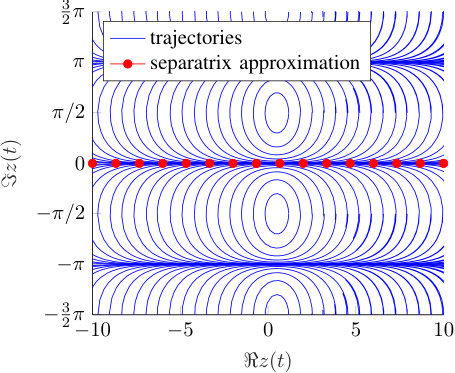 Figure 1
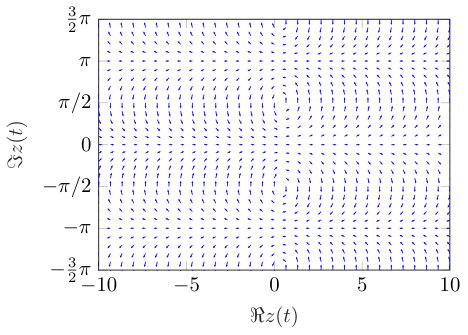 Figure 2
Peer Reviews
No public reviews on file for this paper yet. If you reviewed it on a platform where reviews are public (OpenReview, ICLR, NeurIPS, ICML), you can paste yours below so the community can read it here.
Videos
No videos yet. Explain this paper in a talk, walkthrough, or lecture? Add one.
Taxonomy
TopicsQuantum chaos and dynamical systems · Mathematical Dynamics and Fractals · Nonlinear Dynamics and Pattern Formation
Characterization of Separatrices in Holomorphic Dynamical Systems
\authorblockNMarcus Heitel\authorrefmark1, Dirk Lebiedz\authorrefmark1 \authorblockA\authorrefmark1Institute for Numerical Mathematics, Ulm University, Germany
Abstract
Multiple time scales in dynamical systems lead to a bundling of trajectories onto slow invariant manifolds (SIMs). Although they are absent in two-dimensional holomorphic dynamical systems, a bundling of orbits is often observed as well. They bundle onto special trajectories called separatrices. We apply numerical methods for the approximation of SIMs to holomorphic flows and show how a separatrix between two regions of periodic orbits can be characterized topologically. Complex time reveals a new perspective on holomorphic dynamical systems.
1 Introduction
Separatrices are structures similar to slow manifolds that characterize the flow of a holomorphic function. Their identification has become important in the context of the Riemann Hypothesis (RH) (see [1, 2, 3]). The challenging task for a possible proof of the RH is to characterize separatrices for the 1D-holomorphic flow of the Riemann zeta function [4].
One-dimensional holomorphic dynamical systems can be interpreted as dynamical systems in with a special structure given by the Cauchy-Riemann equations. If a holomorphic function is regarded as two-dimensional function that maps to , then the Cauchy-Riemann equations yield
[TABLE]
2 Separatrix and the flow
In this holomorphic context separatrices can be defined as follows.
Definition 1** (Broughan, [1])**
A trajectory is a positive (negative) separatrix if for some the maximum interval of existence of the path commencing at and proceeding in positive (negative) time is finite. A trajectory is a separatrix if it is a positive or negative separatrix.
With this definition Broughan [1] argues that separatrices are boundary components of special regions. These regions are the union of all trajectories with the qualitatively same phase space behavior, e.g., periodic orbits around the same center.
In Figure 1 trajectories of
[TABLE]
bundle near the separatrices which are the lines for every . This phase space behavior of trajectories is similar to those of slow-fast systems. The difference is here that separatrices are in general not slow (invariant) manifolds. Indeed, there is no spectral gap because of the Cauchy-Riemann equations.
3 Application of SIM Methods
Due to the common bundling behavior, we apply slow manifold approximation methods like the zero-derivative-principle (ZDP) [5] and the following boundary value problem of Lebiedz and Unger [6] to holomorphic dynamical systems:
[TABLE]
The latter calculates pointwise a separatrix candidate for fixed real part of at time , which corresponds to the reaction progress variable in the calculation of slow manifolds. The numerical results of this boundary value problem for several values of are plotted in Figure 1. They all lie exactly on the separatrix. The same holds for the ZDP of order 1 applied to the imaginary part as variable, i.e.,
[TABLE]
In the special case
[TABLE]
the ZDP yields the curves as well as . However, in general these methods only lead to approximations of separatrices.
4 Separatrix Characterization
The idea is to characterize a separatrix by a closer look on the topology of the phase space near separatrices. Figure 2 depicts the direction field of (4).
Periodic orbits above and below the separatrices have different mathematical orientation. More precisely, the index of those curves differs, i.e., the number of (mathematically positive) rotations of a tangent vector along the curve. The following theorem captures this feature to characterize separatrices between two regions of periodic orbits around centers.
Theorem 1
Let be two (neighbored) centers of the flow
[TABLE]
with a holomorphic function . Let the regions
[TABLE]
have common boundary component (i.e. separatrix, cf. Broughan [1]) for an open set . Then it holds
[TABLE]
In case of system (4) it is clear that the indices of all periodic solution orbits around the same center are constant. Thus it changes only at the the curves for integers , which are separatrices.
5 Complex Time
In Equation (8) is a complex-valued function with complex argument. It seems natural to consider the solution of (8) as a function over a complex variable, i.e., complex time. If the real time is replaced by with , then the solution of
[TABLE]
assuming to be complex differentiable w.r.t. time, satisfies
[TABLE]
is called real time and imaginary time. Since multiplication by in can be interpreted as rotation by in , real time trajectories and imaginary time trajectories intersect orthogonally. Imaginary time allows to traverse separatrices of the real time flow and vice versa.
The holomorphic derivative of a simple zero of determines the type of the equilibrium. If is real resp. imaginary, then it is a node resp. center. Otherwise, it is a focus. A node of the real time flow becomes a center of imaginary time flow and vice versa. Thus, switching the sign of and proceeding to imaginary time provide ways of “manipulating” the stability and attractivity of the dynamical system in the neighborhood of a simple zero.
Separatrices of the real time flow can be approximated by maximizing the curvature of the pure imaginary time trajectories. For each (imaginary time) trajectory this yields a point close to the separatrix.
Acknowledgment
Special thanks goes to the Klaus-Tschira foundation for financial funding of the project.
The reference list from the paper itself. Each links out to its DOI / PubMed record.
- 1[1] K. Broughan, “Structure of sectors of zeros of entire flows”, Topol. Proc. , vol. 27, no. 2, 2003, pp. 379–394.
- 2[2] K. Broughan and A. Barnett, “The holomorphic flow of the Riemann zeta function”, Math. Comput. , vol. 73, no. 246, 2004, pp. 987–1004.
- 3[3] J. Neuberger, C. Feiler, H. Maier and W. Schleich, “Newton flow of the Riemann zeta function: separatrices control the appearance of zeros”, New J. Phys. , vol. 16, no. 10, 2014, pp. 103023.
- 4[4] W. Schleich, I. Bezděková, M. Kim, P. Abbott, H. Maier, H. Montgomery and J. Neuberger, “Equivalent formulations of the Riemann hypothesis based on lines of constant phase”, Phys. Scr. , vol. 93, no. 6, 2018, pp. 065201.
- 5[5] A. Zagaris, C. Gear, T. Kaper and Y. Kevrekidis, “Analysis of the accuracy and convergence of equation-free projection to a slow manifold”, Math. Model. Numer. Anal. , vol. 43, 2009, pp. 757–784.
- 6[6] D. Lebiedz and J. Unger, “On unifying concepts for trajectory-based slow invariant attracting manifold computation in kinetic multi-scale models”, Math. Comput. Model. Dyn. Syst. , vol. 22, 2016, pp. 87–112.