Developable surface patches bounded by NURBS curves
Leonardo Fernandez-Jambrina, Francisco Perez-Arribas

TL;DR
This paper presents a method to construct developable surface patches bounded by NURBS curves through reparameterization, enabling the creation of developable surfaces that are not necessarily NURBS, with solutions involving algebraic equations.
Contribution
It introduces a novel reparameterization approach for NURBS boundary curves to generate developable surface patches, expanding the design possibilities beyond traditional NURBS surfaces.
Findings
Reparameterization involves solving algebraic equations, often quadratic or quartic.
Applicable to cubic, spline, and Bezier curves on parallel planes.
Method enables construction of developable patches not limited to NURBS surfaces.
Abstract
In this paper we construct developable surface patches which are bounded by two rational or NURBS curves, though the resulting patch is not a rational or NURBS surface in general. This is accomplished by reparameterizing one of the boundary curves. The reparameterization function is the solution of an algebraic equation. For the relevant case of cubic or cubic spline curves, this equation is quartic at most, quadratic if the curves are Bezier or splines and lie on parallel planes, and hence it may be solved either by standard analytical or numerical methods.
Click any figure to enlarge with its caption.
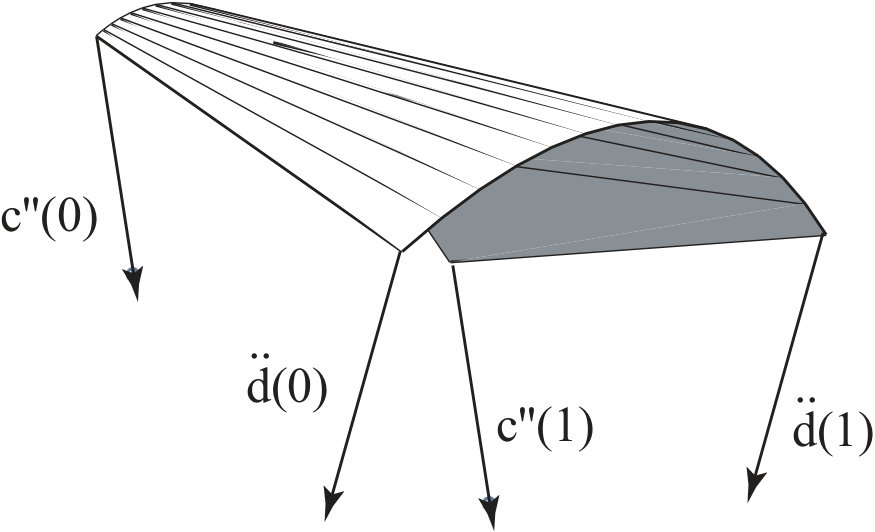 Figure 1
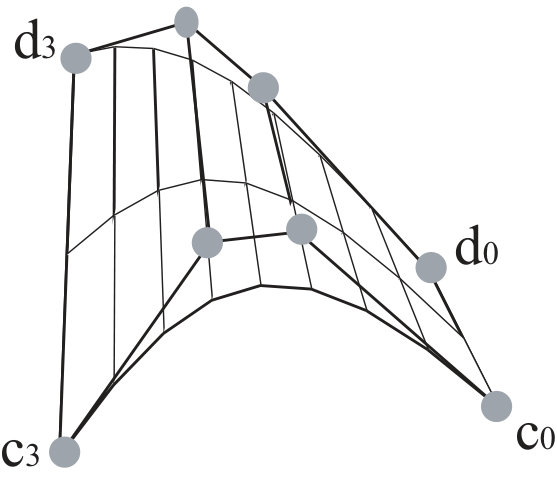 Figure 2
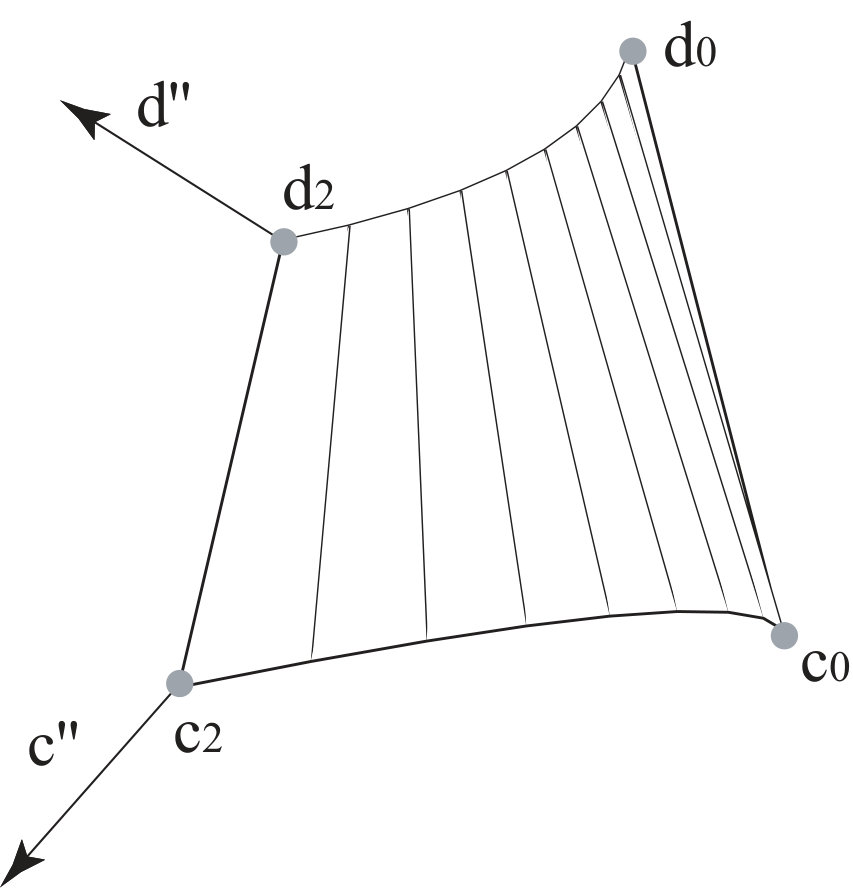 Figure 3
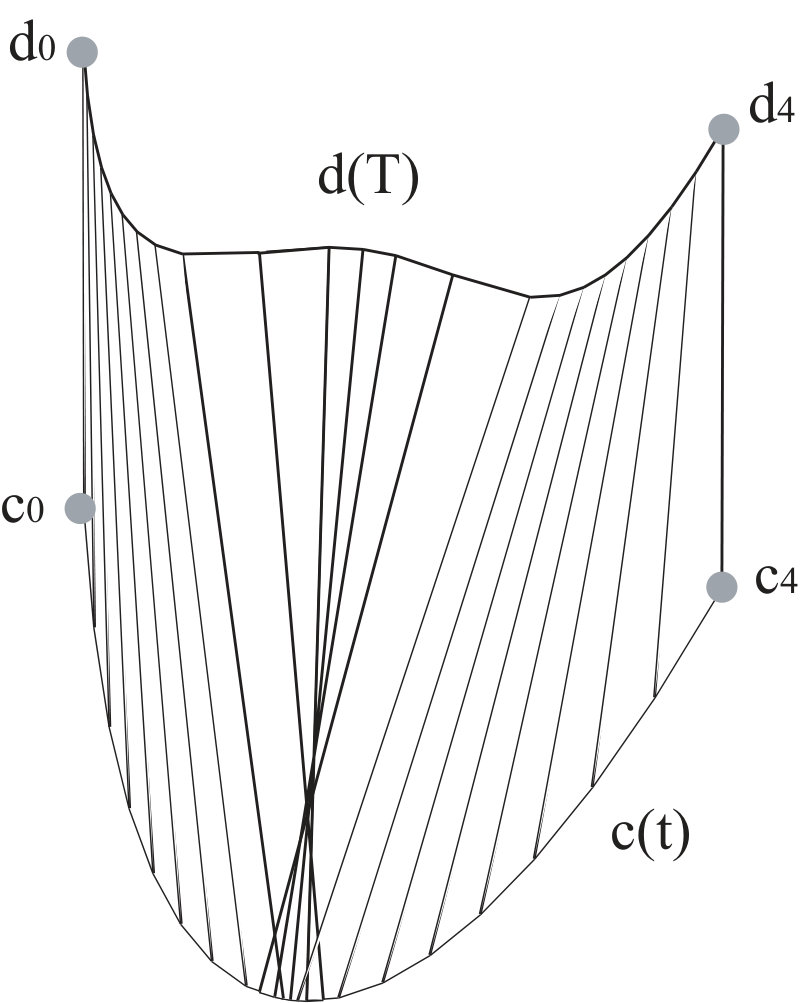 Figure 4
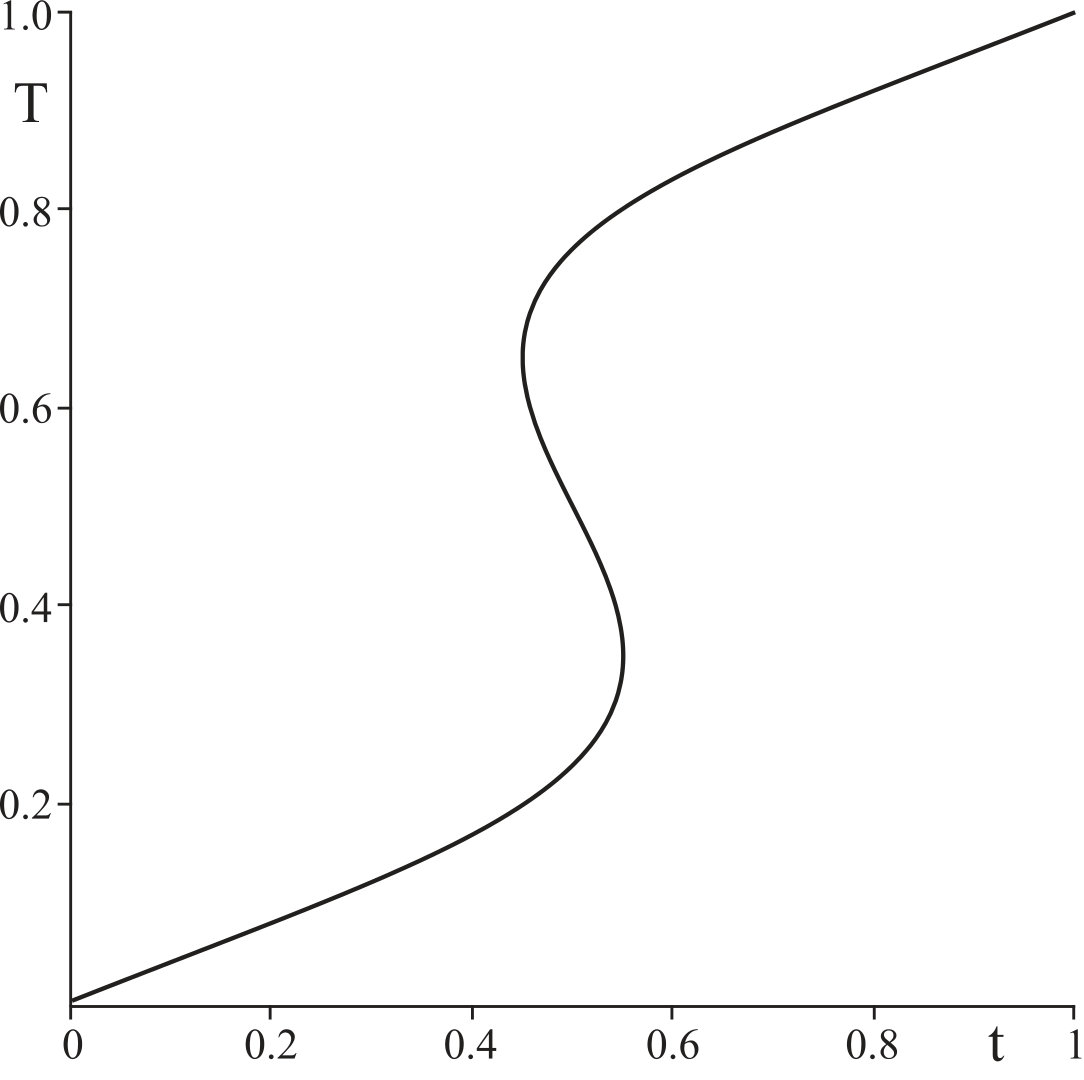 Figure 5
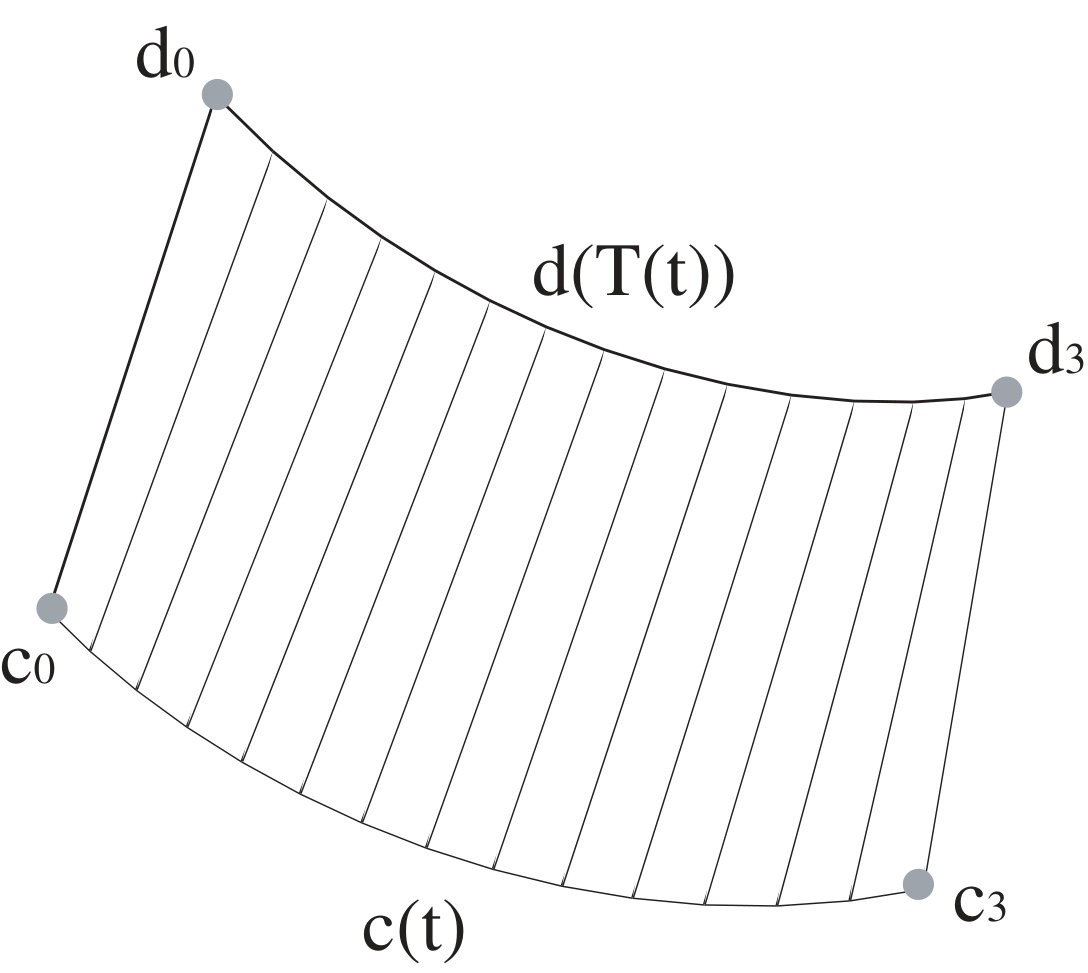 Figure 6
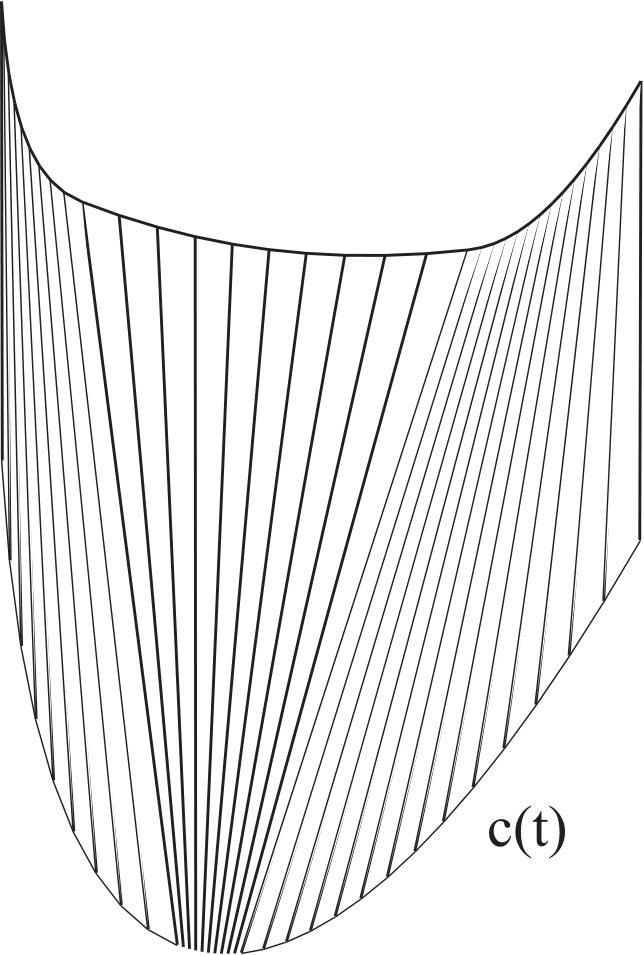 Figure 7
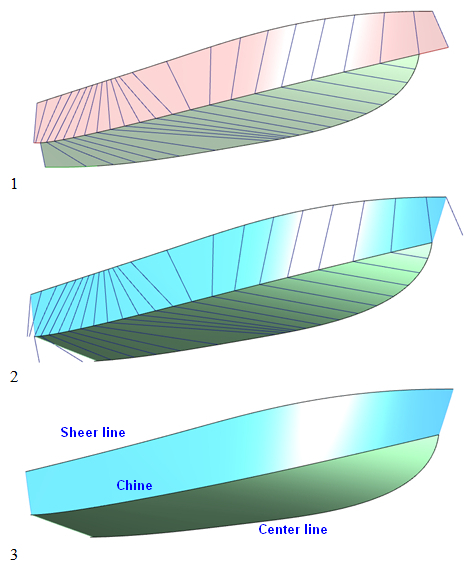 Figure 8
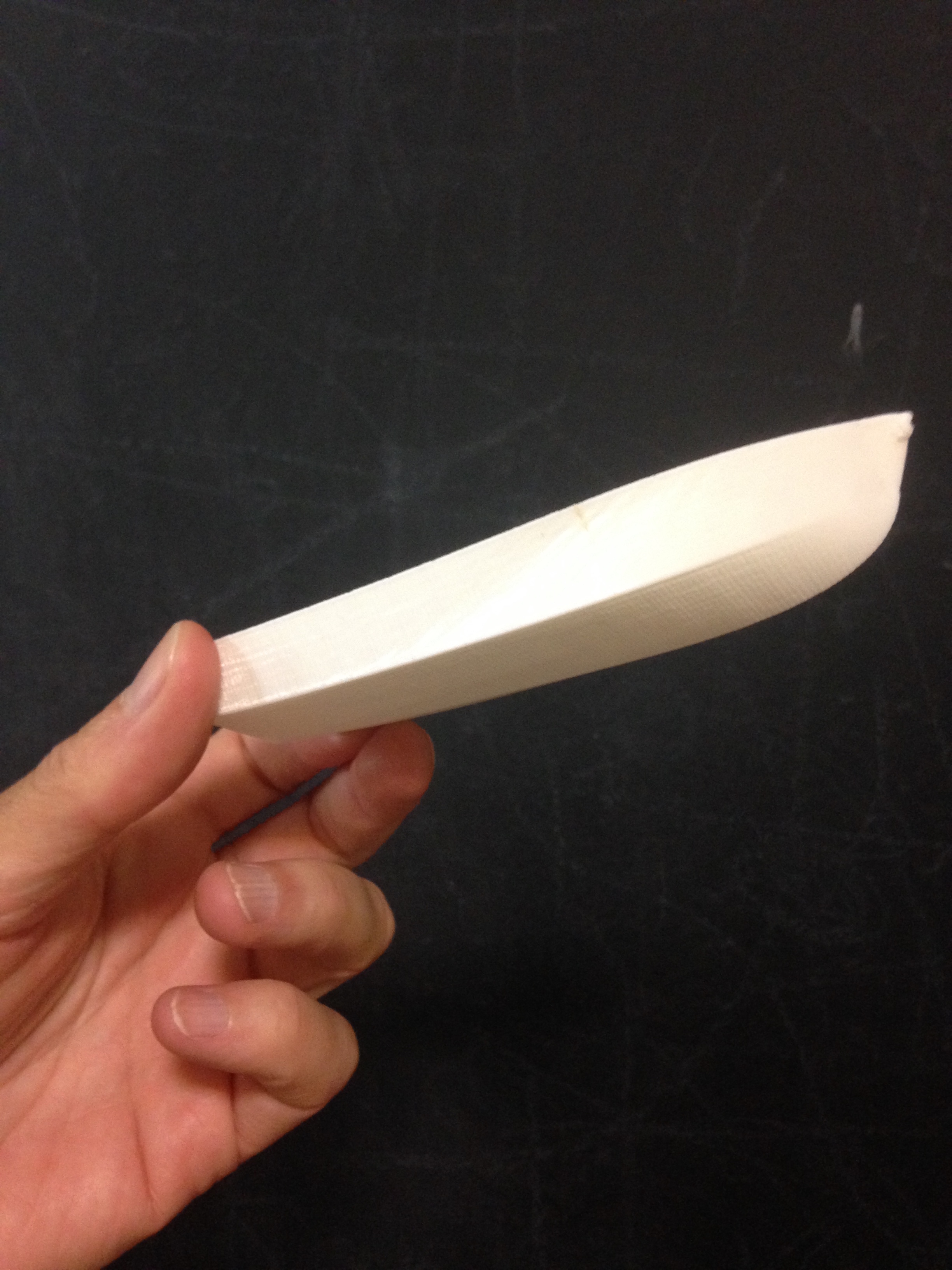 Figure 9
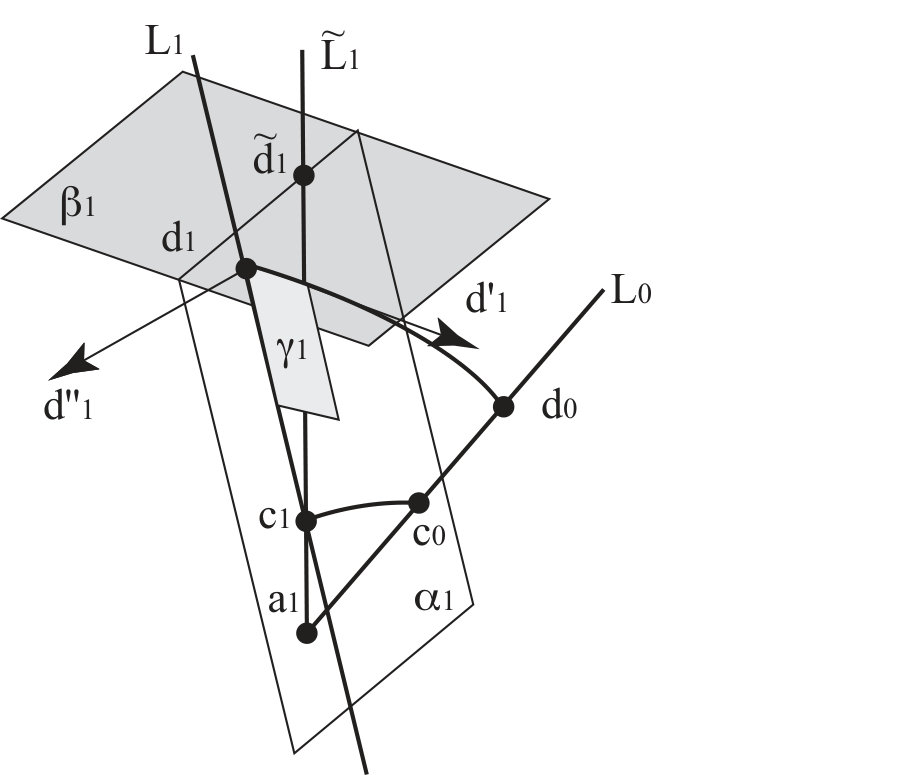 Figure 10
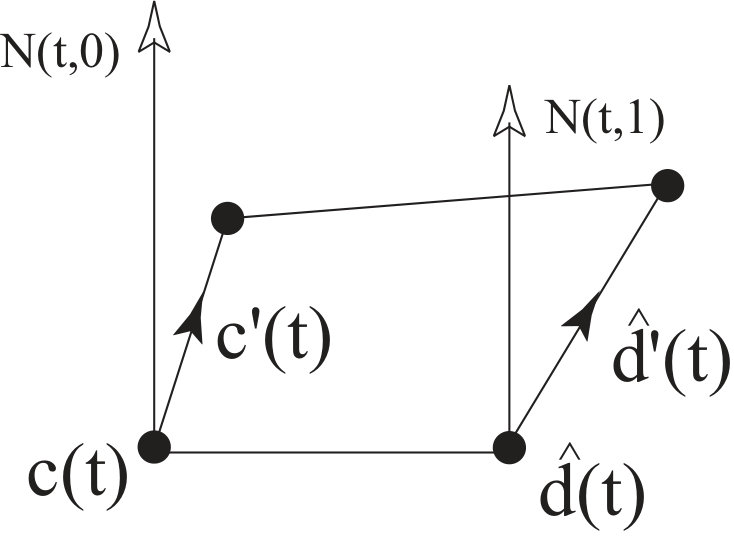 Figure 11
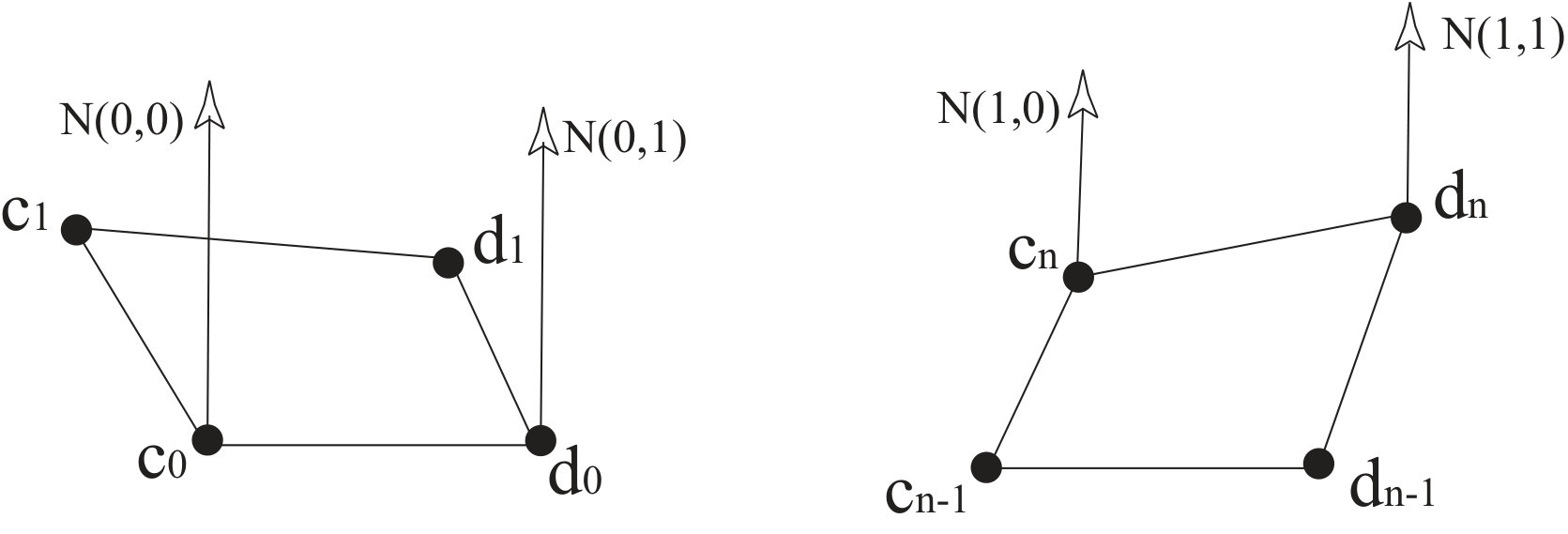 Figure 12
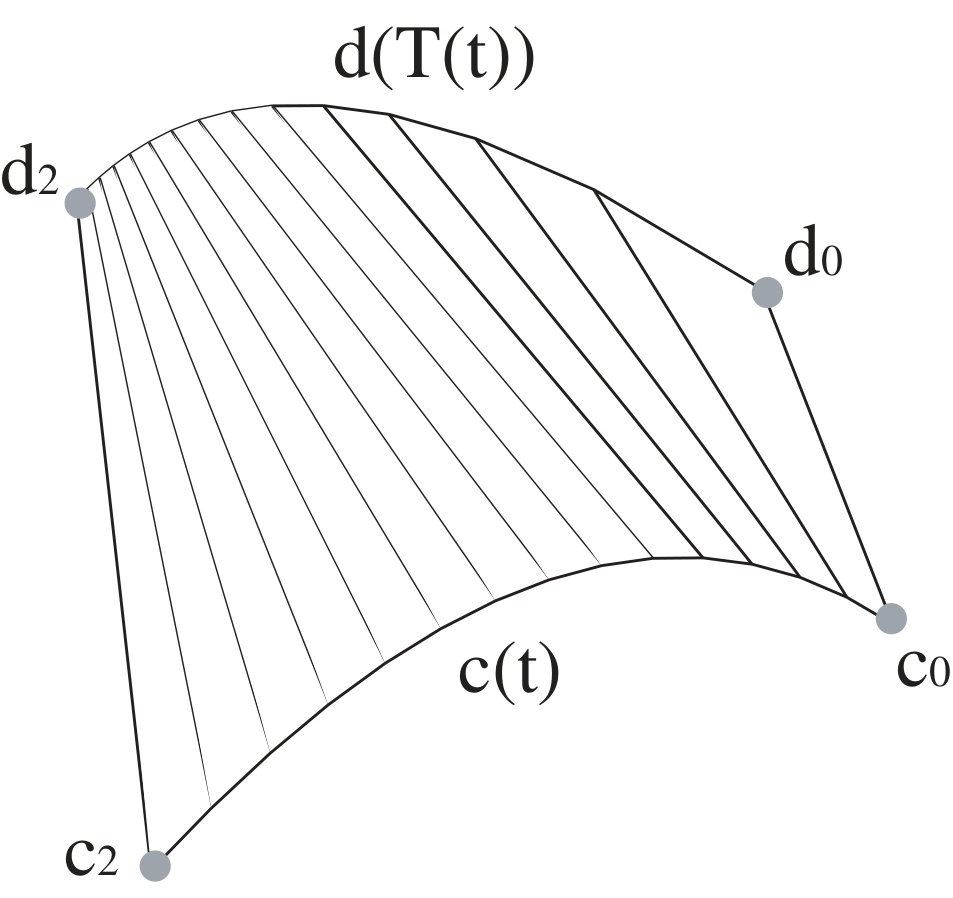 Figure 13
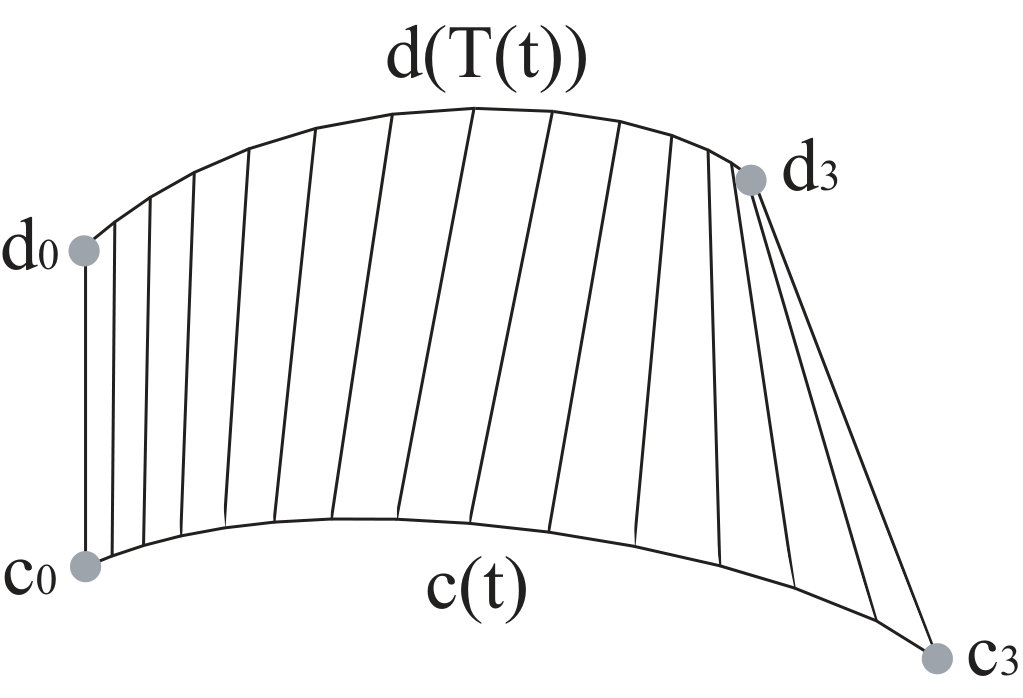 Figure 14
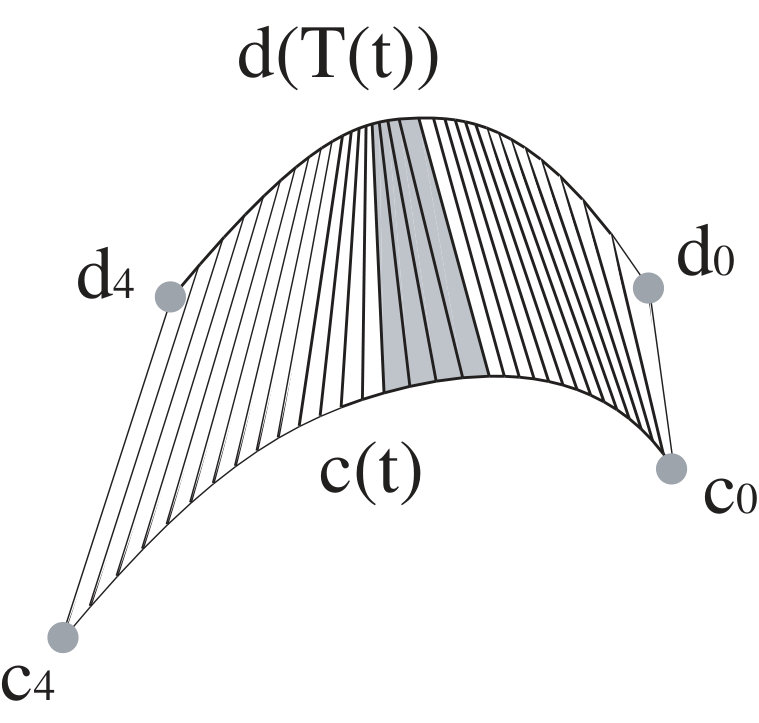 Figure 15
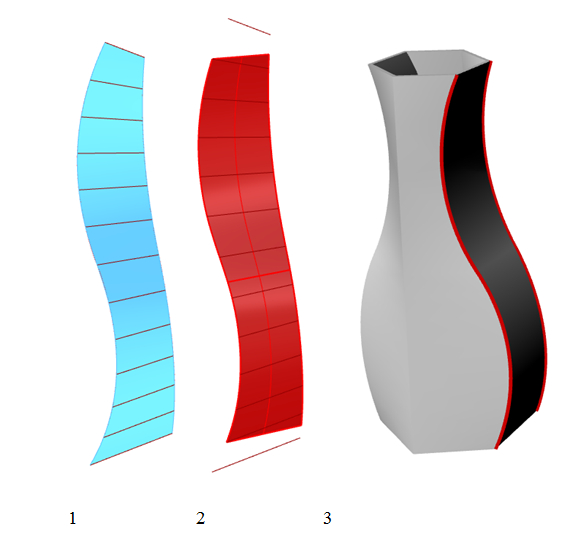 Figure 16
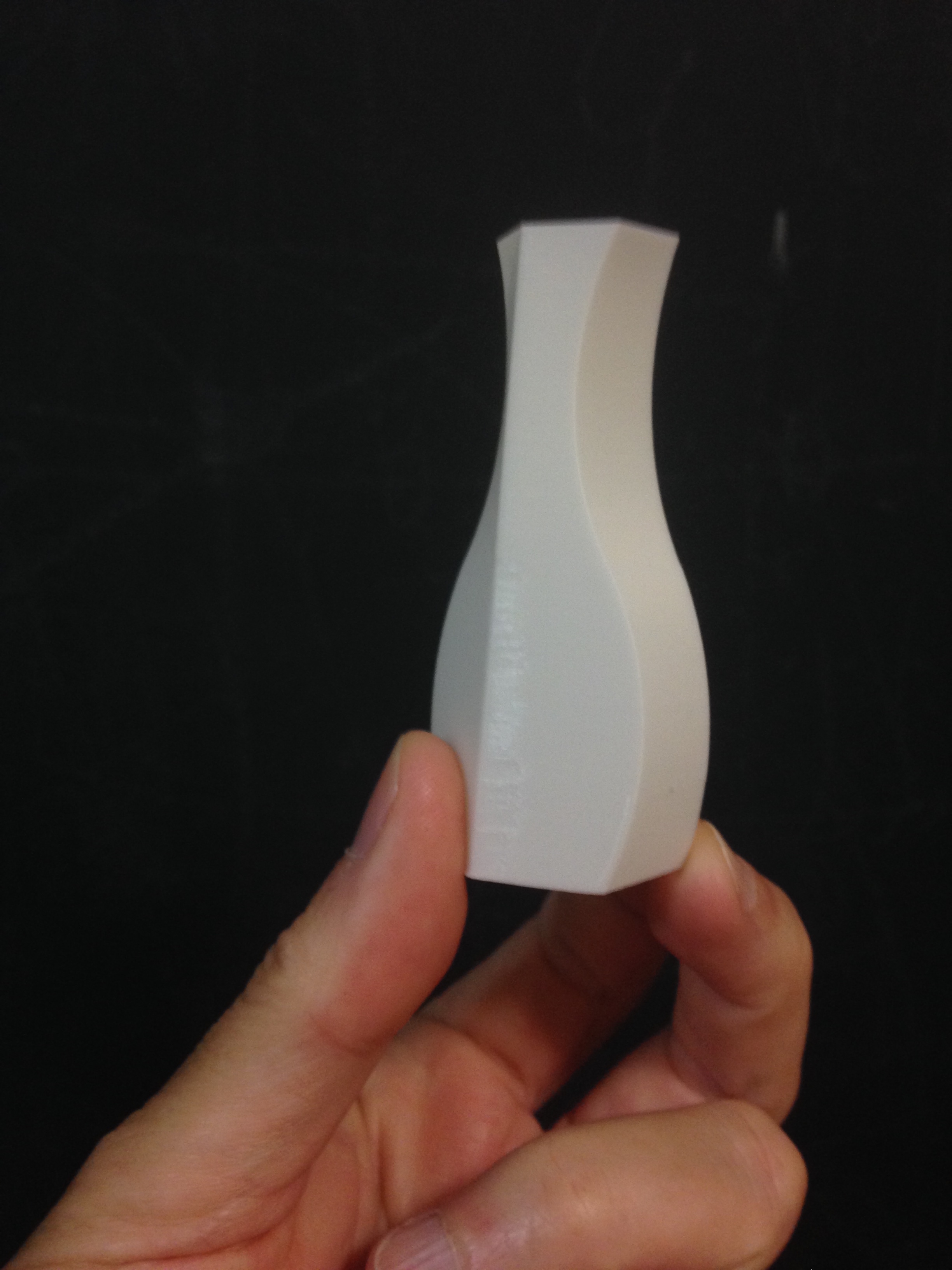 Figure 17
| 0.0 | 0.1 | 0.2 | 0.3 | 0.4 | 0.5 | 0.6 | 0.7 | 0.8 | 0.9 | 1.0 | 1.1 | 1.2 | 1.3 | 1.4 | 1.5 | 1.6 | 1.7 | 1.8 | 1.9 | 2.0 | |
|---|---|---|---|---|---|---|---|---|---|---|---|---|---|---|---|---|---|---|---|---|---|
| 0.06 | 0.15 | 0.25 | 0.35 | 0.46 | 0.58 | 0.71 | 0.85 | 1.09 | 1.29 | 1.38 | 1.40 | 1.43 | 1.46 | 1.49 | 1.52 | 1.56 | 1.60 | 1.65 | 1.71 | 1.79 | |
| 0.00 | 0.09 | 0.17 | 0.26 | 0.35 | 0.44 | 0.53 | 0.61 | 0.69 | 0.76 | 0.80 | 0.82 | 0.85 | 0.90 | 1.19 | 1.41 | 1.56 | 1.71 | 1.88 | 2.08 | 2.39 |
Peer Reviews
No public reviews on file for this paper yet. If you reviewed it on a platform where reviews are public (OpenReview, ICLR, NeurIPS, ICML), you can paste yours below so the community can read it here.
Videos
No videos yet. Explain this paper in a talk, walkthrough, or lecture? Add one.
DEVELOPABLE SURFACE PATCHES BOUNDED BY NURBS CURVES
Leonardo Fernández-Jambrina and Francisco Pérez-Arribas ETSI Navales, Universidad Politécnica de Madrid, 28040-Madrid, Spain
Email: [email protected] ETSI Navales, Universidad Politécnica de Madrid, 28040-Madrid, Spain
Email: [email protected]
Abstract
In this paper we construct developable surface patches which are bounded by two rational or NURBS curves, though the resulting patch is not a rational or NURBS surface in general. This is accomplished by reparameterizing one of the boundary curves. The reparameterization function is the solution of an algebraic equation. For the relevant case of cubic or cubic spline curves, this equation is quartic at most, quadratic if the curves are Bézier or splines and lie on parallel planes, and hence it may be solved either by standard analytical or numerical methods.
:
6
keywords:
NURBS, Bézier, rational, spline, NURBS. developable surfaces.
5D17, 68U07.
1 Introduction
Developable surfaces play an important role in differential geometry as surfaces with vanishing Gaussian curvature. From the point of view of intrinsic geometry, developable surfaces cannot be distinguished from the plane. Only when they are embedded in three-dimensional space, different surfaces arise. The embedding of the planar surface in space has to preserve lengths and angles between curves. Metric properties are not altered and hence the planar surface may be cut or folded, but not stretched or deformed.
On the other hand, these geometrical properties are of relevance for industry. In textile design one starts with a planar piece of cloth to produce garments and their quality improves if the cloth is not stretched. In naval industry one has to adapt planar sheets of steel to the form of the hull of a vessel. This can be done with a folding machine if the result is a developable surface, avoiding the application of heat and reducing the costs. They are also useful for modeling pages of a book [1] for 3D reconstruction and they can also be found in architectural constructions [2].
The main problem for addressing developable surfaces in Geometrical Design is that the null Gaussian curvature requirement takes the form of a non-linear equation when expressed in terms of the vertices of the control net of the surface.
This issue has been handled in several ways. A thorough review may be found in [3]. In [4] rational Bézier surfaces are addressed and the null Gaussian curvature condition is solved explicitly for low degrees. -spline developable surfaces are constructed in [5]. Another restriction is considering boundary curves for the developable surface on parallel planes as in [6] and [7]. A different point of view relies on solving the null Gaussian curvature in the dual space of planes [8, 9, 10].
Concerning the applications in industry, quasi-developable surfaces are constructed in [11] and [12]. In [13] developable surfaces for designing ship hulls are constructed by graphical methods. Developable surfaces can also be approximated with spline cones as in [14]. A different and successful approach for approximate developable surfaces bounded by polylines, grounded on convex hulls, is shown in [15], with examples for garments.
Application of the de Casteljau algorithm has lead to several fruitful approaches as in [16]. In [17] a family of developable surfaces is constructed through a Bézier curve of arbitrary degree. This is useful for solving interpolation problems [18]. These results have been extended to spline curves of arbitrary degree in [19, 20] and to Bézier triangular surfaces [21]. In [22] developable surfaces with several patches linked with -continuity are constructed.
In [23] the non-linear conditions are expressed as quadratic equations and this is used to devise a constraint for interactive modeling.
Finally, in [24] it is shown that the developable surfaces which can be constructed with Aumann’s algorithm are the ones with a polynomial edge of regression. This poses an interesting problem. When we interpolate a ruled surface between two parameterized curves, and , besides the obvious way,
[TABLE]
there are other infinite possibilities, depending on the choice of parameterizations for the bounding curves. In this paper we focus on this issue.
The paper is organised as follows: In Section 2 we introduce developable surface patches bounded by rational Bézier curves of arbitrary degree . We look for the most general solution to this problem by reparameterizing one of the curves. The reparameterization function is shown to satisfy an algebraic equation of degree at most, or of degree if the bounding curves are polynomial and lie on parallel planes. Examples are provided in Section 3. In Section 4 it is shown how the results can be applied to developable surface patches bounded by NURBS curves. A final section of conclusions is included.
2 Developable patches bounded by rational curves
We start with two rational curves of degree , , , and respective control polygons , and lists of weights , . We may think of as a function of in order to construct a parameterized ruled surface,
[TABLE]
denoting the reparameterized curve as . We shall denote by a comma the derivative with respect to and by a dot the derivative with respect to .
A normal vector to the surface at may be calculated,
[TABLE]
as a barycentric combination of the normal at and the normal at .
In the case of developable surfaces [25], and are parallel for all values of (See Fig. 1). In order to avoid singular points for which is a zero vector, we require that and point to the same side of the tangent plane along the ruling corresponding to . Otherwise, the vector would vanish for a value .
The condition for the parameterized surface to be developable [25] is coplanarity of , , for all values of ,
[TABLE]
By the chain rule,
[TABLE]
and multilinearity of the determinant, the previous condition is equivalent to
[TABLE]
which is expected to be satisfied by a function .
We may think of the previous expression as the equation for the reparameterizations that allows us to construct a developable surface bounded by the curves , . The main advantage of this form of the equation is that it is purely algebraic instead of differential and that it depends on a single function .
We may impose from the beginning that be coplanar in order to fulfill the developability condition at . Similarly, are to be coplanar in order to satisfy the developability condition at .
We also require that and point to the same side of the tangent plane at and that and point to the same side of the tangent plane at (See Fig. 2).
If we write , , by explicitly splitting the parameterizations of the curves in their respective denominators , and vector numerators , of degree , we may expand (2) as
[TABLE]
In principle the numerator of this expressions provides an equation of degree in either or , but it is easily seen that the derivative with respect to is identically null and hence (2) is an equation of degree at most. For instance, for the relevant case of cubic curves, the equation is quartic.
Furthermore, if both , are Bézier plane curves and lie in parallel planes, the reduction is more dramatic. Denoting by the -th derivative, in the derivative of the left-hand side of (2),
[TABLE]
all terms are coplanar except for . Hence, the -th derivative vanishes identically and (2) is an equation of degree in the case of curves in parallel planes. This case is relevant since in many cases one is interested in interpolating a surface between plane sections, suchs as stations or waterlines of a hull.
Proposition 2.1**.**
Let , , be rational curves of degree with coplanar sets of vertices and .
We also require that and point to the same side of the tangent plane at and that and point to the same side of the tangent plane at .
The parameterized ruled surface,
[TABLE]
is a developable surface if the reparameterization function satisfies the algebraic equation
[TABLE]
and is a real monotonically increasing function of .
This equation is of degree at most. If both curves are polynomial and lie in parallel planes, the equation is of degree at most.
Among the solutions of (2) we have to choose the ones which are real and monotonically increasing. If is not monotonically increasing, the singular edge of regression of the developable surface is crossed by the surface patch. This can be dealt with using the multiconic development [12], also known as Rabl’s method [26], [12], modifying the boundary curves and replacing the region of the surface where decreases.
We obtain information about this issue, taking the derivative of (2) with respect to ,
[TABLE]
Since the last term is trivially zero, we can get an expression for the derivative of the reparameterization function,
[TABLE]
which has to be positive in order to have a monotonically increasing reparameterization function .
If and are parameterizations of class of differentiability, we see that is at least of class . This is relevant for dealing with spline parameterizations. If , are spline curves of degree without repeated knots, that is, of class , the reparameterization function is of class .
This expression allows several interpretations. Since for a reparameterization function both and are normal vectors to the developable surface along the ruling linking and , both are parallel to the unitary normal to the developable surface at this ruling. We assume here that both normal vectors point to the same side of the tangent plane along the ruling. Otherwise, the developable surface patch would intersect the singular edge of regression.
This means that is monotonically increasing if the projections of the accelerations of both curves, , , have the same sign. That is, if , point to the same side of the tangent plane at . In the case of parabolas, for instance, these two vectors are respectively parallel to the axes of the parabolas (See Fig. 3).
We see what happens when such requirement is not satisfied:
Example 2.2**.**
Developable surface patch bounded by parabolas and with respective control polygons
[TABLE]
The parameterizations of these curves,
[TABLE]
require a reparameterization
[TABLE]
which is not a growing function. This happens because the accelerations of the parabolas, , , point to opposite sides, as it can be seen in Fig. 4.
The acceleration of a parameterized curve may be split into tangential acceleration and normal acceleration in a standard way. The tangential part does not contribute to .
Hence, we may replace by the normal acceleration or curvature vector of the curve in the expression . And also we may replace by . But the projection of the curvature vectors of the curves along the unitary normal to the surface [25] are their normal curvatures, , ,
[TABLE]
and we can summarise this result in the following way:
Proposition 2.3**.**
Let , , be parameterized curves with coplanar sets of vertices and .
We also require that and point to the same side of the tangent plane at and that and point to the same side of the tangent plane at .
Let be a reparameterization function so that
[TABLE]
is a developable surface. is a monotonically increasing function if and only if for all ,
[TABLE]
where is the unitary normal to the surface along the ruling at .
Or equivalently, for the normal curvatures , of both curves
[TABLE]
for all values of . In the case of parameterizations of class of differentiability, is of class .
In case we have a developable surface patch with a region where the reparameterization is not a growing function in an interval , ( for the curve ), we have a regression area where the rulings overlap as in Fig 9.
We may amend this flaw using the multiconic development [26, 12], replacing the regression area by pieces of cones and modifying the curve .
First, we obtain two sequences of equally spaced points, ; , on the curves , , such that , , , , which provide lines linking pairs of points on the curves.
The line linking and does not belong to a developable surface, but we replace it by a ruling of a cone. With this aim, we define the plane containing the line and which is orthogonal to the plane , containing the same line and the velocity of the curve at .
The plane meets the ruling at the point , which is be the vertex of the new cone. The new ruling replacing is , through and .
The endpoint of is the point where this new ruling meets the osculating plane of the curve at (the plane with more contact with the curve at , since it contains , and ).
After obtaining the new ruling and its endpoint we proceed to compute the ruling replacing by constructing a cone with in a similar fashion. The procedure finishes after recalculating the new rulings through .
3 Examples
The procedure for constructing developable surfaces bounded by two rational Bézier curves and satisfying the requirements of Proposition 1 can be cast in the form of an algorithm:
Compute the polynomial . 2. 2.
Solve numerically (or analytically) for for a sequence of values . 3. 3.
Choose a real monotonically growing solution . 4. 4.
If there is no such solution, apply Rabl’s method [26], [12] to the regions where the sequence is not growing. 5. 5.
The developable surface patch is defined by the segments .
In the case of parabolas in parallel planes, the reparameterization is a Möbius transformation. It is monotonically increasing unless its denominator vanishes.
Example 3.1**.**
Construction of a developable surface patch bounded by curves and with respective control polygons
[TABLE]
These are parabolas on parallel planes , ,
[TABLE]
Condition (2) is just
[TABLE]
Since becomes singular just at , out of our patch, the parameterization
[TABLE]
corresponds to a developable surface patch bounded by and (See Fig. 6), which does not meet the edge of regression of the surface.
For cubic curves in parallel planes, equation (2) is of degree two:
Example 3.2**.**
Construction of a developable surface patch bounded by cubic curves and with respective control polygons
[TABLE]
These are cubic curves on parallel planes , ,
[TABLE]
The developability condition (2)
[TABLE]
has just one monotonically increasing solution mapping the interval onto itself,
[TABLE]
which produces a developable surface patch (See Fig. 7).
It is interesting to show what happens when this construction is applied to a Bézier developable patch, that is, a polynomially parameterized surface patch which is developable and which can be obtained, for instance, resorting to Aumann’s construction [17]:
Example 3.3**.**
Construction of a developable surface patch bounded by cubic curves and with respective control polygons
[TABLE]
and respective parameterizations
[TABLE]
[TABLE]
The developability condition (2) is a quartic equation
[TABLE]
which can be easily factored.
The only monotonically increasing solution is the obvious one, . The other one is singular in the interval . The surface patch may be seen in Fig. 8.
Now we show an example of a developable surface patch with a regression area:
Example 3.4**.**
Construction of a developable surface patch bounded by quartic curves and with respective control polygons
[TABLE]
and respective parameterizations
[TABLE]
The developability condition (2) is a quartic equation
[TABLE]
and provides a reparameterization function which is not monotonic and hence the surface patch has a regression area between and , as it is seen in Fig. 9.
This is due to the bump in the graphic of the curve and can be amended (See Fig. 10) modifying this curve using the multiconic development [26, 12].
A simple but realistic example of design of a vase:
Example 3.5**.**
Construction of a developable surface patch bounded by curves and with respective control polygons
[TABLE]
[TABLE]
Both curves , are parabolas. Besides, we consider the straight segment with control polygon
[TABLE]
in order to construct an additional planar face bounded by and the segment.
The developability condition (2) is cubic,
[TABLE]
and can be solved explicitly for ,
[TABLE]
The result may be seen in Fig 11, where 1 shows the original patch, duplicated in a symmetric fashion, 2 shows the trimmed patches and 3 shows the final object after repetition and inclusion of planar faces.
We finish this section with an example with cubic curves:
Example 3.6**.**
Construction of a developable surface patch bounded by rational cubic curves and with respective control polygons
[TABLE]
and lists of weights,
[TABLE]
which are parameterized as
[TABLE]
[TABLE]
In this case the developability condition (2)
[TABLE]
is a quartic equation, which can be solved numerically as a function interpolating a list of pairs of values for and ,
[TABLE]
in order to achieve a developable surface patch (See Fig. 12).
4 Developable patches bounded by NURBS curves
The results for developable surface patches bounded by rational Bézier curves can be trivially extended to rational spline curves of degree , , , , with respective lists of knots , . One has just to apply the algorithm in Section 3 to the pieces of both curves:
Apply the algorithm to the first piece of and till reaching or :
- (a)
If is reached, apply the algorithm to the second piece of and the first piece of . 2. (b)
If is reached, apply the algorithm to the first piece of and the second piece of . 2. 2.
Proceed in a similar way on reaching , ,…, , . 3. 3.
The developable surface patch is defined by the segments .
As it has already been said, the piecewise function belongs to the class of differenciability if the parameterized curves belong to the class .
Example 4.1**.**
Construction of a developable surface patch bounded by curves and with respective B-spline polygons
[TABLE]
and common list of knots . Both curves are cubics of two pieces.
For the interval we have parameterizations for both curves,
[TABLE]
On the other hand, the parameterizations on the interval are,
[TABLE]
The developability condition (2) for , ,
[TABLE]
has a monotonically growing solution
[TABLE]
which reaches the value for .
For , , we have to apply the developability condition (2) to , ,
[TABLE]
which has a monotonically increasing solution,
[TABLE]
which for reaches the value .
Finally, for , , we apply the developability condition (2) to , ,
[TABLE]
for which the monotonically increasing solution is
[TABLE]
which reaches at .
Hence, the list of knots for has to refined to and the one for to .
The parameterized surface patch (See Fig. 13) is developable for
[TABLE]
It can be easily checked that the piecewise function belongs to the class of differenciability, as expected, since cubic splines with simple knots belong to the class .
Example 4.2**.**
This example is borrowed from [11] and corresponds to the hull of a boat : We have three curves named sheer, chine and center line, with respective B-spline polygons
[TABLE]
[TABLE]
[TABLE]
[TABLE]
[TABLE]
[TABLE]
The list of knots is for the three curves and hence they all are cubic splines of two pieces.
We construct two developable surface patches, bounded by these curves, in order to have a developable hull.
The values of the parameters corresponding to the endpoints of each ruling can be seen in Table 1.
The curves have been chosen without fulfilling the coplanarity requirement at and at , since the segments , , are not rulings of a developable surface. For this reason we are to shorten or enlarge the boundary curves.
The resulting developable surfaces may be seen in Fig. 14, showing (1) the lofting surface of the rulings between the extended boundary curves, (2) the trimmed surface at the ends and (3) the final representation of the hull.
5 Conclusions
In this paper we propose a simple method for constructing developable surface patches bounded by two rational Bézier or rational spline curves. The method is founded on finding a reparameterization function for one of the boundary curves. The most relevant feature of this construction is that the equation for this function is algebraic and of low degree and it is amenable to solving by simple numerical methods, or even analytical methods, since the highest possible degree for cubic curves is four. The requirement of monotonicity for the reparameterization function is seen to be simple in terms of the accelerations or curvature vectors of the bounding curves.
Acknowledgments
This work is partially supported by the Spanish Ministerio de Economía y Competitividad through research grant TRA2015-67788-P.
The reference list from the paper itself. Each links out to its DOI / PubMed record.
- 1[1] M. Perriollat, A. Bartoli, A computational model of bounded developable surfaces with application to image-based three-dimensional reconstruction, Computer Animation & Virtual Worlds 24 (5) (2013) 459–476. doi:10.1002/cav.1478.
- 2[2] H. Pottmann, A. Asperl, M. Hofer, A. Kilian, Architectural geometry, Bentley Institute Press, Exton, 2007.
- 3[3] H. Pottmann, J. Wallner, Computational line geometry, Mathematics and Visualization, Springer-Verlag, Berlin, 2001.
- 4[4] J. Lang, O. Röschel, Developable ( 1 , n ) 1 𝑛 (1,n) -Bézier surfaces, Comput. Aided Geom. Design 9 (4) (1992) 291–298. doi:10.1016/0167-8396(92)90036-O.
- 5[5] T. Maekawa, Design and tessellation of B-spline developable surfaces, ASME Transactions Journal of Mechanical Design 120 (1998) 453–461.
- 6[6] G. Aumann, Interpolation with developable Bézier patches, Comput. Aided Geom. Design 8 (5) (1991) 409–420.
- 7[7] W. H. Frey, D. Bindschadler, Computer aided design of a class of developable Bézier surfaces, Tech. rep., GM Research Publication R&D-8057 (1993).
- 8[8] R. M. C. Bodduluri, B. Ravani, Design of developable surfaces using duality between plane and point geometries., Computer Aided Design 25 (10) (1993) 621–632.