Effect of critical fluctuations on the spin transport in liquid He-3
V.P.Mineev

TL;DR
This paper investigates how pair fluctuations influence spin transport in liquid helium-3 near its superfluid transition, providing insights into fluctuation effects on quantum fluid behavior.
Contribution
It introduces a calculation of pair fluctuation effects on spin current in liquid helium-3 within aerogel near the superfluid transition temperature.
Findings
Pair fluctuations significantly affect spin current near the critical temperature.
Theoretical predictions align with experimental observations of spin transport.
Fluctuation effects are crucial for understanding quantum fluid dynamics in disordered systems.
Abstract
The contribution of pair fluctuations to the spin current in liquid 3He in aerogel near the critical temperature of transition to the superfluid state is calculated.
Click any figure to enlarge with its caption.
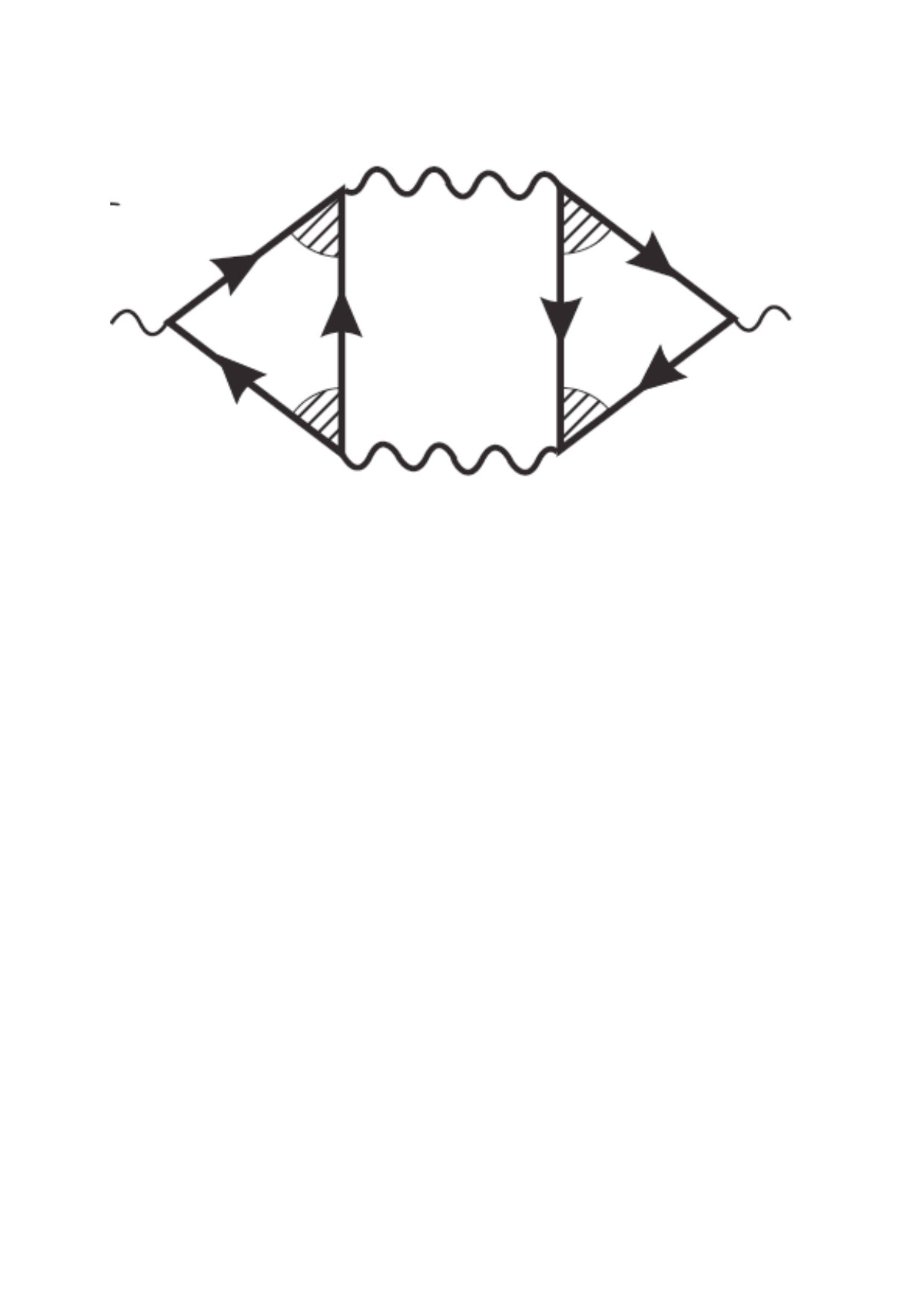 Figure 1
Peer Reviews
No public reviews on file for this paper yet. If you reviewed it on a platform where reviews are public (OpenReview, ICLR, NeurIPS, ICML), you can paste yours below so the community can read it here.
Videos
No videos yet. Explain this paper in a talk, walkthrough, or lecture? Add one.
Effect of critical fluctuations on the spin transport in liquid 3He
V.P.Mineev1,2
1Univ. Grenoble Alpes, CEA, IRIG, PHELIQS, GT, F-38000 Grenoble, France
2Landau Institute for Theoretical Physics, 142432 Chernogolovka, Russia
Abstract
The contribution of pair fluctuations to the spin current in liquid 3He in isotropic aerogel near the critical temperature of transition to superfluid state is calculated.
I Introduction
The superfluid state of liquid 3He is formed by means the Cooper pairing with spin and orbital angular momentum equal to 1 Vollhardt2013 . Investigation of superfluid phases in high porosity aerogel allows to study the influence of impurities on superfluidity with -pairing Parpia1995 ; Halperin1995 . In the normal-state spin diffusion coefficient of 3He in aerogel is determined both by elastic and inelastic scattering of 3He quasiparticles. At low temperatures the collisions between the Fermi liquid quasiparticles induce negligibly small correction to the spin diffusion due to the scattering on aerogel strands Sauls2005 ; Dmitriev2015 . The field theoretical approach to the calculation of the spin diffusion coefficient in the normal 3He in an anisotropic aerogel has been developed in the paper Mineev2018 in the analogy with the calculation of electric current in an isotropic metal with randomly distributed impurities performed in Abrikosov1959 . Close to the superfluid transition temperature in line with regular spin transport limited by scattering of quasiparticles on the aerogel there is an additional mechanism determined by the Cooper pairs fluctuations accelerating spin transport as the critical point is neared. The effects of fluctuations on the thermodynamics and kinetics of a superconductor near the transition point are well known Varlamov2009 . The theoretical studies of these phenomena have acquired the firm basis since the publication of the seminal paper by L.G.Aslamazov and A.I.Larkin where the field theoretical approach to the problem has been developed Aslamazov1968 . The corresponding theory in application to d-wave pairing in layered metals has been developed in the papers Yip1990 . The low temperature (quantum) limit has been considered in Ref.11. In the present paper, I apply this approach to calculation of the contribution of pair fluctuations to the spin current density above the critical temperature in normal 3He in isotropic aerogel.
To make easy comparison with calculation of paraconductivity in superconductors with -pairing Ref.9 I begin with definition of the fluctuating propagator for -wave superfluid. An electric current presents a response to the em vector potential. Similarly a spin current is given by the response to the nonuniform rotation of the spin space. This allows to perform the derivation of para spin diffusion in liquid 3He in the same spirit as paraconductivity of a metal near transition to -wave superconducting state.
II Spin diffusion of a fluctuating pair
The order parameter of superfluid phases of 3He is given Vollhardt2013 by the complex matrix , where and are the indices numerating the Cooper pair wave function projections on spin and orbital axes respectively. The second-order term in the Landau free energy density is
[TABLE]
where is the constant of -wave triplet pairing, is the -component of the momentum unit vector . Here,
[TABLE]
is the normal state quasiparticle Green function and is the vertex part. is the quasiparticles energy counted from the chemical potential, and are the fermion Matsubara frequences, , is the mean free time scattering of quasiparticles in an isotropic aerogel. The Planck constant was everywhere put equal to 1. Correspondingly the matrix of the fluctuation propagator is
[TABLE]
where are the boson Matsubara frequencies.
As it was pointed out in Ref.9 the largest contribution to the conductivity of a fluctuating pair is given by the diagram shown in Fig.1, where wavy lines are the fluctuating propagators, the straight lines are the Green functions and the shaded triangles are the vertex parts. In contrast to s-pairing, due to momentum dependent pairing interaction, all the vertices are not scalar but vector functions. To find the corresponding analytic expression one must define the spin current.
The spin current in neutral Fermi liquid can be found Makhlin1992 ; Volovik1992 as response to the gradient of angle of rotation of the spin space \mbox{\boldmath\omega}_{i}=\nabla_{i}\mbox{\boldmath\theta},
[TABLE]
where
[TABLE]
[TABLE]
\mbox{\boldmath\sigma}=(\sigma_{x},\sigma_{y},\sigma_{z}) are the Pauli matrices, and includes the Fermi liquid interaction and the interaction with impurities. The response to the gauge field \mbox{\boldmath\omega}_{i} is calculated Mineev2018 in analogy with response to the usual vector potential Abrikosov1959 . The contribution of pair fluctuations to the spin current density above the critical temperature corresponding to diagram shown in Fig.1 is
[TABLE]
Here, are the boson Matsubara frequencies, is the fluctuation propagator. The triangle block
[TABLE]
is expressed through three Green functions (2) and the impurity vertex functions , . The sign of the complex conjugation in the second vertex function in Eq.(8) corresponds to the opposite direction of the arrows of the Green function lines in Fig.1 in respect to the first vertex (time inversion). The impurity vertex functions are determined by the integral equation
[TABLE]
Near critical temperature the main frequency dependence arises from the fluctuation propagators having the pole structure. Due to this reason one can neglect by the frequency dependence of the blocks and the vertices . In the integral Eq.(7) are essential only small values of . Then, the solution Eq.(9) is
[TABLE]
here is the Fermi velocity. The integral of the product of three Green functions in linear in respect of wave-vector approximation is
[TABLE]
where is the density of states per one spin projection. Substituting Eqs.(10), (11) in the Eq.(8) and performing the integration over angles we obtain
[TABLE]
where is the second derivative of the digamma function.
The matrix of the fluctuation propagator is given be Eq.(3). The off-diagonal elements of this matrix can be omitted because they are proportional to higher order terms in components of vector : . Performing integration over momenta in Eq.(3) we obtain at small and
[TABLE]
Here,
[TABLE]
The critical temperature is suppressed in respect to the temperature of superfluid transition in pure helium and determined from the equation
[TABLE]
The coefficient
[TABLE]
The first line here corresponds to the limit of weak scattering when the critical temperature is slightly suppressed by impurities and the typical frequencies of fluctuations . This is quasi-static or classic fluctuation region. In respect to the second line one must remark that impurities completely suppresses superfluidity at , here is the Euler constant. Hence, and for fulfillement of inequality the temperature must be at least times lower than the critical temperature in pure helium. Still, at such low temperatures there are two different situations. First, this is again region of classic fluctuations . The second is the region of quantum fluctuations when the frequencies of fluctuations exceed the temperature.
The coefficient
[TABLE]
It is convenient to rewrite these expressions in terms of zero temperature coherence length . Hence, at temperatures near
[TABLE]
Thus, unlike to the case of -wave pairing Ref.8, both in the clean case and in the dirty enough case .
Using this notation the Eq. (12) acquires the following form
[TABLE]
where
[TABLE]
Let us first neglect the terms that is true in low scattering limit . Substituting Eqs.(13) and (23) into Eq.(7) and making use the analytical continuation from the discrete frequencies to the complex plane Aslamazov1968 we obtain linear in frequency term in the spin current
[TABLE]
where
[TABLE]
are retarded and advanced fluctuation propagators. Performing the integration in classic (static) limit we have:
[TABLE]
The quantum limit ( in neglect of terms ) can be reached at low temperatures when and the corresponding current expression is
[TABLE]
Still, the temperature is limited from below by the critical temperature and the critical fluctuations in close vicinity of critical temperature are always classical to displeasure of fans of quantum phase transitions.
Making use the Larmor theorem
[TABLE]
where is the gyromagnetic ratio, is the magnetic moment of 3He atoms, one can rewrite the Eq. (29) for the fluctuation current as
[TABLE]
Thus, in low scattering limit , where the negligence by terms is justified, Eqs.(22), (25) are correct. Whereas in ultra low temperature region we have . Hence, in this temperature region in the classic (static) limit the fluctuation current given by Eqs.(22),(25)acquires factor . The same is true in respect of Eq. (23) in the quantum region .
The sluggish logarithmic correction develops itself only at very low temperatures, therefore it presents just academic interest.
III conclusion
In conclusion it is reasonable to compare the spin current due to the Cooper pairs fluctuations with the diffusion current Mineev2018 determined by impurity scattering. The latter in dimensional units is
[TABLE]
Here, is the spin diffusion coefficient. Thus, the ratio of two currents is
[TABLE]
In dense aerogel the diffusion coefficient can be small enough Dmitriev2015 , the coherence length at ambient pressure Sauls2005 is , density of states at ambient pressure Wheatley1975 is . Thus,
[TABLE]
In respect of experimental detection of fluctuation spin current this result is not encouraging. But, it will be perhaps useful to exact determination of temperature of transition at measurement of coefficient of diffusion near the critical temperature.
The temperature dependence of spin diffusion current in 3He due to pair fluctuations (32) is turned out the same as the temperature dependence of paraconductivity of a normal 3D metal near transition to the s-wave superconducting state Aslamazov1968 . This not astonishing because the structure of the theory is similar despite some particular features typical for -wave pairing. The temperature dependence of the fluctuation spin diffusion current in quantum limit (30) also coincides with the temperature dependence of paraconductivity in -wave superconductors in quantum limit found in Ref.11.
The reference list from the paper itself. Each links out to its DOI / PubMed record.
- 1(1) D.Vollhardt and P.Wölfle, The Superfluid Phases of Helium-3 ( Taylor and Francis, London,1990).
- 2(2) J.V.Porto and J.M.Parpia, Phys. Rev. Lett. 74 , 4667 (1995).
- 3(3) D. T. Sprague, T. M. Haard, J.B. Kycia, M. R. Rand, Y. Lee, P. J. Hamot, and W. P. Halperin, Phys. Rev. Lett. 75 , 661 (1995).
- 4(4) J. A. Sauls, Yu. M. Bunkov, E. Collin, H. Godfrin, and P. Sharma, Phys. Rev. B 72, 024507 (2005).
- 5(5) V.V.Dmitriev, L.A.Melnikovsky, A.A.Senin, A.A.Soldatov, and A.N.Yudin, JETP Letters 101 , 808, (2015).
- 6(6) V.P.Mineev, Phys.Rev.B 98 , 014501 (2018).
- 7(7) A.A.Abrikosov and L.P.Gor’kov, Zh. Exp.Teor. Fiz. 35 , 1558 (1958) Sov. Phys. JETP 8 , 1090 (1959).
- 8(8) A. Larkin and A. Varlamov ”Theory of Fluctuations in Superconductors”, International Series of Monographs on Physics OUP, Oxford, 2009.