Supercurrent detection of topologically trivial zero-energy states in nanowire junctions
Oladunjoye A. Awoga, Jorge Cayao, Annica M. Black-Schaffer

TL;DR
This paper demonstrates that zero-energy states in trivial nanowire junctions can be detected via a phase shift in supercurrent, providing a clear method to distinguish them from Majorana states, with implications for quantum device design.
Contribution
The study reveals that zero-energy states in trivial phases produce a detectable $ ext{pi}$-shift in supercurrent, offering a new detection method that rules out Majorana interpretations.
Findings
Zero-energy states induce a $ ext{pi}$-shift in supercurrent.
Zero-energy states can form in trivial phases under certain conditions.
Detection method distinguishes trivial zero-energy states from Majoranas.
Abstract
We report the emergence of zero-energy states in the trivial phase of a short nanowire junction with strong spin-orbit coupling and magnetic field, formed by strong coupling between the nanowire and two superconductors. The zero-energy states appear in the junction when the superconductors induce a large energy shift in the nanowire, such that the junction naturally forms a quantum dot, a process that is highly tunable by the superconductor width. Most importantly, we demonstrate that the zero-energy states produce a -shift in the phase-biased supercurrent, which can be used as a simple tool for their unambiguous detection, ruling out any Majorana-like interpretation.
Click any figure to enlarge with its caption.
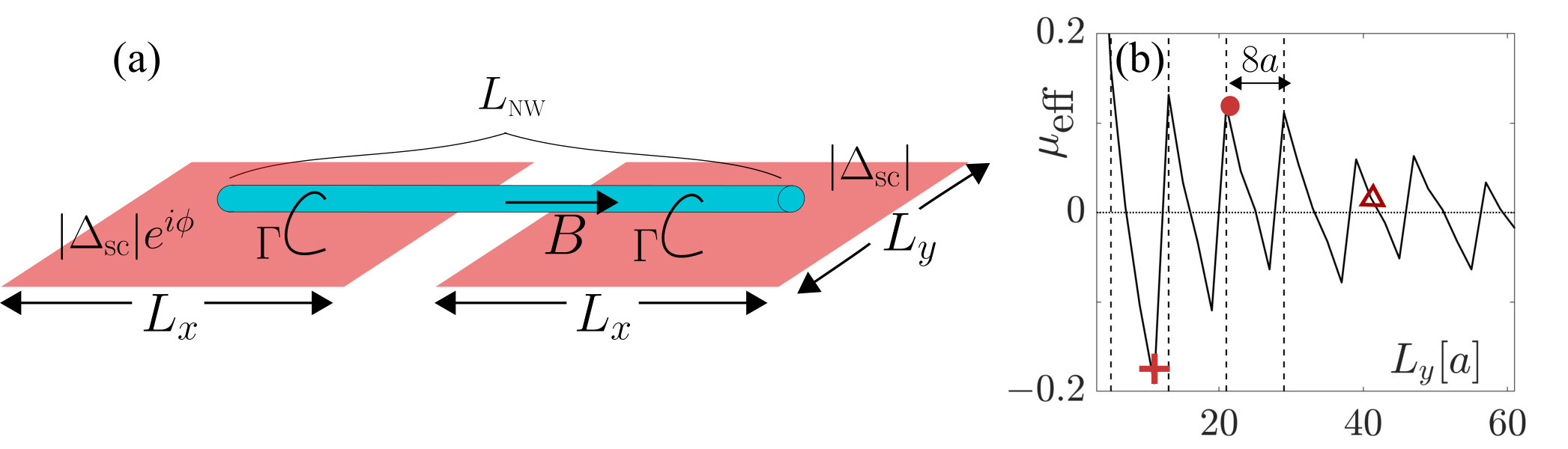 Figure 1
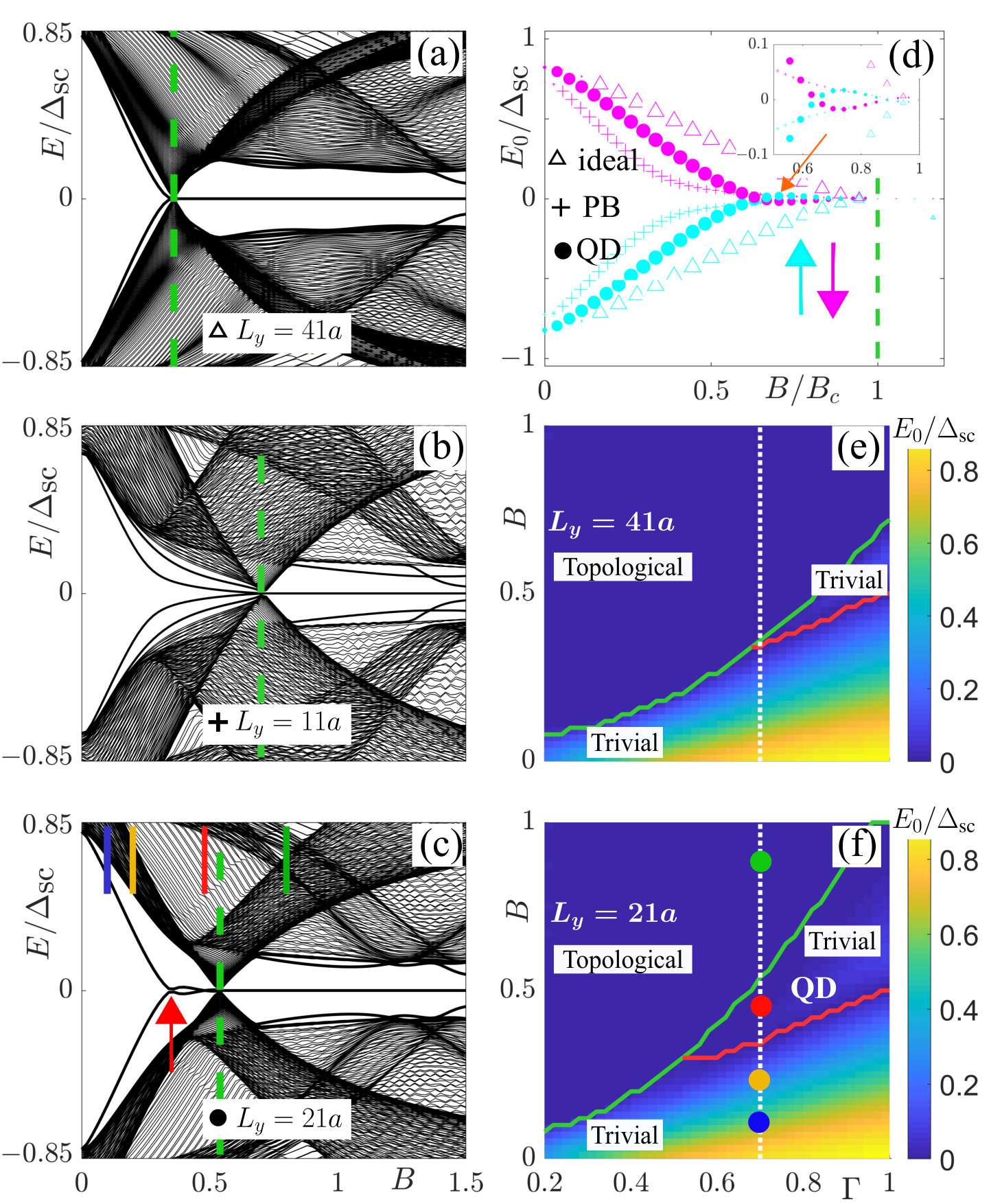 Figure 2
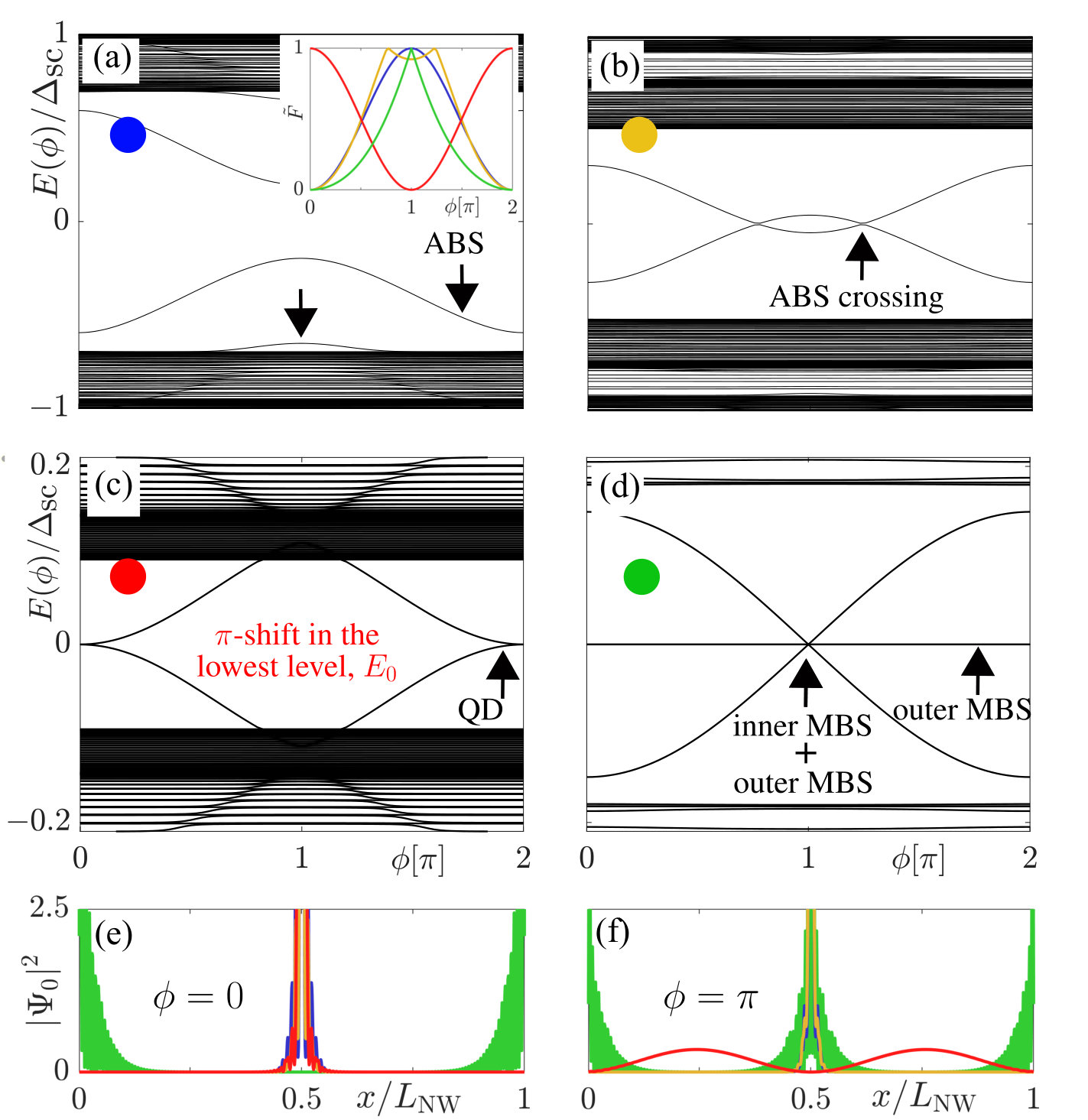 Figure 3
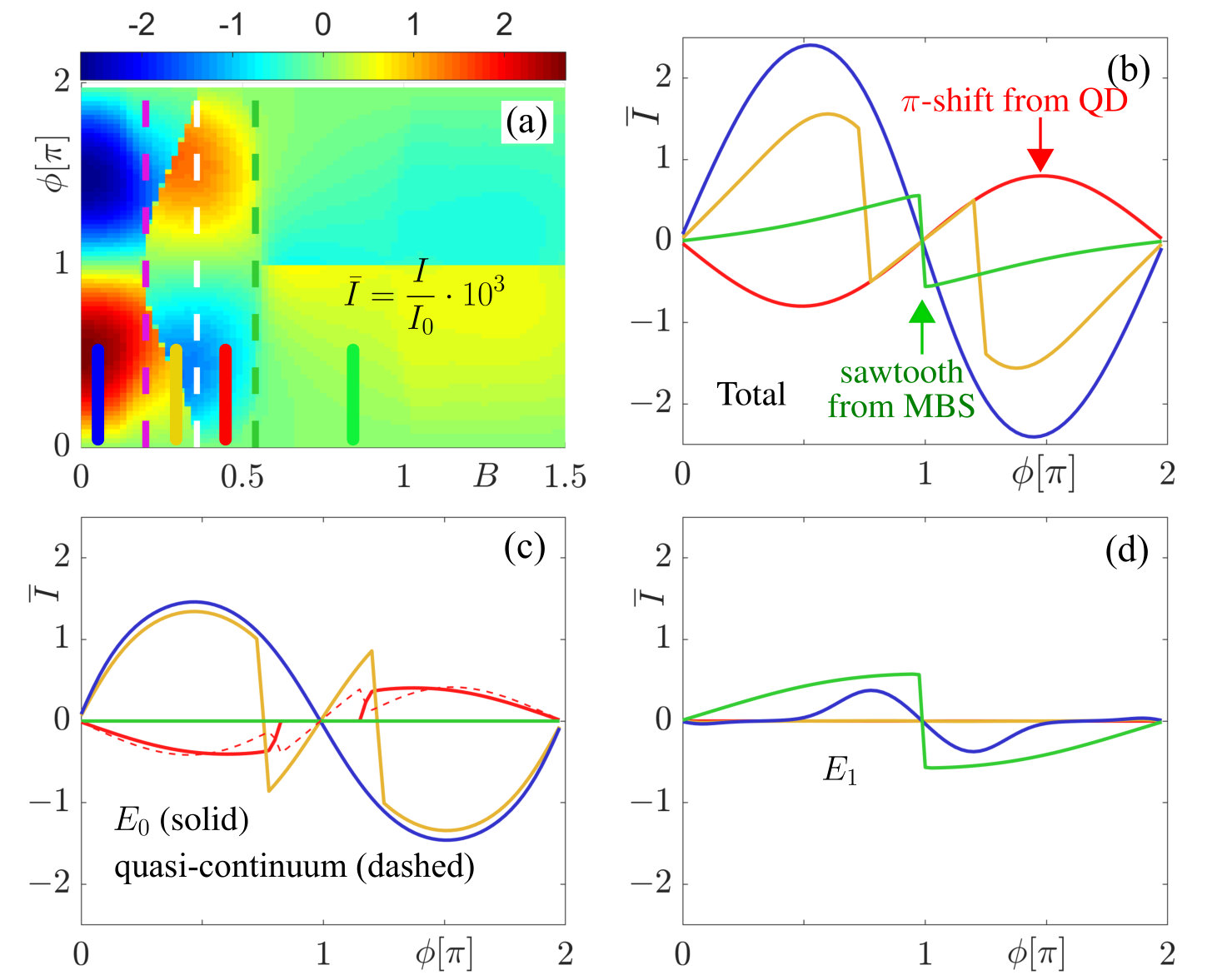 Figure 4
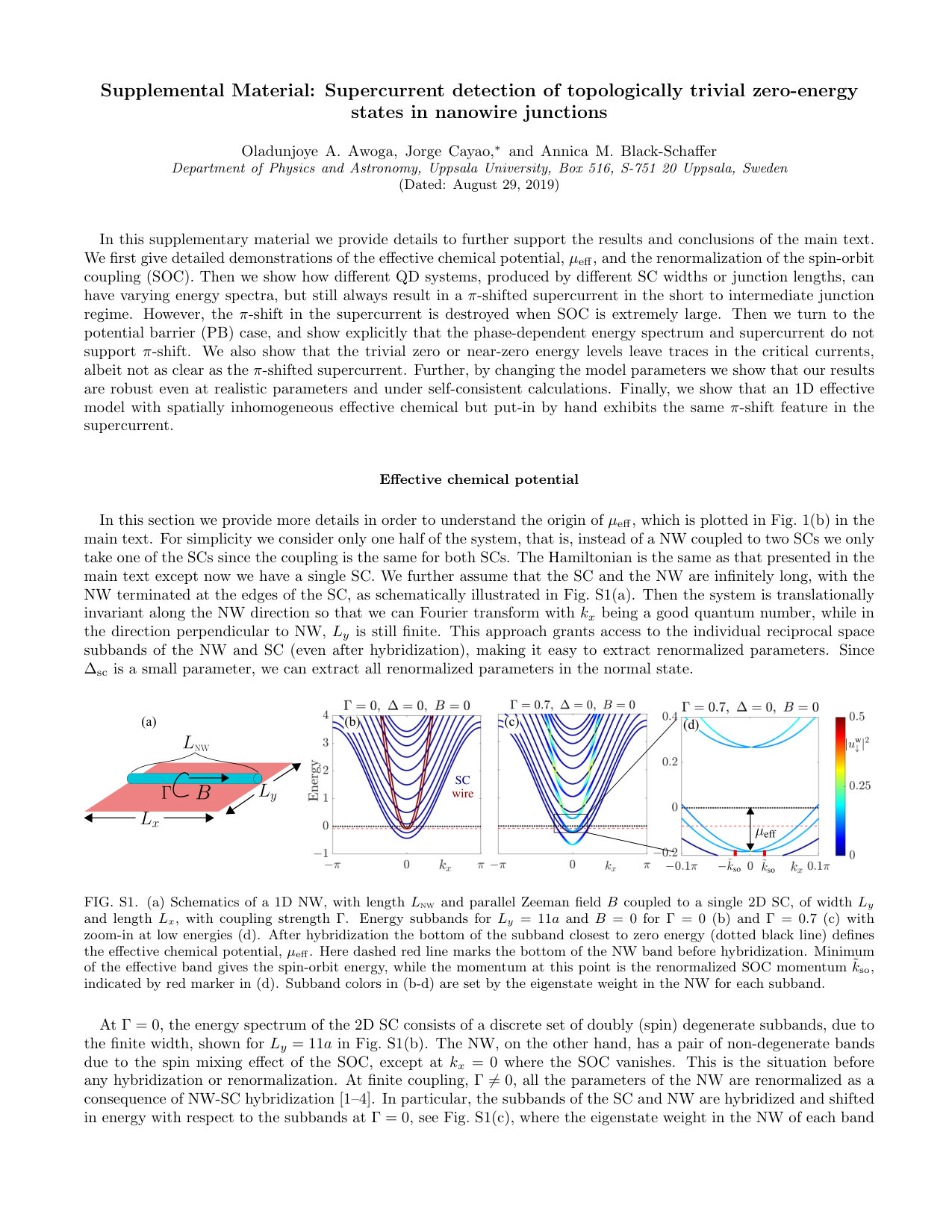 Figure 5
Peer Reviews
No public reviews on file for this paper yet. If you reviewed it on a platform where reviews are public (OpenReview, ICLR, NeurIPS, ICML), you can paste yours below so the community can read it here.
Videos
No videos yet. Explain this paper in a talk, walkthrough, or lecture? Add one.
Supercurrent detection of topologically trivial zero-energy states in nanowire junctions
Oladunjoye A. Awoga
Jorge Cayao
Annica M. Black-Schaffer
Department of Physics and Astronomy, Uppsala University, Box 516, S-751 20 Uppsala, Sweden
Abstract
We report the emergence of zero-energy states in the trivial phase of a short nanowire junction with strong spin-orbit coupling and magnetic field, formed by strong coupling between the nanowire and two superconductors. The zero-energy states appear in the junction when the superconductors induce a large energy shift in the nanowire, such that the junction naturally forms a quantum dot, a process that is highly tunable by the superconductor width. Most importantly, we demonstrate that the zero-energy states produce a -shift in the phase-biased supercurrent, which can be used as a simple tool for their unambiguous detection, ruling out any Majorana-like interpretation.
Majorana bound states (MBSs) in topological superconductors have generated remarkable interest due to their potential applications in fault tolerant quantum computation Kitaev (2001); Nayak et al. (2008); Schrade and Fu (2018a). A promising route for engineering the topological phase is based on nanowires (NWs) with strong Rashba spin-orbit coupling (SOC) and proximity-induced -wave superconductivity, with MBSs emerging at the NW ends for sufficiently large magnetic fields Lutchyn et al. (2010); Oreg et al. (2010); Alicea (2010). Initial issues, such as a soft superconducting gap Lee et al. (2012); Pientka et al. (2012); Bagrets and Altland (2012); Liu et al. (2012); Rainis et al. (2013); Sau and Das Sarma (2013); Žitko et al. (2015), of the first experiments Mourik et al. (2012); Deng et al. (2012); Das et al. (2012); Finck et al. (2013); Churchill et al. (2013); Lee et al. (2014) have been solved through the fabrication of high quality interfaces between the NW and external superconductors (SCs) Chang et al. (2015); Higginbotham et al. (2015); Krogstrup et al. (2015); Zhang et al. (2017); Albrecht et al. (2016); Deng et al. (2016); Nichele et al. (2017); Suominen et al. (2017); Chen et al. (2017); Deng et al. (2018); Zhang et al. (2018).
Despite the advances, there is still no consensus whether MBSs have been observed or not. In fact, recent reports show that trivial zero-energy Andreev bound states (ABSs) from e.g. chemical potential inhomogeneities, appearing well outside the topological phase Prada et al. (2012); Cayao et al. (2015); San-José et al. (2016); Fleckenstein et al. (2018), can also lead to a quantized conductance Liu et al. (2017a); Vuik et al. (2018), a feature previously attributed solely to MBSs Law et al. (2009). This controversy can at least partially be attributed to oversimplified models used to describe the experiments. Indeed, a common treatment of superconductivity has been to simply add an induced superconducting gap into a one-dimensional (1D) NW model, ignoring all other effects caused by coupling a SC to a NW.
A more accurate approach is to study the whole NW+SC system, since the achieved high-quality interfaces result in a strong coupling between NW and SC and thus the SC generates both an induced gap and affect other NW parameters. Importantly, the NW energies are shifted when the coupling between the SC and NW is strong due to the lowest states having a large weight in the SC Stanescu and Das Sarma (2017); Reeg et al. (2017, 2018a, 2018b, 2018c). This results in an effective chemical potential in the NW, which regulates when the NW reaches the topological phase. Therefore using a NW+SC model is crucial for gaining further insights into the experimental situation.
In this Letter we study the whole NW+SC system and find trivial zero-energy ABSs spontaneously emerging in a NW strongly coupled to two SCs forming a short superconductor-normal-superconductor (SNS) junction. The zero-energy ABSs appear in the junction when the SCs induce a large in the NW, such that the junction forms natural quantum dot (QD). The QD formation occurs at regular intervals, every Fermi wavelength increment in SC width, and is thus predictable. By simply regulating the width of the SCs, we can tune the NW from an ideal regime with no energy shifts, to forming a QD or even a potential barrier (PB) at the junction. The formation of the QD and its zero-energy ABSs is therefore very different from previous situations where the QD was simply put in by hand Liu and Baranger (2011); Droste et al. (2012); Vernek et al. (2014); Ruiz-Tijerina et al. (2015); Ptok et al. (2017); Liu et al. (2017b); Vuik et al. (2018). Most importantly, we find that the trivial zero-energy QD states produce a -shift in the phase-biased supercurrent, while MBSs appearing in the topological phase do not. Thus the Josephson effect in short SNS junctions offers a remarkably powerful, yet simple tool for distinguishing between trivial zero-energy states and MBSs.
Model.— We use a 1D NW with strong SOC with the right (R) and left (L) parts strongly coupled to the middle of two 2D conventional SCs, leaving only the central part of the NW uncoupled and forming a short SNS junction, see Fig. 1(a). By varying a magnetic field parallel to the NW we easily tune the topology of the junction. The Hamiltonian is thus , with
[TABLE]
where is the destruction operator for a particle with spin at site in the long NW, while is the destruction operator at site in the 2D SCs with length , width . Here, implies nearest neighbor sites, represents the nearest neighbor hopping and the chemical potential, such that the on-site energies , . In the NW is the SOC, with the SOC strength and the lattice constant, and is the effective Zeeman coupling caused by the magnetic field with a Pauli matrix. The SCs have an onsite -wave superconducting order parameter , with being the SC phase. Finally, is the NW-SC tunneling Hamiltonian with finite coupling strength , whenever the NW touches either SCs.
We solve the Hamiltonian within the Bogoliubov-de Gennes framework de Gennes (1999) using parameters in units of : , , , , which accounts for the small NW effective mass and mismatching Fermi wavevectors in NW and SC, and being close to realistic values. We also set , , and . Here, the strong coupling regime, with the induced gap in the NW close to , is reached around . For smaller and , a smaller achieves strong coupling. Further, we use , , and keep the N-junction long, to reach realistic sizes with the outer ends of the NWs well within the SCs. The width of the SC, , is varied in order to tune the influence of the SC on the NW Reeg et al. (2017, 2018a, 2018b, 2018c). We have verified that our results remain qualitatively unchanged for and both being smaller (or even larger), as well as when is calculated self-consistently Black-Schaffer and Doniach (2008); Björnson et al. (2017); Awoga et al. (2017); Theiler et al. (2018); Mashkoori and Black-Schaffer (2019). Our results also do not depend on , , junction length, provided are longer than the superconducting coherence length and the junction is short, see Supplementary Material (SM) for more information SM .
As a result of strong coupling to the SC, all inherent NW parameters are renormalized Stanescu and Das Sarma (2017); Reeg et al. (2017, 2018a, 2018b, 2018c); Woods et al. (2019). Most important is an energy shift of the NW bands Reeg et al. (2018c). We encode this by an effective chemical potential , which we define as the energy of the bottom of the hybridized subband closest to the Fermi energy (since superconductivity occurs around the Fermi energy). We extract deep in the S regions of the NW and find that it oscillates as a function of , see Fig. 1(b). The oscillations are due to a mismatch between the SC and NW bands, with period (here ) given by the SC Fermi wavelength. Thus, by changing we can easily tune through a range of .
Low-energy spectrum.— When the S regions of the NW get a non-zero , the properties of the SNS junction change. We show this first by studying the Zeeman dependent low-energy spectrum at for three values of the SC width , see Fig. 2(a-c). The common characteristic in all three cases is that the spectrum exhibits a sizable gap at zero , indicating the presence of superconductivity, which then closes and reopens at the critical field signaling the topological phase transition (green dashed line). By calculating the topological invariant for a NW coupled to a single SC Alexandradinata et al. (2014) we verify that the gap closure in Fig. 2(a-c) matches the topological phase transition point. In the topological phase the SNS system hosts a pair of MBSs, with zero energy, one at each end of the NW (outer MBS), for all cases. Since changes the NW properties, we find that also changes somewhat with .
Remarkably, there is a very strong effect of on the low-energy spectrum inside the junction, resulting in the emergence of additional low-energy states below . These can be understood when comparing in the S regions of the NW to the native chemical potential , which is still the relevant energy in the N region. In fact, in Fig. 2(a) the low-energy spectrum does not exhibit any unusual features, since here (triangle in Fig. 1(b)). We refer to this regime as the ideal case. However, when (cross in Fig. 1(b)), the junction acts as a potential barrier (PB) and we see in Fig. 2(b) that such PB junction can host discrete low-energy levels in the trivial phase. Finally, when (dot in Fig. 1(b)), there is instead a quantum dot (QD) profile in the junction. Remarkably, this QD accommodates a clear single zero-energy crossing in the trivial phase, see Fig. 2(c).
We here stress that the QD with a zero-energy crossing in the trivial phase emerges spontaneously at the junction, just due to strong NW-SC coupling and tuning . We have numerically verified that the QD zero-energy states occur for , where is the renormalized SOC in the NW (dependent on and , here ), see SM SM . Zero-energy states have previously been reported in simple 1D models with a QD put in by hand Droste et al. (2012); Lee et al. (2013); Cayao et al. (2015); Ptok et al. (2017); Liu et al. (2017b); Vuik et al. (2018), producing signatures similar to MBSs and thus challenging attempts trying to distinguish between such trivial zero-energy levels and MBSs Reeg et al. (2018c); Vuik et al. (2018); Schrade and Fu (2018b); Yavilberg et al. (2019). In our work the QD instead develops naturally and we also find that the trivial zero-energy crossings appear solely in the QD regime, not in the PB or ideal regimes.
Further insights can be obtained from the local spin projection along (i.e. the -component), in the lowest level states, which is given by , and superscript/subscript denotes component/position and are the wave function amplitudes at position Sticlet et al. (2012); Björnson and Black-Schaffer (2014); Szumniak et al. (2017); Serina et al. (2018). In Fig. 2(d) we show at the junction, i.e. , with marker size denoting the magnitude. vanishes in the topological phase as the lowest level, , is then the outer MBSs. However, in the trivial phase the zero-energy crossing in the QD case is accompanied by an exchange of spins in the occupied state. Such spin exchange does not occur in the other cases, leading to a fundamental difference in the spin properties of the QD and PB cases, even if they both host discrete low-energy states below the quasi-continuum.
We finally analyze the size of the regime where trivial zero-energy QD states are observed. In Fig. 2(e,f) we plot as a function of and for the cases in Fig. 2(a,c), respectively. From the low-energy spectrum, we identify the topological phase transition (green line) and the beginning of the zero-energy state QD regime (red line). The QD regime forms a triangular region which is clearly enlarged with . Remarkably, Fig. 2(e) shows that even wide SCs can host a QD regime with trivial zero-energy states for strong enough couplings (white dotted line marks from the ideal case in Fig. 2(a)). We thus conclude that SNS junctions readily form natural QDs hosting trivial zero-energy states in the strong coupling regime.
Phase-dependence.— Next we allow for a finite phase across the SNS junction. In particular, we study the phase-dependent energy spectrum for the QD case in Fig. 2(c) at the -values identified by the colored bars. At very low (blue) we find ABSs detached from the quasi-continuum and exhibiting the usual cosine behavior Cayao et al. (2017, 2018), see Fig. 3(a). These lowest energy states are localized at the junction for both , see blue line in Figs. 3(e,f). On the other hand, in the topological phase at very large (green) four MBSs appear in the system: two dispersionless outer MBSs and at also two MBSs located in the junction (inner MBSs), see Fig. 3(d) for the energy spectrum and Figs. 3(e,f) for the wave function probabilities. In both the low trivial and high topological regimes, the lowest level reaches maximum negative energy at . The SNS junction is therefore in the [math]-state because the free energy, , is minimized at , see blue and green lines in the inset of Fig. 3(a).
It is at intermediate in the trivial phase that dramatic changes takes place. First, the ABSs move towards zero energy with increasing and start to cross, see Fig. 3(b). As a consequence, the free energy, plotted in gold in the inset in Fig. 3(a), has a global minimum at and a local minimum at . The junction is thus in a -state Vecino et al. (2003). Further increasing we find that the global and local minima interchanges, eventually reaching the situation in Fig. 3(c). Here the zero-energy crossing is at , implying that a full -shift has occurred in the low-energy spectrum. As a consequence, this junction is in a -state, since the minimum of is now at , see red Fig. 3(a) inset. At the ABSs are localized at the junction, as in all other cases in the trivial phase, while at the lowest energy state is completely delocalized because of mixing with the quasi-continuum, see red in Fig. 3(e,f).
We find that the -state always emerges when the SNS junction hosts a pair of QD states with zero-energy crossings. In essence this is because the QD forces the ABS to be at or close to zero energy for . We also note that the QD introduces a phase-dependence for the quasi-continuum, unlike in conventional short junctions Beenakker (1992). We have also verified that the ideal and PB cases do not exhibit any -states, see SM SM . Thus, the phase-dependent energy spectrum offers a remarkably clear differentiation between topologically trivial zero-energy QD levels and MBSs.
Current-phase relationship.— To perform a direct detection of the QD trivial zero-energy states we consider the junction supercurrent , obtained from , where . Figure 4(a) shows a color plot of as a function of and for the QD case in Fig. 2(c). For a complete understanding of how the QD levels contribute to , we also plot both the total current and the contributions from the lowest () and first excited () energy levels in Figs. 4(b,c,d) for the same values analyzed in Fig. 3.
At low in the trivial phase displays the usual -like behavior. This is the [math]-state, where gives the dominating contribution to the supercurrent, albeit also give a small positive contribution, see blue line in Fig. 4(b,c,d). Beyond the topological phase transition (green dashed line) the situation is also easy to understand. Here has a characteristic sawtooth profile at due to the special zero energy behavior of the inner MBS at , which has been proposed as a signature of true MBSs in short SNS junctions Cayao et al. (2018, 2017).
Between the magenta and white lines in Fig. 4(a), we find a region with a discontinuous , which is caused by the ABS crossings in Fig. 3(b). Here, the levels are strongly dispersive with leading to the largest contributions to , see gold in Fig. 4(c). Finally, between the dashed white and green lines in Fig. 4(a), we find a full sign-reversal for the supercurrent, with the white line corresponding to the red arrow in Fig. 2(c) indicating the zero-energy crossing at . This -shifted supercurrent arises from the special behavior of the low-energy spectrum: the lowest ABSs exhibit maximum energy at , see Fig. 3(c), instead of a minimum as is the case for conventional junctions Beenakker (1992). Thus the level contributes strongly to the -shifted supercurrent, as also seen in red in Fig. 4(c). Due to the presence of the QD levels, the quasi-continuum also gives a -shifted contribution to . For the ideal and PB junctions, the ABS energy spectrum only exhibits [math], , -states, but never the -state and thus we never see a -shifted supercurrent. Some signatures of the QD and PB junctions can also be captured by the critical current but not as clear as the -shift, see SM SM .
For SNS junctions with trivial zero-energy crossings we always find a -shifted supercurrent, independent on any zero-energy pinning after the crossing. These zero-energy levels, appearing in the QD regime, are however somewhat sensitive to SOC Droste et al. (2012), with very large SOC inducing level repulsion, which gaps the spectrum and thus destroys the supercurrent -shift, see SM SM . Interestingly, QD levels in clearly non-topological Josephson junctions have previously been shown to change the state of the junction from [math] to with increasing magnetic field and also associated with a spin exchange Buzdin (2005); Chang et al. (2013); Yokoyama et al. (2013); Lee et al. (2014); Szombati et al. (2016); Vecino et al. (2003); Zuo et al. (2017); Lee et al. (2017); Estrada Saldaña et al. (2019), fully consistent with our findings.
In conclusion, we demonstrate the emergence of zero-energy states in the trivial phase of short SNS NW junctions, due to strong NW-SC coupling causing a QD formation in the NW and tunable by the SC width. Most significantly, these zero-energy states produce a -shift in the phase-biased supercurrent, making them easily distinguishable from MBSs appearing in the topological phase.
We thank C. Reeg and C. Schrade for useful discussions and M. Mashkoori for helpful comments on the manuscript. We acknowledge financial support from the Swedish Research Council (Vetenskapsrådet), the Göran Gustafsson Foundation, the Swedish Foundation for Strategic Research (SSF), the Knut and Alice Wallenberg Foundation through the Wallenberg Academy Fellows program and the EU-COST Action CA-16218 Nanocohybri. Simulations were performed on resources provided by the Swedish National Infrastructure for Computing (SNIC) at the Uppsala Multidisciplinary Center for Advanced Computational Science (UPPMAX).
The reference list from the paper itself. Each links out to its DOI / PubMed record.
- 1Kitaev (2001) A. Y. Kitaev, “Unpaired Majorana fermions in quantum wires,” Phys. Usp. 44 , 131–136 (2001) . · doi ↗
- 2Nayak et al. (2008) C. Nayak, S. H. Simon, A. Stern, M. Freedman, and S. Das Sarma, “Non-abelian anyons and topological quantum computation,” Rev. Mod. Phys. 80 , 1083–1159 (2008) .
- 3Schrade and Fu (2018 a) C. Schrade and L. Fu, “Majorana superconducting qubit,” Phys. Rev. Lett. 121 , 267002 (2018 a) . · doi ↗
- 4Lutchyn et al. (2010) R. M. Lutchyn, J. D. Sau, and S. Das Sarma, “Majorana fermions and a topological phase transition in semiconductor-superconductor heterostructures,” Phys. Rev. Lett. 105 , 077001 (2010) . · doi ↗
- 5Oreg et al. (2010) Y. Oreg, G. Refael, and F. von Oppen, “Helical liquids and Majorana bound states in quantum wires,” Phys. Rev. Lett. 105 , 177002 (2010) .
- 6Alicea (2010) J. Alicea, “Majorana fermions in a tunable semiconductor device,” Phys. Rev. B 81 , 125318 (2010) .
- 7Lee et al. (2012) E. J. H. Lee, X. Jiang, R. Aguado, G. Katsaros, C. M. Lieber, and S. De Franceschi, “Zero-bias anomaly in a nanowire quantum dot coupled to superconductors,” Phys. Rev. Lett. 109 , 186802 (2012) .
- 8Pientka et al. (2012) F. Pientka, G. Kells, A. Romito, P. W. Brouwer, and F. von Oppen, “Enhanced zero-bias Majorana peak in the differential tunneling conductance of disordered multisubband quantum-wire/superconductor junctions,” Phys. Rev. Lett. 109 , 227006 (2012) .