This paper constructs and analyzes fine moduli spaces for certain wild covers of affine curves in characteristic p, revealing their structure, local-global relations, and finiteness properties of restriction morphisms.
Contribution
It introduces new fine moduli spaces for cyclic-by-p covers of affine curves and establishes their local-global relationships and finiteness of restriction maps.
Findings
01
Constructed fine moduli spaces for cyclic-by-p covers.
02
Established a finite restriction morphism with p-power degrees.
03
Linked global and local moduli spaces via product structures.
Abstract
A fine moduli space is constructed, for cyclic-by-p covers of an affine curve over an algebraically closed field k of characteristic p>0. An intersection of finitely many fine moduli spaces for cyclic-by-p covers of affine curves gives a moduli space for p′-by-p covers of an affine curve. A local moduli space is also constructed, for cyclic-by-p covers of Spec(k((x))), which is the same as the global moduli space for cyclic-by-p covers of P1−{0} tamely ramified over ∞ with the same Galois group. Then it is shown that a restriction morphism is finite with degrees on connected components p powers: There are finitely many deleted points of an affine curve from its smooth completion. A cyclic-by-p cover of an affine curve gives a product of local covers with the same…
No public reviews on file for this paper yet. If you reviewed it on a platform where reviews are public (OpenReview, ICLR, NeurIPS, ICML), you can paste yours below so the community can read it here.
Videos
No videos yet. Explain this paper in a talk, walkthrough, or lecture? Add one.
Taxonomy
TopicsAlgebraic Geometry and Number Theory · Advanced Algebra and Geometry · Commutative Algebra and Its Applications
Full text
Moduli of certain wild covers of curves
Jianru Zhang
Abstract
A fine moduli space (see Section 2 Definition 17) is constructed, for cyclic-by-p covers of an affine curve over an algebraically closed field k of characteristic p>0. An intersection (see Definition 40) of finitely many fine moduli spaces for cyclic-by-p covers of affine curves gives a moduli space for p′-by-p covers of an affine curve. A local moduli space is also constructed, for cyclic-by-p covers of Spec(k((x))), which is the same as the global moduli space for cyclic-by-p covers of P1−{0} tamely ramified over ∞ with the same Galois group. Then it is shown that a restriction morphism (see Lemma 71) is finite with degrees on connected components p powers: There are finitely many deleted points (see Figure 1) of an affine curve from its smooth completion. A cyclic-by-p cover of an affine curve gives a product of local covers with the same Galois group, of the punctured infinitesimal neighbourhoods of the deleted points. So there is a restriction morphism from the global moduli space to a product of local moduli spaces.
Table of content
Introduction
Notations and Terminology
Existence of moduli space for cyclic-by-p covers
Moduli for p′-by-p covers
Local vs. global moduli
1 Introduction
The paper mainly generalizes the results in [H80] for p-groups to cyclic-by-p groups defined in Section 2 Definition 6 a. See Section 2 for notations and terminology below. Since [H80] is frequently cited, the statements of its main results are given in the Introduction.
In [H80], it is shown that (Theorem 1.2 [H80]) when P is a finite p-group, there exists a fine moduli space for pointed principal P-covers (see Section 2 Definition 9 b and c for the definition) of an affine curve over an algebraically closed field k of characteristic p>0, which is an ind affine space (see Definition 14 b). When P′ is a finite group whose order is prime to p, there are only finitely many pointed principal P′-covers of an affine curve. The wild case, where p divides the order of the Galois group of the cover, and the tame case, where p does not divide the order of the Galois group of the cover, are very different. The fine moduli space for pointed principal P-covers of P1−{0} gives a coarse moduli space for local pointed principal P-covers of Spec(k((x))) (Proposition 2.1 [H80]). This is a special case of the next result, since the finite etale morphism there becomes an isomorphism here. Finally it is shown that a restriction morphism is finite etale (Proposition 2.7 [H80]), where the restriction morphism is described in the Abstract with the cyclic-by-p group there replaced by P here. The result can be interpreted as a local-global principle: Given a pointed P-local cover at each of the deleted points of the affine curve from its smooth completion, there are only finitely many global pointed P-covers of the affine curve, whose restrictions at the deleted points are the ones given.
In Figure 1, points 0 and ∞ are the deleted points of A1−{0} from its smooth completion P1. The infinitesimal neighborhood of 0 is Spec(k((x))) and the infinitesimal neighborhood of ∞ is Spec(k((x−1))). f gives a trivial Z/2-cover of A1−{0}. The restriction of the global cover at 0 is a trivial Z/2-cover of the infinitesimal neighborhood. Similarly for ∞.
The fine moduli space for pointed principal P-covers of an affine curve in [H80] is constructed in an inductive way with the base case for P=Z/p.
Cyclic-by-p groups are the next simplest after p-groups in the wild case. In the local situation, the Galois group of a connected Galois cover of Spec(k((x))) is a cyclic-by-p group when k is algebraically closed.
The fine moduli space for pointed principal cyclic-by-p covers of an affine curve is also constructed in an inductive way, using similar methods to those in the proof of Theorem 1.2 of [H80]. The fine moduli space is a disjoint union of finitely many ind affine spaces. Its relation to the the fine moduli space for pointed principal P-covers of an affine curve constructed in Theorem 1.2 [H80], is shown in Section 4 Lemma 36.
The next simplest groups after cyclic-by-p groups are p′-by-p groups defined in Section 2 Definition 6 a. A disjoint union of finitely many unions, of certain irreducible components in an intersection, of finitely many fine moduli spaces for cyclic-by-p covers of affine curves, gives a moduli space for p′-by-p covers of an affine curve.
Two local-global principle results similar to those in [H80] described above are obtained, based on the construction of the fine moduli space for pointed principal cyclic-by-p covers of an affine curve, again using similar methods to those in [H80].
Here is the structure of the paper.
In Section 2, notations and terminology are given, which are used throughout Sections 3, 4, and 5 without explanation again. In Section 3, a fine moduli space for pointed principal G-covers of an affine curve (Theorem 33), where G is a cyclic-by-p group, is constructed. In Section 4, it is shown that a disjoint union of finitely many unions, of certain irreducible components in an intersection, of finitely many fine moduli spaces for cyclic-by-p covers of some affine curves, gives a moduli space for p′-by-p covers of an affine curve (Corollary 47). In Section 5, a global fine moduli space is constructed (Proposition 53) for cyclic-by-p covers of an affine curve at most tamely ramified over finitely many closed points, as well as a parameter space for local cyclic-by-p covers of Spec(k((x))) (Proposition 64). Then it is shown that a restriction morphism is finite with degrees on connected components p powers, which is from the global moduli space to a product of the local parameter spaces (Proposition 72).
Leitfaden:
[TABLE]
Similar work can be found in [K86] and [P02]. In [K86], Main Theorem 1.4.1 is essentially the version over a general field of characteristic p>0 of Proposition 65. In [P02], a configuration space C(I,j) is constructed in Section 2.2, which is for I=Z/p⋊Z/n-covers of Spec(k[[u−1]]) with jump j. This is related to the parameter space given in Proposition 64.
For the results in [H80] below, Gr is a finite group, P a finite p-group, k an algebraically closed field, (U0,u0) geometrically pointed Spec(k((x))) and (U,ug) a geometrically pointed affine curve, as defined in Section 2.1.
Let (S,s0) be a pointed (see Definition 7 b and Definition 11 a) connected affine k-scheme. In Definition 11 b, when two pointed S-parameterized Gr-covers of U are equivalent is defined; two such covers are equivalent if they agree pulled back to a finite etale cover T of S. Since a pointed S-parameterized Gr-cover of U corresponds to a homomorphism φ~:π1(S×U,(s0,ug))→Gr, the definition of an equivalence class of φ~ is induced in Remark 12 a. Similarly for the local case; in Definition 55, the w-equivalence class of a pointed S-parameterized Gr-cover of Spec(k((x))) is defined, which induces the definition of a w-equivalence class of a homomorphism φ~:π1(S×Spec(k((x))),(s0,u0))→Gr.
With these terminology, the following definition can be given.
Definition 1**.**
a. Define FU,P as the functor: S1→(Sets); (S,s0)↦{[φ~], where φ~:π1(S×U,(s0,ug))→P is a group homomorphism and [φ~] is the equivalence class (see above or Remark 12 a) of φ~.}
b. Define FU0,Pw as the functor: S1→(Sets); (S,s0)↦{[φ~]w, where φ~:π1(S×U0,(s0,u0))→P is a group homomorphism and [φ~]w is the w-equivalence class (see above or Definition 55) of φ~.}
See Section 2.4 for the definition of a fine moduli space. Theorem 2 means that MU,P represents the moduli functor FU,P. The “direct limit of affine spaces” in Theorem 2 is called an ind affine space in the paper (See Section 2.3 Definition 14 b).
Theorem 2**.**
(Theorem 1.2, [H80]) There is a fine moduli space MU,P (denoted by MG there with G=P) for pointed families of principal P-covers of U, namely a direct limit of affine spaces AkN.
The local case, moduli problem for P-covers of Spec(k((x))), is simpler than the global case. A parallel construction to the one in the global case gives a coarse moduli space of pointed P-covers of Spec(k((x))). Proposition 3 below means that MP1−{0},P represents the moduli functor FU0,Pw.
Proposition 3**.**
(Proposition 2.1, [H80]) The fine moduli space MP1−{0},P for pointed principal P-covers of P1−{0} is also a coarse moduli space for pointed principal P-covers of Spec(k((x))), compatibly with the inclusion Spec(k((x)))⊆P1−{0}.
Proposition 4**.**
(Proposition 2.7, [H80]) Let MU,P→ΠiMU0i,Pl be the restriction morphism described in the Abstract. It is an etale cover. Its degree is a power of p, and is equal to the number of pointed principal P-covers of the completion Uˉ.
Theorem 5**.**
(Theorem 1.12, [H80]) Let MU,P be the fine moduli space for pointed principal P-covers of (U,ug). There is a natural action of Aut(P) on MU,P, and a dense open subset MU,P0 of MU,P parameterizing connected principal covers, such that MˉU,P0:=MU,P0/Aut(P) is a fine moduli space for pointed families of Galois covers of (U,ug) with group P.
Acknowledgement I thank D. Harbater for helpful discussions during the preparation of the paper.
2 Notations and Terminology
Terms and symbols are defined here that will be used in Sections 3, 4, and 5 without being explained again.
2.1 General settings
Definition 6**.**
a. Groups of the form P⋊ρZ/n are called cyclic-by-p groups, where p is a prime number, P a finite p-group and ρ:Z/n→Aut(P) an action of Z/n on P with n and p coprime. Groups of the form P⋊ρ′P′ are called p′-by-p groups, where P′ is a finite group whose order is prime to p and ρ′:P′→Aut(P) an action of P′ on P.
b. Let nt be a factor of n, xt=n/nt, ιnt the embedding of Z/nt into Z/n sending 1ˉ∈Z/nt to xˉt∈Z/n and ρnt=ρ∘ιnt.
c. Gr always represents an arbitrary finite group and G represents P⋊ρZ/n.
Definition 7**.**
a. Let k be an algebraically closed field of characteristic p>0 and fix a primitive n-th root of unity ζn in k. Write U0=Spec(k((x))) and Uˉ0=Spec(k[[x]]). Denote the fiber product S×kX by S×X, where S and X are k-schemes.
b. Pointed means geometrically pointed unless otherwise stated. A geometric point of a scheme X is a morphism from Spec(Ω) to X with Ω an algebraically closed field. Curve means a connected smooth integral affine 1 dimensional scheme of finite type over k.
c. Denote by S (resp. S1) the full subcategory of the category (Pointed k-schemes) of all pointed k-schemes, whose objects are connected affine pointed finite type k-schemes (resp. connected affine pointed k-schemes). Denote by S′ (resp. S1′) the non pointed version of S (resp. S1).
d. (U,ug) always represents a pointed curve.
Remark 8**.**
The word “lift” has two meanings in the paper. The first meaning is to extend a group homomorphism whose domain is a fundamental group, to a group homomorphism with domain a bigger fundamental group. This meaning is given around diagram (3.1) in the definition of ρ-liftable. The second meaning is to lift a morphism ϕˉ mapping to a quotient group Pˉ, to some morphism ϕ mapping to the original group P:
[TABLE]
2.2 Covers
Definition 9**.**
a. Let X be a connected scheme and (FetX) the category of finite etale covers of X. For every point x of X (recall from Definition 7 b that a point on X always means a geometric point), the fiber functorFibx: (FetX)→(Sets) sends a finite etale cover YprX to Yx, the geometric fiber (pullback of Y to x) of Y at x. The fundamental group π1(X,x) is defined as the automorphism group of the fiber functor Fibx. Then Yx is a left π1(X,x)-set.
b. A principal Gr-cover of a connected scheme X not necessarily over k, is a finite etale cover Z→X together with an embedding of Gr in the group Aut(Z/X), such that Gr acts simply transitively (left group action) on every geometric fiber of Z→X. A Gr-cover means a principal Gr-cover.
c. With the notations of b, Z is pointed over x0 means Z is pointed at some point z0 that maps to x0 under Z→X. Two pointed Gr-covers of (X,x0) are isomorphic if there is an isomorphism between them:
[TABLE]
such that the triangle diagram commutes and the diagram
[TABLE]
commutes for each g∈Gr.
Remark 10**.**
a. There is a natural bijection between the set of isomorphism
classes of Gr-covers of X pointed over a fixed base point
x0, and the set of homomorphisms from π1(X,x0) to
Gr, hence below a pointed Gr-cover is often identified with
the homomorphism corresponding to it.
b. If Gr is abelian, the
set of homomorphisms from π1(X,x0) to
Gr is a group. It may be identified with the etale cohomology group H1(X,Gr) (SGA 1, XI 5, or Example 11.3 in [M13]), or in terms of group cohomology with H1(π1(X,x0),Gr).
c. Let Gr be an abelian group and W→U be a Gr-cover of U. Then W pointed at a point wg over ug is isomorphic to, as pointed Gr-covers of (U,ug), W pointed at any other point wg′ over ug.
Definition 11**.**
a. A point (s0,vg) on a fiber product S×V of k-schemes means a commutative diagram by the universal property of a fiber product:
[TABLE]
where Ω is some algebraically closed field.
b. A pointed family of Gr-covers of a pointed connected k-scheme X, parametrized by a pointed connected affine k-scheme S, means an equivalence class of pointed Gr-covers of S×X, two being equivalent if they become isomorphic after being pulled back by some finite etale cover (T,t0)→(S,s0).
Remark 12**.**
a. Two elements ϕ and ϕ′ in Hom(π1(S×U,(s0,ug)),Gr) are equivalent if their corresponding pointed Gr-covers of (S×U,(s0,ug)) are equivalent. Denote the equivalence class of ϕ by [ϕ].
b. Using equivalence classes (see Definition 20, Definition 24, Definition 26, Definition 32), rather than isomorphism classes, a fine moduli space can be constructed. The definition of equivalence, using finite etale covers, arises naturally in the proof of Theorem 21: Assume for instance eρ=1, then the last paragraph in the proof gives F(S,s0)=H1(S,Fq)H1(S×U,Fq). The equality holds because the definition of equivalence uses finite etale covers (see c). With the equality it can be shown that F is represented by an ind affine space.
c. If Gr is abelian, then the set of such pointed families may be identified with H1(S×X,Gr)/H1(S,Gr), where H1(S×X,Gr) and H1(S,Gr) are standard etale cohomology groups.
Definition 13**.**
Suppose X is a connected scheme and x,x′ two geometric points on X. A cheminx′→x means an isomorphism from the fiber functor Fibx to the fiber functor Fibx′ ([S09], Remark 5.5.3, p171). Since the fundamental group π1(X,x) is defined as the automorphism group of the fiber functor Fibx, a chemin x′→x:FibxiFibx′ induces an isomorphism π1(X,x)≃π1(X,x′):α↦iαi−1.
2.3 Ind schemes
Definition 14**.**
a. An ind scheme means, in the paper, a direct system of k-schemes {Xi} indexed by natural numbers with transition k-morphisms {XixiXi+1}.
b. An ind scheme is an ind affine space, if every Xi is an affine space Akni.
Remark 15**.**
Every moduli space M in the paper is a disjoint union of finitely many ind affine spaces, then each ind affine space is called a connected component of M. An ind affine space M can be viewed as a functor: S1→(Sets); (S,s0)↦Hom(S,M). The disjoint union of finitely many ind affine spaces {Mi} is the functor ⨿Mi: S1→(Sets); (S,s0)↦⨿iHom(S,Mi).
Definition 16**.**
a. A pre-morphism from a k-scheme X to an ind scheme {Xm} is the equivalence class of a k-morphism between schemes gm0:X→Xm0 for some m0, where two morphisms gm0 and gm1 are equivalent if for some m2≥m0,m1 the two composition morphisms Xgm0Xm0→Xm2 and Xgm1Xm1→Xm2 are the same.
b. A pre-morphism from an ind scheme {Xm} with transition morphisms {xm} to another ind scheme {Ym} with transition morphisms {ym}, is the equivalence class of a system of compatible k-morphisms {fm∣m≥m0} between schemes with fm:Xm→YNm. The system {fm∣m≥m0} is compatible means that for every m≥m0, there exists an nm such that the following diagram is commutative:
[TABLE]
where yNmnm is the transition morphism from YNm to Ynm and similarly for yNm+1nm. Two compatible systems {fm∣m≥m0} and {gm∣m≥m1} are equivalent, if there exists an m2≥m0,m1 such that for every m≥m2 the two morphisms fm and gm are equivalent in the sense of a. Every pre-morphism between ind schemes in the paper, in Lemma 36, Lemma 37, Lemma 70 and Lemma 71, can be given by a compatible system {fm} of the special form: XmfmYm and the following diagram commutes
[TABLE]
c. In either a or b, a presheaf can be gotten. In b, the presheaf Pre is from the site of (ind schemes)×(ind schemes) with etale topology to (sets); ({Xm},{Ym})↦PreMorph({Xm},{Ym}). Let sPre be the sheafification of Pre. A morphism between {Xm} and {Ym} is an element in sPre({Xm},{Ym}). Similarly for a. Since the construction is canonical, it suffices to check assertions on pre-morphisms.
d. In the cases of Lemma 36, Lemma 37, Lemma 70 and Lemma 71, the morphism given by {fm} in diagram (16.1), is surjective (resp. finite, finite etale), if there exists some natural number m0 such that for every m≥m0 the k-morphism fm is surjective (resp. finite, finite etale).
2.4 Fine moduli space
Definition 17**.**
A fine moduli spaceM for a contravariant functor F from the category S1 to the category (Sets), is an ind scheme such that F is isomorphic to the functor Hom(∙,M): S1→(Sets); (S,s0)↦ {k-morphisms from S to M}.
Below is a list of moduli functors in the paper, with their rough meanings and places where they are defined.
List of moduli functors
FU,P; the functor for pointed P-covers of (U,ug) using equivalence classes; Definition 1 a
FU0,Pw; the functor for pointed P-covers of (Spec(k((x))),u0) using w-equivalence classes; Definition 1 b
FV,Hρ; the functor for pointed ρ-liftable H-covers of (V,vg) using equivalence classes; Definition 20 and Definition 50
FV,Hρ∙; the functor for ρ-liftable pairs (of pointed H-covers) of (V,vg) using equivalence classes; Definition 24
FV,Pρ∙; the functor for ρ-liftable pairs (of pointed P-covers) of (V,vg) using equivalence classes; Definition 26
FU,G; the functor for pointed G-covers of (U,ug) using equivalence classes; Definition 32
FU,GT; the functor for pointed G-covers of (U−T,ug), at most tamely ramified over T consisting of finitely many closed points on U, using equivalence classes; Definition 48
FVl,Pρnl∙/T; the functor for ρnl-liftable pairs (of pointed P-covers) of (Vl,vl) using equivalence classes, with Vl a cover of U at most ramified over T consisting of finitely many closed points on U; Definition 49
FV0,Pwρ∙; the functor for ρ-liftable pairs (of pointed P-covers) of (V0,v0) using w-equivalence classes; Definition 55
Comments about several subtle concepts are collected below for reference convenience.
Comments concerning ind schemes include Remark 15.
Comments concerning universal families include Remark 23, Definition 27, Remark 29, Remark 30, and Definition 39.
Comments concerning fine moduli spaces include Remark 12, Remark 22, Remark 15, Remark 30, Remark 31, Remark 38, and Definition 39.
2.5 Table of symbols
Below is a table of symbols, which are used in Sections 3, 4 and 5 without explanation again after their definitions. It gives meanings of symbols and places where they are defined. “Beginning” of a section means beginning of the rest of the section below the introductory part.
**Table of symbols
**
c; a fixed element in π1(U,ug) that maps to 1ˉ
under θ; Section 3, beginning
ci: similar to c
ci′; a fixed element in π1(Vi′,vgi′) that maps to pi′
under θi′; Section 4, beginning
H; an elementary abelian group of order a p-power;
Lemma 18
{pri:(Vi,vi)→(U,ug)}; the set of all connected
pointed Z/ni-covers of (U,ug) with ni
running over factors of n; Section 3, beginning
T; a finite set of closed points on U not including ug; Section 5, beginning
(V,vg); a fixed connected pointed Z/n-cover of
(U,ug); Section 3, beginning
(V′,vg′); a fixed connected pointed P′-cover of
(U,ug); Section 4, beginning
(Vi′′,vgi′); quotient of (V′,vg′) by ⟨pi′⟩; Section 4, beginning
{(Vl0,vl)}; the set of all connected
pointed Z/nl-covers of (U0,ug) with nl
running over factors of n; Section 5, beginning
Vl; extension of Vl0, by putting back in the closed points over T⊂U to Vl0, which are originally missing from Vl0’s smooth completion; Section 5, beginning
(V0t,v0t); a connected pointed Z/nt-cover of (U0,u0) with nt a factor of n; Section 5, Notation 54
ρ; an action of Z/n on P; Section 2.1 Definition 6 a
ρi′; an action of ⟨pi′⟩ on P given by
restriction of ρ′; Section 4 below Remark 34
θ; the group homomorphism π1(U,ug)→Z/n corresponding to (V,vg)→(U,ug);
Section 3, beginning
θi: similar to θ
θ′; the group homomorphism π1(U,ug)→P′ corresponding to (V′,vg′)→(U,ug);
Section 4, beginning
θi′; the group homomorphism π1(Vi′,vgi′)→⟨pi′⟩ corresponding to (V′,vg′)→(Vi′,vgi′);
Section 4, beginning
3 Existence of moduli space for cyclic-by-p covers
In Section 3, a fine moduli space that represents the functor FU,G defined above Theorem 33, for pointed G-covers of the pointed affine curve (U,ug), where G is a cyclic-by-p group, is constructed. The construction is done in 3 steps: Theorem 21⇒Theorem 28⇒
Theorem 33. Theorem 21 is the base case of an induction, and Theorem 28 is the inductive step. Theorem 33 collects building blocks given in Theorem 28 to build the target fine moduli space.
As always, we follow notations and terminology defined in Section 2. For example G represents a cyclic-by-p group.
Since (n,p)=1, for every factor n′ of n, there are only finitely many connected pointed Z/n′-covers of (U,ug), up to isomorphism. See also Remark 10.
Denote these covers by pri:(Vi,vi)→(U,ug), for all n′’s. For each i, pri:(Vi,vi)→(U,ug) is of some degree ni∣n and corresponds to some surjective group homomorphism π1(U,ug)θiZ/ni; fix a ci∈π1(U,ug) that maps to 1ˉ∈Z/ni under θi. Pick a pr:(V,vg)→(U,ug) that is a Z/n-cover. Suppose it corresponds to π1(U,ug)θZ/n with c the chosen element in π1(U,ug) above. There is a short exact sequence of groups
[TABLE]
Let Hom(π1(V,vg),P) be the set of group homomorphisms from π1(V,vg) to P. A group homomorphism ϕ∈Hom(π1(V,vg),P) is ρ-liftable, if there exists a group homomorphism ϕ such that the diagram
[TABLE]
commutes and the bottom horizontal arrow π1(U,ug)→Z/n is θ, where QP is the projection map. We also say that ϕliftsϕ. There are two different meanings of “lift” in the paper (see Remark 8). In this situation, the pointed P-cover of (V,vg) corresponding to ϕ is called a pointed ρ-liftable cover of (V,vg). If ϕ(c)=(p,1ˉ) for some p∈P then (ϕ,p) is called a ρ-liftable pair.
Let (S,s0)∈S1. When (V,U) is replaced by (S×V,S×U), similarly a ρ-liftableϕ∈Hom(π1(S×V,(s0,vg)),P) is defined; the pointed family of P-covers of V parameterized by S corresponding to ϕ is called a pointed ρ-liftable family.
Denote by c∙ the image of c under the group homomorphism π1(U,ug)→π1(S×U,(s0,ug)) induced by U↪S×U. Similarly a
ρ-liftable pair(ϕ,p) is defined. A pointed ρ-liftable family pair means a pair whose first entry is the pointed ρ-liftable family corresponding to ϕ and the second entry p, for some (ϕ,p) a ρ-liftable pair. The pair is also denoted by ([ϕ],p).
Irreducible linear representations of Z/n over the field Fp correspond to the direct summands in Fp[x]/(xn−1)=⊕iFp[x]/(fi(x)), where fi(x)’s are irreducible factors of xn−1 over Fp. The action of 1ˉ∈Z/n on Fp[x]/(fi(x)) is multiplication by [x], where [x] means the equivalence class of x. Thus for a pair (H,ρ) in the case of Lemma 18, there is a group isomorphism HτFq, where q=pm, such that the induced action of ρ(−1ˉ) on Fq is the multiplication by some eρ∈Fq with eρn=1.
Lemma 18**.**
Let P=H=(Z/p)m, an elementary abelian group, and suppose the action ρ on H is irreducible (i.e. ρ can not be an action on any subgroup of H). A group homomorphism ϕ∈Hom(π1(V,vg),H) is ρ-liftable iff for every b∈π1(V,vg)
[TABLE]
Moreover, if ρ=1, there is only one ϕ that can lift ϕ, and in this case ϕ(c)=(n−1ϕ(cn),1ˉ), where n−1 is a natural number such that n−1n≡1(modp). If ρ=1, there is a set {ϕh∣h∈H} consisting of ∣H∣ elements that can all lift ϕ and in this case ϕh(c)=(h,1ˉ).
Proof.
Only if : If there is a ϕ fitting in the diagram of (3.1), then ϕ(c−1bc)=ϕ(c)−1ϕ(b)ϕ(c). Since ϕ(c)=(h,1ˉ) for some h∈H, ϕ(c−1bc)=(h,1ˉ)−1ϕ(b)(h,1ˉ)=ρ(−1ˉ)(ϕ(b)).
If : Suppose (∗) holds. For every element h∈H define a map ϕh:π1(U,ug)→H⋊ρZ/n by ϕh(bci)=ϕ(b)(h,1ˉ)i. The map is well defined since every element in π1(U,ug) can be written uniquely in the form bci with b∈π1(V,vg) and 0≤i≤n−1. Such ϕh’s are not necessarily homomorphisms; they make the diagram commute. The map ϕh is a homomorphism iff ϕ(cn)=(h,1ˉ)n. If ρ=1, (h,1ˉ)n=(nh,0ˉ). Then there is a unique h0=n−1ϕ(cn)∈H such that ϕh0 is a homomorphism. If ρ=1, the condition automatically holds since both sides equal 0. One can compute (h,1ˉ)n=0 using ρ(−1ˉ)(h)=eρh. Hence for every h∈H, ϕh is a homomorphism.
∎
Here is the second lemma needed in the proof of Theorem 21.
Let σ be the automorphism in Gal(V/U) corresponding to 1ˉ∈Z/n. Since U and V are affine, U=Spec(A) and V=Spec(B) for some rings A and B. Then σ corresponds to a ring automorphism σ∈Gal(B/A).
Lemma 19**.**
A group homomorphism ϕ∈Hom(π1(V,vg),H) satisfies condition (∗) of Lemma 18 iff ϕ makes the diagram commutative:
[TABLE]
where vg1 is the image of vg under σ, σ∗ induced by σ and ϕ1 induced from ϕ using any chemin vg→vg1.
Proof.
Since H is abelian, any chemin vg→vg1 gives the same isomorphism π1(V,vg1)≃π1(V,vg), thus induces the same ϕ1 from ϕ.
Denote by Fibv0 (resp. Fibv1) the fiber functor from (Finite etale covers of V) to (Sets) at vg (resp. vg1). Similarly denote by Fibu0 the fiber functor from (Finite etale covers of U) to (Sets) at ug. Denote by PLVU the pullback functor from (Finite etale covers of U) to (Finite etale covers of V) using V→U. There are canonical isomorphisms i0 from Fibv0∘PLVU to Fibu0 and i1 from Fibv1∘PLVU to Fibu0.
The element c∈π1(U,ug) maps to 1ˉ under θ, and 1ˉ∈Z/n corresponds to σ∈Gal(V/U), which sends vg to vg1. And since every finite etale cover of V composed with V→U is a finite etale cover of U, c∈π1(U,ug) induces c01 a chemin vg1→vg. So the first and the last squares of diagram (19.2) commute:
Hence the whole diagram (19.2) is commutative, which shows ϕ(c−1bc)=ϕ(c01−1σ∗(b)c01). Since ϕ(c01−1σ∗(b)c01)=ϕ1(σ∗(b)), the lemma follows.
∎
The two lemmas above are used to prove Theorem 21, the first step in the three step construction of the fine moduli space in Theorem 33.
Definition 20**.**
Define FV,Hρ: S1→ (Sets) as the contravariant functor given by FV,Hρ(S,s0) = {[ϕ]∣ϕ:π1(S×V,(s0,vg))→H is ρ-liftable}, the set of ρ-liftable families of H-covers of V parameterized by S pointed over (s0,vg).
Let S=Spec(k) with s0 determined by vg using diagram (\ref{secn&t}.1). Then FV,Hρ(S,s0) is the set of all isomorphism classes of ρ-liftable pointed H-covers of (V,vg).
Theorem 21**.**
Let H be an elementary abelian group (Z/p)m, ρ:Z/n→Aut(H) an irreducible action of Z/n on H, and V→U as above in this section. There is a fine moduli space MV,Hρ representing FV,Hρ, the functor for isomorphism classes of pointed ρ-liftable H-covers of (V,vg), which is an ind affine space.
Proof.
In the proof, we will pass between Fq and H freely using the isomorphism τ between them given above Lemma 18.
Let F=FV,Hρ.
The Artin-Schreier short exact sequence 0→Fq→Ga℘Ga→0, where ℘(f)=fq−f, yields H0(V,O)℘H0(V,O)→H1(V,Fq)→0, where 0=H1(V,O). This is a short exact sequence of Fq-vector spaces.
Let X be the subset of Hom(π1(V,vg),H) that consists of all the isomorphism classes of pointed ρ-liftable H-covers of (V,vg). Let ϕ be any element in Hom(π1(V,vg),H). By Lemma 19, ϕ∈X iff ϕ1∘σ∗=eρϕ. Let σ∗:H1(V,Fq)→H1(V,Fq) be induced by σ; it is a homomorphism of Fq-vector spaces. Identify H1(V,Fq) with Hom(π1(V,vg),Fq). By definition of σ∗,σ∗(ϕ)=ϕ1∘σ∗.
So ϕ∈X iff
[TABLE]
which shows that X is an Fq-subspace of H1(V,Fq).
There is a commutative diagram consisting of two short exact sequences of Fq-vector spaces with every symbol already defined above:
[TABLE]
which comes from a commutative diagram consisting of two Artin-Schreier short exact sequences of sheaves:
[TABLE]
where Fq→σ∗Fq is induced by VσV and similarly for Ga.
Let b∈B. By the right square of diagram (21.1), (∗1) implies
[TABLE]
Define D=σ−eρ: B→B, an A-module endomorphism of B, where eρ acts on B by multiplication. Similarly to the proof of Theorem 1.2 in [H80], there is an exact sequence KerD℘KerDπX→0, of Fq-vector spaces. (Denote the restriction of ℘ (resp. π) to KerD also by ℘ (resp. π).)
(21.1) Now construct MV,Hρ using the Ker short exact sequence above. Let (KerD)n=KerD∩H0(V,qnDivV), where DivV=ΣPi the sum of all the closed points in V−V and V is the smooth completion of V. There is a k-vector space filtration (KerD)0≤(KerD)1≤...≤(KerD)n≤... . Let Xn=π((KerD)n). There is a short exact sequence (KerD)n−1℘(KerD)nπXn→0 obtained from the similar one above. Inductively choose bases Kn of each (KerD)n as a finite dimensional k-vector space, such that Kn+1 includes both Kn, and {fq∣f∈Kn−Kn−1 and f is not in k}. This is the way to choose bases inductively in a similar situation in the proof of Theorem 1.2 in [H80]. The restriction of π to the k-linear span ⟨Ki−Ki−1⟩k of Ki−Ki−1 is an isomorphism of Fq-vector spaces ⟨Ki−Ki−1⟩kπXi, which gives a k-vector space structure to Xi.
Let (S,s0)∈S1 with S=Spec(R). Similarly there is a commutative diagram consisting of two short exact sequences of Fq-vector spaces:
[TABLE]
where σ^ is an R⊗kA-module endomorphism: R⊗kB→R⊗kB,r⊗b↦r⊗σ(b) and ℘:r⊗b↦(r⊗b)q−r⊗b. Let D=σ^−eρ. As above, there is a short exact sequence of Fq-vector spaces KerD℘KerDΠX→0, where X denotes {ϕ∈H1(S×V,Fq)∣σ^∗(ϕ)=eρϕ} and σ^∈Gal(S×V/S×U) corresponds to σ^. One can check that KerD=R⊗kKerD.
If two S-parametrized P-covers of V pointed over (s0,vg) are equivalent, they are considered the same element in F(S,s0), by definition of F. Hence F(S,s0)=H1(S,Fq)X+H1(S,Fq)=X∩H1(S,Fq)X (see Remark 12 b). The automorphism σ^ of S×V does not change the S-factor, thus for any ϕ~∈H1(S,Fq),σ^∗(ϕ~)=ϕ~. If eρ=1,X∩H1(S,Fq)=0 and F(S,s0)=X=Π(KerD)=Π(R⊗kKerD). Let the transition map from R⊗k⟨Kn−Kn−1⟩k to R⊗k⟨Kn+1−Kn⟩k be Frobenius (r⊗b↦(r⊗b)q). Then limnR⊗k⟨Kn−Kn−1⟩k is an Fq-vector space. There is an Fq-vector space isomorphism limnR⊗k⟨Kn−Kn−1⟩kΠΠ(R⊗kKerD). Hence F(S,s0)=limnR⊗k⟨Kn−Kn−1⟩k. Write out elements in Kn−Kn−1 as {k1,...,kdK}, whose dual vectors are {k1∨,...,kdK∨}. Define A(⟨Kn−Kn−1⟩k) as Spec(k[k1∨,...,kdK∨]). Now R⊗k⟨Kn−Kn−1⟩k=Homk(⟨Kn−Kn−1⟩k∨,R)=Homk(S,A(⟨Kn−Kn−1⟩k)). Therefore MV,Hρ:= the ind scheme {A(⟨Kn−Kn−1⟩k)}, where the transition morphism between A(⟨Kn−Kn−1⟩k) and A(⟨Kn+1−Kn⟩k) is given by Frobenius, represents F.
If eρ=1, then F(S,s0)=H1(S,Fq)H1(S×U,Fq). This is the case, if H=Z/p, of the base step in the proof of Theorem 1.2 in [H80]; the proof there also works for any elementary abelian group H. Hence F is represented by MV,Hρ:=MU,H, which is denoted by MG there with G=H, an ind affine space with transition morphisms given by Frobenius as well. Since now G is a product H×Z/n, it can be derived directly that F is represented by MU,H,
∎
Remark 22**.**
a. By Theorem 21, for any pointed affine connected k-scheme (S,s0), there is a bijection between F(S,s0) and MV,Hρ(S), where the latter set is the set of k-morphisms from S to MV,Hρ.
b. Let S=Spec(k) with s0 determined by vg using diagram (\ref{secn&t}.1). Then F(S,s0), the set of all ρ-liftable pointed H-covers of (V,vg), are in bijection with MV,Hρ(S), the set of k-points of MV,Hρ, same as the set of closed points of MV,Hρ.
c. Let MV,H,nρ=Spec(k[k1∨,...,kdK∨]) if ρ=1. It is the n-th piece of MV,Hρ. Similarly the n-th piece of MV,Hρ when ρ=1 can be defined.
Let MV,H,nρ be the n-th piece of MV,Hρ (see Remark 22 c). A compatible system of H-covers of V over MV,Hρ means a collection of covers {H-covers Zn of MV,H,nρ×V∣n≥1} such that Zn pulled back to MV,H,n−1ρ×V is isomorphic to Zn−1. Since H is abelian, given any point m on MV,H,nρ, where we point Zn over (m,vg) does not matter by Remark 10.
A universal family representative over the moduli spaceMV,Hρ means, a compatible system of H-covers {H-covers Zn of MV,H,nρ×V∣n≥1} of V over MV,Hρ, which can be used to give the isomorphism of functors Hom(∙,MV,Hρ)≃FV,Hρ:S1→(Sets) given in Theorem 21 as follows: Sending a k-morphism f from a k-scheme S with (S,s0)∈S1 to MV,Hρ (see Definition 16 a), to the equivalence class of the pullback of Zn, using the morphism f, to S×V pointed arbitrarily over (s0,vg), is the isomorphism of functors Hom(∙,MV,Hρ)≃FV,Hρ given in Theorem 21. Since the Zn’s are compatible any n can be used.
It is derived from definitions that any two universal family representatives are equivalent. The equivalence class of a universal family representative is the universal family over the moduli space MV,Hρ. There must be a universal family representative: Let S be MV,H,nρ. Identity morphism of MV,H,nρ determines a morphism S→MV,Hρ. The morphism gives an equivalence class in FV,Hρ(S,m) using Hom(∙,MV,Hρ)≃FV,Hρ given in Theorem 21, for any point m on S. Then ρ-liftable representatives in the equivalence class are candidates for the n-th element of a universal family representative. Use the same kind of argument as in Lemma 4.25 of [TY17], a compatible system of H-covers can be chosen.
If ρ=1, a universal family representative over the moduli space MV,Hρ can be given by {the H-cover of MV,H,nρ×V given by z^{q}-z=\sum_{k_{i}\in K_{n}-K_{n-1}}k_{i}^{\vee}\otimes k_{i}$$\,|\,n\geq 1}, by the construction of MV,Hρ. The H-covers are compatible for different n’s.
If ρ=1, similarly a universal family representative over MV,Hρ can be given explicitly: Replace zq−z=∑ki∈Kn−Kn−1ki∨⊗ki above by zq−z=∑li∈Ln−Ln−1li∨⊗li. Ln, an analogue of Kn, is the basis chosen inductively for An/k+ in the proof of Theorem 1.2 in [H80]; here An=H0(U,qnDivU) with p there replaced by q and Bn there is denoted by Ln here.
The universal family representative over MV,Hρ given above is the canonical universal family representative over MV,Hρ. The n-th H-cover in every other universal family representative over MV,Hρ, differs from the n-th H-cover in the canonical one by an element in H1(MV,H,nρ,H), as shown in the last two paragraphs in the proof of Theorem 21.
The corollary below is a version of Theorem 21 for pairs, which will be used in the proof of Theorem 28.
Definition 24**.**
With the same setting as in Theorem 21. Define FV,Hρ∙: S1→ (Sets) as the contravariant functor given by FV,Hρ∙(S,s0) = {([ϕ],h)
∣ϕ:π1(S×V,(s0,vg))→H and (ϕ,h) is a ρ-liftable pair}, the set of ρ-liftable family pairs of H-covers of V parameterized by S, pointed over (s0,vg).
Let S=Spec(k) with s0 determined by vg using diagram (\ref{secn&t}.1). Then FV,Hρ∙(S,s0) is the set of ρ-liftable pairs of V.
Corollary 25**.**
Under the same setting of Theorem 21, there is a fine moduli space MV,Hρ∙ representing FV,Hρ∙, the functor for ρ-liftable pairs of V. It is a disjoint union of finitely many copies of MV,Hρ in Theorem 21.
Proof.
Let MV,Hρ∙ be MV,Hρ if ρ=1 and ⨿h∈HMV,H,hρ if ρ=1, where MV,H,hρ means a copy of MV,Hρ indexed by h.
Let ϕ∈Hom(π1(V,vg),H) and (ϕ,h0) be a ρ-liftable pair. The map ϕh0, as defined in the proof of Lemma 18, is in fact a homomorphism. As stated in Lemma 18, if ρ=1 then h0 is the only element in H such that (ϕ,h0) is a ρ-liftable pair. If ρ=1 then for every h∈H the pair (ϕ,h) is ρ-liftable. Using this fact and Theorem 21FV,Hρ∙ is represented by MV,Hρ∙.
∎
By Corollary 25, MV,Hρ is a connected component of the ind scheme MV,Hρ∙. See Remark 15.
Here is the 2nd step of the 3 step construction of the fine moduli space in Theorem 33. Let P be an arbitrary finite p-group now.
Definition 26**.**
Let FV,Pρ∙: S1→ (Sets) be the contravariant functor given by FV,Pρ∙(S,s0) = {([ϕ],p)
∣ϕ:π1(S×V,(s0,vg))→P and (ϕ,p) is a ρ-liftable pair}, the set of ρ-liftable family pairs of P-covers of V parameterized by S, pointed over (s0,vg).
Let S=Spec(k) with s0 determined by vg using diagram (\ref{secn&t}.1). Then FV,Pρ∙(S,s0) is the set of ρ-liftable pairs of V.
Definition 27**.**
A similar definition for pairs to a universal family representative over MV,Hρ in Remark 23 will be given.
Assume there is an ind scheme MV,Pρ∙, consisting of finitely many connected components (see Remark 15), representing FV,Pρ∙
with an isomorphism between functors Hom(∙,MV,Pρ∙)≃FV,Pρ∙.
Below MV,Pρ∙ is viewed as a scheme instead of an ind scheme (see Remark 30). Connected components of MV,Pρ∙ are denoted by {MV,P,jρ}.
A system of universal family pair representatives overMV,Pρ∙, means a collection of a ρ-liftable pair (ϕ~0j,mj:π1(MV,P,jρ×V,(mj,vg))→P,pϕ~0j,mj) for every base point mj over each MV,P,jρ, which can be used to give the isomorphism of functors Hom(∙,MV,Pρ∙)≃FV,Pρ∙ as follows: Sending a k-morphism ScMV,P,jρ with (S,s0)∈S1 and s0 mapped to mj under c, to the pair ([ϕ~0j,mj∘c~∗],pϕ~0j,mj) with S×Vc~MV,P,jρ×V induced by c and c~∗ the homomorphism between fundamental groups induced by c~, is the given isomorphism of functors Hom(∙,MV,Pρ∙)≃FV,Pρ∙.
It can be derived from definition that any two ϕ~0j,mj and ϕ~0j,mj′ in two different systems of universal family pair representatives over MV,Pρ∙ are equivalent and pϕ~0j,mj=pϕ~0j,mj′.
Similarly to Remark 23, there must be a system of universal family pair representatives over MV,Pρ∙.
Theorem 28**.**
With the notations above, there exists a fine moduli space MV,Pρ∙ representing FV,Pρ∙, the functor for ρ-liftable pairs of V. It is a disjoint union of finitely many ind affine spaces.
Proof.
Induct on ∣P∣.
Let F=FV,Pρ∙.
(28.1) Take a minimal normal subgroup H of G inside C(P),
the nontrivial center of P. It is a product of copies of some
simple group S. Hence H≈(Z/p)m for
some m≥1. Let ρ0:Z/n→Aut(H) be the Z/n-action induced by
ρ; ρ0 is irreducible by the minimality of H.
If H=P, then this is in the case of
Corollary 25. Hence assume H<P below.
Let ρˉ:Z/n→Aut(Pˉ) be the Z/n-action induced by ρ, where Pˉ=P/H. By the inductive hypothesis and Corollary 25 respectively Mˉ:=MV,Pˉρˉ∙ and M0:=MV,Hρ0∙ exist.
Denote FV,Pˉρˉ∙ by Fˉ.
It will be shown that Mˉ×M0 is the moduli space
desired.
(28.2) First need to lift a system of universal family pair
representatives over Mˉ. For every point mˉ of
Mˉ, there is a ρˉ-liftable pair (μ0:π1(Mˉ×V,(mˉ,vg))→Pˉ,pˉ0) in the system, which is the
counterpart of (ϕ~0j,mj:π1(MV,P,jρ×V,(mj,vg))→Pˉ,pϕ~0j,mj)
in Definition 27. Denote by c∙ the image of c under the group homomorphism π1(U,ug)→π1(Mˉ×U,(mˉ,ug)) induced by U↪Mˉ×U. The pair gives a μ0:π1(Mˉ×U,(mˉ,ug))→Pˉ⋊ρˉZ/n with
μ0(c∙)=(pˉ0,1ˉ),
similar to the diagram (3.1). As π1(Mˉ×U,(mˉ,ug)) has cdp≤1 ([H80], p1101), μ0 lifts (a different meaning of “lift”, see Remark 8) to a ψ0:π1(Mˉ×U,(mˉ,ug))→P⋊ρZ/n ([Serre], I Prop. 16) with ψ0(c∙)=(p0,1ˉ), for some p0∈P mapping to pˉ0∈Pˉ, under the quotient map P↠Pˉ. Denote the restriction of ψ0 on π1(Mˉ×V,(mˉ,vg)) by ψ0.
(28.3) Then use the lift ψ0 obtained above to
separate a ρ-liftable pair of S×V into two parts.
Let (S,s0)∈S1 and suppose (ϕ:π1(S×V,(s0,vg))→P, p1) is a ρ-liftable pair. Its quotient (ϕˉ:π1(S×V,(s0,vg))→Pˉ,pˉ1) is a ρˉ-liftable pair. By the inductive hypothesis, the quotient pair
corresponds to a morphism β:S→Mˉ. Denote β×IdV by β~. Denote
the induced homomorphism π1(S×V,(s0,vg))→π1(Mˉ×V,(β(s0),vg)) by β~∗, and let ψ:=ψ0∘β~∗ (letting mˉ above be β(s0)
here). Then define a “quotient homomorphism”
η:π1(S×V,(s0,vg))→H by
ϕψ−1: Since Mˉ is a fine
moduli space for Fˉ that involves equivalence classes,
ϕˉ and ψˉ only
agree pulled back to some finite etale cover T of S, by
definition of Fˉ. Pick a point t0 on T mapping to
s0. Define ηT(a)=ϕT(a)ψT(a−1) for every a∈π1(T×V,(t0,vg)), where ϕT means ϕ
pulled back to T and similarly for ψT.
Actually ηT maps to H and the centrality of
H in P implies that ηT is a homomorphism
. Let h1=p1p0−1. Then (ηT,h1) is a
ρ0-liftable pair and hence corresponds to a morphism
αT:T→M0. By etale decent ([H80], p1109,
second paragraph) αT descends to a morphism α:S→M0. Hence get (α,β):S→M, where M=MV,Pρ∙:=M0×Mˉ.
It is straightforward to verify that the assignment
(ϕ, p1)⇝(α,β)
is well defined on ρ-liftable family pairs (i.e. is independent of the choice of ϕ in its
equivalence class), and yields a bijection between F(S,s0) and
Hom(S,M). As the bijection is compatible with pullback, it
follows that M represents F.
∎
Remark 29**.**
Keeping track of universal family representatives in the inductive construction,
a ρ-liftable universal family representative
over (each connected component of) MV,Pρ∙=M0×Mˉ can be given by the product of a ρ0-liftable universal family representative over M0 and a ρ-liftable lift of a ρˉ-liftable universal family
representative over Mˉ, using the inclusions M0↪M0×Mˉ and Mˉ↪M0×Mˉ.
Remark 30**.**
Since the moduli spaces are ind schemes, strictly speaking
the argument above needs to be carried out for each n and
check compatibility for different n’s. The argument given
above has the advantage of being more concise, which follows
the way of presentation in Theorem 1.2 of [H80].
Remark 31**.**
In the inductive proof of Theorem 28,
(P,ρ) is said to be decomposed to (H,ρ0)
and (Pˉ,ρˉ). If (Pˉ,ρˉ) is not in the
case considered in Theorem 21, then it can be further
decomposed similarly. Repeat the inductive step in Theorem
28 until the last pair got is in the case of Theorem
21. The pairs got in the process are denoted by
(Ht,ρt)t, which are all in the case of Theorem
21 and the first of which is (H,ρ0). Then
MV,Pρ∙=ΠtMV,Htρt∙,
which consists of finitely many connected components of the form
ΠtMV,Htρt.
Here is the main theorem of this section, on moduli for covers with a given cyclic-by-p Galois group.
Definition 32**.**
Let FU,G: S1→ (Sets) be the contravariant functor given by FU,G(S,s0) = {[ϕ~]∣ϕ~:π1(S×U,(s0,ug))→G}, the set of families of G-covers of U parametrized by S, pointed over (s0,ug).
Let S=Spec(k) with s0 determined by ug using diagram (\ref{secn&t}.1). Then FU,G(S,s0) is the set of pointed G-covers of (U,ug).
Theorem 33**.**
There exists a fine moduli space MU,G representing FU,G, the functor for pointed G-covers of (U,ug), which is a disjoint union of finitely many ind affine spaces.
Proof.
It will be shown that FU,G is isomorphic to ⨿ViFVi,Pρni,∙ (see Section 2.5 “Table of symbols” for Vi). The disjoint union of functors means taking disjoint union of sets, since the functors map to the category of sets. Hence it is represented by ⨿ViMVi,Pρni,∙, by Theorem 28.
First the left to right direction map is given in the isomorphism
wanted.
Let (S,s0)∈S1 and (W,wg)→(S×U,(s0,ug)) be a pointed G-cover
corresponding to some ϕ∈Hom(π1(S×U,(s0,ug)),G). Let (Wm,wg) be the pointed connected component of W/P, a (Z/n′)-cover of (S×U,(s0,ug)) with (Z/n′) the order n′ subgroup in
Z/n for some n′∣n. The diagram commutes:
[TABLE]
Let T be a connected component of the inverse image in
Wm of S×{ug′}, where ug′ is any
k-point on U. The fibers of Wm over k-points of U does not vary since the degree of the cover is
prime to p. The k-scheme T is a finite etale
cover of S and pick any base point t0 that maps to
s0. The cover Wm pulled back to T×U is isomorphic to a disjoint union of copies of a product T×Vi for some Vi a Z/ni-cover of U:
[TABLE]
as (Z/n′)-covers of T×U, using the canonical
embedding ιni of Z/ni in Z/n given in Section 2 Definition 6 b.
Let ϕT be the composition π1(T×Vi,(t0,vi))→π1(Wm,wg)→P induced by T×Vi→Wm. Let ci∙ be the image of ci
under π1(U,ug)→π1(S×U,(s0,ug)).
Let p0 be the first entry of ϕ(ci∙)∈G=P⋊ρZ/n. Then (ϕT,p0) is a ρni-liftable pair. It
corresponds to a morphism cT:T→MVi,Pρni,∙. By etale decent again cT descends to a morphism cS:S→MVi,Pρni,∙. The morphism cS
corresponds to an element in FVi,Pρni,∙(S,s0). In fact a morphism δ:FU,G→⨿ViFVi,Pρni,∙ is got.
Conversely, suppose (ϕ,p0) is a ρni-
liftable pair with π1(S×Vi,(s0,vi))ϕP. The diagram commutes:
[TABLE]
where ϕ sends ci∙ to (p0,1ˉ), and ιni is the group embedding induced
by ιni. Hence a pointed family of G-covers of U parametrized by S corresponding to ιni∘ϕ is got. In fact a morphism γ:⨿ViFVi,Pρni,∙→FU,G is got, which is inverse to δ.
∎
4 Moduli for p′-by-p covers
In Section 4, it is shown that, given a pointed affine curve (U,ug), an intersection of finitely many fine moduli spaces for cyclic-by-p covers of some affine curves gives a moduli space for p′-by-p covers of the curve (Corollary 47).
The next simplest groups after cyclic-by-p groups are p′-by-p groups. The first idea on how to get a moduli space for p′-by-p covers of (U,ug), out of fine moduli spaces for cyclic-by-p covers of affine curves constructed in Section 3, is to intersect them.
The fine moduli spaces for cyclic-by-p covers of some affine curves, intersect in a fixed fine moduli space MV′,P,0 for some affine curve V′, which is given first below in Remark 34.
Lemma 36 and Lemma 37 show how to embed a fine moduli space for cyclic-by-p covers of an affine curve in MV′,P,0. The first lemma is the base case for the induction in the proof of the 2nd lemma.
Then an intersection in MV′,P,0 gives a target moduli space MV′,P0ρ′ in Definition 40. However, it is not a moduli space for covers of (U,ug) with Galois group the p′-by-p group given, because pieces do not patch together well when P is not abelian (see Remark 42). It is a moduli space for something else; see Proposition 46. Similarly pieces may not patch together well for a disconnected P-cover. Therefore MV′,P0ρ′ only contains connected covers. The moduli space for covers of (U,ug) with Galois group the given p′-by-p group is a corollary of Proposition 46.
One final thing for the intersection idea to work, is to use a weaker definition of equivalence. A new ER-equivalence is introduced below in the definition of FV′,Per,Gal/ρ′, the functor to present, and that of MV′,Per0ρ′, a functor related to the moduli space MV′,P0ρ′. Using ER-equivalence FV′,Per,Gal/ρ′ and MV′,Per0ρ′ are proven isomorphic in Proposition 46.
As always, we follow notations and terminology defined in Section 2.
First the space where intersections take place is given.
Let (V′,vg′)→(U,ug) be a pointed connected P′-cover of (U,ug), which corresponds to a surjective group homomorphism θ′:π1(U,ug)→P′.
Remark 34**.**
Since P can be decomposed in different ways in the construction of MV′,P (see proof of Theorem 1.2 in [H80]; see Remark 31 for a ρ-liftable version), there are different forms of MV′,P. Since they are all fine moduli spaces of FV′,P, it is derived from the definition that they are isomorphic. Fix a fine moduli space MV′,P,0 for FV′,P below, where intersections take place.
Now the objects that intersect later are given.
Let (Vi′′,vgi′) be the quotient of (V′,vg′) by ⟨pi′⟩, the subgroup generated by pi′, and let ρi′:⟨pi′⟩→Aut(P) be the restriction of ρ′. There is a short exact sequence of groups:
[TABLE]
Let πi∗′ be the homomorphism between fundamental groups induced by πi′:Vi′→U. The following diagram commutes:
[TABLE]
For every pi′∈P′, fix a ci′ in π1(Vi′,vgi′) that maps to pi′ under θi′. The pointed ⟨pi′⟩-cover (V′,vg′)→(Vi′′,vgi′) is the counterpart of the pointed Z/n-cover (V,vg)→(U,ug) in Theorem 28 of Section 3. Apply Theorem 28 on (V′,vg′)→(Vi′′,vgi′) and a fine moduli space MV′,Pρi′,∙ for ρi′-liftable pairs of (V′,vg′) is got.
For every pi′ denote by {MV′,P,ijρi′} the set of finitely many connected components of MV′,Pρi′,∙. Denote by (MV′,P,ijρi′)i a tuple of connected components indexed by i, an element in Πi{MV′,P,ijρi′}. For each tuple (MV′,P,ijρi′)i do their intersection in MV′,P,0, the way of which will be defined below. Then take the disjoint union of intersections belonging to different tuples. The disjoint union is almost MV′,P0ρ′, the moduli space in Proposition 46.
Below are two lemmas to embed every MV′,P,ijρi′ in MV′,P,0 for intersection purpose.
The base case is for (ρ,H) in the case of Theorem 21. With the same setting as in Theorem 21. Let the morphism MV,HριMV,H be given by the canonical universal family representative over MV,Hρ (see Remark 23). The morphism ι can be given explicitly by tracking the construction of both moduli spaces in Lemma 36.
Example 35**.**
Here is an example that is a prototype for the morphism MV,Hρ→MV,Hρ in the diagram of Lemma 36 below. The subring k[Xp] of k[X] is also a polynomial ring. The inclusion k[Xp]⊂k[X] induces a bijection between closed points in Spec(k[X]) and those in Spec(k[Xp]), given explicitly by (X−λ)↔(Xp−λp).
Lemma 36**.**
There is a closed subscheme MV,Hρ of MV,H which ι factors through and whose closed points are in bijection with those of MV,Hρ under ι.
[TABLE]
Proof.
Theorem 21, Remark 31 and the base step for induction in the proof of Theorem 1.2 in [H80] are the references for this proof. Every fact used here can be found in one of the three places.
The explicit expression of ι on each n-th piece of MV,Hρ (see Remark 22 c) will be given, using which the statements in the Lemma can be shown.
Denote by MV,H,nρ the n-th piece of MV,Hρ. The affine space MV,H,nρ can be identified with Spec(k[Kn∨−Kn−1∨]), where Kn, containing Kn−1, is the basis chosen for the k-vector space (KerD)n=KerD∩H0(V,qnDivV) in the proof of Theorem 21. Denote by Kn∨ the set of the dual’s of vectors in Kn. Write out elements in Kn−Kn−1 as {ki,1≤i≤dK}. Then Spec(k[Kn∨−Kn−1∨])=Spec(k[k1∨,...,kdK∨]).
Similarly denote by MV,H,n the n-th piece of MV,H. The affine space MV,H,n can be identified with Spec(k[Ln∨−Ln−1∨]), where Ln, containing Ln−1, is the basis chosen for H0(V,qnDivV)/k+. Denote by Ln∨ the set of the dual’s of vectors in Ln. Write out elements in Ln−Ln−1 as {lj,1≤j≤dL}. The way to choose Ln is described in the base step for induction in the proof of Theorem 1.2 in [H80], analogous to the way to choose Kn. Only need to change the symbol U there to V, Bn there to Ln, and An=H0(U,qnDivU) there to Bn=H0(V,qnDivV). Recall that U=Spec(A) and V=Spec(B). An and Bn denote k-subspaces of A and B respectively.
Denote by ιn the restriction of ι on MV,H,nρ. The morphism ιn maps every closed point in MV,H,nρ to the closed point in MV,H,n that represents the same pointed H-cover as it. Denote the k-algebra homomorphism that corresponds to ιn by ιn∗:k[Ln∨−Ln−1∨]→k[Kn∨−Kn−1∨]. It turns out that ιn∗ has the form: lj∨↦ΣiΣt∈Xj(λitki∨)qtj, where Xj some finite set, λit∈k and qtj is some p-power.
The form of ιn∗ is obtained as follows. All pointed H-covers of (V,vg) can be given by elements in B using Artin-Schreier equations zq−z=b with b∈B. Elements in the k-linear span of Ln−Ln−1 give bijectively all the pointed H-covers of (V,vg) that can be given by zq−z=b with b∈Bn. Every element ∑iλiki in the k-linear span of Kn−Kn−1 is in Bn. Hence the pointed H-cover of (V,vg) given by zq−z=∑iλiki is isomorphic to the pointed H-cover of (V,vg) given by zq−z=∑jλj′lj, for some unique ∑jλj′lj in the k-linear span of Ln−Ln−1. The correspondence ∑iλiki↔∑jλj′lj is what is used to get the form of ιn∗: A closed point in Spec(k[Kn∨−Kn−1∨]) has the form (k1∨−λ1,...,kdK∨−λdK). The maximal ideal represents the pointed H-cover of (V,vg) given by zq−z=∑iλiki, pointed anywhere above vg. There is a unique k-algebra homomorphism k[Ln∨−Ln−1∨]→k[Kn∨−Kn−1∨] such that the inverse image of (k1∨−λ1,...,kdK∨−λdK) is (l1∨−λ1′,...,ldL∨−λdL′), which represents the pointed H-cover of (V,vg) given by zq−z=∑jλj′lj, for every closed point (k1∨−λ1,...,kdK∨−λdK) in Spec(k[Kn∨−Kn−1∨]). Hence the homomorphism is ιn∗, by the definition of ιn∗. It is left as an exercise to the reader to write out the precise formula of the homomorphism, which has the form given above.
Let MV,H,nρ=Spec(Imιn∗), which is a closed subscheme of MV,H,n. After simplification by elimination Imιn∗ turns out a polynomial ring k[{ki′,1≤i≤dK}], where ki′ is a sum Σi<t≤dKPit(kt∨)+(kt∨)nii with Pit a polynomial and nii a p-power. Moreover for every i the polynomial ring Imιn∗ contains a (ki∨)qi with qi a p-power. Similar to Example 35, ιn gives a bijection between the closed points of MV,H,nρ and those of MV,H,nρ.
The ιn’s for different n’s are compatible.
∎
Here are some necessary settings to prove the 2nd lemma for embedding MV′,P,ijρi′ in MV′,P,0.
With the same setting as in Theorem 28. The ind scheme MV,Pρ,∙ consists of finitely many connected components {MV,P,jρ}. For every j, the universal family (see Remark 27 for more precise terminology) over MV,P,jρ determines a morphism MV,P,jριMV,P, since MV,P is the fine moduli space for FV,P.
If (ρt,Ht)t is a decomposition of (ρ,P) (see Remark 31), then MV,Pρ,∙=ΠtMV,Htρt,∙ and MV,P=ΠtMV,Ht. Hence MV,P,jρ has the form ΠtMV,Htρt for every j. The morphism ι can be given componentwise for each t.
Lemma 37**.**
With the notations above, the morphism MV,P,jρ=ΠtMV,HtρtιΠtMV,Ht is given by Πtιt, where MV,HtρtιtMV,Ht is the morphism given in Lemma 36.
Proof.
Theorem 21, Remark 31 and the base step for induction in the proof of Theorem 1.2 in [H80] are the references for this proof. Every fact used here can be found in one of the three places.
Induct on ∣P∣.
(37.1) The base case is done in Lemma 36. Moreover for every t since MV,Ht is the fine moduli space for FV,Ht, the canonical universal family representative over MV,Ht given in 1.9 Rmk of [H80] pulled back to MV,Htρt via ιt, differs from the canonical universal family representative over MV,Htρt given in Remark 23 by some element in H1(MV,Htρt,H), by tracking definitions. Lemma 36 shows that ιt gives a bijection on closed points of MV,Htρt and MV,Htρt. Using this fact and the same kind of argument in Lemma 4.25 of [TY17], a universal family representative over MV,Ht can be chosen such that it pulls back to the canonical universal family representative over MV,Htρt.
Below is the inductive step.
In Theorem 28 an H inside the center C(P) of P is taken, and then the inductive process is carried out, which gives MV,Pρ∙ as MV,Pˉρˉ∙×MV,Hρ0∙. The notation ΠtMV,Htρt means that (H,ρ0) is denoted by (H1,ρ1) here and the inductive step there is carried out for some finite steps until the induction ends (see Remark 31). Thus a connected component of MV,Pˉρˉ∙ can be denoted by Πt≥2MV,Htρt and MV,Pˉ by Πt≥2MV,Ht.
(37.2) By inductive hypothesis, the universal family over Πt≥2MV,Htρt determines a morphism Πt≥2MV,HtρtΠt≥2ιtΠt≥2MV,Ht with ιt given in Lemma 36; and there is a universal family representative over Πt≥2MV,Ht such that it pulls back to a ρˉ-liftable universal family representative over Πt≥2MV,Htρt. Then lift the ρˉ-liftable universal family representative over Πt≥2MV,Htρt as in the proof of Theorem 28, and pick any lift of the universal family representative over Πt≥2MV,Ht. Again using the same kind of argument in Lemma 4.25 of [TY17], the latter lift can be modified such that its pullback to Πt≥2MV,Htρt is the previous lift. (Strictly speaking, Definition 27 needs to be used and pairs should be dealt with, which however will make the proof unnecessarily longer.)
A ρ-liftable universal family representative over ΠtMV,Htρt can be given by the product of a ρ1-liftable universal family representative over MV,H1ρ1 and a ρ-liftable lift of a ρˉ-liftable universal family representative over Πt≥2MV,Htρt (see Remark 29). A universal family representative over ΠtMV,Ht is a similar product. Paragraphs (37.1) and (37.2) together show that the pullback of some universal family representative over ΠtMV,Ht via ΠtMV,HtρtΠtιtΠtMV,Ht is a ρ-liftable universal family representative over ΠtMV,Htρt. By the definition of the fine moduli space MV,P,this means that Πtιt is the morphism ι determined by the universal family over MV,P,jρ=ΠtMV,Htρt.
∎
Remark 38**.**
By Lemma 36 and Lemma 37, Πtιt factors through ΠtMV,Htρt, a closed subscheme of MV,P.
[TABLE]
Definition 39**.**
If a MV,P=ΠtMV,Ht, a MV,P,jρ=ΠtMV,Htρt and their respective universal family representatives are constructed together, using the inductive process in the proof of Lemma 37. Then the MV,P is called attached to the MV,P,jρ.
Definition 40**.**
With the preparation of the two lemmas above, the moduli space MV′,P0ρ′ for Proposition 46 can be defined. There is a closed subscheme image (like ΠtMV,Htρt in Remark 38) of MV′,P,ijρi′ in the MV′,P attached (see Definition 39) to MV′,P,ijρi′. Using the isomorphism (see Remark 34) from the MV′,P attached to MV′,P,ijρi′, to the fixed MV′,P,0, the closed subscheme image has its isomorphic image in MV′,P,0, which is denoted by MV′,P,ijρi′. Denote the morphism MV′,P,ijρi′→MV′,P,ijρi′ by ιρi′,ij. Let MV′,Pρ′=∐(MV′,P,ijρi′)i⋂iMV′,P,ijρi′ (see between Remark 34 and Example 35 for the tuple (MV′,P,ijρi′)i). Let M0 be the dense open subset of MV′,P,0 which parameterizes all connected pointed P-covers of (V′,vg′) ([H80], Theorem 1.12). Let MV′,P0ρ′=∐(MV′,P,ijρi′)i(⋂iMV′,P,ijρi′⋂M0).
Remark 41**.**
What does the space MV′,P0ρ′ parameterize?
Every closed point in MV′,P0ρ′ represents a connected pointed P-cover (W,wg)→(V′,vg′) corresponding to some homomorphism π1(V′,vg′)ϕP that is ρi′-liftable for every i. In fact, for every i the closed point gives a ρi′-liftable pair (ϕ,pi) for some pi∈P, by the definition of MV′,P0ρ′ and the fact that every point in MV,Pρ∙ represents a ρ-liftable pair as shown in Theorem 28.
See between Remark 34 and Example 35 for ci′ and θ′. The cover (V′,vg′)→(Vi′′,vgi′) corresponds to some homomorphism π1(Vi′′,vgi′)θi′⟨pi′⟩ that maps ci′ to pi′. There is a similar diagram as in (3.1) with ϕi(ci′)=(pi,pi′):
[TABLE]
where the composition of the bottom two arrows π1(Vi′′,vgi′)→⟨pi′⟩ is θi′.
Hence the cover (W,wg)→(Vi′′,vgi′) is a pointed P⋊ρi′⟨pi′⟩-cover. Denote by γi the element in the Galois group of W/Vi′′ corresponding to (1,pi′) with 1 the identity of P. Denote by γpi′ the automorphism in the Galois group of V′→U that corresponds to pi′∈P′. Denote by γp the element in the Galois group of W/V′ that corresponds to p∈P. γi lies over γpi′, and satisfies ord(γi)=ord(pi′) and γiγpγi−1=γρ′(pi′)(p) for every p∈P. These three conditions are called condition (∗∗∗i).
So a closed point in MV′,P0ρ′ gives a pair ((W,wg)→(V′,vg′),{γi}) with the first entry a connected pointed P-cover of (V′,vg′) and the second entry a subset of the Galois group of W/U with cardinality ∣P′∣, the i-th element of which satisfies condition (∗∗∗i). The set of such pairs is denoted by GalV′/ρ′.
Reading backwards the discussion above, every pair in GalV′/ρ′ has a unique closed point in MV′,P0ρ′ which represents the pair. Hence there is a canonical bijection between closed points in MV′,P0ρ′ and GalV′/ρ′.
Remark 42**.**
There is a finite partition of closed points in MV′,P0ρ′ by covers’ Galois groups over U.
With the same notations as in the previous remark, the cover W/U is Galois by a group order counting argument.
Denote Gal(W/V′) by Γp, Gal(W/U) by Γ, and Gal(V′/U) by Γp′. The isomorphism Γp≃P is already given since (W,wg)→(V′,vg′) is a P-cover. Similarly for Γp′≃P′.
Fix a subgroup Γp′ in Γ which maps isomorphically to Γp′ under the canonical quotient map Γ↠Γp′. The existence of such a subgroup is given by Schur-Zassenhaus since (p,∣P′∣)=1. Then Γ is canonically isomorphic to Γp⋊Γp′, an inner semiproduct.
The isomorphism Γp′≃P′ induces an isomorphism Γp′≃P′. Substituting Γp by P and Γp′ by P′ in Γp⋊Γp′, an induced semiproduct P⋊ρ′′P′ and an induced isomorphism Γ≈P⋊ρ′′P′ are got. The diagram is commutative:
[TABLE]
For every p′∈P′, the action of ρ′(p′) on P differs from that of ρ′′(p′) by the conjugation of some element pp′∈P, since γi and its counterpart in Γp′ differ by some element in Γp.
When P is abelian, the two groups P⋊ρ′P′ and P⋊ρ′′P′ are the same. The Galois group over U for any element in GalV′/ρ′ is P⋊ρ′P′. If P is not abelian, the two groups P⋊ρ′P′ and P⋊ρ′′P′ may not be the same. The Galois group can not be nailed down.
The action ρ′′ that arises above motivates the definition of a finite set consisting of certain semidirect products. Define Gpρ′ as the finite set {P⋊ρs′′P′∣ for every pi′ there exists a (pi,pi′) in P⋊ρs′′P′ such that ord(pi,pi′)=ord(pi′) and (pi,pi′)p(pi,pi′)−1=ρ′(pi′)(p)}, where ρs′′:P′→Aut(P) is an action of P′ on P.
By the end of Remark 41, the closed points of MV′,P0ρ′ are in canonical bijection with GalV′/ρ′. Every pair in GalV′/ρ′ gives a pointed P⋊ρs′′P′-cover (a similar diagram to diagram (3.1)):
[TABLE]
for some ρs′′ using the process given above diagram (42.1), where the composition of the bottom two arrows is θ′. The group P⋊ρs′′P′ is said to belong to the pair or belong to the closed point corresponding to the pair. A different P⋊ρs1′′P′ can belong to the same pair, if a different section Γp′ is chosen in the process. If two P⋊ρs′′P′ and P⋊ρs1′′P′ belong to the same pair, then a similar diagram to (42.2)
[TABLE]
is also commutative. It together with diagram (42.2) gives a commutative diagram:
[TABLE]
Hence P⋊ρs′′P′ and P⋊ρs1′′P′ are isomorphic extensions. Pick a representative (pick P⋊ρ′P′ in its class) in each isomorphism class of extensions and denote the subset obtained in this way of Gpρ′ by Gpˉρ′. The set GalV′/ρ′ has a finite partition by elements in Gpˉρ′={P⋊ρt′′P′} by discussion above.
For any P⋊ρs′′P′∈Gpρ′ and any pointed P⋊ρs′′P′-cover (W,wg)→(U,ug) corresponding to some π1(U,ug)ϕ^^P⋊ρs′′P′, a pointed P⋊ρsi′′⟨pi′⟩-cover (W,wg)→(Vi′′,vgi′) can be got for every i:
[TABLE]
where ρsi′′ is the restriction of ρs′′ on ⟨pi′⟩.
The pointed P⋊ρsi′′⟨pi′⟩-cover (W,wg)→(Vi′′,vgi′) is also a pointed P⋊ρi′⟨pi′⟩-cover, as shown in the commutative diagram (42.3), where the group isomorphism P⋊ρsi′′⟨pi′⟩→P⋊ρi′⟨pi′⟩ sends (pi,pi′) to (1,pi′) and every p∈P to p. Then Remark 41 shows that (W,wg)→(U,ug) gives a pair in GalV′/ρ′ corresponding to some closed point in MV′,P0ρ′, which can be used to discover the original (W,wg)→(U,ug) using diagram (42.3). If a closed point in MV′,P0ρ′ is used to discover, using diagram (42.3), a pointed P⋊ρs′′P′-cover of (U,ug) for some P⋊ρs′′P′ in Gpρ′, there are several possibilities for ρs′′.
To define the functor FV′,Per,Gal/ρ′ in Proposition 46, several new definitions are needed. The inclusion of polynomial rings Imιtn∗⊂k[{ki,1≤i≤dK}] in the proof of Lemma 36 and the morphism ΠtMV,Htρt→ΠtMV,Htρt in Remark 38 motivate the first two definitions given below respectively.
Definition 43**.**
Let k[X1,...,Xd] be a polynomial ring. Suppose P0′ is a subring that can be written as, for every permutation {s(i)} of {1,...,d}, a polynomial ring k[X1′,...,Xd′] with each Xi′ a sum Σi<t≤dPit(Xs(t))+(Xs(i))nii , Pit a polynomial and nii a p-power. Let P′ be a polynomial ring with an injective k-algebra homomorphism f:P′↪k[X1,...,Xd]. If f gives an isomorphism between P′ and P0′, then f:P′↪k[X1,...,Xd] is an R-extension.
Let {Pi↩Pi′} be a collection of finitely many R-extensions, with possibly different Pi’s and Pi′’s. Tensoring over k gives a morphism Spec(⊗iPi)→Spec(⊗iPi′). For any (S′,s0′)∈S and (S′,s0′)f(Spec(⊗iPi′),x0′) a morphism in S, the pullback (S,s0)→(S′,s0′) of (Spec(⊗iPi),x0)→(Spec(⊗iPi′),x0′), for some x0 mapping to x0′, is called a morphism of type R:
[TABLE]
A morphism (T,t0)→(S,s0) in S is of type ER, if it can be decomposed into a finite sequence of finite etale covers and morphisms of type R.
Remark 44**.**
The morphism MV′,P,ijρi′ιρi′,ijMV′,P,ijρi′ in Definition 40 is an example of the right column in the square diagram in Definition 43.
Below is the definition for the functor to present in Proposition 46, which is motivated by the discussion in Remark 41. Let (S,s0)∈S and let Gal(S,s0) be the set of T-parameterized P-covers (W,w~g)→(T×V′,(t0,vg′)) of V′ pointed over (t0,vg′) for some (T,t0)→(S,s0) of type ER with connected fibers over the closed points of T, such that the composition (W,w~g)→(T×V′,(t0,vg′))→(T×U,(t0,ug)) is Galois. For a pointed P-cover (W,w~g)→(T×V′,(t0,vg′)), and an element p∈P, denote by γ~p the automorphism in its Galois group that corresponds to p. Denote by γ~pi′ the automorphism in the Galois group of T×V′→T×U that corresponds to pi′∈P′. Let Gal/ρ(S,s0)′ be the set of pairs ((W,w~g)→(T×V′,(t0,vg′)),{γ~i}), where (W,w~g)→(T×V′,(t0,vg′)) is in Gal(S,s0) and γ~i is in the Galois group of the cover W→T×U that lies over γ~pi′ and satisfies ord(γ~i)=ord(pi′) and γ~iγ~pγ~i−1=γ~ρ′(pi′)(p) for every p∈P. The set Gal/ρ(S,s0)′ is an S-parameterized version of GalV′/ρ′; by Remark 41, the set FV′,Per,Gal/ρ′(Spec(k),s0), with s0 determined by vg′ using diagram (2.1), is the set GalV′/ρ′. Two elements ((Wj,w~gj)→(Tj×V′,(tj0,vg′)),{γ~ji}) (j=1,2) in Gal/ρ(S,s0)′ are ER-equivalent if there exists a morphism (Td,td0)→(S,s0) of type ER, where (Td,td0) also maps to (Tj,tj0) (j=1,2) in the category S, such that the two pointed P-covers, together with {γ~1i} and {γ~2i}, pulled back to Td become isomorphic. Let FV′,Per,Gal/ρ′ be the functor: S→ (Sets); (S,s0)↦ {ER-equivalence classes of ((W,w~g)→(T×V′,(t0,vg′)),{γ~i}) ∈Gal/ρ(S,s0)′}.
Here is the last definition involved in the statement of Proposition 46. Two morphisms TjfjMV′,P0ρ′ (j=1 or 2, where (Tj,tj0)→(S,s0) is of type ER) are ER-equivalent, if there exists a morphism (Td,td0)→(S,s0) of type ER with (Td,td0) also mapping to (Tj,tj0) (j=1,2) in the category S, such that the fj’s pulled back to Td are the same. Let MV′,Per0ρ′ be the functor: S→ (Sets); (S,s0)↦{ER-equivalence classes of T→MV′,P0ρ′, where (T,t0)→(S,s0) runs over all morphisms to S of type ER}.
Remark 45**.**
The two ER-equivalences in the definitions of functors FV′,Per,Gal/ρ′ and MV′,Per0ρ′ arise naturally in the proof of Proposition 46 based on the intersection idea.
Proposition 46**.**
With the same notations as above, the ind scheme MV′,P0ρ′ is the moduli space for FV′,Per,Gal/ρ′ in the sense that there exists an isomorphism between functors FV′,Per,Gal/ρ′≃MV′,Per0ρ′.
Moreover, on each of the finitely many irreducible components of MV′,P0ρ′, there is a unique P⋊ρt′′P′ in Gpˉρ′ which belongs to (defined in Remark 42) all the closed points. Conversely, for every P⋊ρt′′P′ in Gpˉρ′, there is an irreducible component, such that P⋊ρt′′P′ belongs to all the closed points of the component.
Proof.
Proof of the first statement:
Let (S,s0)∈S and ((W,w~g)→(T×V′,(t0,vg′)),{γi}) be a representative in an ER-equivalence class of FV′,Per,Gal/ρ′(S,s0). Then (W,w~g)→(T×Vi′′,(t0,vgi′)) is Galois (see Remark 41). Letting γi correspond to (1,pi′)∈P⋊ρi′⟨pi′⟩, (W,w~g)→(T×Vi′′,(t0,vgi′)) is a pointed P⋊ρi′⟨pi′⟩-cover. By the definition of MV′,Pρi′,∙, the pointed P⋊ρi′⟨pi′⟩-cover corresponds to a morphism TciMV′,Pρi′,∙. Since T is connected, the morphism ci lands in a connected component MV′,P,ijρi′ of MV′,Pρi′,∙. Embedding MV′,P,ijρi′ in MV′,P,0 as in Remark 44, a morphism Tc^iMV′,P,0 is got. The morphism c^i is the same as the morphism from T to MV′,P,0 determined by the pointed P-cover (W,w~g)→(T×V′,(t0,vg′)), using that MV′,P,0 is the fine moduli space for pointed families of P-covers of (V′,vg′) ([H80], Theorem 1.2). The above discussion applies for every i. Hence a morphism Tc^MV′,P0ρ′ is got, by the definition of MV′,P0ρ′.
Conversely, given Tc^MV′,P0ρ′ for some (T,t0)→(S,s0) of type ER, a morphism Tc^MV′,P,0 is got by the definition of MV′,P0ρ′ and the connectedness of T. For each i, there is a morphism Tc^iMV′,P,ijρi′, for some MV′,P,ijρi′ (see Definition 40 for MV′,P,ijρi′) that c^ factors through
[TABLE]
After pointing MV′,P,ijρi′ιρi′,ijMV′,P,ijρi′ (see Definition 40) properly, the pullback morphism (Ti,ti0)→(T,t0) is of type R, by Remark 44 and the lower square of the diagram, in which both squares are pullbacks:
[TABLE]
The (ind) (see Remark 30) scheme Mij in the upper right corner is a finite etale cover of MV′,P,ijρi′, such that a fixed universal family representative over MV′,P,0 pulled back to Mij, is the same as the pullback to Mij of a ρi′-liftable universal family representative over MV′,P,ijρi′ (see the discussion between Lemma 36 and Lemma 37).
The relationship between Mij and MV′,P,ijρi′ is the same as that between T and S in the proof of Theorem 28. Hence the pullback (Tdi,tdi0)→(Ti,ti0) is a finite etale cover.
The two diagrams together imply that the fixed universal family representative over MV′,P,0, which is a pointed P-cover of (MV′,P,0×V′,(c^(t0),vg′)), pulled back to Tdi is ρi′-liftable. Let (Td,td0) be the common pullback of the (Tdi,tdi0)’s over (T,t0). The pullback to Td of the fixed universal family representative over MV′,P,0 is ρi′-liftable for every i. Consider ρi′-liftable pairs, rather than merely ρi′-liftable covers, at some places in the discussion above. Then a pair (see Remark 41) ((W,w~g)→(Td×V′,(td0,vg′)),{γi}) is got, a pointed P-cover together with ∣P′∣ elements in Gal(W/Td×U), whose ER-equivalence class is in FV′,Per,Gal/ρ′(S,s0).
The two maps are well defined for equivalence classes and inverse to each other.
Proof of the statements after “Moreover”: Every component ⋂iMV′,P,ijρi′⋂M0 of MV′,P0ρ′ is a dense open of ⋂iMV′,P,ijρi′, which itself is an affine closed subscheme of MV′,P,0. Pick any irreducible component of ⋂iMV′,P,ijρi′⋂M0 and a covering of it consisting of connected affine open subsets of finite type over k, which are all dense and intersect each other. Denote any of the affine open subsets by M and apply the first statement proven above to M. The inclusion of M in MV′,P0ρ′, with any base point mg, gives a pointed P-cover of (M′×V′,(mg′,vg′)) for some (M′,mg′)→(M,mg) of type-ER. The pointed P-cover satisfies a M′-parameterized version of (∗∗∗i) for every i and thus gives a pointed P⋊ρt′′P′-cover of (M′×U,(mg′,ug)) for some unique P⋊ρt′′P′ in Gpˉρ′ (see Remark 41 and Remark 42). Hence for every closed point m (need to use chemins for base point issues) in M, P⋊ρt′′P′ belongs to the pair in GalV′/ρ′ that m corresponds. Then Remark 41 and Remark 42 suffice to give all the statements.
∎
Denote the maximal union of irreducible components of MV′,P0ρ′, to all of whose closed points P⋊ρ′P′ belongs (see the last paragraph in the proof of Proposition 46), by MU,V′,P⋊ρ′P′. Denote by MU,P⋊ρ′P′ the disjoint union of MU,V′,P⋊ρ′P′’s over all possible (V′,vg′)’s pointed connected P′-covers of (U,ug).
Define a functor MU,P⋊ρ′P′er: S→ (Sets); (S,s0)↦{ER-equivalence classes of T→MU,P⋊ρ′P′, where (T,t0)→(S,s0) runs over all morphisms to S of type ER}. Similarly to MV′,Per0ρ′ and MV′,P0ρ′ above.
Define a functor FU,P⋊ρ′P′er: S→ (Sets); (S,s0)↦{ER-equivalence classes of pointed P⋊ρ′P′-covers (W,w~g)→(T×U,(t0,ug)) whose fibers over closed points of T are all connected, where (T,t0)→(S,s0) runs over all morphisms to S of type ER}. The definition of ER-equivalence classes here is obvious (see definition of the functor FV′,Per,Gal/ρ′).
Corollary 47**.**
The functor FU,P⋊ρ′P′er is isomorphic to the functor MU,P⋊ρ′P′er, which shows that MU,P⋊ρ′P′ is a moduli space for P⋊ρ′P′-covers of (U,ug).
Proof.
Directly from Proposition 46 and its proof. See also proof of Theorem 33.
∎
5 Local vs. global moduli
In Section 5, a fine moduli space (Proposition 53) for cyclic-by-p covers of an affine curve at most tamely ramified over finitely many closed points, is constructed. The new type of fine moduli space is obtained by modifying the proof for the previous global fine moduli space constructed in Theorem 33 Section 3, and is constructed in similar 3 steps. The new type of fine moduli space is the global side of a local-global principal Proposition 65. There is a different phenomenon for cyclic-by-p covers from that for p-covers. In [H80] the similar local-global principal for p-groups stated in Proposition 2.1 does not involve (tamely) ramified global covers; there the global covers are etale. The local-global principal Proposition 65 has a version over a general field of characteristic p>0, which is Main Theorem 1.4.1 in [K86].
A parameter space for local cyclic-by-p covers of Spec(k((x))) is constructed in Proposition 64, which is the local side of the local-global principal Proposition 65. The construction is also by modifying the one in Section 3 and has similar 3 steps.
Finally it is shown that a restriction morphism (a general case of the local-global principal Proposition 65 with the isomorphism there replaced by a finite morphism now) is finite, which is from the new type of global moduli space to a product of the local parameter spaces (Proposition 72), an analogue to Proposition 2.7 in [H80]. It is proved by a similar argument.
As always, we follow notations and terminology defined in Section 2. For example G represents a cyclic-by-p group.
Here are some necessary settings for the construction of the fine moduli space (Proposition 53).
Let T be a finite set of closed points on U not including ug and U0=U−T. Denote by {(Vl0,vl)} the set of all the finitely many connected pointed Z/nl-covers of (U0,ug), where nl can be any factor of n. Let (Vl,vl)→(U,ug) be the extension of (Vl0,vl)→(U0,ug), obtained by putting back in some deleted closed points from the smooth completions of both curves.
Definition 48**.**
Let FU,GT be the functor: S1→(Sets), (S,s0)↦{equivalence classes of possibly ramified G-covers W→S×U pointed over (s0,ug), where the restriction of W over S×U0 is a G-cover and W→W/P is finite etale}. Let S=Spec(k) with s0 determined by ug using diagram (2.1). Then FU,GT(S,s0) is the set of possibly ramified pointed G-covers (W,wg)→(U,ug) whose restriction W0 over U0 is a G-cover and W→W/P is finite etale.
A group homomorphism ϕ0:π1(S×Vl0,(s0,vl))→Pfactors through Vl if ϕ0=(π1(S×Vl0,(s0,vl))(IdS×(Vl0⊂Vl))∗π1(S×Vl,(s0,vl))ϕP) for some ϕ.
Definition 49**.**
Let FVl0,Pρnl∙/T be the functor: S1→(Sets), (S,s0)↦ {([ϕ0], p), where (ϕ0,p) is a ρnl-liftable pair with ϕ0 factoring through Vl.}. Let S=Spec(k) with s0 determined by vl using diagram (2.1). Then FVl0,Pρnl∙/T(S,s0) is the set of ρnl-liftable pairs of (Vl0,vl) the first entries of which can all extend to P-covers of Vl.
Below is the first of the 3 steps in constructing the fine moduli space in Proposition 53.
Definition 50**.**
(Remark/Definition)
The cover Vl→U above is ramified at finitely many closed points on U. Hence the old definition of ρ-liftable can not apply here. New definition: A group homomorphism ϕ:π1(Vl,vl)→H with (ρ,H) in the case of Theorem 21 is ρ-liftable if ϕ makes the diagram in Lemma 19 commutative. Using the new definition of ρ-liftable in the definition of FV,Hρ, Theorem 21 still holds and FV,Hρ is presented by the same fine moduli space MV,Hρ.
The new definition of ρ-liftable is used below for Vl→U.
Lemma 51**.**
With the notations above, suppose (ρnl,P) is in the case of Theorem 21 and write H for P in this case. The functor FVl0,Hρnl∙/T for ρnl-liftable pairs of (Vl0,vl) the first entries of which can all extend to H-covers of Vl, has a fine moduli space, a disjoint union of finitely many ind affine spaces.
Proof.
It is to be shown that FVl0,Hρnl∙/T=⨿hFVl,Hρnl, copies of FVl,Hρnl indexed by h, where depending on (ρnl,H) the h runs over H or it is just 1 (see Corollary 25). Suppose a ρl-liftable pair (ϕ0:π1(S×Vl0,(s0,vl))→H,h0) with ϕ0 factoring through Vl is a representative for an equivalence class ([ϕ0],h0) in FVl0,Hρnl∙/T(S,s0). Since (IdS×(Vl0⊂Vl))∗ is surjective, ϕ is also ρnl-liftable (see Definition 50 and see the definition of “factoring through Vl” above for ϕ). The left to right map sends ([ϕ0],h0) to [ϕ] in the copy of FVl,Hρnl(S,s0) indexed by h0. The inverse map is obvious. By Theorem 21 (see also Definition 50), FVl,Hρnl is represented by an ind affine space MVl,Hρnl.
∎
Here is the 2nd of the 3 steps in constructing the fine moduli space in Proposition 53.
Lemma 52**.**
The functor FVl0,Pρnl∙/T for ρnl-liftable pairs of (Vl0,vl) the first entries of which can all extend to P-covers of Vl, has a fine moduli space, a disjoint union of finitely many ind affine spaces.
Proof.
The proof is by simply replacing with their obvious counterparts symbols in and slightly modifying the proof of Theorem 28.
Denote Vl by V and ρnl by ρ in the proof. Replace FV,Pρ∙ with FV0,Pρ∙/T, Corollary 25 with Lemma 51, MV,Pˉρˉ∙ with MV0,Pˉρˉ∙/T, and MV,Hρ0∙ with MV0,Hρ0∙/T.
In paragraph (28.2) of the proof of Theorem 28, since the first entry of some universal pair (μ00:π1(Mˉ×V0,(mˉ,vl))→Pˉ,pˉ0) can factor through V: μ00=(π1(Mˉ×V0,(mˉ,vl))→π1(Mˉ×V,(mˉ,vl))μ0Pˉ) for some μ0, lift (μ0,pˉ0) first to get (ψ0,p0) with restriction ψ00 on Mˉ×V0.
Paragraph (28.3) in the proof of Theorem 28 carries over with some obvious modification involving the property of factoring through V.
∎
Below is the last of the 3 steps in constructing the fine moduli space in Proposition 53.
Proposition 53**.**
There is a fine moduli space representing FU,GT, the functor for pointed G-covers of (U,ug) tamely ramified over finitely many closed points T on U, which is a disjoint union of finitely many ind affine spaces.
Proof.
By the same argument for Theorem 33 with slight modification, FU,GT=⨿VlFVl0,Pρnl∙/T which has a fine moduli space by Lemma 52.
∎
Above is the construction of the global side of the local-global principal Proposition 65, whose local side is the local parameter space in Proposition 64, constructed below in similar 3 steps.
Recall U0=Spec(k((x))) and point U0 at u0. Let (V0t,v0t) run over all the finitely many connected pointed Z/nt-covers of (U0,u0), where nt can be any factor of n. Let V0 be a connected Z/n-cover of U0 given by k((x))[Y]/(Yn−x)=k((y)) with 1ˉ∈Z/n acting on k((y)) as y↦ζny. Since Z/n is abelian, V0 can be pointed at any v0 over u0, by Remark 10.
Definition 55**.**
Two pointed Gr-covers of (S×U0,(s0,u0)) with (S,s0)∈S1 are w-equivalent if they become isomorphic pulled back to (T0,t~0), which is the restriction over S×U0 of some finite etale cover (T,t~0)→(S×Uˉ0,(s0,u0)).
Let φ~i:π1(S×U0,(s0,u0))→Gr (i=1,2) be two group homomorphisms. They are w-equivalent if their corresponding pointed Gr-covers of (S×U0,(s0,u0)) are w-equivalent. Denote the w-equivalence class of φ~1 by [φ~1]w.
Let FV0,Pwρ be the functor: S1→(Sets), (S,s0)↦{w-equivalence classes of ρ-liftable P-covers of S×V0 pointed over (s0,v0)}.
Remark 56**.**
The definition of w-equivalence is taken from the 2nd paragraph in the proof of Proposition 2.1 in [H80], which is the right definition of equivalence in the local case to make the proof work.
Below is the building block needed in the first of the 3 steps in constructing the local parameter space in Proposition 64.
Proposition 57**.**
Let (V0,v0) be given in Notation 54. Suppose (ρ,H) is in the case of Theorem 21. Then there exists a fine moduli space MV0,Hwρ for FV0,Hwρ, the functor for w-equivalence classes of pointed ρ-liftable H-covers of (V0,v0).
Similarly to the proof of Theorem 21, start with a short exact sequence k((y))℘k((y))πH1(V0,H)→0 given by the Artin-Schreier sequence. It can be simplified to y−1k[y−1]℘y−1k[y−1]πH1(V0,H)→0 (57.1).
Denote by σ0 the automorphism in Gal(k((y))/k((x))) given by y↦ζny. The action of ρ(−1ˉ) on H is given by multiplication by some eρ∈Fq (q=∣H∣; see proof of Theorem 21). Similarly let D0 be the x−1k[x−1]-module endomorphism σ0−eρ of y−1k[y−1].
Similarly extract from (57.1) an Fq-vector space short exact sequence KerD0℘KerD0πX0→0, where X0 is the set of ρ-liftable pointed H-covers of (V0,v0). From the Ker exact sequence construct the fine moduli space MV0,Hwρ0 same as before, which is also an ind affine space. Choose basis K0i, an analogue to Ki in the proof of Theorem 21, inductively for i∈N. The affine space Spec(k[K0i+1∨−K0i∨]) can be identified with the (i+1)-th piece of MV0,Hwρ; the transition morphism from Spec(k[K0i∨−K0i−1∨]) to Spec(k[K0i+1∨−K0i∨]) is given by Frobenius as before. Finally, with slight modification to the last two paragraghs of the proof of Theorem 21, MV0,Hwρ can be shown to represent FV0,Hwρ.
∎
Remark 58**.**
Similar to Remark 23, a canonical universal family representative over MV0,Hwρ can be given by zq−z=∑k0i∈K0n−K0n−1k0i∨⊗k0i (n≥1). Precise description can be got by some obvious replacement of symbols in Remark 23.
Remark 59**.**
The remark is the base case in the proof for the local-global principal Proposition 65. Let A1′=Spec(k[x−1]). Suppose A1′ is pointed at ag such that the map U0→A1′ sends u0 to ag.
Let V→A1′ be the Z/n-cover given by k[x−1][Y−1]/((Y−1)n−x−1)=k[y−1] ramified at ∞, with 1ˉ∈Z/n acting as y−1↦ζn−1y−1. Point V at vg such that V→A1′ sends vg to ag. Its restriction (pullback) at [math] gives (V0,v0′) and let v0 above be v0′:
[TABLE]
The constructions show that MV0,Hwρ=MV,Hρ:
The short exact sequence y−1k[y−1]℘y−1k[y−1]πH1(V0,H)→0 in the proof of Proposition 57, is similar to the one k[y−1]℘k[y−1]πH1(V,H)→0 for V in the proof of Theorem 21, after modding k[y−1] by k. The short exact sequence KerD0℘KerD0πX0→0 above, is similar to the short exact sequence KerD℘KerDπX→0 for V in the proof of Theorem 21 and KerD0=KerD. Then the constructions of the two moduli spaces out of the Ker short exact sequences are the same, which shows that MV0,Hwρ is the same ind scheme as MV,Hρ.
Moreover, there is a triangle compatibility diagram. For any pointed ρ-liftable H-cover (W,wg) of (V,vg) corresponding to some k-morphism Spec(k)cgMV,Hρ, its restriction (W0,w0) over (V0,v0) is a pointed ρ-liftable H-cover of V0:
[TABLE]
The local cover corresponds to some k-morphism Spec(k)c0MV0,Hwρ. The following diagram commutes:
[TABLE]
Remark 60**.**
All the Z/nt-covers of U0, where nt can be any factor of n, correspond bijectively to all the Z/nt-covers of A1′ ramified at ∞, since these covers can be given by explicit equations of the type in Proposition 57 and that in Remark 59.
Below is the first of the 3 steps in constructing the local parameter space in Proposition 64 using the building block in Proposition 57.
Definition 61**.**
For the local case, a pointed ρ-liftable P-cover of (V0,v0) is defined in the obvious similar way to the global case defined in diagram (3.1). Similarly for a ρ-liftable pair.
The k-points of an ind scheme Mparameterize certain covers, if there is a bijection χ together given with M between the set of k-points of M and the set of these certain covers.
Lemma 62**.**
Suppose (ρ,H) is in the case of Theorem 21. There exists a parameter space MV0,Hpρ,∙, a disjoint union of finitely many ind affine spaces, whose k-points parameterize (see Definition 61) all the ρ-liftable pairs of (V0,v0).
Proof.
Let S=Spec(k) pointed at s0 that is determined by v0, using diagram (2.1). Since MV0,Hwρ represents FV0,Hwρ, there is a bijection χV0,Hwρ between FV0,Hwρ(Spec(k),s0) and MV0,Hwρ(Spec(k)). FV0,Hwρ(Spec(k),s0) is the set of pointed ρ-liftable H-covers of (V0,v0).
Let MV0,Hpρ,∙=⨿hMV0,Hwρ, an analogue of Corollary 25. Depending on (ρ,H), h runs over H or it is just 1. By the same kind of argument of Corollary 25, there is a bijection χV0,Hpρ,∙ between the set of ρ-liftable pairs of pointed H-covers of (V0,v0), and MV0,Hpρ,∙(Spec(k)).
∎
Here is the 2nd of the 3 steps in constructing the local parameter space in Proposition 64.
Lemma 63**.**
There exists a parameter space MV0,Ppρ,∙, a disjoint union of finitely many ind affine spaces, whose k-points parameterize (see Definition 61) all the ρ-liftable pairs of (V0,v0).
Proof.
The proof is parallel to that of Theorem 28 but simpler. It simply replaces some symbols in and do a little modification to the proof of Theorem 28.
First of all there is no longer an F, instead there is CV0,Pρ∙ the set of ρ-liftable pairs (of pointed P-covers) of (V0,v0).
In paragraph (28.1) replace MV,Pˉρˉ∙ by MV0,Pˉpρˉ∙ and MV,Hρ0∙ by MV0,Hpρ0∙.
In paragraph (28.3), there is no longer an S. Replace every V by V0, and vg by v0. Replace (ϕ,p1) by an element
(φ:π1(V0,v0)→P,p1) in CV0,Pρ∙ and (ϕˉ,pˉ1) by (φˉ:π1(V0,v0)→Pˉ,pˉ1). Then replace β by a k-morphism Spec(k)cβMˉ and β~∗ by c~β∗. There is no need for etale descent now and one directly gets a cα:Spec(k)M0. Then replace MV,Pρ∙ by MV0,Ppρ∙. Finally the assignment φ↦(cα,cβ) is a bijection between CV0,Pρ∙ and M(Spec(k)), which gives the bijection χV0,Ppρ,∙ desired.
∎
Here is the last of the 3 steps in constructing the local parameter space in Proposition 64.
Proposition 64**.**
There exists a parameter space MU0,Gp, a disjoint union of finitely many ind affine spaces, whose k-points parameterize (see Definition 61) all the pointed G-covers of (U0,u0).
Proof.
Let MU0,Gp=⨿V0tMV0t,Ppρnt,∙, an analogue of Theorem 33. Using the argument of Theorem 33 with some obvious modification and Lemma 63, there is a bijection χU0,Gp between k-points of MU0,Gp and pointed G-covers of (U0,u0).
∎
Let MA1′,G∞, with A1′ defined in Remark 59, be the short hand notation for MA1′,G{∞}, the fine moduli space for FA1′,G{∞} given by Proposition 53. Below is the local-global principal that involves the global moduli space in Proposition 53 and the local parameter space in Proposition 64.
Proposition 65**.**
The fine moduli space MA1′,G∞, is the same ind scheme as the parameter space MU0,Gp, compatibly with the inclusion of U0 in A1′ (see diagram (59.1)).
Proof.
In the construction of both spaces, there are similar 3 steps to the global case, i.e. Theorem 21⇒Theorem 28⇒
Theorem 33. Hence the equality wanted will be proven in similar 3 steps. The bijections χ’s given in Lemma 62, Lemma 63 and Proposition 64 will be used but not written out unnecessarily.
First both spaces have as building blocks an analogue of the moduli space in Theorem 21. Let V0 and V be the same as in Remark 59, which shows that the local building block is the same as the global one and a triangle compatibility diagram holds. Then using the same kind of argument as in Corollary 25MV0,Hpρ∙=MV,Hρ∙ and a triangle compatibility diagram similar to that in Remark 59 holds. Moreover, by Remark 59, Remark 23, Corollary 25 and Remark 58, the canonical ρ-liftable universal family representative of H-covers of V0 over each connected component of MV0,Hpρ∙, is the restriction of the canonical ρ-liftable universal family representative of H-covers of V over the corresponding connected component of MV,Hρ∙, which is MV0,Hρ∙/{∞} by Lemma 51. Here U=A1′, T={∞}, and V0 is defined at the beginning of this section.
Next MV0,Ppρ∙=MV0,Hpρ0∙×MV0,Pˉpρˉ∙ and MV,Pρ∙/{∞}=MV,Hρ0∙/{∞}×MV,Pˉρˉ∙/{∞} given respectively in Lemma 63 and Lemma 52. By inductive hypothesis MV0,Pˉpρˉ∙=MV,Pˉpρˉ∙/{∞}, a triangle compatibility diagram similar to that in Remark 59 holds, and a ρˉ-liftable universal family representative of pointed Pˉ-covers of (V0,v0) over each connected component of MV0,Pˉpρˉ∙, is the restriction of a ρˉ-liftable universal family representative of pointed Pˉ-covers of (V,vg) over the corresponding connected component of MV,Pˉρˉ∙/{∞}. (Strictly speaking, Definition 27 needs to be used and pairs should be dealt with, which however will make the proof unnecessarily longer.) A ρ-liftable lift of the previous representative can be got from the restriction of a ρ-liftable lift of the latter representative. By this fact and the paragraph above MV0,Ppρ∙=MV,Pρ∙/{∞} and a triangle compatibility diagram similar to that in Remark 59 holds.
Finally by Remark 60, Proposition 53 and Proposition 64, the proposition follows and there is a triangle compatibility diagram similar to that in Remark 59.
∎
Corollary 66**.**
Any pointed G-cover of (U0,u0) extends uniquely to a pointed G-cover of (A1′,ag) which is tamely ramified at ∞.
Proof.
By the compatibility assertion in Proposition 65.
∎
Here are some necessary settings for the last result in Section 5, Proposition 72.
Notation 67**.**
Let U0i be the spectrum of the fraction field of the complete local ring at the i-th closed point of Uˉ−U, which is an infinitesimal neighborhood of that point. Let n′ be a factor of n. Let V0in′ be a fixed connected Z/n′-cover of U0i. All the connected Z/n′-covers of U0i are isomorphic to V0in′ (see Remark 60); they only differ by the action of Z/n′. Any two actions differ by an element in Aut(Z/n′).
For any (ni)i, where ni is a factor of n, there exists a possibly ramified connected Z/n-cover V of U that may ramify at a finite set of closed points T on U, such that its ramification index at U0i is ni. The cover V can be obtained as follows: Suppose U=Spec(A) and denote the fraction field of A by K. Pick a0∈A, such that a0 has poles ∑iNiQi, where Qi is the i-th closed point of Uˉ−U and Ni>>0 with (Ni,n)=n/ni. By Riemann-Roch, such an a0 exists. By adding a constant in k to a0, Yn−a0 can be assumed an irreducible polynomial in K[Y]. Denote K[Y]/(Yn−a0)=K(y) by F. The normalization of U in F gives V, which may ramify over the zeros of a0 on U.
Suppose U0i is pointed at u0i and (U0i,u0i) maps to (U,ugi). Choose vgi such that (V,vgi)→(U,ugi). Let the pointed connected component of V’s restriction (pullback) over U0i be (Vi0,vi0):
[TABLE]
Then Vi0 is isomorphic to V0ini that is one of those fixed above, as covers of U0i. Choose vg such that (V,vg)→(U,ug) and chemins ωi from vgi to vg that induce chemins ϖi from ugi to ug.
Let U0=U−T and V0 be V’s restriction over U0, same as the beginning of this section. A ρ-liftable pointed P-cover of (V0,vg) gives a ρni-liftable (see proof of Theorem 33) pointed P-cover of (Vi0,vi0) for each i using the following diagram:
[TABLE]
where τωi is the isomorphism induced by the chemin ωi and similarly for τϖi.
Here is a definition involved in the statement of Proposition 72.
Definition 68**.**
For every (V0ni,v0i) a degree ni cover of (U0i,u0i), denote by MV0ni,Ppρni a connected component (see Remark 15) of MV0ni,Ppρni∙.
Let i be the index for the i-th closed point of Uˉ−U and (ni)i the same notation in Notation 67. A morphism from an ind scheme that is a disjoint union of finitely many ind affine spaces, to ΠiMU0i,Gp is essentially surjective, if for any (ni)i there is a connected component of the source ind scheme that maps surjectively (see Definition 16 d) to a connected component of the target ind scheme, whose i-th factor for each i is MV0ni,Ppρni for some (V0ni,v0i) a degree ni cover of (U0i,u0i).
Remark 69**.**
The definition of essentially surjective is needed because: Suppose (Vi0)i is a tuple whose i-th component is the restriction of a possibly ramified Z/n-cover V of U and of degree ni over U0i. The Galois actions of Z/ni’s on the Vi0’s are related to each other as shown in the example below. Thus not every tuple (V0ni)i (same notation as in Definition 68) could be the image of the restrictions of some V. Hence the restriction morphism in Proposition 72 below is not surjective. However in some sense it is surjective, which motivates the definition of essential surjectivity.
Suppose p=3. The Z/3-cover of U=Spec(k[x,x−1]), the affine line with 0 deleted, given by V=Spec(k[x,x−1][Y]/(Y3−x))=Spec(k[x,x−1][y]) with 1ˉ∈Z/3 acting on V over U as y↦ζ3y, has restrictions at 0 and ∞. At 0, its restriction is a Z/3-cover of Spec(k((x))) given by V00=Spec(k((x))[Y]/(Y3−x))=Spec(k((x))[y]) with 1ˉ∈Z/3 acting on V00 over Spec(k((x))) as y↦ζ3y. At ∞, its restriction is a Z/3-cover of Spec(k((x−1))) given by V0∞=Spec(k((x−1))[Y]/(Y3−x))=Spec(k((x−1))[y]) with 1ˉ∈Z/3 acting on V0∞ over Spec(k((x−1))) as y↦ζ3y.
Changing the Z/3 actions on the two local Z/3-covers at 0 and ∞ above, the pair of local Z/3-covers ( (Spec(k((x))[Y]/(Y3−x))→Spec(k((x))),1ˉ:y↦ζ3y), (Spec(k((x−1))[Y]/(Y3−x))→Spec(k((x−1))),1ˉ:y↦ζ3−1y) ) got can not come from restrictions of a global Z/3-cover of Spec(k[x,x−1]).
Below is another ingredient involved in the statement of Proposition 72.
For any (ni)i, as shown in Notation 67, there exists a V(ni)i that may ramify at a finite set of closed points on U, denoted by TV(ni)i, such that its ramification index at U0i is ni. Let T=∪(ni)iTV(ni)i.
The last ingredient involved in the statement of Proposition 72, the restriction morphism, is given in two steps in Lemma 70 and Lemma 71. First a map r involved in the statements of Lemma 70 and Lemma 71, is defined.
A pointed G-cover of (U0,ug) gives a local cover of (U0i,u0i) for each i: π1(U0i,u0i)→π1(U0,ugi)τϖiπ1(U0,ug)→G.
Thus there is a map r from the closed points (same as k-points) of MU,GT (see Proposition 53), which parameterize certain pointed G-covers of (U0,ug), to the closed points of ΠiMU0i,Gp, which parameterize tuples each of which consists of covers indexed by i with the i-th entry a pointed G-cover of (U0i,u0i). Similarly there is a map r0 from the closed points of MV,Hρ to those of ΠiMVi0,Hpρni.
Lemma 70**.**
Suppose (ρ,H) is in the case of Theorem 21. With the notations above, there is a restriction morphism r0:MV,Hρ→ΠiMVi0,Hpρni such that every closed point of MV,Hρ maps to the same closed point of ΠiMVi0,Hpρni under r0 or r0.
Proof.
r0 is given by giving for every i its i-th factor using MVi0,Hpρni=MVi0,Hwρni is a fine moduli space.
Denote by Z the canonical ρ-liftable universal family representative of H-covers of V over MV,Hρ, which corresponds to, for every point m on MV,Hρ, some group homomorphism π1(MV,Hρ×V,(m,vg))→H. The composition π1(MV,Hρ×Vi0,(m,vi0))→π1(MV,Hρ×V,(m,vgi))τ~ωiπ1(MV,Hρ×V,(m,vg))→H, where τ~ωi is induced by ωi similar to τωi given at the end of Notation 67, gives a pointed H-cover of (MV,Hρ×Vi0,(m,vi0)) the non pointed version of which is denoted by Z0. By Remark 10, base points here do not matter. It is the restriction (pullback) of Z to MV,Hρ×Vi0:
[TABLE]
Since MVi0,Hpρni=MVi0,Hwρni and MVi0,Hwρni represents FVi0,Hwρni by Proposition 57, there is a morphism MV,Hρr0iMVi0,Hpρni given by Z0. A different base point m′ gives the same r0i. Then define r0:=(r0i)i.
Now it is enough to verify that a closed point m′ of MV,Hρ maps to the same closed point under r0i or r0i, where r0i is the i-th factor of r0. Tracking definitions, r0i(m′) represents the restriction to (Vi0,vi0) of the pointed H-cover of (V,vg) represented by m′. And ri does the same thing by its definition. So r0i and r0i agree.
∎
Lemma 71**.**
Let G=H⋊ρZ/n for some (ρ,H) in the case of Theorem 21. There is a restriction morphism r:MU,GTΠiMU0i,Gp, such that every closed point of MU,GT maps to the same closed point of ΠiMU0i,Gp under r or r, where r is defined above Lemma 70.
Proof.
By construction, MU,GT and ΠiMU0i,Gp are both a disjoint union of finitely many ind affine spaces. The morphism r will be given for each connected component of MU,GT.
Proposition 53 and Lemma 51 give MU,GT=⨿VlMVl0,Hρnl∙/T and MVl0,Hρnl∙/T=⨿hMVl,Hρnl respectively. A connected component of MU,GT is of the form MVl,Hρnl.
Let the pointed connected component of Vl over U0i be Vli0, a Z/ni-cover of U0i. Using Notation 67, r should map MVl0,Hρnl∙/T to ΠiMVli0,Hpρni∙, since it is required to agree with the map r on closed points. Similarly the target connected component of each connected component of MVl0,Hρnl∙/T under r can be identified. Denote by MVl,Hρnl a connected component of MVl0,Hρnl∙/T, by ΠiMVli0,Hpρni its target connected component, and by rlj (suppose MVl,Hρnl is the j-th component of MVl0,Hρnl∙/T) the restriction of r on MVl,Hρnl.
Finally let rlj be the restriction morphism given in Lemma 70 for every index lj. One can check that the morphism r satisfies the requirement.
∎
With the preparation from Notation 67 to Lemma 71, the last result in Section 5 can be given.
Proposition 72**.**
Let G=H⋊ρZ/n for some (ρ,H) in the case of Theorem 21. The restriction morphism MU,GTrΠiMU0i,Gp given in Lemma 71 is essentially surjective and finite. And the degrees of r on different connected components of MU,GT are all powers of p.
Proof.
The proof follows the points of the proof of Proposition 2.7 in [H80]. A calculation of the dimensions of the n-th pieces of both source and target shows that they are the same. By this fact the map r restricted on each connected component of the source can be proven surjective. Then all the three statements follow.
With the same notations as in the proof of Lemma 71, denote a connected component of MVl0,Hρnl∙/T by MVl,Hρnl, whose n-th piece is MVl,H,nρnl. Denote the connected component of ΠiMVli0,Hpρni∙, which MVl,Hρnl maps to under rlj, by ΠiMVli0,Hpρni, whose n-th piece is ΠiMVli0,H,npρni.
For n>>0, Riemann-Roch shows that the dimension of MVl,H,nρnl is at least that of ΠiMVli0,H,npρni for a subsequence {nk} of N: A simpler but similar computation is done in the 1st paragraph of the proof of Proposition 2.7 in [H80]. Here pass from Vl to U first using ramification indices and then do a similar computation to [H80]. Denote by Σidi0n the dimension of ΠiMVli0,H,npρni. For n>>0 Riemann-Roch gives Σidi0n=Σi(⌊niqn−i0⌋−⌊niqn−1−i0⌋) with some natural number i0 between 0 and nl. Denoted by dn the dimension of MVl,H,nρnl. For n>>0 a similar computation gives dn=Σi(⌊niqn+δi⌋−⌊niqn−1+δi⌋) for some δi∈Q. Since the remainder of qn divided by ni is periodic for n∈N there is a subsequence {nk} of N such that dnk≥Σidi0nk.
rlj is quasi finite of degree a p-power: The restriction of rlj on the n-th piece of MVl,Hρnl gives MVl,H,nρnlrljnΠiMVli0,H,npρni using Lemma 70, which is in fact a homomorphism between Fp-vector spaces (The closed points of any moduli space involved here form a Fp-vector space, by the definitions of the moduli spaces.). Since there are, up to isomorphism, only finitely many pointed (etale) P-covers of the completion Xl=Vˉl [SGA1, X 2.12], the kernel of rljn is finite (and equal to this number when n>>0). Thus every non empty fiber of rljn (hence of rlj) contains the same finite number of points. This number is a power of p, being the cardinality of a Fp-vector space.
The 2nd paragraph in the proof of Proposition 2.7 in [H80] shows that since dnk≥Σidi0nk for every k large enough and rljnk is quasi finite, the morphism MVl,H,nkρnl→ΠiMVli0,H,nkpρni is surjective. Thus for every n large enough, using Lemma 70, the morphism MVl,H,nρnl→ΠiMVli0,H,npρni is surjective. Hence the map r restricted on every connected component of MVl0,Hρnl∙/T maps surjectively to a connected component of ΠiMVli0,Hpρni∙.
Direct computation shows that the restriction morphism is finite. The choice of T shows that r is essentially surjective.
∎
References
[H80] D. Harbater. Moduli of p-covers of curves. Commu. Algebra, 8(12): 1095-1122, 1980
[K86] N. Katz. Local-to-global extensions of representations of fundamental groups. Ann. Inst. Fourier (Grenoble), 36(4):69–106, 1986.
[M13] J. Milne. Lectures on Etale Cohomology v2.21. On www.jmilne.org. 2013
[P02] R. Pries. Families of wildly ramified covers of curves. Amer. J. Math. 124 (2002), 4:737-768.
[Serre] J. -P. Serre. Cohomologie Galoisienne. Springer, New York, 1964
[SGA 1] A. Grothendieck, et. al. Revetements etales et groupe fondamental. LNM 224, Springer, New York, 1971.
[S09] T. Szamuely. Galois groups and fundamental groups. Cambridge university press, 2009.
[TY17] F. Tonini and T. Yasuda. Moduli of formal torsors. arXiv:1709.01705v1

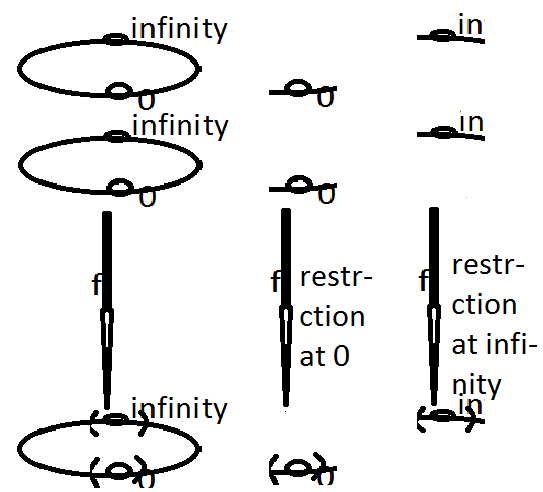 Figure 1